Evaluation of the Childcare Taster Pilot and
Extended Schools Childcare Pilot Programmes:
Final Report on Qualitative Research into
Implementation
September 2007
Evaluation of the Childcare Taster Pilot
and Extended Schools Childcare
Pilot Programmes:
Final Report on Qualitative
Research into Implementation
Sue Clegg and Vanessa Stone
BMRB Social Research
Genevieve Knight, PSI
The views expressed in this report are the authors’ and do not necessarily reflect those of the Department for Children, Schools and Families or the Department for Work and Pensions.
© Her Majesty’s Printer and Controller of HMSO 2007 ISBN 978 1 84775 026 6
Table of Contents
Acknowledgements... 7
Glossary of Abbreviations ... 8
1 Executive Summary ... 9
1.1 Background and Aims ... 9
1.2 Findings ... 10
1.3 Conclusions ... 15
2 Introduction ... 17
2.1 Background ... 17
2.2 The Pilots ... 19
2.3 Eligibility for the New Deal ... 21
2.4 Research Design... 22
2.5 About qualitative research ... 23
2.6 Report Structure ... 24
3 Developing and running Extended Schools Childcare Pilots... 25
3.1 Background ... 25
3.2 Outreach work ... 26
3.3 Developing childcare provision ... 28
4 Developing and running the Childcare Taster Pilots ... 32
4.1 Background ... 32
4.2 Engaging childcare providers ... 33
4.3 Engaging parents ... 33
4.5 Accompanied Visits... 35
4.6 Childcare Tasters... 35
4.7 How CTP and ESCP operated together... 37
5 Issues and problems identified by stakeholders ... 39
5.1 Timescales ... 39
5.2 The desire for more guidance ... 40
5.3 Monitoring issues ... 41
5.4 Data sharing issues ... 42
5.5 Workloads ... 43
5.6 Issues for Childcare Providers... 43
6 Stakeholders’ reflections on the Pilots ... 46
6.1 Aspects of the Pilots which worked particularly well ... 46
6.2 Changes stakeholders would have liked to have made ... 47
6.3 Going forward ... 48
7 Participating Parents’ experiences... 50
7.1 Participating parents ... 51
7.2 Initial experiences of the Pilots... 51
7.3 Elements of the Pilots experienced by parents... 52
7.5 The impact participating in the Pilots had on parents’ views about formal childcare ... 60
7.6 The impact of Pilots on changing attitudes or behaviours about returning to work, increasing working hours or going into training ... 61
7.7 Parents’ suggestions for changes to the Pilots ... 62
8.1 Non-participating parents’ views on returning to work... 66
8.2 Non-participating parents’ experiences of, and views about, childcare . 68 8.3 Non-participating parents’ views about being offered participation in the Pilots, and why they did not take up the offer... 70
8.4 Elements which might have made the Pilots more attractive to non-participating parents ... 71
8.5 Changes in circumstances since being offered participation ... 72
9 Potential barriers to using formal childcare... 74
9.1 The cost of formal childcare... 74
9.2 Finding information about childcare... 75
9.3 Lack of availability of childcare... 75
9.4 Worries about security and safety ... 77
9.5 Worries about their child not settling into formal childcare ... 77
9.6 Worries about the quality of formal childcare ... 77
9.7 Wanting to stay at home and look after their child... 78
10 Conclusions... 80
10.1 The aim of the Extended Schools Childcare Pilot ... 80
10.2 Childcare Taster Pilot objectives ... 81
10.3 The overall aim of the Pilots... 84
10.4 Implications for the Pilots and further developments... 86
11 Appendix 1: Research Design... 93
12 Appendix 2: Topics discussed in interviews... 98
12.1 Phase 1... 98
12.3 Phase 3... 99
12.4 Phase 4... 101
12.5 Phase 5... 102
12.6 Phase 6... 104
13 Appendix 3: The analysis of qualitative data using Matrix Mapping... 106
Acknowledgements
This research was commissioned by the Department for Children, Schools and Families and the Department for Work and Pensions. In particular, the authors would like to thank Kiran Sidhu, Alan Lott and Nina Hughes of the Department for Children, Schools and Families and Rebecca Goodman (formerly of DCSF), for their support and guidance in this research. Numerous staff from Sure Start and DWP have also provided invaluable assistance and co-operation. We would also like to thank Emma Green and Helen Barnard, formerly of BMRB for their contribution in managing the earlier stages of the study and for Emma’s subsequent support more recently.
Glossary of Abbreviations
BA Benefits Agency
CIS Children’s Information Service
CPM Childcare Partnership Manager
CTP Childcare Taster Pilot
DCSF Department for Children, Schools and Families
DWP Department for Work and Pensions
EZ Employment Zones
ESCP Extended Schools Childcare Pilot
IS Income Support. Income Support is a non-contributory, income-assessed benefit available to people who are not required to work.
Jobcentre Plus 56 Jobcentre Plus pathfinder offices, offering fully integrated work and benefit services, and a further 200 fully integrated Jobcentre Plus offices, were opened between October 2002 and April 2006. References to Jobcentre Plus within this report should be taken to also refer to the Employment Service and Benefits Agency local offices, as this research was conducted during a time of changeover.
JSA Jobseeker’s Allowance
LA Local Authority
LP-WFI Lone Parent Work Focused Interview
NDLP New Deal for Lone Parents
NDP New Deal for Partners
1
Executive Summary
1.1
Background and Aims
This report presents the findings of an evaluation of the Extended Schools Childcare and Childcare Taster Pilots which ran from 1st April 2004 to 31st March 2006 in eleven
local authorities in England. Other Pilots ran in Scotland and Wales.
The Pilots explored the assertion that a lack of affordable and accessible childcare is a significant barrier to work for lone parents on Income Support. Affordable childcare was provided for lone parents to enable them to enter employment, allowing an evaluation of whether the childcare barrier is real or perceived and whether, if it is removed, other barriers come to the fore as being major obstacles preventing lone parents from working. Lone parents were the main target group for the Pilots, but partners of benefit recipients who had childcare responsibilities were also a key client group.
The evaluation took place in six phases from June 2004 to June 2006, with phases timed to allow examination of stakeholders’ views at key stages of the Pilots. Phase six of the evaluation explored parents’ views, including both parents who had participated in the Pilots and those who had been offered participation but had declined it.
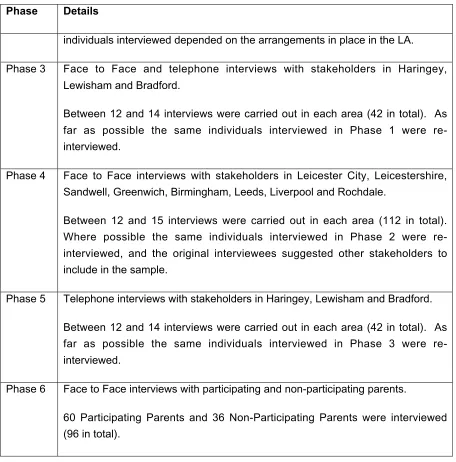
A total of 256 interviews with stakeholders were undertaken across five phases, including revisiting participants up to three times. The research included staff from local authorities, Job Centre Plus, Children’s Information Services, schools and childcare providers.
Ninety six interviews were carried out with parents. Sixty interviews were undertaken across the Pilot areas with parents who had participated in one or more elements of the Pilots. Thirty six interviews were undertaken with parents who had been offered participation but had declined it.
There were two aspects to the Pilots: Extended Schools Childcare Pilots (ESCP) and Childcare Taster Pilots (CTP)1.
1 It should be noted that whilst the Pilots had been intended to include the partners of
ESCP aimed to develop a sufficient supply of affordable, accessible childcare within the Pilot areas to meet the needs of lone parents, with the objective of developing and managing existing childcare places and creating additional places in or through schools where necessary. ESCP stakeholders worked with schools and other childcare providers to fulfil these aims and objectives. As will be noted later, in some areas ESCP stakeholders also worked outside of the main remit of the Pilots by developing outreach work with parents.
CTP was designed to help parents to overcome concerns they had about formal childcare and to allow them, and their children, to sample different types of childcare to judge which would best suit their needs. There were three elements to CTP:
• Childcare Chats, undertaken by Childcare Advisors. These lasted approximately an
hour and examined the childcare needs of parents, and gave information about the childcare available in their area.
• Visits to childcare providers. Childcare Advisors set up visits for parents to go to
childcare providers to see for themselves how the childcare was run; in some areas the Childcare Advisors had the capacity to accompany the parents. It was envisaged that parents might visit several childcare providers in this way, to compare different types of provision.
• Childcare Tasters. Parents could have up to ten half day sessions (effectively, one
week of childcare) free, to try out childcare provision. Again, it was envisaged that parents could try out more than one childcare provider using this scheme.
1.2
Findings
1.2.1 Stakeholders’ perspectives
Stakeholders generally had a good understanding of the aims of the Pilots. Each area developed the Pilots to meet the needs of the parents within their locality.
Some areas experienced difficulties in setting up the Pilots, including:
• The timescales of the Pilots – which caused problems in recruiting staff, and, for
ESCP, fitting in with the school year.
• Stakeholders said they would have liked more guidance on setting up and running
the Pilots, particularly in the early stages. Guidance was felt to be needed, for instance, regarding the goals of the Pilots and definitions of how success would be judged. More information would also have been welcomed on the monitoring systems required by the DCSF and DWP, as some areas had set up their own monitoring, and later had to change to the system put in place centrally.
Stakeholders overcame some of the difficulties they experienced, but others, such as the timescale of the Pilots were more problematic. One area which had received ESCP funding had not been able to recruit anyone to run the scheme in time to set it up, so it did not run at all in that locality.
In some areas the Pilots had not run as originally planned, for example:
• There were areas with ESCP funding that elected to use some of their money for
outreach work, to enable closer working with parents, aimed at helping them overcome barriers other than childcare.
• Although the Pilots were intended to include partners of benefit recipients who had
childcare responsibilities, in the main the stakeholders targeted lone parents. In some areas this was because New Deal for Partners was not fully operational and in others stakeholders had decided that lone parents were a better target group.
1.2.2 Participating parents’ experiences2
Generally, parents were positive about their experiences of the Pilots and overall participation in the Pilots appears to have had a beneficial effect on parents’ views of formal childcare. There were mixed effects on parents’ attitudes to returning to work as a result of the Pilots. Some parents had already taken the decision to return to work prior to being offered the Pilots, and used them to test out childcare or get a week’s free childcare in their first week of work. Other parents were encouraged by their experience of the Pilots to begin thinking about returning to work. There were other parents, however, for whom the experience of the Pilots had caused them to realise that returning to work might not be viable:
• Those who needed childcare during atypical hours.
• Those who realised that they would have to work more hours than they wanted,
to make working financially viable for them.
1.2.3 Non-participating parents’ views
Generally, there was no antipathy to the idea of working amongst non-participating parents. Parents of younger children were likely to say that they wished to wait until their child was at school before returning to work.
It was usual for non-participating parents to have experience of childcare in the past, with some parents having had negative experiences, for example: inflexibility over timings of childcare, and payment for it; the time needed to travel to and from childcare provision; some children did not enjoy being left in childcare; and the high costs and unavailability of childcare.
Some parents expressed a preference for informal childcare, usually with family or friends.
Two major reasons were given for declining participation in the Pilots:
2 Interviews with parents all took place after the Pilots had finished. There were two reasons for
• Not being work ready, for example, not having worked for a long time, or lacking
qualifications.
• Already having childcare in place, so not needing help from the Pilots.
There were parents who did not participate who would have taken part if more information had been available to them. For some of these parents there was an initial interest raised when the Pilots were first mentioned to them, and they had thought that they would be sent more information in the fullness of time, however, when it had not been forthcoming they did not have enough interest to chase it up themselves.
1.2.4 Barriers to using formal childcare
Seven potential barriers to using formal childcare were identified by both participating and non-participating parents. The barriers applied across all age groups, and in relation to both CTP and ESCP.
• The cost of formal childcare. There were two elements to this barrier – the deposit
required by childcare providers, and the ongoing costs on a weekly basis. Both participating and non-participating parents felt that the expense of formal childcare was a major barrier to using it, even with the help they could get through benefits.
• Lack of information about childcare in local areas. There were parents who did not
know how to find out about childcare, and for these parents the Pilots had been extremely advantageous, with the information given by the Childcare Advisors being particularly helpful.
• Lack of availability of childcare. There were four main issues cited here:
o There were areas where there were a general lack of childcare places, and/or parents had found difficulty securing a place for their child. In some areas where parents had participated in the Pilots, and been interested in taking up childcare, they had been disappointed to find out that they could not get a place for their child with the providers they had visited, or tried out in the Tasters.
the children and picking them up, and cost could be involved too, as extra journeys would have to be made.
o Childcare not being available at the right time. This was particularly a problem for parents who worked outside of ‘normal’ working hours, for example those who might need to work nightshifts or weekends. Not only was this type of childcare provision rare, but it was also expensive.
o Lack of childcare for children with special needs. Parents of children with special needs had difficulties finding suitable childcare for their children. Stakeholders reported that this was a consistent problem, and that even when places did become available they might be at quite some distance from the family’s home.
• Worries about security and safety in childcare settings. Both participating and
non-participating parents expressed some concerns about this. Some worries came from media stories about childcare where children were not adequately looked after. Parents who participated in the Pilots felt reassured by visiting and trying out childcare.
• Worries about children not settling in formal childcare. There were parents who felt
that their children would not be happy in formal childcare, and would not, therefore, settle. Generally, when children were left in childcare for the Tasters they enjoyed the sessions, and parents changed their views about this.
• Worries about the quality of formal childcare. Again, this was a worry for both
participating and non-participating parents. Usually the worries were about how children would be occupied during their stay in childcare, and again, these tended to be sparked by stories in the media. Parents who participated in the Pilots generally had their fears allayed.
• Wanting to stay at home with children. Amongst both participating and
non-participating parents there were those, particularly parents of children under school age, who wished to remain at home with their children, at least until they were a little older.
1.3
Conclusions
1.3.1 Meeting the aims and objectives of the Pilots
The Pilots met their aims and objectives with varying degrees of success.
1.3.1.1 Extended Schools Childcare Pilots
ESCP aimed to provide enough affordable formal childcare for lone parents with school aged children, particularly those on Income Support, to enable them to enter employment. Stakeholders investigated the supply of childcare in their areas at the outset of the Pilots, and some found that vacancies existed. Childcare available from the ESCP elements of the Pilots was well liked by parents, who felt it was more affordable and convenient than other types of formal childcare. However, there were some parents who still found the cost of childcare provided through ESCP prohibitive, and this limitation somewhat hindered the success of the Pilots.
1.3.1.2 Childcare Taster Pilots
CTP had four broad aims:
• To raise parents’ awareness of the quality of formal childcare
CTP was largely successful in this respect, with parents’ worries about formal childcare usually being ameliorated as a result of their participation.
• Addressing parents’ concerns
It appears that there was some success in addressing parents’ concerns, for those parents who had them. For parents who were ready to work the Tasters gave useful assistance in facilitating the move into work, for example by providing a week’s free childcare to help them prepare for work or go for interviews.
• Helping parents to make choices about childcare
• Helping parents feel more comfortable about using formal childcare
For those parents who had worries about formal childcare the chance to try out provision in Tasters helped to alleviate many of their concerns. CTP was particularly successful for parents who had worried about whether their child would setting into formal childcare, or who had had concerns about how their children would be occupied during the day.
1.3.1.3 Overall aim of the Pilots
The overall aim of the Pilots was to explore the assertion that a lack of childcare is a significant barrier to work for lone parents on Income Support. Whilst the evaluations suggests that there can be little doubt that childcare is a barrier to work for such parents, that it is only one aspect, and that other barriers (both childcare and non-childcare related) which are potentially of equal or prime importance.
The cost of childcare was the greatest childcare related barrier remaining for parents, others being lack of childcare close to home or work, and lack of childcare for parents who worked outside of ‘normal’ hours.
Other barriers for parents related to not being work ready, either because they lacked confidence or because they needed training. There were also parents, particularly those with children under the age of five, who wished to remain at home with their children until they went to school. These types of barriers could supersede the childcare related barriers, as they had to be addressed before parents were ready to consider the available childcare.
1.3.1.4 Implications for future policy
2
Introduction
2.1
Background
The Department for Children, Schools and Families developed two closely related Pilot programmes in eleven Local Authority (LA) areas in England to help lone parents to move into work. The Pilots were solely funded by the Department for Work and Pensions. These were the Childcare Taster Pilot (CTP) and the Extended Schools Childcare Pilot (ESCP). The Pilots were designed to explore the assertion that a lack of childcare is a significant barrier to work for lone parents on Income Support (IS). The aim was to ensure a sufficient supply of childcare for lone parents to enable them to enter employment. Past research has found that non-working lone parents cite a lack of affordable, accessible childcare as a significant barrier to work3. Many lone
parents express preferences for informal childcare, with insufficient trust in formal providers being a major issue4. It was hoped that the CT/ESC Pilots would show
whether more lone parents claiming IS, take up employment opportunities when suitable formal childcare was made available to them through the ESCP, and if parents’ knowledge of, and trust in, formal childcare was facilitated through the CTP.
In the Childcare Taster Pilot (CTP), the Local Authority offered parents various opportunities to explore childcare covering:
•
Childcare Chats (in-depth discussions with the LA about formal childcare)•
Accompanied Visits to childcare providers, and•
Childcare Tasters (the opportunity to try out formal childcare for free, for up to aweek)
In the Extended Schools Childcare Pilot (ESCP), the Local Authority supported initiatives to ensure a sufficient supply of affordable, accessible, formal childcare for lone parents to allow them to move into work. LAs also engaged with schools to integrate childcare with their other services, where possible.
Lone parents were the principal target group for the Pilots, but partners of benefit recipients who had childcare responsibilities were also included.
3 Ford (1996), Marsh et al (1993), Marsh et al (2004)
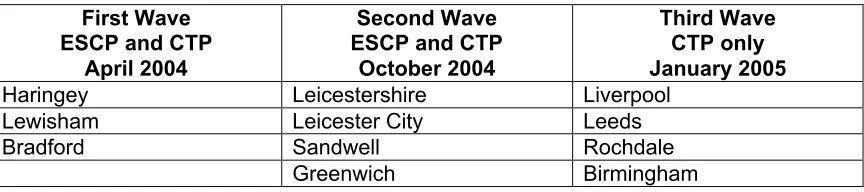
The first wave of Pilots started on 1st April 2004 in Bradford, Haringey and Lewisham
Local Authorities. These three Local Authorities had very high numbers of lone parents claiming Income Support at the time. They were all operating the ESCP and CTP.
A second wave of Pilots started in October 2004 in Leicester City, Leicestershire, Sandwell and Greenwich. These areas were also operating the ESCP and CTP.
In January 2005 the third wave of Pilots began in Birmingham, Leeds, Liverpool and Rochdale. These areas only operated CTP.
All of the Pilots ended on 31st March 2006.
[image:19.595.84.516.314.410.2]The Pilots were extended to additional Local Authorities in Wales and Scotland, however, this report refers only to the English Pilots5.
Table 1. First, Second and Third Wave Pilot Areas First Wave
ESCP and CTP April 2004
Second Wave ESCP and CTP
October 2004
Third Wave CTP only January 2005
Haringey Leicestershire Liverpool
Lewisham Leicester City Leeds
Bradford Sandwell Rochdale
Greenwich Birmingham
The CT/ESC Pilots were managed by the Local Authorities strategically and operationally in ways which best reflected local needs and circumstances, with no detailed guidance from DCSF. The Pilots were designed to work in close co-operation with Jobcentre Plus, schools and other stakeholders. These two factors resulted in considerable variation in delivery of the Pilot services between locations, making comparisons between areas complex.
This report covers the whole of the evaluation of the Pilots. Previous interim reports have focused on how the Pilots were set up and run in detail6, and on the initial
implementation (reported in January 2005)7.
5 Wales has separately commissioned some qualitative research based on the design of this
evaluation. Research has also been commissioned in Scotland.
2.2
The Pilots
2.2.1 Extended Schools Childcare Pilot
The Extended Schools Childcare Pilot (ESCP) aimed to provide enough affordable formal childcare for lone parents with school aged children, particularly those on Income Support, to enable them to enter employment. Partners of benefits claimants with school aged children were a secondary target group for the Pilot. It was hoped that this Pilot would show how important the childcare barrier was, as well as identifying what other obstacles remained for lone parents and partners of benefits claimants around entering employment. The evaluation also aimed to examine how the impact of childcare was affected by the way the Pilots had been set up and operated.
The research looked at the Pilot’s role in helping parents with school aged children, that is, aged between 5 and 14, or 16 for children with special needs. A secondary aim of the evaluation of ESCP was to look at whether the provision of childcare for younger or older children would help parents in the target groups enter employment.
Each local authority decided how best to use the Pilot funding, and whether and how to implement any extra childcare provision within their district. It was hoped that the Pilot would improve the capacity of the local Children’s Information Services (CIS) to manage childcare vacancies, so that places were filled and existing providers become more viable and sustainable. It was expected that additional childcare would be created to meet demand.
It was envisaged that any new childcare provision would be based on networks centred on secondary schools already working as ‘extended schools’. ‘Extended schools’ are schools which provide services for their pupils and the local community beyond the school day. Within ESCP, schools could either provide childcare themselves or work with other local providers, such as out of school clubs, childminders, nurseries or playgroups. It was expected that the childcare provision would be accessible to all local families, not just lone parents and partners of benefits claimants.
7 Barnard, H and Knight, G (2005) Evaluation of the Childcare Taster Pilot and Extended
2.2.2 Childcare Taster Pilot
The overall aim of the Childcare Taster Pilot (CTP) was to help lone parents, and partners of benefits claimants, with childcare to build trust and confidence in using formal childcare. It provided parents with a chance to talk about childcare issues in some depth with a local authority worker (called ‘Childcare Chats’); to visit childcare providers (called ‘Accompanied Visits’); and to have a free experience of formal childcare (called ‘Childcare Tasters’). Parents did not have to take up all three elements of the CTP but were free to choose elements in which to participate.
DWP and DCSF gave local authorities participating in CTP four objectives:
• To raise parents’ awareness of the quality of formal childcare
• To address parents’ concerns regarding using formal childcare, by providing
information and giving a short experience of what such childcare would be like
• To help parents make choices about suitable childcare through clarifying the
types available in the area, and the issues to be considered
• To help parents feel more comfortable with the thought of leaving their
child(ren) with childcare providers and, where desired, to provide an opportunity for them to leave the child(ren) in the care of a provider for a short time
2.2.2.1 Childcare Chat
Childcare Chats consisted of one to one meetings with local authorities’ Childcare Advisors (sometimes called Childcare Champions or Childcare Brokers8). The
Childcare Advisor would discuss with the parent, in some depth, the type of childcare the parent would need (for example, childminder, nursery, after school club, home based care) and any concerns the parent might have regarding formal childcare.
Childcare Chats were available for all parents eligible for New Deal for Lone Parents (NDLP) or New Deal for Partners (NDP), although parents did not have to be participating in NDLP or NDP to take up a place. Parents did not have to be ‘job ready’ to have a Childcare Chat.
2.2.2.2 Accompanied Visit
Accompanied Visits involved parents visiting childcare providers, usually in the company of a Childcare Advisor, with the Childcare Advisor having set up the visit(s). The same eligibility criteria applied as for Childcare Chats, however in practice some areas offered Accompanied Visits to all parents, whether or not they were eligible under the definitions of the Pilots.
2.2.2.3 Childcare Taster
Childcare Tasters allowed parents to experience between half a day and five days’ worth of childcare. The Tasters provided the opportunity for parents to meet childcare providers, visit childcare settings, observe childcare in practice, including their own children being cared for and, where mutually agreed, for the children to be left in the care of the childcare provider for a period of up to a week.
Childcare Tasters were designed to:
• Help parents to overcome concerns they had about particular types of childcare
• Allow parents and children to sample different forms of childcare to judge which
type of provision suited their needs best
The Childcare Taster was available to all NDLP and NDP participants and to parents participating within Employment Zone provision for whom childcare had been identified as a barrier to work.
2.3
Eligibility for the New Deal
New Deal for Lone Parents is a programme designed to help lone parents who want to work to find a job which suits their needs. The programme is open to lone parents who work less than 16 hours a week, or not at all, and whose youngest child is under 16 years of age.
2.4
Research Design
Qualitative interviews were undertaken with stakeholders9 involved in the Pilots and
with parents10. The study explored the views of parents who participated in the Pilots
as well as those who did not, but who had been invited to take part.
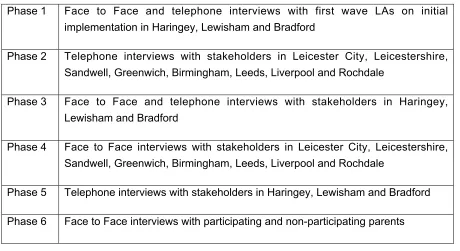
[image:23.595.78.538.208.459.2]The overall design of the research, in six phases, is shown in the table below:
Table 2. Phases of the research
Phase 1 Face to Face and telephone interviews with first wave LAs on initial implementation in Haringey, Lewisham and Bradford
Phase 2 Telephone interviews with stakeholders in Leicester City, Leicestershire, Sandwell, Greenwich, Birmingham, Leeds, Liverpool and Rochdale
Phase 3 Face to Face and telephone interviews with stakeholders in Haringey, Lewisham and Bradford
Phase 4 Face to Face interviews with stakeholders in Leicester City, Leicestershire, Sandwell, Greenwich, Birmingham, Leeds, Liverpool and Rochdale
Phase 5 Telephone interviews with stakeholders in Haringey, Lewisham and Bradford
Phase 6 Face to Face interviews with participating and non-participating parents
The fieldwork with stakeholders took place in waves to capture information about the different phases of the Pilots: setting up; running; and evaluating towards the end of the
9 ‘Stakeholders’ refers to the organisations involved in the Pilots (Local Authorities, Jobcentre
Plus, Children’s Information Services, childcare providers and schools).
10 Although the Pilots were intended to include partners of benefit recipients who had childcare
life of the Pilots. Face to Face and Telephone interviews were used, as outlined in the table above. Telephone interviews were used for early and final interviews with stakeholders, where interviews were likely to be relatively short. Face to Face interviews were used for longer and potentially more complex interviews in the middle phases of the Pilots, when they had been up and running for some time.
Parents who had participated in the Pilots were interviewed in order to understand whether, and how, the Pilots had affected their views on using formal childcare and going back to work. Parents’ experiences of participating in the Pilots were also explored.
Parents who had not participated in the Pilots, but who had been invited to take part were interviewed to explore their views on formal childcare and returning to work. Interviews also explored parents’ reasons for non-participation to identify factors, in addition to childcare, which represent significant barriers to work.
All interviews with parents were recorded and transcribed and analysed using Matrix Mapping. Further details of the methodology can be found in the Appendices.
Fieldwork took place between February 2005 and July 2006.
Phase 1 is reported in detail in Barnard and Knight (2005)11. Phases 2 and 3 are
reported in detail in the interim report on the study12. All phases are reported here.
2.5
About qualitative research
It is important to note that the methods employed in this research are qualitative in nature. This approach was adopted to allow for individuals’ views and experiences to be explored in detail. Qualitative methods neither seek, nor allow, data to be given on the numbers of people holding a particular view nor having a particular set of experiences. The aim of qualitative research is to define and describe the range of emergent issues and explore linkages, rather than to measure their extent.
11 Barnard, H and Knight, G (2005) Evaluation of the Childcare Taster Pilot and Extended
Schools Childcare Pilot Programmes: Qualitative Research into Initial Implementation http://www.dfes.gov.uk/research/data/uploadfiles/SSU_2005_FR_010.pdf
Verbatim quotations are used throughout this report to illustrate points made; such quotations are referenced according to the quota characteristics.
2.6
Report Structure
This report does not refer to any individual areas by name, in order to preserve anonymity.
Chapter 3 discusses the development and running of Extended Schools Childcare Pilots. This work is reported in more detail in the Interim Report and the 2005 report into initial implementation.
Chapter 4 discusses the development and running of the Childcare Taster Pilots. This work has been reported in more detail in the Interim Report.
Chapter 5 looks at issues and problems reported by stakeholders during the life of the Pilots, together with any solutions found.
Chapter 6 discusses stakeholders’ views on lessons learned from the Pilots, and their intentions for taking elements of the Pilots forward on their work.
Chapter 7 looks at the experiences of parents who participated in the Pilots, and the views of parents who were offered participation but declined it. The chapter also discusses the potential barriers to using formal childcare, as expressed by parents, and how the Pilots worked in relation to them.
Chapter 8 concludes the report, looking at whether the Pilots achieved their aims.
3
Developing and running Extended Schools Childcare
Pilots
This chapter discusses the development and running of Extended Schools Childcare Pilots. A more detailed discussion of setting up and running ESCPs can be found in the Interim Report13 and the 2005 report14.
3.1
Background
The first wave of Pilots began in April 2004 in Haringey, Lewisham and Bradford. The second wave began in October 2004 in Leicestershire, Leicester City, Sandwell and Greenwich. The LAs running Pilots in the first two waves also operated Childcare Taster Pilots.
A variety of stakeholders took part in the research:
•
Local Authority staff involved with the Pilots•
Jobcentre Plus staff, particularly Lone Parent Advisors and New Deal Advisors•
Children’s Information Service staff•
Staff in schools involved in ESCP, and•
Childcare providers, such as after school clubsThe main aim of the Extended Schools Childcare Pilots (ESCP), as designed by DCSF, was to develop a sufficient supply of affordable, accessible childcare within the Pilot areas, to meet the needs of lone parents. ESCP was set up in response to evidence that available and accessible childcare was seen to be a substantial barrier to lone parents going back to work, or starting work.
13 Green, E and Knight, G (2007) Evaluation of the Childcare Taster Pilot and Extended Schools Childcare Pilot Programmes: Further Qualitative Research into Implementation
http://www.dfes.gov.uk/research/
14 Barnard, H and Knight, G (2005) Evaluation of the Childcare Taster Pilot and Extended
Pilot areas were given the objective to develop childcare as DCSF believed that this would lead to better management of existing childcare places within particular areas, creating additional childcare places in or through schools where necessary. 15
3.2
Outreach work
After initial scoping work some Pilot areas chose to use some of their ESCP funding to develop outreach work. Although stakeholders were aware of the intentions and aims of ESCP to develop childcare provision, and that outreach work was not part of the remit of the Pilot, they felt it was an important addition to the Pilot.
There were several reasons given for doing outreach work:
•
Stakeholders’ perceptions that parents were mostly not job ready. Developmentwork done by some ESCPs led them to the conclusion that for some parents returning to work would be a long term goal, requiring sustained support and encouragement
“In the beginning, the parents that I was supporting, they wasn’t ready for work, because the ones that were, we found that the parents in the borough that are ready to go back to work, they just go back to work. They go along to the job centre, and they don’t need any other support. But, the parents that we sort of ended up supporting, needed… they wanted to go into training, or they wanted just to find out a bit of information, and maybe they were thinking of going back to work next year, or in five years’ time”
(Extended Schools Childcare Pilot Development Officer)
•
Stakeholders’ perceptions that parents had financial concerns that delayed them searching for work, which needed addressing prior to offering childcare, for example, by giving information on Working Tax Credit
15 One area could not recruit to advertised posts for ESCP, and therefore the Pilot never got
•
In some Pilot areas Development Workers were put in place during the summer,when schools were closed. It was decided that, to make use of their time, they should begin their work by carrying out consultations with lone parents
•
In one Pilot area stakeholders had found that there were vacancies in existing childcare provision, leading to them questioning whether there was sufficient demand for the current number of placesTwo types of outreach work were undertaken:
•
Identifying parents, giving them information and signposting them to other services, for example, referring them to the Jobcentre.Parents were identified in a number of ways, for example:
• Staff from the pilot areas attempted to engage parents at schools and
community settings, such as Children’s Centres, and via the Jobcentre.
• Development officers contacted schools within their area and liaised with the
head teachers about how best to work with parents.
• Joint stakeholder information events organised by the Local Authority,
Jobcentre and Children’s Information Service (CIS) were held within schools in order to engage parents. Outreach events were also held at other localities, such as at Sure Start events.
• Development officers from the Local Authorities (in some areas) set up drop-in
advice sessions and coffee mornings at schools for parents to talk to them about childcare, employment or training issues.
• There were examples of development officers speaking to parents outside
schools and supermarkets.
•
Giving one-to-one support to parents and encouraging them to look for work by addressing the barriers they were facing, for example, spending time finding out what their worries were about skills deficits and helping to find courses to overcome them.‘better off’ calculations and given information about childcare provision in their area. The stakeholders involved in the ‘surgeries’ took the view that they were arming parents with information about childcare and financial issues for when they were ready to consider working, rather than expecting them to look for work immediately. Stakeholders perceived that these aspects of the outreach work, as well as the wider one-to-one support they could give, were well received by parents, and they felt that they had been very successful in encouraging parents to view returning to work in a positive light, albeit as something for the future.
3.3
Developing childcare provision
LAs were given the flexibility to implement the Pilots to best meet local needs and circumstances. No specific targets to create a certain number of childcare places were given to Pilot areas, although a number of the Pilots areas pointed out that they had Sure Start targets (unconnected with ESCP and CTP) to create a specific number of childcare places, and were using funding from the ESCP to work towards achieving these targets.
The original remit of the ESCP work was to work with parents of school aged children (aged 5 to 14, or 16 for children with special needs). However, the Pilot areas generally focused on developing childcare within primary schools, because there was felt to be the greatest need for childcare provision within this age group (5 to 11).
The childcare provision that the LAs developed took the form of breakfast clubs, after school clubs and holiday provision. Development Officers discussed with the schools whether they were able to set up provision on the school grounds, or whether they would link with other schools and local childcare providers.
Stakeholders felt that work with secondary schools was a longer term goal.
In some Pilot areas, stakeholders decided to work with schools in their area which were already operating as ‘Extended Schools’16. For example, one Pilot area was working
with six Extended Schools, some of which were consortia made up of a number of different schools.
16 ‘Extended Schools’ are schools which provide services for their pupils and the local
Successful engagement of schools largely depended on the attitude of the headteacher and the ethos of the school. It also depended on the resources and facilities of the school.
3.3.1 Schools who did not wish to participate in ESCP
Among those schools not wishing to participate17, three factors were identified by
stakeholders:
•
Not having the space to provide childcare on site•
Already having arrangements to provide access to childcare in the community•
Not wishing to create competition for childcare providers they were working withSome schools were too small, and did not have the space to offer childcare provision. For example, they were already offering out of school hours activities and did not always have an appropriate area to offer new childcare provision. There were examples of schools working together to create childcare, and of schools working with independent childcare providers. There were also some instances where a private provider was already collecting children from the school and taking them to childcare provision within the community, and these schools were reluctant to create competition by starting up their own clubs.
When schools said that they did not wish to participate in ESCP, the Development Officers often tried to engage them with the Pilot at a basic level, for example, by asking the school to put information in their newsletter about LA services.
3.3.2 Working with schools interested in ESCP
Where interest in ESCP existed in schools Development Officers and extended schools co-ordinators worked out a business plan with the school. They looked at the school layout and helped them with the decision about whether to run the childcare provision themselves, or get a private provider to run the provision within the school. Schools
17 Schools who did not wish to participate in ESCP were not interviewed for this research.
were then helped to apply for funding, and support was given with applying for OFSTED registration.
Where schools did not have the space to develop provision on-site, staff would try to link the school with a voluntary or private organisation to ensure some childcare was available. In some cases they worked with a larger school offering childcare provision in the area, and arranged collections from smaller schools to increase access to childcare. Development Officers generally found that private providers were happy to collect children from schools in order to boost their intake. It is possible that this service could have been promoted more for schools who had declined participation in the Pilots on the grounds that they did not have room on their premises to develop provision.
Schools did their own marketing to advertise the provision. They felt that they knew the community, and thought that they could target their advertising in ways to make the provision successful. Based on the information available to them, LAs thought that few of the childcare places created through ESCP were filled by referrals from the Jobcentre, and some Pilot areas believed that the Jobcentre did not generally act as an entry point for lone parents into ESCP. There were examples of Jobcentre staff showing lone parents lists of schools with breakfast and after school clubs in their area, but there was no evidence of specific referrals.
Some schools said that parents had to be job ready before they could take up a place in ESCP provision.
Clearly, where good relationships were built between ESCP staff and schools, a positive outcome could be had, with schools, other stakeholders and parents all benefiting.
Summary
This chapter discussed the development and running of the Extended Schools Childcare Pilots.
4
Developing and running the Childcare Taster Pilots
This chapter describes the development and running of the Childcare Taster Pilots. A more detailed discussion of setting up and running CTPs can be found in the Interim Report18 and the 2005 report19.
4.1
Background
The first wave of Pilots began in April 2004 Haringey, Lewisham and Bradford. The second wave began in October 2004 in Leicestershire, Leicester City, Sandwell and Greenwich. The third wave of Pilots began in January 2005 in Liverpool, Leeds, Rochdale and Birmingham. Childcare Taster Pilots ran in all 11 LAs.
A variety of stakeholders took part in the research:
•
Local Authority staff involved with the Pilots•
Jobcentre Plus staff, particularly Lone Parent Advisors and New Deal Advisors•
Children’s Information Service staff•
Childcare providers, such as childminders and nursery staffParents were usually referred to CTP by Jobcentre Plus staff during Work Focused Interviews (WFIs). However, some parents were made aware of the Pilots during outreach events such as Discovery Weeks.
CTPs comprised three elements:
•
Childcare Chats•
Accompanied Visits18 Green, E and Knight, G (2007) Evaluation of the Childcare Taster Pilot and Extended Schools Childcare Pilot Programmes: Further Qualitative Research into Implementation http://www.dfes.gov.uk/research/
19 Barnard, H and Knight, G (2005) Evaluation of the Childcare Taster Pilot and Extended
•
Childcare TastersFor information about how each of these Pilot elements worked, please see the Introduction in section 2.2.
LAs were free to brand CTPs in their own way, and to publicise them as they saw fit.
4.2
Engaging childcare providers
Pilot staff liaised with a range of childcare providers in their areas to see if they were interested in the Pilots. Stakeholders were keen to engage a range of providers to enable parents to experience a number of different types of childcare provision. Pilot areas decided that CTP would be most beneficial for children of pre-school age (0 to 5 years), and therefore mainly contacted nurseries and childminders for these age groups.
Generally, Pilot staff did not have difficulties engaging childcare providers. Providers were happy to take part in CTP and could see advantages in participation – both in terms of giving them credibility by being associated with LAs and giving them publicity to enable them to fill vacancies where/when they occurred. There were, however, some childcare providers who had problems during the course of the Pilots. These are discussed in section 5.6.
4.3
Engaging parents
Parents were informed about the Pilots either through Jobcentres, or through marketing carried out by Pilot staff, usually at Discovery Weeks and other outreach events or in Employment Zones.
Jobcentre staff informed parents about the Pilots during WFIs and also displayed information about the Pilots, and some sent out flyers with New Deal interview letters.
Some Jobcentre staff carried out group sessions with lone parents at day care centres, in partnership with other organisations, to inform them about the range of services available through Jobcentre Plus. They found that group settings worked well, as lone parents found them less intimidating than Jobcentre offices.
felt that the emphasis needed to be on lone parents, as they were seen to be in most need of the help that the Pilots offered.
4.4
Childcare Chats
During the Childcare Chats Advisors discussed the differences between different types of childcare providers, such as nurseries and childminders, and the range of childcare available in the area. They sought to understand what kind of childcare the parent was looking for, and if any concerns about childcare were preventing them from starting work.
Childcare Chats generally lasted between forty minutes and two hours, depending on the needs of the parent. Usually the discussions took place face to face, but sometimes they were carried out over the telephone. Childcare Advisors preferred talking to parents in person, as they believed that expressing understanding and empathy was essential and felt that it was sometimes difficult to do this over the telephone.
Generally, Childcare Advisors discovered that parents had a clear idea of the kind of childcare they wanted to use, even prior to the Childcare Chat. Parents generally expressed a preference for nurseries, rather than childminders, because stories in the media had made them worry about how safe childminders were. Parents perceived nurseries as offering more activities for their children, and would have more chances of interaction with other children than childminders could offer.
Childcare Advisors saw the Childcare Chat as a chance to address parents’ concerns by reassuring them about formal childcare provision:
“…it’s just to reassure them about childcare, what each provision offers, sort of the hours they do, the charges they cost, so the main purpose [of the Childcare Chat] is to really reassure them about childcare”
(Childcare Advisor, Local Authority)
Childcare Advisors used Chats to give parents information about financial help towards childcare, as parents were often daunted by the costs of it.
4.5
Accompanied Visits
Eligible parents were offered accompanied visits to childcare providers. Some areas offered Accompanied Visits to all parents, whether or not they were eligible under the definitions of the Pilots. The Accompanied Visit was an opportunity to visit childcare providers in the company of a Childcare Advisor, or alone if they wished.
Parents were generally given a tour of the provision and given information about how the provider operated. Parents could also ask questions about the childcare provision, and see children experiencing it. Stakeholders reported that safety was a major concern for some parents:
“If the child has been home with the parents, or has always stayed with the family, usually there’s the anxiety: ‘Is my child going to be safe here, is he going to be well looked after, like he is used to?’… is he going to be alright?”
(Childcare provider: Nursery)
In some areas stakeholders did not always accompany parents on Visits. Two main reasons were given for this: firstly, not all areas had enough staff to accompany all parents on visits; and secondly, that not all parents wished to be accompanied. Some parents, therefore, had visits arranged for them by stakeholders, but undertook the visits alone.
4.6
Childcare Tasters
The third element of CTP was Childcare Tasters. Tasters were only available to parents on NDLP, although in some areas parents in the Employment Zone20 organised
by the Jobcentre were also eligible.
20 Employment Zones were created in areas where large numbers of people had been out of
work for a long time. They were created to provide fresh ways of helping eligible people to find and keep jobs.
Usually parents were offered Tasters after they had visited providers, however, some parents did not visit, especially if they had already identified childcare provision to their liking.
Childcare Tasters gave parents up to one week of free childcare (or 10 half day sessions), although there was an example of one Pilot area offering two weeks of free childcare.
Childcare providers were paid by the LA for each session used by parents, usually up to approximately £25 per day.
The original aim of the Taster was to allow parents to test out different types of childcare provision. However, some Pilot areas were putting the Tasters to different uses:
•
Trying out specific childcare providers to see if their child would settle with the provider, with the intention of the child attending the provider when the parent started work•
To cover the cost of the first week of childcare when parents found work•
To cover the cost of childcare before Tax Credits were received•
To allow the child to have childcare sessions over several weeks•
To give parents time to themselves•
To give parents time to job hunt, or prepare for work if they had already found a jobChildcare providers felt that it was better to build children up to full time attendance, for example, by starting with one or two sessions a week and then increasing the time/visits gradually. However, they could find that parents preferred to take the childcare in a block, especially if they had not been fully briefed by the Childcare Advisor. When parents took this view the Providers could find them demanding, since they felt building up was a valuable approach:
door on day one. And I had to basically sell the fact that the settling in period would be that we wouldn’t charge them for the sessions, and by the end of the week the child would be here for two full days. So, therefore, they’re not losing out. But it’s quite hard, because, again, it’s all about relationship, and about them thinking ‘Well, I’m entitled to this, this is my money effectively, and this is the way I want it to be’”.
(Childcare provider: Nursery)
4.7
How CTP and ESCP operated together
Pilots which started in Waves 1 and 2 (April and October 2004) operated both ESCP and CTP. Stakeholders held a range of views about how the two Pilots worked together21.
There were Pilot areas who saw ESCP and CTP as distinct from each other, having little in common, but working well as separate entities. In these areas stakeholders thought the Pilots had different client groups, with ESCP focussing on parents of older children and CTP focussing on parents of younger children. In these areas there tended to be different Pilot staff, which contributed to the feeling of separateness.
In contrast, there were Pilot areas who branded the two Pilots together under one name. Here stakeholders saw the aim of both Pilots as addressing childcare as a barrier to work for lone parents. Stakeholders saw the Pilots as having complementary roles, with CTP stimulating demand for childcare provision and giving advice to parents, and ESCP developing childcare provision in response to this demand, and giving support to lone parents on a wider range of barriers to work. In some areas ESCP Development Officers referred parents to CTP, and CTP Childcare Advisors referred parents to ESCP where appropriate.
Summary
This chapter discussed the development and running of the Childcare Taster Pilots.
21 Unfortunately, it was not possible to gain an understanding of parent’s views of the interaction
Early work by Pilot staff involved liaising with childcare providers about participating in the Pilots and with colleagues in other organisations, such as Jobcentres. When the Pilots were up and running stakeholders engaged with parents in a number of different ways. Parents were usually informed about the Pilots through Jobcentres or via marketing carried out by Pilot staff, such as at Discovery Weeks.
Whilst the Pilots had been intended to include the partners of people on certain benefits, very few partners were approached by Jobcentre staff. There were two main reasons for this: New Deal for Partners had not been fully implemented in all Jobcentres; and there were some stakeholders who felt that the emphasis of the Pilots needed to be on lone parents, as they were seen as being most in need of the help available through the Pilots.
In areas where both ESCP and CTP were running, there were differing ways of operating:
• In some areas the two elements of the Pilots were seen as separate and distinct,
working well as separate entities. Stakeholders in these areas were of the opinion that the two Pilot elements had different client groups, with ESCP being focused on parents of older children and CTP being aimed at parents of younger children.
• In other areas the two elements of the Pilots were branded together under one
5
Issues and problems identified by stakeholders
This chapter discusses stakeholders’ views and experiences of problems arising from setting up and running the Pilots, together with any solutions they found, and suggestions for avoiding problems in the future.
There were six major areas of concern identified by stakeholders:
•
The timescales of the Pilots, which caused problems in recruiting staff, and, for ESCP, fitting in with the school year•
Their desire for more guidance, particularly in the early stages of the Pilots•
Monitoring work on the Pilots, which had caused some confusion in the early stages of the Pilots, and the mechanics of which were interpreted differently by different Pilot areas•
Data sharing between different stakeholders, with stakeholders feeling that DCSF could have given more guidance/training on, and•
Workloads, which was particularly a problem for Jobcentre staff, who had no resources for the Pilots22•
Two issues were raised by Childcare providers. Firstly, there were providers who had committed to the Pilots but who had not had any parents referred to them. Secondly, there were providers who had withdrawn from the Pilots after having problems with some parents that had been referred to them.Each of these issues will be discussed below.
5.1
Timescales
From the earliest contacts with stakeholders the timescales of the Pilots were identified as being unrealistic and problematic. A major issue was the length of time needed to
22 It should be pointed out that DWP provided all of the funding for the Pilots and JCP allocated
recruit and train staff, and to establish relationships with schools and other stakeholders.
In some areas there were delays to the start of the Pilots, which exacerbated the timescale problem, and ultimately led to a relatively short running period since the end point was not extended.
For ESCP, being dependent on the school calendar meant that there were problems making contact with parents in the early stages of the Pilots. In addition, schools generally preferred to set up provision at the beginning of the school year, which, again, cut down on the amount of time the Pilots could run.
Applications for funding to create childcare provision within ESCP, together with OFSTED registration, were also potential causes of delays to the progress of Pilots.
Stakeholders also thought that the timescales meant that there was not sufficient time to see Pilot successes. Staff felt that moving into employment for lone parents was a long term goal, and that parents participating into the Pilots might not have moved into work by the end of the Pilot.
There were instances where the temporary nature of the Pilots caused problems in recruiting staff. In one area with funding for ESCP the Pilot did not run, as it proved impossible to recruit staff for it. Stakeholders in this area thought that other vacancies, advertised at similar times, had been more appealing to candidates because they were permanent positions.
5.2
The desire for more guidance
Stakeholders reported that they would have liked more guidance and support from DCSF and DWP. In particular, there was a desire for clear guidelines regarding the goals of the Pilots, and definitions of what would be classified as successes.
Lack of guidance was identified from the bidding stage of the Pilots, with stakeholders identifying gaps in terms of size and scope, for example, in one area a small scale project was proposed, but later it was found that there had been more money available than had been expected.
wave area, with some people being under the impression that DCSF were reluctant to share examples of good practice between Pilot areas23.
There were examples of stakeholders who had made contact with other Pilots, particularly with those who were geographically close, to discuss issues arising, especially in the developmental stages of the schemes, although this was not facilitated by DCSF. Of particular help was sharing job descriptions for staff to be recruited for the Pilots.
As the Pilots developed the perceived need for direction and guidance from DCSF diminished, with stakeholders having clearer understanding of the Pilot aims. More detailed discussion of this issue is contained in the earlier interim report Green and Knight (2007).
A bigger issue for stakeholders was a perceived lack of direction on the requirements around monitoring information to be collected.
5.3
Monitoring issues
In the early stages of the Pilots there had been confusion about collecting statistical data for monitoring purposes. This continued for some time, with stakeholders feeling that they had not been given enough guidance about monitoring requirements. There was, however, evidence that stakeholders disliked collecting numerical data, as they felt that this did not fully reflect the type and extent of their work.
“… if you look at these figures you might think, it’s not had a really big impact in supporting lone parents into work, when you see the actual… figure. But so many have gone into training with a view to going back to work. So many parents have been, are being, have been supported, and are still being supported. So this Pilot is going to have an impact at the end of this year, and next year. That’s when you’re going to see figures change”
(ESCP Co-ordinator, Local Authority)
Other issues raised regarding monitoring were:
23 The DCSF held operational workshops during the early months of the Pilots, and held a good
•
The forms did not allow ESCPs to record outreach work, as it had not beenoriginally intended that this would be an element of the Pilots
•
Pilot areas were interpreting the monitoring forms differently, and therefore there were concerns that comparisons would not be possible, and progress would be hard to monitor•
Inaccurately recorded information caused difficulties in completing the monitoring forms, and therefore affected monitoring figures – for example, some stakeholders felt that schools did not always provide accurate data on take-up of childcare places•
Jobcentre staff did not always record referrals to the Pilots; this was put down to the busy nature of their jobs and the number of different initiatives they had to consider.5.4
Data sharing issues
In the early stages of the Pilots there were issues about data sharing between Jobcentres and LAs.
These issues were resolved by:
•
Putting in place referral sheets which asked parents to consent for their details to be passed to other stakeholders•
Situating Childcare Advisors in Jobcentres, so that parents could be immediately referred to them for a Childcare Chat•
Asking Lone Parent Advisors to address and send out information packs toparents, so that personal details did not have to be passed to LAs
Some issues on data sharing could not be resolved. Stakeholders did not feel that they could divulge information about specific parents, gathered whilst working with them, to stakeholders in other organisations. In some instances this created problems with tracking parents through the Pilots. LA Pilot staff generally liaised directly with parents to discover whether they had attended interviews at the Jobcentre, or if they had attended a Taster, and kept a record of parents’ progress, rather than seeking this information from other Pilot staff.
Chat or a Taster. There were concerns amongst stakeholders over whether this breached data protection rules.
5.5
Workloads
Early concerns about staff workloads decreased when Pilots became operational, and had recruited staff. The exception to this, however, was in Jobcentres, who were not resourced for the Pilots, and there were instances where Childcare Partnership Managers (CPMs) in Jobcentres had reduced their role in promoting the Pilots and encouraged the LA to increase their role accordingly:
“I initially took it as my responsibility not only to promote it, but also to ensure that there were adequate referrals… there was an understanding tha