
EFFECTIVENESS OF VIDEO ASSISTED TEACHING
PROGRAMME ON KNOWLEDGE REGARDING
SEXUAL EXPLOITATION AMONG ADOLESCENT
GIRLS AT SELECTED HIGHER SECONDARY
SCHOOL, DHARMAPURI
By
Ms. MANIMEGALAI.K
Reg. No: 301618501
A DISSERTATION SUBMITTED TO
THE TAMIL NADU DR.M.G.R MEDICAL UNIVERSITY,
CHENNAI,
IN PARTIAL FULFILMENT OF THE REQUIREMENT FOR THE
DEGREE OF MASTER OF SCIENCE IN NURSING
CERTIFICATE
Certified that this is the bonafide work of Ms. MANIMEGALAI. K, final year M.Sc (Nursing) student of Om Sakthi College of Nursing, Dharmapuri. Submitted in partial fulfilment of the requirement for the Degree of Master of Science in Nursing to the Tamil Nadu Dr. M.G.R. Medical University, Chennai, under the Registration No: 301618501
College seal :
Signature :
Prof. MRS.ESTHER, M.SC (N)., Principal,
EFFECTIVENESS OF VIDEO ASSISTED TEACHING
PROGRAMME ON KNOWLEDGE REGARDING
SEXUAL EXPLOITATION AMONG ADOLESCENT
GIRLS AT SELECTED HIGHER SECONDARY
SCHOOL,
DHARMAPURI
Approved by the Dissertation committee on: 06.08.2018
Signature of the Research Guide:
Prof. MRS.ESTHER, M.SC (N)., Principal,
Department of Mental Health Nursing, Om Sakthi College of Nursing , A.Reddihalli, Sogathur (po), Pennagram Main Road, Dharmapuri.
Signature of the subject Guide:
Mrs. P.Sangeetha, M.Sc (N)., Associate professor,
Head of the Department Child Health Nursing, Om Sakthi College of Nursing,
A.Reddihalli, Sogathur (po), Pennagram Main Road, Dharmapuri.
_________________________ _______________________ Signature of the Internal Signature of the
ACKNOWLEDGEMENT
‘’ Challenges are what make life interesting; overcoming them is what makes life meaningful ’’
Joshua J. Marine
All things started in the will of God ends well. It is an opportunity to do M.Sc (Nursing) programme and a research project by the blessing of the God Almighty for whom I offer my sincere thanks.
I wish to thank express my heartfelt gratitude Dr.S.Ranganathan M.D.D.G.O & Director for helping me to undergo M.Sc nursing course at Om Sakthi College of Nursing, Dharmapuri..
I wish to express my cordial thanks with respect, honour and deep sense of gratitude to our beloved madam Dr.B.Poongodi, M.S., (General Surgeon) chairman Om Sakthi College of Nursing for the support throughout courses.
It is my privilege to express my profound sense of gratitude to the great teacher, my research guide Mrs.Esther, M.Sc(N)., Principal, Om Sakthi College of Nursing for her guidance, ever willing to help from time to time and patient correction, which helped me to bring this study successful.
I wish to record my sincere thanks to subject guide Mrs.P.Sangeetha, M.Sc (N)., Associated Professor, Child Health Nursing Department, Om Sakthi College of Nursing, for her valuable guidance that she has rendered to one throughout the study.
I express my indebted thanks to Mrs.Jayanthi, M.Sc(N)., HOD of Medical Surgical Nursing, Vice Principal, Om Sakthi College of Nursing for her encouragement, timely help and support throughout this study.
I express my deepest sense of gratitude Mrs.Vasumathi, Mr.Sakthinarayanan, Mrs.Manimegalai, Administrative Officers of Om Sakthi College of Nursing.
My deep sense of gratitude and thanks to Mrs.Kanmani, M.Sc(N)., HOD of Medical Surgical Nursing, Mr.Prasath, M.Sc(N)., HOD of Community Health Nursing, Mrs.Rangaygi M.Sc(N)., HOD of Community Health Nursing, Mrs. Sridevi M.Sc(N)., HOD of Mental Health Nursing, Om Sakthi Collage Of Nursing for their guidance and help during my entire research project. With their continuous encouragement I completed this study.
I express my thanks to teaching faculty Mrs.Elavarasi, B.Sc(N)., Mrs.Agiladeshwari, B.Sc(N)., Om Sakthi College of Nursing for the great help and motivation.
I express my deepest tanks to Mrs.Selvi, M.Sc(N)., Dr.Kavitha,
M.Sc(N).,Phd., Mrs.Sangeetha,M.Sc(N).,
Dr.Deepak,M.B.B.S.,D.C.H.,D.N.B.,(Paed)., Dr.Jaganathan M.B.B.S.,D.N.B(Paed), for validating the tools and for the valuable suggestions in spite of their busy schedule.
I extend my thanks to Head Master, Avvaiyar Govt. Girls Hr. Sec. School, for granting permission to conduct the study in their school.
My sincere thanks go to Dr.L.MohanaPriya M.Sc.,MBA.,M.Phil.,Ph.D., in statistics who deserved a word of thanks for his opinion and guidance, he has rendered in the statistical analysis and interpretation of the data.
I would like extend my grateful thanks to Mrs.Aruna, M.L.I.S., Om Sakthi College of Nursing for extending necessary support to collect the needed literature to complete this study efficiently.
I thank my samples none other than the student who are participated in this study, without their co-operation I couldn’t completed this study.
I express my sincere thanks to Mr.M.Sandeepan, B.E.Ece., for his efforts to bring the study into a printing form.
TABLE OF CONTENTS
CHAPTER
CONTENT
PAGE
NO.
I
INTRODUCTION
1-10
Need for the Study
Statement of the problem
Objectives
Operational Definition
Assumption
Hypotheses
Delimitations
Projected Outcome
Conceptual Framework
3 5 5 5 6 6 6 7 7
II
REVIEW OF LITERATURE
10-20
Literature related to knowledge about sexual exploitation among adolescent girls
Literature related to impact of sexual exploitation and prevention
Literature related to effect of video assisted teaching programme among adolescent girls
11
13
17
III
METHODOLOGY
21-28
Research approach
Research design
Description of Setting
Population
Sampling
Variables
Description of Tools
Validity and Reliability
Pilot Study
Method of Data Collection
Plan for Data Analysis
21 21 21 22 22 23 23 25 26 26 27
IV
DATA ANALYSIS AND INTERPRETATION 29-34
V
DISCUSSION
35-38
VI
SUMMARY, CONCLUSION, IMPLICATION
AND RECOMMENDATIONS
39-41
BIBLIOGRAPHY
42-44
LIST OF TABLES
TABLE
NO
DESCRIPTION
PAGE
NO
3.1 Scoring procedure 24
4.1 Distribution of adolescent girls according to their selected demographic variables in pre-test
30
4.2 Distribution of adolescent girls according to the level of knowledge in pre-test and post test
32
4.3 Mean, standard deviation and paired ‘t’ value on effectiveness of video assisted teaching programme on pre test and post test knowledge score regarding sexual exploitation
33
4.4 Association between the pre test level of knowledge among adolescent girls with their selected demographic variables
[image:8.595.105.528.107.450.2]LIST OF FIGURES
FIGURE
NO
DESCRIPITION
PAGE
NO
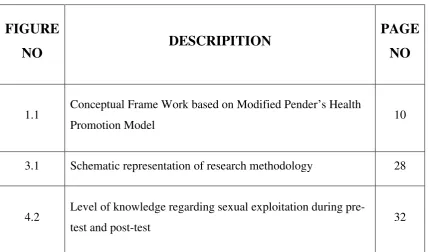
1.1 Conceptual Frame Work based on Modified Pender’s Health
Promotion Model 10
3.1 Schematic representation of research methodology 28
4.2 Level of knowledge regarding sexual exploitation during
LIST OF ANNEXURE
ANNEXURE
TITLE
PAGE
NO
A Letter Seeking Permission to Conduct a Research Study i
B Letter Granting Permission to Conduct a Research Study ii
C Letter Requisition Opinion and Suggestion of Experts for
Content Validity of the Research Tool iii
D Tool for Data Collection iv
E Check List for Validation of the Tool lviii
F Certification of Validation lx
G List of Experts for Content Validity lxvi
ABSTRACT
1
CHAPTER - I
INTRODUCTION
"Abuse changes your life... Fight back and change the life of your abusers by breaking your silence on abuse" - John
Child is a gift from the creator. When a child is born to family, it brings bundle of joy, happiness and responsibility to the family, society and country.
God given gift, the Children are the inheritance of the world. Childhood is a golden period and a blue print of an adult, is the bridge between birth and adulthood. So it has to be taken care of well, with the fulfilment of emotional, psychological and physical needs. “Childhood” generally signifies happy living, healthy nutrition, love, warmth, support and overall affectionate environment. The attitudinal behaviour of children should be hale and hearty. The rights of children which include the right to live, the right to health care, and the right to protection from economic and sexual exploitation, but now a day’s children are being abused and exploited in many ways which lead to many physical, social and psychological problems.
The term adolescence derived from Latin: adolescence means “to grow up” is a transitional stage of physical and mental human development generally occurring between puberty and legal adulthood. According to Erick Erikson’s stages of human development, adolescent is a person between the ages of 13 and 19, KP Neeraja (2007).
Adolescence begins when the secondary sexual characteristics appear and ends when somatic growth is completed. The individual is psychologically matured capable of becoming a contributing member of society. Usually by the age of 13 to 16 years the secondary sexual characteristics have developed fully KP Neeraja (2006).
2
Sexual exploitation also referred to as molestation, is the forcing of undesired sexual behaviour by one person upon another. When that force is immediate, short duration, or frequent, it is called sexual assault. The offender is referred to as sexual abusers or molester. When the victim is younger than the age of consent, it is referred to as sexual abuse. Sexual abuse or violence against adolescents is defined as a situation in which children or adolescents are used for the sexual pleasure of an adult or older adolescent which ranges from petting, fondling of genitalia, breasts or anus, voyeurism, pornography, exhibitionism, pressuring a child to engage in sexual activities, indecent exposure of the genitals nipple etc. With intent to gratify their own sexual desires or to groom the child. Sexual abuse is an especially complicated form of abuse because of its layers of guilt and shame, Marlow (2009).
Sexual abuse can occur in a variety of setting, including home, school or work place. The effects of child sexual abuse can include depression, post traumatic stress disorder, anxiety and complex post traumatic disorder. Further victimization in adulthood is physical injury to the child among other problems in the society. Sexual abuse by a family member is a form of incest and can result in more serious and long term psychological trauma, especially in case of parental incest.
In the world, India has the largest number of children (375 million), covering 40% of its population, out of which 69% of Indian children are victims of physical, emotional and sexual abuse. New Delhi, The nation’s capital, has an abuse rate over 83%.More than 70% of cases are unreported or unshared even with family members. Global prevalence of child sexual abuse study conducted by the Centres for Disease control. The U.S 19.7% of women globally experienced sexual abuse prior to the age of 18. The highest prevalence rate of child sexual abuse geographically was found in Africa (34.4%). Europe showed the lowest prevalence rate (9.2%). America and Asia had prevalence rates between 10.1% and 23.9 %.
3
A survey participated in (2018) by more than 45,000 children in the 12-18 age group, across 26 states in the country, revealed that one in every two children is a victim of child sexual abuse. The survey conducted by humanitarian aid organisation World Vision India with a sample of 45,884 respondents also revealed that one in every five do not feel safe because of the fear of being sexually abused. It is also said one in four families do not come forward to report child abuse. “Despite one in every two children being a victim of child sexual abuse, there continues to be a huge silence. The magnitude of sexual violence against children is unknown,’’ World Vision India National Director Children Thomas said here while launching a campaign to end child abuse and exploitation by 2021. The “It Takes the World to End Violence against Children’’ campaign targets 10 million children across 25 states and one union territory. Children are given training in different aspects, where they are taught about the good touch and bad touch and various other relevant aspects.
Sexual violence against girls is a global human rights violation of vast proportions with severe health and social consequences. Sexual violence has serious and long lasting consequences for the physical and mental health of individuals and their social and occupational functioning as well as for the families, communities, and can impede social and economic development.
A number of factors that make children, adolescent girls particular are vulnerable to sexual violence. A key factor is social tolerance of sexual violence against girls at different levels of society and abuse/exploitation is perceived as something normal and outside the control of communities. The factor include girl who has experienced sexual violence is often blamed for the violence and poverty, social disparities, limited educational and employment opportunities for girls, family disintegration and weak legal and policy frameworks and enforcement.
Need for the Study
4
Sexual abuse common among all the age groups, cultural and socio economic strata’s of society. It occurs in homes, schools, at work place and other public places by family members, neighbours, teachers, supervisors, and schoolmates and, on occasion, strangers. As a taboo subject, sexual abuse is rarely reported or studied. Hence it is difficult to estimate how many adolescents and young suffer from sexual abuse, violence, coercion, incest, rape or sexual trafficking. Nevertheless, evidence suggests that a disturbingly large numbers of adolescent girls and boys are subjected to coercion in South Asia. Sexual abuse and exploitation of adolescent and youth occurs when an adolescent or adult take advantage for sexual purposes, including for participation in prostitution, pornographic performance and in the production of pornography. Sexual abuse and exploitation is perpetrated on adolescence.
The Tamil Nadu government unveiled 13 point action plan, including installation of Closed Circuit Television (CCTV) in all public buildings. The booking of founders in good as act of 1982 that the gives non-bailable up to one year. National Crimes Record Bureau statistics, stated that a total of 48,338 child rape cases was recorded from 2001-2011.
The present study was supported by Ms.Yaiphabee abujamand, Prof.A.Santham Lillypel., (2017) who conducted a quasi-experimental study to compare effectiveness of structured teaching programme on knowledge regarding good touch and bad touch among children. They found significant improvement in knowledge of subjects regarding good touch and bad touch. The mean score level of knowledge of good touch and bad touch in the experimental group the pre-test mean was 18.5 with standard deviation 3.1 whereas after structure teaching programme in the experimental group the post test mean was 25.77 with standard deviation 2.5, which is significant at P=0.05.
5
Statement of the problem
A Study to Evaluate the Effectiveness of Video Assisted Teaching Programme on Knowledge Regarding Sexual Exploitation Among Adolescent Girls at Selected Higher Secondary School, Dharmapuri.
Objectives
To assess the level of knowledge regarding sexual exploitation among adolescent girls
To evaluate the effectiveness of video assisted teaching programme on knowledge regarding sexual exploitation among adolescent girls.
To find out the association between the level of knowledge regarding sexual exploitation among adolescent girls with their selected demographic variables. Operational definitions
Evaluate
It refers to a through statistical measurement and comparison of the pre and post-test knowledge about sexual exploitation.
Effectiveness
It refers to the statistically significant difference in the mean pre test and post test knowledge score.
Video Assisted Teaching Programme
It refers to the systematically planned and organized audio and video programme, which includes meaning, definition, incidence, why does sexual exploitation happen, perpetrators, type, impact, signs and symptoms of after sexual exploitation, prevention, good touch and bad touch, safety rules of sexual exploitation which is implemented by the investigator for 30 minutes.
Knowledge
6
prevention, good touch and bad touch, safety rules of sexual exploitation as measured by structured questionnaire.
Sexual exploitation
Sexual exploitation is refers to a form of sexual abuse that involves a manipulation and coercion of young people under the age of 18 into sexual activity. Sexual abuse may consist of anything from fondling of the child breast or genital to vagina or anal intercourse.
Adolescent girls
In this study adolescence girls are those who aged between 14-16 years.
Assumptions
The adolescence girls may have some knowledge regarding sexual
exploitation.
The video assisted teaching programme may improve the knowledge of adolescent girls about sexual exploitation.
Hypotheses
H1: There will be a significant difference between pre and post test mean knowledge score regarding sexual exploitation among adolescents girls at P<0.05 level of significance.
H2: There will be a significant association between levels of knowledge about sexual exploitation among adolescent girls with their selected demographic variables at P<0.05 level of significance.
Delimitation
The study is delimited to adolescent girls in selected higher secondary school.
The sample size is limited to 50.
7
Projected outcome
The sexual exploitation knowledge will helps the adolescent girls to take meticulous action, in advance, which will prevent the adolescent girls from sexual exploitation.
Conceptual framework
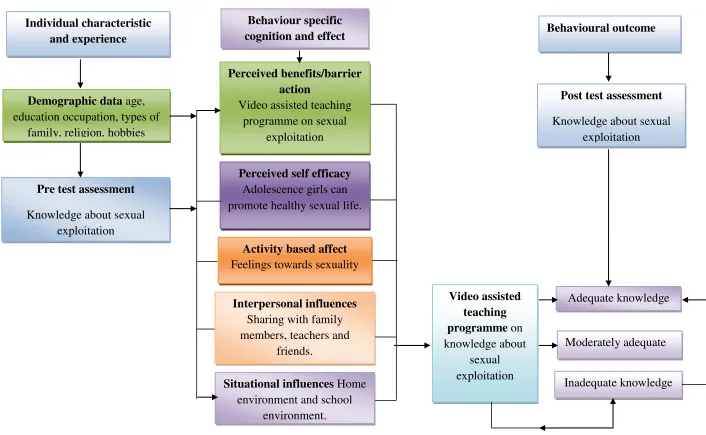
A conceptual framework on a model is making up concepts, which are the mental image of the phenomenon. It offers frameworks of proportion for conducting research. These concepts are linked together to express the relationship between them. A model is used to denote symbolic representation of the concept.
Conceptual framework is inter related concepts to abstraction that are assembled together in some rational scheme by virtue of their relevance, to a common them. It is a device that helps to stimulate research and the extension of knowledge by providing both directions and impulse. (Polite and Hunger 1995)
Major concepts of the phenomenon are described as follows
Researcher’s view
Individual characteristics and experience
Prior related to behaviour
Modifying factor such as demographic data, age, education, type of family, religion, hobbies among adolescence girls
Personal factors
Pre-test assessment on knowledge about sexual exploitation among adolescence girls
Behaviour specific cognitions and affect
Perceived benefits of action
Perceived benefit of action is video assisted teaching programme due to individual may be more inclined to begin. If the benefits to such as behaviour are consider high.
Perceived barriers to action
8 Perceived self efficacy
Perceived self efficacy is capability to promote healthy behaviour regarding sexual exploitation among adolescence girls.
Activity related affect
Activity based affect may positive or negative feeling.
Interpersonal influences
Interpersonal influences sharing with family members, teacher and friends.
Situational influences
Home environment and school environment among adolescence girls
Behavioural outcome
Immediate competing demands
Post test assessment on knowledge about sexual exploitation.
Commitment to a plan of action
Video assisted teaching programme on knowledge about sexual exploitation among adolescence girls.
Level of knowledge
The adolescent girls may categorize according to their level of post test knowledge such as adequate knowledge, moderately adequate and inadequate knowledge.
Authors View
9
Researcher’s view
Modifying factors includes age, education, father education, mother education, type of family, number of siblings, residence, hobbies, mode of transport, sources of information about sexual exploitation were indirectly influenced on behaviour, with the cognitive-perceptual factors.
Summary
10
Fig.1.1: CONCEPTUAL FRAME WORK BASED ON MODIFIED PENDERS HEALTH PROMOTION MODEL Individual characteristic
and experience
Behaviour specific
cognition and effect Behavioural outcome
Demographic data age, education occupation, types of
family, religion, hobbies
Pre test assessment
Knowledge about sexual exploitation
Perceived benefits/barrier action
Video assisted teaching programme on sexual
exploitation
Perceived self efficacy Adolescence girls can promote healthy sexual life.
Post test assessment
Knowledge about sexual exploitation
Activity based affect Feelings towards sexuality
Interpersonal influences Sharing with family members, teachers and
friends.
Situational influences Home environment and school
11
CHAPTER
–
II
REVIEW OF LITERATURE
The literature review involves the systematic identification, location, scrutiny and summary of written materials that contain information on a research problem.
-Polite and Hungler (2008)
The literature was reviewed and presented under the following headings, Literature related to knowledge about sexual exploitation
Literature related to impact of sexual exploitation and prevention
Literature related to effect of video assisted teaching programme on level of knowledge regarding sexual exploitation
Literature related to knowledge about Sexual Exploitation
Scheidell JD, et.al., (2017) a study was at U.S it was a conducted National Longitudinal Study of Adolescent to Adult Health to measure associations between child sexual abuse and substance use and sexual risk behaviours during adolescence, young adulthood, and adulthood among males and females (n = 11,820). Approximately 10% of females and 7% of males reported child sexual abuse. Associations with substance use were strongest during adolescence and lessened over time. Increased odds of sexual risk among those with a history of child sexual abuse remained consistent through the life course. Significant gender differences existed for some associations (e.g., adulthood multiple partners: males adjusted odds ratio (AOR) = 1.73, 95%CI: 1.18, 2.53; females AOR = 1.11, 95%CI: 0.79, 1.56).
12
Leonore. M.i.simon, et.al., (2013) conducted to empirically validate the fixed- regressed typology used in sexual abuse. The researcher were used multiple regression analysis. 136 samples who consecutive cases of convicted child molesters.The results states that significantly predicted an offender’s degree of regression.
Inga tidefors, et.al., (2012) was conducted to explore the characteristics and dynamic of adolescent sibling incest. The researchers were used semi-structure interview technique. The researcher were used adolescent sibling incest offenders (n=21) and non-sibling offenders (n=24). The results founded that the offend ring behaviour in non-sibling incest group was more severe.
Melannie R. Tate., (2010) a study was conducted to assess school psychologist knowledge about adolescent sexual abuse. (n=92) school psychologist were participated. A univariate analysis of (ANOVA) was used to determine the knowledge. The mean knowledge score value 14.5. There was no significant effect of experience on knowledge at p<0.05 level.The result founded that the school psychologist lacked knowledge on general facts about child sexual abuse.
National Study of Child Abuse in India, (2009) was conducted covering 13 states and sample size was 12,446 children. The result of the study was 22% faced severe sexual abuse, 6% sexually assaulted, 53% children report facing one or more forms of sexual abuse, 50% of sexual offenders were known to the victim or were in position to trust (family member, close relative, friend or neighbour), 5-12 group faced higher levels of abuse, largely reported, severest sexual abuse in age group of 11 to16 years, 73% of sexual abuse victims were in age group of 11-18 years.
13
violence in the previous 12 months period. The risk behaviour or perpetrators were older students who accounted 53%, relatives for 8%, teachers for 4% and miscellaneous 27%. The major findings of this study indicate that sexual abuse and violence are common among this population and statistical difference between males and females in overall prevalence of sexual abuse.
A study was designed to ascertain the prevalence and nature of the sexual abuse in childhood for a community sample of women. Two-stage design, using questionnaires and face to face interviews, was employed, providing information on prevalence rates, types of abuse, age of victims, relationship to the abuser, and cohort effects. A significant number of these experiences (70%) involved genital contact or more severe abuse, and 12% of these abused were subjected to sexual intercourse. The abusers were usually known to the victim, being family members in 38.3% of cases and acquaintances in another 46.3% stranger abuse accounted for 15% of all. The consequences of sexual abuse are both short term and long term. Short term include impact on core aspects of emotional, behavioural, and physical health and social development throughout life. Long term effects include; aggression, conduct disorder, delinquency, anti-social behaviour, substance abuse, anxiety, depression, and suicide. Sexual transmitted infections, particularly HIV. (www.ncbi.nlm)
ZwiKJ, et.al., (2006) a study was conducted school based programmes is effective in improving knowledge about sexual abuse and self-protective behaviour. Meta analysis and sensitivity were used. Nine studies were included in meta-analysis evaluating questionnaire based knowledge. An increase knowledge was found (SMD 0.59; 0.44, 0.74). The study was concluded that significant improvements in knowledge measures and protective behaviour.
Review of literature related to impact of sexual exploitation and prevention
14
psychopathology (time 3). We examined associations between child abuse and neural structure, and identified whether abuse-related differences in neural structure prospectively predicted psychiatric symptoms. Abuse was associated with reduced cortical thickness in medial and lateral prefrontal and temporal lobe regions. Thickness of the left and right parahippocampal gyrus predicted antisocial behaviour symptoms, and thickness of the middle temporal gurus predicted symptoms of generalized anxiety disorder. Thickness of the left parahippocampal gyrus mediated the longitudinal association of abuse with antisocial behaviour.
Chinawa Josephat, et al., (2015) Child sexual abuse among adolescents is an often overlooked issue in paediatrics, yet it is a major cause of low self esteem and stigmatization in adolescents. The objective of this study was to determine the socioeconomic determinant and pattern of child sexual abuse among adolescent attending secondary schools in South East Nigeria. This was a cross-sectional study that was carried out among children in three secondary schools in Enugu and Ebonyi states of Nigeria. Five hundred and six adolescents who met inclusion criteria were consecutively recruited into our prospective study between June and October, 2014.One hundred and ninety nine (40 %) of the respondents had been abused and the commonest form of abuse was to look at pornographic pictures, drawings, problems, videotapes or magazine 93(18.4%). Fifty eight (11.5%) adolescents stated that they were abused once with age 13-16 years 57 (11.4%). When grouped together, family members and relatives are perpetrators of child sexual abuse. The mean score level of knowledge on child abuse student group I was 13.63 in pre test and 17.37 in post test. Study group II the mean score level of knowledge on child abuse was 13.33 in pre test and 19.37 in post test, which is significant at p<0.001.
15
behaviour reported for the TG was identified as such by the legal authorities. However, five of 25 child sexual abuse offenders and 29 of 32 CPO offenders reported ongoing behaviours under therapy.
NicholsJ,Embleton, et.al., (2014) Conducted a quantitative study to determine whether orphans are more likely to experience physical and/or sexual abuse compared to non-orphans at sub-Saharan Africa (SSA) The studies consisted of a total 17,336 participants (51% adolescents and 58% non-orphans). Of those classified as orphans (n=7,315), 73% were single orphans, and 27% were double orphans. The majority of single orphans were paternal orphans (74%). Quality assessment revealed significant variability in the quality of the studies, although most scored higher for general design than dimensions specific to the domain of orphans and abuse. Combined estimates of data suggested that, compared to non-orphans, orphans are not more likely to experience physical abuse (combined OR=0.96, 95% CI [0.79, 1.16]) or sexual abuse (combined OR=1.25, 95% CI [0.88, 1.78]). These data suggest that orphans are not systematically at higher risk of experiencing physical or sexual abuse compared to non-orphans in sub-Saharan Africa. However, because of inconsistent 14 qualities of data and reporting, these findings should be interpreted with caution. Several recommendations are made for improving data quality and reporting consistency on this important issue.
16
findings should be interpreted with caution. Several recommendations are made for improving data quality and reporting consistency on this important issue.
O’Brien BS, Sher L, et.al., (2013) a study was conducted on child sexual abuse and pathophysiology of suicide in adolescence. The researcher were used an electronic search of the major behavioural science database. The studies indicated that child sexual abuse makes both direct and indirect contributes to suicide behaviour. The study concluded that child sexual abuse not just related to an increase in impulsivity and risky behaviour’s it has also been linked to an increase in sociality as well.
A prospective study was conducted in Australia on impact of child sexual abuse on mental health, to examine the association between child abuse in birth boys and girls and subsequent treatment for mental disorder. The study used prospective cohort design. The samples of the study were children (n= 1612, 1327 females) ascertained as sexually abuse. Result was male and female victims of abuse had significantly higher rates of psychiatric controls (12.4% v.3.6%). Rates were higher for childhood mental disorders, personality disorders, anxiety disorders and major affective disorders but not schizophrenia. Male victims were significantly more likely to have had treatment then females (22.8% v.10.2%). The study concluded that it demonstrates abuse experiences. Most of the abusers were young men, disclosure of the abuse was infrequent, and only 7% of all abuse was aver officially reported. Thus the study concludes one woman in three reported having one or more unwanted sexual experiences before age 16years. Pre adolescent girls are at greatest risk.
17
disclosure (74%), child behaviour (66%) and child’s e motions (60%). Factors increasing uncertainty included denial by the abuser (21%).
Shenk, & Putnam, (2009) Concluded in their Meta-analyses of 21 studies of child sexual abuse reported that this form of abuse more than doubled the risk of adolescent pregnancy (i.e., prior to age 20 years). Further to this, a study by Fergusson and colleagues (2010) found that young women (18 years of age) exposed to child sexual abuse had significantly higher rates of teenage pregnancy, increased rates of sexually transmitted diseases, and higher rates of multiple sexual partnerships and appeared to be more vulnerable to further sexual assault and rape
Review of literature related to effect of video assisted teaching programme on level of knowledge regarding sexual exploitation
Yaidphabeeabujamand, A.SanthamLillypet, (2017) a quasi-experimental study was conducted to determine the effectiveness of structured teaching programme on knowledge regarding good touch and bad touch. 60 school children were selected by non-probability convenient sampling technique. Pre-test and post-test level of knowledge was assessed using children’s knowledge of abuse questionnaire-revision III2. The findings revealed that the‘t’ test was 12.034 at df =58 at p=0.05 level, which shows a significant difference in the knowledge after the structure teaching programme school children.
18
25(42%) Of them are of 10th class, 22(37%) Of them are of 11th, 13 (22%) Of them are of 12 and 0(0%) of 9th class. There is no significant association found between the level of knowledge related to adolescents with class in pre interventional and post interventional have no significant association with class. Regarding education of father, 10th 31(51%), 12th 22(37%), primary educated 4(7%), and graduated are 3(5%). There is significant association found between the levels of knowledge related to adolescents with father’s education. Regarding education of mother, 10th 27(45%), 12th 25(42%), primary educated are 5(8%), graduated are 3(5%). There is no significant association found between the levels of knowledge related to adolescents with mother’s education. Regarding type of family, nuclear 39(65%), joint families 21(35%), extended are 0(0%).there is no significant association found between the levels of knowledge related to adolescents with type of family. Regarding source of income, 5000-10, 000Rs. 33(55%), Less then 5000Rs. 12(20%), Above 20, 000Rs. 11(18%), 10001-20, 000Rs. 4(7%). There is significant association between the knowledge related to adolescents with source of income. Regarding source of information, parents 21(35%), school 20(34%), mass media 11(18%), Others 8(13%). There is significant association found between the levels of knowledge related to adolescents with source of information. Significant association was found between the level of knowledge related to education of father, family income, source of information at p<0.05and there was no significant association found between level of knowledge related to adolescents with their age, gender, class, education of mother and types of family. Hypothesis i.e. There will be a significant difference between pretest and post-test knowledge of adolescents regarding awareness about sexual abuse was accepted at p<0.05.
19
J.P.Sathiavarthini, (2013) a study was conducted with the objectives to assess the pre test and post test level of knowledge scores among adolescent girls, to determine the effectiveness of video assisted teaching programme and to associate the pre test knowledge scores and their selected demographic variables. The researcher used a quasi experimental research design. The research approach was evaluative approach. The study conducted in Capron hall girl’s higher secondary school at Madurai district.6o samples were selected by using Non-probability convenient sampling technique. The data was collected by using structured questionnaires before after administration of video assisted teaching programme. The study finding of this study shows that, there was a significant improvement of knowledge among adolescent girls after administration of video assisted teaching programme. The mean and SD of post test knowledge score was (28.55 ± 1.29) and pre test knowledge score was (15.27± 3.13).The paired ‘t’ value (132.59) at LOS (<0.001) shows that there is a statistical difference between pre test and post test level of knowledge score among school adolescent girls.
A descriptive study conducted on knowledge, attitude and practice of child abuse and its identification by Ministry of Women and Child Development in India. The samples of the study were 210 mothers and the method of data collection was structured interview schedule. The major findings includes- 69% of children were physically abused, 20% sexually abused and 11% children are emotionally abused. The study found that mothers are having poor knowledge (n =420 and p =22.2%) and after the follow up, researcher found an enlighten knowledge in mothers (78%).
20
20.5% (36/176) of abused girls and 6.3% (3/48) of abused boys. Abusers were known to victims in two thirds of cases. Ninety per cent of abusers were male and 35.3% (71/201) came from the victims' peer group. Over 80% of participants found the questionnaire interesting, clearly formulated, and useful. Child sexual abuse is a universal social phenomenon. Adolescents themselves can contribute to research and so help in the search for more efficient prevention and intervention strategies.
Summary
21
CHAPTER-III
METHODOLOGY
The methodology of research indicates the general pattern of organizing, the procedure for gathering valid data for the problem under investigation.
This chapter describes the research approach, research design, setting, variables, population and sample, sampling technique and sample size, criteria for sample collection, description of the tool, validity and reliability, data collection procedure, pilot study and data analysis.
Research Approach
Quantitative Evaluative research approach was adopted for this study.
Research Design
Research design is a master plan specifying the methods and procedures or collecting and analyzing the needed information. (Ahuja R, 2001)
Pre-experimental (one group pre test-post test) research design was adopted for this study.
Description of the Setting
Setting is the location and condition in which data collection takes place for the study. (Polit and Hungler, 2003)
22
Population
Population is defined as the entire aggregation of cases that meet a designated set of criteria. (Polit and Hungler, 2003)
Target Population
It was comprised of the adolescent girls who are studying in a Government Higher Secondary School in Dharmapuri.
Accessible Population
The Accessible population was the adolescent girls who are in the age group between 14 -16years.
Sampling
Sampling refers to the process of selecting the portion of population to represent the entire population. (Polit and Hungler, 2003)
Sample
The sample comprised of adolescent girls from 14-16years of age, who fulfilled the inclusion criteria.
Sample Size
The sampling size of this study was 50 adolescent girls.
Sampling Technique
Non probability convenience sampling technique was adopted.
Criteria for Sample Selection Inclusion Criteria
The adolescent girls those who are
Studying in the selected school.
Falls in the age group between 14-16years.
23
Exclusion Criteria
Adolescent girls those who are
Not willing to participate in this study.
Not available during study period.
Variables
Independent Variable - Video Assisted Teaching Programme Dependent Variable - knowledge
Extraneous Variables - Age, education, father education, mother education, type of family, number of siblings, residency, hobbies, mode of transport, sources of information.
Development of the Tool
The tool was developed after an extensive review of literature and also considering the opinion given by the nursing and medical experts. The tools used data collections were as follows;
Structured questionnaire.
Description of Tool
Tool -I Demographic Variables
It consist of 10 items such as age, education, father education, mother education, type of family, residence, number of siblings, hobbies, mode of transport and sources of information. No score was given to this section. Data of this section was used for the regarding descriptive purpose.
Tool-II Structured Questionnaire
24
[image:35.595.120.480.120.244.2]Scoring Procedure
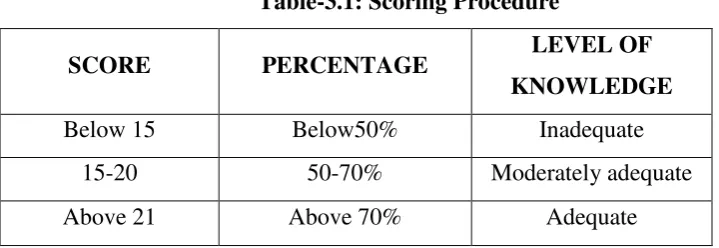
Table-3.1: Scoring Procedure
SCORE PERCENTAGE LEVEL OF
KNOWLEDGE
Below 15 Below50% Inadequate
15-20 50-70% Moderately adequate
Above 21 Above 70% Adequate
Level of knowledge was assessed before and after interventions.
Development of Video Assisted Teaching Programme,
The video assisted teaching programme was developed after an extensive review of literature and experts opinion. The video assisted teaching programme related content was prepared as English lesson plan and translated in Tamil.
Preparation of Video Assisted Teaching Programme
Selection of the Content
The content of sexual exploitation was selected through literature search and in consultation with the experts. The content was divided into sub topics and subtopics were broken down into elements.
Organization of the Content
The video assisted teaching programme consisted of one session and it took 45 minutes to complete.
The content for this session were prepared by covering following areas.
Introduction to the topic
Define sexual exploitation
State the incidence of sexual exploitation
Describe why does sexual exploitation happen
25
Explain the types of sexual exploitation
List out the psychological impact, physiological impact and psychological impact of sexual exploitation
Enlist the signs and symptoms of sexual exploitation
Mention the preventive aspect of sexual exploitation
Describe the details about good touch and bad touch
Explain the safety rules of sexual exploitation
Plan for Teaching
Selection of the Method of Teaching Lecture cum discussion
Audio visual materials: short film and lecture related to sexual exploitation.
Plan for Implementation of Video Assisted Teaching Programme
The plan was made to inform the sample well in advance regarding the time and plan for implementation of the video assisted teaching programme according to the convenience. It was planned to teach a single group. The samples were divided into 5groups, as 10 members per each group. One session of video assisted teaching Programme planned for 30 minutes. Each day one group was planned.
Determining the Method of Evaluating Video Assisted Teaching Programme
The methods of evaluation of Video Assisted Teaching Programme was conducting post test after 7 days of implementation video assisted teaching programme.
Validity and Reliability
Validity
Validity refers to the degree to which an instrument measures what it is supposed to be measured. (Ploit and Hungler, 2003)
26
child health), three nursing expert (the department of child health nursing) and one statistical expert. Minor modification was made as suggested by the experts. Were incorporated in the study.
Reliability
Reliability of an instrument is the degree of consistency with which an instrument measures an attributes. (Polit and Hungler, 2003)
Reliability of the tool was establishing by using test –retest method. The reliability score obtained was r =0.7. It showed that there is significant positive correlation. Hence the tool was considered reliable.
Pilot Study
The pilot study was conducted at Thiru Murugan Kirubanantha Variyar High School, Dharmapuri. After obtaining the permission from the headmaster. The investigator conducted the pilot study with 10 subjects from 12.03.2018 to 19.03.2018. The investigator conducted pre-test. But the investigator felt difficult while conducting pre-test subjects were not co-operated. So the researcher have explained how much of importance of knowledge about sexual exploitation for creating awareness and improve knowledge in their life. After this, subjects were co-operated and actively participated. So the same has applied to main study.
Method of Data Collection
Ethical Considerations
27
Data Collection Procedure
Formal written permission was obtained from the headmaster of Avvaiyar Govt. Girls.Hr. Sec. School in Dharmapuri to conduct the study from 02.04.2018 to 28.04.2018.The ethical aspect of research was kept in mind and data was collected after obtaining informed consent from the samples. The study was conducted with 50 samples that fulfilled inclusion criteria by using convenience sampling technique. The pre test on knowledge about sexual exploitation was conducted for 45 minutes through demographic data and structured knowledge questionnaire. Immediately after the pre test, intervention video assisted teaching programme on knowledge about sexual exploitation was given for 30 minutes. The samples were divided into five groups, as 10 members per each group. One session of video assisted teaching programme and post test was conducted on seventh day after the intervention.
Plan for Data Analysis
The descriptive statistics frequency percentage, mean, standard deviation was used to describe the demographic variable, to assess the knowledge about sexual exploitation. Inferential statistics, paired “t’’ test was used to compare paired observation by analyzing the effectiveness of video assisted teaching programme on knowledge about sexual exploitation. Chi-square test was used to find out the association between knowledge score the selected demographic variables.
Summary
28
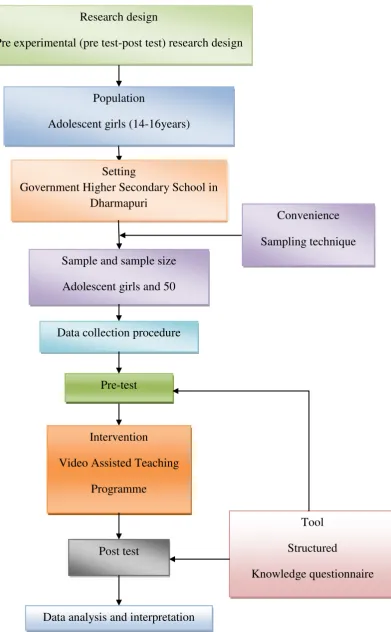
Fig.3.1: SCHEMATIC REPRESENTATION OF RESEARCH METHODOLOGY
Research design
Pre experimental (pre test-post test) research design
Population
Adolescent girls (14-16years)
Setting Government Higher Secondary School in
Dharmapuri
Sample and sample size
Adolescent girls and 50
Data collection procedure
Pre-test
Tool
Structured
Knowledge questionnaire Intervention
Video Assisted Teaching
Programme
Post test
Data analysis and interpretation
Convenience
29
CHAPTER-IV
DATA ANALYSIS AND INTERPRETATION
The statistics analysis is a method of rendering quantitative information and elicit meaningful and intelligible from of research data. Analysis and interpretation of data of this study was done using descriptive and inferential statistics. (Polit and Hungler, 2003)
This chapter deals with analysis and interpretation of data. The data collected to evaluate the effectiveness of video assisted teaching programme on knowledge regarding sexual exploitation among adolescent girls.
Presentation of data
The results are present under following sections.
Section: A
Distribution of adolescent girls according to their selected demographic variables in pre-test
Section: B
Distribution of adolescent girls according to the level of knowledge in pre-test and post test.
Section: C
a) Mean, standard deviation and paired ‘t’ value on effectiveness of video assisted teaching programme on pre and post test knowledge score regarding sexual exploitation
30
Section-A
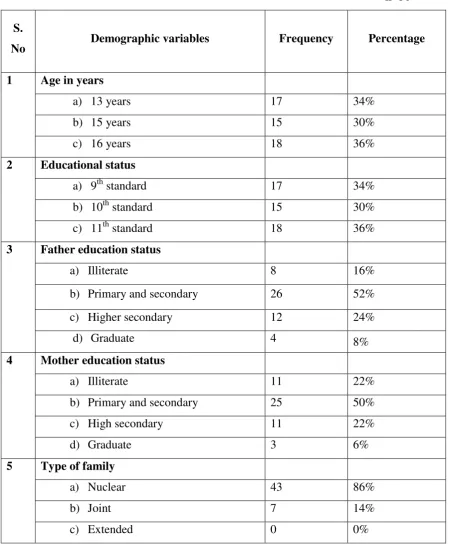
[image:41.595.82.532.207.752.2]Distribution of adolescent girls according to their selected demographic variables in pre-test
Table 4.1:
Frequency and percentage distribution of adolescent girls according to their selected demographic variables
n=50
S.
No Demographic variables Frequency Percentage
1 Age in years
a) 13 years 17 34%
b) 15 years 15 30%
c) 16 years 18 36%
2 Educational status
a) 9th standard 17 34%
b) 10th standard 15 30%
c) 11th standard 18 36%
3 Father education status
a) Illiterate 8 16%
b) Primary and secondary 26 52%
c) Higher secondary 12 24%
d) Graduate 4 8%
4 Mother education status
a) Illiterate 11 22%
b) Primary and secondary 25 50%
c) High secondary 11 22%
d) Graduate 3 6%
5 Type of family
a) Nuclear 43 86%
b) Joint 7 14%
31
6 Number of sibling
a) One 7 14%
b) Two 26 52%
c) Three or more 17 34%
d) None 0 0%
7 Residence
a) Urban 24 48%
b) Rural 26 52%
8 Hobbies
a) Watching television 18 36%
b) Reading news paper 7 14%
c) Browsing internet 12 24%
d) Chatting with friends 13 26% 9 Mode of transport
a) Bus 14 28%
b) Auto 4 8%
c) Two wheeler 20 40%
d) Walk 12 24%
10 Sources of information
a) Mass media 12 24%
b) Teacher 16 32%
c) Family members 12 24%
d) None 10 20%
32
Section -B
[image:43.595.94.504.229.609.2]Distribution of adolescent girls according to the level of knowledge in pre-test and post test
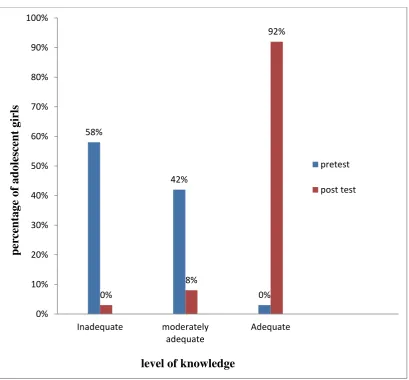
Figure 4.2:
Percentage distribution of adolescent girls according to the level of knowledge during pre test and post test
The above figures represents that in pre-test, most of the samples 29 (58%) are had inadequate knowledge, 21(42%) of samples are had moderately adequate knowledge and none of the samples are had adequate knowledge. Whereas in post test, majority of the samples 46 (92%) are had adequate knowledge, only 4(8%) of the samples had moderately adequate knowledge and none of the samples are had inadequate knowledge.
58% 42% 0% 0% 8% 92% 0% 10% 20% 30% 40% 50% 60% 70% 80% 90% 100% Inadequate moderately adequate Adequate p er ce n tage of ad olesc en t gir ls
level of knowledge
pretest
33
Section-C
Hypotheses testing
[image:44.595.85.533.306.479.2]a) Mean, standard deviation and paired ‘t’ value on effectiveness of Video Assisted Teaching Programme on pre test and post test knowledge score regarding sexual exploitation
Table-4.3:
Mean, standard deviation and paired ‘t’ value on level of knowledge score regarding sexual exploitation
n=50
*significance at P<0.05 level; table value =25.57; df =49
The above table reveals that, the pre test and post test mean, standard deviation and mean difference value of knowledge score were 13.94 ( ±2.52) and 24.9(±2.25) and 10.96. The score prove that there is significant different between pre and post test knowledge score. So it was concluded that the video assisted teaching programme was effective among adolescent’s girls. Hence the research hypothesis (H1) is retained.
S.
No Variables
Total
score Pre-test Post test
Mean difference
paired ‘t’ test
1. Knowledge 30
Mean SD Mean SD
34
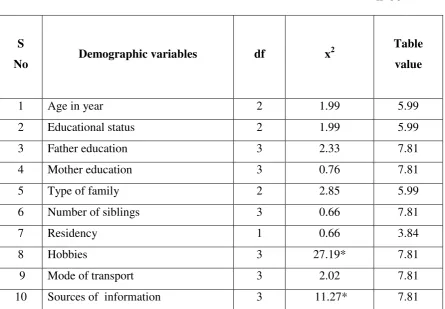
Table 4.4
b) Association between the pre test level of knowledge among adolescent girls with their selected demographic variables
n=50
S
No Demographic variables df x
2 Table
value
1 Age in year 2 1.99 5.99
2 Educational status 2 1.99 5.99
3 Father education 3 2.33 7.81
4 Mother education 3 0.76 7.81
5 Type of family 2 2.85 5.99
6 Number of siblings 3 0.66 7.81
7 Residency 1 0.66 3.84
8 Hobbies 3 27.19* 7.81
9 Mode of transport 3 2.02 7.81
10 Sources of information 3 11.27* 7.81 *significant at P<0.05 level
The above table results shown that there is a significant association between pre test knowledge with selected demographic variables. Hence H2 hypotheses is proved.
Summary
[image:45.595.85.531.145.454.2]35
CHAPTER-V
DISSCUSSION
This study was conducted to evaluate the effectiveness of video assisted teaching programme regarding knowledge about sexual exploitation among adolescent girls at selected higher secondary school, Dharmapuri.
Distribution of demographic variables
The distribution of demographic variables in pre test, 18(36%) of samples were in the age group of 16years. This finding was supported by Chinawa Josephal(2015) study. In her study reported that 57 (11.4%) of the adolescent girls belong to the age of 13-16years.
Most of the samples 18 (36%) were studying in 11th standard.
According to the educational status pre test 26(52%) were father educational status were completed primary and secondary, half of them 25(50%) mother educational status were completed primary and secondary.
Types of family in pre test 43(86%) most of the samples were belongs to
nuclear family.
In number of siblings 26(52%) half of the samples have two siblings.
The living area half of samples 26(52%) were in rural area.
In hobbies 18(36%) of samples were only watching television.
Considering the mode of transport only 20(40%) of samples were used in
two wheeler.
Mostly 16(32%) of samples had sources of information regarding sexual
exploitation through the teacher.
The first objective was to assess the level of knowledge regarding sexual exploitation among adolescent girls.
36
knowledge, only 4(8%) of the samples had moderately adequate knowledge and none of the samples are had inadequate knowledge.
Yaidphabeeabujamand, A.SanthamLillypet, (2017) a quasi-experimental study was conducted to determine the effectiveness of structured teaching programme on knowledge regarding good touch and bad touch. 60 school children were selected by non-probability convenient sampling technique. Pre-test and post-test level of knowledge was assessed using Children’s Knowledge of abuse questionnaire-revision III2. The findings revealed that the‘t’test was 12.034 at df =58 at p =0.05 level, which shows a significant difference in the knowledge after the structure teaching programme school children.
The second objective was to evaluate the effectiveness of video assisted teaching programme on knowledge regarding sexual exploitation among adolescent girls.
The pre test and post test mean, standard deviation and mean difference value of knowledge score were 13.94 ( ±2.52) and 24.9(±2.25) and 10.96. The score prove that there is significant difference between pre and post test knowledge score. So it was concluded that the video assisted teaching programme was effective among adolescent’s girls. Hence the research hypothesis (H1) is retained.
This finding of the study was supported by J.P.Sathiavarthini, (2013) in her study mean and SD of post test knowledge score was (28.55 ± 1.29) and pre test knowledge score was (15.27± 3.13).The paired ‘t’ value (132.59) at LOS (<0.001) shows that there is a statistical difference between pre test and post test level of knowledge score among adolescent girls.
The third objective was to find out the association between the pre-test level of knowledge regarding sexual exploitation among adolescent girls with their selected demographic variables.
There is a significant association between pre test knowledge selected demographic variables like hobbies and sources of information regarding sexual exploitation.
37
source of information. Significant association was found between the level of knowledge related to education of father, family income, source of information at p<0.05.
The hypothesis for this study state that there was a significant difference between the pre-test and post test knowledge about sexual exploitation among adolescent girls. The above finding supports this hypothesis and it was accepted.
The conceptual frame work was based on the modified pender’s health promotion model. The model focuses on the concepts of interrelationship between cognitive perceptual factors.
It has eight components of this model is importance of health; the adolescent girls were interested to get information, second conceptual perceived components health where the samples willing needs to participate. In third component self efficacy which the samples strongly believed that behaviour is possible can influence the health.
The fourth components is definition of health that ranging from inadequate knowledge to adequate knowledge. In fifth component is perceived health status denotes the adolescent girls level of knowledge is inadequate. So as a sixth component of the samples were ready to attend the video assisted teaching programme. In seventh component the adolescent girls had some perceived barriers to learn video assisted teaching programme such as improper classroom setting, interest, absence the last component is modifying factors which change the health status including demographic variables.
38
Summary
39
CHAPTER-VI
SUMMARY, CONCLUSION, IMPLICATIONS AND RECOMMENDATIONS
This chapter presents the summary, recommendation, implication and limitation of the study based on the objectives selected.
Summary
The purpose of the study was to evaluate the effectiveness of the video assisted teaching programme on knowledge regarding sexual exploitation among adolescent girls at selected higher secondary school, Dharmapuri. The pre-experimental (one group pre test and post test) research design was adopted. The sample size of this study was 50 adolescent girls. The structured knowledge questionnaire was used to assess the level of knowledge. The intervention used for this study was video assisted teaching programme. After 7 days the post test was conducted.
Major findings of the study
The distribution of demographic variables in pre test, 18(36%) of samples were in the age group of 16years.
Most of the samples 18 (36%) were studying in 11th standard.
According to the educational status pre test 26(52%) were father
educational status were completed primary and secondary, half of them 25(50%) mother educational status were completed primary and secondary.
Types of family in pre test 43(86%) most of the samples were belongs to
nuclear family.
In number of siblings 26(52%) half of the samples have two siblings.
The living area half of samples 26(52%) were in rural area.
In hobbies 18(36%) of samples were only watching television.
Considering the mode of transport only 20(40%) of samples were used in
two wheeler.
Mostly 16(32%) of samples had sources of information regarding sexual
40
Most of the samples 29 (58%) are had inadequate knowledge, 21(42%) of samples are had moderately adequate knowledge and none of the samples are had adequate knowledge.
Whereas in post test, majority of the samples 46 (92%) are had adequate
knowledge, only 4(8%) of the samples had moderate adequate knowledge and none of the samples are had inadequate knowledge.
There is a significant association between pre test knowledge selected
demographic variables like hobbies and sources of information regarding sexual exploitation.
Conclusion
This study was done to evaluate the effectiveness of video assisted teaching programme on knowledge about sexual exploitation among adolescent girls. The result of this study showed that video assisted teaching programme was effective in improving knowledge among adolescent girls.
Nursing implications
The investigator has derived following implications which are vital concern in the field of nursing practice, nursing administration, nursing education and nursing research.
Nursing practice
It helps the nursing students to conduct a awareness programme regarding sexual exploitation in various school and colleges.
The child health nurse can provide the sex education in the children’s ward in the preventive aspect.
Help the nurses to gain adequate knowledge taking meticulous action to prevent child exploitation..
41
Nursing education
The nurse can plan for mass health education method of teaching to create awareness among nursing students.
The nurse educator can improve the student nurses knowledge about sexual exploitation which helps them during clinical practice.
Helps the educator to conduct various awareness programmes to prevent child sexual abuse.
Nursing administration
Should provide adequate information about sexual exploitation in educational programme.
Should be efficient in organizing the various awareness programmes.
Nursing research
Can conduct study about parental involvement in awareness about sexual exploitation.
This study helps the researcher to conduct a study in other aspects of child abuse.
Recommendations
A similar study can be conducted by using different teaching strategies.
The same study can be conducted in various settings.
Summary
42
BIBLIOGRAPHY
1. Achar’s. (2000). Textbook of paediatrics (3rd .ed.). Orient long man (p) ltd.
2. AkDutta. (2007). Advanced in paediatrics (1st .ed.). New Delhi: Jaypee brothers
3. AgarwalNeera. (2003) paediatrics and adolescent gynaecology. (1st .ed.). New
Delhi: Jaypee brothers.
4. Annsnija G and A. Reenaevency. (2015). Research to child, child to child
approach regarding child abuse, Tamilnadu: nightingale nursing times.
5. Ahmed AG, Seto MC. (2014). Treatment and management of child pornography
use. Available in URL www.victimsof crime.org. Retrieved on 23.12.2014. 6. Beharman. (1996). Text book of paediatrics (15th .ed.). Bangalore: prism books (p)
Ltd
7. Bindler c Ruth. (2009). Paediatrics nursing. (4th .ed.). India: Dorling Kindersley.
8. Binder ball. (2009). Paediatrics nursing caring for children. (4th .ed.). Dorling
Kindersley (p) Ltd.
9. Binder RL, McNiel DE. (2007).’’Evaluation of school based sexual abuse
prevention programme: cognitive and emotional effects’’. Nightingale Nursing
Times.
10.Brown LIoyd. (2005). Paediatrics (1st .ed.) New Delhi: Jaypee brothers.
11.B.T Basavanthappa. (2005). Child health nursing. (1st .ed.). New Delhi: Ahuja
publications.
12.K.Berry, Brenan. (2003). Paediatrics emergency medicine (1st.ed.) BIOS
publishers p (Ltd).
13.DuttaParul. (2007). Paediatrics nursing. (1st.ed.).Jaypee brothers.
14.KE. Elizabeth. (2012). Fundamentals of paediatrics. (2nd .ed.). Solution for health
43
15.Garfunkel. kaczorowski. (2010). Paediatrics clinical advisor (2nd .ed.). Mosby
publications (p) Ltd.
16.Guptesuraj. (2010).The short text book of paediatric (10th .ed.). New Delhi:
Jaypee brothers.
17.17. Gudrun wallmyr. (2008). Use and attitude among young people toward
pornography. Available in URL WWW.ncbi.nlm.nih.gov/pumded.retrived on
24.12.2014.
18. Hull David. (2001) Essentials paediatrics (4thed.)Harcourt publishers (p) ltd.
19.IAP. (2012). Colour atlas paediatrics (1st .ed.) New Delhi: jaypee brothers.
20.Inga Tidefors, Hans Arvidsson (2010). Sibling incest: a child study of sexual
aggression. Available in http://books.google.com.reterived on 30.12.14
21.Jeyareka and jayanthai .p (2013).lived experience of children with child abuse,
Chennai: Nightingale Nursing Times.
22.Jubin Varghese.(2014) . sexual abuse among children, Rajasthan: Nightingale
Nursing Times
23.Kyle Terri. (2009). Essential of paediatrics nursing (1st.ed)Lippincott Williams and
Wilkins
24.N.klosnerjaynee and Hatfield Nancy. (2006). Introductory maternity and
paediatrics nursing, (1sted.). Lippincott Williams and Wilkins
25.Mazedhossain ,et.al,(2015). The relationship of trauma to mental disorder among
trafficked and sexually exploitative girls, Available in URL.www.ncbi.nlm.gov/
pubmed. Retrieved on 3.2.15
44
27.Melannie R. Tate (2010). Assessing school psychologist’s knowledge of child
sexual abuse. Available in www.ncbi.nlm.nih. Retrieved on 5.2.15
28.Nelson. (2002). Essential of Paediatrics (4th.ed.) New Delhi: Elsevier.
29.Potts LNicki, (2007). Paediatrics Nursing (2nd.ed.). Harcourt publishers.
30.Perry and potter. (2005). Basic Nursing: Essential for practice (6th .ed.). New
Delhi Elsevier P(Ltd)
31.Shelov P Steve. (2004). Caring for your baby and young children (4th.ed). Jaypee
brothers.
32.Timby K Barbara, Smith E Nancy. (2005). Essential of Nursing care of adult and
Children. (1st .ed.). Lippincott Williams and Wilkins.
33.Wong’s. (2006). Nursing care of infants and children. (7thed.). Mosby publication
Pvt. (Ltd)
34.ZwiK.j,et.al.,(2006). School based educational programmes for the prevention of
i
ANNEXURE-A
ii
ANNEXURE-B
Figure


Outline
Related documents