THE AUSTRALIAN SOLAR ECLIPSE EXPEDITIONS
OF 1947 AND 1949
Harry Wendt
Centre for Astronomy, James Cook University, Townsville, Queensland 4811, Australia.
E-mail: [email protected]
Wayne Orchiston
Centre for Astronomy, James Cook University, Townsville, Queensland 4811, Australia.
E-mail: [email protected]
and
Bruce Slee
Australia Telescope National Facility, PO Box 76, Epping, NSW 2121, Australia.
E-mail: [email protected]
Abstract: On 1 November 1948 the Radio Astronomy Group within the Commonwealth Scientific and Industrial Research Organisation’s Division of Radiophysics observed a partial solar eclipse on a range of radio frequencies at three different sites within Australia. These observations helped establish Australia’s reputation as a leader in solar radio astronomy. A second partial eclipse occurred on 22 October 1949, and the Division again mounted a major expedition, this time with very different results.
This paper examines the contribution of the eclipse observations and contrasts the very different results achieved. While scientific progress is generally well documented, stumbling in the path of progress is often overlooked. In looking to future research it is important to realise that progress is often only made in the face of adversity.
Keywords: radio astronomy,solar radio emission, eclipses, Division of Radiophysics
1 INTRODUCTION
The history of early radio astronomy in Australia has been well documented by Orchiston and Slee (2005), Robertson (1992) and Sullivan (2005), amongst others, and its success largely revolved around the Council for Scientific and Industrial Research’s Division of Radio-physics team that was associated with the development of radar during WWII. At the end of the war, in 1945, the CSIR decided to retain this Division, refocus on peacetime research, and appoint a number of bright new staff members. Under the inspired leadership of J.L. Pawsey this strategy paid off, and Australia was soon at the forefront of the emerging field that would become known as ‘radio astronomy’.
One of the key events that helped establish Aus-tralia’s reputation in solar radio astronomy was the partial solar eclipse of 1 November 1948. Another partial eclipse was visible from Australia on 22 Oct-ober 1949, and, keen to back up their earlier successes, the Division also mounted a major expedition to observe this event. However, no results were ever published, and were it not for two very brief references by Orchiston and Slee (2005: 135) and Orchiston et al. (2006: 48) this expedition would have escaped notice. Prior to 1948 the Division also considered sending an expedition to Brazil in order to observe a total solar eclipse, and this, too, has only received the briefest of mentions in the historical literature (e.g. see Bolton, 1982: 350).
The purpose of this paper is to recognise that both success and failure contributed to the building of Australia’s radio astronomical reputation. As such, this paper provides an historical account of the 1949
eclipse observations, as well as backgrounding the aborted 1947 expedition to Brazil.
2 SOLAR ECLIPSES AND RADIO ASTRONOMY
A detailed history of the genesis of solar radio astron-omy in Australia has been published (Orchiston et al., 2006). One of the key challenges for the early researchers was the low resolution of the aerials being used, as this inhibited the ability to determine the precise positions of the sources of solar radio emis-sion. Some early progress was made by McCready et al. (1947) using interferometric techniques, but it was soon realised that solar eclipses offered a more sophisticated method of establishing the locations of the different radio-emitting regions in the solar corona (see Hey, 1955). In 1946, the Canadian radio astrono-mer, Arthur Covington, used the opportunity presented by the partial solar eclipse of 23 November to accu-rately measure the time—hence position projected onto the solar disk—when radio emission at 2,800 MHz was masked by the passage of the Moon’s disk (Covington, 1947). Sander (1947) also used this same eclipse to examine the distribution of radiation at the higher frequency of 9,428 MHz. Although Dickie (1946) was the first to observe a solar eclipse at radio frequencies, it was Covington who first showed that strong emission was associated with a sunspot group that was occulted during an eclipse.
3 THE 1947 ECLIPSE EXPEDITION
eclipse of 20 May 1947. In a proposal from the Chief of the Radiophysics Division, Dr E.G. (‘Taffy’) Bowen (1946) to the Chief Executive of the C.S.I.R., Dr F.W.G. White, the rationale for conducting the eclipse observations was outlined. By this time the Radiophysics researchers had determined that there were three quite distinct components of ‘solar noise’: (1) steady radiation, which was believed to be of thermal origin, (2) enhanced levels of solar noise believed to be associated with sunspots and of non-thermal origin (the so-called ‘slowly-varying compon-ent’), and (3) sudden bursts of short duration, which also were believed to be non-thermal in origin.
Figure 1: Illustration from the original Brazilian eclipse expedi-tion proposal showing the different levels in the solar corona where the steady component of solar noise could be expected to originate; R = solar radii (courtesy of National Archives of Australia).
[image:2.612.87.296.448.693.2]The evidence they had accumulated suggested that the steady component of the radiation came from different levels in the Sun’s atmosphere. Calculations suggested that observations of the noise conducted at a number of different frequencies would provide an opportunity to investigate the properties of the corona at a series of different levels. Included with the pro-posal was a hand-drawn diagram illustrating the levels at which thermal noise at 200, 100 and 75 MHz could be expected to originate, and these extended from the top of the chromosphere to a point at 1.2 solar radii in the corona (see Figure 1).
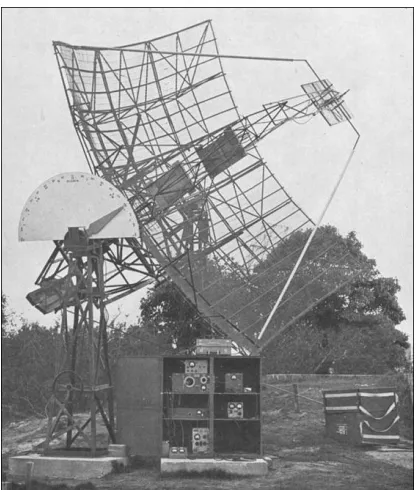
Figure 2: The 16 × 18-ft paraboloid at Georges Heights field station. It was proposed to ship this aerial to Brazil for the 1947 total solar eclipse (courtesy ATNF Historical Photo-graphic Archive: B1164).
The proposal (Bowen, 1946) suggested that a solar eclipse offered the best opportunity to measure the apparent diameter of the Sun’s disk at different fre-quencies and hence provide experimental confirmation of the ideas illustrated in Figure 1. In a later update of the proposal, Pawsey (1946c) expanded on the scien-tific objectives of the observations:
A quantitative theory concerning the steady component of radiation has now been advanced by D.F. Martyn. This assigns a distribution of intensity over the disc of the sun which changes radically with the frequency of observation. An interesting prediction is that, in the region of 600 Mc/s, the radiation should be intense near the edge of the sun and weak in the centre, so that the sun should appear as a bright ring and not a disc. Such a distribution gives an intensity variation during the eclipse markedly different from that from a disc. The part of the theory dealing with intensity distribution over the surface is as yet unsupported by experiment and it appears that eclipse observations provide a sound method of verification. This quantitative verification is an extension of Bowen’s suggested measurement of the apparent diameter of the sun’s disc.
In order to observe the eclipse at different frequen-cies, receivers were constructed to operate at 100, 200, 600 and 1,200 MHz. It was proposed to ship the 16 × 18-ft paraboloid (Figure 2) that was in operation at the Georges Heights field station to Brazil, and it was to be fitted out to operate simultaneously at 200, 600 and 1,200 MHz. In addition, two separate single Yagi antennas fitted to operate at 100 and 200 MHz were also to be shipped (Pawsey, 1946a). Besides simple intensity measurements, the Yagis could be used to measure right-hand and left-hand polarisation by switching between feed elements oriented at 90° with respect to each other. In total, over 3 tons of equip-ment was estimated to be needed for the expedition.
The proposed members of the expedition were Pawsey, L.L. McCready and D.E. Yabsley. The Cam-bridge University radio astronomy group also con-sidered sending an expedition to Brazil, but in a letter written in September 1946 J.A. Ratcliffe told Bowen that if Radiophysics was definitely to proceed with its expedition then Cambridge would withdraw and focus its efforts on making solar observations in the U.K. For Radiophysics, an eclipse expedition to Brazil was a major undertaking, and the high level of funding involved (~£6,000) required Ministerial approval. Al-though there were some concerns that the expedition might not be funded, approval was granted on 13 November 1946 and the Cambridge group therefore elected to withdraw its expedition.
Despite having obtained Ministerial support for the expedition, it soon transpired that the Radiophysics radio astronomers had badly underestimated the log- istical difficulty of transferring the equipment from Australia to Brazil. Shipping could only be made via London, and the transit time, plus delays in customs, meant that the equipment would only arrive in Brazil after the eclipse! In December 1946, Pawsey (1946b) reluctantly wrote to Ratcliffe and informed him of the decision to abandon the expedition. He also expressed his regret for disrupting the Cambridge plans.
Dover Heights (Bolton, 1982: 350), and the Georges Heights 16 × 18-ft antenna and its receivers were re-located to the newly-established Potts Hill field station in time for Australia’s next partial solar eclipse, which
was scheduled for 1 November 1948.1
The 1947 total eclipse was ultimately successfully observed at 200 MHz by a Soviet expedition that used
the steamship Griboedov as an observing platform
(Dagkesamanshii, 2007: 395). Their observations con-firmed that a significant proportion of the radiation at this frequency originated in the corona, something that was independently predicated by L. Ginzberg in 1946, but was unknown to Radiophysics staff at that time.
4 THE 1948 ECLIPSE OBSERVATIONS
The Division of Radiophysics’ assault on the 1948 eclipse has already been discussed (Orchiston, 2004, Orchiston et al., 2006). Observations were made at 600, 3,000 and 9,428 MHz with a variety of instru-ments located at three different sites in Australia, and
the results were published in Nature and in the
Australian Journal of Scientific Research
(Christian-sen et al., 1949a; Christian(Christian-sen et al., 1949b; Minnett and Labrum, 1950; Piddington and Hindman, 1949).
The eclipse observations provided key data relating to the quiet Sun and the slowly-varying component. While optical emission is strongest in the lowest layer of the solar atmosphere, the photosphere, the radio observations clearly showed that the radio-quiet com-ponent of the radiation had its origin in the upper chromosphere and in the corona. Much higher temperatures than the 5,800 K typical of the
photo-sphere were observed, ranging from 104 K in the
chromosphere to 106 K in the corona. At the time the
emission was thought to be thermal in nature, although a non-thermal origin was not ruled out. From the observations it was also clear that at 600 MHz the emission extended well beyond the visible disk of the Sun, confirming an origin in the corona, but the limb-brightening predicted by D.F. Martyn (1946) was not definitively observed. At the higher frequencies of 3,000 and 9,428 MHz the emission appeared to origin-ate from a region that more closely approximorigin-ated the optical disk, and at all three frequencies there was a definite correlation between the slowly-varying com-ponent and sunspot area. At 600 MHz, the positions of the radio-emitting regions in most instances were found to coincide with existing sunspot groups or sites where sunspots were noted during the previous solar rotation. Circular polarisation was also detected at 600 MHz, and although the existence of a general solar magnetic field had been proposed many years earlier (Hale et al., 1918) no evidence of it was found during the eclipse. Later Smerd (1950: 265) used the 1948 eclipse to establish “… an upper limit of 11 gauss for the surface field-strength at the solar poles at the time of observation.”
Part of the 1948 eclipse record that has escaped notice until now is the fact that John Bolton and Gordon Stanley also joined the expedition to Strahan in Tasmania (Bowen 1948). They had just returned from a very successful expedition to New Zealand where they observed Centaurus-A, Cygnus-A, Taurus-A and Virgo-Taurus-A at 100 MHz (see Orchiston, 1993; 1994), and they were keen to use the same equipment to observe the eclipse and to make further observations
of Taurus-A. No results of Bolton and Stanley’s 1948 eclipse observations were ever published, and in fact the entire Strahan expedition was almost a disaster. In the first instance, the petrol power generator could not be started. After various efforts it was realised that the generator had been drained of all fluids for transport, but the team did not know the generator’s air filter was an oil-bath type that had also been drained. It was some time before this was diagnosed and the generator was able to be made functional (Murray, 2007). On completion of the observations all the equipment was loaded onto a borrowed Army truck. Unbeknown to the team the truck had a large hole in its muffler and the wooden frame and its canvas cover caught fire. The truck was extensively damaged, but apart from John Bolton’s briefcase, the eclipse records survived unscathed (Bolton and Stanley, 1948).
5 THE 1949 ECLIPSE OBSERVATIONS
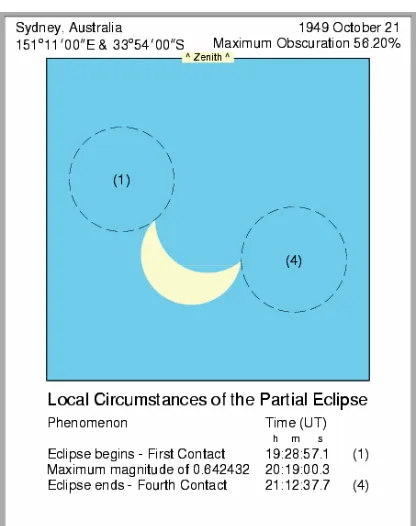
A second partial solar eclipse visible from eastern Australia occurred on 22 October 1949. On this occasion the eclipse occurred in the early morning Australian Eastern Standard Time. Figure 3 shows the local circumstances of this eclipse. The maximum obscuration from Sydney was 56% compared to 55% during the 1948 Eclipse.
[image:3.612.317.526.437.700.2]In a memo from Bowen to the Secretary of the C.S.I.R.O. the success of the 1948 observations at 600 MHz are noted. Bowen (1949b) stresses that as eclipses are rare events the Division should seize this opportunity to mount another major expedition. For this 1949 eclipse the intention was to observe at the higher frequency of 1,200 MHz. Besides repeating the previous year’s observations at the higher frequency, the intent was also to conduct polarisation measure-ments in order to obtain experimental evidence of the existence of a general magnetic field of the Sun.
Figure 4: An AN/TPS-3 radar in operation in 1944 (courtesy CE LCMS Historical Office Department of the Army, USA).
Two new temporary field stations were established for the eclipse observations. This was necessary as the partial eclipse occurred early in the morning and therefore a clear easterly aspect was required (unlike the sunset eclipse that had occurred in 1948). One of the new sites was at Bairnsdale aerodrome in
south-eastern Victoria (147º 35′ E; 37º 53′ S); the other was
at Eaglehawk Neck near Hobart in Tasmania (147º 56′
[image:4.612.87.297.421.600.2]E; 48º 01′ S).2
Figure 5: The 10-ft parabola being set up at Eaglehawk Neck for the 1949 eclipse observations. From left to right are Harragon, Murray and Yabsley (courtesy The Mercury).
Jim Hindman was placed in charge of the Bairnsdale observations with Howarth and Trensky supporting him. The Tasmania team led by Don Yabsley com-prised John Murray and Jack Harragon, and they were assisted by G. Ellis and N. Gerrard, research students in physics and electrical engineering respectively from the University of Tasmania (“Ready for today’s eclipse”, 1949). The same ex-Army surplus AN/TPS-3 portable 10-ft parabolic aerials that had been used in
1948 eclipse observations were used for the 1949 eclipse, except that a polar mount and a motor drive had been added, in order to automatically track the Sun (“Experts arrive …”, 1949; “Ready for today’s eclipse”, 1949).
The AN/TPS-3 radar aerial (Figure 4) had been developed during WWII by the U.S. Army Signal Corps as a light weight portable 600 MHz early warning radar (Orr, 1946). These aerials were also known as the ‘British Type-63 Radar’. The aerial was made up of eight 45º aluminium frame sections cover-ed with wire-mesh that could be packcover-ed in a very compact bundle and quickly reassembled through a series of speed-clips; according to John Murray (2007), two people could assemble an aerial in about five minutes.
Figure 5 shows the team setting up the antenna at Eaglehawk Neck, and Figure 6 shows them preparing to observe the eclipse. The equipment featured in the latter photograph included an Esterline-Angus chart recorder, and was housed in “… an unimpressive-looking caravan …” (Ready for today’s eclipse, 1949). In addition to the observers at the two remote sites, observations were also carried out at the Division’s Dover Heights and Potts Hill field stations in Sydney, and at the ‘Eagle’s Nest’, on the roof top of the Division’s Headquarters building in the grounds of the University of Sydney. Collectively, these observations spanned the frequencies of 9,400, 3,000, 1,200, 600, 200, 100 and 60 MHz (Bowen 1949c). As the eclipse occurred early in the morning, the measurements were complicated by ground reflection effects, and in order to allow for these, observations were made in the week leading up to the eclipse and for up to three days afterwards in order to obtain a base set of measure-ments.
Not to be left out of the action, Cla Allen from the Commonwealth Observatory at Mount Stromlo also observed the eclipse. He made use of the 4-Yagi array and receiver that was used for regular solar monitoring at 200 MHz (e.g. see Allen, 1947); this equipment was installed by Radiophysics staff back in 1946.
The preliminary results of the eclipse observations appeared in the minutes of the Radio Astronomy Com-mittee meeting of 17 November 1949 (Christiansen, 1949; our italics):
Report on Eclipse Records:
3-cm. Satisfactory record obtained at Sydney. Record shows a smooth change in intensity with time.
10-cm. Unsatisfactory record.
25-cm. Good results at Bairnsdale and Sydney. Eagle-hawk Neck record slightly doubtful. Records show effects of “active” areas on solar disk.
50-cm. Good record at Sydney. Effects of active areas can be seen.
150-cm. Sydney record shows diminution of activity after eclipsing of an active area, but otherwise appears to be of little value. Stromlo record unsatisfactory. 300-cm/500-cm. Eclipse record at Dover, Hornsby and Potts Hill shows diminution of activity when a certain area is eclipsed. The calculated position of the active area appears to agree with interferometer measurements at Potts Hill on day of eclipse, which suggest that the
source was off the limb of the solar disk. No decision
was made regarding publication of eclipse results.
The eclipse records have been partly analysed, but final conclusions have been formed. The records show a marked asymmetry about the maximum phase of the eclipse. Small changes in slope are not as clearly mark-ed as those in the 1948 eclipse records. An interesting feature of most eclipse records, to date, is that the west-limb of the sun appears to have great radio brightness. (Christiansen, 1950).
The only other recorded detail of the eclipse obser-vations outside the internal RP files is in the 1949/ 1950 Annual Report of the Division, which states:
The intensity of the radio waves from the sun has been observed systematically throughout most of the year on a number of wavelengths, namely 3, 10, 25, 50, 300 and 500 centimetres. During the partial solar eclipse of October 1949, these observations were extended to include simultaneous observations on 25 centimetres at two sites, one in Victoria and one in Tasmania. During the previous year the techniques had been successfully developed of using spaced receivers during an eclipse to determine the position on the sun of highly-emitting areas. The results this year may be less interesting from
this point of view (because the sun was rather free from
[image:5.612.317.526.61.263.2]such areas on the day of the eclipse) but, in cones-quence, more accurate measurements of the distribution of radio “brightness” across the “quiet” sun were ob-tained. (Bowen, 1950a; our italics).
Figure 6: The team examining a test recording immediately prior to the 1949 eclipse. From left to right are Murray, Ellis (standing) and Gerrard (courtesy The Mercury).
This report suggests that the Sun was free of sunspots at the time of the eclipse, but in fact there were eight sunspot groups visible on the day of the eclipse, which is comparable to the level of sunspot activity during the 1948 partial eclipse. Furthermore, Allen had supplied all three RP observing sites with a table listing the estimated times of covering and uncovering of the different sunspot groups during the eclipse. Four of the sunspot groups were considered major, two were old and two were new. Figure 7 shows the positions of the different sunspots, as supplied by Allen. Previously, Mount Stromlo had agreed to supply optical observations during the eclipse, but on the vital day the sky was completely overcast which prevented any observing.
Figure 7: Mount Stromlo prediction of probable positions of sunspots during the eclipse of 22 October 1949 (courtesy of the National Archives of Australia: 972423 - C3830 - C6/2/4).
The presence of sunspot groups on the day of the eclipse is independently supported by sunspot observa-tions made at the National Astronomical Observatory of Japan in Tokyo, as shown in Figure 8.
No optical observations were obtained at Mount Stromlo, but the Carter Observatory in Wellington (New Zealand) sent Bowen (1949d) thirteen photo-graphs that were taken during the eclipse. These clear-ly showed the presence of sunspot groups. Unfortun-ately no spectroheliograph observations were made at the Carter Observatory on the day of the eclipse.
Although it appears that the eclipse was successfully observed at many of the Radiophysics field stations and remote sites, there is very little information on
[image:5.612.86.295.325.540.2]record as to what results were obtained.3
Figure 8: Sunspot observations on 22 October 1949. Note that North is at the top and East is to the right (courtesy of the National Astronomical Observatory of Japan).
One of the few references in the Radiophysics files is a letter from Allen to Pawsey after the 200 MHz Mount Stromlo observations had been sent to Radio-physics for analysis. Allen (1949) noted:
[image:5.612.320.526.465.610.2]the movement was spoiling the record. Although poor, thought you may be able to recognise the true bursts by comparison with the Sydney recordings.
This letter was also circulated to Yabsley, Christiansen and Payne-Scott. Pawsey’s reply (1949) simply read:
I have passed it [the 200 MHz records] round among those who had similar recordings but we do not seem able to get much from it. This holds also for all our own long wavelength observations. The shorter wave-length ones are promising but the work of reduction is tedious and has not yet reached the interesting stage.
This is the last mention on file of the results of the observations. During the 1948 eclipse the most useful results had come from the 600 MHz measurements, while the higher frequencies gave less definitive in-formation as the Moon’s disk covered and uncovered different sunspot groups. However, the higher fre-quencies did indicate the possible presence of limb brightening.
Meanwhile, a letter from Bowen to Commonwealth Observatory Director, Richard Woolley, dated 6 Sep-tember (Bowen 1949a) noted that the 1949 observa-tions made at Sydney in the early morning could be complicated by ground effects, but since the low position of the Sun above the horizon was not dis-similar to that of the 1948 eclipse this could not be considered a major reason for the lack of published results.
It is interesting to note that the Cambridge group also produced a non-result when they observed a par-tial eclipse on 28 April 1949. In a letter to Pawsey dated 28 September 1949, Ryle (1949) noted:
I do not know if you have done any more experiments on the distribution of intensity across the solar disc. We were hoping to get some results during the partial eclipse in April and were recording on four frequencies. Unfortunately the sun did not co-operate and produced a largish “outburst” half-way through the eclipse which rather spoilt the experiments.
In response to a subsequent question from Ryle on plans for future eclipse observations, Joe Pawsey re-plied:
… we have no plans for observations though we regard the technique as very useful. You know of our 1948 eclipse observations here. A second one in 1949 has
not proved so fruitful owing to lack of solar activity at
the time. The results are not fully reduced yet ... I think
the longer wavelength observations suggested well worth while if feasible – so far we have had little joy from these at eclipses but the Russians did well. There is a large element of chance here owing to varying solar activity – I wish you luck.” (Pawsey, 1950; our italics).
Note that Pawsey cites a lack of solar activity at the time of the eclipse, despite clear evidence of sunspots being present. This may have indicated a minimum level of the slowly-varying component, even though sunspots were present.
Although the Radiophysics Division did not mount further eclipse expeditions after their unhappy 1949 experience, they did provide support for the U.S. Naval Research Laboratory when it observed the total solar eclipse of 12 September 1950. The eclipse was only partial in Australia, but observations were taken at Potts Hill and Dover Heights at 600, 3,000 and 9,400 MHz (Bowen, 1950b), and these provided an independent set of baselines for the U.S.
measure-ments. A similar service was also provided in support of J.F. Denisse’s French expedition to observe the 1
September 1951 solar eclipse.4
The last mention of the results of the 22 October 1949 eclipse observations found in the archives is a letter from Pawsey to M. Servajean at Meudon Observatory (in Paris) dated 6 April 1951. In this, Pawsey apologies for the delay in writing, explaining that he has been awaiting completion of the reduction of the observations, but these were still not finished. He notes:
[Enclosed] A sketch of the Sun at the time of the eclipse
of 21st October 1949, showing sunspots and areas of
excess brightness observed on 25 centimetres wavelength. At this eclipse the “bright” areas are much less well defined. Christiansen thinks the area well off the Sun (A) is real ... We tried but failed to do similar observations on metre wavelengths and so locate corresponding places of high emission at these longer wavelengths. The emission was too variable to apply this method. (Pawsey 1951).
This reference is perhaps the best indication of the results of the 1949 eclipse observations. Unlike the earlier suggestions, it is clear that enhanced radio emission was observed and correlated with sunspot areas in much the same way as during the 1948 eclipse. The clearest results from the 1948 eclipse had come from the 600 MHz observations, with the higher frequencies showing less definitive results. It seems that at the higher frequency of 1,200 MHz there was also a correlation in 1949, but it was much less well defined. Pawsey’s letter suggests that, if anything, the Sun may have been too active at the time of the eclipse as he notes the longer wavelength measurements were “… too variable”. This also tallies with a reference by Allen to observing bursts at 200 MHz during the eclipse. It is not clear why some of the earlier reports suggested a lack of solar activity on the day of the eclipse.
6 DISCUSSION
As no results of the 1949 eclipse observations were ever published a definitive statement of the results of the 1949 eclipse program cannot be presented. In our opinion, the most likely outcome was that after the very successful observations of 1948, the 1949 obser-vations provided no ‘new’ information of sufficient importance to warrant publication. The Division of Radiophysics had a particularly stringent internal ref-ereeing system for new research papers (see Sullivan, 2005), and the absence of any cancelled or rejected papers about this eclipse in the Radiophysics Archives at Epping (M. Goss, pers. comm., 2008) would strong-ly suggest that no manuscript was ever prepared for publication.
Perhaps it was this conspicuous non-result—after so much sustained effort—that finally inspired Christian-sen to develop his Potts Hill solar grating array (Christiansen and Warburton, 1953), so that he no longer had to wait for suitable solar eclipses in order to investigate the distribution of radio-emitting regions in the solar corona (see Christiansen, 1984: 117).
7 CONCLUDING REMARKS
1949 partial solar eclipse and it also provides back-ground information on the aborted Brazilian expedi-tion of 1947.
In this context, it is important to record not just the scientific ‘successes’ that occurred during the forma-tive years of radio astronomy in Australia—and there were many—but also the overall progress of scientific research, including the setbacks.
8 NOTES
1. The history of this pioneering radio telescope is recounted in Orchiston and Wendt (n.d.).
2. In Orchiston and Slee (2005: 135) the remote observation sites were incorrectly identified as Stra-han in Tasmania and a site near Sale in Victoria (while the actual sites were Eaglehawk Neck, near Hobart, in Tasmania and Bairnsdale aerodrome— which is near Sale). However, the correct sites were listed in a subsequent paper (Orchiston, Slee and Burman, 2006: 48).
3. John Murray (2007) has confirmed that successful observations were indeed made at Eaglehawk Neck in Tasmania.
4. For details of the French observations of this eclipse see Orchiston and Steinberg (2007: 13-15).
9 ACKNOWLEDGEMENTS
We are grateful to John Murray for sharing his re-collections of the expeditions to Strahan and Eagle-hawk Neck in Tasmania. We would also like to acknowledge the assistance of Kathryn Brennan from the National Archives of Australia for her help in accessing archive material and Takashi Sakurai from the National Astronomical Observatory of Japan for permission to reproduce Figure 8. We are also grate-ful to the LCMS Historical Office, Department of the
Army (USA) and The Mercury newspaper (Hobart,
Tasmania) for permission to publish Figures 4, 5 and 6. Finally, we wish to thank Miller Goss (NRAO), Jean-Louis Steinberg (Paris Observatory), Richard Strom (ASTRON) and Richard Wielebinski (MPIfR) for reading and commenting on the manuscript.
10 REFERENCES
Allen, C.W., 1947. Solar radio-noise at 200 Mc./s. and its
relation to solar observations. Monthly Notices of the
Royal Astronomical Society, 107, 386-396.
Allen, C.W., 1949. Letter to J.L. Pawsey dated 1November.
National Archives of Australia. 972422 – C3830 – A1/3/18 – Box 19.
Bolton, J.G., 1982. Radio astronomy at Dover Heights.
Pro-ceedings of the Astronomical Society of Australia, 4,
349-352.
Bolton, J.G., and Stanley, G.J., 1948. Report on Fire Damage to Army G.M.C. Truck. National Archives of Australia. 972422 – C3830 – A1/3/18 – Box 19.
Bowen, E.G., 1946. Letter to the Chief Executive of C.S.I.R. dated 12 August. National Archives of Australia. 972177 – C3830 – A1/2/12B – Box 3.
Bowen, E.G., 1948. Letter to the Secretary of C.S.I.R.O. dated 16 September. National Archives of Australia. 972422 – C3830 – A1/3/18 – Box 19.
Bowen, E.G., 1949a. Letter to R.v.d.R. Woolley dated 6 September. National Archives of Australia. 972423 – C3830 – A1/3/19 – Box 19.
Bowen, E.G., 1949b. Letter to the Secretary of C.S.I.R.O. dated 14 September. National Archives of Australia. 972423 – C3830 – A1/3/19 – Box 19.
Bowen, E.G., 1949c. Internal Memo noting observations would be conducted from 04:30 to 08:00 on roof of Radiophysics building, dated 18 October. National Archives of Australia. 972423 – C3830 – A1/3/19 – Box 19.
Bowen, E.G., 1949d. Letter to the Carter Observatory dated 7 December. National Archives of Australia. 972423 – C3830 – A1/3/19 – Box 19.
Bowen, E.G., 1950a. C.S.I.R.O. Division of Radiophysics Annual Report for Year Ended 30 June. National Archives of Australia. 972423 – C3830 – D2/49-50 – Box 50. Bowen, E.G., 1950b. Letter to Dr J.P. Hagen dated 10
Octo-ber. National Archives of Australia. 972100 – C3830 – A1/1/1 Part 5 Box 1.
Cerdena, D.I., Almeida, S.J., and Kneer, F., 2006. The dis-tribution of quiet Sun magnetic field strengths from 0 to
1800 G. Astrophysical Journal, 636, 496-509.
Christiansen, W.N., 1949. Minutes of Radio Astronomy Committee Meeting – November 17, 1949. National Ar-chives of Australia 972807 – C3830 –B2/2Part 2.
Christiansen, W.N., 1950. Minutes of Radio Astronomy Committee Meeting – January 10, 1950. National Ar-chives of Australia 972807 – C3830 –B2/2Part 2. Christiansen, W.N., and Warburton, J.A., 1953. The
dis-tribution of radio brightness over the solar disk at a wavelength of 21 cm. Part I – A new highly directional
aerial system. Australian Journal of Physics, 6, 190-202.
Christiansen, W.N., Yabsley, D.E., and Mills, B.Y., 1949a. Eclipse observations of solar radiation at a wave-length of
50 cm. Nature, 164, 635-637.
Christiansen, W.N., Yabsley, D.E., and Mills, B.Y., 1949b. Measurements of solar radiation at a wavelength of 50 centimetres during the eclipse of November 1, 1948.
Australian Journal of Scientific Research, 2, 506-523.
Covington, A.E., 1947. Microwave solar noise observations during the partial solar eclipse of November 23rd, 1946.
Nature, 159, 405-406.
Dagkesamanskii, R.D., 2007. The Pushchino Radio
Astrono-my Observatory: origin and first decade’s history.
Astro-nomische Nachrichten,328, 395-407.
Dickie, R.H., 1946. Microwave radiation from the Sun and
Moon. Astrophysical Journal, 103, 375-376.
Experts arrive for eclipse of Sun. The Mercury (Hobart
newspaper), 4 October 1949.
Hale, G.E., Seares, F.H., Van Maanen, A., and Ellerman, F., 1918. The general magnetic field of the Sun. Apparent variation of field-strength with level in the solar
atmo-sphere. Astrophysical Journal, 47, 206-254.
Hey, J.S., 1955. Solar radio eclipse observations. Vistas in
Astronomy, 1, 521-531.
McCready, L.L., Pawsey, J.L., and Payne-Scott, R., 1947. Solar radiation at radio frequencies and its relation to
sunspots. Proceedings of the Royal Society, A190,
357-375.
Martyn, D.F., 1946. Temperature radiation from the quiet
Sun in the radio spectrum. Nature, 158, 632-633.
Minnett, H.C., and Labrum, N.R., 1950. Solar radiation at a
wavelength of 3.18 centimetres. Australian Journal of
Scientific Research, 3, 60-71.
Murray, J.D., 2007. Telephone conversation with H.W. Wendt on 5 August. Notes in Wendt Collection.
Orchiston, W., 1993. New Zealand’s role in the
identi-fication of the first “radio stars”. Southern Stars, 35,
46-52.
Orchiston, W., 1994. John Bolton, Discrete sources, and the
New Zealand fieldtrip of 1948. Australian Journal of
Physics, 47, 541-547.
Orchiston, W., 2004. The 1948 solar eclipse and the genesis
of radio astronomy in Victoria. Journal of Astronomical
History and Heritage, 7, 118-121.
Orchiston, W., and Slee, B., 2005. The Radiophysics field stations and the early development of radio astronomy. In
Electromagnetic Window and Expanding our View of Planet Earth. Dordrecht, Springer. Pp. 119-168.
Orchiston, W., and Steinberg, J.-L., 2007. Highlighting the history of French radio astronomy. 2. The solar eclipse
observations of 1949-1954. Journal of Astronomical
Hist-ory and Heritage, 10, 11-19.
Orchiston, W., and Wendt, H., n.d. The contribution of the ex-Georges Heights experimental radar antenna to Australian radio astronomy. MS.
Orchiston, W., Slee, B., and Burman, R., 2006. The genesis
of solar radio astronomy in Australia. Journal of
Astro-nomical History and Heritage, 9, 35-56.
Orr, W.I., 1964. The secret tube that changed the war.
Popu-lar Electronics. March issue, 57-59, 103-105.
Pawsey, J.L., 1946a. Letter to Dr E.G. Bowen dated 20
Sep-tember. National Archives of Australia. 972177 – C3830 – A1/2/12B – Box 3.
Pawsey, J.L., 1946b. Letter to J.A. Ratcliffe dated 24 De-cember. Archives of Australia. 972177 – C3830 – A1/2/12B – Box 3.
Pawsey, J.L., 1946c. Notes on proposed 20 May 1947 Bra-zilian eclipse expedition, dated 11 October. National Archives of Australia. 972177 – C3830 – A1/2/12B – Box 3.
Pawsey, J.L., 1949. Letter to C.W. Allen dated 21 Novem-ber. National Archives of Australia. 972422 – C3830 – A1/3/18 – Box 19.
Pawsey, J.L., 1950. Letter to M. Ryle dated 31 March. National Archives of Australia. 972100 – C3830 – A1/1/1 Part 5 Box 1.
Pawsey, J.L., 1951. Letter to M. Servajean dated 6 April. National Archives of Australia. 972101 – C3830 – A1/1/1 Part 6 Box 1.
Piddington, J.H., and Hindman, J.V., 1949. Solar radiation at a wavelength of 10 centimetres including eclipse
obser-vations. Australian Journal of Scientific Research, 2,
524-538.
Ratcliffe, J.A., 1946. Letter to Dr E.G. Bowen dated 24 Sep-tember. National Archives of Australia. 972177 – C3830 – A1/2/12B – Box 3.
Ready for today’s eclipse. The Mercury (Hobart newspaper),
22 October 1949.
Robertson, P., 1992. Beyond Southern Skies. Radio
Astron-omy and the Parkes Telescope. Cambridge, Cambridge
University Press.
Ryle, M., 1949. Letter to J.L. Pawsey dated 28 September. National Archives of Australia. 9720099 – C38380 – A1/1/1 Part 4 Box 1.
Sander, K.F., 1947. Radio noise from the Sun at 3.2 cm.
Nature, 159, 506.
Smerd, S.F., 1950. The polarisation of thermal “Solar Noise” and a determination of the Sun’s general magnetic field.
Australian Journal of Scientific Research, 3, 265-273. Sullivan, W.T., 2005. The beginnings of Australian radio
astronomy. Journal of Astronomical History and
Heri-tage, 8, 11-32.
Harry Wendt, B.Sc. (Hon), M.Sc. (Astronomy), is a Doctoral student in the Centre for Astronomy at James Cook University, Townsville, Australia. His thesis topic is “The Contribution of the Division of Radiophysics Potts Hill Field Station to Inter-national Radio Astronomy”.
Dr Wayne Orchiston is a Senior Lecturer in Astronomy at James Cook University, Townsville, Australia. His main research interests relate to Cook voyage, Australian, French and New Zea-land astronomical history, with emphasis on the history of radio astronomy, comets, historically-significant telescopes, early astronomical groups and societies, and transits of Venus. He has published extensively, and has edited the book
The New Astronomy. Opening the Electromagnetic Window and Expanding our View of Planet Earth
(2005). He also has a book on early Australian radio astronomy, co-authored by Woody Sullivan and Jessica Chapman, which will be published by Springer in 2008. He is the Chair of the IAU Work-ing Group on Historic Radio Astronomy.