RUNNING HEAD: CAREER DEVELOPMENT
Reviewing Psychologists’ Qualifications for Career Development Practice in Australia
Peter McIlveen, University of Southern Queensland P. Nancey Hoare, University of Southern Queensland
Mary McMahon, The University of Queensland Wendy Patton, Queensland University of Technology
Corresponding Author:
Peter McIlveen
University of Southern Queensland Toowoomba 4350
AUSTRALIA 61 7 46312375 61 7 46312880 (fax) [email protected]
Abstract
Vocational psychology and the practice of career development are important dimensions of the psychology discipline and profession. This paper contains an overview of
Australian career development practice in light of recent trends, particularly the formalisation of career development practice amongst professions other than psychologist. Given the advent of the Professional Standards for Australian Career Development Practitioners, a review of postgraduate degrees in organisational, developmental and educational, and counselling psychology was conducted to
determine their correspondence with the competencies presented in the Standards. The review revealed significant consistency with generic competencies. Degrees in
organisational psychology provided the broadest correspondence; however degrees in counselling, developmental and educational psychology had lower levels of
Reviewing Psychologists’ Qualifications for Career Development Practice in Australia
The need to improve the quality of education and training for practice in the field of career development was highlighted in the international review of career guidance services conducted by the Organisation of Economic Cooperation and
Development (OECD, 2004). Subsequent to the OECD’s (2002) review of Australia’s career development industry there have been a number of significant changes in the domestic scene. Most notably, Australia is currently witnessing the organisation of a new profession Career Development Practitioner, particularly with the establishment of Professional Standards for Australian Career Development Practitioners under the aegis of the Career Industry Council of Australia (CICA, 2006). Although the professional activities of career development are not new to psychology—particularly the sub-discipline vocational psychology—the published stipulation of entry-level
qualifications, continuing professional development, and competencies for practice within the Professional Standards presents both an opportunity and a threat to the more established profession of psychologist in Australia. In the context of recent changes in the career development industry in Australia, it is therefore timely to reflect on the education and training of psychologists. In this paper, we firstly overview significant changes in the career development industry in Australia and the concomitant
requirements of the Professional Standards for Australian Career Development
Practitioners. Secondly, we report on a review of the postgraduate degrees available for psychologists. We conclude with a discussion of the implications.
move towards a personally determined and evolving future‖ (CICA, 2006, p. 38).
According to the Standards, a career development practitioner is a direct service provider who facilitates career development and, as a broad professional entity, may include amongst others occupations such as ―career counsellors, employment counsellors, career educators, career information specialists, career management
consultants, career practitioners, rehabilitation counsellors, work development officers‖
(CICA, 2006, p. 38). Typical career development practices can include career
assessment, career counselling, and career education with individuals or groups, or the design and delivery of career information services (e.g., occupational classifications). Career development services can be delivered in a variety of settings such as
educational institutions, workplaces, rehabilitation services, and mental health services. Many psychologists perform those professional activities. Indeed, psychologists have made a long-standing contribution to career development practice and vocational psychology in Australia (e.g., the development of psychometric instruments); however some scholars (e.g., Athanasou, 2008; Patton, 2005) have indicated that the position of psychologists in the field has been challenged due to a declining interest in the
discipline and the rise of other professionals in the field.
Career Development and Post-industrial Society
The world-of-work in the post-industrial society is markedly different from that of previous eras. Individuals are now confronted by globalisation, deregulation of labour markets, privatisation, technological advances, changing employment patterns, changing organisational forms and structures, demographic and labour market changes, changing balance of work and non-work life, changing psychological contracts,
world-of-work, the relative predictability of occupational certainty experienced by previous generations has given way to the flux and change inherent to the ―knowledge society‖ and post-industrial economies.
Indeed, the human capital reform agenda of the Council of Australian
Governments (2005) clearly indicates political pressure to move Australia toward new social, economic, and educational paradigms. Within the Australian industrial
landscape, for instance, the evolution of work is typified by the rise of Enterprise
Bargaining in the 1980s and 1990s, the emergence of Australian Workplace Agreements in the 21st century, and the repositioning of the traditional Award schemes. Career development theory and practice within Australia must likewise evolve abreast all this change (McMahon, Patton, & Tatham, 2003). There are, of course, significant attendant implications for the education, training, and professional development of psychologists within Australia, as well as internationally (DeBell, 2006), and it is our intention to address some of the implications within this paper from the perspective of how psychologists are educated and trained.
Career Development in Australia and Public Policy Initiatives
Association of Student Advisors, Queensland Guidance and Counselling Association, and the Rehabilitation Counselling Association of Australasia. Whilst individual psychologists who are members of the various Member Associations within the Career Industry Council of Australia are rightly represented according to their affiliation with their particular Member Association, the professional interests and needs of
psychologists per se cannot be addressed specifically because the Australian
Psychological Society (APS) is not a Member Association of CICA. Patton (2005) has asserted that these issues should be addressed by the psychology profession; presumably such representation would come from the APS.
In recent years, career development has come under close scrutiny from policy-makers interested in its capacity to deliver outcomes as a vehicle for personal and national productivity (Watts, 2000, 2005; Watts, Sweet, Haines, & McMahon, 2006). In this regard, international reviews of career development services have been
Australia is no exception when it comes to positioning career development practice as a vehicle for private and public benefit. Indeed, the macro-economic value to Australia of career development is putatively positive (Access Economics, 2006; Department of Education Science and Training, 2006). Notwithstanding the criticism Australia received from the OECD (2002) for the limited infrastructure underpinning the provision of career development services, Australia has demonstrated international leadership in promoting a career development culture (McMahon, 2005) and the construction of publicly accessible services. For example, the Australian Government has invested in a National Career Information System, presented for free public use as the website My Future (www.myfuture.edu.au). Furthermore, in response to the ―skills shortage‖ within various industries, the Australian government has also funded a network of career information services under the imprimatur of Careers Advice
Australia. These distributed services provide career-related information to Australians seeking information on how to enter various industries, typically those demanding labour supply. Perhaps the most optimistic vision of the career development industry and its contribution to nation-building in a knowledge-economy, is the Australian Blueprint for Career Development (Miles Morgan Australia, 2006). Under the auspices of the Ministerial Council for Education, Employment, Training, and Youth Affairs, the Blueprint sets out those career competencies deemed necessary for Australian citizens’ engagement in lifelong career development, integrating notions of lifelong education and employability (McMahon, Patton, & Tatham, 2003).
education resource (www.career.edu.au). The ACDS contains modules that range from an introduction to career development for curious individuals, parents and family, or interested supporters (e.g., sports coaches, community group leaders); through to a formal training module that may be assessed for a Certificate IV in Employment Services delivered by Registered Training Organisations; and upward to a module that may be assessed and granted credit as a postgraduate unit by universities registered as providers. The ACDS is a laudable achievement of public policy and is further evidence of a developing career development culture and infrastructure in Australia. Professional Standards
In addition to the aforementioned initiatives, the Australian Government has supported and funded CICA to develop and implement Professional Standards for Australian Career Development Practitioners (CICA, 2006). The political and policy impetus for the development of the Standards arose in response to the OECD review and, moreover, a request by then Commonwealth Minister for the Department of Education, Science, and Training (The Honourable Dr Brendan Nelson) that the industry self-regulate. A process of broad and inclusive consultations with industry stakeholders, commencing with the National Forum for Career Practitioners in 2005, resulted in the CICA releasing the Standards in 2006, with revisions in 2007. Though the Standards pertain directly to organisations under the aegis of CICA, their
The Professional Standards are consistent with those of other peak international career development bodies (e.g., International Association for Educational and
Vocational Guidance, National Career Development Association of the United States). Three important components of the Professional Standards are germane to this paper: entry-level qualifications, continuing professional development, and competencies.
The Professional Standards stipulate that the minimum entry-level qualification for Professional Career Development Practitioners is: (a) a Graduate Certificate
specifically in career development studies, or (b) a Vocational Graduate Certificate specifically in career development studies, or (c) an alternative pathway to professional status which includes (i) relevant postgraduate degree qualifications, (ii) significant career industry experience, and (iii) continued professional development of knowledge and skills apropos of the Professional Standards. The alternative pathway is akin to the model used by the Colleges of the APS. The Professional Standards also stipulate the minimum-entry qualification for an Associate Career Development Practitioner; however it is qualification for ―professional‖ status that is of focus in this paper.
The Professional Standards provide guidelines in seven Core Competencies of a career development practitioner, and include: (a) career development theory, (b) labour market, (c) advanced communication skills, (d) ethical practice, (e) diversity, (f) information and resource management, and (g) professional practice. The Professional Standards also stipulate competencies that are deemed Specialisations. The
those identified as specialists. In this paper, we will elucidate the areas of consistency and insufficiency through a review.
Psychology, Career Development, and Training
For over a century, psychology has maintained a significant association with career development through its various scientific disciplines (e.g., vocational
psychology, organisational psychology) and the professional disciplines that provide career development services. Within Australian psychology generally, there is a healthy volume of research pertaining to career development: for examples see Prideaux and Creed (2002) and Taft and Day (1988). Indeed, vocational psychology, and associated fields, was recently recorded as representing 10% of the research expertise of academics teaching the specialist discipline of organizational psychology (Carless & Taylor, 2006). Furthermore, the APS has acknowledged the centrality of work in peoples’ lives and related psychological issues for research and practice (Winefield et al., 2002).
Historically, it has been that practitioners mainly enter the field of career development from professions such as psychology, social work, and education, with little or no previous training specific to career development. As it did to other nations, the OECD (2002) criticised Australia for the inconsistency of training and the lack of a clear qualifications framework, reporting as follows:
The professional standards in different sectors conspicuously lack any coherence or consistency. They range from TAFE and Queensland schools, where career counselling is offered by registered psychologists who are over- and/or
whether they assure the requisite competencies or not. This risks undermining the field’s credibility in the eyes of fellow-professionals and the general public (p. 22).
The OECD report paradoxically suggested that Australian psychologists may be over-qualified in some sectors. We hasten to emphasise that this assertion did not equate to a conclusion that psychologists were unqualified. Instead, it meant that practitioners with masters or doctorate qualifications may have superior degree qualifications per se, but not necessarily with sufficient content specific to the requirements for the career
development industry. It is a complex point and one that requires careful consideration; and we pursue the point in this paper.
Patton (2005) noted that, within Australia, postgraduate degree qualifications specifically in career development were offered by Education Faculties; and Psychology Departments offered no specific degree majors, but only a limited number of elective units within degree programs. Postgraduate Certificates specialising in career
development studies, also articulating upward to higher degrees such as Master/Doctor of Education, were (at the time of writing this paper) variously offered by the Faculties of Education at Edith Cowan University, RMIT University, Australian Catholic
in determining the content of postgraduate degrees, we now overview the requirements for those Colleges.
Organisational Psychology
A survey of organisational psychology postgraduate students’ practicum work revealed substantial vocational assessment and counselling activities, with 30% and 47% of two samples indicating they had undertaken this type of professional learning experience (Carless et al., 2003). When we initially cross-referenced a descriptive study of postgraduate degrees in industrial and organisational psychology (Carless & Taylor, 2006), we found that the compulsory and elective content of the degrees described would partially align with the Professional Standards. For example, two topics that were obviously consistent with the Professional Standards, career development and labour/industrial relations were compulsory in 50% and 33%, and elective in 17% and 25% of degrees, respectively. This raised our interest in further exploring training for educational and developmental, and counselling psychologists.
Educational and Developmental Psychology
The APS acknowledges that educational and developmental psychologists provide assistance for the career guidance and school to work transition needs of adolescents and adults. However the guidelines developed by the College of
Educational and Developmental Psychologists to assist universities in preparing course submissions for postgraduate programs are silent on many of the requisite competencies to prepare psychologists to engage in career development work. For example,
training, and employment trends; the labour market; nor social issues. Core areas such as professional issues and skills training in interviewing, counselling, consultation, assessment and planning, implementing and evaluating educational and developmental interventions, are included. However, focus on an extensive career-related literature in career counselling and career assessment is absent. In addition to the lack of coverage in the College’s guidelines, the APS Guidelines for the Delivery of Effective Services by School Psychologists (APS, 2008) do not include career development practices which are relevant to students’ educational planning and outcomes (e.g., vocational assessment
of interests, skills, and abilities). Counselling Psychology
We noted tentative doubts being raised over counselling psychology’s coverage of career development (see Pelling, 2004). Similar to the Educational and Development Psychologists’ guidelines, absences are noted in the equivalent APS guidelines for the College of Counselling Psychologists, although it is noted that educational and
vocational issues may be covered through formal units or electives. The situation for counselling psychologists is made more complex by the limited number of training opportunities; with a total of only four specialist Master degrees nationally, and no degrees in Queensland and New South Wales, due to the rise of clinical majors (Patton, in press; Tindle, 2007).
Students of professional postgraduate degrees in psychology that are endorsed by the APS must complete practica under supervision, and whilst undertaking a practicum must address the professional competencies of their chosen APS
Professional Standards. Not only do psychologists have to comply with the APS requirements, they also have to comply with the Professional Standards if they belong to a Member Association of the CICA (Patton, in press). Such an overlap requires the management of multiple systems of competency development and sign-off, and the recording of continuing professional development. Nevertheless, there are examples of how this potentially onerous duplication of tasks can be successfully negotiated for a postgraduate degree practicum in a career development setting (e.g., McIlveen, 2004). The Need for a Review
The issue of training in vocational psychology and career development practice has been raised as a matter of international concern, over several decades (Patton & McMahon, 2006). One of the most significant issues facing career development internationally is the shortage of training programs and professionally trained staff to deliver career services to individuals who need them (Savickas, 2001; Savickas, van Esbroeck, & Herr, 2005). In the United States, for example, the additional problem of career development being minimised or marginalised in counsellor training programs has been identified (Hartung, 2005); and given the OECD’s review, that state of affairs warrants consideration in the Australian context. In a special issue of the premier journal in the field, Journal of Vocational Behaviour, which was dedicated to
considering the future of vocational psychology in the 21st century, Savickas’ (2001) emphasised the need to recommit to recruitment and training of vocational
new theoretical frameworks, and a diverse and complex array of career development client needs arising from a rapidly changing world of work, where are Australian psychologists and the professional work of career development located? Accordingly, there is a need to review the postgraduate psychology degrees that ostensibly prepare psychologists for career development practice, as respectively distinct from other postgraduate degrees (e.g., Graduate Certificate, Master of Education) and from other professionals in the career development field (e.g., career counsellors, guidance officers, human resources professionals, rehabilitation counsellors, occupational therapists, social workers).
Given that universities are the major providers of postgraduate education and training for psychologists in Australia, and that there are considerable forces inducing psychologists to study for a Master/Doctor degree in psychology, it is worthy to consider how career development is being taught by Australian universities at the postgraduate level. In order to assess psychology’s current postgraduate education and training for career development practice, we conducted a preliminary review of the postgraduate degrees that would, at least according to the requirements of their respective Colleges, prepare graduates for the career development practice.
Method
A list of current accredited postgraduate psychology programs was downloaded from the APS (2007) and the Australian Psychology Accreditation Council’s (APAC, 2007) websites. The specialist postgraduate master programs approved by each of the relevant APS Colleges—Educational and Developmental, Organisational, and
course information1 (where accessible) were downloaded from university websites and systematically examined for their alignment with the Professional Standards for Australian Career Development Practitioners (CICA, 2006). The course information available on the university websites was a brief overview of the content of the courses, generally no longer than a three-four sentence paragraph. Traditional research-only PhD degrees were excluded from the search. The competency categories in the
Standards include: career development theory, labour market, advanced communication skills, ethical practice, diversity, information and resource management, and
professional practice. Areas of specialisation include: assessment, counselling, program delivery, working with people with disabilities, project management, and employer liaison.
An analysis was conducted on the available course descriptions, whereby key words or phrases matching the Standards were identified. The following are examples of the key words or phrases used in the analysis: career, vocation, career development, career development theories, career management, work-related interests, work-related skills, career assessment, vocational assessment, labour market, advanced
communication, counselling, program delivery, ethical practice, diversity, disabilities, vocational rehabilitation, occupational rehabilitation, information and resource
management, technology, and professional practice. The analysis was an iterative process, whereby the course descriptions were initially scanned to familiarise the researcher with their content. The second review of the courses involved highlighting
1 Australian universities use different terminology. In this paper the term program refers to degree (i.e.,
Master) and the term course may refer to unit, subject, or topic (i.e., the component blocks combined to
key words or phrases that aligned with the Standards. A table was then created to cross-reference the content of the courses with the Standards. The CICA Standards were used as column headers and the university programs were listed as row headers. A further read-through of the course descriptions was carried out, this time entering course names along with a brief description of the content as it related to each of the standards, into the table. Finally, peripheral information was removed from the table so that it included only a brief summary of the course content.
Results
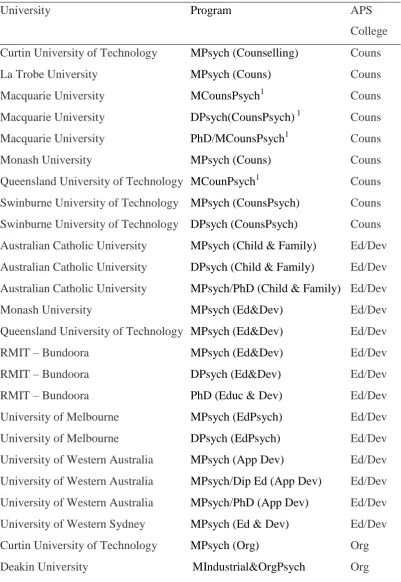
Table 1 provides a list of the postgraduate Psychology programs that were included in the analysis. A review of the programs listed in Table 1 indicated that the majority entailed courses in counselling, assessment, ethics, and professional practice, which are included in the Professional Standards as core competencies or areas of specialisation. Inspection of the courses revealed clear consistency with the Professional Standards; therefore this finding requires no further elucidation.
--- Insert Table 1 Here ---
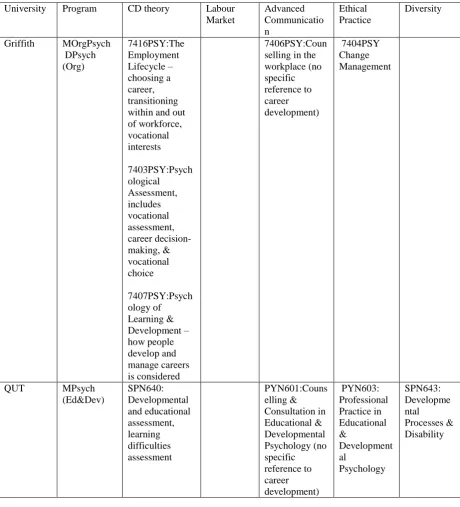
Table 2 presents a cross-reference between postgraduate program content and the Professional Standards for Australian Career Development Practitioners. Two of the standards are not included in the table (i.e., Information and Resource Management and Professional Practice) because all of the programs included professional practice and none of the programs referred to Information and Resource Management in the context of career development.
Insert Table 2 Here ---
The review did not reveal any specific course content in career development in the postgraduate degrees in Counselling Psychology or Educational/Developmental Psychology. As Table 2 indicates, several psychology departments offered courses that contained some career development theory and/or vocational assessment: Murdoch University, Griffith University, the University of Queensland, the University of New South Wales, the University of Adelaide, and the University of South Australia. The courses were offered as part of their Organisational or Occupational Psychology postgraduate programs.
Master of Organisational Psychology program makes a passing reference to vocational interests in the course, Advanced Personnel Assessment.
Two courses from the University of New South Wales’ Master of Psychology (Organisational) program include some career development content in their course descriptions: PSYC7001 Psychological Assessment includes training in the assessment of vocational interests, and PSYC7115 Vocational Interview & Counselling includes theory and practice of career choice and development, approaches to career decision-making, and the role of occupation information.
Two courses from the Master of Psychology (Work and Organisational) program offered by the University of South Australia include references to career development. Career development is a topic mentioned in the description for the course, Assessment and Development Centre; and the course Advanced Work and
Organisational Psychology includes theories of career development. Discussion
This review revealed that the majority of core competencies stipulated in the Professional Standards for Australian Career Development Practitioners are
appropriately treated within Australian postgraduate degrees in Organisational,
Educational/Developmental, and Counselling Psychology. Given psychology’s history, theoretical base, advanced status as a regulated profession, this result was not
alternative pathway to full professional membership of an Association under the aegis of CICA. However, the review’s results are not so reassuring on the topic of learning the core competency of career development theory and the specialist competency of vocational assessment. The review found that degrees in organisational psychology offered specific training in these areas; however, degrees in educational and
developmental, and counselling psychology were limited in their offerings. The competency pertaining to labour market studies was limited across the majority of degrees, with only a master of organisational psychology degree explicitly covering the topic.
The training and supervision of psychologists is thrown into critical relief when another profession emerges, and then takes a market position within one of
psychology’s traditional sub-disciplines and industry segments (cf. for counselling psychology, Patton, in press; Pryor & Bright, 2007), along with the support of professional associations, such as the Career Development Association of Australia, previously the Australian Association of Career Counsellors (see McMahon, 2006). After all, if it is the case that an individual who undertakes a Postgraduate Certificate specialising in career development (and thus has probably completed more courses of study in career development than an equivalent student of a Master/Doctor of
Psychology degree), and then continues on with studies articulating upward to
Master/Doctor of Education, for example, then it would be fair to ask the question: Who is the better qualified to practice in the area of career development? The implications of this question can lead in several directions.
services? It is likely that individual clients and agencies that purchase career development services on behalf of their own individual clients or for their
organisational clients’ employees (e.g., insurance providers) would be keen to hear the answer to the question. As part of its responsibilities to the community broadly, the CICA will promulgate the Standards and the qualifications framework it has established for those standards. We are concerned that psychology’s position may not be fully assured as the Standards take hold in the market. Secondly, what are the possible ramifications pertaining to the opposition of a psychologist and a non-psychologist both claiming status as a career development practitioner? How would an arbitrator decide the more qualified if such a question were put? Surely, an arbitrator would refer to the extant industry Standards and qualifications framework; and where would psychologists feature in that scenario? Finally, as professionals in the field, supervisors, and
educators, we are concerned with the question of how the training of psychologists can be measured up against a new industry benchmark of practice and training
requirements. How can we assure our students that they are indeed learning
Limitations
The review is limited with respect to its coverage of postgraduate degrees only, for it is possible that some universities offer specific courses in their undergraduate degrees. However, given that postgraduate training is tantamount to de rigueur for professional registration as a psychologist, our limited selection seems quite appropriate for the purpose of benchmarking against ―entry qualifications‖. Furthermore, given that
the review used only publicly available internet-based information readily accessible at front-facing, higher levels of program web pages, we admit that the review would be unable to drill down and uncover more detailed information at the lower levels, and the subtle means by which vocational psychology is being taught in various courses. It would not be unreasonable to counter this criticism by suggesting that those teaching vocational psychology subtly within their courses should have clearer public
documentation which better reveals course content. Furthermore, we admit that this type of public web information can be occasionally unreliable due to changes in programs and the lag in publishing new web pages.
Recommendation
The purpose of this study was to provide a preliminary survey of vocational psychology training for psychologists in Australia. Directly linked to this study’s limitation, with respect to analysing only publicly available website information about courses, we recommend that a future study undertakes a comprehensive audit of program and course structure and content. Such a definitive analysis would enable degree providers to better understand their degree programs’ alignment with the
reinvigorate interest in the teaching and learning of the discipline of vocational psychology.
In reflecting on the history of vocational psychology, Savickas and Baker (2005) stated that ―the field of vocational psychology is at a low ebb‖ (p. 15). Part of this apparent lethargy in the field can be attributed to the teaching of vocational psychology and its professional practices. This study revealed that postgraduate qualifications in organisational psychology by and large provide a strong foundation for career
References
Access Economics. (2006). The economic benefits of career development services: Scoping study by Access Economics Pty Ltd for The Career Industry Council of Australia.
Athanasou, J. A. (2008). Vocational psychology: Realising its true potential. Australian Journal of Career Development, 17(3), 3-5.
Australian Psychological Society. (2007). APS member groups. Retrieved 15 December, 2007, from http://www.groups.psychology.org.au/
Australian Psychological Society. (2008). Guidelines for the delivery of effective services by school psychologists. Retrieved 10 January, 2009, from http://www.psychology.org.au/Assets/Files/Guidelines-school-psychology-Dec08.pdf
Australian Psychology Accreditation Council. (2007). Search for courses by State. Retrieved 15 December, 2007, from http://www.apac.psychology.org.au/ Career Industry Council of Australia. (2006). Professional standards for Australian
career development practitioners. Carlton: Author.
Carless, S. A., Couzin-Wood, C., Duncan, C., Imber, A., Munro, J., & Novatsis, E. (2003). Practicum training for organisational psychologists: A survey of current and past students' attitudes. Australian Psychologist, 38(1), 55-61.
Carless, S. A., & Taylor, P. (2006). Industrial and organisational psychology training in Australia and New Zealand. Australian Psychologist, 41(2), 120-129.
Department of Education Science and Training. (2006). Shaping the future: Connecting career development and workforce development—Australia country paper. Australian Journal of Career Development, 15(3), 25-32.
Hansen, E. (2006). Career guidance. A resource handbook for low- and middle-income countries. Geneva: International Labour Office.
Hartung, P. J. (2005). Internationalizing career counseling: Emptying our cups and learning from each other. Career Development Quarterly, 54, 12-16.
McIlveen, P. (2004). A career counsellor internship program. Australian Journal of Career Development, 13(2), 9-15.
McMahon, M. (2005). Moving forward - shaping a career development culture: Quality standards, quality practice, quality outcomes: Careers Industry Council of Australia.
McMahon, M. (2006). Career counselling in Australia. International Journal of Psychology, 41(3), 174-179.
McMahon, M., Patton, W., & Tatham, P. (2003). Managing life learning and work in the 21st Century. Canberra: DEST.
Miles Morgan Australia. (2006). Australian blueprint for career development: Trial version May 2006: Commonwealth of Australia.
National Reform Initiative Working Group for the Council of Australian Governments. (2005). Human capital reform: Report by the COAG national reform initiative working group. Retrieved 12 November, 2007, from
Organisation for Economic Cooperation and Development. (2002). OECD review of career guidance policies. Australia country note. Retrieved 6 November, 2004, from
http://ezproxy.usq.edu.au/login?url=http://www.oecd.org/dataoecd/17/47/19483 41.pdf
Organisation for Economic Cooperation and Development. (2004). Career guidance and public policy: Bridging the gap. Paris: Author.
Patton, W. (2005). Career psychology in Australia: Where is it and where does it need to go? Paper presented at the 40th Australian Psychological Society Annual Conference Past Reflections, Future Directions, Melbourne.
Patton, W. (in press). At the crossroads: Counseling psychology in Australia. In L. Gerstein, P. Heppner, S. AEgisdottir, A. Leung & K. Nosworthy (Eds.),
Handbook of counseling and psychology around the globe. Thousand Oaks, CA: Sage.
Patton, W., & McMahon, M. (2006). Career development and systems theory: Connecting theory and practice. Rotterdam: Sense Publishers.
Pelling, N. (2004). Counselling psychology: Diversity and commonalities across the Western World. Counselling Psychology Quarterly, 17(3), 239-245.
Prideaux, L., & Creed, P. (2002). A review of career development research in Australia and New Zealand from 1995–2000. International Journal for Educational and Vocational Guidance, 2(1), 21-38.
Savickas, M. (2001). The next decade in vocational psychology: Mission and objectives. Journal of Vocational Behavior, 59(2), 284-290.
Savickas, M., & Baker, D. R. (2005). The history of vocational psychology:
Antecedents, origin, and early development. In M. Savickas & W. B. Walsh (Eds.), Handbook of Vocational Psychology (pp. 15-50). Mahwah, NJ: Lawrence Erlbaum Associates.
Savickas, M., van Esbroeck, R., & Herr, E. L. (2005). The internationalization of educational and vocational guidance. Career Development Quarterly, 54(1), 77-85.
Storey, J. A. (2000). 'Fracture lines' in the career environment. In A. Collin & R. A. Young (Eds.), The future of career (pp. 21-36). Cambridge, UK: Cambridge University Press.
Sultana, R. G. (2004). Guidance policies in the knowledge society: Trends, challenges and responses across Europe. Thessaloniki, Greece: European Centre for the Development of Vocational Training.
Taft, R., & Day, R. H. (1988). Psychology in Australia. Annual Review of Psychology, 39(1), 375-400.
Tindle, E. (2007). Vive le difference: Counselling and clinical psychology. Retrieved 7 November, 2007, from
http://www.groups.psychology.org.au/ccoun/publications/papers/vive/ Watts, A. G. (1999). The economic and social benefits of guidance. Educational and
Vocational Guidance Bulletin, 63, 12-19.
Watts, A. G. (2005). Career guidance policy: An international review. Career Development Quarterly, 54(1), 66-76.
Watts, A. G., & Fretwell, D. H. (2004). Public policies for career development. Case studies and emerging information and guidance systems in developing and transition economies. Retrieved 31 December, 2005, from
http://siteresources.worldbank.org/EDUCATION/Resources/278200-1099079877269/547664-1099079984605/PublicPolicy_CareerDev.pdf
Watts, A. G., Sweet, R., Haines, C., & McMahon, M. (2006). International symposium on career development and public policy: Synthesis of country papers.
Australian Journal of Career Development, 15(3), 33-44.
Table 1
Approved and Accredited Specialist Postgraduate Psychology Programs for APS Colleges of Education and Developmental, Organisational Psychologists, and Counselling Psychologists
University Program APS
College
Curtin University of Technology MPsych (Counselling) Couns
La Trobe University MPsych (Couns) Couns
Macquarie University MCounsPsych1 Couns
Macquarie University DPsych(CounsPsych) 1 Couns
Macquarie University PhD/MCounsPsych1 Couns
Monash University MPsych (Couns) Couns
Queensland University of Technology MCounPsych1 Couns
Swinburne University of Technology MPsych (CounsPsych) Couns
Swinburne University of Technology DPsych (CounsPsych) Couns
Australian Catholic University MPsych (Child & Family) Ed/Dev
Australian Catholic University DPsych (Child & Family) Ed/Dev
Australian Catholic University MPsych/PhD (Child & Family) Ed/Dev
Monash University MPsych (Ed&Dev) Ed/Dev
Queensland University of Technology MPsych (Ed&Dev) Ed/Dev
RMIT – Bundoora MPsych (Ed&Dev) Ed/Dev
RMIT – Bundoora DPsych (Ed&Dev) Ed/Dev
RMIT – Bundoora PhD (Educ & Dev) Ed/Dev
University of Melbourne MPsych (EdPsych) Ed/Dev
University of Melbourne DPsych (EdPsych) Ed/Dev
University of Western Australia MPsych (App Dev) Ed/Dev
University of Western Australia MPsych/Dip Ed (App Dev) Ed/Dev
University of Western Australia MPsych/PhD (App Dev) Ed/Dev
University of Western Sydney MPsych (Ed & Dev) Ed/Dev
Curtin University of Technology MPsych (Org) Org
Griffith University MPsych (Org) Org
Griffith University PhD (Org) Org
Griffith University MOrgPsych Org
Griffith University DPsych (Org) Org
Griffith University PhD OrgPsych Org
Macquarie University MOrgPsych Org
Macquarie University DPsych(OrgPsych) Org
Macquarie University PhD/MOrgPsych Org
Monash University MPsych(Org) Org
Monash University DPsych(Org) Org
Murdoch University MAppPsych/PhD
(Occupational)
Org
Murdoch University MAppPsych (Occupational) Org
Murdoch University DPsych (Occupational) Org
University of Adelaide
MPsych (Org & Human Factors)
Org
University of Melbourne MPsych (Org/Industrial) Org
University of Melbourne DPsych (Org/Industrial) Org
University of Melbourne MPsych (Org/Ind) / PhD Org
University of New South Wales MPsych (Organisational) Org
University of New South Wales MPsych/PhD (Organisational) Org
University of Queensland MOrgPsych Org
University of Queensland PhD (Organisational
Psychology)
Org
University of South Australia MPsych (Work & Org) Org
University of South Australia DPsych (Org) Org
University of Western Australia MPsych (Ind&Org) Org
University of Western Australia MPsych/PhD (Ind&Org) Org
Note. Couns = Counselling Psychology; Ed/Dev = Educational and Developmental Psychology; and Org
Table 2
Cross-Reference of University Postgraduate Programs to Professional Standards for Australian Career Development Practitioners
University Program CD theory Labour Market Advanced Communicatio n Ethical Practice Diversity
Griffith MOrgPsych DPsych (Org) 7416PSY:The Employment Lifecycle – choosing a career, transitioning within and out of workforce, vocational interests 7403PSY:Psych ological Assessment, includes vocational assessment, career decision-making, & vocational choice 7407PSY:Psych ology of Learning & Development – how people develop and manage careers is considered 7406PSY:Coun selling in the workplace (no specific reference to career development) 7404PSY Change Management
University Program CD theory Labour Market Advanced Communicatio n Ethical Practice Diversity
UQ MOrgPsych PSYC7494: Advanced Personnel Assessment (includes reference to vocational interests) PSYC7434: Organisational Communicatio n & PSYC7604 Professional Skill Development for Organisational Psychologists (no specific reference to career development) PSYC7604: Professional Skills Development for Organisation al Psychologist s
Macquarie MCounsPsyc h (No longer available)
MOrgPsych PSYO940: Psychological Assessment & Evaluation PSYC911: Advanced Lifespan Psychology for Counsellors (no specific reference to career development) PSYO921Orga nisational Change & Development (no specific reference to career development) PSY863: Research Design & Evaluation
UNSW MPsych (Org) PSYC7001:Psyc hological Assessment 1(includes reference to vocational interests) PSYC7115:Voc ational Interviewing & Counselling – theory and practice of career choice & development, career decision-making PSYC7115 :Vocational Interviewin g & Counsellin g includes the role of occupation al
information
University Program CD theory Labour Market Advanced Communicatio n Ethical Practice Diversity
UWS MPsych (Ed & Dev) Psychological Assessment; Developmental Psychology (no specific reference to career development) Counselling and ethical practice (no specific reference to career development) Core Skills: Counselling & Ethical Practice Counsellin g Children, Adolescents , & Families (no specific reference to career developmen t) UniAdelaid e MPsych (Org & Human Factors) PSYCHOL7207 Human Resource Management – considers issues of career development PSYCHOL7211 :Psychological Assessment: (no specific reference to career development) PSYCHOL720 9: Organisational Behaviour & Management includes communication as a topic (no specific reference to career development) PSYCHOL7 210: Professional & Ethical Practice PSYCHOL7 207 Ji,am Resource Managemen tconsiders cultural diversity in workplace, PSYCHOL 7110: Rehabilitati on & Disability
University Program CD theory Labour Market Advanced Communicatio n Ethical Practice Diversity
ACU MPsych (Child & Family/Ed& Dev) Psychological assessment courses (e.g., PSYC600 Clinical Assessment) (not specific to career development) PSYC604 Approaches to Counselling & Theory (no specific reference to career development) PSYC602 & PSYC604 – Includes ethical issues/princi ples
Deakin MIndustrial & OrgPsych HPS758 Psychological Assessment in Organisations (no specific reference to career development) HPS720 Conflict, Negotiation, & Mediation (no specific reference to career development) HPS759 Issues in Professional Ind/Org Psychology; PPS758 Psychologica l Assessment in Organisation s
La Trobe MPsych (Couns) PSY5MAA; PSY5MAB - Psychological assessment courses (no specific reference to career development) Individual & group counselling courses (e.g., PSY5MGC; PSY5MSA) - no specific reference to career development) PSY5MAA Psychologica l Assessment
Monash MPsych (Couns)
University Program CD theory Labour Market Advanced Communicatio n Ethical Practice Diversity
Monash MPsych (Org) MOP5021 Personnel Assessment - (includes assessment of personality abilities, and specific work skills) MOP6031 Psychological Interventions in Organisations (no specific reference to career development) MOP5011 Legal & Ethical Issues in Professional Practice Course objectives refer to cultural diversity
RMIT MPsych (Ed&Dev) DPsych (Ed&Dev) Assessment & Intervention courses (no specific reference to career development) Foundations of Practice (no specific reference to career development) Foundations of Practice – refers to ethical principles
Swinburne MPsych (CounsPsych ) DPsych (CounsPsych ) HAY527/HAY6 27 Advanced Psychological Assessment (no specific reference to career development) HAY530-HAY630 Counselling Theories & Skills (no specific reference to career development) HAY543-HAY643 Professional, Ethical & Legal Issues
University Program CD theory Labour Market Advanced Communicatio n Ethical Practice Diversity
Curtin MPsych (Counselling ) Psychology 711 - Psychological Assessment (no specific reference to career development) Psychology 705 - Interventions Over The Lifespan; Psychology 795 - Preparation for Professional Practice (Counselling Psychology); Psychology 706 - Group Psychotherapy (no specific reference to career development) Psychology 795 - Preparation for Professional Practice (Counselling Psychology); MPsych (Org) No details available for this program
Murdoch MAppPsych (Occ) DPsych (Occl) PSY562 Psychological Assessment Methods (includes vocational tests) EDU645 Adult learning in education and work – examines theories and research in vocational settings as a component
PSY531 &
PSY532Princip les of Counselling; PSY624 Counselling: Working with Organisations (no specific reference to career development) PSY563 Professional Practice and Organisation al Consulting EDU646 Cultural diversity in learning and working