Does Relational Capital Mediate the Effects of Export Knowledge on Firm
Performance?
Doren Chadee
School of Management and Marketing The University of Southern Queensland, Australia
Banjo Roxas
School of Management and Marketing The University of Southern Queensland, Australia
Abstract
Background: Small exporting firms from a developing economy like the Philippines need to build and nurture their relation capital as well as gain adequate knowledge about exporting in order to succeed in their export ventures. Given the institutional voids in developing economies, relational capital and export knowledge have become critical sources of competitive advantage that enable these small firms to successfully exploit business opportunities overseas. It is not clear however, how relational capital and export knowledge relate to each other such that they synergistically and positively contribute to firm performance in the context of small exporters in the Philippines.
Aims: This paper challenges the conventional view that relational capital is an antecedent to knowledge within the firm. Rather, we argue that relational capital is the mechanism through which knowledge is able to influence firm performance, particularly for exporting SMEs in developing countries. The main purpose is to test the direct, indirect and mediating effects of relational capital on the relationship between export knowledge and firm performance.
Method: The study uses survey data from a sample of 175 SMEs engaged in exporting from the Philippines. SEM is used to estimate the direct, indirect and mediating effects similar to the approach used by Kelloway (1998) and James & Brett (1984).
Results: The results confirm that both export knowledge and relational capital are positively related to firm performance and that the latter has partial mediating effects on the relationship between export knowledge and firm performance.
Conclusion:The findings challenge the conventional wisdom that export knowledge is an antecedent to relational capital. The findings in this study suggest that relational capital allows firms to exploit existing export knowledge and they are able to improve their performance despite the institutional void often present in developing countries.
Keywords export knowledge, relational capital, performance, Philippines.
1. Introduction
The resource-based view of the firm (RBV) highlights the importance of rare, inimitable and non-substitutable resources to the competitive advantage and performance of firms (Barney 2007; Federico, Kantis, Rialp & Rialp 2009; Mejri & Umemoto 2009; Wernerfelt 1984). Knowledge, particularly tacit knowledge, has also been recognised as one of the firm‘s resources with the potential to contribute the most to its competitive advantage (Barney 2007; Morgan, Zou, Vorhies, Katsikeas 2003; Newbert 2007; Xu, Huang & Gao 2010; Kogut & Zander 2003; Nonaka 1994). However, a firm can augment knowledge-based resources by actively engaging with knowledge based institutions such as universities, consultants and government agencies or through informal and formal industry networks.
and managerial ties have been found to be particularly important resources for small and medium size enterprises (SMEs) in developing countries (Ellis 2010; Pollard & Jemicz 2010).
Although knowledge and relational capital have been found to be separately important determinants of the performance of firms in general, it is less clear how knowledge does in fact contribute towards their performance (Mejri & Umemoto 2010). A firm can have a stock of tacit and codified knowledge but such knowledge by itself does not necessarily lead to superior performance unless the firm can exploit such knowledge.
One sector in which SMEs from developing countries find it particularly difficult to grow and compete is the export sector. This is because SMEs from developing countries have relatively limited resources to compete against large companies in the international market place. Because of the lack of well-developed support infrastructures for exporters in developing countries and in order to mitigate the liability of foreignness, developing country SMEs often acquire and exploit export knowledge through formal and informal networking with trade and industry associations.
Although knowledge resources and relational capital are considered to be important elements of the international activities of firms, the interplay among them remain under-researched (Federico et al 2009) particularly for SMEs exporting from developing countries (Ma et al 2009; Manolova et al 2009). Relational capital is conventionally considered as an antecedent to the accumulation of firm resources. However, in this paper we argue that exporters already possess sufficient knowledge by the very fact that they are actively exporting. We argue that in the context of SMEs from developing countries, exporters have access to codified export knowledge from varied sources, in particular from the world wide web and the web sites of foreign governments and agencies. However, codified knowledge does not constitute a source of competitiveness because it is widely available and accessible (Nonaka, 1994). Thus, firms which have well developed relational capital are more likely to have access to more tacit export knowledge in order to exploit international market opportunities. For this reason, in this paper we argue that relational capital is a mediating variable between the firm‘s knowledge resource and performance. Relational capital helps explain why a relationship exists between knowledge and performance. Building on the resource base view of the firm (Barney 2007), this study argues that in addition to having export knowledge, small exporting firms must have relational capital in order to exploit tacit knowledge to facilitate access to foreign markets, and fill the institutional voids such as bureaucratic rigidities in dealing with government agencies particularly in developing countries.
The rest of the paper is organised as follows. The next section presents the theoretical basis for the conceptual model of study and the hypotheses. Section 3 presents the data and measures used. The model estimation and discussion of results are contained in section 4 followed by the conclusion, limitations of the study and areas for future research in the last section.
2. Conceptual Model and Hypotheses
Research on the export performance of firms abounds in the literature (Abby and Slater, 1989; Cavusgil and Zhou, 1994; Sousa, Lopez & Coelho 2008). Traditionally, export performance research have focused on how firm characteristics and their resources influence the performance of exporters. Firm resources traditionally considered include management and financial resources. The resource -based view (RBV) of the firm posits that only resources that are valuable, rare, inimitable and non-substitutable are a source of the firm‘s competitive advantage (Barney 1991; 2007; Wernerfelt 1984). Knowledge and relational capital have been identified explicitly and acknowledged as being rare, inimitable, and non-substitutable mainly because of their intangible and dynamic nature (Chrisholm & Nielsen 2009; Federico et al 2009). Although the roles of export knowledge and relational capital have been studied in relation to firm performance and competitiveness, these two factors have been studied independently and in isolation of each other. Furthermore, a review of the literature suggests that research between export knowledge, relational capital and performance for exporters remain underdeveloped. This is a particularly important gap in the literature because exporters often operate in a more complex environment than purely domestic firms and often they require sophisticated export market intelligence in order to compete successfully in the international market place.
cooperate in order to be able to access and utilise export knowledge and successfully exploit export market opportunities. One way of achieving this is through the development of networks and formal and informal relationships with key industry players which facilitate the transformation of export knowledge into superior performance. For the purposes of this study, these networks of relationships are termed relational capital. Figure 1 shows the relationship between export knowledge and performance and suggests that relational capital is the mechanism through which export knowledge is able to influence the performance of the firm.
+
Figure 1. Export Knowledge, Relational capital and Performance: Conceptual model
Relational capital has traditionally been viewed as an antecedent to knowledge accumulation and creation within the firm (Anderson et al 2010; Luo 2003). The current study challenges this view by arguing that relational capital is a strategic asset that even the most ‗knowledgeable‘ firm needs to build and exploit in order to facilitate access to export markets. This is particularly applicable to small exporting firms in emerging economies where firms operate in environments characterised as having unpredictable and unstable institutions (Peng et al 2008; Roxas et al 2009; Wu & Leung 2005). Having knowledge about exporting is not sufficient for firms to succeed in their export ventures although knowledge by itself has been found to be an important element of performance (Ellis 2010).
2.1 Review of literature and hypotheses Export knowledge and export performance
Knowledge resources form part of the firm‘s bundle of intangible resources which are increasingly being recognised as being the most valuable assets of the firm for competitive advantage (Barney 2007; Wernerfelt 1984; Locket et al., 2009; Newbert 2007; Sousa et al., 2008). The role of knowledge resources in the internationalisation and performance of firms is also well established in the international business and export marketing literatures. The ability of the firm to effectively and efficiently respond by adapting its product offerings to particular target export markets depends critically on how knowledgeable the firm is about these markets (Morgan et al 2003). Knowledge about an export venture‘s potential, consumers, competitors, marketing channels and the broader environment in the target export market allows the firm to strategically reconfigure its existing resources and develop adaptive strategies to take advantage of export opportunities and minimise risks (Cavusgil & Zhou 1994; Morgan et al 2003; Toften 2005). Thus, the ‗knowledgeable‘ exporting firm is more likely to be competitive in international markets and consequently enjoys better overall export performance. Hence the following hypothesis:
H1 - Export knowledge is positively associated with export performance.
Relational capital and export performance
Relational capital refers to formal and informal relationship which firms or rather their owner/managers and employees have developed internally and externally (Li 2007; Ma et al. 2009; Federico et al. 2009). According to the social capital literature, firms do not operate in isolation but rather, are embedded in a network of relationships as they create value (Ma et al 2009; Manolova et al 2009). This network of relationships with other firms, other economic or social entities, and individuals generate some form of intangible relational assets that are valuable to the firm. As this type of resources is highly inimitable and non-substitutable they can potentially endow firms with strategic benefits essential for the creation of sustainable competitive advantage (Chrisholm & Nielsen 2009; Lages, Silva, Styles, & Pereira 2009; Barney 2007)
Previous studies on relational capital have emphasised the importance of inter-firm networks as well as networks of owners or managers and on how these social relations act as conduits or channels through which externally available resources are funnelled into the firm (Ellis, 2010; Li 2007; Ma et al
Export knowledge
Export performance
Relational capital
2009; Newbert 2007). The network model of internationalisation (e.g. Hadley & Wilson 2003; Ellis 2010; Federico et al 2009) also emphasizes that a firm‘s performance in its export ventures depends largely on its ability to build and maintain strong and reliable network of relationships both in the home country and in foreign markets. Relational capital provides the firm with an understanding of possible constraints and opportunities for its export operations (Hadley & Wilson 2003). Hence the following hypothesis:
H2 – Relational capital is positively associated with export performance.
Mediating effects of relational capital
The main contention of this paper is that contrary to the conventional view that relational capital is an antecedent of export knowledge, relational capital provides a mechanism for firms to exploit their export knowledge in order to improve their performance. Relational capital has been found to help channel valuable resources into the firm (Lim & Cu 2010; Manolova et al 2009; Pollard & Jemicz 2010). Furthermore, in today‘s knowledge based economy, knowledge is widely available and often firms are overwhelmed with the quantity and quality of knowledge available to them. And, the environments in which firms operate is often characterised as having shorter product life cycles and more demanding consumers. Firms in developing economies, in particular, operate within institutional environments that are less reliable and predictable adding substantial transaction costs for business operations domestically and internationally (Gao et al 2008; Roxas et al 2009; Peng et al 2008). In such environments it is not sufficient for firms to have export knowledge. Rather, firms must develop and nurture their relational capital in order to exploit their knowledge base, facilitate access to foreign markets, and fill a host of institutional voids (Luo 2003; Manolova et al 2009). Hence it is postulated that SMEs can improve their export performance by using their relational capital to exploit export knowledge.
H3 – Relational capital mediates the relationship between export knowledge and export performance.
3. Sample and Data
The data used in this study form part of a large-scale survey of SMEs conducted in 2007-2008 in three cities in the Mindanao region, southern Philippines. An estimated 750,000 SMEs form the backbone of the economy in the Philippines and account for almost 70% of the country‘s total employment, 30% of the country‘s gross domestic product (GDP) and more than 25% of the country‘s total export revenue (Aldaba 2008). SMEs also represent almost 60% of all exporting firms in the manufacturing sector (DTI 2006). Despite the dominant and critical role of SMEs in the Philippines, research on the behaviour and performance of SMEs engaged in export remains underdeveloped. A sample of 1600 SMEs identified from the local government‘s business registry was first targeted. A number of fieldworkers were used to personally deliver and collect the questionnaires to and from participants in order to ensure a high response rate. The questionnaire contained questions relating to the firm characteristics, the main business activities and also sought management‘s responses to the importance of relational capital. From the returned questionnaires, a total of 1056 responses were deemed fully complete. From this sample, we identified and retained 175 manufacturing firms which were actively exporting for the purposes of the present analysis.
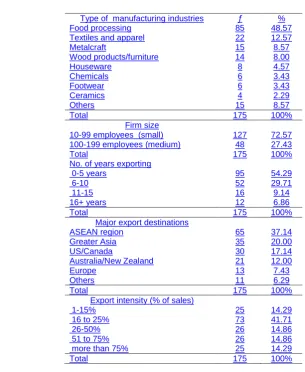
Table 1 summarises selected characteristics of the sample. An analysis of the sample characteristics indicate that the sample included close to 45 percent of experienced exporters (> 6 years of export experience). The majority of firms were in the food processing sector (48%) and almost 72 percent are classified as small (with 10-99 employees). Interestingly, export accounts for more than 50 percent of the revenues of approximately 30 percent of firms in the sample. Overall, for the vast majority of firms in the sample (85%), exports accounted for at least 15 % of their total sales. In terms of export destination, it is not surprising that the majority of firms (57%) were exporting to neighbouring countries where the ‗liability of foreignness‘ is the least.
3.1 Measurement
Type of manufacturing industries ƒ %
Food processing 85 48.57
Textiles and apparel 22 12.57
Metalcraft 15 8.57
Wood products/furniture 14 8.00
Houseware 8 4.57
Chemicals 6 3.43
Footwear 6 3.43
Ceramics 4 2.29
Others 15 8.57
Total 175 100%
Firm size
10-99 employees (small) 127 72.57 100-199 employees (medium) 48 27.43
Total 175 100%
No. of years exporting
0-5 years 95 54.29
6-10 52 29.71
11-15 16 9.14
16+ years 12 6.86
Total 175 100%
Major export destinations
ASEAN region 65 37.14
Greater Asia 35 20.00
US/Canada 30 17.14
Australia/New Zealand 21 12.00
Europe 13 7.43
Others 11 6.29
Total 175 100%
Export intensity (% of sales)
1-15% 25 14.29
16 to 25% 73 41.71
26-50% 26 14.86
51 to 75% 26 14.86
more than 75% 25 14.29
[image:5.595.54.360.133.506.2]Total 175 100%
Table 1 – Demographic characteristics of the sample firms – here
Export knowledge: In the questionnaire, respondents were asked to rate the importance of a series of questions designed to gauge their familiarity with export activities on a 7 point Likert-type scale. The 8 items related to export knowledge was adapted from Shamsuddoha and Ali (2006) and included statements such as, ―We have current information about foreign government regulations that affect our markets; and we know the economic situation in our foreign markets.‖ (see Table 2). The items were designed to capture two salient dimensions of export knowledge namely knowledge of the nature of export markets and knowledge of the necessary steps involved in gaining access to these markets (Toften 2005; Wang & Olsen 2002).
to 7= strongly agree). A sample item states ―There is close personal interaction between my firm and our export partners‖ (see table 2).
The focus on SMEs exporters from developing countries where typically firms face complex administrative barriers from government agencies, financial institutions and so on necessitated the development of a new construct to measure the quality of relationships between the exporting firms and government entities that they have to deal with on a regular basis. A construct called ‗institutional relationship‘ was developed with 5 measured on a 7-point Likert type response scale (1- strongly disagree to 7 strongly agree). A sample item states ―We have reliable relationships with government agencies relevant in our exporting activities.‖
Control variables: A number of control variables were also included in the study, including firm size measured as the number of employees and firm experience measured as the number of years of exporting. For the experience variable, respondents were asked to indicate their export experience on a 4 point scale (e.g. 1 = 0-5 years and 4 = over 16 years).
4. Model Estimation and Discussion of Results
Structural equation modelling (SEM) was used to test hypotheses H1 to H3 of the study aided by the software called EQS 6.1 (Bentler, 1995) using Anderson‘s and Gerbing‘s (1988) two step approach. Confirmatory factor analysis (CFA) was performed on all of the constructs using maximum likelihood technique (Brown, 2006). Details of the CFA summarise in Table 2 show that all of the items measuring each of the four constructs loaded highly on the pre-determined factors with no path estimate less than the 0.5 minimum acceptable value (Brown, 2006). All constructs showed acceptable level of reliability as evidenced by the high internal consistency coefficients (i.e. Cronbach α and the Joreskog rho). Convergent validity was indicated by the fact that the items loaded significantly on their corresponding construct (Bagozzi, Yi & Phillips 1991). Further evidence of convergent validity were the average variance extracted (AVE) values which were all above the threshold of .50 indicating that the constructs contained less than 50% error variance (Fornell & Larcker, 1981). Discriminant validity was established after knowing that the square root of each construct‘s AVE was found to be larger than its correlations with other constructs as shown in Table 2 (Fornell & Larcker, 1981).
Constructs and Corresponding Indicators Standardised factor loadings* Export knowledge (ave = .81) α = .88 rho = .90 The firm is able to arrange shipping and forwarding without difficulty. .96 The firm is able to prepare and handle necessary export documentation. .86 The salespeople are sufficiently knowledgeable about our existing foreign
markets. .95
Overall, we have sufficient information about the foreign markets we are
serving. .93
We have current information about foreign government regulations that
affect our markets. .88
We know the economic situation in our export markets. .91 We have sufficient knowledge about the international marketing services
available for private and public sources. .91
We have the skills and knowledge to cope with the challenge of
globalization. .81
Partner relationship (ave = .78) α = .89 rho = .78 There is close personal interaction between my firm and our export
partners. .75
The relationship between my firm and our export partners is characterised
by mutual respect. .85
The relationship between my firm and our export partners is characterised
by mutual trust. .71
The relationship between my firm and our export partners is characterised
by personal friendship. .78
The relationship between my firm and our export partners is characterised
by high degree of reciprocity. .81
Institutional relationship (ave = .84) α = .82 rho = .92 We have reliable relationships with government agencies relevant to our
exporting activities. .86
We have reliable relationships with financial institutions necessary for our
exporting activities. .97
We have reliable relationships with trade and business associations to
gather information and support for our exporting activities. .92 We have reliable relationships with other shipping and forwarding
companies that we engaged with our exporting activities. .97 We have reliable business relationships with other private companies that
are directly involved in our exporting activities. .86 Export Performance (ave = .79) α = .91 rho = .93 Indicate whether the results of export activities have met or exceeded your
expectations over the past three years with respect to:
overall export sales .91
export profit .95
*all significant at .05 (i.e. test statistic > +1.96)
AVE = average variance extracted based on standardised solutions α = Cronbach alpha
rho = Joreskog rho
Table 2. The measurement model - here
Variables mean SD PR IR EK EP FS EXP Partner relationship (PR) 4.52 1.08 .88
Institutional relationship (IR) 5.21 1.12 .33* .92 Export knowledge (EK) 4.42 1.35 .72* .69* .90 Export performance (EP) 4.13 1.13 .67* .62 .76* .89 Firm Size (FS) 43.25 15.74 .21* .28* .18* .12 n/a No. of Years of Exporting
Experience (EXP)
1.40 .80 .36* .41* .16* .11* .40* n/a
SD - standard deviation *significant at p < .05
in bold, diagonal figures show the square root of average variance extracted (AVE) values n/a - not applicable for AVE computation
Table 3. Descriptive statistics
4.1 Hypothesis Testing with Mediation Models
The second step of Andersen and Gerbing‘s (1988) approach to structural equation modelling requires the development and testing of the structural models in order to test the posited hypotheses. Using EQS‘s maximum likelihood technique with robust function for error correction, three nested structural models were developed and tested following the procedures suggested by Kelloway (1998) and James & Brett (1984) on mediation analysis using structural equation modelling. The various path coefficients are summarised in Figure 2. The first model (model A) shows full mediat ion such that the two types of relational capital fully mediate the relationship between export knowledge and export performance. The second model (model B) is a partially-mediated model whereby the two types of relational capital partially mediate the relationship between export knowledge and export performance. This model identifies some other direct effects which cannot be accounted for by the two types of relational capital. The last nested model (model C) indicates that there is no mediation in any of the relationships tested in the model.
Insert - Figure 2. The structural models - here
The path coefficients were all significant at 0.05 level of confidence. The empirical evidence as shown in Model B suggested that export knowledge is positively associated with the two types of relational capital. On the other hand, the two types of relational capital are also positively associated with high levels of export performance. The empirical evidence support H1 and H2. Given the r2 values of 0.26 to 0.31, the indicators of effect size suggest that despite having relatively small yet significant path coefficients, the results could be considered practically significant and meaningful from which inferences could be drawn (Field, 2005; Pedhazur, 1982).
Firm size and export experience are also statistically significantly correlated with a number of the variables in the structural models. The results suggest that larger firms are more likely to report higher levels of export knowledge and higher levels of relational capital. Firms with greater export experience are also more likely to report higher levels of export knowledge, relational capital, export intensity and overall export performance.
5. Conclusions and Directions for Future Research
The analysis in this paper shows that export knowledge, relational capital and the firm‘s export performance are positively related. The results are consistent with the RBV which suggest that a firm‘s rare resources (e.g. export knowledge and relational capital) are likely to generate positive rates of return (Barney 2007). A firm that has adequate stock of knowledge and has sufficiently well-developed formal and informal relationships with other firms, government and non-governmental organisations is likely to have better performance.
The findings also highlights the role of relational capital or networks as manifestation of social capital that can be leveraged to support the export activities of small firms. The results address one of the issues suggested by Jones et al (2009) on the linkage between networks and international opportunity recognition and exploitation. Small exporting firms are likely to succeed in their export ventures if they have close and reliable partnerships with their customers as well as the various government agencies, financial institutions, and other firms that have some degree of bearing on the firms‘ export activities. These networks serve as conduits or facilitators that enable exporters to effectively deal with the complexity and uncertainty associated with exporting.
The main contribution of the study is in establishing the mediating role of relational capital in the export knowledge – export performance linkage. Previous studies viewed relational capital as an antecedent in the accumulation of firm resources. However, the current study provides empirical evidence that this is not necessarily the case. The empirical evidence suggests that firms with higher can utilise relational capital to exploit export knowledge and improve their performance. One plausible explanation is that export knowledge is useful for firms to identify other players in the industry whom they think could be of help in dealing with the intricacies, obstacles and other challenges associated with exporting. This is particularly relevant for small exporting firms in emerging economies like the Philippines where well developed infrastructures for assisting small exporters are generally lacking.
The contribution of relational capital in the competitive advantage of exporting firms stems from its inimitability. Firms form and maintain their networks in ways that are unique and specific to their historical conditions over an extended period of time. The path dependence of network formation transforms social capital as a unique and inimitable resource-base. Inimitability is further enhanced by the socially-complex nature of the firm‘s social capital which makes it particularly difficult to be reconfigured by others. Moreover, some forms of networks such as close relationships with specific export partners are non-substitutable which makes social capital even more valuable to a firm in possession of such type of intangible resource.
The study has several limitations and as such the findings should be interpreted with caution. First, the data relates to a sample of firms from the Philippines and therefore cannot be generalise to SMEs in general because different countries have different institutional frameworks within which firms operate. Thus, these results reflect the experience of SME in the Philippines only. The second limitation of the study relates to the broad operationalisation of the dependent variable. Although there is a dearth of research on export performance, data constraint in the present study limited our focus on only two indicators of performance.
other settings, including other developing economies and advanced economies. More research on the mediating effects of relational capital would hopefully provide greater support for the main argument in this paper, that is, relational capital provides the mechanism through which export knowledge is exploited and allows firms to improve their performance. Other research avenues include investigating other forms of relational capital that a small firm develops over time and their impact on the variables identified in the model that was tested in this study. It is also interesting to examine if the capability of the firm to learn has an attenuating or enhancing effect on the relevance of relational capital as well as on the exploitation of knowledge gained from it. Finally, resource identification, acquisition and deployment are dynamic and not necessarily linear processes. Repeated study designs may be able to capture the changes within the firm as it engages in relational capital building, knowledge acquisition, and entrepreneurship to sustain its international business ventures.
References
Aaby, N. & Slater, S. 1989. Managerial influences on export performance: A review of the empirical literature 1978-88. International Marketing Review, 6 (4), 53-68.
Aldaba, R. 2008. SMEs in the Philippine manufacturing industry and globalisation: Meeting the development challenges. Discussion Paper 2008-15. Manila: Philippine Institute for Development Studies.
Anderson, A., Dodd, S., & Jack, S. 2010. Network practices and entrepreneurial growth. Scandinavian Journal of Management. 26 (2), 107-232.
Anderson, J., & Gerbing, D. W. 1988. Structural equation modelling in practice: A review and recommended two-step approach. Psychological Bulletin, 103(3), 411-423.
Bagozzi, R. P., Yi, Y., & Phillips, L. 1991. Assessing construct validity in organisational research. Administrative Science Quarterly, 36(3), 421-458.
Barney, J.B. 2007. Gaining and Sustaining Competitive Advantage, 3rd ed. Prentice-Hall, Upper Saddle River.
Bentler, P. M. 1995. EQS Program Manual. Encino, CA: Multivariate Software, Inc.
Brown, T. 2006. Confirmatory Factor Analysis for Applied Research. London: Guilford Press.
Cavusgil, S.T., & Zhou, S. 1994. Marketing strategy-performance relationships: An investigation of the empirical link in export market ventures. Journal of Marketing, 58, 1-21.
Chrisholm, A. & Nielsen, K. 2009. Social capital and the resource-based view of the firm. International Studies of Management and Organisation. 39(2), 7-32.
Dhanaraj, C. & Beamish, P. 2003. A resource-based approach to the study of export performance. Journal of Small Business Management, 41(3), 242-261.
Ellis, P. 2010. Social ties and international entrepreneurship: Opportunities and constraints affecting firm internationalization. Journal of International Business Studies, advance online publication, May 6, 2010; doi:10.1057/jibs.2010.20.
Field, A. 2005. Discovering Statistics using SPSS, 2nd ed. London: Sage Publications.
Federico, J., Kantis, H., Rialp, A., & Rialp, J. 2009. Does entrepreneurs' human and relational capital affect early internationalisation? A cross-regional comparison. European Journal of International Management. 3(2), 199-215.
Fornell, C., & Larcker, F. D. 1981. Evaluating structural equation models with unobservable variables and measurement error. Journal of Marketing Research, 18(1), 39-50.
Gao, S., Xu., & Yang, J. 2008. Managerial ties, absorptive capacity, and innovation. Asia Pacific Journal of Management. 25 (3), 395-412.
Hadley, R., & Wilson, H. 2003. The network model of internationalisation and experiential knowledge. International Business Review. 12(6), 697-717.
James, L., & Brett, J. 1984. Mediators, moderators, and test for mediation. Journal of Applied Psychology, 69, 307-321.
Jones, M., Dimitratos, P., Fletcher, M. 2009. Internationalisation, Entrepreneurship and the Smaller Firm: Evidence from Around the World. Cheltenham: Edward Elgar.
Kale, P., Singh, H., & Perlmutter, H. 2000. Learning and protection of proprietary assets in strategic alliances: Building relational capital. Strategic Management Journal. 21 (3), 217-237.
Kelloway, E.K. 1998. Using LISREL for structural equation modelling. Thousand Oaks, CA: Sage. Kogut, B. & Zander, U. 2003. Knowledge of the firm and the evolutionary theory of the multinational
corporation. Journal of International Business Studies. 34 (6), 516-529.
Lages, L., Silva, G., Styles, C., & Pereira, Z. 2009. The NEP scale: A measure of network export performance. International Business Review, 18(4), 344-356.
Formatted: Font: 10 pt
Formatted: Indent: Left: 0 cm, Hanging: 1.02 cm, Don't adjust space between Latin and Asian text, Don't adjust space between Asian text and numbers, Tab stops: Not at 0.25 cm + 0.5 cm
Lim, K., & Cu, B. 2010. The effects of social networks and contractual characteristics on the relationship between venture capitalists and entrepreneurs. Asia Pacific Journal of Management. Online First. DOI: 10.1007/s10490-010-9212-x.
Locket, A., Thompson, S., & Morgenstern, U. 2009. The development of the resource-based view of the firm: A critical appraisal. International Journal of Management Reviews, 11 (1), 9-28. Luo, Y. 2003. Industrial dynamics and managerial networking in an emerging market: The case of
China. Strategic Management Journal. 24(13), 1315-1327.
Ma, X., Yao, X., & Xi, Y. 2009. How do inter-organizational and interpersonal networks affect a firm‘s strategic adaptive capability in a transition economy? Journal of Business Research.62 (11), 1087-1095.
Manolova, T., Manev, I., & Gyoshev, B. 2009. In good company: The role of personal and inter-firm networks for new-venture internationalization in a transition economy. Journal of World Business. article in press, doi:10.1016/j.jwb.2009.09.004.
Mejri, K., & Umemoto, K. 2010. Small and medium sized enterprise internationalisation: Towards the knowledge-based model. Journal of International Entrepreneurship. 8 (2), 156-167.
Morgan, N., Zou, S., Vorhies, D., & Katsikeas, C. 2003. Experiential and informational knowledge, architectural marketing capabilities, and the adaptive performance of export ventures: A cross-national study. Decision Sciences 34(2), 287-321.
Newbert, S. 2007. Empirical research on the resource-based view of the firm: An assessment and suggestions for future research. Strategic Management Journal, 28(2), 121-146.
Nonaka, I. 1994. A dynamic theory of organizational knowledge creation. Organization Science, 5(1): 14-37.
Okpara, J. 2009. Strategic choices, export orientation and export performance of SMEs in Nigeria. Management Decision, 47(8), 1281-1299.
Pedhazur, E. 1982. Multiple Regression in Behavioural Research: Explanation and Prediction, 2nd ed. Forth Worth Texas: Holt, Rinehart and Winston, Inc.
Peng, M., & Luo, Y. 2000. Managerial ties and firm performance in a transition economy: The nature of a micro-macro link. Academy of Management Journal, 43(3), 486-501.
Peng, M., Wang, D., & Jiang, Y. 2008. An institution-based view of international business strategy: A focus on emerging economies. Journal of International Business Studies, 39 (5), 920-936. Pollard, D., & Jemicz, M. 2010. Social capital theory and the internationalisation process of Czech
SMEs. International Journal of Economics and Business Research. 2(3/4), 210-229.
Roxas, H., Lindsay, V., Ashill, N., & Victorio, A. 2009. Economic accountability in the context of local governance in the Philippines: A structural equation modelling approach. Asia Pacific Journal of Public Administration, 31 (1), 17-38.
Shamsuddoha, A. K. & Ali, M.Y. 2006. Mediated effects of export promotion programs on firm export performance. Asia-Pacific Journal of Marketing and Logistics, 18(2), 93-110.
Sousa, C., Lopez, F., & Coelho F., 2008. The determinants of export performance: A review of the research in the literature between 1998 and 2005. International Journal of Management Reviews. 10 (4), 343-374.
Toften, K. 2005. The influence of export information use on export knowledge and performance: Some empirical evidence. Marketing Intelligence and Planning. 23 (2), 200-219.
Wang, G., & Olsen, J. 2002. Knowledge, performance and exporter satisfaction: An exploratory study. Journal of Global Marketing, 15 (3), 39-64.
Wernerfelt, B. 1984. A resource-based view of the firm. Strategic Management Journal. 5(2), 171-180. Wolff, J., & Pett, T. 2006. Small firm performance: Modelling the role of product and process
improvements. Journal of Small Business Management, 44(2), 268-284.
Wu, W. & Leung, A. 2005. Does a micro-macro link exist between managerial value of reciprocity, social capital and firm performance? The case of SMEs in China. Asia Pacific Journal of Management. 22(4), 445-463.
Xu, K., Huang, K., & Gao, S. 2010. The effects of institutional ties on knowledge acquisition in uncertain environments. Asia Pacific Journal of Management. Online First. DOI: 10.1007/s10490-010-9196-6.
Zhang, S. & Li, X. 2008. Managerial ties, firm resources, and performance of cluster firms. Asia Pacific Journal of Management. 25 (4), 615-633.
Formatted: Font: 10 pt, English (Australia)
Formatted: Font: 10 pt