CLASS SIZES
KATE BERRY
The debate around smaller class sizes is a longstanding one. Policies on class size reduction were pursued by the previous Scottish Executive and the current Scottish Government has now committed to reducing class sizes to 18 pupils or less in P1-P3.
This briefing provides an overview of the debate on class sizes. It considers the national policy framework, research on the subject and the financial considerations involved.
SPICe
briefing
16 April 2008
08/18
Scottish Parliament Information Centre (SPICe) Briefings are compiled for the benefit of the Members of the Parliament and their personal staff. Authors are available to discuss the contents of these papers with MSPs and their staff who should contact Kate Berry on extension 85157 or email [email protected]. Members of the public or external organisations may comment on this briefing by emailing us at [email protected]. However, researchers are unable to enter into personal discussion in relation to SPICe Briefing Papers. If you have any general questions about the work of the Parliament you can email the Parliament’s Public Information Service at [email protected].
Every effort is made to ensure that the information contained in SPICe briefings is correct at the time of publication. Readers should be aware however that briefings are not necessarily updated or otherwise amended to reflect subsequent changes.
CONTENTS
KEY POINTS OF THIS BRIEFING...3
INTRODUCTION ...4
LEGISLATIVE FRAMEWORK ...4
PREVIOUS SCOTTISH EXECUTIVE POLICY ...4
SCOTTISH GOVERNMENT POLICY ...5
ACHIEVING THE CLASS SIZE REDUCTIONS...6
FUNDING...7
THE SPENDING REVIEW AND THE CONCORDAT...7
SINGLE OUTCOME AGREEMENTS...8
ISSUES...8
TIMESCALE AND FLEXIBILITY...8
FINANCIAL CONSIDERATIONS...9
Financial Estimates ...9
Revenue Costs...10
Capital Costs ...10
Value for Money ...10
IMPACT ON EDUCATIONAL ATTAINMENT...11
FUTURE RESEARCH...12
KEY POINTS OF THIS BRIEFING
• Policies on class size reduction were pursued by the previous Scottish Executive and the Scottish Government has now committed to reducing class sizes to 18 pupils or less in P1-P3.
• The previous Scottish Executive target was that by 2007 P1 classes should be a maximum of 25 and S1 and S2 Maths and English classes should average 20 in each school. By September 2007, 95% of classes met the Scottish Executive’s P1 target and 85% of schools met the S1 and S2 target. From the available statistics it would seem that much of the progress towards the P1 target was achieved through larger classes being taught by two teachers.
• The Scottish Government’s policy commitment is to reduce class sizes in P1-P3 to 18 pupils or less. The SNP manifesto states that the aim of this policy is “to give children more time with their teacher at this vital stage of their development”.
• Nationally, as at September 2007, 12% of classes in P1-P3 had 18 pupils or less. But there are wide georgaphical variations with the figure ranging from a high of 72% in Eilian Siar to a low of 5% in Dundee City Council.
• It is not clear how much it will cost to implement the policy. It will be for local authorities to decide how to achieve the reductions in class sizes, and how to fund them, from the resources available to them through the local government settlement.
• The Concordat, negotiated between the Scottish Government and the COSLA presidential team, sets out the national policy aims of the government, which include the class size reduction policy. The Scottish Government aims to develop single outcome agreements (SOAs) with each local authority, which will detail the contribution each individual local authority will be expected to make towards the national outcomes.
• The Concordat states that, “local government is expected to make year on year progress” towards class size reductions. Progress will be monitored through the SOAs. It is unlikely that all local authorities will achieve class sizes of 18 pupils or less in P1-P3 this parliamentary session.
• Key aspects of the class size debate have included the cost of implementing the policy, the practical implications of reducing class sizes and the impact of smaller class sizes on educational attainment.
• While there has been extensive research into the issue of class sizes there has been little research based in Scotland.
• Existing research evidence on the impact of smaller class sizes on pupil’s educational attainment seems inconclusive. Although recently more of a consensus seems to be emerging that where class sizes do make a difference it is in the early years of education. However, this is just one of a number of factors that may influence attainment.
INTRODUCTION
The current Scottish Government’s policy commitment is to reduce class sizes in P1 to P3 to 18 pupils or less. The previous Scottish Executive had made commitments to reduce P1 classes to a maximum of 25 pupils and S1 and S2 maths and English classes to a maximum of 20 pupils.
The issue of class sizes has provoked much debate in recent months. Key aspects of the debate have included the cost of implementing the policy, the practical implications of reducing class sizes and the impact of smaller class sizes on educational attainment.
This briefing provides an overview of the legislative context, previous Scottish Executive policy, statistics on class sizes and the key issues surrounding the Scottish Government’s policy.
LEGISLATIVE FRAMEWORK
The Education (Lower Primary Class Sizes) (Scotland) Regulations 1999 (made under the Education (Scotland) Act 1980 (c 44)) place a limit on class sizes of 30 pupils in P1 to P3. There are specific circumstances where the number of pupils can exceed 30 pupils, for example, when children are placed in school outwith the normal placing arrangements i.e. after 30 April in the year which they start attending school. The regulations also allow a class of over 30 pupils provided a ratio of 30 pupils per teacher is maintained.
There is no other legislative requirement relating to class sizes. However, the expectation, as set out in teachers’ conditions of service, is that there will normally be a maximum of 33 pupils for P4-P7 classes. In some cases composite classes may be formed with pupils from different year stages taught by the same teacher. In these cases the maximum class size is 25.
PREVIOUS SCOTTISH EXECUTIVE POLICY
The previous Scottish Executive set a target of maximum class sizes of 25 in P1 and 20 in S1 English and Mathematics classes, to be reached by 2007. The Partnership Agreement also committeed to increase teacher numbers to 53,000 by 2007 and to increase support staff, mainly in secondary schools. The aim of these measures was to:
“ ..provide more focused attention to their individual learning and development in order to improve attainment, particularly in literacy and numeracy, and to help close the attainment gap.” (Scottish Labour Party and Scottish Liberal Democrats 2003)
Table 1: Class size of pupils in P1, 2006-2007
September 2006 September 2007
Single Stage Classes
Composite Classes
Total % Single Stage Classes
Composite Classes
Total %
25 or less
24,678 9,093 33,771 66 38,693 9,607 48,000 95
26-30 16,713 64 16,777 33 1,527 44 1,571 3
>30 680 19 699 1 720 - 720 1
Total 42,071 9,176 51,247 40,940 9,651 50,591
Of which classes over 25 taught by 2 teachers
26-30 108 - 1 584 22 39
>30 523 - 75 720 - 10
0
Total 631 1,304
Source: Adapted from Scottish Government (2008a) Table 2.14
Table 1 indicates that in 2007 95% of classes in P1 had 25 pupils or less compared to 66% in 2006. The Table also shows that the number of classes over 25 taught by two teachers in P1 has more than doubled from 631 in 2006 to 1,304 in 2007. Therefore, it would seem that much of the recent progress towards the target in P1 has been achieved through larger classes being taught by two teachers.
In early 2007 the Executive indicated that class sizes of up to 29 in S1 and S2 would be allowed if in each school, S1 Maths, S2 Maths, S1 English and S2 English classes each average 20 pupils. This change followed representations from local authorities seeking greater flexibility in organising classes.
Secondary school class size data is not routinely collected by the government. A special collection of S1 to S2 Maths and English class size data was made as part of the 2007 School Census. The preliminary results showed that overall the target was met in 85% of secondary schools. The average class Maths class size in S1 was 18.5 pupils and 18.7pupils in S2. The average English class size in S1 was 18.4 and 18.6 in S2 (Scottish Government 2007a).
SCOTTISH GOVERNMENT POLICY
The Scottish Government’s policy aim is to achieve class sizes of 18 pupils or less in P1 – P3. The Cabinet Secretary for Education and Lifelong Learning, in a Ministerial Statement to Parliament, outlined why the policy was being pursued and stressed the importance of early years development:
ACHIEVING THE CLASS SIZE REDUCTIONS
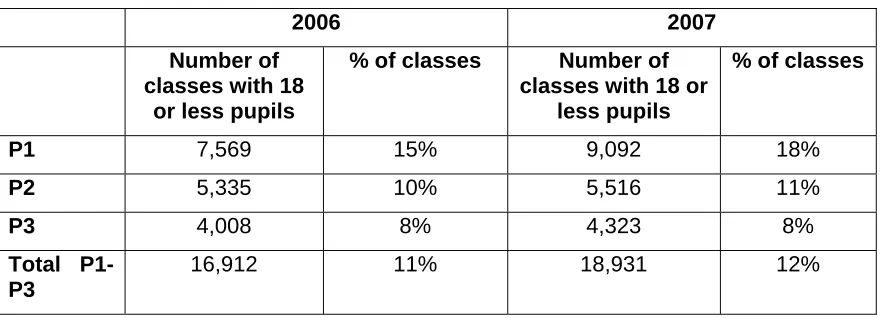
[image:6.595.58.503.131.290.2]Table 2 shows that as at September 2007 12% of P1-P3 classes had 18 pupils or less, compared to 11% in 2006. Primary 3 classes have the lowest proportion of class sizes with 18 pupils or less at 8%.
Table 2: P1-P3 classes with 18 pupils or less
2006 2007
Number of
classes with 18 or less pupils
% of classes Number of classes with 18 or
less pupils
% of classes
P1 7,569 15% 9,092 18%
P2 5,335 10% 5,516 11%
P3 4,008 8% 4,323 8%
Total P1-P3
16,912 11% 18,931 12%
Source: Scottish Government (2008a) from Tables 2.14,2.15 and 2.16
As the majority of P1-P3 classes currently have more than 18 pupils most local authorities will have to make fairly substantial changes to reduce class sizes to 18. However, the existing variations in class sizes means that the scale of change required will be different throughout the country.
Table 3 shows the variation in the proportion of P1-P3 classes with 18 pupils or less amongst selected local authorities.
Table 3: % of classes with 18 or less in selected local authority areas
% of classes with 18 or less P1 P2+P3 P1-P3
National average 18% 9% 12%
Eilean Siar 75% 71% 72% Argyll and Bute 48% 32% 38% East Ayrshire 23% 10% 14% Glasgow 21% 6% 11% West Lothian 11% 10% 10% Dundee City 9% 3% 5%
Source: Scottish Government (2008a) adapted from Table 6.7
Table 3 illustrates that the highest percentage of P1-P3 classes with 18 pupils or less is found in Eilean Siar, at 72%, while the lowest proportion, at 5%, is found in Dundee City Council.
FUNDING
The main cost associated with reducing class sizes is the cost of any additional teachers required, including their initial teacher training, salaries and associated on-going revenue costs. In some areas capital investment may be required to create additional classrooms. This will particularly be the case in areas where schools are already at, or near, their capacity. The specific costs will vary from local authority depending on their existing school estate and current and future school roll.
In the summer of 2007 the Scottish Government provided additional funding, for 2007-08, to assist local authorites to reduce class sizes, and improve pre-school provision. This funding included:
• the allocation of an additional £9m to local authorities with the expectation that it would be used to employ 300 extra teachers particularly in areas of deprivation
• an additional £40m allocated to the Schools Fund. Scottish Ministers have indicated to local authorities, “that if they are not yet in a position to spend it in connection with reducing class sizes they may, meantime, accelerate other priority projects in order to focus future capital spend on reducing class sizes when needed.” (Scottish Parliament 2007b)
• funding for an additional 250 places for the Post Graduate Diploma in Education and an additional 56 places for Bachelor for Education starting from autumn 2007. While the Scottish Government funds places at teacher training institutions it is for the Scottish Funding Council to determine the final number of places. This brought the total target teacher training intake for primary 2007-08 to 2,261(Scottish Funding Council 2007a and 2007b). The actual intake was 2,297(Scottish Government 2008b).
THE SPENDING REVIEW AND THE CONCORDAT
Funding for reducing class sizes from 2008-09 onwards has been provided as part of the general local government settlement as set out in the Scottish Budget Spending Review proposals (Scottish Government 2007b). In 2008-09 the local government settlement as a whole amounts to £11.1bn. Individual local authority allocations are contained in the ‘Local Government Finance Circular No.6/2007’ (Scottish Government 2007c).
The Concordat, negotiated between the Scottish Government and the COSLA presidential team, sets out the terms of a proposed new working relationship between the Scottish Government and local government. It sets out key Scottish Government commitments, national outcomes and national indicators. In return for local authorities working towards the outcomes in the Concordat the Scottish Government has committed to reduce local authority ring fenced funding and to allow local authorities to reinvest any efficiency savings local authorities make. In relation to class sizes the Concordat states that local government and the Scottish Government will move towards:
show year on year progress toward delivery of the class size reduction policy.” (Scottish Government 2007)
SINGLE OUTCOME AGREEMENTS
Although the Concordat has been agreed at a national level it will be for each local authority to decide whether to develop a Single Outcome Agreement (SOA) with the government. The SOAs will include the contribution which the local authority will make to deliver the national outcomes. The Scottish Government expects final versions of SOAs to be in place by the end of June 2008.
Under the new arrangements proposed, each local authority will be required to submit a single report to the government around the turn of the financial year setting out their progress and achievements towards the national outcomes. The first of these reports will cover the financial year 2008-09.
ISSUES
In the last few months there has been much parliamentary debate over the Scottish Government’s class size policy commitments. The following provides an overview of some of the key areas of debate.
TIMESCALE AND FLEXIBILITY
A key area of debate over the class size policy has been the timescale in which the policy aim can be achieved. The Concordat refers to the need to make progress towards reducing class sizes “as quickly as is possible” and the expectation that “year-on-year progress” will be made toward the goal. Scottish Government responses to PQs have indicated that the government has recognised that progress towards reducing class sizes will be variable amongst local authorities:
S3W-7337 - Andy Kerr (East Kilbride) (Lab) (Date Lodged Monday, December
03, 2007): To ask the Scottish Executive, under the terms of its concordat with
COSLA, whether it will accept variations in class sizes in primary 1 to primary 3 between local authorities across Scotland and, if so, whether there is any limit in the variations that it will accept and how it will monitor such variations.
Answered by Maureen Watt (Tuesday, January 08, 2008): We expect local government to make year on year progress in reducing primary 1 to primary 3 classes to a maximum of 18 pupils. There will be different rates of progress according to local circumstances. We will enter into an agreement with every authority which agrees to the concordat that will set out the progress we agree that authorities can make. Class size data is collected at individual school level annually through the school census. Scotland currently already has variations in class sizes in primary 1 to primary 3 between local authorities across Scotland. (Scottish Parliament 2007b)
that there will be year-on-year progress” (Scottish Parliament Education, Lifelong Learning and Culture Committee 2007a).
Minutes of a meeting between Scottish Government officials from the Schools Directorate and Deansof Faculties of Education (which were subject to an FOI request), indicated that officials advised Scottish Ministers that it would take around 8-10 years to deliver the policy commitment (Scottish Government 2008c).
The question of how much flexibility local authorities will have in how they meet the target has also been raised. One way of making progress towards the target would be team teaching i.e. a class of 36 pupils being taught by two teachers. During discussion at the Education, Lifelong Learning and Culture Committee the Cabinet Secretary indicated her views on this option:
“The evidence that we are looking at relates to classes—they should be reduced as a whole. Some local authorities have already achieved the proposals for class sizes that were set out by the previous Government by having more than one teacher for a larger class. It is up to local authorities to approach us if they think that that is an issue, and if they wish either to start to do that or to continue to do that….We should consider whether there are any merits in that—if that is how councils want to progress—but my preference is for class sizes as a whole to be reduced.” (Scottish Parliament Education, Lifelong Learning and Culture Committee 2007b).
As referred to earlier it seems as if much of the recent progress to reducing class sizes in P1 to 25 or less has been achieved through team teaching. Therefore, it may be expected that this is one approach which local authorities may consider when they decide how to reduce class sizes in their area.
FINANCIAL CONSIDERATIONS
Financial Estimates
It is not clear what the current class size reduction policy will cost to implement nationally. As the Cabinet Secretary confirmed during her Ministerial Statement:
“.. none of the specified manifesto commitments comes with an individual price tag precisely because the package as a whole is being presented to local government for agreement. That includes the reductions in ring fencing, the additional £1.3 billion over the spending period to help finance policies such as class size reductions, and the efficiency savings..” (Scottish Parliament 2007a)
COSLA has indicated that, “We negotiated an overall settlement. How councils prioritise within that settlement will determine how much is spent locally on class size reduction” (Scottish Parliament Education, Lifelong Learning and Culture Committee 2007a).
Revenue Costs
The main revenue cost associated with the policy is the costs of any additional teachers required. The number of teachers required will depend on factors such as the projected pupil numbers, the number of teachers retiring and the detail of local authority strategies to implement class size reductions. The Class Size Working Group (see below) calculated that as a “rough estimate” reducing class sizes in P1-P3 to 20 (i.e. two more than the current target) would require an additional 4,000 teachers (Scottish Executive 2006).
In some local authority areas, because of declining school rolls, a smaller pupil: teacher ratio could be achieved without additional expenditure. COSLA confirmed to the Education and Lifelong Learning Committee that falling school rolls could provide the “..opportunity to make progress” towards class size reductions, although this would be a decision taken locally (Scottish Parliament Education and Life Long Learning Committee 2007a).
As noted earlier the Scottish Government provided additional funding for 2007-08 to increase the intake of trainee teachers. In response to a PQ it was indicated that,
“the total number of training places allocated at any university in any year is a matter for the Scottish Funding Council. However, it is anticipated that over the 2007-11 period over 20,000 will enter teacher training. Ongoing work on teacher workforce planning will determine final figures” (Scottish Parliament 2007c)
Capital Costs
Over the Spending Review period the Scottish Government has made almost £3 billion of capital funding available to local authorities. This includes resources previously directed through the Schools Fund which will be rolled up within the local government settlement from 2008-09 onwards. Local authorities may also raise additional capital resources through other means, for example, from prudential borrowing.
Again it is not clear what the total cost of the capital requirements of the policy are. It is for local authorities to decide how to implement, and fund, reductions in class sizes.
Value for Money
A Class Sizes, Staffing and Resources Working Group was established by the previous Scottish Executive in 2005 to consider the issue of class sizes. As part of the group’s work the Scottish Council for Research in Education (SCRE) was commissioned to update a literature review of class sizes which was undertaken in 2001. A literature review was published as part of the interim report of the Class Sizes, Staffing and Resources Working Group on 28 June 2006 (Scottish Executive 2006). The final report of the group was published on 20 November 2007 (Scottish Government 2007d).
The literature review identified a consensus within existing research that policies of class size reductions were expensive. A number of researchers questioned the value for money of such policies and identified alternative options for expenditure that may improve the educational attainment of pupils:
support staff either in classrooms or deployed elsewhere in schools would also be options” (Scottish Executive 2006)
Some local authorities have also questioned the value for money of the current class size reduction policy. It was reported in the Times Educational Supplement that Gordon Matheson, Executive Member for Education and Social Renewal in Glasgow City Council, “welcomes the removal of ring-fencing but will not be targeting the money that will be released on cutting class size in the early years, as the SNP government would wish. He insists there are better ways to raise attainment” (TES 2007).
On the other hand, the Educational Institute of Scotland (EIS), who have been campaigning for smaller class sizes across the primary school years, have also highlighted some of the perceived benefits to teachers of smaller class sizes. They have argued that:
“..reducing class sizes allows each individual child with more time to spend with their teacher, and this brings obvious benefits in terms of improved pupil behaviour, educational performance and attainment “(EIS 2007)
and that
“We support the placing of pupils with special needs in mainstream schools, but it can only be done properly in smaller classes. It would also be easier to tackle classroom indiscipline if there were fewer pupils in a class, so we think the benefits are obvious” (Herald 2007).
IMPACT ON EDUCATIONAL ATTAINMENT
There are a number of methodological issues in trying to evaluate the impact of class sizes on pupil’s educational attainment. A key difficulty is separating out the influence of class sizes from the wide range of other factors that may how well a pupil does at school.
The SCRE literature review found that although a large volume of evidence existed on class sizes, and many of these studies were very good, “..questions remain about the research designs and the statistical analyses employed, and also the generalisability of the findings” (Scottish Executive 2006). The review also found that there was no relevant research on class sizes that had been carried out in Scotland. Much of the research was USA based, including the often quoted Student Teacher Achievement Ratio (STAR) project in Tennessee. Despite the large volume of research the findings have been mixed. The report described the findings over a number of years as “..at best confusing, sometimes even contradictory.”
Despite the mixed research findings the literature review did suggest that recently more of a consensus has been emerging. In particular, there was more of a consensus amongst the research that where class size can make a difference this in the early years of schooling. However, there was also a consensus that class size is only one factor that may influence educational attainment. The key conclusions of the literature review were that:
“Although most researchers agree that there is a relationship between small classes, especially in the early years, and pupil attainment, many accept that this is only part of a complex picture. Other factors such as classroom processes, the quality of teaching, the prior attainment of the child and parental background, are all likely to contribute.
The Class Size and Pupil Ratio research project which he oversaw recognised that the factors affecting pupil attainment were complex but concluded that:
• There was a clear effect of class size difference on academic attainment in the reception year
• Small classes work best for literacy for children who are most in need academically, and have the most ground to make up.
• For low achieving children, class size must be reduced to below 20 if they are to benefit from the reduction.
• There was no evidence that pupils in smaller classes (in England) from year 4 onwards made more progress in maths, English or science.
Other researchers, while noting the possible benefits from class size reductions, claim that there are more cost-effective ways of providing young children with individualised attention when they most need it. Class size reduction is attractive because it maintains the existing structure of schools while simply adding more resources. This may be a necessary step, but there is no evidence that in the long-term it will be sufficient to raise the attainment of all pupils.
Most evidence is in primary but the research commissioned by the CSWG on the impact of class size on Standard Grade results suggest that further work could be carried out to help assess the impact on secondary.” (Scottish Government 2007d)
The size of a class can impact on the teaching methods used. The SCRE literature review found that teachers need to modify their classroom practices, particularly the number and size of within-class groupings, to take account of different sized classes, and identified the potential need for further training.
FUTURE RESEARCH
SOURCES
BBC. (2007) Council Makes Class Size Warning [Online]. News Release 23 November 2007. Available at: http://news.bbc.co.uk/1/hi/scotland/south_of_scotland/7108927.stm [Accessed 23 November 2007]
Education (Lower Primary Class Sizes) (Scotland) Regulations 1999. No. 1080 (S.86) London: HMSO. Available at: http://www.opsi.gov.uk/SI/si1999/19991080.htm
EIS. (2007) EIS Welcomes Teacher Number Increase as Means to Cut Class Sizes. Edinburgh: EIS. Available at: http://www.eis.org.uk/public.asp?id=294&parentid=239&dbase=3
General Register Office for Scotland. (2007) Projected Population of Scotland (2006-based). Edinburgh: GROS. Available at: http://www.gro-scotland.gov.uk/files1/stats/projected-population-of-scotland-2006-based/j896101.htm
The Herald. (16 October 2007) The Cost of Smaller Class Sizes. Available at:
http://www.theherald.co.uk/news/news/display.var.1761931.0.the_cost_of_smaller_class_sizes.
php ) [Accessed 18 October 2007]
Scotland on Sunday. (23 September 2007 p5) Crammed Classrooms Make a Mockery of SNP Targets.Edinburgh: Scotsman Publications.
Scottish Executive. (2006) Class Sizes, Staffing and Resources Working Group: Interim Report.
Edinburgh: Scottish Executive. Available at:
http://www.scotland.gov.uk/Publications/2006/06/26102419/0
Scottish Executive. (2007) Pupils in Scotland 2006. Edinburgh: Scottish Executive. Available at:
http://www.scotland.gov.uk/Publications/2007/02/27083941/78
Scottish Funding Council. (2007a) Intake Targets for the Controlled Subjects for Academic Year 2007-08. Circular SFC/13/2007. Edinburgh: Scottish Government. Available at:
http://www.sfc.ac.uk/information/info_circulars/sfc/2007/sfc1307/sfc1307.html
Scottish Funding Council. (2007b) Initial Teacher Education – Revised Intake Targets for Academic Year 2007-08. Circular SFC/44/200. Available at:
http://www.sfc.ac.uk/information/info_circulars/sfc/2007/sfc4407/sfc4407.html#a
Scottish Government. (2007a) Preliminary Results of 2007 School Census. Edinburgh: Scottish Government. Available at: http://www.scotland.gov.uk/Publications/2007/11/19125551/0
Scottish Government. (2007b) Local Government Finance Circular No.6/2007. Edinburgh: Scottish Government. Available at: http://www.scotland.gov.uk/Topics/Government/local-government/17999/lgf2008-2011
Scottish Government. (2007c) Concordat Between the Scottish Government and Local Government. Edinburgh: Scottish Government. Available at:
Scottish Government. (2007d) Class Sizes, Staffing and Resources Working Group: Final
Report. Edinburgh: Scottish Government. Available at:
http://www.scottishexecutive.gov.uk/Publications/2007/11/16094326/0
Scottish Government. (2008a) Pupils in Scotland 2007. Edinburgh: Scottish Government. Available at: http://www.scotland.gov.uk/Publications/2008/02/25145216/40
Scottish Government. (2008b) Personal Communication [unpublished]
Scottish Government. (2008c) Note of Meeting between Schools Directorate Officials and Deans of Faculties of Education, Monday 2 July 2007. Edinburgh: Scottish Government. Available at: http://www.scotland.gov.uk/About/FOI/Disclosures/2008/02/Minutes
Scottish Labour Party and Scottish Liberal Democrats. (2003) A Partnership for a Better Scotland: Partnership Agreement. Edinburgh: Scottish Labour Party and Scottish Liberal Democrats. Available at: http://www.scotland.gov.uk/Publications/2003/05/17150/21952
Scottish Parliament. (2007a) Official Report 5 December 2007. Col 4067. Edinburgh: Scottish Parliament. Available at:
http://www.scottish.parliament.uk/business/officialReports/meetingsParliament/or-07/sor1205-02.htm#Col4067
Scottish Parliament. (2007b) Written Answers Monday 22 October 2007 to Friday 26 October 2007. S3W-5065. Edinburgh: Scottish Parliament. Available at:
http://www.scottish.parliament.uk/business/pqa/wa-07/war1026.htm
Scottish Parliament. (2007c) Written Answers Monday 12 November to Friday 16 November. S3W-6553. Edinburgh: Scottish Parliament. Available at:
http://www.scottish.parliament.uk/business/pqa/wa-07/war0112.htm
Scottish Parliament. (2008) Written Answers Monday 7 January to Friday 11 January 2008.
S3W-7337. Edinburgh: Scottish Parliament. Available at:
http://www.scottish.parliament.uk/business/pqa/wa-07/war0112.htm
Scottish Parliament Education, Lifelong Learning and Culture Committee (2007a). Official Report 12th Meeting, Session 3, 5 December 2007. Edinburgh: Scottish Parliament. Available at:
http://www.scottish.parliament.uk/s3/committees/ellc/or-07/ed07-1202.htm#Col411
Scottish Parliament Education and Lifelong Learning and Culture Committee (2007b). Official Report 14th Meeting, Session 3, 19 December 2007. Edinburgh: Scottish Parliament. Available
at: http://www.scottish.parliament.uk/s3/committees/ellc/or-07/ed07-1402.htm#Col483