Resource
Inspiring leaders to
improve children’s lives
Schools and academies
Inspiring leaders to
improve children’s lives
Schools and academies
Research Associate
Summary report
Carol Koerner
Headteacher, Sharps Copse Primary School, Havant, Hampshire
Tina Newman
Headteacher, Front Lawn Junior School, Havant, Hampshire
Small, school-based sabbaticals in
continuing professional development
provision
Introduction
One size does not fit all – buying professional learning off the shelf may benefit the individual but have less impact on the collaborative work of staff teams. Indeed, as Fullan (2001) has argued:
Professional development or training of
individuals or even of small teams will
not be sufficient. For this reason schools
must also focus on creating school-wide
professional learning communities.
Fullan, 2001:64
The premise behind this research is that a new, collaborative model of professional learning based on a small sabbatical approach can assist schools and professional learning communities to find bespoke answers to specific context-based questions: growing leaders who find solutions. Whilst all school leaders face the same universal challenge, both within their own schools and between schools in broader collaborations, of how practically to achieve objectives, implement desired outcomes and harness the potential of distributed leadership, the small sabbatical model can unite leaders and participants in a particular time and place to unlock their learning in teams by addressing key improvement questions relevant to the specific organisation.
Drawing on the results of a literature review, key elements in leadership growth and development were identified as:
— shared purpose
— skilled facilitation
— appropriateness of time and place for learning
— provision of bespoke opportunities to enable reflection, relationship-building and collaboration
These elements were used to develop a generic model of small, school-based sabbatical provision for growing collaborative leaders. The research study then set out to explore how the small sabbatical model can work in practice as a vehicle for professional learning both within a single school setting and across a collaboration.
Methods
Four case studies of different contextual applications of the model were explored:
— school-focused: one week off-site focus on a pertinent school development
— inter-school collaboration: concentrated
residential experience for leaders in a community improvement partnership
— immersive: in-depth focus on a learning theme
— emergent: regular, extended and sequential contact over time
Feedback was sought on the effectiveness of the small sabbatical as a vehicle for collaborative professional leaning within bespoke continuing professional development (CPD) provision from participating headteachers, deputy headteachers, school leaders, teachers and newly qualified teachers over a period of 18 months. Data was gathered from 73 respondents using a questionnaire designed to explore the key elements of the
sabbatical model and to seek comments on its potential refinement.
Findings
The small sabbatical model
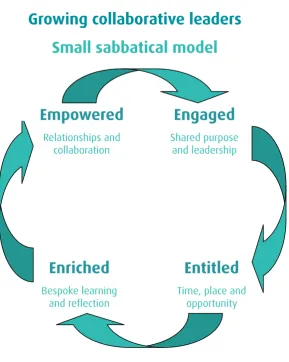
From the literature review, the following elements emerged as important when creating the conditions for collaborative leadership growth:
— engaging a team with a shared purpose and leadership approach
— entitling the team to a time, place and opportunity for professional learning
— enriching the team through bespoke learning and reflection
— empowering the team through relationship-building and collaboration
Engaged
Shared purpose and leadership
Entitled
Time, place and opportunity
Empowered
Relationships and collaboration
Enriched
Bespoke learning and reflection
Growing collaborative leaders
[image:3.595.162.452.119.482.2]Small sabbatical model
Figure 1: Small sabbatical model
Participant responses
Although the precise features of the small sabbatical varied according to the type of case study,
participant evaluations recognised the value of:
— an extended (albeit concentrated) period away from the workplace and its routines
— an opportunity for a focused period of immersion on a development priority or learning theme
— the provision of a structured time-out for reflection
Participants particularly valued the following features implicit in the small sabbatical model:
— a good-quality off-site venue in which to learn and work
— time for activity, discussion and reflection
— an intense focus on one theme
— the opportunity for professional relationship-building
— engagement with flexible learning
Key elements
The model identified and tested key elements for leadership growth within the small sabbatical experience, as follows.
Leadership development with a purpose
By linking school improvement needs withFacilitation
The use of two complementary facilitators mirrored the dual expectation of knowledge enhancement and leadership growth and ensured that participants had both these needs met. A limiting factor could be the cost if external consultants are used; this could be mitigated by training in-house facilitators.
Time and place
All participants recognised the importance of having sufficient time for learning and access to an off-site environment conducive to learning. They described access to these factors as facilitating the right frame of mind for learning, resulting in the achievement of far more than would have been possible during a similar amount of time spent on planning, preparation and assessment in school. Furthermore, they felt that outcomes were of better quality, not rushed but considered, scrutinised and relevant. Equally, the opportunity for dedicated time for reflection was reported by participants to have had positive effects on their levels of motivation, professional confidence, passion and enthusiasm for the leadership role, and consequently upon wellbeing.
Bespoke provision
The bespoke element of the sabbatical model was also appreciated by the participants. Headteachers indicated that whilst there were very good off-the-shelf professional development programmes, these did not sufficiently match the needs and context of their individual schools.
The small sabbatical approach also provided
another tool for bespoke contextualised support and challenge for schools working in collaboration.
Relationships and trust
The value of talk, discussion, debate and dialogue within small supportive groups was a constant feature of participants’ evaluative comments. There was a strong correlation between the ability to engage in this and the capacity to form relationships with colleagues leading to mutual trust. Participants could be very open with each other; they discovered problems, barriers and constraints, and the growth of trusting relationships allowed them to work specifically on the real issues and not waste time window-dressing. The solutions presented were based on reality and not a sanitised version of it.
Collaboration
Effective collaboration was attributed as a key driver in producing high-quality outcomes from participation in the small sabbatical. At one level this evolved from sharing good practice and learning from each other – making sense of the situation. At another level it involved seeking solutions – knowledge creation within a nexus of reflective, trusting relationships built in an atmosphere of sufficient time and appropriate space. The perceived success of the small sabbatical in whatever form appears to lie in the inter-relationship of these factors and the identified key elements for the growth of purpose, vision, confidence and motivation within a cohesive leadership learning experience.
Conclusions and
recommendations
To enhance professional development and ensure that leadership qualities and behaviours stay at the forefront of the sabbatical focus, it would be useful to document and evaluate participants’ growing competences, using a tool such as the Hampshire leadership toolkit (Hughan, 2010) to facilitate this.
To maximise effective facilitation, it would be advantageous to train in-house facilitators either by accessing specific training courses or by aspiring leaders working alongside an experienced facilitator. The use of a facilitator skilled in listening and coaching methods would add significantly to the effectiveness of the process.
To enhance the effectiveness of the small sabbatical and maximise outcomes, consideration should be given to both the environment in which staff learn (eg, space, light, comfort, refreshment, temperature and the ability to control the variables), and the provision of sufficient time and space for reflection and the building of productive working relationships.
To ensure contextual appropriateness of the provision, consideration should be given to the creation of flexible, bespoke opportunities to supplement existing external professional development courses in order to reflect both individual and school needs.
References
Fullan, M, 2001, Leading in a Culture of Change, London, John Wiley & Sons
Hughan, C, 2010, Hampshire leadership toolkit, Hants, Hampshire Teaching and Learning College
NCSL, 2003, Too Busy To Learn? An introduction to collaborative leadership learning. Nottingham, National College for School Leadership
Visit www.nationalcollege.org.uk/researchassociates
for further information about the programme including:
— current projects
— other full research and summary reports
Disclaimer
The National College is uniquely dedicated to developing and supporting aspiring and serving leaders in schools, academies and early years settings.
The College gives its members the
professional development and recognition they need to build their careers and support those they work with. Members are part of a community of thousands of other leaders - exchanging ideas, sharing good practice and working together to make a bigger difference for children and young people.
©2011 National College for School Leadership – all rights reserved. No part of this document may be reproduced without prior permission from the National College. To reuse this material, please contact the Marketing and Communications team at the National College or email publications@ nationalcollege.org.uk.
Triumph Road, Nottingham NG8 1DH
T 0845 609 0009 F 0115 872 2001
www.nationalcollege.org.uk
We care about the environment