Family Inclusion in
Child Protection Practice
Supporting Families Stronger Futures
Acknowledgements
The Family Inclusion Network (FIN) would like to thank:
The parents, grandparents and significant others who contributed their time and expertise, and shared their insights
The previous Ministers for Child Safety, Hon. Mike Reynolds and Hon. Desley Boyle and the current Minister Hon. Margaret Keech
Workers from the non-government agencies and from the Department of Child Safety who took part in the focus groups
Belinda Chown, Diane Westerhuis, Norelle Coles (JCU), Karyn Walsh, Anne Hilton and Leonie Holiday (Micah Projects Inc).
The establishment phase of FIN was sustained by $5000 seed funding received from the then Minister for Child Safety in Queensland, the Hon Mike Reynolds in 2004.
This Report is a direct output of a further $90,000 funding provided to FIN in 2005-2006 to conduct focus groups with biological parents and significant others, service providers and Child Safety Service Centre staff.
Contributors to this report include:
Mark Cary
Ms Chris Klease
Dr Jane Thomson
Prof Ros Thorpe
Karyn Walsh
Executive
summary
This report, completed by members of the Family Inclusion Network (FIN), was commissioned by the Minister for Child Safety, Hon. Mike Reynolds in 2005. It tables key findings from a series of focus groups with parents of children and young people in care as well as workers from both the Department of Child Safety (DChS) and the non-government sector.
The report presents evidence that directly addresses key recommendations from the Crime and Misconduct Commission of Inquiry into the Abuse of Children in Foster Care, which called for improvements in practice with parents of children and young people in care.
FIN is a representative grouping of practitioners, academics and parents with children in care seeking to advance practice and policy in working with parents of children and young people in the statutory child protection system. While it started in Queensland, FIN has also developed in New South Wales and Western Australia as considerable interest exists in those jurisdictions in working to improve outcomes for children and young people through more effective work with parents and other family members. Work has also taken place in the ACT. There is a developing interest in all Australian jurisdictions in the importance of this work. Queensland has, however, been the forerunner to national efforts.
This report has four main sections:
1. An introduction to FIN, the FIN Project and the research methodology underpinning focus groups conducted in Townsville and Brisbane in 2006
2. Key themes and issues emerging from research with parents and significant others, non government workers and child safety officers
3. Recommended strategies, solutions and tools for working more effectively with parents and families of children in the child protection system
4. A focused literature review which provides the evidence base for the work undertaken by those involved with the project.
Underpinning this report are the research findings extrapolated from a series of focus groups held with parents with children in care, workers from the non government sector and child safety officers
(CSOs). A total of 139 people participated in the focus groups providing a mixture of perspectives according to their background and role in child protection system.
Key themes and issues identified by parents were wide ranging from accessing quality information, services and resources to financial hardship and feelings of exclusion from the case management process. Similar themes were shared by focus groups held with non government workers. Child safety officers raised a number of different issues including the confronting nature of the child protection process, the lack of focus on parents, an inability to deal with people’s loss and grief issues, the high turnover of staff creating challenges, not enough training and resources and the process being too bureaucratic and administrative.
From these results, one major conclusion was clear: that a dedicated service to work with parents and other family of children in the child protection system is greatly needed.
To meet this need and encourage greater involvement with parents and families to ensure the safety and wellbeing of children and young people in the Queensland Child Protection System, FIN
recommends that the following priority strategies for inclusion are accepted and adopted by the Queensland Government:
1. Develop a Statement of Commitment by DChS to partnering with parents which is inclusive of a balanced investment into parental support and out of home care options
2. Introduce greater parental inclusion in child protection case management processes
3. Adopt a coordinated approach by Queensland government to ensure the wellbeing of children inclusive of their protection and safety by addressing child poverty and social exclusion.
In addition, FIN recommends the development of a number of key tools and resources to support parents within the child protection process.
The research, strategies and recommendations presented within this report have been underpinned by a robust literature review which takes into account Australian and International literature. A number of common themes were evident. Most studies have found that parents with children in care are likely to experience profound feelings of loss, grief and powerlessness and that contact between children and parents is important to both parties. However, the frequency and success of contact is founded on the values, practice wisdom, knowledge and skills displayed by individual child protection workers.
The two dominant themes emerging from the literature on contact between parents and their children include:
1. The crucial role played by child protection workers in the planning, quality and monitoring of contact
2. The significance of constructive and friendly interactions between parents and foster carers during contact visits.
From all of the research, the overwhelming message is that there is insufficient help available within existing structures to assist parents. Help is needed to:
Firstly, and preferably, avoid children and young people being taken into care
Ensure that they are restored to family wherever possible and not face a life in the care system with the poor outcomes for their futures that are associated with State care, and
When placed in permanent out of home care have an understanding of their family of origin and culture.
This report only presents a snapshot based on the conversations in focus groups, practitioner experience and literature and has been developed to inform child protection practice.
Members of FIN wish to acknowledge previous Ministers for the opportunity to undertake this project through funding and ongoing support which made this project possible. We also wish to encourage the Hon. Margaret Keech, Queensland Minister for Child Safety, to take the lead nationally in developing an innovative new approach to working with parents of children and young people in care.
Family Inclusion Network – October 2007 iv
Contents
Section 1– The FIN Project... 1
1.1 - Background... 1
1.2 – About Family Inclusion Network (FIN) ... 2
1.3 – FIN project terms of reference ... 2
1.4 – Research methodology... 3
1.5 – Key discussion points ... 4
Section 2 - Key themes, issues and needs... 5
2.1 Summary of key themes and issues – Parents and significant others ... 5
2.2 Summary of key themes and issues – Non–government sector workers ... 8
2.3 Summary of key themes and issues – Child Safety Officers... 10
2.4 Consistent themes ... 11
Section 3 – Strategies and solutions for action... 14
3.1 – Key implications and identified needs ... 14
3.2 – Key Strategies for Inclusion ... 15
3.3 – Tools and resources to assist parents in the child protection process ... 16
Section 4 – Literature review... 19
4.1 – Parents with children in care... 19
4.2 – The Importance of Working with Parents: Child Centred Reasons ... 20
4.3 – Parents with children in care and contact – outcomes and barriers... 21
4.4 – Parents with children in care – their relationships with child protection workers and foster carers ... 23
4.5 – Conclusion ... 25
Section 5 – Conclusion... 26
Appendix A – Key themes, issues and needs identified by parents and significant others... 33
Appendix B – Key themes, issues and needs identified by non-government sector workers... 34
Section 1
– The FIN Project
The aim of the FIN (Family Inclusion Network) Project is to conduct and present the findings of a series of focus groups conducted with parents of children within Queensland’s child protection system and workers from the Department of Child Safety and the non-government sector.
Compiled by FIN, this report presents the key research findings and recommends future strategies and tools for working in greater partnership with parents and families to ensure the safety and wellbeing of children and young people in the Queensland Child Protection System.
FIN is committed to representing the issues for biological parents and developing a base of knowledge and strategies which can be included in the current Queensland child protection reform process. This commitment formed the basis for FIN’s funding submission and underpinned the design and conduct of the focus groups.
This report is a direct output of funding provided to FIN in 2005-2006 from the then Minister for Child Safety, Hon. Mike Reynolds. Members of FIN remain indebted to the then Minister and the current Minister, Hon. Desley Boyle, and the staff of her Department, for their ongoing commitment to, and funding support for, FIN’s work.
1.1 - Background
In recent years, there have been horror stories profiled in the media of appalling instances of child abuse. Such instances are reprehensible and deserve society's strongest condemnation. As a group, parents of children removed into care have been typecast as cruel and uncaring, utterly undeserving of sympathy or support. However, there is evidence to support the claim that the vast majority of cases bear little resemblance to the few that hit the headlines (Scott, 2006).
Many more children enter care through neglect and minor instances, or risk, of maltreatment rather than severe abuse. Research further indicates that such neglect and maltreatment is closely related to poverty, ill health, disability, domestic violence, indigeneity, young parenthood or problematic
substance use: that is, conditions which could be alleviated by investment in preventive social policy initiatives aimed at providing support for vulnerable families and communities including, in particular, Aboriginal communities (Thomson & Thorpe, 2003).
Commentators write of the operation historically of a child protection pendulum (Tilbury, et al., 2007) where practices differ markedly on a continuum from erring on the side of caution and removing children in order to guarantee their safety, to introducing more family support measures which keep children with their families. Just as several decades ago there were few alternatives available for women who lost their children to adoption (Gair & Croker, 2004), so today few alternatives are offered to families to prevent the loss of their children into care. Moreover, once in care, it is extraordinarily difficult for parents to remain in meaningful contact with their children or to secure their return to an improved home environment.
Parents who lose their children into care not only experience profound loss, but many also suffer from extreme powerlessness in relation to the child protection system of government departments, non-government agencies and children’s courts (Thorpe & Thomson, 2004). This is borne out by the literature reviewed in section four of this report.
1.2 – About Family Inclusion Network (FIN)
In 2004, awareness of research evidence and the involvement of practitioners and academics in policy and community consultation led to a sense that the time was ripe for renewed activity around
advocacy and support for parents. During that year a core group of workers in Townsville and Brisbane was formed to develop services for parents. This resulted in the establishment of what is called Family Inclusion Network, or FIN.
Children and young people in the child protection system remain a part of their families and therefore remain important stakeholders in the child protection process. Parents, families, life and cultural circumstances will be respected. Partnership with parents is fundamental regardless of difficulties such as age, gender, disability, mental health status, socio-economic status or criminal record.
In line with this overall vision, FIN’s mission statement is:
To ensure parents and family members have access to the information, support and advocacy they require to actively and equitably participate in the child protection process.
FIN’s goals and objectives are to:
1. Advocate for the rights of biological parents and significant others with children in care throughout Queensland
2. Undertake systems advocacy that strives to promote, protect and defend the fundamental rights of biological parents and significant others with children in care throughout Queensland
3. Support the inclusion of biological parents and significant others with children in care in self-advocacy.
1.3 – FIN project terms of reference
The Minister charged FIN with the following terms of reference in order to fulfil the conditions of funding for the project:
To engage a consultant to network with biological parents and significant others of the child subject to statutory intervention, service providers, and Child Safety Service Centre staff in order to:
Identify service types and models
that would assist parents in the child protection process
Identify service types and models
that would assist parents in the child protection process Identify tools and
resources that will be helpful for parents in the child protection process Identify tools and resources that will
be helpful for parents in the child protection process
Contribute to the ongoing development of legislation, policy, programs, services and professional practice in
the child protection system by the provision of this information to the Policy and Programs Division and
Child Safety Services Division of the Department Contribute to the ongoing development of legislation,
policy, programs, services and professional practice in
the child protection system by the provision of this information to the Policy and Programs Division and
Child Safety Services Division of the Department
Family Inclusion Network – October 2007 3 1.4 – Research methodology
Given their lengthy experience in child protection work, FIN members were elected to conduct the focus groups directly. As stated, the aforementioned funding enabled FIN members to run a number of focus groups with parents with children in care, workers from the non government sector and Child Safety Officers. Funding secured research assistance, the employment of project workers, catering, room hire and transport costs.
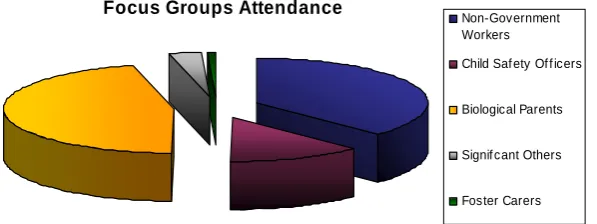
As presented in the following diagram, a total of 139 people participated in the focus groups providing a mixture of perspectives according to their background and role in child protection system.
[image:8.595.163.462.208.320.2]As per the following tables, a total of 139 people participated.
TABLE 1.1– Focus groups with biological parents and significant others.
Location Attendance
Upper Ross Community Centre, Townsville y 3 mothers y 1 grandmother
Child Protection Alternative Care, Townsville y 3 Indigenous mothers y 3 workers
Women’s Centre, Townsville y 3 mothers
Townsville – Sera's Women's Shelter y 1 Indigenous mother
Brisbane y 46 parents
y 3 grandparents
Rockhampton y 4 parents
[image:8.595.78.548.598.725.2]Total participants = 67 TABLE 1.2 – Focus groups with non-government workers and Child Safety Officers
Location Attendance
Centacare, Townsville » 19 workers
» 1 foster carer » 1 mother
Brisbane » 25 workers
Brisbane » 16 Child Safety Officers
Rockhampton » 10 non-government
ticipants = 72 Total par
Focus Groups Attendance
Non-Government Workers
Child Saf ety Of f icers
Biological Parents
Signif cant Others
1.5 – Key discussion points
As illustrated in the following research matrix, focus group discussion centred around the following issues:
Parents’ experiences of the child protection system and having children in
out-of-home care
Parents’ experiences of the child protection system and having children in
out-of-home care
Workers’ perceptions of parents’ inclusion or exclusion in the child protection system
and of having children in care
Workers’ perceptions of parents’ inclusion or exclusion in the child protection system
and of having children in care
Cultural differences between workers, parents and carers
Cultural differences between workers, parents and carers
Types of assistance parents received: before children have been taken into care
after children have been taken into care Types of assistance parents received: before children have been taken into care
after children have been taken into care
Recommendations for improvement
What resources would be needed to support parents?
Which processes would facilitate involvement in the reunification process and the transition?
Section 2 -
Key themes, issues
and needs
In analysing the outcomes of the focus groups, key themes and issues emerged from each of the participant groups involved:
Parents and significant
others Parents and
significant others
Non government
sector workers
Child Safety Officers
Using a number of core topics of discussion as a basis, such as information, legal and cultural issues, the following section summarises the key themes and issues identified by each group. For more information, please refer to the appendices at the back of this report for detailed issues and needs analysis by theme.
2.1 Summary of key themes and issues – Parents and significant others
Key themes and issues identified by parents were wide ranging from accessing quality information, services and resources to financial hardship and feelings of exclusion from the case management process.
A summary of key themes is provided below:
Information concerns surrounded the lack of information quality and transparency provided to parents regarding departmental processes, legal service offerings, reasons for a child’s removal from parents and access to appropriate NGO referrals.
Participating parents felt that requests for help/support services are often not received when required and requests for assistance can often turn into notifications. Parents wanted to see themselves as part of the solutions and not simply the problem. They needed greater clarity about what they were required to do to successfully meet the requirements set out by the Department of Child Safety.
Parents agreed that good legal advice was vital but felt that lawyers are often not equipped to deal with loss and grief issues. Some parents felt that the legal services are ‘too close’ to DChS and, as a whole, the judicial system listens to professionals as opposed to parents in many cases. Concerns were expressed about the cost of the legal system in obtaining advice and the eligibility for legal aid being based on the probability of winning the case rather then on fair and due process.
Financial concerns from parents predominantly surrounded the cost of living, the extent of poverty and the lack of opportunity, resources and services that were not available due to cost. It was evident that the difficulties surrounding parents’ disruption to income when children are in out-of-home care can prejudice the parents’ ability to meet their nominated obligations by the
Department.
- The cost of contact visits and appropriate housing for their children can cause significant financial stress while on a limited income due to their income being reduced while children are in out-of-home care.
- Parents felt that carers are provided with greater assistance by government to meet their basic needs of their children while they were left unassisted and unable to compete.
Parents provided a candid insight into the impact of losing children into care expressing their feelings of loss, grief, embarrassment and inadequacies as a parent while feeling angry, demonised and powerless, and punished by the process.
Parents demonstrated that they have invaluable insights into their own circumstances and the child protection system.
- Parents have the potential to be partners with professionals in creating solutions to identified problems if resources are accessible and are capable of personal growth even when at times their insight and self awareness may seem limited.
- With appropriate professional support, parents can grow new understanding of their roles and responsibility as the primary protector and nurturer of their children.
Parents voiced many concerns regarding the general negative, unsupportive attitude that they have experienced from a range and mix of professionals and carers. Overwhelming was the sense of judgement and discrimination in relation to access to resources and services to address the barriers they have to raising their children.
- Several parents believed that if the equivalent resources were placed into supporting their family as were provided to the foster carers then they would be able to provide and care for their children adequately.
- Other concerns included the stereotyping and lack of objectivity by professionals and carers when making decisions, the avoidance or lack of engagement to keep both parents informed, and their perception that some professionals within the system were unqualified to diagnose mental illness and make significant decisions based on limited knowledge.
The real or perceived power of Department of Child Safety was a strong topic of comment for parents. Among the issues raised during the focus groups were parents’ feeling anxious,
intimidated and forced to cooperate with unreasonable requests and meet unrealistic targets in the light of the major difficulties they experienced in their lives. Concern was expressed about how the impact of imbalance of power affected the behaviour and engagement of parents and their ability to negotiate complex systems.
- Fear of the system and its power to remove children and control the options for a parent was frequently raised, particularly in relation to the inconsistency of expectations and processes across area offices and the number of times staff changed.
- The issue that parents remain on the child protection register even when concerns have not been substantiated was disturbing and of concern. Parents felt that more information on the existence and use of the register should be available.
Parents highlighted a range of concerns relating to the impact on children when removed from home including disruption to schooling, fear towards police and trust issues with CSOs due to high staff turn over. During supervised contact, parents felt their role was at times undermined by CSOs and or carers. Parents stated that they believed their child was often confused, believing that contact was actually reunification. The emotional impact of seeing parents by children was often viewed as distress due to seeing parents rather then acknowledging the normal stress that separation between parents and children bring.
- Parents would like to see their children regularly updated and informed about what is happening to them now, and in the future. In addition, parents should be given bi-annual updates and short term care weekly updates on their children’s well-being. Parents felt very traumatised when their children witnessed others being disrespectful to them.
Parents in contact with non government services stated that they were under funded and under staffed therefore not always equipped to deal with child protection.
Parents identified the need for culturally-appropriate services and care. The lack of Aboriginal and Torres Strait Islander organisations, workers, and carers in the system was identified as a major deficiency. Parents were fearful of their children losing touch with their cultural background and felt that the current system will lead to another stolen generation. Parents felt that the impact and intergenerational experiences of loss and trauma were not understood by the workers they engaged with.
When the topic of domestic violence was raised, parents offered their personal experiences. Common themes included women feeling punished for their partner’s actions and needing greater assistance for moving to safer locations rather than the removal of their child. Engagement with the perpetrator of the violence by the Department was often non existent. Women felt that professionals did not have an understanding of the fear and threats that they lived with from their partners
Participants identified the need for the Department to engage with perpetrators of domestic violence as well as the victims who often maintain the role of protective parent while being unable stop the violence from the perpetrator. Parents felt they were judged either as victims or
perpetrators on whether or not they attended counselling or anger management rather than whether such interventions were helpful in addressing the issues.
- Parents recognised that the presence of domestic violence in their lives requires a range of assessments and not just disclosure about the violence.
- Parents identified their use of violence was connected to their childhood experiences, use of alcohol, drug use and that no services were available where they could address all the issues and acknowledge the way they impact on each other. Violence interventions were in isolation to the other significant issues in their life.
Housing issues revolved around the lack of housing, affordability, discrimination by landlords and inappropriate housing for the family composition. Housing instability was a common characteristic and a significant barrier to achieving continuity and connection with their children. Affordable housing was not always available near carers or departmental officers dealing with notification or matters of concern about children. This impacted greatly on the quality of care.
- Parents felt that they were judged and blamed for being homeless rather then recognising the current housing crisis. In some cases parents felt discriminated against as foster parents were assisted with accessing and improving their housing while they as parents were left to rely on their own resources.
Parents participating in the workshops shared some common frustrations regarding contact and reunification with their child, particularly not being able to negotiate time, duration and place of the contact ⎯ elements that they felt they had no control over or power to negotiate about. Parents also felt under surveillance during contact, impacting on their quality time, and were fearful that incidents during contact could be misconstrued against them. Parents wanted greater communication for both themselves and their children on the reunification process and would prefer if appointments and parenting programs did not count as contact time.
- The space and place where contact visits were organised was described as a significant barrier to effective engagement with children eg McDonalds and area offices of the Department of Child Safety which were not considered child friendly.
- The qualification of professionals and carers in assessing the quality of interactions between parents and carers was raised as matter of concern. Parents felt strongly that carers should not undertake supervision of contact visits if they are reporting back to the Department of Child Safety as it is a dual role which disadvantages the parent and favours the carer in their opinion.
- The confusion about what was supervision of a contact visit and what was an assessment of the quality of their engagement was raised as an issue which impacted on their confidence in the decision making process.
- The confusion about what was supervision of a contact visit and what was an assessment of the quality of their engagement was raised as an issue which impacted on their confidence in the decision making process.
Parents were troubled about how matters of concern or notifications can be raised as a result of conflict between the parent and the carer or the parent and the CSO during the child protection process. Parents felt that decisions about their parenting were clouded by issues regarding the relationship, behaviour and compliance with Departmental staff rather than the quality and capacity of their parenting.
Parents felt strongly that on a regular basis, they should be informed of any matters of concern which were related to the quality of care their children either in foster care and any other out of home care placement. Parents felt any matter which was a breach of the standards of care any allegation of abuse or harm and any injury were matters which they should be informed of verbally and in writing, along with consistent reporting back of actions required to address the issues.
2.2 Summary of key themes and issues – Non–government sector workers
Non government
sector workers rkers
During focus groups discussions with non-government sector workers, topics centred on similar areas to parents. Interestingly, similar themes and issues were shared by these groups as summarised below:
Workers from non-government organisations felt that staff within the DChS needed to show a greater commitment to advising parents of their legal rights and being more forthcoming with information and documentation regarding support services and programs.
- Particular concern was raised about the manner in which parents in crisis are signing over guardianship without adequate understanding of the consequences. Workers felt parents were being forced into providing consent in an atmosphere of fear that it would go against the parent if they did not cooperate.
On the topic of support for parents, participants voiced particular concern over the need for improved support for specific groups within the community including fathers, parents with an illness for intellectual disability, women who are victims of domestic violence and young parents. Support and advocacy workers also wanted to see greater support before a child’s entry to care and after reunification ⎯ times in the child protection process they feel support is currently lacking. Like parent participants, support and advocacy workers felt that, as a whole, the judicial system
favours professionals (eg Lawyers) despite the existence of those with limited skills and knowledge in child protection that face difficulties when representing parents.
- Importantly, support and advocacy workers want to see greater legalinformation provision to ultimately lead to improved understanding of the legal process by parents, greater commitment to administrative fairness and more informed consent by parents when relinquishing guardianship of their children.
Support and advocacy workers from non government services discussed the need for greater recognition of the financial limitations of many families, particularly the costs of attending courses, adequate housing and public transport ⎯ all important elements for enabling contact with children. There was also the perception that poor socio-economic/ poverty circumstances can be seen as bad parenting.
In relation to domestic violence, support and advocacy workers stated that the assessments do not focus on the dynamics of violence within the family but more on the initial disclosure. This led to inadequate decision making with some children being removed unnecessarily and others remaining within the home with a high risk of continued violence. Workers identified this area of work as being one which requires specialist understanding and skill, and greater collaboration in decision making.
- Workers felt strongly that the child protection system had to come to terms with the role of the DChS in holding perpetrators accountable, identifying alternative pathways for the safety of women and children other the removal of the children or insistence that the victim take out a domestic violence order.
- Recognition of the reasons and barriers to women doing this (eg threat to their life and that of their children) needs to be more understood by child protection workers. Workers did
acknowledge the benefits to women when police instigated the protection order.
The shared thoughts of support and advocacy workers regarding the impact on parents of losing children into care centred on parents feeling ashamed, unsupported, and powerless and excluded from the process. Workers recognised that more attention must be given to the traumatic experience on both parents and children of being separated when removal occurs and how this experience impacts on the behaviour and capacity of parents to engage and work with the child protection process. Workers raised particular concern regarding the disruptions to attachment between parents and babies as more very young children were being removed.
- This is considered an area where specialist services could be of value to all involved by reducing the power imbalance and having the specialist skills to engage and negotiate with traumatised participants in the process, paying particular attention to the impact of removal of the children on parent- child relationships.
- Support and advocacy workers expressed their concern regarding difficulty in dealing with the inconsistent attitude of Departmental staff in relation to the ability of a support and advocacy worker to accompany parents throughout the process. In some cases the participation of the non government workers was refused.
When questioned about relationships between DChS and NGOs, support and advocacy workers expressed their desire to build strong partnerships with DChS and work in coordination with each other. However, participants expressed concerns regarding the existing working relationship including difficulties in accessing information and being involved in the process.
Similar to parents, support and advocacy workers felt that decision making processes reflecta process of manipulation, power and control rather than fair and due process. Specific concerns related to parents not having any rights as a consequence of a practice framework that is framed as being ‘in the best interest of the child’, without acknowledging the importance to children of their families. Workers reported witnessing information being withheld from parents when requested and provided when the departmental worker decided it was appropriate.
Support and advocacy workers expressed many concerns regarding the training and awareness of Child Safety Officers about the role and capacity of non government agencies and the diversity of lifestyle options that are reflected in families from diverse family and cultural backgrounds. Workers suggested specialist training around the needs and realities of different population groups.
Feedback concerning the Department’s quality assurance, best practice and complaints system(s) was mixed. Participants felt that the existence of the Quality Assurance team within the DChS was a very positive development. However, it was considered not effective in ensuring that fair and due decision making processes were adhered to and that the focus was on the outcomes of the child as separate to family and culture. There was also a concern that when parents did complain it was a mark against them and they were labelled as difficult, uncooperative and sometimes angry.
The topic of cultural issues provided much discussion. Key themes of the feedback included professionals’ lack of experience and/or training in cultural awareness, excessive pressure placed on Aboriginal and Torres Strait Islander child protection agencies and a lack of acceptance of the diversity of Aboriginal and Torres Strait Islander communities and parenting styles. There was great concern about a child protection agency being the only intervention without family support intervention given a chance to be effective in partnering parents.
The key themes support and advocacy workers brought up in discussions regarding child and parentcontact centred on the negotiations being determined by departmental staff who were controlling details of the contact including time, location and supervisor. In addition, contact often occurs subject to availability of resources and the convenience of DChS, with no consideration or planning provided to the parents to negotiate or participate with assistance.
Together with the feedback that the reunification/ permanency planning process should be clearly articulated and transparent, other related issues raised included the lack of support in addressing poverty and housing issues and were also raised due to their adverse impact on families once reunited and parents having little involvement in the negotiating process.
2.3 Summary of key themes and issues – Child Safety Officers
Child safety
officers When asked to describe their experiences as CSOs in engaging with parents and significant others in the child protection process, key themes or issues raised included the process being confronting, not enough focus on the parents, inability to deal with people’s loss and grief issues, the high turnover of staff creating challenges, not enough training and resources and the process being too bureaucratic and administrative. These and other key issues raised by CSOs are summarised below:
Participants indicated that assisting parents involved activities such as disseminating information amongst all parties, developing case plans, referrals, food parcels etc, monitoring the take up of referrals and organising contacts and appointments. In the context of the heavy and often conflicting demands of the CSO role, they indicated that they were often unable to attend to these details.
CSOs described their experience of how parents participate in the child protection process as challenging due to the pressure placed not only on themselves but also the parents. Participants also felt that they had adversarial dilemmas, impacting on their ability to fulfil their role.
Key issues raised in discussing CSOs’ experiences of children in out-of-home care and how they maintain contact with biological parents and significant others included feelings that contact is an integral part of case plans, coordination of contact should be outsourced to contact centres and that contact occurs in unusual environments.
A number of suggestions were provided by CSOs to improve the system and meet the needs of parents and their children as a family unit. These included increased resources and greater access to them, use of brokerage dollars to assist parents’ participation and access to services, greater celebration of positive outcomes eg. reunification, a community approach and the development of case studies to be used as a platform for best practice.
Increased resources, both financially and in staff, was the only solution provided by CSOs in suggesting ways to improve assistance to children in out-of-home care and understand the circumstances of their biological parents and significant others.
CSOs discussed the strengths, weaknesses and overall experiences of working with organisations in the non-government sector. Key feedback comments/ issues for non government services included the complexity of needs, improved knowledge of the Act and greater communication, particularly reporting back and maintaining confidentiality.
- CSOs felt that the role of NGOs in the child protection process should be collaborative and in partnership with the Department.
Strategies to enhance the partnership with NGOs and CSOs provided by participants were based on the establishment of protocols and enhanced funding for early intervention and prevention.
2.4 Consistent themes
It is clear from the focus groups that it has become increasingly difficult to: Assess who is fit to parent
Develop an appropriate dialogue about parental capacity and parenting between both
professionals and parents and between the different types of professionals, especially those in the legal, social work and medical frameworks.
It is clear that the professional discourse including the language and process have created a way of looking at a parent – child relationship which is often alien to how the ordinary person experiences their relationship with a child. As a result a gulf between professionals and parents who are subject to child protection and or other forms of professional intervention is making assessment and decision making more difficult.
Over the past 20 years there has been significant change in the way in which adoption, child protection, divorce and parental agreements and assisted reproduction ( IVF) have changed how family life is created and how diverse families are in communities today. However the impact of these changes on professionals and individual families continues to have enormous impacts, there seems to be a slowness to respond to the need for different types of professional interventions that are required to accommodate the realities of families today. Whilst there is growing professionalisation and
knowledge of child development and the need for quality interaction between parents and children, it is also a growing recognition that for good parenting to take place, parents need to feel empowered and confident in their role. This has significant implications for the nature of professional intervention that is most effective.
Across the groups several themes emerged in common
1. Parents, non-governmental workers and child safety workers each identify the ambiguity in reality which exists between the different views on who is the client in the child protection system. This makes it very difficult and the power clearly rests with the professional to determine the course of intervention. All parties discussed how their view of assessment process was not simply about balancing the child’s interest and parents but in the face of conflict it was stated that decisions were as much based on serving the professionals interests such as departmental policy, managing conflicts between different professional discourses, and staying out of the media.
2. Each focus group raised the potential and actual conflicts that emerge between different
professional frameworks such as legal, medical and social work as both professionals and parents felt limited and confused by the different approaches of these groups. Parents particularly felt powerless, whilst non-governmental workers and child safety officers felt conflicted about the extent of disadvantage and powerlessness that many parents faced within the system.
3. All three groups raised the issues of power and responsibility that accompanies the role of investigating and assessing parents and determining the future of children, that comes with working within the Child Safety Department. Each focus area, be they parents, non-governmental workers or child safety officers, clearly stated how important accountability for the power invested in child safety officers was, but all had concerns about what controls and processes were in place to check the discretionary power which was given within the child protection system to staff. Whilst systems and processes had improved the issue of staff continuity and follow-up continued to impact on how parents experienced the decision making process and the power it had over the outcomes for themselves and their children. Workers from within the child protection system were concerned that the accountability processes within the statutory process were not adequately inclusive of parents and that sometimes the system while it is constructive works against achieving openness with parents.
Parents and non government workers perceived the system as authoritarian and that
accountability for decisions made were not clear to the parents even if it was clear within the child protection system itself. In some cases parents had never made face to face contact with the people making decisions and had never been informed on what basis and evidence decisions had been made. Parents felt that professionals in both government and non government organisations were protected by a wall of secrecy and annnonymity whilst they were policed, judged and
unsupported in even attempting to address the personal, social and health factors impacting on their ability to parent. In summary parents expect to be treated fairly and expect professionals to exercise their power fairly by communicating their knowledge base in an accessible manner with honesty and openness in their dealings. Parents felt that they had no access to an appropriate mechanism for dealing with their complaints and grievances within the child protection system.
To develop a system which was characterised by openness is critical to balance and ensure that professional power is exercised wisely. In relation to the child protection system this openness means:
- Open access to parents of the knowledge base and theoretical frameworks which professionals operate and in which parents usually have no familiarity
- Greater debate among professionals with parents about what professional intervention is effective or not effective in achieving the outcomes for children. Parents do have insight and ability to contribute to this forum.
- Provide information to parents of the assessment criteria ensuring that it is readily available, has clear goals and timelines ensuring flexibility to work with the needs of parents and children in a mutually agreed upon way
- More direct access by parents to the professionals who assess them and a right to negotiate and appeal if necessary which is more accessible and understood
- Greater inclusion of parents in continuous learning, feedback and research forums with child protection systems.
4. If the child protection system does not consider the needs of parents then it is in danger of thwarting the very interests which it aims to protect. It is not a sustainable or wise to build a systemic response to the safety of children which ignores parent’s needs, abilities, access to services and aspirations. There have been as Inquiries into the lifelong impact of State care just as there have been of abusive parents who have significantly harmed their children. Neither families nor the state has a monopoly on failing to protect children. Strong partnerships are necessary to respond to both the safety and rights of a child and the rights and responsibilities of parents. Both need access to a robust service system which recognises the foundational role of parents for any child’s identity, ability to belong and achieve their potential. When adults as parents fail in the eyes of the community they too need access to proper professional assessments and therapeutic, social and health supports that have been rightly identified as important for children – even if removal of the child is necessary.
Our responses need to be more informed and imaginative rather then relying on removal of children being the first option to enhance the safety and well being of children. The child protection system itself demonstrates that neglect and emotional abuse are the two most common reasons for children entering into the child protection system so it therefore critical that child protection systems become more integrated with systems to address poverty for the benefit of all Queensland children.
Mukti Jain Campion published a book Who’s Fit to Be a Parent? which identified several themes common to the themes which have emerged commonly between parents, non government workers and Child Safety Officers? Her book conducts a wide ranging investigation into how society currently judges parents and concludes that a new framework by which to understand and assess parenting in the future is needs. The above concepts have been adapted for the purpose of this report.
Section 3
– Strategies and
solutions for action
In response to the various themes and issues raised during the focus groups, FIN would like to recommend a number of key strategies and solutions for action. Drawing upon focus group outcomes, a number of key research indicators and insights are highlighted over the following page, including:
Key implications and identified needs
Recommended strategies for inclusion
Tools and resources to assist parents in the child protection process.
3.1 – Key implications and identified needs
Underprinning key strategies and solutions for action are the following rights and identified needs of children and parents:
3.1.1 - Children
Children need parents who can be supported to grow, learn and understand the significance of their parenting in ensuring the well being and safety.
Children and parents need to live within a network of professional support, services, neighbourhoods, family and cultural experiences.
Children and parents need to be stakeholders in addressing poverty, neglect and abuse, with government and community agencies so that the shared aspirations of creating and providing a safe, healthy, learning, and connected childhood for all children can be achieved as much as is possible.
Children need a relationship with their biological parents for their development and wellbeing.
Children need to be supported in developing strong attachments with their parents and extended family as to grow and develop a strong sense of identity self confidence, and belonging throughout their childhood.
Children need to have a home, be financially supported, have access to health services, early childhood development and child care, informal support networks, family and community with their parents, siblings and extended family throughout their childhood.
Children need to be respected and understood in their experiences of loss and grief when separation from parents and family occurs, and trauma when abuse, neglect and abandonment occurs.
Children need to be informed, understand and participate in decisions which impact on their relationship with parents and extended family.
Children need to be supported and represented throughout the child protection process including at separation and reunification periods in a culture that is trauma sensitive and responsive to parents and children.
Children need to witness respect towards their parents and carers by professionals and carers.
Family Inclusion Network – October 2007 15 3.2 – Key Strategies for Inclusion
Drawing upon the results of the research, FIN recommends a number of solutions aligned to three overarching strategies for inclusion:
1. Develop a Statement of Commitment by DChS to partnering with parents
2. Introduce greater parental inclusion in child protection case management
3. Adopt a coordinated approach by Queensland Government to ensure the wellbeing of children inclusive of their protection and safety by addressing child poverty and social exclusion.
Recommendations across each of these priority areas are highlighted below:
Develop a Statement of Commitment by Department of Child Safety to partnering with parents in the best interest of the child by:
Protecting and maintaining the rights of the child
Providing information and access to legal representation and advice to inform consent for change in guardianship
Ensuring ethical, evidence based decision making supported by administrative fairness and due process as a statutory body
Ensuring accountability for compliance with principle and process in child protection act
Ensuring quality care for children in out of home and commitment to provide feedback regarding changes in placement, child development progress reports, any breaches to the standards and quality care, allegations of abuse and criminal behaviour , accidents or injury to the child on a routine basis
Encouraging and actioning parent stakeholder feedback annually by each area office
Encouraging and facilitating the parents' continuing involvement, during the intervention, with the child's life and care.
3.1.2 – Parents
The following fundamental rights and needs of parents underpin the strategies presented within this report:
Parents have access to a service system that recognises the links to housing , income, employment, education and training ,health care and social support to fulfilling their role in ensuring the safety, protection and wellbeing of their children
Parents will grow and develop in their capacity to care and protect their children with education, support and advocacy services, access to services to meet individual family members needs including children, and social and economic participation in the community
Parents are informed, have access to legal representation and advice, are involved in decision making ensuring the rights of children and parents are protected, when crisis and family dysfunction leads to risk and harm due to abuse, violence, neglect and abandonment
Parents are respected as stakeholders in the child protection system and remain informed, connected and actively resourced to participate in decision making as a primary right in the best interest of children
Family Inclusion Network – October 2007 16 Introduce greater parental inclusion in child protection case management,
through:
Adhering to the Child Protection Act in relation to family conferencing and placement principles
Giving greater attention to administrative fairness in relation to parental contact and documentation
Enhancing training and access to range of options for facilitation of family conferencing to address the special needs and power imbalance that specific population groups feel when dealing with the child protection system ensuring best practice benchmarks and access to brokerage dollars to support parental participation’
Enhancing referrals and access to brokerage dollars to facilitate access to services and resources for parents to meet their obligations in the case plan for the child managed by the Department of Child Safety
Developing appropriate systems for engaging, documenting and distributing information and decision making process in relation to policy and practices of Department of Child Safety, and decision making in relation to case plans to ensure fairness and inclusion of parents.
Ensuring parents are informed of the complaints management process
Developing best practice standards for family reunification processes and program and or in out of home care contact visits and connection with family and culture.
Adopt a coordinated approach by Queensland Government to ensure the well being of children inclusive of their protection and safety by addressing child poverty and social exclusion by:
Establishing linkages between government responses to addressing poverty, and disadvantage and child protection systems
Embracing a coordinated approach between all government jurisdictions to address domestic and family violence
Increasing investment into community based family and children’s services connecting up health , housing, education and employment to enhance family functioning, social and economic participation and redress social exclusion
Encouraging best practice case work services to support and advocate with families within the child protection system
Ensuring investment to enable intensive family support services to work in partnership with Department of Child Safety to assist in accurate assessments and parent and child case planning, family reunification and contact centers so as to enhance the capacity of parents to provide the care and protection their children require
Developing a more appropriate funding framework for parents access to legal aide based on fair and due process rather then on the probability of winning
Fostering greater collaboration with the non government sector including Aboriginal and Torres Strait Islander managed agencies
Investing in the sector to facilitate the wellbeing and safety of children by supporting and including parents.
To support each of the above strategies, the following tools and resources are recommended to provide additional assistance to parents in the child protection process:
A DChS Guide for Parents entering into the child protection system.
An information kit on legal process for parents, modelled on South West Brisbane Community Legal Centre Information on Child Protection for Parents
A DChS Statement of Commitment to parents
A Statement of Standards of Care for parents
Issue CSOs with a Resource Guide of local agencies with their contact details etc
Practice papers for working with parents, including parents with special needs, CALD, and Aboriginal and Torres Strait Islander parents, parents who have been in the care of the department as children
Information needs to be presented in various formats, recognising disability and literacy issues
Improved Reunification Plans and resources
Best practice models and protocols for working with the non-governmental agencies
Service types to support works, as contained in the following diagram:
Intensive family support within child
protection system
Addressing poverty and disadvantage
advocacy and support to access
services
Targeted response to vulnerable
populations
Community capacity
building social inclusion
Family reunification
support and services
Service Types to Support Workers
For ease of reference, the above key implications and identified needs, recommended strategies for inclusion and tools and resources to assist parents in the child protection process are highlighted at-a-glance in the following diagram.