Re-Ach Project
Evaluation Support
Research Report DCSF-RR079
Research Report No
DCSF-RR079
Re-Ach Project
Evaluation Support
Georgina Cowen, Kerry Merrill and Elizabeth Cotton
York Consulting
The views expressed in this report are the authors’ and do not necessarily reflect those of the Department for Children, Schools and Families.
Acknowledgements
We would like to express our thanks to all those who participated in the evaluation, particularly:
• The case study agencies who gave up significant time to co-ordinate our visits; and
CONTENTS
Page
REPORT SUMMARY 1
1 INTRODUCTION AND CONTEXT ... 8
2 DELIVERY EFFECTIVENESS ... 13
3 OUTCOMES AND VALUE... 28
4 FACTORS INFLUENCING EFFECTIVENESS ... 41
REPORT SUMMARY
1. This report presents the findings from external evaluation support that York Consulting Limited Liability Partnership (YCL) provided to the Re-Ach Project on behalf of the Department for Children, Schools and Families (DCSF).
2. Re-Ach was a two year pilot programme that aimed, through challenging workshops and performance coaching, to “raise aspiration, engagement and achievement among young people who are least likely to succeed and achieve and most likely to indulge in behaviour which is not productive for them”1. It was delivered by Hanover Foundations and Youth at Risk (YaR), who have
complementary approaches to raising the aspirations of and outcomes for young people and have over ten years experience of delivering this type of work. This was the first joint project the organisations had run.
Key Findings
3. The Re-Ach pilot did not, on the whole, involve young people identified as the hardest to reach and as a result, the pilot did not achieve the spread of participants originally intended2. This was largely a function of the response from many of the delivery agencies3 engaged in the programme who questioned whether the programme was suited for this disengaged group and tended to target and refer those on the borderline of achieving Level 2.
4. The pilot was not, therefore, able to test the programme’s value for the more disengaged and disaffected target groups. More specifically, it was unable to make a significant contribution to two of the three strategic outcomes that were identified in its business case - namely, reducing the number of 16-19 year olds not in education employment or training (NEET); and reducing the number of teenage pregnancies.
5. Most Re-Ach participants were characterised as operating below their potential but not those with the most challenging behaviours. The young people selected were often capable of achieving Level 2 but at risk of achieving lower grades because of relatively mild behaviour, attendance or attitudinal factors.
6. The evaluation demonstrated that Re-Ach was positive and engaging for most of the young people that completed the programme. For some, the evidence showed that the programme helped to prevent a decline in levels of engagement or achievement and / or improve attitudes towards learning. Underpinning this change was an improvement in cognitive skills and understanding of responsibility and choice. Amongst those for whom we have data, a very small number of participants also indicated better attainment and attendance than had previously been predicted.
7. Given the general characteristics of most participants, the positive influence of the Re-Ach programme may have contributed towards the third strategic outcome identified in the pilot’s business case - that is, improved Level 2 attainment for some of those involved. However, more definitive measurement of the impact of the pilot on hard outcomes (such as attendance, attainment and destinations), has been constrained by data quantity and quality issues.
1
Business case to DCSF for Re-Ach pilot. 2
3 target groups were identified - young people not on target to achieve Level 2 (equivalent to 5 GCSEs A*-C); those most likely to fall into the NEET group; and those at risk of teenage pregnancy.
3
8. Up to 700 young people completed the programme over the two years, compared to a target of 1,000. Unit costs for the pilot were therefore higher than expected. Costs were also assessed as relatively high for a programme of this nature given that a minority of participants were, in the event, in the more disaffected target group.
9. Learning from the pilot suggested the potential for improved engagement, communication and management strategies that may have resulted in more effective targeting of agencies, and those young people demonstrating more
Section 1: Introduction
10. The Re-Ach programme was a two year pilot funded by the DCSF and delivered by Hanover Foundations and Youth at Risk (YaR). Through providing intensive support focused on raising aspiration, the pilot was intended to support the wider 14-19 agenda, as set out in the Government’s 14-19 Education and Skills Implementation Plan (2005). Three strategic outcomes for Re-Ach to contribute towards were identified, each of which link to Public Sector Agreement (PSA) targets, as follows:
• increase the proportion of 19 year olds who achieve at Level 2;
• decrease the number of 16-19 year olds not in education, employment or training (NEET); and
• reduce the under-18 conception rate.
11. The programme was piloted in three areas identified as having particular needs - Barking and Dagenham, Hillingdon and Leicester. It was designed to raise
aspirations among young people at risk of not achieving or engaging in behaviour that was not productive for them. It brought together the existing expertise of the two organisations to deliver workshops and coaching support designed to ensure that participants:
• take greater responsibility for their own results from education and training and have a clear plan for their life-long learning;
• are more receptive to the curriculum and support available to them through their educational provider, thereby enhancing their educational potential; and
• have increased self-awareness and self-belief.
12. The project was also designed to create and maintain improved relationships between adults who support these young people.
Section 2: Delivery Effectiveness
13. Re-Ach enrolled approximately 800 young people over two years (302 Year 1 and 461 Year 2). A breakdown of completers/non completers was not available for year one, but in year two, 364 young people completed the full programme (79%). This achievement of up to 700 young people completing the programme over two years was below the target set in the business case for the pilot of 1,000.
14. Drop-out rates were fairly low once young people had made the choice to commit to the programme. Exceptions to this were amongst ‘other’ agencies4 where large drop outs were experienced from the young people’s workshop. Agencies perceived that this was due to participants not responding well to the challenging content and workshop rules.
4
15. In general, schools recruited young people who should have been achieving Grades A*-C but their behaviour, attitude or attendance was putting this at risk. Colleges and other agencies had more mixed cohorts depending on the approach to selection and the young people they work with.
16. Disaffected and disengaged young people were a minority of the Re-Ach cohort. This was a result of not being able to engage many ‘other’ agencies and mainstream agencies choosing not to select their most disengaged for reasons of
“protectiveness” or wariness about how they may respond to an outside programme. Some stakeholders therefore questioned whether the programme was really suited for this more disengaged group.
17. The majority of qualitative and quantitative data show high levels of satisfaction with the programme. Most participants and agencies found it useful. Delivery to young people and professionals was of high quality and agencies welcomed the support offered by the programme.
18. Attendance at coaching was generally good, especially where the agency (or coach) had embedded processes to remind and chase participants for appointments. The greatest variability in attendance was in colleges and other agencies where young people were not necessarily attending on their coaching day and culturally had more choice over attendance.
19. There were some differing views amongst participants and professionals regarding specific elements of the programme. Nevertheless, the majority were positive about the value of the programme as a whole, with the workshops and coaching sessions resulting in specific achievements, for example:
• the workshops contributed towards positive experiences, learning about yourself, confidence and empathy with others; and
• the coaching sessions helped to increase responsibility and motivation amongst young people.
Section 3: Outcomes and Value
20. The evidence suggests that the programme had a positive influence and engaged most of those participating. It commonly supported those considered to be on the borderline of achieving 5A*-Cs and translated to skills development5 and
improvements in attitudes for some of those involved (between one quarter and one third). In this way, the Re-Ach programme may have contributed towards one of its three strategic outcomes - that is, improved Level 2 attainment for some of those involved.
21. The areas where the programme had the most positive influence were helping to prevent deterioration in engagement and achievement and improve attitudes towards learning. Underpinning this change was an improvement in cognitive skills and understanding of responsibility and choice.
5
22. There is some anecdotal evidence of impact on attendance, achievement and destinations. However, despite efforts to improve data access throughout the evaluation, assessing the impact on young people using quantitative data was constrained due to ongoing data issues associated with quantity, quality, timing and attributability.
23. Participants were not generally identified as the hardest to reach and illustrated minimal evidence of disaffection and disengagement. Consequently, the pilot was unable to make a significant contribution to two of the three strategic outcomes that were identified in its business case - namely, reducing the number of 16-19 year olds not in education employment or training (NEET); and reducing the number of teenage pregnancies.
24. Given the underperformance against target numbers, unit costs for the pilot were higher than expected. Costs were also assessed as relatively high for a programme of this nature given that a minority of participants were, in the event, in the more disaffected target group. The evaluation has identified areas where there is the potential to improve cost-effectiveness for any future delivery of programmes that incorporate the principles and elements of the Re-Ach programme.
Section 4: Factors Influencing Effectiveness
25. Learning from the pilot suggested the potential for improved engagement, communication and management strategies at national level. This may have resulted in more effective targeting of agencies and of those young people demonstrating more disengaged characteristics.
26. Learning points included understanding the challenges associated with engaging Local Authorities; improved communication; the need for flexibility of content and timing within agencies; and responding to different agency and cohort cultures and contexts. Some elements of project management affected the engagement and attitude of agencies to Re-Ach, but did not significantly impact on the quality of delivery to young people.
27. Local Authorities adopted different approaches to the local co-ordination of Re-Ach and levels of commitment varied significantly. Only one Local Authority (LA)
appeared to provide consistent levels of co-ordination and administrative /
Success Factors and Lessons Learnt
Project management:
• LAs and agencies were better able to lead the programme where there was clear messages about Re-Ach policy, practice and expectations;
• the effectiveness of project management had a bearing on morale and commitment within LAs and agencies;
Features of delivery:
• the combination of workshop and coaching was considered key by the majority of agencies and/or participants, with the workshop acting as a catalyst and preparation for the coaching (especially schools);
• delivery of workshops off site was considered essential in removing young people from an environment in which they are used to behaving in a certain way;
• the professionalism of Re-Ach delivery staff was critical in engaging and effecting change in young people;
• the voluntary and confidential nature of the programme for young people supported the engagement process;
Agency planning and organisation:
• timing, duration and timetabling of the programme around exams and important events allowed Re-Ach to fit to context and ‘hook’ in young people;
• agency processes to help secure attendance (text, slips, physically bringing participants) increased attendance at coaching sessions;
Staff engagement at agency level:
• senior commitment and pastoral staff involvement within agencies supported effective young people selection and the release of staff time; and
• ensuring continual involvement of staff from the professional workshops to support Re-Ach participants maintained momentum of the programme;
Measuring success - access to consistent and high quality outcomes data could be improved through:
• clear and consistent frameworks developed before delivery begins to set out the management information (baseline and end programme outputs / outcomes data) required, including relevant typologies (e.g. attainment levels, attendance bands);
• such frameworks and the responsibilities/timescales for collation should be communicated, clarified and agreed directly with the agencies that maintain the data / information required.
28. Good practice in local co-ordination by LAs included locating Re-Ach within an appropriate team / strategy; organising feedback meetings with agencies;
29. LAs found it difficult to engage agencies who work specifically with disengaged young people and those at risk of becoming NEET. Reasons provided include variable levels of awareness about what the programme was about; concerns over the perceived rigid structure of the programme; the level of challenge in the
workshop; and the pilot nature of the programme. Mainstream agencies also commonly identified referral processes focused specifically on involving those with the potential to achieve Level 2.
30. More upfront planning and customisation with agencies may have helped to engage the older and / or more disaffected clients, and heightened agency pre-involvement may have enabled better selection of participants.
Section 5: Conclusions
31. The Re-Ach programme was a valuable experience for many of those involved and for some there were observable changes in attitude and skill development.
However, the value of the programme for a more disengaged target group was not tested through the pilot as originally intended.
32. The requirement for participants to demonstrate some commitment and ownership through the workshop process perhaps negated against the harder to reach group of young people being targeted and referred by some agencies from the outset. Whilst involvement in similar workshops and coaching programmes may be a potentially valuable tool for this group, it is likely that they would need to be used alongside more effective and flexible approaches to engaging agencies, staff and the young people themselves.
33. The pilot programme, which sought to test the combination of the workshop and coaching methodologies, has had some success with young people in danger of not achieving Level 2. As such, individual LA areas or agencies that are facing particular issues with low Level 2 attainment may find it valuable to consider the introduction of Re-Ach type activities alongside other tools and programmes designed to address these issues.
34. Any future implementation, however, should take account of the learning from the pilot, which identified a number of areas to improve delivery and cost-effectiveness, for example:
• improved communication and project management at central and local level;
• greater coherence with local pupil engagement strategies;
• greater preparation with agencies to support ownership and clear expectations;
• more flexible and responsive delivery, including potential development work to build capacity at local level; and
1
INTRODUCTION AND CONTEXT
1.1 In May 2007, York Consulting LLP (YCL) was appointed by the former Department for Education and Skills (DfES), now the Department for Children, Schools and Families (DCSF), to provide ‘Evaluation Support to the Re-Ach Project’. This final report presents findings from fieldwork and analysis at both qualitative and quantitative levels undertaken over a 15 month period.
The Re-Ach Project
1.2 Re-Ach was a two year pilot programme funded by the DCSF and delivered by Hanover Foundations and Youth at Risk (YaR). The aim of the project was “to raise aspiration, engagement and achievement among young people who are least likely to succeed and achieve; and most likely to indulge in behaviour which is not productive for them”. The business case for the project identified three target groups for the pilot as follows:
• young people not on target to achieve Level 2 (equivalent to 5 GCSEs A*-C);
• those most likely to fall into the NEET (not in education, employment or training) group; and
• those at risk of teenage pregnancy.
1.3 The pilot brought together the existing expertise of two organisations to deliver workshops and coaching support designed to ensure that participants:
• take greater responsibility for their own results from education and training and have a clear plan for their life-long learning;
• are more receptive to the curriculum and support available to them through their education provider, thereby enhancing their educational potential; and
• have increased self-awareness and self-belief.
1.4 The project was also designed to create and maintain improved relationships between adults who support these young people.
1.5 Through providing intensive support focused on raising aspiration, the pilot was intended to support the wider 14-19 agenda, as set out in the Government’s 14-19 Education and Skills Implementation Plan (2005). Three strategic outcomes for Re-Ach were identified that link to Public Sector Agreement (PSA) targets, as follows:
• increase the proportion of 19 year olds who achieve at Level 2;
• decrease the number of 16-19 year olds not in education, employment or training (NEET);
Model of Delivery
1.6 The Re-Ach pilot project was based on two well established models previously developed and delivered by Hanover and YaR. YaR is a charity that works with young people and the professionals who work with them, providing the opportunity for transformation and development through breakthrough methodology workshops. Hanover Foundations, also a registered charity, has been offering a personal
development coaching service to schools since 1997. Both organisations believe that:
“all young people, whatever their background or intellectual ability, possess immense potential, with young people on their programmes seeing for themselves that they do not have to have a predictable life of unfulfilled potential. They see that they do have choices and that they can choose an educational path that will work for them and their
future”6.
1.7 The aim of Re-Ach was to create a powerful synergy from the combination of the two methods into one seamless programme. It was intended that by raising young people’s self awareness of the influence of their own limiting beliefs, the young person may open themselves up to new possibilities which are reinforced and supported through professional performance coaching. The Re-Ach Model comprises five main elements:
• a three-day professionals workshop (the term professionals could include senior management, teaching, pastoral, support and/or administration staff);
• one-day enrolment for young people;
• three-day workshop for young people;
• one-day coaching workshop for young people; and
• six performance coaching sessions.
1.8 These components are described further in Figure 1.1. There were also normally two revision days (part way through and at the end) run jointly by YaR and Hanover to review progress and maintain momentum.
6
Figure 1.1: Components of Re-Ach Delivery
Professionals Workshop - for agency staff that support young people on a day to day basis: The purpose of the Re-Ach professional workshop is to provide staff/professionals with the opportunity for self-reflection and personal development through enabling participants to:
• understand the process their young people will engage with and enable them to support them in implementing what they have learnt;
• undergo a professional development opportunity - which professionals may use to improve their day to day working (and personal) lives; and
• create new ways forward in areas of their work where they may have previously felt challenged.
Enrolment Day - for young people, also attended by agency staff: All young people selected by their agencies are invited to attend an enrolment day where specialists from YaR provide them with more details about the programme. Young people are asked to identify a number of goals they would like to achieve. At this point young people are asked to make a final choice as to whether to participate.
Young People Workshop - for young people, also attended by agency staff and coaches: Having made the decision to commit to the project, young people attend a three-day workshop. At the workshop the Re-Ach team run through various activities with the young people. Participants start to develop the goals identified at the enrolment day.
Coaching Workshop - for young people, also attended by agency staff and coaches: After the three-day workshop has been completed, the young people attend a one day coaching workshop. This is where the young people meet their coaches again (coaches attend the three-day workshop) and prepare for the next stage of the programme - the professional performance coaching sessions.
Coaching Sessions - for young people, delivered by coaches: The standard model is for participants to receive six professional performance coaching
sessions (normally once a month) from an external professional coach to identify goals and support the young person to identify how to meet these goals. Some coaching sessions in year one were delivered on a paired basis and in some agencies the sessions were more frequent.
Delivery Partners
1.10 Three Local Authorities (LAs) were engaged to deliver the pilot - Barking & Dagenham, Hillingdon, and Leicester. In total, 21 agencies participated in the programme across the two years in these LA areas, including:
• schools;
• formal educational provision for 16-19 year-olds such as FE Colleges; and
• other routes such as youth offending services, entry to employment or agencies working with children in public care.
1.11 The majority of agencies were schools (52% by Year 2). In Year 1 LAs tended to recruit those agencies that could ‘run’ with the programme quickly. In Year 2 a more structured approach to engaging agencies was evident, including the use of
presentations by agencies already involved.
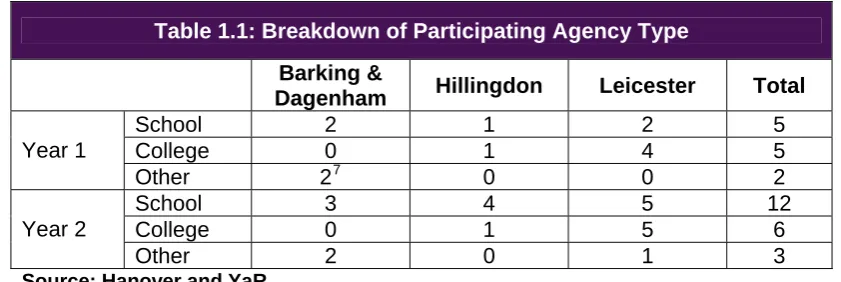
[image:16.595.108.529.336.477.2]1.12 Table 1.1 outlines the breakdown of participating agency by type in Year 1 and Year 2. In Year 1 an equal number of schools and colleges were involved. In Year 2 the number of schools participating more than doubled, whereas the number of colleges increased by a lower rate.
Table 1.1: Breakdown of Participating Agency Type
Barking &
Dagenham Hillingdon Leicester Total
School 2 1 2 5
College 0 1 4 5
Year 1
Other 27 0 0 2
School 3 4 5 12
College 0 1 5 6
Year 2
Other 2 0 1 3
Source: Hanover and YaR
Evaluation Aims and Approach
1.13 The evaluation aimed to “assess whether Re-Ach worked in raising young people’s engagement and attainment in education; and if so, what it was about this particular project that added value”. Specifically, to assess:
• whether the project contributed to raising young people’s aspirations, engagement and achievement;
• the degree to which young people met their personal targets, how their attitude to learning changed and the impact this had on their levels of engagement and attainment; and
• how the project had been implemented and delivered in each area.
7
1.14 Our approach comprised both qualitative and quantitative elements including:
• baseline and completer attitude surveys with pupil participants;
• consultations with strategic and delivery stakeholders (Hanover, YaR, Local Authorities, coaches, trainers);
• ten agency case studies (involving two visits to each and including consultations with project coordinators, strategic representatives, staff engaged in professional workshops and staff supporting participants in a learning environment);
• 35 pupil consultations, undertaken as part of the agency case study visits; and
• analysis of project management information (MI) collated via the delivery agencies (including participant characteristics, and baseline and end of programme achievements, attendance and destinations).
1.15 The value of analysing the project MI has been constrained by the quality and quantity of data available; and the ability to attribute any achievements to the Re-Ach programme itself. The identification of a suitable comparator group was not feasible given the range of factors influencing attitudes and achievements for the young people participating in the programme. Specific detail regarding data access and quality is provided in Section 3.
1.16 Nevertheless, it is also important to recognise that the nature of the target group engaged (who were not on the whole the hardest to reach) and the potential for the project to have a significant and quantifiable impact is limited within the context of other developments / activities and initiatives. Quantitative data alone does not provide therefore a good indication of the value of the programme.
Report Structure
1.17 The remaining sections of the report are structured as follows:
• Section Two: Delivery Effectiveness;
• Section Three: Outcomes and Value;
• Section Four: Factors influencing Effectiveness; and
2
DELIVERY EFFECTIVENESS
Key Messages
1. Re-Ach has enrolled approximately 800 young people (302 Year 1 and 461 Year 2), with an estimate of just under 700 completing the programme over two years. This was below the target set in the business case for the pilot of 1,000.
2. Drop-out rates were fairly low once young people had made the choice to commit to the programme. Exceptions to this were amongst ‘other’ agencies8 where large drop outs were experienced from the young people’s workshop. Agencies perceived that this was due to participants not responding well to the challenging content and workshop rules.
3. In general, schools recruited young people who should have been achieving grades A*-C but their behaviour, attitude or attendance was putting this at risk. Colleges and other agencies had more mixed cohorts depending on the
approach to selection and the young people they work with.
4. Disaffected and disengaged young people were a minority of the Re-Ach cohort. This was a result of not being able to engage many ‘other’ agencies and mainstream agencies choosing not to select their most disengaged for reasons of “protectiveness” or wariness about how they may respond to an outside programme. Some stakeholders therefore questioned whether the programme was really suited for this more disengaged group.
5. The majority of qualitative and quantitative data show high levels of satisfaction with the programme. Most participants and agencies found it useful. Delivery to young people and professionals was of high quality and agencies welcomed the support offered by the programme.
6. Attendance at coaching was generally good, especially where processes for reminding participants had been embedded. The greatest variability in
attendance was in colleges and other agencies where young people were not necessarily attending on their coaching day and culturally had more choice over attendance.
7. There were some differing views amongst participants and professionals regarding specific elements of the programme. Nevertheless, the majority were positive about the value of the programme as a whole, with the workshops and coaching sessions resulting in specific achievements, for example:
• the workshops contributed towards positive experiences, learning about yourself, confidence and empathy with others; and
• the coaching sessions helped to increase responsibility and motivation amongst young people.
8
Young People Engaged
2.1 Over the two years, Re-Ach enrolled almost 800 young people (302 Year 1 and 461 Year 2). These are lower numbers that those originally expected of 400 participants in Year 1 and 600 in Year 2.
2.2 Cohort sizes in some agencies were less than expected largely due to time and staff resource constraints. These included, for example, a very short timescale available for initial set-up of the pilot and difficulties faced by some agencies in providing the adult staff resource required for attendance at workshops and wider support for the programme.
2.3 A breakdown of completers/non completers was not available for Year 1, but in Year 2, 364 (79%) completed the full programme. Drop-out rates were therefore relatively high (979 people dropped out of Re-Ach completely10) though qualitative findings suggested that once young people had made the choice to commit to the
programme they were fairly low.
2.4 The drop-out rate of around 21% could be considered a more reasonable figure if the programme had successfully engaged hard to reach young people. This has not generally been the case (as outlined later in this section). In addition, where drop-outs did occur they tended to be from ‘other’ agencies (the most likely point of engagement for the more disaffected and disengaged youngsters). Agencies
perceived this was due to participants not responding well to the challenging content and workshop rules. If the pilot had been more successful in engaging this group of young people, therefore, drop-out rates may have been even higher.
Participant Characteristics
2.5 We used the baseline data and survey responses to establish common features of the young people participating in the Re-Ach programme. It should be noted at this point that a range of data quality issues (discussed further in Section 3 and outlined in Figure 3.1) meant that characteristic information was not available for all 763 pupils engaged in the programme. This particularly affected, for example, data for free school meals and looked after status where the data was particularly limited.
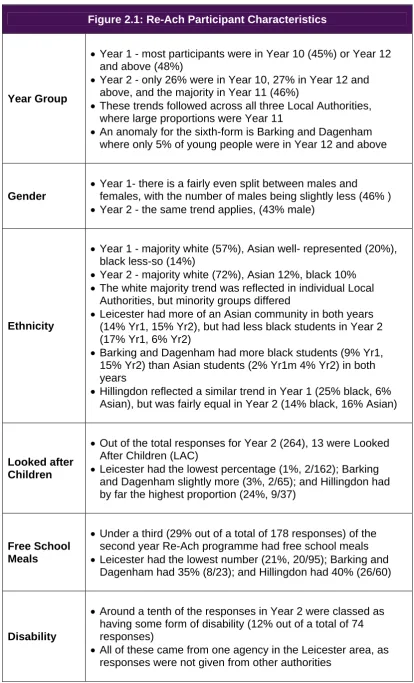
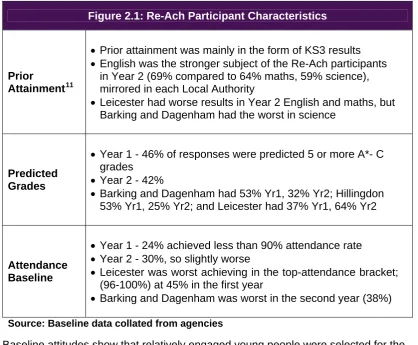
2.6 Figure 2.1 outlines participant characteristics from the data we have. Key features of note include:
• in Year 1 most participants were in Year 10 or Year 12 and above; in Year 2, only a quarter were in Year 10, a quarter in Year 12 and above, and the majority in Year 11;
• there was a fairly even split between males and females participating in the Re-Ach programme over both years;
9
This is an approximate figure found by deduction - it may be the case that more young people than this dropped out.
10
• most participants were white, though participants from Asian and black communities were also well represented according to Local Authority characteristics;
• a very small number of participants were looked-after children or had a disability;
• just under a third of the second year Re-Ach programme (for whom we had data) had Free School Meals (FSM), which was higher than LA averages in two of the areas;
• most participants achieved Level 5 or above at Key Stage 3 in Year 2 and around two-fifths of those under 16 were predicted to achieve 5 or more A* to C grades at Key Stage 4; and
Figure 2.1: Re-Ach Participant Characteristics
Year Group
• Year 1 - most participants were in Year 10 (45%) or Year 12 and above (48%)
• Year 2 - only 26% were in Year 10, 27% in Year 12 and above, and the majority in Year 11 (46%)
• These trends followed across all three Local Authorities, where large proportions were Year 11
• An anomaly for the sixth-form is Barking and Dagenham where only 5% of young people were in Year 12 and above
Gender
• Year 1- there is a fairly even split between males and females, with the number of males being slightly less (46% )
• Year 2 - the same trend applies, (43% male)
Ethnicity
• Year 1 - majority white (57%), Asian well- represented (20%), black less-so (14%)
• Year 2 - majority white (72%), Asian 12%, black 10%
• The white majority trend was reflected in individual Local Authorities, but minority groups differed
• Leicester had more of an Asian community in both years (14% Yr1, 15% Yr2), but had less black students in Year 2 (17% Yr1, 6% Yr2)
• Barking and Dagenham had more black students (9% Yr1, 15% Yr2) than Asian students (2% Yr1m 4% Yr2) in both years
• Hillingdon reflected a similar trend in Year 1 (25% black, 6% Asian), but was fairly equal in Year 2 (14% black, 16% Asian)
Looked after Children
• Out of the total responses for Year 2 (264), 13 were Looked After Children (LAC)
• Leicester had the lowest percentage (1%, 2/162); Barking and Dagenham slightly more (3%, 2/65); and Hillingdon had by far the highest proportion (24%, 9/37)
Free School Meals
• Under a third (29% out of a total of 178 responses) of the second year Re-Ach programme had free school meals
• Leicester had the lowest number (21%, 20/95); Barking and Dagenham had 35% (8/23); and Hillingdon had 40% (26/60)
Disability
• Around a tenth of the responses in Year 2 were classed as having some form of disability (12% out of a total of 74 responses)
Figure 2.1: Re-Ach Participant Characteristics
Prior
Attainment11
• Prior attainment was mainly in the form of KS3 results
• English was the stronger subject of the Re-Ach participants in Year 2 (69% compared to 64% maths, 59% science), mirrored in each Local Authority
• Leicester had worse results in Year 2 English and maths, but Barking and Dagenham had the worst in science
Predicted Grades
• Year 1 - 46% of responses were predicted 5 or more A*- C grades
• Year 2 - 42%
• Barking and Dagenham had 53% Yr1, 32% Yr2; Hillingdon 53% Yr1, 25% Yr2; and Leicester had 37% Yr1, 64% Yr2
Attendance Baseline
• Year 1 - 24% achieved less than 90% attendance rate
• Year 2 - 30%, so slightly worse
• Leicester was worst achieving in the top-attendance bracket; (96-100%) at 45% in the first year
• Barking and Dagenham was worst in the second year (38%)
Source: Baseline data collated from agencies
2.7 Baseline attitudes show that relatively engaged young people were selected for the programme, particularly in Year 2 as shown in Table 2.1. In Year 1, although the young people appeared to have a good attitude to learning and school / college they did indicate a less positive attitude towards the skills they had to help them achieve their potential / goals. However in Year 2, this was not such a problem - suggesting that Year 2 participants may have been more engaged at the outset than those involved in Year 112.
Table 2.1: Baseline Attitudes
Statement Year 1 Year 2
Good / excellent at ‘coming to school / college / work
every day’ 78% 97%
Good / excellent at having ‘good behaviour in lessons /
work’ 68% 82%
Agreed that they ‘enjoy learning’ 87% 73%
Good / excellent at ‘being confident when talking to
adults other than their parents’ 58% 71%
Good / excellent at ‘improving their own learning and
performance’ 54% 82%
Good / excellent at ‘coping with new experiences and
situations’ 52% 65%
Source: Pupil baseline attitude surveys completed at enrolment (slightly different questionnaires were used in Year 1 and Year 2)
11
Although Year 1 data is available, it is not directly comparable to national and Year 2 data. 12
[image:22.595.111.530.70.415.2]Participant Type
2.8 In schools, the majority of young people selected were capable of achieving grade A*-C GCSEs but were at risk of achieving lower grades because of relatively mild behaviour, attendance or attitudinal factors. Figure 2.2 provides some examples of selection approaches amongst the participating agencies.
Figure 2.2 Example Agency Selection Criteria
• Year 11, capacity of 5 A*-C but behavioural / attendance issues preventing attainment
• With academic ability, no behavioural issues, but need extra push to achieve A*-C
• Potential to achieve A*-C but currently underachieving
• Pupils at risk of leaving without qualifications
• Pupils not likely to achieve their predicted levels of attainment
• Previous results, current grades, attendance records & low self-esteem
• Those not expected to achieve 5 A*-Cs
Source: Fieldwork Notes, York Consulting LLP
2.9 In colleges the cohorts were more mixed and in other agencies young people had significant behavioural and / or attitudinal issues. However, the agency-led approach to selection (and difficulty in attracting ‘other’ agencies) resulted in attracting fewer young people at risk of becoming NEET than anticipated:
• there were much fewer ‘other’ agencies engagedin the programme, for example work based training providers and youth offending teams. These are the agencies that would be likely to engage harder to reach individuals. Representatives from LAs reported a perception that ‘other’ agencies lacked confidence in putting vulnerable young people through such a structured, challenging programme; and
• many mainstream agencies chose not to select their most disengaged for reasons of “protectiveness” or wariness about how they may respond to an outside programme.
2.10 As a result and as the characteristics trend indicates relatively few young people that participated in the programme could be regarded as disaffected or disengaged. This was supported through some of the more qualitative evidence:
• most young people consulted during the case studies, particularly in schools, did not show an unwillingness to achieve and illustrated a good attitude towards learning; and
2.11 Overall the findings suggest, therefore, that participants were those ‘operating below
their potential’ but not disengaged or disaffected, and particularly not those with the
most challenging behaviours. This is also apparent when comparing characteristics to those young people participating in the national Key Stage 4 Engagement
Programme (KS4EP)13 - this programme involves young people with similar characteristics to those on the Re-Ach programme but indicators suggest that they may fall within a group classed as relatively more disengaged.
2.12 Comparisons between the Re-Ach pilot years, KS4EP and LA/national data are provided in Table 2.2 and Figure 2.3 overleaf. These data support the view that most Re-Ach pupils, whilst having some characteristics that might influence levels of achievement and attitudes towards learning, were not, on the whole, those from the more disengaged or disaffected groups:
• a slightly higher proportion of Re-Ach pupils accessed free school meals compared to Local Authority averages;
• a similar proportion of Re-Ach pupils were looked after children to LA and national averages;
• a third of Re-Ach pupils have baseline attendance trends of less than national and LA average levels;
• the prior attainment and predicted grades for Re-Ach pupils are similar to national and local averages.
2.13 Some stakeholders questioned whether the Re-Ach programme was really suited for this more disengaged group:
“Some Year 10 pupils dropped out of the programme for not being able to grasp the programme and also behaving dangerously. I felt that these pupils and Year 10 in general are not mature enough to handle the programme.” (Agency staff member);
“In one of the ‘other agencies’ 15 pupils started the workshops but only 4 completed the programme. The staff put this down to the rigid approach of the YaR staff and the style of delivery.” (Case study report)
13
Table 2.2: Participant Type Data
Category Detail Year 1 Year 2 KS4 Project
Comparison
LA / National Comparison
Barking and Dagenham N/A 35% 28.70%
Leicester N/A 21% 22%
Free School Meals
Hillingdon N/A 40%
39%
17.40%
Barking and Dagenham N/A 3% 2%
Leicester N/A 1% 0.70%
Looked After Children
Hillingdon N/A 24%
N/A
2%
Barking & Dagenham 27% 41% 92.30%
Leicester 27% 26% 92%
Attendance14
Hillingdon 17% 27%
N/A
91.70%
English N/A 69% 28% 74%
Maths N/A 64% 27% 76%
Prior Attainment15
Science N/A 59% 26% 73%
Barking and Dagenham 53% 32% 39.70%
Leicester 63% 64% 36.50%
Predicted Grades
Hillingdon 53% 25%
N/A
44.90%
Source: Re-Ach baseline enrolment data and Key Stage 4 Evaluation Database - York Consulting LLP; National/LA statistic websites
14
National comparison is overall attendance rates, LA attendance is percentage below 90% (i.e. approximately the proportion of students that were below national average).
15
Figure 2.3: Participant Type Data - Comparison to National and LA trends16
Free School Meals
• Two out of three areas enrolled a comparatively high proportion of pupils that are eligible for free school meals:
- Barking and Dagenham had an average of 35% of Re-Ach pupils, which is higher than the LA average of 28.7%
- Leicester had a slightly lower figure (21% compared to 22% for the LA)
- Hillingdon has a far higher percentage (40% compared to the LA average of 17.4%)
Looked After Children
• National figures are for children aged 13-19
• Leicester had slightly higher proportions of Re-Ach pupils being LAC (1% compared to LA average of 0.7%)
• Hillingdon had much higher proportions of Re-Ach pupils that were LAC (24% compared to 2% LA average)
• Barking and Dagenham had slightly higher Re-Ach LAC pupils (3% compared to 2% LA average)
Attendance
• Just under a third of Re-Ach pupils had attendance rates less than 90%. The national average for attendance is 92.2% (with LA averages of 92.3% for Barking and Dagenham, 92% for Leicester and 91.7% for Hillingdon)
• 41% of Barking and Dagenham Re-Ach pupils had baseline attendance trends, compared to 27% in Hillingdon and 26% in Leicester
Prior
Attainment17
• The national level for English KS3 was 74%, for Maths 76% and Science 73%. The overall Year 2 Re-Ach results were only slightly lower.
Predicted Grades
• 46% of Re-Ach pupils in Year 1 were predicted 5 or more A*-C grades and 42% in Year 2, compared to national levels of 46.8%
• 32% of Barking and Dagenham Re-Ach pupils had predicted Level 2 attainment, compared to an area average for the LA of 39.7%. This compares to:
- 25% of Hillingdon Re-Ach pupils compared to 44.9% for the LA;
- 64% of Leicester Re-Ach pupils compared to a local average of 36.5% - Leicester students were likely to be significantly more engaged than in the other agencies
Source: Re-Ach Baseline Enrolment Data; National/LA Statistic Websites
16
Due to the very low numbers in many cases, the differences highlighted are not statistically significant 17
Delivery Components
2.14 Most qualitative and quantitative data showed high levels of satisfaction with the programme, where most participants and agencies found it of use. This is evidenced through case study, survey and workshop feedback from both young people and agency representatives.
2.15 Six of the ten case study agencies expressed satisfaction with the overall Re-Ach programme. Amongst the remaining agencies, there was satisfaction with some elements of the programme but some mixed views about the effectiveness of specific elements or a view that other support programmes they operated were more suited to the needs of the young people they support.
2.16 The training and coaching staff from Hanover and YaR were deemed high quality professionals by most case study agencies. A small number identified some
inconsistencies in quality between those staff involved in Year 1 and Year 2 of delivery.
2.17 Table 2.3 shows the pupil survey results associated with the effectiveness of different Re-Ach elements. The workshops and one-to-one coaching sessions were considered enjoyable by most of those participants responding to the survey. Overall the
programme met the needs of the young people, though around a fifth said they needed more sessions. Few young people said Re-Ach was a waste of time, and most said it helped with their personal goals.
Table 2.3: Survey Findings - Effectiveness of Re-Ach Delivery Elements
Year 2
The workshops I attended were interesting and enjoyable 87%
The one to one coaching sessions I received were helpful 93% The coaching sessions were often enough to meet my needs 85%
I needed more coaching sessions than I had 18%
The Re-Ach programme has been a waste of my time 6%
Source: Re-Ach End of Programme Survey
Professional Workshop
2.18 Most participants attending the professional workshops enjoyed them, and staff from a couple of agencies were particularly positive. There were some mixed responses across other agencies but generally these highlighted issues of effectiveness rather than negative experiences.
2.19 Effectiveness issues raised about the professionals’ workshop include:
• a number of professionals stated that they did not know what to expect from the workshop and were not clear what their role was in the project after completing the workshop:
“I was not sure what role I had in the project and what this meant for me in my everyday role”. “I thought I would learn more about the Re-Ach project itself” (Agency Professionals);
• releasing staff to attend the workshop has been identified as a barrier for some agencies particularly when the role of agency staff was unclear and the senior leadership team was not championing the project - “Although I have found it very interesting from a personal development point of view, I am confused as to my role in the Re-Ach project and how I link in my support for the young people on
the programme” (Learning Mentor); and
• in some agencies staff turnover meant that the continuity of support was lost when workshop attendees left the agency.
2.20 Figure 2.4 outlines further stakeholder perceptions of the professionals’ workshop.
Figure 2:4: Stakeholder Perceptions of Professionals’ Workshop
Feedback forms:
• almost two thirds of participants reported that they found the entire workshop useful;
• individual aspects identified as being of most use included listening; understanding the coaching framework; and integrity and sincerity; and
• participants identified a number of actions they will take as a result of the workshop including: listen more and differently; be more committed; develop skills further; use the coaching model in practice; and be more committed.
Positive experiences - case studies and feedback forms:
“I feel the workshop is highly thought provoking. I also feel if the young people can get the opportunity to see / hear or do what I have done; a few lives will be saved!”
“Excellent, I felt totally engaged despite not wanting to attend.”
“A thoroughly enjoyable learning experience I will use in my life and to benefit young people.”
“I found the workshop very enlightening and it made me more aware of what I can do if I allow myself. I feel stronger as a person.”
“The professional workshop was especially useful in being able to give pupils feedback on their behaviour, but it has in general not changed our approach to our role.”
“80% of staff who attended the professionals’ workshop found it to be a profound experience.”
“One head teacher felt the workshop was instrumental in getting his headship”
Negative experiences:
“I didn’t really engage with the philosophy of the workshop”
Young People Workshops
2.21 There was strong support from the majority of young people and agencies regarding the series of workshops for young people. Findings from the feedback forms included:
• almost three quarters of the 237 participants who completed the feedback form thought that their experience was positive (71% Year 1, 92% Year 2);
• just under a half of participants felt the overall experience was excellent (43% Yr1, 53% Yr2); and
• 70% of participants rated the content of the workshop as good or excellent in Year 1 and 91% in Year 2.
2.22 Feedback illustrated that the workshop had been a catalyst in many participants’ personal development. Figure 2.5 provides some examples.
Figure 2.5: Positive Workshop Feedback
Participants stated that the workshop provided them with good or excellent opportunities to:
• learn something new about themselves (72% Yr1, 93% Yr2);
• see something new about the circumstances and situations they are in (75% Yr1, 93% Yr2);
• see new choices (72% Yr1, 92% Yr2);
• learn new skills (71% Yr1, 89% Yr2); and
• see new ways to move forward their goals (71% Yr1, 94% Yr2).
Some elements of the workshops identified as being particularly useful or interesting by the participants included:
• “Learning more about the people you have known for years”;
• “Realising that I am not on my own”; and
• “It made me see things differently”.
Participant 2 really enjoyed the workshop. He found it fun and enjoyed some of the activities. It gave him the opportunity to make new friends in his year group who he wouldn’t have normally spoken to. The group agreed between them that if they ever wanted to discuss their problems with another student, then they would all be there for each other in a support mechanism.
Source: Surveys and Fieldwork Notes
2.23 Over half of the participants stated that the information they received on what to expect from the workshop was good or excellent (61% Year 1, 78% Year 2). In addition, feedback forms from Year 2 showed that 89% of participants rated the facilitators as good / excellent. A couple of positive examples were:
• I found the workshop very useful... it benefited me...l have a very good
• I don’t think there are any improvements that can be made, but the group sessions at the workshop could be longer - and keep the leaders.
2.24 However, there were a small number of participants who were less positive about their experiences:
• Participant 1 didn’t like being forced to enter the programme. She had a lot of coursework to complete at the time of the workshop and didn’t like missing a lot of school; and
• Participant 2 said “it felt like I was at a psychiatrist’s. It did help me to open up and I wouldn’t have spoken to anyone else, but it was very intense.”
2.25 Most agencies were also satisfied with the young peoples’ workshops and considered them to be of value. The vast majority of workshops were delivered off site. Agency staff reported that this was an important feature of the model because it ensured that a young person was away from everyday influences. Only a couple of agencies
suggested that they would have preferred the workshops to take place on site (this may have been because they did not find the selected venue appropriate). Feedback forms show that 79% of pupils in Year 2 thought the location of the venue was excellent or good.
2.26 Nevertheless, some effectiveness issues that impacted on the potential value gained from the workshops were highlighted through the evaluation:
• some internal and external support staff were not clear why they were required to attend. Several individuals felt that the trainers did not relate to them well and overlooked the teacher and pupil relationship. Professionals also reported that the trainers did not appreciate the supervisory position played by the staff;
• over half the case study agencies (schools and colleges) reported concerns that the structure (5 days in total, including 1 day for enrolment, 3 days for the young people workshop, and 1 day for the coaching workshop) was too long and / or not suitable for the target group. A number of agencies also said they would prefer some flexibility in the structure of enrolment and workshops, given that the timing and duration of the workshops were sometimes barriers to agency engagement and commitment. Flexibility was offered in some circumstances, for example in one college the enrolment and workshops were rolled into one;
• some agency staff thought the workshop rules to exclude students from the programme if they were late or missed a day due to illness were too inflexible given that (they felt) these young people could still benefit from the programme. “The very nature of these students, those who have poor attendance, punctuality, commitment, are the very students that should not miss out and would most
benefit from this training”. Some of these students were offered coaching but are
not formally Re-Ach programme completers;
− “feeling vulnerable during the workshop”; and
− “being challenged as they had to address things that were personal to them
with people they were unfamiliar with”.
Performance Coaching Sessions
2.27 This element of the project involved the young person working with a Professional Performance Coach (PPC) over a six-month period meeting once a month. Young people within each agency also came together with the PPCs and YaR trainers twice during the six months to review progress as a group.
2.28 Agencies reported, on the whole, relatively good attendance at coaching sessions by the young people involved (reporting attendance as good or in some cases identifying that 80-90% of young people had attended all/most of their coaching sessions). However, there was some mixed attendance in other agencies and in one, attendance was particularly low (this agency estimated that only around one third of those that enrolled and completed the workshop went on to attend all their coaching sessions).
2.29 Most agencies consulted liked the concepts relating to the Performance Coaching Sessions (PCS) and felt that they could complement the support already offered by the agencies. Agency staff felt that the young people gained from the sessions as they were able to speak to someone disassociated with the school. In addition, the
confidentiality aspect was fundamental in gaining the confidence of the young people.
2.30 The young people consulted as part of the case studies and surveys found the Performance Coaching Sessions useful. A number of participants reported feeling more motivated and aware that they were responsible for their life.
2.31 Young people and professionals consulted as part of the case studies found the performance coaching sessions useful as a result of:
• participants forming a good relationship with their coach;
• working closely with someone disassociated with the school;
• the confidentiality and trust; and
• support staff within some agencies complementing the support.
2.32 Completer survey responses also illustrated that the Performance Coaching Sessions were viewed positively by participants:
• nine tenths of participants stated that the one-to-one coaching sessions were helpful (96% Year 1, 93% Year 2);
• almost three quarters of participants stated that the paired coaching sessions were helpful (73% Year 1, 34% Year 218); and
• over three quarters stated that the coaching sessions were enough to meet their needs (78% Year 1, 85% Year 2).
18
2.33 Most young people stated that they had formed good relationships with their coaches although at first some did find it hard to engage with their coach - “when I first met him I didn’t think I would be able to talk to him about myself but he’s been great. He has
really helped me focus on what I want” (Participant).
2.34 Some young people did not think the coaching sessions had as much impact on them as the workshop and not all young people were happy with their experiences. Nearly a quarter felt that they needed more coaching sessions (24% Year 1, 19% Year 2)19 and one in ten stated that overall the Re-Ach project had been ‘a waste of their time’ (11% Year 1, 6% Year 2). Some agencies used their own staff and their knowledge
developed through the professional workshop to continue sessions with the young people.
2.35 Some issues of effectiveness relating to the coaching sessions, identified through consultations, include:
• the fact that discussions in the coaching sessions were in confidence was considered a key benefit by many participants;
• the effectiveness of the PCSs was linked in a number of cases to the relationship established between the coach(es) and the agency. Where a coach was
embedded into the existing support structures, for example located in the office with other support workers, agencies found this encouraged communication and added value to the support offered to the young people. “By encouraging our staff to work with the coaches progress made by a young person can be validated
without taking away confidentiality” (School). One coach consulted at the time of
reporting stated that he was encouraged to work alongside the agency professionals and use their knowledge of the young people to provide better support;
• the six coaching sessions provided a good starting point for the young people but some professionals argued that a longer period of support (dependent upon the young person in question) was needed. There was no flexibility in the Re-Ach pilot model to meet this need though continuation of support was being piloted with young people in one agency. Agencies felt they may have been able to provide more continuation support following the formal completion of the Re-Ach intervention had there been an opportunity within the programme structure for their own support staff to further develop their coaching skills.
19
3
OUTCOMES AND VALUE
Key Messages
1. The evidence suggests that the programme had a positive influence and engaged most of those participating. It commonly supported those considered to be on the borderline of achieving 5A*-C grade GCSEs and translated to skills development20 and improvements in attitudes for some of those involved (between one quarter and one third). In this way, the Re-Ach programme may have contributed towards one of its three strategic outcomes - that is,
improved Level 2 attainment for some of those involved.
2. The areas where the programme had the most positive influence were helping to prevent deterioration in engagement and achievement and improve
attitudes towards learning. Underpinning this change was an improvement in cognitive skills and understanding of responsibility and choice.
3. There is some anecdotal evidence of impact on attendance, achievement and destinations. However, despite efforts to improve data access throughout the evaluation, assessing the impact on young people using quantitative data was constrained due to ongoing data issues associated with quantity, quality, timing and attributability.
4. Participants were not generally identified as the hardest to reach and illustrated minimal evidence of disaffection and disengagement.
Consequently, the pilot was unable to make a significant contribution to two of the three strategic outcomes that were identified in its business case - namely, reducing the number of 16-19 year olds not in education employment or training (NEET); and reducing the number of teenage pregnancies.
5. Given the underperformance against target numbers, unit costs for the pilot were higher than expected. Costs were also assessed as relatively high for a programme of this nature given that a minority of participants were, in the event, in the more disaffected target group. The evaluation has identified areas where there is the potential to improve cost-effectiveness for any future delivery of programmes that incorporate the principles and elements of the Re-Ach programme.
Context for Impact Assessment
3.1 In this section we present data and survey results alongside the more detailed qualitative understanding gained through case studies. This enables us to provide a reasonable assessment of the outcomes and value associated with the Re-Ach programme. First, however, we briefly outline the data constraints and limitations that have been faced during the study and analysis of findings. This is an important context which influences the confidence that can be applied to any quantitative findings in particular.
20
3.2 A range of data access and quality issues identified at the interim reporting stage led to a decision not to follow-up Year 1 outcomes (though we did access some for a sample of participants in Leicester). At the same time, a greater focus was placed on improving the collation and access to data for Year 2 participants, including considerable efforts to collate baseline and follow-up data by Hanover and YaR; and YCL designed a pro-forma to aid the collation of outcomes data.
3.3 We therefore had access to some outcomes data for Year 2 participants which we comment on (alongside the more qualitative assessments) later in this section. This includes an update of the data collected at the start of the project, specifically attendance, attainment and destination outcomes.
3.4 However, there was a range of issues faced during the evaluation which limited our ability to quantitatively assess impact, both in terms of assessing softer changes such as those associated with attitudes / behaviour; and harder outcomes relating to achievement, attendance and destinations. Details are shown in Figure 3.1, which includes issues associated with:
• quantity and quality of data available;
• timing of reporting, meaning that attainment outcomes are only potentially
available for a sample of participants (those that have completed Year 11 or Year 13); and
• attributing outcomes to the Re-Ach programme given the context of a wide range of influences on young people, and other initiatives / programmes / approaches in place to support improvements in achievement and engagement.
Figure 3.1: Limitations on Measuring Impact
Quantity of data
Records show that Re-Ach recruited 301 young people onto the programme in Year 1 and 461 in Year 2 - 762 participants. Of these data is available for:
• baseline performance for 268 Yr1 (maximum), 423 Yr2;
• outcomes for 283 in Yr 2 (maximum);
• workshop feedback for 239 Yr1, 315 Yr2;
• baseline questionnaires for 268 Yr1 and 202 Yr2
• follow-up questionnaires for 78 Yr1 and 152 Yr2; and
• surveys completed both at baseline and follow-up for only 65 Yr1 and 80 Yr2.
However, each data set shows a different total figure, which limits the evidence available to illustrate the distance travelled on the hard outcomes and attitudinal / behavioural indicators.
Data quality issues
Where data was available there were a number of inconsistencies including:
• ethnicity coding was not standardised;
• there was no identification of year groups on baseline data (though we requested this for follow-up Year 2 data);
• Year 1 outcomes data were not requested due to the issues faced in accessing baseline data;
• not all unique identifier numbers were received. We therefore had to undertake cleansing exercises to remove duplicate names, spelling errors and missing data; and
• not all data in Year 2 came back completed, and some students that information had been requested for did not, in the end, participate in or complete the Re-Ach programme.
This last issue has meant, however, that we have been able to do some comparisons of outcomes between completers and non-completers.
Timing of final report
Most of Year 1 and half of Year 2 pupils were not at an age where quantifiable outcomes are available (i.e. end of Key Stage 4 or 5).
Attributing impact
There are a number of factors that will have influenced the young people engaged on the programme, which meant that it was difficult to attribute any changes in performance for participants to the Re-Ach programme alone, due to for example:
• a range of other influences (school context, peers, culture, home environment);
• school delivery approaches, support, other initiatives; and
Skills, Engagement and Attitudes
3.6 The evidence suggests that the Re-Ach project was positive and engaging for most of the young people that completed the programme, influencing a range of areas
associated with skills development21, confidence and behaviour. Some of the
participants (up to one third) responding to the surveys indicated changes associated with skills and attitudes, for example, improvements in recognition of their own
strengths and weaknesses and enjoyment of learning. For others, the programme may have helped to prevent deterioration in levels of engagement or attainment.
3.7 Pupils responding to the surveys in both Years 1 and 2 were positive about the programme saying that it had supported them in a number of respects, as shown in
Table 3.1.
Table 3.1: Impact of the Re-Ach Project – Survey Responses
The Re-Ach programme helped me to... Year 1 Year 2
..achieve my personal goals 77% 85%
..improve my attendance at school/college/ work 67% 68%
..improve my behaviour 75% 65%
..enjoy learning more 67% 69%
..be aware of my strengths and weaknesses 90% 81%
..raise my level of achievement 82% 79%
..decide what to do in the future 64% 64%
Source: Re-Ach end of programme survey responses
3.8 Supporting skills development and raising levels of achievement were areas where the largest majority of respondents were positive about the programme. The specific goals and positive outcomes achieved tended to relate to the development of life skills and raised aspirations that might support future achievement and progression. Themes identified by young people included:
• developing an understanding of themselves, their beliefs, values and responses;
• helping to identify strengths and weaknesses;
• developing empathy with others;
• understanding how they could change things for the better;
• taking actions to make things better (e.g. moving seats away from people they are distracted by); and
• developing confidence and vocalising opinions.
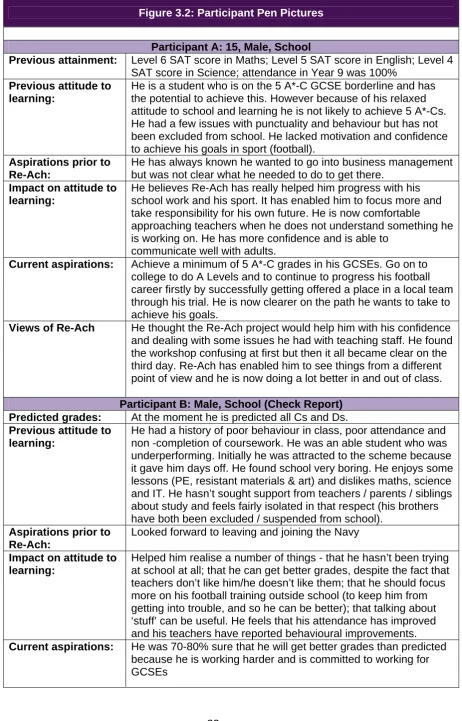
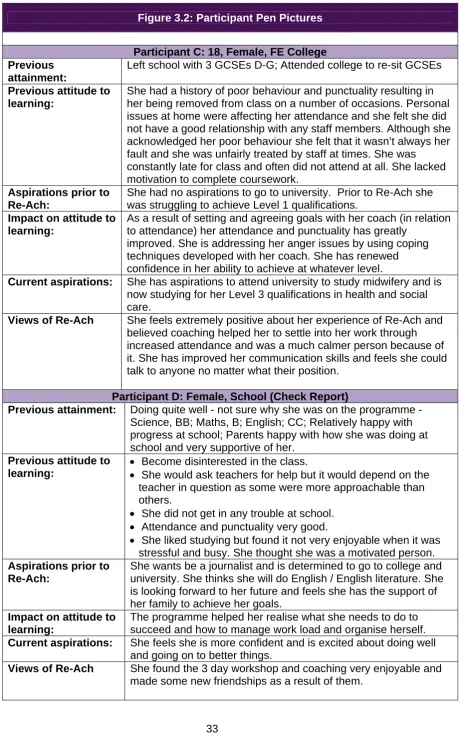
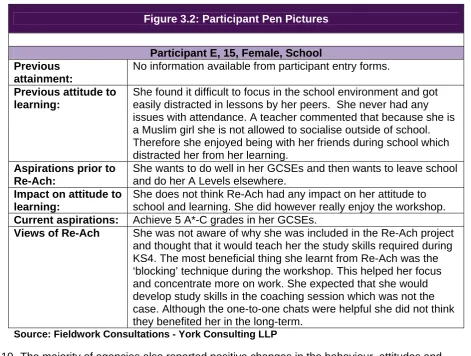
3.9 Some of the case studies with young people highlighted in particular the success of the programme in helping to prevent attitudinal or behavioural issues deteriorate further. The pen pictures in Figure 3.2 provide a range of examples of students engaged on the Re-Ach programme, including one (E) where the programme was not considered to have an impact.
21