This is a repository copy of Integrating the physics with data analytics for the hybrid modeling of the granulation process.
White Rose Research Online URL for this paper: http://eprints.whiterose.ac.uk/119654/
Version: Accepted Version
Article:
AlAlaween, W.H., Mahfouf, M. and Salman, A.D. (2017) Integrating the physics with data analytics for the hybrid modeling of the granulation process. AIChE Journal. ISSN
0001-1541
https://doi.org/10.1002/aic.15831
[email protected] https://eprints.whiterose.ac.uk/ Reuse
Items deposited in White Rose Research Online are protected by copyright, with all rights reserved unless indicated otherwise. They may be downloaded and/or printed for private study, or other acts as permitted by national copyright laws. The publisher or other rights holders may allow further reproduction and re-use of the full text version. This is indicated by the licence information on the White Rose Research Online record for the item.
Takedown
If you consider content in White Rose Research Online to be in breach of UK law, please notify us by
Integrating the Physics with Data Analytics for the Hybrid Modelling of the
Granulation Process
Wafa’ H. AlAlaweena, Mahdi Mahfoufa and Agba D. Salmanb
aDepartment of Automatic Control and Systems Engineering, The University of Sheffield, UK bDepartment of Chemical and Biological Engineering, The University of Sheffield, UK
(E-mails: [email protected]; [email protected];
Abstract
In this paper, a hybrid model based on physical and data interpretations to investigate the high shear granulation (HSG) process is proposed. This model integrates three separate component models, namely, a computational fluid dynamics model, a population balance model and a radial basis function model, through an iterative procedure. The proposed hybrid model is shown to provide the required understanding of the HSG process, and to also accurately predict the properties of the granules. Furthermore, a new fusion model based on integrating fuzzy logic theory and the Dempster-Shafer theory is also developed. The motivation for such a new modelling framework stems from the fact that integrating predictions from models which are elicited using different paradigms can lead to a more robust and accurate topology. As a result, significant improvements in prediction performance have been achieved by applying the proposed framework when compared to single models.
Keywords: Hybrid model; Data fusion; Fuzzy logic; Dempster-Shafer theory; High shear
granulation.
Introduction
In particular, high shear granulation (HSG) has been extensively used because of its short processing time due to the fast growth and densification processes2. In general, granulation is recognised as being a complex process with three distinct mechanisms taking place all inside the granulator itself, namely: 1. Wetting & nucleation, 2. Growth & consolidation, and 3. Breakage & attrition3. Despite the huge body of research addressing the different issues of the granulation process, it remains a subject of active research. The reason behind this can be attributed to the inherent complexity of such a process which results in the poor understanding of the process and its mechanisms and, consequently, leading to a high recycling ratio and significant wastes in the related industries4. Consequently, recent studies have focused on the understanding, the modelling and the simulating of the granulation process. The various modelling paradigms that have been developed and applied are either data-driven (e.g. neural network) or physical based models (e.g. population balance model)1, 5-7.
Data-driven models have been mainly utilized to predict the properties of the granules using different granulation equipment and materials8. There are however some significant advantages of using these paradigms. The number of properties to be monitored can be large compared to physical based models, where studying more than three properties can be computationally taxing. Furthermore, these models map the granulation inputs to the outputs without the need for representation of the complex nature of the process and the interactions among its mechanisms. Thus, they can successfully predict the properties of the granules and can simply interpret the relationships between the inputs and the outputs in a way that one can easily understand and relate to1.
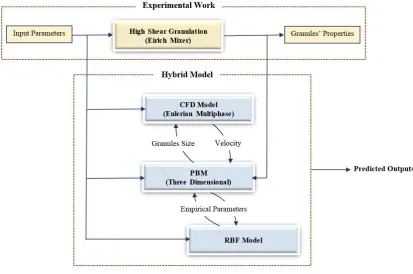
In the granulation process, the successful model is one that (i) can accurately predict the properties of the granules, (ii) can provide the required understanding of the process and its mechanisms, and (iii) can be used reliably and efficiently by the relevant industries. In fact, all of the above objectives may not be achievable by using one single model. Therefore, in this research, a hybrid model integrating both data and physical based models is developed. Such a model integrates three separate but synergetic models through an iterative procedure. The hybrid model consists of three models, namely; a CFD model, the three-dimensional PBM and a radial basis function (RBF) model. These models are integrated in such a way that the outputs from one of these models are used as inputs to the other model. In order to improve the modelling performance of the hybrid model, a new fusion model based on fuzzy logic theory and the Dempster-Shafer theory is also proposed. The main idea behind this model is to combine the predicted outputs from different models to obtain more accurate predictions, which may not be obtainable using a single model. Thus, the predicted outputs from the hybrid model are combined with the ones from the model incorporating the integrated network and the Gaussian mixture model. This model, which will be from now on referred to as the incorporated model, is a data-driven model that was previously developed to predict the properties of the granules produced by the same equipment and materials, which were used in this research1, the integrated network is described in Appendix. The remainder of the paper is organized as follows: first, the experimental work that was conducted using the Eirich high shear mixer is described. The hybrid model and the related theoretical background are then presented, the results are also presented and discussed, followed by presenting the new fusion approach and its results. Finally, concluding remarks summarise the work with recommendations for future research.
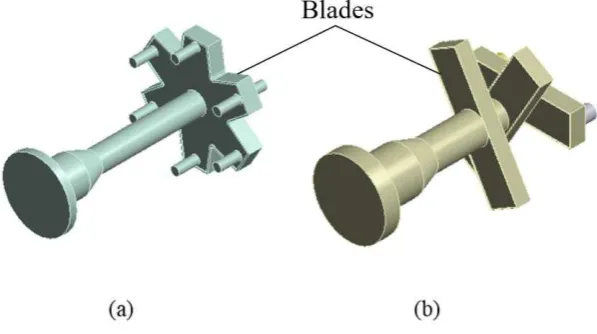
The high shear Eirich mixer (1 Litre vertical axis granulator with a top-driven impeller, Maschinenfabrik Gustav Eirich GmbH & Co KG, Germany) was used to granulate Calcium Carbonate (D50=85µm) by adding Polyethylene Glycol (PEG 1000). This mixer is equipped with a scrapper and impellers with different shapes. It is worth mentioning at this stage that only two impellers were used in this research, as shown in Figure 1; the two impellers not being in the centre of the 16cm diameter vessel. Before the start of the granulation experiment, the binder was melted (the melting point is approximately 40oC), followed by pouring-in the binder on the powder bed while both the vessel and the impeller were rotating in the same direction (clockwise). For all experiments, the binder addition lasted for approximately three minutes. Once the granulation experiment was completed, the granules were left at room-temperature to allow the binder to solidify. Finally, these granules were characterized in terms of size, which was measured using the Retsch camsizer (Retsch Technology GmbH, Germany), binder content and porosity, which were measured in the size range (180-2000µm) as described in1.
Figure 1. CAD drawing of the impeller types (a) impeller type I, bin impeller, and (b) impeller type II, star impeller (Reproduced with Permission from Maschinenfabrik Gustav
Eirich GmbH & Co KG., January 2017).
impeller shapes were used). The granulation vessel was at the horizontal position during the granulation process (i.e. tilt angle was zero) and its speed was kept constant (170rpm). Generally, many input variables can affect the granulation process, however, the specifically investigated variables proved to have the most significant effects, which were measured via the correlation coefficient, in terms of the final properties of the granules produced using Calcium Carbonate. The aforementioned variables were systematically studied using a full factorial design of experiments; the total number of experiments being 108.
The Hybrid Model
The Hybrid Model: Model Development
model is used to express these parameters as a function of the input variables, therefore, a better knowledge relating the effects of the input variables on these parameters and on the final properties of the granules is gained. The size of the granules predicted by the PBM is then used to re-evaluate the parameters obtained from the CFD model, followed by re-estimating the outputs of the PBM and RBF model. The steps above are repeated until a satisfactory performance is reached, or alternatively the difference between the predictions for two consecutive steps becomes asymptotically small. It is worth emphasising at this stage that the performance of the hybrid model depends on the performances of the models included.
Figure 2. The hybrid model for the HSG process.
The mathematics behind the single models presented have already been well-publicised. Readers may refer to various research papers and books for further readings, in particular references3-7, 9-25. In this paper, only the key developments are included to in order to help the reader get to grips with the algorithms presented.
As already stated, a three-dimensional PBM provides a deeper insight into the granulation process by representing its three main mechanisms. This is because it follows the evolution of the granules with time by virtue of the granule size, the binder content and the porosity. The 3D population balance equation is usually written as follows14:
(1)
where F(s, l, g, t) represents the density function such that F(s, l, g, t)ds dl dg is the mass of granules when solid (s), liquid (l) and gas (g) are in the ranges (s, s+ds), (l, l+dl) and (g, g+dg), respectively. The partial derivatives with respect to s, l and g account for layering, drying and re-wetting, and consolidation, respectively. The terms in the right hand-side of (1) stand for the rates of nucleation, aggregation and breakage. Various nucleation rates have been developed, however, the majority of these assumes that one droplet forms a nucleus. However, the latter assumption is not always valid10. Since the breakage of nuclei plays a significant role in the nucleation mechanism15, an empirical nucleation rate was used in this study. The aggregation rate consists of two terms, formation and depletion, which can be written as follows10:
' ' 0 ' 0
1 ( ', ', ', ', ', ') ( ', ', ', ) 2 ( ', ', ', ) ' ' ' ( , nuc nuc Formation Depetion
Aggregation Aggregation Aggregation
s s l g
Formation Aggregation
s s l g
Depetion Aggregation
s s s l l l g g g F s l g t
F s s l l g g t ds dl dg
F s l
' ' 0 ' 0
, , ) ( ', , ', , ', )
( ', ', ', ) ' ' '
nuc
nuc
s s l g
s s l g
g t s s l l g g
F s l g t ds dl dg
(2)where snuc is the volume of the nucleus, and ( ',s s s l l l g g g ', ', ', ', ') is the aggregation
kernel which governs the rate at which two granules with internal coordinates ( ', ', ')s l g and (s s l l g ', ', g') agglomerate. In fact, the coalescence of two granules depends on the
( , , , ) ( , , , )ds ( , , , )dl ( , , , )dg Nucleation Aggregation Breakage
F s l g t F s l g t F s l g t F s l g t
t s dt l dt g dt
granules size and the availability of the binder on their surfaces. The semi-mechanistic aggregation kernel that describes these two factors and the coalescence types has been already presented in16. Such a kernel can be expressed as follows16:
1 2
1 2 1 2
2 0 1 2
1 2 2
1 2 2 2
4 ( )
exp
( ) , Type I coalescence
exp exp
( ) max , , Type II coalescence
R R R
forward reverse
R R R R R R
u R R W
kT
R R dR
R W
kT kT
R R dR dR
R R
(3)where Ri is the radius of the ith particle, u0 and W are the initial velocity of the particle and the Fuch stability ratio, respectively. The parameters k and T represent the Boltzmann constant and the temperature, respectively. The parameter refers to the net attractive potential for coalescence, and is a tuneable parameter.
The consolidation mechanism takes account of the compaction process that increases the binder on the surface of granules and leads to a decrease in the porosity. The consolidation process has been empirically expressed by the following set of equations:
min
min
min min
( )
(1 ) 1
l g
s l g
d c dt
s
dg s l g
c l g
dt s (4)
where
and
min are the porosity and its minimum value, respectively. The constant c is theComputational Fluid Dynamics
Generally, numerical simulation techniques of a system can be classified into two types; continuum and discrete. As the names indicate, the former views the system as a continuous flow (i.e. fluid), while the latter deals with an individual particle. An Eulerian multiphase model is used to simulate the particulate phase as a continuous flow18. Two phases; solid and gas, are considered. The mass and momentum of these two phases are governed by the following set of equations19:
( )
.( ) .( ) ( )
( )
.( ) 0
( )
.( ) .( ) ( )
( )
.( ) 0
g g g
g g g g g g g g s
g g
g g g s s s
s s s s s s s s g s
s s
s s s u
u u P u u F
t
u t
u
u u P P u u F
t u t (5)
where , and
u
are the volume fraction, density and velocity, respectively. The subscripts are used to distinguish the parameters of the gas (g) phase from the ones of the solid (s) phase. The volume fractions must sum to unity. The parameters P and F represent the pressure and all the forces acting on the system under investigation, respectively. The interphase momentum exchange coefficient (
) is calculated using the equation presented in20. The viscous stress tensor (
) can simply be written as follows19:
2
. 2
3
k k k uk I kSk
(6)
By virtue of extension of the kinetic theory of dense gas, one would develop the kinetic theory behind the granular flow (KTGF) model. Such a theory depends on statistical mechanics to describe the velocity of a granular flow. As already outlined in21, the KTGF model assumes that particles interaction is binary as well as instantaneous21. At a high solid fraction, this may result in high particles/granules stresses. Therefore, the frictional term, or the so-called frictional stress model, should be taken into account when the pressure and the dynamic viscosity of the solid phase are evaluated: the model is further detailed in19. It is worth mentioning at this stage that, in this study, the angle of internal friction was 44o.
Various boundary conditions have been used in the open literature19. In this research paper, the ‘no slip’ boundary condition at the vessel, impeller and scraper wall was used for
the gas phase. For the solid phase, the ‘partial slip’ model proposed in22 was utilized. The coefficient of restitution was chosen to be 0.5. Such a model is a combination of both ‘no slip’ and ‘free slip’ conditions.
Radial Basis Function Model
RBF model usually maps a set of inputs to an output. RBF network consists of three layers: an input, hidden including basis functions, and an output layer. Such a mapping can be generally given as follows23:
0 1
( ) ( )
I
i i i
y x w x w
(7)where wi and w0 denote the weights and bias, respectively. x is the input vector and y is the predicted output which is expressed as a linear combination of the basis functions. RBF is a function of the radial distance from a centre (µi). Such function can usually be expressed as follows:
( )
i x fi x i
where fi is the basis function. Because of its ability to approximate any function with a reasonable accuracy using a sufficient number of components, the Gaussian form is a popular choice for such a function23. The predicted outputs in this research are the empirical parameters that are required to implement the PBM. Typically, the available data are divided into training and testing data sets. The training data are used for identifying the relationships between the inputs and the outputs, while the testing data are used to ensure good generalization capabilities measured via the root mean square error (RMSE). The model parameters (e.g. mean) were optimized using the scaled conjugate gradient algorithm23. The best network structure (i.e. the number of basis functions) is the one that corresponds to the minimum RMSE.
The Hybrid Model: Results and Discussions
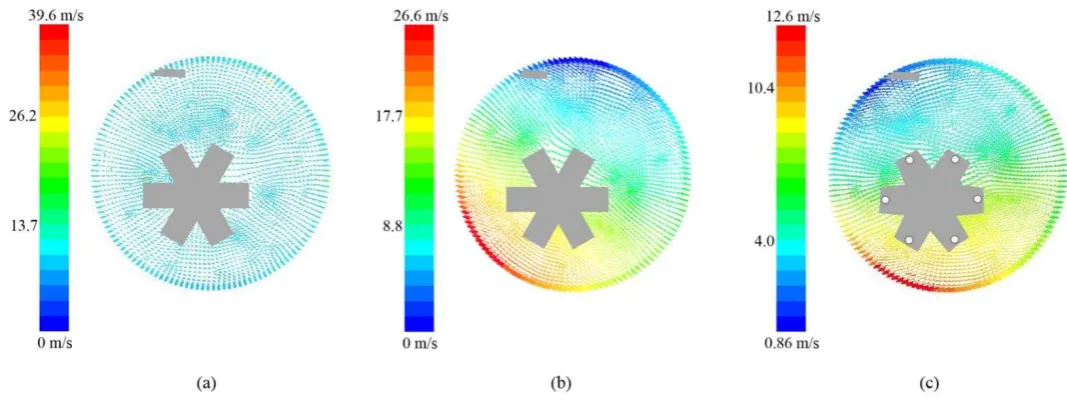
Figure 3. ANSYS based profiles: the velocity profiles of the granules (a) using impeller type II, speed=2000rpm, L/S ratio (w/w)=14%; (b) using impeller type II, speed=6000rpm,
L/S ratio (w/w)=15%; (c) using impeller type I, speed=4000rpm, L/S ratio (w/w)=13%.
velocity values for impeller type II model is wider than the one for impeller type I, which may be due to the difference in the geometry and contact area.
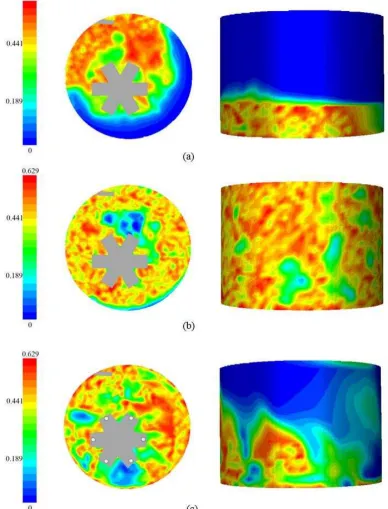
Figure 4. ANSYS based profiles: the concentration of the granules: top (at approximately 3cm from the base) and side view (a) using impeller type II, speed=2000rpm, L/S ratio (w/w)=14%; (b) using impeller type II, speed=6000rpm, L/S ratio (w/w)=15%; (c) using
The concentration of the granules (volume fraction) inside the mixer is shown in Figure 4. The flow regime of the granules shows that the bed surface undulates as the granules are closer to the impeller. A similar behaviour was observed around the scrapper but the bed height is lower. A maximum bed height occurs when the impeller speed is high (at 6000rpm). Spikes in the concentration of the granules were observed during the experiments, which were carried out using impeller type I, as shown in Figure 4 (c). This may be due to the presence of pins on the upper surface of the impeller. As expected, a heterogeneous distribution of the granules is shown in the figure. It is worth noting at this stage that the concentration of the granules is relatively high around the scrapper area in some experiments, which can be explained if one considers the scrapper as a hindrance, especially, at low impeller speed. A low concentration of the granules appears around the impeller; this is the result of the force that is applied by the impeller driving the granules towards the vessel wall. In addition, low concentration of the granules can also be observed in the upper volume of the vessel, where the gas phase dominates. Such a behaviour is noticeable when the impeller speed is relatively low. Moreover, such a low concentration appears around the centre of the vessel in some experiments as a result of the centrifugal force. In fact, this should be in the centre of the vessel, however, the presence of the impeller, which is not in the centre, and the scrapper may have shifted the force effect.
empirical parameters were not systematically estimated. However, in this work, this did not seem to have a significant effect since the RBF-based model will internally compensate for this.
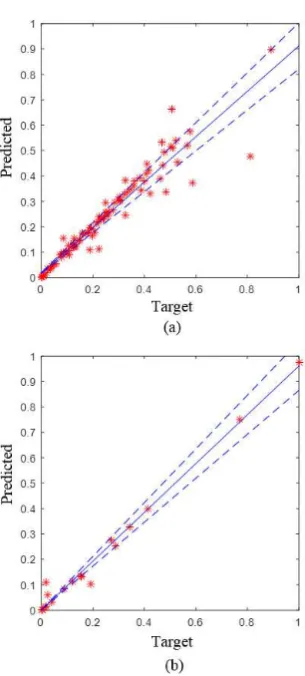
Figure 5. The RBF model for the empirical parameter that is used to estimate the aggregation kernel (normalized): (a) training, (b) testing (with 10% bands) (RBF Network Weights= [1
0.5 0.4 1.5 0.8 1.3 1.3 0.9], and Bias=0.58).
stated previously, estimating the kernels (e.g. aggregation kernel) depends on empirical parameters. These parameters were evaluated to match the experimental results, followed by mapping the parameters to the granulation input variables by using the RBF model. A single RBF model was developed to learn the relationships among all the input variables (i.e. operating conditions) and the empirical parameters of PBM. For the empirical parameter ( ) that is used to estimate the size dependent aggregation kernel presented in (3), 8 RBFs, which correspond to the minimum error calculated using the RMSE, were selected. The prediction performance is presented in Figure 5. The RMSE values (training=0.055, testing=0.035) indicate that the model can be used successfully to predict this parameter. Similarly, the model led to a good performance for all the empirical parameters considered.
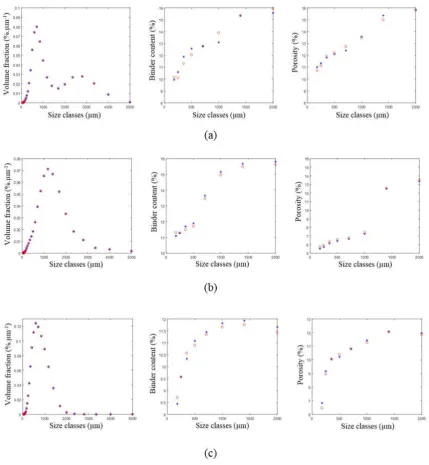
Figure 6. The hybrid model: the predicted (o) and the experimental (*) distributions for the size, binder content and porosity (a) using impeller type II, speed=2000rpm, L/S ratio (w/w)=14% and granulation time=10min; (b) using impeller type II, speed=6000rpm, L/S ratio (w/w)=15% and granulation time=15min; (c) using impeller type I, speed=4000rpm, L/S
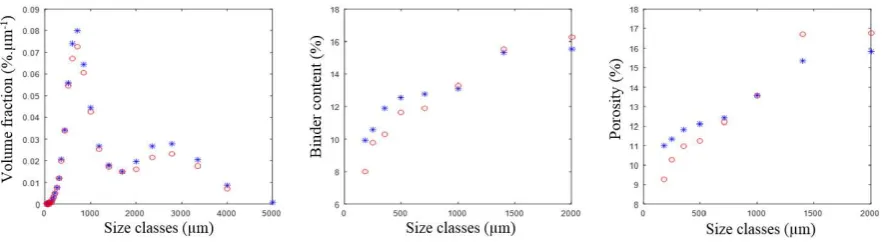
Figure 7. The population balance model: the predicted (o) and the experimental (*) distributions for the size, binder content and porosity using impeller type II, speed=2000rpm,
L/S ratio (w/w)=14% and granulation time=10min.
Although, the hybrid model satisfactorily modelled the granulation process, such a model can be further improved. This model initiated the simulation process using the nuclei instead of the particles, this being due to the difficulty of taking account of three phases in the CFD model. Therefore, the hybrid model can be implemented in two stages; the first stage considers the binder and the particles, whereas the second stage considers the granules and gas, followed by integrating the two stages together. Moreover, further investigations will need to be performed to explore the advantages and the limitations of developing such a complex model.
Model Fusion
Model Fusion: The Basic Idea
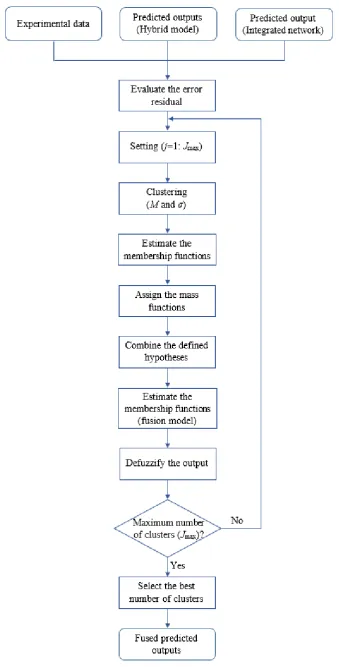
reliability of information. Various approaches have been developed and used such as Bayesian inference, neuro-fuzzy and the Dempster-Shafer (DS) theory26-27. The latter approach has attracted a lot of interest; this being due to its ability to explicitly estimate imprecision and conflict that may exist between two or more sources of information. However, in order to develop a more reliable fusion model, one should consider three types of uncertainties; uncertainty due to probabilities, uncertainty due to lack of specification and uncertainty due to fuzziness28. The first two types can usually be tackled via DS theory, while the third type can be successfully handled using fuzzy logic. Therefore, a new approach that integrates both the DS theory and fuzzy logic has been presented in this research paper. The motivation for such an algorithm stems from the strong need to improve the output predictions of the granulation process which is considered to be one of the complex process to be modelled and predicted. The proposed algorithm integrates the predicted outputs from both the hybrid model and the incorporated model. The fusion model was developed not only to obtain more accurate predictions, which may not be obtainable by using a single model, but also to resolve any conflict that may exist between the two models. Figure 8 summarises the main steps of the proposed fusion model.
First of all, the number of clusters is defined. Generally, clustering is an unsupervised learning process that aims to discover groups of similar data points within the data set. The optimal number of clusters is subjective, in other words, it depends on the application. In this study, the best number of clusters is the one that corresponds to the maximum improvement in the predictive performance (i.e. the minimum RMSE). This step is followed by clustering the input variables and the error residuals that result from both the hybrid model and the incorporated model. The membership function value is defined for each data point as follows29:
2
2
( )
exp 2
e i i
x M
where i is the membership function of the ith data point. The parameters Mand
representthe mean and the standard deviation of a cluster, respectively, and
x
ieis the residual error.In order to combine the predicted outputs of the hybrid model with the ones of the incorporated model, the DS theory is utilized. One of the main challenges in implementing the DS theory is assigning the mass function for all the examined hypotheses. In fact, the mass function can be derived using different algorithms such as probabilities or distance from the centre of a cluster30. In this research, the mass function has been evaluated using the fuzzy membership function, which is calculated in(9). The mass function is generally governed by the following set of equations28:
max
max 1
1
1 ( )
arg max
J
t j j t
j j t
j j J
m
(10)where mt is the mass function for the t
th hypothesis, and
is the maximum membershipfunction. If the number of clusters is less than or equal to three, then special cases are considered28. The hypotheses are merged using the Dempster’s rule of combination as follows:
1 1
, 1
FM HM IM
HM IM
HM IM
HM IM
m m m
K
K m m K
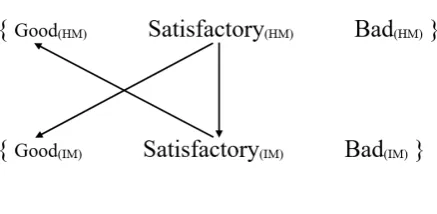
(11)elucidate, assume that the number of clusters for both models is three (i.e. good, satisfactory and bad), as presented in Figure 9. To estimate the mass function for the ‘satisfactory’ hypothesis of the fusion model, the‘satisfactory’ hypothesis of the incorporated model should be combined with the ‘good’ and ‘satisfactory’ hypotheses of the hybrid model, and the ‘satisfactory’ hypothesis of the hybrid model should be combined with the ‘good’ one of the
[image:24.595.188.407.341.448.2]incorporated model,note that the combination of the ‘satisfactory’ hypotheses has already been considered. A high degree of conflict between a hypothesis and another less accurate one is assumed, thus, the fusion model can lead to a better performance compared to both the hybrid model and the incorporated model.
Figure 9. Example of combining the clusters.
Once the mass functions of the fusion model are estimated, the membership functions can be calculated by solving the set of equations in (10), which is reversed to calculate the membership functions, which need to be weighted and normalized28. Finally, the height defuzzifier is utilized to evaluate the outputs of the fusion model29.
Model Fusion: Results and Discussions
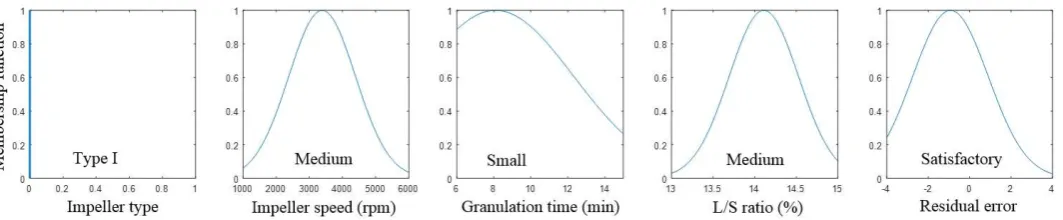
areas. For instance, Figure 10 shows how the hybrid model performs in one of the space areas (i.e. clusters) of the binder content. Such a figure indicates that the hybrid model performance measured via the error residuals is satisfactory when the impeller is of type I, the impeller speed is medium, the granulation time is small and the L/S ratio is medium. It is worth mentioning that the impeller shape was considered as a crisp variable instead of a singleton, as shown in Figure 10.
Figure 10. An example of the hybrid model performance in the space area of the binder content.
Figure 11. The fusion model: the predicted (o) and the experimental (*) distributions for the size, binder content and porosity (a) using impeller type II, speed=2000rpm, L/S ratio (w/w)=14% and granulation time=10min; (b) using impeller type II, speed=6000rpm, L/S ratio (w/w)=15% and granulation time=15min; (c) using impeller type I, speed=4000rpm, L/S
The predictive performance of the fused model for all experiments is similar to the one presented in Figure 11, which shows a good performance. In the size class (1180µm), the predictive performance is not as good as for the other size classes, because the performance of the incorporated model was slightly lower for this size class. However, the overall improvement is noticeable. Table 1 includes the average coefficients of determination (R2) and the RMSE performance values of the RBF model (standalone model), which was used here to predict the properties of the granules, PBM (standalone model), the previous model presented in1, referred to in the table as ‘the incorporated model’, the hybrid model presented in ‘The Hybrid model’ Section, and the fusion model described in ‘Model Fusion’ Section. As shown
[image:27.595.42.562.496.569.2]in this table, the fusion model outperformed both the incorporated and the hybrid models. Furthermore, this table shows that the predictive performance for the size was better than that for the binder content and porosity. This may be due to the heterogeneity and the high uncertainties in the measurements of these properties. However, most of the predictions from the incorporated, hybrid and fusion models lay within the 95% confidence interval.
Table 1. The performances of the models represented by R2 and RMSE.
Model RBF1 PBM2 Incorporated
Model3 Hybrid Model4 Fusion Model5
Output R2 RMSE R2 RMSE R2 RMSE R2 RMSE R2 RMSE
Size 53.65 0.0098 75.84 0.0076 87.83 0.0055 88.49 0.0017 91.28 0.0008 Binder Content 46.8 1.2792 67.53 1.0252 74.04 0.9352 76.06 0.6316 80.30 0.5577 Porosity 36.99 1.6457 65.49 1.23 74.02 1.0879 75.67 0.9208 79.54 0.5508
1. The RBF standalone model was utilized to predict the granule properties. 2. The PBM was used as a stand-alone model.
3. The incorporated model includes the integrated network and the Gaussian mixture model as presented in1. 4. The hybrid model as presented in ‘The Hybrid Model’ Section.
5. The fusion model as described in ‘Model Fusion’ Section.
using the training data. Similarly, the fused model has been validated using the operating conditions of the new experiment and the predictions from both the hybrid and the incorporated models. The predicted outputs obtained by the fused model are presented in Figure 12 (b). The predictive performance and the generalization capabilities prove the abilities of the hybrid and the fusion models to be used successfully to understand the granulation process and to accurately predict the properties of the granules produced by the HSG process.
Figure 12. The validation experiment: the predicted (o) and the experimental (*) distributions for the size, binder content and porosity using impeller type I, speed=4400rpm, L/S ratio (w/w)=13.6% and granulation time=12min (a) the hybrid model and (b) the fusion model.
process and its mechanisms. Generally, one develops models either to predict properties/behaviours or to control a process. The former, which is the main aim of this research, paves the way for the latter. In the future, the developed framework will be exploited in a reverse-engineering framework to identify the optimal operating conditions for granules with predefined properties. This can be achieved by, for instance, embedding the multi-objective optimization paradigms to ensure the right-first-time production.
Conclusions
experimental data and subsequently newly acquired data successfully. By utilizing the scaling-up methods presented in the related literature31 and by training the RBF network, the hybrid model can be exploited on a relatively larger scale. However, many aspects need to be considered (e.g. mixer geometry) to ensure that it will be implemented correctly.
Accurate predictions of the properties of the granules are more often than not required. Accordingly, a new fusion model based on integrating fuzzy logic theory and Dempster-Shafer theory was developed. This model combined the predicted outputs from the hybrid model with the corresponding ones from the model incorporating the integrated network and the Gaussian mixture model; such a model is a data-based model that had been developed previously1.The main motivation behind such a model was, in addition to accurate predictions, to resolve any conflict(s) that may exist between the various model formalisms. Significant improvements were achieved by using this new approach over the hybrid and the incorporated models.
In summary, a good modelling performance was achieved by the hybrid model, followed by the fusion model. Such a framework is considered to be a promising development in those industries where the granulation process is considered to be one of the most crucial unit operations that determine the quality of the final product. In the future, such a framework can be exploited within a reverse-engineering framework that can achieve right-first time production of granules.
Acknowledgement
The Authors wish to thank Maschinenfabrik Gustav Eirich GmbH & Co KG (Germany) for providing the Eirich mixer that has been used for all the experimental work.
1. AlAlaween WH, Mahfouf M, Salman AD. Predictive Modelling of the Granulation Process Using a Systems-Engineering Approach. Powder Technology.2016; 302:265-274.
2. Benali M, Gerbaud V, Hemati M. Effect of operating conditions and physico–chemical
properties on the wet granulation kinetics in high shear mixer. Powder Technology.2009;
190:160-169.
3. Litster J. The science and engineering of granulation processes. Dordrecht Springer, 2004. 4. Walker G. Future development in drum granulation modelling, In: Salman A, Hounslow M, Seville J (Eds.). Granulation. Oxford: Elsevier, 2007:249-254.
5. Bjorn I, Jansson A, Karlsson M, Folestad S, Rasmuson A. Empirical to mechanistic modelling in high shear granulation. Chemical Engineering Science.2005;60:3795-3803. 6. Sanders C, Willemse A, Salman A, Hounslow M. Development of a predictive agglomeration model. Powder Technology.2003;138:18-24.
7. Braumann A, Goodson M, Kraft M, Mort P. Modelling and validation of granulation with heterogeneous binder dispersion and chemical reaction. Chemical Engineering Science.2007;62:4717-4728.
8. Miyamoto Y, Ogawa S, Miyajima M, Matsui M, Sato H, Takayama K, Nagai T. An application of the computer optimization technique to wet granulation process involving explosive growth of particles. International Journal of Pharmaceutics.1997;149:25-36.
9. Iveson S. Limitations of one-dimensional population balance models of wet granulation processes. Powder Technology.2002;124:219-229.
10. Poon JM, Immanuel CD, Doyle III FJ, Litster JD. A three-dimensional population balance model of granulation with a mechanistic representation of the nucleation and aggregation phenomena. Chemical Engineering Science.2008;63:1315-1329.
12. Sen M, Barrasso D, Singh R, Ramachandran R. A multi-scale hybrid CFD-DEM-PBM description of a fluid-bed granulation process. Processes.2014;2:89-111.
13. Dareliusa A, Remmelgasc J, Rasmusona A, Wachemb B, Bjorn IN. Fluid dynamics simulation of the high shear mixing process. Chemical Engineering Journal.2010;164:418-424. 14. Ramkrishna D. Population balances: theory and applications to particulate systems in engineering. London: San Diego Calif., 2000.
15. Liu L, Zhou L, Robinson D, Addai-Mensah J. A nuclei size distribution model including nuclei breakage. Chemical Engineering Science.2013;86:19-24.
16. Immanuel CD, Doyle III FJ. Mechanistic modelling of aggregation phenomena in population balances of granulation processes. IFAC Proceedings Volumes.2005;416-421. 17. Pinto MA, Immanuel CD, Doyle III FJ. A feasible solution technique for higher-dimensional population balance models. Computers and Chemical Engineering.2007;31:1242-1256.
18. Nguyen D, Rasmuson A, Bjorn IN, Thalberg K. CFD simulation of transient particle mixing in a high shear mixer. Powder Technology.2014;258:324-330.
19. Darelius A, Rasmuson A, Wachem B, Bjorn IN, Folestad S. CFD simulation of the high shear mixing process using kinetic theory of granular flow and frictional stress models. Chemical Engineering Science.2008;63:2188-2197.
20. Wen CY, Yu YH. Mechanics of fluidization. Chemical Engineering and Processing: Process Intensification.1966;62:100-111.
21. Gidaspow D. Multiphase Flow and Fluidization: Continuum and Kinetic Theory Descriptions. London: Academic Press, 1994.
22. Tu JY, Fletcher CAJ. Numerical computation of turbulent gas–solid Particle Flow in a 90o bend. AIChE Journal. 1995;41:2187-2197.
24. Immanuel CD, Doyle III FJ. Solution technique for a multi-dimensional population balance model describing granulation processes. Powder Technology.2005;156:213-225.
25. Frikha A, Moalla H. Analytic hierarchy process for multi-sensor data fusion based on belief function theory. European Journal of Operational Research.2015;241:133-147.
26. Dempster AP. Upper and lower probabilities induced by a multivalued mapping. The Annals of Mathematical Statistics.1967;38:325-339.
27. Maseleno A, Hasan MM, Tuah N, Tabbu CR. Fuzzy logic and mathematical theory of evidence to detect the risk of disease spreading of highly pathogenic avian influenza H5N1. Procedia Computer Science.2015;57:348-357.
28. Boudraa A, Bentabet A, Salzenstein F, Guillon L. Dempster-Shafer’s basic probability assignment based on fuzzy membership functions. Electronic Letters on Computer Vision and Image Analysis.2004;4:1-9.
29. Mendel JM. Uncertain rule-based fuzzy logic systems: introduction and new directions. Prentice Hall, 2001.
30. Bloch I. Some aspect of Dempster-Shafer evidence theory for classification of multimodality medical images taking partial volume effect into account. Pattern Recognition Letters.1996;17:905-916.