www.electrochemsci.org
Inhibitive Effect of Some Pyrimidine Derivatives on the Cyclic
Stressed Specimens of Stainless Steel Type 304 in Acidic Media
A.S. Fouda1,* and H. El-Dafrawy2
1 Chemistry Department, Faculty of Science, El-Mansoura University, El- Mansoura-35516, EGYPT 2 Faculty of Engineering, Tanta University, Tanta, EGYPT
*E-mail: [email protected]
Received: 7 June 2006 / Accepted: 12 July 2007 / Published: 1 September 2007
The inhibiting effect of different concentrations some pyrimidine derivatives on the cyclic stressed specimens in 0.1 M HCl at 30oC was studied using galvanostatic polarization technique. Some
quantum – chemical quantities were calculated. The inhibition efficiencies of these compounds on the uniform corrosion was evaluated by recording anodic and cathodic polarization curves of the electrode in the aggressive media. The examined compounds exerted an inhibiting action towards the general corrosion, ranging between 22% to 85%, but the % inhibition efficiency (%IE) for cyclic stressed specimens ranging between 3% to 34%. Polarization studies revealed that these compounds behave as mixed type inhibitors and inhibit corrosion by parallel adsorption on the surface of stainless steel due to the presence of more than one adsorption active centre in the inhibitor molecule. The adsorption is obeyed Langmuir adsorption isotherm. The inhibitor efficiency increases with increasing the concentration of inhibitor and decreasing with increasing the cyclic stress and temperature.
Keywords:Corrosion, cyclic stress, pyrimidine derivatives, stainless steel type 304, HCl, quantum – chemical calculation
1. INTRODUCTION
Stress corrosion cracking (SCC) is one of the most serious corrosion problems for metallic materials encountered in service. Much attention has been paid to mitigating or eliminating the damage of metallic materials due to SCC especially in the case of effecting cyclic stress on the metallic material. Since SCC is sensitive to corrosion environments, the addition of a small amount of proper inhibitor can mitigate SCC of austenitic steels in acidic solution [1].
Authors studied the synergistic inhibition effect of I- ions with some amines in NaCl solution
on SCC of AISI 321 stainless steel , they found that the inhibition efficiency was attributed to the effect of retarding both anodic and cathodic reactions of the corrosion processes [5]. Also SCC of AISI 321 stainless steel in acidic solution was inhibited by thiourea and its derivatives, primary amines and tetra-amine salts, by estimating the anodic and cathodic polarization of the corrosion process, it was found that these inhibitors reduce the rate of anodic dissolution of the steel [6,7].
In situ electrochemical measurements of stressed specimens under dynamic straining condition were performed and this may offers some interesting information on the role of the inhibitors.
In this paper, the effect of some pyrimidine derivatives on the corrosion fatigue of stainless steel type 304 stressed by cyclic frequency 10.5 Hz in hydrochloric acid solution using in situ electrochemical measurements was carried out and some quantum –chemical calculations were carried and were done.
2. EXPERIMENTAL PART
Chemical composition of AISI 304 austenitic stainless steel specimens were shown in Table (1). Two different types of electrodes were used during polarization measurements. Disk with 12 mm diameter and 2 mm thickness which machining to give surface area 1 cm2 was cut from AISI 304
stainless steel rod and was weld from one side to a copper wire used for electric connection and was embedded in glass tube of just larger diameter than the sample. Epoxy resin was used to stick the sample to glass tube. This electrode was used in general corrosion after treatment with emery paper up to # 1000.
Table 1. Chemical composition of AISI 304 stainless steel (wt %)
C Mn P S Si Ni Cr others Fe
0.07 2.00 0.045 0.030 0.75 9.0 18.0 ... Reminder
Cylindrical tensile specimens were used in the fatigue test and in electrochemical measurements after fatigue test in air. The cylinder specimen with diameter 10 mm, the gage length of the middle part 20 mm with diameter 4 mm was used as test section and the overall length 140 mm as shown in Fig. (1). The gage length of all specimens were prepared by treatment with emery papers up to n. 1000, then degreased in acetone in ultrasonic bath, washed with bi-distilled water and then dried at 30oC.
[image:2.612.127.520.618.693.2]Fatigue tests were performed at 10.5 Hz on a cantilever rotary-bending fatigue test machine, with different cyclic stress (82MPa – 247MPa) and number of cycles (1000000). The specimens were coated with epoxy resin except for the gage section which was immersed in the solution during the entire galvanostatic polarization process. The corrosive solution was 0.1 M HCl which was prepared from analytical grade reagents and distilled water and was used as the blank solution. The structure of the pyrimidine derivatives which used as inhibitors are shown in Table (2).
Table 2. The structure of inhibitors used [8]
Inhibitor formula Inhibitor name
Inh.
3-(4-Methoxy-phenylazo)-1,4,11C-triaza-Cyclopenta [c]
Phenanthren-2-ylamine I
3-(4-Methyl-phenylazo)-1,4,11C-triaza-Cyclopenta [c]
Phenanthren-2-ylamine II
3-(4-Hydrogen-phenylazo)-1,4,11C-triaza-Cyclopenta [c]
Phenanthren-2-ylamine III
3-(4-Chlore-phenylazo)-1,4,11C-triaza-Cyclopenta [c]
Phenanthren-2-ylamine IV
3. RESULTS AND DISCUSSION
3.1. Electrochemical measurements
Galvanostatic polarization studies were carried out on AISI 304-SS in 0.1 M HCl solution without and with different concentrations of the investigated compounds. The sample was used as working electrode, saturated calomel electrode (SCE) was used as reference electrode while platinum wire as counter electrode. All experiments were carried out at 30oC =1oC. The inhibition efficiency (%IE) is defined as [10]:
(%IE) = ((Icorr. – Iinh.)/ Icorr)) × 100.
is the degree of surface area coverage and can be calculated from the relation: = (Icorr. – Iinh.)/ I corr.
Where Icorr. and Iinh. are the corrosion current densities in absence and presence of inhibitors ,
respectively.
3.2. Polarization curves
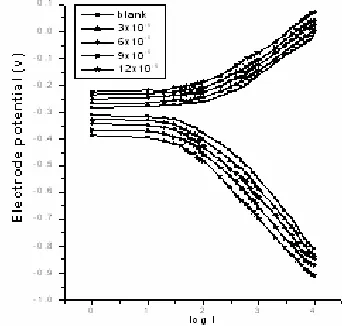
The corrosion behavior of stainless steel type 304 is studied in 0.1M HCl solutions in absence and presence of (3x10⁻⁶ – 1.2x10⁻⁵ M) inhibitors (I – IV) at 30oC. Figure. (2) shows the galvanostatic polarization curves of austenitic stainless steel type 304 in 0.1M HCl in absence and presence of inhibitor I at different concentrations and Table (3) shows the corrosion parameters.
[image:4.612.236.406.211.405.2]Figure 2. Polarization curves of stainless steel type 304 electrode in 0.1 M HCl in absence and presence of various concentarions at of inhibitor I at 30°C.
Table 3. Corrosion parameters of residual stressed SS type 304 in 0.1M HCl at 30°C in absence and presence of different concentrations of inhibitors (I– IV).
Inhibitor Conc., M -Ecorr., v icorr.
µA cm-2 v deca -1 v decc -1 %IE
Blank 0.1 M HCl 0.351 74.64 0.287 0.179 ---- -
---3x10⁻⁶ 0.317 45.81 0.108 0.464 0.3862 38.62
6x10⁻⁶ 0.314 21.88 0.063 0.401 0.6143 61.43
9x10⁻⁶ 0.305 20.79 0.157 0.345 0.7443 74.43
I
12x10-6 0.297 11.48 0.163 0.353 0.8462 84.62
3x10⁻⁶ 0.328 50.70 0.050 0.190 0.3208 32.08
6x10⁻⁶ 0.316 32.81 0.061 0.204 0.5605 56.05
9x10⁻⁶ 0.311 17.10 0.087 0.213 0.7709 71.09
II
12x10-6 0.302 13.68 0.067 0.203 0.8169 81.69
3x10⁻⁶ 0.333 51.40 0.051 0.346 0.2940 29.40
6x10⁻⁶ 0.329 36.30 0.055 0.300 .5355 53.55
9x10⁻⁶ 0.326 28.18 0.081 0.348 0.6656 66.56
III
12x10-6 0.315 14.36 0.109 0.373 0.7672 76.72
3x10⁻⁶ 0.338 57.81 0.063 0.427 0.2255 22.55
6x10⁻⁶ 0.331 36.31 0.076 0.396 0.4962 49.62
IV 9x10⁻⁶ 0.327 29.38 0.082 0.397 0.6295 62.95
[image:4.612.106.510.486.726.2]Inspection of Tafel slopes ( a & c) values, corrosion potential (Ecorr), corrosion current (Icorr)
values, degree of surface coverage ( ) and % inhibition efficiency (% IE) indicate that:
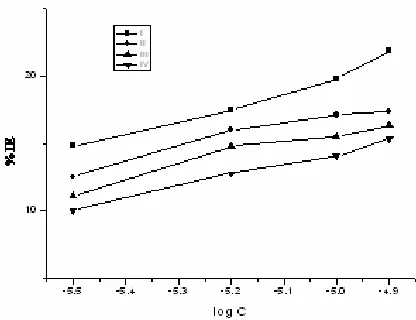
1 - The corrosion current density decreases with increasing the concentration of pyrimidine derivatives, which indicates that the presence of these compounds retards the dissolution of austenitic stainless steel type 304 in 0.1M HCl solution and the degree of inhibition depends on the concentration and type of the inhibitor present as shown in Fig. (3).
2 - The degree of surface coverage was found to increase with increasing the concentration of inhibitors, and for certain range of inhibitor concentrations, where a monolayer adsorption occurs on the SS type 304 surface [10].
3 - Presence of these inhibitors retards both anodic and cathodic reactions of the metal. For this reason, these inhibitors act as mixed type inhibitors.
4 - The order of decreased inhibition efficiency for these additives is: I > II > III > IV.
[image:5.612.211.437.295.451.2]Figure 3. The relationship between % IE and logarithm of concentration of different inhibitors in 0.1M HCl.
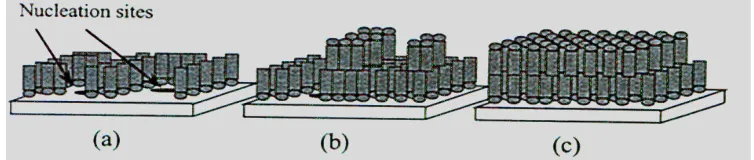
Figure 4. Adsorption schemes for pyrimidine derivatives: (a) at low concentrations, (b) at intermediate concentrations, and (c) at high concentrations on stainless steel type304.
[image:5.612.117.494.511.591.2]inhibitor adsorbs less likely on them. When the adsorption density reaches monolayer adsorption in Fig.(4b), some of the nucleation sites begin to be covered by inhibitor molecules. At maximum adsorption density in Fig.(4c), the whole surface, including the nucleation sites, are covered by the inhibitor molecules then complete inhibition occurs.
3.3. Adsorption isotherm
The Langmuir adsorption isotherm may expressed by [10]:
C/ = 1/K + C
Where C is the inhibitor concentration, and K is the equilibrium constant for adsorption process. The equilibrium constant (K) for adsorption process for each compound can be calculated from the reciprocal of the antilogarithm of the intercept.
[image:6.612.217.431.421.574.2]The plot of log (C/ ) Vs log C found to be linear for all additives as shown in Figure (5). This means that these compounds are adsorbed on the surface of stainless steel type 304 according to Langmuir adsorption isotherm, but the gradient is not equal to unity as expected for the ideal behavior. The deviation from unity can be explained on the basis of the interaction between the adsorbed species on the metallic surfaces. It has been postulated in the derivation of Langmuir isotherm that the adsorbed molecules do not interact with each other. This is not true in the case of organic molecules having polar atoms or groups, which are adsorbed on the anodic and cathodic sites of the metal surface such adsorbed species may interact by mutual repulsion or attraction.
Figure 5. Langmuir adsorption isotherm for pyrimidine derivatives
3.4. A quantum-chemical study of the corrosion inhibition of stainless steel type 304 by means of pyrimidine derivatives in HCl solution.
The results obtained from the relation between inhibition characteristics and quantum chemical data show that log icorr mostly depend upon the energies of the highest occupied molecular orbital
ionization potential. It is further evident that the inhibition efficiency increases with the decrease of ionization of the molecule, which means that the molecule acts as an electron donor when blocking the corrosion reaction. The results in Table (4) were calculated at 1.2x10⁻⁵ M and show that the energies of HOMO orbital of the pyrimidine derivatives decrease in the following order: I > II > III > IV.
Table 4. Quantum - chemical parameters of the investigated pyrimidine derivatives.
Inhibitor Log icorr Atom Charge
density HOMO energy
Kcal/mole
LUMO energy Kcal/mole
%Inhibition
I 1.0599
N(1) O(9) N(8) S(10) +0.249 +0.0853 +0.242
+0.109 -7.2126 1.13847 84.62
II 1.1361
N(1) O(9) N(8) S(10) +0.249 +0.0853 +0.242
+0.109 -7.6654 1.2417 81.69
III 1.1571
N(1) O(9) N(8) S(10) +0.249 +0.0853 +0.242
+0.109 -7.7270 1.2606 76.72
IV 1.2721
N(1) O(9) N(8) S(10) +0.249 +0.0853 +0.242
+0.109 -7.8830 1.2713 74.07
-7.8 -7.7 -7.6 -7.5 -7.4 -7.3 -7.2 -7.1
1.05 1.10 1.15 1.20 1.25 1.30 (B) I II III IV
Fig. (6) Correlation of LUMO (A) and HOMO (B)
Lo
g.
icorr
. m ic ro A /c m 2 HOMO
-1.32 -1.30 -1.28 -1.26 -1.24 -1.22 -1.20 -1.18 -1.16 -1.14 -1.12 -1.10 -1.08 1.00 1.05 1.10 1.15 1.20 1.25 1.30 (A) I II III IV Lo g
icorr
m ic ro A /c m 2 LUMO
Figure 6. Correlation of LUMO (A) and HOMO (B) energies with log icorr for the investigated
pyrimidine derivatives
3.5. Effect of applied cyclic stresses on the corrosion behavior of stainless steel type 304.
3.5.1. Effect of applied cyclic stresses
applied cyclic stresses (82Mpa - 247Mpa) and number of cycles (106) at 10.5 Hz. The galvanostatic
polarization curves were plotted for each inhibitor. In the rotating cantilever bending fatigue test, the tension and compression cyclic stresses occur at the outer surfaces of the specimen, for this reason plastic deformation commonly occurs by the slip of one plane over another. This dislocation occur , results in effect of shear stresses onto the slip planes. This slip is very non-uniform within a polycrystalline solid and can occur on only some of the crystal planes within a metal grain. [9]. Stressed stainless steel type 304 surfaces by the rotating cantilever bending fatigue test, contain iron atoms that are more reactive since they have a less stable crystalline environment and more susceptible to attack. Whenever a metal is stressed, the metallic crystal lattice becomes severely strained, the atoms in the most severely distorted crystal lattice tend to become more anodic, and go into solution more readily than theatoms in less strained sites. Consequently, corrosion of the most strained regions of a metal is most rapid.
The corrosion behavior of stainless steel type 304 in 0.1 M HCl solution in the absence and presence of (3x10⁻⁶ – 12x10-6) inhibitors (I – IV) 30oC and applied cyclic stresses (82 – 247MPa). The
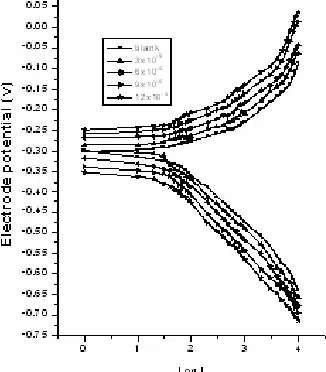
galvanostatic polarization curves were plotted for each inhibitor as shown in Fig.(7) for stress 82MPa, Fig. (9) for 141MPa, Fig. (11) for stress 188 MPa,and Fig.(13) for stress 247MPa. The results indicate that, the inhibition efficiency of inhibitors (I – IV) for corrosion of SS type 304 in the acidic solution at 30oC is decreased in order (I > II > II >IV) with increasing the concentration of inhibitors as shown in
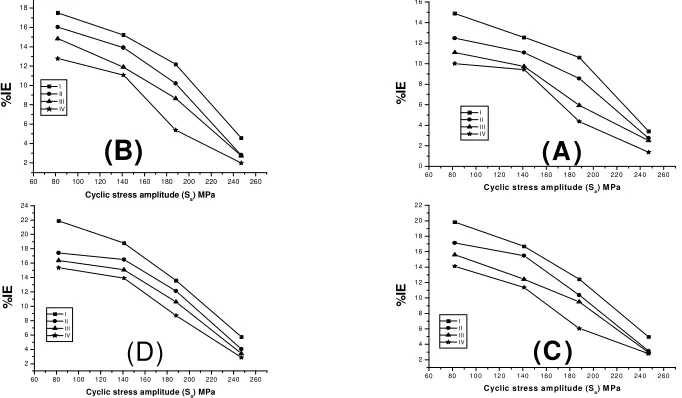
Figs. (8, 10, 12 & 14) and decreased with increasing applied cyclic stresses as shown in Fig.(15). The corrosion of the most strained regions of a metal is most rapid, also the adsorption layer of inhibitor on stainless steel surface becomes less stable and the corrosive media becomes more aggressive. Inspection of Tafel slopes values and Ecorr values in these conditions indicate that these inhibitors act
as mixed – type inhibitors. Also, the corrosion current density icorr increased with increasing the
[image:8.612.240.411.491.654.2]applied cyclic stresses, as shown in Fig. (16). The increasing applied cyclic stress due to increasing the strained atoms i.e. more atoms go to the solution, i.e. increasing the corrosion current density.
Figure 8. The relationship between % IE and logarithm of concentration of different inhibitors (I-IV) in 0.1M HCl at 82MPa and 1000000 cycles at 30°C.
Figure 9. Galvanostatic polarization curves for dissolution stressed stainless steel type 304 at 141MPa and 1000000 cycles in 0.1 M HCl in absence and presence of different concentrations of inhibitor I at 30°C
[image:9.612.223.390.280.448.2] [image:9.612.205.406.509.671.2]Figure 11. Galvanostatic polarization curves for dissolution stressed stainless steel type 304 at 188MPa and 1000000 cycles in 0.1 M HCl in absence and presence of different concentrations of inhibitor I at 30°C
Figure 12. The relationship between % IE and logarithm of concentration of different inhibitors (I-IV) in 0.1M HCl at 188MPa and 1000000 cycles at 30°C.
[image:10.612.227.384.66.249.2] [image:10.612.205.404.297.457.2] [image:10.612.224.387.494.680.2]Figure 14. The relationship between % IE and logarithm of concentration of different inhibitors (I-IV) in 0.1M HCl at 247MPa and 1000000 cycles at 30°C.
60 80 100 120 140 160 180 200 220 240 260
2 4 6 8 10 12 14 16 18
(B)
% IECyclic stress amplitude (Sa) MPa
I II III IV
60 80 100 120 140 160 180 200 220 240 260 0 2 4 6 8 10 12 14 16
(A)
% IECyclic stress amplitude (Sa) M Pa
I II III IV
60 80 100 120 140 160 180 200 220 240 260 2 4 6 8 10 12 14 16 18 20 22 24
(D)
% IECyclic stress amplitude (Sa) MPa
I II III IV
60 80 100 120 140 160 180 200 220 240 260 2 4 6 8 10 12 14 16 18 20 22
(C)
% IECyclic stress amplitude (Sa) M Pa
I II III IV
Figure 15. The relation between %IE and cyclic stress amplitude Sa for SS type 304 in 0.1 M HCl at 30oC in presence of different inhibitors (I– IV) at concentration (A) 3x10⁻⁶ M , (B) 6x10⁻⁶ M, (C) 9x10 -6 M, (D) 12x10-6 M and 1000000 cycles.
4. CONCLUSIONS
Consideration of the results of the general corrosion revealed the following conclusions:
1 - Pyrimidine derivatives have proved to be efficient inhibitors for corrosion of stainless steel type 304 in 0.1MHCl solution.
[image:11.612.140.481.290.489.2]3 - Compound I which contains one methoxy group gives the higher inhibition efficiency compared to the other compounds II , III , and IV.
4 - The inhibition of SS type 304 in 0.1M HCl solution was found to obey the Langmuir adsorption isotherm.
5 - These derivatives increase the efficiency of passive layer of SS type 304.
6 - Pyrimidine derivatives can be used as inhibitors for SS type 304 fatigue corrosion, can decrease the susceptibility to fatigue corrosion in HCl solution and act as mixed type inhibitors.
7 - Inhibition efficiency (%IE) decreases with increasing the cyclic stresses.
60 80 100 120 140 160 180 200 220 240 260
114 116 118 120 122 124 126 128 130 132 134 136 138 140 142 144
(B)
icorr
m ic ro A /c m 2
Cyclic stress amplitude (Sa) MPa
I II III IV
60 80 100 120 140 160 180 200 220 240 260
118 120 122 124 126 128 130 132 134 136 138 140 142 144
(A)
icorr
m ic ro A /c m 2
Cyclic stress amplitude (Sa) MPa
I II III IV
60 80 100 120 140 160 180 200 220 240 260 108 110 112 114 116 118 120 122 124 126 128 130 132 134 136 138 140 142 144
(D)
icorr
m ic ro A /c m 2
Cyclic stress amplitude (Sa) MPa
I II III IV
60 80 100 120 140 160 180 200 220 240 260 112 114 116 118 120 122 124 126 128 130 132 134 136 138 140 142 144
(C)
icorr
m ic ro A /c m 2
Cyclic stress amplitude (Sa) MPa
I II III IV
Figure 16. The relation between %IE and cyclic stress amplitude Sa for SS type 304 in 0.1 M HCl at 30oC in the presence of different inhibitors (I – IV) at concentration (A) 3x10⁻⁶ M, (B) 6x10⁻⁶ M, (C)
9x10⁻⁶ M, (D) 12x10-6 M and 1000000 cycles.
References
1. L. Niu, C.N. Cao, H.C. Lin and G.L. Song, Corrosion Science, 7 (1998)1109
2. Davies, D.E. Dennison, J.P. and Odeh, A.A. Proceedings of 6th European Symposium on Corrosion Inhibitors (6th. SEIC), ANN. Univ. Ferrara, N.S. Sez. V. Suppl. No. 8, P. 669 (1985).
3. Frignani, A., Trabanelli G.,and Zucchi F., Corrosion Science, 24(1984)917.
4. Zucchi, F., Trabanelli, G., Frignani, A., and Carassiti, V., 5eme Congress European de Corrosion, Paris, 24-28 September, P. 217 (1973).
5. Chen, X. Z. and Wu, S.H. Proceedings of the 6th Eurpean Symposium on Corrosion Inhibitors (6th. SEIC), ANN. Univ. Ferrara, N.S. Sez. V. Suppl. No. 8, P. 677 (1985).
6. Cao, C.N., Yang, Q.G., Lu, M. and Lin, H.C. Journal of Chanese Society Corrosion and Protection 12(1992)109.
7. Cao, C.N. Corrosion Science and protection Technique, 2(1990),1.
[image:12.612.131.480.211.452.2]9. George E. Dieter, Mechanical Metallurgy, University of Maryland, 1988. 10. M. Abdallah, Corrosion science 44 (2002) 717 – 728.

![Table 2. The structure of inhibitors used [8]](https://thumb-us.123doks.com/thumbv2/123dok_us/1948003.155135/3.612.103.511.203.488/table-structure-inhibitors-used.webp)