(2009)
www.electrochemsci.org
Cyclic Voltammetric Studies of Dopamine at Lamotrigine and
TX-100 Modified Carbon Paste Electrode
J.G.Manjunatha1, B.E. Kumara Swamy1* G.P.Mamatha2, Umesh Chandra1,E.Niranjana1, andB.S. Sherigara1
1 Department of P.G. Studies and Research in Industrial Chemistry, Kuvempu University, Jnana
Sahyadri, Shankaraghatta, Karnataka, India
2 Department of Chemistry AVK College for women Davanagere, Karnataka, India *E-mail: [email protected]
Received: 15 December 2008 / Accepted: 10 January 2009 / Published: 9 February 2009
This paper describes the procedure that has been optimized for the determination of dopamine at Lamotrigine modified carbon paste electrode (LTGMCPE) by cyclic voltammetry with 0.2M phosphate buffer at pH 7. The carbon paste electrode (CPE) was modified by Lamotrigine and Triton-X-100 (TTriton-X-100).The LTGMCPE and TTriton-X-100 immobilized CPE (TX/LTGMCPE) showed very good sensitivity for dopamine. The scan rate effect at both LTGMCPE and TX/LTGMCPE was studied. Increase of TX-100 showed linear increase in redox peak currents of dopamine. Mechanism of electrocatalytic oxidation of dopamine and ferrocyanide at the surface of the Lamotrigine modified CPE containing various percents of TX-100 is thoroughly investigated. The favorable ionic interaction (electrostatic repulsion) between the cationic form of DA and a non ionic surfactant (TX-100). The preparation of the modified electrode is very easy and renewed by simple polishing gives very good reproducibility, high stability in its voltammetric response and low detection limit for DA.
Keywords: Carbon paste electrode, Lamotrigine, Dopamine, TX-100, Cyclic voltammetry.
1. INTRODUCTION
Lamotrigine (LTG),3,5-diamino –6-(2,3-dichlorophenyl)-1,2,4-trigine is a new generation antiepileptic drug registered for treatment of patients with refractory partial seizures with or without secondary generalization . It acts by inhibiting presynaptic voltage sensitive sodium channels and excitatory neurotransmitter release [1].
sensitive and simple methods for the determination of dopamine. DA can be determined with electrochemical methods because it is an electrochemically active compound. Serious diseases such as Schizophrenia and Parkinsonism may result by loss of DA containing neurons [4-8]. Patient with this disease shows a low level of DA. Therefore determination of DA concentration has become important and many methods were introduced to determine DA such as spectroscopy, chromatography and electrochemistry [9-12]. Since DA is an oxidizable compound it can be easily detectable by electrochemistry methods based on anodic oxidation [7, 13]
Scheme 1. Structure of Lamotrigine.
One of the most common routes is to use the modified carbon paste electrode which has the ability to eliminate the interfering substances from DA determination. The study of electrochemical determination of DA with different modified electrode for sensitive and selective. The modification can be done by adding different types of modifiers [14-19]. One of the modifiers we chosen for the determination of electrochemical response of DA is LTG. And it is immobilized with TX-100 surfactant. Surfactant is a liner molecule with a hydrophilic (attracted to water) head and a hydrophobic (repelled by water) end. Due to its unique molecular structure, surfactant was extensively used in the fields of electrochemistry [20,21] and elelctroanalytical chemistry [22,23] for various purposes. Surfactants, containing hydrophobic and hydrophilic groups, can change the properties of the electrode /solution interface and subsequently influence the electrochemical processes of other substances. Adsorption of surfactant aggregates on the electron transfer, gently enhance the peak current, change the redox potential or charge transfer coefficients or diffusion coefficients, as well as alter the stability of electrogenerated intermediates or electrochemical products.
The aim of the work is to establish a simple and sensitive electrochemical method for the determination of dopamine in the presence of LTG and TX-100 surfactant; the oxidation peak current of dopamine remarkably increases at the CPE suggesting significant improvement of determining sensitivity. Related works have been done by our research group [24-27].
2. EXPERIMENTAL PART
2.1. Reagents and chemicals
LTG received from Sigma Aldrich India, Bangalore, 10-6M TX-100 was prepared in double
distilled water. Potassium ferricyanide (K3Fe(CN) 6) and 25mM dopamine stock solution was prepared
in 0.1 M perchloric acid. All other chemicals were of analytical grade quality and were used with out further purification, the water used was a double distilled. In all the measurements, the supporting electrolyte used was 1M KCl.
2.2. Apparatus and procedure
Cyclic voltammetry (CV) was performed in a model EA-201 Electroanalyser (EA-201 Chemilink system). All experiments were carried out in a conventional electrochemical cell. The electrode system contained a carbon paste working electrode (3.0mm in diameter) a platinum wire as counter electrode and a potassium chloride (KCl) saturated calomel reference electrode.
The carbon paste electrode was prepared as fallows 70% graphite powder and 30% silicone oil were mixed by hand to produce a homogeneous carbon paste was then packed into the cavity of a home made carbon paste electrode and smoothed on a weighing paper.
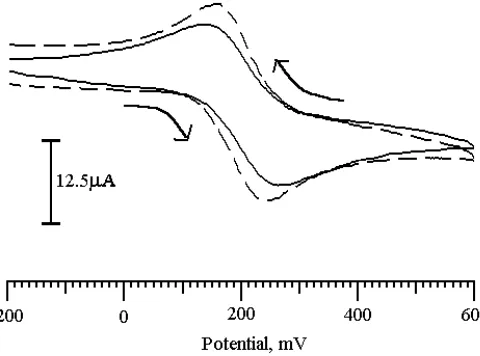
Figure 1. Electrochemical response of K3Fe (CN6) at LTG modified carbon paste electrode and bare
carbon paste electrode.
3. RESULTS AND DISCUSSION
3.1. Electrochemical response of K3Fe (CN6) at a LTGMCPE
[image:3.612.188.428.386.564.2]carbon paste electrode (BCPE) the voltammogram of K3Fe (CN)6 showed poor electrochemical
response (solid line) with reversible behavior in 1M KCl as supporting electrolyte. However, the voltammetric response was apparently improved at LTGMCPE (dashed line) with decreasing the over potential. At BCPE the anodic peak potential (Epa) was found to be 263mV and cathodic peak potential (Epc) 139mV (vs. SCE). The separation of redox potential peaks ( Ep) 124mV and the ratio of peak current (Ipa/Ipc) was 1.5. At LTGMCPE, a pair of redox peak is obtained with strong increase in both anodic cathodic peak current. The Epa was found at 243mV and Epc at 162mV. The separation of redox potential peaks Ep was found to be 81mV and the Ipa/Ipc was 1.3.
3.2. Electrochemical response of dopamine at Lamotrigine modified carbon paste electrode.
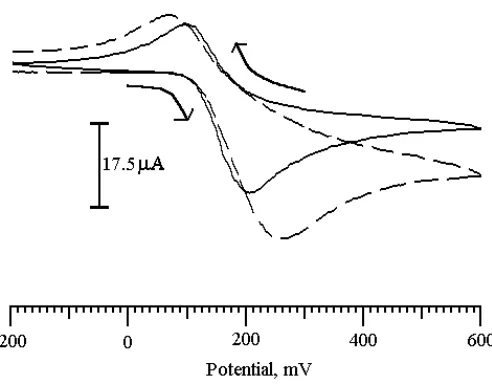
Dopamine being as easily oxidizable catecholamine. Fig.2 shows quassireversible voltammogram in 0.2M phosphate buffer solution at pH 7 at 100 mV/s scan rate for BCPE (solid line). At BCPE the EPA was found to be 205mV and Epc 100mV (vs. SCE). The Ep 105mV and the Ipa/Ipc was 2.55. Which were characteristics of quassireversible electrode process. The formal peak potential (E0) was obtained as 152.5mV. However at LTGMCPE, a pair of redox peak is obtained with strong increase in both anodic cathodic peak current. The anodic peak potential at 258mV and cathodic peak potential (Epc) at 73mV.The separation of redox potential peaks ( Ep) was found to be 185mV and the ratio of peak current (Ipa/Ipc) was 2.94 and E0 was 165mV. So the voltammogram obtained for LTGMCPE shows good electrocatalytic properties at CPE.
Figure 2. Cyclic voltammogram of 1X10⁻³ M DA in 0.2 M phosphate buffer solution of pH 7.0 at bare
CPE (solid line) and LTGMCPE (dashed line).
3.3 Effect of scan rate
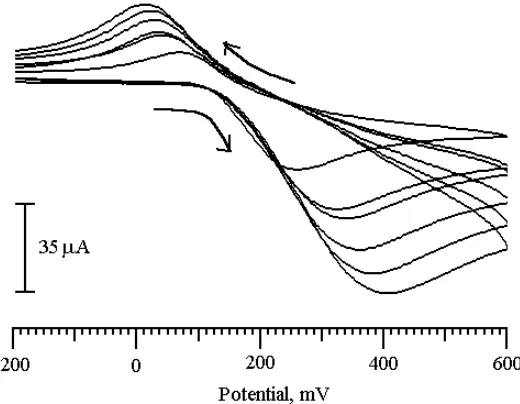
[image:4.612.182.428.409.602.2]increased with increase in scan rate from 100mVs-1 – 400 mVs-1. The graph of anodic peak current
(Ipa) vs. square root of scan rate (ν1/2) showed linear relationship (Fig. 4). The correlation co-efficient was found to be 0.9873. This result showed the electrode process was diffusion controlled. The difference between the anodic peak potential and the cathodic peak potential Ep is increasing with the scan rate.
Figure 3. Variation of scan rate for DA at LTGMCPE (100mVs-1 to 400mVs-1).
0.30 0.35 0.40 0.45 0.50 0.55 0.60 0.65 35
40 45 50 55 60
cu
rr
en
t,
µµµµ
A
[image:5.612.197.419.178.362.2]squar root of scan rate
[image:5.612.181.429.432.645.2]3.4. Effect of dopamine concentration
[image:6.612.180.440.174.376.2]The concentration effect of DA was studied at LTGMCPE in 0.1M phosphate buffer of pH 7.0 Fig.5 shows the dependence of the voltammetric response of DA at LTGMCPE. By increase in the dopamine concentration from 1mM to 3.5mM both Epa and Epc were increased. The plot of Epa versus dopamine concentration showed linear with correlation coefficient of 0.9916 (Fig.6).
Figure 5. Cyclic voltammogram of DA at different concentration ( 0.1X10⁻³ M, 1.5X10⁻³ M, 2X10⁻³
M, 2.5X10⁻³ M, 3 X10⁻³ M, 3.5X10⁻³ M, ).
1.0 1.5 2.0 2.5 3.0 3.5
30 40 50 60 70 80 90
cu
rr
en
t,
µµµµ
A
concentration of dopamine
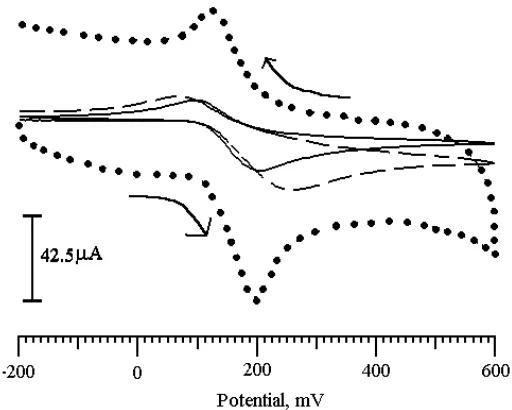
[image:6.612.174.436.454.671.2]Figure 7. Cyclic voltammogram of DA for BCPE (solid line) LTGMCPE(line) and35µL TX-100dashed line
Figure 8. Graph of the Ipa vs. concentration of TX-100
3.5. The influence of concentration of TX-100 surfactant on voltammetric response for dopamine on LTGMCPE
[image:7.612.166.439.355.541.2]µL) showed the electrochemical response of dopamine at TX-100 immobilized LTGMCPE. The LTGMCPE was immobilized by adding 5µL-35µL of TX-100. Above 35µL current signal decreases with the increase in the concentration of TX-100. The probable mechanism is the TX-100 surfactant molecule diffuses in to the carbon paste electrode along with the dopamine results increase in the signal. The voltammogram effectively promote the signals of dopamine even for a trace amount of TX-100. With the increase of TX-100 concentration both Ipa and Ipc varies effectively. As mentioned above TX-100, might form a monolayer in this concentration range and hence increase in the signals. The Fig.8 showed the graph of anodic peak current of dopamine Ipavs. concentration of TX-100.
Figure 9. The effect of scan rate of dopamine at surfactant immobilized LTGMCPE
0.30 0.35 0.40 0.45 0.50 0.55 0.60 0.65 40
50 60 70 80 90
cu
rr
en
t,
µµµµ
A
square root of scan rate
[image:8.612.181.431.458.664.2]The redox peak currents increase with increase in scan rate in the range from 100mVs-1 to
400mVs-1 (Fig.9). The graph of I
pa vs square root of scan rate showed very good linearity with correlation coefficient of 0.9954. The Fig.10 confirming that the electrode process at the electrode surface has some adsorption-controlled and the plot of peak potential (Ep) vs. log of scan rate (data was not shown) was linear and this behavior was consistent with chemical response of dopamine in the presence of TX-100 surfactant at the LTGMCPE could be utilized to investigated the adsorptive behavior of TX-100 at a carbon paste electrode which might be able to explain the enhancement effects of surfactants in some electroanalytical systems [25-26].
4. CONCLUSIONS
In the present work, incorporation of TX-100 as a non ionic surfactant in the matrix of LTG – modified CPE is introduced as a new and very efficient method of enhancement in voltammetric response of the modified carbon paste electrode. The modified electrode has been shown to be able to show high sensitivity for voltammetric peaks of dopamine. Dopamine having reducing property in the biological systems and therefore very similar to analytical detection methods. The high sensitivity and very easy preparation and surface regeneration of the modified electrode and the reproducibility of the voltammetric response make the prepared modified system very useful in the construction of simple devices for the determination of dopamine in clinical and pharmaceutical preparations.
References
1. O.D.Renedo, M.E.B.Calvo and M.J.A..Martínez, Sensors 8 (2008) 4201. 2. P.A. Garris and R.M.Wightman, J. Physiology 478.2 (1994) 239.
3. D.O.alheid, g. F. & Beltrami no, c. AAmygdala. Forebrain and Midbrain, ed. Paxinos, g., Academic press, san Diego, ca, usa. (1985).
4. Wightman, R. M.; May, L. J.; Michael, A. C. Anal. Chem 60 (1988) A769. 5. R. D. O’Neill, Analyst 119 (1994) 767.
6. D. R. Shankaran, K. Limura, T. Kato, Sens. Actuators B, Chem. 94 (2003) 73. 7. J. W. Mo and B. Ogoreve Anal Chem. 73 (2001) 1196.
8. Z.G. Hua, L.M. Fang, L.M. Li CEJC 5 (4) (2007) 1114.
9. S.Sarre, Y. Michotte, P. Herregodts, D. Deleu, N. D. Klippel and G. Ebinger, J chromatogr 575 (1992) 207.
10. C.L.Guan, J. Ouyang, Q. L. Li, B. H. Liu and W. R. G. Baeyens Talanta 50 (2000) 1197. 11. F. B. Salem, Talanta 34 (1987) 810.
12. T. F. Kang, , G. L. Shen and R. Q. Yu Anal Chem Acta 354 (1997) 343. 13. Wei Sun, Maoxia Yang, Kui jiao Anal Bioanal Chem 389 (2007) 1283.
14. Ongera Gilbert, Umesh Chandra, B.E. Kumara Swamy, M. Panduranga Char, C. Nagaraj and B.S.Sherigara, Int. J. Electrochem. Sci., 3 (2008) 1186.
15. C.R. Raj, K. Tokuda and T. Ohsaka, Bioelectrochemistry 53 (2001) 183.
16. H.T.Xu, F. Kitamura, T. Ohsaka, Denki Kagaku (presently Electrochemistry) 60 (1992) 1068. 17. A.J. Downard, A.D. Roddick and A.M. Bond Anal Chim Acta 317 (1995) 303.
18. Z. Ping, H.W. Fang, C.Z. Guang, W.W. Xian Bioelectrochemistry 67 (2005) 109.
20. H.Chengguo, H,Shengshui, Electrochim. Acta, 49 (2004) 405. 21. J.F. Rusling, Acc. Chem. Res., 24 (1991) 75.
22. S.S. Hu, Y.Q. Yan, Z.F. Zhao, Anal. Chim. Acta, 248 (1991) 130. 23. S.S. Hu, K.B. Wu, H.C. Yi, D.F. Cui, Anal. Chim. Acta, 464 (2002) 209.
24. R. Raghavendra Naik, E. Niranjana, B.E. Kumara Swamy, B.S. Sherigara and H. Jayadevappa, Int. J. Electrochem. Sci., 3 (2008) 1574.
25. M. Panduranga Char, E. Niranjana, B.E. Kumara Swamy, B.S. Sherigara and K. Vasantakumar Pai, Int. J. Electrochem. Sci., 3 (2008) 588.
26. E. Niranjana, R. Raghavendra Naik, B.E. Kumara Swamy, B.S. Sherigara and H.Jayadevappa, Int. J. Electrochem. Sci., 2 (2007) 923.
27. Umesh Chandra, Ongera Gilbert, B.E. Kumara Swamy, D. Yadav Bodke and B.S Sherigara Int. J. Electrochem. Sci., 3 (2008) 1044.