COMMISSION OF THE EUROPEAN COMMUNITIES
Brussels, 12.02.1997 COM(97) 47 final
Commission Working Paper
CONTENTS
INTRODUCTION
THE CRITERIA FOR SELECTING THE OBJECTIVES AND AREAS
THE PROGRAMMES: CONTENT AND OBJECTIVES
1.
Organisation and content
2.
The scientific and technological objectives
•
"Unlocking the resources of the living world and the
ecosystem"
•
"Creating a user-friendly Information Society"
•
"Promoting competitive and sustainable growth"
•
"Confirming the international role of European research"
•
"Innovation and participation of SMEs"
•
"Improving human potential"
THE PROGRAMMES: IMPLEMENTATION AND LEGAL ASPECTS
1.
Implementation
•
Two major objectives: coordination and flexibility
•
Instruments
2.
Legal aspects
INTRODUCTION
This second Working Paper on the 5th Framework Prof,1famme for Research
and Teclmological Development is intended to pave the way for a new stage
in the preparation of the Framework Programme.
The Communication
"Inventing Tomorrow" dated 10 July 1996 set out the
broad guidelines proposed for the 5th Framework Programme. In this
document, the Commission underlined its readiness to mark, with this new
Programme, a distinct break with earlier Framework Programmes, by
focusing efforts to a greater extent, by improving the consistency of the
overall approach and by paying greater attention to the exploitation of results
and the management aspects.
The first Working Paper dated 20 November clarified and gave more detail
about the proposed structure and instruments for implementing the
Programme. The two docwnents have already been widely discussed, and
the validity of the proposed guidelines have been broadly endorsed.
The purpose of this second Working Paper is to give a more detailed idea of
the possible content of the 5th Framework Programme and the scientific and
teclmological objectives of the proposed activities within the various
programmes.
These objectives have been fonnulated on the basis of an analysis of the
socio-economic and teclmological situation
in
Europe, and the conclusions of
the evaluation of the activities conducted under earlier Framework
Progranunes.
In support of this Communication, the Commission Services have prepared
separate documents setting out the main socio-economic and teclmological
indicators and a summary of the conclusions of the five-year evaluation
reports on European Union activities.
This Working Paper also explains the criteria used to select the objectives
and provides further clarifications about the implementation and legal and
financial aspects.
These aspects and the financial aspects will be explained in full in the formal
proposal conceming the 5th Framework Pro&rramme that the Commission
plans to submit at the end of March 1997, and which will contain the
C01mnission's definitive proposals in the light of reactions to this Working
Paper.
THE CRITERIA FOR SELECTING THE OBJECTIVES
AND AREAS
The basic task of the European Union's research and technological
development policy is to ensure that advances in knowledge and technologies
serve the purposes of the Union and its policies. From this perspective, the
two inseparably linked objectives of this policy are:
to maintain and enhance, in the context of a genuine
"European
research area", the research potential of European laboratories,
universities and companies and their ability to produce knowledge of the
highest level and high-quality technologies;
to help ensure that European research serves the Union's economic and
social objectives, in other words European research at the service of
the citizen and European competitiveness
in
a global framework.
Basically, therefore, as provided for in Article 130f of the. Treaty on
European Union, the EU's research and technological development policy is
based on the twin principles of scientific and technological excellence and
relevance to the objectives of Union policies.
On account of these specific features, and
in
pursuit of a cost-benefit
approach dictated by concern · for optimum allocation of European public
funding, the choice of objectives and activities under the Framework
Programme must be made on the basis of a set of clear criteria.
This requirement is particularly important
in
the case of the 5th Framework
Programme where it is expected that its definition should be marked by a
particular effort of selectivity and concentration on a limited number of areas
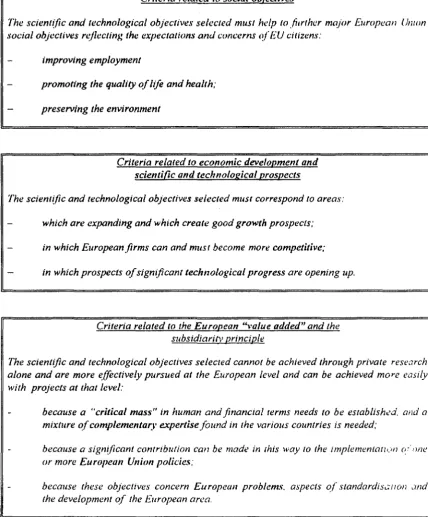
and objectives. The 5th Framework Programme will therefore use for the
definition of its content, three categories of criteria
t:Criteria related to social objedives
The scient{fic and technological objectives selected must help to .fi1rther major European Unum social objectives re.fleclinJ: the expectations and concerns (~lE'U cilizens:
improving employment
promoting the quality of lifo and health;
preserving the environment
Criteria related to economic development and scientific and technological prospects
The scient~fic and technological objectives selected must correspond to areas:
which are expanding and which create good growth prospects;
in which European firms can and must become more competitive;
in which prospects of significant technological progress are opening up.
Criteria related to the European "value added" and the subsidiaritv principle
The scientific and technological objectives selected cannot be achieved through private research alone and are more effectively pursued at the European level and can be achieved more easily with projects at that level:
because a "critical mass" in human and financial terms needs to be establish.:d. and a mixture of complementary expertise found in the various countries is needed;
because a sign~ficant contribulion can be made in this way to the nnplemenlall•:'n o:·nne or more European Union policies;
because these objectives concern European problems. aspects of standardisL;non ,md the development of the European area.
Table n° 1: The selection criteria
[image:5.511.48.477.40.558.2]These criteria have been used for the identification ot:
the six major priority areas set out in the Communication
"Inventing
Tomorrow";
scientific and technological objectives for the activities which could be
conducted under the programmes corresponding to those priorities.
TH"E PROGRAMMES: CONTENT AND OBJECTIVES
The Treaty on European Union provides for four types of activities to
implement research and technological development policy. 2 The structure of
the 5th Framework Programme takes this into account.
This section
describes how the proposed programmes would be organised on the basis of
these four activities and sets out the scientific and technological objectives
identified for the activities under the programmes .
.!:.
ORGANISATION AND CONTENT
In
its first Working Paper dated 20 November 1996 the Commission
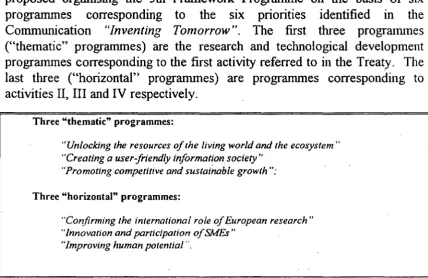
proposed organising the 5th Framework Programme on the basis of six
programmes corresponding to the six prionttes identified m the
Communication
"Inventing Tomorrow".
The first three programmes
("thematic" programmes) are the research and technological development
programmes corresponding to the first activity referred to in the Treaty. The
last three ("horizontal" programmes) are programmes corresponding to
activities II, III and IV respectively.
Three "thematic" programmes:
''Unlocking the resources of the living world and the ecosystem" "Creating a user-friendly information society"
"Promoting competitive and sustainable growth":
Three "horizontal" programmes:
"Confirming the international role of European research" "'Innovation and participation ofSMEs"
[image:7.512.46.475.212.490.2]"Improving human potential··.
Table n° 2: The six programmes proposed for the Framework Programme
The "thematic" and "horizontal" programmes would be both complementary
and interrelated. With a view to maximum efficiency, and in line with the
recommendations of the Framework Programme evaluation panel, it is
proposed that the greatest possible account should be taken of the objectives
of activities II, III and IV in the "thematic" programmes. One of the main
Acti,·ity l: implementation of research. technological development and demonstration programmes
hy promoting cooperation with and between enterprises, research centres and universities;
Activity ll: Promotion of cooperation 1n the field of research, technological development all(/
demonstration f. .. } with third countries and international organisations: Activity HI: Dissemination
and optimisation of the results of research. technological development and demonstration activities
{. .. }: Activity IV: Stimulation of the training and mobility of researchers f. . .f.
functions of the "horizontal" programmes would therefore be to ensure
coordinated implementation of all the activities related to these objectives at
the level of the Framework Programme as a whole. While having their own
objectives, the "horizontal" programmes would therefore help in the coherent
implementation of the "thematic" programmes.
31.1
The content of the "thematic" programmes
These programmes would be organised in such a way as to reconcile the
desire to focus efforts on a limited number of objectives and the need to
maintain and strengthen the science and technology base. To this end, these
three programmes would comprise, firstly, a series of "key actions",
secondly, general activities for the development of generic technologies and
basic research, and, thirdly, activities in support of research infrastructures.
ill
Key actions
The aim of these actions would be to stimulate the implementation, on topics
connected with priority social and economic objectives for the European
Union, of comprehensive· approaches based on the mobilisation of a
wi~espectrum of disciplines, technologies and knowhow, concentrating on the
bottlenecks of all types (scientific, technological and socio-economic) which
are hindering the resolution of the problems involved. The experience built up
during the first phase of implementation of the 4th Framework Programme
shows that organising the 5th Framework Programme
in
a limited number of
bigger programmes, while creating the conditions for more consistent and
more effective management, would make it much easier to carry out such
actions.
For the implementation of "key actions", lessons would be drawn from the
pilot experience of "Task Forces" set up in the 4th Framework Programme.
In particular, their detailed content would be defined and their
implementation monitored in close conjunction with research players and
users. In tllis process, tl1e detailed arrangements of which are being
examined, efforts will be made to maintain an appropriate balance between
suppliers and users of knowledge and technology.
One of the aims pursued would be to stimulate the emergence of a genuinely
integrated science and technology area in the fields concemed, by mobilising
public and private European and national resources in a convergent manner.
As
and when implemented, the key actions would give rise to the definition
and launching of large targeted projects.
On the basis notably of an analysis of the needs capable of being most
effectively addressed at European Union level, 16 subjects for key actions to
be undertaken are proposed. 4
(ii)
General activities for the development of generic technologies
and basic research
These activities represent the ••traditional" component of EU research
programmes and would comprise a significant volume of activities, but on
very selectively defined topics. These activities would complement the key
actions, covering work either on topics linked to the objectives of the
programme but distinct from those of the key actions, or on the topics of the
key actions but addressing other aspects of those topics than those considered
in those actions, particularly the more fundamental aspects.
Complementing the key actions, the activities for the development of generic
technologies and basic research would therefore also provide support for
such actions. Carrying them out would help to both achieve the objectives of
the programme and implement the research and technological development
policy of the Union as a whole: one of their prime functions would be to help
the Union maintain and develop the flow of ideas and knowledge, as well as
its teclmological capability.
(iii)
Support for research infrastructures
In most of the areas covered by the three programmes it is necessary to use
different types of infrastructure "in order to conduct research activities: large
facilities, networks, centres of excellence. With a view to makiilg the most
cost-effective use of them and
in
order to improve the consistency of the
European research fabric, greater support would be provided than hitherto
towards optimizing the utilization of such infrastmcture on a European scale.
4 Justification based on the identified criteria is provided to support the outlines of key actions in the
next chapter. The synopsis table in Aru1ex I suggests the extent to which each of these actions satisfies the different criteria.
The "horizontal" programmes are at the crossroads of European Union
research policy and its external policy, im10vation policy, and policy on
education and training and the promotion of personal mobility. Each of them
would comprise:
actiVIties directly linked to those conducted in liaison with their
respective objectives in the context of the "thematic" programmes.
They would essentially take the fmm of coordination, support and
accompanying activities;
activities linked to the general objectives of European Union policy in
the field of external relations, innovation and human resources which
cannot be carried out under the "thematic" programmes.
The two categories of activities would be carried out in close coordination
between each other and with the corresponding activities under . the
"thematic" programmes.
1.3
Coordination
By reducing the number of programmes, some contributors to administrative
compartmentalisation are eliminated, and they should not be reintroduced.
The activities under each of the progranunes would therefore be conducted,
much more clearly than before, in close consultation with those of other
programmes. In some cases they would be implemented in the context of
actual inter-programme integration.
Tllis formula is essential. for the implementation of multi-disciplinary
activities of very general interest, based on work carried out in several
programmes.
This would be the case notably in the fields of space
technologies, the key action on 'The City of Tomorrow' and of course, the
key action on 'Products, Processes, Organization' which is equally relevant
to the two programmes 'Creating a User-Friendly Information Society' and
'Promoting Competitive and Sustainable Growth'.
'•
The 5
th··RT·D
Framework· Program.me
Organization and Content
"UV~NG
WOIRllDJ
A~D \ECOSVSliiEb\W'
"INIFORMAT~ON SOC~Enr"·
''COMPETn~VE
AND SUSTAHNABLE
GROW'TIH""
(JUT~
em
Zl
ttu
~ Q!l· [p)
lr(Q)~rrca1 m
m®~''HUMAN POTENTiAl"
ao
lH
©
rr fi2o
U'11 ~a~ aa[p)fr@~ [f'tffiMM®~
Tabte 3: Propose<11 organizatiGJn of the 5th Framewori< Pr0~ramme ("taematic" and "horii!:ontal" programmes; key actions and general acthlities for the c:tevelopment of generiG technolO§ies
· · and basic reseamf.l.)l
2.
THE SCIENTIFIC AND TECHNOLOGICAL OBJECTIVES
2.1
Unlocking; the resources of the Riving world and the ecosystem
The progress of knowledge and technology in the fields of the living world and the environment
is
essential for the implementation of the policies of the Union, in particular in the fields of health, agriculture, and the environment, as well as its industrial policy.In this context, a broad range of new markets, bringing growth and employment, should soon emerge.
To ensure the exploitation of these nwrkets and to optimise their impact on the quality of life of its citizens, the Union can build on its strong tradition in nwlecular biology and biochemistry, medical and pharmaceutical research, and agronomic and environmental sciences, and on its great potential in the corresponding areas of industry.
(i)
General objectives of the programme
·To acquire knowledge and develop the necessary technologies to:
maintain and improve the quality of life of the citizens of Europe and the
quality of the environment
In
Europe;
increase the competitiveness of European industiy, particularly
mthe
fields of biotechnology, health, agro-industry and the environment;
llllderstand and master the problems and trends affecting the environment
on the European and worldwide scale.
(ii)
Scientific and technological objectives
•
Key actions
The living world and ecosystem (1):
health and food
The quality of food is a subject of major concern for the people of Europe, and they e"p<:ct che Union to provide a pem1anent framework for its guarantee. With this in mind, this actic·n would aim at the development of knowledge, technologies and methods based, for example, on biotechnology for the production in Europe of a safe, healthy, balanced and varied fooc supply.
This requires as a priority the development of tests to detect, and methods to eliminate, u;fectious
and toxic agents, as well as work in the areas of epidemiology, science and teclmology of riUtrilion.
Aspects of ju.rtitication:5 The problem of "mad cows" and the controversies surrounding genetical~v modified soya and maize have indicated clearly that the quality of food is a matter of public concern which must be addressed as a serious social issue on a European scale. The l!.·uropean Union is the world's largest producer of.food and drink. which represent /6.5% of its industrial production. The impact of food on health can easily and accurately be illustrated by comparing clinical and epidemiological data from different European countries.
1'11ne aiving world! and! ecosystem (H): con troD ®tr vnran and infectious dlnseases
Despite the progress achieved by medicine during the 20th century, microbial, viral, parasttlc,
"prion', and infectious diseases are still far from being under control. With responsibility for
ensuring a high level of public health in Europe, the Union has to help fight them. Such would be
the aim of this action, which would focus particularly on the fight against AIDS, the control of the
"new plagues" (haemorrhagic fevers, illnesses connected with new or mutant microbial or viral strains), and the development of vaccines, especially against viral illnesses. Close attention would
be paid to prevention strategies and tci aspects connected with public health and care provision
systems.
Aspects ofiu~ti(ication: Infectious diseases kill I 7 million people every year throughout the world and 30 new· epidemics have been observed during the last two decades. The world market for vaccines (3 billion ECU per annum) is set to grow by 9. 7% per annum in the coming years; the world market for vaccines for the treatment and prevention of cancer cvuld reach 10 billion ECU in the year 2000. Multi-centre clinical trials at European level will allow a considerable increase. in the speed of development, authorisation and marketing of new medicines and facilitate their use throughout-Europe.
The living world and ecosystem (Ill): the "cell facto "
Progress in the science and technology of the living world opens up considerable opportunities for industry. To assist enterprises to exploit these opportunities in the single market in the context of the Union's policies on, for example, health and the environment, the aim of this action would be the development of multidisciplinary technologies based on the exploitation of the properties of living organisms (micro-organisms, plants and animals) at the cellular and sub-cellular levels, in
order to develop, in particular, new antibiotics and anticancer agents, bio-treatment methods. for
waste, and new biological processes for the agri-food industry.
Aspects o(ju.rti{ication: 280 new therapeutic molecules were developed in·l995 through biotechnology. lhe European market for biotechnology-derived products has grown by 30% since 1995 and should reach /00 billion ECU by the year 2000. Biotechnology is an activity at the intersection between many disciplines and technologies. Progress relies on combining a range of skills and knowhow, and this is
much easier to achieve at European level. This sector also plays a very important role ll'ith respect to rhe Union 's industrial policy. and must be considered in the framework of an overall approach which covers the industrial. research. environment and ethical a!>pects together.
This justification gives examples, for illustrative purposes, based on the three categories of criteria -societal demand. economic and technological prospects and European added value.
The living world and ecosystem (IV): management and quality of water
Now a rare resource whose quality is under threat, water must be managed in the most rational way possible. Situated at the intersection of agricultural policy, environmental policy and regional policy, this action would aim to produce the knowledge and the technologies necessary to achieve this, to satisfy both domestic needs and those of industry and agriculture. Among the priority fields concerned are: technologies for treatment and purification; for monitoring the quality of the water table and of surface waters; systems for surveillance, warning and communication; technologies for the regulation of stocks and technologies for arid and semi-arid regions.
Aspects o(justi{ication: 20% of surface water in the Union is threatened by pollution and more than 60% of farmland contains levels of fertilisers and pesticides considered alarming in terms of local water quality. Investments in equipment and services for water in the European Union are likely to be more than 30 billion ECU in the year 2000. Water is in many cases a shared resource across the Union: several member states depend for more than 50% of their water on suppliers from other countries. The problem of water quality also plays a central role in the Union's environmental policy.
The living world and ecosystem (V):
environment and health
The deterioration of the environment can have a serious adverse effect on health. The aim of this action would be to help reduce this effect, starting \vith a better understanding of the mechanisms involved. It would consist in particular of work on epidemiology and the development of new methods of diagnosis and prevention, as well as methods to reduce harmful impacts, and be carried out in close coordination with the aims of the Union's environmental policy objectives and would concern subjects such as the effects on health of air pollution, heavy metals and toxic substances, electromagnetic radiation, the effects of pollution at the workplace, and the impact of climatic changes on public health.
Aspects of justification: 13% of cases of asthma and 15% of respiratory infections affecting the European urban population could be related to exposure to urban pollution. }./luch of the progress made in improving our understanding of the effects of heavy metals (such as lead) on health is due to comparative epidemiology at the European level. Regulations adopted at European level on nuclear and industrial" safety and the safety of domestic products depend on the availabili(v of an objective scientific information base.
The living world and ecosystem (VI) new rural and coastal areas
[image:14.512.133.375.487.539.2]·,,
Aspects o( justification: 800/0 of the Union 's territory can be categorised as rural, and the agricultural
sector is made up of nearly 7 million holdings which give work to some 14 million people. In the fisherie.o; sector, 70,000 enterprises (essential(v . .S'MEs) generate a turnover of nearly 20 billion ECU. Agriculture and fisheries are fully integrated policies at European level and account for ha(f of the Community budget. The European Parliament and the Commillee of the Regions recently confirmed their desire to give rural areas the means to play their full part in the territory and economy of the Union.
• General activities for the develepment of generic techoologies and basic
research
Work would concentrate on the tb&wing priorities:
research in support of the fight against age-related diseases and health problems
(e.g. Alzheimer's disease), degenerative illnesses (e.g. cancer and diabetes},
illnesses of genetic origin and rare diseases; genome research and the
neurosciences;
research in support of the improvement of health systems, the improvement of
safety at work, and the fight against drug-related public health problems;
bioethics;
research to support the fight against major natural and teehnotogical risks (in
particular "global change"): forecasting, prevention, evaluation of impac~ and
mitigation of consequences, research on the impact of environmental changes on
the economy, society . and employment within a perspective of sustainable
development;
work to support the . development of generic earth observation technologies,
notably satellite technologies, for environmental monitoring and resources
management.
support for optimum use at fEuropeam !eve~ of ~e ~as d~ arui
collections of biolo~ material~ clintcal resting cem:res~ maritte researeh focihties
and computer centres for climate studies.
a Slfoftget involvem.€nt of user S€Ctors
ruut
the ~tat sp~ sbmtld be ~(~)~
~~shoot:! be takem of .. ~,..~~ l!llltil ~ t:A ~s
(~ ~ Y~Sheries);
ac~ shm!W be dire~ lllfJl'$ st~ towa,rds ~ Haetits of liSG7S aJOOi •MM be d:-oo~
wifhiOOftl~ttli>~a1iltf~flmtaY ~~4~).
:··;' . ' .
...
. -~, ·: · ... . ·:· ...
,.· .. -, • ' I ' 'I .: ,: ~ ~· • ,' •. '. •,' -,.
. -~~"'~n: .. :· ·.~ .. .,.
.~.. . '• ·. '
:
; ' ' ~ .... ·,, I ". 'I' ~ • • , 1,'
. -~ ~
. "'"': ..
.' ·'
~ . . . ~· .~
... "-·,. -~"'
.r;.; . . ;:_,
. ·,. ~-. .. '
-r ... '•
2.2 Creating a user-friendly information society
The creation of the information society can make a signifiCant contribution to renewed growth and the development of new forms of jobs in the Union: the development of information and communications technologies and their application will lead to the creation of several million jobs in Europe.
The Union is faced with intense international competition yet concerned to preserve the cultural diversity which constitutes its wealth. lit must therefore develop those technologies which will make it possible to create
an.
original and user-friendly kind of information society.The infortnlltion society means fumlnmental industrial and social change: its establishment is opening up multiple possibilities for new activities, both for individuals and for companies, in the fie/cis of trade, work, t!ransport, education, health, and culture. The technologies associated with the information society at the same time penetrate
every
kind of industrial activity and all aretlS of society. Their economic and social impact by far exceeds thatof
the industries which directly produce information ami communications equipment and services. In sum, these technologies provide a vital contribution to the key actions of the other two thenudic programmes.(i)
General objectives of the programme
It will not be possible to achieve fully the potential of the information society on
the basis of the systems and teclmologies of today. Continual progress is being.
made in the essential technologies such as micro-electronics and this determines
all the new applications.
A continuous effort of research, technological
development, and technology adoption is therefore necessary, which requires a
single, integrated programme to be put into effect in conjunction with the policies
of the Union. The aim of tllis programme should be to help tl1e goods, services
and methods made possible by tl1e teclmologies of the information society to
contribute to tl1e acllievement of the political goals of the Union
in:
creating new jobs and strengthening the competitiveness of companies;
stimulating the development of new markets and services of general
interest and strengthening the role of tl1e general public in society;
improving the attractiveness of Europe as a place for investment, research,
and innovation, and strenb>ihening the scientific and technological base of
the Union, with the goal of reinforcing global competitiveness.
To fully achieve its potential, such a probYfamme must take into account, on a
cost/benefit basis, the need for accessibility and interoperability, at
'lll levels,
In
determining the structure of the programme, account must be taken of:
the links between applications and technologies, so as to reflect the
complex dynamics of innovation, pulled by demand and driven by
teclmology, as well as the role played by applications to guide and
validate research and to stimulate the adoption of technologies, through
encouraging the user-producer
link
which is at the heart of innovation.
the need for transdisciplinarity.
In
this context, the best structure will be obtained by grouping together those
applications and technologies which are most alike or most interdependent and
integrating research with technology take-up
in
order to maximise effectiveness
and minimise the need for coordination.
These considerations lead to a
programme of 4 closely coordinated key actions, supported by a group of basic
research activities.
(ii)
Scientific and technological objectives
• Key actions
Information society (1): services for the citizen
lnformation society technologies must meet users' and consumers' expectations and requirements and the need to provide them with access, at the lowest cost, to quality general-purpose services. This key action would emphasise interoperability of applications and focus on the following five priority fields: education and training, health and the elderly, public authorities, the environment and transport. Particular attention would be given to the integration of these applications and their validation in digital sites, towns or regions. In education and training, the emphasis would be on multimedia applications and new teaching methods using simulation and virtual reality and, lastly •. the development of applications using broadband communications. On the subject of health and the elderly, priority would be on developing computerised medical systems, secure high capacity health net\.vorks, and advanced interfaces and tete-systems for the integration of the elderly and the disabled into social life. The tasks of the public authorities could be made easier by giving the public and businesses better access to public services through applications giving access to "on-line govenm1ent". As regards environmental protection, priority would go to the development of telematic systems for environmental managers and for the public for the purposes of surveillance, analysis and issuing warnings. Finally, transport would benefit from the development of the advanced telematic systems needed for management and tcleservices.
As,,ects o( ju.\ti{ication: the countries of the European Cnion are all faced with the challenge of
improl'ing the quali~v of their public services while containing costs. Furthermore, the emergence of
the information society in these sectors provides major opportunities for indusrry and employment. Indeed. the number of households connected to electronic information ner" orks is set to lriple worldwide between 1996 and the year :!000 to a total of I 00 million, including 30 million in Europe. Within I 0 years, the market for applications connecled with the Information Society could he worth several hi/lion ECU annually; for example, ECU 15 billion for health applications, ECL' 10 bilfion .filr education and training, ECU 8 billion for transport-related telemaucs alone. and EC[: 5 hi/lion for the enl'ironment. The applications im·olved in the information society(health. transport. education. and the environment) are transnational by nature and constitute several of the European Cnion 's
policy areas. Performing activities in this area at a European level will help with the required modernisation of the sectors concerned, ensure the interoperability of services and compatibillly of equipment, and help to preserve Europe's linguistic and cultural diversity
Information society (II): electronic trade and new methods of work
The completion of the single market and Economic and Monetary Union are two major priorities of the European Union. This action would aim to help European enterprises operate efficiently and enable them to become more fully part of the global economy, amongst other things by means of modern statistical systems. It would focus in particular on improving the efficiently of trade in goods and services. Among the topics concerned are: management systems
for suppliers and consumers~ the security of information and networks; the technical means for
authentication and protection of ownership and the integrity of contents, as well as interoperable payment systems; flexible, mobile and remote working methods both for individuals, and for cooperative- and group-working.
Aspects of justification: by the year 2005, one third of all banking transactions ~rorldwide could be completed electronically; by the year 2000, it is expected that there will be more than I 0 milium tele- · workers in the European Union and nearly 40% of businesses will be trading electronically. By 7004, the European market for commercialtelematic services should amount to some ECU 11 billion. The changes in working methods and trade resulting from information and communication technologies mosr(v go far beyond the level of the individual firm, ihe industrial or service sector, or even the national economies. They affect the whole world and necessitate action at a European level,
if
we wish the Union If:! fulfil itspotential as the primary world market. ·
Information socie
Developing creativity in, and increased use of, multimedia contents are two major elements in fully establishing the infonnation society, and helping to promote linguistic and cultural diversity. The objective of this key action would be the development of innovative forms of multimedia contents as well as tools for structuring and processing them. The action would be
focused on three main lines: interactive electronic publishing, with new methods for cr~ating
and structuring publications, and for personalised dissemination of information and accessing cultural items, for example through electronic libraries and \irtual museums: new ·language technologies which help to make infom1ation and conununications systems more user-friendly: advanced technologies for accessing, filtering and analysing information which help to manage the explosion of information and facilitate the use of multimedia contents, notably will respect to geographical and statistical information systems.
A.wects o(justiOcation: the turnover of industries in the European Union connected with the contem (~f
information and communication -~vstems and networks amounL~ to ECC 150 billion per annum. Tirey
employ 2.1 million people full time, and within the next 10 years are expected to create on,• million additional jobs. Even
if
almost all the information on the internet IS in English. 50% c!f current lnternet users do not have English as their mother tongue. Highlighting Europe's cultural and linguistic diversity forms an important part of the European Union's education, audiovisual and culture policies.Information society (lV): essential technologies and infrastructures
To foster the spread of the infom1ation society throughout Europe. cxccllcnce 111 the
and network technologies, the latter comprising architectures, protocols and methodologies, as well as their introduction and use~ software and systems technologies and engineering; mobile and personal communications,
nn
particular satellite-based services~ interfaces making use of multiple hwnan senses; peripherals, e.g. flat screens, microsystems~ micro-electronics (technologies, skills, equipment and hardware necessary for the design of circuits and the development of applications).Aspects o(iusti(ication: from 1994 to 1995, the worldwide market in infonnation society technologies grew by 11%- more than any other economic sector. In 1995, this market was worth ECU 304 billion. Approximately 40-50% of the cost of a modern aircraft is for avionics hardware and software More than
15% of the cost of a car lies in its electronics.
•
General activities for the development of generic technologies arnd lbasic
research
Work undertaken from a "visionary" perspective, connected with all the key actions and intended to ensure a continuous flow of ideas from laboratories to industry.
This would be focused on the following priorities:
technologies for the representation, creation and handling of knowledge~
simulation and visualisation- technologies in real time and on a large scale, and virtual · presence technologies;
quantum. photonic, bi~lectronic technologies for very large scale integration; ultra-high performance computers and super-intelligent networks.
•
Support for research infrastructure
support for advanced high-flow electronic networks for research. These netwo~ would be particularly useful for all programmes.
(iii)
Consideration of recommendations from evaluation exercises
Recommendations of the programmes' evaluation panels in the areas concerned include:
the three programmes dealing with telematic applications, advanced communications technologies and information technologies should be grouped together in a single programme (common conclusion of the evaluation panels of the three programmes);
work on telematics should be concentrated on emerging sectors and those sectors with a particular economic and social relevance, such as those linked to the information society (Telematics Applications)~
support for the development of interactive multimedia services should be increased (Advanced communications technologies).
2.3
Promoting competitive and sustainable growth
Strengthening the competitiveness of finns and moving towards sustainable
development are two complementary and inseparable objectives for the Union: the
products and processes which will be competitive on tomorrow's markets will also be
"clean", inteUigent products and processes.
The development, distribution and application of knowledge and technologies
necessary
toreach these goals are crucial for the implementation of the Union's
industrial policy, and us policies in numerous other fields, especially transport and
energy.
The objective of competitive and sustainable growth should also be extended to urban
areas, in which most European citizens live and work.
ill
General objectives of the programme
To produce the knowledge and technologies which may help to increase
growth and create new jobs in Europe, by helping to develop:
"clean" and "intelligent" industrial products and processes to boost
European industrial competitiveness, which
will
give businesses the
opportunity to make the necessary adjustments to their
activiti~s;economic, safe and environmentally-friendly transport systems;
energy systems and services guaranteeing security of supply and
sustainable exploitation.
(ii)
Scientific and technological objectives
•
Key actions
and maintenance and simulation and shared-work technologies; technologies to reduce resource utilisation and effluents, for waste recycling and for the development of clean products, based on the concept of "life cycle analysis"; new methods of organisation of work and production, and for using skills .
Asneels of jusijficaliofl: The European Union market for industrial ~vods mul aswciated .wrvice.1· amoulll.r to em e.rtimated 4500 billion ECU per annum. 2 million emerprises (99 % with fewer thm1 500
employees) tJre itavolved, employing some 40 million people. The market for enviroNnental protection products is forecast to grow by 50-100 % between now and the year 20CKJ. Use of flexible systems of
production and clean production processes should bring about, in time, a reduction of 50 % in both
industrial energy consumption and time to market of pr~as. In addition to cost-sharing, cooperative research willfacilitate the elaboration and adoption of standards which will be essential in the operation of the internal market.
Competitive and sustainable growth (lij: sustainable mobilit and intermodalit
In an integrated Europe, the mobility of people and goods will considerably increase. This must be able to take place effectively and without damage to the environment, while reducing the costs in particular of traftic congestion and accidents. This action is intended to assist in this process, at the point at which transport, environment and regional policies intersect, by helping to set up a safe, intelligent and interoperable land, air and maritime transport system for passengers and freight on a broad I y intermodal basis. at the European level. This requires, among other things, the development of systems for the rational management of transport, including second-generation satellite navigation and positioning systerris: research on infrastructures, accessibility and the integration of regional planning and transport policies; and the development of socio-economic scenarios.
Asoects o{justification: Demand for internal transport of goods within the Union doubled between 1975
and 1995 and will probably double again between now
i:uuJ
2025. The costs of road congestion in the Union amount to 120 billion ECU per annum and the total cost of rraiiSport "externalities" is estimated at 250 billion ECU per am1w11. As it is closely reklted to the Trans-European Ne,...·orks policy being implemented by the Union, following on to the White Paper on Growth, Competitiwmess, Employment, atu:l will involve the very wrge number of SMEs operating itl this sector, the developmem of an imermodal transport system can by definition only be conceived from a European perspective.Competitive and sustainable growth (llij:new perspectives in aeronautics
Aeronautics is one of the most successful sectors of European industry and is one of the Union's main export industries. This action would aim at helping the Union to maintain and consolidate its position in this field by improving its mastery of advanced t~chnologies. It would cover, more especially, new integrated design and manufacturing technologies. as well as the reduction of energy consumption, emissions and nois~ for various designs of aircraft, and include demonstration activities on these topics; te..:hnological and economic feasibility of new generation aircraft concepts.
Aspects of justification: Air traffic is forecast to double in volume between tww arki 2000 mul I 5000 11ew aircraft need to be produced before then. The European aeronawics .industry exporrs 213 of irs production and irs performance depetuis directly on the quality wul cumpetitivene.>s of its products. European companies srarred gaining new markets when they got together to create the Airbus 25 years ago. The growing Jinks now visible among US aeronautics comt>anies, tu which the
c·s
Governmem pays large lJmoum of state aid, could mean the Union might be facing ll de jizcto monopoly comrvlling 70 %of the world market and should encourage Europeans to invest further inthe.field.
Comp~titive and sustainabl~ growth (JIV):
marine technolo i~
The sea. which surrounds Europe on every side and has played such an important part in European history, is a major economic, social and technological challenge for the Union. The objective of this action would be to boost the development and integration of specific knowledge and technologies which would enable the Union to fully utilize the sea's potential, in support of a true European policy of the sea. The emphasis would be on technologies needed to boost the competitiveness of Europe in the range of areas concerned: technologies for the design of advanced ships which would be safe, efficient and environmentally-friendly; for the use of the sea as an economical means of transporting goods and people (advanced port infrastructure; regional maritime transport systems); and for the rational and sustainable exploitation of the sea as a source of energy and mineral resources (offshore and subsea technologies).
Aspects ofjustification: The Union has 90.000 km of coastline and 47% of irs inhabitallls live less than 50 km from the sea. 90 % of the Union's foreign trade is transported by sea. Between 3 and 5 % of the Union's GDP relares directly to marine industries and services and marine industries employ more than
2. 5 million people· throughout the Union. the sea is central to the Uninn 's industrial, environmem. fisheries, research and energy policies and is the subject of several illlernational agreements to which the
Union is a party.
Competitive and sustainable ·growth (V):
advanced ener svstems and services
The expected growth in the demand for energy and the need to meet this demand without endangering the environment are a major challenge for the Union. This action, based on market needs, would aim to help meet this demand, through the development and improvement of advanced energy systems that are efficient as regards both production and consumption, so as to achieve a substantial reduction of C~ emissions and other greenhouse gases. The work would cover new and renewable sources of energy and their integration into Jecentralised systems: technologies ft)r energy storage and transmission; technologies for dean use of fossil energies and the rational use of energy; technologies for exploiting controlled thermonuclear fusion (in the context, notably, of the ITER experimental international reactor project); study of economy/environment/energy interactions.
Aspects of justification: Toral energy consumption in Europe is forecast to grow by 20 % between no,,·
and 2020, and the related production of C02 should rise by 14% unless specific measures are adopted.
The world market for enagy technologies should grow over the next few years to more than 800 billion ECU per annum. In irs Green Book on Renewable Energies, the Commission proposed 1Lr w1 ubjectil·c
rhe doubling of rhe share of rhl~se technologies in thl~ Union's tara[ energy supply, to rise w 12 % hy 2005. 77ze Union's enerKY polity is btLH'd on the divers!ficarion of.wurces of supply and the main1enance
l!f a di1'Cr.1·ijied rechnological capability whid1 is easier to achievt' through Europt~WI co-opcra1io11. Competitive and sustainable growth (VI):
the cit of tomorrow
sustainable mobility and intermodality), energy (notably in buildings) (see the key action on advanced energy systems and services) and technologies for economic and sustainahle construction; and technologies necessary for the development and demonstration in urban contexts of economic, clean, safe and intelligent motor vehicles, e.g. zero-emission vehicles.
Aspects of justification: 80 % of Europeans live today in towtiS and cities, which are the focus of most
economic activity in Member States. The costs of the decay of the European cultural heritage are estimated at more than 14 billion ECU per annum. TowtiS and cities have played a key role in European history and today colllribute substantially to European integratioll through the creation of networks of co-operatioll and trade between big regional metropoles (Euro-metropoles: Euro-cities etc.).
o
Genernl activities for the development of gellleric teduuoBogies and basic
research
The effort would concentrate in particular on the following priorities :
research to support the development of new materials for industry and the processes for their manufacture; materials resistant to high temperatures (for example for energy generation and engines); light materials (for transport and construction); functional materials (opto-electronics, biomaterials, sensors) designed and developed with ease of recycling in mind; new. materials and technologies for the production of coal and steet6;
precompetitive research in support of standardisation and .the fight against fraud as well as on product and service quality (including the development of high-precision measuring instruments);
research in support of nuclear safety and security: work on the nuclear fuel cycle, storage and waste processing; control of tissile material; the effects of radiation; and to support the development of new designs of inherently safe systems;
• Support for research infrastructures
support for optimum use, at European level, of computing centres for industrial research; . high power wind tunnels; specialized databases; test laboratories.
Undli:r the frarncwork programme, il
rs
proposed increastug}y to e.\~ lh£ activitit.:s CUHCiltly being carrie~~~ oot 011 tt.e busts ()f tke ECSC Treaty, whiocb ~ im 2UU1 ..(iii)
Consideration of recommendations from evaluation
exercises
Recommendations of the programmes' evaluation panels in the areas concerned include:
implement an approach combining a "vertical" concentration on a limited number of application topics and "horizontal" support for generic technologies (Industrial Technologies):
guide activities in a more detinite way towards users' needs and applications (Non-nuclear energy);
In tH world characterized by increta.<;ing globtali1.161ion of ecoflllmflllies, problem.\· am! is ... ues,
intemational cooperation lw ... become tm important di/liJBen.<;;ioflll of the re.<;;,·earch poli!.y of the European Union.
It should coll'6.tribute significantly to the impleme/IIJtmion of the Union's extermol policy, especially the policy towards Central and Eastern El!llropean adhesion candidate countries, aml promote its role on the international stage.
Scientific and technological cooperation should also help the Union establish im!Mstrial cooperation and conquer new markets.
ill
General objectives of the programme
Operating in the context of the implementation of the Union's foreign policy, and
with the accession of new Member States in mind, the general objectives of the
programme would be:
to promote scientific and technological cooperation between entities and
researchers from third countries and from the Union, likely to produce
significant and balanced benefits for both sides (cooperation for "mutual
benefit");
to facilitate access for European laboratories and finns to scientific skills
and know-how available outside the Union, useful to the interests of the
Utuon;
to strengthen the competitiveness of European industry and its presence
in new markets and help those involved in European research obtain
information on research capabilities, activities and priorities outside
the Union.
{ill
Specific objectives
The Union pursues its intemational scientific and technolot:,.-lcal cooperation
policy with both cooperation and competition in mind. Rooted in the principle of
mutual benefit, cooperation with di tlcrent groups of countries would also be
geared towards specific objectives:
Associated countries o{ Central and Eastern Europe: to prepare their accession to the Union by helping them to preserve and develop their research capabilities and apply them to their economic and social needs~
Mediterranean third countries: to assist the development of scientific and technological cooperation in support of the Euro-Mcditerranean Partnership; to help economic take-off, social development and the development of new markets in these countries;
Non-associated countries of Central and Eastern Europe: to help these countries stabilize their human resources in research and mobilize their scientific and teclmological capacity in support of economic and social development;
Newly Independent States o(the (ormer Soviet Union: to stabilize their human resources in research and lo help them apply their research capabilities to the modernization of their economics and to the resolution of the environmental, health, transport, communications and nuclear safety problems they must confront;
Industrialized countries: to obtain access for European researchers to the knowledge and know-how existing in these countries, in order to increase the level of their activities;
"Emerging economies": to develop scientific and teclmological cooperation so as to facilitate access for European companies to these fast-growing markets;
Developing countries: to associate researchers in these countries with the production of specific scientific knowledge and appropriate technologies which can help solve their development problems.
International scientific and technological cooperation actiVIties would be
implemented in two ways, in line with cooperation agreements where these
exist: on the one hand, participation of third country entities in the other
programmes; on the other, activities specific to the international cooperation
programme. Within each of these big categories, various cooperation
formulas would be used according to the countries involved, the nature of the
activities and the sources of financing.
•
Participation of third country entities in programmes:
Four instances are envisaged:
7
Full association with the Framework Programme (certain accession candidate countries choosing this formula,7 notably Central and Ea'\tern European; third countries of lhe
European Economic Area; IsraeJR): participation under similar conditions as t()r Memher States, detailed arrangements for Central and Eastern European countries still to be determined. The technical assistance fund for Central and Eastern European countries, Phare. could be used to support this participation, in accon.Jam:e with its own operating ruks:
Participation in programmes open to third countrie.-; on the hasi.s of bilateral or multilateral cooperation agreement<; (certain industrialized third cuuntries and "emerging economy" (ountrics). "Project-by-project" participation (with no tinandng from the Fran11.:work
Progranm1e fur the third country pa11ner). Measures would be taken to enhance <KCC..'\S to
the Framework Programme for "emerging economy" countries;
Participation in programmes open to third countries without specific cooperation agreements (principally Central and Eastern European countries not associated with the Framework Programme; European NIS; Mediterranean third countries). Justified by the
intensity of the political dialogue, participation on a "project-by-project" basis would in
principle be financed by the third countries themselves. The use of the technical assistance
funds Phare, Tacis (for NIS) and MEDA (for Mediterranean third countries) could also be
srudied here.
Participation in projects in which it is in the Union's interest to have third country
participants involved (all third countries). This would be financed by the third country or, in certain duly justified cases, by the thematic programme concerned.
• Activities specific to the international cooperation programme:
Three categories of activities would be implemented:
Specific cooperation activities with certain categories of countries (Central and Eastern European countries not associated with the Framework Progranm1e; NIS; Mediterraneilll third countries; developing countries; "emerging economy" countries). These activities,
related to very specific problems faced by these countries (e.g. in health and environment)
and therefore outside the scope of the other programmes, would be financed by the
international cooperation programme;
Training of researchers: a system of grants would be established whereby young researchers from third countries could be given a chance to spend time in European laboratories and participate in Framework Programme projects. This would be tinan-:ed
by the international cooperation programme, just like the grant system for young
European researchers in Japan and South Korea.
Coordination with COST and with the EUREKA mttJatlve, and with other Europeilll s.:ience and technology cooperation organizations (e.g. CERN, ESA, EMBL ESF).
(iii)
Consideration of recommendations from the evaluation exercises
The evaluation panel's recommendations in this field (international cooperation) included the following:
hy the combined use of the international cooperation progranm1e a11d the PHARE and
T ACIS assistance funds, to reinforce measures taken to help the Central and Eastern European countries and the Newly Independent States re.o;trw .. wre thdr resi!Mch systems and apply them to their economic a11d social needs;
tn attach greater priority to technological cooperation with the ··emerging economies ...
2.5
Rllllnovationl
and participation of SMEs
lnnomtion
is
the key factor in industrial competitiveness. To enable European research to impact fully on growth ami employment, and to help it achieve concrete outcomes and economically beneficial and socially desirable results, mechanisms need to be set up to promote innovation, exploit the results of scientific work and stimulate the creation of innovative companies.Important vectors and actors in innovation, SMEs, which provide 66% of employment in the European Union, should be able to benefit from
easy
access to the advanced technologies which they need, and to the possibilities offered by the Union's research programmes.(i)
General objectives of the programme
The general objectives of the programme would be:
to improve the economic and social impact of the Union's research
projects by reinforcing the mechanisms designed to ensure the best
possible exploitation of their results, as well as the dissemination and
transfer of the technologies produced;
to facilitate the access of participants, particularly SMEs, to the
instruments which finance innovation and support the creation of
ilmovative enterprises (financial engineering; venture capital);
to stimulate the participation of SMEs in the Union's research
programmes, both SMEs active in research and high technologies and
those with little or no research capabilities but with substantial
technolobrical needs; to help SMEs, notably in the least favoured regions,
to develop their technological capabilities.
(ii)
Specific objectives
Union action to promote innovation and support the participation of SMEs in the
programmes should be undertaken in the double framework of the thematic
programmes and the "Innovation and Participation of SMEs" prohlfammc. The
objectives and methods of tlus action would be principally as follows:
for innovation
in the various programmes:
integration of mechanisms (e.g. value analyses, market research, training) into the "life-cycle" of projects, so as to facilitate the exploitation, private financing, and transfer of technologies and results produced, while guaranteeing protection of the knowledge acquired; creation, to this end, of "innovation units" in the programmes;
management of structured interfaces with the entities which finance innovation and help create innovative start-ups, principally via European organisations and funds (European Investment Fund, European Investment Bank. Eurotech Capital);
management of innovation support networks specific to the research programmes concerned and the setting-up of networks of cooperation and exchange b(;!tween . innovating companies in the fields of the research programmes.
in the programme "Innovation and Participation ofSMEs":
rationalisation and coordination of networks providing infommtion and assistance on the research and innovation activities of the Union, particularly in relation to the identification and dissemination of best practices in the area of technology transfer Goint action: innovation/SMEs); coordination of studies and. analyses, particularly in the area of innovation policy;
coordination of the operation ofthe "innovation units" in the programmes, of the structured interfaces with the entities which finance innovation and help create innovative start-ups; conception and definition of new methodologies for technology transfer projects, integrating the technological, economic and social aspects of innovation;
creation and development of a service giving assistance in the area of Intellectual Property Rights and access to private finance. notably the Venture Capital Funds Goint action innovation/SMEs).
forSMEs
in the various programmes:
'·cooperative research" act1v1hcs enabling groups of SMEs without suitable research capabilities to entrust the resolution of their common technological problem to third parties;
activities to support and encourage the participation of SMEs in collaborative and cooperative research projects (e.g. ··exploratory awards") as well as the