Int. J. Electrochem. Sci., 6 (2011) 1277 - 1293
International Journal of
ELECTROCHEMICAL
SCIENCE
www.electrochemsci.org
Optimizing Stabilizers Enhanced Electrokinetic Environment to
Improve Physicochemical Properties of Highly Organic Soil
Hossein Moayedi1,*, Afshin Asadi 2 , Fatemeh Moayedi3, Bujang B K Huat 1, Lim Wee Chea1 1
Department of Civil Engineering, University Putra Malaysia, 43400 UPM, Serdang, Selangor, Malaysia.
2
Department of Civil Engineering, Science and Research Branch, Islamic Azad University, Isfahan, Iran.
3
Department of biology, Arsanjan Branch, Islamic Azad University, Arsanjan, Iran. *
E-mail: [email protected]
Received: 8 February 2011 / Accepted: 15 April 2011 / Published: 1 May 2011
This paper present the findings of a study into physicochemical properties of highly organic soil mixing with varius binders. The study also investigate increasing unconfined compression strength achieved using founded stabilizers. The influence of concentration of stabilizers as well as dispersion of their pHs on physicochemical properties of organic soil were also investigated. The results proved that even a very low concentration of the reagents (0.001 mol/L) causes a remarkable change of the zeta potential (ζ) of organic colloids. The ζ of the pure organic soil varied from +25.1 to -95.4 mV at pH 2.8 and 11.3, respectively. However, according to the chemical reagents and electrolyte concentration, ζ varied from +189.22 at pH 4.43 for 0.1 M CaCl2 to -88. 2 at pH 9.69 in 0.001 M Na2Co3 solution. The pH of pure organic soils at iso-electric point (IEP) was 3.3. It is noteworthy that using reagents caused a significant shift in IEP to the alkaline part since pH at IEP for Al2(SO4)3, H3PO4, Na2Sio2, and Na2Co3 increased as electrolyte concentration increased. Based on results of ζ, observed from using different cationic species, new binder systems were used. New binders showed a strength increasing to around 350% for soft organic soil. Those chemicals that caused thickening in diffuse double layer also used as secondary additives in order to find their effectiveness in soil strength properties. Optimizing stabilizers cause significant improvement as for electrokinetic (EK) injection method.
Keywords: Organic soil, zeta potential, electrokinetic, physicochemical properties, unconfined compression test
1. INTRODUCTION
involved in its stabilization especially when cement did not used as main stabilizer. Many questions remain to be answered regarding the influence of reagents on ζ potential of humus and its mechanical behaviour in terms of shear strength, compressibility as well as EK properties. This study was conducted to (i) evaluate changes in physicochemical properties of highly organic soil according to using various designed stabilizers enhanced EO flow injection, (ii) interpret the findings with respect to implications for selecting the best binders for highly organic matter soil such as peat. EO can usually be applied to silts, clayey silts, and silty clays of soil texture [24]. EO treatment can cause various electro-chemical effects in soils: oxidation, electrolysis, ion diffusion, hydrolysis, formation of osmotic and pH gradients, desiccation by heat generation across the electrodes, precipitation of salts or secondary minerals, cation exchange, mineral decomposition, fabric changes, physical and chemical adsorption, and reduction [5, 9, 13, 24, 27, 28].
2. EXPERIMENTAL PROGRAM
The experimental program was included two phase. In phase I, fundamental ζ tests were performed on the organic soil mixed with several chemicals, Al2(SO4)3, H3PO4, Na2Sio3, CaCl2, MgCl2, and Na2Co3, in various concentrations. Based on results achieved from Phase I, the organic soil was mixed with some new designed binders and cured for 14 days as for Phase II.
2.1. Organic soil
Organic soil was collected as hand specimen from a deposit in Mardi - Malaysia. It has a cation exchange capacity of only 54 meq. per 100 g, compared to electronegative minerals such as Kaolinite with 2-10 meq. per 100 g or peat between 60-120 meq. per 100 g, is considerable [2]. That means small amounts of Kaolinite particles or other minerals can act as stabilizing agent to organic soil suspension, by having a peptizing effect [28].
2.2. Purification of organic soil
Organic soil sample was treated before its use in the experiments to obtain homogenized organic colloidal particles. Also the suspension containing organic soil (0.1 g L−1) was mechanically stirred for 24 h, and after waiting for 2 min the supernatant suspension was filtered through filter paper (Φ= 125 mm). Moreover, the solid sample was dried at 105◦C for 24 h, ground, and then sieved by a 75μm sieve. The particles under 75 μm were used in further experiments.
2.3. Zeta Potential Measurements
electrophoretic mobility of the particles and also convert it to the ζ using the Smoluchowski’s equation [29-30]. The Smoluchowski equation, for ζ gives a direct relation between electrophoretic mobility and ζ as showed in Eq. 1,
Eq. 1, 4 EM,
D V t t
Where Dt is dielectric constant, Vt is viscosity of the suspending liquid, EM, is electrophoretic mobility at actual temperature, is a constant, and ζ is zeta potential [29]. The ζ measured as a function of adsorbed amount of cations on the surface of organic colloid and pH. After adsorption period, the ζ of particles which were obtained by centrifuging the suspension was measured. For the ζ measurements, a 50mg sample was transferred into aqueous solution and then soil particles mixed homogenously with a magnetic stirrer. All the measurements were conducted therefore at 100 mg/L of solid concentration. Also the voltage need to be applied is determined based on the specific conductivity of the solution. The particle movement is observed through a microscope and the time taken for a particle to travel a particular micrometer distance is measured. To minimize reading error, a minimum of 15 particles are tracked and their average time is calculated. The solution’s pH was adjusted by a drop wise addition of NaOH and HCl solutions. The solution was stirred using a magnet stirrer until the pH of the solution became constant. The pH of the solution was measured before and after each measurement. If changes occurred in pH, the last one was recorded as the pH of the solution.
2.4. Preparation of the stabilized organic soil samples
The mixing procedure that used in this research project followed the EuroSoilStab project method (Design Guide: Soft Soil Stabilization) [26]. Such guideline, explain the different methods of stabilizing soft organic soils, the tests methods to determine the appropriate binder, the design approaches that are normally adopted, and the site equipment and installation procedure to be used. The soil was mixed initially in a laboratory dough-mixer for homogenization before mixing with binder in a dry state. Immediately after mixing, specimens for unconfined compression test were placed in plastic tubes 38 mm in diameter and 76 mm in height, kept immersed in water, and left to be cured under a pressure of 18 kPa, which represents normally about 1 m of fill laid out in the field.
2.5. Design of Binders
[image:5.596.165.432.505.749.2]
bonding between particles. Electrostatic phenomena arise from the forces that electric charges exert on each other [7]. The composition of the mixtures showed in Table 1.
Table 1. Chemical compound of the binders used
3. RESULTS AND DISCUSSION
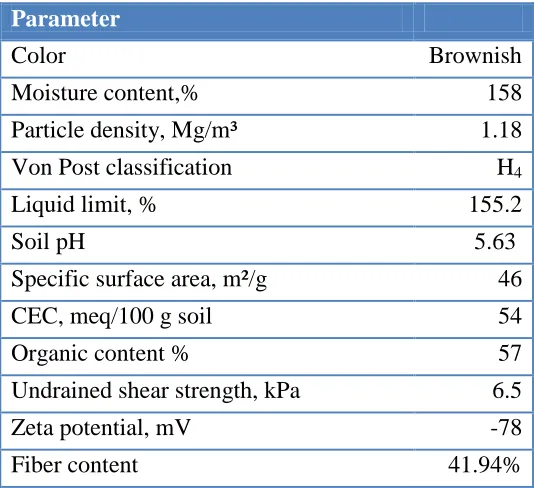
Physico-chemical properties of organic soil used in present research showed in Table 2. It is well understood, organic soil environments are suitable candidates for the EK phenomena due to presence of hydrated ions and a very wet soil mass [5 ,15]. Also, the organic soil sample used in this study showed very high specific surface area, WC and CEC (at the soil pH) (Table 2). Such properties increase with an increase in organic content [1, 5]. In EK remediation, it is important to know the exact CEC and ζ of the soil to estimate the presence of water sorption potential, water momentum, and positive charges on the soil surface [16].
Table 2. Physicochemical properties of the Organic soil
Parameter
Color Brownish
Moisture content,% 158
Particle density, Mg/m³ 1.18
Von Post classification H4
Liquid limit, % 155.2
Soil pH 5.63
Specific surface area, m²/g 46
CEC, meq/100 g soil 54
Organic content % 57
Undrained shear strength, kPa 6.5
Zeta potential, mV -78
Fiber content 41.94%
Chemicals Used
Synonyms
Molarity (mol/L)
Step-1 Step-2 Step-3 Step-4
Na2Sio3 N 0.1, 1, 3 0.1, 1, 3 0 0
H3PO4 H 0 0 0.1, 1, 3 0.1, 1, 3
CaCl2 C 0, 0.1, 1 0, 0.1, 1 0, 0.1, 1 0, 0.1, 1
[image:5.596.164.431.506.751.2]
Humus as a most chemically active fraction of the organic soil colloids can help to justify the underlying reasons for the physicochemical effects on the tropical highly organic matter soils from the EK treatment [2]. The soils had a net negative charge because of the negative charges on the organic matter and on the layer silicates of the mineral portion (kaolinite), which was limited in amount when compared with humus.
3.1. Diffuse double layer interactions of treated organic soil
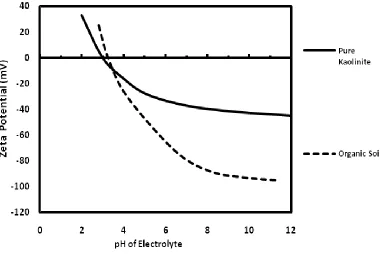
[image:6.596.107.487.281.535.2]The ζ of pure organic soils varied from +25.1mV to -95.4 mV at pH 2.8 and 11.3, respectively. Also, ζ for pure organic soil was almost zero at pH 3.25 to 3.35 (Fig. 1).
Figure 1. The variation of ζ for pure organic soil and kaolinite
(a)
[image:7.596.139.458.77.556.2](b)
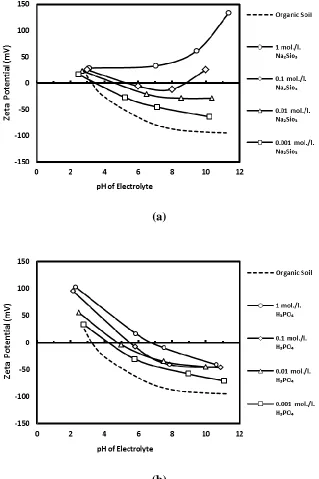
Figure 2. The variation of ζ with electrolyte concentration of organic soil: (a) Na2Sio3, (b) H3PO4
The ζ of organic soil in the presence of Na2Sio2, H3PO4 electrolytes at different electrolyte concentration showed in Fig. 2. As for both Na2Sio3 and H3PO4, ζ sign did not change and remained negative except for 1 mol/L electrolyte concentration that ζ significantly increased to the +133.18mV at pH equal to 11.35 (Fig. 2).
The ζ of organic particles as a function of pH for various electrolytes namely; Na2Co3, CaCl2, MgCl2, and Al2(SO4)3 in four electrolyte concentrations, 0.001, 0.1, and 0.1mol/L showed in Figure 3. ζ of organic soil changed from +189.22 at pH 4.43 according to 0.1 M CaCl2 (Fig. 3.a) to -88.2 at pH 9.69 in 0.001 M according to Na2Co3 (Fig. 3.c). It should be mentioned that ζ for some of solutions such as CaCl2 and MgCl2 showed higher than expected.
(a)
(c)
(d)
Figure 3. The ζ variation of organic vs. pH in the presence of various electrolytes, (a) CaCl2, (b) MgCl2, (c) Na2CO3, (d) Al2(SO4)3,
Due to high ion concentration in diffuse double layer thickness of colloids immersed in these reagents, ζ could not be calculated using Smoluchowski equation. The higher ζ lead to more electric conductivity as well as suitable environment regarding EO flow injection [13].
[image:9.596.135.457.77.517.2]
CaCl2 solution showed a peak value of 189.22, 84 and -29.4 mV at electrolyte concentration of 0.1, 0.01 and 0.001, respectively. PHs at Peak values of ζ for CaCl2 was 4.43, 7.1 and 10.83 at 0.1, 0.01 and 0.001 mol/L electrolyte concentration, respectively (Fig. 3.a). The same behavior has seen regarding MgCl2 and Na2CO3 (Fig. 3.b&c). The ζ of organic soil immersed in Al2(SO4)3 at electrolyte concentrations of 0.1, 0.01 and 0.001 mol/L were 65.3, 41.6 and 28.1 at pH respectively, in their natural pHs which were 2.9, 3.15, and 3.35 respectively (Fig. 3.d). Observed results clearly show that electrolyte concentration has significant change in the increasing ζ value in acidic part and decreasing in alkaline part (Fig. 3).
Fgiure 4. Effect of electrolyte concentration on ζ of organicsoil with different additives in their natural pH
Regardless the ζ sign, the natural ζ of the organic soils immersed in cationic and saline solutions increased with increasing electrolyte concentration (Fig.4). As mentioned, the thickness of diffuse double layer in some cases like MgCl2, CaCl2, Na2CO3 and Al2(SO4)3 in 1 M was more than that can be calculated by the von Smoluchowski theory (1921) [26]. There was no compression in double layer thickness regarding immersing organic soil particles in electrolytes at various concentrations. For instance, Na2CO3 (Fig. 3.c) and H3PO4 (Fig. 2.b) at electrolyte concentration of 0.001 mol/L showed ζ equal to -88.2mV and 33.11mV at their natural pH which were 9.69 and 2.77, respectively.
3.2. Effect of electrolytes on specific conductivity
[image:11.596.126.474.154.395.2]The specific conductivity concept is typically applied to the case of homogeneous electrolytes. Inside the charged pores, the ionic concentration and the potential vary from the charged surface to the bulk solution [23, 29].
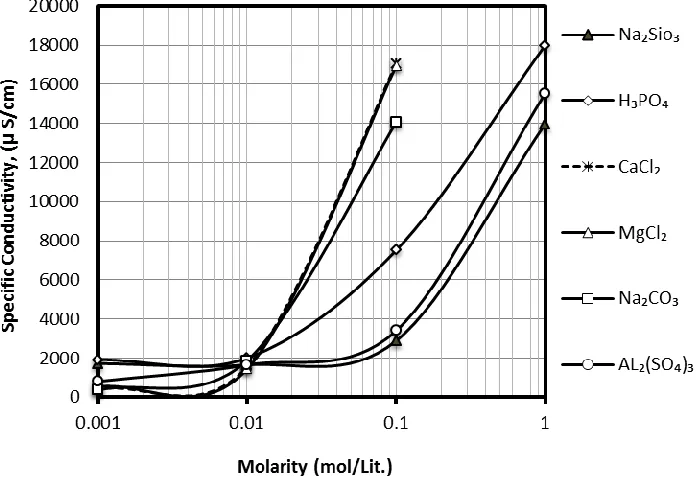
Figure 5. Effect of electrolyte molarity in suspended organic soil on specific conductivity
The specific conductivity titration curves were not very similar (Fig. 5). CaCl2 and MgCl2 were exactly similar and also found to be most conductive reagents. Moreover, the rest of chemical species, Na2Co3, H3PO4, and Al2(SO4)3 were almost similar with a lower value in specified molarities indicating that CaCl2 and MgCl2 are more susceptible to work as secondary additive. Also, based on Helmholtz Smoluchowski equation more specific conductivity cause to increasing in ζ values (Fig. 5). This also indicates the significant effect of reagents on the EO flow and EM through the soils.
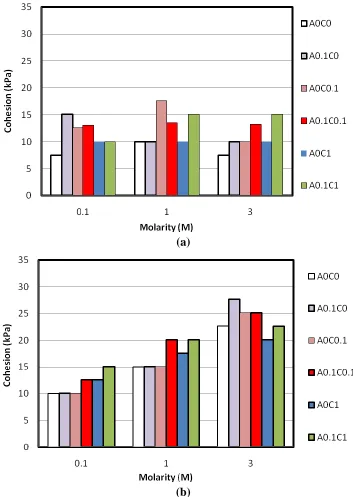
3.3. Unconfined Compressive Strength Tests
(a)
(b)
Figure 6. Phase II, the 14 days undrained shear strength (Cu) for treated organic Soil, (a) H3PO4 (b) Na2Sio3
3.4. Effect of CaCl2 and Al2(SO4)3 on treated organic soil
[image:12.596.115.468.103.600.2]
effect using CaCl2 is certainly enhanced, compared with the EO only. Previous studies also proved that the EO injection tests have less loss of voltage, more current, and larger amounts of drained water than those using EO only. On the other hand, saline solutions which were mixed into the soil as part of binders will increase electrochemical effects such as an increase of cation exchange and precipitation on the surface of humus.
(a)
(c)
Fgiure 7. Effect of electrolyte concentration on undrained shear strength of organic soil, (a) Without CaCl2, (b) 0.1 M CaCl2, and (c) 1M CaCl2
As in many investigators' studies on clay, Ca2+ can exchange Na+ on the surface of clay, which makes the double layer of the clay thinner, resulting in denser organic soil particles and thus increasing shear strength [32-35]. An increase in shear strength of soil can also be related to precipitation in the soil [36-40].
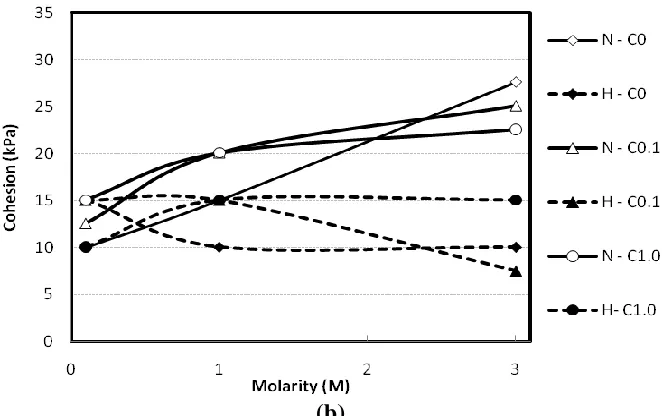
In the absence of Al2(SO4)3, the Cu for 1mol/L of Na2Sio3 at 0, 0.1, and 1 mol/L CaCl2 were almost same and equal to 15.07 kPa (Fig. 7). However having 0.1 mol/L of Al2(SO4)3, the Cu for same molarities of Na2Sio3 at 0, 0.1, and 1 mol/L CaCl2 were 15.07, 20.09, and 20.09, respectively, which means using Al2(SO4)3 increase 25% unconfined compression results (Fig. 8).
(b)
Figure 8. Effect of electrolyte concentration on undrained shear strength of organic soil, (a) Without Al2So43, and (b) 0.1 M Al2(SO4)3
Although, CaCl2 enhaced the EO flow injection process, it will reduce the strength properties of organic soil. Also, adding Al2(SO4)3 in Na2Sio3 treated soil increase the undrained compression strength significantly. As for 3mol/L Na2Sio3 and in the presence of 0.1 mol/L of Al2(SO4)3, the Cu at 0, 0.1, and 1 mol/L CaCl2 were 27.62, 25.11, and 22.60. There was no considerable difference between 1 and 3mol/L Na2Sio3 according to presence of 0.1mol/L Al2(SO4)3 (Fig. 7. c).
4. CONCLUSIONS
This paper describes effect of several new binders in order to stabilizing organic soils. Process has started from finding the effect of each electrolyte on diffuse double layer of organic colloidal. Then optimizing the ζ results led to choosing several amendments, as susceptible option regarding stabilizing. Also a comprehensive series of unconfined compression tests presented to give a good understanding of the behaviour of the stabilized organic soil with new suggested binders.
Using ζ results could be an effective in situ ground improvement tool in soft organic soils, particularly where ground movements need to be controlled. Then batch tests were done to find the effect of different binders on undrained shear strength of organic colloids. Based on the results of this study, the following conclusions may be drawn:
The results show that in the batch tests, shear strength increases of up to 350% of the natural organic soil’s baseline strength can be achieved by adding the Sodium silicate, while little strength increase resulted from the phosphoric acid addition.
[image:15.596.133.464.74.282.2]
Na2Sio3 molarities. This could be due to better interaction between humus in organic soil as initial negative charge part and Na2Sio3 in presence of Al2(SO4)3.
In the presence of CaCl2 at 0.1mol/L and absense of Al2(SO4)3, effect of using high Na2Sio3 molarities as for achieving to high Cu reduced. This effect in turn will contribute to an increase in soil hydraulic conductivity through the soils. In contrast, negatively charged soil particles repel each other, resulting in dispersion and decrease in soil hydraulic conductivity.
Although in the absence of Al2(SO4)3good bonding obtained according to using CaCl2 at 1mol/L mixed with H3PO4 at 1mol/L, there was no considerable increase in Cu for H3PO4 as for stabilizer. This means H3PO4 cannot be a suitable option acting as a good stabilizer regarding organic soil stabilization.
ACKNOWLEDGMENTS
Financial assistance from the Research Management Center (RMC) of the Universiti Putra Malaysia (grant No. 91152) for conducting this experiment is gratefully acknowledged.
References
1. B. K. Huat, Organic and Peat Soils Engineering. University Putra Malaysia Press, Serdang, (2004).
2. F.J. Stevenson, Humus Chemistry: Genesis, Composition, Reactions. John Wiley and Sons, New York, (1994).
3. L. Charlet, P. Wersin and W. Stumm, Geochimica et Cosmochimica Acta, 54 (1990), 2329-2336. 4. W. Smit and H. N. Stein, Journal of Colloid and Interface Science, 60 (1977) 2, 299-307.
5. A. Asadi, B. B. K. Huat, M. Hanafi, T. A. Mohamed and N. Shariatmadari, Geosciences Journal, 14 (2010) 1, 67-75.
6. M. Foss, E. Gulbrandsen and J. SjÖlom, J. Dispersion Sci. Technol., 31 (2010), 233–240. 7. D. Niriella and R. P. Carnahan, J. Dispersion Sci. Technol., 27 (2006) 1, 123–131
8. T. Brunelle, Colloidal fouling of reverse osmosis membranes. Desalination, 32 (1980). 9. P. Moulin and H. Roques, J. Colloid Interface Sci., 261 (2003), 115-126.
10.J. Y. Park, Y. Chen, J. Chen, J. W. Yang, Geosciences Journal, 6 (2002) 1–5. 11.M. Kosmulski, Journal of colloid and interface science, 222 (2003), 113-118. 12.Bear FE. Chemistry of the soil, 2ed, New York; American chemistry society. (1965). 13.R. J. Hunter, Zeta potential in colloid science. New York: Academic Press, (1981). 14.Y. Ou, S. C. Chien, Y. G. Wang.. Applied Clay Science, 44 (2009) 2: 130-136. 15.A. N. Alshawabkeh, J. Separation Science and Technology, 44 (2010) 2171-2187.
16.Asadi, B. B. K. Huat, M. Hanafi, T. A. Mohamed and N. Shariatmadari, Geosciences Journal, 13 (2009) 2, 175-181.
17.Y. B. Acar, R. J. Gale, G. A. Putnam, J. Hamed, and R. L. Wong, J. Envir. Sci. Health. 6 (1990) 687-714.
18.A. Sze, D. Ericson, L. Q. Ren and D. Q. Li, J. Colloid Interface Sci., 261 (2003), 402-410. 19.S. J. Han, S. S. Kim and B. I. Kim, Geosciences Journal, 8 (2004), 85–93.
20.V. M. Smoluchowski. Handbuch der Elektrizitat under Magnetismus II. (1921).
21.H. Y. Fang and J. L. Daniels. Introductory Geotechnical Engineering. An environmental perspective. Taylor and Francis, (2006).
24.T. R. Yu. Chemistry of Variable Charge Soils, New York; Oxford University Press, (1997). 25.J. K. Mitchell and K. Soga, Fundamentals of Soil Behavior. John Wiley and Sons, New Jersey,
(2005).
26.S. Hebib and E. R. Farrell, Can. Geotech. J., 40 (2003), 107-120.
27.R. A. Shrestha, T. D. Pham and M. Sillanpää, Int. J. Electrochem. Sci., 4 (2009) 10, 1387-1394. 28.P. B. Lorenz. Clays and Clay Minerals, 17 (1969), 223-231.
29.H. V. Olphen, An Introduction to Clay Colloid Chemistry. 2ed, New York; John Wiley and Sons, (1977).
30.M. Alkan, Ö. Demirbas and M. Dogan, Journal of Colloid and Interface Science, 281 (2005) 1, 240-248.
31.H. Karami, A. Yaghoobi and A . Ramazani, Int. J. Electrochem. Sci., 5 (2010) 1046-1059. 32.S. S. Madaeni, S. Naghdi and M. D. Nobili, Transport in Porous Media, 65, 469–484. (2006). 33.A. S. Al Attas, Int. J. Electrochem. Sci., 4 (2009) 10, 9-19.
34.S. Riahi, M. R. Ganjali, H. Khajehsharifi, P. Norouzi, and S. Taghipoor, Int. J. Electrochem. Sci., 4 (2009) 122-133
35.T. W. Lambe, J. of the Soil Mechanics and Foundation Engineering Division, 84 (1958) 2, 1654.1– 1654.34.
36.H. Adelkhani, S. Nasoodi, A. H. Jafari, Int. J. Electrochem. Sci., 4 (2009) 238-246. 37.H. Razmi and M. Harasi, Int. J. Electrochem. Sci., 3 (2008) 82-95
38.A. A. Ensafi, M. Taei and T. Khayamian, Int. J. Electrochem. Sci., 5(2010)116-130 39.A. Asadi, H. Moayedi, B. B. K. Huat, A. Parsaie, M. R. Taha, Int. J. Electrochem. Sci.,
6(2011)1135-1145.
40.A. Asadi, H. Moayedi, B. B. K. Huat, F. Z. Boroujeni, A. Parsaie, S. Sojoudi, Int. J. Electrochem. Sci., 6(2011) 1146-1158.