. '
r
lo
11ft '->
-')C
COMMISSION OF THE EUROPEAN COMMUNITIES DIRECTORATE GENERAL XV
Internal Market and Financial Services
General matters and coordination, free movement of persons and direct taxation
External dimension of the internal market and financial services
AUSTRALIA
Brussels, 27 March 1995
Ref: N /gg -i:\wap\winword\work\jv\austr-·
1
Introduction
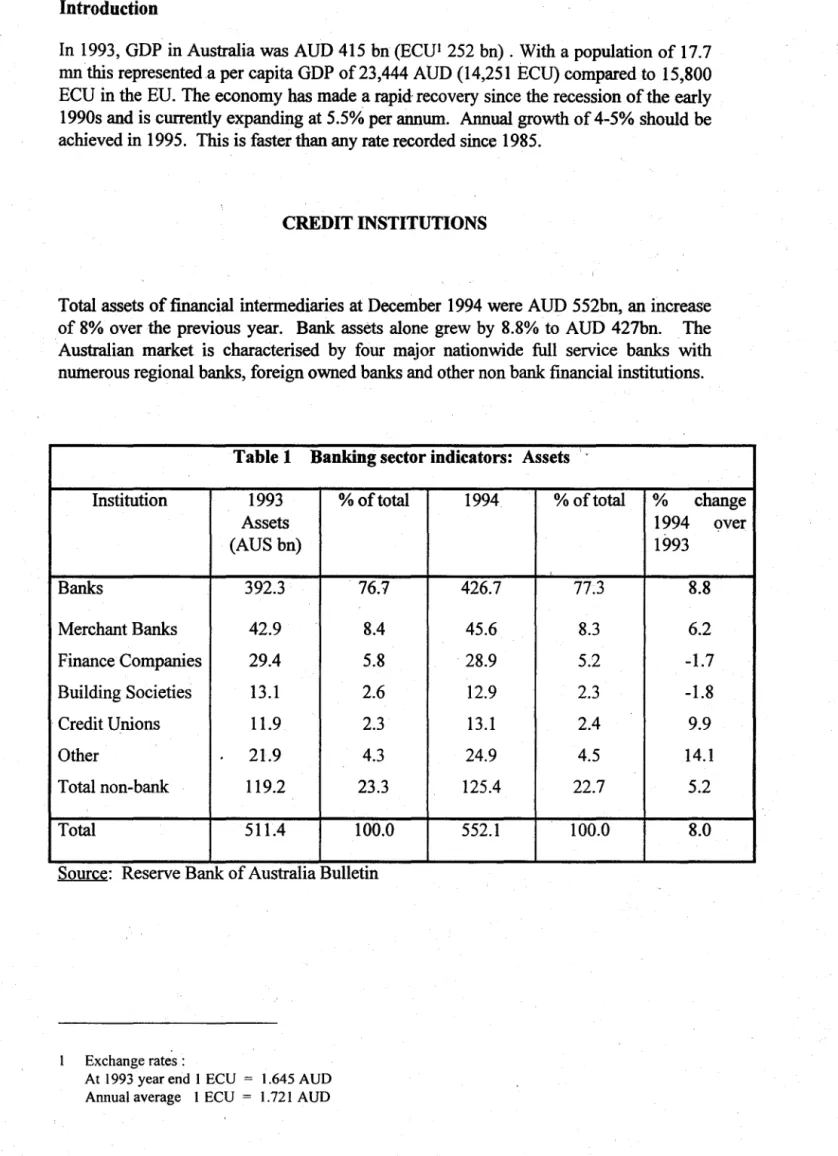
In 1993, GDP in Australia was AUD 415 bn (ECUI 252 bn). With a population of 17.7 mn this represented a per capita GDP of 23,444 AUD (14,251 ECU) compared to 15,800 ECU in the EU. The economy has made a rapid recovery since the recession of the early 1990s and is currently expanding at 5.5% per
annum.
Annual growth of 4-5% should be achieved in 1995. This is faster than any rate recorded since 1985.CREDIT INSTITUTIONS
Total assets of financial intermediaries at December 1994 were AUD 552bn, an increase of 8% over the previous year. Bank assets alone grew by 8.8% to AUD 427bn. The Australian market is characterised by four major nationwide full service banks with numerous regional banks, foreign owned banks and other non bank financial institutions.
Table 1 Banking sector indicators:
Institution 1993 %oftotal Assets
(AUS bn)
Banks 392.3 76.7
Merchant Banks 42.9 8.4 Finance Companies 29.4 5.8 Building Societies 13.1 2.6 Credit Unions 11.9 2.3 Other 21.9 4.3 Total non-bank 119.2 23.3
Total 511.4 100.0
Source: Reserve Bank of Australia Bulletin
Exchange rates :
At 1993 year end l ECU = 1.645 AUD Annual average l ECU = 1.721 AUD
1994
426.7
45.6 28.9 12.9 13.1 24.9 125.4
552.1
Assets ·,
% of total % change 1994 over 1993
77.3
8.8
8.3 6.2 5.2 -1.7 2.3 -1.8 2.4 9.9 4.5 14.1 22.7 5.2
[image:2.598.16.571.45.864.2]·· Foreign banks
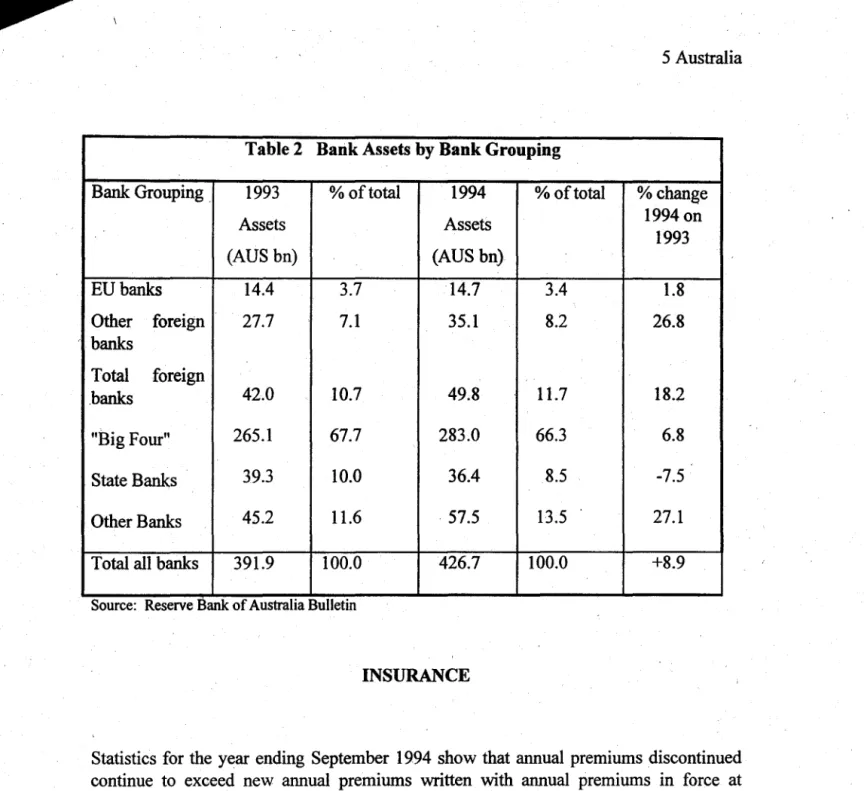
Out of the 47 licensed banks at December 1994, 28 were foreign owned of which 8 were owned by banks in the European Union. Foreign banks accounted for about 11.7% (AUD
50
bn.) of total bank assets with EU banks accounting for 3.4% (AUD 15 bn). Compared with 1993, assets of all foreign banks increased by 18% due mainly to the entry of new banks. For EU banks, the increase in assets is only 2% due to transferred or divested assets of two previously established bank subsidiaries in part offsetting the growth and establishment of other EU banks. Competition from foreign bank entry and regional banking has led to the dominance of the big four Australian banks2 declining to ,66.3%.The assets of merchant banks owned by foreign banks in 1993 totalled AUD 38 bn (93% of total), of which AUD 14 bn (35%) were owned by EU merchant banks. For that year, foreign banks and foreign owned merchant banks accounted for 16% of the Australian assets of all financial intermediaries operating in Australia Foreign banks have been able to pursue marketing strategies for capturing market niches with some spectacular, successes such as in funds management and corporate advisory services.
Foreign banks operating in Australia made losses equivalent to about one-third of their equity base in 1990, but the support of parent banks, changes in market strategies and scales of operation have resulted in an average capital ratio in 1994 of around 15%, well above that for banks as a whole.
MARKET ACCESS AFFORDED TO EU CREDIT INSTITUTIONS
Establishment
In a change from the· previous policy of limited foreign bank entry into the Australian financial system through a restricted number of locally incoporated subsidiaries, the Australian government, in February 1992, relaxed the rules on foreign banks and agreed to accept additional foreign banks to operate in the form of branches. The option of branch banking status was made available, including to foreign banks already operating as subsidiaries, on condition that such branches either add depth to an existing market or develop new niche markets. Retail deposits must continue to be conducted by a subsidiary.
No
additional capitalisation was required for branches as the global capital of their parents was the· basis for assessment of their capital framework. Up to the end of 1994, this has resulted in 11 additional foreign banks establishing in Australia, of which 2 are EU banks. A further 2 EU banks have restructured from a subsidiary to a branch.Activity
Previously, the number of foreign bank licences was limited, whereas the liberalization of foreign investment enabled foreign interests to operate as non-bank financial institutions, many foreign institutions operate as merchant banks. However, limitations on the activities of merchant banks prevent them from competing on equal terms with trading
banks. Firstly, merchant banks, along with all other non-bank financial intermediaries do not have direct access to the cheque clearing system but have access by agency arrangement with banks. · Secondly, under capital adequacy rules based on Basle Guidelines, claims on merchant banks by trading banks are given a 100% weighting instead of the 20% weighting given to claims on trading banks, thus making refinancing of merchant banks more costly. The weighting is reduced to 50% if there is a "letter of comfort" from the parent bank to the RBA and to 20% if there is a clear-cut guarantee by the parent bank. Thirdly, no merchant banks have access to the central bank rediscount facilities, although merchant banks have the same rights of access to rediscount facilities as other equivalent financial institutions. Restricted access for merchant banks exists to the open market operations
(OMO)
of the Reserve Bank. Some peripheral activity is also undertaken by reporting bond dealers and foreign exchange dealers.\
Government owned or controlled banks account for 27% of assets in the banking sector. Commonwealth and State banks benefit from a government guarantee, making the cost of acquiring funds lower and providing an assurance for customers therefore distorting competition against both domestic private banks and foreign banks.
, , For tax revenue reasons, the Government, in June 1993, announced that it would impose interest withholding tax (IWT) on half of the interest on intra-bank borrowings by foreign bank branches. This puts branches at a disadvantage to foreign bank subsidiaries and Australi!ID banks, both of whom have access to foreign borrowings exempt from IWT · through Section 128F of the Income Tax Act. To try to alleviate this, the Reserve Bank, in December 1993, indicated its willingness to accept access to Section 128F funding from abroad as an adequate reason for intermediation business to be undertaken within a . non-bank subsidiary rather than in the foreign bank branch. All other intermediation
must still be conducted through branches.
In a move directed principally at foreign banks, the Reserve Bank of Australia has increased its requirements for a separation between bank management and boards. These include appointment of an independent executive chairman, a majority of non-executive directors and a limit on membership to one bank board.
While the overall picture of Australian regulation is one of non-discrimination, foreign bank branches are not allowed to accept retail deposits. Although the difference is based on the exemption of foreign branches from the Banking Act and, thus, prudential concerns, some foreign branches were allowed to· maintain their existing retail deposits because of their presence in the market when f.he rules were implemented. Moreover, branches are obliged to inform their depositors that their deposits are not covered by the provisions of the Banking Act under which the Reserve Bank protects the interests of the depositors. Depositors are not therefore misled as to the level of protection. These provisions could discourage foreign banks from setting up branches.
Table 2 Bank Assets by Bank Grouping
Bank Grouping . 1993 % of total 1994 % of total %change
Assets Assets 1994 on
1993
(AUS bn) (AUS bn)
EU banks 14.4 3.7 14.7 3.4 1.8
Other foreign 27.7 7.1 35.1 8.2 26.8
' banks
Total foreign
.banks 42.0 10.7 49.8 11.7 18.2
"Big Four" 265.1 67.7 283.0 66.3 6.8
State Banks 39.3 10.0 36.4 8.5 -7.5
Other Banks 45.2 11.6 57.5 13.5 27.1
Total all banks 391.9 100.0 426.7 100.0 +8.9
Source: Reserve Bank of Australia Bulletin
INSURANCE
Statistics for the year ending September 1994 show that annual premiums discontinued continue to exceed new annual premiums written with annual premiums in force at September 1994 down 4.4% on the previous year to AUD 8.0 bn. Conversely, single premiums written increased by 9.8% to AUD 7.7 bn, resulting in total net premiums increasing by 2.1% to AUD 15.6 bn. Total assets held in statutory funds at September 1994 increased by 4.3% on the previous year to AUD 100.Sbn.
[image:5.600.8.582.14.553.2]( .,
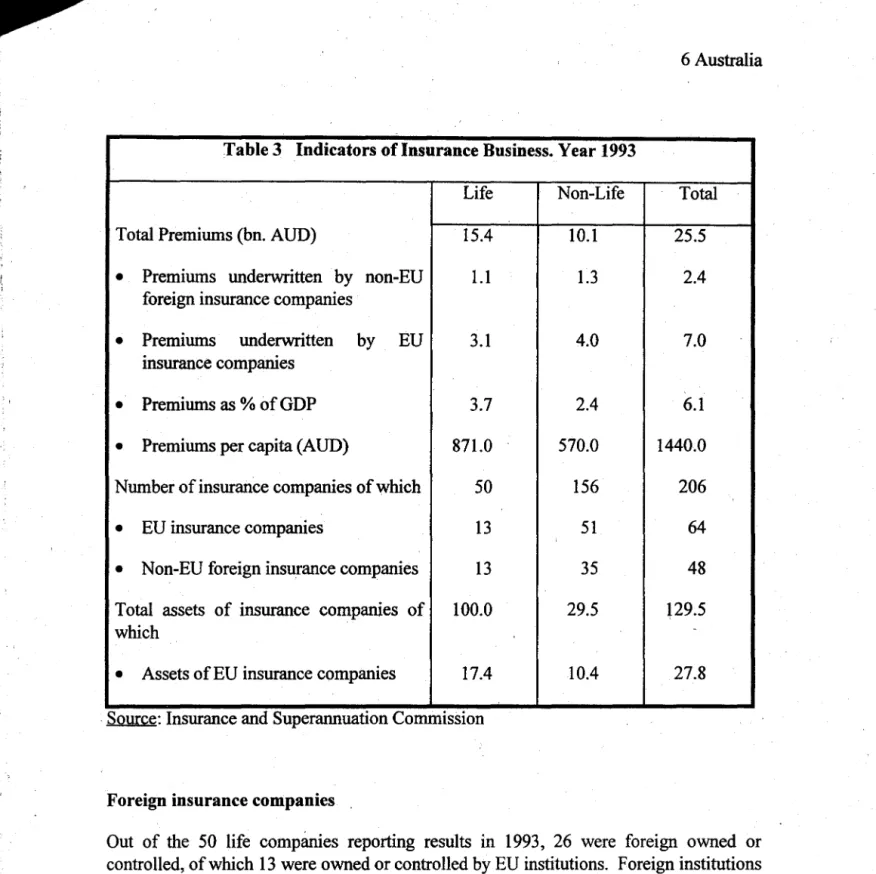
Table 3 Indicators of Insurance Business. Year 1993
Total Premiums (bn. AUD)
• Premiums underwritten by non-EU foreign insurance companies
• Premiums underwritten by EU insurance companies
Life
15.4
1.1
3.1
• Premiums as% of GDP 3.7
• Premiums per capita (AUD) 871.0
Number of insurance companies of which 50
• EU insurance companies 13
• Non-EU foreign insurance companies 13
Total assets of insurance companies of 100.0 which
• Assets of EU insurance companies 17.4
. Source:
Insurance and Superannuation CommissionForeign insurance companies .
Non-Life 10.1 1.3 4.0 2.4 570.0 156 51 35 29.5 10.4 Total 25.5 2.4 7.0 6.1 1440.0 206 64 48 129.5 27.8
Out of the 50 life companies reporting results in 1993, 26 were foreign owned or controlled, of which 13 were owned or controlled by EU institutions. Foreign institutions accounted for 23% of total life premium income earned by the private sector in 1993, with EU companies accounting for 17%.
Of the 156 non-life companies reporting results in 1993, 90 were foreign owned, of which 55 were owned by EU institutions. On aggregate, the foreign-owned companies accounted for 56% of non-life premiums earned by the private sector with EU institutions accounting for 43%.
[image:6.600.21.585.14.588.2]EU MARKET ACCESS AFFORDED TO INSURANCE UNDERTAKINGS
Establishment
Life insurance and general insurance may only be carried out by corporate entities registered by the Insurance and Superannuation Commission which excludes Lloyds Underwriters. The principal officer of a life insurance company must' be a resident of Australia. Lloyds has been permitted to register a $500,000 deposit and Lloyds Underwriters continue to be required to provide a bank guarantee.
Assessments of new application for insurance registration from foreign companies includes a subjective evaluation vis-a-vis its foreign investment policy.
Activities
Certain states monopolies may limit the scope for establishment and activities of foreign insurance firms. In Queensland and South Australia worker's compensation insurance is restricted to a government monopoly, while in Victoria, South Australia, Western Australia, Tasmania and Northern Territories, the government holds a monopoly over third party insurance. Furthermore, the State Government offices are not subject to the same requirements under the Australian 'insurance legislation as private firms (whether . Australian or foreign).
SECURITIES
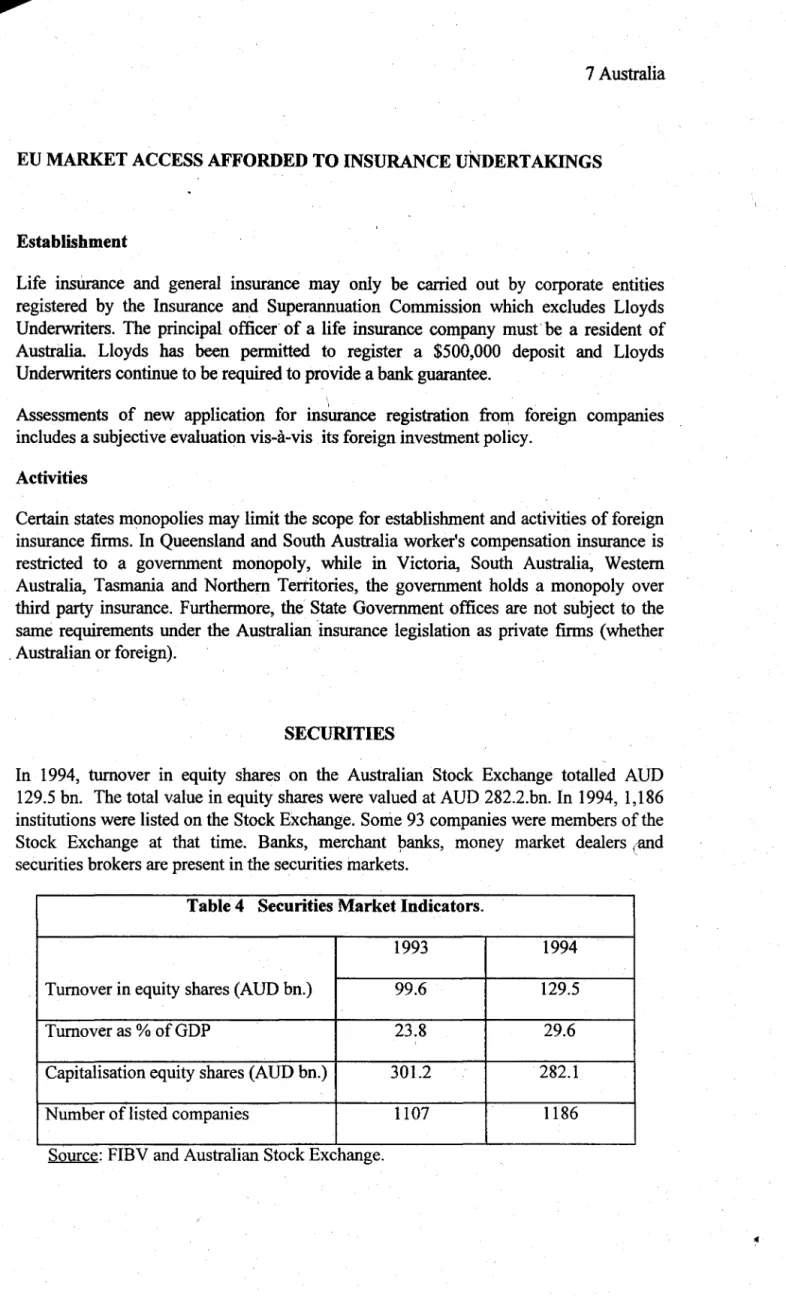
In 1994, turnover in equity shares on the Australian Stock Exchange totalled AUD 129.5 bn. The total value in equity shares were valued at AUD 282.2.bn. In 1994, 1,186 institutions were listed on the Stock Exchange. Some 93 companies were members of the Stock Exchange at that time. Banks, merchant 9anks, money market dealers ifilld securities brokers are present in the securities markets. '
Table 4 Securities Market Indicators.
1993 1994
Turnover in equity shares (AUD bn.) 99.6 129.5
Turnover as % of GDP 23.8 29.6
Capitalisation equity shares (AUD bn.) 301.2 282.1
Number of listed companies 1107 1186
[image:7.596.54.582.19.867.2]MARKET SHARE OF EU SECURITIES INSTITUTIONS
Out of the 93 members of the Stock Exchange, 26 are foreign owned or controlled. Of these, 12 are owned or controlled by EU companies. In 1994, foreign owned/controlled companies accounted for
55
% of the turnover in equity shares of which 42% was the percentage for EU owned/controlled companies.Establishment
Access to the Australian Stock Exchange (ASX) is intende.d to be based upon reciprocal access to foreign Stock Exchanges as provided by Article 37 (2) (e). Branches of a foreign company may, theoretically, be members of the ASX, but the ASX
has
indicated that this would cause a number of problems.In
practice foreign companies have therefore elected to establish subsidiaries. Proposed foreign investment in an existing or new securities firm are subject to the same test of national interest as proposed investment in the banking and insurance sector applying at the same thresholds.Foreign investment in a company's equity of 15% or more is subject to approval for all acquisition involving AUD
5
mn. or more. This supervisory hundle has not involved any discrimination against foreign firms.Activity
As of December 1994, 15 l money market corporations were registered to provide a range of services in the securities market. Of these, 111 were foreign owned of which 29 were EU companies.