' (
1.
C
..
-
>
-·
><
..
UJw
0
·. Internal Market and Financial Services
General matters and coordination, free movement of persons and direct taxation External dimension of the internal market and financial services
SINGAPORE
Brussels, 12 May 1995
Ref: Nigg- jv\tcr\singapo
XV-A-2
Rue de la Loi 200, B-1049 Brussels, Belgium - Office: C 107 08/039.
'
, i
'
i
• J
Introduction
In 1993, GDP in Singapore was SGD 89 bn (ECUI 49.7 bn) with a real growth rate of 6. 7%. With a population of 2.9 mn. this represented a GDP per capita of 30,700 SGD
(ECU 17,100). Singapore has a well developed financial sector. In 1993, income from
financial services accounted for 12% of GDP.
CREDIT INSTITUTIONS
· Overview
Since the late 1960's the government of Singapore has maintained a policy of attracting financial intermediaires to conduct offshore operations, through offering favourable tax and operating conditions. There are 132 commercial banks in Singapore, of them, 119 are foreign-owned.
The fmancial regulator of the market, and in practice the central bank, is the Monetary Authority of Singapore (MAS). The MAS has been in existence. since 1971, and is responsible for the formulation and implementation of Singapore's monetary policies, as well as regulating the financial sector under the Banking Act, the Monetary Authority of Singapore Act, and a string of other Acts. The Board of Commissioners of Currency of Singapore (BCCS), issues and controls the currency. These two bodies are operated under the Ministry of Finance, and organised in the same way as corporations, yet remain quasi-government agencies (quangos).
The MAS consult with the Association of Banks in Singapore, the Offshore Banks
Consultative Committee, and the Singapore Merchant Bankers Association. These
associations do not have a regulatory role, but are used as the industry's consultative body. Foreign as well as local banks participate in the ABS, and sit on the council. Local banks are closely linked to the government, and it is common for government officials to sit on the boards of domestic and foreign banks, as well as for officials of foreign and domestic banks to sit on the boards. of government-linked companies and statutory boards.
The government of Singapore requires banks to prepare distinct accounts between transactions in the domestic and external currency markets. Most of the banks operate external currency units, called Asian Currency Units (ACUs). ACUs do not have to hold
Exchange rates:
reserves against their liabilities, and are not subject to. the minimum liquidity ratios. However, they may not incur.assets or liabilities in Singapore dollars.
In the domestic market, banks operate with Domestic Banking Units (DBUs), and are free to make transactions in either foreign or local currency. DBUs are subject to regulation, and must hold a minimum cash balance of 6% of their liabilities with the
MAS; 18% of their liabilities in liquid assets; and pay a standard rate of corporation tax
of 27%. Banks must notify the MAS of the use of Singapore dollar credit facilities that exceed S$5 million, by nonresidents, or outside Singapore by residents for activities other· than those approved by the MAS.
~·
Insurance deposit funds for banks in Singapore do not exist. Foreign credit institutions must submit "comfort letters" to the MAS, giving the assurance that their operations maintain sound liquidity at all times, and that the parent will, on demand, make-up for any shortfall in the Singapore· operations.
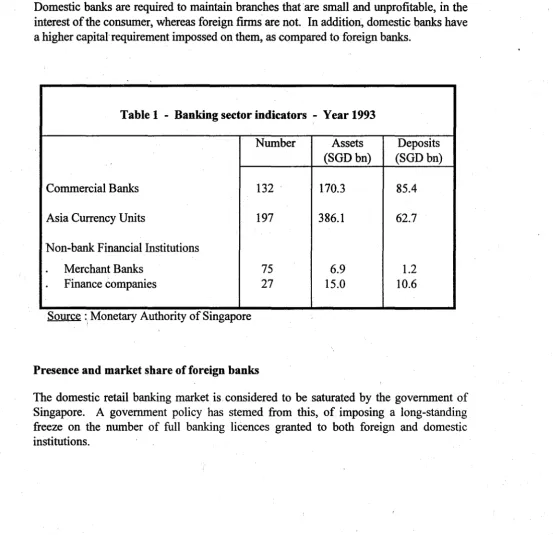
Domestic banks are required to maintain branches that are small and unprofitable, in the interest of the consumer, whereas foreign firms are not. In addition, domestic banks have a higher capitahequirement impossed on them, as compared to foreign banks.
Table 1 - Banking sector indicators - Year 1993
Number Assets Deposits
(SGDbn) (SGD bn)
Commercial Banks 132 170.3 85.4
Asia Currency Units 197 386.1 62.7
Non-bank Financial Institutions
.
Merchant Banks 75 6.9 1.2.
Finance companies 27 15.0 10.6Source :, Monetary Authority of Singapore
Presence and market share of foreign banks
[image:3.597.36.590.306.842.2]·)
Fifty-three foreign
banks
have representative offices in Singapore, accounting for nearly50% of all nonbank deposits from residents, and over 50% of all loans to nonbank residents. Furthermore, the foreign banks lend over 70% of total trade finance and account for over 60% of all banking profits.
Out of a total of 77, there are 7 4 foreign-owned merchant banks operating in Singapore.
MARKET ACCESS PROBLEMS FACED BY EU BANKS
Establishment
The law draws no distinction between foreign and domestic banks in Singapore. The only distiction being between offshore and domestic units, and in the type of licences granted. The MAS have not approved new banking licences to foreign or domestic firms since 1973. Banks must seekpermission from the MAS to open new branches. Over the past twenty years, MAS permission has been refused for foreign banks, but local bank applications have been granted.
Concerning the foreign-ownership of pubicly listed banks, only Singapore residents may purchase local shares on the stock exchange. Foreign shareholdings in local banks is restricted to 40% of the total equity.
Foreign-owned merchant banks are generally incorporated as local subsidiaires, which must be approved by the MAS. The Banking Act applies to the merchant banks, they can not obtain a licence, but they can be established as ACUs. The merchant bank must have a head office established as a bank, merchant bank, security firm, or investment house.
Activity
There are three types of licences in Singapore; a full licence, a restricted licence and an offshore licence. A licence will determine the kind of service the bank can offer. Thirty-five commercial banks have the "full licence", and are permitted to offer a full range of both foreign currency and local banking services. Fourteen commercial banks which are foreign-owned hold "restricted licences", permitting them to operate in the ACUs market, but not in the DBU market. Therefore, foreign banks can only have one main branch, and can not offer general savings accounts, or accept fixed interest-bearing deposits of
less than S$250, OOO from nonbank customers. This leaves the remaining 89 commercial
banks with "offshore" licences. The offshore licence is the only licence available to new entrants in the Singapore market, and are severely restricted in the services they can pmvide.
The foreign banks that have full licences, do not have the same access to the market as domestic banks. Foreign banks can not open new branches, and are restricted iq. the operation df off-premises automatic teller machines. However, foreign banks are allowed to offer a computer and telephone banking service, and can install electronic terminals at corporate clients' premises.
Only one foreign bank, compared to seven local banks can offer special low-interest -.accounts to Singapore citizens, to purchase with their national pension savings. This
INSURANCE
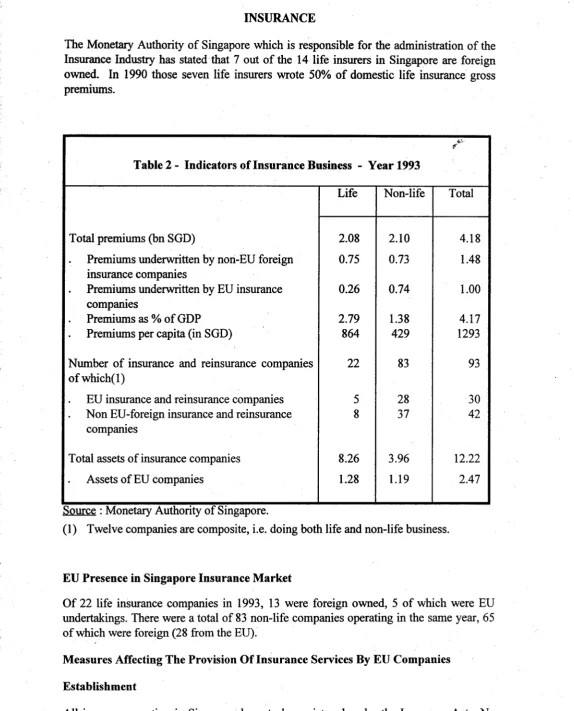
The Monetary Authority of Singapore which is responsible for the administration of the Insurance Industry has stated· that 7 out of the 14 life insurers in Singapore are foreign owned. In 1990 those seven life insurers wrote 50% of domestic life insurance gross premmms.
[image:5.593.8.583.89.801.2]~: .. £
Table 2 - Indicators of Insurance Business - Year 1993
Life Non-life Total
Total premiums (bn SGD) 2.08 2.10 4.18
.
Premiums underwritten by nori-EU foreign 0.75 0.73 1.48.
.
insurance companies
.
Premiums underwritten by EU insurance 0.26 0.74 1.00compames
Premiums as% of GDP 2.79 1.38 4.17
'
.
Premiums per capita (in SGD) 864 429 1293Number of insurance and reinsurance companies 22 83 93
ofwhich(l)
EU insurance and reinsurance companies 5 28 30
Non EU-foreign insurance and reinsurance 8 37 42
compames
Total assets of insurance companies 8.26 3.96 12.22
Assets of EU companies 1.28 1.19 2.47
Source : Monetary Authority of Singapore.
(1) Twelve companies are composite, i.e. doing both life and non-life business.
EU Presence in Singapore Insurance Market
Of 22 life insurance companies in 1993, 13 were foreign owned, 5 of which were EU undertakings. There were a total of 83 non-life companies operating in the same year, 65 of which were foreign (28 from the EU).
Measures Affecting The Provision Of Insurance Services By EU Companies
Establishment
, , :, j
presence of 14 life insurers operating
in
Singapore's small domestic market is broadly sufficient to meet needs. Further fragmentation would in its view lead to excessive and unhealthy competition.In reinsurance, companies can establish as branches or subsidiaries, but existing representative offices must upgrade to branches or subsidiaries by 1 January 1997.
Activity
MAS has said that licensed foreign insurers are subject to the same supervi~n and controls as local insurers. There is no discriminatory restriction on the conduct of insurance business by foreign companies. The MAS states that regulation of insurers is for prudential reasons and not used to protect local insurers against foreign insurers.
SECURITIES
Overview
Singapore now has five equity markets which are operated by the Stock Exchange of Singapore (SES). The five markets consist of: the Main Board (the primary market), the CLOB International (over-the-counter market for international stocks), the SESDAQ (the secondary stock exchange trading in shares of the small and medium-sized companies), the Debentures, Bonds, Loans (DBL) and Transferable Subscription Rights (TSR) market, and the Stock Options Market The Main· Board is dominated by the government-linked companies.
The Monetary Authority of Singapore (MAS) regulate the markets, and under its supervision the SES sets its own criteria for membership and listing, as well as regulating the activities of its members. The SES is owned by its members, 16 of which are 100% Singapore-owned, 10 are joint ventures with foreign partners, and 7 are foreign-owned.
At the beginning of 1994, the SES lists around 205 companies, 27 of which are foreign-owned, and has a market capitalisation of S$225.8 billion. Turnover on the Main Board, the CLOB, the DBL and TSR larkets has risen by an annual average of 53% since.1990. The Securities Industry Council (SIC) gives advice to the Minister of Finance on matters relating to the securities markets. The Council is comprised of representatives from the private sector, but they are appointed by the Minister of Finance. In practice the SIC works closely with the MAS.
In March 1993, the MAS created a small stock options market, which now has 102 call
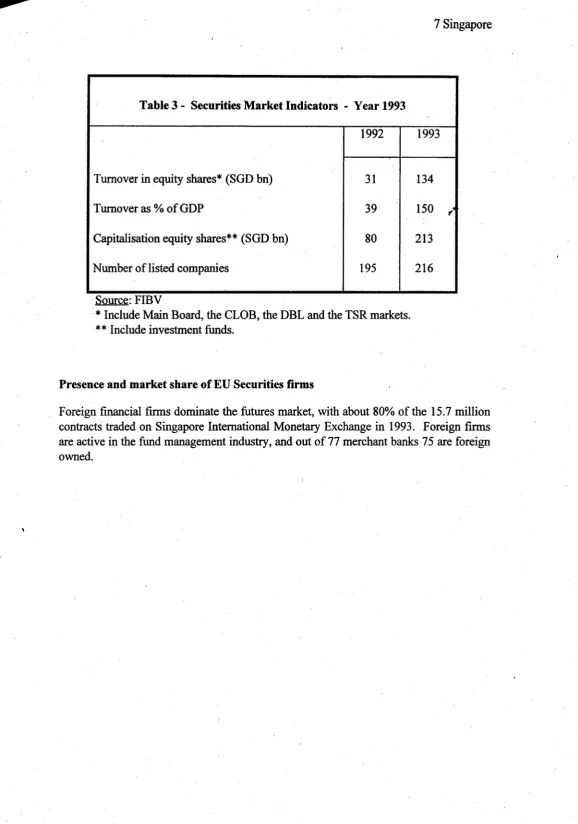
Table 3 - Securities Market Indicators - Year 1993
1992
Turnover in equity shares* (SGD bn) 31
Turnover as % of GDP 39
Capitalisation equity shares** (SGD bn) 80
Number of listed companies 195
Source: FIBV
· * Include Main Board, the CLOB, the DBL and the TSR markets. * * Include investment funds.
Presence and market share of EU Securities firms
1993
134
150 £'
213
216
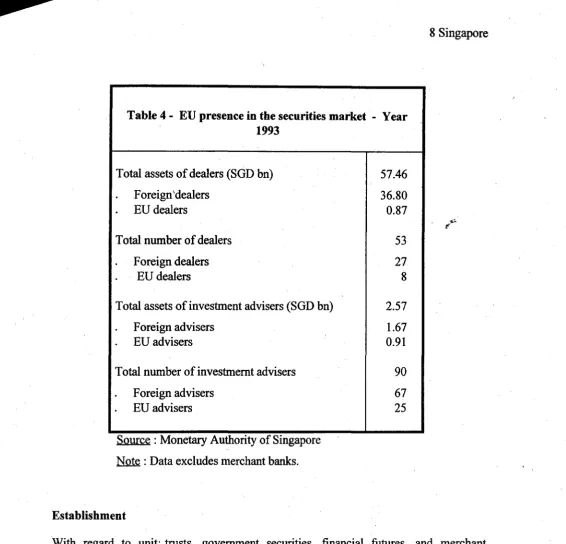
Table 4 - EU presence in the securities market - Year 1993
Total assets of dealers (SGD bn)
Foreign 'dealers
.
EU dealersTotal number of dealers
Foreign dealers EU dealers
Total assets of investment advisers (SGD bn)
Foreign advisers
.
EU advisersTotal number of investmernt advisers
Foreign advisers EU advisers
Source :
Monetary Authonty of SingaporeNote : Data excludes merchant banks.
Establishment
57.46
36.80 0.87
53
27 8
2.57
1.67 0.91
90
67 25
With regard to unit' trusts, government securities, financial futures, and merchant banking, foreign securities firms have the same rights to establish and offer financial products as domestic firms. In 1992, two British and one French companies joined the SES, out of a total of seven. Since 1986, the SES have not approved any local full memberships, and there are no associate members on the SES. The SES restrict foreign equity ownership of SES members to 49%, and 100% foreign-owned members (international members) have no voting rights in elections, nor can they be elected to the SES Committee. The international members may trade only for transactions greater than S$5 million. The MAS stresses that international members can trade with related companies without being limited by that amount.
Activity