THE
IPTS
REPORT
Prodtu·ed by IPTS and issued in Cooperation with the European S & T Observatories Network
FEBRUARY 1996
...
.
.
...
EUROPEAN COMMISSION Jo1nt Research Centre
-"--- ' ~ •' f j,_ _, _-:----~ ~--~ _-_ ~
Lessons To Be Learnt From Japan's Changing R&D Strategy
Content vs. Distribution: The medium loses to the message
Achieving a New Generation of Personal Communications
Using DNA for Data Processing
Plastics Recycling in Europe: Learning through innovative comparisons
Bioenergy: Technology development and the dilemma of its future
Logistics: The leverage of
T h e I P T S R e p o r t r~ o o 1 February 1996
'I hr> Report addrL'''L'' It>elf to the deci>IOn-mahLT> rmolll'd n1 ·managing change·. >ethrng dr>tilled. ,electiil' presentation of technoeconomic mtl'lhgence and pro>pL'l'till' alert on underdr,cu-,,ed taceh ol a topic. rather than a deluge of data and ennclopaedrc rL'\Ie\1,.
Thb Report stand-, a' the mo't 1 I'Ihle mdrcatlon ol till' commitment of the II'TS to Technolog1 \\ atch. It' m am pnont\ and mandate ( 'eL' in,ide hach l'OILT) In tin-, contL'\t. the Report airm to locu> on bsue' ol projected pertinence for the dL'CI,Ion-maher>.e\plonngjlm.ljlec/il'£'/t' the 'ocroL·conomrc rmpact ol S/T deH·Iopmenb. On the one hand. 'uch e\ploratron 11nphe' >rgnalling on i>sue' 11 hich are not \l'l clearh on the pohn-mahers· agenda. hut can lw prowcted to dra11 attL'ntiOn >ooner or later On the other hand. It rmphL'' alertrng actor;, about undere\plored a>Jll'l'h ol an r"ue on the agenda. a'pL'Ch 11lm·h. though under-appreciated toda1 nu1 hall' 'uh-,unual con,L·quL·nce' tommTm\.
The Report hendih lrom a 1ahdatron proce". undenHrtten h1 net11orks of renml!ll'd t\]Wrb and Comnm>ron senices. mahing thb Report a product olnot onh the II'TS. hut al-,o ol Ib collahoratmg net11 ork> of Commi,swn and externall'\perts. rill' pron·" of Interact!\ e comul-tation guarantL'L'' the ulrdlt1 ol the pornh highlighted. the rele1ance of the toprcs chosen. and the timeline" of their e\amrnatron
Then· are nu m publication' L'\l'elling 11 rthrn their dN'Ipline. The Report take' the e\tra Mep, prospectil'eh l'\]lloring interdbciplinan n·pL·rcu"ron,, olten dra11 rng qurte 'urpn,rng connectiorh \1oremer. 'haring the Comnussion ·s priorities. the Report 1' 'till the product of a n·search in-,trtutL'. and can he a neutral platlonn !or dialogue on issues of relevance and a nexus for debate facilitation
rill' pre>ent i''UL' 1' the 'econd rn,tallment m a seven-issue introducton >erie' that \\Ill last until September Jl)lJil Throughout thr' penod. and 11 nh the kedhach and comnH·nh of its reader>. the Report 11 tll be >hapl'll and fine-tuned. In this bsue some of thL''e commenh ha1 L' been adopted For rnqance. the too academic loohmg abstrach have been replaced by a more original introduction Short note,, 11 hich ann to rnlorm and not anah't'. and longer anahtical pi en·' attempt to cm er in a balanced \l'a\ r"ue' 'panning a u-,t -,pectnrm ln>tead of lamellt111g lmrng rne\orahh to deal 111th dbparate topics, 1\l' make a \IrtliL' out of multrdr,crplinan necessity, 11e clll'mh e>ctping rL'>trictiw tag,, and ulorN' the \l'l'\ \\l(lt· 'JWCtrum of e\perti'e in our net\\ ork of l.uropean
srr
Ob>en·atone' ( ESTO)Lookrng for a conrrnon thread through 'uch a dnerse 'et of artrriL'' b onh 'lighth les' hopele" than lookrng !or a hlarh rat 111 a darh room In the piL''L'nt iww hmll'\'tr. the common thread I> prmided h1 net11ork s1nerg1 ta common thread pornted out hv members of our net-\lorkJ I hr, undercurrl'nt is C\emplified mo't clear!) 111 artrriL·-, -,uch <h the one on logi~tic,, emphas1,111g the importance of rollahoratr\e net11orb and rntormatron terhnologiL'' 111 imprmmg both the l'lhrrenr\ oflogr>tir,, a> \ll'll a' Ih L'll\Ironrm·ntalrmpart Snnilarh for mobile rommunrcrtitlll'. the kt'l to the 'urn''' of the propo,ed tlllnl generatiOn SI -,tern' 1' thl' urnhcatlon of thl' pn·,ent diler'e net11 orb Into a
'L'amJe.,., 'l'J'\Il'l'-rJCh lll't\lork. Furthermore netl\ork-, may help reduce monopoh profih for rntL·rmedram·> and allm1 content proiidL'r' to reap hrglll'r l'l'\Urtb
The artrck on hrocornputrn~ l'L'ClprtulatL'' the me.,.,agl' at an ultra mrno-leiL'i a' \ll'll a-, at a rnano-le\L'i Lit ontogenetic and pl11logenetic
kll'b. If 1ou 11111 lorgi\L' till' pun) lt I> the ma.,.,I\L' parallelhm ol ])\ \ 11orkrng together 111 '\Ill'rg1 that rendL'r' hrocomputing >urh an attractiiL' II>Ioil. on the othl'r hand (nt•t)\ltll'hmg togt·thl'r !or hrolog1 and inlorrn.ttil'> can produce quantum !rap' in S/1'- 1rndrrat111g tnultidhnplrnarr t1
\t another lt·H-1. till' fea,rhrhtl ol hroenerg1 ITqurrL'' an rntL·grated approach to hroL'IHTg\ lll't\IOrb/-,\,tL'lll>. rl'lkctrng technical. L'Conomrr :md l'll\Ironlllt'Iltalron-,ideratron-,, a' \ll'il a-, the hL'tL'!'ogt'IH'Itl ot hrtJL'lll'l'gl -,oui'l'l''· ll'l'' and technrques For pLt-,tJl'' rel'lrlrn~ ''Ill'rg1 lwtlll'L'n 1{1\.]) and emrronnlL'ntal pohn 11 IillarrlnatL' Illl'L'trng tht· targeh ol H drrectnc>. In l'\plo!lmg l'L'CL'llth dt·rnon-,trated terlnwlogre> t e g ll'cd-,tork n'l'ICIIng) 1\en till' :trliclc on lapanL''l' Hl\ll 'tratl'g\ can lw 'L'l'll to hrghlrght thl' '\Ill'rg1 111 the l:qunL''L' Rl\.ll ')'tern 11 hcre111 till' gtl\lTllnwnt i' t•rnpha-,I>Ing ha-,IL' n·,earrh. 11hile lirm' n·orwnt their Rl\.ll 'trategiL'' Ill otlll'r drrectHIIb
lnrlo,Ing lll'l11orknrg >1llt'rg1 1' parttctrlarh rltl'l' ttl the lll'art ol the 11"1:-- \ot onh 1' till' \\ork ofli'TS rrurrall1 related toil> ESI'O lll't\\orh. ill' al'o pcnadl'd In .l!J approach l'rnpha'i'IIH.: \\Ill'rg1 and lllrdge-huildrng it h not -,urpii\Jllg tlwrl'iore that the lattt'l' pl'nade tlm I"lll'
No 0 1 February 1996
. t
a
.a _..,
·, P T·s
.
· I .... '
1 • • 6·
:\
.
..EDIJ'ED II:V
~
INSTitUTE~R
PROSPeCTlVE ... ·:Tl!CHNOL<>GI~ STui;)IE,$ • .
ARcllssued 1!! Cooperation ~h thduropean S&T ,.
, .. ' . · ·
:-~a~ortes Network · • · .. ,· · · · Pueusl-im
av·THE euRoPEAN cOMMISSION · · ,Joiilt Reieardl Centre-J .
' · ·, ISSN : in f,tocedure • · · \• . Catalogtre Numbef S.P.J,9s:s7
: ~PQT LEGAL: SE-1937'95
' ·. ~ ' '
.
DlfiE~OR
El;)l;-CmRE~PO~SJBLE
· Herbert J. Allgeler . 'EDHOR-IN·CHIEF '
• ' · . 'J>Im,itris Kyriakou
,SUBJEcT EOITORS
: ·Bioiecb®logy. K. s-e.
, Energy: A Sofia '
. : , . En\riroftment: D PapamitlitOU: • 'lnfofmatjo'n & Telecommurilcation :feehnologies: o. ·
· ' Kyriakou
.. , Tra,spert:
1:
Naegele •PRODUCTION TEAM .
J, Maghii'Qs, K. ~. i Ga~•?• C. de la Torce;· M. NiEOia~ P. Soqlp, P. di Pletroglat~o, J .• M. TOrres
' . .. ' PRODUCTION . · ' · '. ' ECOTEC-Ite$earch &' Conwltlng.t.~.
PRINT\.
Arro_n Print Lid.'
. . TRANSIJfiON . ,
· Eurojla'Techriical Trans~atlons t.td. ·
. " · · '
COP~"'"'· . .
The viewfexprl!s$1!tl in this publication do not necessarily fellect tt,lose of the ~llropean Comm~ <EC), . , ·, The II'TS retains. ~PYfigl)t, but reproduc;tion \s authorised _provided the~ is mentioned: theEC may not be held
responsibl!!
for
the use ma~ of t11e informatiOn.I , - ' ' ' ~
TIIII··IPn UPORT .~
is published tO times a year -on the 15th of every month with the exception of January ard August. lt is p~nt~
availab~ free of chargi!, in-four languages: English, Frenc,h, ~
- ' German ani:! Spanish.' For a
vee
subscription to the IPTS, IREPOIO; or to amend . .ar,~ exiting subscription, pQ5e write · · ' . With fuH deta~s to: ' , -. · ,· ' ' ' .
' ,I ' \
· The IPTS Report Secretariat ,
, . , , , · .IPTS \JR~ ·.SEVlLLA .. ' . . ' , W.T.C., lsta dtf,fa CartUJa 5/n, E-4ro92 Sevllla, ~PANA
• '! • ' ' Tel.~ (+34-5) 44 88 291 ' . '
_ • •• Fax.: (+i+S) 44 88 2)4 · · · · ' ·• E-matl: ipis~Jri:.es , . , Web Address: www.}rc.t~sliptsrejlort/subscribi!.html .·
© IPTS - JRC · St>vrlle, 1 'l%
T h e I P T S R e p o r t
Industrial Competitiveness
5 Lessons To Be Learnt From Japan's Changing R&D Strategy
Studies from Japan suggest that firms are refocusing their efforts towards short-term rather than basic R&D: in the latter government is picking up the slack. There are lessons for Europe in the new forms of cooperation resulting between the public and private sectors.
Information Technology
10 Content vs Distribution: The Medium Loses To The Message
In the telecommunications market, technological and regulatory innovation
· I
increasingly favour content providers and gatekeepers over system operators. , ., Qualifications, however, must accompany such projections.
15 Achieving a New Generation of Personal Communications
Third generation communication technologies, based on mobile and satellite systems, promise a new era of personal communications which will have dramatic market and social implications
Biotechnology
21 Using DNA for Data Processing: Biotechnology Meets lnformatics
Recent experiments in biocomputing demonstrate the cross-fertilisatiOn of ideas from inter-disciplinary cooperation between scientists Early industrial involvement will be essential if Europe IS to reap the commercial rewards from such
endeavours.
Environment
26 Plastics Recycling in Europe: Learning Through Innovative Comparisons
Optimal implementation of the EU's packaging directive depends on developments in recycling technologies. Lessons from the German experience with recycling plans can be of benefit to other Member States
Energy
30 Bioenergy: Technology Development & The Dilemma of Its Future
The periodic resurfacing of bioenergy technologies calls for integrated pilot projects to examine if and how bioenergy can realise its potential.
Transport
35 Logistics: The Leverage of Collaborative Networks and Strategic Information Systems
Trends towards increasing collaboration between market actors and the substitution of physical movements by IT and information are allowmg transport logistics to achieve greater efficiencies, both in economic and environmental terms
41 Brief Notes
,.
T h e I P T S R e p o r t No 0 1 - February 1996
Japanese ftrms reonent thetr pnonttes tn order to react better to the market pressure
For firms baste research ts projected to decrease at least unttl 1997 tn manufactunng, and what will rematn wtll be targeted fully toward the core bustness of the ftrm
6
trend which started in the early 80s. However, this does not mean that they are reducing their efforts in this strategic area but rather that Japa-nese firms are reorienting their priorities in order to react better to the market pres-sure. The research intensity, as measured by the ratio of R&D expenditures to sales, has, indeed, remained stable and the number of scientists and
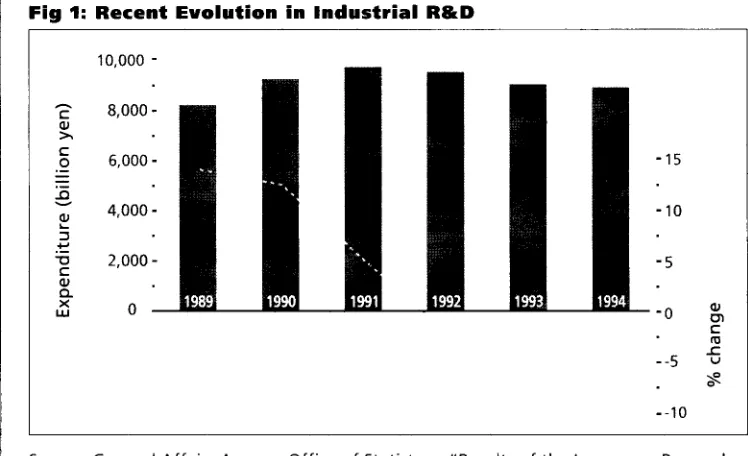
1994 may have been the end of the decline in private R&D expenditures (see fig.l).
The crisis has not affected all sectors evenly. R&D expenditures remained steady for chemical prod-ucts or general machinery, while they fell from 1991 to 1993 for electrical machinery (-11 %) or transportation equipment ( -13%), two of the engineers still continues to increase. Moreover, most strongly export-led sectors.
Fig 1: Recent Evolution in Industrial R&D
10,000
-c
8,000-Q)
>-c: 6,000- -15
0
:3 4,000- -10
Q)
....
::::l
.'!:
-c 2,000- -5
c: Q) c.
X 0
-o
Q)w Cl
c:
Ill --5 ..c. u
~
0
--10
Source: General Affairs Agency, Office of Statistics, "Results of the lnqu1ry on Research in S&T," (Nov 1995)
In the 80s, strong investments in R&D by big companies were, to some extent, part of their efforts to build a high profile image. This was also true for basic research activities which were often supported without clear corporate strate-gies and driven more by image competition than by real need. This situation has changed and the new trends observed in the early 90s will con-tinue for a while. According to a recent report released by the Science and Technology Agency (1994), the importance of basic research will decrease, at least until 1997, in all manufactur-ing industries, while priority will be given to ap-plied research. However, contacts with R&D ex-ecutives from several large groups indicates that the ratio of basic research will stay around 7% of total research expenditure (personal commu-nication with local companies, 1995). Compa-nies still need in-house activities in this domain
in order to create high added value products, especially for electronics and pharmaceuticals. Nevertheless, basic research will be fully targeted toward the core business of the firms.
The results of a survey of I ,800 firms released in April 1995 by STA also show that 76%, as compared to 39% in 1987, will rely on their own R&D activities for the design of new products in the future. Half of the respond-ents will implement this strategy within 2 or 3 years, and 81% consider that priority should be given to the development of products which re-spond to the needs of the clients.
Scientists and engineers will, therefore, become a strategic resource for Japanese companies. Their number will continue to
[image:6.546.146.520.201.429.2]No 0 1 - February 1996
grow at an accelerated pace and a 30% increase is forecast from now to 1998. However, the sup-ply of innovative researchers by the Japanese education system is a major bottleneck for the implementation of the firms' strategy. They have therefore adopted three parallel measures to tackle this problem. Firstly, firms are working closely with Monbusho (the Ministry responsi-ble for Higher Education) for the training of their staff at university laboratories. Secondly, they are attracting young scientists from abroad with their own fellowship programmes, and lastly, they are setting up research centres in technologically advanced foreign countries.
The government creates a new environment for innovation
Well aware of the needs of the industrial sector, the Japanese government has launched, in re-cent years, a series of initiatives to promote ba-sic research, higher education and innovation. This is clearly shown by the increase, in ab-solute terms, of the government R&D budget (table 1), even if real expenditures, which may be different from the budget figures, slightly dropped in 1994 after a boost of nearly 11% in 1993.
T h e
Of course, government commitment to R&D has led to higher expenditures and growth of the number of scientists and engineers in university and research centre laboratories. A large share of them in private research institutions are "ex-ternal non-regular researchers". They are sec-onded by their companies and represent an im-portant mechanism of technology transfer.
The trend should continue since the first prior-ity of the "Economic Measures toward Steady Economic Recovery" published last September is the "development of science and technology, provision of facilities for education and welfare" (Government directive, 1995). The message is clearly to accelerate structural reform of the economy through the promotion of innovative research at the frontiers of knowledge. A spe-cific budget of 300 billion yen is allocated to this task.
The change of attitude can also be seen in the qualitative aspects of the new programme. The Ministry for International Trade and Industry (MITI) is a good example of this. In the 80s one of its flagship projects (JISEDAI) targeted the development of "basic technologies for future
Table 1: Recent Evolution in Government Support for R&D
,,
-9i
.. ~ . 90 g, 93' ~ 94 95
' I
Budge~ 1,92l 2,022' 2',135 --2,267' 2;-359 2,490~
' 1 1
. ) - - · - ' ' r '
%'cHange 5.8 5.3;
ss
6.2 4.1 5.6''%
inflatio'n·:'-I le
3.1 :3.3' ' '1 ,6 ,1.3_ 0.7
NA
Source General Affa1rs Agency, Off1ce of Statistics, "Results of the lnqu1ry on Research 1n S& T. (Nov. 1995)
industries". Today, priority is given to the "lead-ing research" programmes and to the "centres of excellence'' focusing on basic research open to international cooperation. It is also significant that part of the universities' funding, while still marginal, is now being channeled through MITI, who, until recently were not involved in this
proc-ess. Opening up the universities to research fund-ing from ministries other than the Monbusho constitutes an important structural change in the Japanese R&D system.
In a global effort to establish a "science and tech-nology oriented state", various ministries are
P T S R e p o r t
. for tnstance ftrms wt/1
rely tn the future on thetr own R&D for the destgn of thetr new
products
Soenttsts and
engtneers wt/1 become even more of a strategtc resource for Japanese compantes
7
[image:7.546.28.403.454.566.2]T h e I P T S R e p o r t No 0 1 - February 1996
In the 80s MITI focused
on bas1c technologies for future mdustnes, but now stressses leadmg research programmes and centres of excellence, open to 1nternat1onal cooperation
The econom1c cns1s has accelerated changes wh1ch were needed anyway
8
preparing a new action plan under the generic term of "New Scheme for Strategic Basic Re-search Promotion". Within this plan, new frame-work programmes have been set up which allo-cate the largest share of the budget to
non-tar-geted R&D (see Box 1). This qualitative change in the way funds are allocated is much more sig-nificant than the actual increase of funds avail-able for basic research. In addition, all the pro-grammes are open to foreign scientists.
Box 1: Framework Programmes for Basic Research
' / ,r•
0
• STA:
The
OJRDC ?trategii: Basic Research! promotion System: 0199~'bucjget- ·_
0• I ' i ~ ~ , ' . "- I'
5,1GY, t996 requested budget -015GY.
·1
°, 0 ~ - · , _ 0 00 • • • • • ' .
• 0 Monbusho: JSPS Prog~amme for the Prorinotion of Sd~ntlfi~ Research with a 0
•
-
Vi~w tt> <::reating Intellectual Resources, ~0~96. reqt~estea _bl!dget--1~1 GY. ·• - MITitAIST:
lnnovativ~
Industrial;Techn~logy
R&b PromotionPro~tamme,
0~
0 managed by tf1e NfDO; 1'996 requested budget ·~0 2; 7GV •. 0
-0
·~ .
0
•
~ Agrku~ture
1Ministry: Basic-Research Prografnmes for~he ·qea.tio~
.O.f New'Agro·Related Techniques anct ln'dustri~s. managed
by
the' ''Bio..orh~ntect : Technology. ResearchAdv~n:c~ment
·lostitution". 1996 requested'-fiu9get - .2GY. , - 0
t: .
,
0 0 0 - . l 0 00 • • . \ 0 - 0 • 0 0 0 :•
M~;:
System forB~sic
Resear.ch in 'the;fi~lq
oflnfo-COrTirlJ~ni:catic;>ns, or~~nis~d
•o •by; TA(), (Telecommunications Advancement Organization) of Japan; 1,996 -0
' fequestedbudgE:)t.
-0 O,SGY. '' 0
• ' •
The synergy between public and private sectors
The classical scheme of positive interactions be-tween the government and Japanese companies is functioning again with a brand new approach, at least by Japanese standards, based on coop-eration rather than dirigisme. In the 60s and the 70s, various ministries, and especially MITI, were the driving forces behind the rapid growth of the industrial sector. Research was not an in-dependent activity, aimed simply at creating new knowledge, but rather was fully integrated into the production system with a view to collecting and processing scientific and technical informa-tion.
Paradoxically, the economic boom of the 80s put the national research centres and, to some ex-tent, the university laboratories in a difficult situ-ation. They were not needed anymore by the companies which had developed a full range of in-house R&D activities and had access, through different means, to the results of international
, 0
research. Both of these activities reached their limit in the 90s (although the Japanese system continues to be very good at undertaking tech-nology watch and collecting economic intelli-gence). In a sense, the economic crisis has accelerated changes which were needed anyway. The government has anticipated them and taken a series of initiatives which aim to pro-vide industry with a sound national base for tech-nological development. The companies have, in turn, reoriented their R&D activities to fully ex-ploit the contribution of the public sector.
Even if government S&T policy focuses on topics which may pay off for the industry in the future, the crucial point is that this policy is not driven by immediate market needs. The new priorities are to reform the education system and to pro-mote first class open science.
If Japan succeeds in this bold venture it will add to its well known capacity of exploiting research results, a new talent for creating scientific
No 0 1 - February 1996
edge and it may soon become a scientific power in its own right. Europe has yet to learn how to exploit its own research potential and to transfer quickly bright ideas from the laboratory to the users, without losing its advantage in
ba-Keywords
T h e
sic research. The recent evolution in Japanese R&D activities creates new opportunities for better S&T cooperation between Europe and Japan, including within the private sector, which could be further explored.
_6
S&T policy, R&D strategy, Japan, Industry, Government.
References
• NISTEP Report 37, January 1995, Science and Technology Indicators 1994
• STA Report, March 1994, Enquiry on Research Activity in Industry
• General Affairs Agency, Office of Statistics, November 1995, Results of the Enquiry on
Research in S& T
Contacts
Maurice Bourene, Science Counsellor, EU Delegation to Japan, tel: +81-3-3239 0441, fax: +81-3-3261 5194, e-mail: jda01233@ niftyserve.or.jp, Patrice Laget, tel: +34-5-44 88 277, fax.: +34-5 44 88 279, e-mail: [email protected]
<i;l IPTS - JRC - Seville, 1996
I P T S R e p o r t
Europe can exp!ott the new openness of the Japanese R&D programmes, and hopefully tmprove tts record tn translattng tdeas from the laboratory to the market
T h e I P T S
10
R E' p o r t No 0 1 - February 1996
Content vs. Distribution:
The medium loses to the message
Dimitris Kyriakou
'Issue:
Conti~uin~
technologita.l innovation imdlibe~qlisation
drives h!)ve caused~
reduction in tel.ecommllni'cat-ions distributors' expected~rofit\ma~ins a~d,
increasingly, improving p,rospects for cO'nten,t provide~rs and. packagers.:Ret~vance:
The repercussions of the dual_ prebgnosis above for' policy are-substantial: content is, at
pr~sent
still a small partOf
tnetele~~mmu~ications
market, but it may well. reapth~
lion'ssh~re
in thefutur~.
Ori theo~ti~r
hand c distributors (many of them public tele-phony operators) will need·to adjustto-I ' ' , ' ' , ' '
l,ear.ter tiin~. though not necessarily as desperately lean a_s some,scenarios present
-.them. ' - · ' c·A ~
Introduction
Technology and liberalisation are reducing the power of intermediaries, undermining the 'natu-ral monopoly rationale' for telecommunication services provision, and favoring the 'message' over the 'medium'_ The content provided is be-coming increasingly crucial in the consumer's decision to opt for one among several rival dis-tributors, i.e. intermediaries providing access to the carried content. The room for growth of the content part of telecoms is tremendous since, according to the Boston Consulting group, the larger part of the telecoms market is still data transport-based with only a small part content-based. The prognosis need not be bleak for all distributors however. First through alliances, which are an interesting development though not the central topic of this article, they can hope to diversify their business; second, the key to sur-vival and success will be product differentiation - and technological innovation provides oppor-tunities for such differentiation; and third, an eventual consolidation in the marketplace should ameliorate prospects for the survivors.
The all-encompassing
multimedia information society
The multimedia information society (MIS) is an all-encompassing concept that attempts to cap-ture an all-encompassing transformation. The MIS is hence a concept reflecting the result of a series of developments on both the demand and the supply sides, centered around the increas-ing facility, speed and affordability- due to tech-nological as well as (de)regulatory reasons- in manipulating data in various forms in increas-ingly efficient ways. The concept encompasses the increasingly interactive services and the ap-plications riding on them and providing the added value that justifies the launching of such conduits/processors; it encompasses the work of the builders of this infrastructure and of the interacting users, producing and consuming in-formation. The Information Suciety entails the ubiquitous impact on the socio-economic sphere of these pervasive technoeconomic develop-ments, that not only change form continually, they also reshape the social context which gives rise to them.
T h e I P T S R e p o r t
deregulatiOn and technology are undermmmg thetr posttton
and enhancmg the prospects for content
There ts room for the projected growth m the market for content, stnce
distributiOn stt/1 c!atms the !ton's share
12
Secondly, and perhaps most important, techno-logical developments increasingly undermine one of the basic pillars of monopoly treatment of telecoms operators, namely the natural mo-nopoly character attributed to the telecoms in-dustry over a very long period. The start-up fixed costs were deemed to be so high, and econo-mies of scale so strong, that it made sense for the state to have one distributor and regulate it (often through direct control/ownership). Fall-ing marginal costs for transmission, storage, re-trieval, and processing of information are ques-tioning the validity of such claims. The conver-gence of telecoms with one of the most fiercely competitive markets (information technology) has further weakened the foundations of mo-nopolistic structures in the telecoms industry.
On the other hand, the increasing. and increas-ingly affordable, information carrying capacity is leading to a proliferation of intermediaries who are fundamentally in the business of selling a 'connection' to a 'pipe', a conduit (or parts of the conduit itself). In order for the users to pay, directly or indirectly, for such connections how-ever, the content they will be receiving should be attractive. Since the number of creative pro-ducers does not seem to have kept pace with the proliferation of intermediaries, there will be more distributors chasing after more or less the same number of content providers. To put it sim-ply, whereas in the beginning content pro-viders paid intermediaries in order to get their products distributed on-line, they now sell their intellectual products to in-termediaries - often dearly as the recent Microsoft deal with the NBC television network showed. To avoid confusion, note however that large firms such as Microsoft may have content-providing parts as well as intermediary functions. In setting up its own on-line network Microsoft has entered the business of selling connection, of 'intermediating' - not necessarily an optimal move as both its legal troubles as well as its most recent Internet-espousing commercial moves seem to indicate.
No 0 1 - February 1996
These developments in supply and demand ex-plain why ·content will rule' in the MIS, in the sense that it will be at a premium, at least when compared to its relative weakness in earlier times. And there is room for such re balancing in the market in favour of con-tent: according to the Boston Consulting Group, although the telecoms market is worth more than $400 billion, only $50 billion are devoted to content, whereas transport of information claims the lion's share -$260 billion dollars (Le Soir,
2nd Dec.l994, p.6, Economie). These numbers reflect the hitherto enviable position of interme-diaries/distributors. The attractiveness of con-tent benefits concon-tent packagers in multiple ways, since they repackage it in various guises (e.g. movie, video, soundtrack, !-shirts, etc). Interme-diaries, such as on-line services may well suffer as the much cheaper and more populous Internet becomes increasingly attractive; they may be forced into lower profit margins and into selling connection to the Internet, instead of competing with it.
Content rules
Eventually the gap between supply and demand, and the high returns enjoyed by and projected for content providers (e.g. Microsoft, US film industry) will stimulate others to join the club of content provision, which would bring down the profit margins for content in the longer run (at
least for the less creative content-packaging part). Furthermore, whereas telecoms, and in general the more "hardware-oriented" parts of the industry, could enjoy some legal/regulatory/ technical protection, the more creativity-based, "software-oriented" activities have always had the lowest barriers to entry. However, that entry does not guarantee success, especially in "creative" industries, where product attractiveness is no-toriously hard to predict. In such industries, star performers receive huge rewards, attracting masses of emulators who must survive on m eager rewards and grand aspirations while hoping their time will come.
No 0 1 - February 1996
The very characteristics that make commer-cial appeal unpredictable, a priori, for
creative products, also shield these prod-ucts against "reverse engineering" by com-petitors seeking to decipher the elemental "for-mula" for success, so that they can then apply it themselves. The flip side of intellectual products' resilience against reverse engineering is their vulnerability with respect to sheer, crude copy-ing, to which they have fallen victim throughout the ages. This points to one factor that may taint the rosy scenario painted above for content: the importance of adequate protection of intellec-tual property rights for the full realisation of the potential of content provision as it is gradually being liberated from the grip of distributors. The recent emphasis on intellectual property rights (IPR) protection, is partly attributable to the fact that European policy-makers and en-trepreneurs, as well as their US and Japanese counterparts, increasingly realise that high re-turns, and the comparative advantage of the in-dustrialised countries, lie with knowledge-inten-sive activities, including intelligent, flexible MIS-informed manufacturing, and not with traditional mass manufacturing. In the latter, East Asian and other competitors learn extremely fast how to outsell their First World teachers.
There are a few hitches in the above scenario, though not enough to undermine the validity of the main argument. First, as mentioned already above, the culture of the content industry and the fleeting, unpinnable character of product attractiveness makes content a risky business, and this preoccupies investors. Second, from a macroeconomic perspective, since personal disposable income edges up slowly, ex-penditure on content would have to be dis-placed from cars and houses, etc. If, how-ever, consumer spending on leisure increases then content should benefit. Finally, in the longer run the distributors, currently competing among themselves, and bidding up prices for content, will likely consolidate and limit content provid-ers' power.
© IPTS- JRC - Sev1lle, 1996
T h e
Intermediaries' fortunes
This leads us directly to the second clear propo-sition that is often heard regarding the MIS value chain presented earlier. As already explained above, distribution is generally projected to suffer from falling profit margins, due to technological breakthroughs and deregulatory drives, that will virtually turn it into a commodity business. Is the future indeed that dire for distributors? Not necessar-ily: the need for continuous technological up-dating and the technological requirements of high quality multimedia applications imply that not all distributors will be offering the same serv-ices. Product differentiation is the best antidote to becoming commodities, and at least some dis-tributors may afford it (e.g. offering not mere telephony but packages of services with special, even custom-made features). The problem, of course, is that if a large number of them may afford it competition among them in a globalised market will be fierce, and the dire prognosis presented above applies in equal strength. It is quite likely, however, that eventually consolida-tion will improve prospects for the remaining distributors. Nevertheless, the high profit mar-gins of days passed would be hard to realise, because excessive price mark-ups will trigger market entry by new rivals (since set-up costs are falling) as well as competition by cellular and satellite operators etc.
Finally, in dealing with such challenges, distribu-tors are both forming alliances and sharpening their knives. They form inter-industry alliances (e.g. with content providers) to diversify their activities, and to gain a friend while they still have something to offer - market power, access, as-sets, etc. before competition erodes their attrac-tiveness as partners. They also form intra-indus-try alliances in order to benefit from concentra-tion, and to be able to promise global end-to-end, problem-free, seamless telecommunica-tions, which can be a lucrative market, especially with respect to business customers. They also aim, through forming alliances, to spread risk better; to enhance their tactical advantage in light
I P T S R e p o r t
Though entry tn the content tndustry has always been easy, success has not
Creat1ve content products can not be reverse-engtneered
. but they are vulnerable to crude copytng
T h e I P T S R e p o r t No 0 1 - February 1996
The prospects for dtstnbutors can be mitigated through product dtfferenttat!On, inter-industry al!tances and eventual
conso!tda tton
14
of crucial negotiations (e.g. worldwide satellite distribution); to share costs of possible invest-ments; and even, through advertising blitzes, to intimidate rivals, or, defensively, to balance simi-lar posturing by rivals. It should be noted, how-ever, that more than 60% of such alliances fail within a year.
In summary, technology and liberalisation are reducing the power of intermediaries, undermin-ing the 'natural monopoly rationale' for telecom-munication services provision, and favoring the 'message' over the 'medium'. The content pro-vided is becoming increasingly crucial in the consumer's decision to opt for one among sev-eral rival distributors, i.e. intermediaries
pro-Keywords
viding access to the carried content. The room for growth of the content part of telecoms is tre-mendous, since, according to the Boston Con-sulting Group, the larger part of the telecoms market is still data transport-based, and only a small part is content-based. The prognosis need not be bleak for all distributors however. First through alliances, which are an interesting de-velopment though not the central topic of this article, they can hope to diversify their business; second, the key to survival and success will be product differentiation - and technological in-novation provides opportunities for such differ-entiation; and third, an eventual consolidation in the marketplace should ameliorate prospects for the survivors.
I
content providers, distributors, product differentiation, market entry, IPR, reverse engineering, natural monopoly, falling marginal costs
References
• Conferences on Telecoms, multimedia, information society and converging technologies held in Brussels (June 1995) and San Francisco (November 1995)
• Telecommunications Survey, The Economist, Sept. 30, 1995, p.75 ff.
• Multimedia Information Society, D. Kyriakou & I. Maghiros, IPTS Technical Report,
1995
Author
Dimitris Kyriakou, IPTS, tel:+34-5-448 82 98, fax: +34-5-448 83 26, e-mail: [email protected]
No 0 1 - February 1996 T h e
Achieving a New Generation of Personal
Communications
Alois Frotschnig
. I I ~ ' : ' • ' ' '
Issue: At wesent personal.com~ilhication services.·are_ provided by a ra~ge of
· first and second generation networks and technologhis. lt is envisaged that the '.next generation will bring together a11 the attributes of exi;ting personal .
com~uni~atiol)s
into>;a single u'nitied system. However, in order to~ee
how thiscan· be achieved it is nec'essar,y to consider a numoer of technical, economic,
' ..._ ' _,. ' I '
regulatory ar:~.d m~rket plate issues-: ' . ' ,
R'elevan'Ce: .What i~ at.stake is a vision of the ~~rid wher:'e terrestrial and satellite based
mobil~·communications
systems will al\ow people~0
make~nd
reteive Cf!IIS from arw pointon
earth u~in·g the same multi-purpose handset whether at ' home, ir1 the offices, or outside. The progressiv~ migration from second to thirdgeneration systems, which is expectep to start at the turn of the century in' a way thatjs relatively seamiess; •atvactive and.natural for the user, is going to. haye dramatic implication~ both i'n market and social terms.
( ' ' ) I
-The Universal Mobile Telecommunication Sys-tems (UMTS) and Future Public Land Mobile Telecommunications Systems (FPLMTS/ IMT2000) are third generation mobile telecom-munications systems which aim to unify the present diverse systems into a seamless radio infrastructure, capable of offering a wide range of services around the year 2000 (see Box 1) for a brief review of second generation standards).
Using terrestrial and satellite based mobile com-munications systems could allow people to make and receive calls from any point on earth using the same multi-purpose handset whether at home, in the offices, or outside. The first signs
(1995) in Japan of the "Personal Handy Phone'' (PHS), an inexpensive, light weight hand-set that operates as a cordless telephone in the home, and as a cellular phone elsewhere. Thirty-five companies have grouped around the Japa-nese PHS standard, to promote it on a world-wide basis. These include Fujitsu, Hitachi, Matsushita, NEC, NTT, Sanyo, Sharp and Sony as well as multinationals with interests in the tech-nology or market such as AT&T, C&W, Ericsson, Motorola and Nortel (Northern Telecom). Apart from deployment in Japan, nearby Asian coun-tries, such as Singapore, Hong Kong, Malaysia and even China are being targeted for PHS prod-ucts, while NTT has already launched a trial in of the shift to ubiquitous personal communica- Indonesia in cooperation with the national op-tions are evident in the success during last year erator.
I P T S R e p o r t
The IPTS R e p o r t No 0 1 - February 1996
16
Digital Cellular Standards
' ' , -., ' ' ·, f ~ ' I / , , ' ' •' l > 1 ·A cell.ulcrr networ~ cof11prises a series of _lo)N power station ~ites; each providin_g
a relatively ·small area
ot'
cov~rage (cell) ~hich combines t~ f~rm co"ntin'u()us cover'age throughout~'given
area.Th~
first analogue<ellul~t
IT)Obil.e communications network was launchedin.~urope,in
1981, and'the first dlgital cellular network, based on GSM; was· launchea in 1992, 11 years·later"Aitho~:~gnanalogue networks are not dead, the future lies in digital systems
su~h~as.GSM,
D·AMPS, PDC or COMA. ' · - · · · · · ' ' · IGlobal System for MCilbile.communications (GSM): GSM, is a
pan-E~~ope~n
,stam~ard and offers operators the additiohal added-value benefit of .internati,onal
- ' ' ' ' I
roaming. GSM'networks have now been deployed througnout Western Europ~ · and are rapidly gaining grouf1d in Eastern tur'ope and t~e former.Soviet UniOn. They have also beeri installed in
Austr~l~a.
Hong Kong .and India, and~re
being· evaluated or adopted in most countries in the Asia Pacific region. In Chini1, GSM is emerging as the pr~ferred digital cellular.technoli)gy. Already some 8 million subscribers in 86 countries use digital mobile phones based on the GSMstancjard, Iwhich is 90% of all customers w~ing digital cellular systems.. .
Digital Advanced Mobile Phone Service (D-AMPS): This US digital cellular standard (also known' as Time Division Multiple Acce55 - TDMA) has been developed from the analogue AMPS ce.llular techno.logy. lt has been installed in Canada, South America, the Asia Pacific region and' the former Spviet Union .. · AT&T has'chosen TDMA technology, while Pacific Bell Mobile Services nas·gone
for GMS.
-Personal Digital Cellular (PDC): Japan has developed its own
.digital-'sys~em,
' which has not been ta,k€n up outside. ,fhe PDC system offers a variety.ofservices in additiqn to high quality speed (high speed facsimile, mqdemtrans~ission
at speeds up: to 9:6 kbps) and it supports the supplementary service categoc:ies that are defi.ned by the International Telecommunications Union.Code Division Multiple' Access (COMA): This
transmissio~
technology ptomises, to be the state-df-the-art digital cellular system. tt enables improved quality voic;e communications and even weater c.apacity than existing digital starida~ds.' The technology is still imm~ture and h?IS _yet to be proven in a commerdal , network, and so far South· Korea is the only country to adopt it as its chosen digital eellular' standard. COMA's highf!r capacity makes it a n:torelik.~ly
ophon -for carrying large ar;nount~ of previously fi~ed tr<'!ffic from the horn~ 'to work~COMA has been adopted as the preferred technology of ,a number of US .consortia planning to qffer personal communication services in the US,, including Sprin~ - · Telecommunications Venture, GTE Mobilnet aod- PCS'Primeco (i'ncluding Ny~ex, ' Self· Atlantit,\is West and AirTouch. Com~Ljnications). . ' . · •
State-of-the-art technology
As a first step, digital cellular systems have re-cently been introduced in many countries be-cause of the advantages they provide in terms of capacity and adaptability for new services. The principal goals for digital or second generation
technologies were to achieve more capability from the spectrum available, and to prepare for new (non-voice) features and facilities. In ana-logue cellular transmission the voice signal is transmitted in a continuous wave, whereas in digital cellular communications it is transmitted
No 0 1 - February 1996
in short, timed bursts. During the pauses in one conversation the bursts of another can be ac-commodated. This means digital cellular tech-nology has much greater capacity than its ana-logue counterparts. It offers faster set-up times and greater voice clarity and uses encryption techniques to provide more secure communica-tions.
The demand for change has been partly techno-logical and partly supply-side driven. The prin-cipal drivers of digital cellular technology are very similar across the world, however, the ma-turity of the market will influence the impact of
T h e
communications the issue of the combining both terrestrial and satellite-based technologies, such as the Digital European Cordless Telephone (DECT) and the GSM needs to be considered. With respect to second generation systems for office communication we observe an evolution to integration of voice and data. Through wire-less, digital technologies such as DECT multi-line mobile services can be offered. However, for data transport through wireless Local Area Networks (LAN), much more bandwidth and transmission capacity is needed. Next generation systems will be able to deal sufficiently with these problems, facilitating broadband mobile applications such these drivers. Factors affecting market maturity as wireless video.
include pent-up demand for mobility due to changes in societies and working practices; ex-pedient deployment of cellular technologies re-ducing "fixed" PSTN (Public Switched Telephone Network) waiting lists; competition; price reduc-tion to the customer in handsets and tariffs; im-proved coverage and quality in cellular; broader distribution channels; and new and value added features like roaming (moving from one geo-graphic area to another without losing the com-munications link), mobile information displays or messaging. By seeking to liberalise mobile communications, governments and regulators are encouraging demand for these new and value added features in telecommunications.
lnteroperability requires standards
Standards are the key to mass acceptance of new technologies. The four principal families of dig-ital cellular standards we see today include the Global System for Mobile communications ( GSM), Digital Advanced Mobile Phone Service (D-AMPS), Personal Digital Cellular (PDC) and Code Division Multiple Access (CDMA) (see Box I). Such standards have been developed in or-der to realise interoperability between countries. However, they are not completely integrated with fixed networks, and European networks are not compatible with standards developed in Japan and the US. For further development of personal
© IPTS - JRC - Seville, 1996
The global challenge
The shift to ubiquitous personal communications is also evident in the number of consortia com-peting to establish satellite-based systems for inexpensive world-wide personal communica-tions. These include Iridium, led by Motorola, ICO Global Communications and established by Inmarsat, and Globalstar led by Loral and Odys-sey headed by TRW. Generally they claim that services will be available globally. The systems will support basic services, available to all us-ers, and supplementary services and optional offerings. But in today's world the possibilities of mobile communications are limited. There are islands of coverage that allow only limited roam-ing. The multitude of standards is, in some cases, leading to decreasing interoperability, and cov-erage inside buildings and in rural areas are still a problem.
Cellular telephones will continue to be the back-bone of the wireless world, but the following options for mobile communications are, or will shortly be, available to complement the market:
• Satellite is the most cost effective solution for wide area, low population density environments. It is also an essential element in offering global roaming, due to the major regional differences in cellular standards.
I P T S R e p o r t
Shift to ubiqwtous personal
commumcat1ons prev1ewed m the success of the Personal Handy Phone m Japan m
1995
Second generation a1med to achieve more capability from the available
spectrum, and prepare for non-voice features
The matunty of the market will influence the 1mpact of the dnvers for change
1 7
' ~. '
''
. \
T h e I P T S
Standards are key to mass acceptance of new technolog1es
Next generation systems will deal w1th h1gh bandwidth and mtegrate serv1ces
18
R e p o r t
• Cordless techniques are a cost effective so-lution for limited coverage in high density and indoor environments.
• Fixed networks can be enhanced towards Universal Personal Telecommunications (UPT) which will enable users to make and receive calls to a personal number at any access point.
The path towards the third generation
Third generation mobile communication systems aim to integrate all the different services and technologies mentioned above (cordless, PCS, cellular, satellite) and provide a competitive serv-ice (voserv-ice, data, video, multi-media) compatible with the technology developments taking place within the fixed telecommunications networks.
At the global level, the work carried out within ITU (International Telecommunication Union) has been instrumental in the definition of FPLMTSIIMT.WOO. In Europe, R&D on third gen-eration, referred to as UMTS, is coordinated by the European Telecommunications Standards Institute (ETSI) Special Mobile Group. The UMTS work is aiming toward the ideal of ubiquitous coverage and universal access. An ideal multimode terminal would:
• have similar selling price, weight, and size as single mode terminals;
• support a unique call number whatever the host network;
• allow roaming of the terminal over different access networks;
• allow the user to have his same personal service profile anywhere;
• automatically switch to the best locally avail-able radio access for the required services (ac-cording to the user's criteria);
• allow the user the same procedures for call, mobility, and service management, independent of access technology.
In Japan, NTT DoCoMo is going to realise the next generation system, aimed at implementing personal and multimedia mobile systems, by tak-ing two approaches: enhanctak-ing the current
Per-No 0 1 - February 1996
sonal Digital Cellular telesystem (PDC) and de-veloping an entirely new system (third genera-tion, know as FPLMTS). In Japan the rate of in-crease of cellular communication systems in the fiscal year 1994-1995 was more than 100%, with approximately 7,48 million cellular subscribers by November 30, 1995, of which 1,730,000 had· signed up in the previous four months. The surge of demand coincides with the launch of PHS serv-ices in July 1. By the end of November, there were 485,000 PHS customers in Japan, with three PHS networks in operation. These two systems evolve independently for the time being. Regarding the network technologies, the second generation systems (digital cordless PHS and digital cellu-lar PDC) will evolve into the third generation FPLMTS systems.
The next objectives for the PDC system is to real-ise a much higher capacity and to provide new services. According to M. Kuramoto (NTT Mo-bile Communications Network Inc., Telecom 1995), for the next several years, the PDC sys-tem may be the major mobile communication system in Japan. It is estimated that the number of subscribers will be around 10 million in the year 2000. As for FPLMTS, more spectrum-effi-cient and more flexible radio transmission tech-nologies are necessary in order to provide mul-timedia services, and to facilitate the coexistence of macro-cells and micro-cells.
In order to realise the ultimate telecommunica-tion system described through key words such as "personalisation", "mobile multimedia" and "intelligent system", many advanced technologies are required to be developed: Ultra Compact Portable Phone with Low Power Dissipation, Multimedia Mobile Terminal, Multi-Beam An-tenna, Efficient Spectrum Utilisation, Integrated Service for Voice, Video and Data, Infrastructure Transparent to Any Media (e.g. Asynchronous Transfer Mode - ATM), Intelligent Mobile Net-work, Artificial Intelligent Processing, etc. Tech-nical solutions are being developed, as for ex-ample in the mobile ATM. The main problem of the ATM technique is the transportation delay in low bit rate transmission, such as speech.
No 0 1 - February 1996
fore a new mobile ATM cell configuration is be-ing developed that assigns the voice signals of different calls for the same destination to the same ATM cell in a statistical multiplexing man-ner (more about ATM can be found in the 00 issue of the IPTS-Report, Dec. 1995).
The framework of the global telecommunications
infrastructure
Three trends- Globalisation, Liberalisation, and Convergence - are reshaping the performance of national telecommunications infrastructures in specific markets and across the global economy. These trends will be manifested as in-dustry drivers at the local level that affect the cost structure and the competitiveness of particular operators. At the global level, these trends affect the relative performance and competitiveness effects on national operators and the Global In-formation Infrastructure.
Telecommunications and Information Technol-ogy (IT) are increasingly defined in terms of interoperability. Meeting customer expectations as they increasingly transcend time and space will become an attraction and challenge for serv-ice providers throughout the world. In both the telecommunications and IT industries, trad.ing entities like the North America! Free Trade Agree-ment (NAFTA), the EU and the Asia Pacific Eco-nomic Cooperation (APEC) foster and acceler-ate the reduction of barriers to entry and traffic flows. They also promote rapid standardisation and implementation of common market plat-forms. Nevertheless, there are three different approaches in the land mobile telecommunica-tions industry to realise its goals: one common ETSI system for a vast multinational region in Europe; one common national system, standard-ised by majority industry members in Japan, in-cluding foreign countries (the Japanese PHS is
T h e
now one of the ITU standard systems); and no single standard but multiple systems freely com-pete for ultimate domination as the de facto standard in the US.
The European initiative to develop UMTS is, therefore, seen to be part of the policy to pro-vide an advanced, transparent, fully interoperable and integrated personal commu-nications service across the continent. UMTS provides the wireless component of this service. Questions of system revolution, evolution or mi-gration are not only technical problems but also issues of long-term European strategic telecom-munications policy.
On a global scale, the standardisation of UMTS is linked to the development of FPLMTS, even though the latter will be influenced by diverse market conditions and economic drivers. Cur-rent developments in the USA with auctioning of the radio spectrum for PCS will lead to the rapid deployment of a variety of standards. This will inevitably lead to a delay in the introduction of new technology for FPLMTS in the USA. Japanese systems have been constructed solely for the national service operations. If considered for introduction abroad, they have to be partially modified. The ETSI achievement of multi-national and regional standardisation is a commendable solution. Advancing in the very successful dig-ital mobile, GSM was a central learning process to European telecommunication industry and to regulatory and standardisation bodies within Europe. There is no doubt that the definition and implementation of third generation mobile sys-tems constitutes a major challenge to the organi-sation of R&D programs, as to the telecommuni-cations industry and the institutions of regula-tion and standardisaregula-tion within the EU. The outcome of this process is of extreme impor-tance to the European telecommunications in-dustry. •
I P T S R e p o r t
Japan IS focusmg on develop1ng a th1rd generation system known as FPLMTS
Many new technologies are prereqws1tes for achieving the
performance prom1sed by th1rd generat1on systems
T h e I P T S R e p o r t No 0 1 - February 1996
There are three
different approaches to standardisation a common standard for Europe, another specific to Japan, and multiple competmg systems m the US
20
Keywords
Mobile Telecommunications Systems, Digital Cellular Systems, Information Technology
References
• Speakers' Papers, Te/ecom 95: 7th World Telecommunication Forum- Technology Summit, , Vol. 1 ,2. Organised by the I TU, October 3-11, 1995, Geneva.
• Survey on Mobile Communications, Financial Times, Monday November 27, 1995.
• The 2nd annual Global Mobile & Mobile Satellite Conference 1995-Conference Proceedings. Organised by CMP Publications International, Corp,
November 1995, Brussels.
Contacts
Alois Frotschnig, IPTS, tel: +34-5-4488245, fax: +34-5-4488326, e-mail: [email protected]
Dimitris Kyriakou, IPTS, tel: +34-5-4488298, fax: +34-5-4488326, e-mail: [email protected]
- - - --~ ~~ -~---~
No 0 1 - February 1996 T h e
Using DNA for Data Processing:
Biotechnology meets informatics
Kay Beese
· Issue: In
a
recent breakthrougha~_Americanscientist demonstr~ted
how a series. · of biomoleeul.ar (DNA .hybridis?ttion) reactions could be used' to solve a class. ofecono~ically 'very important malhem'atieal problems. 0
' ' ' • - • ' . ••
' • , r > I I , ' /
: ,, ' .' . ' ' ' .,J \ ' "\' ' ' ' ' ' ' •
Relevanee: This 'biocomputing' exp~riment gave a brilliant example of how
-
rev,olutiona~y
nevvapproache~
toward.s i'mportant technicaf problems ca'n _be· ach.ieved by stimulating ~ooper.ation-o{disCiplimis usually'sepaf"ated undw current R&D pr<?gramme schemes.ln
su~h are~~
the competitivenessofEurop~~m
industry depentls on high)y interdisciplinar-Y cooperatiOn and' the early -invoivem~nt of industrial R&D. Qtherwise the potential market ·like in other fields of information tech,nology-will
be losttot~~ US.~nd
JapaneseC~I'T)petitors
who have established' ' . '
such struc-tures.'
!
Do we need a
non-semiconductor based computer
technology ?
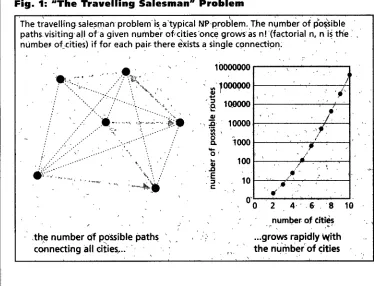
The breath-taking computer development con-ceals the fact that there are still many economi-cally important mathematical problems which conventional computers can not solve within a reasonable time. A model for such 'hard lems' is the so-called "travelling salesman prob-lem", the task of finding the shortest route be-tween cities. As the number of cities grows, the number of possible routes grows as n!, or fac-torial n, where n is the number of cities. If a computer takes 5 seconds to solve a 10-city ex-ample, it would take around 100,000 years to solve one involving 20 cities (Matthews 1995). This example belongs to the important group of NP (non-deterministic polynomial time) prob-lems which are considered as "inherently intrac-table", meaning that it is believed that no de-terministic polynomial algorithm exists for
solv-<c> IPTS - JRC - Seville, 1996
ing them efficiently. Scheduling problems (train, aeroplane, teachers timetables) typically belong to this group and optimisation could save an enormous amount of resources. Network design, storage space minimisation and molecule design are only a few other examples (see Garey & Johnson 1979).
There are ideas for processing data more efficiently
In recent years several new ideas have been de-veloped to use non-electronic natural phenom-ena for real, efficient computation. Several con-cepts to increase the degree of parallelism have been discussed theoretically, with a particular emphasis on using quantum-mechanical (Lioyd 1995) or biomolecular (RooB & Wagner 1995, Birge 1995) mechanisms. While quantum-me-chanical computing is still at a theoretical stage, calculating with DNA has become reality.
I P T S R e p o r t
There still extst hard problems of economtc tmportance for whtch computers are sttll too slow
T h e I P T S R e p o r t No 0 1 - February 1996
The rnasstve paralle!tsrn featured by
b10computers can be app!ted to hard problems
22
Fig. 1: .. The Travelling Salesman .. Problem
·The travelling s~le~r:narr problem·
Is,
a 'typical NP·r>roblem.,T,he n~mber of po~sible paths visiting·all of a given number of,cities·on<~ grows as n! (factorial n, n is th'e · numbeF of_-eities) if for each pair: there eXists a Shlgle q:mnecttpn,. .-~ - . '
' ' • • • • , J . . . -• • ~ • • '
.
<~· ,:':(.:';;~~~~).-.
.. ~~.
J; .. ::. ""
'.
'· .th~ number df p~ssible paths connecting
all
cities,... '.10000000 . . . . - - - .
.
~;'1000QOO /....
' : I A 1Q9000 1---_;,...:_+-~
-
..
Gl
'1 1i·
·;;;
&.
...
0'...
.1l
·E . : I .
c
10000
1ooo
100
10
.,
',./
7
.
-" '
•·
J
'·'
"
o·L-_.;.._..._-:..._..._;...~
0 2 4·' '6 8 10
number o.f tit~s
' "~ ~
.•. grows rapidly With the ni.imtier' of <;ities
Although state-of-the-art computers can easily do lOO million instructions per second, the number of processors running in parallel is small (up to a thousand). Solving NP problems, however, re-quires an approach asking for massive parallel-ism. Integrated circuit technology may be
run-ning up against its physical and technical limits. Moreover, in reducing size by half, production costs increase by a factor of five, meaning that development of classical computers will reach its economic barriers long before physical lim-its are reached (Birge 1995, Lloyd 1995).
Table 1: Different Computer Concepts · Their Advantages and Disadvantages
Concept_ speed. para1.e11s.U techno~
,._..
S.ilicon chip, rath~r fast limited·, simple st~dard
computer 100mio MIPS 1 000 processors
., ' I
DNA slo'w huge (1020) -complicated model
·computer ~ I ' '
-~
•'
Optical very fast limited . sitnple reality
~·computer
Quantum . fast huge compllcat~ theory
computer
' 1
Sli1con ch1p computers and opt1cal computers are unbeaten 1n terms of processing speed, but new concepts allow a yet unknown degree of parallel processmg.
[image:22.549.139.513.71.357.2] [image:22.549.142.515.469.662.2]No 0 1 - February 1996
October 1994 · The era of DNA computing begins
In October 1994 Leonard Adleman of the Uni-versity of Southern California demonstrated in a very clever experiment how a series of DNA re-actions could solve an instance of a problem closely related to the travelling salesman prob-lem, namely the Hamiltonian path problem 1 ,
which called for discovering a continuous path linking all (seven) cities (Adleman 1994, Bass 1995). The general idea was to use a large number of DNA strings as "processors" which computed in parallel (see fig. 2; for technical details see Adleman 1995 and Beaver 1995). The design of this experiment required not only un-derstanding of the mathematical problem but also detailed knowledge of DNA structure, mo-lecular mechanisms and techniques (DNA syn-thesis, hybridisation, PCR, affinity purification, graduated PCR, etc.).
Tiny test tube systems using biomolecules can, theoretically, carry out some billion billion op-erations at once, much more than all the com-puters in the world working together can accom-plish. An attomole of oligonucleotides would have been sufficient for the Adleman experiment. However, the travelling salesman example can only serve as a model for economically more important problems and the brute force algo-rithm used would be too inefficient for a
prob-T h e
Will the DNA testtube replace the silicon chip ?
Nobody suggests a purely biomolecular compu-ter. The system developed by Adleman was de-signed to solve very specific - NP - problems, other calculations can be done more efficiently by conventional computers. Although many com-putation (even non-NP) problems can be solved by massive parallelism, hybrid machines com-bining DNA and semiconductor systems appear much more feasible than pure biocomputers. Even those hybrid systems could be fifty times smaller and up to a hundred times faster than current computers (Birge 1995).
Using current technology the Adleman experi-ment requires one week of laboratory work, this time should grow linearly with the number of cities. For each problem the DM test strand com-position has to be specifically designed. It is obvious that only automation of these processes in small desk-top machines can make biocomputing practical. Automation of the proc-esses and miniaturisation of the devices down to chip-size is being developed for biomedical pur-poses but could also be adapted for biomolecular data processing. The requirements in terms of size, speed, reliability and robustness are quite the same.
lem with many cities. Was this experiment just a What is the state-of the-art in curious footnote to the history of computing? Europe, the U.S. and Japan ?
It does not seem so, even if many researchers doubt whether biocomputing will ever have a large scale application. Richard Lipton (1994) showed that Adleman had solved a NP complete problem, meaning that such a system - a DNA computer - can be adapted to solve any NP prob-lem. Considering the enormous economic im-portance of such problems it appears worthwhile to check the feasibility of the approach.
Biomolecular data processing is far from being operational and it is too soon to tell which way molecular computers might take off. It seems that in terms of practical approaches towards biocomputing nothing has been published since Adleman presented his experiment in autumn 1994, in the U.S.,Japan or Europe. However, al-though unnoticed by most scientists, the field seems to move fast, laboratories are trying to solve harder problems and to design a sort of
The HamJitontan path problem entails tdenttfytng a path between the destgnated ftrst and last ctttes (nodes), vtstttng each ctty exactly once, tn a dtrected graph where ctttes are represented by nodes, and where dtrected edges ltnktng nodes represent the permtsstble one·way paths between nodes
tD IPTS · JRC -S~ville, 199li
I P T S R e p o r t
. and was
successfully applied tn late 7 994 1n the US
Although pure btocomputers are not
pro;ected anyttme soon, hybnd machmes may be feastble
wtth the help of automatton and mtn1atunsat10n