Fumiko Asari Nazikian
A thesis submitted in partial fulfilment of
the requirements for the degree of Master of Arts of the Australian National University.
ACKNOWLEDGEMENTS . . . . . . . . . . . . . . . . . . . . . . . . . . . . . . . . . . . . iv
LIST OF FIGURES . . . . . . . . . . . . . . . . . . . . . . . v
ABBREVIATIONS . . . . . . . . . . . . . . . . . . . . . vi
INTRODUCTION . . . . . . . . . . . . . . . . . . 1
O. O General Consideration . . . . . . . . . . . . . . . . 1
0.1 Studies on Aspect in Japanese . . . . 3
CHAPTER ONE: -HAJIMERU AND -TE KURU . . . . 1.0 1.1 1.2 1.2.1 1.2.2 1.2.3 1.3
The Semantic Structure of Aspect . . . The Inceptive Aspect . . . . -HAJIMERU and -TE KURU . . . . Objectivity and Subjectivity . . . Agenti vi ty . . . . Directionality . . . . Summary . . . .
CHAPTER TWO: -HAJIMERU AND -DASU . . . . 2.1 2.2 2.3 2.3.1 2.3.2 2.3.3 2.4 2.5
-DASU Compounds . . . Semantic and Syntactic Properties of
-DASU Compounds . . . . -HAJIMERU and -DASU . . . . Emotional Activities and Inception . . . Motion or Verval Activities and Inception . . . . Others . . . . Morphological Differences
between -DASU and -HAJIMERU . . . . Summary . . . .
3.1 3.1.1 3.1.2 3.1.3 3.2 3.3 3.4 3.4.1 3.4.2 3.5 3.6
The Semantic of -OWARU and -TE SHIMAU . . . . Process and Boundedness . . . . Agenti vi ty . . . ... . . . The Speaker or Subject's Attitudes . . . . A Single Change and Process . . . . Adverb and Completive Aspect . . . . Morphological and Syntactic Characteristics of
-TE SHIMAU and -OWARU . . . .... . . . Passive and Causative Constructions . . . . The Order of -TE SHIMAU and -OWARU . . . . .... . . Summary . . . . Notes . . . .
CHAPTER FOUR: AN OVERALL VIEW OUTSTANDING
AND ISSUES
REFERENCES . . . .. ...
iii 56 56 65 68 80 84 91 91 95 97 98 100
I wish to thank all the people who morally or intellectually supported me while writing this thesis. First of all, my thank goes to Yoshie Nitta of Osaka Women's University from whose lecture in Australian National University in 1984 I benefited a lot for this thesis.
Thanks is also due to Dr. Harold Koch of the Department of Linguistics for his constructive comments on this thesis and constant encouragement.
Especially I wish to thank my supervisor, Professor Anthony Alfonso for his inspiring input and patient support to the end.
My gratitude also goes to my husband, Rafi Nazikian, for his encouragemant and patients with me.
FIGURE 1: The Meaning of -DASU in Compounds 28
FIGURE 2: The Type of the First Verb of -DASU Compounds and Its Semantic Properties . . . 30
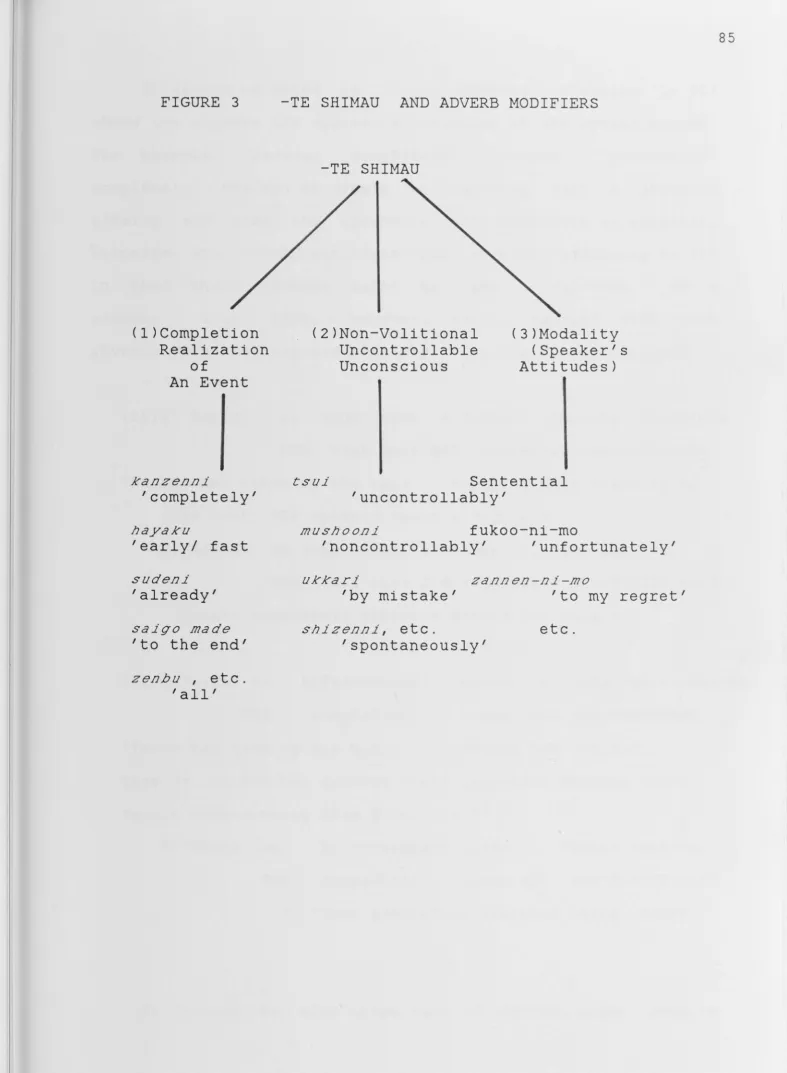
FIGURE 3: -TE SHIMAU and Adverb Modifiers 85
[image:5.822.21.810.21.1095.2]ACC CAUS CONJ DAT DIR DONE FINISH GEN IMP LOC NEG NOM ONOMAT OUT PART PASS pp PRES START TOP
accusative case (o)
causative affix (sase/ ase) conjunction (- -t:e)
dative (n1) case
directional case (e)
the grammatical meaning of -TE SHIMAU
the grammatical meaning of -OWARU genitive case (no)
imperative form
locative case (n1, de, e)
negative morpheme (-na1)
nominative case (qa) onomatopoea
the grammatical meaning of DASU sentential emphatic particles
(yo, .ne, zo, wa)
passive affix (rare)
postpositional phrase present tense (-u)
the grammatical meaning of -HAJIMERU topic marker ( wa)
1
INTRODUCTION
O. General Considerations
When a person linguistically describes a situation where it started raining, i t is possible to describe i t in Japanese with at least three different sentences: ( 1) ame qa fur.i-/Ja_j.ime- ta.
( 2) ame qa fur.i- das/J.i- ta, and ( 3 ) ame qa fut-te k.i-ta.
Morphologically the former two sentence involve compound verbs such as fur.i-dasu and fur.i-/Ja_j.imeru and the last sentence
involves a combination of te conjunction and kuru
aspectual auxiliary verb. The question which arises here, context the speaker however, is whether depending on the
distinguishes these three sentences: whether these formally different sentences indicate the speaker's different ways of perceiving the situation.
When talking about the completion of a situation, say, where a person completed writing a thesis, (s)he can say ronbun o
described by different linguistic forms depending on the way the
speaker commits him/ herself to a situation or how he conceives
it.
In this paper I will investigate the ways to refer to
the inception and the completion of a situation in
Japanese keeping always in mind the relationship between the
liguistic form and the speaker's evaluation. I will investigate
how this relationship works in Japanese aspect in the inceptive
aspect and the completive aspect. The aims of this paper are to
show how aspect in Japanese is related also to the speaker's ways
of viewing a situation, and to describe some features of aspect
in Japanese which have not yet been sufficiently explored.
Accordingly, some problems with aspect which learners of Japanese
as a second language might be faced, could be solved if we paid
more attention to this relationship between the speaker and the
aspectual forms. Although i t is controversial whether aspectual
compounds such as -HAJIMERU, -DASU, etc, can be viewed as "true"
aspectual forms, I believe that the present study will be helpful
to learners of
It will
Japanese.
be necessary to clarify what the relatioship
between the speaker and the aspectual forms means here. When
some process begins, the beginning can be conceived by the
speaker to be abrupt and sudden, or deliberate and gradual . Naturally the speaker will describe the beginning of the process
in a form which best fits the way (s)he views that beginning.
Where the beginning is viewed as abrupt, the speaker will use an aspectual form that expresses "surprise". When the speaker
describes the completion of a process, (s)he can express i t with
11
completion, and consequently would use two different forms: one
which objectively describes the completion, or one which shows
his/ her attitudes towards the completion. I will inquire into
three problems concerning the relationship between the aspectual
system and the speaker (in this paper this relationship is viewed
as expressing communicative function). First, which aspectual
forms are associated with the speaker's attitudes and which
aspectual forms are not. Secondly, which attitudes are realized
in terms of aspectual forms. Thirdly, other factors in the
sentence, for example, the presence of adverbs, which specify the
speaker's attitudes. Consequently, by addressing ourselves to
these problems, we can provide a more systematic analysis of
aspect in Japanese expresses the beginning and the end.
0. 1 Studies on Aspect in Japanese
In this section I will summarize the current linguistic
theory about aspect in Japanese and will explicate the
problems with Japanese aspect. Current linguistic studies on
aspect in Japanese started with Kindaichi (1950) and Kindaichi
(1955). In Kindaichi (1950) verbs were divided into four
categories tense and aspect. In Kindaichi (1955) aspect was
classified into two groups, aspect which represents "state" and
aspect which represents "activity" or "process": furthermore ,
aspect was examined in relation to tense. These two studies
were the first attempt to describe the holistic system of aspect
in Japanese. In these works of Kindaichi, however, aspect was
not studied from a morphological perspective: in these studies,
though the aspectual meanings were described.
Within Kindaichi's orientation, there have been a numbers of
theories on aspect in Japanese . See Suzuki (1957) and (1958), Fujii (1966), Morita (1968a), Takahashi (1969), Yoshikawa
(1971), etc. In Suzuki(l957) and (1958) aspect was studied from
the perspective of the verb; (1) verbs which carry aspectual
characteristics (including both the inherent lexical
characteristices and the categorial characteristics) (2) compound
verbs which denote aspectual characteristics and (3) verbs which
express aspect.
In Yoshikawa (1973) verbs were classified into the following
,. state verb
activity
'- verb
,.
duration verb
change verb
punctual verb
result verb non-result verb
"appear"
verb
"disappear"
verb
5
In Yoshikawa's study, the classification of verbs was done
in reference to the aspectual verbs in the combination [ verb
+ ce conjunction+ aspectual auxiliary verbs ], such as
s/J.i- ce .iru, s/J.i- ce kuru, s/J.i-ce .iku, s/J.i- ce aru and
s/J.i- ce oku. The
such as ce-.iru,
aspectual meanings of each aspectual notion
11
6
the aspectual meanings of the notion above are realized w
and were explored in his study.
In summary, aspect in Japanese has been studied mainly
focused on the combination [verb+
ce
conjunction+ aspectualauxiliary verbs]. Possible issues for future studies would be
(1) the characterization of other aspectual forms (such as
aspectual compounds, etc), (2) the relationship between aspect
and other grammatical categories such as tense and modality,
and (3) the relationship between the grammatical and the lexical
CHAPTER ONE
-HAJIMERU AND -TE KURU
1. O The Semantic Structure of Aspect
As mentioned in the introduction of the present paper, it
is possible to realize aspect in terms of compounds and the
combination of the te conjunction and an aspectual auxiliary
verb. Regardless of morphological differences, the function of
aspectual forms can be divided into two groups:
(1) SUBJECTIVE and ( 2 ) OBJECTIVE. Subjective aspectual
forms indicate the speaker's psychological states or
attitudes and objective aspectual forms simply describe the
state of affairs. This distinction is related to the fact
that some syntactic elements are associated with modality (the
speaker's attitudes) and others are used to objectively
describe a situation. Taking adverbs for example, some such as
mattaku
associated
states:
yukkur.i
'really', sukkar.i
with
other
the speaker's
adverbs
'completely', etc are
psychological attitudes or
such as /Jayaku 'fast',
'slowly' , etc, describe how the situation is
rather than how the speaker feels towards the situation. Such
psychological states include surprise, unexpedtedness, regret,
emphasis, etc: in some cases they include some perceptive or
I;
8
used to "characterize the internal temporal structure of the
event" (S. Chung and A. Timberlake. 1985. Tense, Aspect and
Mood in T.Shopen, ed., p.202) In this chapter I will discuss
the semantics of inceptive and completive aspect in Japanese
from the perspective of different functions of aspect. This
structure is based on the distiction between the
OBJECTIVE and the SUBJECTIVE functions of aspectual
forms. I will show that each aspectual form has its own
semantic properties . In the following chapters i t will be
shown that the semantic structure of the aspectual form
proposed in this chapter can influence the structure of
the sentence as a whole.
1.1 The Inceptive Aspect
While every aspectual form refers to the internal temporal
structure of the event, some aspectual forms can also denote
the speaker's attitudes at the speech moment. Here I will
introduce the the term "modality" in a broad sense: that is,
the speaker's attitudes towards a situation or the speaker's
perceptive evaluations.
It is possible to capture a certain aspectual form from
an aspectual and from a modal point of view. For example, the
inceptive aspect can be realized through - TE KURU, -DASU and
-HAJIMERU. However, the interpretation of these three forms
differs from each other depending on the context. The
semantics of the verb to which one of these three aspectual
forms is added, is not the primary reason for the difference in
the forms above. Rather, the
follows from aspectual and the
9
difference in interpretation
modal meaning of these
aspectual form. In the following sections I will compare
-HAJIMERU and -TE KURU first and illustrate the difference in
1.2 -HAJIMERU and -TE KURU
As indicated in the previous section, -HAJIMERU and
-TE KURU can be distinguished in terms of objectivity and
subjectivity. First of all, -HAJIMERU is used to objectively
describe the start or beginning whilst -TE KURU in some cases
can be used to describe it from the speaker's standpoints . With the former the speaker describes a situation like an
observer. The latter implies the speaker's direct involvement
in the sutuation.
Secondly, -TE KURU is different from -HAJIMERU form in
that the former is possible only with verbs which entail
change in the subject, or with [-agentive] verbs WHEN IT
DENOTES THE INCEPTION; the latter, on the other hand, is
possible not only with these but with other verbs as well. In
this paper an agent denotes an entity which initiates a
situation or can act under its own control.
Thirdly -TE KURU, because
'come', is deictic; that is,
UP TO A CERTAIN POINT IN TIME.
of the lexical meaning of KURU
TOWARDS A PERSON/ PLACE or
(NOTEl}. In some cases it
refers to a situation where the new state does not imply
duration. In some cases it can be used to refer to a certain
point along process (but not necessarily the beginning of
the process}. In these cases, this form occurs with adverbs
(or adverbial phrases} of degree or extent such as
da.ibu 'considerably', .issoo I masumau 'more', etc. In
imply duration.
1.2.1 Objectivity and Subjectivity
We will see the first distinction between -HAJIMERU and -TE KURU. With -HAJIMERU it sounds odd when the sentence refers to a change in the speaker at the speech moment or when it does not imply that the changed state will continue. The following pairs of sentences indicate that -TE KURU only can be used when the sentences denote the speaker's spontaneous or natural utterances:
(1) a. nantonaku onaka ga sui-te
a little bit stomach NOM become hungry-ki-ta naa.
COME-PAST PART
'I feel hungry a little bit.' b.?*nantonaku onaka ga
suki-a little bit stomach NOM become hungry-hajime-ta naa.
START-PAST PART
'I started to be hungry a little bit.'
(2)a. nandaka kanashiku nat-te ki-ta wa . for some reason sad become-COME- PAST PART
'I feel sad for some reason . '
b.?* nandaka kanashiku nari-hajime-ta wa .
for some reason sad become-START-PAST PART
12
-HAJIMRU, on the other hand, is appropriate when the speaker is recalling: the sentence does not denote the speaker's PRESENT condition or feelings:
(3) a. taisetsuna koogi-chuu onaka ga important during lecture stomach NOM sui-te ki-ta-n-desu. (recalling)
become hungry-COME-PAST- COP
'During an important lecture, I started feel hungry.'
b. taisetsuna koogi-chuuni onaka ga important during lecture stomach NOM suki- hajime-ta-n-desu.
become hungry-START-PAST-COP
The intended meaning is the same as in (2a).
(4)a.haha o mi-te,
mother ACC see-CONJ
kanashiku nat-te ki-ta-n-desu. sad become-COME-PAST-COP 'At the sight of my mother, I felt sad . '
b.haha o mi-te, kanashiku nari-hajime-ta-n-desu . mother ACC see-CONJ sad become-START-PAST-COP 'At the sight of my mother, I started to feel
sad for some reason.'
TOWARDS ME: that is, a certain feeling or emotion came
towards me.
1.2.2 Agentivity
The second difference in interpretation between -HAJIMERU
and -TE KURU form is that -HAJIMERU is possible with the
transitive verbs which imply the speaker's volition or
control; -TE KURU is possible only with the verbs which does
not imply the speaker's volition or control. pairs of sentences below:
Compare the
( 5) a. doo-shiyoo-mo-naku hara ga tat-te ki-ta zo.
uncontrollablly feel angry -COME-PAST PART
'I cannot control my anger, really. I
b.* doo-shiyoo-mo-naku hara ga tachi- hajime-ta zo.
uncontrollablly feel angry- START-PAST PART
The adverbial phrase doo-sh.iyoo-mo-naku 'uncontrollablly'
indicates a situation that lacks volition. The ungramaticality
of examples with -TE KURU below can be explained for the same
reason: -TE KURU form is possible only with [-agentive] verbs
when the speaker is the subject of the sentence. -HAJIMERU form
is possible with volition verbs and also in uncontrollable
situations as long as i t is used to refer to the situation
which is remote from the speech moment (that is, objectively
described).
( 6 ) a.*watashi wa kanojo 0 aishi-te ki-ta.
I TOP she ACC love-COME-PAST
The intended meaning is the same as in ( 4b) .
b. watashi wa kanojo 0 aishi-hajime-ta.
I TOP she ACC love-START-PAST
'I fell in love with her.'
(7)a.*watashi wa kare 0 nikun-de ki-ta.
I TOP he ACC hate-COME-PAST
The intended meaning is the same as in ( 5 b) .
b. watashi wa kare 0 nikumi-hajime-ta.
I TOP he ACC hate-START-PAST
'I felt hatred for him.'
The verbs in the examples above , a.isuru 'love' and n.ikumu
'hate' are transitive verbs in Japanese: they denote the
positive mental attitudes of the speaker rather than the
spontaneous and natural emotions (NOTE2). As examples ( 6 a) and
situation denoted by transitive verbs. -HAJIMERU, on the other
hand, is grammatical because the form is to be combined with
volitive or transitive verbs, and because the speaker is not
referring to a specific emotion at the speech moment but
the beginning of the emotion in the past. The following
sentences show that -TE KURU is possible with perception verbs
which entail that the speaker is an experiencer; when it
denotes the beginning, the form cannot be used with perception
verbs entailing the volition of the speaker:
(8)a.koogi-chuu hen-na oto ga kikoe-te ki-ta.
during the lecture strange sound NOM can hear-COME-PAST
'During the lecture I heard a strange sound.'
b. * ima rekoodo ongaku o kii-te ki-ta.
now record music ACC listen to-COME-PAST
The intended meaning is 'I have just begun
listening to record music.'
(9)a. Fuji san ga mie-te ki-ta.
Mt. Fuji NOM can see -COME-PAST
'I could see Mt. Fuji.
b.*himatsubushi-ni terebi o I
mi-te ki-ta.
killing time T.V. ACC watch-COME-PAST
The intended meaning is ' I have began to watch T.V. to kill time.'
Examples (8) and (9) show that -TE KURU is possible only
with the perception verbs which imply the speaker's
are possible when -TE KURU does not function as a notion of
inceptive aspect: the predicates in these examples can be
interpreted as ' and come'. For example, sentence (8b) can be
interpreted as 'I have just come from listening to some
records' Sentence (9b), likewise can be interpreted as ' I come
from watching T.V. to kill time'.
The corresponding sentences involving -HAJIMERU form are
possible in either case above:
(lO)a. koogi-chuu hen-na oto ga
kikoe-during the lecture strange sound NOM can
hear-hajime-ta.
START-PAST
'During the lecture, I started to hear a strange sound.'
b. rekoodo ongaku o kiki-hajime-ta.
record music ACC listen to-START-PAST
'I began to listen to record music.'
(ll)a. Fuji san
Mt. Fuji
ga mie- hajime-ta.
NOM can see-START-PAST
'I began to see Mt. Fuji.'
b. himatsubushi-ni terebi o mi-hajime-ta.
killing time T.V. ACC watch-START-PAST
'I began watching T.V. to kill time.'
In the (a) versions above, the situations such as
'hearing a strange sound' in sentence (10) and 'seeing
Mt.Fuji' in (11) happened before the speech moment; the
II It
17
With cognition verbs, only -HAJIMERU is possible as
a notion of inceptive aspect for the reason given. Cognition
verbs imply the volition or agentivity, and consequently -TE
KURU cannot occur with. Compare the following pairs of
sentences:
(12) a.* watashi wa omoshiroi koto o kangae-te ki-ta . I TOP interesting thing ACC think-COME-PAST
The intended meaning is the same as in (lOb).
b. watashi wa omoshiroi koto 0 kangae-hajime- ta.
I TOP interesting thing ACC think-START-PAST
' I began to think about an interesting thought.'
(13) a.* kare no itta koto o shinji-te ki-ta.
he POSS said thing ACC believe-COME-PAST
The intended meaning is the same as in (llb).
b. kare no itta koto o shinji-hajime-ta.
Again,
he POSS said thing ACC believe-COME-PAST
'I started to believe what he had said.'
just as -TE KURU form with emotion verbs is
possible in a different context, so is also the case with
cognition verbs. For example, sentence (12a) is possible when
it is interpreted as 'I have been thinking about something
interesting (up to now) ' . Sentence (lla) also can be
intepreted as 'I have believed what he said (up to now)'.
Either of these sentences does not imply inceptive aspectual
meaning.
II
sentence, -TE KURU is can occur with non-volitional verbs such
as emotion predicates involving naru (become) verb, and
sensory verbs such as zutsuu qa suru' have a headache',
etc. I have also shown that -HAJIMERU is possible with both
volitional and non-volitional verbs. When -HAJIMERU occurs
with non-volitional verbs such as certain verbs of
perception or emotion the understanding is that the speaker is
describing the situation objectively.
Both TE KURU and HAJIMERU can be used where not the
first person subject but the perceived object becomes the
subject of sentence: However, the implications are different
when the speaker uses -HAJIMERU or -TE KURU. When the speaker
uses -TE KURU, he / she is describing as if he/ she were at
present the moment it occured; when the speaker uses -HAJIMERU,
he/ she is decribing from a remote position.
1.2.3 Directionality
The third distinction is that -TE KURU is associated with
directionality whilst -HAJIMERU is not. -TE KURU is used with
reference to not only space but also time. When first person
subject is involved, the sentence implies the direction
"towards me/ us" or "up to the present". The situation,
however, is more complex when the speaker is not the subject of
the sentence. Both of the notions can occur with verbs which
denote [+process/ +change in subject] or [+activity/
-agentive]. Thus the following sentences are possible:
,.
ice NOM melt-COME- PAST 'The ice is melting.'
b. koori ga toke- hajime- ta. ice NOM melt-COME-PAST
'The ice started to melt.'
( 15) a. ame ga fut-te ki- ta.
rain NOM fall -COME-PAST
' I t started to rain. I
b. ame ga furi-hajime-ta.
rain NOM fall-START-PAST
The intended meaning is the same as in (15a) .
( 16) a. inu ga Taro ni natsui-te ki- ta.
dog NOM DAT get used to -COME-PAST
'The dog is getting used to Taro. I
b. inu ga Taro ni natsuki-hajime-ta.
dog NOM DAT get used to-START-PAST
'The dog began getting used to Taro. I
(17) a. gakusei no kazu ga fue-te ki-ta.
student POSS number NOM increase-COME-PAST
'The number of students has increased
b. gakusei no kazu
student POSS number
ga fue-hajime-ta.
NOM increase-START-PAST
'The number of students began to increase.' I
Sentences (14) to (17) above imply a process or a change in
the subject. Different from cases where subjective verbs such as
sensory, emotion, etc, are used, -HAJIMERU can be used even
when the beginning of the change happened at the speech
moment. For example, in sentence (15) the speaker can use
-HAJIMERU to refer to the changing state of the ice at the speech
1,
II
with the adverbs of degree such as dandan 'gradually',
masumasu 'more', kanar1 'considerablly' ,etc.
(18) a. koori ga dandan
ice NOM gradually
toke-te ki-ta yo!
melt-COME-PAST PART
'The ice has gradually started to melt.'
b.* koori ga dandan toke-hajime-ta yo.
ice NOM gradually melt-START-PAST PART
The intended meaning is the same as in (18a).
(19) a. (ame ga) daibu fut-te ki-ta ne .
(rain NOM) a lot fall-COME-PAST PART
' I t is raining a lot, isn't it?'
b.* (ame ga) daibu
(rain NOM) a lot
furi-hajime-ta ne.
fall-START-PAST PART
The intended meaning is the same as in (19a).
(20)a. roosoku no hi ga dandan kie-te ki-ta
candle POSS light NOM gradually die out-COME-PAST
yo.
PART
'(Look!) The light of the candle is gradually dying out. I
b.*roosoku no hi ga dandan kie-hajime-ta yo .
candle POSS light NOM gradually die out-START PART
The intended meaning is the same as in (21a).
The sentential particles in the examples indicate that these
speaker perceives the gradual change and is perceptively
expressing the change using -TE KURU. The adverb dandan
'gradually' implies that the change of state here had already
started or been perceived by the speaker before the speech
moment. In other words the speaker uses the adverb
dandan referring to the change of state which continued "up
to the present" (or the speech moment). Thus -TE KURU in the
sentences above indicate a temporal direction. It should be
noted that there is a difference in the speaker's standpoint
between -TE KURU and -HAJIMERU sentences above. As pointed out
immediately above, -TE KURU implies that the speaker had
perceived the change of state before the speech moment .
-HAJIMERU, on the other hand, implies that the speaker refers
to the point where the change entailed by a predicate is
realized. Thus sentence (19b) is inappropriate because the
situation does not denote the exact beginning of raining.
The verb k1eru 'die out ' in sentences (20) is normally
classified as [-process] verb and entails a single change from
tsu1-te 1ru 'be l i t ' to k1eru 'die out'. The situation in
(21), however, refers to the transitory process of the light of
candle leading to the changed state ''dying out''. -TE KURU here
can indicate a point along the transitory process, while
-HAJIMERU cannot. -HAJIMERU in this case refers to the moment
the light of the candle died out and results in the ungrammatical
sentence. This difference between -HAJIMERU and -TE KURU can
1,
II
*: the point where the change of state realized
Xl: the speech moment (with -HAJIMERU) X2: the speech moment (with -TE KURU)
(1) TOKERU 'MELT'
change(l) ... change(2) . . . .
Xl* X2
- - - -
-melt away
(2) KIERU 'DIE OUT'
X2 *Xl
light die out
Thus -TE KURU refers to a gradually changining state of affairs implying "up to
new state of affairs continue.
this point". -HAJIMERU indicates that a started implying that the state will
The following sentences with -TE KURU also imply directionality rather than beginning, and therefore -HAJIMERU is not possible:
( 2 2)
intermittently strong rain NOM fall-COME-PAST
'Intermittently there was a sudden heavy shower.'
b.*danzokudeki-ni tsuyoi ame ga furi-hajime-ta.
intermittently strong rain NOM fall-START-PAST
The intended meaning is the same as in (21a).
a. haha no kao ga chi rat-to ukan-de ki-ta.
mother POSS face NOM transitorily come up-COME-PAST
'my mother's image flashed. I
b.*haha no kao ga chi rat-to ukabi-hajime-ta.
mother POSS face NOM transitorily come up-START-PAST
The intended meaning is the same as in (22a).
Danzokutek1-n1 in (21) and ch1rat-to 'transitorily' in
(22) indicate that the situation does not imply duration, and
therefore -HAJIMERU is inappropriate. -TE KURU is appropriate
because the form here denotes the realization of a change
implying directionality: "to this place" in (21) and "towards me"
in (22).
1.3 Summary
In this chapter -TE KURU and -HAJIMERU have been compared:
three semantic differences have been examined. I argued that
these differences come from the inherent meanings of -KURU.
While -HAJIMERU denotes only the beginning of process, -TE KURU
indicates not only a point along process but also the realization
of a change (without implying the continuity of the changed
NOTES
1. -TE KURU means "come to existence" or "continuation of a state of affairs" as well:
(a) atarashii aidea ga umare-te ki-ta. new idea NOM born-COME -PAST
'A new idea came out.'
(b) watashi wa kare ni kyooryoku shi-te ki-ta. I TOP he DAT cooperation do-COME-PAST
'I have been cooperative to him.'
These examples are deictic and imply "up to this point" rather than inception.
2. For example, a1suru 'love' and n1kumu 'hate' are not
CHAPTER 2
-HAJIMERU AND -DASU COMPOUNDS
The aims of the present chapter are (1) to compare -DASU and -HAJIMERU semantically as well as syntactically, and (2) to characterize the aspectual properties of -DASU and -HAJIMERU.
2.1 -DASU Compounds
In this section I will show (1) that in DASU compounds there is not a clearly defined border line between the lexical and the aspectual meaning, and (2) that the semantic characteristics of -DASU are bound with the semantic properties of the verbs with which it compounds.
The lexical meanings of -DASU are: 'to put out', 'to show', 'to exhibit', 'to produce', etc. As these lexical meanings indicate, the basic semantic properties of -DASU in compounds imply 'out' or 'away' meaning ( for example, Lor.idasu' take out', moch.idasu 'take away', etc). The aspectual meaning of -DASU in compounds, on the other hand, refers to the start or inception of the situation. Aspectual -DASU compounds will be classified depending on the semantics of the first verb. The first verbs will be classified into the following six groups depending on their semantic properties:
( 1 ) verbs denoting motions, activities in general such as aru.ku 'walk', hash.iru 'run' , furu 'rain' ,etc.
( 2 ) verbs denoting verbal activities in particular such as
I
I'
belonging to (1), but they deserve special mention.
(3) verbs denoting expressions of emotions such as warau 'laugh',
naku 'cry', okoru 'get angry', etc.
(4) verbs denoting human activities such as hataraku 'work',
tsutomeru 'be employed', osh1ru 'teach' and kaku
'write' (in a specific context).
(5) verbs entailing control by an agent (except verbs in groups
(2)) such as h1ku 'play', arau 'wash', etc.
(6) verbs entailing on-going changing states such as
tokeru 'melt', futoru 'become fat', etc.
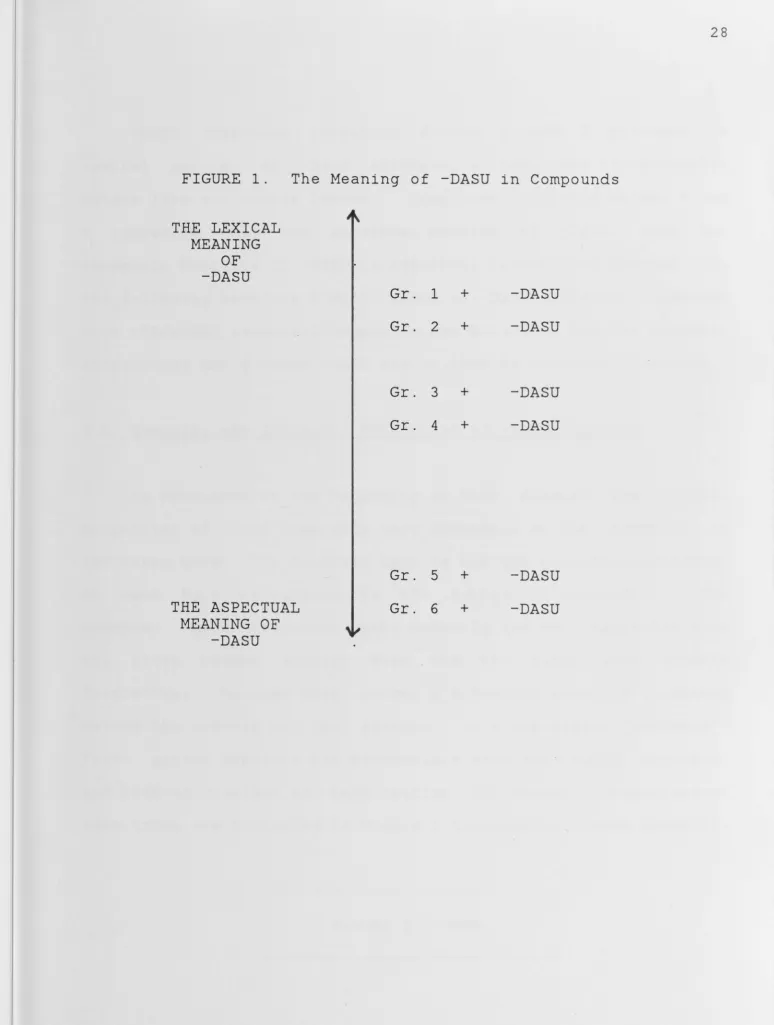
As Figure 1 below shows, some -DASU compounds preserve the
lexical meaning of -DASU stronger than the aspectual meaning;
some have only an aspectual meaning; while others are somewhere
[image:33.802.21.785.16.1117.2]between these two groups.
FIGURE 1. The Meaning of -DASU in Compounds
THE LEXICAL MEANING
OF -DASU
THE ASPECTUAL MEANING OF
-DASU
Gr. 1 +
Gr. 2 +
Gr. 3 +
Gr. 4 +
Gr. 5 +
Gr. 6 +
-DASU
-DASU
-DASU
-DASU
-DASU
[image:34.804.13.787.26.1050.2]-DASU compounds involving Groups 1 and 2 preserve the
lexical meaning of -DASU stronger, whereby they syntactically
behave like one single lexeme. Compounds involving Groups 5 and
6 represent only the aspectual meaning of -DASU: thus the
syntactic behavior of -DASU is aspectual rather than lexical. In
the following sections I will compare -DASU aspectual compounds
with -HAJIMERU aspectual compounds and will show how the semantic
differences among these -DASU are related to syntactic behavior.
2.2 Semantic and Syntactic Properties of -DASU Compound
As mentioned at the beginning of this chapter, the semantic
properties of -DASU compounds vary depending on the semantics of
the first verb. The question here is how the semantic properties
of each type correspond to the syntactic properties. For
example, -DASU aspectual verbs normally are not compatible with
the first person subject when the the first verb entails
[+agentive]: because they denote a situation which is initiated
beyond the control of the speaker, or which starts "suddenly".
First person subjects are permissible when the -DASU aspectual
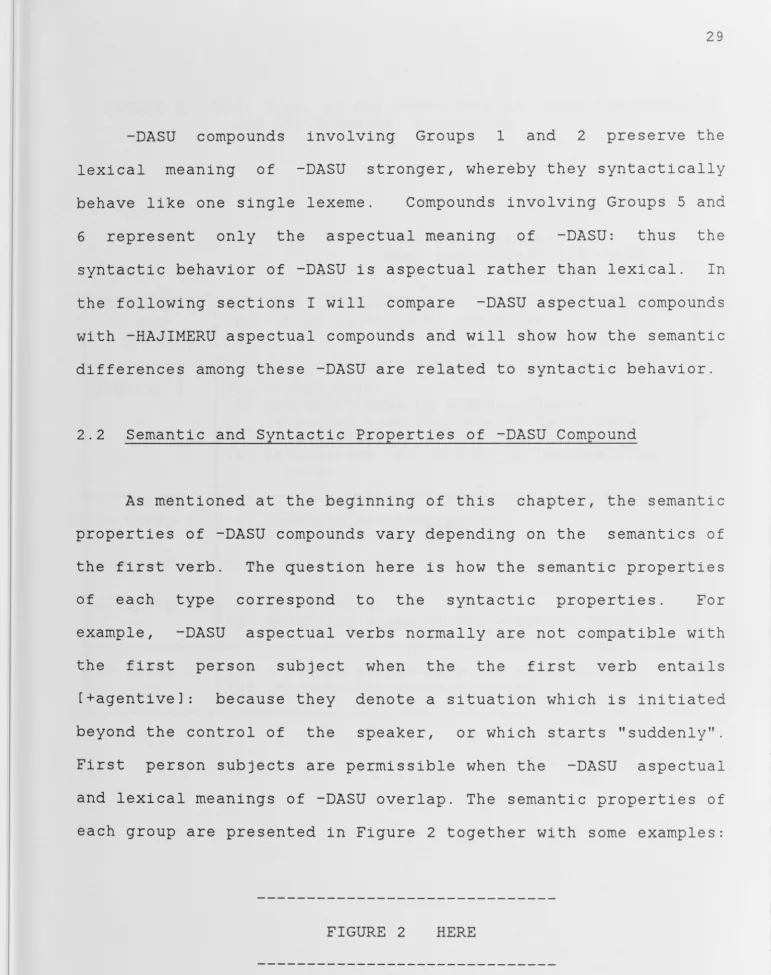
and lexical meanings of -DASU overlap. The semantic properties of
[image:35.804.16.787.22.997.2]each group are presented in Figure 2 together with some examples:
FIGURE 2. The Type of the First Verb of -DASU Compounds and Its Semantic Properties
First Verb
(1) Group 1 and Group 2
(2)Group 3
(3) Group 4
(4) Group 5
(5) Group 6
Semantic Properties
When compounded with -DASU
(a) 'out' or 'away'
(b) 'show' or 'come to existence'
(a) abrupt onset
(b) non-volitional or uncontrollable
(especially in the case of first person subjects)
(c) realization or focus on the starting point
(a) definite starting point
(a) abrupt onset
(b) attention drawn to the starting point
[image:36.807.12.786.26.1088.2]EXAMPLES
(1) a. Taroo wa imooto toisshoni aruki-dashi-ta. (Gr . l )
TOP sister with-together walk-OUT-PAST 'Taro walked away with his sister.'
b.watashi kara sore o ii-dashi-ta. (Gr . 2)
I
from that ACC talk-OUT-PAST'I
put forward that proposition.'(2) kanojo wa totsuzen naki-dashi-ta. (Gr.3) she TOP suddenly cry-OUT-PAST
'She suddenly burst into tears . '
(3) Hanako wa saikin ginkoo ni tsutome-dashi-ta . (Gr . 4) TOP recently bank LOC work-OUT-PAST
'Recently Hanako started working for a bank . '
(4) Taroo wa totsuzen teeburu no ue
TOP suddenly on the table tabe-dashi-ta.
eat-OUT-PAST
no ringo o POSS apple ACC
'Taro suddenly ate the apple that was on the table .'
(5) kyuu-ni sora ga kumori-dashi-ta. (Gr.6) suddenly sky NOM become-OUT-PAST
'All of a sudden the sky became cloudy . '
[image:37.799.21.787.20.1129.2]I I
be viewed as subjective in that it represents the speaker's
attitudes toward the inception of a situation (for example,
sentences (1) to (5) may express the speaker's surprise at the
unexpected) .
When -DASU refers to the inception of a process, it
describes the starting point as a complete event rather than a
part of process. Put it in another way, -DASU captures the start
as a single change and does not imply its continuity. This
characteristic of -DASU results in its stylistic nuances such as
the speaker's concern with the moment of change, unexpectedness,
or surprise.
Take ~aberu 'eat' as an example, i t is possible to
postulate some contexts where -DASU is appropriate. 'Eat'
represents an activity which normally entails [+process].
However, this verb can be used without actually referring to the
process. For example, the speaker gave some food to a bird and
was waiting for the moment when the bird would start to eat. In
this case the inceptive moment itself is important to the
speaker; -DASU indicates such speaker's attention to the
inception. Another example could be where the verb, 'eat' is
used with no thought of its lexical property [+process] when
somebody started to eat suddenly or unexpectedly; the speaker may
express the suddenness by using -DASU.
There are differences between -DASU and -HAJIMERU since
-HAJIMERU does not have such subjective interpretations as -DASU
has. The significant aspectual differences between -DASU and
-HAJIMERU is that the former implies a punctual or momentary
start whilst the latter does not. The distinction between -DASU
2.3 -HAJIMERU and -DASU
Although when used as an independent verb, -HAJIMERU is a transitive agentive verb, when used in compounds it is the first verb that determines whether the whole is to be taken as transitive agentive, or intransitive non-agengentive. In either case, the -HAJIMERU compound is used to objectively describe the beginning of a process; and this aspectual meaning is not to be associated with the speaker's personal attitudes towards this beginning.
The lexical meaning of -DASU, as mentioned above, is 'to present', 'to send', 'to show', etc, which noemally do not imply [ +process J, but only "a single change of state". This lexical meaning of -DASU is reflected in its aspectual meaning: -DASU in aspectual compounds refers to the inceptive moment. In other words, the inception described by -DASU aspectual implies "punctual", "sudden", or "dynamic". This leads to the extended uses of -DASU such as the speaker's surprise, unexpectedness or focusing on the inceptive moment.
Compared with -HAJIMERU, -DASU is more restricted in that (1) unless things are not under the subject's control -DASU cannot occur with first person subjects (2) -DASU cannot be used when the inception implies the speaker's expectation, and (3) -DASU is inappropriate where the beginning implies "slowly",
"carefully", or "attentively".
-DASU describes the situation vividly. For example,
odorok.i-dash.i-ta 'became angry' is more
odorok.i-haj.ime-ta 'started being angry'
descriptive than
!
35
hearer to visualize the situation. -DASU, thus, can be used to
subjectively describe an inception. The following pairs of
used to express the sentences show how -DASU can be
characteristics just mentioned above.
(1) a.?*imooto ga minna no mae de piano o hiki-dashi-ta.
sister NOM in public piano ACC play-OUT-PAST
The intended meaning is 'My sister began to
play the piano in public.'.
b.imooto ga totsuzen piano o hiki-dashi-ta no-de
sister NOM sudenly piano ACC play-OUT-PAST since
minna
everyone
odoroi-ta.
were surprised
' Since my sister suddenly started playing
the piano everyone was surprised.'
Examples above show that -DASU is permissible when a
situation started abruptly or when it started unexpectedly or
surprisingly to the speaker. -HAJIMERU form is used without
such implications which -DASU has. Compare sentences (la) and
(lb) with sentences (2a) and (2b):
(2)a.imooto ga minna-no-mae-de
sister NOM in public
piano
piano
o hiki-hajime-ta.
ACC play-START-PAST
'My sister started playing the piano in public.'
b. imooto ga totsuzen piano o hiki-hajime-ta node
sister NOM suddenly piano ACC play-START-PAST since
minna odoroi-ta.
'Everyone was surprised because my sister
suddenly played the piano.'
As sentence (2a) illustrates, -HAJIMERU does not inherently
entail a sudden beginning or speaker's surprise. However, it can
be used in the context where a situation started suddenly as
well, but without focusing on its suddenness. Depending on the
other contextual clues, -HAJIMERU can be used where a situation
implies 'a sudden beginning' or 'speaker's surprise'. In other
words, -HAJIMERU itself is neutral in respect to a sudden
beginning : the form itself does not imply a sudden beginning ·or
speaker's surprise. Thus (3a) is appropriate whilst (3b) is not:
(3)a.hakushu ni kotaete
applause DAT in reponse to hiki-hajime-ta.
play-START-PAST
imooto wa piano o
sister TOP piano ACC
'In response to the applause my sister
started to play the piano.'
b.*hakushu ni kotae-te imooto wa piano o
applause DAT in response to sister TOP piano ACC
hiki-dashi-ta. play-OUT-START
The intended meaning is the same as in (3a).
Sentence (3b) is not appropriate because the situation
implies a certain expectation on the part of speaker. -HAJIMERU
37
distinction between -DASU and -HAJIMERU explains why normally
-DASU is not compatible with first person
will discuss the different cases from
subjects
this ) :
( later we
-DASU is
appropriate when a situation is innitiated suddenly ( in some
cases unexpectedly or surprisingly to the speaker). There is
no such restriction on -HAJIMERU:
(4)a.*watashi/ kare wa kabe ni penki o nuri-das
I/ he TOP wall DAT pait ACC paint-OUT-PAST
the intended meaning is 'I/ He started
painting the wall.'
b. watashi/kare wa kabe ni penki o nuri-hajime-ta.
I /he TOP wall DAT paint ACC paint-START-PAST
' I / He started painting the wall.'
(5)a.*watashi/ kare wa zasshi o yomi-dashi-ta.
I / he TOP magazine ACC read-OUT-PAST
The intended meaning is ' I / He started reading
a magagine.'
b.watashi/ kare wa zasshi o yomi-hajime-ta.
I /he TOP magazine ACC read-START-PAST
' I / He started reading a magazine.'
Hur.i-dasu 'start
are possible when
painting'
the sentence
abrupt onset or when the sentence
and yom.i-dasu 'start reading'
of the subject. In sentences
implies a sudden beginning or
implies the uncontrollability
(4a) and (Sa) -DASU is
inappropriate in that the first person subject of sentence
Thus -DASU cannot be used in sentences which represent
11 commands 11
, "requests", or "suggestions": because such sentences
entail the controllability of a person who will perform the
commands, requests, or suggestions.
(6)a.*tabe-dashi-te kudasai.
eat-OUT-REQUEST
The intended meaning is 'Please start eating'.
b. tabe-hajime-te kudasai.
eat-START-REQUEST
'Please start eating.'
(7)a.* arai- dashi mashoo.
wash-OUT-let's
The intended meaning is 'let's start washing'.
b. arai-hajime mashoo.
wash-START-let's
'Let's start washing.'
As indicated at the beginning of this chapter, -DASU is
appropriate where the speaker is concerned with the changing
moment of state of affairs . The following sentences must be
understood in this light.
(8)a.sono otoko no mabuta ga furue-dashi-ta.
the man POSS eyelid NOM jitter OUT-PAST
b.sono otoko no mabuta ga furue- hajime-ta. the man POSS eyelids NOM jitter-START-PAST
'The eyelids of the man started jittering.'
(9)a.sono otoko no mabuta ga imanimo
furue-dashi-soo-ni-the man POSS eyelids NOM at this moment jitter-OUT-like nat-ta.
become-PAST
'The eyelids of the man looked as if they would start jittering at any moment.'
b.*sono otoko no mabuta ga imanimo
furue-hajime-the man NOM eyelids NOM at this moment jitter-START-soo-ni nat-ta.
like become-PAST
The intended meaning is the same as in (9a).
(lO)a.sono otoko o mite, chichi ga okori-dashi-ta.
that man ACC looking at father NOM get angry-OUT-PAST 'At the sight of the man, my father got angry.'
b. sono otoko o mite, chichi ga okori-hajime-ta.
(ll)a. sono otoko o mite, chichi ga
okori-dashi-that man ACC looking at father NOM get
angry-OUT-sooni- nat-ta.
likely-become-PAST
'Looking at the man, my father looked as he
was about to get angry.'
b.*sono otoko o mi-te, chichi ga
okori-hajime-that man ACC looking at father NOM get
angry-START-( 12)
sooni-nat-ta.
likely-become-PAST
The intended meaning is the same as in (lla).
a. onaka ga nari-dashi-ta.
stomach NOM make sound-OUT-PAST
'My stomach made a sound. I
b. onaka ga nari-hajime-ta.
stomach NOM make sound-PAST
'My stomach started making a sound.'
(13)a. onaka ga nari-dashi-sooni-nat-ta.
stomach NOM make sound-OUT-likely-become-PAST
'My stomach almost made a sound.'
b.* onoka ga nari-hajime-sooni- nat-ta.
stomach NOM make sound-START- likely-become-PAST
The intended meaning is the same as in (13a).
The examples above indicate that -HAJIMERU is not possible
where the speaker is concerned with the changing point; -DASU is,
and (12) show that -DASU and -HAJIMERU are possible to express
the inception, but there are differences between them: -DASU
versions are more vivid descriptions.
Sentences (9), (11) and (13) imply that a change of state is
about to occur: here the change itself or the changing moment is
the speaker's concern. In this context, only -DASU is
appropriate.
As indicated at the beginning of this chapter, normally
aspectual -DASU do not occur with first person subject. However,
there are some cases where first person subject is compatible
with -DASU. We will see these cases in the following
subsections.
2.3.1 Emotional Activities and Inception
First, we will discuss the verbs which denote human
emotional activities such as warau 'laugh', naku 'cry', etc.
Kaku and warau can be used in both non-volitional and
volitional (deliberate) contexts, but sentences with
nak.i-dasu or wara.i-dasu are more vivid than the corresponding
-HAJIMERU ones. Hak.i-/Jaj.imeru and wara.i-/Jaj.imeru compounds
used with first person subjects imply the deliberate beginning,
but they are not possible when the sentence implies the
uncontrollability or non-volition of the speaker / subject.
Compare the following sets of sentences:
(14) a. watashi wa sore o kiite warai- dashi-taku
I TOP that ACC hearing laugh-OUT-want
.
become-PAST
'On hearing that, I felt like burstin out
laughing.'
b.*watashi wa sore o kiite warai-hajime-taku
I TOP that ACC hearing laugh-START-want
nat-ta.
become-PAST
The intended meaning is the same as in (14a).
(15) a.watashi wa gaman-dekizu waa-waa naki-dashi-ta.
I TOP beyond control ONOMAT cry-OUT-PAST
'I could not help crying in a loud voice.'
b.* watashi
I
wa gaman-dekizu waa-waa
TOP beyond control ONOMAT
naki-hajime-ta.
cry-START -PAST
The intended meaning is the same as in (15a).
Thus only nak.i-dasu and wara.i-dasu can be followed by
-TE SHIMAU which emphasize the speaker/ subject's non-volition
or uncontrollability:
(16)a. watashi wa sore o kii-te warai-dashi-te shimat-ta.
I TOP that ACC hearing laugh-OUT-DONE-PAST
'On hearing that, I couldn't help laughing.'
b.*watashi wa sore o kii-te warai-hajime-te shimat- ta .
I TOP that ACC hearing laugh-START-DONE-PAST
The intended meaning is the same as in (16a).
(17)a.watashi wa naki-dashi-te shimat-ta.
'I burst into tears.'
b.*watashi wa naki-hajime-te shimat-ta.
I TOP cry-START-DONE-PAST
The intended meaning is the same as in (17a).
These two sentences imply that the speaker laughed or cried
beyond his/ her control. In the (b) versins of sentences (16)
and (17) -HAJIMERU is not possible when the sentence implies
2.3.2 Motion or Verbal Activities and Inception
The second exception where DASU does not entail sudden or
unexpected inception is
activity verbs such as
(2) in the combination of
(l)combination of -DASU and motion/
aruku 'walk', hash1ru 'run', etc, and
-DASU and the verbs which denote
verbal activities such as u'/:au 'sing', hanasu 'talk', 1u
'tell/ say', etc: both cases are associated with the lexical
meaning of -DASU (that is, 'out' or 'away' meaning). The
inherent meanings of -DASU entail a change in the position or
location of object. Furthermore such change entails the
directionality ( for example, -DASU takes the n1 particle
which specifies a certain direction or location). Thus
aruk1-dasu and hash1r1- dasu correspond to 'get away the
place by walking or by running', respectively. These compound
verbs refer to the realization of a certain motion, but rather to
the beginning of a continuous motion, with no concern with its
direction:
(18) a. Taroo wa iw-are-ta-toori 3 k.m o hashiri-hajime-ta.
TOP as instructed 3 k.m. ACC run-START-PAST
'As instructed, Taro started runnung the 3 k.m.'
b . *Taroo wa iw-are-ta-toori 3 k.m. o hashiri-dashi-ta.
TOP as instructed 3 k. m. ACC run-OUT-PAST
The intended meaning is the same as in (18a).
I TOP alone park-of-inside ACC walk-START-PAST 'I began walking alone in the park . '
b.*watashi wa hitori-de kooen no naka o aruki-dashi-ta. I TOP alone park-of-inside ACC walk-OUT-PAST
The intended meaning is the same as in (19a).
The pairs of sentences (18) and (19) indicate that -DASU compounds such as aruk.i-dasu and /Jas/J.ir.i-dasu are not
possible when the sentence implies a bounded process (not movement in a certain direction). But note that aruk.i-dasu and
/Jas/J.ir.i-dasu are
direction:
possible when sentence entails a certain
the
(20) watashi wa ie ni mukatte hashiri-dashi-ta. I TOP in the direction of the house run-OUT-PAST
'I dashed running in the direction of the house.'
(21) watashi wa gakkoo mezashite aruki-dashi-ta.
I TOP school aiming at walk-OUT-PAST 'I started walking towards the school.'
-H.i mukaLLe in sentence (20)
directionality. Sentences
and
( 2 0 )
mezasfl.iLe in (21) express
and (21) indicate that
aruk.i-dasu and /Jas/J.ir.i-dasu imply "realization of a motion (or
movement) towards" rather than the beginning of a process.
The corresponding -HAJIMERU compounds, aruk.i-/Jaj.imeru and /Ja s /J.i r .i -/Ja j.imeru
compounds refer
~ ·
'out', 'away', or 'off'. The third exception is that the
first person subject is possible with -DASU in compounds when the
first verb denotes verbal activities:
(22) a. watashi wa jijitsu o ii-das-e- nakat-ta.
I TOP truth ACC tell-OUT-able-NEG-PAST
b.*watashi wa jijitsu o ii-hajimer-are-nakat-ta.
I TOP truth ACC tell-START- able-NEG-PAST
The intended meaning is the same as in (22a).
(23) a.watashi kara hanashi-das-e-nai.
tell-OUT-able- NEG-PRES
I from
'(From me) I cannot tell him.'
b.*watashi kara hanashi-hajimer-are-na-i.
I from tell-START-able-NEG-PRES.
The intended meaning is the same as in (23a).
The (a) versions of these two sentences indicate that the
first person subject can occur with -DASU when the first verb
denotes verbal activities. However, as the (b) versions above
illustrate, -DASU here appear to have different meanings from the
This can be explained in terms of different semantics of
-HAJIMERU and -DASU compounds. As already mentioned, -HAJIMERU
refers to the beginning of a process whilst -DASU refers to a
single change of state. For example, a siginificant point in
sentence (23) is whether the speaker could express a fact or not:
not whether the speaker could start expressing the fact. -DASU
here can be paraphrased as 'reveal', 'disclose', 'propose', etc,
which imply a single change (not a process) and "come to
existence". Likewise, sentence (23a) does not imply a process
but a single change: the sentence does not refer to the beginning
of a process, but to the realization of a single change,
'propose', 'introduce', etc.
2.3.3 Others
Finally, -DASU compounds which denote the start of a career,
work or writing, are also exceptional (for example, nataraki-dasu
'start to work/ labor', tsutome-dasu 'start a career', oshi e-dasu
'start a career as a teacher/ instructor' and kaki-dasu 'make
a start in one's writing').
However, these compounds seem to have different types of
meaning from those of the corresponding -HAJIMERU compounds
Compare the following pairs of sentences:
(24)a. moo sorosoro isha to-shite hataraki-dasoo to omou.
soon as a doctor work-OUT-will COMP think
'I intended to start my career as a doctor.'
b.moo sorosoro isha to-shite hataraki-hajime-yoo to omou.
'I will soon start working as a doctor.'
(25)a.*ashita wa shichi-ji kara hataraki-dashi-te kudasai.
tomorrow TOP 7-o'clock from work-OUT-IMP
The intended meaning is the same as in (25b).
b.ashita wa shichi-ji - ni hataraki-hajime-te-kudasai .
tomorrow TOP 7-o'clock-at work-START-IMP
'Please start working at 7 o'clock tomorrow.'
There are differences between (24) and (25): example (24)
denotes 'to commence a career' whilst example (25) denotes
'to start a routine (which implies a set process). As the
examples show, natarak1-dasu is appropriate when the speaker
refers to the commencement of a career or the moment when
somebody starts working: however, these compounds sound strange
when the speaker presumes work of duration and refers to 'one's
starting of work'.
The meaning of tsutomeru is 'to be employed (by a
company)'or 'to take up service'. Again there are differences
between tsutome-naj1meru and tsutome-dasu :
(26)a. watashi wa ginkoo ni I TOP bank-LOC
tsutome-dashi-ta.
work-OUT-PAST
'I started working for a bank.'
b. watashi wa ginkoo ni tsutome-hajime-ta.
I TOP bank-LOC work-START-PAST
The intended meaing is the same as in (26a).
49
I TOP already bank-LOC work-OUT-ASPECT The intended meaning is the same as in (27b).
b. watashi wa sude-ni ginkoo ni tsutome-hajime-te iru.
I TOP already bank-LOC work-START-ASPECT
'I have already started working for a bank.'
As examples (26a) and (27b) show, both tsutome-dasu and
tsutome-llaj.imeru can be used to refer to the commencement of a career. However, when the sentence denotes the beginning
state of affairs (not the commencement itself), like in
examples (26a) and (26b), tsutome-llaj.imeru is appropriate.
A set of sentences, (27a) and (27b) imply that the speaker
already has worked over a period of time. In this respect,
tsutome-dasu can be used when the speaker refers to the
commencement of work itself but not when sentence refers to the
on-going state after the commencement.
Osll.i e-dasu and· osll.i e-llaj.imeru are also different. Compare sets of sentences below:
(28)a.watashi wa ni-nen mae kara eigo o oshie-dashi-ta.
I TOP 2-year-ago since English ACC teach-OUT-PAST
'I commenced my career teaching English 2 years ago . '
b.watashi wa ni-nen mae kara eigo o oshie-hajime-ta.
I TOP 2-year-ago since English ACC teach-START-PAST
'I started teaching English two years ago.'
(29)a.*watashi wa sorosoro seito ni ressun-san o
oshie-I TOP soon student DAT lesson 3 ACC
teach-dasu- tsumori-da.
OUT-will-COP
The intended meaning is the same as in (29b). b. watashi wa sorosoro seito ni ressun-san o
oshie-I TOP soon student DAT lesson 3 ACC teach-hajimeru-tsumori-da.
START-will-COP
'I will start teaching lesson 3 to my students soon.'
As sentences (28a) and (29b) indicate, both osn.ie- dasu and osn.ie-naj.imeru are possible when the sentence implies the commencement of a career. Sentences (29a) and (29b), on the other hand, show that osn.ie-dasu is not possible when the
sentence implies 'a process which is supposed to be completed'.
osn.ie-naj.imeru can be used in either case.
Likewise, .ka.k.i-dasu 'to commence writing something' is different from .ka.k.i-naj.imeru in that .ka.k.i-dasu refers to
the commencement of a paper, novel, etc ( such commencement being of particular significance to the speaker, or the subject).
(30)a.kinoo
yesterday
ronbun o kaki-dashi-ta.
paper ACC write-OUT- PAST 'Yesterday I started writing my thesis.'
b. kinoo ronbun o kaki-hajime-ta.
yesterday paper ACC write-START-PAST 'Yesterday I started writing my thesis.'
(31)a.?* chichi ni tegami o kaki-dashi-ta. father DAT letter ACC write-OUT-PAST
l
.
b.chichi ni no
father DIR POSS
tegami o kaki-hajime-ta.
letter ACC write-START-PAST
'I started writing to my father.'
51
What is significant in these two sets of sentences
is that kak.i-dasu does not imply 'to start writing something
as a process and continue'. Sentence (31b), on the other hand,
implies 'start/ begin a process towards the completetion' (rather
than the commencement itself).
Thus kak.i-dasu refers to the point where the
commencement of some writing is realized; kak.i-/Jaj.imeru can
refer to the starting point and can imply that 'one starts
52
2.4 Morphological Differences between -DASU and -HAJIMERU
-DASU and -HAJIMERU morphologically as well: verb stem than -HAJIMERU.
aspectual compounds are different
-DASU is more tightly linked with the
This indicates that the -DASU compound
itself has independent lexical meanings.
(32)a. kodomo ni naki-das-are-te, komat-ta.
child DAT cry-OUT-PASS-CONJ embarrassed-PAST
'I felt embarrassed bacause my child started to cry.'
b.*kodomo ni naki-hajimer-are-te, komat-ta.
child DAT cry-START-PASS-CONJ embarrassed-PAST The intended meaning is the same as in (32a).
(33)a.sore o kare ni hanashi-das-are-tara, that ACC he DAT tell-OUT-PASS-CONJ
muda-ni-naru.
will become useless
doryoku ga
effort NOM
'If this is disclosed by him, my efforts will all be
in vain.'
b.*sore o kare ni hanashi-hajimer-are-tara, doryoku ga
that ACC he DAT tell-START- PASS-CONJ effort NOM
muda-ni-naru.
will become useless
The intended meaning is the same as in (33a).
As shown in sentences (32) and (33), the (r)are passive
l.
-HAJIMERU.
(34)a. *watashi wa I TOP
kodomo o pub de hatarak-ase-dashi-ta.
child ACC pub in work-CAUS-OUT-PAST
The intended meaning is the same as in (34b).
b. watashi wa kodomo o pub de hatarak-ase- hajime-ta.
I TOP child ACC pub in work-CAUS-START-PAST
'I started to make my child work in a pub.'