'!
.
COMMISSION OF THE EUROPEAN COMMUNITIES
Brussels, 08.09.1995
COM(95)416 final
ERASMUS
Pmgnunme
Annual Report
1994
1.
..
S~Y.
The annual report for 1994 describes the general implementation of the ERASMUS progfa.mme during the _calendar year and the ·inter-tmiversity cooperation activities supported for 1994-95 - the eighth year of the
programme's operation. · ·
The total ntimber of inter-tmivers!ty cooperation programmes (I CPs) approved by the. Commission for the award of Commtmity funds was 2 280, of which 414 were new programmes. As for the activities within these programmes the number of institutional participations and the number of students proposed for mo!Jilicy in approved ICPs increased between 1993-94. and 1994-95 by over 20% i.e. a total of 1 707 participations and 127 221 s'tudents·eligible to undertake studies abroad. The number ofteach~rs planning to travel rose by 21% (i.e. a total of 9 753 for 1994-95) over 1993-~4 _figures. ·
For higher education establishments from the EFTA countries, 1994-95 was the third year 'of ERASMUS participation. Relations with Switzerland and Liechtenstein continued on the basis of bilateral agreements signed with the Commtmity in 1991, the actions relating to the·other EFTA countries i.e. Sweden, Norway, Finland, Austria. and Iceland being covered by the Agreement on the European Economic Area '(EEA) as ·,from 1994. These countries increased ¢eir level of participation-by approximately 50% over 1993-94 (i.e. ) 834 participations for 1994-95), accminting for 10. 8% of partiCipation and 9. 7% of stuili:nts eligible under·
the I CPs. · ' · · - , · . . . · · . . . .
' . .
' '
· • For the E-uropean Commtmity Course Credit.Trarisfer System(ECTS) 1994 wa5 a year of extension to other · ·. fields and studies, or at the institutional level even-for the establishments participating in the pilot proje-ct.
There was also increasmg interest by an ever-widening sectiort of the tmiversity world and the principles··. of the ECTS scheme were introduced in establishments and subject areas which were outside the scof,e of
the current pilot project. · ·
• In 1994 the_ C~mmission awarded 22 ~ts under Action 4 ofErasmus (additional m~ures to promote . inter-university cooperation). The projects approved involve 300 establishments and orgarusations evenly distributed across the Member States of the Community and the EFTA coimtries. ·
The Commission contin~ed throughout 1994 its work to stimulate inte~est in inter-university cooperation by organising or participating in information campaigns and by financing study visits by the staff of higher
education establishments. . · '
The' puBlications programme continues to play a leading role in the wider dissemination of information on ERASMUS. The .use of electronic information techniques is also. being developed in a preliminary_ experimental phase in order to open access (via the Internet network) to a broad rimge of informa~ion ori ERASMUS which hitherto was available only in printed form · ·
• . The Commission in 1994 launched two pilot projects 'ori th,e. asses;ment of quality
in
higher education in Europe. These pilot projects which should be completed in 1995 will make it possible to_ devise European methodology based on the eXisting systems and on· • .. • f • ap enhailced European added value. • ' •In order to mark the transition from ERASMUS to SOCRAIES and looking ahead to the adoption of a SOCRA lES programme, the Commissi9n. assisted by the ERASMUS National Grant Awarding Authorities . · . (NGAAs), for the second time round awarded' ERASMUS prizes at a ceremony held on 4 December 1994.
Two prizes per Member State, awarded by a prestigious jlll)', were given to a member of the teaching staff a:nd .to a student who have made a significant. contribution to the development of inter-w1iversity
cooperation. in the Community. · · · · ·
ERASMUS Programme- Arumal Report 1994,
- I
2
The Commission's follow-up programme and the activities to assess the programme went on and led to the publication of several studies on the results of the various activities under ERASMUS and their significance.
for future Community action programmes. · ·
For the Commission 1994 -was a year of intense activity looking ahead to the adoption of the future· Community action programmes . in the area of education and vocational training, SOCRATES and . LEONARDO, submitted by the Commission in January 1994 in the wake of the new powers attributed to
the EC by the EC Treaty and particularly Articles 126 and 127 thereof. ·
This has made 1994 a decisive year for the ERASMUS prograriune. The experience gained through this programme and through the LINGUA programme and the various pilot projects has been strengthened and · expanded in the proposal for the new SOCRA 1ES prograrinne.
The negotiations started on 4 January 1994 under the cbdecision procedure continued throughout the· year. The Council of Ministers and the European Parliament formally adopted the SOCRA1ES programme on · . 14 March 1995 for a five-year period with a budget of ECU 850 million..
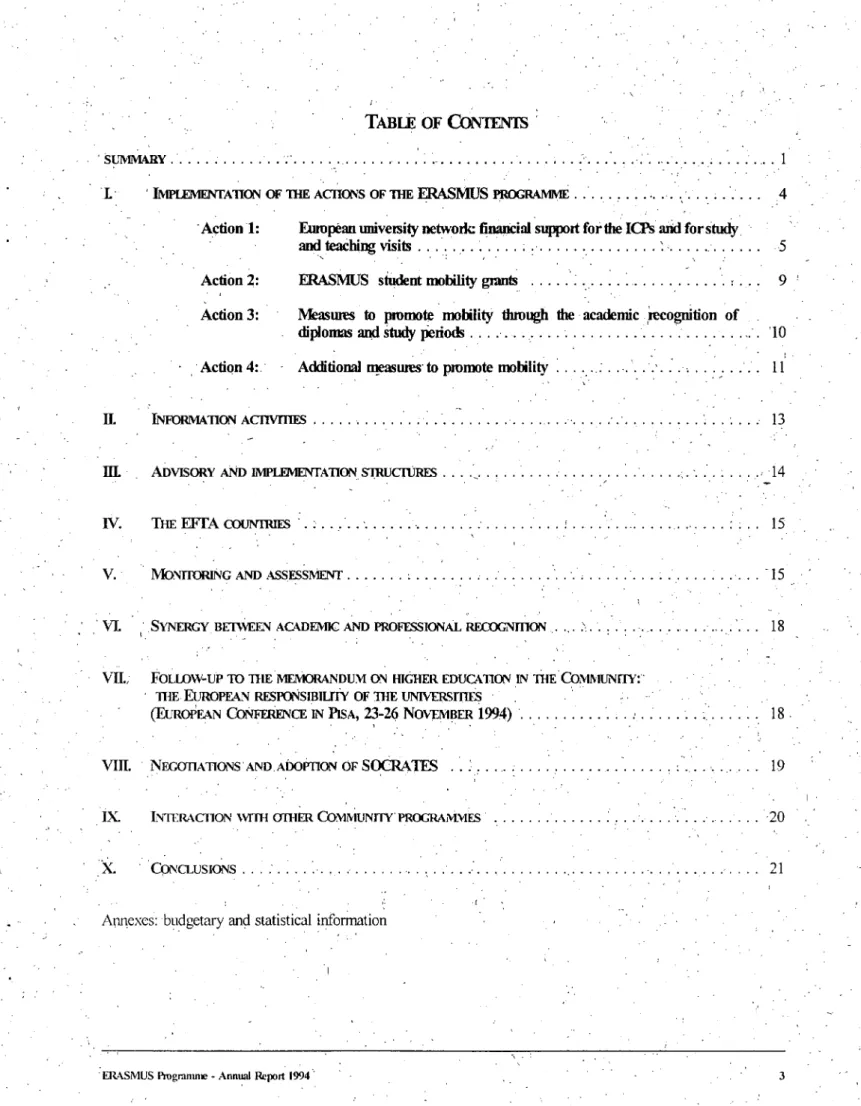
TABLE
OF CoNTENTS .' SUMIVJARY ..•... ·; ... ' ... . ' : ...•... --... '. ·. " ... ·. . . . .. . 1'
·~ . .
L- ' IMPlEMENTATIOO' OF 1HE ACTIONS OF 1HE ERASMUS
~
...~
... ·. . . . 4·Actionl: European university networlc finaJJCial support for the I CPs
ruid
for study ·.and .,· teac. bing . VISI "ts . • . . . . ' .. • . . . . . · . . . ·. . . . .. . . • . . . ' .. 5
' .
Action 2: ERASMUS student mobility gnmts ... ·: ._ .. ~ . ~ ... ·. , . . . 9
Action 3: Measures to promote mobility through the academic . ,recognition of diplomas aQd study Periods .... · ... " . '10
Additional D!Casures· to promote mobility : . . . : . . . ' . .' . ; . . . 11
. . · ' ·. . ' ....
Action 4:.·
R INFoRI\1ATIOO' ACl1VTIIES . . . · . . . · .. : . · . . . : . . . ~ .. · . . . .- 13
Ill ADVISORY AND IMPLEMENTATION SJ:RUcniREs . . . . _ .. , . . . ~ . . . ·•. · . .' . . . ·' 14
' '
lV. THE EFfA COUNIRIES .. :· ... · . . . · . . . : . . . ; . . . •' . . . . : . . . 15
v.
·.
MONITORING AND ASSESSMENT . . . . ' .. ~ . . . · ... ; . . . '15.VL . SYNERGY BEI\VEEN ACADEl\'DC AND PROFESSIOO'AL RECOGNIDON ... > .. : . . . .. . . . .. . . 18
'·
VII., FOU1JW-UP TO TilE MEMORANDUM 0.'1 IDGHER EDUCATION IN
THE
Co;vJMUNITY:·· lifE-EUROPEAN RESPONSIBirnY OF 1liE UNIVER<;;JTIFS
(EURoPFAN CoNFERENCE IN PJsA, 23-2(j NOVEMBER l994) . . . 18 .
VIII. NEGOTIATIOO'S AND.AOOPTIOO' OF SOCRA1ES ... , ... : ... , ~ . . . . . . . 19
. ' .
IX L'<'1Hv\CJ10N \Wlll antER CoMMUNITY PROGRAMiVIES . . . . ·. . . · 20
X.
CONCLUSIO."S . . . . . . ~' . . . .. ·. . . . . . . . . . . . . . . . . . 21· ! .
Atmexes: budgetary and statistical infonnation
L IMPLEMENTATION OF 1HE ACllONS OF 1HE ERASMUS PROGRAMME
4
1. This report describes the general implementation of the programme in 1994 and the various inter -university. cooperation activities funded during the 1994-95 academic year- the eighth year of its operation. It has been prepared in accordance with Article 6 of Council Decision 87/327/EEC ofl5 June 1987 establishing the ERASMUS programme, and amended by Council Decision 89/663/EEC of 14 December 1989.
Under seven CounCil Decisions (from 911611/EEC to 911617/EEC) of28 October 1991 conducting bilateral agreements between the EC and the EFTA countries higher education establishments in these coi.mtries have been able to take part in cooperative actions under the ERASMUS programme with establishments from the European Community since the 1992-93 academic year. ·
Only the relations with Switzerland and Liechtenstein continued on the basis of these bilateral agreements in 1994, the actions relating to the other EFT A countries (Sweden, Norway, Finland, Austria and Iceland) being covered by the Agreement on the European Economic Area (EEA). ·
The main result of this was that the criteria for being eligible for an ERASMUS mobility grant were henceforth the same as for EC students, whereas hitherto when the establishment of origin was situated in a Member State of the Community students from the EFTA countries had to be permanent residents in that country in order to qualify for this grant. This condition nevertheless continued to apply in 1994 for
nationals from Switzerland and Liechtenstein. ·
The activities financed under ERASMUS are divided into tour actions:
. Action 1:
Action 2:
Action 3:
Action4:
ll?ter-Un.iversity cooperation programmes (!CPs) making up the European university
netvvork and study and teaching visits; ·
management of the ERASMUS student mobility grant scheme;
measures to promote mobility through the academic recognition of diplomas and periods of study, including the implementation of the fot.nth year of operation of the European Community Course Credit Transfer System {ECTS) pilot project; · ·
additional measures to promote inter-university cooperation and student mobility. ·
lne budget allocated to the ERASMUS programme for 1994, for the 12 Member States of the Union, amounted to ECU 82.5 million. Taking into account the contribution from the EFT AIEEA countries, Switzerland and Liechtenstein, as well as sums arising from the re-use of revenues from former financial years, the total fu\1ding available for the programme in 1994 was ECU 96.7 million. This total amount has -been fully used. The distribution, by Action, of the ECU 96.7 million committed is given in, Figure. 1.
In addition to the direct provision of funding to establishments, organisations, teachers and students covered · by these ActionS, the Commission continued to support European academic cooperation through an active information policy, close liaison with the university world in the eligible countries and through monitoring designed to ensure improvements.
The ~nalysis of inter-university cooperation prograrnmes (!CPs) in this report rdates to the fLmding of · activities for the 1994-95 academic year; all the statistics on ICP activities are based on infommtion provided by the Comffiission in April.l994 after the selection phase.
,~
ICPappli~tions'for
the 1994-95 ac3.demic yearshow~ ~ubstantial
increase in demand forinstitutional2:
3.
4.
participation and for student mobility; The increase was partiCularly marked in the ~ase of the EFfA ·. cquntries, in this third year of their participation; interest in the programme has continued to grow within '
the Conimunity, .too. The. budget is clearly far lower than the actua1 coSts of implementing cooperation and . student mobility under ERASMUS. Access to additional funding at national level remains a major policy · issue, with a view not 'only to relieving immediate finanCial pressure, also to securing the futUre of
inter-institutional cooperation through. a more . explicit conlm.itment frOm regional, national and inter-institutional_
~- . . .
Action 1: European univezsity ~twork: financial. silppoit for the IQ>s and for· study and teaching
visits · · ·
The ICPs implem~nted under-ERASMUS byhigher education establishments in the eligible countries
involve one or more_ of the following activities: · ·
Student mobility programmes (S.M) · • Teacher mobility programmes (TS)
Joint development ofnew curricula (CD) • Intensive programmes. (IP) .
. Student mobility prognunmes of a substantial duration (three months to one university year). which give .fulJ-rec:ognition to the perioc,i of study abroad (up to arid including the doctorate or equivalent) are eligible for fmancial support tq develop the prograrrime, to prepare documents and teaching material, to provide language tUition for the students· prior to departure and after arrival, and to provide guidance and counselling; this fmancial support can also be used for the other costs directly related to the programme' e.g. organising meetingS and monitoringthe activities funded 1bti Commission's supp6rt lllis enabled the· .
establishments to continue to imProve their coriu:nitment to s!4dent mobility, partic;G.larly
as
regards language tuition, information provision and accommodation. ·· ·Teacher mobility progranunes enable higher education teaching staff. to take an active part in the norrrial study programme of the partrier establishment for a period of one \veek to .orie year as part of a structured project Which provides tor the mobility of a number' of teachers. Financial support is given towards the development of the programme, teachers',travel and accommodation costs and(in certain cases}the costs of replacing staff absent for three months or more. Financing of language tuition for' teachers frem ·ERASMUS grants, first permitted in 1993~94,
Was
also at¢1orised.±or 1994-1995. · ·Teaching staff exchanges contribute to ITk'lk:ing the· benefits of European cooperation available riot only
t6 ·
thc:ise students ~o are actuallY involved in excrumges but also to the majority of the student population, who are not. Experience has shown that teacher mobility can have useful spin-offs for other types of iriter-university cooperation, includingjoint research projects·. . -- ·
- 5. Grants for the joint development of cunicula may be awarded to assist higher education institutions in developing curricula for implementation in ap partner mstitutions. Preference is given to projects which clearly contribute to improved academic recognition (especially by using modular curricula), which ihcm:porate the European dimenSion into the content of courses, or which lead to the sharing or tran.Sfer . of expertise (whether through distance teaching methc:ids.or otherwise). Suppcirt is provided towards the
cost of joint rheetings and the production, translation and circulation of the necessary documents. .. . . ' . . Curriculum development programmes pool the teaching st¢11s of institutions in different eligible states and
encourage them to create'innovative new courses with built-in recognition procedures. Many new "European" degrees (degrees ihich are fully recognised in several eligible states) have been .created as
a .·
·result of curriculum development programmes; and some of these may eme·rge as models for larger-scaleimplementation within the European University Network. ·
6. Intemive progrnmme grants enable networks of higher education ~itutions to organise short, intenSive, full-time teaching programmes bringing together students and teaching staff from several eligible states for periods of between one week and one month. Special attention is given to multinatiorial participation, the involvement of significant numbers of students (in relation to staff numbers) and the award of academic credit.to those taking part. In addition, ac:Count is taken of whether a proposed programme is on a subject not normally available at any one of the participating institutions alone, or contributes to the dissemination of knowledge in a rapidly-evolving new area. ·
. Support may be used to cover the travel and subsistence costs of teaching staff and students who have to go from one eligible state to another to attend a course and the expenses incurred by holding preliminary meetings and preparing documents.
Intens.ive programmes are especially effective in academic subjects where long-term mobility is difficult to arrange, for mature students and others for whom it is normally impossible, or where new subjects or techniques are being taught.
7. Visit Grnnts are available to facilitate the planning of new ICPs· (notably in subject areas less well-represented among ErasmusiCPs), to extend existing programmes to new partners or to enable the staff of institutions to become better informed about the higher education systems in other eligible states. Visit grants are also available for individual intensive teaching visits of no longer than four weeks' duration, which take place outside the framework of I CPs.
ICP applications for 1994-95
8. The -number of ERASMUs· I CPs applications coordinated by establishments in the Member States of the European CommUnity rose slightly in 1994 and stood at 2 424 as shown in. Annex II (a).
·There were 202 applications for 1994-95 coordinated by establishments from the EFTA countries, an . ~crease of 18%.over 1993-94, so the level of pkticipation in the programme by these establishmentS remains comparatively low in relation to that of the EC. There was a substantial increase in "institutional participation" (see Annex ID(a)) from the Member States (+17.6%) and especially the EFrAcol.mtries (+ 45.7%). This increase is in line \vith the trend which is well established within ERASMUS whereby the increase in demand first shows through in the rise 'in the volume of activities proposed within the ne~vorks rather than through the number of applications submitted by coordinators.
. .
The most significant increases for the Community came from Ireland (+24.7%)., Greece (+23.9%), Spain (+22.6%) and Portugal (+19.9%). ·
Significant upward trends were also noted from the EFTA countries of Finland (+78.7%), Norway (+51.4%), Switzerland (+41.8%) and Austria (+35.2%).
· Annex N (a) shows the breakdown ofiCP applications by subject area for 1993-94 and 1994-95. This analysis points to substantial stability, which is also confirmed in, the student mobility programme.s, except ·in the areas of Education and the Framework Agreements which rose by approximately 25% and 20%.
.
ICPs selected for 1994-95
9. The applicatio~s received were all processed before being submitted to three advisory groups of academic
experts. The latter play an important ~ole in the selection process from the point of view of quality and for the selection of the 2 280 I CPs funded the Commission took the utmost account of their opinions.
6
In accordance with the Deci~ion of 14 ])iecember 1989 on the second phase of the ERASMUS programme, the 1994-95 academic year was the fourth year of operation of the system of.multi-aimual applications and
simplifiecl renewal arrangements. The Conim.ission- was already committed to most of the progrnmmes approved in 1992~93 and 1993794 under the multi-annual financing framework (i.e. progriunmes which were into their Second and third years). The budget for 1994-95 was, as for the previOl:JS year, allocated . so as. to strike a balance in. funding for new applications and for both nevi and existing activities in the programmes which in 1994-95 -enter their second or third year of multi-annuru funding or which were · starting their frrst
year·
as_ 'out-Of-period' I CPs. / . · . · . . . · ~ • . · .~e 1994-95 academic year Was in fact the
.frrst
one in which programmes. approvedin
1991-92 arriv~ at the end of their_ multi-annual period While taking due acco~t of the opinion of the ERASMUS advisory corinnittee, the Commission decided to grant them .an ·albeit lower level of fimding in order to satisfy all .· appUcations for fimding selected for the 1994-95 year in the ·"out-of-period" programmes category. 997 · "out-of-period" ICPs were thus selest:d and fimded. _ ·-~
414 of the 2 280 ICPs approved (EC +EFfA) were completely new and. were awarded, in the sarrie way as new activities ill the existing programmes, slightly above average· fimding in· order to provide a sqlid fmanci~l basis for their start -tip phase. The approval rate for new prograinmes in relation to the overall rate of 86% rose slightly in.relation to that for the previous year (69%) ..
. .
.The number of eligible establishments participating in one or ~ore approved ICP rose by 10% (EC + _EFTA) betw~n 1993.-"94 and 1994-95. This .. increase was more marked for the EFTA countries (with approximately 50% for Finland and 30% for Norway) arid, although to a more limited extent, the trend · . remaills the san].e iri the other Member States. The
year
-on-year increase since 1988-89-is sho'wn in Annex ··vn..
'
Grants to I CPs on average represented 27% of the am6unts requested in the applications (EC + EFfA); in more precise teims 2?.6% for student mobility programmes, 25.2% for teacher mobility programmes, . 39~ 1% for joint development of new curricula and 35.8% fo~ intensive programmes. The average per ICP , for 1994-95 (ECU 10 915 for 1993-94) is ECU 9 477 for new ICPs? 8 667 ECUS for.ICPs receiving
multi-annual funding and ECU 7 366 for the "out-of-period" I CPs. Taking all types ofiCPs together, the fimding . per participating establishment feii by 32.7% compared with the previous year and now stands at ECU ·1
107 due to the increase iri the average number of partners per ICP. ·
Annex II (b) shows the distribution of approved I CPs by countrY ~f the coordinating establishment. As regards the Member States· 9f the Community, the ntimber of coordinated· programmes in Ireland rose sharply between 1993-94 iJ11d 1994:.95, followed by Spain and. Greece·(22%, 15%. and 12·.5% respectively). The trend is much .the same ·for the other countries eligible under ERASMUS but on a smaller scale \vith · the exception of Denmark (~6%) and Germany (-1%). The level of participation in the, programmes was ... up 19%, a rise which is visible in hll the eligible couiJ.tries (see Annex m (b). The EFTA countries taken . together show rates of participation in coordination which rose 50% and 34% respectively ~tween 1993-94
· and 1994-95. / · · · · . . · , · ·
The 1994-95 distribution of approved I CPs by subject area for (Annex IV (b)) differs very little from that of_l 993-94. The Commission continues to seek a balance between the subject areas and this means the application of above-average standards when selecting the I CPs in the areas deemed to be well.,represented'
e.g. business/management.
On
the contrary, there is special emphasis on appliCations in education sciences· or rnedicine and psychology which the Commission is endeavouring: to encourage. A comparatively significant increase is I)Oted for 1994~9.5 in Framework Agreements (in various areas of study) (+30.5%), · Education Sciences (+21.6%) and Fine Arts/Niusic (+ 19.3%). ·. I
The number of applications for student mobility~ teacher mobility, joint development of new curricula and · intensive programmes rose between 1993-94 and 1994-95 (Annex V (a)) and it is worth remembering that - the percentage of applications submitted under the multi~annual fimding procedure and simplified r~new~l
is on the incr~ase. 'The number of approved programmes' per type of activity rose substantially in relation
ERASMUS;Progmmme- Annu:il Rqlort i994 7
' ..
Visits
to 1993-94 for the intensive programmes (+ 400/o), followed by teacher mobility (+24%) and student mobility (+6%), but there was a fall in the rates of acceptance for the joint development of new teaching curricula (CD) (Annex VI (b)). As for the acceptance rates themselves, an increase was recorded for teacher mobility and intensive programmes (see Annex VI).
127 221 students were eligible under the ICPs approved for 1994-95 (EC +'EFfA), i.e. an increase of 22.5% over 1993-94 (103 894). Student mobility between the Member States of the Community rose by 20%. The UK (host country for 23% of the students concerned (EC + EFfA), France (19.5%) and Germany (14.5%) continue to be the most popular destinations for ERASMUS students, 25% of them intending to travel between these three countries (compared with 27% in 1993-94). The traditional ERASMUS student "importing" countries remained France, Ireland and the United Kingdom (see Annex. X for details of the number of students by origin and host country).
·In
the 591 ICPs approved and involving student mobility, 9' 819 (EC + EFfA) are expected to go to another eligible country, i.e. 21% more than during the previous year. But the average time spent abroad· fell from 2.9 weeks in 1993-94 to 2.5 weeks in 1994-95. With the e}(ception of Luxembourg, Liechtenstein and Austria, all the eligible countries plan to send more teachers abroad, particularly Portugal(+ 26%), the . United Kingdom (+25%) and Greece (+ 24%) and the seven EFTA countries (+ 57% for the seven countries).(Annex
vm
{a) and (b) gives details of t!Je applications for visit grants and of grants awarded by eligible countryand by. subject area).
10. · The organisation of three selection rounds in 1994 enabled candidates to submit applications throughout the year and to receive a quick &~cision. The total number ofeligible applicatiqns was 1 385, 730 of which -involving over 1 649 people (833 women and 816 men)- were approved. This total fimdingrequired was over 4.2 million ECUS, well over the 1.4 million ECUS allocated for the grants provided. The number of applications for 1994 was approximately 15% down on the previous year. ·
8
There was substantial demand throughout the year and the standard \vas very high. The acceptance rate in 1994 fell back by only 2% and represented 53% despite budgetary constraints.
Most (approximately two thirds) of the visit grants, as on previous occasions, \.vent to help to prepare or expand I CPs. Just under a third related to information visits, although the two types of visits can lead to ·results different from those initially envisaged. Generally speaking, the contacts created between staff
thanks to the study visits have made a significant contribution to a better understanding of the problems and the assets of the higher education sectors in the Member States. Applications relating to short term teaching visits accounted for 'only 8%'of the total, these visits being alternatives (an option granted ·only once) to teacher mobility as part of the ICP actions. This type of programme is more integrated and appears to. be more attractive for institUtions. Be that as it may, significantly, the interest aroused by this type of activity as part of visits has now risen from 3% (in 1987) to 8%.
Priority went, as in previous years, to applications for countries which are under-represented in the I CPs. Due account was taken of the Commission's priority to approve only applications of sound quality. Over one third (46.9%) of visit grants werepaid out to the.ECs four Mediterranean countries (Portugal, Spain, Italy and Gr~ece), a figure which is well above their present rate of participation in the ICPs (31.3%).
As regards the academic subject areas, the Corrunission has continued to encourage visits relating above all to areas which are under-represented in the I CPs although this aspect 'is losing ground in vie\V of the . general balancing-out being sought across the subject areas covered by the ERASMUS programme. The number of applications by subject area within the "visits" action has over the past five years settled <md the distribution of applications accepted covers all areas. · ·
·.
n.
-Adion2: ~§ ·
student mobility
gmnas. ,
' • • ' ' • 'J • • • _i ' ~ . . . \ . ' \
,, Of
the 2 280'ICPsapproved for the academic
year
1994/95
{ECt
EFTA),-_93%inCor_pomte
student-mobility. Provision for
grants
to individualstudents
within these !CPs. toECts
studerits and to-a smallnumber of "free
movers•~accounts for
73%of
theoverall budget for
theEi-asmus Programme .. Grants·
up· . to a maximLim level .9f ECU 5
000
per Studentper
yearmay
be awatded (~thoughin
.Practicegrants
inall
eligible states
are
invariably smaller
than this).Now
that
the
agreement'
on the European Economic .
Area
baS
beenin
force·since ·1
January 1994,
thecondition.S
ofeligibility
of studentshave
changed. As~.trom 1994-95 all students \Vho
are
nationalsof
one ofthese:eotmtries (theJMember States,Austria,
Finland, · . !eel~Norw.1y
and Sweden) are eligible.for an ERASMUS grant. Nevertheless, studentsfroin
the EFTAcotmtries can obtain .grants only for
study
viSitSin
Community establisluner¥;'·. orl
the
basiS ofthe
number
of students resulting
frorriapplications
for-199~_95,
the
totaJ
d~d
for
grants
. · shows an increfJse of24.3%
over
1993-94.And
the 2 112 I CPsapProVed
\\illch contain aStUdent
mobility .. · .. chapter·shows
an .increase of 2215%in
the number of eligiblestudents·
The· average durationof
a study . '·visit
abroad has
fallen
back
toaround :five monthS. ..· . ·
·
· ·.
·
·
The tmavoidable
tiirie
lag~
theimplernentatiori. of
the
actions
of theprognlrritTie
andthe
availability . of final figw-es based on the :repOrtson
theI CPs
and from theNGAAs
means.that
.t:lJe
figure.s.
forstudtnt
mobility uSed
in
thisdocunient
and in}Xmlgraph
9
!eflect
themaxmrum
estimated numbers giv~ ih the . applicationsapproved··
Orithe
basis of, the inforinatiori providerl.by
theNOAA.
in
pevi:O\JS
years
itcan .
reaSonably be considered that approxinlately 600/o of the number
of
students
eligible dotmdertake
a periodof
studyabroad. This
would 'put,the number of students
haVingbenefited
from
ERASMUS
mobility grant<>at between
70 000
and
/·80. 000
for .1994-95.
.· · ·· · .
.·
·
. - ·
.·
12. ·
The
funds available for Action 2. for·1993/94
were dividedben~
the eligible Statesin
acco~
withthe·
allocationtOnn.ula
specifiedin
theCoimcil
DeCision of 14December
1989.
(AnnexJX shows
the · resulting distributiori) 5% of thebudget
~ assigned at the discretion of theCol'IJinission,
With
aview
to~ improving
the
overall balance ofstudent flows.
Each etigible state then ~i~~ed a base allocation of ECU · ·. 200 000 and the remainder of the Action 2 bUdget .w.lS .allOcatedon
the basis of the. number of youngpeople aged
between
18 and 25 in eaCh eligiblestate
an,d the. number of students enrolledin
institutionS ·~f higher education. adjusted ' . by factor,S reflecting travel costs. . and cost of living differentials.
' ' . . . . . •..
The
5%reserve
\VciSdi,stributed
by the.~mrnission·
on
the_ saine
basis
aSin
1993/94. Anoverall
Ji.mit
of
1500/o
of the i!ritial 'allocation wasimpooed
farany
countryrenefiting
fronithe.
use. of the5o/u.
Within this restriction, the avemge grants to students inGreece
and Portugal was reduced to EaJ 120 per monthand--a lower lirlntfor.and--ali other countries
\v.is
set atECU
70.5 per lllonth (except:inIreland.
Where the notional .average
grantreacbecl the,l5QD/o
uPPer-
limit
atECU
65:5): 1l1ecoUntrieS
l>enefiting ,from
thisreserve fimd .
are BelgiUJil,
Greece,.J,reland and Portugal, and
toa Jesser
extent thari theyear
before,Denmark-
the Netherlands and Sweden. Therehas
therefore been ~ increasein
the. average grantsfor
their
students in these comrtries_ Over the past yearSweden
has
benefited
from
part
of the fundsfor
thefirst
tune.lk .·
average grant is ~ted tbrall
countries at 89.2 ECUS per month. In addition, .. ~ 71 000 (i.e. ·1% of the total budget for Actian2) was81Iocated
directlyto.
the EUropeanUniversity Institute
in
Florence
and ·
. . the Fondation Universitaire Luxembourgeoise ,in Arlcm. to cover mobility grantsfor
th~. students as these'. establishirients are· not covered by the net\Vork of NGAA. Similarly. ECU20 000 of the ECTS alloCation
\.VaS
paid directly
to the groupEuropean
Partnemrip·of Busiriess Schools (EPBS),
represent~ by the ESCin
Reims.
.
.
.
. . .
.
. '.
' ' . . . . . ..
·.·
.
. .
. . . ·. ·.
Additional
:financial
support wasgranted
to !he NGAAs to coverECTs
student .m6bility~~
on
thetasis
. of ten notional
grants
for cmetmiversity·year
per establishment (or consortium)belonging
to the ECfS. . -.mner circle. . . .
.'I:
''•
. . . .
13.
As.regards anticipated, student flows for' 1
~95mobility involving the EITA C:oUntries ·
c:Oritin\.res
to
increase. Srudents
~thesecotmtries (11177).acc:ount for 8.8% of the total eligible students (6.8% for
1993-94) \\bile 8.8% of the total EO students eligible (10 217) intend
widertakihga
periqdof
study inan
EFTA country establishment ·
.
.
14. · ,
The principle of complementarity
betweenCommunity and Member State
funding
for Era:smu8
has
ahwys..
Peer~.considered essentialto the
further
~eloprnent'oftheProgramme.
This isparticularly true
ofstudent·mobility 'support, given the "top-up"
riatute ofEras~
student
mobility
grants (v.hich are intended to cover
only
theadditional costs of mobility)
andthe
constantly-increasing shortfall between demand for these.
grants and
the available budget.
In·some Community Member States, complementary public fimding is
available to some or all outgoing Erasmus
students from national or regional sources. (Such complementary
· funding may be
allocated
s~callyfor
Erasmus:student mobilitY or for international
studentmobility
more
generally,or there
may bea combination of these
arrangements.}Luxembourg
issomething of a ·
special case
inthat
its national
grantssystem is.alieady
directed
towards study abroad. given the absence
of a comprehensive
highereducation system
iQ.
the
GrandDuchy
itselfIn
Gree¢arid Ireland no
complementary
fundingis available
at .presept
Asfor the EfTA countries, Austria
bas substantial
additional funding.
·
·Action
3:
1\tJemlures
topromote molility 1hmugh
·tbe academicrecogilition of diplonm
andstudy
periodi
.European
(;:'omnumity CowseCredit
~fer ~)'Stem (ECIS)15. .
·TheECTS pilot programme "vas launched for a six-year rer]Od (1989-95)
un~r
Action 3 of the
. ERASMUS programme, the aim being to facilitate recognition of periods of
study
abroad ·10
The ECIS system ha,s three
key
features:•
~yofcwri~waprior agreement
between'the
partnerinstitutions on
thesyllabus to
be
followoo
by the•
stUdents involved
.
the
use
of
credits
to indicate
thevolume of work carrioo'out
:bv
...the
students . .•
In
order
to test
anddeVelop this
systemthe Commission has set
upa select network of higher education
establislunents
in
allthe Member States (84 ar the
startin
1992, now
expandedto 145, including the
EfTA·countries)
in
~vestudy
areas (medicine. chemistry, management,
history:
mechanical engil?eering):
. . . .
The
pilot
J'I"Oject hasbeen
closcly lnonitora:l internally and externally and
thesmooth
operati~
and
the
compatibility of
the
ECfS
system with
the
various education systems have
beenconfumed
·The
five
groups
(correspOnding to
the tiye
subject
areas
selected) not
only
purSued
their student
excl1anges ·
during the 1994-95 a.cademic,year by using the ECfS system (2 054 students
in
the 1994-95 year
compared with 1850
students·for
theprevious academic
year)but have also reSIXJnded enthusiastically to
theCommission's call by proposing projects for
theextension
of the uSeof
theECIS
both. withintheir
ownestablislnnent (by
intioducing
ECTS in othersubject
areas) and 'Within.their cooperation part:nerships, .
·.
puticuiarly
in
the
I CPs. The proposals have been aSsessed by
the
Commission
inconjtmetion
withan
a1hoc
group of academic experts and support ave:mgirig ECU 13 000
bas
been granted to the143
Lmiversities ·
taking
part .The
i:rnplementation of this extension will
beclosely monitored
bythe Commission
andthe experience
will' . . ·. . ·. ' .
Annex XI shows the numbers ofECfS students by subject area and by country of origin for 1993-94; .the tnost recent year in respect of which infomiation on mobility is to hand. _ . - ·· · 1
. .
The 'network of National Academic Recognition Infonnation Centres (NARIQ ·
16. .F,ach Member State of the El.nupean Union or the EFI'A has' de§1~ted a national centre whose task it is to contribute to student, teacher and researcher mobility by giving them information and advice on matters _ · concerning academic recognition of diplomas and periods of study in other countries. ·
· · Most ofthe NARIC centres also serve as information counters~ regards ttie implementationofCouncil Diiective 89/48/EEC on a general system for the recognition of higher education qualificationS awarded on completion ofeducation and training of at least
t:hree
years' duration. ' · . _ ·I ; • • •
The Commission has networked these nationat centres
m
order to secure close cooperation and optimum exchange of inforniation in the intereSts of the mobile student. The Cdmmission accordingly orgllirises two meetings yearly fcir the representatives of the national centres, one of which is a meeting jointly organised . with the.ENIC network of the Council of Europe and UNESCO-CEPES which covers a wider range ofcountries. The 1994 meetings were held in Budapeyt ((19-21 June 1994) and Brussels (5 December 1994).
. ' '
Corhrnunlty support unde~ ERASMUS (ECU 67 250 in. 1994) also permits stUdy visits between the national -centres .and the implementation of joint projects particularly stucjles and summary reports. In_ 1994; members of the nen.vork prepared training modules on the assessment of diplomas and c;ertificates issued abroad which will make it possible to disseminate more widely the knowledge and experience amaSsed in
these areas; ·· · · · · - · ·
-,, .
Action 4: Additional
meas~.
topro~te
m6bility17. Under Action 4, gran'ts :are awarded in support of projects wf1ich improve cooperation and· the flow of informatiot:l at European level- in particular to associations ofhigher education institutions or to individuals working or studying in the higher education field.· The associations concerned may either. be entirely new, or be established groups wishing to engage upon a particular project with a European dimension . . Publications which enhance awareness of study and teaching opporturi.i.ties in the different eligible states, or which highlight important developments in higher education cooperation are also eligible for fmancial support. Action 4 fi.mding is a\varded to long-term projects for an initi<~.llaunching period. Froin time to _ time the Commission may, alone or in association with various institutions, latmch Specicll IriitiaJives to reinforce the involvement of particular disciplines or regions in the Erasmus Prograrrime or to test new forms of cooperation.
There were ~ee selection rounds in 1994 and out of the 88 applications received 64 related to the fmancing of student and t~acher aSsociations and 24 to projects for publications concerning mobility. 22 grants were awarded - 9 for the development of association activities and 13 for pub! ications - representing
atot~ budget of~CU 187 200 (ECU 67 000 for association activities and ECU 120 200for publications).
Altogether there were over 300 establishments and organisations involved, with an even distribution across · the Member States of the EC and the ,EFTA countries. 87o/~ of the total allocated to associations and publications (ECU 162 200)-werit to 19 projects relating to.nine speeific subject areas, particulady in medicine (6 projects) and translatio_n (3 ·projects), the remaining 13% (ECU · 25 000) going to
ml.iltidisciplinary projects. . · ·
~ive Actio~
4 grants went to studentassociations, particularly a subsidy for the publication$ of the student platfonn 11v1ISO(Intersixtoral Meeting ofinternational Student Organisations), which groups four subject~specific student bodies, and for the organisation of a conference on physical and international mobility by the·AEGEE (AssociaJion des etaJs gem!raux: des etudiC01ts 'del'Euro/x). . . . .
Another interesting project fimded by Action 4 is the .creation of a register of organisationS proViding legal training outside the law faculties in the EEA.
In order to develop actions in open and distance learning the Commission has lent its support for a project submitted by OOMUS (the European Open and Distance learning Students' Association) designed to prepare documents reflecting the opinions of students. These documents will be submitted to the public at a conference entitled "Educational and Cultural Barriers to Open and Distance learning" organised by
Sheffield University. '. · .
Financing has also been given to specific projects by the Cd1EC (Committee of Occupational Therapists for .the European Communities) in order to set up an edqcational occupational therapy network.
As part of a European campaign to raise awareness within higher education establishments in the non-university sector, a sector as yet under-represented in the ERASMUS programme, the Commission has organised eight of the 10 events envisaged in order to promote the involvement of these establishments in ERASMUS. The Commission entrusted the organisation-of this campaign to the national organisers, mostly members of EURASHE (European association of institutions of higher education). Ivfany establishm~nts participating in these events were taking part in ~ European cooperation action for the very first. time.
. ' .
The Member States participating which have a very representative network of higher education within the non-university sector were Belgium, (Flemish-speaking area), Denmark. Finland, Greece, Ireland, the Netherlands, Norway and Portugal. Despite greatly differing situations within the countries concerned, similar issues emerged. Joint cooperation between these countries is needed in order to solve the problems, particularly by disseminating models of good practice among staff not so experienced in Euro~ . cooperation and by deriving innovatory ideas from the intrinsic diversity of the sector.·
18. Studies on higher education
l2
Several studies on the agenda of the Liaison Committee/CRE and EURASHE were supported by the Commission. The publications prepared have the advantage of covering the full spectrum of higher education establishments and enable the Commission to know when the differences between the various types of establishment may be significant as regards the implementation of its policy. These pu~lications, including the study on the mobility ofteaching staff mentioned further on in this report (see Monitoring
co1d assessment), relate to: ·
-Improving academic networus (rnFJEURASHE)
The objectiye ~f this study was to examine the features of the academic networks, to ex'j)loit experience.amassed and. to give recommendations for future action. The overall approach consists of an examination of the different types of network. how they operate and their raison d'etre.
Special attention was paid to the types of network envisaged by the SOCRA 1ES Programme. The final report stresses the n~ed to guarantee academic commitment throughout the network structures. Unks between cunicula and economic life (EURASHE)
The study on the links between curricula and economic life looks at a number of issues in areas other than higher education in the strict sense, particularly employers and employers' organisations. This publication also covers training and the LEONARDO programme in particular. Interaction between skills requirements and education opening on to initial qualifications is the main focus for curriculum development in this study.
1l1c F..uropean dimension in in,'ltitutional management (CRE)
During this study a team of uvisiting consultants" (rectors or persons of equivalent seniority) . conducted a survey among staffof ditlerent levels and difterent origins (central level, faculty level. professors, administrators, but al"so at the exiernal level: EC agencies, govemment and national agencies) on subjects looked at from dif1ering angles: education, research, management, policy, etc). A correlation was established between the conclusions of this survey and the personal ex'J)Crience of the consultants in order· to make the exercise qeneficial for the establishments
covered by the survey and for the personS participating in a seminar/case-study organised in this context. The fmal report makes recommendations both as regards .the .E1.1ropean dimension of· institutional management and on the possibility for applying this new ease-by-case approach to other higher education eStablishments in E1.1rope.
R ' INmRMATI<X"l ACIJ\liiiES ' ' ' ' ' . '
19. Infonnation services on ERASMUS were provided for the,university \vorld in 1994 to the relevant national agencies and authorities, to the media and to the public. This involved producing and distributing ·a range · ofJ:?asic infonnationproducts for potential appliciuits; improving the presentation of the Programme at fairs
aoo
conferences; receiving and advising visitors and dealing with requests f~r infonnation from the acadennc and political world and the press. The level of public awareness concerning the Programnie continues to increase, thanks to sustained press relations and to the broad base on which the Programme now rests. WeU over 5 000 written enquiries were .handledm
Brussels during the year, in addition to numerous personal visits and more than 2 000 telephone requests for infomiation. A significant proportion of information requests c<;~me from such sources as ~veisity international offices, student associations or the media, all of which play a "!D-ultiplier" role which is'cruc~al in the dissemiilation of.information.. ' '
The programme of pllblieations on ERASMuS
contin~s
to play a~jor.
infonnation: role. Publicationsprepared.or published in 1994include: · · ·
•
•
'
.
•
•
• •
' .
-
th~ E~m~us
Direclory ofProgram~es
&
LinguaAclion II 1994195 (1 622,pages, \vifu details. of all the IcPs approved; published in December 1994) - · · ·· · · the 1994 ERASMUS prizes (awarded'to mark the success ofth~ pl,"6gramme'since 1987).-'Le Magazine'for Education, training and youth, IXi XXII's single magaZine .covering all the areas.
~ch relate ·to education,
training
and youth, including activities under ERASMUS. (activities previously covered by the ERASMUS newsletter) ·the ERASMUS annual repott.1993 (deScribes the general implementation.of the prograinme.in·
' 1993) . ' ' ' '
·. Guidelines for Applicants 1994/95 (a doctunent in. nine languages-containing application forms, · together with infonnation on procedures and on the types of grant a~ailable, which is sent to all eligible establislunents)
a new ECfS infonnation booklet in nine languages ·
a wall displC9J of Erasmus JX111icipation in the regions of the EC and the EFTA countries
. The other information activities include:
•
•
•
.the
develop~nt
of press rehitions, leading to a substantial increase in theext~nt
of press coverage ,'-of Erasmus · . . · .
the participation ofiCP coordipators andNGAArepresentatives in local or national events or radio
and television progranimes . . . .
representation of the Programme (either in ·person or by the provision of doctunentation) at 19 international fairs.
· Other methodS of disseminating infonnatiori on Erasmus, inCiuPing more extynsive use· of electronic. commUnications, are under consideration.
contract models, infonnation on the ECI'S, on the visits programme, re'gional statistics on the programmes selected and other practical infonnation . · ·
21. ERASMUS prize 1994
As envisaged in the decision adopting the ERASMUS programme, the Commission can award ERASMUS, prizes to students and staff members ~ have made an outstanding- contribution to the development of inter-university cooperation within the Community. The ERASMUS prize was. aW¥ded for the first time in 1990. For 1994, the Commission wished to mark the transitio11 in <;ontinuity from ERASMUS to SOCRATES by awarding for the second time ERASMUS prizes to the most meritorious peop~e. Two prizes were given per participating country, one for the university staff category and one for the student category. The selection from the norriinations put forward by the NGAAs and adopted by the Commission was
entrusted to an international jury chaired by .Mrs Nicole Fontaine, Vice-Presidel').t 9f the Euro~
Parliament, and comprising celebrities from the European academic world known for their contribution to inter-university cooperation. ·
. The award-giving ceremony for ERASMUS 1994 took place on 4 December 1994 in the presence of the · jury, of Commissioner Ruberti and the 'Ministers for Education of the EU and EFTA ~untries. ·The ceremony, enlivened by performances by ERASMUS students, was broadcast by Euronews and was widely
reported in the European press. · ·
m .
ADVISORY AND JMPLEMENTAnoo smuC'IUREs
ERASMUS advisoay committee
22. . The ERASMUS advisory committee (EAC) which assists the Commission in implementing the programme met twice in Brussels in 1994 (on 21 March and 3 October).
The first of these meetings
was
held primarily to discuss ICP selection policy for 1994-95 and it was in particular agreed to extend funding of the former programmes beyond three years in order to secure sound and phased preparation of the universities for the institutional contract envisaged in the SoCRATESprogr~. At the October meeting the Commission enlarged on the procedural phaseS for adopting the SOCRA T.ES programme and described a number of activities which were in progress: the launching of the pilot projects on assessment of quality in higher education, the Pisa conference, the phased extension of the ECfS, evalUation meetings on cooperatipn by study area, the ERASMUS prize.
ACademic advisoay groups .
23. · Thr~ academic advisory groups each covering . a broad range of subject areas and compnsmg ·representatives from the university world designated by the Commission assist the latter in the selection
of the ICPs; the three groups met_ in March 1994. · ·
The National Grnnt Awanting Agencies (NGAA)
24. All. states participating in Erasmus have designated a National Gr~t Awarding Authority (NOAA), to be responsible for the award of Erasmus student mobility grants to students of higher education institutions
in that state wishing to spend a recognised period of study abroad, whether within the framework of an ICP or the ECTS pilot project or as a "free mover". Although NGAAs may allocate student mobility grants directly to grantholders, the most common pattern is for awards to be made via the sending institution. With the exception ofDenmark, Greece, Italy, Portugal and the EFTA COUJ1tries, eligible stat~s allocate few free mover grants. The EFTA countries are allocating significantly fewer·free mover grants for 1994/95 than for the previous year due to the ever incr~ing number of EFT A students participating in I CPs.
: . . . . I . , - . .
-· The NGAAs took part in the EAC meeting held' on 21March 1994. in Brussels
as
observers. Ameeting . ofthe·NGAAs was held on 22 March. The agenda concerned propo~,s from the Commission to simplifY ··the procedures under Action 2, particularly as regards management as such, checks. and computerisation . ofagencies. On this latter point a working party was convened by the Commission on 24.June 1994 and.· . ·was attended by seven agencies (A, D, GR, L, N, S, UK). In the wake of this restricted ·meeting
a: .'
. questionnairewas
drafted intended for the agencies. The answers provided offer a solig base for analys'ingthe existing situation in order to .look at the pos,sibilities for computerised relations (processing and · dispatching of documents) between the Commission and the agen~ies .
. The NGAAs . made informal' visits to Brussels in 1994 and staff fi;om the German, Dutch and Finnish national agenci~ were seconded for short pei-iods to work in the ERASMUS' Bureau. The· Commission, to which the management of ERASMUS Action 2 has been transferred, made visits. in 1994· to agencies in virtually all the countries taking
part
in order to strengthen relations With. these organisations aJ1d to examine outstanding issues. with those in chaige.The NGAAs also handle a large number' of applications locally and many 6f.them attended
or
organiseq _ informatiop ·meetings, particularly national . or regional ·meetings. \Vith 11fl.iversities, ICP coordinators, l{rospective ICP participants and students. Several of tl)em also took part in other information initiatives e.g. the publication of brochures and catalogues on the programme in their countries, or the organisation o'f specific campaignsfor
the non-university sector. · · ·. · ·'-The ERASMuS Bureau
· 25. The Commission continues to be assisted in the implementation of the Prograinme by the Erasrriu5 Bureau, - an independent non-profit making body of the European Cultural Foundation. However,. the management
of mobility grants for students (Action 2) and additional aid for associations and publications '(Action 2)'
. .waS
transferred to the Commission as from 1994. The assistance of the ERASMUS Bureau is provided· under a contract petween the Commission and the Foundation.. I .
' . IV. ·. THE EFTA COlJNlRIES·
26. The academic year 1994/95 m:arks the third year ofEFfA participation in the Erasmu.S Programme. As 'has · already been rioted, . the scale of EFT A participation has seen a substaritial increase by comparison with
1993/94. ' .· ;. ' . . ' . - .
. The-entry into force on 1 January 1994 '&the EEAAgreement (see summary above) means that Erasmus is how extended in full to Austria, Sweden, Nor\Vay and Iceland. The,se countries now accordingly attend . the EAC meetings, with Switzerland and Liechtenstein attending only ~ observers. .
·The
EEA
countries contribute 9,44% to the Erasmus budget. Switze~land's contribution for 1994 was calculatedIn
the same way as for 1993; the proportionality factors governing the contributions were thus determined, in each case, by the ratio of the gross domestic product of the EFTA country concerned to the 'sum of the gross domestic products of that country and of the CommUnity. Lastly, Liechtenstein made alump-sum contribution of 35
opo
ecus~ · · ·V. MONTIORING AND ASSESSMENT . .. . ,
27. Substantial importance has been attached from the outset of the ERASMUS programme to monitoring and· assessment in terms of both quality and quantity. Monitoring is largely carried out
as
part of the operational management of the programme \Vhile assessment is conducted by advisory groups of experts: A third level of a,ssessment is carrie~ out by the participants therriselves. The challenge of self-assessment reflects the ·, - increasing maturity of the programme and paves the \vay for its future development.. ERASMUS Progrnmme -Annual Report 1994 IS
28. · . The Commission is assisted in its assessment work by the Wissenschaftliches Zentrum fiir Berufs- tmd Hochschulforschtmg (Centre for research 9n higher education and work) at Gesamthochschule Kassel, which sees to collection of statistical data and the qualitative apa!ysis based on questionnaire surveys of particular categories of programme participant.
The following studies were completed in·l994:
• ERASMUS beyond Departments - Infrmtructure in Support of Mobility and Cooperdtion (in · English): study on the arrangements made in establishments to support teaching activities in
Euro~, taking due account of the diversity of the categories of higher education establishment, the . different formulas for participation in European activities and the decision- making procedures in the
areas
concerned This study has proved very useful as a basic document during the discussions on the switchover frcim the ERASMUS programme to SOCRATES.Study abroad and early career: the experiences of fanner ERASMUS students (in English): second follow-up study (rounding off an earlier document in this area) on the experience of students who took part in ERASMUS in 1988/89, five years after their time abroad. · Student mobility withilJ ERASMUS 1992/93 (in English): annual statistical study.
ERASMUS Student Mobility programmes in the view of the local directors (in English) experiences of ECTS students 1990191 and 1991/92 (in English). ·
The summary report on the whole of the ERASMUS programme (document in progress) is the most signifiQant monitoring and as~essment document, providing a summary of opinions on ERASMUS since the start of the programme, and pointers for the future. This report is a summary of all the Kassel studies conducted up to now: the experiences of students, teachers, coordinators and other staff in the institutions. The document will be finalised by mid-1995~
Three other analyses were completed in 1994; these were based on the study entitled "ERASMUS Tea::hing Stqff Mobility" prepared by Kassel in 1993. These studies provided detailed examination of teacher· , mobility from the point of view of the universities, the non-university higher education sector and from an overall iJoint of view: The four studies will be published jointly in 1995.
29. . Conferences to assess European inter-tmivetSity cooperntion
16
, At the end of 1993 the Commission published in "ERAsMUS Nev.'S letter" a call for expressions of interest· in organising conferences to assess cooperation generated under the ERASMUS programme in ~ach area of study.
For .each of the areas considered each conference pursues a threefold objective:
outline of the organisation of teq.ching of teaching
iri
each Member State in that specific area . assessment of the results of inter-university cooperation in the specific area of studyoutlook for the subject area in the light of the SOCRATES programme and the likely and/or desirable developments in that- area. The Commission is particularly interested in receiving proposals for innovatory activities srecific to the area of study concerned.
Many universities and university consortia responded and have subrpitted projects. In view of available funding the Commission has selected the following areas for evaluation: phannacy, law, biology, physics, ch~mistry, tourism and leisure ·activities, agriculture, languages, teacher training, archaeology, communication studies, women and mariagement studies.
, The participants invited to these conferences are academics from faculties and departments in the sectors concerned, ICP coordinators and participants, practitioners and. representatives of European organisations, and representatives from other Commission Directorates-General interested in the area of study.
· .. '
l.
\
· The conference orgarusers will be assisted by a scientific committee comprising-on~ academic, per Member · State, In additioft;
a
representativeof
the professions conGerned or from the btisiiless sector concerned by · thearea
of stUdy will be invited to take part in the work of the scientific committee: ·. . Each· member of the committee will cfraft a national report for his own country consisting ofthree
parts: · • structure . and organisation of training ( tmiversity/vocational) in the study ·area concerned-identificatjon of new training requirements : . · · ' , · · · · proposals for measures/actions SJ)ecific to, the area of study concerned' to meet th~e new needs. ·
I
An
identical structure has been adopted for all the reports so that iriter-coillltry comparisons ·can be made.. .
The orgariisers will be expected to draft a surnrlwy report of the observations ·and proposals made .. This report and the national reports will be published at a later stage. The Whole will constitute, for each subject area, a ·comprehensive summary of the organisation of studies and cooperation betwe_en higher education·
. establishments. ' · ·
30. . Pilot projects on the assessment of quali~. i,n higher education in Europe.
Following up the conclusions of the Coilllcil of Education Ministers ·in J 991 the Commission published· a study entitled: "Management of quality and quality arsurance in.higher education in Eu,rope" in October ,
1993, This comparative study explains the methOds and means used to manage qWlity in higher education in the EC and the EFTA coillltries. Using this publication as a basis and following up the. conclusions. of the 1993 meeting of the Coilllcil ofEdue3:tionMinisters the Commission has, in conjilllction with a group of experts, prepared tWo European pilot projects in this field ~vhich should .be completed by the erid of
1995. .. .
The ~·objectives of these pilot projects on the assessment of quality in higher ~ducation are
to:-.
.
.draw attention to the need to assess quality in higher education develop the European ·dimension of quality assessment
·improve existing national procedures fqr quality assessment
~ontribute to improving mutual recognition of diplomas and study ~riods · by encouraging cooperation between establishments and by improving. mutual comprehension of syllabuses in the
· different cotintries. · · · ·
TI1e actions undert~en as part ofthese pilot projects reiate more specifically to the self-.assessment
of
each ' participating establishment, the assessment of these same establishments by a group ofexternal experts and an assessment visit insitu.
The projects also stick to a set of guidelines jointly accepted by all the partners. TI1e participating ii1Stitutions will exan1ine the common elements in the assessment methods, based on their mvn ex'])ertise and taking their institutional and regional situation into accoilllt. This approach will enable them not only to identify the scope for transfeiring experiences across different colll1tries as a fimction of the mutual interest and reciprocity between establishments but also 'to identify the specific_ problems of institutions under different educ.,1tion systemS, in different areas, etc. Reports drafted by national corrirnittees designated by the Member States will describe and analyse the experiences of the institutions and their <;:ommon ·methods. A European report will ,subsequently analyse these national reports and submit thefindings at the er1d of 1995. · · ·
j
TI1e two existing pilot projets, both involving 23 ·institutions, rdate ·to~ engineering sciences and communication/infonnation sciences or arts and design
ERASMUS Ptugmm~-AnmL'll Report 19')4 17
To launch these pilot projects the Commission organised a conference in Brussels in November 1994 to which it invited all the presidents and secretaries of the national. committees, the representatives of the participating institutions ai1d the coordinators designated by each Member State.
VL SYNERGY BETWEEN ACADEMIC AND PROFESSIONAL RECOGNI110N .
' 31. The . Commission communication on the recognition of qualifications for academic and professional purposes adopted by the Colnmission on 13 .December 1994 (COM(94)596 final) Was submitted to the Education Corirrtlittee at the meeting held on31 January 1995 and was well received by the Member States. The purpose of the communication is to get the various Community institutions to focuS attention on synergy in the recognition of diplomas for academic and occupational purposes and to instigate a discussion at all levels ~ the Member States (higher education establishments, relevant national .. authorities, professional circles, the business world) so that each player can make his contribution in his own area of competence and his own sector of activity.
The Commission has asked each :Member State to appoint a coordinator or organise national or regional events bringing together the experts and the authorities responsible for academic and professional recognition. They will also be expected to draw up a national report on these events.
. .
•' ' .
The situation will be monitored jointly by DG XXII and DG XV. The communication will also be discussed in the European Parliament, Economic and Social Committee, the Committee of the Regions and by other European organisations or associations. The Commission looks forward to receiving reactions from the Community institutions and from players concerned, Vvho are invited to submit their comments preferably in conjunction with players in other Member States in July 1995.' The national reports and.J:he cori:unents received by other· European organisations will ~ examined by the Commission. The final summary report will be completed by December 1995 so that they can be followed up if necessary.
VIL FOlLOW-UP m TIIE MEMORANDUM ON lllGHER EDUCATIQ~ IN TIIE CbMMUNTIY:
TilE EvRoi'FAN RESKNSIBIUIY OF TilE UNIVERSITIES {Et.JmrFAN Cl:NF£REN<:E IN PlsA, ~26 NovtMBrn.1994)
32. The memorandum on higher education in the Community elicited substantial interest which has prompted the Commission to forge ahead with its focus on education in Euroj:le. The Commission has accordingly organised a conference on the EUropean responsibility of the universities, in conjunction with the Univer~ity of Pisa, on 23-26 November 1994, four years after the Siena conference which had preceded the memorandum The conference was attended by some 200 rectors, senior ministerial officials responsible for education, delegates from internatiorial organisations, representatives of EU Member States, and observers from other European countries, and looked at different facets of European responsibility of the universities through matters relating to unity and diversity, research and teaching methods, liilks between
18
free research and targeted research. ·
The Commission's aim in organising this cont~rence was' to get certain key messages across. The universities, thanks to their corpus of linguistic, historical and cultUral knowledge, are in a position to encourage mobility and comprehension between the Member States of the EU. The Commission has also made recommendations on cooperation with other European countries ·and the rest of the world, on lifelong learning (which needs in-depth consideration and reworking of structures and teaching methods), on research and on the creation of a Trans-European Network for Research and Education. This network would be a preliminary step towards the establishment of an information society which could derive benefitrfrom
tl:le new teclmologies
iri
all fields. · ·Given the wealth of themes discussed and the outlook presented, the Commission hopes to continue to act as a catalyst for focusing attention on,education at the European level and intends to publish in 1996 a second.memorandurn on the European responsibility of the universities.