THESES SIS/LIBRARY TELEPHONE: +61 2 6125 4631 R.G. MENZIES LIBRARY BUILDING NO:2 FACSIMILE: +61 2 6125 4063
THE AUSTRALIAN NATIONAL UNIVERSITY EMAIL: [email protected] CANBERRA ACT 0200 AUSTRALIA
USE OF THESES
This copy is supplied for purposes
of private study and research only.
Passages from the thesis may not be
copied or closely paraphrased without the
THE PROCESSING OF INJECTED
FLAVOUR IN THE FLAVOUR
AVERSION [,EARNING PREPARATION
DOUG LLOYD
A thesis submitted in partial fulfilment of
requirements for the degree of Master of Science
This thesis describes original
research carried out by the author
in the Department of Psychology at
the Australian National University,
( i)
Ac knowl edgemen t s
Thanks to my supervisor, Bill Bellingham, and to
everyone in the animal learning area of the
Department of Psychology at the Australian
National University, particularly Gerard 1\lartin,
Katy Gillette and Luke Jones. Thanks also to
Gwenda Granter who typed the manuscript.
(ii)
ABSTRACT
This research examines the processing of injected flavour
in the flavour aversion learning paradigm. It is found that
an aversion can be conditioned to injected saccharin solution
only if the presentation of reinforcement (poisoning by
lithium chloride) is delayed, and not if animals are poisoned
immediately after injection of flavour. It is concluded that
intravascular perception of injected saccharin solution
persists for a number of hours after the time of
injection, and that the time of occurrence of poisoning
within this period determines the strength of any resulting
aversion to the flavour of saccharin. In particular, the
length of delay before poisoning is concluded to determine
how much flavour exposure will occur before illness, thus
contributing to the acquisition of an aversion to that
flavour; and how much flavour exposure will occur after
illness, thus contributing to the total or partial extinction
of that aversion. A number of investigations are proposed
for the purpose of establishing whether or not the
intravascular taste mechanism operates in preparations where
the flavoured solution is consumed in the normal way.
Incidental findings of this research are that confinement
is capable of acting as an unconditioned stimulus in the food
aversion learning paradigm, and that the development of
sensitisation follows a slower time course than either the
attenuation of neophobia or the conditioning of flavour
HEADING
ACKNOWLEDGEMENTS
ABSTRACT
GENERAL INTRODUCTION
GENERAL METHOD
EXPERIMENT 1
EXPERIMENT
Z
EXPERIMENT 3
EXPERIMENT 4
EXPERIMENT 5
EXPERIMENT 6
EXPERIMENT 7
EXPERIMENT 8
EXPERHffiNT 9
EXPERIMENT 10
GENERAL DISCUSSION
APPENDIX A
(iii)
CONTENTS
(Discussion on classical conditioning)
APPENDIX B
(Confinement as an aversive procedure)
APPENDIX C
(Data)
REFERENCE LIST
1,
General Introduction
Food Aversion Learning
Animals appear to select food on the basis of
experience or learning. In particular, they learn to avoid
or withdraw from food which has made them ill in the past
(Garcia, Kimeldorf
&
Koelling, 1955).Avoidance of or withdrawal from unfit food is signalled
by some stimulus characteristic of the food which the animal
has learned to associate with a past episode of illness.
Characteristics of food which appear able to act as cues to
the onset of illness are flavour (Garcia et al., 1955), odour
(Taukul is, 1974) and colour (~!art in, Bellingham & Storlien,
1977). Although these stimuli are the most studied, and
possibly the most readily utilised cues to the onset of
illness, it is likely that a wide range of stimuli, both
food-related and context-related are associable with illness
to a greater or lesser degree (see, for example, Archer &
SJoden, 1979), The most salient signal for the laboratory
rat is flavour (Hankins, Garcia
&
Rusiniak, 1973).Food Aversion Learning as an Instance
of Classical Conditioning
Food aversion learning has been accounted for as an
instance of classical conditioning (Garcia et al,, 1955,
2.
Briefly,
if
an animal becomes ill, it witl~raws from food. If it learns to associate illness with a certainflavour, then it withdraws from all food with that flavour.
The unconditioned stimulus (UCS) is illness, and the
unconditioned response (UCR) is withdrawal from food. The
conditioned stimulus (CS) may be any characteristic of unfit
food which the animal can learn to use as a cue to
foreshadow the onset of illness. The conditioned response
(CR) therefore becomes withdrawal from any food which has,
as one of its elements, that feature which the animal has
learned to regard as a signal for subsequent illness.
In a natural situation involving food selection, and in
the absence of tastes which are familiar-aversive, the CR
will be elicited principally by the last or most salient novel
flavour tasted within the maximum period that the animal is
capable of bridging with learned CS/UCS associations
(Revusky, 1971). It is possible, therefore, for the animal
to make mistaken judgments in relation to unfit food.
Experimentally, in fact, the characteristic of unfitness is
generally divorced from the nature of the food consumed, and
illness is induced by an independently administered poison.
Because this poison is divorced from the CS, and is the sole
cause of subsequent illness, it is referred to,
interchangeably with illness, as the UCS.
Food Aversion Learning as a Normal Learning Mechanism
Although food aversion learning has sometimes been
treated as a variant form of learning, it has many features
3.
Food aversion learning, for instance, obeys the law of
effect. The basic paradigm is based on the fact that if
consumption of a food is followed by punishment (ili.t'lessr
then future consumption of that food is depressed.
Conversely it has been shown (Seward
&
Greathouse, 1973) thatif consumption of a food is paired with reward (recovery
from illness), then future consumption of that food is
enhanced,
The acquisition of a food aversion is also subject to
conventional rules governing latent inhibition, extinction
and habituation, Just as a subsequently learned CS/UCS
association will be attenuated as a function of unpaired
preexposure to the CS (latent inhibition), so will a food
aversion be attenuated by preexposure to the taste CS
{Domjan, 1972). Just as a learned CS/UCS association will
weaken as a function of unpaired postexposure to the CS
(extinction), so will a conditioned flavour aversion weaken
as that flavour is presented without aversive consequences
(Garcia et al., 1955). Just as a subsequently learned
CS/UCS association will be attenuated as a function of
unpaired preexposure to the UCS (habituation), so will a
food aversion be attenuated by preexposure to the poison UCS
(Gamzu, 1974).
Food aversion paradigms are conventionally controlled
for the effects of neophobia and sensitisation.
Respectively, these controls account for the non-associative
4.
controls), and unpaired presentation of the UCS (the
sensitisation controls). In the same way that the orienting
response of an animal to a novel stimulus will cause initial
withdrawal from that stimulus, so taste neophobia will tend
to make an animal initially withdraw from a novel flavour
(Barnett, 1956). Just as the orienting response will
habituate with repeated presentation of the originally novel
stimulus, so taste neophobia will be attenuated with
repeated presentation of an originally novel taste (Green
&
Parker, 1975). The parallel remains true for unpaired
presentation of the UCS. Just as an animal sensitised by
severe punishment (exposure to noxious stimuli) will tend to
withdraw from novel stimuli, so an animal sensitised by
unpaired poison administration will tend to withdraw from
novel flavours (Rozin, 1968).
Food aversion learning also resembles other forms of
learning in terms of the effects of stimulus salience. Just
as the learning of a conventional CS/UCS association is
enhanced by increasing the intensity of the CS and/or the
UCS; so the learning of a flavour aversion is enhanced by
increasing the concentration of the flavour and/or the
severity of tl1e induced illness (Dragoin, 1971).
Stimulus generalisation and conditioned inhibition also
appear to operate in the food aversion learning paradigm.
In the same way that a response conditioned to one CS in a
conventional learning preparation may be elicited to a
s.
been shown (Nachman, 1963) that an aversion conditioned to
one taste in a flavour aversion paradigm, may be elicited to
a diminished extent by a range of similar tastes. In the
same way that a stimulus will become a conditioned inhibitor
if its presentation after an aversive stimulus results in
suppression of punishment, so a flavour will acquire
enhanced preference if its presentation after an aversive
taste results in suppression of illness (Best, 1975).
I t has also been shown (Revusky, 1971) that if a
secondary (interfering) flavour is presented during the
period which may be bridged with learned CS/UCS associations
in a flavour aversion paradigm, then the ability of that
flavour to interfere with the association acquired to the
primary (target) flavour is weak if the secondary flavour is
familiar-safe (in the terminology of Rozin and Kalat, 1971),
and strong if the secondary flavour is familiar-aversive.
Revusky (lg71) also demonstrated that the aversion acquired
to the primary flavour is attenuated as a function of the
intensity (flavour concentration) of the second solution.
The first of these effects may be seen as an instance of the
traditional effect of blocking, and the second as an
instance of the traditional effect of overshadowing.
Unusual Features of Food Aversion Learning
Notwithstanding the many parallels between food
aversion learning and other forms of learning, certain
characteristics of the food aversion learning paradigm are
6.
The first noteworthy feature is the power of the
procedure for the conditioning of associations. A single
trial is generally all that is required for the conditioning
of marked food aversions. Although this feature is of
interest however, it is not unique. In sensitive
preparations, such as the conditioned emotional response
(CER) paradigm, consistent and reliable differences between
experimental and control animals can be demonstrated after
only a single pairing of CS and UCS, A common feature is
that both preparations involve conditioned reaction to a
noxious stimulus, In the CER preparation, the UCS must be
very intense for a significant demonstration of one trial
learning, Perhaps the power of the flavour aversion
paradigm can be attributed to nothing more than the
seriousness with which animals treat the threat of poisoning
(i,e., the high salience of illness as a UCS).
The second noteworthy feature of food aversion learning
is the apparent inability of many stimuli to serve as an
effective CS for the prediction of illness. It has been
shown, for instance (Garcia & Koelling, 1966), that rats
punished with foots hock for drinking '~ater in the presence
of light and sound will learn to depress their consumption
of water in those circumstances, although rats punished with
illness will not. Similarly, rats punished with illness for
drinking water with a distinctive taste will learn to
depress their consumption of water with that taste, although
rats punished with footshock will not. Such examples of
7.
leading to the development of a thesis (Garcia
&
Ervin,1968) that exteroceptive cues (e.g., sound) are associable
only with external consequences (e.g., footshock) whereas
interoceptive cues (e.g., taste) are associable only with
internal consequences (e.g., illness). A number of
exceptions have been noted to this observation however (see,
for example, Garcia, Kimeldorf
&
Hunt, 1957; Krane&
Wagner,1975). There is evidence, also, that birds are able to
associate visual cues more readily with illness than taste
cues (Wilcoxon, Dragoin and Kral, 1971; but see also Gillette,
Martin & Bellingham, 1980). It is furthermore not clear on
what anatomical basis sensory input should be considered as
either interoceptive or exteroceptive (Solomon, 1977).
The final noteworthy feature of food aversion learning
is that CS/UCS associations may be learned over very long
delays. Under normal circumstances, the delay between
presentation of CS and UCS may be up to 7 hours (Revusky,
1968), Under anaesthesia, this period may be extended up to
12 hours (Smith & Roll, 1967). Again the difference between
food aversion learning and conventional learning
preparations may be more apparent than real. Curves showing
the effects on learning of reinforcement delays in food
aversion preparations are similar to those obtained in
conventional classical conditioning preparations, and it has
been suggested that the forming of taste associations over
long delays is possible only because of the extremely
8.
channel on the one hand, and the interoceptive sickness
input channel on the other (Revusky, 1971).
A Procedural Advantage of the Food Aversion
Learning Preparation
Food aversion learning remains of interest, not only
because its unusual features have prompted a reexamination of
learning principles, but also because these features offer
unique technical opportunities for the further investigation
of learning. In particular, the fact that CS/UCS associations
in flavour aversion learning can be formed over long delays,
not only directs attention to the mechanisms by which this
mig~t be achieved, it also offers the procedural advantage
of allowing much more opportunity for experimental
manipulation and recording during the CS/UCS interval.
A Procedural Disadvantage of the Food Aversio11
Learning Preparation
Unfortunately, the CS/UCS interval is not the only
element of the food aversion learning preparation which is
temporally extended. Presentation of the CS, through the
necessary act of eating or drinking a novel food, is
necessarily imprecise and protracted. The inelegance of CS
presentation also allows the procedural criticism (e.g.,
Bitterman, 1975) that the taste of a food may linger in the
mouth for some time after the initial taste presentation, or
that retching during subsequent illness could re-present the
9.
Similar reservations apply to the time course of the
UCS. It is impossible to deliver illness for a brief
predetermined period, or even to define the onset and offset
of illness as it follows its own time course. The most
serious objections in this regard relate to the use of
irradiation as a UCS. Illness following irradiation appears
to last for several hours (Smith and Schaeffer, 1967), and
does not seem even to peak until 30·90 mins after exposure
(Carroll
&
Smith, 1974; Barker&
Smith, 1974). Thisidiosyncrasy can create the illusion of backward
conditioning. Lithium chloride appears the least offensive
UCS from this point of view (Barker, Smith
&
Suarez, 1977),although its use reduces rather than eliminates the problem.
It is just as difficult, therefore, to know the point
of offset of the UCS as it is to know the point of offset of
the CS. In the case of the UCS, however, stimulus onset is
also a problem. Although it is reasonable to assume that
the onset of flavour exposure (i.e., perception of the CS)
occurs from the first moment that food is tasted, it is
obviously necessary for absorption to take place before
sickness could be assumed to have its onset (i.e.,
perception of the UCS). Where poison is mixed with the
distinctively flavoured food, the poison must be digested to
have its effect. Where poison is injected into the
intraperitoneal cavity (the most usual procedure), it must
be absorbed by the vascular system before having its effect.
Time required for absorption of poison may also be
10.
Minimising the Uncertainty
Although uncertainty surrounding the time of onset of
the UCS and the duration of both the CS and UCS are inherent
features of the food aversion learning preparation, it is
plain that a significant part of the uncertainty can be
removed from the procedure by a careful selection of
experimental techniques. Use of lithium chloride as a UCS
in place of ionising radiation is a simple example of such a
measure. A further, apparently desirable measure would be
to select that route of administration which ensures the
quickest, most discrete and most quickly complete
presentation of both the CS and UCS.
Virtually instant absorption may be achieved through
the intravenous (IV) injection route. Intravenously
injected substances are distributed within seconds to all
parts of the body. Bradley and Mistretta (1971) assumed
that IV administration of the CS is perceived as a discrete
presentation-·"Presumably the sodium saccharin passes
rapidly through the tongue in a discrete 'pulse"' (p, 188).
Certainly this is the impression obtained from Fishberg,
Hitzig and King (1933) who report that, when saccharin is
injected into the bloodstream, humans perceive a sweet taste
which passes "with great rapidity from the base to the tip
of the tongue" (p. 652}. Presentation of an IV injected
substance is complete within the time taken for the
injection (5 to 10 seconds). Delivery of the CS and UCS by
11.
of these substances may persist for some time after initial
presentation, but it will
ensure--(a) that no reservoir of flavour is available in the
animal's stomach for re-presentation during
subsequent illness;
(b) that UCS onset follows as closely as possible the
administration of poison; and
(c) that no reservoir of poison is available at the
injection site to maintain a prolonged UCS
exposure.
At worst, the uncertainties removed by use of the IV
route will be found to be insignificant in relation to the
overall uncertainties of the procedure. At best, they will
be found to account wholly for those uncertainties, and
resolve all reservations about the inelegance of the
preparation.
Use of the IV Route in Food Aversion Learning
Only one study (Bradley and Mistretta, 1971) is known
to have used the IV route for the administration of the CS
in a food aversion learning paradigm. They injected sodiw1
saccharin at various concentrations into the tail veins of
rats, followed, within 20 minutes, by either lOOr or 200r of
whole-body irradiation. They were successful in
conditioning aversions to the taste of saccharin. Buresova
and Bures (1977) reported the successful conditioning of an
aversion to the taste of saccharin administered via the
12.
experiment is that they did not use sensitisation controls.
Scarborough and McLaurin (1961) failed to condition an
aversion to an IP injected CS.
One study is known to have used the IV route for
administration of the UCS (Wise, Yokel
&
de Wit, 1976),Conditioning was successful. The IP route is an extremely
common route for the administration of the UCS, and is known
to be effective.
Objectives of this Research
The plan of this research was first to confirm and
calibrate the effectiveness of the IV route for the
administration of CS and UCS in the taste aversion learning
paradigm; and second, to utilise the technique (if justified
by evidence of its utility) to investigate some aspects of
the paradigm where the current lack of procedural control
has proved a major handicap. In particular, there were two
areas where, it was felt, the anticipated merits of the
technique would be of significant advantage.
1. Although many studies have produced data to show the
developing time course of conditioned food aversions,
procedural control has never been good enough to accurately
reflect the outcome of discrete presentations of CS and UCS
separated by small intervals (including negative intervals
corresponding to backward conditioning). Although a number of
investigators have reported UCS/CS conditioning in food
aversion learning (e.g., Smith
&
Schaeffer, 1967), suchfindings are not seriously represented as true instances of
13.
precision of the IV technique could be useful for
investigating the early time course of a developing flavour
avers ion.
2. The second aim was to examine processing of both the CS
and UCS under anaesthesia, which, of course, is only
possible with a technique which does not rely on the animal
to consume food. A second aspect of this aim was to further
investigate the finding that the effective CS/UCS interval
may be extended under anaesthesia (Smith & Roll, 1967). If
this finding is correct, and if the basis of the finding is
that the CS trace remains intact by reason of the absence of
competing stimuli (Revusky, 1971), then it should be
possible to extend the effective CS/UCS interval even
further by allowing a single discrete presentation of the
CS, followed within seconds by total anaesthesia. Such a
preparation would be possible with the use of the IV route
for presenting both the CS and the anaesthetic.
The Final Form of the Investigation
The course of the enquiry was influenced by the outcome
of early experiments, and did not, in fact, proceed beyond
the stage of investigating the procedure. Experiment 1
confirmed the effectiveness of intravenously injected
lithium chloride solution as a UCS in the flavour aversion
paradigm. Experiment 2 failed to confirm the effectiveness
of intravenously injected saccharin solution as a CS in that
14.
the reason for this failure, and the reasons behind the
apparent success of others.
Experiments included as Appendix B to this report were
carried out incidentally to the principal research, and were
pursued simply to clarify some unexpected findings. In
particular, the procedure adopted in this research for the
purpose of immobilising laboratory rats (confinement in a
"rat bag"), was found to be, at best, a sensitising
15.
General Method
Subjects
The animals used in all experiments were male black
hooded Wistar laboratory rats obtained from the Department of
Psychology's breeding colony at the Australian National
University. The animals were typically TO weeks of age and
200 gm in weight. They were individually housed for the
duration of the experiment and had ab lib access to standard
food pellets.
Procedure
The procedure for each experiment consisted
of--(a) pretraining,
(b) training,
(c) pretesting. and
(d) testing.
(a) Pretrainin&
During pretraining, the animals were placed on a
schedule which allowed access to water for only ten minutes
per day. During the drinking period, water was available in
the home cage from either one or two drinking bottles.
Pretraining extended for three days in the case of the one
bottle procedure, and for six days in the case of the two
bottle procedure. Pretraining also lasted for six days in
the case of experiments where the animals were required to
drink while confined in a rat bag (see under the heading
16.
hand bottle was inserted before the right hand bottle on the
first, third and fifth days, and vice versa on the remaining
days.
Animals required to drink while confined in a rat bag
required some initial shaping to orient them towards the
water spout. In this case, neither pretraining nor training
were carried out in the home cage. Rats, confined in their
bags, were laid, belly down, on towels on bench surfaces.
Drinking bottles were held in clamps supported by retort
stands, so that the tips of the drinking spouts were
accessible to the rats.
(b) Training
Training was carried out on the day after pretraining
was complete. Standard aversion training consisted of
exposing the animals to a novel flavour, followed, after
some interval, by a sub-lethal dose of poison. Experiment 6
investigated the attenuation of neophobia rather than the
conditioning of an aversion and involved the administration
of flavour without poison. Except where otherwise stated,
animals were trained only once. Where animals were trained
twice, the two training days were separated by two days,
which were identical to pretraining days. The flavour used
was always saccharin. Confinement in a rat bag was used as
a "poison" (UCS) in the cases of Experiments 7, 11 and 12.
17.
Animals were exposed to the flavour of saccharin either
by drinking or by injection of a saccharin solution. In
the former case, training of experimental animals was
accomplished by substituting saccharin solution for water in
the drinking bottle for that day. The concentration of
saccharin in the drinking water was 0.1% (0.1 gm of sodium
scccharin for every 100 ml of tap water) in the case of the
one bottle procedure and 0.5% in the case of the two bottle
procedure. Where the two bottle procedure was followed,
both bottles contained saccharin solution on the training
day.
Where the saccharin solution was injected, training was
carried out before the normal drinking period. Injection
was either intravenous or intraperitoneal, and the dose of
saccharin was always 2% solution at 1% body weight (2 gm of
sodium saccharin for every 100 mls of vehicle, administered
at a volume of 1 ml for every 100 gms of body weight). This
was the dose used successfully by Buresova and Bures (1977)
who injected intraperitoneally, and very close to the most
effective strength demonstrated by Bradley and Mistretta
(1971) who injected intravenously (although Bradley and
Mistretta injected at a fixed volume of 1 ml per animal
regardless of body weight). The vehicle for injections was
either distilled water or physiological saline.
Lithium chloride solution was injected either
intraperitoneally or intravenously after a variable period
18.
stated, the solution was 0.3 molar concentration,
administered at a volume of 11 body weight. The vehicle again was either distilled water or physiological saline.
Except where otherwise stated, intraperitoneal
injections were given by a ,25 gauge needle, Intravenous
injections were also given by a ,25 gauge needle, and the injection site was one of the animal's tail veins. Where
only a single intravenous injection was given, a standard
syringe was used. Where more than one injection was given,
a butterfly cannula was implanted in a tail vein and taped
to the tail. The cannula was either plugged when not in
use, or connected to a syringe of saline, which was
depressed at intervals to keep the line open. The success
rate for intravenous injections varied between SO and 90
percent, Animals which were not successfully injected were
discarded on the training day. In the case of all
intravenous injections, the injection site was held until
bleeding stopped, The tail was then washed in warm water.
With two exceptions, the procedure described by Barrow
(1968) was followed for injections into the tail vein. The
first exception was in relation to the point of entry into
the vein. Barrow suggests entering the vein at the base of
the tail, although during the course of experiments
described in the following chapters, a higher level of
success was obtained by injecting closer to the tip of the
tail. (The reason for this is unclear. Perhaps the vein at
19.
reason of being less tightly confined by rigid tissues.) The
second exception was in relation to the method of restraint
used, Barrow used light anaesthesia, although this method
appeared to be contraindicated for the study of flavour
aversion learning since some anaesthetics may have an
aversive effect (Rozin
&
Ree, 1972), A method ofintravenous injection without anaesthesia has been described
(Nobunaga, Nakamuya
&
Imamichi, 1966), although this methodg.enerally requires two people. The method of restraint used
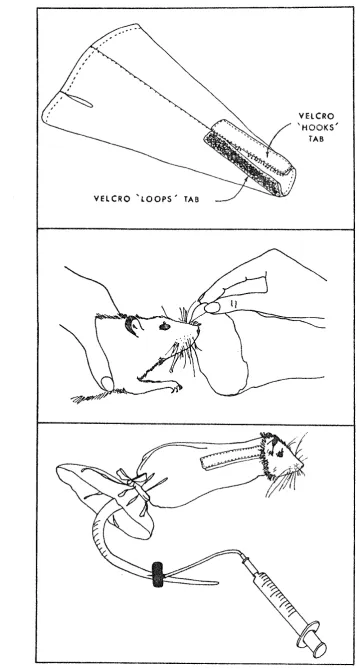
in this research was confinement in a rat bag of the type
described by Bellingham (1980). A velcro tab at the narrow
end of the bag was secured around the animal's neck, being
narrower than either the head or shoulders and serving to
ensure that the animal could neither advance nor retreat.
The wide end of the bag was gathered and tied around the
base of the tail, completing the animal's immobility and
leaving only the tail protruding from one end and the head
protruding from the other. Figure 1 shows a rat confined in
this manner. It was important for two reasons that the head
should not be confined, Firstly, rats will chew their way
readily out of bags where the head is confined. Secondly,
one experiment required the animals to drink at the same
time as they were being injected. A third reason
(accessibility of the head for establishing degree of
anaesthesia) eventually did not prove to be a consideration,
because anaesthetic studies were not proceeded with. It is
worth noting, however, the suitability of this prepatation
for repeated administration of anaesthetic drugs over a long
20.
VELCRO 'LOOPS' TAB
VELCRO 'HOOKS'
[image:27.595.113.473.23.693.2]TAB
Figure 1. A rat confined in a rat bag. From "An
effective, cheap and relatively non traumatizing rat restrainer" by W.P. Bellingham, Behavioral Research Methods and Instrumentation, 1980, In press.
21.
(c) Pretesting
Animals were tested on either the third or fourth day
after training. The intervening days were identical to
pretraining days, and on the last of these (ie the day
before test day) each animal's consumption of water was
measured as an index of overall fluid consumption
independent of any aversive factor. This was the pretest
measure.
(d) Testing
In the case of the one bottle procedure, testing was
accomplished by substituting saccharin solution for tap
water in the drinking bottle of every rat for that day. The
concentration of saccharin used on test day was 0.1% in
tapwater. An aversion was deemed to be present if the
experimental animals drank significantly less saccharin
solution on test day than the control animals,
In the case of the two bottle procedure, testing was
accomplished by substituting saccharin solution for water in
one of the two drinking bottles of every rat for that day.
Each rat, therefore, was able to exercise choice between
saccharin solution and tap water. The bottle containing
saccharin solution was always inserted into the bottle
holder on the left hand side of the cage, and always before
the bottle containing tap water, This procedure ensured
that every rat tasted the saccharin solution on test day and
that any rat which drank tap water exclusively for the ten
22.
of the presence of saccharin solution in the other bottle
(i.e., without the active exercise of choice). The
concentration of saccharin solution in the saccharin bottle
on test day was
o.st.
An aversion was deemed to be presentif the experimental animals showed significantly less
preference for saccharin solution over tap water on test day
than the control animals. Saccharin preference is expressed
in terms of a preference ratio for each rat. The preference
ratio is the volume of saccharin solution drunk on test day
expressed as a function of (divided by) the total volume of
fluid (both saccharin solution and tapwater) drunk on that
day. The preference ratio may range from zero (for
exclusive consumption of tapwater) to one (for exclusive