A COMPARATIVE STUDY ON CERVICAL
LYMPH NODE PATHOLOGY
DISSERTATION SUBMITTED FOR M.S. DEGREE
IN GENERAL SURGERY
BRANCH I
THE TAMILNADU DR.M.G.R. MEDICAL
UNIVERSITY
CERTIFICATE
This is to certify that the dissertation titled “A COMPARATIVE STUDY ON CERVICAL LYMPH NODE PATHOLOGY”is the original work done by
Dr. N. SELVARAJ, Post Graduate in Department of General Surgery, Madras Medical College, Government General Hospital, Chennai-3, to be submitted to The Tamilnadu Dr. M.G.R. Medical University, Chennai-32 towards the partial fulfillment of the requirement for the award of M.S. Degree in General Surgery, September 2006.
Prof. Dr. G. SIVAKUMAR Prof Dr. P. G. KULANDAIVELU
Unit Chief Professor & HOD
Department of General Surgery Department of General Surgery Madras Medical College Madras Medical College Chennai - 600 003. Chennai – 600 003.
DEAN
ACKNOWLEDGEMENT
I wholeheartedly thank our beloved Dean Dr.KALAVATHY
PONNIRAIVAN, Government General Hospital, Madras Medical College
for having permitted me to carry out this study and to utilize the clinical material and the facilities in Madras Medical College, Chennai during the period of Jan-2004 to Feb-2006.
I am greatly indebted to Prof. Dr. P.G.KULANTHAIVELU, Professor& Head of the Department of Surgery, Goverment Madras Medical College for having guided me throughout the period of this work.
Dr. V. RAMADEVI, Dr. V. CHITRA, and Dr. M. MANIKANDAN, for
their valuable advice, encouragement and help rendered during the entire period of study.
I sincerely thank my family, my colleagues and my fellow postgraduates for their help and support.
CHAPTER TITLE PAGE NO.
ACKNOWLEDGEMENT
CONTENTS
I. INTRODUCTION 1
II. AIM AND OBJECTIVE 3
III. REVIEW OF LITERATURE 4
IV. MATERIALS AND METHODS 31
V. OBSERVATION 37
VI. DISCUSSION 41
VII. CONCLUSION 55
REFERENCES
I- INTRODUCTION
Fine needle aspiration cytology is the study of cells obtained by a small gauge needle generally with a vacuum system provided by an airtight syringe. This technique has been in use for studying pathological lymph node enlargement since.
Lymph node enlargement may be due to a variety of underlying diseases both benign and malignant. The clinical examination may be inaccurate in differentiating benign from neoplastic enlargement of the lymph node.
Although surgical excision of a palpable peripheral lymph node is relatively simple it does require anesthesia, strict sterility and theatre time and it leaves behind a scar.
The primary purpose of fine needle aspiration biopsy of an
abnormal peripheral lymph node is to decide on further course of treatment whether medical, surgical or observation. The alternatives are to just observe the patient, to carry out further investigations or try a course of conservative treatment for example with antibiotics. Obviously there are practical and psychological advantages if this decision can be made within a day.
The accuracy of diagnosis has improved considerably over the past few years. Therefore FNAC has got a definite role in the initial evaluation of all patients with peripheral lymphadenopathy.
II – AIM AND OBJECTIVE
The purpose of the study is
1. To assess the usefulness of FNAC in the diagnosis of cervical lymph node enlargement.
2. To study the cytological features of common pathological conditions affecting the lymph nodes viz., tuberculosis, and lymphoma and secondary malignancy.
III – REVIEW OF LITERATURE
“Many observations have been made by morphologists and pathologists interested in normal and morbid cytology and its diagnostic possibilities. This impressive volume of work did not reach a stage of recognition for decades until finally its cumulative force strengthened by the impact of new contributions caused a break in the dam of inertia and scepticism that
blocked its progressive course” – Papanicolaou (1883-1962)– the father of exfoliative cytology 3.
Kun7 introduced needle aspiration in 1841. Erichson (1853) adopted this
Fine needle aspiration of lymph nodes has been around for quite a long time. In 1904 Greig and Gray4, 5 isolated trypanosomes by aspirating lymph
nodes in patients with sleeping sickness. The technique has subsequently been used to study both benign and malignant diseases.
However, the procedure did not gain wide acceptance in medicine at that time. In the 1930s, Memorial Sloan Kettering2, 7 rediscovered the utility
of needle biopsy of head and neck masses. The use of large-bore needles at that time led to frequent complications, one of which was occasional
Forkner (1927) 9, Martin and Ellis (1930) 8, 10, 11and Stewart (1933) were
the pioneers in using fine needle aspiration for lymph node enlargement. This procedure gradually gained momentum through the efforts of Franzen, Zajicek 6 and Sodernstorm in Sweden and now it has become an extremely
well documented technique in the diagnosis of palpable/ localized masses.
In India the technique was first introduced at PGI, Chandigarh in the early seventies followed by AIIMS, New Delhi, in the mid seventies 8, 12.
The assumption that aspiration biopsy spreads malignancy appears theoretical rather than actual. Zajicek and Engzell 16 found no clinical
evidence of tumor dissemination along the needle tract after a long follow-up of lymph node FNAC (1971).
ADVANTAGES OF FNAC 8,32
(i) Office procedure – neither anaesthesia nor patient preparation required
(ii) Eliminates lengthy periods of “watchful waiting”
(iv) Cost-effective 32
(v) High Specificity
(vi) Readily repeatable 23
(vii) Obviates (in many cases) the need for frozen sections24
Special studies like Electron Microscopy or ImmunoHistoChemistry can be used to establish a diagnosis on FNAC.
The emergence of the AIDS epidemic in recent years has greatly increased the number of the patients presenting with lymph node
enlargement. The exclusion or confirmation of malignant lymphoma and other malignant processes by FNB is of great practical importance in these patients, since it may obviate the need for surgical excision.
is not indicated, unless the subsequent course is atypical. Clinical follow-up is justified in all cases in view of the small but significant rate of false-negative cytological reports.
DIAGNOSTIC CRITERIAS
Diagnosis is made by examination with a scanning and low power microscope.
CRITERIA OF MALIGNANCY
Cellularity
Discohesion
Monomorphism
Anisonucleosis
Nuclear crowding and piling
Indistinct cell borders
Nuclear Cytoplasmic ratio alteration
Clumped chromatin
CRITERIA OF BENIGN LESION:
Relative paucity of cells
Cohesion
Polymorphism
Nuclear membrane regularity
Nuclei of same size
Polarity
PATHOLOGY OF CERVICAL NODE
Cervical node involvement in malignancy is grouped as Zone I includes submandibular and submental nodes.
Zones II to IV encompasses lymph nodes along the jugular vein region deep
to the sternocleidomastoid muscle in the upper, mid, and lower neck.
Zone V contains nodes that lie posterior to the sternocleidomastoid muscle.
These posterior neck nodes are commonly enlarged with viral infections (eg, mononucleosis) but can also be a site of metastasis for several head and neck cancers.
Zone VI lies between the carotid sheaths bilaterally and contains
prelaryngeal and pretracheal nodes that drain the larynx and thyroid gland.
NEOPLASMS
Squamous cell carcinoma
Squamous cell carcinoma is the commonest type of primary
22
. Well-differentiated squamous carcinoma has a tendency to undergo liquefactive degeneration. The aspirate may resemble pus but is more often clear and yellow with a mucoid, viscous consistency.
Extremely dense, globoid, kertinised anucleate cells and cells with bizarre shapes are virtually diagnostic of malignancy. Some authors also report that in squamous cell carcinoma of the head and neck,surgical biopsy prior to definitive surgery may adversely affectprognosis22.
Nasopharyngeal carcinoma
Criteria for diagnosis (undifferentiated)
1. Undifferentiated malignant cells, single and in compact aggregates. 2. Scanty but well-differentiated eosinophilic cytoplasm.
3. Basaloid cells
4. Normal lymphoid cells in the background .
Nasopharyngeal carcinoma frequently presents to the cytologist as a lymph node metastasis in the neck without a known primary. Cytological recognition is important since the primary is often clinically occult.
Criteria for diagnosis
1. Neoplastic cells single and in poorly cohesive clusters often with a vaguely follicular arrangement.
2. Abundant but poorly defined, pale cytoplasm with fine red granularity 3. Nuclei round to spindle with finely granular, evenly distributed nuclear chromatin; moderate anisokaryosis.
4. Samples heavily admixed with blood.
Granulomatous Adenitis:
Criteria for diagnosis
1. Histiocytes of epithelioid type forming cohesive clusters. 2. Multinucleated giant cells of Langerhan’s type.
3. Epithelioid cells are quite characteristic of smears from lymph nodes. They have elongated nuclei, the shape of which can be described as resembling the ‘sole of a shoe’.
METASTATIC MALIGNANCY
Criteria for diagnosis
1. Foreign cells among normal/relative lymphoid cells.
2. Cytologic criteria of malignancy.
Problems in diagnosis
1. Representative sampling - small metastatic deposits in a reactive lymph node.
2. Benign epithelial, mesothelial or naevoid inclusions. 3. Necrosis or cystic change.
4. Malignant lymphoma.
5. Pseudoepithelial clustering of lymphoid cells or histiocytes in bloody smears.
Special situations
TESICULAR TUMOURS
FNAC findings of testicular tumour
to pelvic, para-aortic or supraclavicular nodes. The cytological pattern of seminoma is characteristic. The tumor cells are mainly dissociated and are mixed with lymphocytes and epithelioid cells. They have large, rounded, vesicular nuclei and an evenly distributed nuclear chromatin. The cytoplasm is dispersed forming a ' tigroid ' background to the nuclei.
PAPILLARY CARCINOMA35, 36, 39
.
FNAC findings of papillary carcinoma
1. Cellular smears.
2. Syncytial aggregates and flat sheets of cells with a distinct ‘anatomical ’ border, nuclear crowding and overlapping.
3. Papillary tissue fragments with or without a fibrovascular core.
4. Enlarged, ovoid, pale nuclei, finely granular, powdery chromatin (pap). 5. Multiple distinct nucleoli; intranuclear cutoplasmic inclusions; nuclear
grooves.
10. Macrophages and debries multinucleate giant cells and lymphocytes variable.
LYMPHOMA
The role of cytology in the diagnosis of lymphoma has become more clearly defined: it is to confirm a clinical suspicion of lymphoma or to exclude it with the highest possible confidence. A cytological diagnosis of NHL is confirmed by open biopsy and histological examination - especially to study the growth pattern - and by immune marker studies necessary for definitive diagnosis and subtyping. A negative cytological diagnosis needs to be supported by clinical observation.
Although FNA biopsy does not replace histological examination in the diagnosis of lymphoma, it is still of value in the management of these patients of the following reasons.
2. A representative node can be selected for surgical biopsy by FNB
sampling of multiple nodes. The biggest or the most easily accessible node is not always the most suitable and may show only reactive change.
3. If a diagnosis or suspicion of lymphoma is known beforehand steps can be taken to ensure that the node is sent fresh to the laboratory without fixation, so that a complete immunhistochemical investigation can be carried out. 4. Saving time and avoids anaesthesia.
5. For staging purposes FNA biopsies in different sites may be performed. 6. Suspected recurrent or residual disease in patients with previously
confirmed lymphoma can in most cases be diagnosed by FNB alone without the need for a formal biopsy. A change in the type of lymphoma will also usually be recognized.
HODGKIN’S DISEASE
Criteria for diagnosis.
1)Typical Reed-Sternberg cells or their mononuclear variants. 2)Atypical mononuclear cells ('Hodgkin cells')
5)Immunophenotype: 'classic' Hodgkin's disease: Reed-Sternberg cells, CD30, CD15; small lymphocytes pan T. lymphocyte predominant type: Reed-sternberg cells pan B, CD45, #MA; small lymphocytes pan B.
Subtyped as – Mixed cellularity, Lymphocyte predominant, Lymphocyte depleted, and Nodular Sclerosis.
Problems in diagnosis OF Hodgkin’s lymphoma 1. Poor biopsy yield
2. Reed-sternberg look-alike cells in other conditions.
3. Epitheloid histiocytes suggestive of granulomatous lymphadenitis. NON – HODGKIN’S DISEASE
The working formulation classification, which identifies the lymphomas according to their grade and is therefore of prognostic and therapeutic significance is followed.
LOW GRADE
Small lymphocytic
Follicular mixed small cleaved
Large cell.
INTERMEDIATE GRADE
Follicular predominantly large cell
Diffuse small cleaved cell
Diffuse mixed small and large cell
Diffuse large cell
HIGH GRADE
Large cell immunoblastic
Lymphoblastic
Problems In Diagnosis Of Lymphoma
1. Suboptimal cytological preparations. 2. Variable pattern in one node.
3. Distinction from reactive lymphadenopathy .
4. Malignant Lymphoma with few neoplastic cells in a dominant population of reactive lymphoid cells, e.g. T-cell rich B lymphoma.
5. Small cell anaplastic carcinoma and other small cell tumors, particularly versus Malignant Lymphoma- mantle cell and lymphoblastic type.
6. Large cell undifferentiated carcinoma and melanoma versus large cell lymphoma, especially Malignant Lymphoma CD 30 positive.
7. Effects of chemotherapy and radiotherapy.
REACTIVE HYPERPLASIA
The reactive node Criteria for diagnosis
3. Centroblasts, centrocytes, immunoblasts and plasma cells in variable but 'logical' proportions.
4. Dendritic reticulum cells associated with centroblasts and centrocytes (representing germinal centres).
5. Scattered histiocytes with intracytoplasmic nuclear debris (tingible body macrophages).
6. Pale histiocytes, interdigitating cells, endothelial cells, eosinophils, neutrophils (variable).
It is the commonest change observed in enlarged nodes.
The characteristic features, which differentiate it from lymphoma, are
1.Mixed population of cells representing the whole range of
transformation from small lymphocytes to immunoblasts and plasma cells.
2. A predominance of small, sometimes slightly larger 'stimulated' lymphocytes, which have small round nuclei and a characteristic chromatic pattern of large ill-defined condensations.
1. Follicular hyperplasia with large germinal centres 2. Follicular lymphoma.
3. Paracortical hyperplasia with prominent immunoblastic and plasmacellular reaction.
4. Prominent histiocytic component.
EVALUATION OF NECK NODES
Algorithm of the practical approach to cervical adenopathy
Clinical history and physical examination Complete head and neck examination
FNAC
Chest X-Ray
Inconclusive
- Clinical follow-up
- Open biopsy - Repeat FNA
Benign Malignant
Hyperplasia TB Consider open biopsy for confirmation Metastatic epithelial carcinoma
METHODOF REPORT
Definition of Terminology
There is a difficultywhen comparing results and techniques from different centers.For the purpose of the current study, we have defined severalterms as follows
Adequate sample: Sample adequacy was a subjective judgementmade by the histopathologist. A specimen was deemed adequateif the lesion was correctly sampled and if sufficient materialwas present for a diagnosis to be rendered.
False-negative biopsy result: A biopsy result was consideredto be false negative when the tissue sample was thought to be adequate but histologic diagnosis indicated benign disease whenthe final diagnosis was of
malignancy.
False-positive biopsy result: A biopsy result was consideredto be false positive when the tissue sample was thought to be adequate but histologic diagnosis indicated malignant diseasewhen the final diagnosis was of benign disease.
DIAGNOSTIC PITFALLS35
1. Inexperience
2. Fibrosis
3. Necrosis
4. Difficulty in classification of neoplasm.
Geographic miss and lack of representative and sufficient material may be result of inept technique.
Small nodal metastases can be missed and very well differentiated squamous cell carcinoma can cause problems.
The size of the lymph node also influences the adequacy of the aspirate.
Satisfactory samples, both quantitatively and qualitatively, and unequivocal criteria of malignancy are prerequisites for positive diagnosis. Fibrosis hinders the release of cells from the matrix and leads to false negative results.
If the patient has had radiotherapy, it may be difficult to locate a small recurrence in an area of post-radiation oedema and fibrosis
The distinction between an inflamed branchial cyst and a node
metastasis of well-differentiated squamous cell carcinoma with liquefactive necrosis is a particular problem.
lymph node aspirates.
Several of the reported studies in which the Kiel classification of non- Hodgking’s lymphoma was applied to cytological preparations recorded an acceptable level of accuracy of both diagnosis and classification. However, as a rule histology is necessary - 'no meat, no treat' - to be able to determine the prognostically important growth pattern and also the cellular
composition of the tissue section, which is not per se reflected in the aspirated cell sample.
.
ACCURACY OF DIAGNOSIS
The accuracy of FNAC of lymph nodes in the diagnosis of metatstatic malignancy is influenced by factors such as the size and site of the node, fibrosis, previous irradiation and the number of punctures made. Adequate material can easily be obtained from nodes only a couple of millimetres in diameter in a cervical or supraclavicular position. Fibrosis in nodes
DIFFICULT SITUATIONS
When the mass lesion is hypervascular, sampling obtained by non-aspiration method.
Non-aspiration sampling with a 25-gauge needle is recommended8.
Zajdela 8 recommended needle biopsy without aspiration based on the observation that the capillary pressure in a fine needle is sufficient to keep the scraped cells inside the lumen. In this technique a 25-23 gauge needle is held directly with the finger tips, is inserted into the target lesion and is moved back and forth in various directions within the lesions to an extent that depends on the cellularity and the vascularity of the tissue8.
DIAGNOSTIC ACCURACY IN VARIOUS SERIES
Ashok saha et al 16 in their study of 140 cases of cervical lymph node
Martelli G. Pilotti et al 198918 here analysed critically 266 cases of FNAC
of superficial lymph nodes and reported an over all diagnostic accuracy of 95-100% for benign and malignant lesions.
Engzell.U. & Zajicek.J6 presented the largest series of metastatic lymph nodes describing 1101 cases and reported a diagnostic accuracy of 90-95%.
References to Indian literature include the study of FNAC in the diagnosis of tuberculosis by Author M. & Ali.M.A. in 198517 who reported
high specificity of 90-95%.
Series of 103 cases of Primary and Secondary lymph nodes ‘comparing FNAB with excision biopsy by Anand Kumar et al 14 1994
obtaining histopathological correlation in 90% of cases.
In patients with lymphoma, tissue diagnosis is essential fortreatment both at initial presentation29 and at possiblerelapse. The value of cytologic
examination in lymphoma is controversial.In specialized laboratories, the diagnostic accuracy of FNACin lymphoma approaches 79%–90%30, 31 .
genetics, are notuniversally available. In practice, the accuracy of FNAC in the assessment of lymphoma is approximately 20% less than itsaccuracy in carcinoma32.
Fine needleaspiration is most sensitive at detecting anaplastic (almost 100%) and papillary (around 90%) carcinomas33, 34. Diagnosing metastatic or
recurrent malignancy by FNAC generallyhas a high specificity and sensitivity32.
Complications like hematoma, infarction of the node and sepsis were few and negligible13.
There are no reported malignancy following core biopsyof superficial lymph nodes33 , and there are only 12 reportedcases in the literature
following FNAC. In a large series ofcutting-needle biopsies in the head and neck, Southam et al34 found no cases of needle-track metastases after up to 7 years of follow-up.
abdominal node biopsy. The use of needles larger than ZIG, multiple passes and absence of normal parenchymal zone surrounding the malignant zone appear to increase the risk.
CONTRAINDICATIONS FOR FNAC:
None
COMPLICATIONS
Hematoma
Sepsis
Tumor implantation along the needle track.
Serious complications have been reported following FNB or carotid body and glomus jugulare tumors. Confirmation by radiological
IV – MATERIALS AND METHODS
The cytological material for this study was obtained from 100 patients who presented to the general surgical department with cervical
lymphadenopathy. The study period was between Jan2005 and March -2006. The patients were examined clinically after taking a detailed
history,FNAC was done on the same day. Prior to performing the procedure the patient was always informed.
The equipments used
1. Spirit soaked cotton swab
2. 10 ml disposable syringe
3. 22 G disposable needle
4. 5 Glass slides
PROCEDURE
Patient was made to lie on a table. The mass was localized and skin prepared with a spirit swab. No local anaesthesia was used. About 5 ml of air was aspirated into the syringe before the introduction of the needle into the mass, which was held between the finger and thumb of the other hand. This is to obtain a uniform distribution of aspiration material on the glass slide. The needle was introduced into the mass. Once the mass was entered the syringe was pulled to full suction and the needle advanced 3 to 5 times to various foci within the mass. With the continued suction, till fluid or
cellular material was seen to enter the hub of the needle. Care was taken to ensure that the material was not
The needle contents were then expressed to glass slides by touching the needle to surface to prevent air-drying and a smear was made in a manner similar to that for a blood film. At least 5 smears were made, one was air-dried and the others were immediately placed in the ether-alcohol fixative.
MODIFICATIONS SUGGESTED INCLUDE
The use of a syringe holder that leaves one hand free to immobilise and feel the target lesion.Needle biopsy without aspiration on the basis that maintained negative pressure only increases the amount of blood aspirated.
Indirect smearing – If thin fluid is aspirated it is best processed by cytocentrifuge. Cell suspension is prepared by rinsing the aspirate
containing needles in Hank’s balanced salt solution, which is, then span in a cytocentrifuge. Smears of this type are particularly valuable in lymphoma.
The smears were stained with Eosin-Hematoxylin.
After the advent of supplementary techniques, the precision of cytologic diagnosis has improved vastly
ELECTRON MICROSCOPY
Helps in the unequivocal identification of cell type or differentiation and aids in sub-classification especially lymphoma.
SPECIAL STAINS
The use of PAS / Alcian blue for mucin in adenocarcinoma deposits . Congo red for amyloid (medullary carcinoma), formaldehyde induced fluorescence for melanin precursors are some of the examples.
IMMUNOHISTOCHEMISTRY
The increasing availability of monoclonal antisera to a variety of cell products which are specific to different cell lines is the most significant recent development in cytology. This is especially useful in differentiating anaplastic carcinoma and malignant lymphoma.
Immunohistochemistry is a method of detecting the presence of specific proteins in cells or tissues and consists of the following steps21 :
2) antibody-antigen complex is bound by a secondary, enzyme-conjugated, antibody;
3) in the presence of substrate and chromogen, the enzyme forms a colored deposit at the sites of antibody-antigen binding.
Tab: Immunohistochemical characterization of anaplastic tumours
Antibody against Nature of tumour
Cytokeratin Epithelial Epithelial membrane antigen Epithelial
Leucocyte common antigen Lymphoid
Vimentin Mesenchymal, lymphoid
Desmin Muscle
Actin Myoepithelial
Neuron-specific enolase Neuroendocrine, neuronal
S100 Melanocyte, nerve sheath
Factor VIII Endothelial
MICROBIOLOGY
Culture studies can be carried out from the aspirate material to establish a specific diagnosis e.g. in granulomatous adenitis.
MORPHOMETRY
Includes computer assisted image analysis, single cell micro-
spectrophotometry and flow cytometry applied to FNA preparations. This is a good indicator of prognosis e.g. in lymphoma. It also helps in
V – OBSERVATION
A total of 100 patients were subjected to FNAC of cervical lymph nodes using a 22G needle on a 10 ml syringe. HPE correlation has obtained in 73 patients, since remaining 27 patients were diagnosed as non-specific
lymphadenitis. They were treated with antibiotics and followed –up in the out patient department. The 73 patients were subjected to surgical excision routinely as part of the study or a part of radical dissection and HPE
correlation obtained.
Break up of the cases according to the histology is given in the Table, which follow1: -
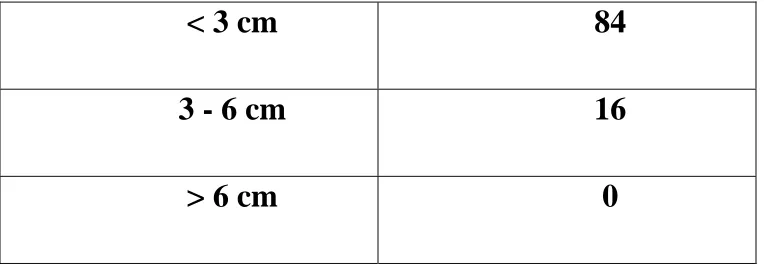
The size of the nodes, which were, sampled range from 1 – 6 cm. No complications occurred in the series. All inadequate and inconclusive aspirations were repeated.
METASTATIC LYMPHADENOPATHY
The type was not specified in 4 smears and only a diagnostis of positive for malignant cells was given. Also the correlation was inaccurate in 2 cases where adenocarcinoma and squamous cell carcinoma were reported as
anaplastic carcinoma.
Among the 3 false negatives, 2 cases on histopathological examination showed partial replacement of the nodes by malignant cell. The samples were therefore not representative. The otherone was a cystic metastasis from occult papillary carcinoma of thyroid reported as a benign cystic lesion.
LYMPHOMA
Of the 15 cases of lymphoma confirmed by histopathology, 8 cases were reported to be Non-Hodgkin’s and 7 Hodgkin’s disease.
6 cases of Hodgkin’s were identified by FNAC and the false negative locked typical R-S cells. Sub-typing was accurate in 10 out of the 15 cases. High-grade lymphomas are readily recognized.
The overall diagnostic accuracy was 87%
TUBERCULOSIS
Of the 25 cases identified by histopathology correlation with FNAC was obtained in 22 cases. The diagnostic accuracy was 88%.
In 2 cases a non-specific diagnosis of granulomatous adenitis was reported.
BREAK – UP CASES ACCORDING TO HISTOLOGY Disease HPE +ve FNAC +ve %
Tuberculous Lymphadenitis 25 22 -
Malignant Disease 48 43 -
Lymphoma 15 13 87%
Metastatic adenocarcinoma 5 3 60%
Metastatic squamous cell Ca. (Primary known)
9 9 100%
Metastatic squamous cell Ca. (unknown primary)
6 6 100%
Metastatic thyroid carcinoma
6 5 83%
Metastatic Anaplastic carcinoma
7 7 100%
VI – DISCUSSION
FNAB is an effective way to diagnose the pathological process underlying lymphadenopathy.
The diagnostic accuracy in various series ranges from 85% to 100%. Diagnostic accuracy in this study was 88% for benign lesion and 89% for malignancy. It is comparable with various studies25, 26, 27, 28.
The high rate of accuracy and its simplicity here resulted in FNAB occupying an important place in the initial evaluation of cervical
lymphadenopathy. It is still not considered as an alternative to
histopathological examination of the node. The extent to which therapeutic decisions can be made solely on the basis of FNAB alone is a moot point.
- Local and possibly general spread of the disease.
- A false sense of security for the patient, who feels that the lump has been removed.
- Compromise of adequate radical dissection due to improperly placed incision.
- Wound infection delaying definitive surgery.
The advantage of FNAB lies in facilitating further work-up in the search of an occult primary tumor. The cytological patterns give clues to the site of the primary tumor.
Only when the primary cannot be found despite the evidence provided by FNAB and supplementary investigations and when this information is likely to be of therapeutic importance is a surgical excision of the node indicated.
Representative sampling – small metastatic deposits in a reactive node is the main cause of false negative report and may be missed even by repeated aspirations.
Benign epithelial inclusions of salivary gland origin and thyroid gland origin in cervical nodes have been observed. Although a rare occurrence this possibility should be kept in mind when only a few epithelial cells without obvious malignant features are found in aspirates.
If an aspirate consists of necrotic material it may be difficult to decide whether it represents caseous necrosis or tumor necrosis. Reaspiration should be done from the periphery of the node and examined for cells. Squamous cell carcinoma is particularly proven to undergo liquefactive necrosis.
There is a risk of mistaking cystic metastasis of a well-differentiated squamous cell carcinoma for a branchial cyst. Cystic nodes in the neck may also represent metastases from papillary carcinoma of thyroid.
carcinoma without recourse to immunocytochemistry or electron microscopy.
LYMPHOMA
Diagnostic sensitivity has been found to be lower for lymphoma than for metastatic Malignancy. For a diagnosis of lymphoma to be of clinical practical value it must identify good and bad prognostic subgroups and
therefore subtype according to one of the current classifications. Cytology is not reliable in this respect.
PROBLEMS IN DIAGNOSIS OF HODGKIN’S DISEASE
Poor biopsy field is a problem in the nodular sclerosis subtype. Use of Rotex screen needle may be necessary to obtain sufficient material.
Reed-Sternberg look alike cells may be present in other conditions like infectious mononucleosis and angioimmunoblastic lymphadenopathy.
may be very similar to Hodgkin’s. Finally an occasional example of large malignant cells with multilobated nuclei in a background of reactive
lymphoid cells, representing malignant cells of metastatic carcinoma which were misdiagnosed as Hodgkin’s lymphoma.
Clusters of epitheloid histiocytes are sometimes seen in smears of
Hodgkin’s and Non-Hodgkin’s and could suggest granulomatous adenitis. The lymphoid cells must always be carefully scrutinised in lymph node smears containing epitheloid cells.
PROBLEMS IN THE DIAGNOSIS OF NON-HODGKIN’S LYMPHOMA
Cytological subtyping requires experience and expert smear preparation. Smears of a cell suspension prepared in a cytocentrifuge and very helpful in the diagnosis and classification and are better suited for immune marker studies.
Pseudoglandular clusters may simulate small cell anaplastic or
adenocarcinoma. This problem occurs in follicular lymphomas. Immuno peroxidase staining for cytokeratin and panleucocyte marker can solve the problem of distinguishing between lymphoma and small cell carcinoma.
GRANULOMATOUS LYMPHADENITIS
The commonest cause in our set-up is tuberculosis. As seen in this series, tuberculosis can be diagnosed with a reasonable degree of accuracy.
The material aspirated can be used for identifying acid fast bacilli with Ziehl-Nielsen stain and for microbiological culture.
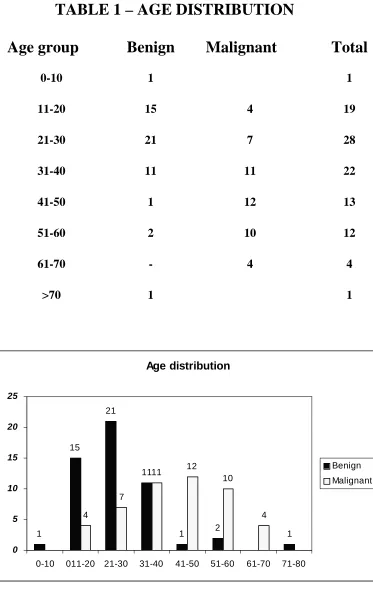
TABLE 1 – AGE DISTRIBUTION
Age distribution 1 15 21 111 2 1
4 7 11 12 10 4 0 5 10 15 20 25
0-10 011-20 21-30 31-40 41-50 51-60 61-70 71-80
Benign
Malignant
Age group
Benign
Malignant
Total
0-10 1 1
11-20 15 4 19
21-30 21 7 28
31-40 11 11 22
41-50 1 12 13 51-60 2 10 12
61-70 - 4 4
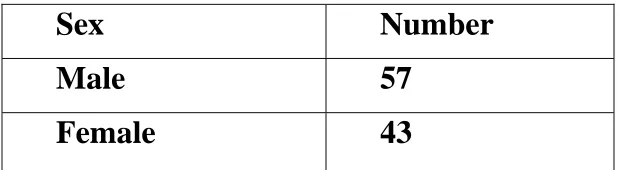
TABLE 2 – SEX DISTRIBUTION
Sex Number
Male
57
Female 43
Sex distribution
Male 57% Female
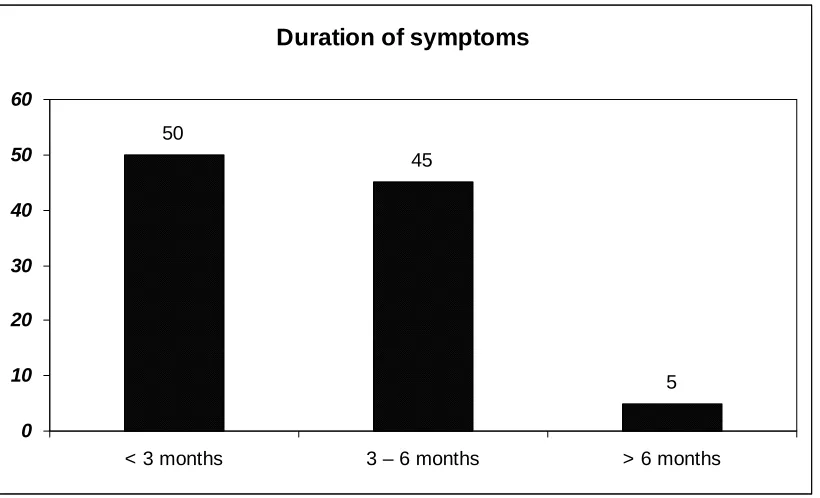
TABLE 3 – DURATION OF SYMPTOMS
Duration of symptoms
50
45
5
0 10 20 30 40 50 60
< 3 months 3 – 6 months > 6 months
Duration (in months)
Number
< 3 months
50
3 – 6 months
45
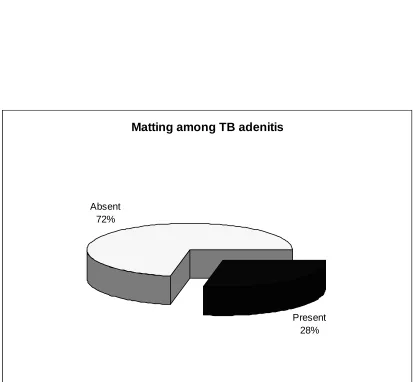
TABLE 4 – MATTED NODES IN TB ADENITIS
Matting among TB adenitis
Present 28% Absent
72%
Present 7
TABLE 5 – SIZE OF THE LYMPH NODES
< 3 cm
84
3 - 6 cm
16
> 6 cm
0
Size of nodes
84
16
0
0 10 20 30 40 50 60 70 80 90
Tab 6. FNAC RESULT IN LYMPHOMA
FNAC Result in Lymphoma
Positive 87%
False negative 13%
Positive False negative
Cytology + ve
HPE + ve
Tab 7. FNAC RESULT IN TUBERCULOSIS
FNAC + ve
HPE +ve
22 25
FNAC Result in Tuberculosis
Positive 88%
False negative 12%
TAB 8. FNAC RESULT IN METASTATIC
LYMPHADENOPATHY
FNAC +ve
HPE +ve
30 33
FNAC Result in metastatic nodes
Positive 91%
False negative 9%
VII – CONCLUSION
Fine needle aspiration forms one of the most important investigations in the initial evaluation of cervical adenopathy.
It is a very simple, uncomplicated outpatient procedure that offers a rapid and specific diagnosis with little trauma and is very cost-effective 32 . One of its major advantages is the early confirmation of a malignant disease
facilitating institution of immediate treatment.
It cannot be over emphasized that fine- needle aspiration is always part of the workup and not the final diagnosis. If the findings do not correlate with the clinical suspicion weight is given to the clinical picture and diagnostic work-up appropriate for the suspected disease is performed.
It should be borne in mind that a negative result on the fine-needle aspiration does not rule out malignancy. Proper use of fine needle aspiration requires close communication between an experienced cytologist and
The two fundamental requirements on which the success of FNA depends are representativeness of the sample and high quality of the
REFERENCES
1. Manual and Atlas of Fine Needle Aspiration Cytology – Churchill Livingstone Pub. – Ovell, Stewart, Wathers, Whitaker – 2nd Edition ’92 – pages 64-92 – Martin H. Untimely lymph node biopsy.
2. Am. J. Surg. 1961: 102: 17-18
3. Webb AJ: Through a glass darkly: The development of needle aspiration biopsy. Bristol Med Chir J 89: 59-68, 1974.
4. Greig E.D.W.: Note on the lymph node aspiration in sleeping sickness – Lancet 1.1570,1904
5. Frable, WJ. and Frable, MA. Fine Needle Aspiration Biopsy revisited; Laryngoscope; 1982, 92 (2), 1414.
6. The technique of FNAC has been described by Engzell et al(2). Engzell, U., Jakobbsen, PA. and Zajicek, J. Aspiration biopsy of metastatic
7. A new instrument for the diagnosis of tumors. Month J Med Sci 1847; 7: 853-4.
8. An Official Publication of Indian Academy of Clinical Medicine,, July-September2000, Volume 1 No 2.
9. Forkner C.E. Material from lymph nodes of man Arch. Int. Med.40: 532-537,1927.
10.Martins H.E and Ellis E.B.: Biopsy be needle puncture and aspiration – Ann. Surg. 92:162-181,1930.
11.Stewart E.W.: The diagnosis of tumors by aspiration Am. J. Pathol 9:801-812, 1933.
12.Chitale A.R. Metha S.L. Aspiration Cytology for diagnosis of palpable lumps – Ind.J.Surg-41: 11-16,1979.
14.Anand Kumar, Hariram, S. Khanna, K. Kumar – Ind. Jour Surg. 1994, 56 (5), 198-202 – Comparative study of Cytological vs Histopathological Methods in Malignant Lymphadenopathies.
15.Shaha A, Weber C, Marti g – Fine Needle Aspiration in the diagnosis of cervical adenopathy Am.J. Surg: 152:420-423,1986.
16.Engzell U, Jakkobson.P.A., Sigurdson.A. Zajicek.J. Aspiration biopsy of metastatic carcinoma in lymph nodes of the neck – a review of 1101 consecutive cases – Acta Octolaryngol 72:138-147,1971.
17.Bailey.T.M, Akhtar M., Ali.M.A, - Fine Needle aspiration biopsy in the diagnosis of tuberculosis Acta Cytol 29:732-736,1985.
18.Martelli Pilotti, Lepera P., Piromalli.D., - Fine Needle Aspiration
Cytology in superficial lymph nodes – a critical review of the results of 266 cases – Eur. J. Surg. Oncol 15:13-16,1989.
19.Webb AJ: Surgical aspects of aspiration biopsy cytology, Recent Advances in Surgery, Vol.II, 36-39,1982.
21.Ackerman’s Surgical Pathology – 7th Edition.
22.Kleid S, Millar HS. The case against open neck biopsy. Aust N Z J Surg 1993; 63:678-681.
23.Silverman JF, Lannin DR, O’Brien K, Norris HT. The triage role of fine needle aspiration biopsy of palpable breast masses: diagnostic accuracy and cost-effectiveness. Acta Cytol 1987; 31:731-736.
24.Brown LA, Coghill SB. Cost effectiveness of a fine needle aspiration clinic. Cytopathology 1992; 3:275-280.
25.Kline TS, Kannan V, Kline IK. Lymphadenopathy and aspiration biopsy cytology: review of 376 superficial nodes. Cancer 1984; 54:1076-1081. 26.Takes RP, Knegt P, Manni JJ, et al. Regional metastasis in head and neck squamous cell carcinoma: revised value of US with US-guided FNAB. Radiology 1996; 198:819-823.
27.Ramzy I, Rone R, Schultenover SJ, Buhaug J. Lymph node aspiration biopsy: diagnostic reliability and limitations—an analysis of 350 cases. Diagn Cytopathol 1985; 1:39-45.
29.Patt BS, Schaefer SD, Vuitch F. Role of fine-needle aspiration in the evaluation of neck masses. Med Clin North Am 1993; 77:611-623. 30.Fulciniti F, Vetrani A, Zeppa P, et al. Hodgkin’s disease: diagnostic accuracy of fine needle aspiration—a report based on 62 consecutive cases. Cytopathology 1994; 5:226-233.
31.Sneige N. Diagnosis of lymphoma and reactive lymphoid hyperplasia by immunocytochemical analysis of fine-needle aspiration biopsy. Diagn Cytopathol 1990; 6:39-43.
32.Bernardino ME. Percutaneous biopsy. AJR Am J Roentgenol 1984; 142:41-45.
33.Owen ER, Banerjee AK, Prichard AJ, Hudson EA, Kark AE. Role of fine-needle aspiration cytology and computed tomography in the diagnosis of parotid swellings. Br J Surg 1989; 76:1273-1274.
34.Southam JC, Bradley PF, Musgrove BT. Fine needle cutting biopsy of lesions of the head and neck. Br J Oral Maxillofac Surg 1991; 29:219-222. 35.Buley ID, Roskell DE. Fine needle aspiration cytology in tumour
diagnosis: uses and limitations. Clin Oncol 2000; 12: 166-71.
37.Gharib H, Goellner JR: Fine-needle aspiration biopsy of the thyroid: an appraisal. Ann Intern Med 1993;119: 282-9.
38.http://www.emedicine.com/ent/HEAD_AND_NECK_ONCOLOGY.ht
m
FNAC OF
METASTATIC SQUAMOUS CELL CARCINOMA
FNAC OF METESTATIC ADENOCARCINOMA
FNAC OF NON-HODGKIN’S DISEASE
FNAC OF FOLLICULAR HYPERPLACIA
ECTOPIC THYROID FOLLICLES IN LYMPH NODE.
HODGKIN’S DISEASE – LYMPHOCYTE PREDOMINANT
HODGKIN’S DISEASE – REEDSTERNBERG CELLS