Copyright © 1999, American Society for Microbiology. All Rights Reserved.
Analysis of Murine CD8
1
T-Cell Clones Specific for the
Dengue Virus NS3 Protein: Flavivirus Cross-Reactivity
and Influence of Infecting Serotype
ANNE C. SPAULDING, ICHIRO KURANE,† FRANCIS A. ENNIS,ANDALAN L. ROTHMAN* Center for Infectious Diseases and Vaccine Research, University of Massachusetts
Medical Center, Worcester, Massachusetts 01655
Received 21 July 1998/Accepted 5 October 1998
Serotype-cross-reactive dengue virus-specific cytotoxic T lymphocytes (CTL) induced during a primary dengue virus infection are thought to play a role in the immunopathogenesis of dengue hemorrhagic fever (DHF) during a secondary dengue virus infection. Although there is no animal model of DHF, we previously reported that murine dengue specific CTL responses are qualitatively similar to human dengue virus-specific CTL responses. We used BALB/c mice to study the virus-specificity of the CTL response to an
immuno-dominant epitope on the dengue virus NS3 protein. We mapped the minimal H-2Kd-restricted CTL epitope to
residues 298 to 306 of the dengue type 2 virus NS3 protein. In short-term T-cell lines and clones, the
predominant CD81 CTL to this epitope in mice immunized with dengue type 2 virus or vaccinia virus
expressing the dengue type 4 virus NS3 protein were cross-reactive with dengue type 2 or type 4 virus, while broadly serotype-cross-reactive CTL were a minority population. In dengue type 3 virus-immunized mice, the predominant CTL response to this epitope was broadly serotype cross-reactive. All of the dengue virus-specific CTL clones studied also recognized the homologous NS3 sequences of one or more closely related flaviviruses, such as Kunjin virus. The critical contact residues for the CTL clones with different specificities were mapped with peptides having single amino acid substitutions. These data demonstrate that primary dengue virus infection induces a complex population of flavivirus-cross-reactive NS3-specific CTL clones in mice and suggest that CTL responses are influenced by the viral serotype. These findings suggest an additional mech-anism by which the order of sequential flavivirus infections may influence disease manifestations.
The family Flaviviridae consists of over 65 arthropod-trans-mitted viruses that are known to infect humans. The dengue viruses, of which there are four serotypes, are the flaviviruses of greatest global health importance, causing an estimated 100 million infections each year (10, 28). Dengue hemorrhagic fever (DHF), the severe clinical form of dengue virus infection, has been shown to occur more frequently in individuals who have experienced a previous infection with a different dengue virus serotype (1, 37, 40), suggesting an immunopathologic basis for severe dengue illness.
Members of our laboratory have been studying memory den-gue virus-specific cytotoxic T-lymphocyte (CTL) responses in order to understand the potential protective and immuno-pathologic effects of these CTLs during secondary dengue virus infections. CD41and CD81CTL responses induced by pri-mary dengue virus infection have been characterized with bulk cultures and at the clonal level in a small number of adult human volunteers who were infected under experimental con-ditions with live tissue culture-passaged dengue viruses (8, 17, 18, 23, 27). Both serotype-specific and serotype-cross-reactive CTLs have been isolated from most subjects. Most serotype-cross-reactive CTLs have been directed at epitopes on non-structural proteins, particularly the NS1-NS2A and NS3 pro-teins. Several different patterns of cross-reactivity have been
observed; some CTL clones have recognized several but not all dengue virus serotypes, other clones have recognized all four dengue virus serotypes, and other clones have also recognized closely related flaviviruses, such as West Nile virus (WNV) (14). The frequencies of different CTL specificities have varied among the subjects studied; however, it has not been possible to relate these differences to host factors, such as HLA type, or differences in the viruses causing primary infections.
We previously reported that T-lymphocyte responses to pri-mary dengue virus infection in mice are qualitatively similar to human T-lymphocyte responses to dengue virus in bulk cul-tures and at the clonal level (34–36). Both serotype-specific and serotype-cross-reactive dengue virus-specific CTL clones were isolated from BALB/c mice, and the serotype-cross-reac-tive clones recognized epitopes on the NS1-NS2A and NS3 proteins. One CD81CTL epitope, recognized in the context of H-2Kd, was mapped to amino acids 296 to 310 of the dengue type 2 virus NS3 protein (34). This epitope is completely con-served in dengue type 4 virus.
To define further the potential importance of these memory dengue virus-specific CD81CTLs in secondary dengue virus infection, we analyzed in more detail the specificity of the NS3-specific CTL clones. As reported here, we noted that all four serotypes of dengue viruses as well as closely related flaviviruses showed a high degree of amino acid homology at the epitope mentioned above. Specific single amino acid dif-ferences in this epitope had different effects on recognition by different CTL clones, accounting for both dengue virus sub-complex-specific and dengue virus complex-cross-reactive pat-terns of responses. We also explored the effects of the infecting virus on the patterns of CTL responses generated.
* Corresponding author. Mailing address: Center for Infectious Dis-eases and Vaccine Research, University of Massachusetts Medical Center, 55 Lake Ave. North, Worcester, MA 01655. Phone: (508) 856-4182. Fax: (508) 856-4890. E-mail: [email protected].
† Present address: Department of Virology I, National Institute of Infectious Diseases, 1-23-1 Toyama, Shinjuku-ku, Tokyo 162-8640, Japan.
398
on November 9, 2019 by guest
http://jvi.asm.org/
MATERIALS AND METHODS
Cells.Target cell lines were the P815 murine mastocytoma line (H-2d), L929
(H-2k) cell lines transfected with Ld(T1.1.1) or Dd(T4.8.3) and provided by
Carol Reiss of New York University (26), and an L929 cell line transfected with
Kd(L-Kd-172) and obtained from Jack Bennick of the National Institutes of
Health (5). The control L929 cell line (DAP) was a gift from Carol Reiss.
Viruses.Mouse-adapted dengue type 2 virus (strain New Guinea C), type 3 virus (strain PR6), and type 4 virus (strain 814669) were kindly provided by Jack McCown of the Walter Reed Army Institute of Research. Tissue culture-adapted dengue type 2 virus (strain New Guinea C) was graciously donated by Walter Brandt, also of the Walter Reed Army Institute of Research, and was propagated in C6/36 cells. Recombinant vaccinia viruses expressing the dengue type 2 or type 3 virus NS3 protein were provided by Margo Brinton of Georgia State University (41), and a recombinant vaccinia virus expressing the dengue type 4 virus NS3 protein was provided by Ching-Juh Lai of the National Institutes of Health (6, 35).
Peptides. Synthetic peptides were prepared by 9-fluorenylmethoxycarbonyl chemistry with a Symphony automated peptide synthesizer (Rainin Instruments, Woburn, Mass.) at the Peptide Core Facility at the University of Massachusetts Medical Center.
Mouse immunization and preparation of spleen cells.Immunization of mice and preparation of clones from spleen cells were performed as previously de-scribed (34–36). Briefly, male BALB/c (H-2d) mice (Charles River Breeding
Laboratories, Wilmington, Mass.) were immunized at 4 to 8 weeks of age with dengue virus (0.2 to 0.3 ml containing approximately 13106PFU) or with one to three doses of recombinant vaccinia virus expressing the dengue virus NS3 protein (0.1 ml containing approximately 23107PFU). Splenocytes were col-lected 4 to 8 weeks after immunization and incubated in RPMI 1640 medium with 53105M 2-mercaptoethanol, 10% fetal calf serum (Hyclone Laboratories, Logan, Utah), and 0.5 ml of dengue virus or 1mM peptide. Approximately every 2 weeks, the cells were stimulated with either 23106gamma-irradiated dengue type 2 virus-infected P815 cells or 33107gamma-irradiated syngeneic nonim-mune spleen cells plus 1mM dengue virus NS3 peptide. Cells were fed twice weekly with medium containing 10% rat lectin-free T-cell growth factor as a source of interleukin 2.
Cytotoxicity assays. Cytotoxicity assays were performed as previously de-scribed (34, 35). Briefly, P815 cells were radioactively labeled by incubation with Na251CrO4for 1 h, washed extensively, and seeded at 0.53104cells per well in 96-well U-bottom plates. Serial dilutions of peptides were added directly to the target cells in the wells. The clones were then added at various effector/target cell ratios. The plates were incubated at 37°C for 4 h. The supernatant fluid was collected with a Supernatant Collecting System (Skatron, Inc., Sterling, Va.). A gamma counter detected the release of51Cr. Minimum51Cr release was mea-sured by sampling supernatant fluid from labeled target cells incubated in me-dium alone. Maximum51Cr release was determined from wells in which labeled target cells were incubated with Renex. Assays were performed in triplicate, and the mean of the samples was used to calculate percent specific lysis with the following formula: percent specific lysis51003[(experimental51Cr release2 minimum51Cr release)/(maximum51Cr release2minimum51Cr release)]. Min-imum51Cr release did not exceed 30% of maximum51Cr release. Lysis of peptide-coated target cells was considered significant when it was$8% more than lysis of target cells in the absence of peptides and values were found significantly different by the Student t test.
RESULTS
Identification of the minimal epitope recognized by
NS3-specific CTL clones. We previously mapped a dominant
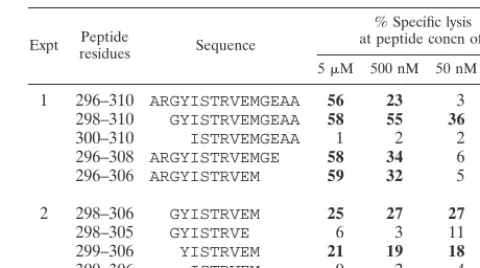
epitope on the dengue type 4 virus NS3 protein recognized by H-2Kd-restricted CD81CTL clones derived from dengue type 2 virus-immunized BALB/c mice to a 15-amino-acid region between residues 296 and 310, ARGYISTRVEMGEAA (34). To define further the specific epitope recognized by these CTL clones, we tested for the recognition of target cells incubated with truncations of this 15-mer. Data obtained with clone 2D65 are shown in Table 1; similar data were obtained with clone 2D42 (data not shown). Initial data suggested that the minimal sequence was the 9-mer representing residues 298 (G) to 306 (M). Analysis of recognition of this 9-mer peptide and trunca-tions thereof showed that the C-terminal methionine was re-quired for recognition by these CTL clones. The 8-mer peptide representing residues 299 to 306 could be recognized by these clones, but recognition of this peptide was reproducibly less efficient than recognition of the 9-mer peptide representing residues 298 to 306.
CTL clones derived from dengue type 2 virus-immunized mice recognize the corresponding sequence of dengue type 4
but not dengue type 1 or dengue type 3 virus.We previously
reported that the sequence of the 15-mer recognized by the CTL clones was completely conserved between dengue type 2 and dengue type 4 viruses (34). We next examined the pub-lished sequences to determine the corresponding sequences of other dengue virus serotypes and related flaviviruses (Table 2) (2, 3, 7, 13, 22, 25, 30, 33, 39). This analysis showed that this region of the NS3 protein is highly conserved among flavivi-ruses. Compared to the dengue type 2 or type 4 virus sequence, there was only a single amino acid difference at peptide posi-tion 8 in dengue type 1 and dengue type 3 viruses, a single amino acid difference at position 9 in Kunjin virus, and two amino acid differences in Murray Valley encephalitis virus. WNV and Japanese encephalitis virus had three amino acid differences, and the less closely related yellow fever virus had seven amino acid differences.
Since serotype cross-reactivity is most clinically relevant among the dengue viruses, we first tested for recognition of the dengue type 1 or type 3 virus sequence by the CTL clones (Fig. 1). Identical results were obtained with recombinant vaccinia viruses expressing the full-length NS3 proteins of dengue type 2, dengue type 3, and dengue type 4 viruses or synthetic pep-tides representing the dengue type 2 or type 4 virus or the dengue type 1 or type 3 virus sequences; none of six clones isolated from dengue type 2 virus-immunized mice recognized the dengue type 3 virus NS3 sequence.
Dengue type 4 virus NS3-immunized mice do have
serotype-cross-reactive CTL responses. We next tested whether the
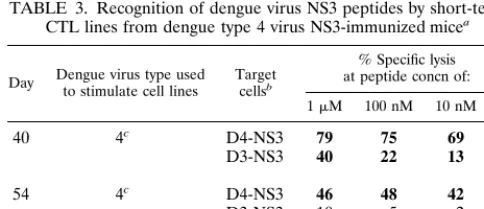
[image:2.612.311.551.93.227.2]dengue type 1 or type 3 virus NS3 sequences could be recog-nized by H-2Kd-restricted CTLs. Splenocytes from mice immu-nized with a recombinant vaccinia virus expressing the dengue type 4 virus NS3 protein were stimulated in bulk cultures with the dengue type 4 virus NS3 peptide (296 to 310) and tested for recognition of the dengue type 2 or type 4 virus and dengue type 1 or type 3 virus NS3 peptides (Table 3). At day 40 of culturing, the predominant response was specific for the den-gue type 4 virus NS3 sequence, but there was significant, if less efficient, recognition of the dengue type 3 virus NS3 peptide. This result suggested that serotype-cross-reactive CTLs were present but at a lower level than CTLs specific for the dengue type 2 or type 4 virus peptide. The bulk cultures were then split TABLE 1. Recognition of truncations of the dengue type 4 virus
NS3 peptide (residues 296 to 310) by CD81CTL clone 2D65a
Expt residuesPeptide Sequence
% Specific lysis at peptide concn of:
5mM 500 nM 50 nM 5 nM
1 296–310 ARGYISTRVEMGEAA 56 23 3 2
298–310 GYISTRVEMGEAA 58 55 36 10
300–310 ISTRVEMGEAA 1 2 2 2
296–308 ARGYISTRVEMGE 58 34 6 5
296–306 ARGYISTRVEM 59 32 5 3
2 298–306 GYISTRVEM 25 27 27 18
298–305 GYISTRVE 6 3 11 5
299–306 YISTRVEM 21 19 18 9
300–306 ISTRVEM 9 2 4 9
aRecognition of synthetic peptide-pulsed target cells was tested at effector/
target cell ratios of 4:1 in experiment 1 and 2:1 in experiment 2. Percentages of lysis of target cells in the absence of peptide were 2% in experiment 1 and 9% in experiment 2. Boldface values represent percent specific lysis significantly greater than that of the negative control.
on November 9, 2019 by guest
http://jvi.asm.org/
and restimulated with either the dengue type 4 or the dengue type 3 virus NS3 peptide. The CTL lines were then tested for recognition of both peptides. The CTL line restimulated with the dengue type 4 virus NS3 peptide maintained recognition of the dengue type 4 virus NS3 peptide but showed little if any recognition of the dengue type 3 virus NS3 peptide at day 54 of culturing. In contrast, the CTL line restimulated with the den-gue type 3 virus NS3 peptide showed a high level of cross-reactivity for both peptides. Both CTL lines recognized the target epitope in an H-2Kd-restricted manner (data not shown). These results suggest that serotype-cross-reactive CTLs were initially present at a low level but that they could be selectively expanded by stimulation with the dengue type 3 virus NS3 peptide.
We then used this stimulation protocol to isolate dengue virus serotype-cross-reactive CD81 CTL clones. Splenocytes from mice immunized with dengue type 4 virus were stimulated with the dengue type 3 virus NS3 peptide and cloned by lim-iting dilution. Five CTL clones were isolated; all recognized both the dengue type 4 and the dengue type 3 virus NS3 peptides in the context of H-2Kd(data not shown).
Dengue virus NS3-specific CTL from dengue type 3
virus-immunized mice are serotype cross-reactive. We wanted to
characterize further the serotype cross-reactivity of dengue virus NS3-specific CTL lines. We immunized mice with dengue type 3 virus to determine the pattern of CTL serotype cross-reactivity induced by the dengue type 3 virus NS3 epitope.
Splenocytes from dengue type 3 virus-immunized mice were stimulated in vitro with the dengue type 3 virus NS3 peptide and tested for the recognition of the dengue type 1 or type 3 virus and dengue type 2 or type 4 virus NS3 peptides (Table 4). These CTLs lysed target cells pulsed with either peptide, indi-cating that the predominant CTL response in dengue type 3 virus-immunized mice is broadly dengue virus serotype cross-reactive. These CTLs also lysed target cells infected with re-combinant vaccinia viruses expressing either the dengue type 2, dengue type 3, or dengue type 4 virus NS3 protein or target cells infected with dengue type 2 virus, indicating that these CTLs recognize the naturally processed epitope (Table 4). We isolated 14 CTL clones from this CTL line by limiting dilution; all the clones isolated recognized both the dengue type 3 and the dengue type 4 virus NS3 peptides in the context of H-2Kd (data not shown).
Flavivirus specificity of dengue virus NS3-specific CTL
clones.We next studied the specificity of the CTL clones for
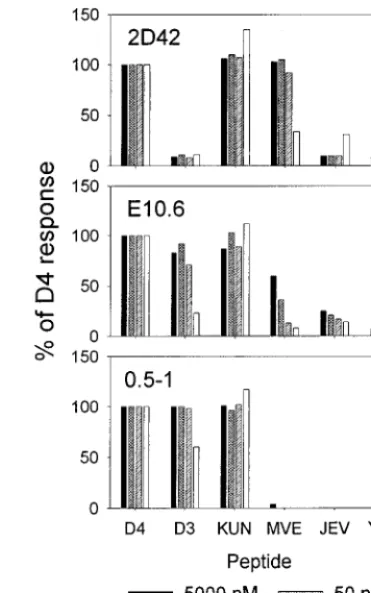
[image:3.612.313.546.70.223.2]other closely related flaviviruses. Representative data obtained with CTL clones each corresponding to the different specific-ities are shown in Fig. 2. Clone 2D42, which was generated from dengue type 2 virus-immunized mice after stimulation with dengue type 2 virus-infected P815 cells, did not recognize the dengue type 1 or type 3 virus peptide but did recognize the homologous peptides of Kunjin virus and Murray Valley en-cephalitis virus. Clone E10.6, which was generated from a dengue type 4 virus-immunized mouse after stimulation with the dengue type 3 virus NS3 peptide, recognized the NS3 peptides from all dengue virus serotypes and Kunjin virus. This clone could recognize the Murray Valley encephalitis virus sequence but less efficiently than clone 2D42. Clone 0.5-1, which was generated from dengue type 3 virus-immunized mice after stimulation with the dengue type 3 virus NS3 pep-tide, was similarly dengue virus serotype cross-reactive and able to recognize the Kunjin virus peptide but did not show any recognition of the Murray Valley encephalitis virus peptide. None of the three clones recognized the homologous peptides of Japanese encephalitis virus, WNV, or yellow fever virus.
FIG. 1. Dengue virus serotype specificity of CD81CTL clones isolated from
[image:3.612.52.293.91.195.2]dengue type 2 virus-immunized mice. Clones 2D42 (hatched bars) and 2D65 (open bars) were isolated from dengue type 2 virus-immunized BALB/c mice and tested at an effector/target cell ratio of 4:1. P815 target cells were uninfected (2); infected with dengue type 2 virus (D2V), wild-type vaccinia virus (vvCont), or recombinant vaccinia viruses (vv) expressing the full-length dengue type 2, den-gue type 3, or denden-gue type 4 virus NS3 proteins (vvD2NS3, vvD3NS3, and vvD4NS3, respectively); or pulsed with the dengue type 4 virus (residues 296 to 310) or dengue type 3 virus (residues 297 to 311) peptides (D4-NS3 peptide and D3-NS3 peptide, respectively) at 10mM.
TABLE 2. Sequences of dengue virus and related flaviviruses at the CD81CTL epitope
Virus Sequence Reference
Dengue type 4 298GYISTRVEM306 25
Dengue type 1 299---G-307 7
Dengue type 2 298---306 13
Dengue type 3 299---G-307 30
Kunjin 299---L307 3
Murray Valley encephalitis 299---A----A307 22 WNV 299---A-K--L307 2
Japanese encephalitis 299---A-K--L307 39
Yellow fever 303-WAAH-ARA311 33
TABLE 3. Recognition of dengue virus NS3 peptides by short-term CTL lines from dengue type 4 virus NS3-immunized micea
Day Dengue virus type usedto stimulate cell lines Targetcellsb
% Specific lysis at peptide concn of:
1mM 100 nM 10 nM —
40 4c D4-NS3 79 75 69 1
D3-NS3 40 22 13
54 4c D4-NS3 46 48 42 7
D3-NS3 10 5 2
433d D4-NS3 47 50 46 2
D3-NS3 41 36 25
aBALB/c mice were immunized with a recombinant vaccinia virus expressing the dengue type 4 virus NS3 protein. Boldface values represent percent specific lysis significantly greater than that of the negative control (no peptide [—]).
bP815 target cells were incubated with the corresponding peptides of dengue type 4 virus (D4-NS3) or dengue type 3 virus (D3-NS3).
cSpleen cells from immunized mice were stimulated in vitro with the D4-NS3 peptide.
dSpleen cells from immunized mice were initially stimulated in vitro with the D4-NS3 peptide for 40 days and then stimulated with the corresponding D3-NS3 peptide.
on November 9, 2019 by guest
http://jvi.asm.org/
[image:3.612.52.294.542.646.2]Identification of the critical contact residues for dengue
virus-specific CTL clones.The different patterns of
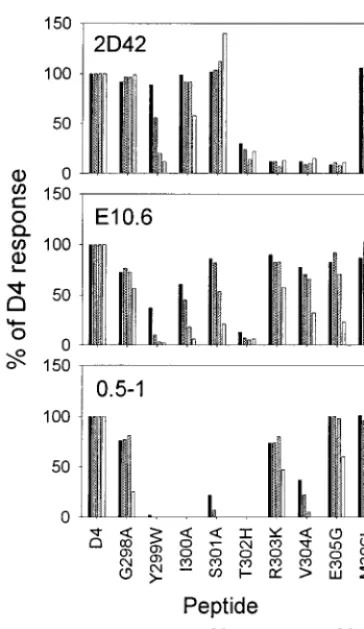
recogni-tion of related flaviviruses suggested that the clones differed in the critical contact residues of the NS3 peptide. To character-ize this idea further, we tested the three above-mentioned clones for the recognition of peptides with individual substitu-tions at each of the nine residues of the dengue type 4 virus NS3 sequence. To facilitate the comparison of the recognition of these peptides and the peptides of the related flaviviruses, we based the substitutions on the corresponding amino acids of other flaviviruses, except for position 1, where we substituted alanine for the conserved glycine. Recognition of these pep-tides by clones 2D42, E10.6, and 0.5-1 is shown in Fig. 3.
The second and ninth residues are most important for bind-ing to H-2Kd(32). Substitution of tryptophan for tyrosine at the second residue, as in yellow fever virus, abolished recog-nition by clones E10.6 and 0.5-1 and drastically inhibited rec-ognition by clone 2D42. Substitution of leucine for methionine at the ninth position, as in Kunjin virus, did not impair recog-nition by any of the clones, in keeping with the known suit-ability of leucine at this position for binding to Kd(32). Sub-stitution of histidine for threonine at the fifth residue, as in yellow fever virus, impaired recognition by all clones. Peptide recognition by clone 2D42 was also inhibited by substitutions at positions 6, 7, and 8, which included the single substitution in the dengue type 1 or type 3 virus peptide. In comparison, peptide recognition by clones E10.6 and 0.5-1 was inhibited most by substitutions at positions 3 and 4.
DISCUSSION
This study expands on our previous work showing that H-2Kd-restricted CD81CTL clones isolated from dengue type 2 virus-immunized BALB/c mice recognize a dengue type 2 and type 4 virus-cross-reactive epitope between amino acids 296 and 310 of the NS3 protein (34). We defined the minimal epitope as amino acids 298 to 306 of the dengue type 2 virus NS3 protein. We also generated additional CD81CTL clones that recognized the same epitope from mice immunized with dengue type 3 or dengue type 4 virus. We found that these CTL clones were either dengue virus subcomplex (dengue type 2 or type 4 virus) specific or broadly serotype cross-reactive. In
addition, all of these CTL clones recognized the corresponding sequences of one or more other flaviviruses.
The NS3 protein appears to be a dominant target for dengue virus-specific CD41and CD81T cells, and most dengue virus NS3-specific T cells are serotype cross-reactive (14, 27, 35). Multiple human CD41 T-cell epitopes on the NS3 protein have been identified (15, 19, 21, 29, 41). Although few human CD81T-cell epitopes have been mapped on the NS3 protein, bulk-culture CD81 CTL recognition of the NS3 protein was detected in six of eight dengue virus-immunized subjects in one study (27). CTLs from several mouse strains have been found to recognize the NS3 protein of dengue virus as well as other flaviviruses, including WNV, Murray Valley encephalitis virus, and Kunjin virus (11, 24, 31, 35). The abundance of T-cell epitopes on the flavivirus NS3 protein is not well explained. The relative conservation of the NS3 protein among flavivi-ruses suggests that the requirements for the enzymatic func-tions of this protein may restrict the ability of flaviviruses to survive mutations. The minimal peptide recognized by the H-2Kd-restricted CTLs that we studied, GYISTRVEM,
con-FIG. 2. Flavivirus specificity of CD81CTL clones. Clones 2D42, E10.6, and
[image:4.612.338.524.73.370.2]0.5-1 were tested in separate experiments. Virus sequences are designated as follows: D4, dengue type 4 (identical to dengue type 2); D3, dengue type 3 (identical to dengue type 1); KUN, Kunjin; MVE, Murray Valley encephalitis; JEV, Japanese encephalitis (identical to WNV); and YFV, yellow fever. Data are expressed as a percentage of the D4 response, calculated as 1003[(percent specific lysis of target cells incubated with indicated peptide)/(percent specific lysis of target cells incubated with the dengue type 4 virus peptide)]. For clone 2D42, the effector/target cell ratio was 1:1, and percentages of specific lysis were as follows: no peptide, 3%; 5,000 nM, 36%; 500 nM, 35%; 50 nM, 36%; and 5 nM, 30%. For clone E10.6, the effector/target cell ratio was 2:1, and percentages of specific lysis were as follows: no peptide, 5%; 5,000 nM, 58%; 500 nM, 59%; 50 nM, 65%; and 5 nM, 55%. For clone 0.5-1, the effector/target cell ratio was 2:1, and percentages of specific lysis were as follows: no peptide,23%; 5,000 nM, 29%; 500 nM, 30%; 50 nM, 28%; and 5 nM, 27%.
TABLE 4. Serotype cross-reactivity of NS3-specific CTLs in dengue type 3 virus-immunized micea
Day of culturing Target cellsb % Specific lysis
27 D4-NS3 (298–306) 25
D3-NS3 (299–307) 27
WNV NS3 (299–307) 4
40 D2V 57
Uninfected 22
vvD2:NS3 31
vvD3:NS3 43
vvD4:NS3 25
vvControl 1
aSpleen cells from mice immunized with dengue type 3 virus were stimulated in vitro with the dengue type 3 virus NS3 (D3-NS3) peptide (residues 299 to 307) and tested for recognition of the indicated target cells. Boldface values represent percent specific lysis significantly greater than that of the negative control.
bP815 target cells were incubated with the corresponding peptides of dengue type 4 virus, dengue type 3 virus, or WNV (day-27 effectors) or were infected with dengue type 2 virus (D2V), wild-type vaccinia virus (vvControl), or recom-binant vaccinia viruses (vv) expressing the dengue type 2, dengue type 3, or dengue type 4 virus NS3 proteins (day-40 effectors) (e.g., vvD2:NS3 represents dengue type 2 virus NS3 protein expressed by a recombinant vaccinia virus).
on November 9, 2019 by guest
http://jvi.asm.org/
[image:4.612.54.294.92.203.2]tains the typical Kdbinding motif, with tyrosine at position 2 and a hydrophobic amino acid at position 9 (32). This Kd binding motif is conserved in Kunjin virus, Murray Valley encephalitis virus, WNV, and Japanese encephalitis virus, sug-gesting that this epitope may be recognized by CTLs induced in mice by infection with these flaviviruses.
Memory dengue virus serotype cross-reactive CTLs may play a protective role in limiting viral replication, but they have also been proposed to contribute to the increased risk for DHF during secondary dengue virus infections (20). Levels of solu-ble CD8 in serum were found to be elevated in children with DHF compared to those with dengue fever, supporting an immunopathologic role for CD81 CTLs (7a, 16). The NS3-specific CTL clones that we studied recognized one or more heterologous dengue virus serotypes and theoretically could be activated during a secondary dengue virus infection.
These results also demonstrate CTL cross-reactivity with other flaviviruses, specifically Kunjin and Murray Valley en-cephalitis viruses, which have the most homology with dengue viruses at the epitope in question. Similarly, Kurane et al. reported that some human dengue virus-specific CD41CTL clones could recognize WNV or yellow fever virus (14). Inter-estingly, not all flavivirus-cross-reactive CTL clones isolated from dengue virus-immunized humans and mice were able to recognize all four dengue virus serotypes (41). We used pep-tides incorporating single substitutions into the background of
the dengue type 2 or type 4 virus NS3 peptide sequence to explain this unexpected pattern of specificity. Peptide recogni-tion by clone 2D42, which recognized the dengue type 2 or type 4, Kunjin, and Murray Valley encephalitis virus sequences, was sensitive to the substitution at position 8 in the dengue type 1 or type 3 virus sequence, whereas substitutions at positions 4 and 9, as in Murray Valley encephalitis virus, had little effect. In contrast, clone 0.5-1, which was broadly dengue virus sero-type cross-reactive but unable to recognize the Murray Valley encephalitis virus sequence, was unaffected by the substitution at position 8 but was unable to recognize the peptide incorpo-rating the position 4 substitution.
CTL cross-reactivity with other flaviviruses suggests that protective and immunopathologic effects might occur during sequential infections with flaviviruses other than dengue virus. In a large field study of a Japanese encephalitis virus vaccine, Hoke et al. observed that the incidence of DHF was somewhat lower in immunized children than in control subjects over a 2-year period, although the difference was not statistically sig-nificant (12). Several studies have also found that the antibody response to candidate live dengue virus vaccines was enhanced in subjects previously immunized with a yellow fever virus vaccine (4, 38). Epidemiologic studies have not fully addressed this possibility, in part because the geographic distribution of dengue virus has historically overlapped that of only Japanese encephalitis virus. More recently, however, dengue virus infec-tions have become more frequent in areas of the Western Hemisphere where yellow fever is endemic and in Australia where Kunjin and Murray Valley encephalitis viruses circulate (9). These epidemiologic changes increase the opportunities for sequential flavivirus infections.
We found that the patterns of dengue virus serotype cross-reactivity in short-term T-cell lines and clones differed in mice immunized with different dengue virus serotypes. In BALB/c mice immunized with dengue type 2 virus or a recombinant vaccinia virus expressing the dengue type 4 virus NS3 protein, the predominant CTL responses were dengue type 2 or type 4 virus cross-reactive, with a low level of CTL recognition of the dengue type 1 or type 3 virus sequence. In mice immunized with dengue type 3 virus, the CTL responses to this epitope were broadly serotype cross-reactive. Substantial variability in the levels of serotype-cross-reactive T-cell responses have been noted in studies of dengue virus-immunized humans, but an effect of the viral serotype on these responses has not been apparent. In studies of murine CTL responses to WNV and Kunjin virus, Hill et al. also noted nonreciprocal CTL flavivirus cross-reactivity (11). Although a detailed analysis of the levels of CTLs with different specificities, such as by use of intracel-lular gamma interferon staining in response to peptide stimu-lation, would be necessary to provide a definitive demonstra-tion of this effect, our data suggest that there is nonreciprocal CTL cross-reactivity among the dengue virus serotypes as well. Epidemiologic studies have suggested that the order of ac-quisition of dengue virus infections is important; specifically, having a sequence of infections in which dengue type 2 virus is the agent of secondary dengue virus infection increases the odds of DHF or dengue shock syndrome (37, 40). Differences in virulence between the different dengue virus serotypes have been proposed to explain this finding. Our results raise another possible explanation, that CTLs induced by other serotypes may recognize dengue type 2 virus to a greater extent than the reverse.
The full story on the importance of T-cell immunity in DHF pathogenesis is not yet known, but clarifying the specificity and cross-reactivity of T-cell clones could give insights into how cell-mediated immunity might work in nature. Although
den-FIG. 3. Effects of single amino acid substitutions on recognition by dengue virus-specific CTL clones. Clones 2D42, E10.6, and 0.5-1 were tested in separate experiments. Data are expressed as a percentage of the response to dengue type 4 virus, calculated as described in the legend to Fig. 2. The peptide designation specifies the amino acid and position number in the dengue type 4 virus NS3 sequence followed by the substituted amino acid. Peptides E305G and M306L are the dengue type 3 virus and Kunjin virus peptides, respectively.
on November 9, 2019 by guest
http://jvi.asm.org/
[image:5.612.83.265.68.383.2]gue virus-infected mice do not manifest DHF, our results sug-gest that the immune response to sequential dengue virus infection in mice may provide information useful for directing further human studies.
ACKNOWLEDGMENTS
We thank Jurand Janus, Kim West, Anita Leporati, and Lichen Dai for technical assistance.
This work was supported by grants K11 AI00971 and T32 AI07272 from the NIAID.
REFERENCES
1. Burke, D. S., A. Nisalak, D. E. Johnson, and R. M. Scott. 1988. A prospective study of dengue infections in Bangkok. Am. J. Trop. Med. Hyg. 38:172–180. 2. Castle, E., U. Leidner, T. Nowak, and G. Wengler. 1986. Primary structure of the West Nile flavivirus genome region coding for all nonstructural proteins. Virology 149:10–26.
3. Coia, G., M. D. Parker, G. Speight, M. E. Byrne, and E. G. Westaway. 1988. Nucleotide and complete amino acid sequences of Kunjin virus: definitive gene order and characteristics of the virus-specified proteins. J. Gen. Virol.
69:1–21.
4. Eckels, K. H., S. C. Kliks, D. R. Dubois, L. M. Wahl, and W. H. Bancroft. 1985. The association of enhancing antibodies with seroconversion in hu-mans receiving a dengue-2 live-virus vaccine. J. Immunol. 135:4201–4203. 5. Eisenlohr, L. C., J. W. Yewdell, and J. R. Bennink. 1992. A transient
trans-fection system for identifying biosynthesized proteins processed and pre-sented to class I MHC restricted T lymphocytes. J. Immunol. Methods
154:131–138.
6. Falgout, B., M. Pethel, Y. M. Zhang, and C. J. Lai. 1991. Both nonstructural proteins NS2B and NS3 are required for the proteolytic processing of dengue virus nonstructural proteins. J. Virol. 65:2467–2475.
7. Fu, J., B. H. Tan, E. H. Yap, Y. C. Chan, and Y. H. Tan. 1992. Full-length cDNA sequence of dengue type 1 virus (Singapore strain S275/90). Virology
188:953–958.
7a.Green, S. Personal communication.
8. Green, S., I. Kurane, R. Edelman, C. O. Tacket, K. H. Eckels, D. W. Vaughn,
C. H. Hoke, Jr., and F. A. Ennis.1993. Dengue virus-specific human CD41
T-lymphocyte responses in a recipient of an experimental live-attenuated dengue virus type 1 vaccine: bulk culture proliferation, clonal analysis, and precursor frequency determination. J. Virol. 67:5962–5967.
9. Gubler, D. J., and G. G. Clark. 1995. Dengue/dengue hemorrhagic fever: the emergence of a global health problem. Emerg. Infect. Dis. 1:55. 10. Halstead, S. B. 1992. The XXth century dengue pandemic: need for
surveil-lance and research. World Health Stat. Q. 45:292–298.
11. Hill, A. B., A. Mullbacher, C. Parrish, G. Coia, E. G. Westaway, and R. V.
Blanden.1992. Broad cross-reactivity with marked fine specificity in the cytotoxic T cell response to flaviviruses. J. Gen. Virol. 73:1115–1123. 12. Hoke, C. H., A. Nisalak, N. Sangawhipa, S. Jatanasen, T. Laorakapongse,
B. L. Innis, S. Kotchasenee, J. B. Gingrich, J. Latendresse, K. Fukai, and D. S. Burke.1988. Protection against Japanese encephalitis by inactivated vaccines. N. Engl. J. Med. 319:608–614.
13. Irie, K., P. M. Mohan, Y. Sasaguri, R. Putnak, and R. Padmanabhan. 1989. Sequence analysis of cloned dengue virus type 2 genome (New Guinea-C strain). Gene 75:197–211.
14. Kurane, I., M. A. Brinton, A. L. Samson, and F. A. Ennis. 1991. Dengue virus-specific, human CD41CD82cytotoxic T-cell clones: multiple patterns
of virus cross-reactivity recognized by NS3-specific T-cell clones. J. Virol.
65:1823–1828.
15. Kurane, I., L. C. Dai, P. G. Livingston, E. Reed, and F. A. Ennis. 1993. Definition of an HLA-DPw2-restricted epitope on NS3, recognized by a dengue virus serotype-cross-reactive human CD41CD82cytotoxic T-cell
clone. J. Virol. 67:6285–6288.
16. Kurane, I., B. L. Innis, S. Nimmannitya, A. Nisalak, A. Meager, J. Janus,
and F. A. Ennis.1991. Activation of T lymphocytes in dengue virus infec-tions. High levels of soluble interleukin 2 receptor, soluble CD4, soluble CD8, interleukin 2, and interferon-gamma in sera of children with dengue. J. Clin. Investig. 88:1473–1480.
17. Kurane, I., B. L. Innis, A. Nisalak, C. Hoke, S. Nimmannitya, A. Meager, and
F. A. Ennis.1989. Human T cell responses to dengue virus antigens. Prolif-erative responses and interferon gamma production. J. Clin. Investig. 83: 506–513.
18. Kurane, I., A. Meager, and F. A. Ennis. 1989. Dengue virus-specific human T cell clones. Serotype crossreactive proliferation, interferon gamma pro-duction, and cytotoxic activity. J. Exp. Med. 170:763–775.
19. Kurane, I., Y. Okamoto, L. C. Dai, L. L. Zeng, M. A. Brinton, and F. A.
Ennis.1995. Flavivirus-cross-reactive, HLA-DR15-restricted epitope on NS3
recognized by human CD41CD82cytotoxic T lymphocyte clones. J. Gen.
Virol. 76:2243–2249.
20. Kurane, I., A. L. Rothman, P. G. Livingston, S. Green, S. J. Gagnon, J.
Janus, B. L. Innis, S. Nimmannitya, A. Nisalak, and F. A. Ennis.1994. Immunopathologic mechanisms of dengue hemorrhagic fever and dengue shock syndrome. Arch. Virol. 9:59–64.
21. Kurane, I., L. Zeng, M. A. Brinton, and F. A. Ennis. 1998. Definition of an epitope on NS3 recognized by human CD41cytotoxic T lymphocyte clones
cross-reactive for dengue virus types 2, 3, and 4. Virology 240:169–174. 22. Lee, E., C. Fernon, R. Simpson, R. C. Weir, C. M. Rice, and L. Dalgarno.
1990. Sequence of the 39half of the Murray Valley encephalitis virus genome and mapping of the nonstructural proteins NS1, NS3, and NS5. Virus Genes
4:197–213.
23. Livingston, P. G., I. Kurane, L. C. Dai, Y. Okamoto, C. J. Lai, R. Men, S.
Karaki, M. Takiguchi, and F. A. Ennis.1995. Dengue virus-specific, HLA-B35-restricted, human CD81cytotoxic T lymphocyte (CTL) clones. Recog-nition of NS3 amino acids 500 to 508 by CTL clones of two different serotype specificities. J. Immunol. 154:1287–1295.
24. Lobigs, M., C. E. Arthur, A. Mullbacher, and R. V. Blanden. 1997. The flavivirus nonstructural protein NS3 is a dominant source of cytotoxic T cell peptide determinants. Virology 202:195–201.
25. Mackow, E., Y. Makino, B. T. Zhao, Y. M. Zhang, L. Markoff, A.
Buckler-White, M. Guiler, R. Chanock, and C. J. Lai.1987. The nucleotide sequence of dengue type 4 virus: analysis of genes coding for nonstructural proteins. Virology 159:217–228.
26. Margulies, D. H., G. A. Evans, K. Ozato, R. D. Camerini-Otero, K. Tanaka,
E. Appella, and J. G. Seidman.1983. Expression of H-2Ddand H-2Ldmouse major histocompatibility antigen genes in L cells after DNA-mediated gene transfer. J. Immunol. 130:463–470.
27. Mathew, A., I. Kurane, A. L. Rothman, L. L. Zeng, M. A. Brinton, and F. A.
Ennis.1996. Dominant recognition by human CD81cytotoxic T lymphocytes
of dengue virus nonstructural proteins NS3 and NS1.2a. J. Clin. Investig.
98:1684–1694.
28. Monath, T. P. 1994. Dengue: the risk to developed and developing countries. Proc. Natl. Acad. Sci. USA 91:2395–2400.
29. Okamoto, Y., I. Kurane, A. M. Leporati, and F. A. Ennis. 1998. Definition of the region on NS3 which contains multiple epitopes recognized by dengue virus serotype-cross-reactive and flavivirus-cross-reactive, HLA-DPw2-re-stricted CD41T cell clones. J. Gen. Virol. 79:697–704.
30. Osatomi, K., and H. Sumiyoshi. 1990. Complete nucleotide sequence of dengue type 3 virus genome RNA. Virology 176:643–647.
31. Parrish, C. R., G. Coia, A. Hill, A. Mullbacher, E. G. Westaway, and R. V.
Blanden.1991. Preliminary analysis of murine cytotoxic T cell responses to the proteins of the flavivirus Kunjin using vaccinia virus expression. J. Gen. Virol. 72:1645–1653.
32. Rammensee, H. G., T. Friede, and S. Stevanovic. 1995. MHC ligands and peptide motifs: first listing. Immunogenetics 41:178–228.
33. Rice, C. M., E. M. Lenches, S. R. Eddy, S. J. Shin, R. L. Sheets, and J. H.
Strauss.1985. Nucleotide sequence of yellow fever virus: implications for flavivirus gene expression and evolution. Science 229:726–733.
34. Rothman, A. L., I. Kurane, and F. A. Ennis. 1996. Multiple specificities in the murine CD41and CD81T-cell response to dengue virus. J. Virol. 70:6540–
6546.
35. Rothman, A. L., I. Kurane, C. J. Lai, M. Bray, B. Falgout, R. Men, and F. A.
Ennis. 1993. Dengue virus protein recognition by virus-specific murine CD81cytotoxic T lymphocytes. J. Virol. 67:801–806.
36. Rothman, A. L., I. Kurane, Y. M. Zhang, C. J. Lai, and F. A. Ennis. 1989. Dengue virus-specific murine T-lymphocyte proliferation: serotype specific-ity and response to recombinant viral proteins. J. Virol. 63:2486–2491. 37. Sangkawibha, N., S. Rojanasuphot, S. Ahandrik, S. Viriyapongse, S.
Jata-nasen, V. Salitul, B. Phanthumachinda, and S. B. Halstead.1984. Risk factors for dengue shock syndrome: a prospective epidemiologic study in Rayong, Thailand. I. The 1980 outbreak. Am. J. Epidemiol. 120:653–669. 38. Scott, R. M., K. H. Eckels, W. H. Bancroft, P. L. Summers, J. M. McCown,
J. H. Anderson, and P. K. Russell.1983. Dengue 2 vaccine: dose response in volunteers in relation to yellow fever immune status. J. Infect. Dis. 148:1055– 1060.
39. Sumiyoshi, H., C. Mori, I. Fuke, K. Morita, S. Kuhara, J. Kondou, Y.
Kikuchi, H. Nagamatu, and A. Igarashi.1987. Complete nucleotide se-quence of the Japanese encephalitis virus genome RNA. Virology 161:497– 510.
40. Thein, S., M. M. Aung, T. N. Shwe, M. Aye, A. Zaw, K. Aye, K. M. Aye, and
J. Aaskov.1997. Risk factors in dengue shock syndrome. Am. J. Trop. Med. Hyg. 56:566–572.
41. Zeng, L., I. Kurane, Y. Okamoto, F. A. Ennis, and M. A. Brinton. 1996. Identification of amino acids involved in recognition by dengue virus NS3-specific, HLA-DR15-restricted cytotoxic CD41T-cell clones. J. Virol. 70:
3108–3117.