i
Community Preferences
for Digital Futures
Regional Perspectives
Khorshed Alam
ii
Community Preferences for Digital Futures: Regional Perspectives
A Report Prepared for the Southern Downs Regional Council.
Authored by Khorshed Alam and Md Shahiduzzaman.
Published in 2013.
ISBN: 978-0-909306-00-7
© 2013 by the University of Southern Queensland.
Acknowledgements
The authors would like to express their appreciations to all of the participants who attended the focus group discussions at Stanthorpe. They would also like to thank Sophia Imran, Mohammad Salahuddin and Anjan Kumer Dev Roy for their research assistantship with this project and Southern Downs Regional Council for the funding of this study. Special thanks go to Diane Anstee and Jenny Sherrin of Southern Downs Regional Council for their support and encouragement.
This work can be cited as:
Khorshed Alam and Md Shahiduzzaman (2013), Community Preferences for Digital
Futures: Regional Perspectives, Australian Centre for Sustainable Business and Development, University of Southern Queensland, Toowoomba.
This report represents the provisional findings of a research project of the same name funded by the Southern Downs Regional Council.
The views and interpretations expressed in these reports are those of the authors and should not be attributed to the organisations associated with the project. They should not be reproduced in part or whole without the written authorisation of the Project Leader, Dr Khorshed Alam.
About the authors
Khorshed Alam is a Senior Lecturer (Economics) in the School of Accounting, Economics and Finance and coordinator of the Applied Resource Economics and Innovation group in the Australian Centre for Sustainable Business and Development at the University of Southern Queensland.
Md Shahiduzzaman is a Post-doctoral Research Fellow within the Australian Centre for Sustainable Business and Development at the University of Southern
iii
Executive Summary
This study of the community preferences for the digital futures at the University of Southern Queensland (USQ) was commissioned by the Southern Downs Regional Council (SDRC) to examine the following research questions:
What advantages (internal) do the community have to exploit the opportunities
in the digital futures?
What disadvantages (weaknesses) do the community have that pose
difficulties in exploiting the opportunities in the digital futures?
What are the opportunities being created through the recent development and
deployment of broadband services, particularly with the rollout of National Broadband Network (NBN) in the region?
What are the threats/barriers (external) to the inclusion of the community to
digital future?
Using strengths-weaknesses-opportunities-threats (SWOT) approach, focus group discussions (FGDs) were conducted to explore a specific set of issues related to the digital futures. The study was conducted during February-April 2013.
The objective of the SWOT analysis is to leverage the community’s core
competences and optimise their potentials on the productive use of digital technologies. SWOT analysis also assists in diagnosing the weaknesses so that these can be addressed through effective policies and strategies. Key findings of the study include:
Strengths
positive community attitudes in terms of the adoption of digital technology
abilities of community-based organisations and volunteer groups to assist the
vulnerable groups on the digital inclusion issues
good skill base and willingness to adopt new technologies
strong linkage among community, business and industry
useful role of local library, cultural centre and art gallery in fostering
awareness and strengthening literacy skills
Weaknesses
iv
lack of awareness/skill among some agriculture and business sectors
high cost of service/network
lack of competition among service providers
uncertainty of return on Information and Communication Technology (ICT)
investment
Opportunities
wider markets
cost and time savings
potential for mining, hospitality and tourism sectors to grow
Threats
uncertainty surrounding the roll out of NBN inthe region
lack of internet coverage and poor service quality in some remote locations
shortage of skilled workforce
due to its small population size, Stanthorpe is not capable enough to politically
convince the government for major infrastructure development
ageing population
Participants of the FGDs in general agreed on the issue of overwhelming importance of digital inclusion to foster regional economic growth and competitiveness.
However, poor quality of Internet services still remains a critical issue in some remote locations due to limited number of providers and platform availability. Differences in the Internet access and usages related to socio-economic factors were also mentioned. However, there is a lack of studies that focus on the socio-economic and geographical factors of digital inclusion. While this study provides an overall understanding of the community related issues concerning the uptake of digital technologies, further analyses on the micro-level perspectives, specifically for the households and businesses in the regional areas are clearly warranted to design the region’s move towards a digital future. There are also issues related to
v
Table of Contents
Acknowledgements ...ii
Executive Summary ... iii
Table of Contents ... v
1.0 Introduction ... 1
1.1 Background ... 1
2.0 Purpose ... 2
3.0 Description of the Study Area ... 3
4.0 Methods ... 4
5.0 Analyses and Discussions ... 4
5.1 Demographic profile of the FGD participants ... 4
Table 1: Demographic profile of the FGD participants ... 5
Table 2: Satisfied with the speed of broadband connection ... 6
5.2 Focus Group Discussions ... 7
5.2.1 General perception ... 7
5.2.2 Internal Strengths ... 8
Table 3: Internal strengths of the community ... 8
5.2.3 Internal Weaknesses ... 8
Table 4: Internal weaknesses ... 9
5.2.4 External Opportunities ... 10
Table 5: Opportunities ... 11
5.2. 5 External Barriers ... 11
Table 6: Threats/barriers of digital inclusion ... 13
6.0 Action matrix ... 13
Table 7: Action plan ... 14
7.0 Conclusions ... 16
References ... 18
1 Recent data confirms that the rural
and remote areas in Australia are in a disadvantaged position in terms of various socio-economic indicators as compared to the urban counterparts.
1.0 Introduction
1.1 Background
Despite the robust growth performance of Australia over the last two decades,
economic endowment across population remains uneven (ABS 2012). For instance, data from Australian Bureau of Statistics (ABS) indicate that one in five (20% or 1.7 million) households were in the category of low economic resources in 2009-10 (ABS 2012). A more disadvantaged situation exists in the regional and rural areas due to the lack of opportunities and infrastructure and access to the services. Recent data confirm that the rural and remote areas are in a disadvantaged position in terms of various socio-economic indicators as compared to their urban counterparts (ABS 2013a). People of these areas in general experience barriers to education and workforce participation, poor health outcome, social exclusion and welfare dependency (ABS 2013a). Official statistics from ABS show that people with non-school qualification decline with the increasing level of remoteness (ABS 2008). Patients suffering from cancer in remote areas are up to three times more likely to die within five years of diagnosis than patients living in cities (NRHA 2012).
2 Improving the digital inclusion of
the households and businesses in the remote and rural areas is a major policy concern.
interaction at the community level could play a vital role to narrow digital divide at the regional level (Broadbent & Papadopoulos 2013).
How to improve the digital inclusion of the households and businesses in the remote and rural areas is now a major policy concern in Australia (DBCDE 2011). While the Government of Australia is implementing National Broadband Network (NBN) to provide high-speed broadband infrastructure in the rural and remote areas over the next ten years (DBCDE 2011), it does not guarantee the use of, and/or knowledge of ICT among households and busineses. Reducing the digital divide is not only about the ICT infrastructure but also about supporting the ICT solutions and empowering local communities to use the technology (Broadbent & Papadopoulos 2013). However, gaps exist in understanding the barriers to digital inclusion in Australia, especially in the regional economic development and intra-industry/sector context (Holloway 2005). Earlier studies on digital divide in Australia mainly focused on small cities or towns (e.g., Atkinson et al. 2008), and specific communities/programs (Black & Atkinson 2007). There are some studies focusing on the digital divide between metropolitan and non-metropolitan areas (Simpson 1999) or within metropolitan areas (Holloway 2005). There is considerable gap of knowledge about the digital divide within a regional or local government context. Moreover, many of these studies are dated in the context of ongoing rollout of the NBN. This study provides perspectives in the broader regional context considering a case for the Southern Downs Region (SDR) in Queensland.
2.0 Purpose
The purpose of this study is to provide an understanding towards community preferences for digital futures from a regional perspective. This study is specifically designed to understand issues, opportunities, challenges and barriers, and identify and prioritise community preferences on the progression of digital future. The following research questions were set to attain the research objectives:
What advantages (internal) do the community have to exploit the opportunities
3
What disadvantages (weaknesses) do the community have that pose
difficulties in exploiting the opportunities in the digital futures?
What are the opportunities being created through the recent development and
deployment of broadband services, particularly with the rollout of NBN in the region?
What are the threats/barriers (external) for the inclusion of the community to
digital future?
3.0 Description of the Study Area
The Southern Downs Region (SDR) is a Local Government Area located in the Darling Downs region of Queensland, Australia, along the state's boundary with New South Wales. It was created in 2008 from a merger of the Shire of Warwick and the Shire of Stanthorpe. According to 2011 Census, the number of resident population in the Southern Downs local government area was 33,883: 48.97% were males and 51.03% were females (ABS 2013b). Of the total population in the SDR, 3.3% were Indigenous persons, compared with 2.5% Indigenous persons in overall Australia. The median age of people in the region was 42 years, of which children aged 0 - 14 years made up 20.6% of the population and people aged 65 years and over made up 19.1% of the population. Of the total population, 26.4% of the people were attending an educational institution in 2011 as compared to more than 30% in Australia. More profoundly, the attendance rate in tertiary or technical institution in the SDR was only about 12% as compared to about 21% in Australia (ABS 2013b).
4
4.0 Methods
The research primarily employed qualitative approach to answer the research questions. Qualitative methods include focus group discussions (FGDs). Focus groups are group discussions organised to explore a specific set of issues (Kitzinger, 1994). In addition, the research also used a survey questionnaire to gain the demographic and basic perceptions on digital technology of the focus group participants. The sample questionnaire is presented in Appendix A. The FGDs assisted in understanding the issues, opportunities, challenges and barriers to the progression of digital future to identify and prioritise community preferences. The FGD was conducted in two parts. In the first part, a strengths-weaknesses-opportunities-threats (SWOT) approach was employed. A policy matrix focusing on access-affordability-application issues of digital technology was developed in the second part.
The focus group meetings were guided by a set of open-ended questions discussed with the SDRC. Prior to the FGDs, the issues were discussed with the participants by a power point presentation. An experienced researcher facilitated the FGD as the moderator. Three focus group discussions were conducted concurrently. Each FGD was conducted for 70 minutes totalling 50 minutes for the SWOT and 20 minutes for the policy matrix development. An experienced official working in the local council was engaged as a 'note-taker'.
5.0 Analyses and Discussions
5.1 Demographic profile of the FGD participants
5
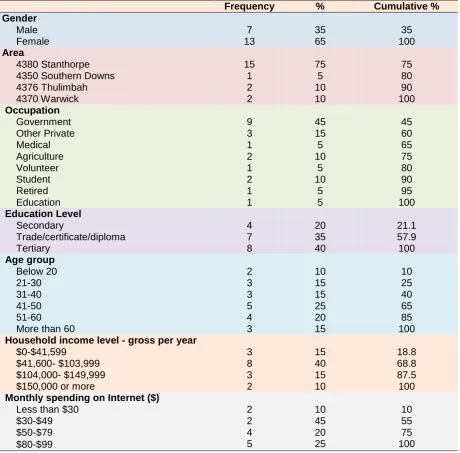
[image:10.595.70.531.164.617.2]maintained in terms of age, occupation, educational level and income. A total of 20 participants attended the FGDs. Table 1 shows the demographic profile of the FGD participants.
Table 1: Demographic profile of the FGD participants
Frequency % Cumulative % Gender
Male 7 35 35
Female 13 65 100
Area
4380 Stanthorpe 15 75 75
4350 Southern Downs 1 5 80
4376 Thulimbah 2 10 90
4370 Warwick 2 10 100
Occupation
Government 9 45 45
Other Private 3 15 60
Medical 1 5 65
Agriculture 2 10 75
Volunteer 1 5 80
Student 2 10 90
Retired 1 5 95
Education 1 5 100
Education Level
Secondary 4 20 21.1
Trade/certificate/diploma 7 35 57.9
Tertiary 8 40 100
Age group
Below 20 2 10 10
21-30 3 15 25
31-40 3 15 40
41-50 5 25 65
51-60 4 20 85
More than 60 3 15 100
Household income level - gross per year
$0-$41,599 3 15 18.8
$41,600- $103,999 8 40 68.8
$104,000- $149,999 3 15 87.5
$150,000 or more 2 10 100
Monthly spending on Internet ($)
Less than $30 2 10 10
$30-$49 2 45 55
$50-$79 4 20 75
6
Figure 1 shows the
distribution of Internet service
providers to the FGD
participants. About 55% of
the participants use the
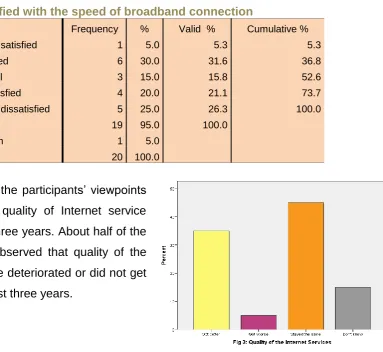
service of Telstra, followed by Exetel (10%) and HaleNET (10%). When asked about the satisfaction with the Internet service provider, over 47% of the participants indicated their dissatisfaction about the quality of the service (Table 2).
Table 2: Satisfied with the speed of broadband connection
Frequency % Valid % Cumulative %
Highly satisfied 1 5.0 5.3 5.3
Satisfied 6 30.0 31.6 36.8
Neutral 3 15.0 15.8 52.6
Dissatisfied 4 20.0 21.1 73.7
Highly dissatisfied 5 25.0 26.3 100.0
Total 19 95.0 100.0
Missing System 1 5.0
Total 20 100.0
[image:11.595.151.535.340.692.2]7
5.2 Focus Group Discussions
5.2.1 General perception
FGDs were initiated by the moderator regarding the controllable aspects of the SWOT: strengths and weaknesses. Participants initiated the discussion with the importance of the digital technologies in their day-to-day usage. They raised some vital points regarding digital technology. According to their perceptions, digital technology could help increase their academic knowledge by providing access to information and online resources. They opined that digital technologies enabled them to consult a medical practitioner or expert remotely. It not only saves their time and resources but also enhances their engagement with ongoing business activities and occupation. Most importantly they realised that the uses of digital technology offered them a chance to update their skills as a community. They were of the view that it helped them to accomplish their jobs more efficiently. Students acknowledged that they even did not need to go to libraries due to the availability of huge resources online. Older community members admitted that the use of digital technology had made their lives easier as they could perform their daily activities from home such as on-line shopping, knowledge gathering, networking and medical consultation. The participants identified the role of digital technology was strong in academic and medical practices in the following ways:
“The significance of using internet is extremely strong in schools and colleges. We can get information and increase our knowledge. It helps us do our assignments and achieving better outcomes.”
“The role of digital technology is immense in hospital. Look, we can now communicate with medical experts online. We do not need to go to Brisbane to consult specialist doctors every time. It saves our time and money as we do not need to visit them in-person.”
8 5.2.2 Internal Strengths
In response to the question “What advantages do your community have to exploit
opportunities in the digital futures?” focus group participants identified several key advantages that are outlined in Table 3.
Table 3: Internal strengths of the community
What advantages (internal) do your community have to exploit the opportunities in the digital futures?
Many business and agricultural enterprises already have Internet access through wireless network although service quality is not satisfactory
Some small businesses have already started using internet for service delivery
Volunteer groups are also using the high-speed technology
Retirees can be benefited
Cultural centre and art gallery can be a good place to build community awareness
Community is receptive to digital futures
Demonstrated council leadership in digital futures and a desire to maximise the opportunities available
The mainstream business community is ready to adopt the new technology
Local organisations such as the Chamber of Commerce, the Granite Belt Wine Tourism and the Wine College can be a powerful platform to promote the use of digital technology for the Stanthorpe community
Each of these institutes already has key, unique strengths in the digital area and work co-operatively together and are positioned to play a strategic role in the digital future of the region
Some local organizations are already providing online training programs
A good skill base exists within the community as people from other places with IT skills have relocated to Stanthorpe because of tourism
Strong community links with greater outreach with people and business groups
Strong public/private linkages to promote digital technology
The FGD participants were of the view that the local organisations such as the Chamber of Commerce, the Granite Belt Wine Tourism and the Wine College were well established, already had key strengths in the digital area and were working co-operatively. They are positioned to play a strategic role in the digital future of the region together with the regional council. They felt that the advantage of digital technology would help them create stronger community links with greater outreach to people and business groups.
5.2.3 Internal Weaknesses
9
digital age opportunities. Participants identified three major problems as impediments to digital usages. These were poor infrastructure, small population size and lack of required skills. Participants’ responses were:
“Especially the older community members are scared to use computer. They lack required digital skills and training. There is a knowledge gap to flow the information to the next generation too. Hence, some are unwilling and scared to allow their children to use Internets".
“Use of digital technology is time-consuming as reading instruction takes more time. We [older people] don't have any training on the use of technology”.
Participants identified the speed of Internet as slow due to the disconnection of optical fibres with the tower. They identified this infrastructure issue as the 'granite shell'. Besides, participants expressed their concern about the health issue of their children related to the overuse of Internet and video games. Moreover, one
participant reacted and said:
“Young generation is making friends through Internet. They even do not know each other personally. This is making children socially inactive.”
Participants also expressed their concern over forgery such as illegal use of credit card information; many small businesses believe they are immune to cyber threats. The participants were concerned that small businesses, particularly in agriculture and tourism, face challenges to get online and build a strategy that is profitable for their enterprises, as they do not have the knowledge, skills and understanding of the opportunities digital technology offers. The key points identified by the focus groups in regards to the internal weaknesses are summarized in Table 4.
Table 4: Internal weaknesses
What disadvantages your community have that pose difficulties in exploiting the opportunities in the digital future?
Limited access to services in remote areas
Lack of awareness about the risks as well as benefits of digital technologies
High costs of running business including labour shortages and increasing utility charges and
business taxes, rent and rates
Lack of knowledge, skills and understanding of the opportunities digital technology offers
Rural and remote locations are the main weaknesses in exploring the
10
Lack of up-to-date marketing strategies
High percentage of small and micro businesses with limited time and capacity
Lack of willingness to change and embrace the new technology
Lack of knowledge on how to use the technology
Monopoly of some IT providers creating fewer choices for customers to try others
High costs for the internet facility in the absence of competition among IT providers
Uncertainty regarding the monetary return from further investment on ICT
Some businesses are not well prepared for further investment
Some businesses believe that they cannot make money from further investment – not clear
about ICT opportunity with the business/agriculture sector
Some people still believe that ICT issues are too difficult to learn (e.g. older people)
There are still some people in the community who are not interested to learn – negative
attitude regarding digital technology still persists
Many people live in alternative style of life
Many agricultural agents still don’t use computer
5.2.4 External Opportunities
Regarding the question “In your opinion, what are the opportunities being created through the recent development and deployment of broadband services, particularly with the rollout of NBN in your locality?” participants expressed that digital future provided the opportunities to increase productivity, expanded their reach and generated new products and services. In the local area, entrepreneurs
can run their businesses with less labour.Many haveembraced this shift and
integrated it into their own business practices.
One participant was of the view that:
“Local small business has the opportunity to sell their products outside the community due to easy access to technology. For example, iPod is reachable to them. They don't need enough marketing skills. Business has come to them on the street. That means iPods sell themselves”.
In tune with the above comment another participant opined:
“Rich web pages and information along with faster Internet connection poses the opportunity to run a business with minimum outlay to offer them an opportunity to be self-employed. These also provide them to find a supplier with minimum outlay.”
11
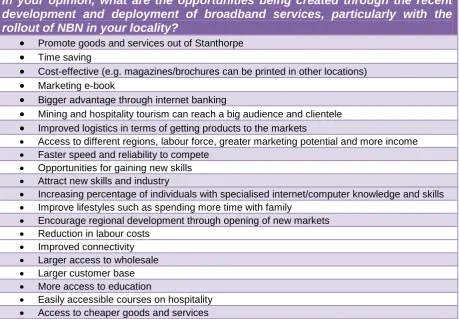
markets and access to different regions that would generate more income. It will attract new skills and industry and encourage regional development through opening of new markets.
[image:16.595.70.530.304.623.2]Overall, there is a consensus among participants that digital technology enhances the gross domestic product. The current contribution of this sector to GDP is 6.5%. To substantiate their argument participants provided examples of the growing contribution of tele-health and e-learning to the economy. These save expenditures of the service recipients. Alternatively, young people can increase their skills by acquiring knowledge from cross-country and cross-nation providers.
Table 5: Opportunities
In your opinion, what are the opportunities being created through the recent development and deployment of broadband services, particularly with the rollout of NBN in your locality?
Promote goods and services out of Stanthorpe
Time saving
Cost-effective (e.g. magazines/brochures can be printed in other locations)
Marketing e-book
Bigger advantage through internet banking
Mining and hospitality tourism can reach a big audience and clientele
Improved logistics in terms of getting products to the markets
Access to different regions, labour force, greater marketing potential and more income
Faster speed and reliability to compete
Opportunities for gaining new skills
Attract new skills and industry
Increasing percentage of individuals with specialised internet/computer knowledge and skills
Improve lifestyles such as spending more time with family
Encourage regional development through opening of new markets
Reduction in labour costs
Improved connectivity
Larger access to wholesale
Larger customer base
More access to education
Easily accessible courses on hospitality
Access to cheaper goods and services
5.2.5 External Barriers
12
losing small business opportunities is one of the major threats. Participants presume that local small business entrepreneurs are facing increasing competition now than before because of the global access of the consumers to on-line shopping. Customers and buyers are purchasing on-line from extended supply chains. Therefore, digital inclusion can help extend supply chain, and regional businesses need to prepare for this. Currently, local businesses are not competitive enough to cope with big companies. This ultimately moves away local businesses and can intensify unemployment problem for rural communities. Furthermore, it increases the depression and other mental health issues among community members. Second, the health issue is another concern; the by-product of digital future could be the deterioration of the health situation of the children in the long run, especially of the younger generation as they spend extended time with the computer. They commented:
“Big issue is kid's attraction to the Internet and Facebook. These encourage them to stay at home and pose a threat to their health. Hence, ultimately these increase health expenditures of the community.”
Third, participants raised the concern that despite some improvements of the Internet services, availability of the tele-health service is still very limited. They were of the views that in most cases patients face difficulties to consult a specialist doctor through a telehealth consultation due to limited supply. This ultimately leads patients visiting medical experts physically. Some participants also raised concern over the usefulness of the tele-health service. According to one participant:
“Tele-health is not worthwhile at all. Rather, face to face interaction is always helpful”.
Participants identified some other threats of digital future. These are:
First, they mentioned multitasking - digital technologies make users intrusive and information overloaded, which impact their concentration level leaving them overstressed.
13 Table 6: Threats/barriers of digital inclusion
What are threats/barriers for the inclusion of your community to digital future?
Community need is not fulfilled by the present state of Internet services
Lack of internet coverage in many places
Big problem is to sit with computer – time constraint
Difficulties to send info to agents using the Internet as often the speed is too slow
Technology enabled barriers – competition from large scale farms/firms
Internet cost is too high for some people especially pensioners and low income groups
Monopoly of one local provider – lack of competition
Stanthorpe is not politically convincing to the Government due to low population and vote base
Some small businesses do not understand technology
Uncertainty remains regarding the actual implementation of NBN in this area
Attracting IT companies to the region is not easy
Other regions are more advanced so they gain more advantages
Small businesses, particularly in agriculture and tourism, face challenges to get online and build a strategy that is profitable for their enterprises
Affordability of the technology such as high costs incurred by users of the technology
Competition is not local, rather global now
Ageing population not being able to tackle with the contemporary technology and usage
Low mobile broadband penetration
Competing with the global market
In some cases, inability of small and medium enterprises to compete on a state and national level
Shortage of skills and workforce
The timing of the infrastructure rollout as other communities will get the head start before Stanthorpe has the chance
Lack of community willingness to attract new skills to town
Providing the same facility at the same cost for a smaller customer base can increase costs for customers
Lack of interest among IT service providers as it is not commercially viable
6.0 Action matrix
What policy actions do you suggest to exploit opportunities and to overcome internal
and external barriers?
14 Table 7: Action plan
Issues Strategies Programs/partnerships
Access Ensure the access to digital facilities – a holistic plan is needed for education, business, medical and other prospective institution
Analyse community needs
Bring community needs together
Strengthen community links to reach more people
and businesses
Develop strong public/private linkages to facilitate
access and use of the technology
There should be strategic plan from the Regional
Council
Lobby government and providers regarding
community requirements
Aggregation of demand
In-depth understanding of digital divide and its
determinants
ICT infrastructure mapping
Coordinate with education department to foster
awareness and enhance digital literacy
Building an e-commerce website
Community based workshops/seminars to educate
them
Advertising the technology through newspapers,
local websites for greater outreach
Community
group
Council
Chamber of
Commerce
Micro-business
Key stakeholders
15
Affordability For digital inclusion, community coverage needs to be cost-effective. Expensive digital connection will not be affordable for rural communities
Allocate council budget for community services and
business community related to digital technology
Build public place or a hub where people can go
and easily access and use the technology
Funding flow should be identified and needs to be aligned with digital expenditures.
Enhance demand side capability making businesses
and the community aware of the digital economy, its
importance and likely impact
Financial incentives for volunteers
ICT support for the people with pension
Digital inclusion will be fruitful provided digital education is at reasonable cost.
Government
Council
Industry funding
Application/ use
Consult broader cross-section of community people
Find and train one person as a driving force to represent a particular community group such as business, education or health
Two-way communication from service provider to ‘digital agent’ to community and vice versa
One-to-one training, especially for the elderly
population and people from remote and isolated
communities
Inclusion of ICT curriculum in the school
Arrangement of online training
E-learning
Provision of relevant information and access to
appropriate knowledge and skills to assist and
empower individuals, businesses and industry to
review and transform their current digital capability
Local volunteers
Community
group
Education
16
Community groups' needs are to be explored for
separate training purposes. Older people are not
always ready to adopt digital technologies in its
current form. They need to be trained and well
informed for digital inclusion
Local clubs in partnership with the council as the main focal point for spreading information about the digital technology and training and knowledge sharing
To make digital inclusion successful for the community, an action plan at local and regional level would be effective
7.0 Conclusions
The purpose of the study was to understand the community preferences on digital future in the Southern Downs Region in Queensland, Australia. This study examined the strengths, weaknesses, opportunities and threats to the digital future in the regional context. The methodology applied in this study included FGDs along with a structured questionnaire survey among the participants.
The findings from the study demonstrate wide range of issues and concerns related to digital inclusion in this region. The survey results indicate that the new providers of broadband are coming to the market. Telstra, however, still captures more than 50% of the market share. Overall, about 47% of the respondents indicated their dissatisfaction with the quality of service. Many respondents indicated that quality of Internet service did not improve much in the region over the last three years. The access to quality broadband services therefore remains a critical issue for the region.
17
opportunities. Digital technology also has the potential to provide remote access to health care through the advancement of telemedicine facility, however, at present, the scope of telemedicine services is very limited in the region. The role of digital technology is particularly found to be profound in schools and colleges as information and communication helps to significantly improve the knowledge base.
The FGDs participants believe that the communities, in general, are receptive to digital futures. Many small businesses have already started to use information technology and the mainstream business community is ready to adopt new technologies. Online training programs as provided by local organizations are already in place and the Stanthorpe community groups such as Chamber of Commerce, the Granite Belt Wine Tourism and the Wine College can play a strategic role in the digital future of the region.
Participants in the FGDs identified poor infrastructure, dispersed population and lack of required skills as the main barriers to digital inclusion. A strong public-private linkage can potentially help to remove the barriers to digital inclusion, especially in the context of infrastructure provisioning and supportive measures. Specific attention
should be given to the digital literacy of the older people – not only because of the
fact that they are lagging behind in respect of necessary skills to cope with the changes but also that they can place supporting measures for the next generation.
Finally, several actions in the form of community-based initiatives resulted from the FGDs. The FGDs indicate that digital coverage needs to be cost-effective and people belonging to low socio-economic groups may require specific supportive measures. This is important to provide digital education at low or subsidised cost at remote locations. It is therefore important to have a comprehensive understanding of community needs, demand and barriers to adoption in order to design a digital
18
References
ABS, (2008), Australian Social Trends, Cat no 4102.0, March Quarter 2008,
Australian Bureau of Statistics (ABS), Canberra.
ABS, (2012), Australian Social Trends, Cat no 4102.0, March Quarter 2012,
Canberra: Australian Bureau of Statistics (ABS).
ABS, (2013a), A Review of Regional Development Australia Committee 2010-11
Regional Plans: Issues Identified by Regions, Cat no 1318.0, Canberra: Australian Bureau of Statistics (ABS).
ABS, (2013b), 2011 Census, Canberra: Australian Bureau of Statistics (ABS).
Atkinson, J., Black, R. & Curtis, A., (2008), ‘Exploring the digital divide in an
Australian regional city: a case study of Albury’, Australian Geographer, 39(4):
479-93.
Black, R. & Atkinson, J., (2007), ‘Addressing the digital divide in rural Australia’, http://researchoutput.csu.edu.au
Broadbent, R. & Papadopoulos, T., (2013), ‘Bridging the digital divide – an Australian
story’, Behaviour & Information Technology, 32(1): 4-13.
DBCDE, (2011), National Digital Economy Strategy, Department of Broadband
Communications and the Digital Economy (DBCDE), Canberra ACT.
Holloway, D., (2005), ‘The digital divide in Sydney’, Information, Community &
Society, 8(2): 168-93.
Kitzinger, J., (1994), ‘The methodology of focus groups: the importance of interaction
between research participants’, Sociology of Health & Illness, 16(1): 103-121.
Krueger, R. A. & Casey, M. A., (2000), Focus Groups: A Practical Guide for Applied
Research, 3rd Edn, Thousand Oaks, CA: Sage Publications.
NRHA, (2012), ‘Cancer in rural Australia’, Fact Sheet 8, January 2012, Canberra: National Rural Health Alliance Inc.
Rabiee, F., (2004), ‘Focus group interview and data analysis’, Proceedings of the
Nutrition Society, 63(4): 655-660.
Simpson, R., (1999), ‘Life is too short to run at 2,400 Bps’, The Farmwide Online Services Pilot Project, Canberra: Farmwide Pty Limited.
19
Appendix A: Survey Questionnaire
Digital Preference Study Private and Confidential
While the use of broadband Internet offers many benefits for individuals and communities, its distribution may not be equal across demographic groups and regions. Given that public policies are directed towards removing physical barriers to access, this may not guarantee the entry into the digital services. The objective of this research is to understand the community preferences for digital technology in rural and regional Australia.
STUDY UNIT: FOCUS GROUP PARTICIPANTS
1.0 Personal
1.1 Gender (please tick) ……… Male Female
1.2 Your locality ………. and area code ……… 1.3 Which of the following options best describes your occupation?
Craftsman/tradesman Domestic duties Education Government
Manual/factory worker Medical Office/clerical Senior management Student Not working Other (please specify)……….
1.4 Highest education level achieved (please tick)
Primary Secondary Trade/Certificate/Diploma Tertiary 1.5 Which age group do you belong to?
below 20 21-30 31-40 41-50 51-60 more than 60 1.6 Household income level – gross per year (please tick)
$0 - $41,599 (up to $799 per wk) $41,600 – $103,999 ($800 - $1,999 per wk)
$104,000 - $149,999 ($2,000 - $2,884 per wk) $150,000 or more ($2,885 per wk or more) 1.7 Are you of Aboriginal or Torres Islander Origin (please circle) Yes No
2.0 Present status of Internet use
2.1 How long have you had internet access at home?
Your authentic answers to the questions below will help us understand your problems in and prospects of using broadband and to identify remedial measures.
We want to know your own opinion – not what you believe other people think. Information provided by you is absolutely CONFIDENTIAL.
20
Less than one year 1-3 years more than 3 years Don’t have internet access 2.2 Who is the current provider of your internet service?
Telstra Vodaphone Dodo TSL Optus Other (please specify)………… 2.3 Are you satisfied with the speed of Internet connection in your area?
Highly satisfied Satisfied Neutral Dissatisfied Highly dissatisfied At present, what types of Internet connections do you have?
Dial-up connections
Broadband connections: DSL Cable Fibre Satellite Fixed wireless Mobile wireless (3G, 4G) Others ………
What kind of internet service do you use
Unlimited Limited 5GB 10GB 20GB 50GB 100GB or more 2.6 How much do you spend for the internet service per month?
Less than $30 $30-$49 $50-$79 $71-$99 $100 or more
2.7 What do you think about the quality of the Internet services in your locality over the past three years? (please tick)
Got better Got worse Stayed the same Don’t know For what purposes did you use the Internet at home in the last 12 months?
Work or business Education or study Volunteer or community work Personal or private Other (specify): ………. Don't know 3.0 Your perception about digital futures (please tick in the relevant box)
Stro
n
gly
ag
ree
Ag
ree
N
eutral
D
isag
ree
Stro
n
gly
d
isag
ree
Internet plays an important role in my life Using Internet has major advantages Internet makes my job more fun/interesting
21 Internet facilitates better learning and professional development
I believe that NBN will create new economic opportunities in SDRC region
4.0 Future uses of Broadband Internet (please tick in the relevant box)
Stro
n
gly
ag
ree
Ag
ree
N
eutral
D
isag
ree
Stro
n
gly
d
isag
ree
I believe NBN will improve Internet services in my community in the near future
I believe Internet uses will increase in the future I find use of Internet is too costly for me
I think I have lack of technical skills of using Internet Use of internet is just wastage of time
5.0 Are you willing to be involved in further sessions and/or a cluster group to pursue projects related to digital futures? (Please tick in the relevant box)
Yes No