0022-538X/09/$08.00⫹0 doi:10.1128/JVI.01035-09
Copyright © 2009, American Society for Microbiology. All Rights Reserved.
Cochaperone Activity of Human Butyrate-Induced Transcript 1
Facilitates Hepatitis C Virus Replication through an
Hsp90-Dependent Pathway
䌤
Shuhei Taguwa,
1Hiroto Kambara,
1Hiroko Omori,
2Hideki Tani,
1Takayuki Abe,
1Yoshio Mori,
1Tetsuro Suzuki,
3Tamotsu Yoshimori,
2Kohji Moriishi,
1and Yoshiharu Matsuura
1*
Department of Molecular Virology1and Department of Cellular Regulation,2Research Institute for Microbial Diseases,
Osaka University, Osaka, and Department of Virology II, National Institute of Infectious Diseases, Tokyo,3Japan
Received 21 May 2009/Accepted 27 July 2009
Hepatitis C virus (HCV) nonstructural protein 5A (NS5A) is a component of the replication complex consisting of several host and viral proteins. We have previously reported that human butyrate-induced transcript 1 (hB-ind1) recruits heat shock protein 90 (Hsp90) and FK506-binding protein 8 (FKBP8) to the replication complex through interaction with NS5A. To gain more insights into the biological functions of hB-ind1 in HCV replication, we assessed the potential cochaperone-like activity of hB-ind1, because it has significant homology with cochaperone p23, which regulates Hsp90 chaperone activity. The chimeric p23 in which the cochaperone domain was replaced with the p23-like domain of hB-ind1 exhibited cochaperone activity comparable to that of the authentic p23, inhibiting the glucocorticoid receptor signaling in an Hsp90-dependent manner. Conversely, the chimeric hB-ind1 in which the p23-like domain was replaced with the cochaperone domain of p23 resulted in the same level of recovery of HCV propagation as seen in the authentic hB-ind1 in cells with knockdown of the endogenous hB-ind1. Immunofluorescence analyses revealed that hB-ind1 was colocalized with NS5A, FKBP8, and double-stranded RNA in the HCV replicon cells. HCV replicon cells exhibited a more potent unfolded-protein response (UPR) than the parental and the cured cells upon treatment with an inhibitor for Hsp90. These results suggest that an Hsp90-dependent chaperone pathway incorporating hB-ind1 is involved in protein folding in the membranous web for the circumvention of the UPR and that it facilitates HCV replication.
Hepatitis C virus (HCV) is the major causative agent of non-A, non-B hepatitis in humans and infects approximately 170 million people worldwide (64). HCV belongs to the genus
Hepacivirusof the family Flaviviridaeand is classified into six
major genotypes (39). The virus forms small, round, enveloped particles and possesses a genome consisting of a single posi-tive-stranded RNA with a nucleotide length of 9.6 kb. The viral genome encodes a single precursor polyprotein consisting of approximately 3,000 amino acids, which in turn is posttransla-tionally processed into 10 viral proteins by host and viral pro-teases. The structural proteins are cleaved from the N-terminal one-fourth of the polyprotein by the host signal peptidase and signal peptide peptidase (36, 43, 44), resulting in the matura-tion of capsid protein, two envelope proteins, and viroporin p7. The nonstructural protein 2 (NS2) protease cleaves its own carboxyl terminus, and then NS3 cleaves the appropri-ate downstream positions to produce NS3, NS4A, NS4B, NS5A, and NS5B (24, 60), which form the replication complex, together with several host proteins (14, 35).
NS5A is a membrane-anchored zinc-binding phosphopro-tein that appears to possess diverse functions, including the suppression of host defense and the regulation of virus repli-cation (1, 15, 58), but its biological function remains unclear.
Several groups, including ours, have suggested that the molec-ular chaperone, heat shock protein 90 (Hsp90), and several cochaperones participate in the replication complex of HCV through interaction with NS5A or other NS proteins (45, 56, 65). Hsp90 is the highly conserved and ubiquitously expressed protein that acts as a key regulator for the turnover and the activities of more than 200 signaling proteins, including steroid receptors and cell-signaling kinases (66). The chaperone activ-ity of Hsp90 contributes to the refolding of an unfolded protein in an ATP-dependent manner, and the execution of Hsp90-dependent protein folding requires the formation of a multi-chaperone complex containing other multi-chaperones (e.g., Hsp70, Hsp104, and Hsp40) and cochaperones (e.g., p23, Hop, and immunophilins) (4, 18, 48). Geldanamycin or its derivatives, which are represented as specific inhibitors of Hsp90, can de-stabilize and then degrade client proteins (41, 55).
The host chaperone mechanism is involved in the folding of viral polymerase to support viral replication (6, 27). Moreover, host chaperones have been reported to play roles in the as-sembly of viral particles and the sorting of virus proteins (9, 32, 38). We have previously reported that Hsp90 chaperone activ-ities and chaperone-associated proteins are required for the efficient propagation of HCV (45, 56) and that human bu-tyrate-induced transcript 1 (hB-ind1) is involved in the prop-agation of HCV through interactions with NS5A and Hsp90 via the coiled-coil domain and the FXXW motif, respectively (56). hB-ind1 was first reported to be a multiple-membrane-spanning protein consisting of 362 amino acids that possesses a significant homology with a cochaperones, p23, that regulates
* Corresponding author. Mailing address: Department of Molecular Virology, Research Institute for Microbial Diseases, Osaka University, 3-1, Yamadaoka, Suita-shi, Osaka 565-0871, Japan. Phone: 81-6-6879-8340. Fax: 81-6-6879-8269. E-mail: [email protected].
䌤Published ahead of print on 5 August 2009.
10427
on November 8, 2019 by guest
http://jvi.asm.org/
Hsp90 function by its cochaperone activity (11). However, the roles of hB-ind1 in the life cycle of HCV have not been precisely clarified. In this study, we investigated the role of the Hsp90-related chaperone system, including hB-ind1, in the regulation of the RNA replication and particle production of HCV.
MATERIALS AND METHODS
Plasmids.The plasmids encoding hB-ind1, NS5A, Hsp90, and FK506-binding protein 8 (FKBP8) were prepared by methods described previously (45, 56). The DNA fragments encoding hB-ind1 mutants were prepared by PCR with the introduction of a silent mutation that is resistant to the short hairpin RNA in the hB-ind1 knockdown cells, as described previously (56). The human p23 gene and glucose-regulated protein 78 (GRP78) promoter region (⫺151 to⫹22) were amplified by PCR from the total cDNA and genomic DNA of Huh7 cells, respectively. The DNA fragments encoding mutants of hB-ind1 and p23 were prepared by the method of splicing by overlap extension (26) and introduced into pEF FLAGGs pGKpuro (28). The GRP78 promoter region was introduced between the KpnI and HindIII sites of pGL3-basic (Promega, Madison, WI) and designated pGRP78-luc. The reporter plasmid carrying a firefly luciferase gene under the control of the GR promoter (pGR-luc) was purchased from Panomics (Fremont, CA). The internal-control plasmid encoding a Renilla luciferase (pRL-TK) was purchased from Promega. The plasmid pFK-I389neo/NS3-3⬘/
NK5.1 (47) was kindly provided by R. Bartenschlager. The plasmids used in this study were confirmed by sequencing them with an ABI Prism 3130 genetic analyzer (Applied Biosystems, Tokyo, Japan).
Cells and virus infection.All cell lines were cultured at 37°C under a humidi-fied atmosphere and 5% CO2. The human embryonic kidney 293T and
hepato-cellular carcinoma Huh7 cell lines were maintained in Dulbecco’s modified Eagle’s medium (DMEM) (Sigma, St. Louis, MO) supplemented with 100 U/ml penicillin, 100g/ml streptomycin, and 10% fetal calf serum (FCS). The human hepatocellular carcinoma cell line Huh7.5.1 was kindly provided by F. Chisari (70) and was maintained in DMEM containing nonessential amino acids, 100 U/ml penicillin, 100g/ml streptomycin, and 10% FCS. The Huh9-13 cell line, which is a Huh7 cell line harboring a subgenomic HCV RNA replicon (35), was maintained in DMEM containing 10% FCS, nonessential amino acids, and 1 mg/ml G418 (Nakalai Tesque, Kyoto, Japan). The hB-ind1 knockdown cell line Huh-KD and control cell line Huh-ctrl were described previously (56). Huh-KD cells were transfected with each of the expression plasmids encoding wild-type or mutant hB-ind1 and cultured for 1 week in the presence of 10g/ml of puro-mycin. The remaining cells were used for the experiments described below. The viral RNA of JFH1 was introduced into Huh7.5.1 cells according to the method of Wakita et al. (62) for preparation of the infectious HCV particles in cell culture.
Antibodies.The rabbit anti-hB-ind1 antibody was prepared as described pre-viously (56). Mouse monoclonal antibodies to HCV NS5A, influenza virus hem-agglutinin (HA) and FLAG tags, and-actin were purchased from Austral Biologicals (San Ramon, CA), Covance (Richmond, CA), and Sigma, respec-tively. Mouse anti-protein disulfide isomerase (PDI) immunoglobulin G2a (IgG2a) was from Affinity Bioreagents (Golden, CO). Mouse anti-double-stranded RNA (dsRNA) IgG2a (J1 and K2) antibodies were from Biocenter Ltd. (Szirak, Hungary). Alexa Fluor 488 (AF488)-conjugated anti-mouse IgG1, AF647-conjugated anti-rabbit IgG, and AF594-conjugated anti-mouse IgG2a and IgG2b antibodies were from Invitrogen (San Diego, CA).
Transfection, immunoblotting, and immunoprecipitation.Transfection and immunoprecipitation analyses were carried out as described previously (25, 45). Immunoprecipitates boiled in loading buffer were subjected to 12.5% sodium dodecyl sulfate-polyacrylamide gel electrophoresis. The proteins were trans-ferred to polyvinylidene difluoride membranes (Millipore, Bedford, MA) and were reacted with the appropriate antibodies. The immune complexes were visualized with Super Signal West Femto substrate (Pierce, Rockford, IL) and detected by an LAS-3000 image analyzer system (Fujifilm, Tokyo, Japan). The protein bands of GRP78 and-actin were quantified by Multi Gauge software (Fujifilm), and the values of GRP78 expression were normalized with those of -actin.
Quantitative reverse transcriptase PCR.HCV RNA was estimated by the method described previously (56). Total RNA was prepared from cells by using an RNeasy minikit (Qiagen, Tokyo, Japan). First-strand cDNA was synthesized using an RNA LA PCR in vitro cloning kit (Takara Bio Inc., Shiga, Japan) and random primers. Each cDNA was estimated with Platinum SYBR green qPCR SuperMix UDG (Invitrogen) according to the manufacturer’s protocol. Fluores-cent signals were analyzed with an ABI Prism 7000 (Applied Biosystems). The
internal ribosomal entry site regions of HCV and mRNAs of GAPDH (glycer-aldehyde-3-phosphate dehydrogenase), GRP78, and growth arrest- and DNA damage-inducible gene 153 (GADD153) were amplified using the primer pairs 5⬘-GAGTGTCGTGCAGCCTCCA-3⬘ and 5⬘-CACTCGCAAGCACCCTATC A-3⬘, 5⬘-GAAGGTGAAGGTCGGAGTC-3⬘and 5⬘-GAAGGTGAAGGTCGG AGTC-3⬘, 5⬘-CGCCAAGCGGCTCATC-3⬘and 5⬘-AACCACCTTGAACGGC AAGA-3⬘, and 5⬘-AGCTGGAACCTGAGGAGAGA-3⬘and 5⬘-TGGATCAGT CTGGAAAAGCA-3⬘, respectively. The values of the HCV genome or each mRNA were normalized with those of GAPDH mRNA. Each PCR product was detected as a single band of the correct size on agarose gel electrophoresis (data not shown).
In vitro transcription and RNA transfection. The plasmid pFK-I389
neo/NS3-3⬘/NK5.1 was linearized by treatment with ScaI and then transcribed in vitro using the MEGAscript T7 kit (Applied Biosystems) according to the manufac-turer’s protocol. The in vitro-transcribed RNA was electroporated into cells at 4 million cells/0.4 ml under conditions of 270 V and 960F using a Gene Pulser (Bio-Rad, Hercules, CA). The colony formation assay was carried out by a method described previously (45).
Indirect immunofluorescence assay.Cells cultured on glass slides were fixed with 4% paraformaldehyde in phosphate-buffered saline (PBS) at room temper-ature for 30 min. After being washed twice with PBS, the cells were permeabil-ized for 20 min at room temperature with PBS containing 0.25% saponin and blocked with PBS containing 0.2% gelatin (gelatin-PBS) for 60 min at room temperature. The cells were incubated with gelatin-PBS containing rabbit hB-ind1 antibody, mouse NS5A IgG1, mouse PDI IgG2a, mouse anti-FKBP8 IgG2b, or mouse anti-dsRNA IgG2a (J1 and K2) at 37°C for 60 min; washed three times with PBS containing 1% Tween 20; and incubated with gelatin-PBS containing AF488-conjugated anti-mouse IgG1 or AF647-conju-gated anti-rabbit or AF594-conjuAF647-conju-gated anti-mouse IgG2a or IgG2b antibodies at 37°C for 60 min. Finally, the cells were washed three times with PBS containing 1% Tween 20 and observed with a FluoView FV1000 laser scanning confocal microscope (Olympus, Tokyo, Japan).
Correlative FM-EM. Correlative fluorescence microscopy-electron micros-copy (FM-EM) allows individual cells to be examined both in an overview with FM and in a detailed subcellular-structure view with EM (51). The endogenous hB-ind1 and NS5A were stained and observed in the HCV replicon cells by the correlative FM-EM method as described previously (45).
Luciferase assay.Each plasmid was transfected into Huh7, Huh9-13, and interferon (IFN)-cured cells seeded in a 12-well plate, and the cells were treated with 1M dexamethasone (Sigma) for 12 h or with 17-dimethylamino-ethyl-amino-17-demethoxygeldanamycin (DMAG) (Sigma) for 6 h at 36 h posttrans-fection and lysed in 200l of passive lysis buffer (Promega). Luciferase activity was measured in 20-l aliquots of the cell lysates using a Dual-Luciferase Re-porter Assay System (Promega). Firefly luciferase activity was standardized with that ofRenillaluciferase cotransfected with the internal-control plasmid pRL-TK. The resulting values were expressed as the increase in relative light units (RLU).
Statistical analysis.Results were expressed as the mean⫾standard deviation. The significance of differences in the means was determined by Student’sttest.
RESULTS
The p23-like domain of hB-ind1 has cochaperone activity.
Although we had previously reported that hB-ind1 regulates HCV RNA replication through interaction with NS5A and Hsp90, the molecular mechanisms underlying the regulation of HCV replication remained to be clarified. To gain more in-sights into the potential cochaperone activity of hB-ind1 in the Hsp90 chaperone system, we prepared expression plasmids encoding a wild-type p23 and three p23 mutants—one in which the FXXW motif was replaced with AXXA (p23AxxA), one in which the cochaperone domain of p23 was replaced with the p23-like domain of hB-ind1 (cp23), and one in which both substitutions were made (cp23AxxA) (Fig. 1A). HA-tagged Hsp90 was coexpressed with tagged p23 or the FLAG-tagged p23 mutants in 293T cells (Fig. 1B). Hsp90 was coim-munoprecipitated with wild-type p23 and a cp23 mutant, but not with the p23AxxA or cp23AxxA mutants, indicating that the FXXW motif of hB-ind1, as is the case with that of p23
on November 8, 2019 by guest
http://jvi.asm.org/
(67), is also involved in binding to Hsp90. Hsp90 participates in the folding and stabilization of the ligand-binding domain of the glucocorticoid receptor (GR), together with p23 and other cofactors (49). p23 was shown to act not only in the activation (30), but also in the inhibition, of GR signaling (67). To ex-amine whether hB-ind1 has the ability to work as a cochaper-one in an Hsp90-dependent manner, each of the plasmids encoding p23 or the p23 mutants was cotransfected with a reporter plasmid carrying a firefly luciferase gene under the control of the GR promoter (pGR-luc), together with an in-ternal-control plasmid (pRL-TK), and GR-mediated transcrip-tional activity was determined at 12 h after treatment with dexamethasone, a ligand of GR. Expression of the p23 or cp23 mutant, but not of the AXXA mutants, significantly inhibited GR-mediated transcription (Fig. 1C). These results indicate that the p23-like domain of hB-ind1 possesses cochaperone activity comparable to that of p23.
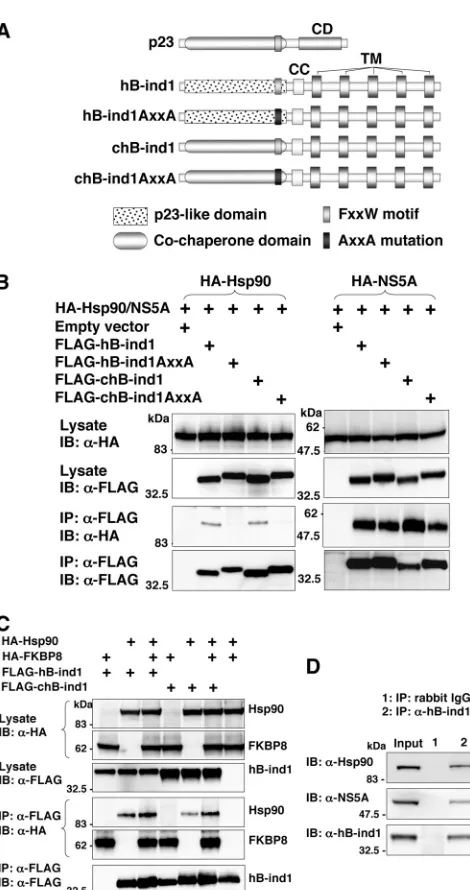
The p23-like domain of hB-ind1 is interchangeable with the p23 cochaperone domain during complex formation with NS5A, Hsp90, and FKBP8.Previous reports have suggested that HCV NS5A interacts with several host proteins, including FBL2 (63), vesicle-associated membrane protein-associated protein subtype A (VAP-A) (61), VAP-B (25), FKBP8 (45), and hB-ind1 (56), and that these interactions participate in the replication of HCV. We have shown that hB-ind1 interacts with NS5A and Hsp90 through the coiled-coil domain and the FXXW motif in the p23-like domain, respectively, and that coexpression of FKBP8 enhances the interaction of Hsp90 with hB-ind1 (56). To determine the effect of the mutation in the p23-like domain of hB-ind1 on interaction with Hsp90, NS5A, and FKBP8, we prepared an expression plasmid encoding wild-type hB-ind1 and three hB-ind1 mutants, one in which the p23-like domain was replaced with the cochaperone domain of p23 (chB-ind1), one in which the FXXW motif was replaced with AXXA (hB-ind1AxxA), and one in which both replace-ments were made (chB-ind1AxxA) (Fig. 2A). The FLAG-tagged wild-type or mutant hB-ind1 was coexpressed with HA-tagged Hsp90 (Fig. 2B, left) or HA-HA-tagged NS5A (Fig. 2B, right) in 293T cells and immunoprecipitated with anti-FLAG antibody. Hsp90 was coprecipitated with wild-type hB-ind1 and the chB-ind1 mutant, but not with the hB-ind1AXXA and chB-ind1AXXA mutants (Fig. 2B, left), confirming that the FXXW motif is crucial for the interaction with Hsp90. In contrast, NS5A was coprecipitated with each of the hB-ind1 proteins, suggesting that mutation in the p23-like domain of hB-ind1 has no effect on the binding of hB-ind1 to NS5A through the coiled-coil domain (Fig. 2B, right). To determine the effect of FKBP8 expression on the interaction between hB-ind1 and Hsp90, FLAG-tagged wild-type hB-ind1 or the chB-ind1 mutant was coexpressed with HA-tagged FKBP8 and/or Hsp90 in 293T cells and immunoprecipitated with anti-FLAG antibody. The amounts of Hsp90 coprecipitated with hB-ind1 or chB-ind1 were increased by coexpression of FKBP8 (Fig. 2C). To further examine the interaction of hB-ind1 with Hsp90 and NS5A at an endogenous expression level in Huh9-13 cells harboring an HCV subgenomic RNA replicon, lysates of the replicon cells were subjected to immunoprecipitation anal-ysis. Endogenous Hsp90 and NS5A were specifically coimmu-noprecipitated with endogenous hB-ind1 (Fig. 2D). These results suggest that the p23-like domain of hB-ind1 is
inter-FIG. 1. Construction and characterization of p23 mutants. (A) Structures of hB-ind1, p23, and the three p23 mutants. hB-ind1 consists of a p23-like domain, an FXXW motif, a coiled-coil domain (CC), and a transmembrane domain (TM). p23 consists of a cochap-erone domain, an FXXW motif, and a chapcochap-erone domain (CD). The three p23 mutants, p23AxxA, cp23, and cp23AxxA, were constructed by replacing the FXXW motif with AXXA, the cochaperone domain of p23 with the p23-like domain of hB-ind1, and both of the regions, respectively. (B) FLAG-tagged p23, p23AxxA, cp23, or cp23AxxA was coexpressed with HA-tagged Hsp90 in 293T cells and immunoprecipi-tated (IP) with anti-FLAG antibody. The immunoprecipitates were subjected to immunoblotting (IB). (C) The expression plasmid encod-ing FLAG-tagged p23, cp23, p23AxxA, or cp23AxxA was cotransfected with pGR-luc and pRL-TK plasmids into 293T cells and treated with 1 mM dexamethasone [Dex(⫹)] at 36 h posttransfection or untreated [Dex(⫺)], and the luciferase activities were determined at 12 h of incubation. The firefly luciferase activity was normalized with that of Renillaluciferase, and the GR-responsive promoter activity was indi-cated as the RLU. The error bars indicate standard deviations. The asterisks indicate significant differences (P⬍0.01) versus the control value. The data shown are representative of three independent exper-iments.
on November 8, 2019 by guest
http://jvi.asm.org/
[image:3.585.71.253.81.498.2]changeable with the cochaperone domain of p23 during com-plex formation with NS5A, Hsp90, and FKBP8.
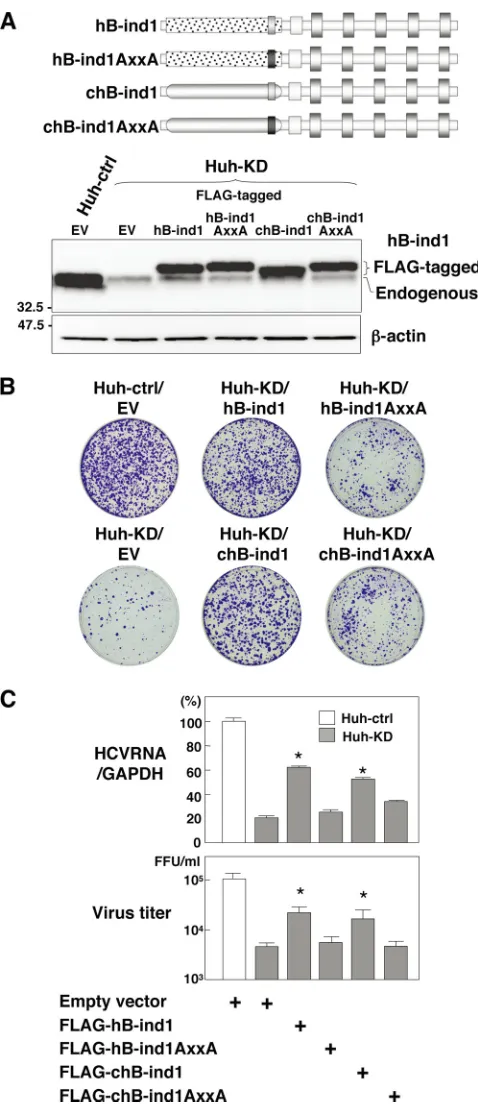
Cochaperone activity in the p23-like domain of hB-ind1 is required for propagation of HCV. The p23-like domain of hB-ind1 has been suggested to be required for HCV propaga-tion (56). However, the involvement of the cochaperone activ-ity of hB-ind1 in HCV propagation has not been examined. To assess the effect of cochaperone activity in the p23-like domain of hB-ind1 on the RNA replication and particle production of HCV, each of the expression plasmids encoding the FLAG-tagged wild-type or mutant hB-ind1 carrying the silent muta-tions resistant to small interfering RNA was transfected into hB-ind1 knockdown (Huh-KD) cells and cultured for a week in the presence of puromycin. The expressions of FLAG-tagged hB-ind1 and the mutants in the Huh-KD cells were compara-ble to that of the endogenous hB-ind1 in the control (Huh-ctrl) cells transfected with an empty vector (Fig. 3A). Subgenomic HCV replicon RNA transcribed from pFK-I389 neo/NS3-3⬘/ NK5.1 was transfected into these cells and cultured for 4 weeks in the presence of G418. Although the number of colonies was reduced in the Huh-KD cells compared with the Huh-ctrl cells after transfection with an empty vector, as described previously (56), the colony numbers were recovered by the expression of the hB-ind1 or chB-ind1 mutant, but not by that of the hB-ind1AXXA or chB-ind1AXXA mutants (Fig. 3B). Sim-ilarly, intracellular HCV RNA and infectious viral titers in the culture supernatants of Huh-KD cells infected with JFH1 virus were partially recovered by the expression of the ind1 or cind1 mutant, but not by that of the hB-ind1AXXA or chB-hB-ind1AXXA mutant (Fig. 3C). These re-sults suggest that cochaperone activity in the p23-like do-main of hB-ind1 is required for HCV propagation and that the cochaperone domain of p23 can substitute for the p23-like domain of hB-ind1.
[image:4.585.45.280.77.522.2]hB-ind1 colocalizes with NS5A, FKBP8, and dsRNA on the membranous web.Our previous report revealed the interplay among hB-ind1, Hsp90, FKBP8, and NS5A and showed that these interactions play an important role in HCV replication (56). However, the subcellular localization of the endogenous hB-ind1 in the replicon cells and JFH1 virus-infected cells has not been precisely assessed. To determine the subcellular lo-calization of hB-ind1 in the context of HCV replication, the expression of hB-ind1 and NS5A in the replicon cells and JFH1 virus-infected cells was examined by immunofluores-cence analyses (Fig. 4A). Endogenous hB-ind1 was colocalized with the endoplasmic reticulum (ER)-marker PDI and NS5A as dot-like structures in the Huh9-13 replicon cells (Fig. 4A, top) and in cells infected with JFH1 virus (Fig. 4A, bottom), and these dot-like structures disappeared in concert with the loss of NS5A expression by treatment with IFN-␣in the rep-licon cells and was not observed in the mock-infected Huh7.5.1 cells. Furthermore, FKBP8 (Fig. 4B, top) and dsRNA (Fig. 4B, bottom) were colocalized with hB-ind1 and NS5A in the dot-like structures in Huh9-13 replicon cells. These results indicate that HCV replicating RNA is localized with hB-ind1, FKBP8, and NS5A in the dot-like compartments. HCV RNA replica-tion or expression of viral proteins leads to formareplica-tion of the convoluted membranous structures designated the membra-nous web (14, 23). The large structures of the replication com-plexes in the replicon cells indicate membranous webs with
FIG. 2. Construction and characterization of hB-ind1 mutants. (A) Structures of p23, hB-ind1, and the three hB-ind1 mutants. The three hB-ind1 mutants, hB-ind1AxxA, chB-ind1, and chB-ind1AxxA, were constructed by replacing the FXXW motif with AXXA, the p23-like domain of hB-ind1 with the cochaperone domain of p23, and both of the regions, respectively. (B) FLAG-tagged hB-ind1, hB-ind1 AxxA, chB-ind1, or chB-ind1AxxA was coexpressed with either HA-tagged Hsp90 (left) or NS5A (right) in 293T cells and immunoprecipi-tated (IP) with anti-FLAG antibody. The immunoprecipitates were subjected to immunoblotting (IB). (C) tagged Hsp90 and HA-FKBP8 were expressed with FLAG-tagged hB-ind1 and chB-ind1 in various combinations in 293T cells and immunoprecipitated with anti-FLAG antibody, and the immunoprecipitates were detected by immu-noblotting. (D) Endogenous hB-ind1 in Huh9-13 cells harboring subgenomic HCV replicon RNA was immunoprecipitated with anti-hB-ind1 rabbit IgG (lane 2). The cell lysate was mixed with normal rabbit IgG as a negative control (lane 1). The immunoprecipitates were analyzed by immunoblotting with an antibody to Hsp90, NS5A, or hB-ind1. The data shown are representative of three independent experiments.
on November 8, 2019 by guest
http://jvi.asm.org/
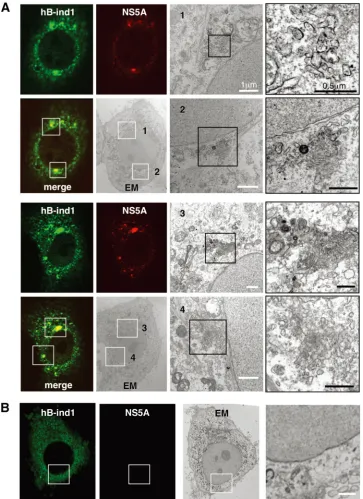
restricted motility (68). To further analyze the subcellular com-partments, including hB-ind1 and NS5A, the same field of the Huh9-13 replicon cells was observed under FM and EM by using the correlative FM-EM technique (Fig. 5A, upper two rows). The large structures that included hB-ind1 and NS5A in the replicon cells were observed under FM and EM (white-boxed areas) and further magnified (black-(white-boxed areas). Con-voluted membranous structures that consisted of small vesicles and that were similar to the membranous web were observed. Another field of view yielded similar results (Fig. 5A, lower two rows). The membranous web resembling the convoluted struc-tures was not observed in the Huh9-13 cells depleted of viral RNA by IFN treatment (Fig. 5B). Together, these results sug-gest that hB-ind1 interacts with NS5A on the membranous web in cells replicating HCV RNA.
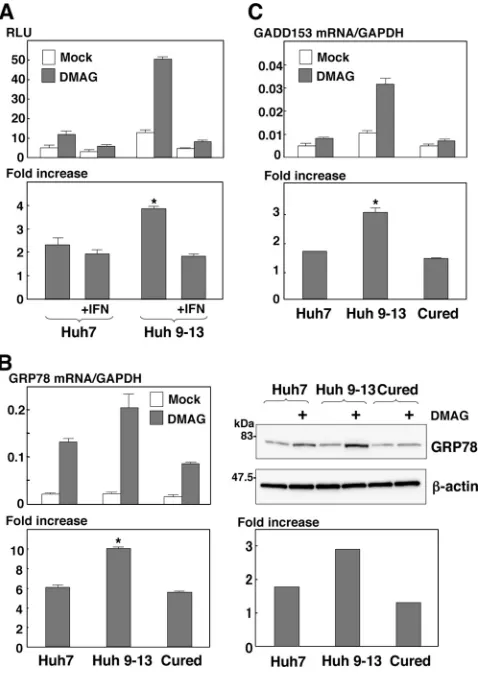
[image:5.585.43.282.72.627.2]Hsp90 is involved in the circumvention of the UPR during HCV replication.Hsp90 regulates the folding and stability of proteins in all eukaryotes (59), and inhibition of the chaperone pathway suppresses correct protein folding, which leads to induction of proteasome-mediated degradation of the un-folded proteins and the unun-folded protein response (UPR). Our previous (46) and present studies (Fig. 4 and 5) showed that several cochaperone components are recruited in the membra-nous web, suggesting that the Hsp90 chaperone system partici-pates in the replication complex to circumvent the induction of the UPR and to maintain the folding of the host and viral proteins in a replication-competent state. To determine the induction of the UPR by HCV replication, Huh9-13 replicon cells were transfected with a reporter plasmid carrying a firefly luciferase gene under the control of the GRP78 promoter, which is activated by the induction of the UPR, together with an internal-control plasmid. Although the GRP78 promoter activity was slightly enhanced in the Huh9-13 cells compared to that in the parental cells, a fourfold increase of GRP78 pro-moter activity in the replicon cells was observed after treat-ment with an Hsp90 inhibitor, DMAG, in contrast to the two-fold increase in similarly treated parental Huh7 cells, and the activation of the GRP78 promoter was canceled by treatment with IFN-␣ despite DMAG treatment (Fig. 6A), suggesting that the Hsp90 chaperone system participates in the circum-vention of the UPR induced by the replication of HCV RNA. In addition, activation of GRP78 at transcriptional and trans-lational levels after treatment with DMAG was higher in the
FIG. 3. Effects of the cochaperone activity of hB-ind1 on the prop-agation of HCV. (A) Huh-KD cells were transfected with either an empty vector or an expression plasmid encoding FLAG-tagged hB-ind1, hB-ind1AxxA, chB-hB-ind1, or chB-ind1AxxA, which are resistant to small interfering RNA due to the introduction of silent mutations, and cultured for a week in the presence of 10g/ml of puromycin. The surviving cells were used in the subsequent experiments. The endog-enous and exogendog-enous expression of hB-ind1 and the mutants was detected by immunoblotting. The control cell line (Huh-ctrl) or the Huh-KD cell line transfected with an empty vector (EV) was used as a control. (B) Huh-KD cells were transfected with the plasmids and
then selected with puromycin. The resulting cells were further trans-fected with a replicon RNA transcribed from pFK-I389neo/NS3-3⬘/ NK5.1, cultured for 4 weeks in the presence of 1 mg/ml of G418, and stained with crystal violet after fixation with 4% paraformaldehyde. The Huh-KD cell line transfected with an empty vector (EV) was used as a positive control. (C) The cells prepared as described above were infected with JFH1 virus and harvested at 3 days postinfection. The amount of intracellular HCV RNA was estimated by quantitative re-verse transcriptase PCR and normalized with that of GAPDH mRNA. The values of HCV RNA are presented as percentages versus those of Huh-ctrl cells transfected with an empty vector. The culture superna-tants were subjected to a focus-forming assay. Virus titers are pre-sented as focus-forming units (FFU) per ml. The error bars indicate standard deviations. The asterisks indicate significant differences (P⬍ 0.01) versus the value of the control. The data shown are representa-tive of three independent experiments.
on November 8, 2019 by guest
http://jvi.asm.org/
HCV replicon cells than in the parental cells or in cured cells, which were depleted of HCV RNA by treatment with IFN-␣ (Fig. 6B). Furthermore, DMAG treatment enhanced the tran-scription of the UPR marker protein GADD153 at a higher level in the replicon cells than in the parental Huh7 or the cured cells (Fig. 6C). These results suggest that the Hsp90-dependent chaperone system plays a crucial role in the folding of the host and viral proteins involved in HCV replication and in the regulation of UPR induction.
DISCUSSION
[image:6.585.109.474.65.524.2]Studies of the relationship between Hsp90 and steroid re-ceptors, such as GR, have revealed the activities of cochaper-ones (52, 67). Cochapercochaper-ones, such as p23, appear to interact with and dissociate from Hsp90 and the client protein complex in a defined order. These cochaperones participate in the chap-erone complex in a late step and promote the dissociation of the client proteins from Hsp90 to facilitate formation of the
FIG. 4. Intracellular localization of hB-ind1 in replicon cells and infected cells. (A) Huh9-13 replicon cells with IFN-␣or untreated and Huh7.5.1 cells infected with JFH1 virus or naïve cells were stained with antibodies against NS5A, hB-ind1, or PDI and examined by immunoflu-orescence assay. The boxed areas in the merged images are magnified and displayed on the right. The arrowheads indicate intracellular positions colocalized with NS5A, hB-ind1, and PDI. (B) Huh9-13 replicon cells were fixed, permeabilized, and stained with appropriate antibodies to NS5A, hB-ind1, and FKBP8 (top) or dsRNA (bottom). The boxed areas in the merged images are magnified and displayed on the right. The arrowheads indicate intracellular positions colocalized with NS5A, hB-ind, and FKBP8 or dsRNA. The images shown are representative of three independent experiments.
on November 8, 2019 by guest
http://jvi.asm.org/
chaperone complex in the next chaperone cycle (16–18). In this study, we have shown that hB-ind1 participates in HCV repli-cation and that the p23-like domain of hB-ind1 possesses co-chaperone activity comparable to that of the coco-chaperone do-main of p23, suggesting that hB-ind1 is involved in the recycling of the chaperone complex in the membranous web to maintain the function of the replication complex of HCV.
Previous studies have indicated that HCV proteins
rear-range the ER membrane into the small convoluted membra-nous vesicles that are collectively known as the membramembra-nous web, and these vesicles have been suggested to be the intra-cellular compartments in which HCV replication takes place (14, 23, 68). In the living replicon cells, two forms of replication complexes, small and large vesicles, are detected, both of which include the viral replication complexes (68). Large vesicles, corresponding to membranous webs, exhibit restricted
motil-FIG. 5. hB-ind1 interacts with NS5A in the membranous web. Huh9-13 replicon cells were stained with specific antibodies to hB-ind1 and NS5A. Identical fields of Huh9-13 (A) or the cured cells (B) were observed under EM by using the correlative FM-EM technique. The white-boxed areas indicate the colocalized areas of hB-ind1 with NS5A. Magnified views of the white-boxed areas are displayed in the third column from the left. The right column contains further-magnified images of each of the black-boxed areas. Another field of view is presented in the lower two rows.
on November 8, 2019 by guest
http://jvi.asm.org/
[image:7.585.111.474.68.567.2]ity, while small vesicles show fast movement (68), and FM and EM have revealed that NS5A is colocalized with hB-ind1, as well as FKBP8 (45), in the membranous webs. hB-ind1 was first identified as a regulator of Rac1 that activates JNK and NF-B (11). Rac1 is a member of the Rho GTPase family and plays
crucial roles in cytoskeletal dynamics, membrane ruffling, and gene transcription through the effectors of the Rho GTPase family members. IQGAP1 and PAK1 are Rac1 effectors that bind to Rac proteins and are also involved in the replication of HCV (5, 7, 19, 31, 50). The tetratricopeptide repeat domain of immunophilin family members, such as FKBP8, has been shown to interact with Hsp90 (12, 45) and the GR-Hsp90 complex that leads to association with dynein for retrograde transport, along with microtubules (12). Hsp90 has been shown to play an important role in the interaction of transcriptase with genomic RNA of hepatitis B virus (27) and the nuclear transportation of the polymerase of influenza virus (40). Flock house virus also recruits Hsp90 in the polymerase synthesis in the early step of infection (9). Hsp90 may be involved in the regulation of the movement and arrangement of the HCV replication complexes through interaction with Rac1, hB-ind1, and FKBP8. Further investigation is needed to clarify the role of the Hsp90 chaperone system in the life cycle of HCV.
The surrounding membranes, including the membranous web, may protect the viral replication complex and RNA ge-nome against digestion by the host proteases and nucleases (69). The replication complex is composed of viral nonstruc-tural proteins and host proteins, including chaperone and co-chaperone proteins. HCV NS5A has been shown to interact with various host proteins, including cochaperones, such as FKBP8 and hB-ind1, and to recruit a chaperone, Hsp90, into the replication complex through interaction with these cochap-erones. Recruitment of the chaperone complex into the repli-cation complex is crucial for the correct folding of newly syn-thesized viral proteins to maintain the efficient replication of the viral genome. HCV replication has been shown to be im-proved by the adaptive mutations suppressing the phosphory-lation status of NS5A in the replicon cells (3). Although sup-pression of the hyperphosphorylation of NS5A by treatment with kinase inhibitors improves the replication of the replicons that have no adaptive mutations (42), several kinase inhibitors have been shown to suppress the replication of the HCV rep-licon carrying the adaptive mutations (29), and phosphoryla-tion of NS5A by casein kinase II was shown to improve virus production but not HCV RNA replication (57). Hsp90 is ca-pable of directly modulating the activities of several kinases (37, 53, 54), and thus, it might be feasible that cochaperones, including hB-ind1 and FKBP8, participate in the propagation of HCV by regulating the phosphorylation status of NS5A in cooperation with Hsp90.
[image:8.585.44.283.69.407.2]The host chaperone system regulates the quality of client proteins, and impairment of the chaperone activity induces accumulation of misfolded proteins and affects the natural cellular function and viability (20, 21, 33). In this study, DMAG treatment induced a higher level of UPR in HCV replicon cells than in parental and cured cells, indicating that the Hsp90 chaperone system participates in the maintenance of correct folding of the viral and host proteins in the replication complex in the membranous web and in the circumvention of the UPR induced by HCV replication. Treatment with geldanamycin or its derivatives has been shown to inhibit GRP94, which is the Hsp90 paralog located in the ER (10), and to disrupt the ER chaperone pathway, leading to the induction of ER-associated protein degradation, transcriptional attenuation, and eventu-ally induction of apoptosis (34). ER chaperones, such as
FIG. 6. Effect of Hsp90 inhibitor on the induction of the UPR in HCV replicon cells. (A) Huh7 and Huh9-13 replicon cells were trans-fected with a reporter plasmid, pGRP78-luc, and an internal-control plasmid, pRL-TK. The transfected cells were treated with IFN-␣ (⫹IFN) from 6 to 36 h posttransfection or left untreated and then further incubated for 6 h in the presence or absence of 1M DMAG. The resulting cells were harvested and subjected to a dual-luciferase assay. The firefly luciferase activity is indicated as the RLU (top) after standardization with that ofRenillaluciferase. The enhancement of promoter activity by treatment with DMAG is presented as the in-crease (bottom). (B) Huh7 cells, Huh9-13 cells, and Huh9-13 cells cured by IFN-␣treatment (Cured) were cultured for 6 h in the pres-ence or abspres-ence of 1M DMAG, and the amount of GRP78 mRNA was measured by real-time PCR. The value of the mRNA was nor-malized with the amount of GAPDH mRNA (upper left), and the transcriptional enhancement by treatment with DMAG is presented as the increase (lower left). The expression levels of GRP78 and-actin in the cells were determined by immunoblotting (upper right) and are presented as the increase (lower right). (C) The amounts of GADD153 mRNA in Huh7 cells, Huh9-13 cells, and the cured cells cultured for 6 h in the presence or absence of 1M DMAG were measured by real-time PCR. The values of the mRNA were normalized with the amount of GAPDH mRNA (top), and the transcriptional enhance-ment by treatenhance-ment with DMAG is presented as the increase (bottom). The error bars indicate standard deviations. The asterisks indicate significant differences (P⬍0.01) versus the control value. The data shown are representative of three independent experiments.
on November 8, 2019 by guest
http://jvi.asm.org/
GRP94, may also participate in the correct folding of the viral and host proteins in the replication complex for efficient rep-lication of the HCV genome.
Geldanamycin and its derivatives have been reported to remarkably inhibit poliovirus replication in vivo without any emergence of drug-resistant escape mutants (22), suggesting that an inhibitor of the chaperone system may be a promising candidate for the treatment of viral infectious diseases with low risk of the emergence of drug-resistant viruses. In addition, Hsp90 inhibitors exhibit anticancer activities through the sup-pression of various cell signals essential for cancer growth and the enhancement of radiation sensitivity (2, 8, 13). In conclu-sion, our data indicate that hB-ind1 is included within the HCV replication complex and regulates HCV RNA replication through its own cochaperone activity. Hsp90 and cochaper-ones, including hB-ind1 and FKBP8, which are required for efficient HCV replication, should be ideal targets for the treat-ment of chronic hepatitis C with a low frequency of emergence of drug-resistant breakthrough viruses.
ACKNOWLEDGMENTS
We thank H. Murase for her secretarial work. We also thank R. Bartenschlager, T. Wakita, and F. V. Chisari for providing the plas-mids and cell lines.
This work was supported in part by grants-in-aid from the Ministry of Health, Labor, and Welfare; the Ministry of Education, Culture, Sports, Science, and Technology; the Global Center of Excellence Program; the Foundation for Biomedical Research and Innovation; and the Naito Foundation.
REFERENCES
1.Abe, T., Y. Kaname, I. Hamamoto, Y. Tsuda, X. Wen, S. Taguwa, K. Mori-ishi, O. Takeuchi, T. Kawai, T. Kanto, N. Hayashi, S. Akira, and Y. Mat-suura.2007. Hepatitis C virus nonstructural protein 5A modulates the toll-like receptor-MyD88-dependent signaling pathway in macrophage cell lines. J. Virol.81:8953–8966.
2.Bisht, K. S., C. M. Bradbury, D. Mattson, A. Kaushal, A. Sowers, S. Mark-ovina, K. L. Ortiz, L. K. Sieck, J. S. Isaacs, M. W. Brechbiel, J. B. Mitchell, L. M. Neckers, and D. Gius.2003. Geldanamycin and 17-allylamino-17-demethoxygeldanamycin potentiate the in vitro and in vivo radiation re-sponse of cervical tumor cells via the heat shock protein 90-mediated intra-cellular signaling and cytotoxicity. Cancer Res.63:8984–8995.
3.Blight, K. J., A. A. Kolykhalov, and C. M. Rice.2000. Efficient initiation of HCV RNA replication in cell culture. Science290:1972–1974.
4.Bohen, S. P., A. Kralli, and K. R. Yamamoto.1995. Hold ’em and fold ’em: chaperones and signal transduction. Science268:1303–1304.
5.Bost, A. G., D. Venable, L. Liu, and B. A. Heinz.2003. Cytoskeletal require-ments for hepatitis C virus (HCV) RNA synthesis in the HCV replicon cell culture system. J. Virol.77:4401–4408.
6.Brown, G., H. W. Rixon, J. Steel, T. P. McDonald, A. R. Pitt, S. Graham, and R. J. Sugrue.2005. Evidence for an association between heat shock protein 70 and the respiratory syncytial virus polymerase complex within lipid-raft membranes during virus infection. Virology338:69–80.
7.Bryan, B. A., D. Li, X. Wu, and M. Liu.2005. The Rho family of small GTPases: crucial regulators of skeletal myogenesis. Cell Mol. Life Sci.62: 1547–1555.
8.Calderwood, S. K., M. A. Khaleque, D. B. Sawyer, and D. R. Ciocca.2006. Heat shock proteins in cancer: chaperones of tumorigenesis. Trends Bio-chem. Sci.31:164–172.
9.Castorena, K. M., S. A. Weeks, K. A. Stapleford, A. M. Cadwallader, and D. J. Miller.2007. A functional heat shock protein 90 chaperone is essential for efficient flock house virus RNA polymerase synthesis inDrosophilacells. J. Virol.81:8412–8420.
10.Chavany, C., E. Mimnaugh, P. Miller, R. Bitton, P. Nguyen, J. Trepel, L. Whitesell, R. Schnur, J. Moyer, and L. Neckers.1996. p185erbB2 binds to GRP94 in vivo. Dissociation of the p185erbB2/GRP94 heterocomplex by benzoquinone ansamycins precedes depletion of p185erbB2. J. Biol. Chem. 271:4974–4977.
11.Courilleau, D., E. Chastre, M. Sabbah, G. Redeuilh, A. Atfi, and J. Mester. 2000. B-ind1, a novel mediator of Rac1 signaling cloned from sodium bu-tyrate-treated fibroblasts. J. Biol. Chem.275:17344–17348.
12.Davies, T. H., Y. M. Ning, and E. R. Sanchez.2002. A new first step in
activation of steroid receptors: hormone-induced switching of FKBP51 and FKBP52 immunophilins. J. Biol. Chem.277:4597–4600.
13.Didelot, C., D. Lanneau, M. Brunet, A. L. Joly, A. De Thonel, G. Chiosis, and C. Garrido.2007. Anti-cancer therapeutic approaches based on intracellular and extracellular heat shock proteins. Curr. Med. Chem.14:2839–2847. 14.Egger, D., B. Wolk, R. Gosert, L. Bianchi, H. E. Blum, D. Moradpour, and
K. Bienz.2002. Expression of hepatitis C virus proteins induces distinct membrane alterations including a candidate viral replication complex. J. Vi-rol.76:5974–5984.
15.Evans, M. J., C. M. Rice, and S. P. Goff.2004. Genetic interactions between hepatitis C virus replicons. J. Virol.78:12085–12089.
16.Freeman, B. C., S. J. Felts, D. O. Toft, and K. R. Yamamoto.2000. The p23 molecular chaperones act at a late step in intracellular receptor action to differentially affect ligand efficacies. Genes Dev.14:422–434.
17.Freeman, B. C., and K. R. Yamamoto.2002. Disassembly of transcriptional regulatory complexes by molecular chaperones. Science296:2232–2235. 18.Frydman, J., and J. Hohfeld.1997. Chaperones get in touch: the Hip-Hop
connection. Trends Biochem. Sci.22:87–92.
19.Fukata, M., M. Nakagawa, and K. Kaibuchi.2003. Roles of Rho-family GTPases in cell polarisation and directional migration. Curr. Opin. Cell Biol. 15:590–597.
20.Garrido, C., M. Brunet, C. Didelot, Y. Zermati, E. Schmitt, and G. Kroemer. 2006. Heat shock proteins 27 and 70: anti-apoptotic proteins with tumori-genic properties. Cell Cycle5:2592–2601.
21.Garrido, C., S. Gurbuxani, L. Ravagnan, and G. Kroemer.2001. Heat shock proteins: endogenous modulators of apoptotic cell death. Biochem. Biophys. Res. Commun.286:433–442.
22.Geller, R., M. Vignuzzi, R. Andino, and J. Frydman.2007. Evolutionary constraints on chaperone-mediated folding provide an antiviral approach refractory to development of drug resistance. Genes Dev.21:195–205. 23.Gosert, R., D. Egger, V. Lohmann, R. Bartenschlager, H. E. Blum, K. Bienz,
and D. Moradpour.2003. Identification of the hepatitis C virus RNA repli-cation complex in Huh-7 cells harboring subgenomic replicons. J. Virol. 77:5487–5492.
24.Grakoui, A., D. W. McCourt, C. Wychowski, S. M. Feinstone, and C. M. Rice. 1993. Characterization of the hepatitis C virus-encoded serine proteinase: determination of proteinase-dependent polyprotein cleavage sites. J. Virol. 67:2832–2843.
25.Hamamoto, I., Y. Nishimura, T. Okamoto, H. Aizaki, M. Liu, Y. Mori, T. Abe, T. Suzuki, M. M. Lai, T. Miyamura, K. Moriishi, and Y. Matsuura. 2005. Human VAP-B is involved in hepatitis C virus replication through interaction with NS5A and NS5B. J. Virol.79:13473–13482.
26.Ho, S. N., H. D. Hunt, R. M. Horton, J. K. Pullen, and L. R. Pease.1989. Site-directed mutagenesis by overlap extension using the polymerase chain reaction. Gene77:51–59.
27.Hu, J., D. Flores, D. Toft, X. Wang, and D. Nguyen.2004. Requirement of heat shock protein 90 for human hepatitis B virus reverse transcriptase function. J. Virol.78:13122–13131.
28.Huang, D. C., S. Cory, and A. Strasser.1997. Bcl-2, Bcl-XL and adenovirus protein E1B19kD are functionally equivalent in their ability to inhibit cell death. Oncogene14:405–414.
29.Huang, Y., K. Staschke, R. De Francesco, and S. L. Tan.2007. Phosphory-lation of hepatitis C virus NS5A nonstructural protein: a new paradigm for phosphorylation-dependent viral RNA replication? Virology364:1–9. 30.Hutchison, K. A., L. F. Stancato, J. K. Owens-Grillo, J. L. Johnson, P.
Krishna, D. O. Toft, and W. B. Pratt.1995. The 23-kDa acidic protein in reticulocyte lysate is the weakly bound component of the hsp foldosome that is required for assembly of the glucocorticoid receptor into a functional heterocomplex with hsp90. J. Biol. Chem.270:18841–18847.
31.Ishida, H., K. Li, M. Yi, and S. M. Lemon.2007. p21-activated kinase 1 is activated through the mammalian target of rapamycin/p70 S6 kinase pathway and regulates the replication of hepatitis C virus in human hepatoma cells. J. Biol. Chem.282:11836–11848.
32.Kampmueller, K. M., and D. J. Miller.2005. The cellular chaperone heat shock protein 90 facilitates Flock House virus RNA replication inDrosophila
cells. J. Virol.79:6827–6837.
33.Kim, H. P., D. Morse, and A. M. Choi.2006. Heat-shock proteins: new keys to the development of cytoprotective therapies. Exp. Opin. Ther. Targets 10:759–769.
34.Lai, E., T. Teodoro, and A. Volchuk.2007. Endoplasmic reticulum stress: signaling the unfolded protein response. Physiology22:193–201.
35.Lohmann, V., F. Korner, J. Koch, U. Herian, L. Theilmann, and R. Barten-schlager. 1999. Replication of subgenomic hepatitis C virus RNAs in a hepatoma cell line. Science285:110–113.
36.McLauchlan, J., M. K. Lemberg, G. Hope, and B. Martoglio. 2002. In-tramembrane proteolysis promotes trafficking of hepatitis C virus core pro-tein to lipid droplets. EMBO J.21:3980–3988.
37.Miyata, Y., and I. Yahara.1992. The 90-kDa heat shock protein, HSP90, binds and protects casein kinase II from self-aggregation and enhances its kinase activity. J. Biol. Chem.267:7042–7047.
38.Momose, F., T. Naito, K. Yano, S. Sugimoto, Y. Morikawa, and K. Nagata.
on November 8, 2019 by guest
http://jvi.asm.org/
2002. Identification of Hsp90 as a stimulatory host factor involved in influ-enza virus RNA synthesis. J. Biol. Chem.277:45306–45314.
39.Moradpour, D., F. Penin, and C. M. Rice.2007. Replication of hepatitis C virus. Nat. Rev. Microbiol.5:453–463.
40.Naito, T., F. Momose, A. Kawaguchi, and K. Nagata.2007. Involvement of Hsp90 in assembly and nuclear import of influenza virus RNA polymerase subunits. J. Virol.81:1339–1349.
41.Neckers, L.2002. Hsp90 inhibitors as novel cancer chemotherapeutic agents. Trends Mol. Med.8:S55–S61.
42.Neddermann, P., M. Quintavalle, C. Di Pietro, A. Clementi, M. Cerretani, S. Altamura, L. Bartholomew, and R. De Francesco.2004. Reduction of hep-atitis C virus NS5A hyperphosphorylation by selective inhibition of cellular kinases activates viral RNA replication in cell culture. J. Virol.78:13306– 13314.
43.Okamoto, K., Y. Mori, Y. Komoda, T. Okamoto, M. Okochi, M. Takeda, T. Suzuki, K. Moriishi, and Y. Matsuura.2008. Intramembrane processing by signal peptide peptidase regulates the membrane localization of hepatitis C virus core protein and viral propagation. J. Virol.82:8349–8361. 44.Okamoto, K., K. Moriishi, T. Miyamura, and Y. Matsuura.2004.
Intramem-brane proteolysis and endoplasmic reticulum retention of hepatitis C virus core protein. J. Virol.78:6370–6380.
45.Okamoto, T., Y. Nishimura, T. Ichimura, K. Suzuki, T. Miyamura, T. Su-zuki, K. Moriishi, and Y. Matsuura.2006. Hepatitis C virus RNA replication is regulated by FKBP8 and Hsp90. EMBO J.25:5015–5025.
46.Okamoto, T., H. Omori, Y. Kaname, T. Abe, Y. Nishimura, T. Suzuki, T. Miyamura, T. Yoshimori, K. Moriishi, and Y. Matsuura.2008. A single-amino-acid mutation in hepatitis C virus NS5A disrupting FKBP8 interac-tion impairs viral replicainterac-tion. J. Virol.82:3480–3489.
47.Pietschmann, T., V. Lohmann, A. Kaul, N. Krieger, G. Rinck, G. Rutter, D. Strand, and R. Bartenschlager.2002. Persistent and transient replication of full-length hepatitis C virus genomes in cell culture. J. Virol.76:4008–4021. 48.Prapapanich, V., S. Chen, E. J. Toran, R. A. Rimerman, and D. F. Smith. 1996. Mutational analysis of the hsp70-interacting protein Hip. Mol. Cell. Biol.16:6200–6207.
49.Pratt, W. B., and D. O. Toft.1997. Steroid receptor interactions with heat shock protein and immunophilin chaperones. Endocr. Rev.18:306–360. 50.Ridley, A. J., H. F. Paterson, C. L. Johnston, D. Diekmann, and A. Hall.
1992. The small GTP-binding protein rac regulates growth factor-induced membrane ruffling. Cell70:401–410.
51.Rieder, C. L., and S. S. Bowser.1985. Correlative immunofluorescence and electron microscopy on the same section of epon-embedded material. J. His-tochem. CyHis-tochem.33:165–171.
52.Sanchez, E. R., D. O. Toft, M. J. Schlesinger, and W. B. Pratt.1985. Evi-dence that the 90-kDa phosphoprotein associated with the untransformed L-cell glucocorticoid receptor is a murine heat shock protein. J. Biol. Chem. 260:12398–12401.
53.Sato, S., N. Fujita, and T. Tsuruo.2000. Modulation of Akt kinase activity by binding to Hsp90. Proc. Natl. Acad. Sci. USA97:10832–10837.
54.Stancato, L. F., A. M. Silverstein, J. K. Owens-Grillo, Y. H. Chow, R. Jove, and W. B. Pratt.1997. The hsp90-binding antibiotic geldanamycin decreases Raf levels and epidermal growth factor signaling without disrupting
forma-tion of signaling complexes or reducing the specific enzymatic activity of Raf kinase. J. Biol. Chem.272:4013–4020.
55.Stravopodis, D. J., L. H. Margaritis, and G. E. Voutsinas.2007. Drug-mediated targeted disruption of multiple protein activities through func-tional inhibition of the Hsp90 chaperone complex. Curr. Med. Chem.14: 3122–3138.
56.Taguwa, S., T. Okamoto, T. Abe, Y. Mori, T. Suzuki, K. Moriishi, and Y. Matsuura.2008. Human butyrate-induced transcript 1 interacts with hepa-titis C virus NS5A and regulates viral replication. J. Virol.82:2631–2641. 57.Tellinghuisen, T. L., K. L. Foss, and J. Treadaway.2008. Regulation of
hepatitis C virion production via phosphorylation of the NS5A protein. PLoS Pathog.4:e1000032.
58.Tellinghuisen, T. L., J. Marcotrigiano, and C. M. Rice.2005. Structure of the zinc-binding domain of an essential component of the hepatitis C virus replicase. Nature435:374–379.
59.Terasawa, K., M. Minami, and Y. Minami.2005. Constantly updated knowl-edge of Hsp90. J. Biochem.137:443–447.
60.Tomei, L., C. Failla, E. Santolini, R. De Francesco, and N. La Monica.1993. NS3 is a serine protease required for processing of hepatitis C virus polypro-tein. J. Virol.67:4017–4026.
61.Tu, H., L. Gao, S. T. Shi, D. R. Taylor, T. Yang, A. K. Mircheff, Y. Wen, A. E. Gorbalenya, S. B. Hwang, and M. M. Lai.1999. Hepatitis C virus RNA polymerase and NS5A complex with a SNARE-like protein. Virology263: 30–41.
62.Wakita, T., T. Pietschmann, T. Kato, T. Date, M. Miyamoto, Z. Zhao, K. Murthy, A. Habermann, H. G. Krausslich, M. Mizokami, R. Bartenschlager, and T. J. Liang.2005. Production of infectious hepatitis C virus in tissue culture from a cloned viral genome. Nat. Med.11:791–796.
63.Wang, C., M. Gale, Jr., B. C. Keller, H. Huang, M. S. Brown, J. L. Goldstein, and J. Ye.2005. Identification of FBL2 as a geranylgeranylated cellular protein required for hepatitis C virus RNA replication. Mol. Cell18:425– 434.
64.Wasley, A., and M. J. Alter.2000. Epidemiology of hepatitis C: geographic differences and temporal trends. Semin. Liver Dis.20:1–16.
65.Watashi, K., N. Ishii, M. Hijikata, D. Inoue, T. Murata, Y. Miyanari, and K. Shimotohno.2005. Cyclophilin B is a functional regulator of hepatitis C virus RNA polymerase. Mol. Cell19:111–122.
66.Whitesell, L., and S. L. Lindquist.2005. HSP90 and the chaperoning of cancer. Nat. Rev. Cancer.5:761–772.
67.Wochnik, G. M., J. C. Young, U. Schmidt, F. Holsboer, F. U. Hartl, and T. Rein.2004. Inhibition of GR-mediated transcription by p23 requires inter-action with Hsp90. FEBS Lett.560:35–38.
68.Wolk, B., B. Buchele, D. Moradpour, and C. M. Rice.2008. A dynamic view of hepatitis C virus replication complexes. J. Virol.82:10519–10531. 69.Yang, G., D. C. Pevear, M. S. Collett, S. Chunduru, D. C. Young, C.
Ben-etatos, and R. Jordan.2004. Newly synthesized hepatitis C virus replicon RNA is protected from nuclease activity by a protease-sensitive factor(s). J. Virol.78:10202–10205.
70.Zhong, J., P. Gastaminza, G. Cheng, S. Kapadia, T. Kato, D. R. Burton, S. F. Wieland, S. L. Uprichard, T. Wakita, and F. V. Chisari. 2005. Robust hepatitis C virus infection in vitro. Proc. Natl. Acad. Sci. USA102:9294– 9299.