Analytics and complexity: Learning and leading for the
future
Colin Beer
Office of Learning and Teaching CQUniversity
David Jones Faculty of Education
University of Southern Queensland
Damien Clark
Office of Learning and Teaching CQUniversity
There is growing interest in the application of learning analytics to manage, inform and improve learning and teaching within higher education. In particular, learning analytics is seen as enabling data-driven decision making as universities are seeking to respond a range of significant
challenges that are reshaping the higher education landscape. Experience over four years with a project exploring the use of learning analytics to improve learning and teaching at a particular university has, however, revealed a much more complex reality that potentially limits the value of some analytics-based strategies. This paper uses this experience with over 80,000 students across three learning management systems, combined with literature from complex adaptive systems and learning analytics to identify the source and nature of these limitations along with a suggested path forward.
Keywords: learning analytics, complex adaptive systems, e-learning, managerialism
Introduction
Higher education is being challenged by uncertainties associated with the need to respond to local and global exigencies. Government scrutiny, government reforms, increased competition and the pace of technological change are impacting on how universities conduct and manage their learning and teaching within this volatile environment. The increasing accessibility and globalization of higher education is also creating problems for universities due to the challenges associated with the increasingly diverse range of students. The management and delivery of learning and teaching is particularly challenging for Australian universities seeking to respond to government targets specified in the Bradley review (Commonwealth Government of Australia, 2008).
Achieving the goal of 40% of 25-34 year old Australians with, or progressing to, bachelor degrees will require a significant influx of students from very different cultural, educational, experiential and socio-economic
backgrounds.
Universities are increasingly accountable for their learning and teaching by government despite decreased public funding and burgeoning demand (Kenny, 2009; Macfadyen & Dawson, 2010; Nouwens, 2002; Reid, 2009). Consequently, universities are being managed as business or corporate entities where academic activities are managed through strategic control with a focus on outputs that can be quantified and compared (Reid, 2009). This is affirmed by Kenny (2009) who suggests that while universities are aiming to be dynamic and innovative enterprises, many operate under onerous external accountability processes with top-down, corporate
management structures. The teleological approach to the management of universities is known as managerialism and its influence has extended to how universities manage their learning and teaching. The prevalence of managerialism in higher education, coupled with the rapid adoption of technologies that support learning and teaching (Ellis, Jarkey, Mahony, Peat, & Sheely, 2007), has given rise to the almost universal adoption of learning management systems (LMS) .
The integration of Internet and communication technology (ICT) into learning and teaching has accelerated in the past decade (Macfadyen & Dawson, 2010). E-learning refers to the use of technologies to support learning and teaching (Ellis, et al., 2007) and is rapidly becoming the dominant delivery mode for distance education. In fact the Bradley review (Commonwealth Government of Australia, 2008) includes “An accessible and
order to meet increasing demands for access to higher education (Coates, James, & Baldwin, 2005). This has led to the situation where LMS provide value to institutions by supplying the ability to deliver large-scale online programs in conjunction with the managerial requirements to control and regulate teaching (Coates, et al., 2005; Sawyer, Johnson, & Holub, 2009). However, while there is almost universal adoption of LMS in higher
education, it has occurred in a vacuum of research into their learning and teaching effectiveness (Lopes, 2008).
Associated with the ubiquitous adoption of LMS in higher education is their ability to track and store vast amounts of data on student and designer behavior (Heathcoate & Dawson, 2005). The process of analyzing institutional data captured by an LMS and other institutional information systems for decision making and reporting purposes is called academic or learning analytics (J. P. Campbell, Oblinger, & DeBlois, 2007). The use of learning analytics has been shown to be directly relevant to student engagement, evaluating learning activities and can usefully answer other important questions (Dawson, McWilliam, & Tan, 2008). The analysis of LMS captured data has the potential to qualitatively change learning and teaching as it takes advantage of what computers are good at, gathering and sorting data (Black, Dawson, & Priem, 2008). Further to this, it has been suggested that academic analytics has the potential to improve learning, teaching and student success through an awareness of patterns in the data and the application of predictive modeling techniques (J. P. Campbell, et al., 2007). Learning analytics talks strongly to managerialism due to its potential to facilitate data-driven decision-making and to complement existing institutional business intelligence areas. This is evidenced by the practice of situating learning analytics within existing business intelligence units who are typically tasked with providing institutions with strategic information based on retrospective student data.
Insight gained over the last four years exploring learning analytics at one university suggest that the assumptions embodied by managerialism may be an inappropriate foundation for the application of learning analytics into tertiary learning environments. It appears likely that any such application will place significant limits on the potential uses of learning analytics to inform and improve learning and teaching. This paper starts by exploring the hidden complexity behind some simple examples of learning analytics and highlights some dangers presented by the hidden complexity when applying a managerialistic mindset. The paper also examines the managerialistic perspectives with the intent of demonstrating their limitations when associated with learning analytics. The paper then describes complex adaptive systems as a theoretical perspective that may be more appropriate for the task of applying learning analytics. Finally, some implications for learning analytics work that arises from a complex adaptive system perspective, identifies some ideas for future work and draws some conclusions.
The hidden complexity behind simple patterns
Figure 1. Average forum posts and replies grouped by grade
[image:3.595.80.514.438.666.2]Figure 1 shows the average number of student forum posts and replies for each grade grouping for distance students using the CQUniversity Moodle LMS since term 2, 2009. On the surface, the linear trend in Figure 1 would indicate that, on average, the more students engage in discussion on the Moodle discussion forums, the better their resulting grade. The 6453 students who received a fail grade averaged 0.4 forum posts and 0.7 forum replies, while the 5693 high distinction students averaged 1.6 forum posts and 4.1 forum replies. This appears to align with Macfadyen & Dawson (2010) who suggested that student contribution to discussion forums was significant in terms of predicting their success in a biology course. However, a danger exists where the interpretation of such patterns and the associated development of institutional interventions, is oversimplified without regard to the complexity occurring within individual courses and programs. The following figure exemplifies the underlying complexity that is occurring within individual courses.
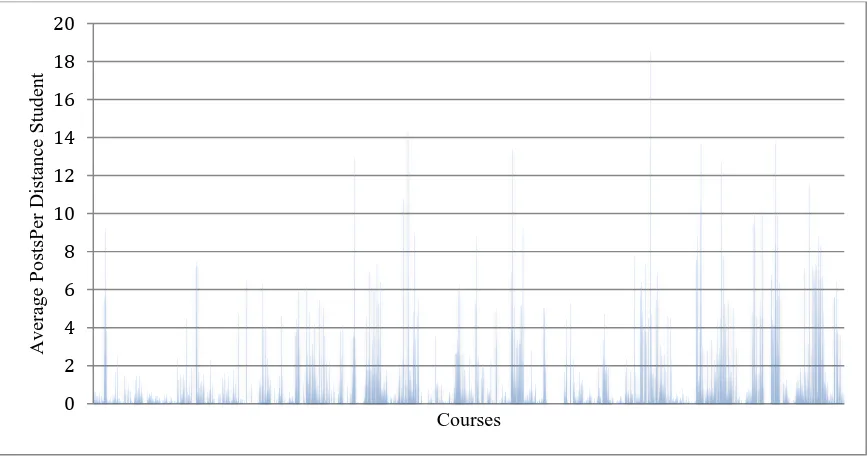
Figure 2. Average distance student forum posts across 1441 courses in 2010 and 2011.
Figure 2 is showing the average number of posts made by distance students across 1441 Moodle courses at the university during 2010 and 2011. The inherent variation is indicative of the plethora of factors that influence how staff and students are using the Moodle discussion forums. Factors such as differing educational philosophies, staff and student familiarity with the technologies, staff and student educational backgrounds, course design, the teacher‟s conception of learning and teaching, the level and discipline of the course, institutional policies and processes are just some of the factors that are contributing to the variation apparent in
0.00 0.50 1.00 1.50 2.00 2.50 3.00 3.50 4.00 4.50
F P C D HD
A
ve
ra
ge
n
umb
er
of
con
tr
ib
ution
s
Grades
Forum Posts Forum Replies
0 2 4 6 8 10 12 14 16 18 20
A
v
er
ag
e
P
o
sts
P
er
Dis
tan
ce
Stu
d
en
t
Figure 2. While learning analytics provides an unprecedented opportunity to observe how staff and students are using the LMS, associated interpretations and interventions need to be carefully considered due to the
underlying complexity of the learning environment. This is of particular concern when considered in parallel with the teleological management approaches that are prevalent in modern universities.
Symptoms of the simplistic
As a result of decreasing public funding, universities are increasingly managed by their leaders as if they were businesses in a competitive marketplace. In most universities, accountability for the use of public funding requires both rational allocation of resources and intentional management of change (Russell, 2009). Correspondingly there is a reduction in diversity brought about by this rational allocation of resources (Andriani, 2001). The modernist, teleological manner of university operation also requires that they follow a purpose driven approach to strategic direction (McConachie, Danaher, Luck, & Jones, 2005) which requires goals and objectives to be centrally set and achieved (Lucas, 1996). This teleological approach perhaps links with the rapid adoption of LMS in that they provide universities with an orderly mechanism for control over their online learning strategy and direction (Coates, et al., 2005). A key problem arising from teleological management approaches of learning environments is the assumption that the system‟s behavior is stable and predictable (Lucas, 1996). Universities and their learning environments on the other hand, have been described as “supercomplex” (Barnett, 2000).
As an example of the tension between managerialism and the complex nature of learning and teaching, in 2009 CQUniversity adopted Moodle as its single LMS. Associated with the adoption of the new LMS and recognition of the importance of student engagement, a set of minimum service standards for course delivery were adopted to guide the course design and planning processes (Tickle, Muldoon, & Tennent, 2009). These standards mandated that every course offer a space for spontaneous student interactions that, within Moodle, was primarily facilitated using discussion forums. However, of 1252 Moodle courses delivered during 2010, 39% had less than five forum contributions by either staff or students. This would suggest that the organizational goal of promoting staff and student interaction within the LMS discussion forums through the teleological imposition of minimum standards has failed to a degree. A factor contributing to this failure is an incorrect assumption by the organization that the underlying system is causal in nature, and the effect of interventions like these minimum standards are predictable and linear.
Organizational leadership has been strongly influenced by Newton‟s “clockwork universe” where the belief is that big problems can be broken down into smaller ones and solved through rational deduction (Plsek & Greenhalgh, 2001). The “machine model” of organizations lets us down badly when no part of the equation is constant, independent or predictable (Plsek & Greenhalgh, 2001). Universities fit the definition of a complex system where the plethora of interacting and interdependent agents and structures includes teachers, students, community stakeholders, community leaders, the state and its education departments, economic structures, technologies, business organizations and so on (Mason, 2008a). Furthermore, complex systems like universities are unlike simple systems in that they consist of very large numbers of constituent elements or agents that that are connected to, and are interacting with each other in many different ways (Mason, 2008b).
Complex systems, such as university learning environments, are open to and interact with their environment, which includes other complex systems (Jordan, 2010). This can lead to problems if they are managed as simple systems. Snowden and Boone (2007) suggest that different management approaches are needed based on the system type. With simple systems, cause and effect are evident and this means best practice can be applied. Complex systems are not causal, patterns are emergent and there exists no single correct solution. Managing complex systems requires an evolutionary approach as small changes can have disproportionate and non-linear consequences. Applying decision making processes appropriate for one particular system type to another, will lead to problems. Similarly, using learning analytics as if a university is a simple context will lead to limitations and problems.
Problems and limitations of the simple to the complex
Using insights from complex adaptive systems and experience over four years with learning analytics, it is possible to identify a number of likely problems that could arise when the implementation of learning analytics is simplistically applied within a complex context like a university. Some of the likely problems, based on the experience of the Indicators project, are summarized below.
o Abstraction losing detail
o Organizational decomposition preventing action
It is not a causal system
o Confusion between correlation and causation o An assumption of causality
Abstraction losing detail
Gardner Campbell (2012) suggested during his presentation to the Learning Analytics and Knowledge Conference 2012, that the nature of learning analytics and its reliance on abstracting patterns or relationships from data has a tendency to hide the complexity of reality. This is exemplified in Figure 2 that shows the variation in student posts and replies and shows an underlying complexity that is not apparent in the linear relationship suggested by Figure 1. This hidden complexity is particularly profound when the data is used for decision making by people who are not directly engaged in the reality (G. Campbell, 2012) and this aligns with complexity science which suggests “bottom up” and emergent change in complex environments (Palmberg, 2009). A 2010 study that used learning analytics to analyze the patterns of particular teacher‟s behavior within an LMS, found widely varying results across three courses which were all located within a single discipline and were all delivered by a single academic (Clark, et al., 2010). So even though the three courses were within a single degree program and were delivered by the same teaching academic, the variation noted would have made decisions based on learning analytics information difficult by someone divorced from the context.
Decomposition difficulties
The concept of universities and their associated learning and teaching environments as complex systems appears to conflict with typical university organisational structures and teleological management approaches, where it is assumed that organizational performance is a direct product of rational, macro-level control from above (Goldspink, 2007). This creates a fundamental problem for those seeking to draw upon learning analytics to improve online learning and teaching across an institution, as organizational structures are often representative of teleological thinking. The organization‟s structures are rationally decomposed into specialized units with rigid command and control processes, and limited scope for cross unit interaction.
As mentioned previously, the LMS is most often central to online learning within universities and responsibility for the installation, maintenance and support of these systems typically falls to the information technology areas. LMS are learning and teaching systems under the control of IT departments who often have little or no
knowledge of their pedagogical application to learning and teaching. Conversely and equally typical, academics and their learning support areas are often bereft of information technology expertise and have little or no technical knowledge of enterprise systems such as an LMS. Consequently, these areas are often segregated within the organizational structure and this can constrain knowledge sharing and cooperation between the areas. Learning analytics, for example, requires significant interaction and collaboration between the information technology areas and the other organisational areas that interpret and act upon the information it provides. This is one simple example of how institutional knowledge sharing can be constrained by rigid organizational structures.
An example of this is the experience of the Indicators project researchers at CQUniversity who required access to the databases associated with the current Moodle LMS and the Blackboard LMS it replaced, in order to explore the potential of learning analytics. As the LMS is the responsibility of the Information Technology Department (IT) and the Indicators researchers were in a different organizational unit, access to data was made difficult due to the overarching organizational structure. A number of questioned were raised when non-IT people requested access to data for the first time. Who owns the LMS data, who should be able to access the data and how will the data be accessed were some of the issues that had to be negotiated in order to instigate a learning analytics project. The decomposed conceptual model of organizations is based on the assumption that the system is like a machine with replaceable parts and predictability can be inferred based on historical performance data (Boustani et al., 2010). Causation in learning and teaching is far more complex as outcomes are not determined by single causes but by multiple causes which means the system is fundamentally
unpredictable (Mason, 2008b). This presents a problem as rigid organizational structures inhibit the cross-unit cooperation and collaboration required to adapt and respond to needs an evolving learning and teaching paradigm.
developing “dashboards” that give insight into the strategic data. A danger exists where learning analytics is incorporated into these “dashboards” simply to fit the organizational structure. While the strategic data that the “dashboards” provide is important, it could be argued that learning analytics data is tactical data that needs to be located where the students and teachers are interacting. In most universities with online students, the interaction point will most likely be the LMS and not the institution dashboard.
Confusion between correlation and causation
The maxim “correlation does not equal causation” is probably familiar to all researchers. This maxim becomes something more fundamental in complex adaptive systems (CAS) as they are not causal systems. Observed patterns within a CAS may be different next time due to small and unpredictable variations in agent behavior. Correlations arising from learning analytics projects are relatively easily measured which fits current
organizational paradigms that value efficiency and compliance (Kenny, 2009). A danger exists where
correlation may be interpreted as a universal constant despite the complex nature of the system and this can lead to problems similar to those experienced in health systems, where attempts to rigidly control complex systems worsens the targeted problems and leads to unintended negative consequences (Boustani, et al., 2010).
Earlier, Figure 1 showed a distinct correlation between student participation in LMS forum discussion and their resulting grade. Figure 2 demonstrated significant variations in the way that discussion forums were used between courses indicating that the correlation shown in Figure 1 might be sheltering some underlying
[image:6.595.124.471.337.539.2]complexity. The following figure further points towards the problems caused when the worldview underpinning the adoption of learning analytics is based on causation.
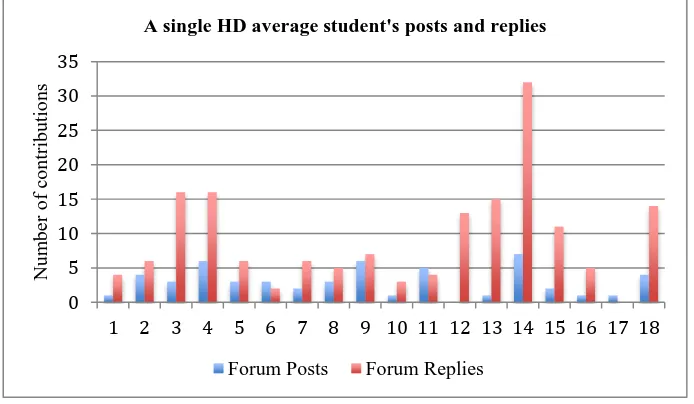
Figure 3. Forum participation for a single student across a degree program
The student represented in Figure 3 has received high distinctions for all of their courses. Figure 3 highlights the large variation in the number of discussion forum posts and replies that a specific student makes across their courses. While Figure 1 showed a correlation between discussion forum participation and student success across a large student population, Figures 2 and 3 suggests that this is may not be a universal constant. Each course is different both in pedagogical intent and in the way that different teachers service their courses. Additionally each student will exhibit different patterns of behavior within each course based on a range of variables internal and external to the student. This aligns with the definition of complex adaptive systems that are comprised of semi-autonomous individuals who interact in non-linear ways while faced with internal and external stressors (Boustani, et al., 2010).
An assumption of causality
The previous section showed the danger of confusing correlation with causation in the interpretation of learning analytics data. However, a broader problem may be the tendency for management to assume causality (D. Snowden & Stanbridge, 2004). The often cited, and somewhat facetious example is if the CEO of a successful company plays golf, then there is a causal link between the company‟s success and the CEO playing golf. Of course this is not the case as the reality is vastly more complex. However we can see elements of this basic error in logic in the ways that companies approach best practice and organizational structure (D. Snowden &
0 5 10 15 20 25 30 35
1 2 3 4 5 6 7 8 9 10 11 12 13 14 15 16 17 18
Nu
m
b
er
o
f
co
n
tr
ib
u
tio
n
s
A single HD average student's posts and replies
Stanbridge, 2004). The danger for learning analytics is if the correlations exposed by the data are seen as causative or universal constants, and this leads to strategic decision-making that assumes the data is
reproducible. An example might be where learning analytics information is used as a performance indicator by the organisation. We noted something similar previously in the example where management mandated the presence of LMS discussion forums across all courses to promote staff and student interaction. While arguably a noble goal, it seemingly failed as 39% of the courses had less than five forum contributions.
Complex adaptive systems: An alternative lens
Complex adaptive systems (CAS) are a variation on complex systems and have been described as systems that involve many components that adapt, learn or change as they interact (Holland, 2006). Each agent within a CAS is nested within other systems, all evolving together and interacting so that we cannot understand any of the agents or systems without reference to the others (Plsek & Greenhalgh, 2001). Changes in outcomes from a CAS are not proportional to changes in input, as the interacting systems behave in non-linear fashions (Shiell, Hawe, & Gold, 2008). In summary, Boustani (2010) postulated:
A CAS is a dynamic network of semiautonomous, competing and collaborating individuals who interact and coevolve in nonlinear ways with their surrounding environment. These interactions lead to various webs of relationships that influence the system‟s performance.
In order to harness learning analytics for the betterment of an institution‟s learning and teaching, interventions will be required based on the information provided by the learning analytics. Associated with complex adaptive systems are the difficulties involved with making interventions within systems bereft of causal relationships. Interventions implemented in complex systems are likely to have diverse, far-reaching, unpredictable and non-linear effects (Shiell, et al., 2008). The potentially disproportionate ramification of interventions made within a complex system is known colloquially as “the butterfly effect” and can inhibit the predictability of outcomes arising from the intervention. Goldspink (2007) suggested that change within the complex system should come from the „inside out‟ and that micro-level interventions are to be preferred to macro-level interventions or system-wide prescription due to the potential for disproportionate ramifications. This raises some questions about the teleological management of learning and teaching and even the deep-root assumptions about teaching that are based on causality and independence (Davis & Sumara, 2007). From a learning analytics perspective, it begs the question about where, and who within the organization is best placed to receive and respond to the information it provides.
Implications for learning analytics
It has been said that learning analytics can improve learning, teaching and student success through an awareness of patterns in the data and the application of predictive modeling techniques (J. P. Campbell, et al., 2007). As touched on previously, there is a danger that within the current organizational management paradigm, learning analytics results will be interpreted as universal constants by which decree and regulation will be applied to meet the organization‟s goals. Considering learning analytics as indicators resulting from the activity occurring within a CAS enables us to evaluate and respond to the realities of the present rather than target an idealistic future state. So while macro-level learning analytics can help describe historical contexts, such as how LMS features usage evolves over time, the inherent complexity in behavior by agents within the system make predictions and statistical modeling difficult and cautions a more evolutionary approach to implementation. The traditional scientific perspective that predictability arises from combining a law with a set of initial starting conditions to deduce an outcome (Hempel, 1966), cannot be applied due to the continuing evolution and interactions of agents within a CAS.
While it could be argued that providing learning analytics derived insights to students is important (Purdue University, 2009), it‟s likely to be the teacher who has the right mix of closeness and expertise with the learning context. This is especially pertinent given the decomposed organizational models in higher education have contributed to development of information silos that constrain the teacher‟s access to data. Not to mention the fact that teacher engagement with students in web-based learning environments is perhaps the number one factor in any discussion around improving learning and teaching (Fresen, 2007; Radloff, 2008). Additionally, it is not unusual for the teacher to be responsible for the design and delivery of LMS courses. This well positions the teacher to respond to situations that emerge as a result of what is transpiring within the course‟s context. For example, the teacher may notice questions about a particular concept within the discussion forums, and can respond by adding a resource that explains the concept in more detail. An example involving learning analytics might be that the teacher is notified that a student has not accessed the LMS course site at the end of week one, and also failed an important preceding course last term. The learning analytics application is linked to the LMS and the student administration system and brings this student‟s situation to the teacher‟s attention so that an intervention can be facilitated and monitored.
Conclusions
This paper is an initial attempt to consider learning analytics against a backdrop of complexity science and more research is required to fully realize its potential. It has suggested that there are going to be limitations for institutions attempting to use learning analytics to inform and improve their learning and teaching due to teleological management approaches and corporate structures and the complex, diverse behaviors of agents within online learning and teaching systems. These limitations stem from organizational silos that constrain knowledge sharing and collaboration as well as a fundamental misalignment between the nature of the university learning and teaching and the way that it is managed.
This paper also provided some insight into potential problems for learning analytics implementation based on over four years experience with learning analytics at a particular institution. These included the hidden complexity behind learning analytics data where abstract representations and interpretations can veil the complexity of behavior occurring within the learning environments. The paper also looked at decomposed organizational models and how this can present problems with the interpretation of learning analytics data and associated responses. It was also suggested that learning analytics is data that stems from a non-causal system where the assumptions of causation and confusion between correlation and causation may cause problems for organizations seeking to gain advantage through the use of learning analytics.
This paper suggests that complexity science and in particular, complex adaptive systems might provide a more appropriate lens by which to consider learning analytics, if the goal is to inform and improve learning and teaching. Complex adaptive systems exhibit apparent order at the macro-level despite the vast diversity of behaviors exhibited at the micro-levels. Complex adaptive systems are about emergence and evolution, which contrasts with teleological management approaches based on targeting idealistic future states through strategic goals and visions.
Many would agree with the notion that learning and teaching environments are complex and require different management approaches. Complex adaptive systems theory provides a lens that allows us to sense and respond to the variety of data that learning analytics provides. While there may be the potential for learning analytics to conflict with management approaches based on reductionist thinking, there exists an opportunity to provide students and educators with an unprecedented view of what is transpiring within their learning environments. While some might argue that the application and presentation of learning analytics needs to be simplified, perhaps it should be “complexified”.
Acknowledgements
The authors would like to thank DEHUB and the participants of the research project “Learning Interactions: A cross-institutional, multi-disciplinary analysis of learner and teacher interactions within online contexts” for their contribution to this work.
References
Andriani, P. (2001). Diversity, Knowledge and Complexity Theory: Some Introductory Issues. [Article]. International Journal of Innovation Management, 5(2), 257.
255-265.
Beer, C., Clark, K., & Jones, D. (2010). Indicators of engagement [electronic resource] / Colin Beer, Ken Clark [and] David Jones: Brisbane, Qld. : University of Queensland, 2010.
Beer, C., Jones, D., & Clark, K. (2009). The indicators project identifying effective learning: adoption, activity, grades and external factors. Paper presented at the ASCILITE 2009. Retrieved from
http://indicatorsproject.wordpress.com/2009/10/09/the-indicators-project-identifying-effective-learning-adoption-activity-grades-and-external-factors/
Black, E. W., Dawson, K., & Priem, J. (2008, 17 March 2008). Data for free: Using LMS activity logs to measure community in online courses. Internet and Higher Education, 11, 65-70.
Boustani, M. A., Munger, S., Gulati, R., Vogel, M., Beck, R. A., & Callahan, C. M. (2010). Selecting a change and evaluating its impact on the performance of a complex adaptive health care delivery system. Clinical Interventions In Aging, 5, 141-148.
Campbell, G. (2012). LAK12 conference presentation. Canada: Learning Analytics and Knowledge 2012. Campbell, J. P., Oblinger, D. G., & DeBlois, P. B. (2007). Academic Analytics. Educause Review(July/August
2007).
Clark, K., Beer, C., & Jones, D. (2010). Academic involvement with the LMS [electronic resource] : an exploratory study / Ken Clark, Colin Beer [and] David Jones: Brisbane, Qld. : University of Queensland, 2010.
Coates, H., James, R., & Baldwin, G. (2005). A critical examination of the effects of learning management systems on university teaching and learning. [Journal Article]. Tertiary education and management, 11(2005), 19-36.
Commonwealth Government of Australia. (2008). Review of Australian Higher Education.
Davis, B., & Sumara, D. (2007). Complexity Science and Education: Reconceptualizing the Teacher's Role in Learning. Interchange: A Quarterly Review of Education, 38(1), 53-67.
Dawson, S., McWilliam, E., & Tan, J. P.-L. (2008). Teaching Smarter: How mining ICT data can inform and improve learning and teaching practice. Paper presented at the ASCILITE, Melbourne, Australia. Ellis, R. A., Jarkey, N., Mahony, M. J., Peat, M., & Sheely, S. (2007). Managing Quality Improvement of
eLearning in a Large, Campus-Based University. Quality Assurance in Education: An International Perspective, 15(1), 9-23.
Fresen, J. (2007). A Taxonomy of Factors to Promote Quality Web-Supported Learning. [Article]. International Journal on E-Learning, 6(3), 351-362.
Goldspink, C. (2007). Rethinking Educational Reform: A Loosely Coupled and Complex Systems Perspective. Educational Management Administration & Leadership, 35(1), 27-50.
Heathcoate, L., & Dawson, S. (2005). Data Mining for Evaluation, Benchmarking and Reflective Practice in a LMS. E-Learn 2005: World conference on E-Learning in corporate, government, healthcare and higher education.
Hempel, C. G. (1966). Philosophy of natural science / [by] Carl G. Hempel: Englewood Cliffs, N.J. : Prentice-Hall, [1966].
Holland, J. (2006). Studying Complex Adaptive Systems. Journal of Systems Science and Complexity, 19(1), 1-8.
Jansen, C., Cammock, P., & Conner, L. (2011). Leadership for Emergence: Exploring Organisations through a Living System Lens. Leading and Managing, 17(1), 59.
Jordan, M. E. (2010). Mathematics as a Complex System: Learning in Complex Adaptive Systems. [Article]. Complicity: An International Journal of Complexity & Education, 7(1), 70-76.
Kenny, J. D. (2009). Managing a Modern University: Is It Time for a Rethink? Higher Education Research and Development, 28(6), 629-642.
Lopes, V. M. (2008). Course Management Systems and Campus-Based Learning. Seneca College. Lucas, D. I. (1996). Notes on ateleological information systems development. Information Technology &
People, 9(4).
Macfadyen, L. P., & Dawson, S. (2010). Mining LMS data to develop an “early warning system” for educators: A proof of concept. [Article]. Computers & Education, 54(2), 588-599.
Mason, M. (2008a). Complexity theory and the philosophy of education. Educational Philosophy and Theory, 40(1), 15.
Mason, M. (2008b). What Is Complexity Theory and What Are Its Implications for Educational Change? Educational Philosophy and Theory, 40(1), 35-49.
McConachie, J., Danaher, P. A., Luck, J., & Jones, D. (2005). Central Queensland University's Course
Management Systems: Accelerator or Brake in Engaging Change? International Review of Research in Open and Distance Learning, 6(1).
Palmberg, K. (2009). Complex Adaptive Systems as Metaphors for Organizational Management. Learning Organization, 16(6), 483-498.
Plsek, P. E., & Greenhalgh, T. (2001). Complexity science: The challenge of complexity in health care. BMJ (Clinical Research Ed.), 323(7313), 625-628.
Purdue University. (2009). Signals tells students how they're doing even before the test. Retrieved 26th November 2009, from http://news.uns.purdue.edu/x/2009b/090827ArnoldSignals.html
Radloff, A. (2008). Engaging staff in quality learning and teaching: what's a Pro Vice Chancellor to do? Sydney: HERDSA.
Reid, I. C. (2009). The contradictory managerialism of university quality assurance. [Article]. Journal of Education Policy, 24(5), 575-593.
Russell, C. (2009). A systemic framework for managing e-learning adoption in campus universities: individual strategies in context. [Article]. ALT-J: Research in Learning Technology, 17(1), 3-19.
Sawyer, K. R., Johnson, J., & Holub, M. (2009). Decline in academe. [Article]. International Journal for Educational Integrity, 5(2), 10-28.
Shiell, A., Hawe, P., & Gold, L. (2008). Complex interventions or complex systems? Implications for health economic evaluation. BMJ, 336(7656), 1281-1283.
Snowden, D., & Stanbridge, P. (2004). The landscape of management: Creating the context for understanding social complexity. [Article]. Emergence: Complexity & Organization, 6(1/2), 140-148.
Snowden, D. J., & Boone, M. E. (2007). A Leader's Framework for Decision Making. (cover story). [Article]. Harvard Business Review, 85(11), 68-76.
Tickle, K., Muldoon, N., & Tennent, B. (2009). Moodle and the institutional repositioning of learning and teaching at CQUniversity. Paper presented at the Same places, different spaces. Proceedings ascilite Auckland 2009. Retrieved from
http://www.ascilite.org.au/conferences/auckland09/procs/tickle.pdf
Author contact details:
Colin Beer, [email protected]
Please cite as: Beer, C., Jones, D. & Clark, D. (2012). Analytics and complexity: Learning and leading for the future.
Copyright © 2012 Colin Beer, David Jones and Damien Clark.
The author(s) assign to the ascilite and educational non-profit institutions, a non-exclusive licence to use this document for personal use and in courses of instruction, provided that the article is used in full and this copyright statement is reproduced. The author(s) also grant a non-exclusive licence to ascilite to publish this document on the ascilite website and in other formats for the Proceedings ascilite 2012. Any other use is prohibited without the express permission of the author(s).