RAY-MODE DUALITY FOR SH WAVES AND THE EFFECT OF EARTH STRUCTURE ON FREE OSCILLATION EIGENFREQUENCIES
A thesis submitted for the degree of
DOCTOR OF PHILOSOPHY
at the
Australian National University Research School of Earth Sciences
CANBERRA A.C.T. 2600 by
CHENGSUNG WANG
STATEMENT
This thesis includes results of research undertaken while I was a full-time research scholar at the Research School of Earth Sciences, Australian National University during the period March 1975 to September 1978.
Except where mentioned in the acknowledgements, the work
described in this thesis is my own. This thesis has never been submitted to another university or similar institution.
Chengsung Wang Canberra
ii.
ACKNOWLEDGEMENTS
I am greatly indebted to my supervisors, Drs. John R. Cleary of the Research School of Earth Sciences and Robert S. Anderssen of the Computing Research Group, Australian National University, for their
patient guidance and encouragement during the course of this work and also to Dr. Joseph F. Gettrust of the Hawaii Institute of Geophysics, University of Hawaii, Hawaii, U.S.A., for his assistance and advice while he was at the Research School of Earth Sciences.
I wish to express my sincere thanks to Professor Ralph A. Wiggins of the Western Geophysical Company at Houston, Texas, U.S.A., and Professor Freeman Gilbert of the Scripps Institution of Oceanography, University of California at San Diego, California, U.S.A., for making available their computer programs WIGGINS and MODE respectively; to Clementine Krayshek and Lesley Hodgson for their help in preparing the figures; to Carmel Neagle
T>r. Ken tfuMvioJ.,
for her skilful typing; and to^Dr. Ian Reid, Douglas Christie and my fellow students (Jo Lock, Jim Leven and Bob Clements) for frequent discussions.
I would like to thank my wife, Ying-ying, for her encouragement and care which was necessary to complete this research.
PUBLICATIONS DURING THE COURSE OF THIS THESIS
Wang, C . , Gettrust, J.F. and Cleary, J.R., 1977. Asymptotic overtone structure in eigenfrequencies of torsional normal modes of
the Earth : a model study, Geophys. J.R. astr. Soc., 50, 289-302. Wang, C . , Cleary, J.R. and Anderssen, R.S., 1978a. Ray-mode duality
for SH waves in Earth models with crust and mantle discontinuities: I. The case of one discontinuity, Geophys. J.R. astr. Soc.
(in press).
Wang, C . , 1978a. Ray-mode duality for SH waves in Earth models with crust and mantle discontinuities: II. The case of N discontinuities, Geophys. J.R. astr. Soc. (accepted).
Wang, C . , 1978b. A strategy for the summation of seismic signals multiply-reflected at internal discontinuities, Physics of the Earth and Planetary Interiors (submitted).
Wang, C . , Cleary, J.R. and Anderssen, R.S., 1978b. Effect of Earth structure on radial oscillations (in draft).
iv.
ABSTRACT
A major aim in geophysics is to extend the power of available data to constrain Earth structure. Brune (1964) used body wave data to derive information about free oscillations of higher overtone number than so far observed by direct methods. His technique, however, was not designed to cope with the presence of discontinuities in the upper mantle. As a result higher mode data derived by him and Brune and Gilbert (1974) are unable to detect the solotone effect, a persistent oscillatory
component in the eigenfrcquency spacing of high overtone data, which, as McNabb et at. (1976) have shown, is a consequence of the existence of internal discontinuities. This thesis is mainly concerned with an
examination of the constraining power of high overtone eigenfrequencies, and with an extension of Brune's method to include the cases of internal discontinuities.
At the beginning of the present work, a computational study was carried out to show that the solotone effect in torsional oscillations
could be derived from the summations of multiple reflections of SH waves from internal discontinuities recorded at small epicentral distances, using Brune's equation. Subsequently, a technique was developed to verify this result mathematically by deriving the McNabb et at. result from these
summations. This was accomplished firstly for the case of a single
discontinuity, and the analysis was then generalized to include'an arbitrary number of discontinuities. The results of the above study were used to examine the relationship between the solotone effect and the depths and magnitudes of discontinuities.
Finally, the overtone behaviour of radial oscillations were
vi.
TABLE OF CONTENTS
page CHAPTER 1 GENERAL INTRODUCTION
1.1 Aims 1
1.2 Historical Background 3
1.3 Thesis Outline 5
1.4 Identification of Mode Numbers 6
CHAPTER 2 ASYMPTOTIC OVERTONE STRUCTURE IN EIGENFREQUENCIES OF TORSIONAL NORMAL MODES OF THE EARTH : A MODEL STUDY
2.1 Introduction 8
2.2 Asymptotic Formula, Asymptotic Behaviour of
Overtone Eigenfrequencies, and the Solotone Effect 10
2.3 Brune's Phase Correlation Method 14
2.4 Asymptotic Behaviour of Eigenfrequencies Computed from SH Wave Seismograms by Brune's Phase
Correlation Method 16
2.5 Discussion 27
CHAPTER 3 RAY-MODE DUALITY FOR SH WAVES IN EARTH MODELS WITH CRUST AND MANTLE DISCONTINUITIES : I. THE CASE OF ONE DISCONTINUITY
3.1 Introduction 30
3.2 Preliminaries 31
3.2.1 Application of Brune's Phase Correlation
Method for Small Epicentral Distances 31 3.2.2 Crust and Mantle Models with a Single
Discontinuity 33
3.2.3 Combinatorial Lemmas for the Summation of Multiple Reflections from Discontinu
ities 35
3.3 Analysis of Rays 36
3.3.1 Ray Decomposition 38
3.3.2 Summation of Equivalent Rays 40
3.4 Formulation of f^(t) and f^ (t) and their Fourier
Transforms 45
3.5 Derivation of F^ (oj)/F (a)) 46
3.6 Derivation of Eq. (3.1) from Brune's Formulation 48 APPENDIX Expression of a ray in terms of fundamental
ray components 49
CHAPTER 4 A STRATEGY FOR THE SUMMATION OF SEISMIC SIGNALS MULTIPLY-REFLECTED AT INTERNAL DISCONTINUITIES
4.1 Introduction 51
4.2 Earth Models and Terminology 52
4.3 Ray Decomposition 56
4.3.1 Properties of Rays 56
4.3.2 Equivalent Rays 57
4.4 Summation of Equivalent Rays 59
4.4.1 Numbers of Non-Equivalent Junctions 60 4.4.2 Construction of Equivalent Rays 65 4.5 Summation of Multiple Reflections of Signals 71 4.6 Re-interpretation and Extension of a Filter for
CHAPTER 5 RAY-MODE DUALITY FOR SH WAVES IN EARTH MODELS WITH CRUST AND MANTLE DISCONTINUITIES: II. THE CASE OF N DISCONTINUITIES
5.1 Introduction 79
5.2 The Summations f (t) and f (t) 79
5.3 Formulation of f (t), f2 (t]and their Fourier
Transforms 80
5.4 The Expression F^(w)/F (w) 82
5.5 Derivation of Eq. (1.2) from Brune's Formulation 84
5.6 Discussion 88
APPENDIX A Simplification of Eq. (5.5) APPENDIX B Properties of I^+ .
APPENDIX C Verification of Eq. (5.12) APPENDIX D A proof of Relation (5.C8) APPENDIX E A proof of Relation (5.9)
APPENDIX F Proofs of Relations (5.22) and (5.23) APPENDIX F Derivation of Eq. (1.2) for Models with
two discontinuities
90 95 97 99 108 112 115 CHAPTER 6 THE EFFECT OF CRUST AND MANTLE DISCONTINUITIES ON THE
ASYMPTOTIC SPACING BETWEEN SUCCESSIVE TORSIONAL OVERTONE EIGENFREQUENCIES OF THE EARTH
6.1 Introduction 115
6.2 Properties of the Solotone Effect Investigated
from Model Studies 117
6.3 The Form of Solutions of Eq. (5.26) 120 6.4 Mathematical Derivation of Properties of the
Solotone Effect 123
6.4.1 Earth Models with a Single Discontinuity 123 6.4.2 Earth Models with more than One Small
Discontinuity 130
CHAPTER 7 EFFECT OF EARTH STRUCTURE ON RADIAL OSCILLATIONS
7.1 Introduction 134
7.2 Terminology 135
7.2.1 Curves 136
7.2.2 Magnitudes of Discontinuities and
Transition Layers 137
7.3 Effects of Core Boundaries 138
7.3.1 Earth Models Used 138
7.3.2 Result 141
7.3.2.1 Effect of a Discontinuity or Transition Layer at the I/O
Boundary 142
7.3.2.2 Effect of a Discontinuity or Transition Layer at the C/M
Boundary 145
7.4 Effect of the Crust and Upper Mantle Structure 149 7.5 Comparison between Observed and Synthetic Data 153
7.6 Conclusions 155
CHAPTER 8 GENERAL DISCUSSION 159
viii.
LIST OF FIGURES Figure
2.1 Model B497 and its variations B497C, B497D and B497DC 2.2 Asymptotic overtone structures curves) of the
model Earth eigenfrequencies computed using Eq. (2.1) for models B497C, B497 and B497D.
2.3 Dependence of the amplitude of the oscillation in the solotone effect on the magnitude of a shear velocity discontinuity at a fixed depth of 531 km.
2.4 Dependence of the frequency of the oscillation in the solotone effect on the depth of a small shear velocity discontinuity of a fixed magnitude of 0.3 km/s
2.5 The ray paths and the corresponding model Earth response functions used for models B497DC and B497D.
2.6 Interpolation method used to evaluate,
from the synthetic SH-wave pulses shown in Fig. 2.5, the eigenfrequencies n^ for which
I
is an integer.2.7 The phase difference functions g (^w) and the asymptotic overtone structures (nY^:w curves), based on eigen frequencies computed using Eqs. (2.3) and (2.4), for models B497C and B497DC.
2.8 The phase difference functions g ( w) and the asymptotic overtone structures ( Y
7:n
curves), based oneigen-Yl ty
frequencies computed using Eqs. (2.3) and (2.4), for model B497D.
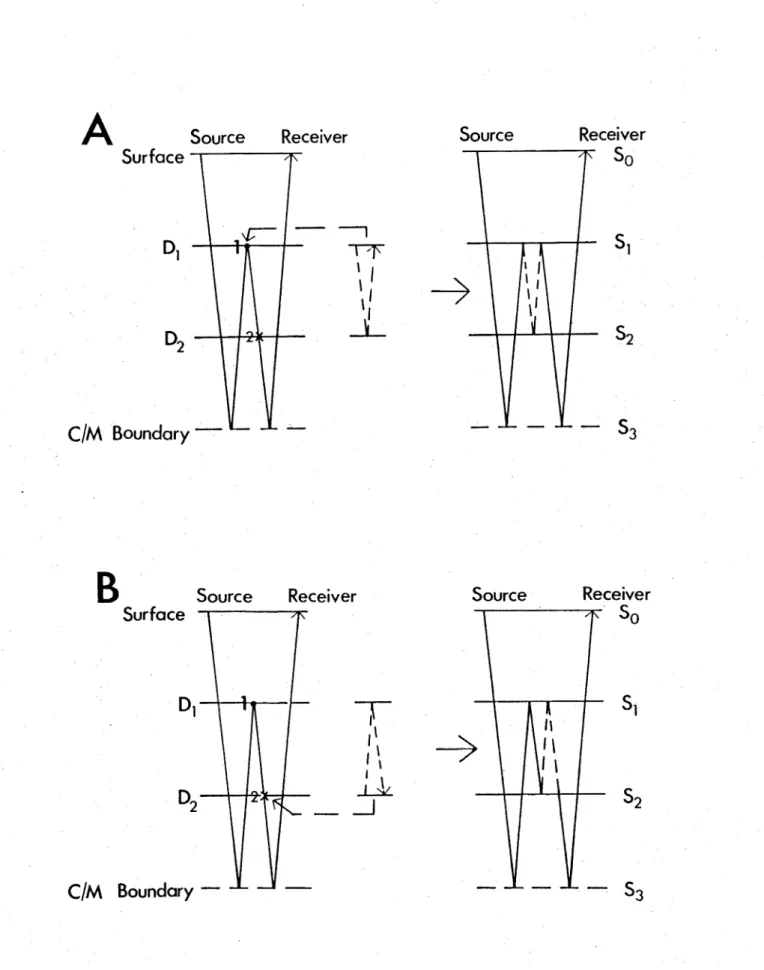
3.1 Crust and mantle models with only one discontinuity between the Earth's surface and the core-mantle boundary.
3.2 The six fundamental ray components for Earth models containing only one discontinuity.
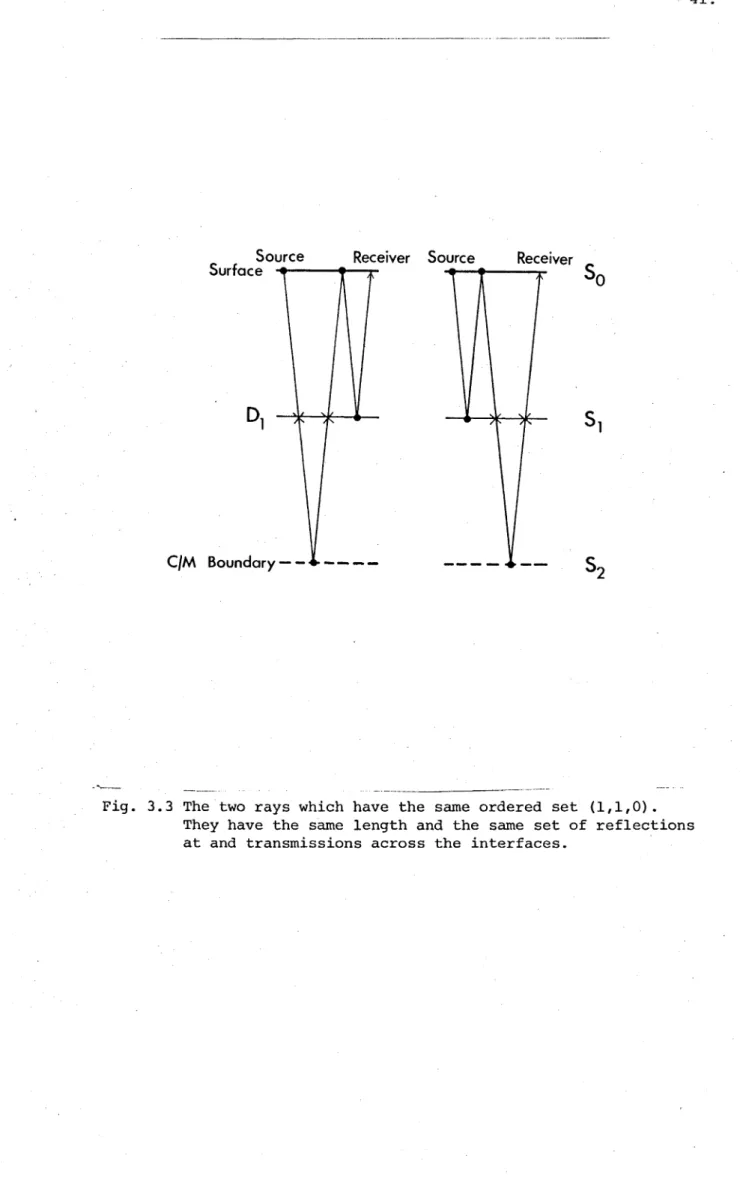
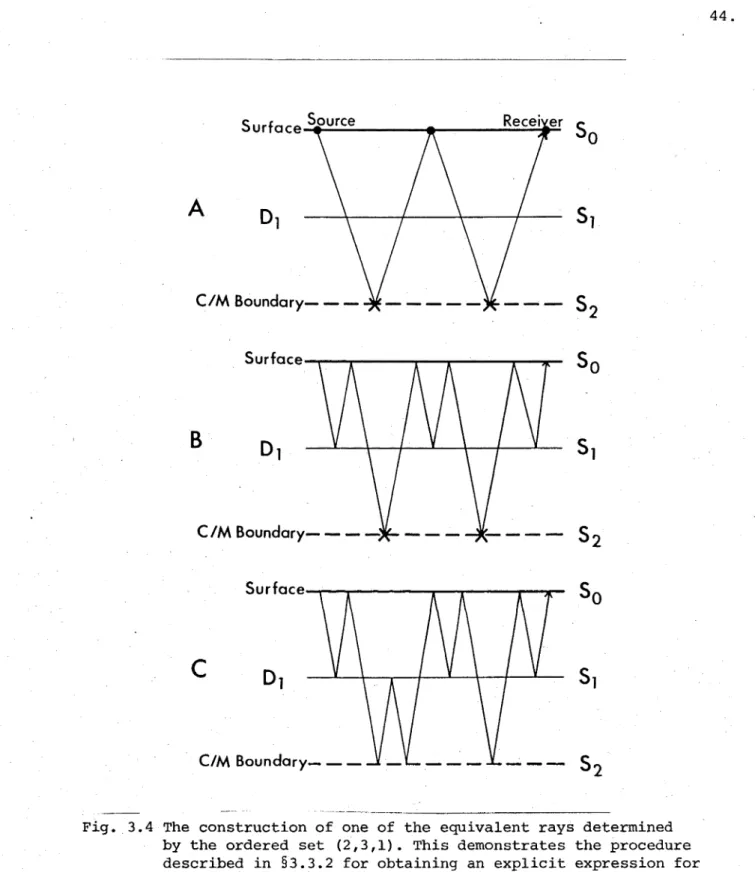
3.3 The two rays which have the same ordered set (1,1,0). The construction of one of the equivalent rays determined by the ordered set (2,3,1).
page
9 12
13
15
18
20
22
26
34
37
41
Figure 4.1 4.2 4.3 4.4 4.5 4.6 4.7 4.8 4.9 5.1 5.2
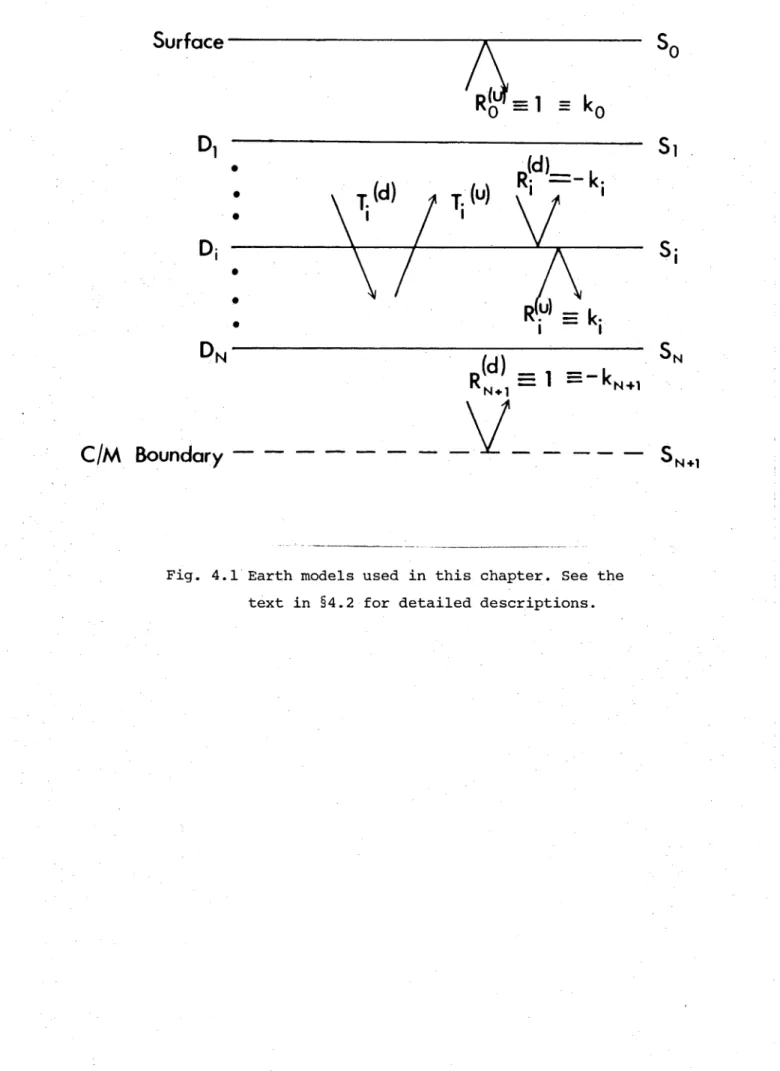
Crust and mantle models with N discontinuities between the Earth's surface and the core-mantle boundary.
The twelve fundamental ray components for models containing two discontinuities between the Earth's surface and the core mantle boundary.
The two rays which have the same set of ray segments and the same set of reflections at and transmissions across interfaces, yet belong to the different ordered sets
(1; 1, 1; 0,0,0) and (2; 0, 0; 0,1,0).
The two ways of constructing the same ray with an ordered set (1; 0, 1; 0,1,0) from a ray with an ordered set (1; 0, 1; 0,0,0).
The three types of fundamental reflections which are associated with and (l<i<j<N) and have a longer length than r\ . The fundamental reflections which are associated with SQ
(the Earth's surface) and S. (j=l,2,...N) and have a longer
0 11
length than r_^.
The triangular pyramids of the numbers m^ . and the corres-ponding numbers
The construction of the equivalent rays determined by the ordered set (1; 2, 1; 1,2,1).
Diagram showing that the wave reverberations in the water layer associated with a reflection from an interface below the water bottom can occur at both sides of the reflection. Representations of terms in Expression (i), Expression (ii),
and "^+"^uL+j °f Eq. (5.D4), and representations of the products of the terms in Expressions (i) and (ii) and of the
terms in and in
L+j ” " L+j *
The correspondence of an ordered pair [U,V] of different sets which produces a term on the left-hand side of Eq. (5.D4) to an ordered pair which produces a term on the right-hand side.
T -n curves for Earth models with a discontinuity of almost the same magnitude
Figure
Diagram illustrating the meaning of h(n) for an Earth model with a single discontinuity
x .
6.2
page 121
6.3 The diagram showing the departure of overtone eigenfrequencies 122 computed by MODE from 2nu/T for £=1 and £=2 (for an Earth
model with a homogeneous crust and mantle).
6.4 Comparison with ^ values derived from eigenfrequencies 126 computed by MODE and those evaluated from Eq. (6.9) (for
Earth models shown in Figs. 6.1A and 6.1C).
6.5 Comparison between ^ values derived from eigenfrequencies 129 computed by MODE and those evaluated from Eq. (6.14) (for an
Earth model shown).
6.6 Comparison between V values derived from eigenfrequencies 131 (i 1
computed by MODE and those evaluated from Eq. (6.17) (for an Earth model shown).
6.7 Comparison between values derived from eigenfrequencies 133 computed by MODE and those derived from solutions of Eq. (5.26) calculated by a computer with the BISECTION algorithm (for an Earth model shown).
7.1 Comparison between amplitudes of the solotone oscillations 135 corresponding to a discontinuity and to a transition layer,
respectively, at 600 km depth.
7.2 Diagram showing how a discontinuity in a parameter is replaced 139 by a linear transition layer.
7.3 Models 1066A, HOMO and some other models ACxIy and IlCxIy 140 derived from them.
7.4 n^Q~n curves constructed from ACxIy with varying thickness y. 143
7.5 ? -n curves constructed from HCxIy with varying thickness y. 144 7.6 V -n curves constructed from ACxIy with varying thickness x. 146
n 0
7.7 n^0~n curves constructed from HCxIy with varying thickness x. 147
7.8 The dependence of the magnitude of the C/M transition layer 148 on the thickness of the layer for different Earth models.
7.9 Comparison of the effect of the continuous upper mantle of isi 1066A and that of the discontinuous one of 1066B on the
Y -n curve.
Figure page 7.10 Comparison of n ^ Q ~ n curvGS for models 1066A and 1066B 152 7.11 Observed error ranges and comparison of observed ^y^ 154
values and those constructed from model 1066A and two perturbed models of 1066A.
7.12 Comparison of y and I y (AC800I0) + y (AC0I800) - 157
n 0 l n 0 n 0
xii.
Table 2.1 2.2
LIST OF TABLES
P values and arrival times for the rays shown in Fig. 2.5A.
(m)
Values of Y, derived from the data of Brune and Gilbert
n l
(1974) , compared with values from models 1066A and 1066B.
CHAPTER 1 GENERAL INTRODUCTION
1.1 AIMS
Virtually all the direct information about the structure of the Earth's interior has been derived from measurements of the times, amplitudes and periods of seismic waves. Studies of body and surface waves have provided a great deal of information about the distributions of compressional and shear wave velocities (a, and 3) in the Earth's
interior. However, the diversity in the calculated velocity distributions has been a major problem. In addition, the determination of density from velocity distributions was impossible without an appeal to plausible assumptions concerning chemical and phase homogeneity in layers with smooth velocity profiles.
Since the differential equations for the free oscillations of the Earth explicitly involve p, a and 3 (or p, k and y, where k and y are the bulk and rigidity moduli), important additional direct constraints on the solution of these problems have been provided by the observed
eigenfrequencies (or eigenperiods) of the Earth. The first indisputable free oscillation data were those presented at an international meeting in Helsinki in 1960 (Bullen, 1975, p. 301). Using improved techniques of data acquisition, the set of free oscillation data has been greatly enlarged by Pekeris (1966), Derr (1969), Dziewonski and Landisman (1970), Mendiguren (1973), Dziewonski and Gilbert (1972, 1973), Brune and Gilbert
2.
Earth. For example, using the same refinement technique and the same set of free oscillation data, Gilbert and Dziewonski (1975) obtained two different Earth models, 1066A and 1066B, from different starting models. The differences between these models are mainly concerned with limited structural features such as discontinuities and rapid transition regions in the upper mantle, such that 1066A has a 'continuous' upper mantle, and 1066B a 'discontinuous' upper mantle.
Free oscillations are defined such that their wavelengths decrease with increasing overtone number. As a consequence, it is not possible to distinguish between continuous and discontinuous models
( such as 1066A and 1066B) unless free oscillation data of sufficiently large overtone number are available. It is therefore clear that, in order to obtain better resolution of the Earth's fine structure, free
oscillation data of high overtone number are required. These data are related to body waves (e.g., Sato et. al.} 1963), but have not yet been observed directly due to attenuation effects.
Applying the constructive interference condition for body waves of the same apparent phase velocity, Brune (1964) devised a phase
correlation method (reviewed in §2.3) which makes possible the evaluation of normal modes of high overtone number directly from body wave pulses in seismograms. As pointed out by Ben-Menaham (1964), Brune's method represents an application of a ray-mode duality to the representation of the Earth's displacement field. His method is, however, strictly
applicable only to continuous Earth models, and requires modification in order to be applied to discontinuous ones.
In accordance with the above considerations, this thesis is chiefly concerned with
1. an examination of Brune's strategy for supplementing available observed eigenfrequencies (especially of high overtone number). This is done by showing that the equation derived by McNabb, Anderssen and Lapwood (1976) for the asymptotic behaviour of overtone eigenfrequencies can be derived by an adaptation of Brune1s method to almost vertical SH waves multiply-reflected in discontinuous Earth models;
2. the development of background theory which describes explicitly the dependence of free oscillation overtone eigenfrequencies on Earth structure. To this end, the effects of discontinuities and transition regions in the Earth's interior on the free
oscillation eigenfrequencies have been investigated theoretically and by model studies.
1.2 HISTORICAL BACKGROUND
For spherically symmetric, non-rotating, elastic and isotropic (SNREI) Earth models, the free oscillation eigenfrequencies G 7 with
Yl
overtone number n and angular order number Z are defined (e.g., Alterman, Jarosch and Pekeris, 1959) by the differential eigenvalue problem
Z(Z;1) V ) U = 0
rz (1 .1 )
0 = 0 7 , U = U (r) , y = p (r) , p = p(r) , R < r < R
Yl 1, C O
with boundary conditions
y (^- - — ) = 0, r = R and r = R
dr r c 0
where y is rigidity, p is density, and R and R are the radii of the
c 0
In addition to the numerous investigations of the interdependence of free oscillation eigenfrequencies and Earth structure along the lines
initiated by Backus and Gilbert (1967, 1968, 1970) (c.f. Gilbert and Dziewonski, 1975), a number of recent studies have concentrated on the properties of the asymptotic overtone eigenfrequencies. Anderssen, Osborne
and Cleary (1974) found that the spacings between torsional eigenfrequencies 0- of successive overtone numbers n and fixed angular order number l contain n l
information about the structure of SNREI Earth models. Subsequently, the effect of discontinuities in the Earth's interior on eigenfrequency spacings has been studied by various authors (Anderssen and Cleary, 1974; Lapwood,
1975; McNabb, Anderssen and Lapwood, 1976; Anderssen, Cleary and
Dziewonski, 1975; Gilbert, 1975). The central conclusion of these studies is that, for fixed small 2- and sufficiently large n, discontinuities in the Earth's interior cause a persistent oscillatory component, called the solotone effect, in the spacings.
In particular, McNabb, Anderssen and Lapwood (1976) derived an equation for the asymptotic behaviour of the eigenfrequencies of a Sturm-Liouville system (reduced from Eq. (1.1)) with discontinuous
coefficients. For SNREI Earth models with N discontinuities between the Earth's surface and the core-mantle boundary, their equation can be written as
sin (ao) = Z B. sin(b.0) (1.2)
i-i 3 3
where a is the shear wave radial travel time from the Earth's surface to the core-mantle boundary, and B. and b. are constants which depend
D 3
on the parameters defining the discontinuities. The constants B and have not been determined explicitly except for the cases where N=1
1.3 THESIS OUTLINE
The dependence of the solotone effect on parameters defining the discontinuities in the Earth interior is investigated and a physical explanation of the solotone effect is sought in Chapter 2. It is found, for the case of torsional free oscillations, that some properties of
the solotone effect vary systematically with the depths and the magnitudes of discontinuities, and that the solotone effect can be interpreted in terms of SH waves multiply-reflected from discontinuities.
For an Earth model with a single discontinuity between the surface and the core-mantle boundary, the basic equation (Eq. (1.2)) for the asymptotic behaviour of the torsional overtone eigenfrequencies is derived in Chapter 3, by summing almost vertical SH multiple reflections
in the model by a ray analysis strategy and then adapting Brune's method to the summations. In Chapters 4 and 5, the ray analysis strategy is extended to Earth models with N discontinuities, and Eq. (1.2) is derived
(with constants determined) using this extended strategy. This provides a theoretical proof that the solotone effect arises from multiple reflections between the Earth's surface, the core-mantle boundary and discontinuities between them, and establishes a basis for
a ray-mode duality for discontinuous models.
The properties of the solotone effect summarised in Chapter 2 are derived in Chapter 6 from Eq. (1.2) for Earth models with (i) a single discontinuity which is either small or near the surface, or
(ii) more than one small discontinuity. This connects the theoretical and model studies in the earlier chapters.
Finally, the effect on the radial free oscillations of the transition regions at the core-mantle and inner-outer core boundaries,
6.
number Yi reflects the overall spherically symmetric structure of the
Earth, while that of eigenfrequencies of high
n
tends to reflect vertically limited Earth structures such as discontinuities and very rapid transitionregions. The details of this study are given in Chapter 7. The results of the thesis are discussed in Chapter 8.
1.4 IDENTIFICATION OF MODE NUMBERS
The normal modes of the Earth can be grouped into two classes:
spheroidal modes yC’Z and torsional modes Y\}"Zm Since the deformation of the Earth's surface can be expressed uniquely in terms of the spherical
harmonic functions [P^ (cos G)cos m\] (where G is the latitude and X the
longitude; 1- 0,1,... and m= 0,!,...£), the integers
Z
(called the angular order number or simply order number) andm
define the pattern of surface displacement with regard to the source of disturbance. The remaining integer n (called the overtone number) defines the overtone pattern, i.e.,the pattern of displacements as a function of depth. If Earth models are assumed to be non-rotating and spherically symmetric, the set
(n , Z, m)
is degenerate and can be replaced by (n,Z)
, since the deformation of the Earth's surface is now uniquely describable in terms of the zonal harmonics(cos G)]
(Z-
0,1,...). Under such conditions, there areZ ( Z =
0,1,...) lines of nodal lattitude in the surface pattern for spheroidal modesn l
and
Z-l
(Z=
1,2,...) lines for torsional modes T ? . If, in addition, theYl U
Earth models are assumed to be solid, both S7 and T 7 modes have
n
nodaln i
n i
surfaces in the Earth's interior (MacDonald and Ness, 1961). It is noted
that the qS^ and modes do not exist since they involve changes in
linear and angular momentum respectively.
The study of the Earth's free oscillations is complicated by
the presence of a liquid outer core which consequently does not permit the
interpretation (cf. MacDonald and Ness, 1961) of the notation if attention is restricted to the torsional free oscillations in the mantle
(in this case, n is the number of nodal surfaces between the surface and the core-mantle boundary). However, n in the notation S? no longer denotes the number of nodal surface in the Earth's interior if it is assigned according to sequentially decreasing period for a given Z. This leads to various difficulties (Anderssen, Cleary and Dziewonski, 1975). For example, if a new mode is discovered, it is often necessary to change the identification of some others. This makes the prediction of new modes and the study of the distribution of spheroidal overtone eigenfrequencies difficult.
For high eigenfrequencies of a small fixed angular order number Z, Anderssen, Cleary and Dziewonski (1975) have classified the spheroidal modes into three sequences equivalent to the following three body wave types: PKIKP, (ScS)^ or Jy (shear waves in the inner core). For K= PKIKP,
(ScS)y or Jy, -the symbol (K) was introduced by them to identify the normal modes corresponding to the body wave type K. As a consequence, the
standard meaning of overtone number n ( cf. MacDonald and Ness, 1961) is retained. However, such an identification does not apply to normal modes with small n and large Z.
In this thesis, the classification of Anderssen, Cleary and Dziewonski (1975) is used for spheroidal normal modes, since we deal with normal modes of small Z. Spheroidal normal mode eigenfrequencies
corresponding to the different sequences are written as CJ- (k) and
Yl U
torsional eigenfrequencies as (ScS ). However, in Chapters 2 through
Yl ts H
7 the notation is used when there is no ambiquity.
CHAPTER 2
ASYMPTOTIC OVERTONE STRUCTURE IN EIGENFREQUENCIES OF TORSIONAL NORMAL MODES OF THE EARTH: A MODEL STUDY
2.1 INTRODUCTION
Asymptotic behaviour of eigenfrequencies of normal modes of the Earth has been the subject of some investigation in the past few years
(§1.2). The main conclusion of the investigation has been that
discontinuities in the interior of a SNREI Earth model will produce a persistent oscillatory component (the solotone effect) in the asymptotic spacings between successive overtone eigenfrequencies. In order to understand this phenomenon, a model study is useful since the factors which may produce it can be studied separately. The present chapter
shows that the oscillations in the solotone effect result from multiple reflections from discontinuities in the Earth's interior, and that the
frequencies and amplitudes of the oscillations vary systematically with the depths and magnitudes of the discontinuities.
In this chapter the changes produced in the solotone effect by discontinuities at different depths and of different magnitudes are
first examined for various Earth models. The asymptotic overtone structure in eigenfrequencies computed from synthetic SH-wave seismograms by Brune's
(1964) phase correlation method is then constructed, to show that the solotone effect can be reproduced by summation of relevant multiple reflections from the discontinuities.
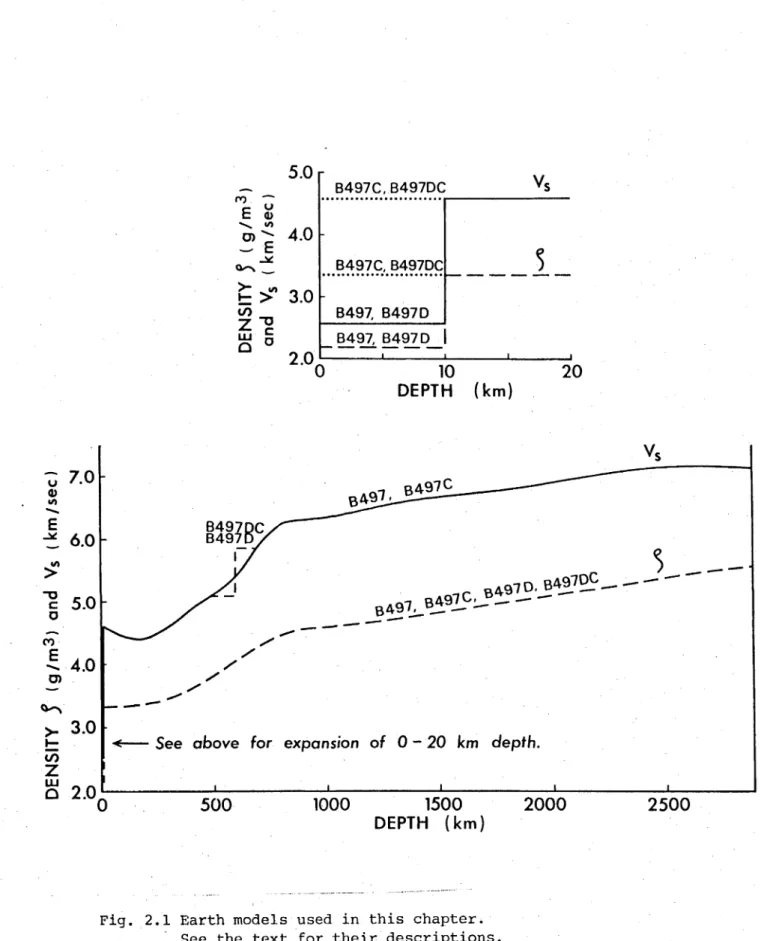
Earth models B497 (Gilbert, Dziewonski and Brune, 1973; Dziewonski and Gilbert, 1973, Appendix Al) and variations, including B497C, B497D and B497DC (Fig. 2.1), are used throughout the study. B497 is continuous except for a large discontinuity in density and wave
D
ENS
ITY
5
(g
/m
3
>
a
n
d
V
s
(k
m
/s
e
c
I
>
-y— to
Z
LU
Q
5.0
B 497C ,B 497D C
u a)
4.0
-E
B497C, B497DC
>" 3.0 _
“O B497, B497D
c
o B497, B 497D
2 . 0---1---4---1--- '
0 10 20
DEPTH (km )
B497QC B497D /
See above for expansion of 0 - 2 0 km depth.
1500 DEPTH ( km)
2000 2500
1 0.
constraints, certain eigenfrequencies (Brune and Gilbert, 1974) computed by Brune's phase correlation method. B497D was derived from B497 by the addition of a 0.77 km/s discontinuous increase in shear velocity at 600 km depth. The radial travel times for SH-waves from the Earth's surface to the core-mantle boundary for these two models were constrained to be the same. B497C and B497DC are the same, respectively, as B497 and B497D, except for the absence of the crustal layer.
2.2 ASYMPTOTIC FORMULA, ASYMPTOTIC BEHAVIOUR OF OVERTONE EIGENFREQUENCIES, AND THE SOLOTONE EFFECT
The free oscillation eigenfrequencies for overtone number
n
and angular order number 1 for SNREI Earth models are defined by Eq. (1.1). Using the variational method of Backus and Gilbert (1967), Gilbert wrote a computer program MODE to compute eigenfrequencies G? from Eq. (1.1).
Yl is
Throughout this thesis MODE is used for the investigation of the behaviour of the overtone structure in the eigenfrequencies.
Under the assumption that the coefficients in Eq. (1.1) contain no discontinuities, Anderssen and Cleary (1974) derived from Eq. (1.1), using the Sturm-Liouville transformation, the following asymptotic formula for 0-,
n l
n l
2 -2 -2 -2 -2 -3
(mr) y + Ay + By
n
+ 0(n )
(2.1)for fixed
l
and suitably largen (n>
10 was sufficient for the models used in this study), where y is the radial travel time for (ScS) wavesH
between the Earth's surface and the core-mantle boundary and A and B are constants independent of
n.
The formulan^l
it (2n + l ) 1 / 2 (2 2 -1/2
Ö-7 “ Ö-, )
n+l l
n l
(2.2)and higher order effects can be neglected. With fixed Z , ^Y^ is expected
to approach an asymptote for a continuous Earth model as n increases
(Anderssen, Osborne and Cleary, 1974; Anderssen and Cleary, 1974). The
behaviour of Y 7 is quite different for models containing discontinuities;
Yl U
for these models Y 7 will oscillate about the asymptote in a persistent
Yl Is
manner. This phenomenon is the solotone effect (McNabb, Anderssen and
Lapwood, 1976).
Curves 1, 2 and 3 in Fig. 2.2 show the asymptotic overtone
structures ( Y 7' n curves) in the eigenfrequencies of Eq. (1.1) for models
Yl U
B497C, B497 and B497D (Fig. 2.1) respectively. Curve 1 (B497C) shows
that the Y value quickly approaches its asymptote, the constant value of
which is the radial travel time for SH waves from the surface of the model Earth to the core-mantle boundary. This is the characteristic
asymptotic behaviour of the normal mode eigenfrequencies for a continuous
Earth model.
It can be seen in Fig. 2.2 that the solotone effect is in the
form of an oscillation about a value of Y which depends on the model.
By analogy with more common forms of oscillation we may describe the
effect in terms of frequency (in units of cycles per step of increase
inn) and amplitude (in units of seconds).
Curve 2 shows the effect produced by the 10 km discontinuity
(crust-mantle boundary) of B497, and curve 3 the composite effect of the
10 and 600 km discontinuities of B497D. The 10 km discontinuity of B497
causes the low-frequency oscillation of curve 2 , while the 600 km
discontinuity of B497D causes the high-frequency oscillation of curve
3 about curve 2.
The amplitude of the oscillation in the solotone effect
increases, for a fixed depth, with the magnitude of the discontinuity
v
a
lu
e
s
(s
e
co
n
ds
)
2000
DEPTH ( km )
490. 0
485 .0
480. 0
475. 0
470. 0
505-0
5 00. 0
495. 0
490. 0
485. 0
480. 0 (N
^ 475. 0
5 25. 0
5 20 . 0
515-0
5 10. 0
5 05. 0
50 0. 0
495. 0
490. 0
485 -0
480. 0
P M f
I n 11
p
11 P 11
, 1 , 1 1 1 . 1 1 1 1 1 ■ 1 1 1 1 1 1 1 1 1 1 1 1 1 » 1 1 1 » » 1 1 1 1 1 » I » » I » i * * 1 - * - 1
IQ 20 30 40 50 60 70 80 90 100
n
F i g . 2 . 3 D e p e n d e n c e o f t h e a m p l i t u d e o f t h e o s c i l l a t i o n i n t h e s o l o t o n e e f f e c t
1 4.
to the radial travel times and from the Earth's surface and the
core-mantle boundary, respectively, to the discontinuity. When the
discontinuity is moved down from the Earth's surface towards the core
mantle boundary, the frequency of the solotone oscillation (Figs. 2.4A
and 2.4B) increases as x^ increases until x^ = x^r and then decreases
as decreases (Figs. 2.4G and 2 . 4 H ) . When the absolute value of
(x^ - x^) becomes small, there is observed, in addition to the frequency
mentioned above, a superposed frequency in the solotone effect (Figs.
2.4C-F) which is a function of both x^ and x^. A theoretical verification
of these results can be found in A n d e r ssen (1977) and Chapter 6.
2.3 B R U N E 'S PHASE CORRELATION METHOD
Brune (1964) has presented a method which permits the evaluation
of overtone eigenfrequencies from pairs of body wave pulses of equal
apparent phase velocity dA/dT = 1/p (where p is the ray p a r a m e t e r ) ,
e.g. [ (ScS) ^ , (2ScS)2^] or [(S)^, ( S S ) ^ ] , where the first and second
phases of the pairs are recorded at distances A and 2A respectively.
The method is particularly well suited to SH waves since there are no
P/SV conversions at interfaces to complicate the result.
The pair [(ScS)^, (2ScS)2^] is taken as an example and this method
is reviewed briefly. Since (ScS) and (2ScS) have the same phase velocity,
they can be represented approximately by the superimposition of normal
modes having that phase velocity. The component frequencies satisfying
the following constructive condition then correspond to overtone normal
modes
(J> (to) + 2tt7T = ^(to) + (T - A-dT/dA) *w (2.3)
or
A
B
C
D
E
F
G
H
472.0 470.0 466.0
I I I I I I I I 50 60
6 173
5 873
300 1000 2 0 0 0 2 8 8 6
6.205
5 905
il . Ii 6 0 0 2 0 0 0 2 8 8 6
6 .2 4 7
5.94 7
1000 2 00 0 2886
6 295
5 995
i l l __ I i_ _ ll_ 1291 2000 2881
6 .3 0 5
6 0 0 5
i ■ I ■ , I, 1000 1586 2886
6 341
6.041
■ h ■ I.
1000 1900 2886
6 3 8 0
6 0 8 0
6 410
6110
r
__ I___l —A, 1 1 „ 1000 12U6
"too
r
i i. -I__L_li_
1000 2586
DEPTH (km)
1 6.
where (u)) and are Fourier transform phases of (ScS)^ and ( 2 S c S ) , respectively, and T is the difference between the arrival times of
(2ScS) ^ and (ScS)^. To avoid ambiguity ö is used for the eigenfrequencies of Eq. (1.1) and U) for angular frequencies of waves recorded at the
receiver. If T is chosen correctly such that g (to) is restricted to the range ±tt, n corresponds to an overtone number of the Earth's free
oscillations.
2.4 ASYMPTOTIC BEHAVIOUR OF EIGENFREQUENCIES COMPUTED FROM SH WAVE SEISMOGRAMS BY BRUNE'S PHASE CORRELATION METHOD
The advantage of Brune's method as formulated above is the
removal of the source effect, but a disadvantage is the restriction of the application only to body wave pulses having the same apparent phase velocity. It will be shown that the solotone effect arises from the superposition of multiple reflections from discontinuities in the Earth's interior, and these reflections have apparent phase velocities which are not identical to those of the primary phases. The derivation of y values from Brune's
(1964) and Brune and Gilbert's (1974) calculations of eigenfrequencies from SH data showed no solotone effect (Anderssen, Osborne and Cleary, 1974; Anderssen and Cleary, 1974), because the time window used by them would have excluded any such reflections from the analysis. The evaluation of eigenfrequencies from body-wave pulses including the multiple reflections
from the discontinuities is therefore not strictly covered by the Brune formulation. This problem is not examined here, but it is assumed that, for small epicentral distances, changes in apparent phase velocity do not perturb the solution seriously.
c o n s i d e r a b l y s i m p l i f i e s the d i s c u s s i o n of the s o l o t o n e e f f e c t in t e rms of m u l t i p l y - r e f l e c t e d b o d y waves.
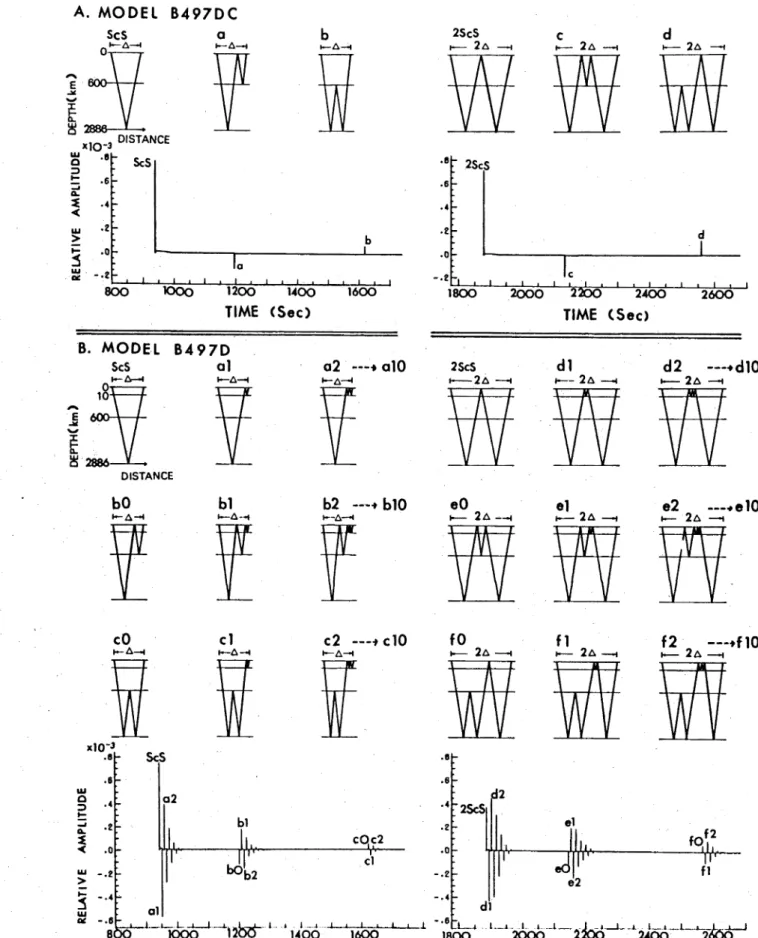
Figs. 2.5A and 2 . 5B r e p r e s e n t some of the ray p a t h s and the c o r r e s p o n d i n g r e s p o n s e f u n c t i o n s for E a r t h m o d e l s B 4 9 7 D C and B497D. They and t h e i r e q u i v a l e n t s are c o n s i d e r e d to be the l a r g e s t c o n t r i b u t o r s to the s o l o t o n e effect. The study is r e s t r i c t e d to A<10° and E q . (2.3a) is used as an a p p r o x i m a t i o n f ormula (Table 2.1 shows the p v a l u e s and a r r i v a l times for the rays at A = 5° and 10° for B 4 9 7 D C ) . In E q . (2.3a) T is taken as the d i f f e r e n c e b e t w e e n (2ScS)2^ and (ScS)^ arr i v a l times, d T /dA = p for (ScS)^ and ( 2 S c £ ) ^ , and (J) ((a)) , (j) ((a)) are the F o u r i e r t r a n s f o r m p h a s e s of the
1 *■
s u m m a t i o n s of r e l e v a n t p u l s e s (Fig. 2.5) r e c o r d e d at A and 2A w i t h r e s p e c t to the (ScS)^ and ( 2 S c S ) ^ a r r i v a l times. For a g i ven e p i c e n t r a l d i s t a n c e A, the f r e q u e n c i e s (a) are d e t e r m i n e d by v a r y i n g (a) until n is an i n t e g e r (the
c o r r e s p o n d i n g g((A)) are d e n o t e d by g ( (a)) ) . The r e l a t i o n (Brune and Gilbe r t , 1974)
Z
+ 1/2 = w d T / d A (2.4)is used to give the a n g u l a r o r d e r n u m b e r
Z
for the given A and each n a r e d e s i g n a t e d by in Fig. 2.6). Thef r e q u e n c i e s for w h i c h
Z
is an i n t e g e r are18 .
A. MODEL B4 97DC
ScS a b
E 6 0 0
DISTANCE
ScS
1200 1400
TIME (Sec)
1600
2ScS c
(-— 2 A — - I h 2 A —H
d
I— 2a — »
2200 2000
1800 2 6 0 0
TIME (Sec)
B. MODEL B 4 9 7 D
ScS a l
bO
t— A — I
cO cl
K— A —H H— A —H h— A — Ic2 — *clO fOh--- 2 A --H hf 2 ^ — *f10 2 A — -H
“ 2ScS
lOOO 1200 1400
TIME (Sec)
2000 2 4 0 0
1800
TIME (Sec)
T a b l e 2.1 p v a l u e s a n d a r r i v a l ti m e s f or t he r a y s s h o w n i n F ig .
a
■— i eo
CO CO o CO
1— 1 CO CN in
CO co CN 00
• • • •
n o 00 T5 1-1 e'
m en
in m
CN CN
1— 1 o
CN i— i o <Ti
ID ■O' Ch CD
CO i— i CO
• • • •
0 o CO O 1— 1 LO
CO ■O'
1— 1 1— 1
CN CN
'O’ o
o in ■O' 00
Oc m co ■O'
CO CO CN cn r- in
&
o 00 ■— i i-HCN r- CN cn
00 00
i— 1 i— l
■O’ CO
e' eo CN
r-en 00 CO 00
•O' 00 cn CO
• • • •
b o CT> b o CO
i— 1 CN
CD CD
i— 1 i— 1
o 00
r- i— 1 1— 1 CD i— i CN CN CN 00 O CD i— 1
• • • •
rd o ■O' cd 1-1 O
e r e o
i— 1 CN
rH i— 1
■O' o
o r- •O' ■O'
CP> CN co r-CO 00 i— 1 CO r"
r-o CTi
&
i— 1 mCO ■O'
fre
qu
en
c
y
2 0.
5
10
15
o r d e r n u m b e r
l
20
Fig. 2.6 Interpolation method used in this chapter to evaluate, from the synthetic SH-wave pulses shown in Fig.2.5, the eigenfrequencies for
which l is an integer. • represents the Wy values for which n is an
Yl Is
integer (using Eq. (2.3a)in the text) and t (using Eq. (2.4)) is not.
for these eigenfrequencies.
Since
(T - AdT/dA)
is almost the same for smallA
(i.e. forsmall l) , from Eqs. (2.2) and (2.3a) it is clear that if g (go) = 0 for all (a), the distribution of overtone eigenfrequencies is even, and there
is no oscillation in the asymptotic structure • The solotone effect
can therefore be interpreted in terms of the behaviour of g ( w ) .
The Fourier transform pairs for a delta function with amplitude
A^ at time T are
A n 6 (t - T. ) £ + Ä n exp (-iüOT ) . (2.5)
1 1 X 1
If only the pair of pulses [(ScS)^, (2ScS)2^] is considered, the phase
difference g(^U)) of (2.3a) will be zero (Fig 2.7A); hence the overtone
structure will be smooth (Fig. 2.7B). This corresponds to the continuous
model B497C, and is equivalent to curve 1 of Fig. 2.2. When arrival
pulses from crust/mantle discontinuities are included in the calculations,
the phase functions become much more complex.
In the case of discontinuous models, where multiply-reflected
arrivals from crust/mantle discontinuities must be considered, we can
generalize Eq. (2.5) and write
OO — — P 00 — _
£ A . 6 (t — T ,) ■*-*■ £ A. exp (-iwx.)
j=i 3 3 j=i 3 3
(2.6)
where A_. is the amplitude of the pulse arriving at time . It can also
be seen from Fig. (2.5) and Table 2.1 that the time separations from
ScS and 2ScS for the multiply-reflected paths are almost of equal magnitude
for small
A.
We will use this simple model to demonstrate the behaviour22 .
A
B
o 475.0470 -0 465.0
Fig. 2.7 The phase difference functions g(^U3) of Eq. (2.3a) and the asymptotic overtone structures ( curves), based on eigenfrequencies computed
Yl U
For the case of B497DC (with only one discontinuity at 600 km depth, of. Fig. 2.1), since we have limited the number of rays to the most simple paths (Fig. 2.5A), the series in Eq. (2.6) is finite. This, of course, assumes that Eq. (2.6) converges rapidly. The frequency domain representations associated with the summations of relevant multiple reflections at A and 2A (Fig. 2.5A), respectively, are
F = A q [1 + 2k^exp(-iwt^) + J^exp(-iwt^)] (2.7)
F 2 = B [1 + 3k exp(-iü)t ) + 2k2exp (-iwt2) ] (2.7a)
where t = t - t^ (t is twice the radial travel time for Sll waves from the Earth's surface to the core-mantle boundary, and t is twice the radial travel time from the surface to the 600 km discontinuity); Aq and Bq are the amplitudes of ScS (at A) and 2ScS (at 2A) respectively; and k^(k2 ) as rat-*-° amplitude of the first multiple (single) reflection from the top (bottom) of the discontinuity to A^ at A(or to Bq at 2 A).
Since k^ and k^ are an order of magnitude smaller than 1 for the model, we can write Eqs. (2.7) and (2.7a) as
- -2 - -1
F^ = A q [1 - k^exp(-iwt )] [l - k2exp(-iwt2 )] (2.7b)
F 2 - Bq[1 - k1exp(-iwt1 )]3 [1 - k 2exp(-iwt2 )]2 . (2.7c)
Dividing F^ by F2 , we get
A
f1/F2 = — [1 - k^exp (-iuyt^ ) ] [1 - i^exp (-iüJt2 ) ] . (2.8)
2 4.
g(w) = -arc tan [ (k^sinoot^ + k^inu) 12 - k^k^sin wt )/
(1 - k cos 03t - k cos OJt + k k cos wt ) ] . (2.9)
4- 4. ^ _L Z U
We can simplify Eq. (2.9) and write
g (OJ) = -arc tan [k^ sin U)t^ + k^ sin wt^] . (2.10)
For a large discontinuity such that we cannot evaluate the phase difference g (oo) by summation of a small number of paths (e.g. the crust-mantle
discontinuity for models B497 and B497D), Eqs. (2.8) and (2.9) still hold (Chapter 3). Eq. (2.9) together with Brune's phase correlation equation, (2.3a), corresponds to McNabb, Anderssen and Lapwood's (1976) equation, (1.2), for evaluating the asymptotic torsional overtone eigenfrequencies of the Earth models with only one discontinuity (Chapter 3):
0 - 2 1
sin — (j0 = k sin --- w, (2.11)
2 2
where k is a function of k^ and k ^ •
Eqs. (2.9) and (2.10) demonstrate that g (03) will oscillate with a frequency related to t^ and t^, and will have an amplitude determined by k^ and k^. The addition of more discontinuities to the Earth model will result in a complex superposition of frequencies to g(w). This effect will also be demonstrated experimentally here. See Chapter 5 for the general formulation and a rigorous verification of the correspondence between McNabb, Anderssen and Lapwood's (1976) result and the representation of multiple reflections from discontinuities in the Earth's interior.
calculations. Fig. 2.7D shows the effect when only pulses (b) and (d) are included. These figures show that the multiple reflections from the top and the bottom of the discontinuity havd the same effect. Fig. 2.7E shows the superposition of the effect from these two types of pulses. Fig. 2.7F shows computed from Eq. (1.1) superimposed on that derived from eigenfrequencies evaluated by Brune1s phase correlation equation,
(2.3a), with the phase difference g ( w) shown in Fig.2.7E. It should be recalled that ten distances
(A
= 1° through 10°) are used for thispurpose, and Fig. 2.7E is only an example for A = 5°. The close agreement
between the results from the two techniques is clearly demonstrated. This result suggests that the approximations we have made have not seriously affected the body-wave solutions. It demonstrates very well that the higher frequency oscillation in the solotone effect (curve 3 in Fig. 2.2) results from the multiple reflections from the 600 km discontinuity of model B497D.
Figs. 2.8A and 2.8B show the phase difference function g (^U3) (at A = 5°) and ^Y^ for model B497D when only the pulses (al) - (alO) and (dl) - (dlO) (Fig. 2.5B) and their equivalents (together with ScS and 2ScS) at A and 2 A, respectively, are included in the calculations. Since the crust-mantle discontinuity of model B497D is quite large, and only a small number of paths are considered in the calculations of
eigenfrequencies (those reflected from bottom of the 10 km discontinuity are neglected), the amplitude of the oscillation in the solotone effect
X
lC
h
K
D
9
(
n
^
)
n
fl
C
h
lO
)
9
(
n
*
«
0
2 6.
475.0
470.0
465.0
' \ ~ \ ' N /
Fig. 2.8 The phase difference functions g(nw ) of Eq. (2.3a) and the asymptotic overtone structures n curves), based on eigenfrequencies computed
Yl is
is a function of the number of ray paths which were considered. Figs. 2.8C and 2.8D demonstrate the superposition of the solotone effect from the two discontinuities of model B497D - using the paths shown in Fig. 2.5B. Although there is some discrepancy in these results, they are the result of a failure to include a sufficient number of multiple-reflections from the crust-mantle discontinuity; the more interesting test is that of the existence of a discontinuity in the mantle, and it has been shown that a few simple ray paths should be sufficient for that application.
2.5 DISCUSSION
Observations of normal modes of the Earth's free oscillations have provided a useful constraint in the construction of gross Earth models, and in recent years wo have witnessed a rapid obsolescence of earlier models as more normal mode data come to hand. To date, however, the data have not provided significant information about upper mantle structure. The use of Brunc's method permitted the derivation of frequencies of torsional oscillation modes of higher order number than have so far been directly observable. The data sample lengths used by Brune (1964) and Bruno and Gilbert (1974) in their frequency analysis of body waves of ScS and SS type were too short, however, to include arrivals reflected from upper mantle discontinuities (Brune, private communication). This study has indicated that these reflected arrivals are responsible for the solotone effect. Thus, although the Brune and Gilbert data were included in the data set of Gilbert and Dziewonski
28 .
data are biased towards a continuous model. This is made clear in Table 2, in which the y values derived from the Brune and Gilbert data (Anderssen, Osborne and Cleary, 1974) are compared with the corresponding values from models 1066A and 1066B. Apart from the presence of a baseline change
(which reflects the local nature of Brune and Gilbert's observations, the y values from model 1066B scatter about the mean significantly more than
those from 1066A.
One of the major aims of the present study has been to ascertain what modifications of the Brune method are required to obtain upper mantle data in normal mode form. It is apparent, first of all, that the
formulation of Brune is appropriate only for continuous models, and that some modification is therefore necessary. At the same time, the results indicate that, for small epicentral distances, deviations in phase velocity are not significant to the computation of the solotone effect. The study shows also that the window used in the Fourier analysis of body-wave phases of ScS type must have a length of at least 700 s if the relevant reflections from the supposed 600 km discontinuity are to be included. Such a procedure might be complicated by the necessity of avoiding the
inclusion of other phases in the window, and for this reason other
refinements to the technique might be necessary before the method becomes practicable.
The results also support the conclusion of Anderssen and Cleary (1974) that determination of torsional oscillations of high (beyond 10) overtone number n could yield useful information about upper mantle structure. It is possible that high-gain, long-period digital
3 0.
CHAPTER 3
RAY-MODE DUALITY FOR SH WAVES IN EARTH MODELS WITH CRUST AND MANTLE DISCONTINUITIES:
I. THE CASE OF ONE DISCONTINUITY
3.1 INTRODUCTION
Ben-Menahem (1964) constructed a theoretical derivation of Brune1s (1964) formulation (reviewed in §2.3) for the evaluation of
overtone eigenfrequencies of the Earth from body wave pulses, and pointed out that Brune's method represents a ray-mode duality of the Earth's displacement field. However, he did not explicitly examine its ramifications with respect to the possible existence of internal discontinuities.
As pointed out in Chapter 1, McNabb, Anderssen and Lapwood (1976) derived an equation, (1.2), for the asymptotic behaviour of torsional
overtone eigenfrequencies of discontinuous SNREI Earth models and the solotone effect can be interpreted in terms of it. For Earth models with a single discontinuity between the surface and the core-mantle boundary, their equation can be written as
sin(aö) = B sin (b^O), (3.1)
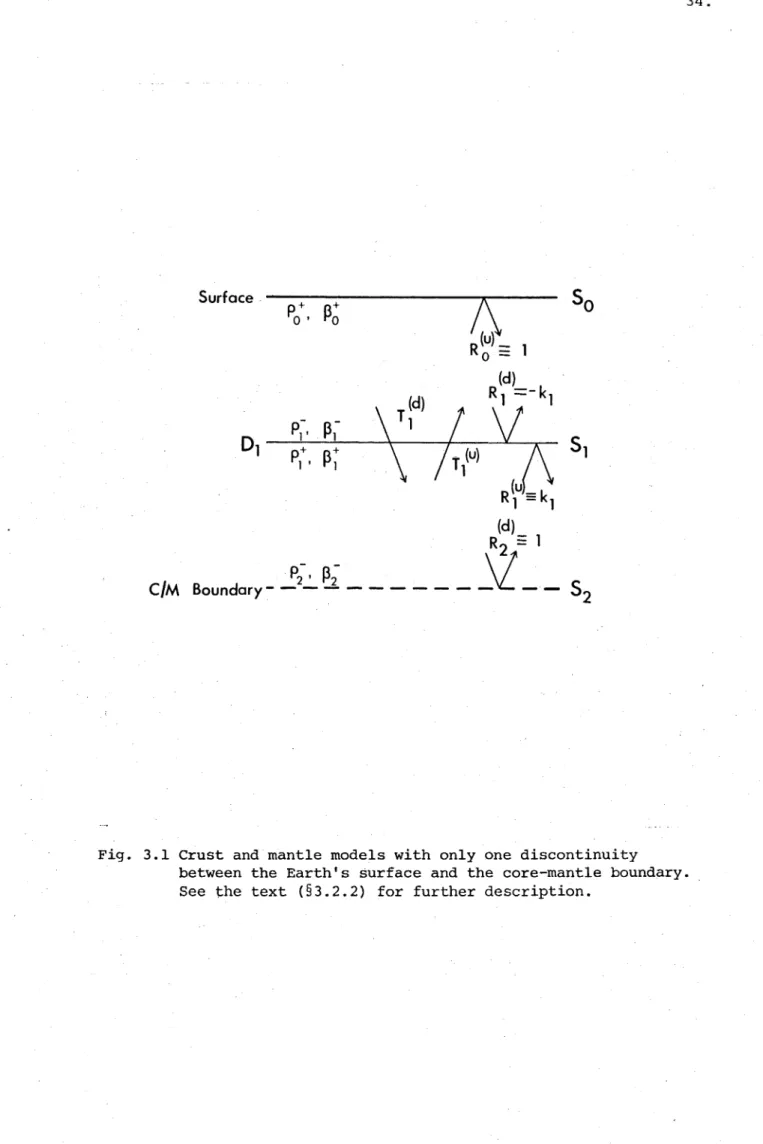
where a is the shear wave radial travel time from the Earth's surface to the core-mantle boundary; b is the difference between the shear wave travel times from the model Earth's surface and the core-mantle boundary, respectively, to the discontinuity between them; and B is the reflection coefficient at the discontinuity for rays incident normally from the bottom of the discontinuity (of. Anderssen, 1977).
By synthetic SH seismograms and Brune's method, it has been shown in Chapter 2, for discontinuous Earth models, that the solotone
these two different approaches (the technique for summing SH multiple reflections from discontinuities and the analysis of a Sturm-Liouville system) yield the same result is consistent with a ray-mode duality for the representation of the displacement field in a SNREI Earth, and
indicates that it is possible to derive the solotone effect and associated information about the Earth's structure directly from body wave pulses in seismograms. As a step towards the final goal of using the properties of the solotone effect as constraints in Earth modelling, the aim of this chapter is to verify that Eq. (3.1) can also be derived by applying Brune's (1964) phase correlation method to the summation of approximately vertically incident SH multiple reflections between the model Earth's
surface, the core-mantle boundary and the discontinuity between them. This establishes a basis for a ray-mode duality for SNREI Earth models with a single discontinuity. A general derivation of Eq. (1.2) for Earth models with N discontinuities between the Earth surface and the core-mantle boundary is given in Chapter 5.
3.2 PRELIMINARIES
3.2.1 Application of Brune's Phase Correlation Method for Small Epicentral Distances
It has been shown in Chapter 2 that, for discontinuous Earth models, the solotone effect arises from multiple reflections from
discontinuities between the Earth's surface and the core-mantle boundary. At least these multiple reflections should be included in the evaluation of the Earth's normal modes. But they have phase velocities which differ from those of the primary phases, e.g., (ScS)^ and (2ScS)2^. Therefore the evaluation of normal modes is not strictly covered by Eq. (2.3a) when discontinuities are present.
32.
seismic wave pulses recorded at small epicentral distances (i.e., A < 5 ° ) .
At such distances, all the rays corresponding to kScS (a pulse which
travels k times the ray path of ScS) and the above-mentioned multiple
reflections from discontinuities can be treated as vertically incident,
for their phase velocities are all very large, so that dT/dA=0. Then
since the second term on the right-hand side of Eq. (2.3a) includes a
factor which is the product of A and dT/dA, it can be neglected if only
such wave pulses are taken into account and there is no need to consider
the different phase velocities corresponding to different rays.
Consequently, instead of using pairs of single body wave pulses, we can
equally well use pairs [h^(t), h^(t)] of wave trains of appropriate body
wave pulses, corresponding to almost vertically incident rays, recorded
at distances
A
and2A
respectively. Thus, Eq. (2.3a) becomesTU)-2mT = g (go) ; g (a)) = <J> (w) - <J> (w) (3.2)
where T is the difference between the starting times of (t) and (t),
and ^ (to) and 4>2 (w) are the Fourier transform phases of h^(t) and h^ (t) ,
respectively.
Since g(w) of Eq. (3.2) is independent of the source functions,
h^(t) and h^(t) can be represented by series, f^ (t) and f^(t) , of
6-functions (with each 6-function representing a ray) to simplify our
discussion. It is seen in Eq. (3.2) that if g(w) = 0 for any angular
frequency (jO, the distribution of overtone eigenfrequencies is even. g (üo)
is thus the term which produce the perturbation of the eigenfrequency
distribution. If we let (oo) and F 2 (w) be Fourier transforms of f^(t)
and f2 (t), then g(w) can be computed by taking the ratio of the imaginary
and real parts of F^ (o>)/F^ (oj) ; i.e.