Recasting the
problem
of self-concept change:
A
self
-categorization perspective
Rina Sara
Onorato
April
2000
A
thesis
submitted for
the
degree
of
Doctor of Philosophy of
ERRATA
p. 6, line 3: Change to "Using this methodology, Jones and his colleagues (Jones, Rhodewalt, Berglas, & Skelton, 1981)..."
p. 20, line 33: Add comma after "Elaborating on this idea" p. 23, line 31: Add comma after "According to Mead"
p. 24, line 3: Change to "Over time, the child comes to see him or
herself..."
p. 26, line 9: Add comma after
"...the
other early theorists" p. 26, line 13: Add comma after "In his view"p. 33, lines 9 & 14: Add commas after "In 1977" p. 56, line 1: Add comma after "On returning" p. 98, line 3: Change to
"...must
freely choose" p. 116, line 4: Change to "Abrams et al., 1985"p. 159, line 2: Change to "In contrast, the results for feminine traits indicate that the same behaviour (i.e., positive self -presentation) tended to have one effect on self - conception when it was elicited in an interpersonal context (i.e., it tended to produce a
positive shift in self -perceived femininity here), and the opposite effect when it was elicited in an a setting that more closely approximated an intergroup context (i.e., it
tended to produce a negative shift in self -perceived femininity here)." p. 160, line 8: Change to
"...in
this previous research"p. 161, line
10
Change to "The observation that self -deprecators tended to apply negative neutral traits more strongly than self -enhancers (p = .051) can similarly be interpreted as a manipulation check."p. 164, line 4: Change to "In contrast, self- deprecating women reported marginally higher group self -esteem (for men and women in general) than self -enhancing women." p. 166, line 24: Change to "Positive self -presentation tended to produce a positive shift in the individual level of behaviour condition but a negative shift in the group level
of
behaviour condition for self -perceived femininity, group self -esteem, and perceived choice over behavioural role."
p. 197, line 19: Change to "Personal femininity depended on intragroup similarity and intergroup difference. The evidence also sugggests, albeit more tentatively, that social femininity may depend on the stereotypicality
of
one's own behaviour and that of the ingroup and outgroup ... That the social comparison information affected gender identity salience was also apparent at the level of social self -ratings, although the effects here were comparatively weak."p. 200, line 20: Change to "In judging one's own personal femininity, what appeared to matter was behavioural similarity to the ingroup (irrespective of whether the participant and her group both behaved dependently or independently). Somewhat more tentatively, it can be concluded that in judging one' s own social femininity, what appeared to matter
was normative fit at the level of own behaviour and group behaviour; thus participants who behaved dependently, or who viewed normative group behaviour, tended to report higher social femininity Conclusions in relation to social femininity are, however, tentative due to the failure to detect statistically significant shifts."
p. 212, line 12: Change to "The following general pattern emerges in Table 8.7 in relation to personal self- ratings: independent behaviour in males appears to confer slightly higher personal independence, particularly when the ingroup is dependent; however there is one exception to this general pattern: acting independently appears to
decrease personal independence when the outgroup is dependent." p. 231, line 16: Add comma after
"...
within social cognition" p. 232, line 15: Change to "...(among many) that"p. 234, line 23: Change to
"...male
participants endorsed more"DECLARATION
Aside from the normal intellectual debts inherent in all scientific endeavour, the research reported in this thesis was carried out by myself without the collaboration
of
others. This work has not been submitted for a higher degree to any other university or institution.
ACKNOWLEDGEMENTS
I am indebted to John Turner for the intellectual vigour with which he supervised my work. I am a better scholar for his example. His capacity for good humour and patience is the mark
of
a great teacher, and friend.Many thanks to Craig McGarty, Penny Oakes, and Alex Haslam. You taught me that scholarly work cannot be undertaken in isolation. I thank you for the lively discussions which always allowed me to feel I had your support as well as your guidance.
My years
of
study would have been lonely and tedious but for the friendship and laughter shared with Brenda Morrison, Tricia Brown, Kate Reynolds and Angie Khoo.The participation
of
literally hundredsof
research volunteers is gratefully acknowledged.I sincerely thank the Board
of
Fellows at University House for awarding me a University House Scholarship, which allowed me to enjoy the richnessof
university life and its creative energy.For my parents, especially my number one supporter, my mum Vincenza, thank you for the warmth and love
of
family and the many meals that brought me so much respite and comfort. For Rosa and Angelo, Mary and Pino, you were always there for me, every step of the way; thank you for your willingness to help, your love and understanding.Many, many thanks to my colleagues at Charles Sturt University for their support.
Mr David requires special mention for he renewed my confidence in myself and that is a very special gift indeed.
Rina Onorato April 2000
ABSTRACT
This thesis redefines the nature
of
the self and the problemof self
-concept change from the perspectiveof self
-categorization theory. The emphasis is on examining the conditions that cause transitory shifts in self- perception. The relevant literature is reviewed to establish the dominant modelof
the self -concept, and the most important extant approach to self -concept change in experimental social psychology. It was established firstly, that the self -concept is often conceptualised as a schema-
an enduring cognitive structure that comprises personally relevant trait terms; and secondly, that change is often attributed to the internalisation of new (or previously non -diagnostic) behaviour. These ideas are contrasted with an analysis of the self and self -
concept fluidity derived from self -categorization theory.
Self
-categorization theory conceptualises the self as a flexible processof
social judgement. The self -concept and self -esteem are assumed to be context- dependent properties of the perceiver, always defined in relation to others. In addition, the theory predicts that self -category content will change when the context shifts from a focus on the personal self to a focus on the collective self or group identity. What are the implicationsof
this view for current approaches to self -concept change?Studies 1, 2 and 3 progressively test the first primary hypothesis
of
the thesis, within the dominant self -concept change paradigm. The hypothesis is that the impact of overt behaviour on self -perception is mediated by self -categorization and social comparison processes. Each study provides some support for the general hypothesis. Indeed, the same behaviour was found to sometimes cause no change, a shift in the directionof
the behaviour, or a shift in the opposite direction, depending on the social context of one's actions. In Study 4, a different paradigm is adopted (one which does not focus on behaviour) to continue our examination of how social context causes change in self -category content. Study 4 re- evaluates the basic idea that the self can be treated like a personal schema. Importantly, the results indicate that the impact
of
a personal schema on self -perception is attenuated under conditions that make a diametrically opposed social identity salient. Furthermore, the results confirm that overt behaviour is not essential to self -concept change. Taken together, Studies 1 to 4 support the generalconclusion that the self is variable, relational and context -dependent. The implications
of
the results for contemporary approaches to self -concept change, and for the self -TABLE OF CONTENTS
Declaration ii
Acknowledgments iii
Abstract iv
Table
of
contents vList
of
figures xList
of
tables xChapter
1:Introduction
and overview1.1 Introduction 1
1.2 The social psychology of the self 1 1.3 The unresolved problem
of self
-concept 4change
1.4 Aims
of
the present thesis 61.5 Overview 8
1.5.1 Theoretical chapters 8
1.5.2 Empirical chapters 10
Chapter
2: The study of the social self: Ahistorical perspective
2.1 Introduction 14
2.2 William James 15
2.3 James Mark Baldwin 18
2.4 Charles Horton Cooley 21
2.5 George Herbert Mead 23
2.6 Interim summary 25
2.7 Freudian psychoanalytic theory 25
2.8 Allport 27
2.9 Phenomenologists 28
2.10 Ruth Wylie's reviews of the
self
-concept 30 literature2.11 Conclusions 30
Chapter
3:Contemporary
perspectives onthe
self: Social cognition
and
self-maintenance
processes3.1 Introduction 32
3.2 The social cognition approach: An 32 introduction
3.3 Self as schema 33
3.4 Self as prototype 38
3.5 Interim summary 42
3.6 Unresolved issues in the social cognition 43 of the self
3.6.1 How do self -structures form? 43
3.6.3 How are self -schemas activated? 50
3.6.4 Issues
of
measurement 533.7 Interim summary 54
3.8 Motivational processes that maintain the 54
self -concept
3.9 Conclusions 59
Chapter
4: Theproblem
of self -concept change4.1 Introduction 61
4.2 Social psychological contributions to the 62 problem
of self
-concept change4.2.1 Self- schema theory 62
4.2.2 Self- perception theory 64 4.2.3 Cognitive dissonance theory 65
4.2.4 Self- affirmation theory 67
4.2.5 Interpersonal congruency theory 69
4.2.6 Self -verification theory 70
4.2.7 Self- completion theory 71
4.2.8 Action identification theory 73
4.2.9 Self- evaluation maintenance theory 75
4.2.10 Self- discrepancy theory 76
4.2.11 Social comparison theory 77
4.2.12 Ecological self theory 79
4.3 Interim summary 82
4.4 Experimental studies
of
change: When 82 do social feedback and overt behaviourchange the self -concept?
4.5 Conclusions 97
Chapter
5:Personal identity,
social identity, andthe psychological
reality of the group:
Self -categorization theory and research
5.1 Introduction 99
5.2 Social comparison and social identity 100
theories
5.3 Self -categorization theory 101
5.4 Contrasting self -categorization theory 106
and social cognition approaches to the self
5.5 Links between self- categorization theory 113
and the classical view
5.6 Redefining the self in terms
of
the group: 115 Empirical demonstrations ofself -stereotyping or depersonalization
5.6.1 Evidence of homogenization processes at 117 the level
of
the ingroup5.6.2 Evidence
of
homogenization processes at 1275.6.3 The "primacy issue ": Is personal identity 130
or social identity primary in self -
conception?
5.7 Conclusions 134
Chapter
6:Study
1 - The distinction betweeninterpersonal
andintergroup
behaviour:Implications for self change
6.1 Introduction 136
6.2 Method 142
6.2.1 Participants 142
6.2.2 Design 142
6.2.3 Materials and procedure 142
6.2.3.1 Instructions to interviewees 143
6.2.3.2 Personality descriptions 144 6.2.3.3 Description of Personality Triads Test 144
6.2.3.4 Interviewers' protocols and instructions 146
6.2.3.5 Dependent measures 148
6.2.3.6 Post -experimental measures 149
6.3 Results 149
6.3.1 Manipulation checks 149
6.3.2 Self -ratings on feminine, masculine and 152 positive and negative attributes
6.3.3 The effect
of
self -presentational 154 behaviour on self -evaluation6.3.4 Post -experimental measures 156
6.4 Discussion 158
Chapter
7: How do self -categorization and socialcomparison affect
the impact
of self-presentation
on self -perception: Study 27.1 Introduction 169
7.2 Method 173
7.2.1 Participants 173
7.2.2 Design 174
7.2.3 Materials and procedure 174
7.2.3.1 Screening questionnaire 174
7.2.3.2 Main experiment 175
7.2.3.2.1 Self- presentational behaviour 175
7.2.3.2.1.1 Cover story and instructions 175
7.2.3.2.1.2 Development of the Personality Triads 177
Test
7.2.3.2.2 Social comparison information: Group 178 behaviour
7.2.3.2.3 Dependent measures 179
7.3 Results 180
7.3.1 Classification into low and high 181
independence groups
7.3.2 Manipulation checks 183
7.3.2.1 Self- presentational behaviour 183
7.3.2.2 Social comparison information: Group 184 behaviour
7.3.3 Major analyses 186
7.3.3.1 The effect of self -presentation and group 187 behaviour on self -perceived
independence
7.3.3.2 The effect
of
self -presentation and group 189 behaviour on self -perceived femininity7.3.3.3 The effect
of
self -presentation and group 190 behaviour on self -perceived masculinity7.3.3.4 The effect
of self
-presentation and group 191behaviour on self -esteem
7.3.3.5 Post -experimental measures 192
7.4 Discussion 193
Chapter
8: How do self-categorization and
socialcomparison affect the impact of self
-presentation
on self-perception: Study
38.1 Introduction 202
8.2 Method 204
8.2.1 Participants 204
8.2.2 Design 204
8.2.3 Materials and procedure 204
8.2.3.1 Social comparison information: Group 204 behaviour
8.2.3.2 Self- presentational behaviour 205
8.2.3.3 Reinstating the social comparison 206 information
8.2.3.4 Dependent measures 206
8.3 Results 206
8.3.1 Manipulation checks 207
8.3.1.1 Social comparison information: Group 207 behaviour
8.3.1.2
Self
-presentational behaviour 2108.3.2 Major analyses 210
8.3.2.1 The effect of self -presentation and group 211 behaviour on self -perceived
independence
8.3.2.2 The effect of self -presentation and group 214 behaviour on self perceived femininity
8.3.2.3 The effect
of self
-presentation and group 216 behaviour on self -perceivedmasculinity
8.3.2.4 The effect
of self
-presentation and group 218 behaviour on self -esteem8.3.2.5 Post -experimental measures 221
8.4 Discussion 222
Chapter
9: Study 4 -Individual
differencesand
social identity: A study of self -categorization processes in the
Markus paradigm
9.1 Introduction 231
9.2 Method 238
9.2.1 Participants 238
9.2.2 Initial questionnaire (individual 238 differences)
9.2.3 Design 239
9.2.4 Main experiment 239
9.2.4.1 Person- versus group -primed 239 manipulation
9.2.4.2 Content and latency of personal versus 241 social identity
9.3 Results 243
9.3.1 Preliminary analyses 243 9,3.1.1 Classification into personality types 243 9.3.1.2 Person -primed condition 244 9.3.1.3 Group -primed condition 245
9.3.2 Major analyses 247
9.3.2.1
Self
-stereotyping on independent and 247 dependent words9.3.2.1.1 Trait endorsements 248 9.3.2.1.2 Response latencies 249 9.3.2.1.3 Confidence ratings 250 9.3.2.2 Self- stereotyping on masculine and 251
feminine words
9.3.2.2.1 Trait endorsements 252 9.3.2.2.2 Response latencies 253 9.3.2.2.3 Confidence ratings 255
9.4 Discussion 256
Chapter
10:Summary and
conclusions10.1 Introduction 266
10.2 Theoretical contributions
of
the thesis 26610.3 Empirical contributions of the thesis 269 10.4 Implications and general directions for 279
future work
10.5 Conclusions 284
References 286
Appendix A 313
Appendix B 319
Appendix C 325
Appendix D 331
Figure 5.1
LIST OF FIGURES
A comparison
of
the traditional focusof
self -concept research with the focus of the present workLIST
OF TABLESTable 4.1 Summary
of
social psychological contributions to understanding self - concept changeTable 6.1 Distribution
of
participants across cellsof
experimental designTable 6.2 Informativeness
of
elaborations as a function of valenceof
behaviour and levelof
behaviourTable 6.3 Mean femininity ratings as a function
of
valenceof
behaviour and levelof
behaviourTable 6.4 Mean Rosenberg scores as a function
of
valenceof
behaviour and levelof
behaviourTable 6.5 Group self -esteem as a function of valence
of
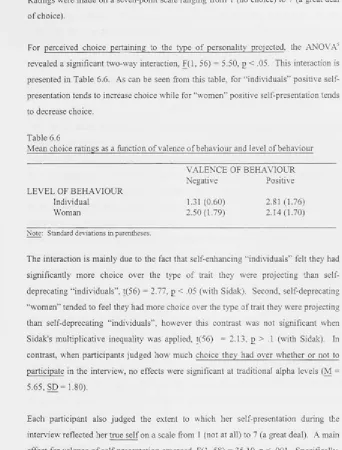
behaviour and level of behaviourTable 6.6 Mean choice ratings as a function
of
valence of behaviour and levelof
behaviour
Table 7.1 Distribution of participants across cells
of
the experimental design Table 7.2 Summary of differences between Low LN = 44) and High (N = 44)Independents at pretest
Table 7.3 Two -way interaction for ratings of perceived independence
of
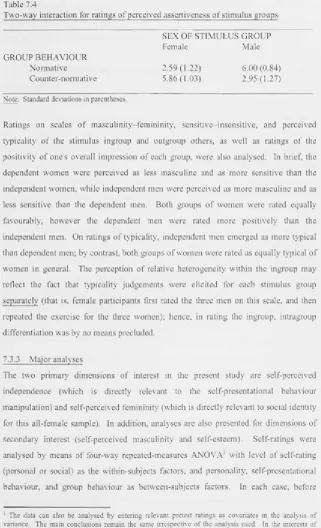
stimulus groupsTable 7.4 Two -way interaction for ratings
of
perceived assertivenessof
stimulus groupsTable 7.5 Cell means for self -perceived independence
Table 7.6 Mean independence ratings as a function of personality and level of self -
rating
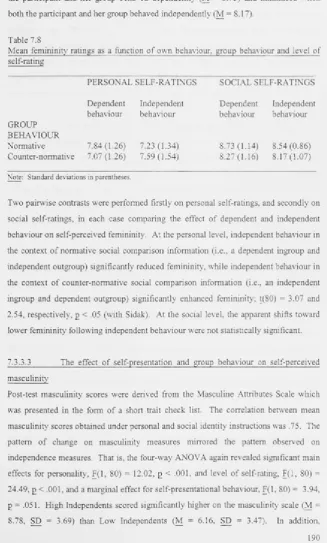
Table 7.7 Mean femininity ratings as a function
of
personality and self -presentational behaviour
LIST OF TABLES
Table 7.9 Mean self -esteem ratings as a function
of
personality, own behaviour and level of self -ratingTable 7.10 Task difficulty ratings as a function
of
personality and group behaviour Table 7.11 Mean interest levels as a function of personality and own behaviour Table 8.1 Distributionof
participants across cellsof
the experimental design Table 8.2 Mean masculinity ratings as a function of sexof
participant and stimulusgroup
Table 8.3 Mean typicality ratings as a function
of
sexof
participant, stimulus group, and stimulus group behaviourTable 8.4 Mean similarity ratings as a function
of
sexof
participant and stimulus groupTable 8.5 Mean independence ratings for males as a function
of self
-presentational behaviour and stimulus groupTable 8.6 Mean independence ratings for males as a function of self -presentational behaviour, stimulus group and group behaviour
Table 8.7 Mean independence ratings for males as a function of self -presentational behaviour, stimulus group, group behaviour and level of self -rating Table 8.8 Cell means for self -perceived independence for females
Table 8.9 Mean femininity ratings for males as a function of self -presentational behaviour and stimulus group
Table 8.10 Mean femininity ratings for females as a function of self -presentational behaviour, stimulus group and group behaviour
Table 8.11 Mean masculinity ratings for males as a function of stimulus group behaviour and level
of
self -ratingTable 8.12 Mean masculinity ratings for males as a function
of
self -presentational behaviour, stimulus group, group behaviour and level of self -rating Table 8.13 Mean self -esteem ratings for males as a functionof
self -presentationalbehaviour and stimulus group
Table 8.14 Mean self -esteem ratings for males as a function
of
self -presentational behaviour, stimulus group and stimulus group behaviourTable 8.15 Mean self -esteem ratings for males as a function of self -presentational behaviour, stimulus group, group behaviour and level of self -rating
LIST OF TABLES
Table 8.16 Mean self -esteem ratings for females as a function
of
self -presentational behaviour and Ievel of self -ratingTable 9.1 Mean proportion of independent, dependent, masculine and feminine words endorsed as self -descriptive as a function
of
sexof
participant(Onorato, 1992)
Table 9.2 Mean response latencies (sec) as a function of pattern
of
responding (Onorato, 1992)Table 9.3 Summary
of
differences between Low (N = 101) and High LN = 102) Independents at pretestTable 9.4 Mean trait endorsements for Low (N = 49) and High Independents (N =
54) in the person -primed condition
Table 9.5 Mean trait endorsements for group discussion task in the group -primed condition
Table 9.6 Distribution
of
participants across cells of the experimental design Table 9.7 Mean proportionof
independent and dependent traits endorsed as afunction
of
personality and levelof
self -categorizationTable 9.8 Mean latency (ms) for social identity- consistent responses as a function of level of self -categorization
Table 9.9 Mean confidence in social identity -consistent responses as a function of personality
Table 9.10 Mean confidence in social identity- consistent responses as a function
of
level
of
self -categorizationTable 9.11 Mean proportion
of
masculine and feminine traits endorsed as a function of personality and levelof
self -categorizationTable 9.12 Mean latency (ms) for social identity- consistent responses as a function of personality and level
of
self -categorizationTable 9.13 Mean latency (ms) for social identity- consistent responses as a function of prime and level of self -categorization
Table 9.14 Mean confidence in social identity- consistent responses as a function
of
personality and level of self -categorization
Chapter
1Introduction
and overview
I give my soul now one face, now another, according to which direction f
turn it.
If
I speak of myself in different ways, that is because I look at myself in different ways. All contradictions may be found in me ... Bashful, insolent; chaste, lascivious; talkative, taciturn; tough, delicate; clever, stupid; ... all this I see in myself to some extent according to how I turn. (Montaigne, 1580/1967, p. 242)For there is not a single human being ... who is so conveniently simple that his being can be explained as the sum of two or three principal elements; and to explain so complex a man as Harry by the artless division into wolf and man is a hopelessly childish attempt. Harry consists of a hundred or a
thousand selves, not of two. His life oscillates, as everyone's does, not merely between two poles, such as the body and the spirit, the saint and the sinner, but between thousands, between innumerable poles. (Hesse, 1927/1963, p. 70)
1.1 Introduction
Scholars
of
every genre have found fascination in the psychology of the self, asillustrated by these excerpts. The essayist Montaigne and the novelist Hesse (author of Steppenwolf) each posited a multiplicity of selves that coexist, but compete for expression. In social psychology, as in popular folklore, the search for an adequate and precise conceptualisation
of
the self is a classic and persistent problem. It is this problem that constitutes the focusof
the present inquiry. Two basic, yet fundamentally important theoretical issues will be addressed, from a social psychological perspective. Specifically the issues are firstly, what is the nature of the self, and secondly, what does the process of self -concept change entail? These questions are closely intertwined since one's definition of the self clearly sets the stage for any analysis of change.1.2 The social psychology of the self
The social psychological literature on the self is characterised by a general acceptance
of
Zajonc, 1985). To illustrate, Kihlstrom and Cantor (1984) define the self -concept as
"one's mental representation of oneself ... a concept, not unlike other concepts, that is
stored in memory as a knowledge structure" (p. 2, emphasis added). Similarly, in Markus' (1977) analysis, self- schemas' are defined as cognitive structures that reflect the invariances people have discovered in their own personal behaviour.
In the process
of
delineating the structureof
the self -concept, researchers have generally distinguished two facets, self -conception and self -evaluation, representing content and value dimensions, respectively. Self -conception is "a compositeof
characteristics associated with the individual and resulting from social interaction ", while self - evaluation is "the subjective value placed upon these characteristics" (Breakwell, 1992,p. 3). The self -concept and self -esteem have traditionally been conceptualised as global and relatively stable individual difference variables. Much of the research on self -
conception and self -evaluation has therefore focused on identifying the differences between high and low scorers on various personality characteristics or self -esteem scales (see Wylie, 1974, 1979).
Two popular paradigms for studying the content dimension
of
the self have been the Markus (1977) paradigm and the T. B. Rogers, Kuiper, and Kirker (1977) paradigm. In the Markus (1977) paradigm, individuals are initially classified into groups on the basis of whether or not they have a self -schema for a specific behavioural domain (e.g., independence). Schematic individuals are subsequently compared to non -schematics ona range of cognitive tasks. This paradigm has repeatedly demonstrated that schematic individuals ascribe more schema -relevant traits to the self than non -schematics, are faster to say "me" to schema -congruent traits than non -schematics, are more confident in their endorsement
of
schematic traits, resist counter -schematic information, and have superior recognition memory for schema -relevant material. These findings are usually interpreted as evidence of the stable and enduring nature of self -schemata (Markus &Sentis, 1982).
In the T. B. Rogers et al. (1977) paradigm, participants are asked to rate words structurally, phonemically, semantically, or self -referentially. Incidental recall for the
presented words is subsequently examined. The basic finding to emerge from this experimental paradigm is that words initially encoded with reference to the self produce superior memory to all other types of encoding. This finding is likewise often interpreted as evidence
of
the effective useof
pre- existing cognitive structures (Greenwald & Pratkanis, 1984).Research conducted within these paradigms has produced a vast Iiterature that documents the consequences for cognition
of
having a self - structure for a particular behavioural domain (Higgins & Bargh, 1987). However, as pointed out by Kihlstrom and Cantor (1984), little is known about the processual componentof
the self apart from its role in information processing:We have treated the self as an object
of
knowledge-
as a mental representation of a thing that exists in the physical and social world ... We have had nothing to say about the self as knower, except, obviously, to identify it with the cognitive system that encodes, retrieves, and transforms information. But the matterof
the self -as- knower is not simply a matterof
information processing. Rather, it is a matter
of
the executive, the portionof
the cognitive system that monitors and controls the rest and forms the basis for the experiences
of
phenomenal awareness and intentionality. We identify our ideas ... and our actions as ours. This problem of consciousness and metacognition remains the great mystery. (p. 40)This distinction between structure and process (the self -concept as an object of knowledge or the Known, and the self as subject or Knower) is a correlate for the
stability-change dichotomy that is central to this thesis. It should be noted however, that
in distinguishing between structure and process, there is no intention to suggest that the issue of structure is separable from (or actually has been divorced from) considerations of process. On the contrary, the broad consensus is that the self is both a structure and a
process (e.g., Gergen, 1971; Linville & Carlston, 1994; Markus & Wurf, 1987); investigators nevertheless differ in the extent to which they make structural versus processual aspects of the self their conceptual and empirical focus (Abrams, 1996).
explicitly state that the self -concept needs to be conceived in dynamic terms (e.g., Markus & Wurf, 1987) are constrained by their own assumptions about the self, and invariably conclude that the self -concept is minimally changeable. For example, Markus and Kunda (1986) state: "Drawing on current thinking about cognitive structures, we propose that, although the self -concept is in some respects quite stable, this stability can mask significant local variations that arise when the individual responds systematically to events in the social environment" (p. 859). However it is clear that in Markus and Kunda's opinion "This mutability or fluidity in the self -concept will be fairly subtle; it will not, under most circumstances, involve a major revision or reorganisation of significant self -relevant thoughts and feelings" (p. 859). Similarly, Deaux (1991) first suggested that the "recognition
of
multiplicity andof
change is central" to her approach (p. 77), but subsequently concluded "Despite this flexibility in their use, identities are relatively stable self -constructions" (p. 86).In short, there is a general consensus among contemporary theorists that despite some minimal fluidity, the self can be characterised as predominantly stable. To further complicate matters, the empirical literature is replete with examples
of
the self -concept's stability and mutability (see Markus & Kunda, 1986), therefore it would appear that the utility of any given theoretical perspective will depend on its ability to account for both aspectsof
the self and to make clear predictions about when stability or change is to be expected.1.3 The unresolved problem
of
self- concept changeThe problem of self -concept change has not been adequately addressed within social psychology (Banaji & Prentice, 1994; Baumeister, 1998). Thus Bums (1979) concluded, "What self -concept theory lacks is an explanation
of
how change in self -concept, perception and behaviour can occur" (p. 11). Commenting more specifically on experimental social psychology, Hormuth (1990, p. 54) stated that "Only some isolated attempts have been made ... to understand the processes
of
change [in the self -conceptj ".
intrapsychic structures that constitute the self -concept. In this view the self -concept is typically construed as a conglomeration
of
stored mental structures, and the types of change possible include the eliminationof
a self -concept or the acquisitionof
a new self -concept, or the reorganisationof
various facets of the self -structure (e.g., see Deaux, 1991; see also Markus & Wurf, 1987, p. 307). In particular the internalisation of new behaviours with the existing self-structure is considered to be a major causeof
self -concept change (Tice, 1992, 1994). Indeed this mechanism is evoked to explain how self -concepts come to be acquired in the first instance, in addition to how they change (Banaji & Prentice, 1994; D. J. Bem, 1972).
The second view is that apparent changes may reflect the momentary activation or situational variability
of
different subsetsof
self- knowledge (Higgins & King, 1981; W. J. McGuire, 1984; Nurius & Markus, 1990). The basic idea here is that one's recent behaviour and other situational cues will tend to activate self -structures that are consistent with those cues. For example, enacting extroverted behaviour can make congruent self -knowledge more accessible, and consequently,this
knowledge can be weighted more heavily in subsequent self -reflections (Rhodewalt, 1998). Markus andWurfs
(1987) notion of a "working self -concept" is one example of this typeof
mechanism (see also Hinkley & Andersen, 1996).
Both views assume that the self is an enduring structural entity. Both views also assume that behaviour plays a central role in producing self -concept change. To recapitulate, the role of behaviour is seen to be one
of
either directly causing change to the self -structure, or,
of
activating specific aspects of the self -structure. Either way, discussionsof
self -concept change are arguably premised on a reified model of the self -concept, and have tended to emphasise self -behaviour relations.The assumption that self -concept change is due to generalisation from new (or previously non -diagnostic) behaviour has been tested in experimental studies which examine the effect of self -presentational behaviour on self -conception. In the currently dominant paradigm for studying self -concept change, the target person is induced to
include traits that are diagnostic of the target's
self
-presentational behaviour but that were not previously endorsed as self -descriptive, this is taken as evidenceof
self -concept change. Using this methodology, Jones and his colleagues have repeatedly observed that when participants engage in strategic self -presentation for the purpose
of
creating a specific impression
of
themselves, self -concept change occurs in the direction of the self -presentational behaviour. For instance, projecting positivity leads one to subsequently feel more positive in an unrelated context (Jones, Rhodewalt, Berglas, & Skelton, 1981). Despite the general support for the so- called "carry-over effect" from behaviour to subsequent self -conception, "the conditions under which these transformations occur,if
indeed they do, and those under which the changes are maintained are unknown at present" (Kihlstrom & Cantor, 1984, p. 19).1.4 Aims
of
the present thesisThe primary theoretical aim of this thesis is to develop an alternative theory of the social variability
of
the self. The theoretical framework that will guide us, and that in turn will be extended is self -categorization theory (Turner, 1985; Turner, Hogg, Oakes, Reicher,& Wetherell, 1987; Turner, Oakes, Haslam, & McGarty, 1994). As we will see shortly, self -categorization theory rejects the assumption that the self -concept comprises fixed cognitive structures. Instead, it offers a process- oriented account
of
the self, one in which "change" is viewed as a normal outcomeof
the ongoing person x situation interaction that determines self -definition at any given time. Accordingly, the aimof
the present thesis is not to study the self -concept as a relatively stable, long -term structure, or to study change in this underlying structure. Instead, the present thesis examines contextual variation (or short-term change) in the self. Our strategy will be to extrapolate from this to a preliminary analysisof
long -term change, which will be presented in the final chapterof
the thesis.representations
of
those personal qualities used by individuals for the purposeof
defining themselves" (Niedenthal & Beike, 1997, p. 106; emphasis added). Definitions such as these reflect the conventional view that self -definition is predominantly
if
not exclusively about individual differences. The tendency to treat the self in highly personalised or individualistic terms has meant that the notionof
collective or shared identities has assumed little or no importance in many contemporary theories of the self (cf. Greenwald & Pratkanis, 1984; Sherif & Cantril, 1947). Furthermore, the shift from personal to social identity (termed "depersonalisation" in self -categorization theory) has not previously been conceptualised as a legitimate mechanism for self -concept change by self researchers, and therefore has not been the subjectof
empirical investigation within traditional and contemporary self -concept paradigms. The primary empirical aimof
this thesis is to fill this gap by systematically investigating the consequences for self -cognition
of
variation between the personal and the social level of self -categorization.Following the social identity tradition (Tajfel & Turner, 1979, 1986), self -categorization theory states that social identity, like personal identity, can be a source of self -esteem. Commenting on the social identity view, Deaux (1991) points out that "This recognition that self -esteem derives from group membership is an important supplement to the more individualistic tradition
of
self -esteem research, which focuses primarily on intrapsychic experience" (p. 78). The questionof
how self -evaluation changes when self -perception shifts from the personal to the social level of self -categorization is therefore alsoof
theoretical and empirical interest.
Drawing the above points together, the present thesis has three primary aims; first, to highlight the limitations
of
the long -standing traditionof
equating the self -concept with stable psychological structures; second, to examine the conditions which produce self- definition in terms of shared group membership or social identity, in addition to and as opposed to personal identity; and third, to examine the implications of this distinction between personal and social identity for current approaches toself
-concept change. More generally, the thesis aims to demonstrate that there is much to be gained from bringing an intergroup relations perspective to the study of the nature and functioningof
1.5 Overview
1.5.1 Theoretical chapters
Chapter 2 will review early approaches to the self with the aim of examining the extent to which the early theorists viewed the self -concept as a social product. In Chapter 3,
we will update the historical review by discussing the recent proliferation
of
social -cognitive models
of
the self -concept. It will become clear from this update that in many respects modern approaches have moved away from the basic premise which guided the early theorists, namely, that the self is inherently social. In particular, we will see that the view that theself
and the other are mutually defining has been replaced by the popular viewof
theself
-concept as a separate or bounded entity defined in opposition to others.Although most contemporary self theories "comment" on the relative stability and fluidity
of
the self -concept, there is no major theory of self -concept change within social psychology. On the contrary, theories emphasise stability as a general rule. Nevertheless, at is possible to "extract" from the existing theories the implications for understanding change (as illustrated by Hormuth, 1990). This will be our strategy in Chapter 4, when we come to consider various social psychological contributions to the problemof
self -concept change. We will also review empirical evidenceof
self -concept change, with a view to further distilling the current stateof
knowledge in this area.In Chapter 5 an analysis
of
the social variability of the self which has been derived from self -categorization theory will be presented in full. At this stage it will suffice to introduce three basic points of the theory. First, self -categorization theory states that the self -concept does not exist as a latent stored cognitive structure (or set of structures), but rather, self -concepts take the formof self
-categorizations that represent the perceiver in context. Second, it states that the self as partof
its normal variation is not just personal-
the self has more inclusive levels and this is a basic functionof
its variation (Turner etal., 1994). Third, it states that self -concept change is, broadly speaking, due to the flexible nature
of
categorical judgment rather than to the differential activation or the re- configurationof
pre- existing self -structures.458). It is argued that self -concepts take the form
of
self -categories-
"cognitive groupings of self and some class of stimuli as identical and different from some other class" (Turner et al., I994, p. 454). Thus, from the perspectiveof
self -categorization theory, the term "self- concept" is used to refer to one's current self -categorization, the variable and context -dependent productof
this "dynamic [reflexive] process of social judgement ". Traditionally, the term self -concept has implied a long -term knowledge structure, which represents "me" and differentiates "me" from "not me ". In contrast, self -categorization theory rejects the view that there is an enduring, one -to -one correspondence between a particular preformed cognitive structure (or setof
structures) and the self -concept. Self -categorization theory should not be misunderstood as denying the existenceof
long -term knowledge structures in memory. Undoubtedly this complex knowledge base includes information about the self. However, a critical point from this perspective is that this long -term knowledge (like other cognitive resources, such as values, norms, and ideologies) is recruited flexibly when we come to categorize self and others (Turner et al., 1994). Sometimes one's current self -categorization will be consistent with aspectsof
that long -term knowledge (e.g., my current self -category may confirm the knowledge that I have behaved independently on numerous occasions in the past), but the point is: one's current self -categorization need not be consistent with stored knowledge about past instantiationsof
the self, because the traditional assumptionof
a pre- existing cognitive structure called the "self- concept" has been abandoned. From the perspectiveof
self -categorization theory, the self -concept is fluid, and this fluidity characterises its normal functioning.of
self -categorization (in Roschian terminology) (e.g., Simon, 1993, cf. Turner et al., 1987).Importantly, the psychological group is implicated in both personal and social identities. Indeed, it will be argued (somewhat paradoxically) that a private, subjective sense
of
self is made possible because
of
the psychological reality of the social group. That is, at some level, the psychological group (in the general sense of "society" or in the more particular senseof
a specific group membership) is implicated in the experienceof
all self -concepts, irrespectiveof
whether they are based on global or specific judgments at the personal or group level.Thirdly, the theory explains variation in self -conception as a function of the categorization process rather than change to cognitive structure or the activation of pre- existing structure. From this perspective, self -concept change always reflects change in the implicit or explicit psychological context at the time of judgement. In particular, the perceiver's categorization of self vis -à -vis others at any given time is said to reflect the interaction between three key variables: (a) the observed comparative relations between self and others, (b) "the social meaning of differences between people in terms
of
the normative and behavioural contentof
their actions (Oakes, 1987)" (Turner & Oakes,1989, pp. 241 -243)2, and (c) the perceiver's readiness to use or apply a certain categorization
of
self and others, which in turn depends on his or her past experience, and current motives and values.As well as expounding the self -categorization approach, Chapter 5 selectively reviews empirical research conducted within the self -categorization theory framework. The empirical review wiII mainly focus on evidence
of
depersonalisation, given that the empirical program of this thesis was designed to investigate this type of variation inself -category content, within dominant self -concept paradigms.
1.5.2 Empirical chapters
Chapters 6 to 9 present the formal empirical analysis. In line with the central theoretical arguments derived from self -categorization theory, the research strategy was to show
that variation in self -conception and self -evaluation is mediated by level
of self
-categorization. The first three studies
of
the thesis were located within the dominant self -concept change paradigm. Thus self -presentational behaviour was elicited in aninterview context, and the impact
of
that behaviour on self -perception was subsequently assessed.In Study I (Chapter 6) self -presentational behaviour and the context
of
one's behaviour were manipulated in order to test whether the effect of behaviour depends on how the self is categorized in the contextof
the experiment. The expectation was that self -presentational behaviour which is elicited (and therefore presumably interpreted) in an intragroup context should tend to affect personal self -conception and personal self -
evaluation more so than one's self -conception and self -evaluation as a group member. Conversely, self -presentational behaviour that is elicited (and therefore presumably interpreted) in an intergroup context should tend to affect one's self -conception and self -
evaluation as a group member more so than one's self -conception and self -evaluation as a unique person. In other words, where behaviour "fits" a relevant social identity, that identity should become salient. By the same token, the perceiver should come to view the behaviour as an expression of that salient identity. Study 1 provided a preliminary
test
of
this hypothesis.Studies 2 and 3 (Chapters 7 and 8) used more ambitious experimental designs to further examine the general proposition that self -categorization and social comparison processes will mediate the effect of behaviour on self -conception and self -evaluation. This time, participants were given an opportunity to compare their own behaviour to the behaviour
of
ingroup and/or outgroup members. The normative fitof
others' behaviour was manipulated in these studies via stimulus videos that featured group members behaving in either a stereotypical or counter -stereotypical way. The question was whether the provisionof
a normative or counternormative frameof
reference for social behaviour would modify the interpretation of one's own recently enacted behaviour, and hence its impact on self -definition.Because Studies 1 to 3 were designed to extend the literature on self -concept change, they focused on the effect
of
behaviour on self -conception. From the perspectiveof
and above other situational cues) in shaping self -category content. While the question of how self -category content changes as a function of self -categorization processes remained the focus
of
the fourth study, unlike the previous studies Study 4 was not concerned with the role of public behaviour in that process. Instead, Study 4 (Chapter 9) investigated self -concept change in the contextof
the information processing paradigmsof
social cognition. As already noted, the Markus (1977) paradigm has traditionally been utilised to examine the information processing consequencesof
self -schemata for specific personality dimensions. In Study 4 however, we used the Markus paradigm to investigate whether the effect
of
personality on information processing is attenuated, or perhaps eliminated, when a competing higher -order identity is made salient. That is, do individuals with particular personality attributes come to describe themselves in diametrically opposed terms under conditions that make a conflicting group identity salient? Self- categorization theory argues that social identity salienceshould produce depersonalised self -perception relative to personal identity salience. This hypothesis was tested in Study 4 of the thesis.
The empirical program thus examines whether self -conception and self -evaluation vary in important ways as a function of the level at which the self is categorized. From the perspective
of
self -categorization theory, self -concept change is a much more complex matter than straightforward inference or generalisation from past behaviour. In particular, the empirical studies of the thesis aim to illustrate the roleof
the psychological group in shaping self -category content (including behavioural, cognitive and evaluative aspects). In Chapter 10 we will discuss the implicationsof
the major findings for current conceptualisations of the self -concept and theoriesof
self -concept change, and the directions they suggest for future research, not only within the discipline of social psychology, but also the neighbouring disciplines.Chapter
2The study of the
social
self:
A
historical perspective
2.1 Introduction
In 1943 Gordon Allport wrote "the existence of one's own self is the one fact of which every mortal person
-
every psychologist included-
is perfectly convinced" (p. 451). Despite the consensual understanding that we all possess "aself',
contemporary social psychologists continue to debate the natureof
the self (Greenwald & Pratkanis, 1984; Kihlstrom & Cantor, 1984; Markus & Wurf, 1987).flow
did the early theorists conceive of the self, and to what degree have their ideas shaped current conceptualisations? The aimof
this chapter is to place the topicof
the social self in ahistorical context.
The study
of
the self can be traced back to ancient Greek philosophy (Harter, 1996), however the term "self- concept" (as currently used by social psychologists) is only of twentieth- century origin (Burns, 1979; Wells & Marwell, 1976). Our historical review will therefore be restricted to relevant developments in the last century. Reviews of the history of the self prior to the turnof
the century are available elsewhere (Baumeister, 1987; Diggory, 1966; Hattie, 1992; Logan, 1987).Theorists such as William James and the sociologists James Mark Baldwin, Charles Horton Cooley and George Herbert Mead had a particularly significant impact on the self literature. The perspectives of the early theorists will he presented here as a general conceptual backdrop to the thesis. In particular, we are interested in what the early theorists had to say about the social basis of the self. In what sense is the self "social "?
In other words, how did the early theorists conceive the relationship between the self and the other, or the individual and society? We will see that several important ideas emerged from the early self theories, foremost among them the ideas that the self is
always defined in relation to others, and that groups, society, or the collective aspect
of
social life, can come to be internalised and represented in individuals' minds
(Kahlbaugh, 1993). In the ensuing chapters it will become clear that this understanding also constitutes the theoretical starting point of the present work.
In addition to the contributions
of
the early American theorists, even a brief historical account of the developmentof
self theory such as this must include mention of the influence of the psychoanalytic theorists, the ego psychologist Gordon Allport, and the phenomenological perspectives which dominated the field up to the timeof
Wylie's(1974, 1979) seminal reviews.
2.2 William James
Early in the history of American psychology, there was considerable interest in the self,
as highlighted by the publication of Principles
of
psychology by William James (1890/1950) (a treatise that was revised in Psychology: The briefer course, 1892/1961). W. James (1950) is perhaps best known for his distinction between the Me (the self as Known) and the I (the self as Knower). This distinction was critical to his analysis:We may sum up by saying that personality implies the incessant presence of two elements, an objective person, known by a passing subjective Thought and recognised as continuing in time. Hereafter let us use the words Me and
I for the empirical person and the judging Thought. (p. 371)
In other words, the Me was the structure or object of experience, while the I was the process or subject
of
experience. Importantly, the Me and the I were not separate but "discriminated aspects"of
the same entity (Gergen, 1971; Wells & Marwell, 1976).Elaborating on the nature
of
the Me self, W. James (1950) perceived it as "a fluctuating material. The same object being sometimes treated as a part of me, at other times as simply mine, and then again asif
I had nothing to do with it at all" (p. 291). W. James claimed that we divide the whole universe into two halves, "me" and "not me ", and in the broadest possible sense, the Me self is the sum totalof
all that one can call his or hers.For W. James, the Me Self comprised three subsidiary parts: the Material Me, the Social Me, and the Spiritual Me. The material Me comprises one's body, clothes, immediate family, home, property and possessions; in short, the Material Me is everything
objective that can be called mine (Goodwin, 1965). W. James (1950) argued that on losing a possession to which, we feel attached, we feel "a sense
of
the shrinkage of our personality" (p. 293).Of greater interest here though, is W. James' notion of the Social Me. This is where W. James most clearly postulated the social basis
of
the self. The Social Me in W. James' theory is the recognition a person gets from his or her acquaintances. Social selves (like material selves) clearly serve social ends in that these selves can bring the individual honour, influence, power, and so on (Bums, 1979). Wells and Marwell (1976) made the observation that W. James almost seemed to locate this senseof self
in the mindsof
other people, rather than the perceiver. Thus W. James (1950, p. 294) wrote:
a man has as many social selves as there are individuals who recognise him and carry an image
of
him in their mind. To wound any oneof
these his images is to wound him. But as the individuals who carry the images fall naturally into classes, we may practically say that he has as many different social selves as there are distinct groupsof
persons about whose opinion he cares.Here W. James hints at the view that through identification with individuals and groups, others can become a part
of
the self, however he does not go further towards explicating the process which underlies this mergingof
"self" and "other ". In addition, it is here, in discussing the Social Me, that W. James argues most cogently for the multiplicityof
selves, suggesting that a different Social self exists for each audience (Schlenker, 1980):
[A person] generally shows a different side
of himself
to eachof
these different groups. Many a youth who is demure enough before his parents and teachers, swears and swaggers like a pirate among his 'tough' young friends. We do not show ourselves to our children as to our club -companions, to our customers as to the laborers we employ, to our own masters and employers as to our intímate friends. (W. James, 1950, p. 294)
W. James thus claimed that different selves are expressed in different contexts. He went on to assert that the inherent contradictions can, but need not be, a source
of
distress for the individual. For example, an alcoholic husband who is trying to conceal a drinking problem from his wife may well experience what W. James described as "a discordant splitting" (p. 294). However, when the contradiction is contained in distinct self -conceptions or clearly demarcated social roles, "as where one tender to his children is
stem to the soldiers or prisoners under his command" (p. 294), there need not be any resultant stress.
W. James was less explicit about the exact nature
of
the Spiritual Me, but in general terms it referred to inner psychic qualities such as volition and the capacity for emotion or desire. In short, for W. James the Spiritual Me was the qualityof
seeming to be active: "The very core and nucleusof
our self, as we know it, ... is the sense of activity which certain inner states possess" (1961, p. 48).As pointed out by Harter (1996), in thus discussing the three constituents
of
the Me, the Material, the Social and the Spiritual, W. James paved the way for future discussionsof
the multidimensional and hierarchical structure of the self -concept (e.g., see Marsh, 1990). He argued that the various selves are arranged in a hierarchy according to their implications for self -esteem. W. James reasoned that the Material Me occupied the bottom tier of the hierarchy (at least for most people), while the Social Me occupied the next position in that friends and human ties should matter more than physical or material aspects
of
the self. The Spiritual Self was considered to be the most important tier; it should be defended at all costs. Nevertheless, there were bound to be individual differences in the worth attached to the Spiritual Me: "it is probable that individuals differ a good deal in the degree in which they are haunted by this senseof
an ideal spectator" (W. James, 1961, p. 60).W. James (1950) also dealt explicitly with the notion
of
self -esteem: "there is a certain average toneof self
-feeling which each one of us carries about with him [sic]" (p. 306). Self -esteem was defined as the ratioof
our successes (or actual achievements) to our pretensions (or aspirations). Like the "fluctuating material"of
the Me self, self -esteem was similarly conceived as a barometer which "rises and falls from one day to another" (p. 307). Importantly, our self -esteem reflects where we stand in relation to others in important behavioural domains. Thus in a self -reflective passage W. James explained that his identity as a psychologist was so central to his being that he would be mortifiedif
others knew more psychology than he; on the other hand he was content to wallow in the grossest ignoranceof
Greek, for which he had no "pretensions ".W. James (1961) acknowledged that despite its multiplicity, the self can be experienced as stable. According to W. James, the fact that the Me of yesterday appears to have a certain sameness, stability or continuity with the Me of today presents no special mystery:
my personal identity is just like the sameness predicated
of
any other aggregate thing. It is a conclusion grounded either on the resemblance in essential respects, or on the continuity of the phenomena compared. And it must not be taken to mean more than these grounds warrant or treated as asort of metaphysical or absolute Unity in which all differences are overwhelmed. (p. 69)
He likewise opined that the I self is not a fixed or absolute identity at different times. He based his conclusion on the premise that the changing states
of
consciousness represent real change that should not be discounted:If
there were no passing states of consciousness, then indeed we might suppose an abiding principle ... to be the ceaseless thinker in each oneof
us.But
if
the states of consciousness be accorded as realities, no such `substantial' identity in the thinker need be supposed. (1961, p. 69)Thus for W. James, the sense
of
continuity in theself
was a functional rather than a substantive aspectof
the streamof
experience (Goodwin, 1965). Each experiential moment "appropriates" each previous moment; the knower is thus embedded in what is known (Allport, 1955). In this way, W. James tried to avoid a homunculus view of the self, asserting that "Metaphysics or theology may prove the soul to exist; but for psychology the hypothesis of such a substantial principleof
unity is superfluous" (W.James, 1961, p. 70).
2.3 James Mark Baldwin
Less than a decade after Principles, J. M. Baldwin published Social and ethical interpretations in mental development (1897/1902). In James' theory, the Social self was just one component
of
the total self. J. M. Baldwin, on the other hand, considered the self in all its aspects a social and cultural product (S. Rosenberg, 1988). The social self was referred to as the "socius ". Interestingly, J. M. Baldwin saw no need to differentiate personality from the social self: "I do not see ... how the personality ... can be expressed in any but social terms" (p. 27). The social self in J. M. Baldwin's theory consistedof
two parts: the ego and the alter, or the self and the other. However, just asW. James argued that the Thinker and the Thoughts are not separate entities, J. M. Baldwin made a similar argument this time with respect to the ego (self) and the alter (other). The ego in J. M. Baldwin's theory refers to the thoughts you have about yourself; the alter refers to the thoughts you have about other people you know or that you can imagine (S. Rosenberg, 1988). According to J. M. Baldwin (1902), self and other were part of a whole; together they made up a "bipolar" self (the social self or socius) with ego at one pole and alter at the other (pp. 15 -16)1:
If
it be true ... that what the person thinks as himself is a pole or terminus atone end
of
an opposition in the sense of personality generally, and that the other pole or terminus is the thought he hasof
the other person, the 'alter', then it is impossible to isolate his thoughtof
himself at any time and say that in thinkingof
himself he is not essentially thinkingof
the alter also.Throughout his treatise, J. M. Baldwin (1902) emphasised that the self does not develop in a social vacuum; that is, "The banks are not the river, but where is the river -course without banks ?" (p. 8). The interrelatedness
of
the ego and the alter implies that one can not have an attitude toward the other that one can not have toward oneself; and further, that knowledgeof
the other is constrained by knowledgeof
the self (Kahlbaugh, 1993).J. M. Baldwin provided an account of the social genesis
of
the self. He argued that the ego and the alter formed simultaneously in a child. Baldwin maintained than social interaction plays an essential role in this process. He went further than this though, arguing that the primary modeof
social interaction is imitation; accordingly, it was through imitation that a social self developed (Kahlbaugh, 1993). Imitation is an inherently social process since it presupposes the presenceof
others.The 'ego' and the 'alter' are thus born together . . My sense of myself grows
by imitation of you, and my sense
of
yourself grows in. termsof
my senseof
myself. But ego and alter are thus essentially social; each is a socius and each is an imitative creation. This give- and -take between the individual and his fellows, looked at generally, we may call the Dialectic
of
Personal Growth. (J. M. Baldwin, 1902, p. 15)I One limitation of the postulated "self- other" continuum would appear to be that it does not allow for the
possibility that the self can be defined in terms of those outside the individual doing the perceiving. This
is a point that we will return to in Chapter 5.
Paradoxically, J. M. Baldwin thus held that imitation is the source of individuality. However J. M. Baldwin was adamant that the self and other will not be exact copies; on the contrary, each imitative act becomes redefined in the context of the imitator (Kahlbaugh, 1993). The child learns through imitation that "it is he who varies the copy by trying to reproduce it; that he turns out interesting combinations which are his own peculiar property" (J. M. Baldwin, 1902, p. 113). The self which thus emerges is a perception
of
self as distinct from other people.J. M. Baldwin (1902) stressed the role played by assimilation and accommodation in shaping the self, and the interplay between social influence ( "suggestion ") and innate propensities ( "habit ") in self development. The real self comprised both; it was not simply what was stored in the cognitive system:
The character which he shows actively at any time is due to these two factors in union. One
of
them is no more himself than the other. He is the outcomeof
`habit' and `suggestion' ... Social suggestion is the sumof
the social influences which he takes in and incorporates in himself when he is in the receptive, imitative, attitude to the alter; habit is the body of formed material, already cast in the mouldof
a self; which he brings up for self -assertion , .. when he stands at the other pole of the relation to the alter, and
exhibits himself ... as master
of
his own conduct. (pp. 31 -32)Once the self was formed, it was not a fixed entity. J. M. Baldwin took it for granted that self varied with the situation, and consequently, could be inundated with inconsistency:
His wants are not at all consistent. They are in every case the outcome
of
the social situation; and it is absurd to endeavour to express the entire body of his wants as a fixed quantity under such a term of description as `selfish', or `generous', or other, which has reference to one class only
of
the varied situations of his life. (p. 31)Another interesting idea to emerge from J. M. Baldwin (1902) was the view that the social self vanes as you extend the frame
of
reference to include increasingly dissimilar others. In this connection, he writes: "what school -fellow among his companions, whatRob Roy surrounded by the clan has not felt the socius, the common self
of
the group, come in to drive out the narrower egoof
his relatively private life within the group ?"(pp. 35 -36). Elaborating on this idea J. M. Baldwin gives the following illustration