Int. J. Electrochem. Sci., 8 (2013) 1067 - 1078
International Journal of
ELECTROCHEMICAL
SCIENCE
www.electrochemsci.org
Electrochemical Properties of C-coated Cu
6Sn
5Nanoparticles
Dispersed on Carbon Matrix Prepared by Spray Drying Process
Jung Hyun Kim1, Yong Seung Jang1, Byung Kyu Park2, Yun Chan Kang1,*
1
Department of Chemical Engineering, Konkuk University, 1 Hwayang-dong, Gwangjin-gu, Seoul 143-701, Korea
2
Suncheon Center, Korea Basic Science Institute, Suncheon 540-742, Korea
*
E-mail: [email protected]
Received: 14 November 2012 / Accepted: 5 December 2012 / Published: 1 January 2013
Spherical hollow Cu6Sn5/C composite powders are prepared by a post-treatment of the precursor
powders obtained by a scalable spray drying process. Metal citrates are formed by chelation of the Sn and Cu components with citric acid, and they have good drying properties under high water vapor pressure. Citric acid used as a chelating agent is a key material in synthesizing the composite powders. Decomposition and reduction of the precursor powders under reducing atmosphere produces phase-pure Cu6Sn5/C composite powders with unique morphology. Cu6Sn5 alloy particles coated with an
amorphous carbon layer are uniformly dispersed on the inner and outer surface of spherically shaped carbon powders. The mean sizes of Cu6Sn5 alloy and carbon matrix particles are 0.4and 7 m,
respectively. The discharge capacities of the composite powders reduced at 600°C and 800°C are 380 and 275 mAh g-1, respectively, after 20 cycles at a constant current density of 300 mA g-1. The corresponding capacity retentions are 93% and 89%, respectively.
Keywords: anode material; tin alloy; spray drying; composite powders; electrochemical properties
1. INTRODUCTION
material. Nano-alloys dispersed on carbon sheets and carbon-coated alloy particles were recently investigated [5-12]. The carbon sheet and shell act as a barrier to obstruct the aggregation between nanometer-sized alloy particles, thereby reducing their volume change during lithium insertion/extraction. However, the development of an easy and efficient production process for large quantities of alloy/C composite powders is a major challenge.
Spray drying is the most widely used industrial process for the production of a dry powder from a liquid or slurry by rapid drying with a hot gas. It has been commonly used in the industry to produce hollow or spherical particles. It has already been employed to prepare nanoporous spherical materials for applications in lithium ion batteries [13-16]. However, owing to the low melting point of Sn, the preparation of Sn nanometer-sized particles by spray drying still remains a challenge [17,18]. Furthermore, the spray drying process has not been studied with respect to the production of alloy/C composite powders for application in lithium secondary batteries.
In this study, precursor powders with a hollow and thin-walled structure were prepared by commercial spray drying process from an aqueous solution of Sn and Cu components. Citric acid used as chelating agent was a key material in synthesizing the composite powders. Reduction of the prepared powders under reducing atmosphere produced the Cu6Sn5/C composite material in form of
thin hollow spheres.
2. EXPERIMENTAL
[image:2.596.62.520.396.719.2]
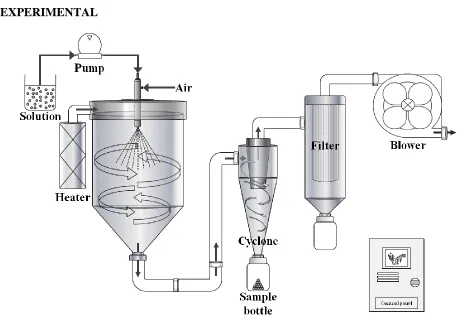
A schematic diagram of the spray drying process is shown in Fig. 1. Usually, a liquid containing a high concentration of the product material is pumped to an atomizing device where it is transformed into a spray of small droplets. These droplets meet a stream of hot air. Their moisture evaporates very rapidly while they are still being suspended in the drying air. The dry powder is separated from the humid air in a cyclone system by centrifugal forces. The centrifugal separation is caused by the great increase in air speed when the mixture of particles and air enters the cyclone system. The particles are forced towards the cyclone walls while the lighter, moist air is directed away through exhaust pipes. Conditions such as inlet temperature, feeding rate, and atomization pressure are controlled during the spray drying process. In the present study, the temperatures of the inlet and outlet of the spray dryer were 350°Cand 150°C, respectively. A two-fluid nozzle was used as atomizer and the atomization pressure was 1 bar. The spray solution was prepared by dissolving a stoichiometric ratio of copper nitrate hydrate [Cu(NO3)2∙3H2O, Junsei] and tin sulfate hydrate [Sn(SO4)2∙2H2O,
Junsei] in distilled water. Citric acid was used as a chelating agent. The overall concentration of copper and tin components of the solution was 0.5 M.
The crystal structure of the alloy powders was investigated by X-ray diffractometry (XRD, RIGAKU DMAX-33) at the Korea Basic Science Institute (Daegu). The morphological characteristics of the samples were investigated using scanning electron microscope (SEM, JEOL JSM-6060) and high-resolution transmission electron microscope (TEM, JEOL JEOL-2100F). The thermal properties of the prepared powders were studied using a thermo-analyzer (TG-DSC, Netzsch, STA409C) in the temperature range of 25–1000°C in air. The capacities and cycling properties of the Cu6Sn5/C
composite powders were measured by 2032-type coin cells. The electrode was made by mixing 40 mg of Cu6Sn5/C composite with 5 mg carbon black and 5 mg sodium carboxymethyl cellulose (CMC) in
distilled water. Lithium metal and a polypropylene film were used as counter electrode and separator, respectively. 1 M LiPF6 dissolved in a mixture of ethylene carbonate/dimethyl carbonate (EC/DMC)
with a volume ratio of 1:1 was used as electrolyte (TECHNO Semichem. Co.). The entire cell was assembled in a glove box under argon atmosphere. The charge/discharge characteristics of the samples were measured by cycling in the 0.1–1.5 V potential range at a constant current density of 300 mA g-1.
3. RESULTS AND DISCUSSION
strong chemical bonds with metal ions, forming chelates. Citric acid is widely used as a chelating agent for liquid solutions.
Figure 2. SEM images of the Cu-Sn/C precursor powders prepared by spray drying process.
20 30 40 50 60 70 80
SnO2 (1 0 1 ) (1 1 8 ) (4 4 3 ) (2 2 6 ) (5 1 5 ) (5 3 0 ) (2 4 1 ) (3 1 4 ) (1 3 2 ) (4 0 2 ) Sn Cu3Sn
700 oC
600 oC
500 oC
400 oC
In te n si ty 2
800 oC
(1
1
3
[image:4.596.81.518.133.298.2])
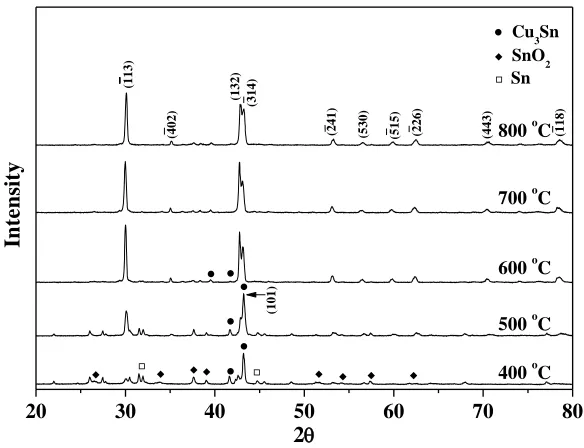
Figure 3. XRD patterns of the Cu-Sn/C composite powders reduced at various temperatures.
The dried precursor formed from the metal chelates of citric acid had poor gas penetration properties during spray drying. Therefore, the resulting precursor powders had a large size of several tens of micrometers and a hollow morphology with a thin-walled structure.
The precursor powders prepared by the spray drying process were post-treated at various temperatures under reducing atmosphere. Fig. 3 shows the XRD patterns of the final Cu-Sn/C composite powders. The sample reduced at 400°C showed a main crystal structure of Cu3Sn with
[image:4.596.156.448.358.582.2]
the decomposition of the metal citrates and their subsequent reduction formed the metal and alloy components of the composites. Likewise, reduction of the composite powders at 500°C yielded to the main Cu3Sn-type crystal structure. However, (
_
,113) and ( _
,314) peaks associated with the Cu6Sn5
phase were additionally observed. The ( _
,314) peak of the Cu6Sn5 phase overlapped with the (101)
peak associated with the Cu3Sn phase and its intensity increased upon increasing reduction
temperature, corresponding to the intensity growth of the (132) peak of the Cu6Sn5 phase. In contrast,
the intensity of the (101) peak of the Cu3Sn phase decreased with increasing reduction temperature.
This was because Cu3Sn crystals transferred to the Sn-rich Cu6Sn5 upon increasing reduction
temperature. Finally, the composite powders reduced at 600°C had a crystal structure of pure Cu6Sn5
phase without impurity peaks.
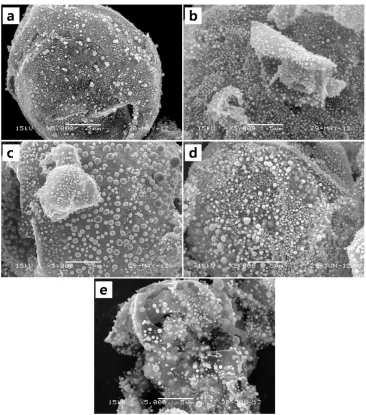
Figure 4. SEM images of the Cu-Sn/C composite powders reduced at (a) 400 oC, (b) 500 oC, (c) 600
o
[image:5.596.117.483.282.697.2]
The intensity ratio of the ( _
,113) and (132) peaks for the composite powders reduced at temperatures between 600°C and 800°C were consistent with a pure Cu6Sn5 phase (JCPDS card
45-1488). A high mixing degree of the Cu and Sn components in the precursor powders formed by spray drying enabled the formation of the pure Cu6Sn5 phase at low reducing temperatures. In this study, the
carbon material of the composite powders decreased the reduction temperature of the Cu and Sn materials.
Fig. 4 shows the morphologies of the Cu-Sn/C composite powders reduced at temperatures between 400°C and 800°C. In comparison with the shell, the nanosized particles imbedded inside the shell appear as brighter spots in the SEM images, thus demonstrating the formation of a metallic Cu-Sn alloy. Segregation of the Cu and Sn components occurred during the decomposition and reduction processes of the metal salts while forming the nanosized metallic alloy particles. Therefore, the Cu-Sn nanoparticles are uniformly dispersed on the inner and outer surface of the spherically shaped carbon powders. Carbon spheres were formed by the decomposition of metal citrate under reducing atmosphere. The mean size of the Cu-Sn alloy nanoparticles increased with increasing the post-treatment temperature up to 600°C because of the low melting temperature of Cu-Sn alloys. However, a further increase of the particle size did not occur at still higher temperatures of 700°C and 800°C. This result indicates that the alloy nanoparticles do not aggregate even at higher temperature than their melting temperature, because of the carbon matrix on which they are dispersed. The mean sizes of the Cu-Sn nanoparticles reduced at 400°C and 600°C were 169 and 414 nm, respectively.
Figure 5. Schematic diagram of the formation mechanism of Cu6Sn5 alloy nanoparticles dispersed on a
carbon matrix.
Fig. 5 shows the schematic diagram of the formation mechanism of Cu6Sn5 alloy nanoparticles
[image:6.596.82.521.429.622.2]
The subsequent reduction of SnO2–CuO resulted in the formation of Cu6Sn5/C alloy composite
powders for reduction temperatures between 600°C and 800°C. The particle growth of the Cu-Sn alloys occurred during the reduction process in order to minimize the total surface energy. Some of the alloy powders entered to the inner part of the spherical carbon powders and the others moved out to the outside of the carbon powders.
[image:7.596.81.517.183.405.2]Figure 6. TEM images of the Cu6Sn5/C composite powders post-treated at 600°C.
Fig. 6 shows the TEM images of the Cu6Sn5/C composite powders post-treated at 600°C. The
alloy powders are well dispersed on the spherical carbon matrix. The mean sizes of the Cu6Sn5 alloy
and the carbon powder are 0.4 m and 7 m, respectively.
0 200 400 600 800 1000
0 20 40 60 80 100
Temperature (oC)
T
G
(
%
)
0 20 40 60 80
a
D
S
C
(
m
W
m
g
-1
[image:7.596.163.447.536.727.2]
0 200 400 600 800 1000
0 20 40 60 80 100
Temperature (oC)
T
G
(
%
)
0 20 40 60 80
b
D
S
C
(
m
W
m
g
-1
)
Figure 7. TG/DSC curves of the precursor powders and Cu6Sn5/C composite powders post-treated at
600°C.
Fig. 6 (b) shows a high-resolution TEM image of the Cu6Sn5 alloy particles dispersed on a
carbon matrix. The alloy particles are fully covered by amorphous carbon with a uniform thickness of 4 nm. The carbon shell acts as a barrier to obstruct the aggregation between alloy particles.
0 150 300 450 600 750 900
0.0 0.5 1.0 1.5 2.0 2.5 3.0
600 oC 400 oC
V
o
lt
a
g
e
(
V
)
Capacity (mAh g-1)
800 oC
600 oC 400 oC 800 oC
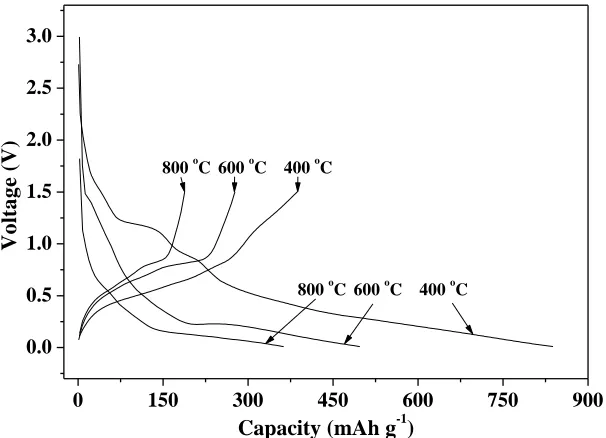
Figure 8. The initial charge/discharge curves of Cu-Sn/C composite powders reduced at different temperatures at a constant current density of 300 mA g-1 in the voltage range of 0.01–1.5 V.
Fig. 7 shows the TG/DSC curves of the precursor powders and Cu6Sn5/C composite powders
[image:8.596.163.446.90.286.2] [image:8.596.145.448.438.657.2]
apparent between room temperature and 1000°C. The first prominent weight loss region at temperatures from 40°C to 100°C resulted from loss of adsorbed water. Upon heating the precursor powders up to 1000°C, a high weight loss of 70 % was observed.
0 10 20
0 200 400 600 800 1000
a
Cycle number C a p a c it y ( m A h g -1 ) 0 20 40 60 80 100 C o u lo m b ic e ff ic ie n c y ( % )0 10 20
0 200 400 600 800 1000
b
Cycle number C a p a c it y ( m A h g -1 ) 0 20 40 60 80 100 C o u lo m b ic e ff ic ie n c y ( % )0 10 20
0 200 400 600 800 1000
c
Cycle number C a p a c it y ( m A h g -1 ) 0 20 40 60 80 100 C o u lo m b ic e ff ic ie n c y ( % ) [image:9.596.160.436.141.715.2]
This indicates that a decomposition of the metal chelates formed from the Sn and Cu components and citric acid did not occur during the spray drying process. The DSC curves of the precursor powders exhibited several endothermic and exothermic peaks at temperature below 450°C by decomposition of the metal chelates and carbon components. The DSC curve of Cu6Sn5/C
composite powders post-treated at 600°C showed two exothermic peaks at temperatures of 400°C and 550°C due to decomposition of the carbon and oxidation of the alloy parts. The corresponding weight loss and gain are observed in the TGA curve.
Fig. 8 shows the initial charge/discharge curves of Cu-Sn/C composite powders reduced at different temperatures at a constant current density of 300 mA g-1 in the voltage range of 0.01–1.5 V. The composite powders post-treated at 400°C showed a different behavior upon lithium insertion as compared to the powders post-treated at 600°C and 800°C, due to their different crystal structure. The initial discharge capacities of the composite powders reduced at 400°C, 600°C, and 800°C were 387, 277, and 188 mAh g-1, with corresponding Coulombic efficiencies of 46%, 56%, and 52%, respectively. The composite powders reduced at 400°C included inhomogeneous mixtures of Cu3Sn,
Sn, and SnO2. Therefore, the extra lithium insertion capacity observed might be caused by lithium
reacting with SnO2 to form Li2O, which is irreversible.
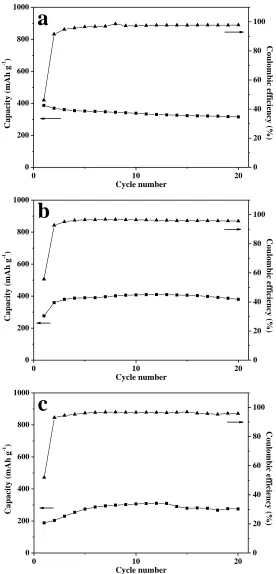
Fig. 9 shows the cycle performances and Coulombic efficiencies of Cu-Sn/C composite powders at a constant current density of 300 mA g-1. The discharge capacities of the composite powders reduced at 400°C decreased monotonically from 387 to 315 mAh g-1
during 20 cycles, the capacity retention being 82%. The discharge capacities of the composite powders reduced at 600°C increased from 277 to 409 mAh g-1 during the first five cycles, while reduction at 800°C led to a gradual increase from 188 to 309 mAh g-1 during the first ten cycles. This indicates that the inner part of large Cu6Sn5 particles gradually reacted with Li during cycling. After 20 cycles, the discharge
capacities of the composite powders reduced at 600°C and 800°C were 380 and 275 mAh g-1
and the corresponding capacity retentions 93% and 89%, respectively.
0.0 0.5 1.0 1.5
-1.2 -0.8 -0.4 0.0 0.4 0.8
C
u
rr
en
t
(m
A
)
Voltage (V)
1st
[image:10.596.170.414.525.703.2]
The Coulombic efficiencies of the Cu-Sn/C composite powders increased during the first several cycles and then saturated slightly above 96%, irrespective of the reduction temperatures.
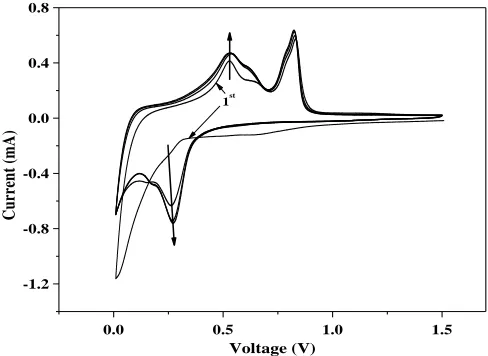
Fig. 10 shows the cyclic voltammetry profiles of the Cu-Sn/C composite powders reduced at 600°C for the first five cycles. During the first cycle, the composite powders exhibited a different anodic and cathodic performance compared to the following cycles. It can be seen that the cyclic voltammetry curve declines smoothly with a peak appearing at about 0.27 V, which corresponds to the early stage of Li reacting with Sn [19]. In particular, the current increases when the potential is reduced from 0.3 to 0.01 V, which results from the intercalation of Li into amorphous carbon [20]. This indicates that there is only a small amount of the Sn phase and a lot of amorphous carbon in the matrix reacting with Li during the first cycle. However, the peak observed at 0.27 V, which is attributed to Li insertion into the crystalline Sn phase, becomes more pronounced from the second cycle. This result suggests that an increasing amount of the Sn phase reacts with Li, in addition to the carbon, after activation in the first cycle. The subsequent anodic sweeps result in smoothly increasing curves with two distinct peaks at 0.53 and 0.83 V, respectively; no difference is observed for the first and the following cycles. These two peaks are attributed to the extraction of Li from Sn, while the broad background is related to Li extraction from amorphous carbon [20]. This result proves that the use of a carbon matrix or a carbon shell improved the electrochemical properties of nanosized Cu-Sn alloy materials.
4. CONCLUSIONS
Spherically hollow precursor powders of Sn and Cu components are prepared by spray drying from aqueous solution with citric acid as a chelating agent. The high mixing degree of Cu, Sn, and carbon components in the precursor powders formed by spray drying enables the formation of phase-pure Cu6Sn5 powders at a low reduction temperature of 600°C. Submicron-sized Cu-Sn alloy particles
are uniformly dispersed on the inner and outer surfaces of spherically shaped carbon powders during the reduction process. The discharge capacities of the composite powders reduced at 600°C increase during the first five cycles. During cycling, the inner part of large Cu6Sn5 particles gradually reacts
with Li. The discharge capacities of the composite powders are 277, 409, and 380 mAh g-1 during the first, fifth, and twentieth cycle, respectively. The new-concept spray drying process could be widely applied to the large production of the alloy-C composite powders with various compositions as anode materials for lithium ion batteries.
ACKNOWLEDGEMENT
References
1. M. Winter, J.O. Besenhard, Electrochim. Acta, 45 (1999) 31. 2. R.A. Huggins, J. Power Sources, 81 (1999) 13.
3. C. Tan, G. Qi, Y. Li, J. Guo, X. Wang, D. Kong, H. Wang, S. Zhang, Int. J. Electrochem. Sci., 7 (2012) 10303
4. Z. Du, S. Zhang, J. Zhao, T. Jiang, Z. Bai, Int. J. Electrochem. Sci., 7 (2012) 1180.
5. S. An, J.H. Park, C.H. Shin, J. Joo, E. Ramasamy, J. Hwang, J. Lee, Carbon, 49 (2011) 1108. 6. H. Li, L. Shi, Q. Wang, L. Chen, X. Huang, Solid State Ionics, 148 (2002) 247.
7. S. Hirano, T. Yogo, K. Kikuta, S. Naka, J. Mater. Sci., 21 (1986) 1951. 8. D. Applestone, A. Manthiram, RSC Adv., 2 (2012) 5411.
9. H. Li, Q. Wang, L. Shi, L. Chen, X. Huang, J. Chem. Mater., 14 (2002) 103. 10.Y. Kwon, H. Kim, S.G. Doo, J. Cho, J. Chem. Mater., 19 (2007) 982. 11.W. Cui, F. Li, H. Liu, C. Wang, Y. Xia, J. Mater. Chem., 19 (2009) 7202.
12.S. Chen, P. Chen, M. Wu, D. Pan, Y. Wang, Electrochem. Commun., 12 (2010) 1302.
13.G. Zhou, D.W. Wang, X. Shan, N. Li, F. Li, H.M. Cheng, J. Mater. Chem., 22 (2012) 11252. 14.X. Du, Z. Jiang, X. Meng, Z. Wang, H. Yu, M. Li, T. Tang, J. Phys. Chem. C, 112 (2008) 6638. 15.J. Liu, T.E. Conry, X. Song, L. Yang, M.M. Doeff, T.J. Richardson, J. Mater. Chem., 21 (2011)
9984.
16.F. Yu, J. Zhang, Y. Yang, G. Song, J. Power Sources, 195 (2010) 6873.
17.M. Lu, Y. Tian, Y. Li, W. Li, X. Zheng, B. Huang, Int. J. Electrochem. Sci., 7 (2012) 760. 18.S.H. Hong, B.K. Kim, Mater. Lett., 57 (2003) 2761.
19.R.Z. Hu, Y. Zhang, M. Zhu, Electrochim. Acta, 53 (2008) 3377.
20.R.Z. Hu, H. Liu, M.Q. Zeng, H. Wang, M. Zhu, J. Mater. Chem., 21 (2011) 4629.