Int. J. Electrochem. Sci., 7 (2012) 9390 - 9400
International Journal of
ELECTROCHEMICAL
SCIENCE
www.electrochemsci.org
The Atomic and Electronic Structure Changes Upon
Delithiation of LiCoO
2: From First Principles Calculations
F. Xiong1, H. J. Yan1, Y. Chen1, B. Xu1, 2, J. X. Le1, C. Y. Ouyang1, 2*
1
Department of Physics, Jiangxi Normal University, Nanchang 330022, China
2
Key Laboratory for Advanced Functional materials of Jiangxi Province, Nanchang, 330022, China *E-mail: [email protected]
Received: 2 August 2012 / Accepted: 2 September 2012 / Published: 1 October 2012
The physical origin of the degradation on the cycling performance of LiCoO2 upon deep lithium
extraction is studied from first principles calculations. Results show that the structural stability is strongly associated with the electronic structures of Co-3d, which is very flexible and can be exhibited as different electronic configurations. In LiCoO2, Co3+ is non-magnetic and holds the (t2g↑)3(t2g↓)3
electronic configuration. Upon lithium deintercalation, some Co3+ ions loss one electron and become Co4+ with (t2g↑)3(t2g↓)2 configuration. Both structures are stable since the distortion of the CoO6
octahedral is small, and thus these structures do not contribute much to the instability. On the other hand, oxygen vacancy is one important reason to the structural instability. We found that spin flip occurs to the electronic structure of Co-3d close to oxygen vacancies. Co3+ holds the (↑)4(↓)2 electronic configuration and magnetized with 2 μB magnetic moment. Furthermore, some Co3+ obtains one
electron and becomes Co2+ near the oxygen vacancy. In these cases, the charge distribution around the Co atom is not symmetric and the local structure is distorted obviously, which can further accelerate the process of the structural degradation.
Keywords: Lithium ion batteries; High voltage charging; Structural stability; LixCoO2; Electronic
structure
1. INTRODUCTION
Materials for cathodes in lithium rechargeable batteries have been widely studied in the last three decades. The energy density is still a big problem for wide application of lithium ion batteries in the electrical vehicle. Among various cathodes materials studied, LiCoO2 is the most widely used in
the lithium ion battery industry [1, 2]. LiCoO2 has a theoretical capacity of about 270 mAhg-1 when all
In order to improve the energy density of lithium ion batteries, we can improve either the capacity or the intercalation potential of the cathode material. Both of them can be achieved simply by extracting more Li from the LiCoO2 lattice. However, the structural stability of the LiCoO2 material is
very bad during the charge/discharge cycling when more than half of the Li atoms are extracted, which leads to poor cycling performance of the battery. Furthermore, high voltage charging of the material is also harmful to the safety of the battery, because O2 gas will be released from the lattice accompanied
by structural transition upon high voltage charging, and then reacts with the electrolyte. Experiments have shown that oxide coating layers like Al2O3, ZrO2, MgO, et al, can improve the structural stability
and thus the cycling performance [4-7]. However, the physical mechanism behind this improved performance is still not clear to the literature. Oxides coating affects only the surface properties of the material, it is hard to understand how the surface effect induced the bulk structural stability.
In order to understand the mechanism of the oxygen release problem in LiCoO2 during the
charge/discharge process, it is important to understand the basic physical and chemical changes of the materials upon lithium deintercalation. Experimentally, in situ synchrotron X-ray diffraction is applied to observe the structural change of the material during cycling [8]. It is found that the phase transition upon high voltage charging of Al2O3 coated LiCoO2 is reversible. Unfortunately, it is not easy to
observe the microscopic structure change and local electronic structure change from those in situ experiments. Therefore, theoretical studies are important to reveal the physical mechanism of the coating improved cycling performance.
The physical and chemical properties like electronic structures [9-10], lithium ion diffusion [11], lithium ion ordering and phase stability, voltage-temperature phase diagram et al. [12] of the partly delithiated LixCoO2 is studied with first principles calculations in the past. However, those
studies did not give reasonable predictions to the electronic and magnetic ground states of this material. Co is nonmagnetic in stoichiometrical LiCoO2, as the average oxidation state of the cobalt is
Co3+ with 6 electrons taking the 3d-orbital. In an octahedral crystal field, 3d-orbital split into t2g triplet
and eg doublet. Therefore, both spin up and spin down of the t2g triplet is fully filled by the 6 electrons
in LiCoO2, which gives rise to a symmetric distribution of the charge around the CoO6 octahedral.
However, upon delithiation of the LiCoO2, the average oxidation state of Co is higher than +3.
Therefore, some Co atoms become Co4+ and the others remain Co3+. Experimentally, it is shown that delithiated LixCoO2 (x<1) exhibits magnetic ground state, indicating that the charge distribution in the
spin up and spin down channels are no longer symmetric. However, conventional local density approximation (LDA) or general gradient approximation (GGA) level of the calculation results in non-magnetic solution of the ground state [9-12] and thus a metallic electronic structure, which is not consistent with the experimental observations.
More recently, within the density functional theory (DFT) scheme, GGA+U (or LDA+U) method, in which a Hubbard U term is added to describe the orbital dependence of the Coulomb and exchange interaction[13, 14], is shown to give much better description of the electronic structure in oxide cathode materials for lithium ion batteries [15-18]. In the present work, we show that GGA+U also gives good description of the electronic ground state of LixCoO2 (x<1). Then, we focus on the
LixCoO2, and we demonstrate that the Co spin state change in LixCoO2 (x=1, 0.75, 0.5 and 0.25) is
associated with the local structural distortion and thus the structural stability.
2. COMPUTATIONAL DETAILS
All calculations in the present study are performed at GGA+U level, with the projector augmented wave (PAW) method [19] as implemented in the Vienna ab initio simulation package (VASP) [20]. The U (the on-site coulomb term) value for the Co-3d state is selected to be 4.91 eV according to other reports [17, 21], and our tested results show that this value is suitable for the LixCoO2 system.
All calculations are performed with a 2×2×1 super cell containing 12 formula units (12Li, 12Co and 24O). The convergence tests of the total energy with respect to the k-points sampling and cut-off energy have been carefully examined, which ensure that the total energy is converged to within 10-5 eV per formula unit. The Monkhorst-Pack [22] scheme 3×3×1 k-points mesh is used for the integration in the irreducible Brillouin zone. Energy cut-off for the plane waves is chosen to be 520 eV. Before the calculation of the electronic structure, both the lattice parameters and the ionic position are fully relaxed, and the final forces on all relaxed atoms are less than 0.005 eVÅ-1
. In all the calculations, spin polarization is included because the magnetic atoms play important roles in the electronic structure. The calculation of the density of states (DOS) is smeared by the Gaussian smearing method with a smearing width of 0.05 eV.
3. RESULTS AND DISCUSSION
3.1 The structure changes upon delithiation
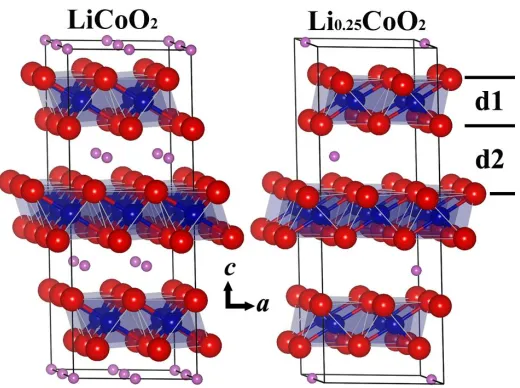
Figure 1. Schematic views of the atomic structures of LiCoO2 and Li0.25CoO2 in the ball and stick
mode. The large (red), middle-sized (blue), and small (purple) spheres are O, Co and Li atoms, respectively. The transparent polyhedral are CoO6 octahedral. Symbols “d1” and “d2” are the
[image:3.596.170.430.494.688.2]
LiCoO2 is isostructural with α-NaFeO2, whose space group is R3m. Within this space group,
Li occupies the 3a, Co the 3b, and O the 6c sites. It has an ordered rock salt structure in which alternate layers of Li and Coatoms occupy octahedral sites within the face centered cubic oxide array [23-24]. Figure 1 gives the relaxed structures of LiCoO2 and Li0.25CoO2. In general, we found that the CoO6
[image:4.596.95.501.241.559.2]octahedral is kept unchanged upon delithiation, even when three fourth of Li atoms are removed from the lattice, except for certain small distortion.
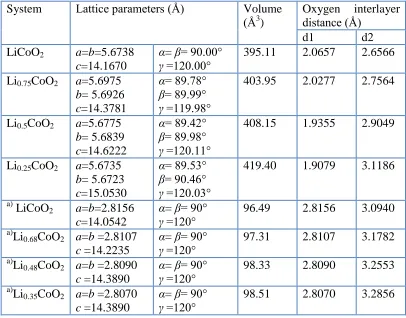
Table 1. The relaxed structural parameters of LixCoO2. The “d1” and “d2” correspond to the average
O-O interlayer distance shown in Fig. 1
System Lattice parameters (Å) Volume (Å3
)
Oxygen interlayer distance (Å)
d1 d2
LiCoO2 a=b=5.6738
c=14.1670
α= β= 90.00° γ =120.00°
395.11 2.0657 2.6566 Li0.75CoO2 a=5.6975
b= 5.6926 c=14.3781
α= 89.78° β= 89.99° γ =119.98°
403.95 2.0277 2.7564
Li0.5CoO2 a=5.6775
b= 5.6839 c=14.6222
α= 89.42° β= 89.98° γ =120.11°
408.15 1.9355 2.9049
Li0.25CoO2 a=5.6735
b= 5.6723 c=15.0530
α= 89.53° β= 90.46° γ =120.03°
419.40 1.9079 3.1186
a)
LiCoO2 a=b=2.8156
c=14.0542
α= β= 90° γ =120°
96.49 2.8156 3.0940
a)
Li0.68CoO2 a=b =2.8107
c =14.2235
α= β= 90° γ =120°
97.31 2.8107 3.1782
a)
Li0.48CoO2 a=b =2.8090
c =14.3890
α= β= 90° γ =120°
98.33 2.8090 3.2553
a)
Li0.35CoO2 a=b =2.8070
c =14.3890
α= β= 90° γ =120°
98.51 2.8070 3.2856 a). Experimental results from reference [25].
Detailed structural information is listed in Table 1, together with the experimental values [25]. These calculated lattice constants are basically in agreement with experimental values, although over estimated to some extent. The lattice parameters a and b do not change significantly while c increases when the lithium ions are extracted from the electrode. In the stoichiometric LiCoO2, the lattice
the weakened coulomb interaction between positively charged Li layers and negatively charged CoO6
layers. In fact, the binding forces in the layered LiCoO2 material include the coulomb interactions
between Li layers and CoO6 layers and Van der Waals interaction between CoO6 layers. When there
are more Li ions in the lattice, the binding forces are dominated by the coulomb interaction. Therefore, when Li content is lowered during delithiation, the interaction strength is lowered and the lattice is expanded along the c-axis direction. When the lithium content is very low (or completely removed), the binding forces are dominated by the Van der Waals interaction. In this case, the system comes to a new and shortened equilibrium layer to layer distance. At the same time, the O-O interlayer distances also change substantially upon lithium extraction. The “d1”, which is 2.066 Å in LiCoO2, is shortened
by near 0.16 Å, to the value of 1.908 Å in Li0.25CoO2. The thickness of Co-O layer becomes thinner
indicates that the Co-O bonds becomes stronger. On the other hand, the “d2” is elongated substantially from 2.657 Å in LiCoO2 to 3.119 Å in Li0.25CoO2, indicating that the layer to layer interaction
becomes weaker. These results are in good agreement with experimental findings [25].
3.2. Average delithiation potential
To enhance the energy density of the LiCoO2 material, it is suggested to charge the battery to a
higher voltage and extract more Li from the cathode. Here we calculated the average intercalation potential of the LixCoO2 material at different stage. The average lithium extraction potential is
calculated by: [12, 26]:
Vave = -ΔG/nF
Where ΔG is the Gibbs free energy changes for the removal reaction, F is the Faraday constant, and n is the Mole number of lithium ions removed. Generally, it is assumed that the changes in volume and entropy are small during the reaction. Therefore, the average removal potential can be approximately obtained from the internal energy given by:
Vave = -ΔE/nF
where ΔE is the calculated difference of the total energy. Here, the potential is examined by the composition ranges. As for the energy changes of removal between LiCoO2 and LixCoO2, ΔE is given
by:
ΔE = E[LiCoO2]-E[LixCoO2]-(1-x) Ebcc[Li]
Where Etot[LiCoO2] and Etot[LixCoO2] are the total energy of LiCoO2 and LixCoO2, and Ebcc[Li]
is the total energy of metallic lithium in a body-centered-cubic (bcc) phase.
~4.0 V [5, 8]. This underestimated potential is also reported in other materials, which is attributed to the underestimation of the cohesive energy of metallic lithium as reference electrode [26-27]. Upon further removal of lithium ions from the Li0.5CoO2 state to the Li0.25CoO2 state, the average
intercalation potential is increased to 3.95 V. Although this value is also lower than the experimental value of ~4.2 V, the amount of the increased potential value is similar for the theoretical and experimental values.
[image:6.596.113.490.227.499.2]3.3 Electronic structure
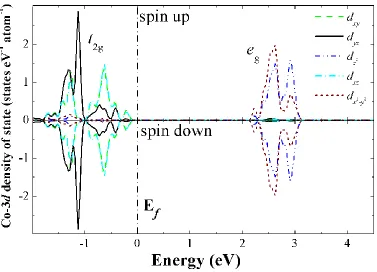
Figure 2. Co-3d projected density of states of Co3+ in LiCoO2. The triplet and duplet of the d-orbit are
denoted as t2g and eg, respectively .The Fermi level is set to 0 eV.
The average oxidation state of the cobalt is Co3+ in LiCoO2, which corresponds to a d6
electronic configuration. In an octahedral crystal field, 3d-orbitals split into t2g triplet and eg doublet.
As shown in Fig. 2, Co3+ exhibits low spin state with 3 electrons occupying spin up t2g orbital and the
other 3 electrons occupying spin down t2g orbital. The energy gap of about 2.4 eV is opened between
the occupied t2g and empty eg orbital. The energy gap is relatively high for activating electrons from
the valence band to the conduction band at room temperature. Therefore, the electronic conduction mechanism in LixCoO2 should be small polaron migration among Co3+/Co4+ ions, in agreement with
Figure 3. Co-3d projected density of states of Co4+ ions in LixCoO2 along the Co-O bond direction (a)
and c-vector direction (z-axis) of the lattice (b). The five “d-orbitals” in (b) is not really corresponding to the split of an octahedral crystal field. The triplet and the duplet of the d-orbital are denoted as t2g and eg, respectively. The Fermi level is set to 0 eV.
Upon removal of Li atoms from the material, the average cobalt oxidation state is higher than +3, therefore, some Co atoms loss one electron and becomes Co4+. After checking the relative positions of Co4+ and Li vacancies (Li atoms are extracted) in the lattice, we did not observe any correlation among them in our simulation. Meanwhile, the removed Li atoms are not the direct driving force to the formation of Co4+, or the distribution of Co4+ is not related with the distribution of Li vacancies (or the remaining Li atoms) in the lattice. Removal of Li atom from the lattice only accounts for the lost charge in the Co-O layer.
The electronic structure of the Co4+ 3d-state is shown in Fig. 3. Transition from Co3+ to Co4+ indicates of removing one electron from the Co-3d orbital. Very interestingly, we found that rather than removing one electron from any one specific orbital from the t2g triplet (dxy, dyz and dxz), the
removed electron is contributed by all orbitals of the triplet. This is quite different from Mn and Ni in spinel or layered electrode materials like LiMn2O4 and LiNiO2. In LiMn2O4, transition between Mn3+
and Mn4+ is associated with removal of one electron from the d(x2-y2) orbital, which is accompanied by large local distortion of the MnO6 octahedral due to the strong Jahn-Teller effect [29]. Similar effect
also occurs upon Ni3+/Ni4+ transition [30]. In LiCoO2, however, structural distortion around Co4+O6 is
much smaller than that of around Mn3+O6 and Ni3+O6. Since charge is removed from all orbital of the
triplet rather than one specific one in the triplet, charge distribution around the CoO6 octahedral is
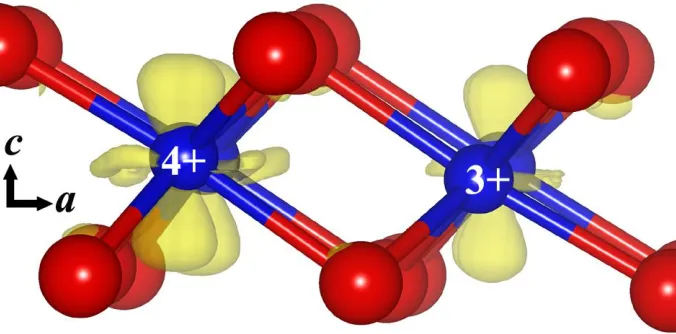
equally from all three orbitals. Furthermore, we project the Co4+-3d along the c-vector direction of the lattice (z-along the c-vector), and we found that the dz2 orbital moved up above the Fermi level and become empty (Fig. 3b), indicating that the removed electron is from some kind of “orbital” along the c-vector direction. In order to confirm this result, Fig. 4 gives the charge density difference Δρ between LiCoO2 and LixCoO2 after Li atoms are partly removed. The differential charge density Δρ is defined
as ρ(LiCoO2)-ρ(LixCoO2). Therefore, integration of the Δρ over the supercell is equal to the number of
Li atoms (electrons) removed from the system. As it is shown in Fig. 4, the removed electron from Co3+ is localized at an “orbital” shaped like dz2 along the c-vector, which is consistent with the projected density of states. In the charged state of Li0.25CoO2, three quarters of the Co ions are in +4,
[image:8.596.130.468.269.436.2]while the other quarter is in +3.
Figure 4. Charge density difference between LiCoO2 and Li0.25CoO2. The red (large) and blue (small)
balls are O and Co atoms, respectively. Symbols “+4” and “+3” denotes the oxidation state of the corresponding Co atoms, “a” and “c” refer to the orientation of the lattice vectors.
The above results show that CoO6 octahedral structure is quite stable during the lithium
insertion/extraction process of the LiCoO2 material, because the relatively uniform charge
redistribution around the CoO6 octahedral upon removal of lithium atoms from the lattice. This is good
for the cycling stability of the material as electrodes for lithium ion batteries. The unique charge redistribution around CoO6 octahedral is associated with the relative strength between the octahedral
crystal field and the exchange correlation of the Co-3d states. The Co atoms in the stoichiometric LiCoO2 hold a low-spin (t2g↑)3(t2g↓)3 electronic configuration, results in a non-magnetic ground state
solution. In the LixCoO2 state, some Co ions become Co4+, which hold the (t2g↑)3(t2g↓)2 electronic
configuration and become magnetized with 1 μB magnetic moment. These electronic structures
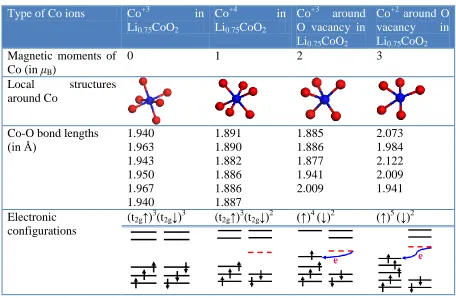
Table 2. The local structure and electronic configurations for different types Co ions
Type of Co ions Co+3 in
Li0.75CoO2
Co+4 in
Li0.75CoO2
Co+3 around O vacancy in Li0.75CoO2
Co+2 around O
vacancy in
Li0.75CoO2 Magnetic moments of
Co (in μB)
0 1 2 3
Local structures around Co
Co-O bond lengths (in Å) 1.940 1.963 1.943 1.950 1.967 1.940 1.891 1.890 1.882 1.886 1.886 1.887 1.885 1.886 1.877 1.941 2.009 2.073 1.984 2.122 2.009 1.941 Electronic configurations
(t2g↑)3(t2g↓)3 (t2g↑)3(t2g↓)2 (↑)4 (↓)2 (↑)5 (↓)2
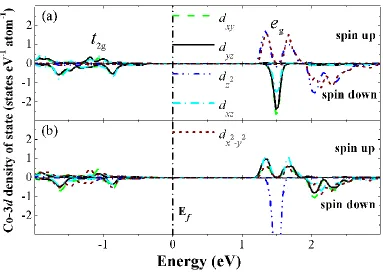
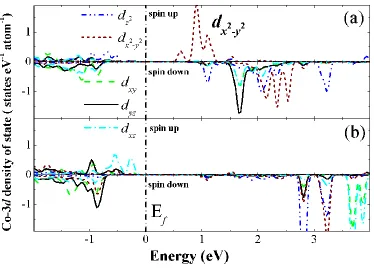
Fig. 5 gives the electronic structures of Coions near the O-vacancy. The Co is preferred to be in relatively lower oxidation state. In the case of Li0.75CoO2 with one O vacancy, in addition to Co3+
ions, we also observed one Co2+ ion around the O vacancy. Very interestingly, we find that Co3+ near the O-vacancy is no longer non-magnetic. Spin flip occurs and one spin down electron orbital moves to spin up orbital (see Tab. 2). Because of the O-vacancy, CoO6 octahedral symmetry is broken and
becomes CoO5. Therefore, as the crystal field is changed substantially, the Co-O bond lengths and
charge distribution are adjusted accordingly. The symmetrical charge distribution around CoO6
(t2g↑)3(t2g↓)3 is changed into (↑)4(↓)2, accompanied with the changed Co-O bond lengths. As a result,
the Co3+ is magnetized with 2 μB magnetic moment (see Tab. 2). Similarly, in addition to one
additional electron in the Co-3d orbital, spin flip also occurred in the case of Co2+ around the O vacancy. The charge distribution is changed from (t2g↑)3(t2g↓)3 into (↑)5(↓)2, with which the Co ion has
a magnetic moment of 3 μB. After checking the details on the Co-O bond, we can see that the six Co-O
bond lengths are quite close to each other around the Co3+O6 in LiCoO2 and the Co4+ in Li1-xCoO2
without O vacancies around them, as presented in Tab. 2. Except for the shortened bond length values from ~1.95 Å to 1.89Å, the CoO6 octahedral do not undergo distortion after one electron removed
from Co3+ and the cation becomes Co4+. On the other hand, when there is O vacancy around the Co atom, the Co-O bonds are changed substantially. Even for the case of Co3+, spin flip occurs and the bond lengths are no longer close to each other, the CoO5 structure undergoes substantial distortions.
[image:10.596.112.486.134.402.2]
cathode to higher voltage, O release is expected and O vacancies are created in the lattice. This in turn further destroys the structural stability, and finally the performance of the material degrades.
Figure 5. Co-3d projected density of states of Co3+ ions (a) and Co2+ ions (b) next to an O vacancy in Li0.75CoO2. The project is along the Co-O bond direction. The Fermi level is set to 0 eV.
4. SUMMARY AND CONCLUSIONS
In summary, the atomic and electronic structural changes of LiCoO2 cathode material upon
delithiation are studied from density functional theory. Upon lithium removal from the LiCoO2 lattice,
the CoO6 structures do not change substantially. The volume expansion is mainly contributed by the
lattice expansion along the c-axis lattice vector, due to the weakened coulomb interactions between positively changed Li layer and negatively charged Co-O layer. As the charge distribution around the CoO6 octahedral is quite even, the Co-O bond lengths are close to each other for both Co3+ and Co4+
ions. Those results indicate that the structural stability is good upon lithium removal. However, upon high voltage charging of LiCoO2, oxygen release is observed from experiments and oxygen vacancies
are formed in the lattice. Oxygen vacancies may induce spin flip to the Co-3d electronic configuration and therefore change the electronic structure and charge distribution substantially, which in turn further distorts the CoO6 structure. As a result, oxygen vacancies will accelerate the degradation
ACKNOWLEDGEMENT
Thanks to the support of NSFC under Grant Nos. 11064004, 11234013 and 11264014. C. Y. Ouyang is also supported by the “Gan-po talent 555” Project of Jiangxi Province. Special thanks to the financial supports from Amperex Technology Limited (ATL) at Ningde, China. Computations are partly performed at Shanghai High Performance Computer center.
References
1. M. M. Thackeray, W. I. F. David, P. G. Bruce, J. B. Goodenough, Mat. Res. Bull., 18 (1983) 461. 2. J. B. Goodenough, K. Youngsik, Chem. Mater., 22 (2010) 587.
3. R. Koksbang, J. Barker, H. Shi, M.Y. Saidi, Solid State Ionics. 84 (1996) 1.
4. Y. J. Kim, T. J. Kim, J. W. Shin, B. Park, J. Cho, J. Electrochem. Soc., 149 (2002) A1337. 5. Z. X. Wang, L. J. Liu, L. Q. Chen, X. J. Huang, Solid State Ionics, 148 (2002) 335.
6. J. Cho, Y. J. Kim, B. Park, J. Electrochem. Soc., 148 (2001) A1110.
7. A. M. Kannan, L. Rabenberg, A. Manthiram, Electrochem. Solid-State Lett., 6 (2003) A16. 8. L. J. Liu, L. Q. Chen, X. J. Huang, X. Q. Yang, W. S. Yoon, H. S. Lee, J. McBreenb, J.
Electrochem. Soc., 151 (2004) A1344.
9. A. Van der Ven, M. K. Aydinol, G. Ceder, Phys. Rev. B, 58 (1998) 2975.
10. L. Y. Hu, Z. H. Xiong, C. Y. Ouyang, S. Q. Shi, Y. H. Ji, M. S. Lei, Z. X. Wang, H. Li, X. J. Huang, L. Q. Chen, Phys. Rev. B, 71 (2005)125433.
11. M. Catti, Phys. Rev. B, 61 (1999) 1795.
12. C. Wolverton and Alex Zunger, Phys. Rev. Lett., 81 (1998) 606. 13. A. Juhin, F. de Groot, Phys. Rev. B 81 (2010) 115115.
14. V. I. Anisimov, F. Aryasetiawan, and A. I. Lichtenstein, J. Phys.: Condens. Mat. 9 (1997) 767. 15. L. Wang, T. Maxisch, G. Ceder, Phys. Rev. B 73 (2006) 195107.
16. C. Y. Ouyang, Y. L. Du, S. Q. Shi, M. S. Lei, Phys. Lett. A, 373 (2009) 2796.
17. F. Zhou, M. Cococcioni, C.A. Marianetti, D. Morgan, G. Ceder, Phys. Rev. B 70 (2004) 235121. 18. Z. X. Nie, C. Y. Ouyang, J. Z. Chen, Z. Y. Zhong, Y. L. Du, D. S. Liu, S. Q. Shi, and M. S. Lei,
Solid State Commun., 150 (2010) 40.
19. G. Krosse, J. Joubert, Phys. Rev. B 59 (1999) 1758. 20. G. Kresse, J. Furthmuller, Phys. Rev. B 54 (1996) 11169.
21. I. V. Solovyev, P. H. Dederichs, V. I. Anisimov, Phys. Rev. B, 50 (1994)16861. 22. H. J. Monkhorst, J. D. Pack, Phys. Rev. B 13 (1976) 5188.
23. L. D. Dyer, B. S. Borie, G. P. Smith, J. Am. Chem. Soc. 76 (1954) 1499.
24. J. B. Goodenough, D. G. Wickham, W. J. Croft, J. Phys. Chem. Solids, 5 (1958) 107.
25. Y. Takahashia, N. Kijimaa, K. Dokkob, M. Nishizawab, I. Uchidab, J. Akimoto, J. Solid State Chem. 180 (2007) 321.
26. M. K. Aydinol, A. F. Kohn, G. Ceder, K. Cho, J. Joannopoulos, Phys. Rev. B 56 (1997) 1354. 27. Z. Y. Zhong, C. Y. Ouyang, S. Q. Shi, and M. S. Lei, ChemPhysChem, 9 (2008) 2104.
28. J. B. Goodenough, A. Manthiram, B. Wnetrzewski, J. Power Sources, 43-44 (1993) 269.
29. C. Y. Ouyang, X. M. Zeng, Z. Sljivancanin, A. Baldereschi, J. Phys. Chem. C, 114 (2010) 4756. 30. J. M. Wang, J. P. Hu, C. Y. Ouyang, S. Q. Shi, M. S. Lei, Solid State Commun. 151 (2011) 234.