Reducing the Cost of Real-Time
Software through a
Cyclic Task Abstraction for Ada
Assisted by Acton: the novel Ada real-time executive
A thesis submitted for the degree of
Doctor of Philosophy
The Australian National University
February 2017
Declaration
I hereby declare this thesis is my own original work carried out exclusively for the degree of Doctor of Philosophy at the Australian National University. Contribution by others though feedback, editing and prior work are acknowl-edged in the customary manner.
Patrick Bernardi February 9, 2017
© Patrick Bernardi 2017
Abstract
Ada is unique as a software engineering language, facilitating
the development of reliable and maintainable software through clear, unam-biguous, modular code enforced to a specification. However, despite compre-hensive real-time systems support, Ada lacks the abstraction at the heart of these systems: cyclic tasks. Without it, users resort to solutions decomposing their designs: introducing unnecessary complexity to a real-time systems prim-itive. Furthermore, the only Ada executive for microcontrollers, GNAT for Bare Boards, impedes the timing analysis of tasks and schedulability analysis of systems. Consequently, Ada and its environments do not reach their potential of producing low-cost, reliable and maintainable real-time systems.This thesis unlocks this latent potential through the development of the Cyclic Task Specification and Acton. The Specification extends Ada to incorporate cyclic
tasks within Ada’s existing task abstraction using a simple but powerful model. Acton, on the other hand, is a new Ada executive built from the ground up to support real-time systems, forgoing an existing Ada tasking run-time in favour of building the tasking semantics natively within its kernel. The result is a flexible and portable Ada executive which correctly apportions execution time and enforces cyclic task attributes. Furthermore, tasks only perform user assigned activities and lower priority tasks cannot interrupt a running task.
Their contributions come at the cost of a more complex language and larger execution time overheads for kernel operations. For Acton, the up to order of magnitude larger overheads is the cost of simplifying task timing and system schedulability analysis. For the Cyclic Task Specification, the added complexity
simplifies the expression of cyclic task patterns for a wide range of systems. Its simple model centred on task attributes permits model expansion outside the formal language, addressing aversions to incorporating high-level abstractions.
Together, the Cyclic Task Specification and Acton advance real-time systems by
providing the clarity, structure and simplicity needed to express cyclic tasks and have their real-time constraints enforced at run-time. Furthermore, real-time analysis tools can now use the same cyclic task semantic information as the compiler to provide automatic timing verification and run-time enforceable cyclic constraints. Consequently, the contributions of this thesis allow real-time systems to use less code and have less scope for faults: reducing the life-cycle cost of real-time systems through quicker development and maintenance.
Acknowledgements
I would not have embarked down the long journey of a
postgrad-uate degree if not for my supervisor Uwe Zimmer. His convincing arguments for a topic on autonomous model helicopters proved irresistible compared to my then favoured option of working in telecommunication industry. For the reader this will be puzzling because, as presented, this thesis has nothing to do with autonomous model helicopters. However, when push came to shove on a failing autonomous model helicopter project, I switched to a question that was gnawing at me more than the failed autonomous electronic hardware I had in my hands:Why was there no Ada tasking run-time for my rather powerful mi-crocontroller and why does Ada not support the high-level real-time abstractions I was taught and used in my designs?
The origin of this question lies very much with Uwe, but from his role as a teacher rather than as a supervisor. Uwe taught Ada and real-time systems in two courses I took as an undergraduate. His style of teaching led me to ap-preciate and value the power Ada and real-time systems bring to the building of reliable, maintainable and predicable systems. However, the hallmark of a great teacher is not the knowledge imparted but the inspiration and curiosity planted to seize on the gained knowledge. Uwe achieved this, instilling the expectation of having the right tools for the task at hand. Uwe is a teacher par excellence, whom I thank for his teaching, and his ongoing advice, appraisal and support throughout the thesis.
I am also grateful to acknowledge another teacher par excellence from my youth, Frank O’Shea, for his influence and passion for mathematics.
This thesis, however, needed more than determination, inspiration and support to make it possible: it needed a high quality Ada environment from which my ideas could integrate. AdaCore delivered this in the form of the GNAT Ada en-vironment and I thank the many people who developed it for producing such a high-quality and accessible open-source Ada environment. It is a testament to its design that someone without any experience developing compilers can step-in and learn not just how the GNAT compiler works, but also how com-pilers work generally. Furthermore, exposure to GNAT has taught me how to properly write software, particularly for large systems, for which I am thankful.
“
”
Nevertheless, I cannot diminish the immense support by others. To my fellow PhD students Florian Poppa and Ben Coughlan I thank for the amazing of-fice atmosphere and friendships. Our ofof-fice was one of engaging discussions, encouragement and support: providing a valuable environment for sounding board ideas.
To the participants of IRTAW-17 I thank for the warm welcome I received to the small community, and for their invaluable input to refine the rough edges of the Cyclic Task Specification.
I would like to end by thanking my friends and family who provided vast support and encouragement over the course of my thesis; each in their own cherished way. In particular, special mention goes to Paul Altin and Steve Pe-terson. To my brother James and sister Maria I thank them for reading sections of my thesis and making my life more fulfilling.
Finally, to my parents Linda and John, I thank them for their unwavering sup-port and generosity. Without them, I would not be where I am today.
Contents
Declaration i
Abstract iii
Acknowledgements v
Contents vii
Chapter 1 Introduction 1
Task Abstraction 2
Task Abstraction Implementation 3
Outline 5
Thesis Conventions 6
Chapter 2 Cyclic Tasks and Ada 9
Cyclic Task Definitions and Properties 11
Ada’s Real-Time Facilities 15
Implementing Cyclic Tasks in Ada 16
Prior Work Incorporating Cyclic Tasks into Ada 30
Cyclic Tasks in Other Languages 32
Conclusion 38
Chapter 3 The Cyclic Task Specification 41
The Specification 42
Examples 51 Implementation 54 Ada Semantic Interface Specification 56
Language Impact and Flexibility 62
Comparison with Existing Ada Approaches 65 Conclusion 72
Chapter 4 Review of GNAT for Bare Boards for Real-Time
Systems 75
GNAT 76
GNAT for Bare Boards 79
Real-Time Problems in GNAT for Bare Boards 84 Conclusion 89
Chapter 5 Acton 91
Rationale 92 Architecture 93
Oak Resources 96
The Oak Run-Loop 112
Scheduling 116
Task Management 123
Cyclic Tasks 128
Protected Objects 134
Interrupt Handling 143
Conclusion 148
Chapter 6 Review of Acton 151
Platforms and Setup 152
Kernel Design 154
Scheduling and Task Dispatching 158
Idle State 163
Protected Objects 164
Interrupt Handling 165
Memory Footprint 166
Portability 169
Language Cover 169
Conclusion 172
Chapter 7 Conclusion 175
Future Work 179
Appendix A Cyclic Task Libraries 181
Appendix B References 189
Introduction
A gap exists between the design and specification of tasks in a
real-time system and their implementation in Ada. Predominately, these tasks are inherently cyclic in nature, yet Ada does not provide a simple way to express cyclic tasks and their properties. Furthermore, microcontroller-based real-time systems lack a suitable Ada executive or run-time with the capability to enforce cyclic task properties online, nor fully support the needs of real-time users.These observations resulted from experiences gained at the beginning of the doctorate, when the dissertation began as a study into the reliability of auton-omous scale helicopters. At the time a suitable autonauton-omous platform was not readily or affordably available, necessitating its development for the thesis.
While abandoned because of hardware issues, the software of the autonomous helicopter project inflicted a desire to address the observed weaknesses of cyclic tasks in Ada. Ada was chosen because, unlike other languages, Ada marks itself as a language aiding software engineering practises: facilitating the develop-ment of reliable and maintainable software by promoting the writing of clear, unambiguous and modular code, enforced to a specification (Moralee, 1981). Consequently, Ada minimises the life-cycle cost of software (Whitaker, 1993) and naturally befits a project where the software must be correct or people get hurt: a scale helicopter has all the inherent safety of an upside-down flying lawnmower.
Chapter 1
An additional appeal of Ada lay with its unique task abstraction: a syntactical and semantic approach placing the state of a task and its operations into a single type. This approach marries with the architecture of real-time systems where systems decompose into a set of independent tasks — each with their own individual timing constraints. However, a mismatch exists between the task abstraction Ada provides and the task abstraction real-time systems use.
Furthermore, Ada’s tasking support comes in the form of an Ada run-time on top of an existing operating system or as an Ada executive implementing Ada tasks natively within its kernel. For the autonomous helicopter project, there was not a readily available Ada executive for the hardware’s chosen microcon-troller: a Power Architecture-based Freescale MPC5554. An open source Ada executive based on GNAT and the Ravenscar Profile does exist, presenting an opportunity to bring the executive to the MPC5554. However, its design com-plicates the calculation of a task’s worst-case execution time (WCET) and the schedulability analysis of the system. Moreover, the constraints imposed by the Ravenscar Profile prevent online WCET enforcement.
In response, this dissertation has developed a cyclic task abstraction for Ada and a new Ada real-time executive. The Cyclic Task Specification defines the new
cyclic task abstraction for Ada: incorporated within the language’s existing syn-tax and semantics to permit a seamless transition from the design of a real-time system to its implementation and back again. Acton is the dissertation’s new Ada real-time executive: integrating Ada’s dynamic tasking semantics into a novel kernel. The new executive simplifies the timing analysis of tasks and the schedulability analysis of real-time systems, while providing online enforce-ment of cyclic task attributes. Together, the new abstraction and executive aims to improve the reliability, maintainability and productivity of real-time systems: aiding Ada’s ultimate goal of reducing the life-cycle cost of software.
During system design, each real-time task is specified with a set of timing, re-lease and constraint properties. To implement them, Ada provides a rich set of real-time facilities that allows users to build sophisticated cyclic tasks to these specifications. Ada can build cyclic tasks with different release mechanisms; build tasks that detect and respond to missed deadlines and over-running their execution bounds; and safely mix aperiodic tasks with periodic and sporadic tasks through the sharing of CPU budgets. The problem Ada has in realising these cyclic tasks lies with the word build: the real-time facilities provided by
Ada, while powerful, are low-level system primitives forming only the building blocks users use to create cyclic tasks themselves — a process repeated for each cyclic task. This approach is not desired as it is error prone, a poor use of time, and makes software harder to read and maintain. In essence, the current Ada approach to cyclic tasks is akin to languages that do not support concurrent features within their syntax and instead rely on the assembly of library calls: an approach lacking the simplicity, clarity, and semantic protections offered by an integrated approach.
Thus, a gap exists between the high-level cyclic task abstraction real-time sys-tems are designed around and the lower-level task abstractions provided by
Task Abstraction
Ada: imposing extra effort and risk on the development of real-time systems by forcing the decomposition of the real-time model into an Ada model.
From observations made in Chapter 2, this dissertation forms the hypoth-esis that incorporating a cyclic task abstraction into Ada’s syntax and semantics increases the reliability and maintainability of real-time systems; ultimately serving the central purpose of Ada: minimising the life-cycle cost of software.
To support the hypothesis, this dissertation has created an extension to Ada called the Cyclic Task Specification that integrates a cyclic task abstraction into
Ada. The abstraction consists of an extension to Ada’s existing task syntax and a cyclic task model providing the abstraction’s semantics. The Specification will be
shown to increase the reliability and maintainability of real-time Ada software since the cyclic task design abstraction becomes directly implementable in Ada, removing the existing need to decompose cyclic tasks into low-level primitives during development and their reconstruction during program maintenance. Consequently, a program consists of less code: reducing the effort to read and write real-time programs.
The other side of Ada’s tasking model is its implementation, requiring run-time support to underpin the language’s dynamic tasking semantics. For this dis-sertation’s first hypothesis, a tasking implementation incorporating the Cyclic Task Specification in the first instance validates the feasibility of the language
extension. Secondly, an implementation allows real-time systems to immedi-ately take advantage of the benefits the Cyclic Task Specification provides. Thus,
this dissertation proceeds with an implementation of the Specification, with a
focus on microcontrollers because of their common use in real-time systems (Laplante & Ovaska, 2011) and due to the background of the dissertation.
Implementation of the Cyclic Task Specification occurs inside GNAT, an Ada
environment developed by AdaCore. GNAT was chosen because it is the only open source Ada environment and the only environment supporting the cur-rent Ada standard ISO/IEC 8652:2012. Commonly known as Ada 2012, the Cyclic Task Specification leverages the current standard to provide a natural expression
of cyclic tasks within Ada.
Extending GNAT with Cyclic Task Specification required modification to GNAT’s
compiler and run-time. Its integration into the compiler was straightforward due to the excellent design and clarity of the GNAT compiler. Therefore, the dissertation does not detail the changes made to the compiler to directly sup-port Cyclic Task Specification, with GNAT: The GNU Ada Compiler (Miranda &
Schonberg, 2004) and the compiler sources providing the necessary resources explaining how to extend the compiler.
By contrast, extending GNAT’s run-time was not straightforward. Implementing the dynamic semantics of Ada, the GNAT Run-Time Library depends heavily on the underlying operating system to provide the required tasking services (AdaCore, 2015C; Giering & Baker, 1994). With the Freescale MPC5554 selected
hypothesis
Task Abstraction Implementation
as the target microcontroller, two options existed to supply the needed tasking services:
▶ RTEMS, a small open source real-time operating system (RTOS) sup-porting the GNAT run-time (OAR, 2011).
▶ A bare boards version of the GNAT run-time that replaces the run-time’s operating system dependencies with a purpose built kernel, turning GNAT into an Ada executive (AdaCore, 2015B). Developed by AdaCore, this Ada executive appears to lack an official name, instead marketed as
GNAT for [Processor] or GNAT for Bare Board [Processor] — for example GNAT for LEON or GNAT for Bare Board ARM. For the purpose of this
dis-sertation, this variant of GNAT is called GNAT for Bare Boards (GNAT-BB).
Being a general-purpose RTOS not devoted to the needs of an Ada run-time means RTEMS imposes larger overheads and greater timing complexity than GNAT with a specialised run-time (de la Puente, Ruiz & González-Barahona, 1999). For this reason this dissertation did not consider GNAT on RTEMS. MaR-TE, another RTOS built to support Ada applications (Rivas & Harbour, 2001), was not considered since the RTOS only supports x86 platforms and carries similar overheads as RTEMS by offering POSIX.13 services and an extensive set of drivers. This differs from GNAT-BB low-overhead approach of directly implementing only the services required by GNAT.
Before incorporating Cyclic Task Specification support into GNAT-BB, this
disser-tation reviewed the suitability of GNAT-BB as a real-time executive supporting cyclic tasks. Presented in Chapter 4, the review found limitations in GNAT-BB and the GNAT run-time that unreasonably complicated the timing of tasks and the schedulability analysis of systems. Additionally, GNAT-BB compromises run-time enforcement of a task’s WCET with the task’s execution time including actions not related to the task.
These limitations arise from the design of GNAT-BB’s kernel and run-time. In particular, design decisions made to accommodate GNAT’s run-time portability creates negative consequences for real-time systems. In addition, GNAT-BB adherence to the Ravenscar Profile meant the Ada executive did not offer a mechanism to react to tasks exceeding their execution time, nor offered any support for different task dispatching policies or execution servers without significant changes to the GNAT-BB kernel.
From the review of GNAT-BB in Chapter 4, this dissertation hypothesises a new Ada executive built specifically for real-time systems will simplify system timing and schedulability analysis, and enable run-time enforcement of cyclic task attributes with tighter WCET bounds.
To support the second hypothesis, the dissertation has developed a new Ada real-time executive called Acton. Acton focuses on the needs of real-time us-ers with its design simplifying the timing analysis of tasks and schedulability analysis of systems. Acton differs from GNAT-BB by integrating Ada tasking support within its kernel — creating a new Ada tasking run-time. The Ada executive supports the majority of the Cyclic Task Specification and goes outside
the Ravenscar Profile to support multiple task dispatching policies and to relax many protected object restrictions.
hypothesis
Support of the dissertation’s first hypothesis begins with an examination of cyclic tasks in Chapter 2. After defining the cyclic task model and describing the importance of cyclic tasks for real-time systems, the chapter demonstrates the implementation of cyclic tasks in Ada today and the subsequent techniques developed to reduce their implementation complexity. In doing so, Chapter 2 provides evidence of the gap between real-time theory and Ada practise, and the negative implications the gap has on the reliability and maintainability of real-time systems. The Chapter will conclude with a review of earlier pro-posals to incorporate cyclic tasks into the semantics of Ada and will review the approach other languages have taken to incorporate cyclic tasks.
Chapter 3 removes this gap through the Cyclic Task Specification: extending
Ada’s syntax and semantics to include a cyclic task abstraction. This chapter will demonstrate how extending Ada’s existing task abstraction creates a superior solution to implementing cyclic tasks over existing library-based approaches. Importantly, the Specification works with the existing language to minimise
impact on the language and its existing users, offering cyclic tasks in a manner familiar to Ada users.
Focus of the dissertation switches to the rationale for the second hypothesis in Chapter 4, reviewing GNAT-BB’s suitability for real-time systems as a precur-sor to porting it to the MPC5554 and incorporating the Cyclic Task Specification.
This chapter centres on GNAT-BB’s scheduling, protected object, and execution time support and how GNAT-BB’s design in these areas affects real-time systems.
Chapter 5 presents Acton, the thesis’ new Ada real-time executive designed
to explicitly support real-time systems. This chapter documents Acton’s design and implementation, focusing on the executive’s novel aspects and how it sup-ports both real-time systems and the Cyclic Task Specification.
With an Ada executive designed to support real-time system in hand, Chapter 6 reviews how Acton serves the needs of real-time users compared to GNAT-BB. The review also reflects on the merits of both Ada executives as general bare-board Ada run-times.
The thesis concludes with Chapter 7: evaluating the presented hypothesises in light of the Cyclic Task Specification and Acton. Also discussed is the future
direction for both the Specification and Acton.
Outline
Ada as standardised as ISO/IEC 8652:2012 (Information technology — Pro-gramming languages — Ada) is referred to in this dissertation as Ada or, if needed to distinguished it from earlier editions, Ada 2012. Previous editions and revisions of Ada are denoted by their year of standardisation. The standard itself is referred to as the Ada Reference Manual or ARM. References to the ARM are done by chapter and section, for example ARM 9.1 for Task Units and Task Objects.
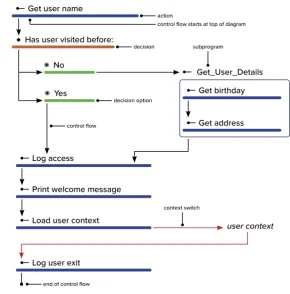
Figure 1 describes how to interpret the control flow diagrams used by this dissertation.
Thesis Conventions
Get birthday
Get address Get user name
Log access
Print welcome message
Load user context
Log user exit
◉ No
◉ Yes
♦ Has user visited before:
user context
Get_User_Details
action
control fl ow starts at top of diagram
decision subprogram
context switch decision option
control fl ow
end of control fl ow Figure 1
A control flow diagram for an example system.
Cyclic Tasks and Ada
Like all embedded systems, real-time systems have computer
hard-ware integrated into their control loops. They utilise this hardhard-ware to calculate and drive appropriate actuator responses in reaction to the environment state gathered by the system’s sensors: thus permitting a system to react and modify its environment to meet its design requirements (Laplante & Ovaska, 2011).Real-time systems distinguish themselves from other embedded systems with the timeliness of the system’s results as important as their logical correctness (Stankovic, 1988). Hard real-time systems consider violation of a system’s tim-ing constraints erroneous, while soft real-time systems can cope with some violation with degraded service; potentially placing less emphasise on the results missing their deadlines (Buttazzo, 2011; Manacher, 1967). Firm real-time system form an extreme soft-real time system subset with results discarded if they miss their deadline.
Take, for example, a humanoid LEGO Mindstorms robot named Frank: a sim-ple but non-trivial real-time system used by the dissertation to develop and demonstrate both the Cyclic Task Specification and Acton. Frank has a simple
existence, walking in (vaguely) straight lines and turning only to avoid hitting obstacles. Equipped with an ultrasonic distance sensor to gauge the distance to an obstacle in front of it, Frank is a hard real-time system because failure to react to the presence of an obstacle in time will cause the robot to hit it.
Chapter 2
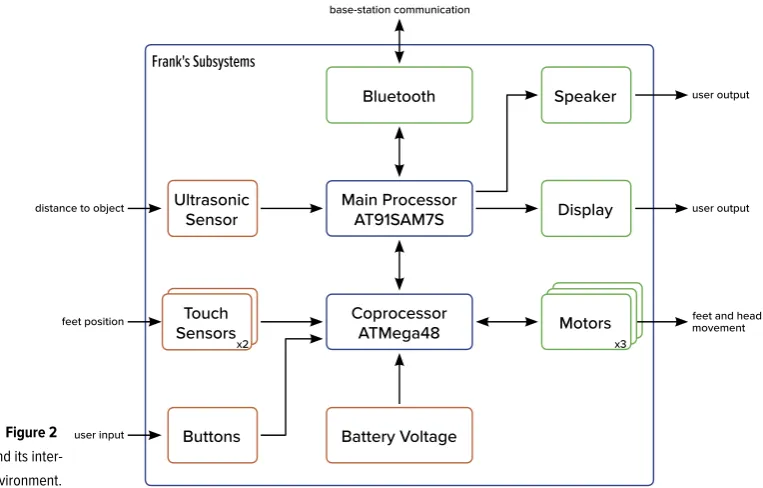
While simple, Frank consists of numerous subsystems collecting data and modifying the state of robot and the environment it operates in (Figure 2) — including user interaction through the robot’s buttons, screen and speaker. Consequently, the software running on the main processor consists of the required control loop calculations and the interactions with the various subsys-tems (Kopetz, 2011). The functionality of the system decomposes into a set of tasks the robots software will perform, with each task focusing on a subsystem interaction or control calculation (Cottet, Delacroix, Kaiser & Mammeri, 2002). Each task possesses individual real-time constraints, with a hard real-time system able to consist of a collection of hard, soft and non-real-time tasks. For example, Frank has a hard real-time task to collect obstacle distance measure-ments while the task performing screen updates has soft real-time requiremeasure-ments.
The key feature of such a real-time system is the performance of the same se-quence of tasks in response to changes to the system’s inputs: resulting from the integration of embedded software into the system’s control loop. Thus, the tasks themselves are repetitive, commencing a new cycle each time the digital control loop they participates in runs. Because of their repetitive nature, this dissertation calls these tasks cyclic tasks to differentiate them from sequential tasks; that is, a task that executes once. This dissertation makes a clear
dis-tinction between the two kinds of tasks because Ada’s existing task type only implements a sequential task abstraction.
Because real-time tasks are cyclic and their timing behaviour known offline, it becomes possible to determine if all tasks in a system will meet their timing constraints before running the system (C. L. Liu & Layland, 1973). This is the most important aspect of cyclic tasks, as a schedulability analysis can provide a guarantee a system is free from timing-related faults; improving system reli-ability and reducing development costs as problems are found and dealt with during the initial development (Sha et al., 2004).
This chapter reviews the support for cyclic tasks in Ada, beginning by defin-ing key cyclic task definitions and properties as used by the dissertation. The
Main Processor AT91SAM7S
Coprocessor
ATMega48 Motors Touch
Sensors Ultrasonic
Sensor Display
Speaker Bluetooth
Buttons Battery Voltage
x3 x2
distance to object
feet position feet and head movement
user output user output base-station communication
user input
[image:22.595.126.508.70.314.2]Frank's Subsystems
Figure 2
Frank’s subsystems and its inter-action with its environment.
chapter then introduces Ada’s real-time facilities and how users assemble them to create cyclic tasks. The chapter will then demonstrate how this assembly is detrimental to the production of reliable and maintainable real-time systems, and how existing efforts to reduce the complexity through library-based ap-proaches similarly fall short. Finally, the chapter will review previous attempts to integrate cyclic tasks into Ada and other languages.
Classical real-time theory defines tasks in the general sense of the word: as a
unit representing an activity or algorithm (Cottet et al., 2002; Kopetz, 2011). A job represents the single execution of a task, and thus under the classical
real-time model a task consists of an infinite number identical jobs with the system releasing a job in response to a system event (Buttazzo, 2011; Laplante & Ovaska, 2011). Each job is characterised by its arrival time to the scheduler,
its computation time and the deadline the job has to complete by.
The unit of work under the classical real-time model is the job. Without any re-strictions on the release of jobs, a task may have more than one job executing at the same time. Allowing jobs to overlap requires they execute inside their own context, imposing significant complexity on real-time systems. In particular, there are data integrity issues with multiple jobs accessing the state of a task in addition to resource contention between jobs of the same task.
These problems disappear by imposing the restriction that the arrival time of a job can be no earlier than the deadline of the preceding job. Consequently, the restriction enables tasks to become the work unit since only one job can execute at any point in time.
Such a restriction enables the dissertation to define a more precise definition of a task: an execution unit encapsulating the code and state of an activity or
algorithm. The new definition forms the basis of the dissertation’s cyclic task model and aligns with same definition used by Ada (Ichbiah, Barnes, Firth & Woodger, 1986).
The dissertation’s cyclic-time model deviates from the classical real-time model because of the refined task definition. Aside from the imposed deadline restric-tions, the primary difference lies in the terminology used to describe real-time tasks and their attributes to align closely with the new definition.
Cyclic task A task whose code executes in response to an event. Such a task sleeps while waiting for the next event after completing a cycle of its code. A
cyclic task requires explicit termination to terminate the task. By contrast, a
sequential task executes its code once and then terminates.
Cycle The execution of a cyclic task’s code once. Similar to the concept of a job used by the classical real-time model except a task performs the cycle itself.
Cyclic Task Definitions and Properties
Dissertation’s Cyclic Task Model
definitionReal Time The physical time as observed in the environment the system is apart of (ARM D.8). It is non-decreasing monotonic.
Real-Time Clock A monotonic clock incremented at a steady rate from which time within a real-time system derives.
Cyclic Execution Start Time The earliest time in a system which all tasks may begin executing their first cycle.
Phase An offset from the cyclic execution start time before the first cycle may begin executing.
Worst-Case Execution Time (WCET) Upper bound on the execution time for a task’s cycle. The execution time for a task is the time the task spends executing it code on a processor. Known under the classical real-time model as a job’s computation time.
Execution Budget Total amount of execution time a cycle may consume. Normally set to the WCET of the task.
Relative Deadline The duration from a cycle event a task has to complete by.
Absolute Deadline The time a task has to complete the current cycle by, be-ing the sum of the task’s relative deadline and the time of the cycle event that started the cycle.
Cycle Event The event causing a cyclic task to execute a cycle. There are four types of cycle events:
▶ Periodic events repeat at fixed intervals given by the task’s cycle period
and sourced from the system’s real-time clock. A cyclic task with pe-riodic cycle events is called a periodic task.
▶ Aperiodic events repeat at irregular intervals and occur from the
activ-ities of other tasks or external interrupts. A cyclic task with aperiodic cycle events is called an aperiodic task.
▶ Sporadic events are a type of aperiodic event where a minimum inter-ar-rival time (MIT) exists between events. A cyclic task with sporadic cycle
10
5
1
TASK PRIORITY
REAL-TIME periodic task
periodic task cycle period
consumed budget
cycle minimum inter-arrival time
cycle phase cycle event may be raised
cycle
absolute deadline
execution budget relative deadline
cycle event cyclic execution
start time
[image:24.595.173.473.73.240.2]sporadic task
Figure 3
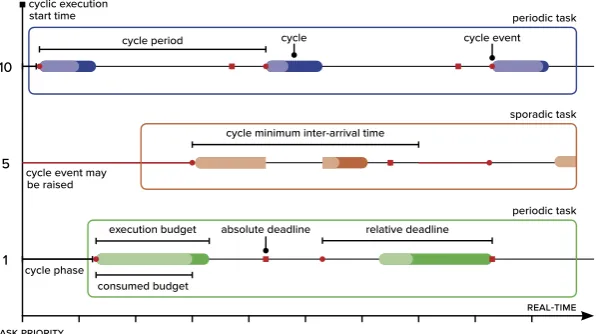
Graphical representation of cyclic task properties.
events is called a sporadic task.
▶ Cycle completion events occurs when a cycle completes. A cyclic task
commencing a new cycle in response to its own cycle completion event is called a yielding task: a task that yields the processor between
cycles. The dissertation’s real-time model introduces yielding tasks to extend the use of the cyclic task model outside the real-time domain, covering applications requiring tasks to execute cycles back-to-back or need a more complex event release mechanism than provided by other cyclic task types.
Priority A value assigned to each task denoting the precedence over other tasks to execute on a processor or processors.
A scheduler organises the execution of a given task set: determining when a given task executes on a processor in the system (Cottet et al., 2002). A real-time scheduler focuses on ensuring the tasks within a task set meet their real-time constraints, achieved by assigning each task a priority (Buttazzo, 2011). At a task dispatching point, where the system selects and runs a task, a real-time system
dispatches the highest priority task eligible to run.
Schedulers fall into a number of different categories:
Task dispatching point location A non-preemptive scheduler limits task dis-patching points to locations of the task’s choosing. By contrast, a preemptive
scheduler imposes its own task dispatching points; for example when another task wakes or when a task has used up its allotted processor time.
Task priority assignment A fixed priority scheduler has task priorities assigned offline as part of the system’s development, with the goal to create a feasible schedule that permits all tasks to meet their real-time constraints. At run-time, the scheduler simply dispatches the highest priority task at each task dispatch-ing point. A dynamic priority scheduler on the other hand assigns priorities at
run-time, assigning priorities based on the urgency to complete the task set at the given task dispatching point.
Number of processors The complexity involved with dispatching to multiple processors means different scheduler algorithms are better suited to uniproces-sor, partitioned multiprocessor or global multiprocessor systems.
Real-time schedulers provide the ability for users to determine the feasibility
of a set of tasks to meet their timing constraints under a scheduler by using a
schedulability analysis (Sha et al., 2004). The ability to perform a schedulability
analysis is essential for hard real-time systems as the analysis determines if the system is free of timing faults and relies on the cyclic nature of real-time systems, in particular the periodicity of its tasks. If all the tasks are periodic, then a minimum set of cycles across all tasks exist until the set repeats. Thus, if a schedule is feasible for the minimum set, it is feasible for any set.
Sporadic tasks fit within a schedulability analysis by treating them like period-ic tasks, using knowledge of their MIT and event frequency (Audsley, Burns, Richardson, & Wellings, 1991). By contrast, aperiodic tasks by definition have no periodicity attached to them and require execution-time servers (or execution
real-time scheduling
servers for short) to provide periodic access to the processor (Burns & Wellings,
2006). An execution server operates like a periodic task — with an attached periodicity, deadline and execution budget — except the server does not dis-patch to the processor: instead, a task using the server is. Execution servers are also referred to in literature as priority servers (Buttazzo, 2011) or aperiodic servers (Lehoczky & Ramos-Thuel, 1992).
As a mature research field, the real-time scheduler domain comes with exten-sive research and textbooks documenting different real-time schedulers and execution servers. Books from Burns and Wellings (2009), Buttazzo (2011), Cottet et al. (2002) and Liu (2000) provide detail descriptions of common real-time schedulers, while Sha et al. (2004) and Davis and Burns (2011) pro-vide comprehensive literature reviews on uni and multiprocessor schedulers.
Task deadlines and execution budgets lie at the heart of real-time systems to ensure tasks meet their timing constraints. While a schedulability analysis can provide a guarantee a system has no timing faults for a given set of tasks, the guarantee only holds while the assumptions underpinning the analysis is correct.
For hard real-time systems theses assumptions include: no unexpected tran-sient or permanent hardware faults causing a task to run longer than expected; no logic defects in the software that may cause it or another task to run longer than its bounds; and no external communication exceeds its time bounds. On the other hand, soft real-time systems explicitly assume missed deadlines will occur. Consequently, soft real-time systems need to detect missed deadlines to know when to devalue results, while hard real-time systems require deadline enforcement to handle situations where the system assumptions fail.
Additionally, real-time tasks require execution budget enforcement: if a task exceeds its execution budget due to a temporary or permanent hardware fault, the system looses its timing guarantees and a task may miss its deadline (Kopetz, 2011). Catching execution budget exhaustion before a missed deadline allows a system to identify and treat the task with the timing anomaly, as opposed to potentially having to resolve its effect on another task (Figure 4). It also help to easily identify the causes of timing violations, with permanent or transient hardware faults more likely to cause a task to exhaust its execution budgets before it misses a deadline, while a missed deadline would more likely occur from a task waiting longer on the activity of another task or external subsystem. run-time deadline
and execution budget enforcement
Figure 4
Not enforcing T1’s WCET causes T2 to miss its deadline. Reacting to T2 also masks the fault in T1.
T1 deadline
T1 executing within WCET
T2 executing within WCET T2 executing within WCET with T1’s WCET exceeded
T1 exceeding WCET T2 deadline
TASK PRIORITY
TIME 9
6
3
Without WCET enforcement, T2 will be blamed for the system error when the problem lies in T1.
Ada 2012 provides thorough support for real-time systems, with the base lan-guage assisting the prime software engineering requirements for real-time systems: reducing the life-cycle cost of software by facilitating reliable and maintainable software. Ada then provides explicit real-time support through an optional Real-Time Systems Annex (ARM Annex D).
Ada’s tasks form the backbone of the language’s real-time support, using the same basic task definition as the dissertation: encapsulating the state of the task and the code that operates on it within a single programming unit (Ich-biah et al., 1986; ARM 9.1). A public specification and private body provide this abstraction using the same approach as used by packages and protected objects. Software benefits from this abstraction as it provides a new scope from which declarations relevant only to the task can be made, resulting in clearer and easier to maintain programs. Additionally, the scope ensures a task cannot access another task’s internal state.
To provide inter-task communication and shared resource access, the core language provides protected objects: an abstraction coordinating access to shared data (ARM 9.4). Additionally, the core language provides a flexible delay statement allowing a task to sleep for a specific period or, more usefully for real-time applications, until a particular point in time passes (ARM 9.6).
The Real-Time Systems Annex extends Ada’s basic tasking model to include a
comprehensive and flexible priority, task dispatching and monotonic time models in addition to incorporating a substantial library of real-time abstrac-tions. The Annex priority model forms the backbone of Ada’s real-time support,
clearly defining how the language uses priorities and detailing the situations when a priority may inherit from another source (ARM D.1).
Complementing the priority model, the Real-Time Systems Annex provides a
task dispatching model based on conceptual priority-ordered ready queues (ARM D.2.1). The model defines how tasks from these ready queues execute and is sufficiently generic to permit the use of different schedulers under a single language defined approach. Responsibility for the these queues, and determin-ing the time tasks are added or removed, lies with the task dispatchdetermin-ing policies. These policies implement the scheduler algorithms, with the Annex providing
four language-defined policies covering the most commonly used schedulers:
▶ FIFO_Within_Priorities A fixed priority preemptive scheduler
▶ Non_Preemptive_FIFO_Within_Priorities A fixed priority
non-pre-emptive scheduler
▶ Round_Robin_Within_Priorities A time sliced preemptive scheduler
▶ EDF_Across_Priorities A dynamic priority preemptive scheduler
Finally, the Annex provides comprehensive additions to Ada’s run-time library:
▶ Timing events (ARM D.15)
Ada’s Real-Time Facilities
▶ Execution time (ARM D.14)
▶ Execution time timers (ARM D.14.1)
▶ Group execution time budgets (ARM D.14.2)
▶ Synchronous task control (ARM D.10)
▶ Synchronous barriers (ARM D.10.1)
▶ Processor assignment (D.16)
▶ Scheduling partitioning (D.16.1)
Since much of the rich and extensive tasking model Ada provides lies outside the needs of real-time users, the Real-Time Systems Annex also makes available
optional tasking model restrictions a run-time system may use to facilitate the construction of efficient real-time systems (ARM D.7). The Ravenscar Profile (ARM D.13) collates a set of these restrictions under a single usage profile to enable the production of Ada programs with predictable timing behaviour, bounded memory usage and amenable to schedulability analysis (Burns, Dob-bing & Vardanega, 2004).
While Ada shares a basic tasking model in line with this dissertation, the lan-guage only provides a sequential task abstraction. Ada instead expects users to build cyclic tasks upon these sequential tasks using its control statements, protected objects and Real-Time Systems Annex facilities. This section explores
how users build cyclic tasks using this approach and documents the accompa-nying issues before examining library-based approaches attempting to abstract away the implementation complexity.
A sequential task that iterates over same code and never terminates is easily created:
task type Loopy_Task
with Priority => Some_Priority;
task body Loopy_Task is
... task state ...
begin
... initialise task ...
loop
... do something ...
end loop;
end Loopy_Task;
Implementing Cyclic Tasks in Ada
Direct Ada Implementation
Listing 1
A sequential task that repeats its statements indefinitely.
The task can turn into a cyclic task by including a wait for event statement:
task type Cyclic_Task
with Priority => Some_Priority;
task body Cyclic_Task is
... task state ...
begin
... initialise task ...
loop
[wait for event statement]
... cyclic code ...
end loop;
end Cyclic_Task;
The wait for event statement uses an Ada statement or library procedure to cause
the sequential task to wait at the start of the loop until a cyclic event occurs. Po-tential wait for event statements include the delay until statement and entry calls. A user can build all kinds of cyclic tasks from this template. For example, using the delay until statement as the wait for event statement creates a periodic task:
task type Periodic_Task
with Priority => Some_Priority;
task body Periodic_Task is
Period : constant Time_Span := Milliseconds (500); Phase : constant Time_Span := Milliseconds (100); Wake_Up : Time := Clock + Phase; ... task state ...
begin
... initialise task ...
loop
delay until Wake_Up;
Wake_Up := Wake_Up + Period; ... cyclic code ...
end loop;
end Periodic_Task;
An aperiodic task can use a protected object or a suspension object to signal an event occurrence. The wait for event statement becomes the entry or procedure
call holding the task until the object releases it. Suspension objects create sim-pler aperiodic tasks since the object does not require the creation of a new type:
Aperiodic_Event : Ada.Synchronous_Task_Control.Suspension_Object;
task Aperiodic_Task
with Priority => Some_Priority;
task body Aperiodic_Task is
... task state ...
Listing 2
A general Ada implementation of a cyclic task.
Listing 3
A simple periodic task using Ada primitives.
Listing 4
A simple aperiodic task using Ada primitives.
begin
... initialise task ...
loop
Suspend_Until_True (Aperiodic_Event); ... cyclic code ...
end loop;
end Aperiodic_Task;
Combining both the periodic and aperiodic task templates results in a simple sporadic task:
Sporadic_Event : Ada.Synchronous_Task_Control.Suspension_Object;
task Sporadic_Task
with Priority => Some_Priority;
task body Sporadic_Task is
MIT : constant Time_Span := Milliseconds (500); Phase : constant Time_Span := Milliseconds (100); Wake_Up : Time := Clock + Phase; ... task state ...
begin
... initialise task ...
Set_False (Sporadic_Event) loop
Suspend_Until_True (Sporadic_Event); delay until Wake_Up;
Wake_Up := Wake_Up + MIT; ... cyclic code ...
end loop;
end Sporadic_Task;
The problem with building cyclic tasks on top of lower level task abstractions lies with the negative impact the approach has on the life-cycle cost of real-time software. As the chapter has described, the tasking model real-time systems use is the cyclic task model. Thus under Ada, there is a direct development cost as developers have to spend time, and thus money, to build up a new cyclic task for each task in their real-time system. Furthermore, ramifications to system reliability and maintenance also affect life-cycle costs:
▶ A user has to write more code, increasing the scope for the introduc-tion of errors.
▶ Using cyclic task templates to reduce coding burden affects reliability since the compiler cannot verify the correct use of the template.
▶ Awkward to create multiple copies of the same task, in particular for aperiodic and sporadic tasks which rely on external objects to signal a cyclic event. Using the aperiodic task for example, each new task object requires its own suspension object, permitting errors like assigning the wrong suspension object to a task to occur.
Listing 5
A simple sporadic task using Ada primitives. Listing 4 continued A simple aperiodic task using Ada primitives.
▶ More code makes it harder to understand the task, affecting mainte-nance.
▶ Furthermore, the code and state associated with making the task cyclic mixes with the cyclic task’s code and state, decreasing code readability.
▶ Requires users to carefully read a task’s body to determine the type of cyclic event used, affecting maintenance speed and presenting po-tential misidentification.
▶ Requires coding convention to make it easier to identify cyclic task properties during maintenance, which is unenforceable by the com-piler.
▶ Understanding the type of cyclic task and its attributes requires both the task specification and task body. This differs from Ada’s general approach of having static task properties identifiable on the task spec-ification, reducing the need to share the body of the task.
A critical problem with building cyclic tasks on top of a set of low-level real-time abstractions is the code complexity grows with the utilisation of the cyclic task model, compounding the above effects. For example, if an exception needs raising in response to a sporadic event occurring before the expiry of a task’s MIT, the simple suspension object needs replacing with a more complex protected object, with the wait for event statement adjusting accordingly:
protected Event_Object is
procedure Signal_Event;
procedure Initialise (Earliest_First_Event : Time);
entry Wait_For_Sporadic_Event (Earliest_Next_Event : Time);
private
Earliest_Event_Time : Time;
Event_Occurred : Boolean := False; Initialised : Boolean := False;
end Event_Object;
protected body Event_Object is
procedure Signal_Event is
begin
if Clock < Earliest_Event_Time then
raise Program_Error; else
Event_Occured := True; end if;
end Signal_Event;
entry Wait_For_Sporadic_Event (T : Time) when Event_Occured is
begin
if not Initialised then
raise Program_Error; end if;
Event_Occured := False; end Wait_For_Sporadic_Event;
Listing 6
A sporadic task where an exception is raised in the releasing task if the task is released before its MIT.
procedure Initialise (T : Time) is
begin
Earliest_Event_Time := T; end Update_Earliest_Event_Time;
end Event_Object;
task Sporadic_Task
with Priority => Some_Priority;
task body Sporadic_Task is
MIT : constant Time_Span := Milliseconds (500); Phase : constant Time_Span := Milliseconds (100); Earliest_Arrival_Time : Time := Clock + Phase; ... task state ...
begin
... initialise task ...
Event_Object.Initialise (Earliest_Arrival_Time); loop
Earliest_Arrival_Time := Earliest_Arrival_Time + MIT; Event_Object.Wait_For_Sporadic_Event
(Earliest_Arrival_Time); ... cyclic code ...
end loop;
end Sporadic_Task;
Further complexity exists when enforcing execution budgets and deadlines, requiring the incorporation of execution time timers and timing events into the cyclic task templates. For example, modifying the simple periodic task in Listing 3 to enforce budgets and deadlines results in:
protected Timing_Enforcement is
procedure Missed_Deadline (Event: in out Timing_Event); procedure CPU_Budget_Exceeded (TM : in out Timer);
end Timing_Enforcement;
protected body Timing_Enforcement is
procedure Missed_Deadline (Event: in out Timing_Event) is
begin
... Handle missed deadline ...
end Missed_Deadline;
procedure CPU_Budget_Exceeded (TM : in out Timer) is
begin
... Handle exceeded execution budget ...
end CPU_Budget_Exceeded;
end Timing_Enforcement;
type Deadline_Event is new Timing_Event with record
T : Task_Id;
end record;
Listing 7
A periodic task with enforced deadlines and execution budgets. Listing 6 continued A sporadic task where an exception is raised in the releasing task if the task is released before its MIT.
task type Periodic_Task with Priority => Some_Priority;
task body Periodic_Task is
Period : constant Time_Span := Milliseconds (500); Phase : constant Time_Span := Milliseconds (50); Relative_Deadline : constant Deadline := Milliseconds (400); CPU_Budget : constant Time_Span := Milliseconds (100); Wake_Up : Time := Clock + Phase;
CPU_Timer : Timer (Current_Task'Access); Deadline_Timer : Deadline_Event;
P_Control : Timing_Enforcement; Timer_Cancelled : Boolean;
... task state ...
begin
... initialise task...
Deadline_Time.T := Current_Task; loop
Set_Handler (Event => Deadline_Timer,
At_Time => Wake_Up + Realative_Deadline, Handler => P_Control.Missed_Deadline'Access); delay until Wake_Up;
Wake_Up := Wake_Up + Period; Set_Handler (TM => CPU_Timer, In_Time => CPU_Budget, Handler =>
P_Control.CPU_Budget_Exceeded'Access); ... cyclic code ...
Cancel_Handler (Event => Deadline_Timer, Cancelled => Timer_Cancelled); Cancel_Handler (TM => CPU_Timer, Cancelled => Timer_Cancelled); end loop;
end Periodic_Task;
Finally, different task dispatching policies may require different wait for event statements. The examples presented so far work under Ada’s FIFO_Within_Pri-orities and Non_Preemptive_FIFO_Within_Priorities policies but not with the EDF_Across_Priorities policy. The latter policy requires the task to update the deadline stored with scheduler every iteration, accomplished via the Ada.Dis-patching.EDF.Delay_Until_And_Set_Deadline procedure. Thus, the task body of the previous example becomes:
task body Periodic_Task is
Period : constant Time_Span := Milliseconds (500); Phase : constant Time_Span := Milliseconds (50); Relative_Deadline : constant Deadline := Milliseconds (400); CPU_Budget : constant Time_Span := Milliseconds (100); Wake_Up : Time := Clock + Phase;
CPU_Timer : Timer (Current_Task'Access); Deadline_Timer : Deadline_Event;
Listing 8
Listing 7’s periodic task, modified to run under the EDF_Across_ Priorities task dispatching policy. Listing 7 continued
A periodic task with enforced deadlines and execution budgets.
P_Control : Task_Control; Timer_Cancelled : Boolean; ... task state ...
begin
... initialise task...
Deadline_Time.T := Current_Task; loop
Set_Handler (Event => Deadline_Timer,
At_Time => Wake_Up + Realative_Deadline, Handler => P_Control.Missed_Deadline'Access); Delay_Until_And_Set_Deadline
(Delay_Until_Time => Wake_Up,
Deadline_Offset => Relative_Deadline); Wake_Up := Wake_Up + Period;
Set_Handler (TM => CPU_Timer, In_Time => CPU_Budget, Handler =>
P_Control.CPU_Budget_Exceeded'Access); ... cyclic code ...
Cancel_Handler (TM => CPU_Timer, Cancelled => Timer_Cancelled); end loop;
end Periodic_Task;
Needing task dispatching policy-specific operations has a negative effect on code reuse, since a proven task requires modification and retesting to adapt to different policies.
The amount of work required to build cyclic tasks has been acknowledged by users in the Ada real-time community, resulting in two approaches seeking to make cyclic tasks easier to implement by utilising Ada’s library support to provide reusable cyclic task building blocks. The two approaches lean on different data reuse abstractions: the GNAT Component Collection utilises generic packages to contain the common cyclic code, while the Real-Time Utilities Library leverages Ada’s tagged types.
The GNAT Component Collection (GNATColl) by AdaCore provides an assort-ment of general-purpose packages used by AdaCore and which are available to end-users (AdaCore, 2013B). For real-time systems, GNATColl provides what the collection calls multitasking patterns: a set of packages factoring the cyclic task template code into Ravenscar-compliant generic packages. The patterns offer only a subset of the cyclic task model — simple periodic and sporadic
tasks — in addition to servers that extend the tasks to accept different param-eters or requests on each task invocation. Despite the small coverage of the real-time model, they sufficiently show the benefits and limitations of factoring cyclic task template code into generic packages.
GNAT Component Collection Ravenscar Patterns
Listing 8 continuedListing 7’s periodic task, modified to run under the EDF_Across_Pri-orities task dispatching policy.
generic
Task_Priority : System.Priority; Phase : Millisecond; Period : Millisecond;
System_Start_Time : Ada.Real_Time.Time := Ada.Real_Time.Clock; with procedure Cyclic_Operation;
package GNATCOLL.Ravenscar.Simple_Cyclic_Task is private
task Simple_Cyclic_Task is
pragma Priority (Task_Priority); end Simple_Cyclic_Task;
end GNATCOLL.Ravenscar.Simple_Cyclic_Task;
Listing 9
GNATCOLL.Ravenscar. Simple_Cyclic_Task package specification.
generic
Task_Priority : System.Priority; Minimum_Interelease_Time : Millisecond;
System_Start_Time : Ada.Real_Time.Time := Ada.Real_Time.Clock; Protocol_Ceiling : System.Any_Priority;
-- the ceiling priority of the protected object used to post
-- and fetch requests
with procedure Sporadic_Operation;
package GNATCOLL.Ravenscar.Simple_Sporadic_Task is
procedure Release;
-- used by client to trigger the task
private
protected Protocol is
pragma Priority (Protocol_Ceiling); procedure Release;
entry Wait (Release_Time : out Ada.Real_Time.Time); private
Barrier : Boolean := False; Pending : Integer := 0; end Protocol;
task Simple_Sporadic_Task is
pragma Priority (Task_Priority); end Simple_Sporadic_Task;
end GNATCOLL.Ravenscar.Simple_Sporadic_Task
Listing 10
GNATCOLL.Ravenscar.Simple_ Sporadic_Task package specification.
The packages GNATCOLL.Ravenscar.Simple_Cyclic_Task (Listing 9) and GNAT-COLL.Ravenscar.Simple_Sporadic_Task (Listing 10) provide GNATColl’s Raven-scar tasking patterns. At their heart, each generic package contains a task whose task body contains the appropriate cyclic task template, with the task’s cyclic attributes passed via the generic package’s parameters. The user provides the task’s cyclic code in the form of a procedure, also passed through the generic package’s parameters. Thus, a simple periodic task would look like:
procedure Cycle_Operation;
package My_Periodic_Task is
new GNATCOLL.Ravenscar.Simple_Cyclic_Task (Task_Priority => 10,
Phase => 500, Period => 100,
System_Start_Time => System_Properties.Start_UP_Time, Cyclic_Operation => Cyclic_Operation);
... persistent task state ...
procedure Cycle_Operation is
... cycle state ...
begin
... cyclic code ...
end Cycle_Operation;
While a simple sporadic task:
procedure Cycle_Operation;
package My_Sporadic_Task is
new GNATCOLL.Ravenscar.Simple_Sporadic_Task (Task_Priority => 10,
Minimum_Interelease_Time => 1_000, Protocol_Ceiling => 15,
System_Start_Time => System_Properties.Start_UP_Time, Sporadic_Operation => Cycle_Operation);
... persistent task state ...
procedure Cycle_Operation is
... cycle state ...
begin
... cyclic code ...
end Cycle_Operation;
with another task or interrupt handler raising cyclic events via the My_Spo-radic_Task.Release procedure call.
Hiding the cyclic task template within a generic package simplifies the crea-tion and understanding of cyclic tasks in Ada. However, doing so buries Ada’s task abstraction inside the generic package. Consequently, the generic library approach looses the advantage Ada’s task abstraction provides: collocating a task’s state and code in a single programming unit. State persisting across Listing 11
Simple periodic task using GNATColl
Listing 12
Simple sporadic task using GNATColl
cycles now lies in a scope not exclusive to the cyclic operations, opening the way for other tasks to incorrectly access the task’s state. From a maintenance perspective, without carefully applied coding conventions difficulties lie in quickly determining which package-level objects belong to a task.
Finally, the GNATColl approach imposes its own complexity if a system requires multiple copies of a cyclic task. If the task has a persistent state, then each copy of the task requires a unique set of external state variables. Thus, each task copy requires its own task body procedure referencing the correct state objects. Accordingly, development costs increase because the same task body procedure requires duplication and modification to reference unique state objects, increasing the risk for faults from incorrect modifications. Likewise, maintenance burden increases due to changes to the task body requiring rep-lication across the multiple copies of the task body procedure.
Andy Wellings and Alan Burns (2007) presented an alternative approach to implementing cyclic tasks through a framework of common real-time utili-ties. These reusable utilities are defined in a standards-like manner, alleviating the work required to build a cyclic task while supporting real-time systems: offering periodic, sporadic and aperiodic tasks; with optional deadline and execution budgets support; and execution servers supporting aperiodic tasks in real-time systems.
At its core, the Real-Time Utilities Library breaks a cyclic task into three
com-ponents:
▶ A task state object that contains the state of the task and the user code that operates on the state.
▶ A release mechanism used to release each cycle. This component also detects missed deadlines and execution overruns.
▶ A real-time task, implementing the cyclic behaviour.
An additional fourth component supports aperiodic tasks sharing common CPU budget.
Each component in the Library (Table 1 on page 26) provides a set of types
that offer differing behaviour that, once assembled, provides the user a cyclic task with the desired attributes. Underlying this library of real-time compo-nents is tagged records and type interfaces, minimising the number of types each component provides. For the task state object, the library provides three abstract tagged records to support three types of cyclic tasks: periodic, sporadic and aperiodic. Users then create their own task state type by extending one of these tagged records to include their own state and actions; all without needing to touch the state associated with the cyclic template. The release mechanism types use protected objects to provide different cycle release behaviours and support for missed deadlines and execution time overruns. Finally, the task itself with its implemented cyclic behaviour is provided through one of several real-time tasks, differing in their termination semantics, and brings together the task, its state and its release mechanism.
Real-Time Utilities Library
State Objects (abstract tagged types)
Periodic_Task_State Sporadic_Task_State Aperiodic_Task_State
Release Objects (protected types)
Periodic_Release Periodic_Release_With_Deadline_Miss Periodic_Release_With_Overrun Periodic_Release_With_Deadline_Miss_And_
Overrun
Sporadic_Release Sporadic_Release_With_Deadline_Miss Spoardic_Release_With_Overrun Sporadic_Release_With_Deadline_Miss_And_
Overrun
Aperiodic_Release Aperiodic_Release_With_Deadline_Miss Aperiodic_Release_With_Overrun Aperiodic_Release_With_Deadline_Miss_And_
Overrun
Real-Time Tasks (task types)
Simple_Real_Time_Task Real_Time_Task_With_Deadline_Termination Real_Time_Task_With_Overrun_
Termination
Real_Time_Task_With_Deadline_And_Overrun_ Termination
Table 1
Real-time components provided by the Real-Time Utilities Library
type My_Sporadic_Task_State is
new Sporadic_Task_State with record
... task state ...
end record;
procedure Initialize (S : in out Sporadic_Task_State);
procedure Code (S : in out Sporadic_Task_State);
procedure Overrun (S : in out Sporadic_Task_State); Task_State : aliased My_Sporadic_Task_State; Task_Release : aliased Sporadic_Release
(S => Task_State'Access); My_Sporadic_Task : Real_Time_Task
(S => Task_State'Access, R => Task_Release'Access, Init_Prio => Default_Priority);
procedure Initialize (S : in out Sporadic_Task_State) is begin
S.Pri := 10;
S.MIT := Milliseconds (500);
end Initialize;
procedure Code (S : in out Sporadic_Task_State) is begin
... cyclic code ...
end Code;
Listing 13
Simple sporadic task using Real-Time Utilities Library.
Listing 13 and Listing 14 demonstrate use of the Real-Time Utilities Library for
a simple sporadic and aperiodic task respectively. A new cycle for both tasks requires a release call to the task’s release mechanism object (for the examples this would be Task_Release.Release). For the aperiodic task, the Real-Time Utilities Library automatically attaches the task to the specified execution server.
Since the Library targets real-time systems, all aperiodic tasks require
attach-ment to an execution server.
Listing 15 shows a simple periodic task using the Real-Time Utilities Library,
while Listing 16 extends the task to enforce deadlines and execution budgets. The latter listing demonstrates an appealing aspect of the Library: building a
complex cyclic task is only slightly more complicated than a simple cyclic task.
Together, these examples highlight the structure the Real-Time Utilities Library
uses to implement cyclic tasks and how the three Library components link
together. Together with abstracting the cyclic code, the Real-Time Utilities Library provides a clarity and structure that does not exist when implementing
cyclic tasks directly with Ada’s low-level tasking primitives.
A_Sporadic_Server : Execution_Server.Sporadic.Sporadic_Server (Period => Milliseconds (500),
Budget => Milliseconds (50); Prior => 10);
-- An implementation defined execution server.
type My_Aperiodic_Task_State is
new Aperiodic_Task_State with record
... task state ...
end record;
procedure Initialise (S : in out Aperiodic_Task_State);
procedure Code (S : in out Aperiodic_Task_State);
procedure Overrun (S : in out Aperiodic_Task_State); Task_State : aliased My_Aperiodic_Task_State; Task_Release : aliased Aperiodic_Release
(S => Task_State'Access ES => A_Sporadic_Server); My_Aperiodic_Task : Real_Time_Task
(S => Task_State'Access, R => Task_Release'Access, Init_Prio => Default_Priority);
procedure Initialize (S : in out Aperiodic_Task_State) is begin
S.Pri := 01;
end Initialize;
procedure Code (S : in out Aperiodic_Task_State) is begin
... cyclic code ...
end Code;
Listing 14
Simple aperiodic task using Real-Time Utilities Library.