COMMISSION OF THE EUROPEAN COMMUNITIES
COM(85) 208 final
Brussels, 4 june 1985
GENERAL OBJECTIVES STEEL 1990
(Commission working document)
. INTRODUCTION ..
Chapter I
Chapter II
Chapter I II
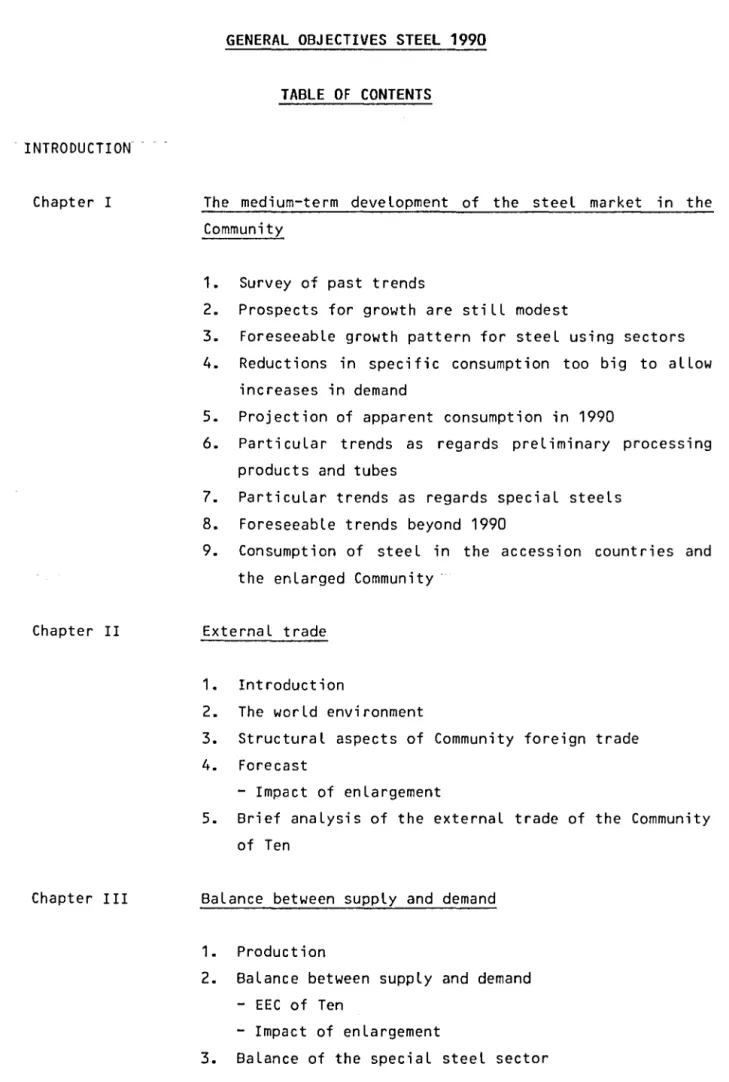
GENERAL OBJECTIVES STEEL 1990
TABLE OF CONTENTS
The medium-term development of the steel market in the Community
1. Survey of past trends
2. Prospects for growth are still modest
3. Foreseeable growth pattern for steel using sectors 4. Reductions in specific consumption too big to allow
increases in demand
5. Projection of apparent consumption in 1990
6. Particular trends as regards preliminary processing products and tubes
7. Particular trends as regards special steels 8. Foreseeable trends beyond 1990
9. Consumption of steel in the accession countries and the enlarged Community·
External trade
1. Introduction
2. The world environment
3. Structural aspects of Community foreign trade 4. Forecast
- Impact of enlargement
5. Brief analysis of the external trade of the Community of Ten
Balance between supply and demand
1. Production
2. Balance between supply and demand - EEC of Ten
- Impact of enlargement
Chapter IV
Chapter V
Chapter VI
Chapter VII
2.
Research and Development
1. Production and processing of steel 2. Stimulation of steel consumption
Prices and conditions of sale
1 • General
2. 1973 - 1974 the Last two exceptional years 3. 1977 - 1985 the crisis years
4. Export sales 5. Import prices 6. Currencies
7. The medium-term prospects
Employment in the Community steel industry
1. Background
2. Characteristics of employment
3. Employment prospects in the iron and steel industry in 1990
4. Qualitative aspects of the development of the workforce
5. The social consequences
Supply of the steel industry
1. Scrap
- Analysis of the scrap market - prospects for 1990 2. Raw materials supply
1.
INTRODUCTION
I. The General Objectives Steel 1990 for the Community of Ten have had
to be drawn up in circumstances which were quite different from those under which preceding programs and forecasts were established. The restructuring of the steel industry in the European Community is in full swing following the political decisions taken at Elsingor in 1982. In addition, the 1990 horizon must be viewed in the light of
the enlargement of the Community with Spain and Portugal, which
might accentuate some of the disequilibria appearing in the
following chapters; the restructuring of the steel industry in these countries therefore becomes an important issue.
The crisis measures which made it possible to embark on the restructuring process without upsetting the market have done the job they were supposed to do and should give the Community steel industry a better starting position for its future development.
However, as the restructuring process still goes on, it is difficult
to paint an exact picture of our steel industry in 1990, and to
assess correctly the underlying trends of supply and demand, let
alone the strategic choices which firms may make, when
controls are lifted.
market
Under these circumstances, the Community should carefully analyse the financial viability prospects of steel production companies in the light of the current restructuring plans.
II. It should be pointed out straight away that the Commission can only
look at the steel sector in a global way, and that it can not
consider separate policies for individual firms. The Commission is
perfectly aware that the Community averages may be masking
considerable discrepancies between different companies
productivity, and hence competitiveness will have developed in
different ways. There is equally a diverging trend between
2.
important capacity surplus, and this not-withstanding the
restructuring effort which will have been made until the end of this year.
Even on the fairly optimistic assumption that internal consumption of steel, and exports, will remain relatively stable in the medium
term compared with 1984, this surplus is likely to remain a
structural factor in the steel industry in the European Community. If we were to accept this structural surplus and the resulting pressure on prices, it would weigh heavily on the strategies of the
steel companies, which, moreover, will have to make significant
efforts to increase their level of competitiveness. Although it is
impossible at present to pinpoint the surplus capacity, the steel industry should prepare itself to see market forces forcing it into further capacity reductions in the years ahead.
In this connection, each firm has to ascertain that its production
structures can still be regarded as being in line with the
foreseeable developments of steel production technology and trends
in the structure of supply and demand. The same remark applies to
the structures and conditions of supply, in particular in the light of certain warning signals from the scrap market, which could call into question investment options which were valid in the past, as well as to the competition of substitution materials on the demand side.
For the assessment of both supply and demand, it should be stressed
that there is considerable uncertainty, due the unforeseeable
behavior of exchange rates, concerning the foreign trade in steel and also for the raw material supply. Continuing changes, in both a
''
favorable and unfavorable way,of the dollar rate can not be excluded in the future.
Even if exports could be maintained in the immediate future at
present levels, this is likely to prove increasingly difficult to
achieve, firstly for ordinary steels, given that production
capacities in newly industrialised third-world countries are
penetrating world markets. This only increases the necessity for
3.
changes are possible in the respective parts of flat and Long products according to the geographical distribution of exports. In particular long products are situated in a very competitive segment of the market and are very susceptible to the slightest macroeconomic variations.
There remains, in market terms, the permanent threat of a strong advance in the use of substitute products. The steel industry can also counteract this,
means to invest in reasonable level.
but on condition that it mobilises sufficient R & D and that prices are maintained at a
Nevertheless, this effort, which can only be undertaken by those firms with sufficient profitability, can -partly- be strenghtened by official support measures in the field of research aid and by direct aid for steel consumption (loans under art. 54 for steel users). Anyway, the preservation of traditional markets will require that producers change their strategy from essentially being quantity-oriented towards a strategy of products having a higher added-value.
III. Even if the macroeconomic indicators are indicating moderate growth and increasing investment in industry, these prospects do not apply to all sectors, and in particular not to the steel industry.
There is the fact that the reduction in specific consumption is tending to cancel out the growth which is perceptible in products with a high steel content. This phenomenon was not always fully apparent until recently because of the gross reduction in steel consumption due to the economic crisis. The crisis and the excess capacity to which it gave rise merely served to conceal a much more basic problem, in the long run, i.e. the permanent change in the pattern of consumption and of steel processing technology.
However, products
4.
the constant improvement in the quality of our steel is a decisive factor in the ability of the European Community steel industry to withstand international competition. rurthe-rmore;-such- -a- -"quality -label-"-- can _.also __ b_e __ atttached to manufactured products and further improve the image of Community
products on non-Community markets. Lastly, it is also a factor
which may work to the benefit of our processing industries on
condition, however, that as a result of productivity our steel
products remain at a price level which renders them commercially preferable to imported products.
IV. If the European steel industry is to survive in these difficult
circumstances, and in the face of international competition, the companies should return definitively to viability - from both a financial and a technical point of view.
The Community market cannot continue to be relatively sheltered from competition from non-Community producers, as was the case during the
period of acute crisis, and it is urgently necessary that our
industry recognizes that its market_ shar_e_ depef1d_s_ ~~se!]tially ~n _t~~
quality and the price attractiveness of its supply.
This aspect is equally valid in internal and export markets, which
have in some ways speculative characteristics. The EEC-steel
industry must therefore permanently adapt the level and the flows of
its exports to ever changing conditions; it should therefore also
consider carefully whether its offer remains competitive from a qualitative point of view.
The link between the Community's ability to preserve its internal market and its ability to maintain a worthwhile level of exports is
not only determined by its direct exports : steel is a starting
material for many european manufactured products the steel content
of which remains high (machinery, vehicles, ••• ). The Commission
has already emphasized this point in earlier General Objectives, and it will also be considered in later sections.
Moreover, the pressure of imports (and particularly semi-finished
5.
continues to exist in all industrialised countries and is forcing
their steel industry to increase its export efforts. Only certain
third countries (Like Japan) have begun their structural policy well before the others and far from resting on their laurels, they are
pursufng- this -pol icy in a very mot iva ted -fashion. The effects of_
these policies have to be faced in all markets.
V. Leaving aside the figures and projections, not withstanding their
information value for all those concerned with the development of the sector (producers,workers,steel users, bankers, government ••• ), it must be stressed that the future of the steel industry, even if it depends on a political will to set and, above all, pursue common
European objectives in this sector in a logical manner, is largely
dependent on the economic conditions under which the companies must operate in the different Member States and on the quality of the companies' management.
Against this background, each common action should focus on the
following goals :
(a) the steel industry in the European Community must be
technologically up to date, capable of ensuring prices as low as possible and meeting the requirements of steel-using industries in the Community in the best possible way;
(b) it must not be too big; otherwise it would not be sufficiently flexible to cope with cyclical fluctuations without losing financial viability or to provide an effective response to at times sudden changes in the qualitative pattern of demand;
(c) the position which the Community steel industry strives for in
world trade, will have to be compatible with the need for
financial viability: each company will have to plan,
6.
These objectives are realistic from a technical and economic point
of view. The conservation of a competitive steel industry also
makes a direct constribution to furthering a strong and competitive European transformation industry.
VI. However, it is not enough to set policy objectives; it must be borne
in mind that if these objectives are to be attained there are a
number of preconditions.
The first, and not the least important, is that the concept of the
single market should not only be safeguarded but also
re-established. It would be a contradiction in terms (and a decline)
if the majority of firms relied on the domestic market, and
considered trade with the other Community Member States as being of secondary importance- like world exports.
Such a renationalisation attitude would result in behaviour and structures incapable of displaying a joint front to international competition, even on our internal market.
The problem posed by the remaining structural over-capacity must be carefully analysed. It would be a shame and politically inconsistent not to see through to the end of the structure pol icy begun so
courageously ·three years ago. The effort made till now, (the first
effects of which are starting to be felt already), has greatly
clarified the situation and opened up valuable opportunities. We
must continue to finalize conditions which will enable the firms to
pursue the restructuring movement and subsequently, search for
optimum productivity.
At the same time, it is of fundamental importance that the Community should continue its specific action to counteract the serious social
consequences of restructuring. It is unthinkable that the efforts
to solve the crisis in the steel industry should be a success as far as industrial policy is concerned, but a failure socially. Because
the Community must follow up the restructuring in the steel
7.
Therefore, more so than in the past, there will be a need to
coordinate the instruments of social and regional reconversion. Restructuring measures will cause their social effects to be felt
for many years to come. A productive steel industry can remain in
many cases the centre of a regional economy with all the problems
of direct and indirect employment common to regional monostructures. Given that the steel industries' problems are likely to continue to
hit the steel "bassins", the more they have a monosectorial
industrial structure, the Commission will reinforce its efforts to
improve the functioning and effectiveness of the existing
instruments.
Our policy must therefore continue to be based on a Community-wide strategy transcending the geographical boundaries of the individual
Member States. There is no alternative if duplication of effort is
to be avoided in the various stages of the production process and the management of our structures is to be improved.
This is the way in which we should emerge from the present period which is dominated by the crisis measures and hence by the urgent need for equitable burden-sharing with a view to making coordinated progress towards an all-round improvement.
It is obvious that the five-year forecast for a "heavy" sector, cannot appear satisfactory. On the other hand, five years are a lot in a period which is dominated essentially by intensely speculative
movements (e.g. the rate of the U.S.$), by numerous uncertainties
and finally by the weakness of the macroeconomic growth, the
essential of which is concentrated in precision techniques and the resulting services.
VII. Forecasts for the period up to 1990 are based on the assumption that although gradual progress will be made in the use of advanced technology in our industry (as regards both the means of production and finished products) this will not disrupt the production process to any significant extent.
8.
the macroeconomic factors and the technological evolution are hard to predict.
But it is also difficult at present to assess exactly how these
parameters will affect matters: for example, it is possible that
regional differentiations will occur.
The biggest uncertainties lie however within the field of
substitution materials for steels, from which it is not unreasonable
to expect surprises in view of the worldwide research and
development efforts on new materials.
Based on certain elements known at present, one can imagine that:
the production of steel in developing countries will grow to meet
the needs of the local market, at least for ordinary steel of a
low added value;
-other large countries, for example China, will join the group of
industrialised countries, at least as far as primary products,
i.e. steel, are concerned;
-substitute products will be used especially where they allow
direct or indirect savings (examples:
appliances).
cars, electrical
One of the scenarios with which one is therefore very likely
confronted -but according to the economic, monetary, technological and even socio-political evolution deviating scenarios can be conceived - would be looking as follows:
- the European steel industry would depend for the most part on the market of the Community;
- it would have to share this internal market, in many user sectors, with other products; it is up to the steel industry to be price-competitive and to offer attractive european products;
9.
and only then when prices can sustain the international competition.
The Commission consequently stresses the link there is between the competitive position of the steel industry and the development of steel production within the Community after 1990.
It can see growth prospects only for those steelmaking companies, which will have made a permanent restructuring effort, and which will have adjusted to the market trends, probably towards a more intensive production of higher value products.
The Commission has therefore the intention to report periodically on the Community market evolution and on exports, with an aim at comparing its forecast with the effective situation and at detecting rapidly any new trend. Within this context, particular attention will be paid to the technical evolution in the main steel using sectors, and to the competitiveness of the steel industry on world markets.
VIII. In presenting the "General Objectives 1990", the Commission wishes to distinguish from this document, the concrete decisions it will have to take in the near future, in view of the expiry, at the end of 1985, of a significant part of the anti-crisis measures.
The General Objectives reflect essentially the macroeconomic framework within which the European steel industry will have to -.determine- its medium-term industrial- strategy. In its final version, after the opinion of the ECSC Consultative Committee will have been received, this text will form the background for the positions the Commission will adopt on accompanying measures at a Community level beyond 1985, in particular in the following areas: market, prices, structures,
external trade.
CHAPTER I
THE MEDIUM-TERM DEVELOPMENT OF THE STEEL MARKET IN THE COMMUNITY
1. Survey of past trends
The profound crisis which the Community steel industry has been going through since the recession in autumn 1980 following the general recession unleashed by the second oil shock of 1979-80, eased slightly towards the end of 1983. After three consecutive years of contracting markets, demand recovered strongly in 1983/84. Together with the favourable conditions for steel exports and the replenishment of stocks, this produced an unexpected 10% rise in Community steel production in 1984. However, this recovery mainly benefited products with a higher added value, such as coated sheet, and more in particular products not covered by the production qu6ta system.
Seen in a longer perspective, however, the recovery in 1984 is really more of a short-term peak in a fundamentally downward curve, and the situation is hence very similar to that in 1979.
Comparison of macroeconomic trends over the last twenty years - during which period there have been four separate cycles - with some specific steel market indicators shows the main features of the structural decline characterizing the steel industry. There are, however, a number of factors which have combined to bring about the progressive divorce between economic growth (measured in GDP) and apparent steel consumption during this period. Analysis of this difference allows each factor to be seen in perspective, and in this way projections based on crude extrapolation from too general trends can be avoided.
PERIOD GROSS
Macroeconomic context of the Community steel market (EUR-9)
(mean annual growth in %)
GROSS FIXED OVERALL PRODUCTION DOMESTIC CAPITAL INDUSTRIAL IN STEEL PRODUCT FORMATION PRODUCTION PROCESSING
SECTORS (NACE 31-36)
APPARENT STEEL
CONSUMPTION
I
( 1)I
11965-70 + 4.4 + 4.8 + 4.9 + 4.6 + 4.2
11971-74 + 3.8 + 1.9 + 3.6 + 2.5 + 0.7
11975-79 + 2.6 + 1.0 + 2.0 + 1.5 - 0.8
11980-84 + 0.9 - 0.3 - 0.1 + 0.1 - 2
I
(1) including first-stage steel processing products (non-ECSC).
It is immediately apparent from the above table that, for at least ten years, apparent steel consumption has been falling by about 3% a year compared with GDP.
From one cycle to the next, growth in the Community economy has been slowing down, whereas investment's share of GDP (gross fixed capital formation-GFCF) has remained pretty well constant (the respective averages for the four cycles being 22%, 22.3%, 20.6% and 19.4%). In particular, public investment declined significantly during recent years.
Since the mid-1970s, GDP and industrial production have clearly grown at different rates; this is explained by the fact that economic growth has been centred in tertiary activities and the public sector.
Steel's customer industries grew more slowly, initially, than overall industrial production, and fell back into stagnation in the 1980s; this is largely explained by the fact that their activities are concentrated in heavy equipment and construction sectors, which were particularly affected by the lack of investment.
The main factor behind the structural decline of the steel market emerges clearly, however, when one compares the production (in volume terms) of the steel-processing sectors with the curve for steel demand created by those sectors. The phenomenon of declining specific consumption of steel has cut steel's traditional steel markets in advanced industrial economies such as the Community by nearly 2% a year - and in the United States this trend has been even more marked than in Europe. A special section is devoted to this crucial phenomenon (cfr. infra).
If it is to give sufficient expression to the economic and technological factors resulting from the production activities of the processing industries, any forecast of Community demand for steel, must examine the following aspects of the future industrial environment :
the extent and nature of macroeconomic growth;
- the development curve of the main steel-processing industries, with allowance being made for the macroeconomic environment;
- the demand for steel products emanating from those sectors, taking account of possible changes in the structure of demand and production technology.
2. The prospects for growth are still modest, in spite of an upswing in industrial investment
The forecasts for 1985 show that GOP growth wiLL 2 1/2 % in volume terms - confirmation that the Community's economy began to recover in 1984 after three years of recession.
As regards internal demand, consumption, both private and public, will go up only slowly, whereas capital formation should be more vigorous, although the Latter's rise depends essentially on private industrial
(2)
investment rather than public investment or housing construction. As in 1984, the increase in GOP will result largely from an improvement in the Community's trade balance, made possible by growth in world trade and in US imports in particular (the contribution of Japanese imports to the development of world imports remaining significantly less).
For subsequent years, it is essential that the growth of the Community's economy should be increasingly supported by internal demand factors- without prejudice to the adjustment and stabilization policies that are now well under way - especially as the growth in world trade may peter out as a result of a possible change of course by the US economy.
Against this background, one encouraging feature of the Community economy has been the recovery in industrial investment, which should continue beyond 1985, if manufacturers 1 intent ions actually come to
pass. The revival in industrial investment can be explained, it seems, by a combination of four factors: the ageing of the Community's fixed capital stock in recent years; the consequent technological need for plant and equipment to be replaced; improved profitability; and a greater use of capacity in many industries. As regards other types of investment, however, housing construction can pick up only slowly as interest rates come down, and investment opportunities in the public sector will be very limited.
It follows that overall growth in the second half of the 1980s will be modest, with a more dynamic investment component gradually resuming its traditional level of 20% of GOP - a significant contrast with recent years during which the investment climate has deteriorated.
However, uncertainties of an international nature (e.g. a sudden devaluation of the US dollar or a drastic reduction in US imports) may jeopardize the level of predicted medium-term growth and the growth rates set out below are therefore only tentative. The scenario assumes that the economic policies currently applied in the various Member States will be continued, especially with respect to the encouragement of investment.
I/5
Medium-term projection for the Community economy ( 1) (annual average growth in %)
I
1981-'83 1984 1985 1986 andlI
VARIABLE beyondI
( 1)I
!International assumptions
Real price of crude oil in US$ - 1,1 - 0,1 - 0,1 Imports (in volumeterms)
- non-member countries 2,6 10,8 5,6
- of which USA 6,3 26,4 9,4
ECU/$ exchange rate 13,8 12,7 3,5
Long- term interest rates in the USA (a) 12,0 12,5 13,5 International economic policy assumption (EUR-10)
Public consumption 1,4 1,1 1,1
Public investment - 2,5 2,0 0,6
Housing construction (private+ public) - 2,4 1,4 0,5 Growth (EUR-10)
GDP 0,4 2,4 2,4
Private consumption 0,7 1,1 1,5
GFCF - 2,1 2,1 3,0
(Share of GFCF in GDP) (a) (19,1) ( 18, 7) (19 ,0
Exports 2,3 6,9 5,7
Imports 0,8 6,2 4,5
Long-term interest rates (a) 13,7 11,2 10,8
(1) 1986-89, Commission forecasts (COMET-model>, january 1985. (a) Absolute percentage
3. The foreseeable growth pattern would allow most sectors to reach better production Levels than at the start of the decade
0,0 5,0 4,6 - 1,5 13,0 0,7 0,9 1,9 2,5 2,1 3,4 (20) 4,9 3,9 10,8
During 1984, these sectors managed to raise production overall, with the exception of means of transport, which experienced the effects of social conflicts in the Federal Republic of Germany.
In a climate of investment-Led growth, most of the steel-processing sectors should be able to sustain growth during the second half of the 1980s,· but at rates which will not suffice in all cases to offset the effects of a still-declining specific consumption of steel. It can be expected, therefore, that between now and 1990 steel consumption will not exceed the Level it reached in 1984.
The sectors which should benefit directly from this favourable climate for industrial investment are mechanical engineering and, potentially, structural steel work. As regards the former, it is almost certain that unit weight reductions will prevent the increase in activity from causing a corresponding increase in the steel tonnage produced: with many types of machine, a significant increase can be observed in performance per unit of weight, partly as a result of new technology, e.g. digital controls in place of heavier, mechanical systems.
The size of the increase in structural steelwork - the sector depends primarily on the construction of industrial and commercial buildings-will depend on the sector's ability to increase its penetration of the buiLding market (to the detriment of concrete, with the emphasis on shorter buiLding times) and on the impact which the expansion of investment will have on demand for this type of construction.
Generally speaking, investment will be aimed at the rationalization rather than the expansion of production equipment, which would seem to exclude a heavy-industry sector such as a boilermaking from receiving its full share of such investment.
Finally, the metal articles industry, which in the past has been particularly responsive to the expansion of investment, could be stimulated, provided that new materials do not result in the excessive erosion of markets in this sector (e.g. springs made of composite materials).
In building and civil engineering there will be no further contraction below the Level reached in 1983 (1984 already saw this Level stabilize). Housing construction, however, should not exceed the Levels dictated by demographic and purchase power Limitations. However, the expected recovery will not be greater than that in housing construction, given the continuing depressed condition of the civil engineering sector. Obviously, projects such as the possible construction of a. Channel tunnel or any other project which might be undertaken within the framework of a coordinated European infrastucture policy, would have a considerable impact on activity and thus on steel consumption.
The same is probably true of shipbuilding, where international forecasts indicate a recovery worldwide to 1981 and 1982 Levels towards the end of the decade, but with major changes in the production pattern (more complex, special-purpose vessels).
The sectors which produce mainly consumer durables, i.e. car manufacturing and electrical engineering, will continue to provide a fairly firm base for private-consumption demand. As regards the Last-mentioned of these, it should be stressed that only products with a Low steel content <audiovisual and information processing equipment) are the cause of this increase, whereas products of interest to the steel industry generally remain at the same Level (household electricals, with the exception of certain items such as dishwashers and microwave ovens).
The cans and metal boxes sector, which is competing hard with rival forms of packaging, could maintain its Level, or even register a slight increase (compared with 1981) as a result of expansion in certain sections of the market (e.g. pet foods).
The "other users" sectors, where demand primarily reflects investment for replacement by, say, the extractive industries, the railways and the steel industry itself - as well as those sectors which are difficult to pin down such as agriculture or precision engineering -do not seem to contain any major sections where demand can be expected to increase <with the possible exception of high-speed railway engineering).
The growth curve for the manufacture of steel tubes and the other preliminary processing sectors -which lie between the abovementioned "end - user" sectors and the steel industry proper - should not differ from that for end-user sectors, especially as certain products <e.g. castings) are also liable to be affected by the reduction in specific consumption. Certain subsectors such as wire-drawing, cold-forming and deepdrawing will very probably maintain their level of production, however, or even increase it, since their products can be substituted for less elaborate (ECSC) steel products in a great many uses. This is not a general trend, ho~ever, and must be seen in the context of downward trends for specific consumption, including sometimes the replacement of one steel product with another <see below).
Finally, the production of steel tubes should remain stable at 1982-83 production Levels, after the export boom in 1981.
Development of the main steel processing sectors (1981 production
=
100)I/9
!TYPE I I
IOF I YEAR I
!INDEX I 19751 19801 19811 1982l1983el1984el 1990 I - - - ' - ' <_1) _ _ 1 _ _ 1 _ _ 1 _ _ 1 _ _ 1 _ _ 1 _ _ 1 _ _ _ 1
I I I I I I I I
!Mechanical engineering
I
AI
97I
102I
100I
96I
93 95I
99-103I
I <P> I <101> I <103> I <1om I <96> I <92> <93> I 92- 96 I !Electrical engineering I A I 85 I 103 I 100 I 102 I 104 112 I 122-125 I !Shipbuilding IGRT I 355 I 72 I 100 I 123 I 99 •• I 87-109 Il~1eans of transport N I 96 I 110
I
100 103 I 106 100I
110 I!Structural steelwork P
I
I
(104) I (100) (96)I
(92) (93)I
109-115 I !Building-civil engineering A I I 105 I 100 96 I 95 95 I 106 I!Metal articles A I 96 I 105 I 100 97 I 94 95 I 100-112 I
leans-metal boxes P
I
89I
96 I 100 I I 103-110 IIBoilermaking P I 107 I 106
I
100 100I
I 90-100 I~~~M,~·s~c~e~ll~a~n~eo~u~s~---~----~~~~~~~~~~~~~~~----~--~1 _______ I_
!Total final processing A I 89 I 102 I 100 99 I 99 102 I 103-108 I
~I_<N_AC_E_3_1_-3_6_> ____________ ~----~~--~~--~~--~--~~~--~--~~ ______
I
!tubes P
I
90I
89I
100 89I
84 I 92- 95I
!Other preliminary processing P I 101 I 109 I 100 94 I I 104-109 I
I I I I I I
e estimate
(1) P
=
Production weightA
=
Activity index (production value or value added at constant prices)GRT
=
Gross registered tonnage of merchant vessels launched N=
Number of cars4. Reductions in specific consumption too big to allow increases in demand
I/10
At sector level, the continuing decline in the amount of steel needed to make a given product - generally referred to as the reduction in specific consumption - principally involves the following :
(i) making the final product lighter by improved design (increasingly CAD) or by using digital
controls;
instead of mechanical
(ii) making the product lighter by replacing certain steels with others with for instance a better quality: weight ratio (e.g. high-strength sheet, coated sheet);
(iii) substitution by other materials (aluminium, composite materials, glass etc);
synthetic or
(iv) reducing the amount of processing scrap by improving the productivity of machinery (robots, lasers, etc) thus reducing (a) the purchasing requirement for a given type of production and (b) the amount of bad work.
It should be clear, that to a considerable extent these tendencies result from continuous product or process 'improvements sought by the steel processing industries, in order to maintain or increase its competitiveness in world markets.
If one Looks at the trend for specific consumption by sector, it will be seen that although nearly all sectors are affected by this phenomenon, it is greatest in ECSC products, whereas non-ECSC products
(tubes and other preliminary processing) are much Less affected.
In certain cases, the Latter constitute alternatives for ECSC products, or make it possible to economize on base materials: thus, drawn wire is in competition with wire rod or merchant bars, tubes and cold formed shapes can be substituted for merchant bars and rolled shapes, and deep-drawn articles can be substituted for castings in certain applications.
As regards ECSC products, the reductions in specific consumption have affected merchant steels (even in the buiLding sector) and semi-finished products in particular, whereas flat products have on the whole better resisted on account of the expansion in the specific use of coated sheet. This shows that the steel industry, by adapting supply to requirements and the problems which the user has to face, can control this phenomenon to a certain extent by concentrating on quality.
Annual reductions in specific consumption observed during the period 1975-1982 <X>
SECTOR
Mechanical engineering Electrical engineering Shipbuilding
Means of transport Structural steelwork
Building-civil engineering Metal goods
Cans-metal boxes Boilermaking Mi see llaneous
Total
ECSC PRODUCTS
- 2,1 - 5,5
0 - 3,0 - 3,5 - 1,5 - 0,7
0 - 2,3
- 2,0
(a) Small quantities only involved
Future trends of specific consumption
PRELIMINARY PROCESSING PRODUCTS (INCL.TUBES)
0 1,5 + 17 (a) + 1,5
1,5 0,7 + 0,2
0 0
+ 0,4
In the years ahead, there is generally no reason to suppose that these phenomena will diminish, although the
change. For instance, greater weight
new production technologies which
whereas in certain cases (e.g.
causes underlying the trends may may be given to the influence of will reduce processing scrap,
motor vehicles and household
electricals) product substitution will subside for a while for Lack of
substantial investment in this area in recent years. Whether this
will prove true, depends however on a lot of factors which are
generally extremely difficult to quantify, such as the price of steel compared to alternative materials, or the quality of the latter -many of them are in an experimental or trial phase.
The main points about specific consumption in the various sectors between now and 1990 can be summarized as follows:
mechanical engineering: products become Lighter as a result of improved design (CAD), the use of high-quality or special steels, or the replacement of steel with other products; improved steel yields in the manufacture of machinery;
electrical engineering: the replacement of steel in household electrical goods seems to have peaked. It should be reckoned therefore that ECSC steels wiLL continue to decline by about 3% a year, a trend which reflects the fact that as regards the whole sector's output the production of household electricals will stagnate (compare this with a decline of 5.5% a year in the period from 1975 to 1982);
shipbuiLding: given that under the pressure of world competition- production is shifting towards more specialized vessels with in general a high steel/grt ratio, specific consumption is not Likely to fall. Substitution will not be significant either;
-means of transport <including motor vehiiles): the tendency towards Larger-volume cars could partly offset the effect of substituting other materials for steel, the scale of which will remain Limited provisionally. It is reckoned that the decline in the specific consumption of ECSC steels will temporarily slow to 1% a year <with an increase in the use of coated sheet);
-structural steelwork: certain merchant steels will be replaced by cold-formed sections (non-ECSO, and coated sheets will increase their share of the market; steel will undergo replacement by composite materials and wood to improve fire-protection and insulation;
building and civil engineering: renovation will increase, but civil engineering will decline, resulting in an overall reduction in the use of steel in this activity;
metal processing: Lighter products (use of quality or special steels) and Less process waste (from using Lasers and robots, for instance);
cans and metal boxes: possible reductions in thickness; better quality steels may replace aluminium slightly in two-piece cans;
- boilermaking: similar trend to that for structural steelwork;
- other uses: same characteristics as structural steelwork or mechanical engineering.
5. Projection of apparent consumption in 1990
In view of the above trends and the uncertainties associated with sectoral activities and specific consumption especially in electrical engineering and motor vehicles, where the expected slowdown
runs counter to the historical trends - it is essential to provide a sufficiently wide range for internal demand in the year 1990. The limits of the range will be more or less contained between the 1983 and 1984 levels. Possible increases in demand are most likely in the flat products sector, notably coated sheets. As for heavy sections, the anticipated increase is the induced effect of the increase in structural steelwork activity.
(Note: the range for real steel consumption in 1990 contained in the table below has been obtained on the basis of the following factors:
- the sectoral breakdown of steel consumption during the reference year 1981, which is the most recent year for which steel consumption by sector within the Community can be determined with sufficient precision;
- the range forecast for the development of sectoral activities <see the table in section 3 of this chapter), which in turn takes account of a degree of uncertainty at macroeconomic level;
the expected reductions in specific steel consumption : these match broadly with the effective reductions observed during the reference period 1975-1982; the historical trends have been adjusted - because their relevance for the future is
questionable in the case of vehicle construction
(substitution), electric equipment (production structure), and building (part of renovation and public works in sectoral activity).
There results, glo_bally, a reduction of specific c:onsumption (ECSC.-steels) of 1.4% per annum in the high case, agains.t -2% per year in the Low case.)
REAL CONSUMPTION OF ECSC PRODUCTS IN THE COMMUNITY BY SECTOR CEUR-10) (million tonnes)
II II
I/16
1981 II 19SU HIG1 ASSI.M'Tlcr.l II 19SU LGI ASSI.WTicr.l ,
_ _ _ _ _ _ _ , _ _ _ _ _ _ _ _ II II _ _ _ _ _ _ _
SECTOO
!Semis I IISemis I IISemis I
lard llcrrJ I Flat I TOTAL liard JL.mg I Flat I TOTAL lard IL.a'YJ I Flat I TOTAL I ll iQJidlprod. I prod. I Ill iQJidlprod. I prod. I ll iQJidlprod. I prod. I I - - - ' ! s t e e l l _ _ l _ _ l _ _ llsteel 1 __ 1 __ 1 __ !steel 1 __ 1 __ 1 _ _ 1
I I II I I I
!steel fcurlries, d?€P I 1,4 I - I 1,4 I 2,8 II o,8 I - I 1,5 2,4 o,8 I - I 1,5 I 2,3
!drawing, cutting I I I I II I I I I I
!Forging & dnopforging I 3,4 I 1,0 I 0,1 I 4,5 I I 2,8 I 1,1 I 0,2 4,o 2,7 I 1,0 I 0,2 I 3,9
IExtrusicr~ & wiredrawing I - I 6,9 I - I 7,o II o, 1 I 7,7 I - 7,8 o, 1 I 7,3 I - I 7,5 I Cold rolling and I - I - I 4,5 I 4,5 II - I - I 4,8 4,8 - I - I 4,6 I 4,6
ltonning I I I I II I I I I I
ITLbes I 5,6 I - I 10,0 I 15,6 II 4,9 I - I 9,8 14,7 4,8 I - I 9,5 I 14,3
1, _ _ _ _ _ _ 1 __ 1 __ 1 __ 1 __ 11 __ 1 __ 1____ I 1 __ 1 _ _
I II II I I I
lft?chanical engineering II o, 1 I 2,2 I 4,2 6,5 II - I 1,5 I 3,7 5,2 I - 1,4 I 3,5 I 5,o
I cexcl.electricaD II I I I I I I I I
!Electrical II - I 0,2 I 2,1 2,3 I - I o,3 I 1,9 I 2,1 II - 0,2 I 1,4 I 1,7
Jengineering II I I I I I I II I I
IShi!ilJilding II - I o,3 I 1,2 1,6 I - I o,3 I 1,2 I 1,4 II - o,2 I o,9 I 1,1 I ~~'cans of transport II o, 1 I 1,4 I 7,6 9,1 I - I 1,6 L 7,4 I 9,1 II - 1,4 I 6,2 I 7,6 I !structural steel1o.0rk II - I 3,4 I 1,3 4,7 I - I 3,7 I o,7 I 4,4 II - 3,3 I o,7 I 4,0 I IBJilding-civil engineer II - I 9,5 I o,9 10,4 I - I 8,9 I 1,2 I 10,1 II - 8,6 I 1,1 I 9,6 I lft?tal articles II - I 3,6 I 5,3 8,9 I - I 3,3 I 6,1 I 9,4 II - 2,9 I 5,4 I 8,4 I I cans-metal boxes II - I - I 3,o 3,o I - I - I 3,3 I 3,3 II - - I 2,8 I 2,9 I IEbilennaking II - I o,4 I 2,6 3,o I - I 0,2 I 2,2 I 2,4 II - 0,2 I 2,0 I 2,2 I lather users II 1,5 I 3,7 I 4,6 I 9,8 I 1,3 I 2,9 I 4,0 I 8,2 II 1,3 2,9 I 4,0 I 8,2 I
, _ _ _ _ _ _ 11 __ 1 __ 1 __ 1 __ 1 __ 1 __ 1 __ 1 __ 11 _ _ _ _ 1 __ 1 _ _ 1
!TOTAL I
II I I I II I I I II I I I I
II 12,0 I 32,7 I 48,8 I 93,5 II 10,0 I 31,4 I 47,9 I 89,3 II 9,7 I 29,5 I 43,9 I 83,1 I
-APPARENT CONSUMPTION OF FINISHED PRODUCTS IN THE COMMUNITY (EUR-10) BY PRODUCT CATEGORY (million t)
II I 1981 I 1982 I 1983 VII-1983 II
I I I VI -1984 II HIGl
I/17
I
1990 I
I LGJ :I I I I II ASSlPPTIQ'J IASSLWTICA':JI
I I I I I I
· ·
-I I I
L iQJid steel, ingots and ser:ds 12,3 11,2 10,1 10,0 9,7 I
Heavy sections 6,5 5,9 5,5 5,3 5,9 5,5
ll'erchant steels (a) 16,1 14,9 14,4 15,2 14,6 13,8
Wire rod 10,1 9,6 10,0 10,6 10,9 10,2
I
LQ'JG PRODUCTS,SUBTOTAL 32,7 30,4 29,9 31,1 31,4 I 29,5
I
Plate ~ 3 rrm (b) 17,3 16,8 15,7 16,2 I 15,3
Sheet
<
3 rrm (incl. hot-rolled narrow strip) (b) 21,7 20,7 19,9 21,0 I 17,9Coated sheet 8,.1 8,4 8,5 10,7 I 10,7
I
I
FLAT PRODUCTS, SUBTOTAL 47,1 I 45,9 44,1 45,2 47,9 I 43,9
I I
I ROLLED PRODUCTS,SUBTOTAL 79,8 I 76,3 74,0 76,3 79,3 I 73,4
I I
1=1
- II I
I ECSC PRODUCTS, TOTAL I 92,2 I 87,3 84,0 89,3 83,1
I I
(a) incl. reinforcing bars
6. Particular trends as regards preliminary processing products and tubes
Certain particular trends should be pointed out in the preliminary processing and tube manufacturing sectors. The development of tube production is largely dependent on export opportunities. Following the conclusion of the arrangements with the United States on tubes and pipes, fierce competition can be expected in non-Community markets, which may result in restricted export opportunities and a reduction in the volume of production. As regards quality and hence value added, Community tube manufacturers must try to adapt its supply to future market needs (in areas such as resistance to corrosion, high-strength tubes, offshore platforms, pipes using multiple layers of coil,very clean steel).
The activities of this sector will decline in tonnage terms compared with 1981 but may increase in value if tube manufacturers adopt a high profile in the sophisticated end of the market, where, in turn, more advanced primary products are often required.
This trend is valid, in particular, for the primary steel processing subsectors, an illustration being the grades used in wire-drawing which allow the fairly costly annealing stage of the process to be omitted. Preliminary processing companies are benefiting increasingly from this product-orientated policy. It is evident, moreover, that greater emphasis is being placed on high value added than on Large-volume production. As regards metallic fibres (which can be as little as two thousandths of a milLimetre in diameter) ,a porous product composed of eight-micron high-temperature - resistent alloy fibres - a humain hair is between 50 and 70 microns thick - will be used in the Space Shuttle building programme.
REAL AND EXPECTED CONSUMPTION OF NON-ECSC PRODUCTS (TUBES AND OTHER PRELIMINARY PROCESSING)
IN THE COMMUNITY, BY SECTOR CEUR-1a)
Mia t.
I I 1981 199a HIGH ASSUMPTION 199a LOW ASSUMPTION
I I
I Sector !Extrusion/ I Cold ITubesiOtheriiExtrusion/ I Cold ITubesiOtherl !Extrusion/ I Cold~ ITubesiOtherl I I Wire- I produc-1 IC2) II Wire- lproduc- I I (2) II Wire- lproduc- I I (2) I I I drawing ltion (1) I I II drawing ltion (1) I I II drawing ltion (1) I I I !Mechanical engineering I a,9 I a,3 I 1,5 I 1,3 II 1,0 I a,3 I 1,5 I 1,a II 1,0 I 0,3 I 1,5 I 1,a I
I I I I I II I I I II I I I I
I Electrical engineering I a,3 I a,5 I a, 1 I a,2 II a,3 I a,6 I a, 1 I a,2 II a,3 I a,6 I a, 1 I a,2
I I I I I II I I I II I I I
!Shipbuilding !Means of transport !Structural steelwork I Building-civil
engineering I Metal articles !Cans and metal boxes IBoilermaking
!Other users
!Total
I
a,1 a,7 a,1 I a,8
I 1,7 I a,a I a,a I a,8
5,3
I
I o,a I a, 1 I a, 1 II a,2 I a,a I a,3 I a,2 II a, 1 I a,a I a,2 I a, 1 I a,9 I a,9 I 1,8 II a,9 I 1,1 I 1,4 I 1,9 II a,9 I 1,1 I 1,4 I 1,9 I a,3 I a,8 I a, 1 II a, 1 I a,3 I a,8 I a, 1 II a, 1 I a,3 I a,7 I a, 1
a,4
a,8 a,1 a,a
I , a,4
I I I 3,8
I
1,4 I a,1 II II
a,6 I a,2 II a,a I a,a II a,7 I a,1 II
1,8 I a,5 II
II II 1,a 1,9 a,o a,o a,8
8,a I 4,4 II 6,2
II
I a,4 I I 1,2 I a, 1 I a, 1 I a,4
4,5
I 1,1 I o, 1 II 1,a I a,4 I 1,1 I a,1
I I II I I I
I a,3 I a,4 II 1,7 I 1,1 I a,3 I a,3 I a,a I a,a II a,a I a,1 I a,a I a,a I a,7 I a,1 II a,o I a,o I a,6 I a, 1 I 1,8 I a,5 II a,8 I a,~ I 1,8 I a,5
8,1 I 4,5 5,9 4,3 7,8 I 4,4
(1) Cold-rolled narrow strip and cold sections.
(2) Steel castings; deep-drawn steel; forgings and drop forgings.
H
(3)
This trend in the activities of the preliminary processing sectors is taking place against a backdrop of increasing diversification, which is why traditional activities will not increase as they have done in
the past. Foundry and forging activities may perhaps decline in
tonnage terms, but are tending to increase in quality and value.
The low growth in rolling and forming is explained primarily by the upturn in the use of these products by certain user sectors (in particular means of transport and metal products).
7. Particular trends as regards special steels
Over the years, the Member States' steel industries have continued to increase special-steels production, which has risen from 10.3X of ECSC output in 1970 to 12.5~ in 1975 and 15.6~ in 1983.
This development is particularly evident in the preliminary processing sectors, where purchases of special steels have gone up from 21% of
the total in 1975 to nearly 30~ at present - a trend which should
continue up to 1990.
There are technological and market-related reasons for this increase in demand.
Technological development in mechanical and electrical engineering
requires increasingly sophisticated, high-performance products; the
need for high~strength low-alloy (HSLA) steels to compete with
alternative products (aluminium and plastic) is a major consideration
in sectors where lightness is important; the developing growth
industries <such as energy production) and the transport and
distribution of oil and gas requires the development of steel grades
with ever increasing physical properties~
The market-related aspect concerns more particularly the growth in
exports of special-steel preliminary processing products, notably
tubes and drawn wire.
The trend in special-steel consumption will probably be higher than that for ordinary steels and will be linked in particular to the reduction in specific steel consumption in certain sectors, i.e. the replacement of ordinary steel components with lighter, special-steel ones. In short, this trend will make it possible to raise value but will not affect quality.
For future reference, it must be stressed that the refinement of manufacturing technology in melting shops and rolling mills that has taken place over the last few years has made it possible to obtain "ordinary" steels very similar to, but not as expensive as, "special" steels. The fact that this division between ordinary and special steels is becoming hazier may provoke a crisis in a fairly wide section of the industry (through the overcapacity that may result).
8. Foreseeable trends beyond 1990
When it comes to long-term projections, it is to be feared that traditional forecasting methods (even sophisticated ones), which rely inevitably on extrapolation, may no longer be appropriate, since it is very difficult to give adequate expression to the technological changes which characterize our society. Nevertheless, it is possible at this stage to outline some features of these changes. Thus:
economic growth is to be found increasingly in the tertiary sector. and less and less in industry. Steel's traditional customers, moreover, are gradually "maturing" and forming a replacement market. Motor vehicles and the construction industry are cases in point. In addition, the question of international competitiveness is vital for sections of threatened industries such as shipbuilding.
Qualitative changes in final products will probably affect life cycle and there will be less need for such products to be replaced (e.g. in motor vehicles and machinery).
Changes in production technology will no longer be gradual, as has
been assumed in this forecast, but more radical: thus, entire
sectors may abandon steel for other materials. In the motor
industry, composite car bodies have already appeared on the market and there could be a large-scale move in this direction after 1990.
All these factors, which so far have not had a drastic effect,
together with the constant improvement in steel processing technology, may force the steel market to contract further in the 1990s; it cannot even be excluded a priori that the market for flat products, which in
the medium term offers the best prospects for stable demand, plunges
into a recession after 1990 (effects of substitution).
9. Consumption of steel in the accession countries and the enlarged Community
Demand for steel in Spain and Portugal is estimated at about 9% of the 1983 internal EUR-10 market; however, long products account for about half of the accession countries' market for rolled products (as against only 40% in EUR-10), a reflection inter alia of the relative importance of the construction industry in the Spanish and Portuguese
economies. It is very likely therefore that the structure of demand
in these two countries will gradually come to resemble that in the
Community as the manufacture of consumer durables (e.g. motor
vehicles) and plant and machinery develops. This raises the question
at the outset of just how competitive these-countries will be as they become intgrated in the economic area of the enlarged Community.
Steel consumption in Spain (1979) can be broken down roughly as follows :
Pipes and tubes 13 %
Other preliminary processing 15 %
Building and civil engineering 33 %
Mechanical engineering 11 %
Motor Vehicles 16 %
Shipbuilding 5 %
Other 7 %
After the major <1mO rise in demand in 1980, the Spanish market
remained static and even went into recession - which continued into
1984- in a macroeconomic climate which was similar in many ways to the Ten's <low growth in GOP and downturn in investment), but which
was aggravated by the fact that distressed industries such as
shipbuilding and electrical engineering represent such a large share of Spanish's industrial structure. The forecasts (for 1986) contained in the following table were forwarded to the Commission by the Spanish
~uthorities in 1984. They assume a macroeconomic recovery from 1983 onwards of 3% a year in GOP and 5% a year in investment. Since the
Spanish economy did not fulfil these expectations in 1983, and only
did so in part in 1984, it is reasonable to assume that these
forecasts can only be achieved after a considerable delay. As
apparent consumption in 1984 remained more than 20% below the target level, the 1986 forecasts for Spain can be added to the 1990 forecasts for the Ten.
As for Portugal, where consumption is only about 1 million tonnes, the preponderance of long products in the Country's demand structure
reflects the crucial role played by the construction industry. As
the Portuguese market is small, the (estimated) data for 1983 have
been included in the following table - but only with a view to
providing a complete picture - as being applicable in the context of
the Twelve in 1990.
I/24
APPARENT CONSUMPTION OF ECSC PRODUCTS
IN EUR-10, THE ACCESSION COUNTRIES AND THE ENLARGED COMMUNITY
Product
11981
I
EUR-10* 1983 199011981
I
SPAIN 1983 198611981
19901 Liquid steel, ingots & 112,3 10,1 10,01 0,6 0,6 0,71
semis
I
I
I
Heavy sections Merchant steel Wire rod
I
6,5 5,5 5,91 o,9 o,8 116,1 14,4 14,61 1,7 1,9 110,1 10,0 10,91 0,4 0,4I
1,01 0,1 2,21 0,5 0,71 0,1
I
(million tonness) PORTUGAL EUR-12 1983 199011981 1983 199Q
I
0,0 0,4 0,1
•• 112,9 10,7 10,7 •• 1 7,5 6,3 6,9 •• 118,3 16,7 17,2 • -110,6 10,5_.!1L?_
I
Long products
subtotal 132,7 29,9 31,41 3,0 3,1 3,91 0,7 0,6 •• 136,4 33,6 35,9
I
I
I
Sheet~ 3 mm 117,3 15,7 16,21 0,8 0,4 0,61 0,1 0,1 •• 118,2 16,2 16,9
PLate
<
3 mmI
I
1
Hot rolled narrow stripl21,7 19,9 21,01 1,8 2,0 2,6110,4 0,3 •••• 32,6 31,4 35,4
_c_oa_t_e_d~sh~e_e~t---~~-8~,~1~~8,~5~1~0~,7~1~0~,6~~0~,~7~0~,~8~1~~---~----Flat products
I
I
I
subtotal 147,1 44,1 47,91 3,2 3,1 4,01 0,5 0,4 •• 150,8 47,6 52,3
Rolled products
I
I
I
subtotal 179.8 74.0 79.31 6.2 6,2 7.91 1.2 0.9 •• 187.2 81.1 88.1 ECSC products,total 192,2 84,0 89,31 6,8 6,8 8,61 1,2 0,9 •• 1100,2 91,7 98,8
II/1
CHAPTER II
EXTERNAL TRADE
1. Introduction
The introductory section outlined the external policy objectives to be pursued between now and 1990 on the basis of the likely performance of
the Community's steel industry, and the main emphasis was on the
following points
the viability and productivity of firms will be key factors in determining their propensity to export on very competitive markets;
-quality will be the strong point, on which all export perspectives will have to concentrate;
- the penetration of third countries on the Community market can not indefinitely be restricted by arrangements.
Whether these objectives will be achieved or not, depends primarily on the performance of the Community steel industry, but here we must go
into a brief examination of some factors, that could render the
achievement of the agreed objective more difficult.
2. The world environment
The table below indicates prospective consumption and production
capacity in 1990. Taking a medium case hypothesis (the most
realistic) and in view of the stagnation in world consumption <719 in
1985, 722 in 1990), capacities could increase by some 100 million
tonnes, i.e. 10%, which would lead to a further inba lance between
II/2
WORLD STEEL PRODUCTION, CONSUMPTION AND STEELMAKING CAPACITY TRENDS
Unit : mio t crude steel (1) CClJNlRY /REGICl-l I CRLt>E SlEEL APPARENT COOSLt'PTICl-l I CRU>E SlEELMAK. CAPAC.
I PRODUCTICl-l (a) (a) I (b)
I I
1983 1983 1985 19SU(2) I 1982 19SU(2)
M-H I B-H
I
EUR-10 109,5 ff1,9 f/3,7 91-100 I 200,3 1n,8
Other Western-Europe 34,2 29,6 31,8 33-35 I 43,6 (40,0)
USA 76,8 96,0 111,9 1CXH10 I 140 ) 145
- 150
Canada 12,8 11,3 12,9 14- 16 I 20,3 )
Jcpan W,2 66,3 73,5 73-001 159 147 - 152
Ocecnia 5,8 5,5 7,1 8- 91 9,1 (9,5)
South-Africa 7,0 5,3 5,6 6- 71 10,5 10,7
Deve[op1ng countr1es 63,6 96,8 104,1 122-133 I 87,8 118,9 - 132,8 Africa<excl.South A) 2,7 12,0 12,4 13- 14 6,5 7,1 - 9,4
Algeria 0,8 2,1 2,1
Egypt 0,9 2,0 2,2 1,8 2,4 - 3,1
Nigeria 0,2 4,0 4,0 1,1 1,1- 2,4
Zirrbcble 0,6 0,2 0,4 1,0 1,0
Others 0,2 : 0,5 0,5 - 0,8
Latin lllrerica 28,9 23,1 29,0 34- 37 40,8 55,3 - 58,1
Argentina 2,9 2,9 3,3 5,3 5,4 - 7,0
Brazil 14,7 9,0 12,0 17,3 27,2- 27,9
Chile 0,6 0,5 0,6 1,1 1,1
Coloobia 0,5 0,7 0,7
Mexico 6,9 6,2 7,6 10,7 13,3 - 13,5
Peru 0,3 0,6 0,8
Venezt.ela 2,3 1,6 2,5 3,7 5,1
Others 1,4 1,7- 2,1
Middle East 2,4 18,7 17,2 19- 23 2,5 7,5- 10,7
Ircn 1,2 5,4 4,0 1,0 3,9 - 7,1
Iraq 0,4 0,4
Lybia 1,3
Sat..di Arabia 0,8
Others 1,1
South-East Asia
<excl.J~n) 29,6 43,- 45,5 56-
ro
I 38,0 49,0- 54,6Irrl:resia 0,8 I 1,3 2,5 - 2,6
Korea 11,9 8,9 11,0 I 13,3 16,4- 17,3
Malaysia 0,4 I 0,6 1,1
PhiliJ:Pines 0,2 1,6 1,6 I 0,6 0,6
Taiwan 5,0 5,4 6,4 I 6,2 6,4 - 8,8
India 10,2 11,6 11,5 I 14,3 18,9 - 21,1
Pakistcn I 0,1 1,2
Others : I 1,7 1,9
Careccn 210,0 211,0 215,0 20)002101 210,3 21o -<22m
China + North Corea 45,8 57,0 63,0 75- 82 I 41,0 (50)- (55)
II/3
(1) For apparent consumption, broad definition <including foreign trade in non-ECSC steel products)
__ (2) _M
_=
average case H=
high case 8=
base case (incl. only firm- - - · - - -
-capacity extensions)
(a) Source IISI
II/4
The expansion of new steel industries in South America has already
made this region into a net exporter. Between now and 1990 its
present production capacities will grow by a further 10 million - -tonnes, -at- least,- to -a -total-of 55-60 mill ion. It is hardly
possible-that Community exports to these countries will recover, at least in
quantitative terms. The main thrust will have to be based on quality
and on certain products (e.g. sheet less than 0.5 mm, coated products, etc) if presen~ export levels are to be maintained.
But what must be emphasized even more is the competitive pressure
these countries will exert in other world markets : in 1984, they
already accounted for 12~ of the United States' imports.
It is also difficult to foresee an increase in exports in Eastern
Europe. The aim of the development plans is self-sufficiency in the
steel sector with a substantial reduction in imports. According to
our information, export prospects to these countries will tend to
decrease.
_ The Community has sent 14~ of its exports in 1983 to the Far East
(excluding Japan). This region has the highest growth rate in the
world and more in particular its steel consumption doubled between
1975-1983. The theoretical import requirement was 25 million tonnes
in 1983. Between now and 1990 the region should be regarded as the
most dynamic due to the expansion of demand in China. Nevertheless,
in this market it will always be difficult to deal with competition from Japan and the most recently established steel industries (Taiwan, Korea, Singapore>, which at least can benefit from a more favourable
geographical position. In view of new investments in the steel
industry within this region, and the general development in world
competition, this market tends not to have the promising character, that was expected.
The Middle-East market, which had achieved exceptional levels of steel consumption during the last ten years, will show a declining demand
due to the finishing of important infrastructure works, even if