Rochester Institute of Technology
RIT Scholar Works
Theses
Thesis/Dissertation Collections
8-1-1992
Eco battery exchange system
Rit Kasetsuwan
Follow this and additional works at:
http://scholarworks.rit.edu/theses
This Thesis is brought to you for free and open access by the Thesis/Dissertation Collections at RIT Scholar Works. It has been accepted for inclusion in Theses by an authorized administrator of RIT Scholar Works. For more information, please [email protected].
Recommended Citation
ROCHESTER INSTITUTE OF TECHNOLOGY
AThesisSubmitted to the
Faculty
ofTheCollege of
Imaging
Arts and Sciencesin
Candidacy
forthe DegreeofMASTEROF FINE ARTS
ECO BATTERY EXCHANGE SYSTEM
By
RIT KASETSUWAN
Advisor: Jim Sias
Date:
26
¥11!2..
Associate Advisor: Toby Thompson
Dote:20~
rr
~
Associate Advisor: Douglas Cleminshaw
Date:
'It..A~-z.L
~J;l~stant
to the Dean for Graduate
Affairs:~1
IX".,M
lA'-Date:
't
I
t6
/1
'L.
Dean, College of Imaging Arts and Sciences:
Margaret O. Lucas, Ph.D.
Dote:
_..::::..8"_'
=,C;-I---+-_
8
I,
RIT KASETSUWAN ,
prefer to be contacted each time a request for
reproduction is made. I can be reached at the following address:
335 Fairwood Circle
TABLE
OF
CONTENTS
O
LIST OF ILLUSTRATIONS
O
PREFACE
INTRODUCTION
O
THE NEED FOR A BATTERY EXCHANGE SYSTEM
-Thecurrentstateofrechargeables
-Preliminary
solution-O
ECO BATTERY EXCHANGE SYSTEM CONCEPT
- Construction
-Feasibility
-ECO BATTERY EXCHANGING UNIT
- Design
outline
-Primary
concepts-- Design development
-Study
model- Form
refinement
-- Graphic design
-Final model
-CONCLUSION
O
LIST OF ILLUSTRATIONS
LIST OF ILLUSTRATIONS
4
Four Popular Sizes ofBatteries
5
Consumer
Battery
Prices6
Rechargeablevs. Non-rechargeable
7
DischargeCharacteristics
7
Millennium Rechargeables
11
Characteristic ofVoltage, Pressureand
TemperatureVs. State ofChargeofa Sealed
Cell at0.3C Charge Rate
13a
Eco
Battery
Exchange System Concept17
Loss in
Capacity
as Electrolyte in aRechargeable
Battery
is Lost19
Conventional Rechargeable Vs. Eco Rechargeable
Battery
Lives20
Design Outlineofthe Exchange Unit
21
Designwith an Internal
Battery
Charger22
Operation Chartofthe Exchange Unit
23
Designswitha TouchScreenControl 24
Design with
Fancy
SculpturesLIST OF ILLUSTRATIONS
24
DesignswithSimple Forms
24a
Primary
Concepts26
Designwith
Stacking
Forms 26aInteriorofthe
Battery
Exchange Machine 27D-size
Battery
Magazine28 Self-discharge Rates 29 System Scenario 30 Unit
Stability
32Study
Model34a,
b,c,and d Form Refinement35
Trademark Designs
35
Graphic Design Sketches 35a
1:5Scale Model 36a
Final Design witha 50th Percentile Man 38a
Step-by-step
Instructiononthe TouchScreen 39aFinal Model
40a
Project Presentation
40a
Final Model ina Poor
Lighting
AreaPREFACE
Twoyearsagowhen Istarted mystudentlife in the UnitedStates, I encountered many
things which were different from myhome
country,Thailand. The most
interesting thing
formewasthe concept of recycling.
InThailand,people do not knowmuch about
recycling, butrather,theconcept of re-use is
theirstrategy. Although thathabitcan slow
down the solid waste accumulation in some
areas, itis not enoughfora
big
citylikeBangkok. After I kept myeyes onthe
thoughtful campaign ofAmericans, I realized
thegreat benefit of recycling. Specifically, that it is not onlya partial solutionforthesolid
waste problem, but itcanalso save energy
and money from theproduction of new materials.
Before
beginning
this project, I thoughtabouta consumerdevicewhich would make
recycling easierand more effectivethan
everbefore. The question was what object I
should consider, andhow broad itshould be.
Finally,
I decided upon the problem ofdisposing dry
cell batteries from ahouseholdwas an
interesting
and suitable issue formy thesisproject.In this modernage, electrical products are
a factofeveryday life. Children love to play
withtheirautomatictoys. Teenagersusually
go with aWalkman. And,modern business
men note appointmentson digital memos.
Sincethese productscannot reach hard
wired electricalsystems, portable,
pocket-size,or wireless devicesneedto use energy from an electrochemical power source or
dry
cell batteries.
All kinds ofbatteries producesdirect
current from electrochemical reaction. Someelements in the
dry
cell can becometoxic waste. The majorityof
heavy
metals(lead,arsenic,zinc,cadmium, copper,
and mercury) in the householdwaste stream
comefrom batteries.
Heavy
metals aretoxic and have recently been associated
with neurological illness and cancer (Gasbarro 1991,42).
By
today's technology,dry
cell batteriescannot be recycled. Allconsumer
dry
cellbatteries are
tightly
sealedtoprotectthemfrom chemical
leaking
which maycause fireorexplosion. Therefore, only asmall part of
a used cell is ableto be reclaimed
by
re-grinding. As theresult, reclaiming isnot
commercially practical.
The initial idea for this thesis project wasto:
1) respondto the
increasing
demandofusing batteriesinthefuture, and 2)stop the
spreadof chemical wastefrom
dry
batteries.Onepossiblesolution to theseproblems
would bean efficient
battery
dispenser/collectorsystem.
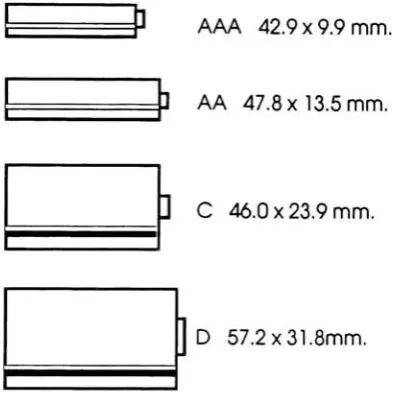
AAA 42.9x9.9 mm.
INTRODUCTION
Perhaps the best known of allbatteries are
dry
cellbatteries,
whichare used in awide]
C 46.0x23.9mm.] aa 47.8x 13.5mm. varietyof portableequipment. The majority
ofthisclass ofbatteries,which areeasily
found in supermarketsand generalstores,
arethestandard sized cylindrical single cells
shown in fig.1-1 . Toexplain myconcept
moreeasily,these fourstandard batterieswill
[image:11.533.30.228.141.338.2]be theprinciple objectsofthis project. 57.2x31.8mm.
Fig. 1-1 FourPopular SizesofBatteries
Therearetwo typesof
dry
cell batteries:primarybatteriesandsecondary batteries.
Primary
batteries are disposable.The chemical reactionthatsupplies current
inthis kind of
battery
cannot be reversed.Conversely, secondary batteriesare
rechargeable, because the chemical
reaction which produceselectrical energy
can be reversed
by
recharging witha
battery
recharger(Gasbarro 1991,42).Those twocategories of batteries have
differentadvantages and disadvantagesin
Currently,
disposable batteriesare morepopularthan rechargeables. Userscan
easily find disposable batteries in any super
marketor conveniencestore, but
they
canget rechargeable batteries only from
specialtystores. The problem with the
rechargeable
battery
marketisthatrechargeablesarehigherpricedand poorly
promoted and marketed.
Battery sizes
rec
Two-batterypack prices($)
GE [
haraeable c
>URACELL isoosable
D 6.93 1.88
C 6.93 1.88
AA 5.00 1.22
[image:12.533.31.224.312.475.2]AAA 5.83 1.68
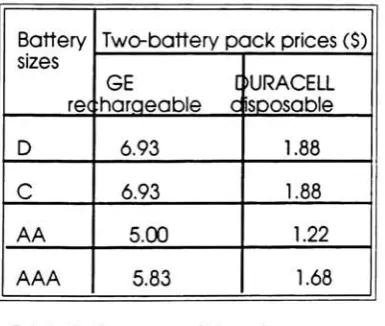
Table 1 Consumer Prices from WAL-MART, Rochester, NY, 92
The initial purchaseprices aretheeasiest
numberstocomparebetweenthetwo
products. From table 1, a rechargeable
maycostabout3.5 times the price ofthe
same size
throw-away
battery, plus $10-25fora
battery
charger. On theother hand,this situationwould be completelyreversed
ifa buyerconsideredthe prices in term of a
whole life.
According
to the advertisementon the back ofa GE
rechargeables'
package,a pair oftheir batteriescan
replace upto 150 pairsof
throw-away
batteries. This means it is farmore
economical toreplace disposable batteries
with rechargeables (seefig.1-2).
RECHARGEABLE $5.00 DISPOSABLE S 1.22 =E3 RECHARGER $10.00
X
150
TIMES $ 183.00Fig. 1-2 Rechargeablevs.
Non-rechargeable
Promotion,
anotherimportant marketingtool,can create a goodimage forproducts, and
educate itsconsumers. Since I have been in
the
U.S.A.,
I have rarelyseenads forrechargeable batterieseither on televisions
orin magazines. Incontrast, Ialwayssee
manygood advertising campaignsforthe two majordisposablealkaline
battery
brands,Evereadyand Duracell,through different
mediums. Consequently,people are much
morefamiliarwith disposable alkaline
batteries than rechargeable batteries.
Besides a good
Marketing
strategy,a successful product mustsatisfy its user
by
its dependablequality. Although secondary
batteries can be recharged over and over,
their
discharging
characteristic is notas good as primary, alkaline batteries.
The best known rechargeable,
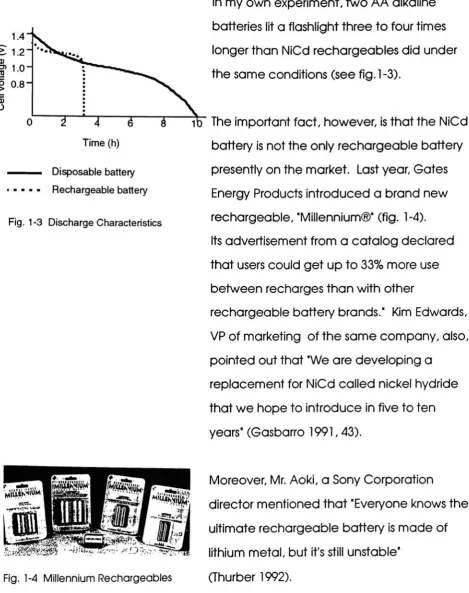
nickel-cadmium (NiCd) battery,smoothly releases its energyuntil it is almostgone, andthen it
suddenly stops. On the otherhand, alkaline
batteries losetheirenergy gradually (Vincent,
Scrosati,
Lazzari, Bonino1984, 79,
1 19).Time(h)
Disposablebattery
Rechargeablebattery
Fig. 1-3 Discharge Characteristics
In myown experiment,two AAalkaline
batteries litaflashlight threeto four times
longerthan NiCd rechargeablesdid under
the same conditions (see fig. 1-3).
The importantfact, however, is that the NiCd
battery
isnotthe only rechargeablebattery
presently onthemarket. Lastyear,Gates
Energy
Products introduced a brand newrechargeable,
"Millennium"
(fig. 1-4).
Itsadvertisementfrom acatalog declared
that users could getup to 33% more use
betweenrechargesthan with other
rechargeable
battery
brands."
Kim Edwards,
VP of marketing ofthe same company,also,
pointed outthat "Weare
developing
areplacementforNiCd called nickel hydride
thatwehope to introduce in five to ten
years"
[image:14.533.30.500.78.672.2](Gasbarro 1991, 43).
Fig. 1-4 Millennium Rechargeables
Moreover, Mr. Aoki,a
Sony
Corporationdirector mentionedthat "Everyoneknows the
ultimate rechargeable
battery
ismade oflithium metal, but it'sstill
unstable"
(Thurber 1992).
Since there isatrend that thefuture
rechargeable
battery
will approchtheuser'sneeds more than thedisposable
battery,this thesiswill be based ononly
rechargeable batteries. The designwill be
concerned with
Marketing
strategy. Humanneed,and Environmental care. Thesample
situation refers to today's NiCd batteries,
but the final solution may be able to apply
tootherfuturerechargeables.
THE CURRENT STATE OF RECHARGEABLES
THE
CURRENT
STATE OF
RECHARGEABLES
Distribution
Different from the disposablebattery, it is
moredifficult to find the rechargeable
battery
in anydrug
storeor conveniencestore. Rechargeable batteriesare available
insome specific stores,such as electronic
suppliers and
toy
shops. Thereason may bethat the rechargeablebattery's price is
more expensivethan the disposable battery.
Additionally, everynew rechargeable needs
the firstcharge. That meansevery user
should have a
battery
charger.According
to thecharging time,there aretwo kindsoftherechargeable in themarket:
the quick charged
battery
(2-6hrs.),andtheovernight charged
battery
(8-16 hrs.).They
need differenttypesofbattery
chargers. Theovernight charged
battery
hasmore electric capacity percharge,which
meansthe power willlast longer than the
quick charged battery.
(Catottiand others. 1975).
THE CURRENT STATE OF RECHARGEABLES
Use
Users donot have muchfreedomto usetheir
rechargeable batteries awayfrom a charger.
Forexample, itwould notbe a good idea to
use rechargeablebatterieswith aWalkman
during
along traveling
trip, unless theuserbringsa chargeralongsothat the batteries
can berecharged whenever
they
aredrained and an electric socketisavailable.
Moreover,waiting timeforafull recharging is
considerable. It takesabout14-16 hours to
fully
chargethestandard rechargeable cell,and 3-5 hours for the quickcharge
battery
(Catotti and others. 1975).
Recharging
a pair of batteries isverysimple.Auser need nothave towatchrecharging,
but there isa certain procedure.
According
to the operating instructionsmanual ofa Panasonic charger, "Batteries
can be left in charging unit withoutharm,
but formaximum
battery
life, removebatteriesafter
fully
charging."
Ifa
battery
is"overcharged"
atthe0.3 C rate(quick
charging),the cell temperatureand pressure
THE CURRENT STATE OF RECHARGEABLES
CELL VOLTAGE
CELL TEMPERATURE
CELLPRESSURE 50 100
STATE OFCHARGEfU)
downas an
interrelationship
aspresented infig.2-1.
Frequently
overchargetemperatureand pressurewill shorten thecell life.
And,continuous chargingafter
being fully
charged will
drop
voltage levels (Catotti andothers.1975).
Fig.2-1 CharacteristicsofVoltage,
PressureandTemperature
Vs.StateofChargeof aSealed Cellat0.3C Charge Rate
Conclusion
The rechargeable
battery
can be chargedand discharged hundreds oftimes.
Correctmaintenanceand use may
keep
therechargeable
battery
in good condition upto 1000 charge/discharge cycles.
The only signthat identifiesthe poorly
conditioned cell is the lowerpeak voltage
that thecell can reach. The power will drain
from the full charge quickerthan before.
PRELIMINARY SOLUTION
PRELIMINARY
SOLUTION
The "tool"
that I usedtocreatethe
beginning
solutionfor thisproject wasthe imagination
of myself as a rechargeable
battery
user.Iattempted to freemyselfofall current
constraints and perceptions and visualize
a scenariothatwould:
allow userstopurchase, affordably,
rechargeablebatteries from automatic
dispensers that areavailable in many
convenient locations,
havean efficient recharge service after
purchase so it is notneccessary for the user
tohave a
battery
charger at home,andtake careof used batteries; thus,users feel
betteraboutenvironmental care.
Afteranalyzing theabovecriteria,the
problemseemed tosuggestthatan ideal
solution mighttakethe form ofa large
service "system". Thiscould besimilarto those
systems provided
by
Banking
institutions.Gasstations, orFood and beveragevending
operations. The biggerthe service system is,
the moreconveniencetheuser gets.
CONSTRUCTION
It makes more sensetosetup asystem for
distributing
energy than a system fordistributing
little physical blocksof products.The "Eco
Battery
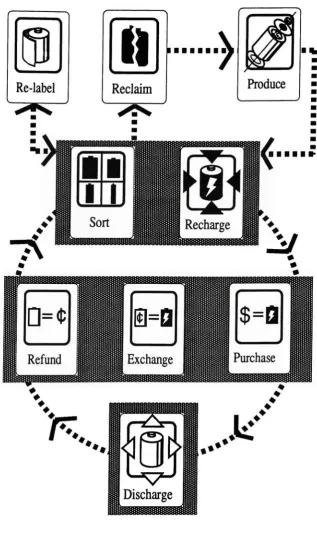
exchangesystem" will
circulateEco rechargeablebatteries
between users (see fig. 3-1). Userswould not
permanently own these batteries.
Ready-to-be-used rechargeable batteries
aredistributed through "Eco exchanging
units"
without packaging. Oncecustomers
purchase batteries from an exchanging unit,
they
enterthebattery
exchange system.Userscan getthe exchanging service
through any availableexchanging unit.
To exchange,
they
have to deposittheirEco batteries and paya service charge ata
small fractionofthe originalcost. Then,
they
receive otherEco batteries
freshly
charged.Furthermore, exchangingwith different
battery
sizesis a feature ofthesystem.Users do nothave to use thesame size of
Distributor
Eco exchanging unit
[image:22.533.173.491.82.621.2]User
batteries
whenthey
need tochangethem.Also,
they
can get a partial refund if thebattery
exchange system nolonger fits theirneeds.
By
thesealternatives,most Ecobatteries will come back to thesystem.
Deposited batteriesare picked up
by
a distributor. Distributorswill sort batteries,
rechargethem, check and removefailed
batteries,
and returnthem to exchangingunits. This process includesre-labeling,
reclaiming,and adding new productsinto
thesystem,which I will explainin the later
sections.
Asa result,this is an ideal concept forpublic
spaces and convenient locations. Itallows
usersto userechargeable batterieswithout
a personal charger.
They
do not have totake responsibilityfor
throwing
batteriesaway, if
they keep
using thesystem.Additionally,
by
doing
so,they
will getunlimited service. Figuratively, forthe users
Eco rechargeable batteries havean
unlimited lifetime.
FEASIBILITY
According
to thesystem construction,thisprojectincreases notonly
battery
users'
convenience,but alsobusiness potential.
Let meexplain how both distributors and
users in the Eco
Battery
Exchange Systemwould benefit.
Rechargeable batteriesare expensive
long-lifeproducts. The users who purchase
them may not come backfor manyyears
untiltheir old rechargeables have
permanently failed. That is notgoodfor
business. On the otherhand, Eco
battery
distributers could earn more profitthan using
conventional rechargeabledistribution.
The Eco
Battery
Exchange System offersaffordably charged batteries to the
users forlessthan
they
would pay fornew,powerlessrechargeables. The users are
eligible touse the exchangingservice from
the system. Thisconvenientsystem will
increasethe number of users. As a result,the
distributor's profit comes primarily from selling
batteriesand rechargingservice.
To
keep
thebattery
exchanging businessflowing
smoothly,thefollowing
detailsareimportant:
Circulation
In the earlyconcept, Eco batterieswere
circulatedwithin each exchanging unit.
Returned batterieswould be automatically
recharged and re-distributed
by
themachine itself. Since Eco
battery
users areableto exchangebatteries through different
exchangingmachines,the early idea could
have problems. Thesystem needsservicing
to balance the number ofbatteries ineach
exchanging unit. Circulators
bring
returnedEco batteries back to a central recharging
area. After the recharging process,
they
proportionally distribute the batteries to every
exchangingmachine according to the
battery
needsof each area.Each exchangingunitcan beconnected to
telephone lines and can signal particular
messagesto the centerfor moreefficient
circulation. Moreover,the machines can
monitor notonly
battery
quantities,butalsocashstatus and maintenance needs.
Sortand Recharge
At the centers, Eco batteriesare sorted
accordingto size; so,it is easierfor
recharging and distributing.
Sorting
andchargingwould be done
by
an automaticmachine. Differentsizes of batterieswillfall
into
corresponding
slotsthat lead to differentbattery
charging lines. Inorderto maintainthemaximum life ofthe batteries,
they
woldbecharged overa period of 16 hours
(overnight). Slowcharging helps maintain
the life ofthe
battery
(Catotti and others.1975). Afterthat,the qualityof each
battery
is tested.
250 500 750 1000
Electrolyte loss(Cycles)
Fig.3-2 Loss inCapacityas Electrolyte in
aRechargeable
Battery
is LostTest
Rechargeable batteries can be tested
by
measuring the open circuit voltage after
charging. The cellsremain in good condition
for a
long
time.They
sufferonlyslightcapacity degradationwith moderate
electrolyte loss,but almost complete loss of
capacitywhen a largeamountofelectrolyte
is lost. Theeffect ofelectrolyte loss on cell
capacity is portrayed in figure 3-2 (Catotti
and others. 1975). This diagram showsthat
a nickel cadmium
battery
can bechargedand discharged forabout600-700cycles
without
disappointing
its user.Re-label
Each Eco
battery
iswrapped witha recyclable plasticlabel (PET orHDPE).The labelswill be constantlychanged: 1)to
encourage usersto exchange batteries,and
2)
tokeep
the batteries' bodiesclean.Besidesstandard information,there is a
bar-codeand exchanging
date-warning
on each Eco battery's label. Thebar-codeidentifies Eco
battery
eligibilityand the label'sissue date to thescanners in Eco exchanging
machines. The exchanging
date-warning
tells the usersthat
they
may have to payrelatively higherpricesfor exchanging if
they
keep
the samebatteries longer than theexchange dateshown.
Reclaim and Replenish
Ifan Eco
battery
could notpass thebattery
testing
process (aftercharging), itwill be removed from the EcoBattery
ExchangeSystem. It isthe distributers' responsibilityto
Distributors Users Landfill Conventional Rechargeable . . Distributors Reclaim EcoRechargeable Batterylife
Fig. 3-3 Conventional Rechargeable vs. Eco Rechargeable
BatteryLives
send all failed batteries toa separate
reclaiming
organization (see fig. 3-3).Meanwhile,
the exchangingsystem isreplenishedwith newrechargeables.
After
being
fully
charged,old and newbatteries are re-distributed at random.
Eco
battery
distributorswould needto investin exchanging machines,
bulky battery
chargers,and re-labelingsystems.
The investmentfor innovative machines is
always the
beginning
ofeveryautomaticdispenser business. The differences that
makethe investment for thisprojectmore
interesting
are asfollows:1)
Rechargeablebatteriesare smaller in sizebut higher invalue thanotherproducts
sold
by
vending machines.2)
Battery
recharging is less difficult thanproducing orpackaging newproducts.
3)
Battery
energy isa necessityformostpeople.
4)Thesystem issafefor the environment.
DESIGN
OUTLINE
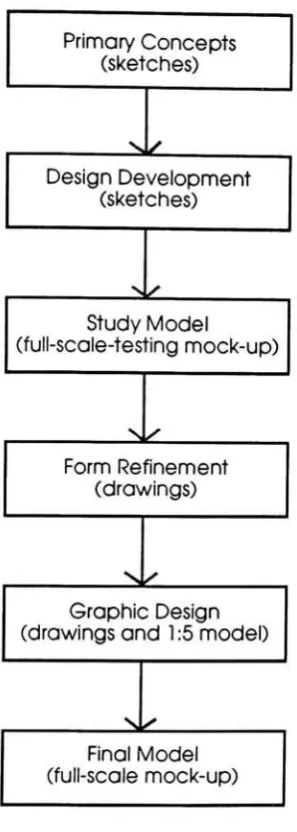
PrimaryConcepts (sketches) _^l DesignDevelopment (sketches) ^ StudyModel (full-scale-testingmock-up) Nl/ Form Refinement (drawings) _^k. GraphicDesign(drawingsand 1:5model)
NlX
FinalModel
(full-scale mock-up)
Fig.4-1 DesignOutlineof TheExchange Unit
Inthe
battery
exchangesystem, thekey
componentis the
battery
exchange unit.This is the connecting pointbetween the
operators andtheircustomers.
Therefore,
itneeds a well
functioning
design withharmony
between esthetic ofthe product and
graphics morethan anyothercomponentin the system.
The Eco
battery
exchangingunit is a productforpublic-use. Consequently,
designing
foruntrained users is the majorconcern.
An easy-to-operate system and easy-to-read
graphicsfor ordinary peoplefrom 1 1 to 65
year-old arethe aim ofthedesign
development. Infigure 4-1 is a scenariothat
showstheoverall design forthe Eco
battery
exchange unit. And,the
following
is thedetails of each category.
[image:30.533.39.188.133.550.2]RY CONCEPTS
PRIMARY CONCEPTS
Fig.4-2 Designwith anInternal BatteryCharger
According
to thesystem construction(fig.
3-1),
a definition for the Ecobattery
exchangingunit isa machinethat distributes
Ecobatteries, offers exchangingservice,and
collects Eco batteries from users.
Thisdefinition led the
beginning
concepttothe combination of similarproducts,such as
foodand beverage vending machines and
cash machines. Then,thiscombination was
unified andsimplified.
From the firstconceptto the final concept,
therewere manychanges in thesystem
layout, userinterface,and installation ofthe
product. The
following
is the analysis ofthosechanges:
From Internal Chargers
to The Human Intervention
Inthe first concept,the
battery
exchangingmachine included an internal
battery
charger(fig. 4-2)which can charge returned
batteries and re-distributethem
by
itself.Thiswas an
interesting
idea butnotpractical. [image:31.533.44.189.132.638.2]RY CONCEPTS
Besidesthe circulation problem thathas been
explainedin chapter2,the internal charger
complicatedthe designofthe exchanging
unit. Also,itwould causeexpensive
production and difficultmaintenance.
Without the internalcharger,theappearance
ofthe later designs could bemore compact
and less complicated.
From The Multi-button Control
to The Touchscreen Control
User interface isan important issueforthe
battery
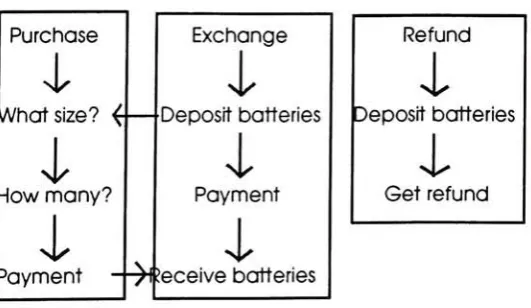
exchange service. Eachmode oftheservices
-which arepurchase, exchange,
and refund
-needs continuous operation
(figure4-3) like theonein the bank'scash
machine. Purchase
I
A/hatsize?I
-lowmany?i
ayment Exchange1
4J
[Depositbatteriessi Payment
I
--^deceive batteries
Refund
i
Depositbatteries
I
Getrefund
Fig. 4-3 OperationChartofthe EcoExchang Unit
[image:32.533.133.399.487.641.2]PRIMARY CONCEPTS
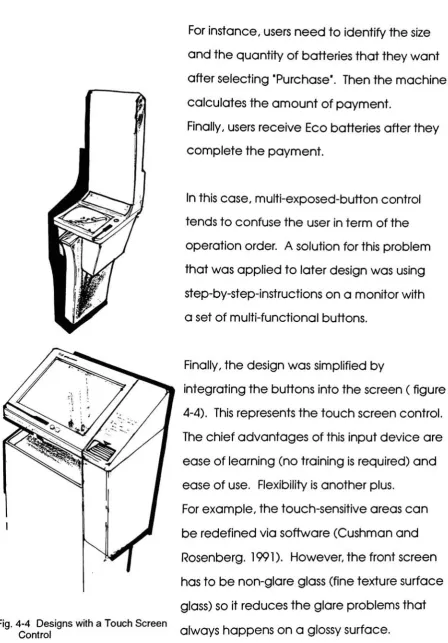
Fig.4-4 Designswith aTouchScreen Control
For
instance,
users needtoidentify
thesizeandthe quantity ofbatteriesthat
they
wantafterselecting "Purchase". Then the machine
calculatesthe amount of payment.
Finally,
users receive Eco batteries afterthey
completethe payment.
In thiscase, multi-exposed-button control
tends toconfuse the userin term ofthe
operation order. Asolution forthis problem
thatwas applied to later design was using
step-by-step-instructions on a monitor with
a set ofmulti-functionalbuttons.
Finally,
the designwas simplifiedby
integrating
the buttons into thescreen (figure4-4). This representsthe touch screen control.
The chiefadvantages ofthis input deviceare
easeof
learning
(notraining
isrequired) andease of use.
Flexibility
is another plus.Forexample,the touch-sensitiveareas can
be redefined via software(Cushman and
Rosenberg. 1991). However,the frontscreen
has to be non-glare glass (fine texturesurface
glass) so it reducestheglare problemsthat
alwayshappens on aglossy surface.
[image:33.533.41.490.45.689.2]PRIM CONCEPTS
From
Fancy
Sculpturesto Simple Forms
The image of
batteries
in mymindwassomething
thatwas sparkling, moving,andhad
fancy
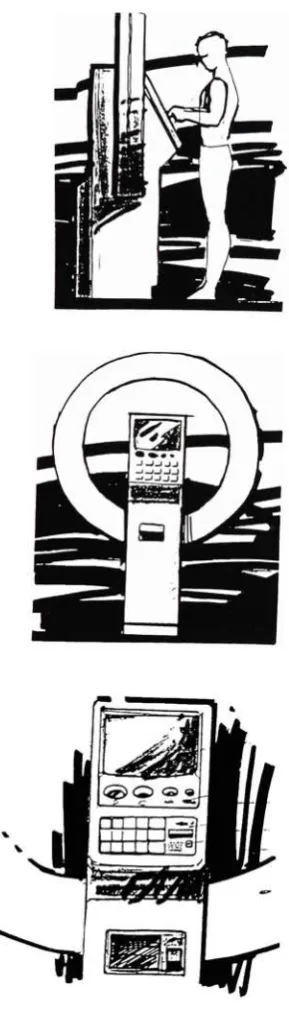
shapes. Someofthe conceptsketchesforthis project were purely drawn
from that
imagination
(fig.4-5). However,those "blue sky"
designswere notappropriate
for the product environment. Since the Eco
battery
exchanging machinewouldstandbesideothervending machines,supermarket
shelves, or
building
corners, its form must besimple (fig.4-6).
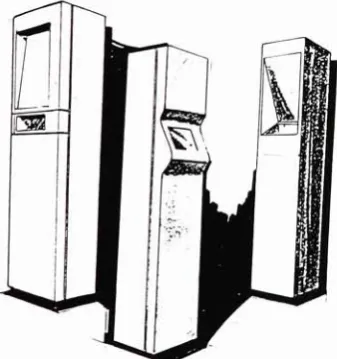
Fig.4-5 Designwith FancySculptures WithSimple tall towerform,this machine
would be easierfor installation in limited
spacethan ones in theshort, wideform with
a
big
footprint. Also,thevertical shapemachine looksmore elegant and arousing.
Both leftand rightsidesofthemachine
should bestraight. Thissaves spacewhen
themachine stands nexttootherflatwalls.
Also,itwould notcollect dirtand litterwhere
it is difficult toreach formaintenance people.
Fig.4-6 DesignswithSimple Forms
[image:34.533.50.485.46.632.2] [image:34.533.37.206.455.635.2]POWERCYCLEDESIGNCONCEPTSBY RITKASETSUWAN
[image:35.533.265.475.154.630.2]DESIGN DEVELOPMENT
Thefrontofthe unit should notbe
deeply
recessed sothat itwould be difficult to
recognize whenstanding betweentwoother
vending machines. But, itmust not stick out
too muchto be a "bully" ofthe narrow way.
DESIGN
DEVELOPMENT
The primary conceptonly refinedthe original
idea ofthe design. To
develop
the primaryconceptto be a strongerdesign, the Eco
battery
exchange machine needed exteriorand interior details based on Humanfactors
and design sense.
Exterior
Theconclusionfrom the primary concept
doesnot meanthat the design must be too
simple. The Eco machine should retainthe
electrifying imageofthe battery. A
big
cylindrical form wasa designelementthat
best representedthe characteristic ofthe Eco
batteries. Meanwhile,the questionwas
-how
to effectively apply it into the design?
DESIGN DEVELOPMENT
Fig.4-8 Designwith StackingForms
Through manysketches,the most
interesting
designwasthe onethat looked like a set of
stacking
audio equipment (fig.4-8).The upper andthe loweredgesof each
component ofthis design are
big
roundcorners. The repetition ofthis horizontal
roundnessrepresents cylindrical
dry
cells.Yet,it helpsemphasize each functional part
ofthe unit: the charged-batterystorage,
the control panel, the
battery
gateway, andthe
discharged-battery
storage.In term ofexpressiveappearance,
thecurvilinearfrontofthe unitalways reflects
and creates highlight beamswhen itisunder
a lightsource. Thisphenomenon also
representsthe energyproducts inside.
Itcan even bean attractivespotin a
poor-lighting
situation (figure Bon page40a).Interior
Whole parts ofthe frontofthe Eco
battery
exchange machinecan be openedlike
a single, swinging door. Most maintenance
worksforthe machine are behind this door.
The posibledetail ofthe interior is illustrated in
figure 4-9.
[image:37.533.59.202.81.486.2]CPU
TOUCHSCREEN
HOUSING
BARCODE >
SCANNER
IN-OUT
BATTERIES PASSAGE
POWERFULBATTERS
STORAGE
cold supply air
REFRIGERATORSECTION
CASH STORAGE
DISCHARGE?5ATTERV
STORAGE
WEIGHT
[image:38.533.47.485.158.645.2]DESIGN DEVELOPMENT
On the back ofthe door, there is a CPUthat
controlthe wholesystem in this machine,
including
the application ofthe touch screencontrol. The distributorcan reprogram the
application softwarethrough this CPU like
other personal computers.
D SIZEV.TTERiSSTOfytQt
[image:39.533.46.207.346.555.2]CAFPCITY 234 wtCHT 35 lb
Fig. 4-10 D-sizeBatteryMagazine
The recharged
battery
storage is located onthe top-left corner ofthe trunk. Thestorage
consists offour different magazines for four
sizes ofbatteries (AAA, AA, C, D).
These magazines arethe same overall design,
but different in battery-lines'
dimensions.
The example detail shown in figure 4-10 is
a D-size
battery
magazine. The othermagazinesforsmallerbatteries have
relatively greater capacity. The range ofthe
weight of each full-loaded magazine would
be about 30-40 lb,which isstill underthe
reasonable weightlimits foroccasional
lifting
for 18-35year-old males (max. 55 lb)
(Woodson. 1981).
Adjacentto the storage on the right-hand
side wasa refrigerator section. The cold air
from the refrigeratorwould flowaround the
DESIGN DEVELOPMENT
Storage Temperature
(C)
Fig. 4-11 Self-discharge Rates
temperature lower than 20 C. The lowerthe
storagetemperature,thelongerthe
battery
retains itsstoredenergy. Figure4-11 shows
typical self-discharge ratesfrom 0C to 50C
fora representative nickel-cadmium cell
(Catotti. 1975).
Thecharged
battery
storage isconnectedto40 a
battery
gateway( in-outbattery
passage).Batteries in the magazineare smoothly
dropped down fromthe
top
to the bottomto the connection
by
gravity. Attheconnection,thereare fourcounter valves
and agate controlled
by
computeras shownin figure 4-12. In the picture,valve2 is in the
positionthatcutstwo bottom batteries from
the upper stack. Thereafter, thegate Ais
opened and only the two batteriesfall down
to thegatewaywithout a
battery
jam.The Eco
battery
exchanging machine hasonlyone
battery
gateway. To exchange,usershaveto deposit andreceive Eco
batteries throughthisgateway. Deposited
batteries have to be faced up in the
gateway, sothe bar codescannercan read
[image:40.533.37.218.76.291.2]DESIGN DEVELOPMENT
C MM
Charged PWm ()QQ Batteryb^-^BQ
StorageDP
v?
GateB Gateway I Returned ; Battery . Storage ^x::::xx::;:;::::x;:;:::;:::::::::;:::::;::xr:xFig. 4-12 System Scenario
them. If
they
are qualified,the machine willcontinuethe exchangingprocess. Afterthe
userpaysthe charge, gate B isopenedto
removethe old batteries to the returned
batteriesstorage. Then, newbatteries fall
down from the upperstoragetoreplace the
old batteries in the gateway.
The
big
cash storage isatthe middleright-handside. The
battery
exchanging machinedealswith high priced batteries,so it needs
a high capacitycash system. Although an
Eco
battery
is cheaperthan avirginrechargeable battery, it is still more expensive
than any other product sold
by
machines.The Ecocash machine would accept not
only coinsand one-dollar bills likeother
vending machines,but include5$ and 10$
banknotes. This ismore convenient for
customers who first purchase many Eco
batteries but do not haveenough change.
The lastvisible partin figure 4-9 isa massof
weight atthe bottom ofthetrunk. It is an
option preparedforstabilizingthe unitin case
theunitis standing unaccompanied.
[image:41.533.41.199.52.438.2]DESIGN DEVELOPMENT
The most unstabledirection ofthe narrow,
deep,
andtall unitare the left theand rightsides.
Especially,
whenthetop
storage is fullandthe bottomstorage isempty,theCG
(Centerofthe
Gravity)
is too high,and mayeasilyfall over. (fig. 4-13). The bottomweight wouldlower the CG and
keep
the unitmorestable.
Fig.4-13 UnitStability
[image:42.533.192.340.384.601.2]STUDY
MODEL
The front partofthe selected design from
Design Developmentwas built in
full-scale-studymodel. The purposeofcreatingthis
model wasto study the
following
subjects:The User Reaction
During
the time that themodel wasstandingin the Industrial Designstudio at R.I.T., it
interested manystudentswho wereworking
nearby.
Many
ofthem positivelycommented onthe overall form ofthe
model. Someofthem had
interesting
opinionsaboutthe details. Someother
friends demonstrated theirreactionto the
model.
Every
useful opinion and demonstration was recordedfor later improvement.
Forexample,figure 4-14suggested that the
controlscreen wastoo lowevenfor a 10 th
percentile man.
The
Lighting
EffectThe studymodel showsits details
by
thereflection,theshadows, and the darksidesof
different levelsand angles. Differentpositions
oflightsource create a variety of
lighting
effects,which explains the
beauty
ofits formbetter thanthat in the drawing. Therefore,
the model is veryuseful for the laterform and
graphic refinement.
Material and Process
The lastadvantageof making thismodel was
to survey materials andtechniques that may
besuitabletoapplyto the final model
making. This reducedtherisk of potential
mistakes. 5-millimeter-thick foam core board
with melted glue stickswerethe only
materials used forthismodel. Foam core
panelsare rigid enough for theflatsurfacesin
this design. Italso handled round corners
very smoothlywith V tracksonthe innerside
ofthe corners.
Techniquesformaking thismodel werevery
simpleand quick.
Heavy
machinetoolswerenever required. In contrast,thework was
donewithin 2 dayswith only basictools, such
asasharp knife, a metal ruler, and a cutting
mat. The output work wasthe light-weight
model which can be lifted up
by
an indexfinger.
J < 2
1-2 u
O 0"
ii.
ill
to
j F z
o
a:
[image:45.533.83.454.120.670.2]FORM
REFINEMENT
The proper-scale drawingsinfigure4-15, 4-16,
4-17. and 4-18arethe summaryofthe Human
Factors
test,
plus stylistic detailsonthe userinterface. The details included materials,
textures, colors, parting lines,and primary
graphics. Detailed
drawing
and renderingtechniqueswere employedto expressthe
effectofthe materials as closeto the real
thing
as possible. The major media used onthose drawingswas
dry
pastel overthe graystrokesof
felt-tip
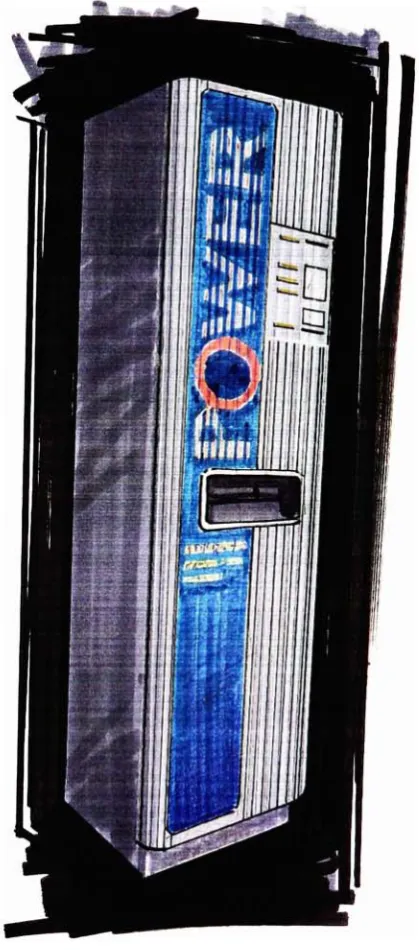
markers.Figure 4-15
Thematblack finish unifies andemphasizes
the monitorand the
battery
gatewaywhicharethe
key
componentsofthe Ecomachine.There isa rotation lock, at aboutthe middle
rightside,forthe door'ssecurity. This kind of lock doesnot need a key. And,it isin
harmony
withthe restparts ofthe design.However,the overall appearanceis too
delicate andnot appropriateforthe image
ofitscontent.
Figure 4-16
The contrastofthe materialsandthe colors
makethis design simple andstrong. The dark
gray area is a durableplastic bumper
intended forscratch protection.
Moreover,
ithighly
contrastswiththegoldmetallic surface ofthe upper part oftheuser
interface. Although blackand gold colors
are a good match,the
big
gold area onfigure 4-15 may make peopleuncomfortable
because it is awarm color.
Figure 4-17
Aftergradual
development,
there isa revolution inthe user-interface design.
Many
design trickswere applied to the newseries ofdrawings. In figure4-17, forexample,
purple and blackwith split components
causethe design lookfashionable; but it
might soon becomeout of date.
Figure 4-18
This design was developed from the one in
figure 4-16,which met most ofthe design
criteria. Thispicture shows the detailsand
explanation ofthe userinterface.
AWODIZED-5357ALUMINUM
SHEETS COVER PLASTIC FRAMES.
13xy cmTOUCHSCREEN
IS AN ACTIVEAD SPOT
WHICH CAN BE UPDATED.
THESCREEN DISPLAYS ACTIVE BUTTONS,
ADVISORY GRAPHICS, AND NECESSARY INFO.
IN/OUT BATTERIES PASSAGE IS AUTOMATICALLY
LOCKED/UNLOCKED
BY COMPUTER CONTROL.
WHEN A USER PUSHTHE
UPPER PART IN , THE
LOWER PART IS AUTOMATICLY
DRIVEN OUT BY A
MECHANISM.
THE FIRSTfiCMSOM
GRAPHICISAT ABOUT THEEYELEVEL
PRICES,LWITEDCHANGE
AND REFUNDARE WSPLAYEP ONTHETOUCHSCREEN
UNLOCK"THEDOORHANDLE
BY A KEY
PULL-OUT DOOR HANDLE
WITH AFINGER RECESS ISEASY 10 CRAB
7x10cm CHANGEOUTLET
DURABLEPLAST\C BUMPER TOPROTECT SCR&CHING
BY USERS'
BELONGINGS,
SUCHAS BRIEFCASES
[image:51.533.28.507.133.654.2]BICYCLES, OR SHOPPING CARTS
GRAPHIC
DESIGN
RECHARCSABLE BATTERIES
eco
Fig. 4-19 TrademarkDesigns
i.K\.i!:l'MM
Fig. 4-20 Graphic Design Sketches
Trademark
The first
logotype, Eco,
was createdduring
the Form
Refinement
process tosupportthe designs. It came from the firstthree
characters ofthe terms "ecological"
and
"economical",
which are what this projectaimedfor. Figure 4-19 illustratessome parts of
the sketchesforthe Eco trademark.
The circle design is the best onein this
category because it simply explessesthe
cross-section ofthree cylindrical cells,yetit
repeatsthe stackingappearance of the Eco machine.
Then this trademark was applied onto the
product alongwith some coorperative terms,
such as
"Energy"
and "Rechargeable".
The firststepofthis process was makingsuch rough sketches as illustrated in figure 4-20. Afterthat,some
interesting
sketches wererefined and applied on the metalic surfaces
of 1:5 scale models as shown in figure 4-2 1.
Finally,the conclusionwas reached that:
1)themat colorfieldstands outbest on
the shinysurface,
2)
thenegative letteronthesame surface is easiertoread than the
positive
letter, 3)
the designwith thebig
trademarkis thestrongest design for thisproduct.
Instruction
Therearetwo kindsof instructionsonthe user
interface ofthe Eco
battery
exchangingmachine: the permanent instructionsandthe
interactive instructions.
As shownin figure4-22, 'TO STARTplease
touchscreen"
and "TO RECEIVEorTO DEPOSIT
please push
here"
are only two permanent
instructions ofthe Eco machine.
Each instruction is a combination oftwo
differenttype faces. The mainterm ofthe
instruction is36 pt.Helvetica Light Italic.
The
key
words ofthe instructions areemphasised
by
using 48 pt. HelveticaCompact inthe uppercase style.
Consequently, the usercould read and
1
mi
Wffi.
W
JrSSSsS5sSSSw
rs
[image:55.533.34.509.49.724.2]Thefirstinstructionadvises the userto
activatethe machine
by
touching
thetouchscreen.
Thereafter,
the step-by-stepinstructionsonthescreen willlead the user
from the first to the final stepofthe operation.
To supportthe instruction onthe screen,
the second permanentinstruction assuresthe
user ofthe locationand theoperation ofthe
battery
gateway,which is belowthetouchscreen. Thisposition may be too low forthe
human's eye level, but theinstruction isstill
easy to read because it ison a
turned-up
surface.When noone operatesthe Eco
battery
exchanging machine,the touch screen
displays a standby image which can be an
advertising campaign or special information
forthe period oftime,depend upon
programingvia thesoftware.
Immediately
whenthescreen is disturbed, the standby
image changesto be the main menu (figure
4-23). Themenu invitesthe userto useone of
the threeservices ofthe machine which are:
PURCHASE, EXCHANGE,and RETURN.
The black fields
identify
the touch buttons(icons)
onthescreen. Most ofthose buttonsare atthe bottom ofthe screen, exceptfor the
battery
selection buttonsonthe firstscreen ofthe "PURCHASE"
category. Thefour
battery
iconsare notthe actual size butthey
are aboutthe right proportion in a smaller
scale. So,the userwho always forgets the
battery
code (AAA, AA, C,and D)will beableto recognize the
battery
he or she wants.Additionally,
the requiredquantitycanbe increased
by
onefor eachtime aMain Menu
Figure 4-23
Step-by-step
Instruction onthe Touch Screen"PURCHASE"
Process
PLEBSEDEPOSIT 113.1 OUNNTITV BRTTERV TYPE RMOUNT(t)
2 0 5.50
4 RR 8.00
TOTRL 13.00
MOUNT RECEIIIEO 0.00
CHRNGt 0.00
icB:
[image:58.533.135.400.111.609.2]13.00
Figure 4-23
"EXCHANGE"
Process
Figure 4-23
[image:59.533.136.398.109.608.2]"RETURN"
Process
QUANTITY BRTTERV TVPE AMOUNT It) 2 D 0.20 i R 0.40 REFUND O.tO
Figure4-23
[image:60.533.137.402.110.607.2]FINAL MODEL
The full scale model shownin figure 4-22 is the final resultfrom
blending
the two dimensional and threedimensional workstogether.The method for makingthis model was almost the same asthat for the study model.
The main structure ofthe final model is made offoam coreboard.
Only
some detailssuch asthe monitor,the blackframe, and the bumped texture are plastic.An important trick ofthepresentation isthe light behind the translucent panelwhich
representsa flattouch screen. The light screen helpsthe model looks like the actual product with power-on.
CONCLUSION
The
battery
exchangeunit would bedifferentfrom othervending machines in the consumer market in thatitincludesa
collecting unit. Therefore,the user can return or exchangethe drained
battery
back forrecharging. This concept applies notonly
to rechargeable batteries thatare cylindrical,
but toonesthat areother shapes such as
those used in camcorders. If
battery
exchange units were as ubiquitous asdrink
vending machines,tourists would nothave
to carry
heavy
sparebatteriesfor theircamcorders.
Furthermore,considering a
battery
as refillable powerin a reusablecase may extendthe conceptto otherproducts such as music cassettes,colorspray paintcans,and anything else. As aresult, consumers will
have little to throw away,andthat reduces
the demand on raw materials.
Figure A Project Presentation (Thesis Show)
[image:64.533.53.482.415.704.2]REFERENCE
LISTSCatotti,
Arthur J. withDinkier,
L.,Evjen,
J.,Hodgman,
J., Lehnen, R.,
Messier,
J.,Mullersman,
F.,Pensabene,
S.,Rockey,
R., Scholefield, C. 1975-Nickel-cadmium
Battery
Florida: General Electric.Barak,
M. 1980. Electrochemical PowerSources. London and New York:The Institution of Electrical Engineers.
Vincent,
Colin A. withScrosati,
B., Lazzari, M., and Bonino, F. 1984.Modern Batteries.
London,
Maryland, Melbourne: Edward Arnold.Woodson,
Wesley
E. 1981. Human Factor Design Handbook.New York: McGraw-Hill.
Cushman,
W. andRosenberg,
D. 1991. Human Factors in Product Design.Amsterdam: Elsevier Science.
Panero,Julius and Zelnik,Martin. 1979. Human Dimension & Interior
Space. New York: Watson-Guptill Publications.
Gasbarro, Ron. 1991.
Getting
rid ofBatteries, Garbage.The PracticalJournal forThe Environment. September/October 1991, 42-43.