Int. J. Electrochem. Sci., 13 (2018) 7939 – 7948, doi: 10.20964/2018.08.68
International Journal of
ELECTROCHEMICAL
SCIENCE
www.electrochemsci.orgEffect of Mn on the Characterization of Layered Perovskite
NdBaCo
2-xMn
xO
5+δ(x=0.5, 1, 1.5, 2) as Cathode Materials for
IT-SOFCs
Xin Kong1,2, Shaoping Feng1, 2, Hongyan Sun1,2, Zhongzhou Yi1,2, Guiyang Liu1,2,*
1
Local Characteristic Resource Utilization and New Materials Key Laboratory of Universities in Yunnan, Honghe University, Mengzi 661199, Yunnan, China.
2
Lab of New Materials for Power Sources, College of Science, Honghe University, Mengzi 661199, Yunnan, China
*
E-mail: [email protected]
Received: 14 April 2018 / Accepted: 4 June 2018 / Published: 5 July 2018
NdBaCo2-xMnxO5+δ (x=0.5, 1, 1.5, 2) samples are synthesized via sol-gel method. The effect of Mn on
the crystal structure, thermal expansion, electrical conductivity and electrochemical properties of NdBaCo2-xMnxO5+δ (x=0.5, 1, 1.5, 2) have been investigated. The lattice parameter of NdBaCo 2-xMnxO5+δ decreases when Mn increasing. The substitution of Mn for Co significantly lowers the
thermal expansion coefficient (TEC) which consequently improves the mechanical compatibility with the electrolyte SDC. Although the electrical conductivity and the electrochemical performances of NdBaCo2-xMnxO5+δ (x=0.5, 1, 1.5, 2) decrease with Mn increasing, NdBaCo1.5Mn0.5O5+δ and
NdBaCoMnO5+δ have better electrochemical performance and the Rp are 0.07Ωcm2 and 0.10Ωcm2 at
800°C respectively, which can accord with the electrochemical performance requirement of IT-SOFCs cathode materials. NdBaCoMnO5+δ provides a tradeoff relationship between TEC and electrochemical
performance.
Keywords: IT-SOFCs; cathode; thermal expansion coefficient; electrochemical performance.
1. INTRODUCTION
Solid Oxide Fuel Cells (SOFCs) is considered as one of the most feasible solutions for the future energy and environmental crises which have relatively higher efficiency of conversion than other traditional technologies [1, 2]. LaMnO3 are widely used as traditional cathodes. However, the
Therefore the development of intermediate-temperature solid oxide fuel cells (IT-SOFCs) which operating temperature is below 800°C has received considerable interest in recent years. Intermediate operating temperature is conducive to extend the choices of the electrode materials and interconnects, reduce the production cost, enhance the stability and increase the battery lifespan [5-7]. However, the electrochemical activity of traditional ABO3-type manganese perovskite cathode decreases
dramatically during the intermediate operating temperatures[6].Thus, researchers make great efforts to develop new mixed ionic and electronic conducting (MIEC) oxides with high catalytic activity as IT-SOFCs electrode materials.
MIEC oxides LnBaCo2O5+δ (Ln=lanthanide) have gained great attention due to their attractive
electrochemical activity [8-10]. Layered perovskite oxides LnBaCo2O5+δ have rapid oxygen exchange
and fast oxygen diffusion characteristics owing to their consecutive layer structure [LnOδ]-[CoO2
]-[BaO]-[CoO2] [5]. The surface exchange coefficient K and the chemical diffusion coefficient D in
LnBaCo2O5+δ are much higher than these of ABO3-type perovskite [11]. However, similar with other
cobalt-based oxides, the TECs of LnBaCo2O5+δ are ~20×10−6 K−1 which are much higher than that of
traditional electrolyte SDC (12.2×10⁻⁶K−1)[8, 12]. The mismatch TEC between cathode and electrolyte may lead to the crack formation which shortens the lifespan of SOFCs. Therefore, it’s necessary to develop novel layered perovskite cathodes with tradeoff properties between TEC and electrochemical performance.
The thermal expansion properties can be improved by partial substitution of other transition metals, such as Ni, Fe, Cu and Mn for Co[10, 12-16]. Manganese oxides are inexpensive and environmental friendly which is convenient for the large-scale development as SOFCs cathodes. Recently, the minor replacement of Co by Mn in PrBaCo2−xMnxO5+δ(x = 0.1, 0.2 and 0.3) and
NdBa0.5Sr0.5Co2-xMnxO5+δ (x = 0, 0.25, and 0.5), the partly substitution of Mn and Mg for Co in
SmBaCo2-x-yMnxMgyO5+δ (x=0.5, 1, 1.5 and y=0.05, 0.1) have been investigated in previously
researches [12, 15, 16]. However, Mn-doped NdBaCo2O5+δ cathodes have not been reported so far. Co
partially substituted by Mn in NdBaCo2O5+δ may offer a trade-off between electrochemical
performance and TEC. With the aims of lowering the TEC and maximizing the electrochemical performance, we investigate the synthesis and characterization of NdBaCo2-xMnxO5+δ (x=0.5, 1, 1.5, 2)
as cathode materials for IT-SOFCs in this research. The effect of Mn substitution for Co on structural characteristics, thermal expansion behavior, electrical properties and electrochemical performance of NdBaCo2-xMnxO5+δ (x=0.5, 1, 1.5, 2) are investigated.
2. EXPERIMENTAL
The NdBaCo2-xMnxO5+δ (x=0.5, 1, 1.5, 2) perovskite oxides were synthesized by sol-gel
method. EDTA and citric acid were complexing agents and dissolved in deionized water. Nitrates Nd(NO3)3·6H2O, Ba(NO3)2, Co(NO3)2·6H2O and Mn(NO3)2 were the metal sources. The mole ratio of
value to 7. The gel was dried in drying oven to obtain precursors and then the precursors were sintered in air at 1100°C for 10h to obtain the cathodes powders.
The electrolyte powder of Sm0.2Ce0.8O2-δ(SDC) was synthesized by the conventional solid
reaction method using dried starting materials Sm2O3 and CeO2. The as-synthesized SDC powders
were sintered in air at 1200°C for 5 h. Uniaxially pressed SDC electrolytes with PVA agglomerant were sintered at 1450°C for 2h to obtain SDC electrolyte disks. The dense SDC electrolyte were fabricated to characterize the electrochemical performance of the cathodes.
The ink for electrode deposition was prepared by mixing the as-prepared NdBaCo2-xMnxO5+δ
(x=0.5, 1, 1.5, 2) powder with ethylcellulose and terpinol in appropriate ratio. The cathode slurry was applied on both sides of SDC electrolyte disks with circle pattern as working electrode (WE) and opposite side with same surface area as counter electrode (CE). The disks were sintered at 1000℃ for 2h in air. And current collectors of silver pastes were further coated onto the surfaces of electrodes. The disks were sintered at 700℃ for 30 minutes in air to form symmetrical configuration for the electrochemical performance measurement.
The synthesized cathodes NdBaCo2-xMnxO5+δ (x=0.5, 1, 1.5, 2) were characterized by X-ray
diffraction (XRD),The phase analyses of powders was evaluated by X-ray diffraction using PANalytical X'Pert Powder X-ray Diffractometer. NdBaCo2-xMnxO5+δ (x=0.5, 1, 1.5, 2) oxides mixed
PVA agglomerant evenly were pressed and heated at 1150°C, 1200°C, 1250℃ for 2h to form dense samples to measure the electrical properties and TEC performance. The electrical conductivities of NdBaCo2-xMnxO5+δ (x=0.5, 1, 1.5, 2) samples were measured with a four-probe dc method using
ST-2258C four point probes meter from 50°C to 800°C. The TECs of NdBaCo2-xMnxO5+δ (x=0.5, 1, 1.5, 2)
were measured by ZRPY-1000 thermal dilatometer from room temperature to 800°C with a heating rate of 5°C/min. The electrochemical performance of NdBaCo2-xMnxO5+δ (x=0.5, 1, 1.5, 2) cathodes
were measured at different temperatures by ac-impedance spectroscopy using an electrochemical workstation CHI604D from 0.1 Hz to 105 Hz with the amplitude potential of 10 mV. The electrochemical impedance data were fitting by the ZSimpWin software.
3. RESULTS AND DISCUSSION
3.1 XRD analysis
The X-ray diffraction patterns of NdBaCo2-xMnxO5+δ (x=0.5, 1, 1.5, 2) sintered at 1100°C for
10h is shown in Fig.1. The characteristic peaks of NdBaCo2-xMnxO5+δ (x=0.5, 1, 1.5, 2) are layered
perovskites [17], but impure peaks are observed in NdBaCo0.5Mn1.5O5+δ at 31.2°and NdBaMn2O5+δ at
30.7°, respectively. When the content of manganese increase from 0.5 to 2, it’s observed the characteristic peaks of NdBaCo2-xMnxO5+δ (x=0.5, 1, 1.5, 2) shift slightly from low angle to the high
20 30 40 50 60 70 80
0 4000 8000 12000 16000 20000 24000 ▽ ▽ In te ns ity (a .u .) x=2 x=1.5 x=1 x=0.5 32.4 33.0
[image:4.596.185.415.86.242.2]2
Figure 1. The X-ray diffraction patterns of NdBaCo2-xMnxO5+δ (x=0.5, 1, 1.5, 2) sintered at 1100°C for
10h.
3.2 Thermal expansion behavior
100 200 300 400 500 600 700 800
-0.2 0.0 0.2 0.4 0.6 0.8 1.0 1.2 1.4 1.6 T herm al E xpansi on L /L ( % )
Temperature
(C)
NdBaMn2O5+
NdBaCo0.5Mn1.5O5+
NdBaCoMnO5+
NdBaCo1.5Mn0.5O5+
[image:4.596.118.458.355.592.2]a b c d a b c d
Figure 2. The thermal-expansion (L/L0) curves of NdBaCo2-xMnxO5+δ (x=0.5, 1, 1.5, 2) from room
temperature to 800 °C.
Fig.2 shows the thermal-expansion (L/L0) curves of NdBaCo2-xMnxO5+δ (x=0.5, 1, 1.5, 2)
from room temperature to 800 °C. The average TEC of NdBaCo1.5Mn0.5O5+δ, NdBaCoMnO5+δ,
NdBaCo0.5Mn1.5O5+δ and NdBaMn2O5+δ are 18.86×10⁻⁶/˚C, 15.59×10⁻⁶/˚C, 12.89×10⁻⁶/˚C and 12.8×10 -6/˚C, respectively. The TEC value of NdBaCo
2-xMnxO5+δ (x=0.5, 1, 1.5, 2) reduces with Mn increasing.
electrolyte SDC (12.20×10⁻⁶K-1[8]) and are much lower than these of Co-based layered perovskites, such as NdBa0.5Sr0.5CoO5+δ (20.27×10⁻⁶K-1) [8], SmBaCo2O5+δ (21.2×10⁻⁶K-1)[14] and
PrBaCo1.9Mn0.1O5+δ (22.8×10⁻⁶K-1)[15]. Cobalt-based layered perovskites suffer the abnormally high
TEC due to Co3+ transition from low-spin to high-spin with temperature [8, 15, 16]. The TEC of manganese-based layered perovskitessignificantly decreases owing to the suppression of the spin state transition of Co3+ which consequently improves the mechanical compatibility with the electrolyte SDC.
3.3 Electrical conductivity
100 200 300 400 500 600 700 800
0 50 100 150 200 250 300 350
NdBaMn2O5+
NdBaCo0.5Mn1.5O5+
NdBaCoMnO5+
NdBaCo1.5Mn0.5O5+
(S
cm
-1 )
[image:5.596.131.441.263.498.2]Temperature (C)
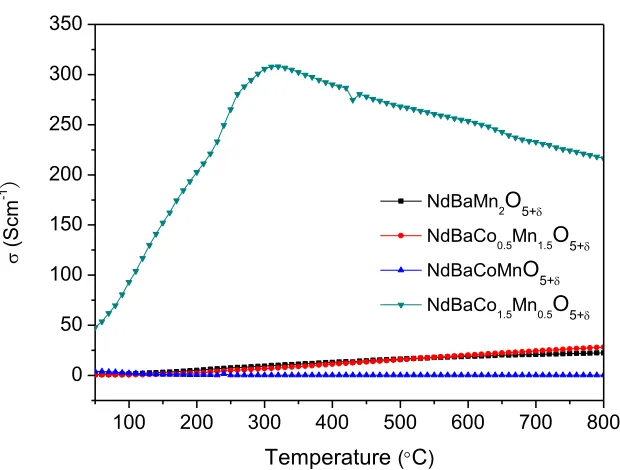
Figure 3. Temperature dependence of electrical conductivity of NdBaCo2-xMnxO5+δ (x=0.5, 1, 1.5, 2)
samples from 50 °C to 800 °C in air.
Fig.3 shows the temperature dependence of electrical conductivity of NdBaCo2-xMnxO5+δ
(x=0.5, 1, 1.5, 2) samples from 50 °C to 800 °C in air. The electrical conductivity of NdBaCo1.5Mn0.5O5+δ shows a typical semiconductor to metal-conductor transition. The same
phenomena occur in other layered perovskites oxides [3, 8]. In the temperature range of 50-307°C, the conductivity of NdBaCo1.5Mn0.5O5+δ increases gradually with temperature increasing and shows a
typical semiconductor behavior which can be ascribed to thermal-activation of electronic hopping[15]. The maximum conductivity is 216 Scm-1 at 307°C. In the temperature range of 307-800°C, the conductivity of NdBaCo1.5Mn0.5O5+δ decreases with temperature increasing and shows a metallic
Co O O
Co O O g V Co
Co 1/2 ( ) 2
2 2
Eq.1
Where OO and VOrepresent oxygen ions and oxygen vacancies respectively. Beside, the primary charger carriers are transported by the Co-O-Co network. The randomly distributed oxygen vacancies perturbs the (Co, Mn)–O–(Co, Mn) periodic potential so that it leads to the carrier localization [12]. The conductivity of NdBaCo2-xMnxO5+δ (x=1, 1.5, 2) samples increases gradually
with temperature increasing due to an increase of thermal-activation of electronic hopping [13]. However, metal–insulator transition (MIT) behaviors have not been observed in them. The maximum conductivity of NdBaCo2-xMnxO5+δ (x=1, 1.5, 2) is 4.05 Scm-1, 28.14 Scm-1 and 22.50 Scm-1 at 800°C,
respectively. The electrical conductivity of NdBaCo2-xMnxO5+δ (x=1, 1.5, 2) decreases when the Mn
content increasing, mainly due to the decrease in the overlap between the (Co, Mn):3d orbital and O:2p orbital which causes the covalency of the (Co, Mn) -O- (Co, Mn) bond decreases [12, 18, 19]. The maximum conductivity of NdBaCo2-xMnxO5+δ (x=1, 1.5, 2) are in the same order with other
free-Cobalt based layered perovskites, such as NbBaCu2O5+δ(16.87 Scm-1 at 560 °C) [8], SmBaCu2O5+δ
(31.61 Scm-1 at 610 °C) [14].
3.4 Electrochemical properties
14 16 18 20 22 24 26 28 30 -1.2 -0.8 -0.4 0.0 0.4 0.8 1.2 1.6 2.0
103Hz
103Hz
103Hz
103Hz
101
Hz 101Hz
101Hz
101Hz
a 600℃
cm2
c m 2
NdBaCo1.5Mn0.5O5+ NdBaCoMnO5+
NdBaCo0.5Mn1.5O5+ NdBaMn2O5+
fitting
5.0 5.5 6.0 6.5 7.0 7.5
-1.2 -1.0 -0.8 -0.6 -0.4 -0.2 0.0 0.2 0.4
103Hz 101Hz
103Hz 101
Hz
b 700℃
NdBaCo
1.5Mn0.5O5+
NdBaCoMnO
5+
NdBaCo
0.5Mn1.5O5+
NdBaMn
2O5+
fitting
cm2
2.0 2.2 2.4 2.6 2.8 3.0 -0.3
-0.2 -0.1 0.0 0.1
c
c
m
2
cm2
800℃
NdBaCo1.5Mn0.5O5+ NdBaCoMnO5+
NdBaCo0.5Mn1.5O5+ NdBaMn2O5+
fitting
101Hz 10
3Hz
101
[image:7.596.173.407.86.252.2]Hz
Figure 4. Impedance spectra of NdBaCo2-xMnxO5+δ (x=0.5, 1, 1.5, 2) in air at (a) 600°C, (b)700 °C and
(c)800°C.
The electrochemical performance of the NdBaCo2-xMnxO5+δ (x=0.5, 1, 1.5, 2) are tested on
symmetrical cells NBCMO/SDC/NBCMO by means of EIS. Impedance spectra of NdBaCo2-xMnxO5+δ
(x=0.5, 1, 1.5, 2) in air are shown in Fig.4. In order to investigate the process of oxygen reduction reaction (ORR) of NdBaCo2-xMnxO5+δ (x=0.5, 1, 1.5, 2), the impedance spectra are analyzed by fitting
equivalent circuit models using ZSimpWin software. The Nyquist impedance spectra of NdBaCo 2-xMnxO5+δ (x=0.5, 1, 2) are fitted well by the equivalent circuit model LRel(Q1R1)(Q2RL) and the
Nyquist impedance spectra of NdBaCo0.5Mn1.5O5+δ are fitted well by the equivalent circuit model
LRel(Q1R1)(Q2R2)(Q3RL). The Rel at high frequency intercepted with the real axis Rel denotes the
ohmic resistance which includes the resistance contributions of the electrolyte, the electrodes, the current collectors and the lead wires. L denotes a high frequency induction tail ascribed to the device and connects leads; Q represents a nonideal capacitor. The fitting results indicate that there are at least two electrode processes corresponding to the high and low frequency arcs during ORR. R1 and R2 are
equivalent to the high frequency polarization resistances RH which are caused by the charge transfer
during the migration and diffusion of oxygen ions from the triple phase boundaries (TPB) into electrolyte lattice. RL is relative to the low frequency polarization resistance which is associated with
the adsorption/desorption of the molecular oxygen, bulk or surface oxygen diffusion process [3, 12]. The total polarization resistance Rp is defined by the sum of resistances RH and RL.
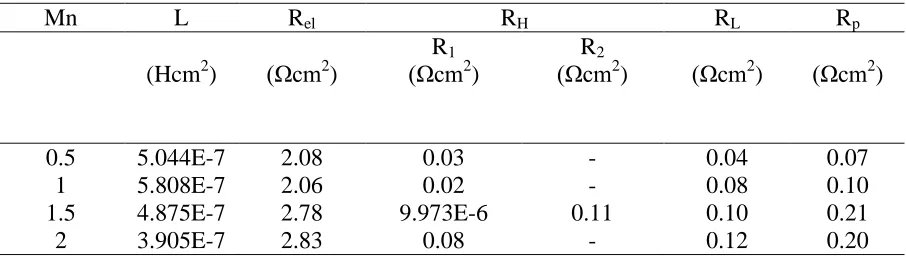
The EIS fitting results of NdBaCo2-xMnxO5+δ (x=0.5, 1, 1.5, 2) cathode measured in air at
600°C, 700°C, 800°C are shown in Table 1-3, respectively. In 600-800°C, the R2 of NdBaCo 2-xMnxO5+δ (x=0.5, 1, 1.5, 2) are larger than R1, which was interpreted the oxygen diffusion processes
are the rate-determining step of ORR. At the same temperature, Both RH and RL increase with Mn
Although electrochemical performances of NdBaCo2-xMnxO5+δ (x=0.5, 1, 1.5, 2) decreases with
Mn increasing, the Rp of NdBaCo0.5Mn1.5O5+δ and NdBaCoMnO5+δ are 0.07Ωcm2 and 0.10Ωcm2 at
800°C which are much lower than that of Manganese-based perovskite, such as La0.8Sr0.2Co0.17Mn0.83O3−δ (2.4Ωcm2 at 800°C)[21], Sm0.5Sr0.5MnO3 (1.92Ωcm2 at 800°C)[22],
PrBaCo1.9Mn0.1O5+δ (0.16Ωcm2 at 800°C) [15] and PrBaCo1.7Mn0.3O5+δ (0.15Ωcm2 at 800°C)[15] .
NdBaCo0.5Mn1.5O5+δ and NdBaCoMnO5+δ can accord with the requirement of electrochemical
[image:8.596.73.525.244.372.2]performance of IT-SOFC cathode materials.
Table 1. EIS fitting results of NdBaCo2-xMnxO5+δ (x=0.5, 1, 1.5, 2) cathode measured in air at 600 °C.
Mn L Rel RH RL Rp
(Hcm2) (Ωcm2)
R1
(Ωcm2
)
R2
(Ωcm2
) (Ωcm2) (Ωcm2)
0.5 2.012E-6 13.36 0.66 - 0.87 1.53
1 2.054E-6 14.32 0.57 - 2.24 2.81
1.5 2.075E-6 17.06 1.72 1.28 2.64 5.64
[image:8.596.72.525.431.560.2]2 1.629E-6 20.88 2.92 - 5.48 8.40
Table 2. EIS fitting results of NdBaCo2-xMnxO5+δ (x=0.5, 1, 1.5, 2) cathode measured in air at 700 °C.
Mn L Rel RH RL Rp
(Hcm2) (Ωcm2)
R1
(Ωcm2
)
R2
(Ωcm2
) (Ωcm2) (Ωcm2)
0.5 2.026E-6 4.82 0.10 - 0.20 0.30
1 2.136E-6 4.72 0.11 - 0.56 0.67
1.5 6.501E-7 6.66 0.0001 0.13 0.65 0.78
2 1.894E-6 6.56 0.01 - 1.05 1.06
Table 3. EIS fitting results of NdBaCo2-xMnxO5+δ (x=0.5, 1, 1.5, 2) cathode measured in air at 800 °C.
Mn L Rel RH RL Rp
(Hcm2) (Ωcm2)
R1
(Ωcm2
)
R2
(Ωcm2
) (Ωcm2) (Ωcm2)
0.5 5.044E-7 2.08 0.03 - 0.04 0.07
1 5.808E-7 2.06 0.02 - 0.08 0.10
1.5 4.875E-7 2.78 9.973E-6 0.11 0.10 0.21
[image:8.596.73.526.619.748.2]
4. CONCLUSIONS
In order to develop novel layered perovskite oxides with lower TEC and adequate electrochemical activity, NdBaCo2-xMnxO5+δ (x=0.5, 1, 1.5, 2) are synthesized via citrate-EDTA
sol-gel method. Although the substitution of Mn for Co leads to a decrease in electrical conductivity, the TEC becomes more compatible with SDC electrolyte due to the suppression of Co3+ transition from low-spin to high-spin. The TEC of NdBaCo1.5Mn0.5O5+δ, NdBaCoMnO5+δ, NdBaCo0.5Mn1.5O5+δ and
NdBaMn2O5+δ are 18.86×10⁻⁶/˚C, 15.59×10⁻⁶/˚C, 12.89×10⁻⁶/˚C and 12.8×10⁻⁶/˚C, respectively.
NdBaCo1.5Mn0.5O5+δ and NdBaCoMnO5+δ have better electrochemical performance, the Rp are
0.07Ωcm2
and 0.10Ωcm2 at 800°C. Among the samples, the NdBaCoMnO5+δ show better tradeoff
properties between TEC and electrochemical performance as a promising cathode material for IT-SOFCs.
ACKNOWLEDGEMENTS
This work was supported by the Yunnan Applied Basic Research Project (No.2017FD157), the National Natural Science Foundation of China (No.51662007 and No.U1602273), Yunnan Local Colleges (part) Applied Basic Projects Joint Special Foundation (No.2017FH001-120).
References
1. O.L. Pineda, Z.L. Moreno, P. Roussel, K. Świerczek and G.H. Gauthier, Solid State Ionics, 288 (2016) 61-67.
2. N.Q. Minh, Solid State Ionics, 174 (2004) 271-277.
3. X. Ding, X. Kong, H. Wu, Y. Zhu, J. Tang and Y. Zhong, International Journal of Hydrogen Energy, 37 (2012) 2546-2551.
4. X. Ding, X. Kong, J. Jiang, C. Cui and L. Guo, International Journal of Hydrogen Energy, 35 (2010) 1742-1748.
5. B. Wei, Z. Lü, T. Wei, D. Jia, X. Huang, Y. Zhang, J. Miao and W. Su, International Journal of Hydrogen Energy, 36 (2011) 6151-6159.
6. X. Zhu, H. Xia, Y. Li and Z. Lü, Materials Letters, 161 (2015) 549-553.
7. R.A. De Souza, J.A. Kilner and J.F. Walker, Materials Letters, 43 (2000) 43-52.
8. X. Kong, G. Liu, Z. Yi and X. Ding, International Journal of Hydrogen Energy, 40 (2015) 16477-16483.
9. A. Jun, T.-h. Lim, J. Shin and G. Kim, International Journal of Hydrogen Energy, 39 (2014) 20791-20798.
10.J.H. Kim and A. Manthiram, Electrochimica Acta, 54 (2009) 7551-7557.
11.A.A. Taskin, A.N. Lavrov and Y. Ando, Applied Physics Letters, 86 (2005) 091910
12.X. Kong, H. Sun, Z. Yi, B. Wang, G. Zhang and G. Liu, Ceramics International, 43 (2017) 13394-13400.
13.L. Jiang, T. Wei, R. Zeng, W.-X. Zhang and Y.-H. Huang, Journal of Power Sources, 232 (2013) 279-285.
14.X. Kong and X. Ding, International Journal of Hydrogen Energy, 36 (2011) 15715-15721. 15.W. Guo, R. Guo, L. Liu, G. Cai, C. Zhang, C. Wu, Z. Liu and H. Jiang, International Journal of
Hydrogen Energy, 40 (2015) 12457-12465.
16.J. Kim, S. Choi, S. Park, C. Kim, J. Shin and G. Kim, Electrochimica Acta, 112 (2013) 712-718. 17.T.V. Aksenova, L.Y. Gavrilova, A.A. Yaremchenko, V.A. Cherepanov and V.V. Kharton, Materials
18.A. Jun, T.H. Lim, J. Shin and G. Kim, International Journal of Hydrogen Energy, 39 (2014) 20791-20798.
19.K.T. Lee and A. Manthiram, Solid State Ionics, 178 (2007) 995-1000.
20.S. Choi, J. Shin, K.M. Ok and G. Kim, Electrochimica Acta, 81 (2012) 217-223.
21.Y. Bai, M. Liu, D. Ding, K. Blinn, W. Qin, J. Liu and M. Liu, Journal of Power Sources, 205 (2012) 80-85.
22.W. Li, J. Pu, B. Chi and L. Jian, Electrochimica Acta, 141 (2014) 189-194.