The Scottish Economy
Industrial Performance
BUSINESS SURVEYS
Taken together, the Scottish Chambers' Business Survey (SC8S) and the CBI's Industrial Trends Survey provide a reasonable guide to current and recent trends in the Scottish economy. Both are conducted quarterly with the results being derived from the responses of the Chambers of Commerce and CBI members. There are, however, differences between them, namely: the SCBS provides a geographical breakdown, whereas the CBI provides
information on trends by size of firm; the CBI provides data on sectoral employment patterns, whilst the SCBS distinguishes between male and female and full-time and part-time employment; the number of respondents to the SCBS is well over twice that to the CBI Survey and it covers not only manufacturing but also construction, wholesale distribution, retail distribution and financial institutions.
The Surveys took place against a background of rising interest rates, relatively strong sterling and a large balance of payments deficit; despite which, retail sales continued to increase.
SCBS
Respondents to the SCBS remain pessimistic in their outlook although admittedly not as pessimistic as in the November Survey. The pessimism is evident in all sectors with the balances of optimism all remaining negative. The effects of recent events in the economy are difficult to ascertain. To the extent that
i ncreases in i nterest rates are 1i kely to adversely affect potential investors, then this could have dire consequences for Scottish manufacturing activity. Also, an indirect threat to potential new investment could be increased wage pressure, induced by increases in the rate of
inflation. If the growth in earnings fails to be matched by productivity advances then this could erode profits over the short-run thus leading to a contraction in planned investment projects.
The apparent pessimism of Scottish manufacturers does not seem to reflect actual or expected trends in orders or sales. The trend in the balance for orders and sales improved over the last quarter. The balance of new orders rose from +6% to +13%, and the trend in the balance of the volume of sales rose from +1% to +35%. This was largely accounted for by an increase in orders and sales to the rest of the UK (i.e. not Scotland) from - 1 % to +5% and - 2 % to +10% respectively. Export markets continued to represent the strongest trend with respect to orders and sales.
Optimism in the Scottish manufacturing sector varies significantly between Chamber of Commerce areas, with Aberdeen representing the most optimistic area with a balance of optimism figure of +27%. Glasgow proved to be the most pessimistic area with an optimism figure of -11%. Reported investment intentions broadly reflect regional divergences with Aberdeen having the most positive trend with respect to investment in plant and equipment. Dundee however showed a marked decrease in investment intentions and reported the most negative trend at -14% for plant and equipment. The Dundee economy is perhaps not performing as badly as a casual inspection of respondents general business confidence would appear to indicate. Both actual and expected orders and sales continue to show signs of strong growth as does employment. The good performance in Aberdeen is largely attributable to the continued recovery of the oil industry, in which "business situation optimism" is +52%.
uniform however, as Aberdeen's balance of optimism figure was +75%. The trend in orders for all sectors was positive, including orders from central government sources. The trend in the levels of employment was also positive for both manual and non-manual labour. Regionally, a net of firms in Dundee are expecting a decline in orders from central government and private sources, whereas a balance of - 4 % of Glasgow respondents are expecting a decline in other public sector orders. The factor most likely to limit output in the Scottish construction industry was orders or sales, mentioned by 41% of firms. A shortage of skilled labour was the second most important factor with 29% of firms giving this reason. A shortage of skilled labour was the factor most likely to limit output in Aberdeen, Dundee and Edinburgh.
Optimism in the Scottish retailing sector recovered slightly in the February SCBS, although it still remains pessimistic with a balance of -18%. Sales are still buoyant, with a net of +66% of firms reporting an increase in retail sales, this corresponds to figures indicating that high interest rates policies are failing to discourage retail spending. Employment rose for a net of +3% of retail respondents, but prospects are poor with a net of -26% of firms expecting total employment to fall. Regionally, Aberdeen and Glasgow showed definite signs of optimism with general business situation optimism figures standing at +10% and +25% respectively. Dundee and Edinburgh retailing firms returned balances of -57% and -42%.
The prognosis for Scottish wholesaling activity is slightly different with Aberdeen and Edinburgh being optimistic and Dundee and Glasgow being pessimistic. The balance of optimism for all four chambers was - 3 % compared to -38% in the November SCBS. As with the retail distribution sector, the volume of sales was strongly positive with a balance of +46% of firms reporting increases in the level of sales; this was true for all areas. Employment rose for a balance of retail respondents during the course of the Survey. A balance of +17% of respondents reported a rise in total employment, +20% in full-time employment and +8% in part-time employment. During the current quarter, total and full-time employment are expected to increase for a balance of respondents, part-time employment however, is expected to fall for a net of -14% of firms. Employment prospects for Glasgow wholesalers are especially pessimistic with a net of -40% of firms forecasting a drop in
total employment levels.
In the last quarter, Scottish financial institutions report that they increased their advances to both the corporate and personal sectors. During the current quarter however, advances to the personal sector are expected to decline and advances to the corporate sector are expected to rise less quickly. Presumably, these expectations reflect recent interest rates increases during the past months. To the extent that the expectations of Scottish financial
institutions are validated, there is, of course, likely to be knock on effects on both consumer and investment demands; although this trend will not become apparent for several months. Actual investment appears to be fairly buoyant with a net of +79% of financial institutions reporting
increased demand for credit from manufacturing companies. The corresponding figures for the distributive trades, other services and construction sectors were +23%, +59% and +25% respectively. Unfortunately, however, much of this credit appears to be being demanded for working capital, suggesting long or medium term investment
is suffering. However, there was an improvement in the demand for credit for buildings and plant and machinery.
CBI Industrial Trends Survey
Business confidence about the prospects for Scottish industry declined for the fourth Survey
in succession. Respondents were, on balance, less optimistic about the general business situation than was the case four months ago. In the October Survey the balance of optimism was -32+, compared to -11% in the January Survey. The Survey showed all sizes of firms and all sectors except for 'textiles', 'chemicals', 'food, drink and tobacco' and ' metals and metal manufacture' being less optimistic in January than was the case in the October Survey.
No growth in the volume of total new orders was recorded during the four months to December. Although small firms did report an improvement in the growth of new orders, while medium and large firms reported falling demand. Sectorally, 'textiles' and 'food, drink and tobacco' reported an increase in the total new orders over the past four months.
October Survey. A balance of +14% of respondents reported an increase in the volume of output. The previous balance was 0. The chemicals sector reported a distinct improvement over the four months to December while 'metal and metal manufacture1, 'textiles' and 'other manufacturing' indicated a fall in output levels. Despite this increase in output in relation to demand, stocks of finished goods declined.
The main constraint on output is still a shortage of orders or sales with -77% of respondents citing this factor. Plant capacity remained the second most cited constraint to output, being mentioned by +25% of firms. A shortage of skilled labour was cited by +18% of respondents, up from +12% in October.
The degree of spare capacity increased between October and December with the result that fixed capacity is on balance more than adequate to meet expected demand. The proportion of respondents reporting levels of output below capacity rose from -43% to +45%. 'Metals and metal manufacture' and 'other manufacturing' reported the most significant increases in spare capacity.
For the fourth Survey in succession, investment intentions have been revised downwards on plant and machinery, partly reflecting lower capacity utilisation and expectations of no demand growth. Increasing efficiency continues to be the most frequently cited reason for authorisation of capital expenditure, with +78% of respondents giving this reason. Expansion of capacity was cited by +36% of respondents and replacement by +46% of respondents.
An inadequate net return on investment remains the most important factor to limit the authorisation of capital expenditure for +49% of respondents. +45% of firms cited uncertainty about demand, up from +34% in the October Survey. The third most frequently cited factor was likely to limit investment over the next twelve months is a shortage of internal finance with +13% of firms mentioning this.
Despite October's expectation of a decline in employment levels, employment in Scottish manufacturing firms rose for a balance of +2% of respondents during the four months to December. The 'chemicals' sector continued to report the strongest employment growth over the past four months while 'textiles', 'other manufacturing' and
'metals and metal manufacture' on the other hand reported reductions in employment levels. All sectors with the exception of 'chemicals' and 'other manufacturing' are expecting reductions in employment levels.
A balance of +46% of firms reported a rise in costs with average costs per unit of output rising at a faster rate than was the case for the previous Survey. The balance of +46% is the highest figure since April 1981. The rate of increase in average prices at which domestic orders are booked also picked up during the four months prior to the Survey, although not by as much as had been expected. A balance of +18% of respondents reported an increase in prices. A net of +39% expected prices to rise during the current quarter, partly reflecting the revision of the price lists at the beginning of the year.
Optimism about exports reached its highest point since April 1976 with a balance of +32% of firms. Increased confidence was reported by all size firms and by all sectors apart from 'metals and metal manufacture. Export order books have
improved since the previous Survey with respondents indicating above normal export books. Prices remain the most important factor likely to limit with +66% of respondents citing this factor. Political or economic conditions abroad remains the second most cited factor.
Summary
Both the CBI and the SCBS surveys continued to report a pessimistic outlook towards business confidence, although there was an improvement in optimism from the previous surveys. The firms do however remain fairly confident about orders and sales, but are rather pessimistic over employment expectations.
Primary
AGRICULTURE & FORESTRY
continue the marketing initiatives, at present marketing Scotland's pig industry, into the sheep and beef sectors. Thirdly, he will be looking into the finances of the Scottish NFU which have been a cause for concern of late and reassessing the services they offer to farmers.
He made strong reassurances that despite last years £63,000 deficit the union is nowhere near bankruptcy. There are "massive reserves" and the president will be looking at "priority areas" as opposed to any major restructuring of the organisation.
Within the E.C. there is broad consensus that prices should be frozen for another year on main commodities. Many ministers want other measures to be taken to alleviate the "plight" of Southern European farmers, many of whom see the real possibility of actual price cuts in the coming year. The Netherlands and Denmark joined Britain in opposing the proposed extension of the suckler cow premium to farms with mixed beef and dairy herds. It is strongly felt that such a move would be open to fraud.
The phasing out of the variable premium for prime lamb has made the immediate future uncertain for producers in spite of the hoped for emergence of a pattern of seasonal price trends. This will necessitate a more market orientated approach from producers for both finished lambs and store sheep. At present no one can say for sure whether it is best to market lambs early or to hold on to them for as long as possible.
This uncertainty is of course going to place an important role on brassica fodder crops, although the crop balance will have to swing more towards swedes and away from rape in order to keep the lambs over until the spring. An alternative to this is the stocking of rape in September as was the case in the past. Former NFU livestock convener, Mr Jim Sharp, talking at the recent British Grassland Society's conference at Peebles said that he could cite four main reasons for growing 100 acres of mixed brassicas - swedes, kale and fodder rape: (Mr Sharp's farm is hill and upland/arable, sheep and beef with the majority of output finished on the farm).
1. Brassicas help improve the returns from the lamb crop by marketing later in the season as well as the last ewes which are poorly marketed on many farms.
2. They can be used as "pioneer" crops when renewing old pasture and as a cover crop for game. Often some brassica crops, especially kale, are sown specifically for game, however, it is usual for most of the crops to be managed so as to maintain some cover until the shooting season is over.
3. Swedes are available for the unfinished lambs and will facilitate the purchase of long keep store lambs in the autumn and the finishing of ewes.
4. The variable costs of growing brassicas varied from about £35 an acre (rape after winter barley) to £57 an acre (kale due to more expensive seed).
If the future for UK sheep farmers is to be secure then a much harder and more organised selling process will be necessary in order to obtain the gradual increase in prices needed to meet production costs in the 1990s. Scottish producers will need to carve out their own niche market and will require to balance and control the flow of the product on to the market to take account of seasonal and continued demand.
The rationalisation of E.C. abattoir standards by 1993 will likely force the closure of many UK slaughterhouses in the next few years. There is also likely to be pressure from the retaile-s for the vetting and preparation of lambs to take place
in large meat plants.
This leaves producers facing a decline in the number of auction marts, a drop in the number of abattoirs and an already concentrated retail sector, leading to further erosion of producers bargaining powers. This should force a closer co-operation between the groups and could well increase a greater joint marketing programme.
The government has announced that beef and poultry farmers are to be fully compensated (100%) for animals suffering from bovine spongiform encephalopathy (BSE) or "Mad Cow Disease" as it has colloquially become known. There is still great concern that the disease which has killed in excess of 10,000 cows could infect humans. However, Mr Tim Lang, director of the London Food Commission pressure group said compensation should exceed 100% "to give farmers a positive incentive to hold back from slaughter any animal about which they have the slightest doubts". Cattle can incubate the infection (which is thought to come from infected sheep offal) for years without showing symptoms. These animals are entering the food chain but the Government believes the risk to human health is minimal by removing the most infectious organs. At least 150 new cases of BSE are reported every week and the Agriculture Minister, Mr John Gummer says that this number is expected to continue rising until 1993. The ministry has commissioned research into whether infected mothers can transmit BSE through the placenta to their calves. Calf brains are excluded from the offal ban and are permitted for sale.
Changes in the regulations under the control of Substances Hazardous to Health are of prime importance to Scottish dairy farmers. It is not quite clear where a farmer would stand should one of his employees claim to have contracted Leptospirosis from the cattle with which he or she works. Leptospirosis has been common among dairy cattle in the West of Scotland for many years and outbreaks of "milk drop syndrome" and abortion have been sporadic and of little cause for concern. However, the main cause for concern is that it can be passed on to humans, mainly dairymen, infected after contact with urine from excretor cows. This manifests itself in a
"flu-like" illness with fever and joint pains with gradual recovery. However, in severe cases it may cause meningitis and can be fatal. Therefore it would be wise for dairy farmers to instigate a screening programme to demonstrate that they are doing all they can for their workers.
The National Audit Office in trying to assess the effects of aid for the improvement of farm structures, "has not been able separately to measure or assess the impact of support on the structure and efficiency of British farming, on the level of farm incomes, on the maintenance of Less Favoured Areas or the conservation of the
countryside". In a recent report* the NA0 is critical of the way some projects have been pioneered and followed through. There is no inspection prior to the payment of grants to control pollution from farm waste. Since 1980 nearly £1.6 billion (£2.4 billion) at 1988 prices) have been spent on structural support to UK agriculture, about 75% from the E.C. and the remainder from Britain. The NA0 is concerned that a greater effort should be made to evaluate new schemes like the environmentally sensitive areas introduced in 1987. It suggests that, for example, the new £50 million programme to control farm pollution should set targets for say, a reduction in the number of pollution incidents recorded.
The passing of a resolution, backing the continued use of pesticides, at the recent NFL) meeting is seen as a rejection of "green" agriculture. However, the 1000 member British Organic Farming and Organic Growers Association said that the decision was out of step with public opinion, the trend in government policy and with retailers who wish to secure increased supplies of organic food. There is certainly a high degree of confusion regarding the safety of pesticides, residues of which have been found in some foods bought in supermarkets by Friends of the Earth and Parents for Safe Food. These fungicides are linked to cancer and are banned in the United States. The fungicides like maneb, mancozeb and zimeb are banned by the US Environmental Protection Agency as carcinogenic. However, the Ministry of Agriculture said recently that it had no plans to restrict their use.
The World Wide Fund for Nature says that the Forestry Commission should no longer be the sole judge of forestry applications. This was in response to recent Scottish Development Department proposals for regions to prepare indicative forestry strategies. The WWF said that forestry development should take more account of the needs of local people and of conservation.
The WWF made five recommendations:
1. Indicative forest strategy should consider forest quality as well as location.
2. The UK should set an overall target for the size and nature of the forest estate.
3. District Councils should include woodland planning in local plans.
4. The incentive system should be redesigned to encourage multipurpose woodlands on improvement agricultural lands.
8. Indicative strategies should used to steer the industry towards creating the type of woodlands society desires.
FISHING
Statistics issued recently by the Department of Agriculture and Fisheries for Scotland show that the value of fish landed into Scotland by UK vessels in 1989 was £245m, 3% less than in 1988. Quantity landed fell by 8%, while prices rose by 5%.
Demersal (white fish) landings, in particular, showed large volume falls, although price rises produced some offsetting effect on fishing incomes. Volumes of landing falls for various species were as follows: haddock down by 25%; cod by 11% and whiting down by 2%.
Pelagic species in total showed a small (4%) fall in value terms between 1988 and 1989. Mackerel volumes fell by 7%, whereas herring rose by 9%. Shellfish in total exhibited little change in value terms between the two years in question, although in general it was the case that volumes of landings fell whereas average prices rose. The major "event" affecting fishing in Scotland since the previous issue of this Commentary has been the new arrangements for allowable catches. Reductions in total allowable catches (TAC) for various species arose from scientific advice showing a serious problem of stock depletion in community waters. The problem is not a new one of course and fishing quotas have been reduced (for certain species) in earlier years.
Species thought to be in jeopardy include haddock,
cod and saithe. The final agreement, reached by the European Commission in December, was a little better than first valuations suggested. The quotas are though, according to Scottish fisherman, far short of what is needed to sustain the industry on a commercially viable basis. Britain's quota for North Sea haddock for 1990 is 36,300 tonnes, compared with 54,500 for 1989 and 128,000 in 1988. The magnitude of the quota cuts is thus very dramatic.
Mr Allan of the Scottish Fisherman's Federation, estimates for example that the haddock quotas represent only half of one year's worth of fishing for the existing fleet. Given this situation, a serious problem exists with regard to excess fleet capacity and major falls in fishing income. (Prices will of course rise as catches fall, but it is very unlikely that this will be a full compensating factory).
Meanwhile, the combination of reduced catch volumes and stricter hygiene regulations is threatening to push the financial problems "downstream" into the fish processing industry in Scotland. As a result, the industry is seeking government financial aid.
Construction
Construction output
<t 985-1 ea>
75 _| , , , , , ,
. 1978 1980 1982 1984 198* 1988 1990
The latest Scottish Chambers Business Survey (SCBS) shows that respondent firms have reported a present capacity rate of utilisation of 84%. The balance of optimism for respondent firms is -3%; this from a position in the previous quarter of 23%. So a further 3% of respondent firms are less optimistic about the overall business situation than they were three months ago.
sources all exhibited positive balances of 17%, 8% and 16% respectively. This compares with an actual trend for the preceding three months; again respectively +11%, +15% and +14%. A large proportion of respondents exhibited no change in the trend in new orders for the future three months than the preceding three.
Respondents stated that the actual trend in employment in the last three months was up for a balance of 30% of firms whilst future trends in employment for the next three months show a balance of a further 19%. This increase is expected to be met by increases of manual and non-manual employees for a balance of +16% and +10% respectively of all respondent firms.
The SCBS shows that Aberdeen and Dundee are experiencing problems in recruiting skilled labour, indeed this has been cited as the main limit to output in Aberdeen for both this and the previous SCBS.
The Building Employers Confederation (BEC) State of Trade Enquiry for February 1990 shows that 45%, 42% and 43% of Scottish firms reporting found difficulties in securing bricklayers, carpenters and plasterers respectively.
There is an exhibited future trend in work in progress for a balance of 42% of respondents. The limiting factors in output are ranked as orders/sales for 41% and shortage of skilled
labour for 29% of respondents.
The rising curve of new orders is beginning to level off, but the high capacity utilisation figure shows that it is levelling off at a fairly high level.
The prosperity of the Scottish construction industry is seen as being supported by relative stability of the home ownership market, in direct contrast to the South of England. Despite a slowdown in new private commercial development it is hoped that its relatively high level will act as a catalyst to further investment.
High interest rates are of course beginning to bite on two fronts, firstly affecting the decision of clients to build and secondly the cost of the constructor of financing the project.
The Nationwide Anglia Building Society's house price index for 1989 shows that for the last
quarter in Scotland there was an increase of 2.7% in house prices and an annual figure of 26.3%. These figures put Scotland third in the UK behind the North and the North West of England, showing annual changes of +40.5% and +33% respectively. The Halifax regional house price index paints a broadly similar picture although Scotland is shown as having an annual growth of only 17.5% and a fourth quarter rate of 2.8%. Both indices however still show that house price inflation in Scotland has reached its peak and future increases will not be as severe as those experienced in 1989.
There has been an increase of £3.5 million in supplementary housing capital allocations for Glasgow District Council for the current year 1989/90. Of this amount, £1.0 million will be used on the Council's own housing stock and £2.5 million will be available to enable continued support for important projects in co-operation with the private sector.
EEC harmonisation, in preparation for 1992, has led to a considerable amount of work being undertaken by the British Standards Institute (8SI), supported by research organisations, manufacturers, technical experts and users in order to make key technical requirements uniform throughout Europe. It is essential that government funding is made available for this in order to give British firms an equal opportunity.
The UK construction industry has always had an international orientation and has been active in such organisations as FIEC (Contractors), CEDIC (Consultants) and CEMPC (Manufacturers) for many years. These and other associations are actively pursuing the need to ensure that legislative and regulatory parameters of post 1992 business promote rather than inhibit fair competition and enterprise. The single European Market will affect all British civil engineering contractors to at least some degree.
Proposals for a Single European Time Zone, however, have a number of serious disadvantages to Scottish participants in the construction industry. If such proposals were to take effect they would lead to an alteration in the winter working hours which would add significantly to peak hour traffic both in the morning and the evening and hence increase the likelihood of an accident.
Energy
OIL AND GAS
According to the Royal Bank/Radio Scotland index, North sea oil output in December 1989 averaged 1.96 mbpd, a fall of 2.5% compared with November. The short term decline in output was primarily attributable to a reduction in Brentfield output of 37,000 bpd.
Over 1989 as a whole, the average daily volume of oil output was 1.85 mbpd, 20% less than in 1988. However, on the assumption of no new major offshore accidents, output volume should recover towards 1988 levels this year. However, in spite of the fall in output volume in 1989, average daily output value was £1.12 million higher than in the previous year. This was because (a) the average dollar price per barrel increased by 22% and (b) sterling depreciated against the dollar by 8%.
Crude oil prices continue to exhibit short-run volatility, albeit around higher mean prices than many expected a few months ago. In early January, Brent crude reached a four year high of $22.50 pb before falling back to $19.65 pb within two weeks. Analysts expect some further easing of prices over the next few months as the Northern hemisphere moves from winter into spring, typically reducing the demand for heating oil in particular.
In recent months a number of reports have indicated that this year could see a significant upturn in offshore activity on the UKCS with resulting benefits for the onshore oil supplies sector. For example, a recent survey of North sea operators by the Financial Times suggested that exploration/development drilling in the UK sector could be at least 18% higher in 1990 than in 1989. This would be sufficient to keep an average of 95 drilling rigs active throughout the year. In January, Energy Minister Peter Morrison forecast that development expenditure in the North Sea
could be £3.7 billion this year compared with £2.5 billion last year. In a detailed report, the Scottish Development Agency has predicted that total offshore expenditure on the UKCS could be £5473 million in 1990 at constant 1989 prices, a real increase of £808 million from last year. While a "mini-boom" in offshore activity can only be beneficial to oil-related industry onshore, some concern has been expressed that the indigenous oil supplies sector does not have the capacity to meet a rapid expansion in demand, leading to a significant proportion of new orders going to foreign competitors.
COAL, ELECTRICITY AND OTHER ENERGY
400 -]
200
0
-, 1978
Coal. & coke output
<1985=108)
1 1 1 1 1 1
1980 1982 1984 1986 1988 1990
The revised timetable for electricity privatisation indicates that the Scottish boards, now stripped of their nuclear generating capacity, will probably be floated in May 1991. This is after the English distribution companies (discos) in the autumn of this year and the English generating companies in the spring of 1991. While much of the preparatory work on the sale still has to be performed, it appears that the revised timetable is now fairly firm, as any further delay would bring flotation into the election period. Remaining problems and uncertainties would therefore be more likely to be resolved by a reduction in the asset value realised by the sale than the extension of the sale period. While progress has clearly been made toward defining the structure of the post-privatisation industry, a number of such problems remain.
From the Scottish suppliers' point of view, two important decisions will affect their asset price on flotation. Both refer to the opportunities for
surplus electricity to be exported to England. While final decisions have not yet been taken on upgrading, the Hydro Board has begun to export using the existing connection.
Other •rwrgy and wattr supply output (1985=188)
125 -i
75 _j , , , , , ,
1978 1980 1982 1984 1986 1988 1990
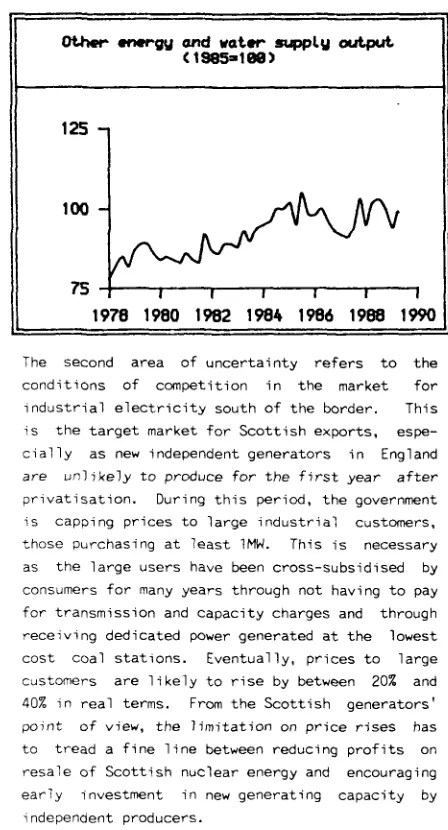
The second area of uncertainty refers to the conditions of competition in the market for industrial electricity south of the border. This is the target market for Scottish exports, espe-cially as new independent generators in England are unlikely to produce for the first year after privatisation. During this period, the government is capping prices to large industrial customers, those purchasing at least 1MW. This is necessary as the large users have been cross-subsidised by consumers for many years through not having to pay for transmission and capacity charges and through receiving dedicated power generated at the lowest cost coal stations. Eventually, prices to large customers are likely to rise by between 20% and 40% in real terms. From the Scottish generators' point of view, the limitation on price rises has to tread a fine line between reducing profits on resale of Scottish nuclear energy and encouraging early Investment in new generating capacity by
independent producers.
The Scottish producers are therefore hedging their bets as to their ability to export power to England. In particular, the present Hydro Board, officially the NSHEB and soon to become Scottish Hydro-Electric, is involved in one of two
'independent' consortia considering constructing power stations on Teesside to burn North Sea gas in a project connected with developments in the steel industry in the area (from which see the section on the iron and steel industry). It could well be that the Scottish producers will attempt to be part of rather than compete with the new
'independent' producers in England.
[image:9.540.54.278.99.514.2]This change of direction is likely to have been the result of the retention of Scottish Nuclear within the public sector. This leaves Scottish Power and Scottish Hydro-Electric more akin to the English power distribution companies in their structure. The future of the Scottish nuclear industry is therefore still subject to political decisions. One of the brighter spots of the privatisation process has been the new policy of glasnost regarding nuclear costs. The two Scottish power boards have written off these £lbn of costs in the year just finished with regard to the closure of the uneconomic Magnox station Hunterston 'A'. These are made up as follows. In addition to £188.8m of direct costs to be written off, upward revisions to decommissioning costs total £143m and the costs of treating operational wastes at the station come to £158.5m. As well as this sum, additional fuel costs from BNFL price rises come to £350m. The SSEB's increase in recurrent nuclear costs is £38m. The decommissioning costs (ie excluding the fuel increase and recurrent costs) compare with a figure for decommissioning CEGB nuclear stations in England and Wales of £600m a time. While this figure is higher than the Scottish numbers, it is also possible that the greater efficiency of the Scottish industry is responsible for the dis-crepancy. However, it is entirely possible that nuclear costs both north and south of the border have still been considerably underestimated.
The government's price freeze, already referred to, also applies to smaller industrial users and consumers. Consumer prices will rise by slightly more than inflation in April, followed by rises in the next two years pegged to inflation. Smaller industrial and commercial customers may see some real decline in their power costs. This is a rather disappointing result, given the decline in input costs, especially coal.
Manufacturing
FOOD, DRINK AND TOBACCO
Food i n d u s t r i e s output
(1985=108)
110 -i
100
-90
1 1 1 1 1 11978 1980 1982 1984 1986 1988 1990
A recent report has proposed that the drinks industry is currently facing two major challenges. The first of these has arisen from the fear of Governments and anti-alcohol groups that people are drinking too much. As a result there have been a number of campaigns pointing out the ill-effects on health of alcohol misuse. This could damage sales of alcohol as people become more aware of these effects. The response of the big drinks groups; Seagram, IDR, Allied-Lyons and Guinness, has been to set up a group to tackle alcohol misuse. The aim of the group, called the Portman Group, is to promote better, more expensive, brands that people should drink less of.
The second challenge facing the industry is consolidation. The 198G"s has seen a number of takeovers and like many other sectors there has been a tendency towards fewer, larger firms which are more international in their outlook. Distribution is the key to gaining a foothold into foreign markets and, as a result, there have also been a number of joint ventures which may or may not result in takeovers. The globalisation of beer markets has been slower but is proceeding
nonetheless. It is expected that in 1992, with the single European market and the breaking down of tariff barriers, consolidation and concentration will speed up. There has been one criticism of this notion. It has been argued that excise duty on alcoholic drinks will remain a barrier to free trade.
In Britain the brewing industry is facing a further challenge. The Monopolies and Mergers Commission has recently suggested that brewers who own more than 2,000 pubs should either sell the
surplus or introduce other beer brands. This is likely to force brewers to concentrate on either brewing or retailing. Whitbread is selling its spirits division to concentrate on retailing and it is expected that only Bass, Courage and Scottish and Newcastle will remain brewers. Guinness don't own pubs and Grand Metropolitan, Whitbread and Allied-Lyons are likely to concentrate on retailing.
Drink and tobacco industries output <1985=100)
160
120
80 -) 1 1 1 1 1 )
1978 1980 1982 1984 1986 1988 1990
In late December Allied-Lyons purchased the wines and spirits division of Whitbread, leaving that company free to concentrate on its retailing activities. Elders IXL the Australian brewing company which owns the Courage beer group in Britain is about to re-acquire 5,000 Courage pubs for £250m. This may be the first step towards an asset swap with Grand Metropolitan. Elders, if this deal went ahead, would exchange the pubs for Grand-Metropolitan's breweries. Grand Metropolitan however, are currently involved in talks with other parties including Anheuser-Busch whose Budweiser beer brand they currently distribute. They wish to settle the future of their brewing investments by spring.
49% share in Remy-Martin and its 19% stake in Cointreau which are soon to merge. If the deal goes ahead, Grand Metropolitan will have a 20% share of the merged company at a cost of £100m. Control Securities, who own Belhaven Breweries, have bought 220 pubs from Grand Metropolitan bringing the total of their pubs to 770. Belhaven sales are expected to rise by 15,000 to 20,000 barrels and Control Securities are now widely regarded as one of the top three regional brewers. They have negotiated a deferred payment for the pubs with initially only £7.5m being paid in cash. Grand Metropolitan will get £5.85m worth of Control shares giving them a 2.5% stake in the company.
A G Barr, the soft drinks manufacturer, has shown better than expected year-end pre-tax profits. They are only £400,000 down on last years' despite the company having suffered a number of setbacks. High interest rates forced up repayments on money borrowed to take over Mandora St Clements, water problems at two plants affected production and rationalisation problems were also prevalent. While interest rates remain high the other problems have been resolved and a good summer boosted sales by 15% and annual turnover by 8%. Alma Holdings, the Dundee based company, is setting up a new plant in Glenrothes at a cost of £7.1m. This will replace the Stockport plant which was destroyed by fire and will employ 260 people. 1,300 people are employed by Alma Holdings world-wide and 1,000 of these are in Scotland. The company is recognised as the third largest UK confectioner since its takeover of Barker and Dobson and Squirrel Horn and Keiller. Sales are expected to exceed £60m.
WHISKY
Export figures for the calendar year 1989 give further evidence of the improved position of the Scotch whisky industry. Total exports were actually 1.4% down on 1988 at 242.5 million LPA (litres of pure alcohol), but the overall performance masks several encouraging features. Bottled blended exports, the mainstay of the industry, rose by 3.6% during the year, with bottled malt exports growing by 4%, a somewhat less spectacular growth rate than of recent years but nevertheless very welcome.
The overall drop in exports is totally accounted
for by a substantial (23%) fall in the volume of bulk blended exports. In many ways this is another illustration of the industry's increased strength because bulk exports are the lowest value-added and most controversial aspect of the industry's activities. It is also worth noting the total nominal value of whisky exports rose by 14% during 1989, reflecting the improved prices which producers are now receiving.
Total whisky production
L i t r e s oP pure alcohol - thousands
150000 -]
100000
50000
-HA/X
Vu .
M M |
YVVT/YF
V
1 1 ! 1 1 1
1978 1980 1982 1984 1986 1988 1990
At the time of writing, information on whisky production is confused by a disagreement between HM Customs & Excise and the Scotch Whisky Association over production levels for the third quarter of 1989. Nevertheless, there seems to be little doubt that production has once again increased sharply, and total output for 1989 will be between 15% and 20% higher than 1988's level of 329.9 million LPA. Production levels such as this have not been seen in the industry for nearly a decade.
US companies withdrawing from the industry. Before the purchase of Whyte & Mackay, Seagram held the only sizeable North American interest in the industry following the withdrawal of both Publicker Industries and Hiram Walker.
This is not, however, the only important change in ownership recently. As the last commentary mentioned, James Burrough Distillers, which includes Long John, was put up for sale by owners Whitbread. The buyers in late December were Allied
Distillers, the wines and spirits arm of Allied Lyons, which has become a substantial force in the industry with its existing Wm Teacher and Hiram Walker connections. Allied will now control around 17% of the world whisky trade, second only to Guinness.
MECHANICAL ENGINEERING
Mechanical engineering output
< 1985-190)
SO
-\
1
, 1 1 1 1
• 1978 1980 1982 1984 1986 1988 1990
The downturn in the economy as a whole is only now beginning to affect the Scottish mechanical engineering sector. The Scottish Chambers of Commerce Business Survey still reports positive balances of responses for new orders, sales and employment. The pattern is similar for the outlook for the next three months. However, the balance of responses for investment is down. This reflects adequate existing capacity and, notwithstanding the optimism regarding output and orders, the level of demand. Within this picture, the view over exports is brighter than that for UK orders. This may well reflect the rapid depreciation of the pound at the end of 1989. One cause for concern noted by a number of respondents is a shortage of skilled labour. This reflects concerns expressed by the CBI at national level about the availability of trained staff.
The employment level in the Scottish engineering
and metals sector has been stable in the year to September 1989 while for Great Britain as a whole employment recovered to its position a year earlier, having declined in early 1989. This indicates that Scotland is not managing to pick up sector employment displaced from the South East of England, especially Greater London, by regionally increased labour and premises costs and by the impending (in England) Uniform Business Rate. The fall-out from the privatisation and the change
in nuclear policy continues to affect prospects for the power engineering industry. Those firms with heavy exposure to nuclear power that have not taken evasive action are likely to face problems, while there is at least the potential for benefits to firms with experience in constructing non-nuclear plants. The UK market for power plant during the 1990s has been estimated at up to 15 000MW, representing some eight stations. The size of the market has recently been reduced by the government's decision not to insist on flue-gas desulphurisation for all coal-fired power plants after the privatisation of the electricity supply industry. This will not only have environmental implications but also mean a loss of orders for both desulphurisation plant and also for generating equipment to replace plants where desulphurisation is uneconomic. The upside is comparatively lower electricity prices.
Of the Scottish firms that have potential for damage by the policy change, Babcock
International, which won the order for the boiler for Sizewell 'B', have the potential to build boilers for fossil-fired stations. The Hopkinson valve subsidiary of Weir is also exposed to the policy change. While John Brown, a subsidiary of Trafalgar House, ought to benefit from their experience in turnkey non-nuclear projects, the indications are currently that the larger scale continental and American producers have been able to enter the market. In particular, Lakeland Power, which have won a major supply contract in the North West of England, are dominated by ABB, the Swedish-Swiss based engineering firm. The American construction firm Bechtel are scheduled to build a power station on behalf of British Coal. It is likely that the recent drive toward integration of a number of European power engineering firms, spurred on by the 1992 process, has not yet finished.
Howden's interim profits have increased by £1.7m to £7.1m, with a number of divisions contributing to profits. In particular, Howden's are supplying four tunnelling machines for the Danish Great Belt project. These are to be delivered by the end of 1990. The sector is seen generally as buoyant, hence the purchase of the Hong Kong drilling consultancy Fedco for up to £1.91m. Also in the tunnelling division, a £3.3m investment is being made in Renfrew. In the power engineering sector, the flue-gas desulphurisation project at Drax is worth some £20m over 3-4 years. The North American market for power generation is seen as being positive over the next few years. By implication, this shows a de-emphasis on the domestic market. Other subsidiaries are also attracting investment: the Craigton plant is to be refurbished to hold Howden Compressors and ADC Fans.
Other industry developments include the purchase by Anderson of the remaining 48.8% of the American firm National Mine Services at a price of $20m. John Brown Engineering have also reported positive results, making a strong recovery. The firm is to develop its water and sewerage engineering capabilities in Glasgow and Clydebank.
ELECTRICAL AND ELECTRONIC ENGINEERING
Following an enormous amount of behind the scenes bargaining, the beginning of the year brought the welcome announcement that Ferranti's radar division has finally been awarded the contract to supply the radar systems for the European fighter aircraft (EFA), a decision which will safeguard the company's defence-related jobs in Scotland until the end of the decade, along side the simultaneous announcement that the radar division had been sold to GEC. There was severe doubt surrounding the possibility of Ferranti winning the order following its acquisition of ISC, with the West German government in particular attempting to stress the lack of wisdom involved in awarding such vital work to a company whose future is so uncertain (while simultaneously pressing the case for a German-manufactured system (the MSD). Indeed, the West German's had originally threatened to fit the alternative system to its own planes, leaving the whole future of the ESA project in doubt. They have now retreated from this position and accepted instead a guarantee that they will not be responsible for cost overruns.
For Ferranti, however, the price has been the sale of its radar division which will at a stroke remove about a quarter of the company's total assets. It appears that the acquisition by GEC was a necessary condition for the contract to be awarded, as a means of securing the financial strength of the radar division. The UK government has accepted this fact and indeed appears to have been a prime mover. Because of its desire to retain an indigenous radar development capability in the UK Ferranti have also sought to further secure its future by selling its sonar division, based in England to a French company Thompson CSF for £32m. The reduced Ferranti group now plans to issue shares to cover its outstanding debts.
Electrical and instrument engineering output (1985=188>
200 -i
100
-0 -) , , , , , ,
, 1978 1980 1982 1984 1986 1988 1990
The remaining worries surround the Ferranti sell-off of its radar division are the implications for competition in radar and whether there are any possible job implications for Scotland following the GEC sale. GEC also owns Marconi, the UK's only other radar manufacturer of note, but the government has clearly accepted that the benefits of keeping control of a vital defence interest in the UK outweigh any adverse implications for competition in the radar industry. It appears highly unlikely, therefore, that there will be any referral to the MMC, although this move has been suggested by Labour MPs. Secondly, the fact that the basic development work on the EFA has been done in Scotland will undoubtedly make it more likely that any rationalisation which follows in GEC's radar interests will occur at Marconi, which was responsible for GEC's loss of the NIMROD radar contract some years ago. Overall, it can be cautiously concluded that the electronic sector in Scotland has done better than appeared possible a few months ago.
growing strongly over the last couple of years. In early 1989 it was announced that 3 of the companies granted manufacturing licences by the DTI will use phones produced at Phillips factory in Dunfermline (see QEC March 1989). Now GPT at Kirkcaldy (a joint venture between GEC and Plessey) has announced that the continual sales success of the system produced there will secure 70 jobs at present, and there is a strong possibility of further new employment in the future as sales continue to expand. Most importantly, however, is the announcement by Motorola that it is to invest £100m at a plant in West Lothian which will produce mobile telephones. The reported 1,500 jobs involved will be a major boost for the area around Bathgate, which had a major disappointment recently with the decision of the Secretary of State to refuse planning permission to use the old British Leyland factory as a major leisure/shopping centre. Motorola have, of course, a long history in Scotland and the East Kilbride factory which produces semi-conductors has developed over time into an integrated operation responsible for design and marketing in addition to manufacturing. It is understood that the Bathgate factory wi11 have a small design team in addition to manufacturing, and while it is impossible at this stage to speculate on the future development of the operation in West Lothian, the company's history of devolving high value added responsibility to Scotland suggests that there could be positive implications for both the quality as well as the level of employment.
The Motorola decision is important in other respects, especially when seen in conjunction with the announcement by Conner Peripherals that it will build a facility in Irvine which is expected to create another 1,500 jobs. Both of these announcements will go a long way to restoring the public image of Locate in Scotland and also to calming fears that Scotland is failing to compete in inward investment, a possibility which would threaten the continued expansion of "silicon glen". Such claims were bandied at the time of the Wang decision last year and when the Intel Corporation announced that it was to locate a major semi-conductor manufacturing facility in Ireland instead of Scotland. As was noted at the time, however, the Wang situation arose because of problems within the company and it was not reasonable, in our opinion, to infer that Scotland was in danger of becoming the wrong location for electronics plants. Intel was a major
disappointment, but it is known that the company was overwhelmingly concerned with finding a low-cost production base in Europe, and "it is at least debatable whether Scotland should choose to offer only financial support to inward investors. It is germane to point out that Scotland retains a major package of attractions, not least the fact of a well-established electronics industry.
Indeed, Conner have indicated that the major factors which attracted them to Scotland were the provision of an advanced factory, the quality of the labour force and the existing of an established supplier base. In addition, locating
in Irvine will place it within 40-50 miles of a large number of major customers, particularly SUN, Compaq and IBM. All of these factors are, in some sense, due to a legacy of previous inward investment in electronics in Scotland and it is this which other peripheral areas of the UK find hard to match. Scotland cannot be expected to attract all major inward investment projects in electronics, but it will continue to attract a stream of them.
CHEMICALS & MAN MADE FIBRES
The latest Scottish Chambers Business Survey (SCBS) shows that a balance of 46% of respondent firms are less optimistic about the general business situation than they were three months ago. This shows a marked continuation in the decline of optimism. In the previous SCBS, only 20% of respondents were less optimistic than they were when answering the same question, three months ago.
Table 1 Scottish Chambers Business Survey Chemicals & Man Made Fibres
% Balance
Quarter 1:90 Quarter 4:89 Balance of Optimism -46% -20% Trend in Orders -25% 15% Trend in Sales -26% 30% Trend in Employment -58% 4%
balance of -63% and -42% f o r expected new orders
and sales respectively, t o outside the United
Kingdom.
Respondent firms are expecting t o run down t h e i r
stocks of finished goods and raw materials i n the
next quarter with negative balances of -17% and
-22% respectively.
C h m i c a l s and man Mad* Fibres output
<1985-1 ee>
125
n
100
75 i 1
—i
1 1 1 1
1978 1980 1982 1984 1986 1988 1990
Capacity utilisation stands at an average of 81% for respondent firms whilst a balance of -58% of firms responding foresee a reduction in their seasonally adjusted employment needs for the next three months. The brunt of this employment reduction is being met by reductions in female employment with a balance of -59%. However, a balance of 47% of firms are expecting a reduction in male employment.
It is apparent that high interest rates are continuing to be a disincentive for investment with a negative balance of -78% of respondent firms revising their investment intentions for plant and equipment downwards. It is a similar story for investment in buildings although not quite so marked with a balance of 21% showing a downward revision.
The current changes in Eastern Europe represent an opportunity for investment in this sector and many companies are aware of the substantial potential that may be afforded to them. ICI is already represented in every Eastern European country except Albania, although they are awaiting market moves before committing large sums.
Britain is still seen as the Dirty Man of Europe and it is not a great triumph that it is to take us eight years to stop the dumping of untreated sewage sludge in the North Sea. The tide has turned and it is now a brave company indeed that
will disregard the environmental consequences of its actions. The smart company should not wait for government legislation before adopting conservation measures, as there is a financial saving to be made as well as the environmental considerations.
Recycling and re-use: chemicals can be recovered from the production process and re-used.
Separation of toxic and non toxic waste, thus allows most wastes to be recycled and facilitates a waste audit to be undertaken.
Equipment modernisation and regular inspection will keep spills of chemicals to the minimum -simple good housekeeping.
Process redesign: the introduction of closed loop systems in order to prevent waste.
Input substitution: e.g. degreasing can be accomplished by the use of a water and detergent compound rather than chlorinated solvents.
Product redesign: it may be possible to replace an existing product with one that can be manufactured using a less toxic production method.
The foregoing are all worth considering and may increase profits as well as company image.
TEXTILES, FOOTWEAR, LEATHER & CLOTHING
downwards for a net of - 6 % and -11% of companies respectively. The orders and sales least affected are exports outside of the UK. The downwards trend is expected to continue and has already affected the trend in the volume of stocks of finished goods which has risen for a balance of +17% of firms. It is thought that this is likely to be ongoing over the next three months for a balance of +24% of respondents. 77% of all firms asked believed falling orders and sales are most likely to limit output over the next three months.
While a net of -43% of responding firms have shown a downwards trend in total employment over the last three months, a balance of +10% expect employment to rise over the near future. These results are also less pessimistic than those noted in last quarter's Commentary when a net of -40% of firms expected the downwards employment trend to continue. Female employment has been the worst affected with a balance of -39% of respondents reporting that this had fallen.
The issues facing the textile sector in the near future have forced a number of reactions from those involved. A number of textile groups from Western Europe are joining forces to represent the industry on issues such as the single European market and the expected abolition of the Multi-Fibre Arrangement (MFA). There is to be a committee formed to act on behalf of the industry composed of six industrialists with the United Kingdom, West Germany, France and Italy each having one representative.
There have also been reports of a restructuring in the industry as textile companies attempt to remain or become more competitive in the world market.
There has been a shift towards higher value products, diversification and the use of smaller, more versatile production units. Raised productivity is essential and expensive high quality products are more in vogue. This renders labour costs less important although in Europe employment has decreased. The greatest fear has been expressed over the abolition of the MFA even though the Economist Intelligence Unit has indicated that imports from developing countries into developed ones are lessening.
A conference organised by the General, Municipal and Boilermakers Union in Hawick expressed fears that textile companies in Poland and Hungary are
hoping to increase their quotas under the existing MFA by 60% and 16% respectively. There have been calls for stricter import controls rather than existing ones being relaxed. It was restated that jobs lost from the abolition of the MFA would be closer to 100,000 than the governments estimate of 30,000 and there has also been discussion over the level of textile imports into Britain and the jobs already lost as a result of import penetration. Small and medium firms are said to have suffered most - especially those in the sector in competition with low cost imports from developing countries.
A recent report has indicated that the UK hosiery industry is facing increased European competition and reduced demand, the result of which may be a price war at the lower end of the market. During the 1980's tights and stockings became an
important fashion accessory. Prices were high and sales increased. Changes in taste away from expensive patterned tights have resulted in decreased demand and increased competition as European and US companies have been attempting to gain a foothold in the British market.
Regular Commentary readers will be aware of the long running discussions concerning the merger proposal between Coats and Tootal. The latest news is that these have broken down even though the Monopolies and Mergers Commission agreed to the Merger in October last year.
The Chief Executive of Tootal has said that the companies failed to agree on a price even although the rationale for a merger remains. In May 1989 Coats valued Tootal at E395M but their recent offer has been for £315M. Tootal are aware that the uncertainty which has lasted now for a year is bad for their business given the current poor market conditions and have decided to remain independent and expand into the Far East.
It is expected that Coats will still sell its 20% share of Gutterman as well as its UK domestic thread interests in the hope that at some point in the near future talks will be resumed. Coats Deputy Chairman blamed the present poor state of the textiles market for the breakdown. Coats shares have fallen since the merger proposals began and it has suffered a fall in interim pre-tax profits from £76M to £55M.
profits to £23.5M. This has resulted partly from a restructuring of the group and partly from the particularly cold winter. In the past year there have been redundancies and short term working at most of its companies resulting from a combination of high cashmere prices, poor quality raw materials, supply problems, higher prices to offset raw materials costs and the strong pound affecting the US market. In addition, fashion tastes away from this kind of product compounded the problems.
Four divisions have now been established - one each for US interests, spinning and weaving, fur fabrics and cashmere, knitwear and fine yarns. Each division will concentrate only on its own market. It is hoped this will rationalise the business side. New lines are being introduced as well as shops selling knitwear direct to the public (Ballantyne and Pringle). The knitwear company is also benefiting from new investment and Dawson is now more confident about their place in the knitwear market as well as the future of the market itself.
James Seddon, the Manchester based shirtmaker has gone into receivership and there is fear that 1,200 jobs at the four Scottish plants may be lost.
Throughout January the company was involved in merger talks to encourage investment. Later reports indicated that the Denny and Mayfield plants were to close with a loss of 450 jobs. Buyers are being sought and there has been some interest expressed in the Mayfield and Denny factories. The US Russell Corporation may buy the Mayfield factory to expand their Scottish interests. It is hoped that the company can be sold as a going concern.
A number of companies have changed hands over the past three months. Walter Alexander is in the process of selling the majority of its businesses to a single buyer for £32M. The home textiles division has been sold separately. Coats Viyella has agreed to a management buyout for £27M cash for its Nottingham Group - the schools and hospitals equipment subsidiary since their policy is now to concentrate on the textiles and clothing market. A buyer has now been found for the Borders knitwear firm Murray Allen securing its 125 jobs. Union Cashmere beat off another two firms to take over Murray Allen after its parent company Oakwood
was put into receivership. Murray Allen are now expected to produce cashmere knitwear for export. PAPER, PRINTING AND PUBLISHING
Paperi printing fc publishing output C1985=100)
125 -,
100
75 -) 1 1 1 1 1 1
. 1978 1980 1982 1984 1986 1988 1990
The results of the latest Scottish Business Survey indicate that a net - 3 % of firms are less optimistic about the general business situation than three months ago. This is despite the trend in both the volume of new orders and sales rising for a balance of +31% and +13% of firms. While the upwards trend is expected to continue for new orders, a net - 3 % of respondents expect a downwards trend in the volume of new sales over the near future. Non-UK orders and export sales have shown the best results - a balance of +35% of firms have increased the volume of their non-UK orders and a net of +55% their export sales. This healthy trend is expected to continue over the next three months.
The trend in total employment is downwards with a balance of -21% of companies reporting this. The downward trend is expected to continue. Male employment has been the worst affected - a balance of -17% of firms have shown a decrease in male employment while only a net of - 7 % have indicated that female employment has been falling.
for thirteen consecutive quarters. This has fed into paper prices.
Investment in a new pulp or paper mill, to increase capacity in order to meet increased demand, must be on a large scale and, with cost considerations, planned at least two years in advance. When in operation a new mill raises capacity considerably. Before new capacity is brought into effect there tend to be supply constraints followed by rising prices and since it is not until prices are rising that investment will be encouraged, there is an inevitable time lag. It is often the case that demand is starting to be "choked off" by rising prices at the same time as the new capacity is brought onto the market. This results in spare capacity and the industry goes into decline. At such a time older high cost producers will be hardest hit unless they are in a position to shoulder any losses which may be sustained. This produces a spate of mergers and takeovers as companies try to even out profits and losses in pulp and paper production.
The paper industry at the present time is aware that it could be on the verge of the kind of decline described above. A lot of new capacity has recently been brought into effect at a time when the market is starting to 'soften1. There has been an effort to iron out the booms and slumps cycle that is prevalent in paper production. As a result there have been many mergers and the industry is also becoming more international to take advantage of cheap raw materials and new markets in other areas. Takeovers have taken place as each company vies to remain in business should the market deteriorate. Size and new technology are seen to be the safest guards against bankruptcy alongside vertical integration.
In Britain there has been a high level of restructuring into a smaller number of very large mills but despite the success of these mills imports are still high. It is hoped that with more recent investment coming into effect import levels will fall. One optimistic sign is that foreign companies are now investing in UK paper mills and there have been a number of joint ventures between Uk and foreign firms eg Reedpack are considering a partnership with Daishowa a Japanese owned Canadian paper company. It is felt that the market is less buoyant now than it has been and that it is no longer possible to pass cost increases onto the consumer resulting in a
decrease in profitability. The steps taken to remain competitive in the world market will be of vital importance in the near future as competition sharpens in the face of a possible downturn. At industry level the actions of companies in the face of increased competition are shown by the speculation which took place throughout December over the £263m takeover bid for UK Paper by Metsa-Serla the Finnish forest products group. The deal, had it gone ahead, would have been advantageous for Metsa-Serla in terms of vertical integration since it is, in the main, a pulp producer while UK Paper manufactures fine paper. The combined company would also have been much larger in the current highly competitive market. City analysts however, expressed a fear that the company was selling too cheaply. They argued that land owned by the company, which became independent in 1986 after a management buyout from Bowater Industries for £38m, was undervalued and that the benefit to Metsa-Serla of owning UK Paper was greater than what they were offering. Although it had been suggested by the board of UK Paper that pre-tax profits for 1989 would be £15m - down from £19m in 1988 as a result of high pulp prices, in fact at the interim stage for 1989 pre-tax profits had increased by 9.5%. This further strengthened the analysts argument. The UK Paper Chairman however stated that he was happy with the Metsa-Serla offer and urged shareholders to sell. He suggested that Metsa-Serla were the kind of organisation which UK Paper wished to be involved with and that under the new deal the management of UK Paper would remain independent. The situation changed very quickly when Fletcher Challenge, a New Zealand pulp and paper group, offered £299m for the company. They are interested in expansion in Europe as well as diversification - at the moment they produce newsprint paper. UK Paper accepted their increased offer since Metsa-Serla did not increase theirs to match Fletcher Challenge. The city analysts had been proved correct.
Services
FINANCIAL SECTOR