Int. J. Electrochem. Sci., 13 (2018) 333 – 343, doi: 10.20964/2018.01.10
International Journal of
ELECTROCHEMICAL
SCIENCE
www.electrochemsci.org
A study on Electrosynthesis of 2,5-dichlorophenol Using
Titanium Anode Coated with Metallic Oxide
Xiangyu Ma1,2, Xuguo Tu1,2, Ruinan He1,2,Yanjun Wu1, Beibei Zhang1, Yunshan Bai1, Jianping Zeng1, Shouyan Shao2, Guisheng Zhu2, Song Chen1,2*
1
School of Chemistry and Chemical Engineering, Yancheng Institute of Technology, Yancheng 224051, P. R. China
2
College of chemistry and chemical engineering, Jiangsu University, Zhenjiang, Jiangsu 212013, P.R. China
*
E-mail: [email protected]
Received: 25 September 2017 / Accepted: 24 October 2017 / Online Published: 1 December 2017
A conventional thermal decomposition method was used to prepare Sn-Ir electrodes modified with Sb-, Co-, and Ce-based oxides, which were applied to synthesize 2,5-dichlorophenol by the electro-oxidation of 1,4-dichlorobenzene. The morphology of the electrodes was investigated by scanning electron microscopy (SEM) and X-ray diffraction (XRD). Cyclic voltammetry (CV) and linear sweep voltammetry (LSV) tests were employed to analyse the electrolysis experiment and electrocatalytic activity of the electrodes. The results showed that Sn-Ir electrodes doped with designated amounts of Sb, Co or Ce could compact the coating, and improve the stability of the electrode. Typically, Sn-Ir doped with 1% Ce had a good response in the LSV measurement, which yielded a 2,5-dichlorophenol concentration of 45% with a selectivity of 85%. The conversion rate of 1,4-dichlorobenzene was 53%, which indicated that the Sn-Ir-Ce electrode had a better catalytic activity.
Keywords: 2,5-dichlorophenol; electrosynthesis; Sn; Ir; Sb; Ce; Co
1. INTRODUCTION
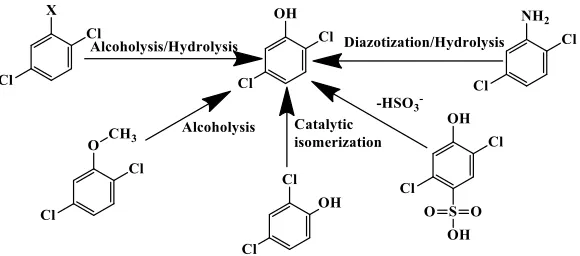
[9]. The electrolyte contains trifluoroacetic acid and triethylamine. CF3COO- was oxidized to CF3COO· at the anode, and the radical combined with 1,4-dichlorobenzene to form the intermediate of 2,5-dichlorophenol. Then, 2,5-dichlorophenol was generated by hydrolysis [Reactions (1)-(4)]. Although the formation of 2,5-dichlorophenol was believed to occur directly in the water phase for OH· to be generated easily, O2 could be formed as well, and O2 could react with 2,5-dichlorophenol. Therefore, the reaction was complex in the water phase.
Typically, conditions such as the anode materials, current density, electrolysis time and type of electrolyte could influence the yield of 2,5-dichlorophenol in the electrolysis experiments. It is known that electrodes with high electrocatalytic activity can enhance the yield. A platinum electrode is usually used in electrolysis for its stability and higher catalytic activity; however, platinum electrodes are expensive, and they are not feasible for large-scale industrial applications. Furthermore, the electrochemical catalytic activity of the platinum electrode still needs to improve to meet the needs of practical applications. Actually, a new type of anode, which is a Ti-based dimension stable anode (DSA), has attracted a great deal of attention in recent decades, and it is widely applied in the chlor-alkali industry, electrosynthesis, oxygen evolution reaction, and sewage disposal because of its advantages of superior performance and facile fabrication [10-14]. Ti is chosen as the substrate for its availability and corrosion resistance compared with Zr, Nb, Hf, and Ta [15]. It is known that the electrochemical performance of DSAs can be improved by altering the composition and morphology of the coating [16]. SnO2 and IrO2 are usually selected as the metallic oxide coating for their good performance in electrocatalysis [17-21]. To get a better electrode in terms of service and electrochemical performance, other metallic oxides are doped in the electrode because the physical structure of the electrode is changed, and the metallic oxides dopants can increase the adhesion between the coating and the substrate [22-25].
Scheme 1. Chemical methods for the synthesis of 2,5-dichlorophenol
2. EXPERIMENTAL
2.1 Preparation of electrodes
[image:3.596.155.445.70.198.2]Titanium mesh (5 cm × 5 cm) was pretreated by thermal oxidation (500 ℃) to degrease the sample. Next, it was sand blasted to obtain a rough surface. Then, to remove the oxides and strengthen the adhesion between the coatings and the substrate, it was etched in 30 wt % sulfuric acid heated to 80 ℃ for 30 min, and the Ti substrate was subsequently washed with deionized water. Different mole ratios of SnCl4·5H2O (99%, Aladdin Co., Ltd., Shanghai, China), HIrClO4 (Ir wt %=35%, Aladdin Co., Ltd., Shanghai, China), CoCl2·6H2O (99%, Aladdin Co., Ltd., Shanghai, China), SbCl3 (99%, Aladdin Co., Ltd., Shanghai, China) and CeCl3·7H2O (99%, Aladdin Co., Ltd., Shanghai, China) (Table 1) were added to n-butyl alcohol as a brush solution. The brush solution was dipped on the Ti substrate, dried at 120 ℃ for 10 min and heated up at 500 ℃ in air atmosphere for 10 min. The electrodes were cooled naturally to avoid cracking on the electrodes surface. The above process was repeated 12 times, and the final time it was heated at 500 ℃ for 1 h. Total metal mass of the coating was 20 g·m-2.
Table 1. The various compositions of prepared electrodes
Entry Sn Ir Co Sb Ce
E1 95 5
E2 90 10
E3 85 15
E4 80 20
E5 78 20 2
E6 76 20 4
E7 74 20 6
E8 75.2 20 4.8
E9 75 20 0.5
E10 70 20 1
E11 65 20 1.5
2.2 Accelerated life test of electrodes
Accelerated electrolysis life test was carried out to compare the adhesion of metallic oxides with Ti substrates in a solution containing 1 mol L-1 H2SO4 at a current density of 10 A·cm-2. The Ti electrode was used as the counter electrode, and the thermostat water bath was used to keep the temperature at 40 ℃. When the voltage increased 5 V, the electrode was considered invalid [26]. The purpose of the accelerated life test of the electrodes was to select the electrodes that had a longer service life for the anode in the electrolysis experiments.
2.3 Electrochemical characterization
The electrochemical behaviour of 1,4-dichlorobenzene oxidation was investigated by using a CHI660B electrochemical workstation (Shanghai Chenhua Instruments Co., Ltd., China). The electrochemical cell was assembled with a conventional three-electrode system with a Pt plate working electrode, a saturated calomel reference electrode (SCE), and a graphite plate counter electrode. The working and counting electrodes were chosen because the Pt plate has the characteristics of an active anode as well and the graphite shows superior conductivity, making them suitable for this purpose. The electrolyte was a mixed solution of trifluoroacetic acid and triethylamine (mol ratio was 2:1) containing 0.1 mol·L-1 1,4-dichlorobenzene.
2.4 Synthesis of 2,5-dichlorophenol
Scheme 2. The electrolysis device
cathode (2 cm × 2 cm). A polypropylene diaphragm was used to divide the chambers. The current density was 7.5 mA·cm-2. The electrolyte was a mixed solution of trifluoroacetic acid and triethylamine (mol ratio was 2:1), which were added with 1,4-dichlorobenzene (0.1 mol·L-1) in the anode chamber (50 ml), and cathode chamber contained 50 ml of a mixed solution of trifluoroacetic acid and triethylamine (mol ratio was 2:1). The electrolysis was conducted in the plate and frame electrolytic cell showed in Scheme 2, and the electrolysis time was calculated by the faradaic efficiencies, which were determined to be 100% by equation (5). With electrolysis time, the by-product could be formed by CF3COO· and the intermediate of 2,5-dichlorophenol.
2.5 Analysis method
The electrolyte was hydrolysed to form 2,5-dichlorophenol after electrolysis and extracted by methylbenzene. Because the boiling points of methylbenzene, 1,4-dichlorobenzene, and 2,5-dichlorophenol are 110.6 ℃, 173.4 ℃, and 210 ℃, respectively, the extract was analysed by gas chromatography (HP6890N, Agilent Technologies Co., Ltd.). The temperature programming was set from 50 ℃ to 230 ℃ at a speed of 20 ℃ per minute. The standard curve of the peak area and concentration of 1,4-dichlorobenzene and 2,5-dichlorophenol were drawn to precisely calculate the concentration of 1,4-dichlorobenzene and 2,5-dichlorophenol. In addition, the conversion rate, selectivity and yield could be calculated by the following equations:
2.6 Physical characterization
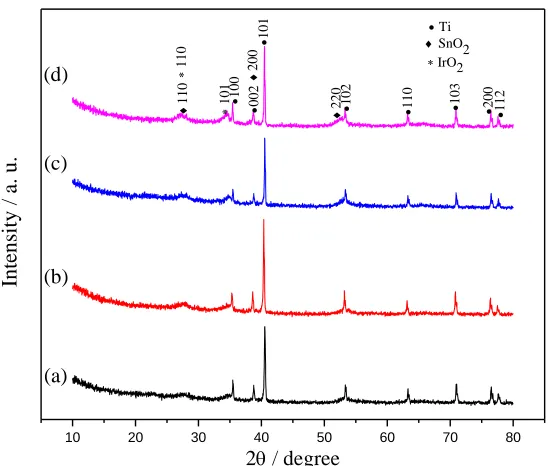
A Hitachi S-4800 SEM was utilized to observe the surface microtopography of the electrodes. XRD analysis (D/MAX-2500, Rigaku, Japan) was used to measure the microstructure of the electrodes using a diffractometer with Cu K-Alpha radiation (λ=1.54425 nm) working at 40 KV/40 mA. The diffraction patterns were collected in the range of 2θ=10-80° at a rate of 10° per minute.
3. RESULTS AND DISCUSSION
3.1 Accelerated life test
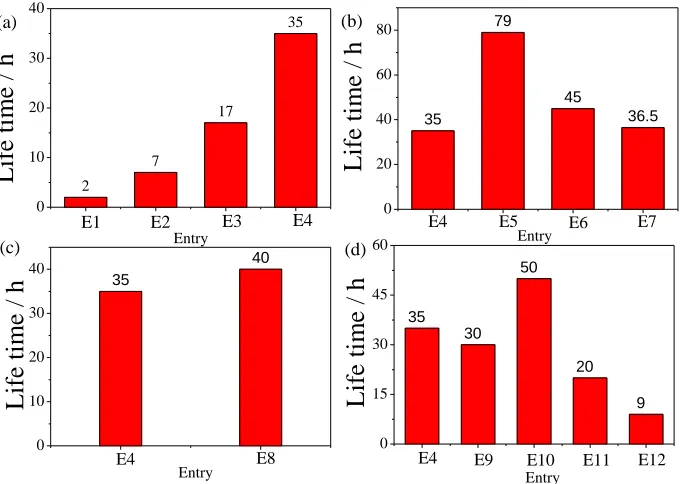
decreases, the accelerated life was obviously increased. Ir is a metal that was previously taken into consideration, and the amounts of Sn and Ir were determined as 80% Sn and 20% Ir (mol ratio). E5, E6 and E7 were prepared by using E4 doped with different amounts of Co, as is shown in Figure 1 (b). Here, E5 had a longer accelerated life. As the content of Co increases, the accelerated life decreases. Figure 1 (c) reflects that E4 doped with Sb at a ratio of Sn: Sb=94:6 (mol ratio) [27] could improve the accelerated life of the electrode. E9, E10, E11 and E12 were prepared by E4 doped with different amounts of Ce, as is shown in Figure 5 (d), and E10 had a longer accelerated life. Ce is a rare earth metal that can improve the performance of the electrode when doped with an appropriate amount [28]. An electrode surface with fewer cracks could protect the Ti substrate and slow corrosion. Xu et al. [29] reported that the accelerated life of an IrO2-Ta2O5-coated titanium electrode could last 800 h at 2 A·cm-2 in 1 mol L-1 H2SO4 at room temperature. According to the equation, , (i2 and i1 are the actual current density and the accelerated current density, respectively; τ2 and τ1 are the actual service life and accelerated life, respectively), the accelerated life of E4, E5, E8 and E10 are longer than the life of the IrO2-Ta2O5 electrode (70% content of Ir).
2 7 17 35 35 79 45 36.5 35 40 35 30 50 20 9 0 10 20 30 40 (d) (c) L ife ti me / h L ife ti me / h Entry
E1 E2 E3 E4 0
20 40 60 80 0 10 20 30 40 L ife ti me / h E4 0 15 30 45 60 E12 (b) Entry Entry Entry E11 E10 E9 E4 E8 E4 E7 E5 E6 L ife ti me / h (a)
Figure 1. The accelerated life of different electrodes in 1 mol L-1 H2SO4 at a current density of 10 A·cm-2.
3.2 Cyclic voltammetry
[image:6.596.133.473.342.584.2]
Figure 2 (2), the relationship between the peak current (Ip) and the scan rates is linear, indicating that the electrode reaction was a surface controlled process and that the electrolytic reaction could be influenced by the electrode [30]. It was necessary to seek out an electrode with a high electrocatalytic activity.
0.6 0.8 1.0 1.2 1.4 1.6
-5.0x10⁻⁴ 0.0 5.0x10⁻⁴ 1.0x10⁻³ 1.5x10⁻³ 2.0x10⁻³
50 100 150 200 250 300 0
20 40 60 80 100 120 140 160
Current density/ A·cm
-2
Potential / V vs SCE
a b c d e
(1)
V
/
m
V
·s
-1
Ip / μA (2)
Figure 2. (1) Cyclic voltammograms of 0.1 mol·L-1 1,4-dichlorobenzene at a Pt electrode at the different scan rates of (a) 10 mV/s, (b) 25 mV/s, (c) 50 mV/s, (d) 100 mV/s, and (e) 150 mV/s. (2) Linear relationship obtained between the peak current and the increase of the square root of scan rates.
3.3 Electrolysis experiments
Gas chromatography was used to examine the product and calculate the yield. As is shown in Figure 3 (a), the retention times of 6.62, 8.06, and 9.37 correspond to 1,4-dichlorobenzene, 2,5-dichlorophenol, and a by-product (deep oxidation), respectively. In theory, 2,5-dichlorophenol was the only product of the electro-oxidation of 1,4-dichlorobenzene. However, during deep oxidation, it was difficult to prevent the formation of 2,5-dichlorophenol. Figure 3 (b) shows the standard curves, in
which (1,4-dichlorobenzene), (2,5-dichlorophenol), such
that x is the concentration (mol·L-1), and y is the peak area.
[image:7.596.104.450.164.409.2]
6 7 8 9 10 11
30 40 50 60 70 80 90
0.005 0.010 0.015 0.020 0.025
0 100 200 300 400 500 600 700 800
(b)
R
el
at
ive
abund
ance
Retention time / min
6.62
8.06
9.37
(a)
Peak
area
C / mol·L-1
[image:8.596.115.489.99.252.2]6.62 8.06
Figure 3. (a) Metrological chromatograph of the products, the retention times of 6.62, 8.06, and 9.37
[image:8.596.47.549.371.471.2]correspond to 1,4-dichlorobenzene, 2,5-dichlorophenol, and a by-product, respectively. (b) Standard curve of the peak area corresponding to the concentration of products. 6.62 is 1,4-dichlorobenzene, 8.06 is 2,5-dichlorophenol.
Table 2. The results of gas chromatography after calculations
Entry
1,4-Dichlorobenzene (peak area)
2,5-Dichlorophenol (peak area)
Yield Conversion Selectivity
E4 84 60 43% 54% 79%
E5 106 42 36% 47% 77%
E8 143 28 31% 35% 89%
E10 89 65 45% 53% 85%
3.4 Surface analysis
Figure 4. SEM images showing the surface morphologies of E4, E5, E8 and E10.
10 20 30 40 50 60 70 80
101
220
200
110
112
200
103
110
102
(d)
(c)
(b)
Ti
101
002
Intensity / a. u.
2 / degree
100
(a)
SnO2
110 IrO2
Figure 5. XRD patterns of electrodes (a) E4, (b)E5, (c) E8, and (d) E10.
3.5 Liner sweep voltammetry
[image:9.596.152.426.402.635.2]
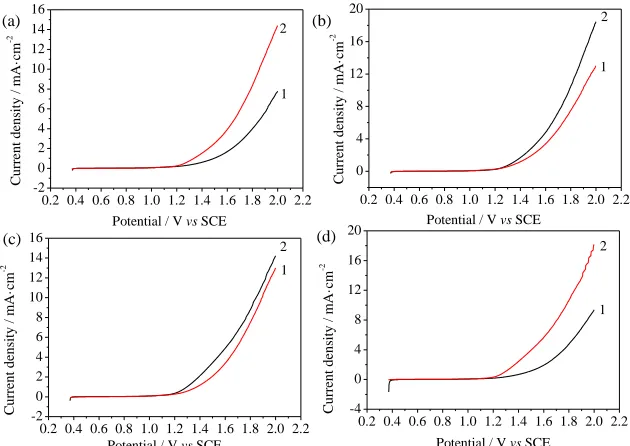
attributed to the participation of 1,4-dichlorobenzene in the reaction. The net current of the E4 and E10 samples was notably larger than that of E5 and E8, which reflects that E4 and E10 have a better catalytic activity for the electro-oxidation of 1,4-dichlorobenzene. The surface structure should also be considered for this result. The SEM images of E4 and E10 show many thin particles that enhance the real area of the electrode and improve its the electrocatalytic activity. Based on the results of the cyclic voltammetry, E4 and E10 are more suited for use as anodes in the electrolysis experiments. These results are consistent with the electrolysis experiments.
0.2 0.4 0.6 0.8 1.0 1.2 1.4 1.6 1.8 2.0 2.2 -4 0 4 8 12 16 20
0.2 0.4 0.6 0.8 1.0 1.2 1.4 1.6 1.8 2.0 2.2 -2 0 2 4 6 8 10 12 14 16
0.2 0.4 0.6 0.8 1.0 1.2 1.4 1.6 1.8 2.0 2.2 -2 0 2 4 6 8 10 12 14 16
0.2 0.4 0.6 0.8 1.0 1.2 1.4 1.6 1.8 2.0 2.2 0 4 8 12 16 20 C ur rent dens it y / m A ·cm -2
Potential / V vs SCE 2
1
Potential / V vs SCE
C ur rent dens it y / m A ·cm -2 2 1 (c) (d) (b) C ur rent dens it y / m A ·cm -2
Potential / V vs SCE
(a) 2 1 C ur rent dens it y / m A ·cm -2
Potential / V vs SCE 2
[image:10.596.150.465.227.450.2]1
Figure 6. LSV of different electrodes (a) E4, (b) E5, (c) E8, (d) E10 in the blank solution (1) and in the sample solution (2).
4. CONCLUSIONS
References
1. T. Eisner, L. B. Hendry, D. B. Peakall and J. Meinwald, Science, 172 (1978) 277. 2. A. W. Carlson, C. Lake, US patent, 7972492 (1978)568.
3. M. Ahmaruzzaman, Adv. Colloid Interface Sci., 143 (2008) 48. 4. G. Alexander, J. Am. Chem. Soc., 74 (1952) 3890.
5. K. Fujimoto, Y. Tokuda, H. Maekawa, Y. Matsubara, T. Mizuno and I. Nishiguchi, Tetrahedron, 52 (1996) 3889.
6. B. Lee, H. Naito and T. Hibino, Angew. Chem., 51(2012) 440. 7. H. J. Schäfer, C. R. Chim., 14(2011)745.
8. E. J. Horn, B. R. Rosen, Y. Chen, J. Tang, K. Chen, M. D. Eastgate and P. S. Baran, Nature, 533 (2016) 77.
9. X. Y. Ma, X. G. Tu, R. N. He, Y. Chen, G. S. Zhu, S. Y. Shao and S. Chen, J. Electrochem., 3 (2017) 327.
10.S. Wu and G. G. Zeng, Envir. Sci. Technol., 44,(2010)1754.
11.R. G. Haverkamp, A. T. Marshall, B. C. C. Cowie, Surf. Interface Anal., 43 (2011) 847.
12.F. Ye, J. Li, X. Wang, T. Wang, S. Li, H. Wei, Q. Li and E. Christensen, Int .J Hydrogen Energy, 35 (2010) 8049.
13.W. Wu, Z. H. Huang and T. T. Lim, Appl. Catal. A- Gen., 480 (2014) 58. 14.R. K. B. Karlsson and A. Cornell, Chem Rev., 116 (2016) 2982.
15.C. Mallika, B. Keerthika and U. K. Mudali, Electrochim. Acta, 52 (2007) 6656.
16.F. Fathollahi, M. Javanbakht, P. Norouzi and M. R. Ganjali, Russ. J. Electrochem., 47 (2011) 1281. 17.E. Chatzisymeon, S. Fierro, I. Karafyllis, D. Mantzavinos, N. Kalogerakis and A. Katsaounis, Catal.
Today, 151 (2010) 185.
18.A. L. Giraldo, E. D. Erazo-Erazo, O. A. Flórez-Acosta, E. A. Serna-Galvis and R. A. Torres-Palma, Chem. Eng. J., 279 (2015) 103.
19.S. Ferro, D. Rosestolato, C. A. Martínez-Huitle and A. D. Battisti, Electrochim. Acta, 146, (2014) 257.
20.H. B. Xu, Y. H. Lu, C. H. Li and J. Z. Hu, J. Appl. Electrochem., 40 (2010) 719.
21.20 J. Y. Xu, Q. F. Li, E. Christensen, X. D. Wang and N. J. Bjerrum, Int. J. Electochem. Sci., 8(2013)2388.
22.L. Vazquez-Gomez, S. Ferro and A. D. Battisti, Appl. Catal. B- Environ., 67 (2006) 34. 23.L. Zhang, X. Li, J. He and J. Zhang, Electrochim. Acta, 117 (2014) 192-201.
24.X. Cui, G. Zhao, Y. Lei, H. Li, P. Li and M. Liu, Mater. Chem. Phys., 113 (2009) 314. 25.L. Yuan, H. Liu, J. Ma and J. Li, Electrochim. Acta, 56 (2011) 1352.
26.F. Montilla, E. Morallón, A. D. B. And, and J. L. Vázquez, J. Phys. Chem. B, 108 (2004) 213. 27.W. Wu, Z.-H. Huang and T.-T. Lim, Appl. Catal. A- Gen., 480 (2014) 58.
28.X. Chen, P. Yao, D. Wang and X. Wu, Chem. Eng. J., 147 (2009) 412. 29.L. K. Xu, Y. L. Xin and J. T. Wang, Electrochim. Acta, 54(2009)1820.
30.E. Saint-Aman, M. Ungureanu, T. Visan and J. C. Moutet, Electrochim. Acta,42(1997)1829. 31.H. L. Qi, D. S. Chen, J. S. Ye and J. M. Huang, J. Org. Chem., 78 (2013) 7482.
32.G. R. P. Malpass, R. S. Neves and A. J. Motheo, Electrochim. Acta, 52 (2007) 936. 33.Y. Feng, Y. H. Cui, J. Liu and B. E. Logan, J. Hazard. Mater., 178 (2010) 29.
34.Z. D. Ren, S. S. Quan, J. Gao, W. Y. Li, Y. C. Zhu, Y. Liu, B. Chai and Y. R. Wang, RSC Adv, 5 (2015) 8778.
![Figure 2 (2), the relationship between the peak current (Ip) and the scan rates is linear, indicating that the electrode reaction was a surface controlled process and that the electrolytic reaction could be influenced by the electrode [30]](https://thumb-us.123doks.com/thumbv2/123dok_us/1778513.131877/7.596.104.450.164.409/relationship-indicating-electrode-reaction-controlled-electrolytic-influenced-electrode.webp)