ISBN 978-94-6138-486-7
This study was carried out at the request of the Impact Assessment Unit of the Directorate for Impact Assessment and European Added Value, within the Directorate General for Parliamentary Research Services (DG EPRS) of the General Secretariat of the European Parliament. Originally entitled “The Internal Market aspects of EU copyright: The added value and options for improving the functioning and efficiency of the Single Market in the field of copyright”, it is part of a larger, 3-part study entitled “Review of the EU copyright Framework: European Implementation
Assessment”, published on the Parliament’s website
(http://www.europarl.europa.eu/thinktank/en/document.html?reference=
EPRS_STU%282015%29558762). It is republished here by CEPS with the kind permission of the European Parliament.
The opinions expressed in this document are the sole responsibility of the authors and do not represent the official position of the European Parliament or CEPS.
Reproduction and translation for non-commercial purposes are authorised, provided the source is acknowledged and the publisher is given prior notice and sent a copy.
Available for free downloading from the CEPS website (www.ceps.eu) Brussels © European Union, 2015.All rights reserved.
Centre for European Policy Studies ▪ Place du Congrès 1 ▪ B-1000 Brussels ▪ Tel: (32.2) 229.39.11 ▪ www.ceps.eu
Policy Options for Improving the
Functioning and Efficiency of the Digital
Single Market in the Field of Copyright
Andrea Renda, Felice Simonelli,
Giuseppe Mazziotti and Giacomo Luchetta
No. 121 / November 2015
Abstract
T
ABLE OF
C
ONTENTS
Executive Summary ... i
1. Introduction ...1
2. The policy problem...3
2.1 Problem #1: The ‘non-functioning’ of the Internal Market for online copyrighted content ...3
2.1.1 Who is affected?...5
2.1.2 Main drivers of the identified policy problem ...5
2.2 Problem #2: Tension between the system of copyright exceptions and limitations and emerging uses of information in the online environment ...7
2.2.1 Who is affected?...9
2.2.2 Main drivers of the identified policy problem ...9
3. Policy options ... 10
3.1 ‘Zero’ option (no new policy action)... 10
3.2 Option 1: A ‘Soft law’ approach ... 11
3.3 Option 2: Legislative intervention ... 14
3.3.1 Option 2a: ‘light-handed regulation’, aimed at specifying licensing agreements and territorial restrictions that are incompatible with the free movement of goods and services (so-called ‘black list’) ... 14
3.3.2 Option 2b: ’comprehensive legislative reform’ ... 14
3.4 Option 3: Unitary copyright title and a European copyright Code... 17
3.4.1 Option 3a: ‘complete unification’ ... 17
3.4.2 Option 3b: ‘optional EU copyright registration system’ ... 18
4. Assessing the added value of alternative policy options: selected assessment questions 18 4.1 Methodological framework ... 19
4.1.1 Effectiveness: Policy objectives ... 19
4.1.2 Efficiency: Relevant costs and benefits ... 20
4.1.3 Coherence ... 21
4.1.4 Summary of policy options ... 21
4.2 Assessment of policy options ... 22
4.2.1 Effectiveness ... 22
4.2.2 Efficiency ... 26
4.2.3 Coherence ... 30
5. Conclusions: Specific assessment questions ... 33
List of Abbreviations
ARROW Accessible Registries of Rights Information and Orphan Works BEREC Body of European Regulators of Electronic Communications CJEU Court of Justice of the European Union
CMO Collective Management Organisation ERG European Regulators Group
GDP Gross Domestic Product InfoSoc Information Society
IPRED Directive on the enforcement of intellectual property rights LCC Linked Content Coalition
TFEU Treaty on the Functioning of the European Union TPM Technological Protection Measure
TRIPS [Agreement on] Trade-Related Aspects of Intellectual Property Rights UGC User-Generated Content
VPN Virtual Private Network
| i
Executive Summary
This briefing paper explores the existing policy problem and the possible options for reforming the EU copyright framework as provided by EU Directive 29/2001 on Copyright in the Information Society (InfoSoc Directive) and related legislation, with specific focus on the need to strengthen the Internal Market for creative content. We find two main policy problems: the non-functioning of the Single Market, and the tension generated between the current system of exceptions and limitations and emerging uses of information in the online environment.
This briefing paper finds that there are many gaps in the existing legal framework. Of these, some gaps could be filled if the existing acquis was clarified and made more consistent both in terms of interpretation and implementation. However, the majority of existing gaps would require legislative intervention. These gaps include the absence of a clear legal framework for the remuneration and compensation of authors and performers; the existing uncertainty as regards the responsibility of online intermediaries; the lack of clear rules on ‘geo-blocking’ practices; the uncertainty as regards the determination of the applicable law in case of copyright infringements occurring online; uncertainty on the applicability of the exhaustion principle to the making available of ‘download-to-own’ content on intangible media; and the lack of clear rules on access to justice and collection of evidence to be used in civil proceedings. As demonstrated by the ongoing debate on copyright reform at the EU level, all these are issues that only legislative interventions could contribute to remedying. Addressing these gaps efficiently might lead to very significant gains in macroeconomic terms. To be sure, related benefits largely overlap with the expected benefits of enjoying a Digital Single Market, which are estimated conservatively as representing at least 1% of GDP.
|1
Policy Options for Improving the
Functioning and Efficiency of the Digital
Single Market in the Field of Copyright
Andrea Renda, Felice Simonelli,
Giuseppe Mazziotti and Giacomo Luchetta
No. 121 / November 2015
1.
Introduction
Since the diffusion of the Internet in the mid-1990s, governments around the world have sought to adapt copyright legislation to the new opportunities and challenges posed by the ‘network of networks’. The gradual digitisation of information and the Internet’s end-to-end design have made the exchange of content (including copyrighted content) much easier for end-users, with both positive and negative consequences. On the one hand, the new environment enables unprecedented communication, knowledge sharing and even creation of new content on the side of end-users; on the other hand, right-holders’ attempts to preserve control of their copyrighted works have been so far systematically frustrated. After the adoption of two World Intellectual Property Organisation (WIPO) Treaties in 19961,
the European Union (EU) has launched a far-reaching policy debate on the need for new copyright legislation, which culminated in the adoption, in 2001, of the Information Society (InfoSoc) Directive2. The InfoSoc Directive, rather than completely harmonising the
copyright framework in the EU Member States, introduced a number of common definitions; streamlined the approach to technical protection measures (TPMs) and the treatment of their circumvention; and introduced a closed number of exceptions and limitations, which Member States had the option of implementing at national level. However, the InfoSoc Directive, as discussed in our companion ex-post evaluation Study, appears today as having been largely ineffective and inefficient; increasingly outdated if one considers the evolution of markets and technologies; and far from coherent not only in terms of internal consistency, but also with respect to other important domains of legislation, such as the
Andrea Renda is Senior Research Fellow and Head of the Regulatory Affairs Programme at CEPS;
Felice Simonelli is Researcher in the Regulatory Affairs Programme at CEPS and Giuseppe Mazziotti is Associate Research Fellow in the Regulatory Affairs Programme at CEPS. Giacomo Luchetta is Economist at Economisti Associati srl, in Bologna. The authors would like to thank Romain Bosc, Research Assistant at CEPS, for excellent research assistance in the completion of this work, and Jacques Pelkmans, CEPS Senior Research Fellow, for peer-reviewing the entire study. They also thank Lee Gillette for providing editorial control of the text of the study.
1 WIPO Copyright Treaty and WIPO Performances and Phonograms Treaty, adopted in Geneva in
December 20, 1996 (www.wipo.int/treaties).
commerce Directive, and even more important, fundamental rights such as the “right to privacy” and the “freedom to run a business”.
EU institutions already started to recognise this problem a few years ago, and even more so since the launch of the Digital Agenda within the Europe 2020 strategy3. A Communication
on the “Single Market for Intellectual Property Rights” was adopted in 2011 and set out inter
alia an ambitious programme for copyright reform4. Since then, the most tangible results have been the adoption of the 2012 Directive on Orphan Works5 and the Directive on Collective Rights Management, eventually adopted in February 20146.
Today, copyright reform is considered one of the top priorities for the EU and has been given a prominent role in the new Digital Single Market strategy presented by the European Commission in May 20157. In the new strategy, the Commission announced that
it will adopt legislative proposals before the end of 2015 to “reduce the differences between national copyright regimes” and “allow for wider online access to works by users across the EU, including through further harmonisation measures”8. As a result, it is possible to state
that the Internal Market dimension will be central to the ongoing modernisation efforts. In this briefing paper, we will outline possible policy options for the reform of the InfoSoc Directive and related legislation, with specific attention to Internal Market issues. Section 2 defines the existing policy problems and identifies the underlying drivers as well as the affected parties. Section 3 presents possible policy options. Finally, Section 4 discusses the policy objectives to be achieved and provides an assessment of the expected impacts of alternative policy options.
3 See “Digital Agenda for Europe”, launched in May 2010 as part of the broader Europe 2020 Strategy.
In particular, the Digital Agenda aims among others at creating a Digital Single Market by: i) removing all barriers that might hamper the free flow of online services and entertainment across Member States’ borders; ii) fostering a European market for online content; iii) establishing a single area for online payments; and iv) protecting EU consumers in cyberspace.
4 See European Commission, Communication from the Commission to the European Parliament, the
Council, the European Economic and Social Committee and the Committee of the Regions, A Single
Market for Intellectual Property Rights - Boosting creativity and innovation to provide economic growth, high quality jobs, and first class products and services in Europe, COM(2011)287 final.
5 See Directive 2012/28/EU of the European Parliament and of the Council of 25 October 2012 on certain permitted uses of orphan works, OJ L 299/5, 27 October 2012 (hereinafter Directive 2012/28/EU).
6 See Directive 2014/26/EU of the European Parliament and of the Council of 26 February 2014 on collective management of copyright and related rights and multi-territorial licensing of rights in musical works for online use in the internal market, OJ L 84/72, 20 March 2014 (hereinafter Directive 2014/26/EU).
7 See European Commission, Communication from the Commission to the European Parliament, the
Council, the European Economic and Social Committee and the Committee of the Regions, A Digital
Single Market Strategy for Europe, COM(2015)192 final.
8 The Commission also envisages that the proposals will include: i) portability of legally acquired
2.
The policy problem
The main challenge that the existing EU copyright framework poses to the proper functioning of the Internal Market for creative works, especially in a borderless environment such as the Internet, is related to the principle of territoriality. In spite of the significant and comprehensive harmonisation measures that have been enacted in the EU since the early 1990s, each Member State preserves a distinctive copyright system, which applies exclusively within its own borders. A distinctive national dimension is still found in crucial aspects of the legal framework such as the definition of the rights granted to authors, performers and content producers, as well as the exceptions and limitations to such rights and the measures (e.g. injunctions) through which copyright can be enforced, also in web-based environments.
Stating that the territoriality of copyright hampers the Internal Market does not mean that removing the existing fragmentation would lead to the harmonisation of content available across the EU28: individual creators, content licensors and commercial exploiters would still be encouraged, in many circumstances, to adopt a ‘country-by-country’ approach in their respective businesses on the grounds of Europe’s cultural diversity and linguistic specificities. Moreover, an unequal penetration of Internet broadband services and varying levels of per capita income from one Member State to another create different conditions of access to online content services and inevitably cause market distortions.
In other words, the nature and magnitude of the policy problem should be carefully assessed: the subject matter of this briefing paper is not the removal of national specificities; rather, we focus on the elimination of those barriers to the Internal Market that frustrate the legitimate interest of European citizens in respect of the free flow of information and content across borders. Below, we thus focus on two outstanding problems: the non-functioning of the Internal Market (Section 2.1) and the growing tensions created by the current system of optional exceptions and limitations introduced by the InfoSoc Directive in 2001 (Section 2.2).
2.1
Problem #1: The ‘non-functioning’ of the Internal Market for online
copyrighted content
As widely recognised by EU institutions, the online distribution of audiovisual content in the EU is dominated by territorial licensing agreements that partition the Internal Market along national borders.9 Such a territorial fragmentation persists also in the music sector10 in spite
9 See inter alia Communication from the Commission to the European Parliament, the Council, the
European Economic and Social Committee and the Committee of the Regions, A Digital Single Market Strategy for Europe, COM(2015)192 final; European Commission, Antitrust: Commission sends Statement of Objections on cross-border provision of pay-TV services available in UK and Ireland, Press releases, 23 July 2015, Brussels; and KEA and MINES Paris Tech (2010), Multi-Territory Licensing of Audiovisual Works in the European Union, European Commission.
10 For a discussion on the difficulties in the supply of multi-territorial licenses and the aggregation of
of a significant attempt of the EU Commission to discourage11 and, at a later stage, outlaw
the firmly territorial segmentation of online music rights management in the Internal Market caused by the so-called mutual representation agreements concluded by national collecting societies.12 The recently adopted EU Directive on collective rights management (Directive
2014/26/EU; hereinafter Collective Rights Management Directive) certainly improves the previous legislative framework and clarifies the conditions under which collecting societies and other entities can license music rights for digital uses. The Directive also facilitates the aggregation of national music repertoires, and the creation of licensing ‘hubs’ by groups of collecting societies or mono-repertoire licensing agencies, allowing commercial users to obtain multi-territorial or pan-European licenses for aggregated repertoires. However, it is still unclear whether these multi-territorial licenses will effectively develop, and whether the replacement of country-by-country licenses giving access to all music repertoires with EU-wide (or multi-territorial) licenses concerning specific repertoires will result in lower transaction costs for commercial users of digital music.
Against this background, territorial licensing schemes exert a twofold impact on the functioning of the Internal Market for online copyrighted works:
First, they limit the cross-border portability of copyrighted works. In other words, consumers who lawfully subscribe to online services in a certain Member State (e.g. to stream music or audiovisual content) are often unable to access the same service when moving, even temporarily, to another one.13
Second, they limit cross-border trade. Consumers living in a certain Member State are not able to subscribe to online services providing copyrighted content in another Member State. This situation generates two main effects: not only some consumers are unable to access copyrighted content that is instead available to other consumers in the EU,14 but
11 See Commission Recommendation on collective cross-border management of copyright and related
rights for legitimate online music services of 18 October 2005, OJ L 276, 21.10.2005, pp. 54-57.
12 See Commission Decision Relating to a Proceeding Under Article 81 of the EC Treaty and Article 53
of the EEA Agreement, C(2008) 3435 final, 16 July 2008. Interestingly, a much later judgment of the General Court of the European Union (see T-442/08 CISAC v. Commission, and all related/joined cases, 12 April 2013) annulled the Commission’s decision in respect of the finding of the concerted practice which caused the above-mentioned territorial fragmentation.
13 To better understand the current situation, it should be borne in mind that certain service providers
that operate in more than one Member State allow for cross-border portability in geographic areas covered by their services. This is for instance the case of Spotify, which ensures full portability to premium users across 25 EU countries (Croatia, Romania, and Slovenia are still excluded). In such a context, cross-border portability is not due to an EU copyright framework that facilitates the creation a digital single market. Rather, full portability is the result of the business ability of some international companies that are able to meet a pan-European demand by acquiring licenses in more than one Member State, thus bypassing the obstacles posed by territorial licensing. In fact Spotify ensures portability in 60 countries worldwide.
14 For instance, in the Impact Assessment of the 2014 Directive on collective rights management, the
even when the same service is provided in several EU Member States, consumers are often able to access only their ‘national’ offer, at local conditions and prices.15
2.1.1
Who is affected?
Limited cross-border portability and accessibility significantly harm EU consumers. According to a study carried out by Plum Consulting (2012) for the European Commission, portability issues may affect up to 4.7 million Europeans per day including short-term migrants and travellers. As for accessibility, cross-border demand of copyrighted content in the audiovisual sector is usually generated by people living away from their ‘country of origin’ (long-term migrant populations) as well as by people with foreign language skills or interests. In the EU, these groups comprise approximately 121 million citizens. About 13 million long-term migrants based in EU countries are estimated to generate a demand for subscription-based cross-border audiovisual services in the area of €760 million to €1,610 million per year. There is potential additional demand from around 108 million Europeans who are proficient in or learning another language. Nonetheless, costs to provide such services, especially given the current system of exclusive territorial sales of copyright content, leave this potential demand to a large extent untapped (Plum Consulting, 2012). Besides consumers, also content creators, right-holders and commercial users might be damaged by this situation insofar as transaction costs hamper the exploitation of cross-border business opportunities. This of course does not extend to all those cases in which territorial licensing schemes are the result of deliberate commercial decisions, based on the legitimate need to adapt content and related commercial offers to national specificities.
2.1.2
Main drivers of the identified policy problem
The current EU copyright framework plays a dual role in the fragmentation of the Internal Market for online copyrighted content. On the one hand, it facilitates territorial licensing and the partitioning of the EU market along national borders. On the other hand, it creates cost barriers to the development of pan-European offerings.
As regards territorial licensing, the combined effect of the principle of territoriality16 and the application of the principle of exhaustion only to the realm of tangible goods makes
Related Rights and Multi-territorial Licensing of Rights in Musical Works for Online Uses in the Internal Market, SWD(2012)2014 final). In line with the example provided in note 13, consumers from Croatia, Romania and Slovenia are currently not able to subscribe Spotify.
15 For instance, Apple iTunes covers all Member States but consumers can purchase contents only
from their national store and content availability varies between national web-stores. Local versions of YouTube are available in some EU countries and provide tailored content not accessible by consumers located in another Member State. Xbox Live filters content based on the consumer’s location (Plum Consulting, 2012). When it comes to Spotify, although the premium service is fully portable, consumers can lawfully subscribe only their national service and this is reflected in price discrimination across EU: the monthly price for a premium account in euro ranges from €4.99 in Bulgaria to €9.99 in Belgium, Finland, France, Germany, Ireland, Italy, Luxembourg, the Netherlands, and Spain, going up to £9.99 in the UK.
16 By way of example, Article 2(a) of the InfoSoc Directive does not provide the author of a musical
the online exploitation of copyright and related rights in intangible works on a national basis perfectly legitimate.17 In fact, under the legislative framework created by the InfoSoc
Directive, the online delivery of intangible works is regarded as a supply of services. First, by relying on the territoriality principle the copyright holder can license his/her work on a country-by-country basis.18 Second, by relying on the inapplicability of the exhaustion
principle to online services, the copyright holder can legitimately prevent both non-licensed parties from giving access to the same copyrighted work in any territory and licensed parties from offering the same work in a territory outside the scope of their license.19 Against this
background, commercial users that are granted territorial exclusivity can also resort to geo-blocking practices (i.e. technological measures preventing online consumers from accessing online content based on geographic location) to avoid copyright infringement as well as breach of territorial licensing agreements. In this respect, geo-blocking measures may also protect consumers from copyright infringements resulting from exploiting online content in territories not covered by the license they have purchased. 20
As mentioned above, the current EU copyright framework poses obstacles to the Internal Market for online copyrighted content by increasing transaction costs for the clearance of online exploitation rights on a pan-European basis. In particular, online commercial users might be required to negotiate licenses with a wide range of stakeholders located in various Member States rather than clearing all the required rights for all the territories of the EU in a single transaction (so-called ‘one-stop shop’ effect). Difficulties are exacerbated since the transmission of copyrighted content through digital networks involves two different rights: i) the reproduction right; and ii) the making available right. As a result, any single act of exploitation requires the clearing of two autonomous and independent rights, which might raise transaction costs and make clearance more complex and burdensome, especially in sectors where rights are held by different entities.
Member State. As a result, a right-holder can separately exercise each of these 28 rights on a strictly territorial basis.
17 Article 4 of the InfoSoc Directive confines the scope of the exhaustion principle to the distribution
right, which concerns only physical media embodying copyrighted works.
18 As discussed in our companion Study on ex post evaluation of the InfoSoc Directive and related
legislation (see Section II.2.2), right-holders and service providers may autonomously decide to partition the Internal Market on the grounds of commercial motivations, irrespectively of obstacles that national copyright systems may raise for multi-territorial licenses. It is worth stressing that while territorial licensing practices reflect lawful commercial strategies, competition policy issues may still arise, especially when licensing agreements are based on absolute territoriality exclusivity (cf. C-403/08, Football Association Premier League Ltd and Others v. QC Leisure and Others (2012)).
19 At any rate, the interplay between the existing limitation to the scope of the principle of exhaustion
and Article 20(2) of the ‘Services Directive’ (Directive 2006/123/EC), which aims at “limiting discriminatory provisions relating to the nationality or place of residence of the recipient”, should be further investigated.
20 It is worth stressing that geo-blocking measures are adopted also in e-commerce of non-copyrighted
This problem is perceived, in particular, in the music sector, where the application of different types of rights (i.e. the reproduction and public performance rights) and the existence of multiple right-holders (i.e. authors or co-authors and music publishers, performers and record producers) oblige online commercial users to conduct numerous parallel negotiations before launching an online music service in a given Member State or in a region of Europe. Moreover, it should be considered that, even though from 2005 onwards the market for online music rights has changed and has become more transnational, the scope of the licenses granted to commercial users by collecting societies (or their regional licensing ‘hubs’) and the specialised agencies set up by music publishers is still limited, either by territory or by repertoire.21 This inflates transaction costs and creates substantial
obstacles to the provision of pan-European online music services as well as other online services requiring the clearance of music copyright and related rights, such as audiovisual services. According to a study drafted by KEA & Vrije Universiteit Brussel (2012), commercial users operating in more than one Member State and providing more than one million titles face transaction costs up to €260,000 per year and need about six employees to deal with licensing issues; in particular, the identification of relevant right-holders may require up to six months and negotiations to clear rights may last up to two years. In principle, in both the audiovisual and book publishing sector, transaction costs generated by the current EU copyright framework are lower than in the music sector as the majority of relevant exploitation rights are in the hands of a single entity, respectively the film producer and the book publisher. Nonetheless, transactional obstacles to the online provision of copyrighted content still exist.
2.2
Problem #2: Tension between the system of copyright exceptions and
limitations and emerging uses of information in the online
environment
As mentioned above, the InfoSoc Directive introduced a closed number of exceptions and limitations, which enables uses of copyrighted works for certain purposes and to a certain extent without the authorisation of right-holders. Under the current system, the implementation of such exceptions and limitations remains optional for Member States, with one exception (transient and incidental copies; see Box 1). This has not only led to fragmentation due to the availability of some exceptions in certain Member States and not in others; disparities have gradually magnified since one Member State decided to adopt an exception that was not included in the original closed list (i.e. the UK on “text and data mining”). In addition, national courts have provided divergent interpretations of some of the exceptions, despite the attempts made over time by the Court of Justice of the European Union (CJEU) to foster convergence in interpretation.
21 Please note that the Collective Rights Management Directive, which will have to be transposed by
Box 1. Exceptions and limitations in the InfoSoc Directive
Article 5(1) of the InfoSoc Directive provides the only mandatory copyright limitation which exempts transient and incidental copies, i.e. those reproductions that are part of a technological process and carried out to enable either efficient communication in a network between third parties by an intermediary or lawful uses of a copyrighted work. Article 5(2) and 5(3) provide a list of exceptions and limitations which is: i) exhaustive, i.e. no additional exceptions or limitations can be enacted at national level; and ii) non-mandatory, i.e. Member States are free to choose whether implementing or not any of the listed exceptions and limitations.
Finally, Article 5(5) introduces into the EU copyright framework the so-called ‘three-step test’ according to which exceptions and limitations: i) can be applied only to certain special cases; ii) cannot be in conflict with a normal exploitation of the copyrighted work; and iii) cannot unreasonably prejudice the legitimate interests of right-holders.
It is worth stressing that not all exceptions and limitations have a clear Internal Market dimension and that their cross-border impacts need to be assessed on a case-by-case basis and taking into account technological developments. In light of the analysis carried out in Section II.2.3 of our companion ex post evaluation Study, obstacles to the functioning of the Internal Market for online copyrighted content are most likely to stem from the current diverging implementation of:
The exception for the purpose of teaching or scientific research (Article 5(3)(a));
The exception for the purpose of reporting of current events (Article 5(3)(c));
The limitations for quotations (Article 5(3)(d);
The parody exception (Article 5(3)(k));
The ‘freedom of panorama’ exception (Article 5(3)(h)).
Concerning the exceptions having an impact on the Internal Market, a number of problems have been identified:
First, the list of exceptions and limitations available to Member States is closed and exhaustive and, to some extent, technologically non-neutral. As a result, exceptions and limitations are not able to keep pace with technological developments and new market needs. This is, for instance, apparent for mass digitisation projects or e-lending, for text and data mining and for news aggregation.
Second, the ample discretion available to Member States in implementing exceptions and limitations and striking the balance between exceptions and limitations on the one hand, and TPMs22 on the other, leads to a situation in which some uses are possible in certain Member States and not in others.
22 It is worth stressing that, contrary to the expectations when the InfoSoc Directive was enacted, TPMs
Third, the InfoSoc Directive left Member States free to introduce levy schemes to compensate right-holders for some uses allowed by exceptions and limitations. In particular, it explicitly requires fair remuneration for the reprography exception as well as for private copying.23 Diverging levy schemes at national level generate three major
problems affecting the functioning of the Internal Market:
o Double payments in cross-border transactions of already levied products, which
inflate costs for producers, importers, exporters and consumers;
o Uncertainty in terms of media and devices covered as well as the amount to be paid,
which increases business risks to serve new markets or sell new products;
o Undue payments by professional users, which generate additional business costs for
such users in some Member States.
2.2.1
Who is affected?
Diverging and outdated implementation and interpretation of exceptions and limitations affect both actual and potential beneficiaries as well as some commercial users engaging in certain activities. A non-exhaustive list of stakeholders involved would include: i) consumers engaging in exempted uses; ii) creators of so-called user-generated content (UGC) or, more generally, digital derivative works; iii) libraries, educational establishments, archives, and museums and patrons of these institutions; iv) teachers, teacher-practitioners, professors, researchers, universities and other education establishments providing distance learning services; v) media services and private individuals (e.g. bloggers) engaging in news reporting activities on the Internet; vi) commercial users producing and/or distributing derivative works; vii) producers, importers and/or exporters of levied media and equipment; viii) commercial users producing and/or distributing digital copyrighted content on tangible media protected by TPMs (e.g. DVD, CD).
2.2.2
Main drivers of the identified policy problem
The main drivers of the problem identified include the following:
The wording adopted in the InfoSoc Directive is too general and left significant discretion to Member States. Our analysis of a sample of Member States (France, Germany, Ireland, Italy, Poland, and the UK) portrays a widely fragmented picture, exacerbated by divergent interpretations of some exceptions in national courts.24 Only the
national implementation of the mandatory exception for transient and incidental copies (Article 5(1)) carefully reflected the text of the InfoSoc Directive.
The principle of territoriality applies also to exceptions and limitations, hence their effects are not occurring across borders. This means that an act exempted in a certain Member State can still require authorisation in another Member State.25
23 Fair remuneration is also a requirement for reproductions of broadcasts made by social institutions
such as hospitals and prisons.
24 See companion Study on ex post evaluation of the InfoSoc Directive and related legislation.
25 The CJEU has clarified that Member States should ensure a balance between their legal tradition and
Article 6 of the InfoSoc Directive introduces an unlimited prohibition of acts of circumvention of TPMs: this means that uses enabled by existing exceptions and limitations might still be precluded by TPMs adopted by right-holders. This leads to a situation in which right-holders are free to shape the scope of their rights irrespective of any limitation imposed by law, especially for online services to which the safeguard provision introduced by Article 6(4) does not apply.
The list of exceptions and limitations provided in the InfoSoc Directive leads to a limited adaptability to technological developments. This problem chiefly affects emerging uses such as online news aggregation, text and data mining, mass digitisation projects, e-lending and off-premises access to library collections, e-learning services, online journalism, and posting pictures on social networks and non-profit online platforms such as Wikipedia (see the ‘freedom of panorama’ exception).
3.
Policy options
This Section identifies and takes into consideration distinct policy options that could help the EU to achieve a higher degree of market integration and ensure a smooth, cross-border dissemination of copyrighted works on an EU-wide basis.
3.1
‘Zero’ option (no new policy action)
Under this option, no further policy intervention would be introduced. The assessment of this option thus entails a forward-looking analysis of how the situation would evolve in the absence of further policy intervention. This, in the case at hand, implies that both the impact of recent legislation that has not fully produced its effects, and the impact of future technological developments are taken into account. This also entails the consideration of past rulings of the CJEU on crucial aspects of copyright, such as originality, the scope of the exclusive rights of reproduction, communication to the public and distribution and copyright exceptions and limitations;26 the need to secure the enforcement of constitutional
principles enshrined in the Charter of Fundamental Rights (especially when it comes to copyright enforcement measures) and in the Treaty on the Functioning of the European Union (TFEU), in particular the provisions on free movement of goods and services and competition law. In this respect, the Premier League judgment has shown the potential and the limits of judicial interpretation of the existing law provisions for the attainment of a more integrated market for creative works. In this case the CJEU was asked to review the compatibility with EU law of a licensing agreement between the organiser of football matches and a Greek broadcaster under which a regime of absolute territorial exclusivity
de Thuiskope and Stichting Onderhandelingen (2014). As of today, the only cross-border exception within the EU copyright framework is represented by the ‘mutual recognition of orphan work status’ under Article 4 of the Directive 2012/28/EU on certain permitted uses of orphan works.
26 Such rulings have gone beyond mere interpretation and clarification of existing provisions by
was created for such a commercial user to broadcast football matches from the UK just on the Greek territory to the benefit of Greek residents/customers.27
It is important to assess the extent to which the implementation of the two most recent pieces of legislation adopted in this domain, i.e. the Orphan Works Directive and Collective Rights Management Directive, might well improve the functioning of the Internal Market in the field of copyright and whose impact will have to be assessed in the near future:
The Orphan Works Directive has a rather limited/specific scope of application, which concerns certain uses of works whose right-holders are unknown and/or cannot be located and whose orphan status is certified, after a diligent search, by public sector institutions acting for the pursuit of their institutional missions. The fact that orphan works can be used only for non-commercial purposes significantly constrains the application of this mandatory and cross-border copyright exception. Another limit of the Directive is that it does not apply to photographs, which constitute a high portion of the orphan works held by public libraries, museums, archives and broadcasters.
The Collective Rights Management Directive is expected to improve the functioning of collecting societies in Europe, through the transposition, by April 2016, of a detailed and pervasive (harmonised) set of provisions aiming at imposing higher standards of efficiency and transparency to such institutions and obliging them to modernise their licensing activities. In addition, the Directive seeks to facilitate the aggregation of music repertoires in the clearance of online rights, with the creation of ‘hubs’ and one-stop shops for commercial users of such works.
Finally, for what concerns technological evolutions, it is important to take into account at least two relevant aspects:
The ongoing diffusion of access-based services such as on-demand streaming in the
music and audiovisual sector (e.g. Spotify, Apple Music, and Netflix) seems to be exerting a significant impact on the market and, at the same time, reducing the incentive to engage in illegal downloading.
The increasing diffusion of virtual private networks (VPNs) enables users to increasingly
bypass territorial restrictions created by licensing schemes designed on a purely country-by-country basis (i.e. geo-blocking).28
3.2
Option 1: A ‘Soft law’ approach
An alternative option could entail that EU institutions, and in particular the European Commission, rely on soft law initiatives in order to set out better/common standards in the implementation of existing EU law provisions and to foster the development of industry-led
27 See C-403/08 Football Association Premier League Ltd and Others v. QC Leisure and Others, 2012.
28 A virtual private network (VPN) extends a private network across a public network, such as the
solutions to Internal Market-related problems that have emerged in certain areas of copyright. Non-legislative initiatives were already developed with regard to collective rights management,29 copyright levies30 and new licensing schemes in areas such as user-generated
content (envisaging licenses for small-scale users) and text and data mining.31 It should be
recalled, however, that none of the above-mentioned initiatives has brought significant improvements.32 That said, even though these initiatives have not proven to be effective, they
could be explored further for certain aspects of copyright where a higher degree of harmonisation is either allowed under existing rules or required by the new unitary standards and notions coming from the case law of the CJEU. This could be done in two ways:
By offering more guidance on provisions of the InfoSoc Directive (and of the related
legislative acts) whose broader and unitary interpretation at national level could significantly reduce or remove barriers to cross-border uses. Such provisions include:
o Copyright exceptions and limitations such as quotations and parody for which the
CJEU, in spite of their optional character, found that these provisions should necessarily be interpreted in a uniform way across the EU, in order to preserve the harmonisation purposes of copyright directives. A uniform notion for these exceptions would be ensured by the removal of all those national law requirements that narrow the scope of these provisions and end up making them inapplicable to new digital uses.
o Exceptions and limitations that have been transposed in national legal systems in a
way that makes their scope limited to non-digital settings, in the main: copying by
libraries, archives and museums for purposes of preservation and archiving; copying aimed at enabling both on-site and remote consultation as well as e-lending; uses for purposes of illustration for teaching and scientific research; temporary copying aimed at mining text and data after having accessed such materials lawfully. National lawmakers could modify all of these exceptions slightly in order to enable the same uses in both analogue and digital settings. The enforcement of the so-called ‘three-step test’33 would ensure that a broader scope of these exceptions would not prejudice
the interests of copyright-holders in an unreasonable way.
o Exceptions of reprography and private copying, for which Member States could be
encouraged to adopt ideas, criteria and methods of implementation of levy systems
29 See Commission Recommendation on collective cross-border management of copyright and related rights for legitimate online music services of 18 October 2005, OJ L 276, 21.10.2005.
30 See Vitorino, A. (2013), Recommendations Resulting from the Mediation on Private Copying and Reprographic Levies (http://ec.europa.eu/internal_market/copyright/docs/levy_reform/130131
_levies-vitorino-recommendations_en.pdf).
31 See License for Europe, Structured stakeholder dialogue 2013
(http://ec.europa.eu/licences-for-europe-dialogue/en).
32 In particular, the failure of the 2005 Recommendation to achieve the expected objectives with regard
to the diffusion of pan-European licenses for music works persuaded the European Commission that a legislative action (which resulted in Directive 2014/26/EU) should have been taken.
incorporated into the recommendations issued by the Commission’s mediator Antonio Vitorino in 2013 or suggested by the CJEU in its judgments.34
By providing guidance on the interplay between copyright law and competition law. A
Commission recommendation could incorporate a number of best licensing practices that would help copyright holders, especially in the audiovisual sector, identify the conditions under which they are entitled to exploit their intellectual property at national level, while taking advantage of the remuneration opportunities associated with a particular territory, without infringing Article 101 TFEU and the principle of free movement.
By further promoting initiatives aimed at ensuring that rights data and metadata are effectively made available by their respective holders to commercial and non-commercial users and, more generally, to the public. Identification systems and repertoire
databases such as the Global Repertoire Database,35 the Linked Content Coalition36 and
Accessible Registries of Rights Information and Orphan Works37 are expected to simplify,
modernise and improve the conditions of licensing in the online market. The European Commission might consider continuing to support such initiatives, which also aim at setting out standardised rights expression languages in those sectors where digital right management systems are still used and relied on by content producers. One additional possibility would be to make the grant of further subsidies conditional on the definition and preventive approval of ownership regimes over rights management data and databases and on the related licensing policies by all consortium/project participants (i.e. associations of rights holders, collecting societies, online intermediaries, technology companies, etc.).
34 These measures include among others (i) the application of levies only in the country of destination
of levied products in case of cross-border transactions; (ii) a simplification of the methods of calculation and collection of levies, with a shift of the liability to pay them from the manufacturer (or importer) level to the retailer level and a drastic simplification of the applied tariffs (which would give retailers the possibility of reasonably handling the new above-mentioned task). These changes would solve the problem of products that are levied twice (in both the countries of manufacture/import and of destination) and of the subsequent reimbursements, (cf. 467/08, Padawan SL v. SGAE, 2010; C-462/09, Stichting de Thuiskopie v. Opus Supplies Deutschland, 2011; and C-521/11, Amazon v. Austro
Mechana, 2013).
35 The ‘Global Repertoire Database’ is an attempt to create a single global and authoritative source of
multi-territory information about the ownership or control of the musical repertoires.
36 Linked Content Coalition (LCC) is a non-profit global consortium of standards bodies and registries,
for more details, see: http://linkedcontentcoalition.org.
37 The Accessible Registries of Rights Information and Orphan Works towards Europeana (ARROW)
3.3
Option 2: Legislative intervention
3.3.1
Option 2a: ‘light-handed regulation’, aimed at specifying licensing agreements
and territorial restrictions that are incompatible with the free movement of
goods and services (so-called ‘black list’)
Under this option, a new legal provision would specify the types of licensing agreements and territorial restrictions that should be regarded as incompatible with the free movement of goods and services. This provision might be shaped so as to ensure a higher degree of legal certainty for copyright-holders and commercial users of creative works, with the introduction of a safety mechanism enabling rights-holders to show that territorial licenses are the only way to achieve appropriate remuneration. Such intervention would preserve the principle that, under certain circumstances, the protection of intellectual property at national level and the related remuneration opportunities associated with a particular territory might constitute a legitimate exception to free movement, as contemplated by Article 36 TFEU.
3.3.2
Option 2b: ’comprehensive legislative reform’
A broader reform of EU copyright law might consist of several measures/variants aimed at consolidating the existing framework and ensuring more consistency and uniformity, especially for its cross-border application. This option would entail the following interventions:
A Better/Clearer definition of exclusive rights. Even though CJEU case law has shed light
on the scope of the exclusive rights granted by the InfoSoc Directive, there are still unclear aspects of such rights when they are applied in digital settings. These include current uncertainties on the applicability of exceptions to text and data mining, on the treatment of hyperlinking as a form of communication to an extended audience (a ‘new public’), and on the application of the exhaustion principle to the online distribution of copyrighted works, following recent CJEU decisions in landmark cases such as Bestwater,
Svensson and UsedSoft.38
Simplification of the right of online transmission. Although the InfoSoc Directive
already provides for a right of making content available to the public specifically conceived to cover web-based interactive exploitation (Article 3.2), this right has not been conceived as an independent right of online transmission. This means that, given that the category of ‘online rights’ is not codified under EU law, online exploitations of protected works trigger the simultaneous application of both the rights of reproduction and making content available. Such a simultaneous application, which occurs irrespective of whether a commercial use entails the creation of permanent copies (i.e. download) or just streaming, increases transaction costs dramatically whenever these rights belong to distinct rights-holders, as happens often in the music business. Options in this respect include i) the creation of a single right of online transmission, or at least ii) simplifying licensing to make the bundling of the aforementioned rights indispensable for each license to be valid. This obligation would guarantee that each license granted by a copyright-holder enables a concrete and autonomous type of digital use.
Introduction under EU copyright law of a principle of ‘country of origin’ (or country of upload) for online transmissions of categories of works for which the problem of
territorial exclusivity is particularly evident. Considering that the availability of audiovisual works on the Internet is much lower than that of music, this measure could be confined to the realm of films and other audiovisual works (e.g. TV series).39 Such a
remedy would extend and adapt to online content a principle that has already been implemented under EU law for the determination of the applicable law to satellite broadcasts and digital TV services. This policy option aims at making online transmissions of copyrighted works subject to one single national law instead of making them subject to the laws of all EU countries where the transmission can be accessed, in accordance with the principle of territoriality and with the accessibility criterion recently developed by the CJEU for the identification of the law applicable to online infringements. This provision should not deprive the parties of the possibility of agreeing by contract on the territorial scope of the licence, which would allow them to calculate license fees on the basis of the audiences and territories reached by online deliveries.
Modernisation and further harmonisation of copyright exceptions and limitations. As
already mentioned, the adaptation of exceptions to the digital environment and their application in a technology-neutral manner is significantly restricted by the exhaustive character of the exceptions provided under Article 5 of the InfoSoc Directive. In addition, as emphasized by the CJEU in recent judgments, the so-called ‘three-step test’, which is incorporated into international treaties and, as a result, has a binding force for the EU, makes the applicability of exceptions in digital settings more difficult or impossible.40
This means that if EU lawmakers, as suggested below, decided to undertake legislative initiatives aimed at expanding the scope of copyright exceptions, they would either need to consider a re-negotiation and amendment of the international copyright treaties or propose a broader interpretation of the test at international level. To further harmonise and modernise copyright exceptions, the following initiatives could be envisaged:
o Making a core set of exceptions having an impact on cross-border uses mandatory for Member States in order to preserve values such as freedom of expression and
information, online media freedom, teaching and research purposes. Such exceptions might include uses such as text and data mining for non-commercial purposes, quotations for purposes of research and teaching, copies and transmissions of works for the purposes of e-lending, e-learning, and enabling freedom of panorama.
o Mandating that exceptions enabling transformative or productive uses of copyright materials or encouraging research and innovation cannot be overridden through contract under national law, in the same way as for exceptions provided under
39 Such a decision would need to take the existing online music licensing schemes into consideration in
order to assess their efficiency and desirability. Moreover, EU policy makers should also evaluate the impact of the 2014 Directive on Collective Rights Management on the transaction costs that commercial users of online music have to bear in order to launch pan-European or multi-territorial online music services.
40 The three-step test embodied into Article 9.2 of the Berne Convention and Article 13 of the TRIPS
sector-specific legislation on the legal protection of computer programmes. Similarly,
TPMs could be shaped as not having the effect of restricting the exercise of such exceptions and limitations.
o Injecting flexibility into the current system of exceptions. Courts might be allowed to
freely estimate whether a certain usage should be considered ‘fair’ by relying on a mixed system where unauthorised uses of copyrighted materials could be permitted by analogy, i.e. when they are similar but not identical to the ones expressly intended by the law.
o Creating additional exceptions in order to ensure a nuanced and balanced legal
treatment at EU level of technology-enabled uses for which exceptions and licensing schemes could become complementary. Exceptions might apply to non-profit uses,
whereas licensing schemes could be developed for uses that are directly or indirectly commercial. Confining the scope of a certain copyright exception to the realm of non-profit uses is a criterion that EU law has already embraced under the InfoSoc Directive (cf. Article 5) and, more recently, under the Orphan Works Directive (cf. Article 6). Following the same criterion with regard to future exceptions permitting certain technology-enabled uses might be a suitable policy option.
o Creating an additional exception to the right of reproduction to enable text and data mining uses. In this case, the amended version of the InfoSoc Directive would need to
be coordinated with that of Directive 96/9/EC on the legal protection of databases, where the extraction and reutilisation of data from non-original databases (i.e. mere aggregation of data) is currently restricted by an exclusive sui generis right.
o Clarifying and streamlining exceptions for reprography and private copying. In those
Member States where the exception applies, several measures could help reduce the impact of copyright levies on the free movement of levied products within the EU. Among other options, it would be important to: i) adopt a uniform concept of harm caused by unauthorized private copying to right-holders across the EU; ii) clarify that copies falling within the scope of application of private copying and levy systems cannot be validly licensed by right-holders and that licensing schemes should be used as an alternative to levies before their phasing-out (to avoid that consumers end up paying twice for the same copy); iii) clarify that only equipment and media that are deemed to be used by individuals acting for non-professional ends can be subject to the levy scheme;41 iv) prescribe that permission to make private copies is subject to
the condition that copies come from a lawful source (i.e. a lawfully acquired copy of the work); v) ensure that levies are applied (only) in the country of destination of levied products in case of cross-border transactions; vi) shift the liability to pay the levy from the manufacturer (or importer) level to the retailer level in order to avoid the problem of products that are levied twice and that of subsequent reimbursements; vii) radically simplify the tariffs applied in order enable retailers to handle this new task in conjunction with the task of providing a customer receipt where the levy is visible for the consumer.
41 As held by the CJEU in Padawan v. SGAE, this means that private copying levies cannot be applied
3.4
Option 3: Unitary copyright title and a European copyright Code
This option entails the unification of legislation through a uniformly applicable regulation across the EU. This option would fall in line with the unification of intellectual property rights legislation that emerged at EU level after the entry into force of the Lisbon Treaty (Article 118 TFEU). However, contrary to the case of patents, trademarks and industrial designs, for copyright, which subsists independently of registration and for whose recognition international agreements provide a ‘no formalities’ principle, the co-existence of unitary and national titles would be more problematic and, as briefly explained below, would depend mostly on where the EU can legitimately create a registration system for copyrighted works. Accordingly, we distinguish between two sub-options.
3.4.1
Option 3a: ‘complete unification’
For a complete unification of copyright law and for the creation of a genuinely pan-European system of copyright entitlements, the EU would need to adopt a regulation that would replace national legislation in this field. This means that national copyright systems would be dismantled by the regulation, with a subsequent loss for Member States of the prerogatives they still enjoy under the current system of EU copyright Directives and territorial (i.e. country-by-country) protection. This new EU regulation would need to deal with all aspects of copyright law, such as:
The definition of rights: on this front, EU lawmakers might easily draw on the acquis
communautaire regarding the subject matter of exclusive rights, as harmonised by the InfoSoc Directive and the case law of the CJEU.
The definition of the right to authorise the alteration, modification and translation of original works: no formal harmonisation measure has been adopted so far in the EU, even though the CJEU has started focusing on exceptions such as parody, which presuppose the limitation of such an exclusive right; unification might also be facilitated by the circumstance in which this category of right is internationally harmonised by the Berne Convention and the related international agreements.
The definition of protected subject matter: on this issue, an EU regulation might merely codify the EU standard of the ‘author’s own intellectual creation’ for all types of copyrighted works.
Authorship: different concepts of authorship still apply in the various EU Member States, especially with regard to certain types of works (e.g. films) for which different categories of creators are regarded as ‘authors’.
Ownership: ownership regimes, especially in the context of employment relationships where the employer might automatically acquire the economic rights of exploitation of a creative work, still vary considerably from a Member State to another.
Moral rights: it is the area of copyright law where the ‘distance’ at national level is more evident.
Terms of protection: these terms are all harmonised by copyright directives.
Copyright contract law: significant differences still apply, also with regard to the formalities which are required for copyright titles to be validly transferred from original right-holders to subsequent copyright-holders (e.g. publishers).
Enforcement law and practice: there is significant disparity between Member States as regards the types, conditions and effects of such measures; the principle of territoriality of copyright inevitably limits the effect of these measures (e.g. injunctions) to the national level.
3.4.2
Option 3b: ‘optional EU copyright registration system’
An alternative legislative initiative might be developed through the adoption of an EU regulation, the aim of which could be the introduction of an EU-wide copyright Code (i.e. a set of rules similar to the one sketched in the previous Section) and an optional registration system that would run on top of national copyright systems and titles and would apply specifically to registered works. Such a system might become appealing for copyright holders wishing to effectively exploit their works on a pan-European basis and take advantage of unified and simplified rules, including access to EU-wide enforcement measures (which would work as an incentive for prospective right-holders under this new regime).42 The optional registration system might prove to be compatible with the
aforementioned ‘no formalities’ principle under international copyright law insofar as registration of copyright works were required for the sole purpose of choosing the desired layer of protection, and not as a formality for the protection to subsist. In case of co-authorship, if authors did not agree with each other on the desired level of copyright protection, registration would not be possible, in a way that the new joint work would be protected, by default, only under national law.
4.
Assessing the added value of alternative policy options: selected
assessment questions
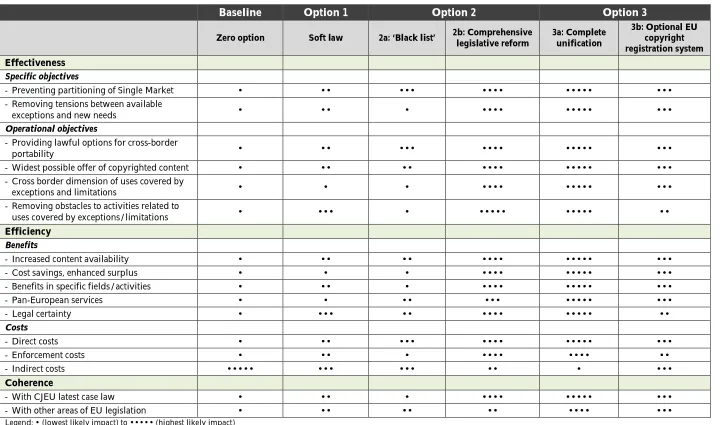
In this Section, we offer insights on the possible impacts that would be associated with the alternative policy options listed in Section 3 above. Section 4.1 below explains the main assessment criteria, which include effectiveness, efficiency and coherence. This Section clarifies which benefits and costs are most likely to be relevant for the ex-ante impact assessment of the proposed options. Section 4.2 applies specific assessment questions selected by the European Parliament to the alternative options and provides an impact matrix.
42 Please note that an ‘optional EU copyright registration system’ was envisaged in the Green Paper on
4.1
Methodological framework
We base our comparison of the alternative policy options on three main criteria: effectiveness, efficiency and coherence.
Effectiveness relates to the extent to which the proposed options achieved the intended general, specific and operational objectives.
Efficiency refers to the overall impact of the proposed options on social welfare. It implies an evaluation of both the expected costs and the expected benefits of each option.
Coherence refers both to how the internal components of the EU copyright framework operate together (so-called ‘internal’ coherence) and to the consistency of the proposed options with other EU legislation (so-called ‘external’ coherence).
4.1.1
Effectiveness: Policy objectives
[image:25.595.82.524.416.682.2]Any intervention aiming to address the policy problems would need to be based on consistent general, specific and operational objectives. These policy objectives are summarised in Figure 1 below. Our assessment of the options’ relative effectiveness will be based on these intended objectives. In addition, the ancillary objective of removing obstacles to the free movement of media and devices subject to copyright levies will be taken into account.
Figure 1. Policy objectives
Notes: General objectives in blue; specific objectives in red; operational objectives in green.
Source: Authors’ own elaboration. Improving the functioning
and efficiency of the Digital Single Market for copyrighted content
Preventing the partitioning of the Internal Market
Providing lawful options for cross-border portability of
copyrighted content
Ensuring access to the widest possible offer of digital copyrighted content
all over Europe
Removing the tension between copyright exceptions and limitations
and new market needs
Ensuring cross-border dimension to uses covered
by exceptions and limitations
Removing obstacles to new activities related to uses covered by exceptions and