1
The European Union’s EDF Programme for ACP Countries
The project is financed by the European Union
The project is implemented by IBF International Consulting
CAPITALISATION STUDY ON CAPACITY
BUILDING SUPPORT PROGRAMMES FOR
NON STATE ACTORS UNDER THE 9
THEDF
Letter of Contract N°2008/162532
FINAL REPORT
Prepared by:
Maurizio Floridi
Beatriz Sanz-Corella
Stephano Verdecchia
3
4
Foreword
The capitalisation study on capacity building programmes under the 9th EDF, sponsored by the European Commission, took place between September 2008 and April 2009. It was undertaken by independent experts, namely Maurizio FLORIDI – sociologist and specialist in the dynamics of non state actors in the ACP countries -, Beatriz SANZ CORELLA – socio-economic and management expert, specialist in support and advisory services for civil society experts and training, formulation and monitoring of EDF programmes -, and Stefano VERDECCHIA, a participatory local development expert.
Being a capitalisation study, the team in charge with the study focused their attention on the concrete experiences which characterised the NSA support programmes under the 9th EDF and, in particular, on best practices. A selection of the latter is presented herein, by way of example, in order to illustrate possible solutions to the problems that affect the majority of NSA support programmes.
The team was confronted with various problems; theoretical and methodological on the one part and, on the other, organisational.
In terms of theory and methodology, the study required the adoption of two approaches: quantitative and qualitative, each involving different analytical logics and methods. In addition, the needs of the qualitative approach forced the team to increase the number of field missions. As such, in addition to the 3 missions foreseen in Ethiopia, Uganda and Dominican Republic, a further 5 missions were added with a view to enriching the overall quality of the study, which took place in Suriname, Malawi, Burkina Faso, the Democratic Republic of the Congo and Mali.
As to the constraints of the organisational side of the project, the major problem was, firstly, the collection of documents relating to the 40 NSA support programmes and, secondly, the analysis of a quite significant number of pages, not an easy task when the time and budget considerations are taken into account.
The team would like to highlight the importance of the restitution seminar held in Brussels on 1-3 April, which allowed the team to meet with a large number of actors (35 representatives of the ECDs in the ACP countries, 15 members of the PMU and AIDCO, DEV and RELEX representatives) on the themes and first results of the study.
The team would, in particular, like to thank the services of the European Commission Delegation in the 38 studies involved in the study, as well as the PMUs of the 40 NSA support programmes for their cooperation and availability in the collection of the documents needed for the analysis.
Lastly, we would like to offer a sincere thanks to the members of Unit E4, notably Ms. Susana El-Kum Molina, the in house Commission study coordinator and her support staff for the invaluable assistance and advice provided.
Maurizio FLORIDI, Beatriz SANZ CORELLA and Stefano VERDECCHIA
5
Acronyms
ACP Africa, Caribbean and Pacific
CfP Call for Proposals
CSCBP Civil Society Capacity Building Programme
CB Capacity Building
CS Civil Society
CSF Civil Society Fund
CSO Civil Society Organisation
CSP Country Strategy Paper
EC European Commission
ECD Delegation of the European Commission
EDF European Development Fund
EU European Union
FA Financing Agreement
GRO Grassroots organisation
IEC Information, Education and Communication
INGO International Non Governmental Organisation
IO Intermediary Organisation
LA Local Authority
NSA Non State Actor
MDG Millennium Development Goals
NAO National Authorizing Officer
NGO Non governmental Organisation
NIP National indicative Programme
OCA Organisational Capacity Assessment
PCC Project Coordination Committee
PMFU Programme management and Facilitation Unit
PMU Project/Programme Management Unit
PRMT Participatory Resource Monitoring Tool
PRSP Poverty Reduction strategy paper
PS Private Sector
RCA Regional Corresponding Agencies
SC Steering Committee
SMC Steering and Monitoring Committee
6 TAU Technical Assistance Unit
TC Technical Cooperation
TFG Task Force Group
TFP Technical and Financial partners
ToR Terms of Reference
7 Index
Executive summary... 10
Part A. Context and presentation of the study... 19
1. THE CONTEXT: LEGAL RECOGNITION OF THE ROLE OF NSA AND THE OBJECTIVE OF CAPACITY BUILDING... 20
2. CAPITALIZATION STUDY ON THE SUPPORT PROGRAMMES FOR NSA UNDER THE 9TH EDF... 20
2.1. Objectives and scope of the study... 21
2.2. Research timetable... 23
2.3. Methodological approach... 26
2.4. Key notions adopted by the research... 27
Part B. The results of the study... 30
1. DEFINITIONS AND TYPES OF NSA... 31
1.1. The private sector/civil society dialectic... 31
1.2. The principle of differentiated analyses... 32
1.3. The question of differing vocations and the differentiation between actors... 34
1.4. The question of grassroots organisations and emerging actors... 38
1.5. Towards a new approach to NSAs... 39
2. THE PURPOSES OF NSA SUPPORT PROGRAMMES AND THEIR STRATEGIC POSITIONING... 42
2.1. Analysis of purposes... 42
2.2. Analysis of guiding principles of 9th EDF programmes and orientations for the 10th EDF... 44
3. IDENTIFICATION OF CAPACITY BUILDING PROGRAMMES AND MAPPING EXERCISES... 49
3.1. Quantitative analysis of mapping exercises and identification studies... 49
3.2. Qualitative analysis of mapping exercises and identification studies... 52
3.3. Final thoughts as regards the mapping exercises under the 10th EDF... 59
4. THE INSTITUTIONAL ORGANISATION, INTERNAL PROGRAMME GOVERNANCE INSTITUTIONS, THE ROLE AND PROFILE OF THE TA AND THE COOPERATION WITH DONOR ORGANISATIONS... 60
4.1. The management system: feasible options and cost analyses... 60
4.2. The Steering Committee... 69
4.3. The role of actors involved... 73
4.4. The role and profile of TA... 79
4.5. The role of international NGO (INGO)... 87
4.6. Cooperation with donor organisations and the new common funding systems (pool funding)... 92
5. CAPACITY BUILDING: DEFINITION, APPROACHES AND MODUS OPERANDI... 97
5.1. The programme components and the approaches and tools deployed for capacity building... 97
5.2. Approaches deployed by the programmes for the prioritisation of NSA access to capacity building activities... 102
5.3. Concrete experiences and lessons learnt from the adoption of the capacity building plan... 109
5.4. Concrete experiences and lesson learnt from the adaptation of the ”Call for proposals” mechanism.... 110
6. PROGRAMME MONITORING AND EVALUATION SYSTEMS AND PROCESSES... 118
8
6.2. Impact Indicators... 120
6.3. The disruption of the evaluation logic: when failure turns into success... 123
6.4. Taking into account the “inferred effects” or the “unexpected effects”... 124
7. INFORMATION AND COMMUNICATION WITHIN NSA SUPPORT PROGRAMMES... 124
7.1. The role of communication and the superimposition with the need of visibility... 124
7.2. Communication as a capacity building instrument... 126
7.3. Communication as an instrument for the promotion of strategic position of a programme and its “mission” as regards the stakes of NSAs... 127
7.4. Communication for the promotion of transparency... 129
7.5. Communication instruments... 131
7.6. Institutional visibility and communication... 133
ANNEXES... 135
Annex 1 : Grid for the in-depth analysis... 136
Annex 2 : Grid for the synthetic analysis... 140
Annexe 3 : Grid for the quality analysis of information and communication... 142
Annexe 4 : Agenda of the workshop 1-3 April 2009... 143
9
Index of figures and tables
Figure 1 : The two levels of analysis... 22
Figure 2 : Differentiated actor analysis... 33
Figure 3: Relation modalities between partners (INGOs) and CSOs... 90
Figure 4 : A reminder of the capacity building dimensions... 98
Figure 5 : Visualisation of the on line bulletin of the “Civil Society and good governance support programme” (PASOC) in Mauritania... 125
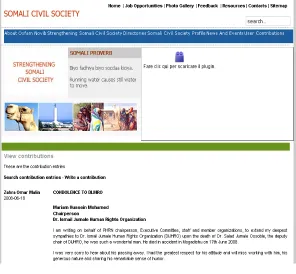
Figure 6 : Visualisation of a page from the website of the “Strengthening Somali Civil Society” Programme”... 126
Figure 7: Visualisation of a page of the Tanzanian NSA Support Programme website... 129
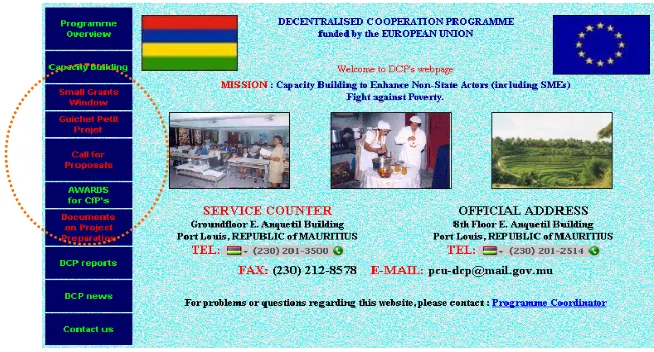
Figure 8 : Visualisation of a web page from the site of the Mauritius NSA Support Programme... 130
Figure 9 : CSO Support Programme in Niger and the webpage of the ARIANE programme in Mali... 133
Table 1 : NSA families and levels of organisation... 36
Table 2 : Institutional and political changes taking place on a national and local level and major implications for NSA ... 43
Table 3 : The added value of cooperation actors ... 83
Table4 : Capacity Building instruments in relation to objectives and dimensions ... 99
Table 5 : Visualisation of a page of the website of the Malian NSA Support Programme, relative to the grants given under the “Support for development initiatives” component. ... 130
11
The capitalisation study on the NSA capacity building programmes under the 9th EDF, involving around 40 programmes in 38 ACP countries, has allowed identifying strong and weak points in the EC strategy under the Cotonou era.
The results of the implementation of this first generation of NSA support programmes confirm the significant added value brought by the Community to the development process in ACP countries, and the positive role of EC programmes in increasing public sector's accountability vis a vis citizens.
While there is no such a thing as a theoretical or methodological formula for the identification, implementation and evaluation of these programmes, it is nonetheless possible, on the one hand, to identify common tendencies and, on the other, to select a certain number of positive experiences which can act as a reference point for the continuation of NSA support in the framework of the implementation of the 10th EDF.
Types of NSAs In the identification phase, a NSA support programme must address the question of what are the characteristics and added value of each family of non state actors, with regard to the goals of the programme and, in general, to the implementation of the Community strategy in the country.
At a general level, a distinction must be made between the different NSAs' structures in order to refine the methodologies aimed at comprehending their modus operandi and, above all, their differences. In essence, the notion of non state actor is quite broad, and it includes multiple families of actors which are not homogenous and which have complementary, yet fundamentally different vocations. This difference has a very concrete value to the extent that belonging to one family or another can determine an organization's eligibility for access to programme resources.
While different NSAs families may share similar objectives, each family can bring, on the basis of its own specialisation, skills, and experience, a specific contribution to the ACP countries' strive in the direction of sustainable development through good governance and enhanced citizenship.
In order to ensure that each family of actors can fully contribute, it is important to enable them to play their roles by taking into account their specific vocation and individual technical skills, all while bearing in mind the different organisational levels (grass roots, intermediary and advisory, and 3rd and 4th level umbrella organisation). Secondly, capacity building must be carried out on the basis of a clear distinction between the individual, organisation and institutional level.
It is thus necessary to adopt a differentiated strategy that takes three aspects into account: differentiation between families of actors, differentiation between organisational levels of NSAs, and differentiation between spheres of capacity building.
Support to NSAs poses a certain number of problems, both in relation to the efficiency and impact of supported activities, and for what concerns the respect of EDF procedures. The paradox in some cases is that organisations which, in principle, provide the most guarantees with regard to their adherence to rules and procedures are not necessarily those that will ensure viable medium to long term results. In reality, the less well-equipped organisations often represent the most active forces of society, notably at the local level, where the majority of collective actors do not possess formal structures or official recognition.
A project or programme intending to provide support to NSAs cannot ignore the existence of these new actors, which represent relevant and emerging social instances, and that tend to act according to their profound sense of social responsibility while they work to provide efficient and innovative solutions to the question of sustainable development.
12
and political framework. In sub-Saharan Africa, for instance, one has to deal with a new generation of NSAs created by the structural and democratic adjustment process, that often refuse labels and formal operational rules and that are, by contrast, no less effective in their social action.
At a concrete level, it is necessary to ensure that the eligibility criteria for access to funding provide these emerging actors the opportunity to participate, and that the types of actions that can be undertaken be kept as broad as possible. In other words, it is necessary for the support programme or project to be based on the demand of actors, rather than being supply-driven.
The aim of NSA support programmes and their strategic positioning If certain programmes under the 9th EDF were focused on capacity building as a goal in itself, or were generically aimed to the overarching goal of fighting poverty, those conceived under the 10th EDF cannot afford to neglect the new contexts characterised by profound changes in the formulation and management of public affairs.
Important political and institutional changes are in fact already underway in most ACP countries. These changes, at the national as well as, more importantly, the local level, include a progressive political and administrative decentralisation that opened up new perspectives in terms of governance and, more in general, new forms of relationships between the State and its citizens.
All NSA support programmes and, in particular, those supporting civil society, must therefore face the question of the relevance and strategic positioning of different types of organisations, vis a vis the new challenges raised by governance in all its forms. In other words, the civil society capacity building programmes conceived in the framework of the 10th EDF must incorporate a basic element of the new cooperation agreement: the political dimension. This means that a NSA capacity building programme cannot be limited to the strengthening of individual actors, but must as well focus on the links between the actors themselves and, above all, between the actors, their contexts, and their institutional partners, notably the State in all its manifestations.
NSA support programmes should therefore promote a stronger connection between NSA and their context of reference. Due attention must be paid to the relevance of supported NSAs' activities, which must not be too distant from the social and political problems that the countries are experiencing, and which should provide a relevant contribution in terms of governance best practices. In order to achieve this, the NSA support programmes under the 10th EDF must take into account five main principles. The first is that each programme needs to be strategically positioned in the social, economical, institutional, cultural, as well as political context of the country in which it is implemented.
In other words, an NSA support programme cannot in any case be “neutral” as regard to the context in which it is intervening and, more importantly, in the context of civil society. The “neutrality” of a programme is actually neither a strong point nor an indicator of objectivity, but a flaw to the extent that it prevents the programme from positioning itself in an explicit way.
This strategic positioning should necessarily take into account 1) the main principles at the basis of EC’s development policies, with particular focus on the Cotonou Agreement; 2) the policy choices made by the Community and expressed in the CSP; 3) the concrete reality of NSAs, their role within the context and, above all, the interests and strategic issues they deal with.
13
The third principle is linked to the pluralistic nature of NSAs. A NSA support programme dealing with the internal dynamics of civil society must at all costs avoid any intervention modality that aims to ensure a monopolistic position for umbrella organisations with regard to the policy dialogue with the government and donor organisations. The programme must, instead, support the current dynamics within civil society, respecting the vocations of each actor, and in coherence with national development strategies, the community strategy outlined in the CSP, the principles of EC development policy and, above all, the social and economic issues NSAs are asked to deal with.
The fourth principle is the need to recognise the specific nature of NSA support programmes, which should be based on a process approach, where actors guided through long-term couching and mentoring and to avoid the project/micro-project approach, that emphasizes immediate outputs. The idea of a process which requires adequate time to produce a visible impact is actually at the very core of the capacity building concept.
The fifth principle is that NSAs should not be considered as an alternative to existing power. On the contrary, their added value should be seen in terms of what NSAs can offer in terms of creative and innovative solutions in the direction of sustainable development.
In fact, the governance approach foresees the active and responsible participation of all stakeholders, with their specific vocations and mission, in the development processes. Participation is not limited to the contribution of beneficiaries, it is an interactive process of dialogue and cooperation, along which each actor, on the basis of its proper specialisation and prerogatives, must attempt to integrate the perceptions of others.
Identification of capacity building programmes and mapping exercises Under the 9th EDF mapping exercises have often been limited to a statistical survey of NSAs, and have been generally informed by a static and descriptive logic. On the contrary, the establishment of a programme requires a dynamic framework where, aside from the quantitative and qualitative information on the actors themselves, key elements are provided to understand the actual social and political challenges in the context of which non state actors are asked to operate.
These fundamental elements include: 1) a classification of NSAs based on their characteristics, the strategic issues and challenges they face given the country social, economical and political contexts, and their future perspectives; 2) the identification of key actors among NSAs, the assessment of their capacity building needs, according to which category and structural level they belong to; 3) the analysis of the country juridical and institutional framework with respect to NSAs, as well as of the areas for cooperation between governmental and non governmental actors; 4) the review of the existing cooperation framework between NSAs and EC; 5) a map of stakeholders in the domain of NSAs support, including the different approaches they adopt.
In addition to this, mappings must also include local capacity building resources (universities, private sector, local NGOs, research centres, etc.) in order to provide an exhaustive analysis in terms of both demand and supply. Regarding NSAs' involvement in the mapping exercise, several modalities have been experimented in the whole of the ACP states over the course of the 9th EDF. In general, the choice of including NSAs in the mapping was linked to the specific situation in the country at the time, taking into account the advantages and disadvantages of each option.
14
Today's challenge is that of mainstreaming the theme of NSAs into all European cooperation, according to a governance approach. This also involves undertaking sectoral mapping exercises. This new approach, already tested by other donors with an established sector policy, is of fundamental importance to the extent that the exercise can provide precious indications for the implementation of the Community strategy outlined in the CSP on the basis of sector priorities.
Institutional set-up, programme management modalities, role and profile of TA, cooperation with donor organisations As regards management modalities, five possible options exist, within two general types of management (centralised or decentralised), namely: indirect centralised management by a private company (article 23.6 of annex IV of the Cotonou Agreement); joint centralised management with other donors (pool fund system) and/or International Organisations; indirect centralised management by a NGO -through grant contracts – (article 23.6 of annex I of the Cotonou Agreement); direct decentralized management (with or without TA); indirect decentralized management by a private entity (consulting firm) or NGO. The “direct decentralized management" modality is, on the whole, the preferred option under the NSA support programmes of the 9th EDF, followed by the “direct centralized management” one. The other mentioned modalities have revealed much less practical.
With regard to the management modality of the programme, it is up to the different Delegations, on the basis of the mapping study's results (or, in absence of that, of the feasibility study), to consider which category the country belongs to, and to agree with the NAO on the approach to be adopted. The cost of certain management modalities is an important factor and, sometimes, a constraint to the implementation of NSA support programmes. The choice of how to manage a programme is usually linked to 3 factors: the national context, the goals of the project and the skills required.
With regard to the responsibilities of the Monitoring and Steering Committee, the experience of NSA support programmes under the 9th EDF shows a large variability when it comes to interpretation, as well as some common trends.
The variability is typically exemplified by the frequency of the Committee's meetings, which can vary from one to four times a year and, secondly, by the different interpretations of the Committee's duties and prerogatives. These go from the simple validation of work undertaken by the PMU to the Committee's being made part in every decision of the programme, including the selection of activities or, in some cases, even the recruitment of support personnel.
The common tendency is however for the Monitoring and Steering Committee to be nothing more than the place where decisions taken elsewhere (subject of a prior agreement between the programme, the NAO and the EC ) are formalized. In short, the MSC is usually not a forum for assessing the programme development but, rather, an occasion for validation. Such a situation risks of jeopardizing the relations with stakeholders as much as the programme institutional set-up.
For what concerns the inclusion of NSAs in the programme monitoring and steering bodies, independently of the chosen formula, the fundamental question is how to ensure, on the one hand, the representativity of members who are there in the name of NSAs, and, on the other, to avoid conflicts of interest. The experiences show that the most appropriate procedure in certain contexts is that of including resource persons linked to the NSA world rather NSA representatives themselves.
15
The NAO should play a double role: the programme supervisor through the Monitoring and Steering Committee, as well as the facilitator in the dialogue between NSAs and government at the level of the programme activities, especially those involving State-NSA cooperation, in all of its dimensions.
The role of EC Delegations involves two aspects; they are “critical observers”, ensuring that the appropriate and competent NSAs are identified and included in the new cooperation framework according to the principles of the Cotonou Agreement; and “facilitators”, in the sense that they guarantee access to clear and transparent information, and that they contribute to the development and capacity building of NSAs.
Lastly, as regards RCAs or Intermediary Organisations, it is important to note that there is a risk of tying- up collaboration under the programme with the specific logic of service contracting. In reality, RCAs should not be seen as mere programme antennas, but as opportunities for the creation of new focal points for civil society at the regional level, something that is perfectly consistent with the mission of most umbrella organisations operating at such scale.
Another fundamental aspect is the role and profile of the technical assistance responsible for the implementation of NSA support programmes. Experiences under the NSA support programmes of the 9th EDF revealed a widespread tendency to consider Technical Assistance as almost exclusively dealing with administration and book keeping, while NSA support programmes should adopt a different approach. TA in these new programmes must first and foremost have the role of facilitating the social processes which are underway, by making available their capacity building tools, in the respect of the different missions and vocations of NSAs.
In a general sense, the drafting of ToR (in the procurement note phase) and the criteria for the integration of skills are also key aspects of the selection phase of TA.
It would be interesting to link European NGOs, which have a significant experience in supporting Southern NSAs , in providing technical assistance. These NGOs could actually bring a significant added value to the implementation of a new generation of capacity building programmes with which large scale European consulting firms are often not familiar enough .
One of the reasons why European NGOs are often left out is that EDF procedures for TA contracts require not only the direct financial responsibility of the contractor but also its capital adequacy, documented by bank guarantees.
These findings, which denote a feeble presence of International NGOs (INGOs), not only in technical assistance but also as partners in NSA/civil society support programmes, strongly contrast with the presence and dynamism of INGOs in a significant number of ACP countries.
In fact, European and International NGOs have, historically, had a significant role in the emerging and strengthening of civil society organisations in ACP countries, notably in the domain of the promotion and protection of human rights.
16
As regards management aspects, backstopping is a very important aspect of TA. The role of backstopping can be extremely beneficial for supporting local staff, at the condition that a distinction is made between two types of backstopping: administrative and technical.
From the analysis of the NSA support programmes under the 9th EDF, it emerges that only a minority of programmes adopted a proactive and institutionalised approach to the cooperation with other donor organisations, besides the implementation of a few punctual activities and the routine consultation events. The situation is however changing, and it is hoped that cooperation among donors, notably the Member States as well as international organisations, will increase under the 10th EDF. In essence, as donors begin to seek an increased harmonisation in the spirit of the Paris Declaration and other initiatives, we will assist to the emergence of new common financing systems, aimed at making funding more reliable and independent from the day-to-day donors' management. This is the case, for example, of the new pool funding systems.
Capacity building: operational approaches and modalities in the framework of the 9th EDF programmes The NSA support programmes under the 9th EDG generally integrated several components, from strengthening the capacity of individual organisations and their representatives to the relational aspects of networking, and to the questions of political dialogue with the State.
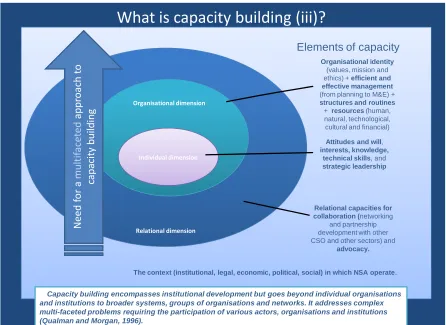
The multi-dimensional nature of programmes strictly follows the systemic nature of capacity building. In effect, capacity building needs to be conceived as a process that seeks, with the active participation of concerned actors, to consolidate their capacities in order for them to evolve and adjust to new context-specific demands. Programs should therefore encompass three dimensions: the strengthening of individual capacities, including strategic leadership skills; the organisational dimension, with a particular attention to the aspects of identity, as well as to the efficiency and efficacy criteria; and, finally, the strengthening of the relational dimension, which means the organizations' capacity to cooperate with other actors, but also the establishment of a judiciary and institutional framework appropriate to respond to the needs of organisations and to their demand of participation in public policy. Such regulatory environment should be conceived not only as an external factor constraining or enabling NSA development, but also as an element that can be reformed and transformed in the process.
Four main approaches were identified within the NSA support programmes of the 9th EDF. These can be placed on a continuum, from a purely reactive approach, based on the call for proposals instrument, to a programmatic and proactive approach, based on the elaboration of a capacity building plan, on the basis of a strategic analysis. The majority of programmes currently rely on a fundamentally reactive approach, where the calls for proposals are the preferred mechanism for addressing NSAs' capacity building needs. In this respect, the experience of 9th EDF programmes showed how the call for proposal mechanism, but above all the logic and approach often underlying it, may impoverish the nature of a programme, by generating a number of scattered, stand-alone and poorly coordinated initiatives that are managed according to the same logic of the “pre-Cotonou” micromanagement projects and/or thematic programmes.
On the other hand, some recent experiences have shown that the call for proposals instrument can be adapted to the capacity building needs of NSAs, on the condition that it is considered as a tool and not as an end in itself.
As regards alternative tools, the proactive capacity building plan presents some interesting aspects. Whereas the adoption of this tool is somewhat recent, there is already some evidence of NSAs' positive reaction as, on the one hand, the tool is more effective in targeting their capacity building needs, and, on the other, it generates a less intense competition among NSAs.
17
often complex information gathering system; the PMU's strong capacity to communicate the relevance and innovative nature of the tool, and its differences in comparison to calls for proposals; in this case the PMU must not only have an administrative and book keeping role within the programme, but it should be able to support and facilitate the dynamics of the actors; the PMU should therefore possess the appropriate technical skills.
The question of procedures The specificity of NSA support programmes, due to the peculiar characteristics of non state actors and the nature itself of capacity building, poses a series of procedural problems that deserve not only to be evoked but also concretely analysed in order to identify short and medium-term solutions.
Thanks to the active participation of a number of programmes and delegations in the restitution workshop on 1st -3rd April 2009 in Brussels, some operational issues and recommendations have been identified.
The programme monitoring and evaluation system The monitoring and evaluation of NSA support programmes presents a twofold challenge: on the one hand, the NSA support programmes deal with social dynamics that are not easily measurable and, on the other, there is neither a history nor a tradition of EC intervention in this area and, thus, no lesson learned to benefit from.
In reality, the major difficulty in evaluating a process, and not an activity, such as NSA capacity building, is that it can only have an impact in the medium to long term. This contrasts with the needs of the monitoring and evaluation exercise, which is usually carried out during and immediately after the programme.
The evaluation of this type of programmes has to do with long-term social dynamics, by their nature difficult to quantify, and must therefore identify the appropriate impact indicators, relevant to the nature of NSA capacity building. One promising direction is the use of impact indicators that capture the institutional and organisational changes generated within the beneficiary organisation. The time factor is decisive, bearing in mind that such changes can only be measured 6-12 months after the end of a programme.
Evaluators should also be ready to overthrow the standard evaluation logic, by recognizing that apparent failures can actually turn into successes.
A capacity building activity that is judged today a failure, as the planned amount in the WP has not been spent, could be considered tomorrow a success, thanks to the long-term positive dynamics that it generated. In fact, NSA support programmes intervene in a complex context where no one can master or foresee all the long-term effects of a given activity.
There are also effects that were not foreseen by the programme but which, by contrast, bear a significant importance to the ends of NSA capacity building. The capacity building activity must be therefore evaluated not only against its intended objectives, but, more broadly, in terms of the wide range of dynamics that it produced.
Information and communication within NSA support programmes Communication with all concerned actors is a transversal capacity building instrument of any programme. It should be a “two-way” process between the programme and non state actors, particularly those belonging to the third and fourth level organisations.
18
donor organisations. To maintain and strengthen the ties between the programme and the social and political challenges NSAs face, communication tools should be adapted to the context and the intended target groups.
In essence, the role of communication should be, on the one hand, to express the coherence of the programme with EC country strategies, and, on the other, to strengthen the strategic positioning of NSAs in the country socio-political framework.
The programme experiences in many countries clearly show the importance of transparency. To inform the public opinion, notably NSAs, about programme management modalities, as well as about the management tools adopted by the PMU, is an important transparency factor, and it is facilitating element in the PMU's work, particularly for what concerns its interaction with NSAs. Disseminating information on the progress and challenges during implementation confers more strength and legitimacy to the programme.
19
20
1.
T
HE CONTEXT:
L
EGAL RECOGNITION OF THE ROLE OFNSA
AND THE OBJECTIVE OFC
APACITYB
UILDINGOne of the great innovations of the Cotonou Agreement lies in the legal and political
recognition of the participation of non state actors (NSA) in the development and cooperation
process. On the one hand, this participation is defined as one of the fundamental principles of cooperation (Article 2 – Fundamental principles). On the other hand, and for the first time in the history of EU-ACP (European Union – African Caribbean and Pacific) cooperation, a new chapter on the actors in this partnership recognises the complementary roles played by civil society, the private sector and decentralised local communities together with the central administration in the development and cooperation process.
The definition of national development strategies, however, remains the responsibility of the ACP governments; but it is imperative that Non-State Actors (NSA) are involved at every stage of the process; consultation, programming, implementation, monitoring and evaluation. Thus, the Cotonou Agreement introduces new measures to promote participatory approaches in order to ensure the involvement of civil society and of economic and social actors, especially: ▪ through the provision of appropriateinformation on the ACP-EC partnership agreement; ▪ by ensuring consultation with NSA on the economic, social and institutional reforms and
policies to be supported by the EC ;
▪ by facilitating the participation of NSA in the implementation of programmes and projects; ▪ by providing non state actors with the necessary capacity building support
These objectives express the desire of the European Commission not to limit the role of NSA to a technical contribution to the struggle against poverty. The reinforcement of NSA is seen as an objective in itself for the foundation of a civic culture, enhanced democracy and good governance.
2.
C
APITALIZATION STUDY ON THE SUPPORT PROGRAMMES FORNSA
UNDER THE9
THEDF
In order to support NSA in their role as responsible, informed and competent partners in the political, economic, social and cultural life of the country and thereby reinforce the country’s democratic foundations, a large proportion of the National Indicative Programmes (NIPs) of the 9th EDF included a capacity building programme for NSA.
Under the 9th EDF, 42 NSA capacity building programmes were approved in 38 ACP countries for a total of approximately €202 million.
Within the framework of the 10th EDF, even though not all the NIPs have yet been signed, the sum earmarked for the capacity building of NSA confirms the fundamental necessity of this sector in order to ensure that NSA are able to fulfil their roles both in the development of their country and in the implementation of the Community’s strategy.
The execution of a review of these programmes highlights the importance of this issue, both for the countries which have not yet initiated the identification of programmes under the 10th EDF as much as for those already implementing or preparing to do so.
21
identified: notably the risk that these capacity building programmes may, on the one hand, turn into micro projects, or even micro-realisations and, on the other, into technical assistance programmes focused on administrative and financial tasks (limited to dealing with calls for proposals), and neglecting their essential role of facilitator.
This shows, as reported in the Terms of Reference of the study, that the implementing strategy for Community support of NSA is still centred on the logic of financing projects and has not really progressed towards the logic of guiding actors through the national processes of transformation at political, institutional, economic and social levels. In order to ensure a stronger impact and a greater degree of viability in Community support, it is no longer necessary to manage a series of calls for proposals and tendering projects, but to actually implement the new political and cooperation agenda of the EC; one which invites collaboration alongside NSA as indispensable players in the global development process, recognising the diversity of NSA, their different roles and the added value in each sector, as well as in each phase of cooperation.
The capacity building programmes for NSA, which will be developed in the framework of the 10th EDF, will need to integrate the lessons learned from the 9th EDF programmes, while placing themselves at the centre of the Community’s global strategy, building bridges between these programmes and the other sectors supported to promote effective participation by NSA in the definition of public policy (building their capacity as actors in the governance sphere).
2.1. Objectives and scope of the study
The global objective of this study was to capitalise on the various experiences gathered from
the NSA capacity building programmes financed under the 9th EDF in order to improve the approach logic and strategic use of these programmes with a view to enhancing the impact of EC support to NSA in their role as governance actors.
In order to attain this global objective, a threefold specific objective was determined:
OBJECTIVE
OFCAPITALIZATION
(i) To produce a conceptual, methodological and operational document to support the NSA correspondents within the Delegations in ACP countries and the units at Head Office responsible for support to NSA, along the entire strategic programming chain as well as management of cooperation programmes (strategic programming at a national level, identification and formulation of programmes and initiatives in support of NSA, implementation, monitoring and evaluation of these programmes and dialogue on cooperation).
OBJECTIVE
OF
DISSEMINATION
(i) On the basis of the conceptual, methodological and operational review, to produce a training module (in PowerPoint) aimed at the NSA correspondents in the Delegations in ACP countries and the units at Head Office responsible for support to NSA.
OBJECTIVE
22 OF
TRAINING
key concepts and challenges relating to support for NSA. This workshop had the twofold objective of presenting the main conclusions and recommendations contained in the study and testing the training module that has been developed.
In terms of scope, as specified in the terms of reference, the analysis of the capacity building programmes focused on a number of key questions concerning the different stages in the
strategic programming cycle of cooperation. At the same time, two levels of analysis must be
defined:
(i) a first level of analysis which looks beyond the capacity building programmes of NSA in order to place the review of these programmes within a wider context, exemplified
by the participatory approaches adopted, as much by the EU in its intervention
strategy, in terms of dialogue and monitoring of cooperation, asby the ACP governments.
(ii) a second level of analysis consisting of the review of key questions regarding the identification, teaching, implementation, monitoring and evaluation of the NSA
capacity building programmes that have been financed under the 9th EDF.
The following diagram illustrates these two levels of analysis and the principal stages related to them:
Figure 1 : The two levels of analysis
EVALUATION AND REVIEW OF NSA SUPPORT
PROGRAMMES
PROGRAMMING:
DEVELOPING A COOPERATION STRATEGY
FORMULATION OF NSA SUPPORT PROGRAMMES
IDENTIFICATION OF NSA SUPPORT
PROGRAMMES
IMPLEMENTATION OF NSA SUPPORT PROGRAMMES
PA R T I C I P A T I O N B Y N S AS I N D E V E L O P I N G T H E
C O O P E R A T I O N
S T R A T E G Y
PA R T I C I P A T I O N B Y N S AS I N D I A L O G U E A N D
M O N I T O R I N G O F C O O P E R A T I O N
INFORMING THENSAS THROUGHOUT THE PROCESS
1ST LEVEL OF
ANALYSIS :
COMPLEMENTA RY QUESTIONS CONCERNING THE RÔLE OF
NSAS IN
EUROPEAN COOPERATION
2ND LEVEL OF
ANALYSIS:
PHASES IN
THE MANAGEMENT CYCLE OF
NSA SUPPORT
23
Source: the authors
2.2.
Research timetable
Inceptionphase
October – November 2008
The research team collected all the necessary documentation regarding the 42 NSA capacity building programmes (NIPs, financing arrangements, ToRs and reports on mapping studies, identification of topics, feasibility studies, involvement of and recruitment by the Project Management Unit (PMU), evaluation studies, reports on PMU activity, audit and external monitoring reports, guidelines for calls for proposals, the minutes of meetings of the Pilot Committee and the Selection Committee, evaluation reports, monitoring reports, final reports on seminars, and any other document relevant to this research). This information was collected by mail or by means of telephone interviews, whether through the services of the Commission’s Head Office or in the ACP countries. On the basis of the documentation collected, it has been possible to analyse 40 programmes carried out in 38 countries1.
Execution phase November 2008 – January 2009
The analysis of the 40 programmes was carried out in two stages:
x A first stage of rationalisation and synthesised analysis (based on a selection of key questions entered on a synthesised analysis slip) of all the existing capacity building programmes in ACP countries, with an initial identification of possible good practices, innovative experiences and lessons learned. At the end of this stage, a definitive selection of countries for an analysis in greater depth was made.
x A second stage of in depth analysis of the 16 selected countries (based on the key questions grouped in an in-depth analysis file) and identification and recording any good practices, innovations and lessons learned, in order to illustrate the methodological approach of the document as a guide for each of the proposed phases.
In addition to the analysis of the available documentation, 7 field trips were carried out (in Ethiopia, Uganda, the Dominican Republic, Surinam, Burkina Faso, Mali and Malawi) with the aim of collecting more data on "good practices" in different contexts. These countries were chosen because of their relevance as regards to the study’s goals and because of the absence of detailed information on them in Europe. The experts in charge of the study conducted interviews, either on the spot or in Europe, with the various stakeholders: representatives of NSA, representatives of national and local government, other interested parties, NSA correspondents and other members of the delegations responsible for other projects as well as for Community support programmes for NSA, and members of the administrative bodies.
Phase for the preparation
March – Organisation of a three-day workshop in Brussels (1st -3rd April) for the NSA correspondents in Delegations and in the Head Office to inform
1
24 and
organisation
of the restitution
seminar
April 2009 them of the key concepts and challenges regarding support to NSA. The main conclusions and recommendations of the review were presented. The workshop was held on the Commission premises. Among participants, on top of representatives from 35 Delegations, there were 15 PMU members responsible for the NSA support programmes (especially to civil society) in all the relevant geographical areas.
Phase for the preparation of the draft report
March – April 2009
The team of experts drew up a report which includes both a general section on the involvement of NSA in Community cooperation and an account of the lessons learnt and their recommendations according to the different cyclic stages of the project (identification, formulation, implementation, monitoring and evaluation). The report gives concrete examples (case studies) to exemplify best practices, difficulties encountered and lessons learnt.
Phase for the finalisation of the report and the training
module
April - May 2009
At the end of the workshop, the team of experts provided a final version of their study and a training module for the NSA correspondents, including the principal key points to be taken into account when 'identifying, formulating and implementing programmes’.
Regarding the choice of 16 countries for the in-depth analysis, 4 criteria were adopted for the sake of a framework that is generally representative of the problems addressed and the different national contexts. In particular, these were:
• The distribution of the 16 chosen countries among three different contextual
categories (see table below). From the 16 selected countries, seven belong to
Category I, six to Category II and three to Category III.
• The progress made by the different programmes; in this instance the team chose to
analyse programmes at different stages of development (inception, mid-term or completed). It must be stressed that the team gave preference to programmes which were well advanced, so as to obtain as many indications and examples of best practices as possible. As such, 8 programmes are in their final phase, 5 are under-way and 3 are in their inception phase.
• Geographical zones; 5 of the countries are in West Africa, 4 in East Africa, 2 in
Southern Africa, 1 in Central Africa, 2 in the Caribbean, and 2 in the Pacific.
• Linguistic contexts; language is important insofar as, where certain subjects are
25
Below is a list of the 16 countries according to the first criterion, i.e. their grouping in three contextual categories according to the degree to which NSA are involved in political dialogue2:
Countries with a culture of participation by NSA
in the development process
Countries with a somewhat limited tradition of dialogue with and participation by NSA
Countries with very limited NSA participation Benin Mali Senegal Uganda Dominican Republic Malawi Tanzania Angola Niger Cameroon Suriname Vanuatu
Papua New Guinea
Mauritania
Somalia
Ethiopia
The synthesised analysis extended to 22 other countries (with 24 project analyses) on which
the team already had adequate documentation. These are the following:
Countries with a culture of participation by NSA
in the development process
Countries with a somewhat limited tradition of dialogue with and participation by NSA
Countries with very limited NSA participation Botswana Burkina Faso Cape Verde Mauritius Zambia Burundi
Democratic Republic of the Congo Gabon Guinea-Conakry Jamaica Kenya Lesotho Mozambique Nigeria Seychelles Sierra Leone Zimbabwe Djibouti Equatorial Guinea Gambia Guinea-Bissau Namibia
2
26
2.3.
Methodological approach
2.3.1. The methodological framework
In terms of the methodology of the study, the team undertook two approaches, quantitative and qualitative.
For the quantitative approach, the study took the following into account:
Statistical processing of the information collected through the use of a grid for in depth analysis of the 16 NSA support programmes;
Statistical processing of the information gathered through the use of a grid for global analysis of the 24 NSA support programmes;
Statistical processing of the information gathered through the use of a grid for the analysis of the websites of NSA support programmes and the websites of the ECDs.
The qualitative approach took the following into consideration:
Analysis of the documentation of the NSA support programmes, with a special emphasis on the identification of best practices;
In depth interviews with stakeholders of the NSA support programmes in the field (7 countries) and by telephone or email;
Content analysis of the websites of the NSA support programmes and the ECDs.
2.3.2. Technical tools
As far as the technical instruments are concerned, 3 grids were used for the analysis of the documentation collected. These include:
A grid for the in depth analysis of the 16 NSA support programmes (see annexe 1);
A grid for the global analysis of the 24 NSA support programmes (see annexe 2);
A grid for the analysis of the NSA support programme web sites (see annexe 3).
2.3.3. Sources
As regards sources, the team used primary and secondary sources.
Primary sources, or direct sources, included:
The NSA support programme managers within the ECDs;
The NAO services of the countries included in the implementation of NSA support programmes under the 9th EDF;
The PMU responsible for NSA support programmes;
The Technical Assistance contract holders for the implementation of PMUs in NSA support programmes;
The responsible geographic members of AIDCO Unit E4;
Key personnel (or resource personnel).
As regards secondary source, or indirect sources, the team consulted the following documents:
The 10th EDF CSPs/NIPs;
The PRSPs;
27
The ToRs of the programme identification studies;
The identification studies (including mapping where available);
The Tender Dossier for the recruitment of the TA;
The Programme Estimates;
The guidelines of the Calls for Proposals, the evaluation reports and the list of selected projects (including project fiches);
Programme reports;
Evaluation reports (mid-term and final);
All other documentation related to the implementation of programmes;
The websites of programmes and ECDs
2.4.
Key notions adopted by the research
2.4.1. The notion of NSA and Civil Society
In a general sense, the Cotonou Agreement defines non state actors as a large range of development actors outside government circles, in which the private sector, economic and social partners (as well as trade unions) and civil society in all of its forms are included, according to the characteristics of each country.
In essence, the definition of non state actors or civil society is a question that runs the risk of being too complicated if this definition has to have an unequivocal, universal character. As affirmed by the Cotonou Agreement, each of the ACP countries can themselves define, according to their own contexts, which are the collective actors belonging to civil society or, more in general, which enter into the category of non state actors.
It is this that a great disparity appears in the ACP countries. While the trade unions in Guinea, for example, are considered as a part of civil society, in the majority of ACP states they belong to the social and economical partners grouping. By the same token, faith-based organisations organisations in DRC and Zambia are considered to be among the most active actors, while in Niger, for example, these organisations are not at all considered as civil society actors and, as a consequence, are not eligible for community funding. Again, the Unions in Guinea are considered as a civil society actor, while in DRC they are seen as economic and social partners.
The question of the composition of non state actor families is, in any case, not a theoretical exercise, but an extremely practical and operational one, as it on the basis of these definitions of NSAs and CSO that the eligibility criteria for community financing are formed in each country.
Bearing in mind the restrictions linked to the great variability in terms of the notion of NSAs and civil society in each ACP country, it is fundamental that a single notion based on elements and characteristics that transcend each individual context is established. This notion must take a dual necessity into account; on the one hand the inclusive capacity of the notion of NSAs and Civil Society in order to avoid excluding key actors from the development process and, on the other, the selective capacity of the notion itself.
As regards inclusion, the concept must bear in mind the plurality, in terms of multiplicity and heterogeneity, of organisational structures unique to non state actors and, more importantly, civil society, where associations, often informal, at a grass roots level, have the same social and political legitimacy as platforms, networks and NGOs (women, development, human rights etc.) placed at an intermediary level which should not include a superior level in a hierarchy that shouldn’t exist.
Nonetheless, the concepts of non state actors and civil society must, equally, have a selective
28
in the field of social, economical and cultural development of any given country, then, on the other, one must be able to operate an objective selection process to the detriment of all those who, within the same society, work solely for a particular goal.
This second selective nature of the concept allows for a distinction to be made between the different collective actors focused on social responsibility and the entities which, without any real associative assize, are just the manifestation of the actions of several individuals, often motivated by their own interests.
While the actions of individuals are entirely legitimate in the social and political domain, they have no real relation to collective actions and, for all that, cannot be considered in a context where non state actors are borne in mind the key issues in the case of social and economical development.
According to this approach, non state actors and, in particular, civil society, are made up of the entirety of actors active on a local, regional or national level and who are the bearers of a
focus on social responsibility, that is to say that they express an intention and operate in
favour of social and economical development in their own territory in the interest of the collective, often through the creation of public good or services of public interest.
When it comes to the nature of actors, it is important to remember that, at the heart of civil society, there are, equally, forces other than collective actors at work. These include social actors who are more undetermined and, despite the fact that they are the holders of a high degree of subjectivity and innovation in the sense of public and social change, do not have the necessary stable organisational structure. This category often includes women, youth, peasant movements and union movements, etc.
These social actors, therefore, by virtue of their propulsive force, working in a transversal way through society, represents the fertile ground for the birth of collective actors who, with a strong institutional and organisational capacity, can solidify and implement the aspirations and changes in society according to a self development and governance perspective, often on a local level.
2.4.2. The notion of capacity building
Capacity building has become a recurring theme, even a “buzz word” in institutional literature and the agenda of the leading public administrations, international agencies and nongovernmental organisations. In effect, one can note a revitalised presence of terms such as capacity development, institutional modernisation or good governance in the different policy or strategy documents of these organisations, as much as in their progressive integration into the list of objectives of a plethora of cooperation programmes and projects. Still, regardless of its rising importance from the point of view of dialogue and organisational practice, it does not, at this point in time exist a single and unequivocal definition of the concept of “capacity building”.
29
In a stricter “institutional” sense, capacity building refers to the process of ameliorating the skills of individuals and the institutional support of one or several organisation3. This definition may be enhanced by two key concepts4 :
• On the one hand, the notion of mission: capacity building must contribute to aiding the organisation fulfil its mandate
• On the other hand, the notion of the greater good: capacity building must aim to optimise the living conditions of the commune and its populace, that which forms the keystone of social movements.
In the framework of the present study, and in respect of the Cotonou Agreements, the adopted notion of capacity building is the following: “Contributing to the facilitation of the consolidation, in unison with the actors, of their capacities on an individual, organisational and sectoral level to allow them to evolve and adapt themselves to the new demands of the context in order to play their part in the structure of a partnership”.
This capacity building notion implies a certain number of considerations:
• There must, above all, be a core of skills that can be reinforced;
• Capacity building must be done through direct participation (on all levels) with the persons and organisations involved;
• The concept of means, capacity building must not be considered an end in itself; • The idea of processes: capacity building needs sufficient time to have an impact;
• Its multidimensional nature: capacity building can, and should by preference, be
applied to four different levels from a holistic viewpoint: the institutional level, the
organisational level, the relational/sectoral level and the institutional level;
• Capacity building focuses on the attainment of a concrete objective, even a contribution to the changing of attitudes within the concerned organisations and individuals. In this sense, the capacity building programmes must integrate monitoring and evaluation systems into their results;
• The importance of the environment, in a first instance as a conditional factor (positive or negative) on the capacity building possibilities and, in a second, as an element that one can hope to transform;
• Finally, adaptation to the local context and the essential need for flexibility and the
ability to adapt: there are no “magic formulas”, nor a single formula for capacity
building. The different approaches that exist are based on a plethora of strategies, methodologies and resources focused as much on changing mentalities as to the development of certain key technical skills and the transmission of knowledge and skills.
3
Clark, John: Democratizing Development: The Role of Voluntary Organizations. West Hartford, CN: Kumarian Press; 1991.
4
30
31
1.
D
EFINITIONS AND TYPES OFNSA
Aside from the terminological questions concerning the definitions of non state actors and civil society, one of the main problems for the NSA support programmes under the 9th EDF was that of how to choose the family of actors to support. In reality this question presents a great difficulty in the sense that numerous types of actors from many different families enter into the category of “non state actors”.
As of its identification, an NSA support programme must face up to the question of the characteristics and the added value that each family of non state actors brings to the objectives of the programme and, more generally, the implementation of the community strategy of the country. The following paragraphs try and provide some initial response on the methodological and operational plan on the basis of the experiences garnered under the 9th EDF.
1.1.
The private sector/civil society dialectic
On the grand scheme of things, it is useful to make a preliminary distinction between the different components of NSAs. In reality, it is not about asking oneself on what NSAs are, a subject already discussed ad infinitum, but to hone the methodologies for comprehension of their modus operandi and, above all, their differences.
In essence the notion of NSA is quite large and the entity is composed of several families of actors which are by no means homogenous and which have vocations that, however complementary, are entirely different. The importance of this difference has uniquely useful application. Indeed, at the level of National Indicative Programmes, much mention is made to the notion of NSAs when, in reality, it is civil society that is considered, in the majority of projects, to be the beneficiary of the support and capacity building programmes.
This can bring problems, especially as regards to the expectations of different actors, as can be observed in a few countries where the representatives of patrons and, on the whole, the private sector, has posed a plethora of problems regarding their exclusion in terms of certain NSA support programmes. On the other hand, the attempts to create platforms representative of all of the families of NSAs, in some cases, unfortunately under the direct initiative and support of the Delegations, failed due to divergent vocations and interests, as is the case with patron and trade unions.
32
Apart from one or two, that is to say “limited”, experiences, the nature and logic of the support to the private sector and civil society are not really compatible within such a capacity building programme if they are approached in this way. If, for example, the aspect of democratic or associative life, or even that of action in favour of the poor is one of the fundamental criteria even at the level of eligibility for CSOs, these aspects do not bear much relevance for the private sector.
While the private sector is of critical importance to the goals of sustainable development, an importance evidenced and underlined at the level of the new elaborations in terms of EU development policy and at the level of the new Community strategy for the African continent, its role is purely linked to the economic sphere and much less to that of social development and the democratisation process underway in the majority of ACP states, notably sub-Saharan Africa.
1.2.
The principle of differentiated analyses
It is becoming increasingly usual to identify NSAs as NGOs, especially development NGOs. Indeed, while their importance may be fundamental in a large number of countries as regards the goals of the democratisation, legitimisation and multiparty process, there is a risk that other collectives of actors on the same level as the non profit private sector or the associative grass roots movements will be forgotten. As regards the latter, it often appears with no formal structure or official recognition on the part of the State, despite their vital role in terms of identifying efficient solution for sustainable development and local governance.
By contrast, the reality of umbrella organisations, which often have a role that cannot be
ignored in the lobbying activities vis a vis the State and, above all, in terms of the elaboration
of sector policy, cannot afford to be omitted.
This typology, suggested equally by the “Users Manual for NSAs5” promoted by the ACP Secretariat, allows, among others, the avoidance of all confusion as to the role and positioning of each actor within civil society, the aim being to avoid competition between actors unable to share the same starting point. The values, mission, technical skills, functioning, and
5
33
leadership of a grassroots organisation cannot be compared with that of a higher-level
umbrella organisation, even if they are of the same area or field.
The typology is founded on four levels of analysis (or structure) which are presented in the following diagram. In this diagram each of the four arrows in the left hand column represents one of the four structural levels of NSAs, which are (from top to bottom): Fourth-tier organisations made of platforms and consultations forums; third-tier organisations made of umbrella organisations such as networks, federations and coordination bodies; second-tier organisations made up of formally constituted actors with an advanced structural level and finally, grass-roots organisations.
As regards the small black arrows, these represent the communication flows and the
[image:33.595.88.545.295.727.2]horizontal and vertical relations between organisations.
Figure 2 : Differentiated actor analysis
Networks Federations
NGO Association NGO
Association
Local grouping
Grass root org.
Local grouping Second level organisations
Formally constituted NGOs (direct support or accompanying grass roots organisations); Trade unions; Churches; etc.
Third level organisations
Third level organisations
Coordinations Third level organisations
cooperatives Grass root org.
Church
cooperatives Third level organisations
Networks, federations, coordination, associations of churches and confessional movements; etc.
Church First level organisations
Local associations, grass roots organisations; churches and confessional movements; etc.
Capacity building organisations /training institutions
Fourth level organisations:
platforms, forums, etc