Int. J. Electrochem. Sci., 14 (2019) 4828 – 4837, doi: 10.20964/2019.05.50
International Journal of
ELECTROCHEMICAL
SCIENCE
www.electrochemsci.org
Preparation and Corrosion Inhibition of Single and Biphase
Composite Coating Based on PEDOT in 0.1M NaOH
Shengjian Zhang,, Min Li, Lijun Zhai
Department of Chemistry and Chemical Engineering, Taiyuan Institute of Technology, Taiyuan 030008, P. R. China
*E-mail: [email protected]
Received: 28 January 2019 / Accepted: 11 March 2019 / Published: 10 April 2019
In this study, a compact poly(3,4-ethylenedioxythiophene) (PEDOT) film was deposited onto the surface of stainless steel (SS) to prepare PEDOT/SS by chronoamperometry. The porous polymer film is highly hydrophobic with a water contact angle of ~ 140o after the modification by fluorinate agents.
Perfluorinated lubricant/PEDOT/SS (PFL/PEDOT/SS) was prepared by the infusion of perfluorinated lubricant. The corrosion inhibition properties of SS, PEDOT/SS and PFL/PEDOT/SS in acidic, neutral and alkaline solutions were investigated by electrochemical impedance spectroscopy and potentiodynamic polarization techniques. It is found that the PEDOT/SS matrix has a compact surface, and the biphase composites show significant corrosion inhibition effects on SS in alkaline solutions.
Keywords: Stainless steel; poly(3,4-ethylenedioxythiophene); slippery liquid-infused porous surfaces; perfluorinated lubricant; corrosion inhibition.
1. INTRODUCTION
inhibition and they also have some disadvantages that may greatly limit their applications. For example, polypyrrole may be not very stable in some aqueous solutions [10-11]; and some toxic or carcinogenic products can be released during the degradation of polyaniline.
Recent several decades have witnessed a growing interest in poly(3,4-ethylenedioxythiophene) (PEDOT), which is a conjugated conducting polymer with excellent environmental stability and a high electrical conductivity (ca. 2000 S/cm with nanotubes). It is now widely used in antistatic materials, supercapacitors, electrochromic devices, organic light emitting diodes, biosensors, etc., due to its good properties such as non-toxicity, high electrical conductivity, high environmental compatibility and easy synthesis [12-15]. An epoxy paint containing a small amount of commercial PEDOT/poly(styrene sulfonate) and polyethylene glycol as the anti-corrosion additive can significantly decrease the pitting corrosion and enhance the mechanical performance [4]. It has been shown that PEDOT, either alone or mixed with other materials such as graphene, can excellent corrosion protection for metals such as SS, magnesium and titanium alloys [16-19].
Aizenberg et al. have recently developed a new type of ice-repellent material based on slippery, liquid-infused porous surfaces (SLIPS), which showed extremely excellent anti-icing, anti-frosting and anti-fouling behaviors [20-21]. During the fabrication process, the hydrophilic surfaces were modified by fluorides to obtain oleophilic properties. And the micro/nanoporous substrate was infiltrated with a lubricating liquid to form a thin, ultra-smooth lubricating layer. The high capillary force caused by miro/nanoscale channels allows for a firm attachment of the lubricant. As the lubricating liquid is immiscible with water, the diffusion of water containing O2 or Cl- through the layer can be effectively
blocked. Thus, SLIPS could be a promising candidate for both fouling and corrosion inhibition. There is convincing evidence that SILPS on the surface of Al matrix has excellent anti-corrosion behaviors [22-23].
The objective of this study is to study the anticorrosion performance of the micro/nano porous surface infiltrated with a lubricating liquid in alkaline, acidic and neutral media, respectively. It is found that the composite consisting of both solid PEDOT and liquid lubricant shows excellent corrosion inhibition to SS in alkaline media.
2. EXPERIMENTAL
2.1 Preparation of PEDOT/SS samples
Electrochemical measurements were performed in a standard three-electrode cell with SS disc having an exposed area of 1 cm2 as the working electrode, platinum-niobium wire as the counter
electrode and saturated calomel electrode (SCE) as the reference electrode. The working electrode was polished with wet emery papers of successively finer grades (800, 1200 and 1500, respectively) prior to the measurement. The steel electrode was ultrasonically cleaned in acetone for several minutes and washed with double distilled water. Electropolymerization was performed by chronoamperometry on an ACM (Gill AC) workstation to deposit PEDOT films onto the SS surface with aqueous solutions containing 0.02 M 3, 4-ethylenedioxythiophene (EDOT) (C. P. Sinopharm), 0.1 M LiClO4 (A. R.
the surfactant. Then, the film was cleaned with double distilled water in order to remove the residual. The surface morphology of PEDOT films was characterized by scanning electron microscopy (SEM, Zeiss Ultra 55), and the phase composition was determined by X-ray diffraction (XRD, Bruker D8 Advance).
2.2 Preparation of perfluorinated lubricant/PEDOT/SS (PFL/PEDOT/SS)
PEDOT was deposited onto the surface of SS and dried in air, and then PEDOT/SS was dipped in 1H, 1H, 2H, 2H-perfluorooctyl trichlorosilane (Aldrich). The matrix was stored in a vacuum desiccator for 24 h to produce a hydrophobic surface (indicated as M-PEDOT/SS). M-PEDOT/SS was infused with a perfluorinated lubricant, perfluoroalkylether (Nascent FX-6200), to form PFL/PEDOT/SS. The wettability properties of as-prepared PEDOT and M-PEDOT/SS were measured using a contact angle meter (CAM-101, KSV Instruments), and the water droplet used was ca. 3 L. Electrochemical impedance spectroscopy (EIS) and potentiodynamic polarization were performed on a Model 283 potentiostat/galvanostat (EG&G Princeton Applied Research). EIS was performed at an open circuit potential with a frequency range of 105 Hz to 10-2 Hz and a perturbation voltage of ±10 mV. The EIS results were fitted by Zsimpwin. Potentiodynamic polarization was carried out from −0.5 V to 0.7V vs. OCP at a scan rate of 1 mV/s. The corrosion inhibition performance was tested in 3.5 wt.% NaCl, 0.1 M HCl (pH=1) and 0.1 M NaOH (pH=13) aqueous solutions, respectively, in the ambient environment if not otherwise specified.
3. RESULTS AND DISCUSSION
3.1 Electrochemical synthesis and surface analysis of PEDOT films.
PEDOT films were prepared using a conventional potentiostatic electropolymerization method in aqueous solutions. EDOT monomers were electrochemically oxidized on the active metal surface. However, it is necessary to choose proper electrochemical conditions to deposit PEDOT and avoid the dissolution of the SS substrate.
0 500 1000 1500 2000
0.0 0.4 0.8 1.2 1.6
Cu
rr
ent
(mA
cm
-2 )
Potential (mV)
c
[image:3.596.183.400.569.725.2]a b
Figure 2. SEM images of the PEDOT coating deposited on SS in aqueous solutions.
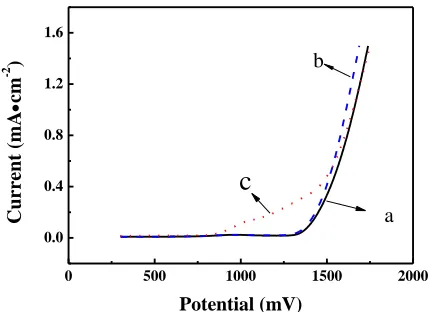
SS shows a passivation process, as shown in Fig. 1. The formation of a passive film can reduce the loss of substrate during the electropolymerization process. At a potential of about 0.9-1.2 V, the E– I curves for the solution containing EDOT, LiClO4 and SDS are different from that for other solutions
containing only SDS or SDS/LiClO4, thus indicating the electropolymerization of EDOT. Also, a current
density jump can be observed. As the potential is higher than 1.2 V, SS is dissolved again. It is clear that the electropolymerization of EDOT is initiated at a potential of 0.9 V, while the SS substrate is still at the potential of passivation. Then, a Cr2O3 film can be formed, which could effectively prevent the
dissolution of SS [24]. In addition, PEDOT films grow at an electrochemical deposition potential of 1.1 V and 900 s.
Fig. 2(a) shows that SS has a uniform and dense layer, which can act as a physical barrier to effectively prevent the substrate from oxygen and water vapor in air. Fig. 2(b) shows that the PEDOT coating is composed of small cauliflower-like grains with an average size of tens of microns, which is the characteristic microstructure for PEDOT [25-26]. There is an increase in the surface roughness and area of the PEDOT coating [27]. The matrix with a rough surface and a microporous structure favors the infusion and attachment of the perfluorinated lubricant.
0 20 40 60 80 100
5 10 15 20 25 30
In
tensity/ a.
u.
2/deg.
b PEDOT/SS
[image:4.596.183.396.519.675.2]a SS
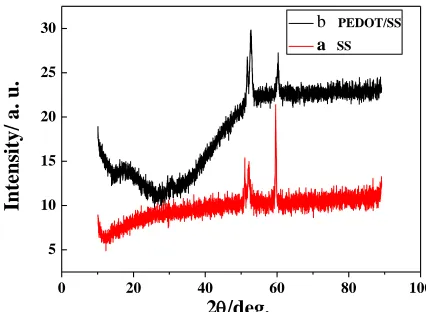
Figure 3. XRD patterns of (a) 304 SS; and (b) 304 SS with a PEDOT coating.
within the polymer and the scattering from chains of the polymer at the interplanar spacing [29]. However, no spike peaks are observed, thus indicating no long-range order in the amorphous polymer. As PEDOT has a rough surface, there are many gaps of micrometer dimensions around the granular PEDOT. However, corrosion would still occur as the dissolved corrosive species can easily penetrate into the gaps and reach the metal surface, which can be easily overcome by surface hydrophobilization. 1H, 1H, 2H, 2H-perfluorooctyl trichlorosilane is used to modify the structure of PEDOT films in order to induce hydrophobic and oil-loving surfaces that could admit the perfluorinated lubricant, which can act as an effective corrosion inhibition barrier [24].
Fig. 4 shows the wettability properties of unmodified and modified PEDOT films. The contact angle of unmodified PEDOT coating on the SS is 21°, indicating a hydrophilic surface; while that of pure SS is about 83°, which can be assumed to be an intrinsic Young contact angle. Therefore, PEDOT shows hydrophilic characteristics compared to bare steel. Kumar et al. also found that the contact angle of the PEDOT coating was about 32-44° but that of base metal was 89° [19]. According to the Wenzel equation cosθW= rcosθY, the surface roughness is calculated to be 8.9, indicating the formation of a rough
surface at a potential of 1.1 V [30]. The contact angle is increased to 140°, which is lower than that (160°) of Al oxide after modification by the fluorinating agent, suggesting substantial changes in surface properties [22], and the contact angle lower than 150° is characteristic of superhydrophobicity. The surface modification results in a change in the wettability from hydrophilicity to hydrophobicity, which can be attributed to the oleophilic characteristics of the organic fluorine. In addition, the surface is intrinsically porous, making it possible to accommodate the lubricant. The porous structure can be regarded as capillary channels of micro/nano scale. The high capillary force caused by miro/nanoscale channels allows for a firm attachment of the lubricant, and the out layer of the fluid can also be anchored to the inner layer to avoid free flowing due to the large van der Waals force of macromolecules. The infusion of lubricant results in the formation of the material composed of stationary lubricant and PEDOT with a smooth and nearly defect-free surface [22].
Figure 4. The contact angle of PEDOT/SS film (a) and PEDOT/SS modified by 1H, 1H, 2H, 2H-perfluorooctyl trichlorosilane (b) .
3.2 Corrosion inhibition performance
[image:5.596.191.403.505.591.2]
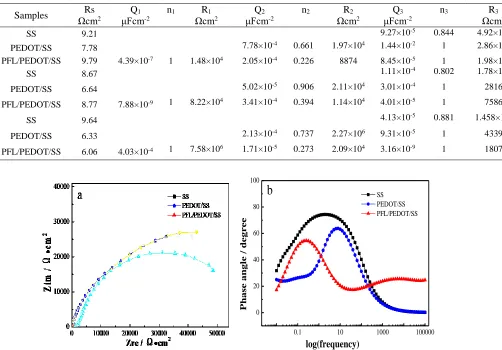
are characterized by the resistance R3 and associated capacitance Q3, resistance R2 and associated
[image:6.596.71.529.147.229.2]capacitance Q2, and resistance R1 and associated capacitance Q1, respectively.
[image:6.596.60.562.321.671.2]Figure 5. Equivalent circuits for bare and coated samples in aggressive electrolytes (0.1 M HCl, 3.5 wt % NaCl and 0.1 M NaOH aqueous solutions); (a) SS; (b) PEDOT/SS and (c) PFL/PEDOT/SS
Table 1. EIS simulation results for SS, PEDOT/ SS and PFL/PEDOT/SS in 0.1 M HCl, NaCl and NaOH solutions.
Media Samples Rs Ωcm2
Q1
μFcm-2
n1 R1
Ωcm2
Q2
μFcm-2
n2 R2
Ωcm2
Q3
μFcm-2
n3 R3
Ωcm2
HCl
SS 9.21 9.27×10⁻⁵ 0.844 4.92×10⁴
PEDOT/SS 7.78 7.78×10⁻⁴ 0.661 1.97×10⁴ 1.44×10⁻² 1 2.86×10⁴
PFL/PEDOT/SS 9.79 4.39×10⁻⁷ 1 1.48×10⁴ 2.05×10⁻⁴ 0.226 8874 8.45×10⁻⁵ 1 1.98×10⁴
NaCl
SS 8.67 1.11×10⁻⁴ 0.802 1.78×10⁴
PEDOT/SS 6.64 5.02×10⁻⁵ 0.906 2.11×10⁴ 3.01×10⁻⁴ 1 2816
PFL/PEDOT/SS 8.77 7.88×10⁻⁹ 1 8.22×10⁴ 3.41×10⁻⁴ 0.394 1.14×10⁴ 4.01×10⁻⁵ 1 7586
NaOH
SS 9.64 4.13×10⁻⁵ 0.881 1.458×10⁵
PEDOT/SS 6.33 2.13×10⁻⁴ 0.737 2.27×10⁶ 9.31×10⁻⁵ 1 4339
PFL/PEDOT/SS 6.06 4.03×10⁻⁴ 1 7.58×10⁶ 1.71×10⁻⁵ 0.273 2.09×10⁴ 3.16×10⁻⁹ 1 1807
0.1 10 1000 100000
0 20 40 60 80 100
log(frequency)
Ph
ase
an
gle
/ d
egr
ee
SS PEDOT/SS PFL/PEDOT/SS
b
Figure 6. (a) Nyquist plots and (b) phase angle–log (frequency) diagrams of three matrices in 0.1 M HCl solution.
difference in the Nyquist plots between SS and PEDOT/SS with a time constant. The PFL/PEDOT/SS matrix has a relatively depressed semi-circular shape with two time constants. Although inherently conductive, the PEDOT polymer film is still frail in the highly aggressive acid solution, and the extra time constant can be attributed to the perfluorinated lubricant attached to the polymer. It is easily seen that the arc capacitive impedances of PEDOT/SS and PFL/PEDOT/SS are smaller than that of SS, which can be attributed to the dispersion effect as both PEDOT/SS and PFL/PEDOT/SS matrices have a rougher surface.
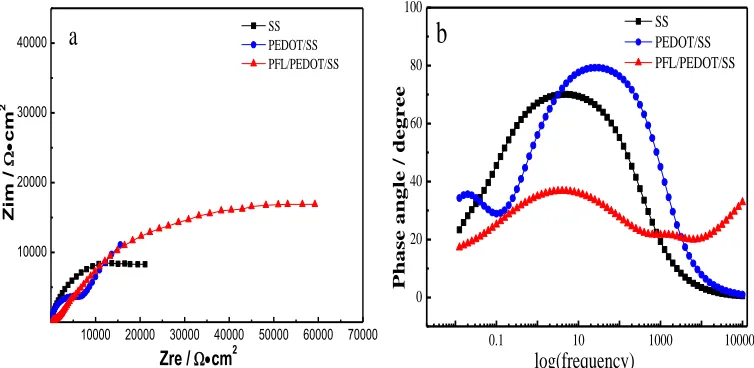
The corrosion performance of the three matrices in neutral (NaCl) media is shown in Fig. 7. The Nyquist plots and phase angle–log (frequency) diagrams of SS show that no oxide layer is formed on SS and it has a capacitive impedance with one time constant. The impedance data show that PEDOT/SS has a traditional capacitance loop at high frequencies and an irregular line with a slope of ca. 1 at low frequencies, indicating tangent hyperbolic diffusion in the passive process (Fig. 7 a). This is characteristic of the impedance for a thin layer cell, and PEDOT as an electroactive film can have high oxidation activity to SS to form a passivity layer. The SS covered by the polymer film is dipped into electrolyte solution containing a redox couple. In this case, there exist two interfaces, including a metal/polymer film interface where only electrons may be exchanged and a polymer film/electrolyte solution interface where electrons, ions and solvent molecules are exchanged [24, 31]. For the PFL/PEDOT/SS matrix, the Nyquist plot shows a larger semi-circular shape. The Bode diagrams show that the maximum phase angles decrease and the peaks become broader.
10000 20000 30000 40000 50000 60000 70000 10000
20000 30000 40000
Zre / cm2
Zi
m /
cm
2
SS PEDOT/SS PFL/PEDOT/SS
a
0.1 10 1000 100000
0 20 40 60 80 100
log(frequency)
Ph
ase
an
gle
/ d
egr
ee
SS PEDOT/SS PFL/PEDOT/SS
[image:7.596.107.484.412.596.2]b
Figure 7. (a) Nyquist plots and (b) phase angle–log (frequency) diagrams of the three matrices in 3.5 wt % NaCl solution.
The impedance data of SS, PEDOT/SS and PFL/PEDOT/SS in NaOH media are shown in Fig. 8. It shows that PEDOT/SS has the largest semi-circular shape, indicating that the conductive polymer film can act as a good physical barrier against corrosion. The results are supported by the phase angle– log (frequency) plots (Fig. 8b), in which an increase in the phase angle is observed at low frequencies. The resistance of lubricant (R1) is as high as 7.58×10⁶ in 0.1M NaOH solution, which indicates that the
0 35000 70000 105000 140000
0 35000 70000 105000 140000
Zre / cm2
[image:8.596.53.473.85.257.2]Zim / cm 2 SS PEDOT/SS PFL/PEDOT/SS
a
Figure 8. (a) Nyquist plots and (b) phase angle–log (frequency) diagrams of the three matrices in the 0.1 M NaOH solution for electrodes tested.
-600 -400 -200 0 200 400 600
1E-5 1E-4 1E-3 0.01 0.1 1 Cu rr ent (mA ) Potential (mV) SS PEDOT/SS PFL/PEDOT/SS
a
-900 -600 -300 0 300 600 900
1E-6 1E-4 0.01 1 100 Cu rr en t (m A) Potential (mV) SS PEDOT/SS PFL/PEDOT/SS
b
-900 -600 -300 0 300 600 900 1200
1E-7 1E-6 1E-5 1E-4 1E-3 0.01 0.1 1 10 Cu rr en t (m A) Potential (mV) SS PEDOT/SS PFL/PEDOT/SS
c
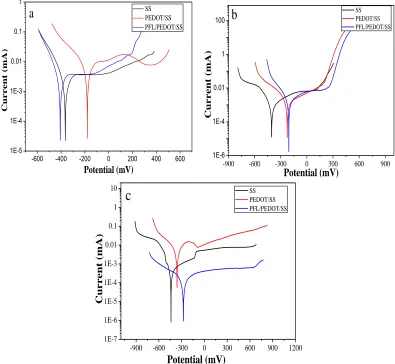
Figure 9. (a) Potentiodynamic polarization behaviors of the three matrices in 0.1 M HCl solution; (b) 3.5 wt % NaCl solution; and (c) 0.1 M NaOH solution
[image:8.596.101.496.322.686.2]
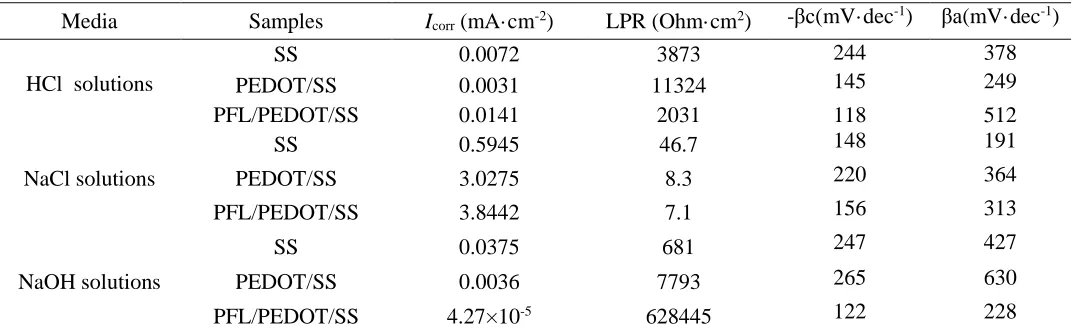
Fig. 9 shows the potentiodynamic polarization curves for the three matrices in various solutions, and Table 2 shows the curve-fitted results from the potentiodynamic polarization experiments. Fig. 9a shows that compared to SS and PFL/PEDOT/SS, the corrosion potential of PPEDOT/SS shows a large positive shift, while the corrosion current Icorr also shows a distinct decrease in HCl aqueous solution.
Fig. 8b shows the potentiodynamic polarization results of the three matrices in NaCl aqueous solution. However, PEDOT/SS and PFL/PEDOT/SS show no significant improvement in corrosion performance compared to SS, which is in agreement with the results of Aguirre et al.[27]. It is assumed that PEDOT or perfluorinated lubricant could temporarily prevent the formation of oxide layers, while the bare SS is covered with a passivation layer containing compact Cr2O3 [32]. However, the formation of the compact
passivation layer is inhibited due to the blocking effect of PEDOT or PFL/PEDOT, so that the conductive film or the biphase composition would have no obvious advantages. The corrosion inhibition of these composite materials in NaOH aqueous solution is shown in Fig. 9c and Table 2. The corrosion performance of PEDOT/SS and PFL/PEDOT/SS is significantly improved, and their corrosion potentials show a positive shift compared to SS. The Icorrof PFL/PEDOT/SS decreases dramatically. The
Icorr of PEDOT/SS and PFL/PEDOT/SS is ca. 1 and 3 order of magnitude lower than that of SS,
[image:9.596.31.568.451.618.2]respectively. Therefore, it can be concluded that the corrosion inhibition performance of PFL/PEDOT/SS is significantly improved in NaOH aqueous solution after the modification by fluorinating agent and perfluorinated lubricant.
Table 2. Icorr and linear polarization resistances of SS, PEDOT/SS and PFL/PEDOT/SS matrices in 0.1
M HCl, NaCl and NaOH solutions.
Media Samples Icorr (mA·cm-2) LPR (Ohm·cm2) -βc(mV·dec
-1) βa(mV·dec-1)
HCl solutions
SS 0.0072 3873 244 378
PEDOT/SS 0.0031 11324 145 249
PFL/PEDOT/SS 0.0141 2031 118 512
NaCl solutions
SS 0.5945 46.7 148 191
PEDOT/SS 3.0275 8.3 220 364
PFL/PEDOT/SS 3.8442 7.1 156 313
NaOH solutions
SS 0.0375 681 247 427
PEDOT/SS 0.0036 7793 265 630
PFL/PEDOT/SS 4.27×10⁻⁵ 628445 122 228
4. CONCLUSIONS
In this study, a PEDOT film was deposited onto the SS surface to prepare PEDOT/SS by chronoamperometry. The porous polymer film is highly hydrophobic with a water contact angle of ~ 140o after the modification by the fluorinate agent. PFL/PEDOT/SS was prepared by the infusion of
References
1. S. O. Moussa, M. G. Hocking, Corros. Sci., 43 (2001) 2037.
2. M. Saitou, W. Oshikawa, T. Ishikawa, Corros. Sci., 44 (2002) 1469. 3. I. T. Hong, C. H. Koo, Mater. Sci. Eng., A, 393 (2005) 213.
4. J. Hou, G. Zhu, J. Xu and H. Liu, J. Mater. Sci. Technol., 29 (2013) 678. 5. S. E. Ziemniak, M. Hanson, Corros. Sci., 48(2006) 2525.
6. A. A. Hermas, M. Nakayama, K. Ogura, Electrochim. Acta, 50(18) (2005)3640. 7. F. Jonas, J. T. Morrison, Synth. Met., 85(1997) 1397.
8. A. R. Elkais, M. Gvozdenović, B. Z. Jugović and B. N. Grgur , Prog. Org. Coat., 76(2013) 670. 9. Y. Zhang, Y. Shao, T. Zhang, G. Meng and F. Wang, Prog. Org. Coat., 76 (2013) 804.
10. L. Groenendaal, F. Jonas, D. Freitag and HPielartzik, J. R. Reynolds, Adv. Mater., 12(2000) 481. 11. Joseph B. Schlenoff, H. Xu, J. Electrochem. Soc., 139(1992) 2397.
12. P. Lv, Y. Feng, Y. Li and W. Feng, J. Power Sources, 220(2012) 160 .
13. G. Nie, L. Zhou, Q. Guo and S. Zhang, Electrochem. Commun., 12(2010) 160. 14. S. O. Jeon, J. E. Sang, S. S. Hyo, Adv. Mater., 23(2011) 1436.
15. K. Lin, T. Tsai, S. Chen, Biosens. Bioelectron., 26(2010) 608.
16. D. Gopi, S. Ramyaa, D. Rajeswari, M. Surendirana and L. Kavithab, Colloids Surf., B, 114 (2014)234
17. K. Catt, H. Li, X. T. Cui, Acta Biomater., 48 (2017) 530
18. D. Gopi, P. Karthikeyan, L. Kavitha and M. Surendiran, Appl. Surf. Sci., 357(2015)122 19. A. M. Kumar, M. A. Hussein, A.Y. Adesina, S. Ramakrishna and N. Al. Aqeeli,RSC Adv.,
8(2018)19181
20. T. S. Wong, H. K Sung, K. Y. S. Tang, E. J. Smythe, D. H. Benjamin, G. Alison and A. Joanna, Nature, 477 (2011) 443.
21. K. Philseok, T.S. Wong, J. Alvarenga, M. J. Kreder, W.E. Adorno and J. Aizenberg, ACS nano, 6,(2012) 6569.
22. P. Wang, Z. Lu, D. Zhang. Corros. Sci., 93(2015)159
23. B. Zhang, X.Zhao, Y. Li and B. R. Hou, RSC Adv., 6 (2016)35455
24. G. Zhu, J. Hou, H. Zhu, R. Qiu and J.K. Xu, J. Coat. Technol. Res., 10(2013) 659.
25. R. Salgado, R. del Rio, M.A. del Valleand F. Armijo, J. Electroanal. Chem., 704(2013)130
26. M.A. del Valle, A.M. Ramirez, L. Hernández, F. Amijo, F.R. Díaz and G.C. Arteaga, Int. J. Electrochem. Sci., 11 (2016) 7048
27. J. Aguirre, L. Daille, D. A. Fischer, C. Galarce, G. Pizarro, I. Vargas, M. Walczak, R. D. L. Iglesia, F. Armijo, Prog. Org. Coat., 113(2017),175
28. M. A. Chougule, S. G. Pawar, R. G. Prasad, N. M. Ramesh, S. Shashwati and B. P. Vikas, Soft Nanosci. Lett., 1 (2011) 6.
29. J. Y. Ouyang, Y. F. Li, Polymer, 38 (1997) 3997.
30. J. A. Bradford, W. R. Harlan and H. R. Hanmer. Ind. Eng. Chem., 28(1936) 988. 31. R. M. Kraljić, K. Kvastek, V. R. Horvat, Corros. Sci., 49(2007) 2567.
32. A. Igual Muñoz, J. G. Anton, J. L. Guiñón and V. Pérez Herranz, Corros. Sci., 49 (2007) 3200.