http://eprints.whiterose.ac.uk/144417/ Version: Accepted Version
Article:
Costantini, A, Ceschi, A, Viragos, A et al. (2 more authors) (2019) The role of a new strength-based intervention on organisation-based self-esteem and work engagement: A three-wave intervention study. Journal of Workplace Learning, 31 (3). pp. 194-206. ISSN 1366-5626
https://doi.org/10.1108/JWL-07-2018-0091
© 2019, Emerald Publishing Limited. This is an author produced version of a paper published in Journal of Workplace Learning. Uploaded in accordance with the publisher's self-archiving policy.
Reuse
Items deposited in White Rose Research Online are protected by copyright, with all rights reserved unless indicated otherwise. They may be downloaded and/or printed for private study, or other acts as permitted by national copyright laws. The publisher or other rights holders may allow further reproduction and re-use of the full text version. This is indicated by the licence information on the White Rose Research Online record for the item.
Takedown
If you consider content in White Rose Research Online to be in breach of UK law, please notify us by
Journal of Workplace Learning
The role of a new strength-based intervention on organisation-based self-esteem and work engagement. Athree-wave intervention study.
Journal: Journal of Workplace Learning
Manuscript ID JWL-07-2018-0091.R2 Manuscript Type: Research Paper
Journal of Workplace Learning
TITLEThe role of a new strength-based intervention on organisation-based self-esteem and work
engagement. A three-wave intervention study. 2
Journal of Workplace Learning
ABSTRACTThe present study investigates the relationship between organisation-based self-esteem (OBSE)
and work engagement during a new strength-based intervention over nine months.
A sample of 82 workers composed of 70 sales consultants and 12 area-managers working in an
Italian pharmaceutical company received a 1-day training based on the FAMILY approach, three
times for nine months, with a three-month lag between each workshop.
Self-reported measures of OBSE and work engagement were collected before and after each
workshop.
Results showed that final levels of both OBSE and work engagement were significantly higher
compared to baseline. Moreover, results from a multiple mediation analysis showed that the direct
and indirect relationships between OBSE and work engagement changed at different time points,
which may have been related to the different contents of the workshops.
This study provides initial evidence suggesting that organisations could leverage on medium-term
interventions to provide employees active guidance on how to use their strengths at work, likely
to boost higher employees’ positive perceptions of themselves as organisational members and
work engagement.
Keywords: Positive Psychology, Strength-Based Interventions, Work Engagement,
Organization-Based Self-Esteem. 2
Journal of Workplace Learning
INTRODUCTIONOrganisations are increasingly promoting employee health and wellbeing (Tonkin, Malinen,
Näswall, & Kuntz, 2018). This trend is due to evidence showing that happy workers are more
productive and cope better with the high demands of the work environment than their dissatisfied
counterparts (Zelenski et al., 2008; Lyubomirsky et al., 2005; Pfeffer, 2018). A promising
approach to promote wellbeing is the focus on individual strengths at work (Bakker & van
Woerkom, 2018; Quinlan et al., 2012; Peterson et al., 2010). However, research on strengths use
in organisational contexts is still in its early stages (Bakker & van Woerkom, 2018; Buckingham,
2007), and enabling strengths use might represent an overlooked strategy to boost employee
wellbeing. Indeed, organisations may implement strengths interventions, i.e. training processes
aiming at the identification, development, and use of the participants’ strengths (Quinlan et al.,
2012) to boost the benefits of employees’ strengths use. Importantly, such an approach to
employees’ empowerment has been found to consistently enhance general wellbeing while being
relatively easy to implement and moderately costly (Quinlan et al., 2012).
While strengths interventions may represent a valuable resource to sustain employees’
engagement and wellbeing, there are still considerable gaps in the empirical research on strengths
interventions (Bakker & van Woerkom, 2018). First, most of the existing studies on strengths
interventions involved samples of children, adolescents, or students rather than adults (Quinlan et
al., 2012). Second, most of the studies focus on the use of strengths in daily life, while little
research has been conducted in work contexts (Meyers et al., 2013). Third, existing studies have
mainly focused on general instead of work-related wellbeing and have not explored the
mechanisms through which strengths interventions influence wellbeing (Quinlan et al., 2012). 2
Journal of Workplace Learning
In this contribution, we aim at addressing these gaps by presenting results from a field,
quasi-experimental study that involved 82 employees who took part in a strengths intervention
initiative lasting over nine months. In doing so, we contribute to the literature on strengths
interventions and employees’ resources and wellbeing in several ways. First, by investigating the
effects of a strengths intervention on employees’ organisation-based self-esteem (OBSE), we
aimed at further deepening the knowledge on how workplace interventions supporting employees’
effective use of their strengths build their personal resources. Second, by investigating the
relationship between OBSE and employees’ engagement during the intervention period, we shed
light on the role of strengths interventions to support wellbeing in working contexts. In doing so,
we contribute to disentangling the psychological mechanisms through which strengths
interventions exert their effects on employees’ wellbeing. Third, by addressing the relationship
between employees’ OBSE and work engagement at three time points over nine months, we
provide evidence on the role of such a personal resource originating in the working context to
sustain work engagement over time.
Sustaining employees’ strengths use to unleash personal resources in the workplace
Individual strengths have been defined as “ways of behaving, thinking or feeling that an individual
has a natural capacity for, enjoys doing, and which allow the individual to achieve optimal
functioning while they pursue valued outcomes” (Quinlan et al., 2012, p. 3). By using individual
strengths, employees feel energised and inspired, able to cope with stressful situations and less
prone to experience strain and exhaustion (Bakker & van Woerkom, 2018; Bakker & Demerouti,
2007). That is, individual strengths use is not only beneficial in that it drives high performance,
but also because it is intrinsically motivating, enjoyable, engaging, satisfying, and energising
(Peterson & Park, 2006; Linley & Harrington, 2006; Peterson & Seligman, 2004). However, 2
Journal of Workplace Learning
despite such positive outcomes, today’s organisations often overlook the potential of organising
work around employee strengths (Peterson & Park, 2006), or of channelling strengths use in an
efficient way (Biswas-Diener et al., 2011). Also, most employees and leaders cannot readily
identify their own strong points (Kaplan & Kaiser, 2010; Buckingham & Clifton, 2001), and report
to not use their strengths very often when at work (Buckingham, 2007).
To raise awareness for the value of individual strengths and to stimulate an efficient
strengths use, organisations can make use of strengths interventions, which have been defined as:
“a process designed to identify and develop strengths in an individual or group. Interventions
encourage the individual to develop and use their strengths, whatever they may be. Their goal is
to promote wellbeing or other desirable outcomes through this process” (Quinlan et al. 2012, p.
4). By using their strengths, employees feel true to themselves and their values (Ghielen et al.,
2018), which conveys a sense of leading a meaningful and significant life, eventually fostering
engagement in activities (Schaufeli & Salanova, 2010). Moreover, when employees apply their
strengths, they get the chance to work on or with their strong points (Peterson & Seligman 2004).
By doing so, they are likely to develop positive self-evaluations regarding their adequacy as
organisational members, because they feel they can successfully master work tasks by employing
their assets, which may reflect in high OBSE.
Organisation-based self-esteem is defined as the degree to which an individual believes
him/herself to be capable, significant, and worthy as an organisational member (Pierce, Gardner,
Cummings, & Dunham, 1989). Elaboration of the construct casts OBSE as a self-evaluation of
one’s personal adequacy (competency) as an organisational member. It reflects the self-perceived
value that individuals have of themselves as valuable, competent, and capable within their
employing organisations (Pierce & Gardner, 2004). Employees with high OBSE have the belief 2
Journal of Workplace Learning
that “I count around here” and have a sense of having satisfied their needs through their
organisational roles (Korman, 1970). Previous studies showed the role of OBSE to buffer the
negative effect of job insecurity on work engagement (De Paola & Charkhabi, 2016). Moreover,
evidence shows that, among different personal resources considered such as optimism and
self-efficacy, OBSE is the best predictor of work engagement (Bakker & Demerouti, 2008). However,
while such findings are key to understand the role of OBSE to enhance wellbeing and reduce stress,
less is known on the role of strengths interventions to sustain OBSE.
Building on the definition of OBSE reported above, we argue that interventions supporting
employees’ strengths use nurture employees’ OBSE in that employees who get the chance and
learn to work by applying their strong points will feel more competent and valuable to their
organisations.
Hypothesis 1: Participants’ level of OBSE after the intervention will be higher compared
to their level of OBSE before the intervention.
Employees’ strengths and work-related wellbeing
Employing strengths is an energising process that renews vigour and counteracts exhaustion
(Ghielen, van Woerkom, & Meyers, 2018; Peterson & Seligman, 2004; Schaufeli et al., 2002).
Indeed, actively putting one’s strengths to work can trigger flow experiences (Csikszentmihalyi,
1990) and employees who apply their strengths may feel good about themselves and invigorated
(Peterson & Seligman 2004). Accordingly, strengths interventions have been proposed as an
effective means to influence and sustain employees’ engagement (Bakker, Hetland, Olsen, &
Espevik, 2018; Schaufeli & Salanova, 2010).
Work engagement represents a conceptually related aspect of work-related wellbeing that
can be influenced through targeted workplace interventions (van Wingerden, Bakker, & Derks, 2
Journal of Workplace Learning
2016; Schaufeli, 2014; Schaufeli & Salanova, 2010; Le Blanc & Schaufeli, 2008). Specifically,
work engagement has been defined as a positive, fulfilling, work-related state of mind that is
characterised by vigour, dedication, and absorption (Schaufeli et al., 2002). Employees with high
levels of work engagement put much effort and energy in their work, take pride and find inspiration
in the work activities they pursue, and immerse themselves fully in their tasks (Schaufeli et al.,
2002). However, while literature already showed that when companies give their employees the
opportunity to use and develop their talents and strengths, this results in more engaged employees
at work (Demerouti & Cropanzano, 2010; Schaufeli et al., 2006; Xanthopoulou et al., 2008), only
limited research has been conducted to investigate the role of strengths interventions to sustain
work-related wellbeing (Meyers & van Woerkom, 2016). In one of the few studies conducted on
the topic, findings showed a positive association between the applicability of one’s strengths at
work and engagement (Harzer & Ruch, 2013). Based on these findings, we expect that participants
taking part in an intervention designed to empower employees’ strengths at work will result in an
improvement of their work engagement:
Hypothesis 2: Participants’ level of work engagement after the intervention will be higher
compared to their level of work engagement before the intervention.
As previously argued, it is likely that employees participating in a tailored intervention
aiming at supporting strengths’ use in the workplace may experience a high sense of control and
perceptions of mastery (Bakker & van Woerkom, 2018), which will reflect in high OBSE. In turn,
such perceptions are likely to help them dealing with the demands of the work environment,
resulting in more frequent experiences of work engagement. Previous findings already showed the
positive effects of OBSE on work engagement (e.g. Bakker & Demerouti, 2008; Xanthopoulou et
al., 2008), but less is known about whether nurturing employees’ OBSE through strengths 2
Journal of Workplace Learning
interventions results in stable, significant relationships between OBSE and work engagement that
replicate over a medium time frame. Such a gap deserves closer attention in that understanding
whether and how the pattern of the mechanism linking OBSE and work engagement remains stable
or changes over time is key to provide evidence-based guidelines to scholars and practitioners
interested in the design of interventions to improve employees’ personal resources and wellbeing.
Overall, based on previous literature attesting a positive association between OBSE and work
engagement, we expect that:
Hypothesis 3: OBSE and work engagement will be positively related at every time point.
Moreover, consistent with Hypothesis 2, participants involved in a strengths intervention
will feel more engaged and energised, i.e. will report higher work engagement compared to
baseline. In turn, we argue, such a positive state will be linked to higher OBSE because it will
provide employees with the energy to master work tasks by making use of their strengths, a process
that will be supported by means of the strengths intervention.
Hypothesis 4: Participants’ OBSE will be positively related to participants’ work
engagement, which in turn will be positively related to participants’ OBSE. Such a
relationship will be recursive throughout the intervention.
METHOD
Participants and procedure
Participants were 82 employees working in an Italian pharmaceutical company in North Italy.
Among these, 70 were sales consultants and 12 were area-managers. Eighty per cent of participants
were women and ages ranged from 24 to 57 years (M = 32.38; SD = 7.70). Most of the participants
had a master’s (37%) or a bachelor’s degree (32%). 2
Journal of Workplace Learning
In this study, the intervention was designed for a duration of about nine months and
consisted in a one-day, eight-hour workshop delivered to participants every three months, in
groups of up to twenty participants led by trained research assistants and a facilitator. The first
questionnaire, which included a scale to measure OBSE and socio-demographic information, was
filled in one and a half month before the first workshop. Participants were again asked to fill in the
same questionnaire before the second and the third workshops. At the end of each workshop
participants reported data referred to their work engagement, exception made for the last
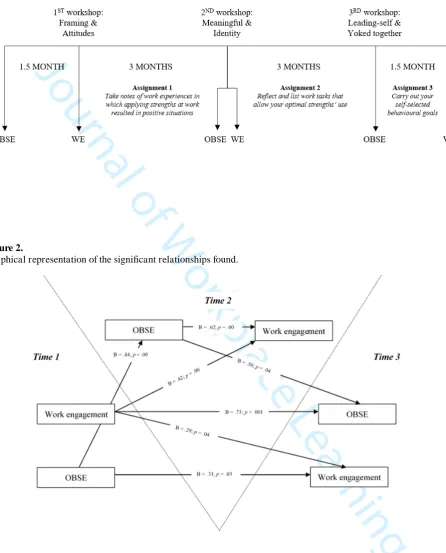
questionnaire, which was filled in one and a half month after the last workshop. Figure 1 provides
a graphical representation of the time points of data collection, the contents of the workshops and
participants’ assignments between one workshop and the following.
_________________________
INSERT FIGURE 1 ABOUT HERE
_________________________
The research staff provided participants with the questionnaires and explained the
anonymous nature of data collection. Anonymity was guaranteed through an identification code
formed by the initial three letters of a significant person and objects of the respondent’s life, which
together constituted a nine-letter code used to match the questionnaires.
Our intervention aimed to develop and channel employees’ strengths by inspiring
participants on how to positively reframe emotional situations, supporting them in the
identification of possible challenging work situations, and structuring reflection and
meaning-making process to support their awareness of work identity beliefs. Specifically, the structure of
the strengths intervention was based on the six stages of the FAMILY approach (i.e. framing,
attitudes, meaningfulness, identity, leading-self, and yoked together; Costantini et al., 2017; 2
Journal of Workplace Learning
Costantini & Sartori, 2018), which integrates the VIA (Values in Action: Peterson & Seligman,
2004) and the PERMA model (Seligman, 2010).
In the first workshop, participants were introduced to the overall structure of the
intervention and focused on the first two dimensions of the FAMILY approach, i.e. framing and
attitudes. Specifically, framing (F) referred to helping participants focusing on the positive rather
than on the negative aspects of work by using their strengths. This stage started with participants
creating their own list of their personal strengths. Then, after reflecting over past work experiences,
they were supported in reframing their work-related negative experiences by reframing the
meanings attributed to them and leveraging on how their strengths could have been suitable to
differently facing them. Attitudes (A) referred to the second step of the FAMILY approach and
constituted the second focus of the first workshop. Participants were supported in the process of
adopting a positive perspective when facing challenging work tasks and guided in doing so by
leveraging on their self-identified strengths. At the end of the workshop, participants were asked
to take note of their work experiences during the time-lag between the first and the second
workshop, to be shared in the next session, on how applying their strengths at work resulted in a
favourable situation.
In the second workshop, participants focused on the dimensions of meaningfulness (M)
and identity (I). First, participants were guided to explore their perceptions referred to the meaning
attributed to their work and on how such perceptions were (or not) aligned with the mission of
their organisation. Second, the session focused on the dimension of identity and participants were
facilitated in reflecting over their aspirations within the organisational context and on how such
aspirations matched and were concretely translated in the work environment by means of
every-day tasks. At the end, participants were given an assignment consisting of reflecting and listing, 2
Journal of Workplace Learning
during the three months before the next workshop, the working tasks that, in their opinion, allowed
their optimal strengths use.
Finally, the last workshop focused on the dimensions of leading-self (L) and yoked together
(Y). In the first part, participants were guided in the self-selection of behavioural goals to be carried
out during their work activities in order to face stressful and negative events by making use of
personal strengths. In doing so, participants confronted with their colleagues, who provided
feedback and suggestion on the feasibility of the proposed goals. Each participant identified a
“buddy”, who was in charge of providing social and emotional support to allow goal achievement.
A booklet was provided to each participant, which was designed to target the contents of
the workshops, including (a) an outline of the overall intervention; (b) a section providing the
definition of all of the FAMILY dimensions and key-points of each workshop; (c) an assignment
and planning sheet, designed to provide tangible space where to list strengths and set goals referred
to the assignments between each workshop, and (d) blank pages for personal/reflection notes, to
be used during the months between one workshop and the following.
Measures
All measures were administered in Italian. Scales that were not available in Italian were translated,
using the back-translation method (Behling & Law, 2000).
Organisation-based self-esteem. Ten items from the organisation-based self-esteem scale
(Pierce et al., 1989) measured OBSE. Sample items are “I am important around here” and “I make
a difference around here”. The scoring was performed using a seven-point rating scale ranged
from 1 (strongly disagree) to 7 (strongly agree).
Work Engagement. Work engagement was measured with five items of the Utrecht Work
Engagement Scale (UWES-9; Schaufeli et al. 2006). A sample item is “At work, I feel bursting
Journal of Workplace Learning
with energy”. Answers were given on a seven-point rating scale from 1 (never) to 7 (always/every
day).
Data analyses
Repeated measures ANOVAs were conducted to test Hypotheses 1 and 2. Hypothesis 3 was tested
by inspecting correlations among the study variables at different time points. Finally, to test
Hypothesis 4, we used the PROCESS macro (Hayes, 2013) and conducted a bootstrapping-based
analysis.
RESULTS
Measurement model and descriptive statistics
To test the factorial validity of our measures, we conducted confirmatory factor analysis using
Amos 23.0. To report our findings, we followed established recommendations (Hu & Bentler,
1999; Schumacker & Lomax, 2004). The hypothesised two-factor model supported the
discriminant validity of our measures at every time point (i.e. at Time 1, χ2
(86) = 145.18, p < .01,
CFI = .94, TLI = .92, RMSEA = .08; at Time 2, χ2
(86) = 142.16, p < .01, CFI = .93, TLI = .90,
RMSEA = .08; at Time 3, χ2
(83) = 104.15, p < .01, CFI = .98, TLI = .97, RMSEA = .05). Descriptive
statistics of the research variables including mean, standard deviations, correlations among the
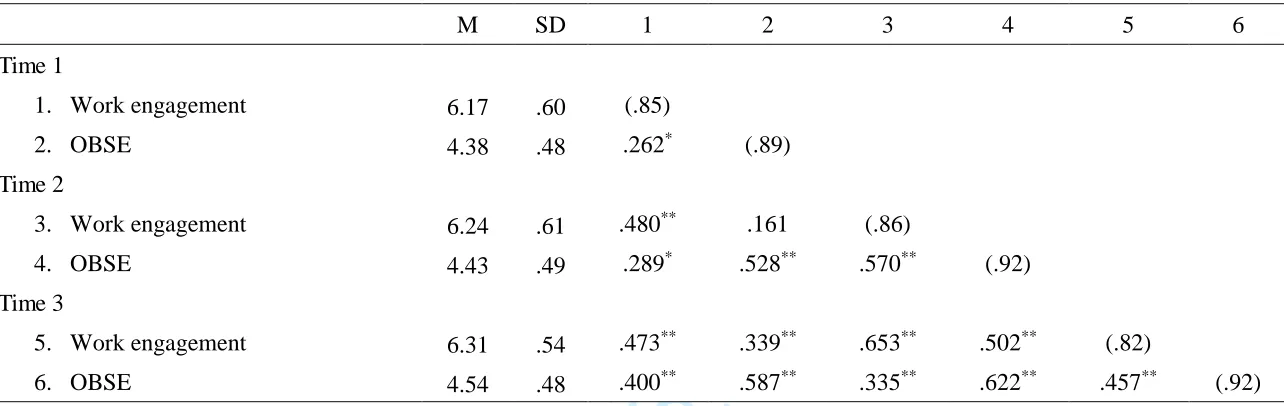
variables and reliability coefficients (Cronbach’s α) are reported in Table 1. As can be seen, the
correlations were all in the expected direction and provided support for Hypothesis 3.
---INSERT TABLE 1 ABOUT HERE
---Hypotheses testing
Repeated measures ANOVAs were conducted to determine whether the levels of work 2
Journal of Workplace Learning
engagement and OBSE significantly differ between time points. For what concerns work
engagement, Mauchly's Test of sphericity indicated that the assumption of sphericity was violated,
χ2(2) = 9.161, p = .01. Repeated measures ANOVA with a Huynh-Feldt correction determined that
the mean of work engagement significantly differed between time points (F(1.794, 105.833) =
4.502, p = .02). Post hoc tests using the Bonferroni correction revealed that the intervention elicited
a slight increment in work engagement from Time 1 to Time 2, which was not statistically
significant (p = .12). However, work engagement at Time 3 increased and was significantly
different to Time 1 (p = .036). Regarding OBSE, Mauchly's Test of sphericity indicated that the
assumption of sphericity was not violated, χ2(2) = .08, p = .96. Repeated measures ANOVA
assuming sphericity determined that the mean of OBSE significantly differed between time points
(F(2, 108) = 7.514, p = .001). Post hoc tests using the Bonferroni correction revealed that the
intervention elicited a slight increment in OBSE from Time 1 to Time 2, which was not statistically
significant (p = .07). However, OBSE at Time 3 significantly increased compared to Time 1 (p
= .001). Based on these findings, Hypotheses 1 and 2 are confirmed. That is, the levels of OBSE
and of work engagement after the intervention were significantly higher compared to participants’
level of the same constructs before the intervention.
Hypothesis 4 stated that participants’ OBSE would have been positively related to
participants’ work engagement, which in turn would have been positively related to participants’
OBSE. Moreover, it assumed that such a relationship would have been recursive throughout the
duration of the intervention. To test this Hypothesis, we used bootstrapping following the
PROCESS procedure recommended by Hayes (2013). Specifically, we run a mediation analysis
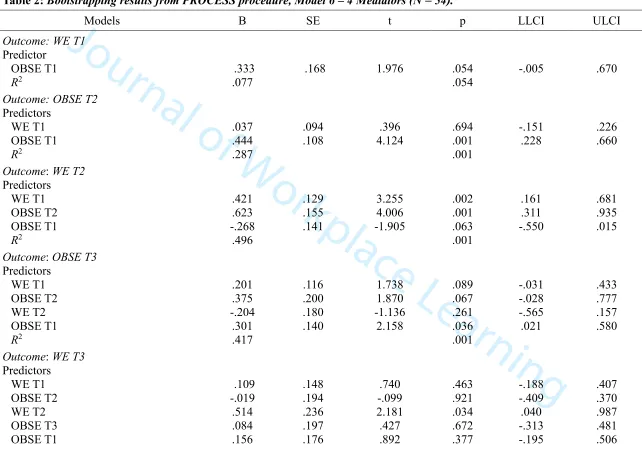
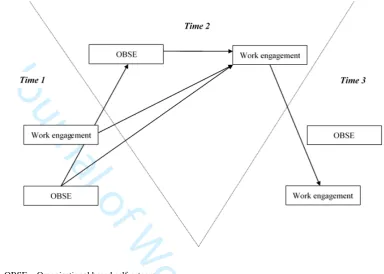
with four mediators. Results are reported in Table 2 and displayed in Figure 1 and 2. As can be
seen in Figure 2, Hypothesis 4 was not confirmed since the indirect effect of OBSE at Time 1 on 2
Journal of Workplace Learning
work engagement at Time 3 was not significant. However, results showed that OBSE at Time 1
was significantly related to OBSE and work engagement at Time 2, which in turn were
significantly related to work engagement at Time 3. Moreover, OBSE at Times 1 was significantly
related to OBSE at Time 2, which in turn was positively related to work engagement at both Time
2 and 3.
---INSERT TABLE 2 ABOUT HERE
---INSERT FIGURE 2 ABOUT HERE
---INSERT FIGURE 3 ABOUT HERE
---DISCUSSION
This contribution presented a quasi-experimental field study on the role of a strengths intervention
to support employees effective use of their strengths at work and wellbeing. Moreover, by
collecting data before and after three workshops over nine months, we were able to examine the
relationships between OBSE and work engagement across multiple time points, over a medium
time-frame. Findings showed that participants’ level of both OBSE and work engagement were
higher at the end of the intervention period, i.e. after nine months from the first time point,
compared to baseline. These results suggest that interventions designed to improve employees’
effective use and awareness of their strengths can be effective to sustain work engagement in the 2
Journal of Workplace Learning
medium term when multiple workshops and assignments are provided between one workshop and
the other.
Results also showed that the pattern of relationships between OBSE and work engagement
changed across time. Such changes may be linked to the different contents of the workshops and
the different assignments during the intervention period (see Figure 1). The first workshop focused
on cognitive (re)framing and attitudes. OBSE measured before such a workshop was not
significantly related to work engagement measured after it, while it was significantly linked to
OBSE measured before the second workshop. This may suggest that the contents of the first
workshop (i.e. reflecting over past work experiences and reframing work-related negative
experiences leveraging on personal strengths) and assignments (i.e. how applying strengths at
work resulted in favourable situations) may have contributed to fuel OBSE after three months
rather than boost work engagement immediately at the end of the workshop. Differently, after the
second workshop, focused on meaningfulness and identity, (i.e. on exploring the links between
personal and organisational meanings related to work and on how personal aspirations were
translated to the work environment), work engagement resulted to be significantly related to OBSE
measured before the third workshop. That is, the second workshop may have helped participants
linking the value of their organisational affiliation to express their aspirations, leading to work
engagement. Finally, in the last workshop, participants were guided in the self-selection of
behavioural goals to be carried out during work to face stressful and adverse events by making use
of their strengths. Also, they identified a co-worker in charge of providing support for the
achievement of their goals. While results showed that OBSE measured before the third workshop
was unrelated to work engagement one and a half month after it, this session could have 2
Journal of Workplace Learning
contributed to building the link between work engagement measured after the second workshop
and the third one (see Figure 2 on the indirect relationships found).
Overall, in line with previous literature (e.g. Xanthopoulou et al., 2008), results showed
that, at the end of the intervention period, participants’ initial levels of OBSE was a significant
predictor of work engagement. This confirms that employees who feel valued and appreciated in
their working contexts feel energetic, dedicated and inspired in their work. Against this
background, this study additionally contributes to previous knowledge by showing how the
mechanisms underlying the link between a personal resource, i.e. OBSE, and work engagement
change over several months and during positive organisational initiative. In doing so, our findings
enrich the literature on the role of positive interventions to reinforce individual strengths and boost
work engagement, contributing to filling an important research gap in strengths literature (Bakker
& van Woerkom, 2018). Indeed, to the best of our knowledge, this is one of the few intervention
studies adopting a 9-month time-lag between the first and the last time point. Organisational
practitioners may rely on these findings to design interventions for improving effective strengths
use and wellbeing at work focusing on different aspects of employees’ development and
empowerment. Indeed, in our study OBSE seemed related to work engagement based on the
different contents of the workshops, suggesting that they may have conveyed different value
messages transmitted from the organisation to the employees.
Study limitations and future research
Our study has several limitations that deserve attention for future research. First, in the current
study we could not involve employees in a control group and we were not able to assess the effects
of the intervention in the long run. Thus, it is unclear whether the changes in our variables were
caused by the intervention program or were due to other reasons, such as a natural course. Future 2
Journal of Workplace Learning
research could try to replicate our findings using a controlled study design, i.e. comprehending a
control group, and assessing the effects of the intervention in the long term. A second limitation is
that all participants worked for the same pharmaceutical organisation. Socially desirable behaviour
and group pressure are possible risks when participants work in the same team. Participants from
different organisations may be less influenced by other participants and may feel more comfortable
showing their vulnerability because of the anonymity (van Wingerden, Bakker, & Derks, 2017a).
Future research could try to replicate this intervention study involving participants from different
working contexts. Third, all the scales we used were self-reports. Future studies could combine
objective assessments and self-report scales to better understand the effects of our intervention on
employees and organisational outcomes. Lastly, we only used quantitative research methods.
Future research may also use qualitative approaches to shed light on participants’ experiences and
reveal how the intervention is useful to them (van Wingerden, Bakker, & Derks, 2017b).
CONCLUSION
This study provides initial evidence-based support for scholars and practitioners interested in
promoting employees’ wellbeing by empowering their effective strengths use. Our results suggest
that empowering and supporting employees’ strengths use may foster work engagement, which is
critical to sustain job performance and creativity (Christian et al., 2011; Kim et al., 2013).
Organisations could leverage on medium-term interventions to provide employees with active
guidance on how to use their strengths at work, likely to boost higher employees’ positive
perceptions of themselves as organisational members and work engagement. 2
Journal of Workplace Learning
REFERENCESBakker, A. B. & Demerouti, E. (2007), “The job demands-resources model: State of the art”,
Journal of Managerial Psychology, Vol. 22, No. 3, pp. 309–328.
Bakker, A. B. & Demerouti, E. (2008), “Towards a model of work engagement”, Career
Development International, Vol. 13, No. 3, pp. 209-223.
Bakker, A. B., Hetland, J., Olsen, O. K., & Espevik, R. (2018), “Daily strengths use and employee
well ‐ being: The moderating role of personality”, Journal of Occupational and Organizational Psychology.
Bakker, A. B., & van Woerkom, M. (2018), “Strengths use in organizations: A positive approach
of occupational health”, Canadian Psychology/Psychologie canadienne, Vol. 59, No. 1,
38-46.
Behling, O., & Law, K. S. (2000), Translating questionnaires and other research instruments:
Problems and solutions, Sage, Thousand Oaks, CA.
Biswas-Diener, R., Kashdan, T. B., & Minhas, G. (2011), “A dynamic approach to psychological
strength development and intervention” Journal of Positive Psychology, Vol. 6, No. 2, pp.
106-118.
Buckingham, M. (2007), Go put your strengths to work: 6 powerful steps to achieve outstanding
performance, Free Press, New York, NY.
Buckingham, M., & Clifton, D. O. (2001), Now, discover your strengths, Free Press, New York,
NY.
Christian, M. S., Garza, A. S., & Slaughter, J. E. (2011), “Work engagement: A quantitative review
and test of its relations with task and contextual performance”, Personnel Psychology, Vol.
64, No. 1, pp. 89–136. 2
Journal of Workplace Learning
Costantini, A., & Sartori, R. (2018), “The intertwined relationship between job crafting,
work-related positive emotions, and work engagement. Evidence from a positive psychology
intervention study”, The Open Psychology Journal, Vol. 11, No. 1.
Costantini, A., De Paola, F., Ceschi, A., Sartori, R., Meneghini, A.M., & Di Fabio, A. (2017),
“Work engagement and psychological capital in the Italian public administration: A new
resource-based intervention programme”, SA Journal of Industrial Psychology, Vol. 43,
No. 1, pp. 1-11.
Csikszentmihalyi, M. (1990), Flow: The psychology of optimal experience, New York: Harper &
Row.
De Paola, F. & Charkhabi, M. (2016), “The effect of qualitative job insecurity on work
engagement: testing moderating role of organization-based self-esteem”, European Health Psychologist, Vol. 18, pp. 872.
Demerouti, E., & Cropanzano, R. (2010), “From thought to action: Employee work engagement
and job performance”, Work Engagement: A Handbook of Essential Theory and Research,
Vol. 65, pp. 147-163.
Ghielen, S. T. S., van Woerkom, M., & Christina Meyers, M. (2018), “Promoting positive
outcomes through strengths interventions: A literature review”, The Journal of Positive
Psychology, Vol. 13, Vol. 6, pp. 573-585.
Harzer, C. & Ruch, W. (2013), “The application of signature character strengths and positive
experiences at work”, Journal of Happiness Studies, Vol. 14, No. 3, pp. 965–983.
Hu, L., & Bentler, P. M. (1999), “Cut off criteria for fit indexes in covariance structure analysis:
Conventional criteria versus new alternatives”, Structural Equation Modeling: A
Multidisciplinary Journal, Vol. 6, No. 1, pp. 1-55. 2
Journal of Workplace Learning
Kaplan, R. E. & Kaiser, R. B. (2010), “Toward a positive psychology for leaders”, Linley, P. A.,
Harrington, S., & Garcea, N. (Eds.), Oxford handbook of positive psychology and work,
Oxford University Press, New York, NY, pp. 107–117.
Kim, W., Kolb, J. A., & Kim, T. (2013), “The relationship between work engagement and
performance: A review of empirical literature and a proposed research agenda”, Human
Resource Development Review, Vol. 12, No. 3, pp. 248–276.
Korman, A. K. (1970), “Toward an hypothesis of work behavior”, Journal of Applied Psychology,
Vol. 54, No. 1, pp. 31–41.
Le Blanc, P. M., & Schaufeli, W. B. (2008), “Burnout interventions: An overview and illustration”,
Halbesleben J. R. B. (Ed.), Handbook of stress and burnout in health care, Nova Science
Publishers, New York, pp. 201–216.
Linley, P. A. & Harrington, S. (2006), “Playing to your strengths”, Psychologist, Vol. 19, No. 2,
pp. 86–89.
Lyubomirsky, S., King, L. & Diener, E. (2005), “The benefits of frequent positive affect: Does
happiness lead to success? ”, Psychological Bulletin, Vol. 131, No. 6, pp. 803–855.
Meyers, M. C., van Woerkom, M. & Bakker, A. B. (2013), “The added value of the positive: A
literature review of positive psychology interventions in organizations”, European Journal
of Work and Organizational Psychology, Vol. 22, No. 5, pp. 618-632.
Meyers, M.C. & van Woerkom, M. (2016), “Effects of a strengths intervention on general and
work-related well-being: The mediating role of positive affect”, Journal of Happiness Studies, Vol. 18, No. 3, pp. 671-689.
Peterson, C. & Park, N. (2006), “Character strengths in organizations”, Journal of Organizational
Behavior, Vol. 27, No. 8, pp. 1149–1154. 2
Journal of Workplace Learning
Peterson, C., & Seligman, M. E. (2004), Character strengths and virtues: A handbook and
classification, Oxford University Press, New York, NY.
Peterson, C., Stephens, J. P., Park, N., Lee, F. & Seligman, M. E. P. (2010). “Strengths of character
and work”, Linley, P. A., Harrington, S., Garcea, N., Linley, P. A., Harrington, S., &
Garcea N. (Eds.), Oxford handbook of positive psychology and work, Oxford University
Press, New York, NY, pp. 221–231.
Pfeffer, J. (2018), “Work Hours and Health: A Comment on “Beyond Nine to Five”, Academy of
Management Discoveries, Vol. 4, No. 1, pp. 94-96.
Pierce, J. L. & Gardner, D. G. (2004), “Self-esteem within work and organizational context: A
review of the organization-based self-esteem literature”, Journal of Management, Vol. 30,
No. 5, pp. 591-622.
Pierce, J. L.,Gardner, D. G.,Cummings, L. L. & Dunham, R. B. (1989), “Organization-based
self-esteem: Construct definition, measurement, and validation”, Academy of Management
Journal, Vol. 32, No. 3, pp. 622-648.
Quinlan, D., Swain, N. & Vella-Brodrick, D. A. (2012), “Character strengths interventions:
Building on what we know for improved outcomes”, Journal of Happiness Studies, Vol.
13, No. 6, pp. 1145–1163.
Schaufeli, W. B. & Salanova, M. (2010), “How to improve work engagement? ”, Albrecht S. (Ed.),
The handbook of employee engagement: Perspectives, issues, research and practice,
Edwin Elgar, Northampton, MA, pp. 399–415.
Schaufeli, W. B. (2014), “What is engagement? ”, Truss, C. , Delbridge, R., Alfes, K., Shantz, A.
& Soane, E. (Eds.), Employee engagement in theory and practice, Routledge, Abingdon,
pp. 15–35. 2
Journal of Workplace Learning
Schaufeli, W. B., Bakker, A. B., & Salanova, M. (2006), “The measurement of work engagement
with a short questionnaire: A cross-national study”, Educational and Psychological
Measurement, Vol. 66, No. 4, pp. 701-716.
Schaufeli, W. B., Salanova, M., Gonzalez-Roma, V. & Bakker, A. B. (2002), “The measurement
of engagement and burnout: A two sample confirmatory factor analytic approach”, Journal
of Happiness Studies, Vol. 3, No. 1, pp. 71–92.
Schumacker, R. E., & Lomax, R. G. (2004), A Beginner's Guide to Structural Equation Modeling,
Erlbaum, Mahwah, NJ.
Tonkin, K., Malinen, S., Näswall, K., & Kuntz, J. C. (2018), “Building employee resilience
through wellbeing in organizations”, Human Resource Development Quarterly, Vol. 29,
No. 2, pp. 107-124.
van Wingerden, J., Bakker, A. B., & Derks, D. (2016), “A test of a job demands-resources
intervention”, Journal of Managerial Psychology, Vol. 31, No. 3, pp. 686-701.
van Wingerden, J., Bakker, A. B., & Derks, D. (2017a), “The longitudinal impact of a job crafting
intervention”, European Journal of Work and Organizational Psychology, Vol. 26, No.1,
pp. 107-119.
van Wingerden, J., Bakker, A. B., & Derks, D. (2017b), “Fostering employee well-being via a job
crafting intervention”, Journal of Vocational Behavior, Vol. 100, pp. 164-174.
Xanthopoulou, D., Baker, A. B., Heuven, E., Demerouti, E., & Schaufeli, W. B. (2008), “Working
in the sky: A diary study on work engagement among flight attendants”, Journal of
Occupational Health Psychology, Vol. 13, No. 4, pp. 345.
Zelenski, J., Murphy, S. & Jenkins, D. (2008), “The happy-productive worker thesis revisited”,
Journal of Happiness Studies, Vol. 9, No. 4, pp. 521–537. 2
Journal of Workplace Learning
Figure captionsFigure 1. Graphical representation of the study design.
Figure 2. Graphical representation of the significant relationships found.
Note. N = 54. Unstandardized regression coefficients are reported. Only significant direct relationships are reported.
Figure 3. Graphical representation of the significant indirect relationships.
Note. N = 54. OBSE = Organizational based self-esteem.
Indirect effect of X on Y n.1 = OBSE time 1 Work engagement (WE) time 1 WE time 2 WE time 3;
Indirect effect of X on Y n.2 = OBSE time 1 OBSE time 2 WE time 2 WE time 3;
Indirect effect of X on Y n.3 = OBSE time 1 WE time 2 WE time 3. 2
Journal of Workplace Learning
Table 1: Means, Standard Deviations (SD), and Intercorrelations among the Study Variables. Cronbach’s are reported in parenthesis on the diagonal.
M SD 1 2 3 4 5 6
Time 1
1. Work engagement 6.17 .60 (.85)
2. OBSE 4.38 .48 .262* (.89)
Time 2
3. Work engagement 6.24 .61 .480** .161 (.86)
4. OBSE 4.43 .49 .289* .528** .570** (.92)
Time 3
5. Work engagement 6.31 .54 .473** .339** .653** .502** (.82)
6. OBSE 4.54 .48 .400** .587** .335** .622** .457** (.92)
Note. N = 54. * p < .05 (2-tails). ** p < .01 (2-tails). OBSE = Organisational based self-esteem.
Journal of Workplace Learning
Table 2: Bootstrapping results from PROCESS procedure, Model 6 – 4 Mediators (N = 54).Models B SE t p LLCI ULCI
Outcome: WE T1 Predictor
OBSE T1
R2 -.077.333 -.168 1.976 .054.054 -.005 .670
Outcome: OBSE T2 Predictors WE T1 OBSE T1 R2 .037 .444 .287 .094
.108 4.124.396 .694 .001
.001 - -.151 .228 - .226 .660
Outcome: WE T2 Predictors WE T1 OBSE T2 OBSE T1 R2 - .421 .623 -.268 .496 - .129 .155 .141 3.255 4.006 -1.905 .002 .001 .063 .001 .161 .311 -.550 .681 .935 .015
Outcome: OBSE T3 Predictors WE T1 OBSE T2 WE T2 OBSE T1 R2 .201 .375 -.204 .301 .417 .116 .200 .180 .140 1.738 1.870 -1.136 2.158 .089 .067 .261 .036 .001 -.031 -.028 -.565 .021 .433 .777 .157 .580
Journal of Workplace Learning
R2 .454 .001
Outcome: WE T3 Predictor
OBSE T1
R2 .306
.100
.140 2.184 .034
.034 .025 .588
Note. B = Unstandardized coefficients from the final step of the models; R2 = Explanation rate; OBSE= Organizational based self-esteem; WE = Work engagement; T1 = Time 1; T2 = Time 2; T3 = Time 3. Prior to run the matrix procedure, all variables have been mean centered.
Journal of Workplace Learning
Figure 1. [image:29.595.72.519.102.656.2]Graphical representation of the study design.
Figure 2.
Graphical representation of the significant relationships found.
Note. N = 54. Unstandardized regression coefficients are reported. Only significant direct relationships are reported. 2
Journal of Workplace Learning
Figure 3.Graphical representation of the significant indirect relationships.
Note. N = 54. OBSE = Organisational based self-esteem.
Indirect effect of X on Y n.1 = OBSE time 1 → Work engagement (WE) time 1 → WE time 2 → WE time 3; Indirect effect of X on Y n.2 = OBSE time 1 → OBSE time 2 → WE time 2 → WE time 3;
Indirect effect of X on Y n.3 = OBSE time 1 → WE time 2 → WE time 3. 2