Int. J. Electrochem. Sci., 12 (2017) 5503 – 5510, doi: 10.20964/2017.06.14
International Journal of
ELECTROCHEMICAL
SCIENCE
www.electrochemsci.org
Flexible Multiple Micro Sensor for Local Persistent Effect Test
in High Temperature Proton Exchange Membrane Fuel Cell
Stack
Chi-Yuan Lee*, Fang-Bor Weng, Chuang-Yu Hsieh, Ay Su, Fan-Hsuan Liu, Chih-Kai Cheng, Yi-Chang Shiu
Department of Mechanical Engineering, Yuan Ze Fuel Cell Center, Yuan Ze University, Taoyuan, Taiwan, R.O.C.
*
E-mail: [email protected]
Received: 5 March 2017 / Accepted: 3 April 2017 / Published: 12 May 2017
The nonuniformity of local temperature, voltage and current in the high temperature proton exchange membrane fuel cell stack can accelerate the aging of membrane electrode assembly (MEA) and the failure of overall fuel cell stack. This study used micro-electro-mechanical systems (MEMS) technology to integrate micro temperature, voltage and current sensors into a 40μm thick stainless steel substrate, the flexible multiple micro sensor was embedded in the high temperature fuel cell stack for 100-hour persistent effect test at 150oC operating temperature and constant current 20A and real-time microscopic diagnosis of local information of internal temperature, voltage and current. The experimental results showed that the nonuniform temperature distribution in the high temperature fuel cell stack resulted in nonuniform voltage and current distributions and hot stack.
Keywords: High temperature proton exchange membrane fuel cell stack, MEMS, Flexible multiple micro sensor, 100-hour persistent effect test, real-time microscopic diagnosis.
1. INTRODUCTION
Due to climate change and energy crisis, various countries promote green energy industry actively, bringing up the research and development of fuel cell and vigorous growth of product development. In recent years, the international trend of development and research has turned to high temperature proton exchange membrane fuel cell stack gradually [1].
Int. J. Electrochem. Sci., Vol. 12, 2017
5504 the overall fuel cell stack. The key factor influencing the performance and stability of fuel cell stack is thermal manage. When the internal temperature is too high, it influences the activity of catalyst, dry film, mass transfer and thermal manage [6-9]; if the temperature is too low, the reaction of MEA is incomplete. On the other hand, when the gas flow and pressure of fuel in the fuel cell stack are nonuniform, the gas is wasted and the pressure drop in the runner is too large, degrading the performance of fuel cell stack. The voltage and current values determine the local performance. Therefore, if the waste heat of high temperature fuel cell stack and the uniformity of fuel distribution can be managed instantly, the fuel cell stack performance degradation, output performance instability and fuel cell aging can be avoided [10-12].
Flow field design for the distribution of reactants and products on the electrode surface plays an important role in the overall performance of the fuel cell. It acts as a crucial factor when the laboratory scale fuel cell is scaled up for commercial applications.[13, 14].
High temperature polymer fuel cells operating at 100 to 200oC require simple fuel processing and produce high quality heat that can integrate well with domestic heating systems. Because the transportation of hydrogen is challenging, an alternative option is to reform natural gas on site. The dynamic response for a change in current shows that the model compares well with some of the cells in the stack while other cells may have typically lower voltages levels during dynamic operation. [15, 16].
The aforesaid problems, including membrane material durability, catalyst corrosion and local temperature, voltage and current distribution nonuniformity in the fuel cell stack, will influence the performance of fuel cell stack significantly, which shall be overcome urgently for commercializing this type of fuel cell. Most studies concerning this topic focus on the methods such as external measurement, invasive measurement, theoretical simulation, temperature, voltage or current single measurement, and the like, but these methods have such problems as over large sensor size, imprecise measurement, impairing the high temperature fuel cell performance, being unable to indicate the internal real-time reaction state. This study uses the MEMS technology to develop the multiple micro sensor and inserts it into the high temperature proton exchange membrane fuel cell stack for local real-time measurement.
2. DESIGN AND SENSING PRINCCIPLE OF FLEXIBLE MULTIPLE MICRO SENSOR 2.1 Integrated design of flexible multiple micro sensor
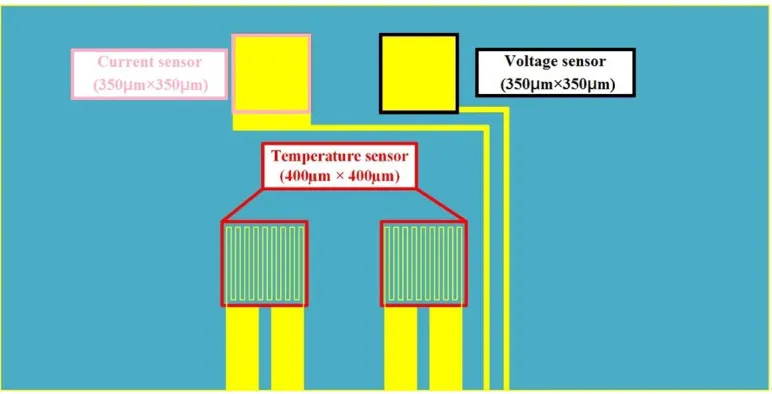
Figure 1. Design drawing of flexible multiple micro sensor.
2.2 Sensing principle of micro temperature sensor
The micro temperature sensor is of sandwich structure, only foil sensor is unlikely to cause gas leak which unstabilizes or degrades the performance of fuel cell stack.
Therefore, the micro temperature sensor used in this study is resistance temperature detector (RTD), the electrode is of snake structure; the RTD is made of Au for stable chemical properties, simple process and high linearity. The sensing principle is that when the ambient temperature rise, the resistivity of RTD increases due to the characteristic of positive temperature resistance coefficient. The relationship between the ambient temperature change and the change in the measured resistance value is expressed as Eq. (1).
0
1
1t
R
R
T
(1)
where Rt is the resistivity (Ω) at toC; R0 is the resistivity (Ω) at 0oC; ΔT is the temperature difference (oC) to reference temperature 0oC; the physical significance of α1 is the sensitivity of micro temperature sensor (oC-1).
2.3 Sensing principle of micro voltage sensor
Int. J. Electrochem. Sci., Vol. 12, 2017
5506 2.4 Sensing principle of micro current sensor
The micro current sensor used in this study is miniaturized galvanometer probe, it is an extension conductor. The two probes face towards the two sides of foil substrate respectively, and a 350μm×350μm sensing area is exposed at the frontmost end, the conductor is insulated by insulating layer. The micro current sensor penetrates into the high temperature fuel cell stack and connects current detector in series to form a series circuit, the local current in the high temperature fuel cell stack can be measured.
3. PROCESS DEVELOPMENT OF FLEXIBLE MULTIPLE MICRO SENSOR
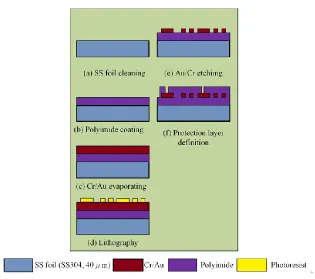
For the flexible multiple micro sensor developed in this study, the stainless-steel foil (SS foil) applicable to high-temperature electrochemical environment is selected as flexible substrate, the polyimide (PI) with better temperature tolerance is selected as protective layer.
[image:4.596.146.461.407.686.2]The flexible multiple micro sensor production process is shown in Figure 2. (a) SS foil cleaning; (b) coating PI as lower insulating layer; (c) evaporating Cr/Au as sensing layer; (d) photolithography definition pattern; (e) Au/Cr etching; (f) protection layer definition. Finally, the flexible multiple micro sensor is completed.
4. EXPERIMENTAL
4.1 Temperature correction of flexible multiple micro sensor
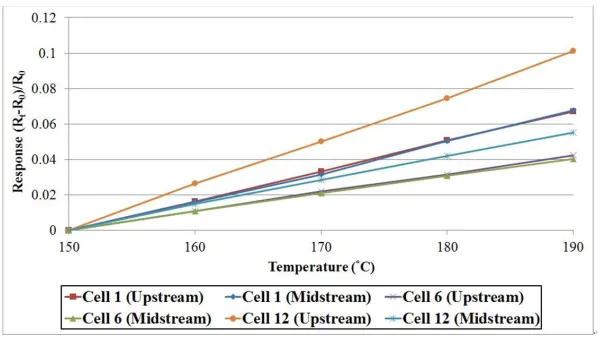
[image:5.596.149.450.343.512.2]The flexible multiple micro sensor must be corrected before it is embedded in the high temperature fuel cell stack for diagnosis, so as to guarantee the signal reliability. In order to free the flexible multiple micro sensor from the closing pressure when it is embedded in the high temperature fuel cell stack, it is embedded in the high temperature fuel cell stack before temperature correction, and the high temperature oven is used for heating as calibration reference. When the temperature is stable, the NI PXI 2575 data acquisition unit of National Instruments (NI) is used to extract the resistivity of micro temperature sensor instantly and export it to the computer, and the correction curve is obtained. Figure 3 shows the correction curve measured by averaging three times of correction of six micro temperature sensors in the high temperature fuel cell stack within 150oC to 190oC. Table 1 shows the linearity values of six micro temperature sensors. The result shows the micro temperature sensors have good linearity and reliability.
[image:5.596.190.412.593.749.2]Figure 3. Temperature correction curves of micro temperature sensor.
Int. J. Electrochem. Sci., Vol. 12, 2017
5508 4.2 Current correction of flexible multiple micro sensor
[image:6.596.182.411.295.458.2]The micro current sensor must be corrected before current measurement. The high temperature fuel cell testing machine 890C provides load to keep a certain current for the high temperature fuel cell stack, and it is converted into the current intensity corresponding to the overall reaction area. Meanwhile, the current value of micro current sensor is obtained by NI PXI 2575 data acquisition unit, converted into current intensity corresponding to the micro current sensor area. According to Table 2, the current intensity trend measured by micro current sensor is quite consistent with the current intensity of high temperature fuel cell stack.
Table 2. Comparison of current density of high temperature fuel cell testing machine 890C and micro current sensor.
5. RESULT AND DISCUSION
[image:6.596.150.451.527.707.2]
With 100-hours persistent effect test for flexible multiple micro sensor embedded in high temperature fuel cell stack.
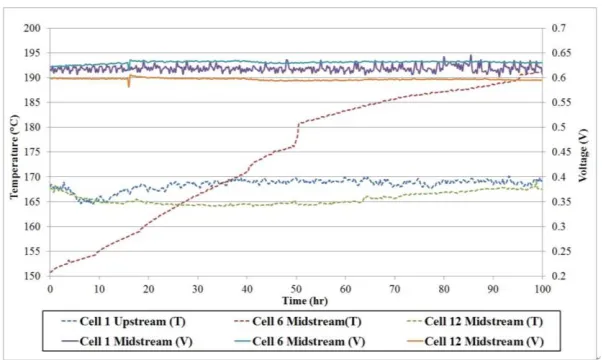
[image:7.596.125.474.183.399.2]The operating temperature is 150oC in the experiment, 7 l min-1 anodic gas (H2) and 35 l min-1 cathode gas (Air) are given, and constant current (20A) is exported for 100 hours. The changes in internal local temperature, voltage and current of high temperature fuel cell stack in 100-hour long operation are obtained by NI PXI 2575 data acquisition unit.
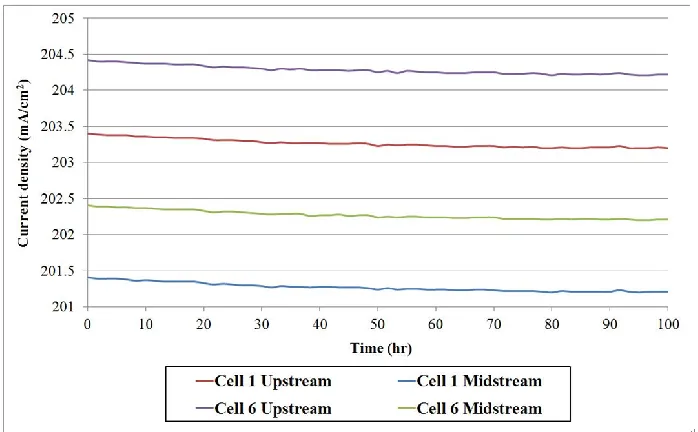
Figure 5. Persistent effect test chart of local current density of high temperature fuel cell stack.
Figure 4 shows persistent effect test for local temperature and voltage in different cells, the temperature of Cell 6 keeps rising apparently, because the high temperature fuel cell stack temperature distribution is nonuniform and the middle cell has worse heat sinking. Figure 5 shows the persistent effect test for local current density in different cells. As the upstream is close to the air inlet, the current intensity is higher than the midstream. The experimental results show that the temperature, voltage and current inside the high temperature fuel cell stack are correlated with each other, and they have critical effect on the performance of high temperature fuel cell stack. Most studies concerning this topic focus on the methods such as external measurement, invasive measurement, theoretical simulation, temperature, voltage or current single measurement [10-16], and the like, but these methods have such problems as over large sensor size, imprecise measurement, impairing the high temperature fuel cell performance, being unable to indicate the internal real-time reaction state. This study uses the MEMS technology to develop the multiple micro sensor and inserts it into the high temperature proton exchange membrane fuel cell stack for local real-time measurement.
6. CONCLUSION
Int. J. Electrochem. Sci., Vol. 12, 2017
5510 features, thin thickness, small structure area, high sensitivity, and can be placed in any position and many other advantages. Hope this multiple micro sensor to provide the authentic information inside the high temperature proton exchange membrane fuel cell stack, so as to improve the performance of fuel cell stack and to prolong the service life.
ACKNOWLEDGEMENTS
This work was accomplished with much needed support and the authors would like to thank for the financial support by Ministry of Science and Technology of R.O.C. through the grant MOST 102-2221-E-155-033-MY3, 103-2622-E-155-006-CC2, 104-2623-E-155-004-ET, 103-2622-E-155-018-CC2, 104-2622-E-155-004, 105-ET-E-155-002-ET, 105-2221-E-155-005, 105-2218-E-155-012 and 106-2622-8-155-002-TE3. The authors also like to thank Shih Hung Chan and Guo-Bin Jung of Yuan Ze University for their valuable advice and assistance in the experiments. In addition, we would like to thank the YZU Fuel Cell Center and NENS Common Lab, for providing access to their research facilities.
References
1. S. Shimpalee, S. Greenway, J. W. V. Zee, Journal of Power Sources, (2006) 160, 398. 2. Y. Luo, Q. Guo, Q. Du, Y. Yin, K. Jiao, Journal of Power Sources, (2013) 224, 99. 3. J. F. Botero-Cadavid, P. Wild, N. Djilali, Electrochimica Acta, (2014) 129, 416. 4. K. Jiao, I. E. Alaefour, G. Karimi, X. Li, Electrochimica Acta, (2011) 56, 2967. 5. D. Fofana, S. K. Natarajan, J. Hamelin, P. Benard, Energy, (2014) 64, 398.
6. J. L. Jespersen, E. Schaltz, S. K. Karb, Journal of Power Sources, (2009) 191, 289.
7. N. Fouquet, C. Doulet, C. Nouillant, G. Dauphin Tanguy, B. Ould Bouamama, Journal of Power Source, (2006) 159, 905.
8. T. Kurz, A. Hakenjos, J. Kramer, M. Zedda, C. Agert, Journal of Power Source, (2008) 180, 742. 9. W. Merida, D. A. Harrington, J. M. Le Canut, G. Mclean, Journal of Power Source, (2006) 161,
264.
10. J. S. Pierre, D. P. Wilkinson, S. Knights, M. Bos, Journal of New Materials for Electrochemical Systems, (2000) 3, 99.
11. A. Mughal, X. Li, (2006) 63, 377.
12. X. G. Yang, N. Burke, C. Y. Wang, K. Tajiri, K. Shinohara, Journal of Electrochemical Society, (2005) 152, A759.
13. G.. Nguyen, S. Sahlin, S. J. Andreasen, B. Shaffer, J. Brouwer,International Journal of Hydrogen Energy ,(2016) 41, 8.
14. T. T. Molla, K. Kwok, H. L. Frandsen, Journal of Power Sources, (2017) 351, 8.