LINEAR ALGEBRA
K. R. MATTHEWS
DEPARTMENT OF MATHEMATICS
UNIVERSITY OF QUEENSLAND
Corrected Version, 10th February2010
Contents
1 LINEAR EQUATIONS 1
1.1 Introduction to linear equations . . . 1
1.2 Solving linear equations . . . 5
1.3 The Gauss–Jordan algorithm . . . 8
1.4 Systematic solution of linear systems. . . 9
1.5 Homogeneous systems . . . 16
1.6 PROBLEMS . . . 17
2 MATRICES 23 2.1 Matrix arithmetic . . . 23
2.2 Linear transformations . . . 27
2.3 Recurrence relations . . . 31
2.4 PROBLEMS . . . 33
2.5 Non–singular matrices . . . 36
2.6 Least squares solution of equations . . . 47
2.7 PROBLEMS . . . 49
3 SUBSPACES 55 3.1 Introduction . . . 55
3.2 Subspaces ofFn . . . . 55
3.3 Linear dependence . . . 58
3.4 Basis of a subspace . . . 61
3.5 Rank and nullity of a matrix . . . 63
3.6 PROBLEMS . . . 67
4 DETERMINANTS 71 4.1 PROBLEMS . . . 84
5.1 Constructing the complex numbers . . . 89
5.2 Calculating with complex numbers . . . 91
5.3 Geometric representation of C. . . 95
5.4 Complex conjugate . . . 96
5.5 Modulus of a complex number . . . 99
5.6 Argument of a complex number . . . 103
5.7 De Moivre’s theorem . . . 107
5.8 PROBLEMS . . . 111
6 EIGENVALUES AND EIGENVECTORS 115 6.1 Motivation . . . 115
6.2 Definitions and examples . . . 118
6.3 PROBLEMS . . . 124
7 Identifying second degree equations 129 7.1 The eigenvalue method . . . 129
7.2 A classification algorithm . . . 141
7.3 PROBLEMS . . . 147
8 THREE–DIMENSIONAL GEOMETRY 149 8.1 Introduction . . . 149
8.2 Three–dimensional space . . . 154
8.3 Dot product . . . 156
8.4 Lines . . . 161
8.5 The angle between two vectors . . . 166
8.6 The cross–product of two vectors . . . 172
8.7 Planes . . . 176
8.8 PROBLEMS . . . 185
9 FURTHER READING 189
List of Figures
1.1 Gauss–Jordan algorithm . . . 10
2.1 Reflection in a line . . . 29
2.2 Projection on a line . . . 30
4.1 Area of triangleOP Q. . . 72
5.1 Complex addition and subtraction . . . 96
5.2 Complex conjugate . . . 97
5.3 Modulus of a complex number . . . 99
5.4 Apollonius circles . . . 101
5.5 Argument of a complex number . . . 103
5.6 Argument examples . . . 105
5.7 The nth roots of unity. . . 108
5.8 The roots of zn=a. . . 109
6.1 Rotating the axes . . . 116
7.1 An ellipse example . . . 135
7.2 ellipse: standard form . . . 137
7.3 hyperbola: standard forms . . . 138
7.4 parabola: standard forms (i) and (ii) . . . 138
7.5 parabola: standard forms (iii) and (iv) . . . 139
7.6 1st parabola example . . . 140
7.7 2nd parabola example . . . 141
8.1 Equality and addition of vectors . . . 150
8.2 Scalar multiplication of vectors. . . 151
8.3 Representation of three–dimensional space . . . 155
8.4 The vector -AB. . . 155
8.5 The negative of a vector. . . 157
8.7 Position vector as a linear combination of i,jand k. . . 158
8.8 Representation of a line. . . 162
8.9 The lineAB. . . 162
8.10 The cosine rule for a triangle. . . 167
8.11 Pythagoras’ theorem for a right–angled triangle. . . 168
8.12 Distance from a point to a line. . . 169
8.13 Projecting a segment onto a line. . . 171
8.14 The vector cross–product. . . 174
8.15 Vector equation for the planeABC. . . 177
8.16 Normal equation of the plane ABC. . . 178
8.17 The plane ax+by+cz=d. . . 179
8.18 Line of intersection of two planes. . . 182
8.19 Distance from a point to the plane ax+by+cz=d. . . 184
Chapter 1
LINEAR EQUATIONS
1.1
Introduction to linear equations
Alinear equation innunknownsx1, x2,· · ·, xn is an equation of the form
a1x1+a2x2+· · ·+anxn=b,
wherea1, a2, . . . , an, b are given real numbers.
For example, with x and y instead of x1 and x2, the linear equation
2x+ 3y = 6 describes the line passing through the points (3,0) and (0,2). Similarly, with x, y and z instead of x1, x2 and x3, the linear
equa-tion 2x + 3y + 4z = 12 describes the plane passing through the points (6,0,0),(0,4,0),(0,0,3).
Asystemofmlinear equations in nunknownsx1, x2,· · ·, xnis a family
of linear equations
a11x1+a12x2+· · ·+a1nxn = b1
a21x1+a22x2+· · ·+a2nxn = b2
.. .
am1x1+am2x2+· · ·+amnxn = bm.
We wish to determine if such a system has a solution, that is to find out if there exist numbersx1, x2,· · ·, xn which satisfy each of the equations
simultaneously. We say that the system is consistent if it has a solution. Otherwise the system is calledinconsistent.
Note that the above system can be written concisely as
n
X
j=1
aijxj =bi, i= 1,2,· · ·, m.
The matrix
a11 a12 · · · a1n a21 a22 · · · a2n
..
. ...
am1 am2 · · · amn
is called thecoefficient matrix of the system, while the matrix
a11 a12 · · · a1n b1
a21 a22 · · · a2n b2
..
. ... ...
am1 am2 · · · amn bm
is called theaugmented matrixof the system.
Geometrically, solving a system of linear equations in two (or three) unknowns is equivalent to determining whether or not a family of lines (or planes) has a common point of intersection.
EXAMPLE 1.1.1 Solve the equation
2x+ 3y= 6.
Solution. The equation 2x + 3y = 6 is equivalent to 2x = 6−3y or
x= 3−3
2y, wherey is arbitrary. So there are infinitely many solutions.
EXAMPLE 1.1.2 Solve the system
x+y+z = 1
x−y+z = 0.
Solution. We subtract the second equation from the first, to get 2y = 1 and y = 12. Then x =y−z= 12 −z, where z is arbitrary. Again there are infinitely many solutions.
EXAMPLE 1.1.3 Find a polynomial of the formy=a0+a1x+a2x2+a3x3
1.1. INTRODUCTION TO LINEAR EQUATIONS 3
Solution. Whenx has the values−3,−1,1,2, theny takes corresponding values−2,2,5,1 and we get four equations in the unknownsa0, a1, a2, a3:
a0−3a1+ 9a2−27a3 = −2
a0−a1+a2−a3 = 2
a0+a1+a2+a3 = 5
a0+ 2a1+ 4a2+ 8a3 = 1,
with unique solutiona0 = 93/20, a1 = 221/120, a2 =−23/20, a3 =−41/120.
So the required polynomial is
y = 93 20+
221 120x−
23 20x
2− 41
120x
3.
In [26, pages 33–35] there are examples of systems of linear equations which arise from simple electrical networks using Kirchhoff’s laws for elec-trical circuits.
Solving a system consisting of a single linear equation is easy. However if we are dealing with two or more equations, it is desirable to have a systematic method of determining if the system is consistent and to find all solutions.
Instead of restricting ourselves to linear equations with rational or real coefficients, our theory goes over to the more general case where the coef-ficients belong to an arbitrary field. A field F is a set F which possesses operations of additionand multiplication which satisfy the familiar rules of rational arithmetic. There are ten basic properties that a field must have:
THE FIELD AXIOMS.
1. (a+b) +c=a+ (b+c) for all a, b, cinF; 2. (ab)c=a(bc) for all a, b, cinF;
3. a+b=b+afor all a, binF; 4. ab=bafor all a, binF;
5. there exists an element 0 in F such that 0 +a=afor all ainF; 6. there exists an element 1 in F such that 1a=afor all ainF;
7. to everyainF, there corresponds anadditive inverse −ainF, satis-fying
8. to every non–zero a in F, there corresponds a multiplicative inverse
a−1 inF, satisfying
aa−1 = 1;
9. a(b+c) =ab+acfor all a, b, cinF; 10. 06= 1.
With standard definitions such as a−b = a+ (−b) and a
b = ab−
1 for
b6= 0, we have the following familiar rules:
−(a+b) = (−a) + (−b), (ab)−1=a−1b−1; −(−a) = a, (a−1)−1=a;
−(a−b) = b−a, (a
b)
−1 = b
a; a
b + c
d =
ad+bc bd ; a
b c
d =
ac bd; ab
ac = b c,
a
¡b
c
¢ =
ac b ;
−(ab) = (−a)b=a(−b); −³ab´ = −a
b = a
−b;
0a = 0; (−a)−1 = −(a−1).
Fields which have only finitely many elements are of great interest in many parts of mathematics and its applications, for example to coding the-ory. It is easy to construct fields containing exactly p elements, where p is a prime number. First we must explain the idea of modular addition and modular multiplication. If a is an integer, we define a (mod p) to be the least remainder on dividingaby p: That is, ifa=bp+r, whereband r are integers and 0≤r < p, thena(mod p) =r.
For example,−1 (mod 2) = 1, 3 (mod 3) = 0, 5 (mod 3) = 2. Then addition and multiplication modp are defined by
a⊕b = (a+b) (modp)
1.2. SOLVING LINEAR EQUATIONS 5
For example, with p = 7, we have 3⊕4 = 7 (mod 7) = 0 and 3⊗5 = 15 (mod 7) = 1. Here are the complete addition and multiplication tables mod 7:
⊕ 0 1 2 3 4 5 6
0 0 1 2 3 4 5 6
1 1 2 3 4 5 6 0
2 2 3 4 5 6 0 1
3 3 4 5 6 0 1 2
4 4 5 6 0 1 2 3
5 5 6 0 1 2 3 4
6 6 0 1 2 3 4 5
⊗ 0 1 2 3 4 5 6
0 0 0 0 0 0 0 0
1 0 1 2 3 4 5 6
2 0 2 4 6 1 3 5
3 0 3 6 2 5 1 4
4 0 4 1 5 2 6 3
5 0 5 3 1 6 4 2
6 0 6 5 4 3 2 1
If we now letZp ={0,1, . . . , p−1}, then it can be proved thatZp forms a field under the operations of modular addition and multiplication modp. For example, the additive inverse of 3 in Z7 is 4, so we write −3 = 4 when calculating inZ7. Also the multiplicative inverse of 3 inZ7 is 5 , so we write 3−1= 5 when calculating in Z
7.
In practice, we writea⊕banda⊗basa+bandabora×bwhen dealing with linear equations overZp.
The simplest field isZ2, which consists of two elements 0,1 with addition satisfying 1 + 1 = 0. So inZ2,−1 = 1 and the arithmetic involved in solving equations overZ2 is very simple.
EXAMPLE 1.1.4 Solve the following system overZ2:
x+y+z = 0
x+z = 1.
Solution. We add the first equation to the second to gety = 1. Thenx= 1−z= 1 +z, withzarbitrary. Hence the solutions are (x, y, z) = (1,1,0) and (0,1,1).
We use Q and R to denote the fields of rational and real numbers, re-spectively. Unless otherwise stated, the field used will be Q.
1.2
Solving linear equations
DEFINITION 1.2.1 (Row–echelon form) A matrix is in row–echelon formif
(i) all zero rows (if any) are at the bottom of the matrix and
(ii) if two successive rows are non–zero, the second row starts with more zeros than the first (moving from left to right).
For example, the matrix
0 1 0 0 0 0 1 0 0 0 0 0 0 0 0 0
is in row–echelon form, whereas the matrix
0 1 0 0 0 1 0 0 0 0 0 0 0 0 0 0
is not in row–echelon form.
The zeromatrix of any size is always in row–echelon form.
DEFINITION 1.2.2 (Reduced row–echelon form) A matrix is in re-duced row–echelon formif
1. it is in row–echelon form,
2. the leading (leftmost non–zero) entry in each non–zero row is 1,
3. all other elements of the column in which the leading entry 1 occurs are zeros.
For example the matrices
· 1 0 0 1
¸ and
0 1 2 0 0 2 0 0 0 1 0 3 0 0 0 0 1 4 0 0 0 0 0 0
are in reduced row–echelon form, whereas the matrices
1 0 0 0 1 0 0 0 2
and
1 2 0 0 1 0 0 0 0
1.2. SOLVING LINEAR EQUATIONS 7
are not in reduced row–echelon form, but are in row–echelon form. The zeromatrix of any size is always in reduced row–echelon form.
Notation. If a matrix is in reduced row–echelon form, it is useful to denote the column numbers in which the leading entries 1 occur, by c1, c2, . . . , cr,
with the remaining column numbers being denoted by cr+1, . . . , cn, where r is the number of non–zero rows. For example, in the 4×6 matrix above, we have r= 3, c1 = 2, c2= 4, c3= 5, c4 = 1, c5 = 3, c6 = 6.
The following operations are the ones used on systems of linear equations and do not change the solutions.
DEFINITION 1.2.3 (Elementary row operations) Three types of el-ementary row operationscan be performed on matrices:
1. Interchanging two rows:
Ri ↔Rj interchanges rows iand j.
2. Multiplying a row by a non–zero scalar:
Ri →tRi multiplies row iby the non–zero scalar t.
3. Adding a multiple of one row to another row:
Rj →Rj+tRi addst times rowito rowj.
DEFINITION 1.2.4 (Row equivalence) MatrixAisrow–equivalentto matrixBifBis obtained fromAby a sequence of elementary row operations.
EXAMPLE 1.2.1 Working from left to right,
A=
1 2 0
2 1 1
1 −1 2
R2 →R2+ 2R3
1 2 0
4 −1 5 1 −1 2
R2↔R3
1 2 0
1 −1 2 4 −1 5
R1 →2R1
2 4 0
1 −1 2 4 −1 5
=B.
Thus A is row–equivalent to B. Clearly B is also row–equivalent to A, by performing the inverse row–operationsR1→ 12R1, R2 ↔R3, R2→R2−2R3
onB.
same solution sets – a solution of the one system is a solution of the other. For example the systems whose augmented matrices are A and B in the above example are respectively
x+ 2y = 0 2x+y = 1
x−y = 2
and
2x+ 4y = 0
x−y = 2 4x−y = 5 and these systems have precisely the same solutions.
1.3
The Gauss–Jordan algorithm
We now describe the GAUSS–JORDAN ALGORITHM. This is a process which starts with a given matrixAand produces a matrixBin reduced row– echelon form, which is row–equivalent toA. If A is the augmented matrix of a system of linear equations, thenB will be a much simpler matrix than
Afrom which the consistency or inconsistency of the corresponding system is immediately apparent and in fact the complete solution of the system can be read off.
STEP 1.
Find the first non–zero column moving from left to right, (column c1)
and select a non–zero entry from this column. By interchanging rows, if necessary, ensure that the first entry in this column is non–zero. Multiply row 1 by the multiplicative inverse ofa1c1 thereby convertinga1c1 to 1. For
each non–zero element aic1, i > 1, (if any) in column c1, add −aic1 times
row 1 to rowi, thereby ensuring that all elements in column c1, apart from
the first, are zero.
STEP 2. If the matrix obtained at Step 1 has its 2nd, . . . , mth rows all zero, the matrix is in reduced row–echelon form. Otherwise suppose that the first column which has a non–zero element in the rows below the first is columnc2. Thenc1< c2. By interchanging rows below the first, if necessary,
ensure thata2c2 is non–zero. Then converta2c2 to 1 and by adding suitable
multiples of row 2 to the remaing rows, where necessary, ensure that all remaining elements in columnc2 are zero.
The process is repeated and will eventually stop after r steps, either because we run out of rows, or because we run out of non–zero columns. In general, the final matrix will be in reduced row–echelon form and will have
1.4. SYSTEMATIC SOLUTION OF LINEAR SYSTEMS. 9
0 0 4 0
2 2 −2 5
5 5 −1 5
R1↔R2
2 2 −2 5
0 0 4 0
5 5 −1 5
R1 → 12R1
1 1 −1 52
0 0 4 0
5 5 −1 5
R3 →R3−5R1
1 1 −1 52
0 0 4 0
0 0 4 −152
R2 → 14R2
1 1 −1 52
0 0 1 0
0 0 4 −152
½
R1 →R1+R2
R3 →R3−4R2
1 1 0 52
0 0 1 0
0 0 0 −152
R3 → −152R3
1 1 0 52
0 0 1 0
0 0 0 1
R1→R1−52R3
1 1 0 0 0 0 1 0 0 0 0 1
The last matrix is in reduced row–echelon form.
REMARK 1.3.1 It is possible to show that a given matrix over an ar-bitrary field is row–equivalent to precisely one matrix which is in reduced row–echelon form.
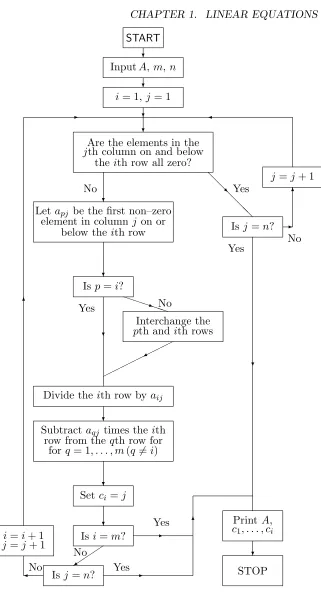
A flow–chart for the Gauss–Jordan algorithm, based on [1, page 83] is pre-sented in figure 1.1 below.
1.4
Systematic solution of linear systems.
Suppose a system ofm linear equations innunknownsx1,· · ·, xn has
aug-mented matrix A and that A is row–equivalent to a matrix B which is in reduced row–echelon form, via the Gauss–Jordan algorithm. ThenAand B
arem×(n+ 1). Suppose thatB hasr non–zero rows and that the leading entry 1 in row ioccurs in column numberci, for 1≤i≤r. Then
1≤c1< c2< · · ·, < cr≤n+ 1.
Also assume that the remaining column numbers arecr+1,· · ·, cn+1, where
1≤cr+1< cr+2< · · · < cn≤n+ 1.
Case 1: cr = n+ 1. The system is inconsistent. For the last non–zero
START
?
InputA, m, n
?
i= 1, j= 1
?
- ¾
?
Are the elements in the
jth column on and below the ith row all zero?
j=j+ 1
@ @
@ @@ R Yes No
?
Is j=n?
Yes No
-6
Let apj be the first non–zero
element in column j on or below theith row
?
Is p=i? Yes
?
PPPqPPNo
Interchange the
pth and ith rows
© © © © © © ©
¼
Divide theith row byaij
?
Subtractaqj times the ith
row from the qth row for forq = 1, . . . , m(q6=i)
?
Setci=j
?
Is i=m?
´ ´ ´ +
Is j=n?
¾
i=i+ 1
j=j+ 1
6
No No
Yes
Yes
-- 6
?
PrintA,
c1, . . . , ci
?
[image:15.595.157.478.90.686.2]STOP
1.4. SYSTEMATIC SOLUTION OF LINEAR SYSTEMS. 11
which has no solutions. Consequently the original system has no solutions. Case 2: cr ≤n. The system of equations corresponding to the non–zero rows ofB is consistent. First notice thatr ≤nhere.
If r=n, thenc1 = 1, c2= 2,· · ·, cn=nand
B =
1 0 · · · 0 d1
0 1 · · · 0 d2
..
. ...
0 0 · · · 1 dn
0 0 · · · 0 0
..
. ...
0 0 · · · 0 0
.
There is a unique solutionx1=d1, x2 =d2,· · ·, xn=dn.
If r < n, there will be more than one solution (infinitely many if the field is infinite). For all solutions are obtained by taking the unknowns
xc1,· · ·, xcr asdependentunknowns and using the r equations
correspond-ing to the non–zero rows of B to express these unknowns in terms of the remaining independent unknowns xcr+1, . . . , xcn, which can take on
arbi-trary values:
xc1 = b1n+1−b1cr+1xcr+1− · · · −b1cnxcn
.. .
xcr = br n+1−brcr+1xcr+1− · · · −brcnxcn.
In particular, taking xcr+1 = 0, . . . , xcn−1 = 0 and xcn = 0,1 respectively,
produces at least two solutions.
EXAMPLE 1.4.1 Solve the system
x+y = 0
x−y = 1 4x+ 2y = 1. Solution. The augmented matrix of the system is
A=
1 1 0
1 −1 1
4 2 1
which is row equivalent to
B =
1 0 12 0 1 −12
0 0 0
.
We read off the unique solutionx= 12, y=−12.
(Here n = 2, r = 2, c1 = 1, c2 = 2. Also cr = c2 = 2 < 3 = n+ 1 and
r=n.)
EXAMPLE 1.4.2 Solve the system
2x1+ 2x2−2x3 = 5
7x1+ 7x2+x3 = 10
5x1+ 5x2−x3 = 5.
Solution. The augmented matrix is
A=
2 2 −2 5
7 7 1 10
5 5 −1 5
which is row equivalent to
B =
1 1 0 0 0 0 1 0 0 0 0 1
.
We read off inconsistency for the original system.
(Heren= 3, r= 3, c1= 1, c2= 3. Also cr=c3 = 4 =n+ 1.)
EXAMPLE 1.4.3 Solve the system
x1−x2+x3 = 1
x1+x2−x3 = 2.
Solution. The augmented matrix is
A= ·
1 −1 1 1
1 1 −1 2
1.4. SYSTEMATIC SOLUTION OF LINEAR SYSTEMS. 13
which is row equivalent to
B = ·
1 0 0 32
0 1 −1 12 ¸
.
The complete solution isx1= 32, x2= 12+x3, withx3 arbitrary.
(Here n = 3, r = 2, c1 = 1, c2 = 2. Also cr = c2 = 2 < 4 = n+ 1 and
r < n.)
EXAMPLE 1.4.4 Solve the system
6x3+ 2x4−4x5−8x6 = 8
3x3+x4−2x5−4x6 = 4
2x1−3x2+x3+ 4x4−7x5+x6 = 2
6x1−9x2+ 11x4−19x5+ 3x6 = 1.
Solution. The augmented matrix is
A=
0 0 6 2 −4 −8 8
0 0 3 1 −2 −4 4
2 −3 1 4 −7 1 2
6 −9 0 11 −19 3 1
which is row equivalent to
B =
1 −32 0 116 −196 0 241
0 0 1 13 −2
3 0 53
0 0 0 0 0 1 14
0 0 0 0 0 0 0
.
The complete solution is
x1= 241 + 32x2−116x4+ 196x5,
x3= 53 −13x4+ 23x5,
x6= 14,
withx2, x4, x5 arbitrary.
EXAMPLE 1.4.5 Find the rational numbertfor which the following sys-tem is consistent and solve the syssys-tem for this value oft.
x+y = 2
x−y = 0 3x−y = t.
Solution. The augmented matrix of the system is
A=
1 1 2
1 −1 0 3 −1 t
which is row–equivalent to the simpler matrix
B =
1 1 2
0 1 1
0 0 t−2
.
Hence ift 6= 2 the system is inconsistent. If t= 2 the system is consistent and
B=
1 1 2 0 1 1 0 0 0
→
1 0 1 0 1 1 0 0 0
.
We read off the solution x= 1, y= 1.
EXAMPLE 1.4.6 For which rationals a and b does the following system have (i) no solution, (ii) a unique solution, (iii) infinitely many solutions?
x−2y+ 3z = 4 2x−3y+az = 5 3x−4y+ 5z = b.
Solution. The augmented matrix of the system is
A=
1 −2 3 4
2 −3 a 5
3 −4 5 b
1.4. SYSTEMATIC SOLUTION OF LINEAR SYSTEMS. 15
½
R2 →R2−2R1
R3 →R3−3R1
1 −2 3 4
0 1 a−6 −3
0 2 −4 b−12
R3 →R3−2R2
1 −2 3 4
0 1 a−6 −3
0 0 −2a+ 8 b−6
=B.
Case 1. a6= 4. Then −2a+ 86= 0 and we see that B can be reduced to a matrix of the form
1 0 0 u
0 1 0 v
0 0 1 −b2−a+86
and we have the unique solution x=u, y=v, z= (b−6)/(−2a+ 8). Case 2. a= 4. Then
B =
1 −2 3 4
0 1 −2 −3
0 0 0 b−6
.
If b6= 6 we get no solution, whereas ifb= 6 then
B =
1 −2 3 4
0 1 −2 −3
0 0 0 0
R1 → R1 + 2R2
1 0 −1 −2 0 1 −2 −3
0 0 0 0
. We
read off the complete solution x=−2 +z, y=−3 + 2z, withz arbitrary.
EXAMPLE 1.4.7 Find the reduced row–echelon form of the following ma-trix overZ3:
·
2 1 2 1 2 2 1 0
¸
.
Hence solve the system
2x+y+ 2z = 1 2x+ 2y+z = 0 overZ3.
·
2 1 2 1 2 2 1 0
¸
R2 →R2−R1
·
2 1 2 1
0 1 −1 −1 ¸
= ·
2 1 2 1 0 1 2 2
¸
R1 →2R1
·
1 2 1 2 0 1 2 2
¸
R1 →R1+R2
·
1 0 0 1 0 1 2 2
¸ .
The last matrix is in reduced row–echelon form.
To solve the system of equations whose augmented matrix is the given matrix over Z3, we see from the reduced row–echelon form that x= 1 and
y = 2−2z = 2 +z, where z = 0,1,2. Hence there are three solutions to the given system of linear equations: (x, y, z) = (1,2,0), (1, 0,1) and (1,1,2).
1.5
Homogeneous systems
A system of homogeneous linear equations is a system of the form
a11x1+a12x2+· · ·+a1nxn = 0 a21x1+a22x2+· · ·+a2nxn = 0
.. .
am1x1+am2x2+· · ·+amnxn = 0.
Such a system is always consistent as x1 = 0,· · ·, xn = 0 is a solution.
This solution is called the trivial solution. Any other solution is called a non–trivialsolution.
For example the homogeneous system
x−y = 0
x+y = 0
has only the trivial solution, whereas the homogeneous system
x−y+z = 0
x+y+z = 0
has the complete solutionx =−z, y = 0, z arbitrary. In particular, taking
z= 1 gives the non–trivial solutionx=−1, y= 0, z= 1.
There is simple but fundamental theorem concerning homogeneous sys-tems.
1.6. PROBLEMS 17
Proof. Suppose that m < nand that the coefficient matrix of the system is row–equivalent toB, a matrix in reduced row–echelon form. Letr be the number of non–zero rows in B. Then r ≤m < nand hence n−r >0 and so the number n−r of arbitrary unknowns is in fact positive. Taking one of these unknowns to be 1 gives a non–trivial solution.
REMARK 1.5.1 Let two systems of homogeneous equations in n un-knowns have coefficient matricesAand B, respectively. If each row ofB is a linear combination of the rows of A (i.e. a sum of multiples of the rows ofA) and each row ofAis a linear combination of the rows of B, then it is easy to prove that the two systems have identical solutions. The converse is true, but is not easy to prove. Similarly if Aand B have the same reduced row–echelon form, apart from possibly zero rows, then the two systems have identical solutions and conversely.
There is a similar situation in the case of two systems of linear equations (not necessarily homogeneous), with the proviso that in the statement of the converse, the extra condition that both the systems are consistent, is needed.
1.6
PROBLEMS
1. Which of the following matrices of rationals is in reduced row–echelon form?
(a)
1 0 0 0 −3
0 0 1 0 4
0 0 0 1 2
(b)
0 1 0 0 5
0 0 1 0 −4
0 0 0 −1 3
(c)
0 1 0 0
0 0 1 0
0 1 0 −2
(d)
0 1 0 0 2
0 0 0 0 −1
0 0 0 1 4
0 0 0 0 0
(e)
1 2 0 0 0 0 0 1 0 0 0 0 0 0 1 0 0 0 0 0
(f)
0 0 0 0 0 0 1 2 0 0 0 1 0 0 0 0
(g)
1 0 0 0 1
0 1 0 0 2
0 0 0 1 −1
0 0 0 0 0
. [Answers: (a), (e), (g)]
2. Find reduced row–echelon forms which are row–equivalent to the following matrices:
(a) ·
0 0 0 2 4 0
¸ (b)
·
0 1 3 1 2 4
¸ (c)
1 1 1 1 1 0 1 0 0
(d)
2 0 0 0 0 0 −4 0 0
[Answers:
(a) ·
1 2 0 0 0 0
¸ (b)
·
1 0 −2
0 1 3
¸ (c)
1 0 0 0 1 0 0 0 1
(d)
1 0 0 0 0 0 0 0 0
.]
3. Solve the following systems of linear equations by reducing the augmented matrix to reduced row–echelon form:
(a) x+y+z = 2 (b) x1+x2−x3+ 2x4 = 10
2x+ 3y−z = 8 3x1−x2+ 7x3+ 4x4 = 1
x−y−z = −8 −5x1+ 3x2−15x3−6x4 = 9
(c) 3x−y+ 7z = 0 (d) 2x2+ 3x3−4x4 = 1
2x−y+ 4z = 21 2x3+ 3x4 = 4
x−y+z = 1 2x1+ 2x2−5x3+ 2x4 = 4
6x−4y+ 10z = 3 2x1−6x3+ 9x4 = 7
[Answers: (a)x=−3, y= 194 , z= 14; (b) inconsistent; (c)x=−12 −3z, y =−32−2z, withz arbitrary;
(d)x1 = 192 −9x4, x2=−52 +174x4, x3 = 2−32x4, withx4 arbitrary.]
4. Show that the following system is consistent if and only if c = 2a−3b
and solve the system in this case.
2x−y+ 3z = a
3x+y−5z = b
−5x−5y+ 21z = c.
[Answer: x= a+5b+ 25z, y= −3a5+2b + 195z, with zarbitrary.]
5. Find the value oft for which the following system is consistent and solve the system for this value oft.
x+y = 1
tx+y = t
(1 +t)x+ 2y = 3.
1.6. PROBLEMS 19
6. Solve the homogeneous system
−3x1+x2+x3+x4 = 0
x1−3x2+x3+x4 = 0
x1+x2−3x3+x4 = 0
x1+x2+x3−3x4 = 0.
[Answer: x1 =x2=x3 =x4, with x4 arbitrary.]
7. For which rational numbersλdoes the homogeneous system
x+ (λ−3)y = 0 (λ−3)x+y = 0 have a non–trivial solution?
[Answer: λ= 2,4.]
8. Solve the homogeneous system
3x1+x2+x3+x4 = 0
5x1−x2+x3−x4 = 0.
[Answer: x1 =−14x3, x2=−14x3−x4, withx3 and x4 arbitrary.]
9. Let A be the coefficient matrix of the following homogeneous system of
nequations inn unknowns:
(1−n)x1+x2+· · ·+xn = 0 x1+ (1−n)x2+· · ·+xn = 0
· · · = 0
x1+x2+· · ·+ (1−n)xn = 0.
Find the reduced row–echelon form ofAand hence, or otherwise, prove that the solution of the above system isx1 =x2 =· · ·=xn, withxn arbitrary.
10. Let A = ·
a b c d
¸
be a matrix over a field F. Prove that A is row–
equivalent to ·
1 0 0 1
¸
11. For which rational numbers a does the following system have (i) no solutions (ii) exactly one solution (iii) infinitely many solutions?
x+ 2y−3z = 4 3x−y+ 5z = 2 4x+y+ (a2−14)z = a+ 2.
[Answer: a = −4, no solution; a = 4, infinitely many solutions; a 6= ±4, exactly one solution.]
12. Solve the following system of homogeneous equations overZ2:
x1+x3+x5 = 0
x2+x4+x5 = 0
x1+x2+x3+x4 = 0
x3+x4 = 0.
[Answer: x1=x2 =x4+x5, x3 =x4, with x4 and x5 arbitrary elements of
Z2.]
13. Solve the following systems of linear equations overZ5:
(a) 2x+y+ 3z = 4 (b) 2x+y+ 3z = 4
4x+y+ 4z = 1 4x+y+ 4z = 1
3x+y+ 2z = 0 x+y = 3.
[Answer: (a) x = 1, y = 2, z = 0; (b) x = 1 + 2z, y = 2 + 3z, with z an arbitrary element of Z5.]
14. If (α1, . . . , αn) and (β1, . . . , βn) are solutions of a system of linear
equa-tions, prove that
((1−t)α1+tβ1, . . . ,(1−t)αn+tβn)
is also a solution.
15. If (α1, . . . , αn) is a solution of a system of linear equations, prove that
the complete solution is given by x1 = α1 +y1, . . . , xn = αn+yn, where
1.6. PROBLEMS 21
16. Find the values ofaand b for which the following system is consistent. Also find the complete solution whena=b= 2.
x+y−z+w = 1
ax+y+z+w = b
3x+ 2y+ aw = 1 +a.
[Answer: a6= 2 ora= 2 =b;x= 1−2z, y = 3z−w, withz, w arbitrary.] 17. LetF ={0,1, a, b} be a field consisting of 4 elements.
(a) Determine the addition and multiplication tables of F. (Hint: Prove that the elements 1 + 0,1 + 1,1 +a,1 +bare distinct and deduce that 1 + 1 + 1 + 1 = 0; then deduce that 1 + 1 = 0.)
(b) A matrixA, whose elements belong toF, is defined by
A=
1 a b a a b b 1
1 1 1 a
,
prove that the reduced row–echelon form of Ais given by the matrix
B =
1 0 0 0
0 1 0 b
0 0 1 1
Chapter 2
MATRICES
2.1
Matrix arithmetic
A matrix over a fieldF is a rectangular array of elements fromF. The sym-bolMm×n(F) denotes the collection of allm×nmatrices overF. Matrices
will usually be denoted by capital letters and the equation A= [aij] means
that the element in the i–th row and j–th column of the matrix A equals
aij. It is also occasionally convenient to write aij = (A)ij. For the present,
all matrices will have rational entries, unless otherwise stated.
EXAMPLE 2.1.1 The formula aij = 1/(i+j) for 1≤ i ≤3,1 ≤j ≤ 4 defines a 3×4 matrix A= [aij], namely
A=
1
2 13 14 15
1
3 14 15 16
1
4 15 16 17
.
DEFINITION 2.1.1 (Equality of matrices) MatricesA, B are said to be equal if A and B have the same size and corresponding elements are equal; i.e., Aand B ∈Mm×n(F) and A= [aij], B = [bij], with aij =bij for
1≤i≤m, 1≤j≤n.
DEFINITION 2.1.2 (Addition of matrices) Let A = [aij] and B =
[bij] be of the same size. Then A+B is the matrix obtained by adding
corresponding elements ofA and B; that is
A+B = [aij] + [bij] = [aij+bij].
DEFINITION 2.1.3 (Scalar multiple of a matrix) LetA= [aij] and
t∈F (that istis ascalar). Then tA is the matrix obtained by multiplying all elements ofA byt; that is
tA=t[aij] = [taij].
DEFINITION 2.1.4 (Additive inverse of a matrix) Let A = [aij] .
Then −A is the matrix obtained by replacing the elements of A by their additive inverses; that is
−A=−[aij] = [−aij].
DEFINITION 2.1.5 (Subtraction of matrices) Matrix subtraction is defined for two matrices A = [aij] and B = [bij] of the same size, in the
usual way; that is
A−B = [aij]−[bij] = [aij−bij].
DEFINITION 2.1.6 (The zero matrix) For each m, n the matrix in
Mm×n(F), all of whose elements are zero, is called the zeromatrix (of size m×n) and is denoted by the symbol 0.
The matrix operations of addition, scalar multiplication, additive inverse and subtraction satisfy the usual laws of arithmetic. (In what follows,sand
twill be arbitrary scalars and A, B, C are matrices of the same size.) 1. (A+B) +C=A+ (B+C);
2. A+B =B+A; 3. 0 +A=A; 4. A+ (−A) = 0;
5. (s+t)A=sA+tA, (s−t)A=sA−tA; 6. t(A+B) =tA+tB, t(A−B) =tA−tB; 7. s(tA) = (st)A;
8. 1A=A, 0A= 0, (−1)A=−A; 9. tA= 0⇒t= 0 orA= 0.
2.1. MATRIX ARITHMETIC 25
DEFINITION 2.1.7 (Matrix product) Let A = [aij] be a matrix of size m×n and B = [bjk] be a matrix of size n×p; (that is the number
of columns of A equals the number of rows of B). Then AB is the m×p
matrixC= [cik] whose (i, k)–th element is defined by the formula
cik= n
X
j=1
aijbjk =ai1b1k+· · ·+ainbnk.
EXAMPLE 2.1.2 1. · 1 2 3 4 ¸ · 5 6 7 8 ¸ = ·
1×5 + 2×7 1×6 + 2×8 3×5 + 4×7 3×6 + 4×8
¸ = · 19 22 43 50 ¸ ; 2. · 5 6 7 8 ¸ · 1 2 3 4 ¸ = · 23 34 31 46 ¸ 6 = · 1 2 3 4 ¸ · 5 6 7 8 ¸ ; 3. · 1 2 ¸ £
3 4 ¤ = · 3 4 6 8 ¸ ; 4. £
3 4 ¤ · 1 2 ¸ =£ 11 ¤ ; 5. ·
1 −1 1 −1
¸ ·
1 −1 1 −1
¸ = · 0 0 0 0 ¸ .
Matrix multiplication obeys many of the familiar laws of arithmetic apart from the commutative law.
1. (AB)C=A(BC) if A, B, C arem×n, n×p, p×q, respectively; 2. t(AB) = (tA)B=A(tB), A(−B) = (−A)B =−(AB);
3. (A+B)C=AC+BC ifA and B arem×nand C isn×p; 4. D(A+B) =DA+DB ifAand B arem×nand Dis p×m.
We prove the associative law only:
First observe that (AB)C and A(BC) are both of sizem×q. LetA= [aij], B = [bjk], C = [ckl]. Then
((AB)C)il =
p
X
k=1
(AB)ikckl= p X k=1 n X j=1
aijbjk
ckl
= p X k=1 n X j=1
Similarly
(A(BC))il =
n X j=1 p X k=1
aijbjkckl.
However the double summations are equal. For sums of the form
n X j=1 p X k=1
djk and p X k=1 n X j=1 djk
represent the sum of thenpelements of the rectangular array [djk], by rows
and by columns, respectively. Consequently
((AB)C)il= (A(BC))il for 1≤i≤m, 1≤l≤q. Hence (AB)C =A(BC).
The system of m linear equations inn unknowns
a11x1+a12x2+· · ·+a1nxn = b1
a21x1+a22x2+· · ·+a2nxn = b2
.. .
am1x1+am2x2+· · ·+amnxn = bm
is equivalent to a single matrix equation
a11 a12 · · · a1n a21 a22 · · · a2n
..
. ...
am1 am2 · · · amn
x1 x2 .. . xn = b1 b2 .. . bm ,
that is AX=B, whereA= [aij] is the coefficient matrix of the system,
X = x1 x2 .. . xn
is the vector of unknowns and B = b1 b2 .. . bm
is the vector of
constants.
Another useful matrix equation equivalent to the above system of linear equations is x1 a11 a21 .. .
am1
+x2
a12 a22 .. .
am2
+· · ·+xn
a1n a2n
2.2. LINEAR TRANSFORMATIONS 27
EXAMPLE 2.1.3 The system
x+y+z = 1
x−y+z = 0.
is equivalent to the matrix equation
·
1 1 1
1 −1 1 ¸
x y z
= ·
1 0
¸
and to the equation
x
· 1 1
¸ +y
· 1 −1
¸ +z
· 1 1
¸ =
· 1 0
¸
.
2.2
Linear transformations
An n–dimensional column vectoris an n×1 matrix overF. The collection of alln–dimensional column vectors is denoted byFn.
Every matrix is associated with an important type of function called a linear transformation.
DEFINITION 2.2.1 (Linear transformation) We can associate with
A∈Mm×n(F), the functionTA:Fn→Fm, defined byTA(X) =AX for all X ∈ Fn. More explicitly, using components, the above function takes the
form
y1 = a11x1+a12x2+· · ·+a1nxn y2 = a21x1+a22x2+· · ·+a2nxn
.. .
ym = am1x1+am2x2+· · ·+amnxn,
wherey1, y2,· · ·, ym are the components of the column vector TA(X).
The function just defined has the property that
TA(sX+tY) =sTA(X) +tTA(Y) (2.1)
for all s, t∈F and all n–dimensional column vectorsX, Y. For
REMARK 2.2.1 It is easy to prove that if T : Fn → Fm is a function satisfying equation 2.1, then T = TA, where A is the m×n matrix whose
columns are T(E1), . . . , T(En), respectively, where E1, . . . , En are the n–
dimensionalunit vectors defined by
E1 =
1 0 .. . 0
, . . . , En=
0 0 .. . 1
.
One well–known example of a linear transformation arises from rotating the (x, y)–plane in 2-dimensional Euclidean space, anticlockwise through θ
radians. Here a point (x, y) will be transformed into the point (x1, y1),
where
x1 = xcosθ−ysinθ
y1 = xsinθ+ycosθ.
In 3–dimensional Euclidean space, the equations
x1 =xcosθ−ysinθ, y1 =xsinθ+ycosθ, z1 =z;
x1 =x, y1 =ycosφ−zsinφ, z1=ysinφ+zcosφ;
x1 =xcosψ−zsinψ, y1=y, z1=xsinψ+zcosψ;
correspond to rotations about the positive z, x and y axes, anticlockwise through θ, φ, ψradians, respectively.
The product of two matrices is related to the product of the correspond-ing linear transformations:
IfAism×nandB isn×p, then the functionTATB :Fp→Fm, obtained by first performingTB, thenTAis in fact equal to the linear transformation TAB. For ifX∈Fp, we have
TATB(X) =A(BX) = (AB)X=TAB(X).
The following example is useful for producing rotations in 3–dimensional animated design. (See [27, pages 97–112].)
2.2. LINEAR TRANSFORMATIONS 29
θ
l (x, y)
(x1, y1)
¡¡ ¡¡
¡¡ ¡¡
¡ ¡ ¡ ¡ ¡
@ @ @ @
@ @
[image:34.595.111.461.78.571.2]@
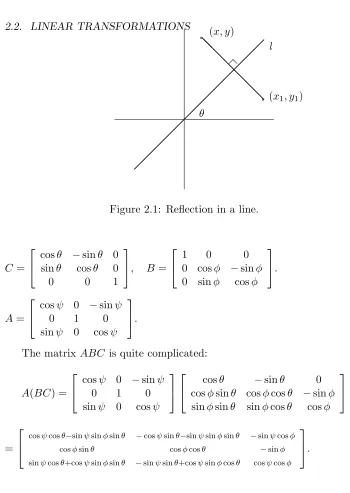
Figure 2.1: Reflection in a line.
C=
cosθ −sinθ 0 sinθ cosθ 0
0 0 1
, B =
1 0 0
0 cosφ −sinφ
0 sinφ cosφ
.
A=
cosψ 0 −sinψ
0 1 0
sinψ 0 cosψ
.
The matrix ABC is quite complicated:
A(BC) =
cosψ 0 −sinψ
0 1 0
sinψ 0 cosψ
cosθ −sinθ 0
cosφsinθ cosφcosθ −sinφ
sinφsinθ sinφcosθ cosφ
=
cosψcosθ−sinψsinφsinθ −cosψsinθ−sinψsinφsinθ −sinψcosφ
cosφsinθ cosφcosθ −sinφ
sinψcosθ+cosψsinφsinθ −sinψsinθ+cosψsinφcosθ cosψcosφ
.
EXAMPLE 2.2.2 Another example from geometry is reflection of the plane in a linel inclined at an angleθ to the positivex–axis.
We reduce the problem to the simpler case θ = 0, where the equations of transformation are x1 = x, y1 = −y. First rotate the plane clockwise
θ
l
(x1, y1)
¡¡ ¡¡ ¡¡ ¡¡ ¡ ¡ ¡ ¡ ¡ @ @ @
Figure 2.2: Projection on a line.
In terms of matrices, we get transformation equations
· x1 y1 ¸ = ·
cosθ −sinθ
sinθ cosθ
¸ ·
1 0
0 −1 ¸ ·
cos (−θ) −sin (−θ) sin (−θ) cos (−θ)
¸ · x y ¸ = ·
cosθ sinθ
sinθ −cosθ
¸ ·
cosθ sinθ
−sinθ cosθ
¸ · x y ¸ = ·
cos 2θ sin 2θ
sin 2θ −cos 2θ
¸ ·
x y
¸
.
The more general transformation
· x1 y1 ¸ =a ·
cosθ −sinθ
sinθ cosθ
¸ · x y ¸ + · u v ¸
, a >0,
represents a rotation, followed by a scaling and then by a translation. Such transformations are important in computer graphics. See [23, 24].
EXAMPLE 2.2.3 Our last example of a geometrical linear transformation arises from projecting the plane onto a line l through the origin, inclined at angle θ to the positive x–axis. Again we reduce that problem to the simpler case where l is the x–axis and the equations of transformation are
x1 =x, y1 = 0.
In terms of matrices, we get transformation equations
· x1 y1 ¸ = ·
cosθ −sinθ
sinθ cosθ
¸ · 1 0 0 0
¸ ·
cos (−θ) −sin (−θ) sin (−θ) cos (−θ)
¸ ·
x y
2.3. RECURRENCE RELATIONS 31
= ·
cosθ 0 sinθ 0
¸ ·
cosθ sinθ
−sinθ cosθ
¸ ·
x y
¸
= ·
cos2θ cosθsinθ
sinθcosθ sin2θ
¸ ·
x y
¸
.
2.3
Recurrence relations
DEFINITION 2.3.1 (The identity matrix) The n× n matrix In = [δij], defined by δij = 1 ifi=j, δij = 0 if i6=j, is called the n×n identity
matrix of order n. In other words, the columns of the identity matrix of order nare the unit vectorsE1,· · ·, En, respectively.
For example,I2 =
· 1 0 0 1
¸ .
THEOREM 2.3.1 IfA ism×n, then ImA=A=AIn.
DEFINITION 2.3.2 (k–th power of a matrix) IfAis ann×nmatrix, we defineAk recursively as follows: A0=I
n andAk+1=AkA fork≥0.
For exampleA1 =A0A=InA=Aand hence A2 =A1A=AA.
The usual index laws hold providedAB=BA:
1. AmAn=Am+n, (Am)n=Amn; 2. (AB)n=AnBn;
3. AmBn=BnAm;
4. (A+B)2 =A2+ 2AB+B2;
5. (A+B)n=
n
X
i=0
¡n
i
¢
AiBn−i;
6. (A+B)(A−B) =A2−B2.
We now state a basic property of the natural numbers.
AXIOM 2.3.1 (MATHEMATICAL INDUCTION) If Pn denotes a mathematical statement for each n≥1, satisfying
(ii) the truth of Pn implies that ofPn+1 for each n≥1,
thenPn is true for alln≥1.
EXAMPLE 2.3.1 LetA= ·
7 4
−9 −5 ¸
.Prove that
An= ·
1 + 6n 4n
−9n 1−6n
¸
if n≥1.
Solution. We use the principle of mathematical induction.
Take Pn to be the statement
An= ·
1 + 6n 4n
−9n 1−6n
¸
.
ThenP1 asserts that
A1 = ·
1 + 6×1 4×1 −9×1 1−6×1
¸ =
·
7 4
−9 −5 ¸
,
which is true. Now letn≥1 and assume thatPnis true. We have to deduce
that
An+1= ·
1 + 6(n+ 1) 4(n+ 1) −9(n+ 1) 1−6(n+ 1)
¸ =
·
7 + 6n 4n+ 4 −9n−9 −5−6n
¸
.
Now
An+1 = AnA
= ·
1 + 6n 4n
−9n 1−6n
¸ ·
7 4
−9 −5 ¸
= ·
(1 + 6n)7 + (4n)(−9) (1 + 6n)4 + (4n)(−5) (−9n)7 + (1−6n)(−9) (−9n)4 + (1−6n)(−5)
¸
= ·
7 + 6n 4n+ 4 −9n−9 −5−6n
¸
,
and “the induction goes through”.
2.4. PROBLEMS 33
EXAMPLE 2.3.2 The following system of recurrence relations holds for alln≥0:
xn+1 = 7xn+ 4yn
yn+1 = −9xn−5yn.
Solve the system forxn and yn in terms ofx0 and y0.
Solution. Combine the above equations into a single matrix equation ·
xn+1
yn+1
¸ =
·
7 4
−9 −5 ¸ ·
xn yn
¸
,
orXn+1 =AXn, whereA=
·
7 4
−9 −5 ¸
and Xn=
·
xn yn
¸ . We see that
X1 = AX0
X2 = AX1=A(AX0) =A2X0
.. .
Xn = AnX0.
(The truth of the equation Xn = AnX0 for n ≥ 1, strictly speaking
follows by mathematical induction; however for simple cases such as the above, it is customary to omit the strict proof and supply instead a few lines of motivation for the inductive statement.)
Hence the previous example gives ·
xn yn
¸
=Xn =
·
1 + 6n 4n
−9n 1−6n
¸ ·
x0
y0
¸
= ·
(1 + 6n)x0+ (4n)y0
(−9n)x0+ (1−6n)y0
¸
,
and hencexn= (1 + 6n)x0+ 4ny0andyn= (−9n)x0+ (1−6n)y0, forn≥1.
2.4
PROBLEMS
1. LetA, B, C, D be matrices defined by
A=
3 0
−1 2
1 1
, B =
1 5 2 −1 1 0 −4 1 3
C=
−3 −1
2 1
4 3
, D= ·
4 −1
2 0
¸
.
Which of the following matrices are defined? Compute those matrices which are defined.
A+B, A+C, AB, BA, CD, DC, D2.
[Answers: A+C, BA, CD, D2;
0 −1
1 3 5 4 , 0 12
−4 2
−10 5
,
−14 3
10 −2 22 −4
, ·
14 −4 8 −2
¸ .]
2. LetA= ·
−1 0 1 0 1 1
¸
. Show that if B is a 3×2 such thatAB=I2,
then
B =
a b
−a−1 1−b a+ 1 b
for suitable numbers a and b. Use the associative law to show that (BA)2B =B.
3. IfA= ·
a b c d
¸
, prove that A2−(a+d)A+ (ad−bc)I 2= 0.
4. If A = ·
4 −3
1 0
¸
, use the fact A2 = 4A −3I
2 and mathematical
induction, to prove that
An= (3
n−1)
2 A+
3−3n
2 I2 ifn≥1.
5. A sequence of numbersx1, x2, . . . , xn, . . . satisfies the recurrence
rela-tionxn+1 =axn+bxn−1forn≥1, whereaandbare constants. Prove
that
·
xn+1
xn
¸ =A
·
xn xn−1
¸
2.4. PROBLEMS 35
whereA = ·
a b
1 0 ¸
and hence express ·
xn+1
xn
¸
in terms of ·
x1
x0
¸ . If a= 4 and b =−3, use the previous question to find a formula for
xn in terms ofx1 and x0.
[Answer:
xn=
3n−1 2 x1+
3−3n 2 x0.]
6. LetA= ·
2a −a2
1 0
¸ .
(a) Prove that
An= ·
(n+ 1)an −nan+1
nan−1 (1−n)an
¸
ifn≥1.
(b) A sequencex0, x1, . . . , xn, . . . satisfies xn+1 = 2axn−a2xn−1 for
n ≥ 1. Use part (a) and the previous question to prove that
xn=nan−1x1+ (1−n)anx0 forn≥1.
7. Let A = ·
a b c d
¸
and suppose that λ1 and λ2 are the roots of the
quadratic polynomialx2−(a+d)x+ad−bc. (λ1andλ2 may be equal.)
Letknbe defined by k0 = 0, k1 = 1 and forn≥2
kn= n
X
i=1
λn1−iλi2−1.
Prove that
kn+1= (λ1+λ2)kn−λ1λ2kn−1,
ifn≥1. Also prove that
kn=
½
(λn1 −λn2)/(λ1−λ2) ifλ16=λ2,
nλn1−1 ifλ1=λ2.
Use mathematical induction to prove that ifn≥1,
An=knA−λ1λ2kn−1I2,
8. Use Question 7 to prove that if A= ·
1 2 2 1
¸ , then
An= 3
n
2 ·
1 1 1 1
¸
+(−1)
n−1
2 ·
−1 1
1 −1 ¸
ifn≥1.
9. The Fibonacci numbers are defined by the equations F0 = 0, F1 = 1
andFn+1=Fn+Fn−1 ifn≥1. Prove that
Fn= √1 5
ÃÃ
1 +√5 2
!n −
Ã
1−√5 2
!n!
ifn≥0.
10. Let r > 1 be an integer. Let a and b be arbitrary positive integers. Sequencesxnand ynof positive integers are defined in terms of aand
bby the recurrence relations
xn+1 = xn+ryn yn+1 = xn+yn,
forn≥0, where x0 =aand y0 =b.
Use Question 7 to prove that
xn yn →
√
r asn→ ∞.
2.5
Non–singular matrices
DEFINITION 2.5.1 (Non–singular matrix) A matrix A ∈ Mn×n(F)
is called non–singular or invertible if there exists a matrix B ∈ Mn×n(F)
such that
AB=In=BA.
Any matrixB with the above property is called an inverse ofA. IfA does not have an inverse,A is called singular.
2.5. NON–SINGULAR MATRICES 37
Proof. Let B and C be inverses of A. Then AB = In = BA and AC =
In=CA. ThenB(AC) =BIn=B and (BA)C=InC=C. Hence because B(AC) = (BA)C, we deduce thatB =C.
REMARK 2.5.1 If Ahas an inverse, it is denoted byA−1. So
AA−1=In=A−1A.
Also if Ais non–singular, it follows thatA−1 is also non–singular and
(A−1)−1=A.
THEOREM 2.5.2 IfAand B are non–singular matrices of the same size, then so is AB. Moreover
(AB)−1 =B−1A−1. Proof.
(AB)(B−1A−1) =A(BB−1)A−1 =AInA−1 =AA−1=In.
Similarly
(B−1A−1)(AB) =In.
REMARK 2.5.2 The above result generalizes to a product of m non– singular matrices: IfA1, . . . , Am are non–singularn×n matrices, then the
productA1. . . Am is also non–singular. Moreover
(A1. . . Am)−1 =A−m1. . . A−11.
(Thus the inverse of the product equals the product of the inverses in the reverse order.)
EXAMPLE 2.5.1 If A and B are n×n matrices satisfying A2 = B2 =
(AB)2 =In, prove thatAB=BA.
Solution. Assume A2 = B2 = (AB)2 = In. Then A, B, AB are non– singular and A−1=A, B−1 =B,(AB)−1 =AB.
But (AB)−1=B−1A−1 and henceAB=BA.
EXAMPLE 2.5.2 A = ·
1 2 4 8
¸
is singular. For suppose B = ·
a b c d
¸
is an inverse ofA. Then the equation AB=I2 gives
· 1 2 4 8
¸ ·
a b c d
¸ =
· 1 0 0 1
and equating the corresponding elements of column 1 of both sides gives the system
a+ 2c = 1 4a+ 8c = 0
which is clearly inconsistent.
THEOREM 2.5.3 Let A = ·
a b c d
¸
and ∆ = ad−bc 6= 0. Then A is non–singular. Also
A−1= ∆−1 ·
d −b
−c a
¸
.
REMARK 2.5.3 The expression ad−bc is called the determinant of A
and is denoted by the symbols detAor ¯ ¯ ¯ ¯
a b c d
¯ ¯ ¯ ¯ .
Proof. Verify that the matrix B = ∆−1 ·
d −b
−c a
¸
satisfies the equation
AB=I2 =BA.
EXAMPLE 2.5.3 Let
A=
0 1 0 0 0 1 5 0 0
.
Verify thatA3= 5I
3, deduce thatA is non–singular and findA−1.
Solution. After verifying thatA3 = 5I3, we notice that
A
µ 1 5A
2

=I3=
µ 1 5A
2

A.
HenceA is non–singular and A−1 = 15A2.
THEOREM 2.5.4 If the coefficient matrix A of a system of n equations in n unknowns is non–singular, then the system AX = B has the unique solution X=A−1B.
2.5. NON–SINGULAR MATRICES 39
1. (Uniqueness.) Assume thatAX =B. Then (A−1A)X = A−1B,
InX = A−1B, X = A−1B.
2. (Existence.) Let X=A−1B. Then
AX = A(A−1B) = (AA−1)B =InB =B.
THEOREM 2.5.5 (Cramer’s rule for 2 equations in 2 unknowns)
The system
ax+by = e cx+dy = f
has a unique solution if ∆ = ¯ ¯ ¯ ¯ a b c d ¯ ¯ ¯ ¯6
= 0, namely
x= ∆1
∆, y=
∆2
∆, where
∆1=
¯ ¯ ¯ ¯ e b f d ¯ ¯ ¯ ¯
and ∆2 =
¯ ¯ ¯ ¯ a e c f ¯ ¯ ¯ ¯ .
Proof. Suppose ∆6= 0. ThenA= ·
a b c d
¸
has inverse
A−1 = ∆−1 ·
d −b
−c a
¸
and we know that the system
A · x y ¸ = · e f ¸
has the unique solution
·
x y
¸ =A−1
· e f ¸ = 1 ∆ ·
d −b
−c a
¸ · e f ¸ = 1 ∆ ·
de−bf
−ce+af
¸ = 1 ∆ · ∆1 ∆2 ¸ = · ∆1/∆
∆2/∆
¸
.
COROLLARY 2.5.1 The homogeneous system
ax+by = 0
cx+dy = 0
has only the trivial solution if ∆ = ¯ ¯ ¯ ¯
a b c d
¯ ¯ ¯ ¯6
= 0.
EXAMPLE 2.5.4 The system
7x+ 8y = 100 2x−9y = 10
has the unique solutionx= ∆1/∆, y= ∆2/∆, where
∆=
˛ ˛ ˛ ˛ ˛ ˛
7 8
2 −9
˛ ˛ ˛ ˛ ˛ ˛
=−79, ∆1=
˛ ˛ ˛ ˛ ˛ ˛
100 8
10 −9
˛ ˛ ˛ ˛ ˛ ˛
=−980, ∆2=
˛ ˛ ˛ ˛ ˛ ˛
7 100
2 10
˛ ˛ ˛ ˛ ˛ ˛
=−130.
Sox= 98079 and y= 13079.
THEOREM 2.5.6 Let A be a square matrix. If A is non–singular, the homogeneous system AX = 0 has only the trivial solution. Equivalently, if the homogenous system AX = 0 has a non–trivial solution, then A is singular.
Proof. If Ais non–singular and AX = 0, then X=A−10 = 0.
REMARK 2.5.4 IfA∗1, . . . , A∗n denote the columns ofA, then the
equa-tion
AX =x1A∗1+. . .+xnA∗n
holds. Consequently theorem 2.5.6 tells us that if there existx1, . . . , xn,not
all zero, such that
x1A∗1+. . .+xnA∗n= 0,
2.5. NON–SINGULAR MATRICES 41
EXAMPLE 2.5.5
A=
1 2 3 1 0 1 3 4 7
is singular. For it can be verified thatA has reduced row–echelon form
1 0 1 0 1 1 0 0 0
and consequentlyAX = 0 has a non–trivial solutionx=−1, y=−1, z= 1.
REMARK 2.5.5 More generally, if A is row–equivalent to a matrix con-taining a zero row, then A is singular. For then the homogeneous system
AX= 0 has a non–trivial solution.
An important class of non–singular matrices is that of the elementary row matrices.
DEFINITION 2.5.2 (Elementary row matrices) To each of the three types of elementary row operation, there corresponds an elementary row matrix, denoted by Eij, Ei(t), Eij(t):
1. Eij,(i6=j) is obtained from the identity matrixIn by interchanging
rows iandj.
2. Ei(t),(t6= 0) is obtained by multiplying thei–th row ofIn by t.
3. Eij(t),(i=6 j) is obtained from In by adding ttimes the j–th row of In to thei–th row.
EXAMPLE 2.5.6 (n= 3.)
E23=
1 0 0 0 0 1 0 1 0
, E2(−1) =
1 0 0
0 −1 0
0 0 1
, E23(−1) =
1 0 0
0 1 −1
0 0 1
.
The elementary row matrices have the following distinguishing property:
EXAMPLE 2.5.7
E23
a b c d e f
=
1 0 0 0 0 1 0 1 0
a b c d e f
=
a b e f c d
.
COROLLARY 2.5.2 Elementary row–matrices are non–singular. Indeed
1. Eij−1=Eij;
2. Ei−1(t) =Ei(t−1); 3. (Eij(t))−1 =Eij(−t).
Proof. Taking A = In in the above theorem, we deduce the following
equations:
EijEij = In
Ei(t)Ei(t−1) = In=Ei(t−1)Ei(t) ift6= 0 Eij(t)Eij(−t) = In=Eij(−t)Eij(t).
EXAMPLE 2.5.8 Find the 3×3 matrix A = E3(5)E23(2)E12 explicitly.
Also findA−1.
Solution.
A=E3(5)E23(2)
0 1 0 1 0 0 0 0 1
=E3(5)
0 1 0 1 0 2 0 0 1
=
0 1 0 1 0 2 0 0 5
.
To find A−1, we have
A−1 = (E3(5)E23(2)E12)−1
= E12−1(E23(2))−1(E3(5))−1
= E12E23(−2)E3(5−1)
= E12E23(−2)
1 0 0
0 1 0
0 0 15
= E12
1 0 0
0 1 −2 5
0 0 15
=
0 1 −25
1 0 0
0 0 15
2.5. NON–SINGULAR MATRICES 43
REMARK 2.5.6 Recall thatAandB are row–equivalent ifB is obtained from A by a sequence of elementary row operations. If E1, . . . , Er are the
respective corresponding elementary row matrices, then
B =Er(. . .(E2(E1A)). . .) = (Er. . . E1)A=P A,
where P = Er. . . E1 is non–singular. Conversely if B = P A, where P is
non–singular, thenA is row–equivalent to B. For as we shall now see, P is in fact a product of elementary row matrices.
THEOREM 2.5.8 LetA be non–singularn×nmatrix. Then (i) Ais row–equivalent to In,
(ii) Ais a product of elementary row matrices.
Proof. Assume thatAis non–singular and letBbe the reduced row–echelon form of A. Then B has no zero rows, for otherwise the equation AX = 0 would have a non–trivial solution. ConsequentlyB =In.
It follows that there exist elementary row matricesE1, . . . , Er such that Er(. . .(E1A). . .) = B = In and hence A = E1−1. . . Er−1, a product of
elementary row matrices.
THEOREM 2.5.9 LetA be n×nand suppose that A is row–equivalent to In. Then A is non–singular and A−1 can be found by performing the
same sequence of elementary row operations onIn as were used to convert
AtoIn.
Proof. Suppose that Er. . . E1A = In. In other words BA = In, where B = Er. . . E1 is non–singular. Then B−1(BA) =B−1In and so A =B−1,
which is non–singular. Also A−1 =¡
B−1¢−1
=B =Er((. . .(E1In). . .), which shows that A−1
is obtained from In by performing the same sequence of elementary row
operations as were used to convertA toIn.
REMARK 2.5.7 It follows from theorem 2.5.9 that if A is singular, then
Ais row–equivalent to a matrix whose last row is zero.
EXAMPLE 2.5.9 Show thatA= ·
1 2 1 1
¸
is non–singular, findA−1 and
Solution. We form thepartitionedmatrix [A|I2] which consists ofAfollowed
byI2. Then any sequence of elementary row operations which reduces Ato
I2 will reduce I2 toA−1. Here
[A|I2] =
·
1 2 1 0
1 1 0 1
¸
R2 →R2−R1
·
1 2 1 0
0 −1 −1 1
¸
R2 →(−1)R2
·
1 2 1 0
0 1 1 −1
¸
R1 →R1−2R2
·
1 0 −1 2
0 1 1 −1
¸
.
Hence A is row–equivalent toI2 andA is non–singular. Also
A−1 = ·
−1 2
1 −1 ¸
.
We also observe that
E12(−2)E2(−1)E21(−1)A=I2.
Hence
A−1 = E12(−2)E2(−1)E21(−1)
A = E21(1)E2(−1)E12(2).
The next result is the converse of Theorem 2.5.6 and is useful for proving the non–singularity of certain types of matrices.
THEOREM 2.5.10 Let A be an n×n matrix with the property that the homogeneous system AX = 0 has only the trivial solution. Then A is non–singular. Equivalently, if A is singular, then the homogeneous system
AX= 0 has a non–trivial solution.
Proof. If A is n×n and the homogeneous system AX = 0 has only the trivial solution, then it follows that the reduced row–echelon form B of A
cannot have zero rows and must therefore beIn. HenceA is non–singular.
COROLLARY 2.5.3 Suppose that A and B are n×n and AB = In.
2.5. NON–SINGULAR MATRICES 45
Proof. Let AB = In, where A and B are n×n. We first show that B
is non–singular. Assume BX = 0. Then A(BX) = A0 = 0, so (AB)X = 0, InX= 0 and henceX = 0.
Then fromAB=In we deduce (AB)B−1=InB−1 and henceA=B−1. The equationBB−1=In then givesBA=In.
Before we give the next example of the above criterion for non-singularity, we introduce an important matrix operation.
DEFINITION 2.5.3 (The transpose of a matrix) LetA be anm×n
matrix. ThenAt, thetransposeofA, is the matrix obtained by interchanging
the rows and columns ofA. In other words if A = [aij], then ¡At¢ji =aij.
ConsequentlyAt is n×m.
The transpose operation has the following properties:
1. ¡
At¢t =A;
2. (A±B)t=At±Bt ifAand B arem×n;
3. (sA)t=sAt ifsis a scalar;
4. (AB)t=BtAt ifAis m×nand B isn×p;
5. IfA is non–singular, then At is also non–singular and ¡
At¢−1 =¡
A−1¢t ;
6. XtX=x2
1+. . .+x2n ifX = [x1, . . . , xn]tis a column vector.
We prove only the fourth property. First check that both (AB)t and BtAt
have the same size (p ×m). Moreover, corresponding elements of both matrices are equal. For if A= [aij] and B= [bjk], we have
¡
(AB)t¢
ki = (AB)ik
=
n
X
j=1
aijbjk
=
n
X
j=1
¡
Bt¢
kj
¡
At¢
ji
= ¡
BtAt¢
ki.
DEFINITION 2.5.4 (Symmetric matrix) A matrix A is symmetric if
At = A. In other words A is square (n×n say) and aji = aij for all
1≤i≤n, 1≤j≤n. Hence
A= ·
a b b c
¸
is a general 2×2 symmetric matrix.
DEFINITION 2.5.5 (Skew–symmetric matrix) A matrix A is called skew–symmetric if At = −A. In other words A is square (n×n say) and
aji =−aij for all 1≤i≤n, 1≤j≤n.
REMARK 2.5.8 Takingi=jin the definition of skew–symmetric matrix givesaii=−aii and so aii= 0. Hence
A= ·
0 b
−b 0
¸
is a general 2×2 skew–symmetric matrix.
We can now state a second application of the above criterion for non– singularity.
COROLLARY 2.5.4 Let B be an n×n skew–symmetric matrix. Then
A=In−B is non–singular.
Proof. Let A=In−B, where Bt=−B. By Theorem 2.5.10 it suffices to
show thatAX= 0 implies X= 0.
We have (In−B)X= 0, so X=BX. Hence XtX=XtBX.
Taking transposes of both sides gives
(XtBX)t = (XtX)t
XtBt(Xt)t = Xt(Xt)t
Xt(−B)X = XtX
−XtBX = XtX =XtBX.
HenceXtX=−XtX and XtX= 0. But if X= [x1, . . . , xn]t, thenXtX = x2