International Journal of Innovative Technology and Exploring Engineering (IJITEE) ISSN: 2278-3075, Volume-8 Issue-6S, April 2019
Abstract: Learning disability alludes to a huge impairment of general intellectual and adaptive functioning that begins in childhood. Children register their name and attend the test for identifying their learning disability. In the existing system was developed as a mobile application dyscalculia for children in Malaysia during the year 2017.The existing application was developed in native language of Malaysia so it cannot use globally. Though the researches are done, there are no implemented solutions for this problem. In the proposed system presents the detection and diagnose of learning disability. The role of this mobile application will improve the hard life of persons with learning disability. The mobile application system is supporting the individual with learning disability to practice arithmetic and language skills. This application also focuses on the development and brain stimulation of a community with learning disability as a social development service. The Mobile application is developed for registration, information gathering, and disability test through questionnaire using clinical methods. To improve the learning disability to conduct tests for basic arithmetic and language skills. It combines neuron science and computer science in order to find the solution for a community. It develops computational models of attention and memory. The vital goal of this application is to improve brain efficiency of individuals with learning disability.
Keywords: Learning disability, Detection, disability test and improve brain efficiency.
I. INTRODUCTION
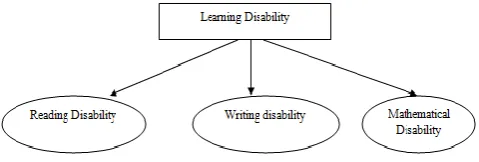
Learning disability is not related with physical disability. There are three kinds of learning disability. Those are writing disability, reading disability and mathematical disability and it is shown in fig.1. Learning disabilities are neurologically-based treating problems. These processing problems can restrict with learning basic skills such as reading, writing and/or math. They can also impede with higher level skills such as organization, time planning, mental reasoning, long or short term memory and attention. It is main to realize that learning disabilities can affect an individual’s life beyond academics and can impact relationships with family, friends and in the workplace.
Revised Manuscript Received on April 15, 2019.
G.Rajivsureshkumar, Professor, Department of CSE, JCT College of Engineering and Technology
K.Malarvizhi, Associate Professor, Department of CSE, JCT College of Engineering and Technology
[image:1.595.318.558.144.225.2]G.Deebanchakkarawarthi, Assistant Professor, Department of CSE, JCT College of Engineering and Technology
Fig. 1 Learning Disability classification
Since problems with reading, writing and/or math are detectable problems during the school years, the signs and signs of learning disabilities are most often diagnosed during that time. However, some individuals do not accept an evaluation until they are in post-secondary education or adults in the employees. Other individuals with learning disabilities may never obtain an evaluation and go through life, never knowing why they have complications with academics and why they may be consuming problems in their jobs or in interactions with family and friends.
Learning Disability has affected one third of the children in the whole world, it takes long time to detect the Disability in children. As Learning Disability is not a physical disability, the children are affected with neurological issues that can be improved through the systematical treatment. The application can be used for detecting and diagnosing the Learning Disability in the children, the digitalized systems are needed in our decade. The users are afraid to consult doctors thinking the future issues in society, so that the community of children with learning disabilities is not getting enough treatment. The system gives enough treatment via the new technologies for a community of children who are not getting enough concern the need of this system is to detect the Learning Disability and to improve the abilities of children.
There are several Mobile application are developed for children. One of the application was dyscalculia who are not capable enough normal children normal IQ in mathematics only in Malaysia. The application is developed in the Malay language which is the national language of Malaysia. So the application can be used within the Malaysia only. It influences the capacity to do mathematical problems by step by step lessons and it improves the mathematical efficiency.
Another Mobile Application for the children The Easy Lexia and Dyslexia for learning disabilities. The above applications influences the capacity of reading comprehension in children, but the application has an effortful interface that the children with physical disability has to take effort.
Mobile Application Development on Detection
and Diagnose of Learning Disability for Children
The application is for autistic children only though the autistic child has more difficulties in using the Mobile and accessing the Mobile Applications. Even if the study has done, the application is not available for the users.
The proposed system is the development of mobile application system for supporting the individual with learning disability to practice arithmetic and language skills. This application also focuses on the development and brain stimulation of a community with learning disability as a social development service. The Mobile application is developed for registration, information gathering, and disability test through questionnaire using clinical methods. To improve the learning disability to conduct tests for basic arithmetic and language skills. It combines neuron science and computer science in order to find the solution for a community.
The main objective is to provide some digitalized services and skill improvement mechanism for a community of children with Learning Disability. The Mobile application provides service for children of any age. It is made for a small community and to improve the users after the detection of the disability. Those are having learning disabilities of any type are allowed to use. In the existing system was developed for children are Dyslexia, Dyscalculia and Dysgraphia. Those systems provide support for different types of the learning disability. Based on the performance in the application’s arithmetic and language sessions, the skills of the children can be developed. In this project provides an effortless user interface using the Mobile Application.
The role of this Mobile Application is to detect and diagnosing the users Learning Disability. This gives the children the chance of improving their ability to read, write and understand the things of real life in an effortless way. The users have the possibility to check whether they have Learning Disability or not. No internet is required after the application is downloaded.
1. The vital goal of this application is to improve brain efficiency of individuals with learning disability.
2. To develop an application for digitalize the clinical methods of detection and diagnose of learning disability for children.
3. To test the status of detection and their language and arithmetic skills.
4. To preserve a digitalized platform for improving the skills of a community of children with learning disability.
That is Dyslexia which is a reading disorder and Dyscalculia which is a math disability and Dysgraphia which is writingdisability.
Brain-Train comes with clinical methods and new facilities with effortless user interface in comparison with the existing solution. It is a platform for detecting and diagnosing the children’s Learning Disability. The application enables the parents know whether their child is affected with Learning Disability or not and the improvement for arithmetic and language skills are developed through it.
II.SYSTEM MODEL A. Learning Disability
Learning disabilities are neurologically-based processing issues (Butterworth, 2013). These processing issues can meddle with learning essential aptitudes, for example, reading, writing and math. They can likewise meddle with more elevated amount aptitudes, for example, organization, time planning, dynamic thinking, long or transient memory and focus (Learning Disabilities Association of America, n.d). Learning disability emerge from neuro-logical contrasts in brain structure and capacity and influence a person's capacity to receive, store, process, recover or convey data (National Centre for Learning Disabilities, 2014). The most well-known sorts of particular learning disabilities are those that affect the parts of reading (Dyslexia), math (Dyscalculia) and writing (Dysgraphia). They may co-happen with different issue of attention, language and behaviour, yet are particular in how they affect learning (National Centre for Learning Disabilities, 2014).
According to Zabidi Azhar (1998), learning disability among children including Dyslexia, Dyscalculia and Dysgraphia is a typical issue, with the pervasiveness evaluated at 10-15% of primary school children worldwide including Malaysia.
B. Learning Disability for Children
Now days a lot of information and communication technology (ICT) have been developed and some of them can help the children with learning disabilities. According to Special Education Support Service (2007), the viable utilization of ICT has advantages for all learners, incorporating children with learning disability.
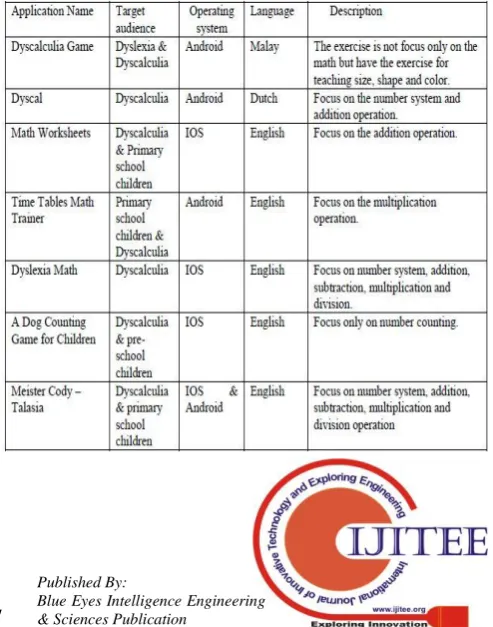
[image:2.595.304.551.516.830.2]The Kids is focused on number counting, object counting, addition and subtraction operation. They will be developed in English language in order to support the children in every country because English language is a global language.
International Journal of Innovative Technology and Exploring Engineering (IJITEE) ISSN: 2278-3075, Volume-8 Issue-6S, April 2019
Easylexia
It is a Mobile Application for the children with learning disabilities that is Dyslexia. Which influences the capacity of reading comprehension in children, but the application has an effortful interface that the children with physical disability has to take effort. The application is for autistic children only though the autistic children have more difficulties in using the Mobile and accessing the Mobile Applications. Even if the studies have done, the application is not available for the users.
III. MOBILE APPLICATION FOR LEARNING DISABILITY CHILDREN
Learning disabilities are neurologically-based processing problems. These processing problems can interfere with learning basic skills such as reading, writing and/or math. They can also interfere with higher level skills such as organization, time planning, abstract reasoning, long or short term memory and attention. It is important to realize that learning disabilities can affect an individual’s life beyond academics and can impact relationships with family, friends and in the workplace.
Since difficulties with reading, writing and/or math are recognizable problems during the school years, the signs and symptoms of learning disabilities are most often diagnosed during that time. However, some individuals do not receive an evaluation until they are in post-secondary education or adults in the workforce. Other individuals with learning disabilities may never receive an evaluation and go through life, never knowing why they have difficulties with academics and why they may be having problems in their jobs or in relationships with family and friends.
Learning Disability has affected one third of the children in the whole world, it takes long time to detect the disability in children. As learning disability is not a physical disability, the children are affected with neurological issues that can be improved through the systematical treatment. The application can be used for detecting and diagnosing the learning disability in the children, the digitalized systems are needed in the modern world. The users are afraid to consult doctors thinking the future issues in society, so that the community of children with learning disabilities is not getting enough treatment. The system gives enough treatment via the new technologies for a community of children who are not getting enough concern the need of this system is to detect the learning disability and to improve the abilities of children.
The proposed system is the development of mobile application system for supporting the individual with learning disability to practice arithmetic and language skills. This application also focuses on the development and brain stimulation of a community with learning disability as a social development service. The Mobile application is developed for registration, information gathering, and disability test through questionnaire using clinical methods. To improve the learning disability to conduct tests for basic arithmetic and language skills. It combines neuron science and computer science in order to find the solution for a community.
The main objective is to provide some digitalized services and skill improvement mechanism for a community of children with learning disability. The Mobile application provides service for children of any age. It is made for a small community and to improve the users after the detection of the disability. Those are having learning disabilities of any type are allowed to use. In the existing system was developed for children are Dyslexia, Dyscalculia and Dysgraphia. Those systems provide support for different types of the learning disability. Based on the performance in the application’s arithmetic and language sessions, the skills of the children can be developed.
The role of this application is to create a Mobile Application in which the users are detected if they have learning disability and diagnosing the learning disability. This gives the children to the chance of improving their ability to read, write and understand the things of real life in an effortless way. The users have the possibility to check whether they have Learning Disability or not. No internet is required after the application is downloaded. This application also provides to detect learning disability and diagnosing.
A. Symptoms of Learning Disabilities
Symptoms can be found in all children at some time during their development. However, a person with learning disabilities has a cluster of these symptoms which do not disappear as s/he grows older.
Most frequently displayed symptoms: Short attention span
Poor memory
Difficulty following directions
Inability to discriminate between/among letters, numerals, or sounds,
Poor reading and/or writing ability
Eye-hand coordination problems; poorly coordinated Difficulties with sequencing, and/or
Disorganization and other sensory difficulties.
B. Characteristics for Learning Disabilities
The following characteristics are identified for disabled children
Performs differently from day to day Responds inappropriately in many instances Distractible, restless, impulsive
Says one thing, means another Difficult to discipline
Doesn’t adjust well to change Difficulty listening and remembering
Difficulty telling time and knowing right from left Difficulty sounding out words
Reverses letters
Places letters in incorrect sequence
C. Registration and Test
To identify the knowledge disability is a procedure. It occupies testing, history taking, and inspection by a skilled expert.
The decision a highly regarded appointment is important. To initiate with your child's school, and if they are not capable to assist you, inquire your insurance company, physician, or contacts and relatives who have compact effectively with learning disabilities.
A variety of specialists who may be capable to analyze and detect learning disabilities include:
Clinical psychologists
School psychologists
Child psychiatrists
Educational psychologists
Developmental psychologists
Neuropsychologist
Psychometrist
Occupational therapist (tests sensory disorders that can lead to learning problems)
Speech and language therapist
[image:4.595.52.487.210.398.2]The user name is used to register into the Brain Train mobile application. The password is registered by the user for future use. The registration and detection for learning disability is shown in figure 2. The detection test is done as chose the answer questions based on the clinical methods to find out the Learning Disability. After answering the test questions the result will be shown as the number of wrong answers and the right answers.
Fig. 2 Registration
D. Language Session
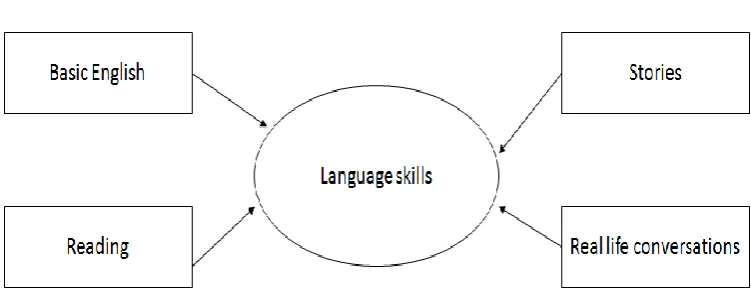
The first session for the language development are shown in this module. The language session consists of four types of lessons to improve the language skills of the children. The language sessions are displayed in figure 3.
Speech and message learning disabilities engage the capacity to appreciate or create verbal communication. Language is also measured yield commotion because it requires organizing beliefs in the brain and passion upon the exact words to orally explain impressive or correspond with someone else.
Symbols of a language supports learning confusion engage troubles with oral word skills, such as the skill to repeat a tale and the glibness of speech, as well as the capacity to appreciate the meaning of words, parts of communication, guidelines, etc.
• Basic English Letters
• Reading
• Stories
• Real life conversation
Fig. 3 Language Session
Learning disabilities in evaluation (dyslexia)
There are two kinds of learning disabilities in reading.
Learning disabilities in reading are intricacy in
understanding the association between sounds, letters and words. Reading conception problems happen when there is
[image:4.595.104.480.546.695.2]International Journal of Innovative Technology and Exploring Engineering (IJITEE) ISSN: 2278-3075, Volume-8 Issue-6S, April 2019
Ciphers of reading obscurity contain problems with:
Letter and word detection
Perceptive words and ideas
Reading speed and glibness
Common language skills
Learning disabilities in characters (dysgraphia)
Wisdom disabilities in writing can absorb the substantial make of writing or the rational commotions of comprehending and synthesizing in sequence. Basic writing disarray refers to physical obscurity forming words and letters. Expressive writing disability specifies a effort to arrange thoughts on paper. Symptoms of a written language learning disability gyrate around the work of writing.
They include inconveniences with: Smartness and constancy of writing Exactly stealing letters and words Spelling stability
Writing association and consistency
For the better understanding of the children, here uses the pictorial representation with the letters with comfort color combination. The language of the children can be developed with practice in this module also it will help the children to have more attention. So by this module the children’s language skills can be developed.
E. Arithmetic Session
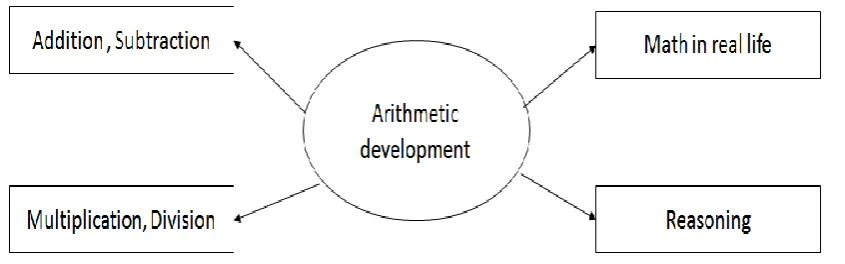
The second session is arithmetic development are presented in this module. The arithmetic session contains four types of lessons to improve the arithmetic skills of the children. The arithmetic development skills for learning disability are presented in figure 4.
Learning disabilities in mathematics (dyscalculia) Learning disabilities in arithmetic differ deeply depending on the child’s other strengths and weaknesses. A child’s capacity is to do sum will be precious in another way by a words learning disability, or an image disorder or a complexity with sequencing, memory or association.
A child with a math-based learning disorder may thrash about with memorization and group of numbers, operation signs, and numeral “facts” (like 5+5=10 or 5x5=25). Children with arithmetic learning disorders might also have problem with counting values (such as counting by twos or counting by fives) or have intricacy impressive time.
Addition and Subtraction
Multiplication and Division
Reasoning
[image:5.595.88.511.368.500.2] Mathematics in real life
Fig. 4 Arithmetic Session For the better understanding of the children, here uses the
pictorial representation with the numbers with comfort color combination. The math of the children can be developed with practice in this module also it will help the children to have more attention. So by this module the children’s arithmetic skills will be developed.
Mobile application mainly focuses on the arithmetic development of the children with any of these learning disabilities. The mobile application evaluates the IQ of the child with a disability Test. The disabilities can be exposed through this test. The scores of the detection test will be showing, if the child who attended the test got more than minimum marks the child is normal. After getting the test results analyzed that the child got less marks then the child is identified as learning disability and can continue improving skills through the application itself.
This application develops computational models of attention and memory. It combines the neurology science and computer science for the betterment of a community of people with Learning Disability. The uultimate goal is to build an application to improve brain efficiency of children with learning disability.
F. Diagnose and test
Mobile application mainly focuses on the arithmetic and language development of the children with any of these learning disabilities. The mobile application evaluates the IQ of the child with a disability Test. The disabilities can be exposed through this test. The scores of the detection test will be shown. If the child who attended the test got more than minimum marks the child is normal. After diagnosing the results, when the child got less marks that means the child is affected by Learning Disability can continue improving skills through the application itself.
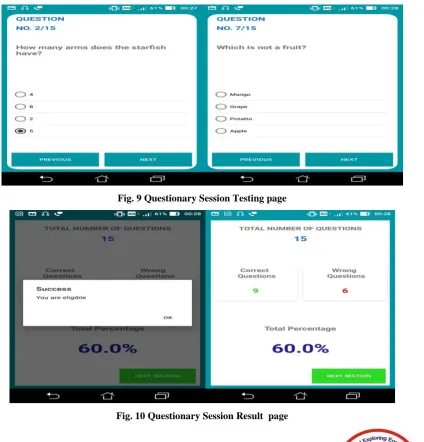
The detection test is done as chose the answer questions based on the clinical methods to find out the Learning Disability. After answering the test questions the result will be shown as the number of wrong answers and the right answers.
IV. IMPLEMENTATION AND RESULTS
The proposed system is the development of mobile application system for supporting the individual with learning disability to practice arithmetic and language skills. This application also focuses on the development and brain stimulation of a community with learning disability as a social development service. The Mobile application is developed for registration, information gathering, and disability test through questionnaire using clinical methods. To improve the learning disability to conduct tests for basic arithmetic and language skills. It combines neuron science and computer science in order to find the solution for a community.
The Mobile application provides service for children of any age. It is made for a small community and to improve the users after the detection of the disability. Those are having learning disabilities of any type are allowed to use.
This application consists of four modules. Those are registration, Language session, Arithmetic session and Diagnose and test.
Mobile application mainly focuses on the arithmetic and language development of the children with any of these learning disabilities. The mobile application evaluates the IQ of the child with a disability Test. The disabilities can be exposed through this test. The scores of the detection test will be shown. If the child who attended the test got more than minimum marks the child is normal. After diagnosing the results, when the child got less marks that means the child is affected by Learning Disability can continue improving skills through the application itself.
[image:6.595.81.522.341.506.2]This application develops computational models of attention and memory. It combines the neurology science and computer science for the betterment of a community of people with Learning Disability. The uultimate goal is to build an application to improve brain efficiency of children with learning disability.
Fig. 5 Home Page
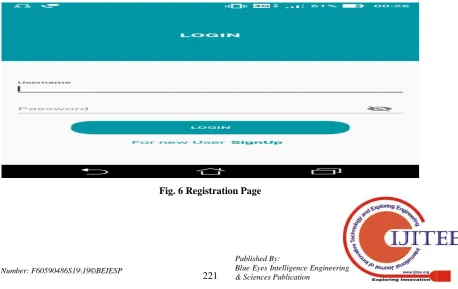
In the registration module, the user name is used to register into the Brain Train mobile application. A password is registered by the user for future use.
[image:6.595.87.546.549.838.2]International Journal of Innovative Technology and Exploring Engineering (IJITEE) ISSN: 2278-3075, Volume-8 Issue-6S, April 2019
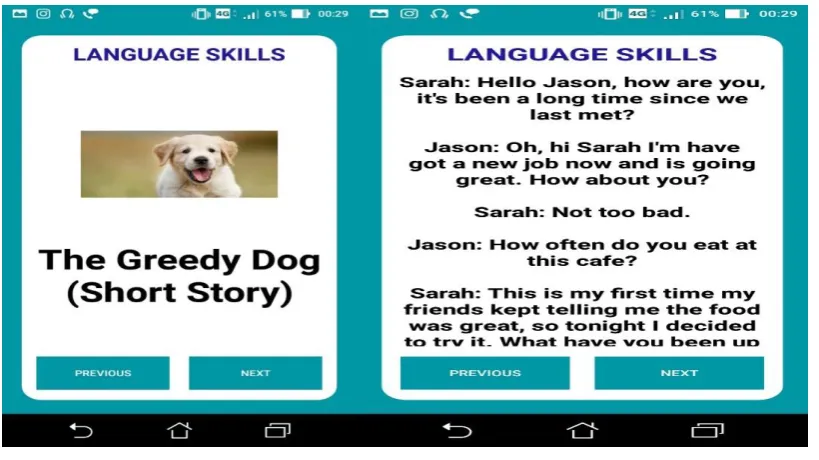
Language and communication learning disabilities involve the ability to understand or produce spoken language. Language is also considered an output activity because it requires organizing thoughts in the brain and calling upon the right words to verbally explain something or communicate with someone else.
[image:7.595.95.505.126.356.2]Signs of a language-based learning disorder involve problems with verbal language skills, such as the ability to retell a story and the fluency of speech, as well as the ability to understand the meaning of words, parts of speech, directions, etc.
Fig. 7 Language session Page Learning disabilities in math vary greatly depending on
the child’s other strengths and weaknesses. A child’s ability to do math will be affected differently by a language learning disability, or a visual disorder or a difficulty with sequencing, memory or organization.
Fig. 8 Arithmetic session Page The mobile application evaluates the IQ of the child with
a disability Test. The disabilities can be exposed through this test. The scores of the detection test will be shown. If the child who attended the test got more than minimum
marks the child is normal. After diagnosing the results, when the child got less marks that means the child is affected by Learning Disability can continue improving skills through the application itself.
[image:8.595.95.520.316.759.2]Fig. 9 Questionary Session Testing page
International Journal of Innovative Technology and Exploring Engineering (IJITEE) ISSN: 2278-3075, Volume-8 Issue-6S, April 2019
V. CONCLUSION AND FUTURE WORK
A Mobile application which facilitates the detection and step wise diagnose of the children with learning disability is specified, which is a solution for the generation’s biggest hidden problem. Children register their name and attend the test which will test the user’s ability. In the existing system was developed as a mobile application for dyscalculia
children in Malaysia. It was in native language of Malaysia so it cannot use globally. Though the researches are done, there are no implemented solutions for this problem. In the proposed system grants a system that detects and diagnoses learning disability. The role of this mobile application will improve the hard life of persons with learning disability. The mobile application allows individual with learning disability to practice arithmetic and language skills and the application focuses on the development and brain stimulation of a community with LD as a social development service. Mobile application has been developed for registration, learning skills for language, Arithmetic and disability test through questionnaire session using clinical methods. This application is improved the learning disability to conduct tests for basic arithmetic and language skills. This application also developed computational models of attention and memory It is an effective solution that the clinical methods are digitalizing through this mobile application for the improvement of the community of children with Learning Disability. In the future it can be enhanced for people with any age by using the EEG analysis algorithms.
REFERENCES
1. F.D.L.Abneu, F.P.Silva, P.B.Neto -‘MA assistance in mathematics basic operations in children with learning disabilities’- April 2017 2. Mazeyanti mohd Ariffin, Fiqa Azreen Abd Aziz-’ mobile application
for dyscalculia children in Malaysia 2017
3. Butterworth, B. (2013). Handbook of Mathematical Cognition: Chapter 26: Developmental Dyscalculia. Mathematical Cognition, 455-468. 4. Ferraz, F., & Neves, J. (2015). A Brief Look into Dyscalculia and
Supportive Tools. 15-18.
5. Morin, A. (2014). Understanding Dyscalculia. Retrieved February 21, 2016, from
https://www.understood.org/en/learning-attention-issues/child-learningdisabilities/dyscalculia/understanding-dyscalculia
6. Mulligan, P. (2011). Sunderland College: Using mobile phones for dyslexic learners. Regional Support Centers, Sunderland College. Retrieved 17 February 2016, from
http://www.jiscrsc.ac.uk/media/363673/n46_sunderland_college_pdf.p df.
7. Nagavalli, T., & Juliet, P. (2015). Technology For Dyscalculic Children. SALEM, 16, 1-10. Retrieved January 16, 2017
8. National Center for Learning Disabilities. Dyscalculia. (2014). Retrieved September 26, 2016, from
http://www.ncld.org/glossary/dyscalculia
9. Saifulazrin, S. Program Coordinator in Persatuan Dyslexia Malaysia, Ipoh. Personal Interview. March. 4. 2016.
10. Skiada, R., Soroniati, E., Gardeli, A., & et al. (2014).
11. EasyLexia: A Mobile Application for Children with Learning Difficulties. Procedia Computer Science, 27, 218-228
12. Special Education Support Services. (2007). Information on Mild General Learning Disability, 1, 1-8.
13. Types of Learning Disabilities. (2014). Retrieved February 07, 2016, from http://ldaamerica.org/typesof- learning -disabilities/