https://doi.org/10.5194/bg-15-5415-2018 © Author(s) 2018. This work is distributed under the Creative Commons Attribution 4.0 License.
Technical note: A simple theoretical model framework to
describe plant stomatal “sluggishness” in response to
elevated ozone concentrations
Chris Huntingford1, Rebecca J. Oliver1, Lina M. Mercado2,1, and Stephen Sitch2
1Centre for Ecology and Hydrology, Benson Lane, Wallingford, Oxfordshire, OX10 8BB, UK
2College of Life and Environmental Sciences, University of Exeter, Amory Building, Rennes Drive, Exeter, EX4 4RJ, UK
Correspondence:Chris Huntingford ([email protected]) Received: 25 April 2018 – Discussion started: 7 May 2018
Revised: 31 July 2018 – Accepted: 24 August 2018 – Published: 12 September 2018
Abstract. Elevated levels of tropospheric ozone, O3, cause
damage to terrestrial vegetation, affecting leaf stomatal func-tioning and reducing photosynthesis. Climatic impacts un-der future raised atmospheric greenhouse gas (GHG) con-centrations will also impact on the net primary productiv-ity (NPP) of vegetation, which might for instance alter vi-ability of some crops. Together, ozone damage and climate change may adjust the current ability of terrestrial vegeta-tion to offset a significant fracvegeta-tion of carbon dioxide (CO2)
emissions. Climate impacts on the land surface are well stud-ied, but arguably large-scale modelling of raised surface level O3effects is less advanced. To date most models
represent-ing ozone damage use either O3 concentration or, more
re-cently, flux-uptake-related reduction of stomatal opening, es-timating suppressed land–atmosphere water and CO2fluxes.
However there is evidence that, for some species, O3damage
can also cause an inertial “sluggishness” of stomatal response to changing surface meteorological conditions. In some cir-cumstances (e.g. droughts), this loss of stomata control can cause them to be more open than without ozone interfer-ence. To both aid model development and provide empiricists with a system on to which measurements can be mapped, we present a parameter-sparse framework specifically designed to capture sluggishness. This contains a single time-delay pa-rameterτO3, characterizing the timescale for stomata to catch
up with the level of opening they would have without dam-age. The larger the value of this parameter, the more slug-gish the modelled stomatal response. Through variation of
τO3, we find it is possible to have qualitatively similar
re-sponses to factorial experiments with and without raised O3,
when comparing to reported measurement time series
pre-sented in the literature. This low-parameter approach lends itself to the inclusion of ozone-induced inertial effects being incorporated in the terrestrial vegetation component of Earth system models (ESMs).
1 Introduction
Anthropogenic emissions from industrial processes, trans-port and biomass burning are increasing background levels of surface ozone, O3(mol mol−1) (Vingarzan, 2004). There is
much evidence this adjusts the stomatal opening of terrestrial vegetation, and so influencing land–atmosphere exchanges of water and carbon both globally and locally (Ainsworth et al., 2012; Wittig et al., 2007, 2009; Mills et al., 2016). This may reduce the ability of vegetation to photosynthesize, which at the global scale is a concern as it may lower the current frac-tion of CO2 emissions the land draws down (Felzer et al.,
2005; Sitch et al., 2007; Lombardozzi et al., 2015). At more local-to-regional scales, ozone-induced damage could affect crop yields and hence potentially food security Ainsworth et al. (2012); Anav et al. (2011); Avnery et al. (2011); Tai et al. (2014).
hormonal signalling pathway abscisic acid (ABA) (Wilkin-son and Davies, 2009, 2010; Mills et al., 2009). ABA is used by plants to communicate to stomata the need to re-duce opening in the presence of growing abiotic stress con-ditions. Specifically, elevated ozone stimulates ethylene pro-duction which prevents ABA from otherwise closing stomata (Wilkinson and Davies, 2009, 2010). Loss of stomatal con-trol is observed in response to a range of environmental fac-tors, including drought (Wilkinson and Davies, 2009, 2010; Mills et al., 2009; Hayes et al., 2012; Wagg et al., 2013), high light (Paoletti and Grulke, 2010; Hoshika et al., 2012b; Wagg et al., 2013) and high vapour pressure deficit (Grulke et al., 2007). The ABA signalling pathway mediates stom-atal responses to many of these stress factors, as has been found particularly in drought conditions. It is therefore likely to play a role in controlling stomatal responses to ozone un-der fluctuating environmental conditions.
Ozone-induced sluggishness can have the opposite effect to that generally associated with O3 damage. In some
cir-cumstances stomata are more open than without O3
influ-ence. Ozone-induced sluggish behaviour that delays stom-atal closure means affected plants create a positive feedback whereby they receive a higher O3flux with greater O3
dam-age resulting. Impacted plants could also lose more water, and if this occurs during drought episodes for example, this may exacerbate soil moisture deficits, in turn affecting net primary productivity (NPP). Hence there are implications for water use, crop yields and food security (Sun et al., 2012; Tai et al., 2014; Van Dingenen et al., 2009).
At the regional scale, McLaughlin et al. (2007a, b) and Sun et al. (2012) provide field evidence of increased transpiration and reduced streamflow in forests. This is attributed to a slug-gish stomatal response to ambient levels of O3. This could
in-crease the frequency and severity of droughts, then suppress-ing forest productivity and add to any direct O3inhibition of
photosynthetic capacity. However, in contrast, Hoshika et al. (2012a) found that despite sluggish stomatal control in trees exposed to O3, whole tree water use reduced due to lower
gas exchange and premature shedding of injured leaves. The literature suggests that sluggish stomata response to O3 is
not ubiquitous (Mills et al., 2016; Wittig et al., 2007); which species respond this way and under what conditions requires understanding. For species affected, significant impacts on watershed hydrology and carbon sequestration are possible. The extent of any stomatal inertial response is likely depen-dent on the magnitude and cumulated time of exposure to raised O3, suggesting the importance of experiments to
anal-yse this and that require operation over long time series such as full growing seasons.
Most large-scale terrestrial models represent raised tropo-spheric ozone concentrations as detrimental to photosynthe-sis, inducing extra stomatal closure (Wittig et al., 2007). For instance, the JULES (Joint UK Land Environment Simula-tor) model uses a flux-gradient approach to describe simu-lated plant O3damage (Sitch et al., 2007; Clark et al., 2011).
The model is parameterized to reduce photosynthesis in re-sponse to accumulated O3uptake, and because in JULES this
processes is coupled to stomatal conductance, that also de-creases. This has similarities to how ozone damage repre-sentation has been introduced by Franz et al. (2017) to the OCN land model Zaehle and Friend (2010). Lombardozzi et al. (2012), for the CLM (Community Land Model), decou-ple photosynthesis and stomatal conductance so that raised surface O3levels reduce carbon assimilation
disproportion-ately more than transpiration. A first attempt to numerically emulate the sluggish feature of higher stomatal opening is by Hoshika et al. (2015). They modulate the multi-layer atmosphere–soil–vegetation (SOLVEG) terrestrial model so the minimum stomatal opening in the Ball–Woodrow–Berry model,gmin(m s−1), increases for higher cumulative O3
ex-posure. This potentially raises transpiration losses.
Geographically extensive projections of ozone impacts on the land surface response need understanding within the context of other large-scale changes affecting terrestrial ecosystems. These include the direct physiological effect of raised CO2 through fossil fuel burning, the impact of
cli-mate change due to raised CO2and other greenhouse gases
(GHGs), and aerosols adjusting the composition of down-ward shortwave radiation (Huntingford et al., 2011). Even if an emissions trajectory is followed that achieves global warming stabilized at 2◦C above pre-industrial levels, gen-eral near-surface warming over land will be higher (Hunt-ingford and Mercado, 2016). Therefore even moderate levels of global warming could have strong influences on terrestrial vegetation, and in this situation any additional ozone-induced changes need to be described. Earth system models (ESMs) are the main tools to describe the effect on climate of raised atmospheric GHGs, and interactions and feedbacks on global biogeochemical cycles. Such models contain a land surface component, e.g. the JULES model (Clark et al., 2011) within the HadGEM2-ES ESM (Jones et al., 2011). HadGEM2-ES ESM carries ozone as an atmospheric tracer, to which JULES responds Sitch et al. (2007). ESMs contribute to global model databases, most recently the fifth phase of the Coupled Model Intercomparison Project, CMIP5 (Taylor et al., 2012), which inform the United Nations Intergovernmental Panel on Climate Change reports (e.g., IPCC, 2013). If a substan-tial fraction of vegetation responses to elevated tropospheric ozone contain stomata sluggishness, this requires implemen-tation in large-scale terrestrial vegeimplemen-tation models and ESMs to assess global implications. Any influence on terrestrial car-bon stores is important for attribution and understanding of recent trends in the land carbon sink (e.g., Le Quéré et al., 2018).
stomatal sluggishness implies a timescale exists, describing the delay behind a state without ozone damage. We call this timescaleτO3 (s).
2 Sluggishness parameterτO3 and modelled
stomatal opening
Proposed is a simple and minimal mathematical descrip-tion of sluggishness. We first set the time-evolving leaf-level stomatal opening that would occur without ozone damage as gl(t ) (m s−1). This is assumed to respond to the
stan-dard drivers of temperatureT (K), light level (i.e. photosyn-thetic active radiationIP (W m−2)), vapour pressure deficit
(VPD (kPa)) and soil moisture statusθ(kg water (kg soil)−1). A second variable is defined as the stomatal opening with additional ozone-induced sluggishness and named gl,slug(t )
(m s−1). Sluggishness is characterized by a single new pa-rameter τO3 (s), representing the timescale of how long
ozone-damaged stomata take to “catch up” with the level of opening without O3influence, i.e.gl=gl(T , IP,VPD, θ ).
This leads to the ordinary differential equation, for the rate of change ofgl,slugwith respect to timet(s), as
dgl,slug
dt = −
gl,slug−gl
τO3
. (1)
For this technical note, two illustrative sets of solutions to Eq. (1) are considered. Setting tday=86 400 (s) as the
number of seconds in a day, the sluggishness effects for a timescale less than 1 day, withτO3/tday=0.25, are first
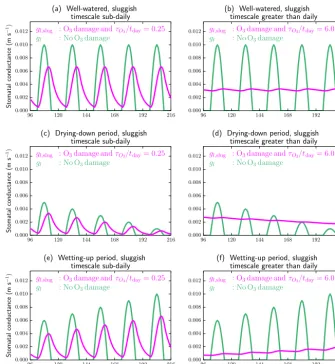
mod-elled. Then a second set, corresponding to a more sluggish timescale that is significantly greater than 1 day, are con-sidered, withτO3/tday=6. These are shown, respectively, as
the magenta curves in the left-hand and right-hand columns of Fig. 1. The green curves are with no O3 sluggish
dam-age, showing identical curves for gl between the two
dia-gram columns. The background “sluggish-free” curves forgl
are described in Appendix A, and they broadly correspond to three cases as daily variability for (i) well-watered veg-etation, (ii) a period of increasing drought conditions and (iii) recovery from drought. These correspond to the top, middle and bottom rows respectively of Fig. 1.
The simulations are summarized as follows. In the well-watered case (top row), forτO3/tday=0.25 there remains a
sizeable diurnal cycle in the ozone-damaged stomatal con-ductancegl,slug. ForτO3/tday=6, almost all within-day
vari-ation is lost and stomata remain open throughout the night-time periods. For drying conditions (middle panels), again for the smaller τO3 case, there remains subdiurnal
variabil-ity, and the downward trend is similar between damaged and undamaged stomata. However, for largerτO3, the solution to
Eq. (1) is such that the larger inertia makes stomata eventu-ally more open than at any point during the diurnal cycle of those that are undamaged. This scenario is starting to receive
particular interest, with emerging evidence that ozone dam-age can under some circumstances cause excessive opening of stomata. In the bottom row, the lowerτO3 example (left)
shows again delays at subdiurnal timescale, but the damaged stomata retain capability to open more as conditions become more favourable. For the higherτO3 case, there is only
mini-mal ability to keep up with increases in opening by the mod-elled undamaged stomata.
Observational evidence of different levels of sluggish-ness suggests that these are a function of accumulated ex-posure (e.g., Hoshika et al., 2015). For existing models of O3 damage to stomata, a level exists and only above which
damage occurs to account for the ability of vegetation to detoxify low levels of ozone. In Sitch et al. (2007) for in-stance, that threshold is a level of ozone flux in to vege-tation. This implies that the evolution ofτO3, possibly
de-pendent on time since the start of the growth season,tg,start
(s), can be described by two parameters. The first is a crit-ical threshold above which damage occurs, as flux FO3,crit
(nmol m−2s−1) (or concentration O3,crit (mol mol−1)). The
second linearly relates time spent over the threshold to the amount of sluggishness, expressed by changes to τO3.
Hence τO3(t )=b
Rt
tg,startmax[FO3−FO3,crit,0]dt or τO3(t )=
bRt
tg,startmax[O3−O3,crit,0]dt. This second parameterb has
units of either s [nmol m−2]−1or [mol mol−1]−1.
3 Discussion
There is evidence in the literature that some features of Fig. 1 can be seen in measurements. Our two representative val-ues of τO3 are guided by the experimental measurements
presented for Siebold’s beech (Hoshika et al., 2012b) and for grassland (Hayes et al., 2012). In the former, after ap-proximately two months at double ambient ozone concen-tration (at well-watered conditions), imposed oscillations of light levels on timescale order hours cause variations in stom-atal opening which have a slight lag compared to equivalent experiments at ambient O3 levels. This is analogous to our
smallerτO3/tdayvalues of sub-daily magnitude, seen by
com-parison of Fig. 2a of Hoshika et al. (2012b) with Fig. 1a. Similar curves are observed for beans, in Fig. 1 of Paoletti and Grulke (2010). In the grassland experiments of Hayes et al. (2012), analysis is made of well-watered and reduced-watered (i.e. drought experiments) and for different O3
con-centration treatments. The notable feature in those experi-ments is that for very high O3levels (order 90 nmol mol−1),
then beyond nine weeks at that level and in the drought-induced case, the stomata are almost as wide open as the well-watered example. This suggests a long-term broad in-ability to respond to changing conditions, and so in-keeping with our high sluggishτO3/tday value of much greater than
96 120 144 168 192 216 0.000
0.002 0.004 0.006 0.008 0.010 0.012
Stomatal
conductance
(m
s
−
1)
gl : No O damage3
gl,slug : O damage and3 τ /tO3 day= 0.25
(a) Well-watered, sluggish timescale sub-daily
96 120 144 168 192 216
0.000 0.002 0.004 0.006 0.008 0.010 0.012
gl : No O damage3
gl,slug : O damage and3 τ /tO3 day= 6.0
(b) Well-watered, sluggish timescale greater than daily
96 120 144 168 192 216
0.000 0.002 0.004 0.006 0.008 0.010 0.012
Stomatal
conductance
(m
s
−
1)
gl : No O damage3
gl,slug : O damage and3 τ /tO3 day= 0.25
(c) Drying-down period, sluggish timescale sub-daily
96 120 144 168 192 216
0.000 0.002 0.004 0.006 0.008 0.010 0.012
gl : No O damage3
gl,slug : O damage and3 τ /tO3 day= 6.0
(d) Drying-down period, sluggish timescale greater than daily
96 120 144 168 192 216
Time since end of numerical spin-up period (h)
0.000 0.002 0.004 0.006 0.008 0.010 0.012
Stomatal
conductance
(m
s
−
1)
gl : No O damage3
gl,slug : O damage and3 τ /tO3 day= 0.25
(e) Wetting-up period, sluggish timescale sub-daily
96 120 144 168 192 216
Time since end of numerical spin-up period (h)
0.000 0.002 0.004 0.006 0.008 0.010 0.012
gl : No O damage3
gl,slug : O damage and3 τ /tO3 day= 6.0
[image:4.612.130.465.64.428.2](f) Wetting-up period, sluggish timescale greater than daily
Figure 1.The effect of low(a, c, e)and high(b, d, f)levels of stomatal sluggishness. Calculations for stomatal conductance correspond to well-watered conditions(a, b), entering a period of drought(c, d)and recovery from drought(e, f). Simulations are for nine 24 h periods, with the last five shown. Green curves are stomatal conductance without ozone effects, and magenta curves are with sluggishness. Appendix A details the modelling framework and driving conditions leading to these curves.
of Hoshika et al. (2012b) and the middle row, right-hand panel of our Fig. 1 (i.e. Fig. 1d).
Our mathematical framework of Eq. (1) and solution for two representativeτO3 values raises a set of conjectures,
is-sues and questions about the implications of stomatal slug-gishness. This can aid in developing future measurement campaigns of ozone effects on stomatal conductance, to test the validity of Eq. (1) and then its parameterization if verified as an appropriate model.
For sluggishness at sub-daily periodsτO3/tday<1,
stom-atal conductancegl,slughas some symmetry, with periods of
both larger and smaller opening, when compared togl.
How-ever, this may cause an asymmetry for photosynthetic activ-ity, as there are frequently periods at night when sluggish stomata are open (left columns of Fig. 1) and when photo-synthesis would not occur. Conversely daytime opening is often suppressed ingl,slug, and so overall sluggish stomatal
response will lower terrestrial carbon uptake. This is seen in Fig. 2b of Hoshika et al. (2012b). Hence when averaged over periods longer than 1 day, sluggishness will dampen over-all draw-down of atmospheric CO2. This could cause a
mis-attribution of effect, if measurements are made during day-time light periods only and withτO3/tday<1. This is because
in the presence of stomatal sluggishness, and with measure-ments made only when stomata are less open than without O3damage (i.e. no night measurements), it could be inferred
that the more conventional non-sluggish overall closure de-scriptions of damage are valid. An open research question is whether stomata could have both responses. That is the com-monly modelled ozone flux-based (or concentration-based) description that always reduces stomatal opening, as well as an additional inertial contribution.
this is of concern during periods of approaching drought, high temperatures or both. Under severe ozone damage with
τO3/tday1 and during “drying-down” periods, raised
evap-otranspiration through larger stomatal opening could trigger severe water stress. This may deplete soil moisture to lev-els that would not otherwise have been attained. This could cause wilting or initiate plant hydraulic failure through em-bolism or cavitation, with clear implications for crop via-bility and food security in regions that experience seasonal drought. More comprehensive characterization of O3
thresh-olds and length of time over them that could cause this situa-tion is required. Furthermore, long-term (i.e. chronic) ozone influence on photosynthetic capability may alter terrestrial carbon stores and thus the global carbon cycle. The size of current uncertainty in the modelled global carbon cycle is large, reaching order 40 % of that of the physical climate in terms of predicting expected future warming levels (Hunt-ingford et al., 2009).
If the ABA signalling process plays a key role in link-ing tropospheric ozone levels to stomata sluggish effects, then careful analysis is needed of data from experimental examples of well-watered vegetation at high ozone levels. This is because high ABA concentrations generally increase during periods of soil moisture stress, to which stomata re-spond by lowering their opening. If, therefore, sluggishness is also observed during well-watered periods and hence for low ABA concentrations, then this suggests that additional mechanisms operate beyond this hormone in linking O3
con-centrations to inertia of stomata.
Finally, the representation of general plant functional types (PFTs) in land surface models is evolving, and including a larger set of them (e.g. Harper et al., 2016) changes the JULES model from five basic PFTs to nine. In the event that comprehensive measurements show variations in sluggish-ness between species, then this could inform future PFT def-initions – existing PFTs in large-scale land models may have to be split to accommodate different responses. For trees, for example, birch and oak are found to have high and low sen-sitivity in existing models of ozone-induced stomatal closure (Sitch et al., 2007). Hoshika et al. (2018) find similarly that sluggishness effects might be stronger in white birch than de-ciduous oak.
4 Conclusions
We present a simple first-order differential equation to char-acterize the observed “sluggish” response of modelled stom-ata to elevated levels of tropospheric ozone. The formula-tion is deliberately parameter-sparse, with a single parame-terτO3. This parameter represents a delay, characterizing the
timescale required for ozone-damaged stomata to “catch up” with the value it would have without ozone-induced damage. Through simple numerical examples we illustrate how, de-pending on circumstances, this equation can project stom-ata to be both more closed than they would otherwise be, and critically the opposite whereby sluggishness can provide a mechanism for additional opening. Stomata that are more open through ozone damage have been reported from obser-vations, yet they are currently not routinely included in land surface response models. This is because most existing mod-elling schemes can only lower stomatal opening for raised O3levels.
Targeted measurement campaigns may provide more de-tailed information on the appropriateness of ourτO3
formu-lation. This includes (a) whether this is a generic form for describing tropospheric ozone damage to vegetation (or al-ternatively, for instance, if the response may be nonlinear in
gl,slug−gl), (b) how theτO3 value depends on accumulated
ozone exposure, or if there is a more complex dependence on O3exposure history, and (c) if there is potential to map on
to broad PFTs. However if our formulation is broadly valid, then “sluggish” effects can be implemented within large-scale land surface models such as JULES (Clark et al., 2011) via our proposed Eq. (1). Furthermore, if valid, then eventual implementation in the large-scale terrestrial models of ESMs offers hope that the implications of sluggish stomata can be understood in the context of simultaneous changing climatic conditions, the global carbon cycle and varying tropospheric ozone levels, along with any feedbacks.
Appendix A: Parameters leading to illustrative Fig. 1 The driving conditions leading to the illustrative simulations of Fig. 1 are as follows. In well-watered conditions, and without ozone damage influence, a daily maximum stomatal opening gl,max is assumed invariant, at 0.01 m s−1. This is
representative of midday values, under high sunlight levels and with well-watered conditions. This corresponds to the top row of Fig. 1. Sub-daily variability is then described as the part of a sinusoidal function when positive as
gl=gl,max(t )×max
−cos
2π t tday
,0
. (A1)
“Drying-down” is represented by changinggl,maxon a daily
basis, following a period of being well-watered at 0.01 m s−1. This occurs over 9 days, down to a minimum stomatal open-ing of 0.001 m s−1, falling by 0.001 m s−1each day. This is the middle panels of Fig. 1. “Wetting-up” is described as fol-lowing a period with low conductance of 0.001 m s−1, rising to 0.01 m s−1over 9 days, the bottom panels of Fig. 1. These calculations of gl are the green curves throughout the
dia-gram.
Equation (1) is then solved to calculategl,slug(t ), for the
corresponding values in each diagram panel of gl. This
is with left panels of τO3/tday=0.25 and right panels of
τO3/tday=6.0. As Eq. (1) is a non-equilibrium solution,
then initial conditions are required. We do this numerically, by “spinning up” over 100 repeated initial days, which in the top and middle panels are well-watered with gl,max=
0.01 m s−1, and bottom panels are drought conditions with
Author contributions. CH created the theoretical model, operated the numerical experiments and designed the paper. RJO, LMM and SS performed the literature review and placed the analysis in the context of existing research. All authors contributed to writing the paper.
Competing interests. The authors declare that they have no conflict of interest.
Acknowledgements. Chris Huntingford, Rebecca J. Oliver and
Lina M. Mercado acknowledge support from the NERC-CEH National Capability Fund. Rebecca J. Oliver and Lina M. Mercado acknowledge support from UK Natural Environment Research Council grant NE/N017951/1. Lina M. Mercado and Stephen Sitch acknowledge support from UK Natural Environment Research Council grant NE/R001812/1.
Edited by: Sönke Zaehle
Reviewed by: two anonymous referees
References
Ainsworth, E. A., Yendrek, C. R., Sitch, S., Collins, W. J., and Em-berson, L. D.: The Effects of Tropospheric Ozone on Net Pri-mary Productivity and Implications for Climate Change, Annu. Rev. Plant Biol., 63, 637–661, https://doi.org/10.1146/annurev-arplant-042110-103829, 2012.
Anav, A., Menut, L., Khvorostyanov, D., and Viovy, N.: Impact of tropospheric ozone on the Euro-Mediterranean vegetation, Glob. Change Biol., 17, 2342–2359, https://doi.org/10.1111/j.1365-2486.2010.02387.x, 2011.
Avnery, S., Mauzerall, D. L., Liu, J., and Horowitz, L. W.: Global crop yield reductions due to surface ozone exposure: 1. Year 2000 crop production losses and economic damage, Atmos. Environ., 45, 2284–2296, https://doi.org/10.1016/j.atmosenv.2010.11.045, 2011.
Clark, D. B., Mercado, L. M., Sitch, S., Jones, C. D., Gedney, N., Best, M. J., Pryor, M., Rooney, G. G., Essery, R. L. H., Blyth, E., Boucher, O., Harding, R. J., Huntingford, C., and Cox, P. M.: The Joint UK Land Environment Simulator (JULES), model description – Part 2: Carbon fluxes and vegetation dynamics, Geosci. Model Dev., 4, 701–722, https://doi.org/10.5194/gmd-4-701-2011, 2011.
Felzer, B., Reilly, J., Melillo, J., Kicklighter, D., Sarofim, M., Wang, C., Prinn, R., and Zhuang, Q.: Future effects of ozone on carbon sequestration and climate change policy using a global biogeochemical model, Climatic Change, 73, 345–373, https://doi.org/10.1007/s10584-005-6776-4, 2005.
Franz, M., Simpson, D., Arneth, A., and Zaehle, S.: Develop-ment and evaluation of an ozone deposition scheme for cou-pling to a terrestrial biosphere model, Biogeosciences, 14, 45– 71, https://doi.org/10.5194/bg-14-45-2017, 2017.
Grulke, N. E., Neufeld, H. S., Davison, A. W., Roberts, M., and Chappelka, A. H.: Stomatal behavior of ozone-sensitive and -insensitive coneflowers (Rudbeckia laciniata var. digitata) in
Great Smoky Mountains National Park, New Phytol., 173, 100– 109, https://doi.org/10.1111/j.1469-8137.2006.01872.x, 2007. Harper, A. B., Cox, P. M., Friedlingstein, P., Wiltshire, A. J., Jones,
C. D., Sitch, S., Mercado, L. M., Groenendijk, M., Robertson, E., Kattge, J., Bönisch, G., Atkin, O. K., Bahn, M., Cornelis-sen, J., Niinemets, Ü., Onipchenko, V., Peñuelas, J., Poorter, L., Reich, P. B., Soudzilovskaia, N. A., and Bodegom, P. V.: Im-proved representation of plant functional types and physiology in the Joint UK Land Environment Simulator (JULES v4.2) us-ing plant trait information, Geosci. Model Dev., 9, 2415–2440, https://doi.org/10.5194/gmd-9-2415-2016, 2016.
Hayes, F., Wagg, S., Mills, G., Wilkinson, S., and Davies, W.: Ozone effects in a drier climate: implications for stomatal fluxes of reduced stomatal sensitivity to soil drying in a typical grassland species, Glob. Change Biol., 18, 948–959, https://doi.org/10.1111/j.1365-2486.2011.02613.x, 2012. Hoshika, Y., Omasa, K., and Paoletti, E.: Whole-Tree Water Use
Efficiency Is Decreased by Ambient Ozone and Not Affected by O-3-Induced Stomatal Sluggishness, PLOS ONE, 7, e39270, https://doi.org/10.1371/journal.pone.0039270, 2012a.
Hoshika, Y., Watanabe, M., Inada, N., and Koike, T.: Ozone-induced stomatal sluggishness develops progressively in Siebold’s beech (Fagus crenata), Environ. Pollut., 166, 152–156, https://doi.org/10.1016/j.envpol.2012.03.013, 2012b.
Hoshika, Y., Katata, G., Deushi, M., Watanabe, M., Koike, T., and Paoletti, E.: Ozone-induced stomatal sluggishness changes car-bon and water balance of temperate deciduous forests, Sci. Rep.-UK, 5, 9871, https://doi.org/10.1038/srep09871, 2015.
Hoshika, Y., Watanabe, M., Carrari, E., Paoletti, E., and Koike, T.: Ozone-induced stomatal sluggishness changes stomatal parame-ters of Jarvis-type model in white birch and deciduous oak, Plant Biol., 20, 20–28, https://doi.org/10.1111/plb.12632, 2018. Huntingford, C. and Mercado, L. M.: High chance that current
atmospheric greenhouse concentrations commit to warmings greater than 1.5 degrees C over land, Sci. Rep.-UK, 6, 30294, https://doi.org/10.1038/srep30294, 2016.
Huntingford, C., Lowe, J. A., Booth, B. B. B., Jones, C. D., Har-ris, G. R., Gohar, L. K., and Meir, P.: Contributions of carbon cycle uncertainty to future climate projection spread, Tellus B, 61, 355–360, https://doi.org/10.1111/j.1600-0889.2009.00414.x, 2009.
Huntingford, C., Cox, P. M., Mercado, L. M., Sitch, S., Bel-louin, N., Boucher, O., and Gedney, N.: Highly contrast-ing effects of different climate forccontrast-ing agents on terrestrial ecosystem services, Philos. T. R. Soc. A, 369, 2026–2037, https://doi.org/10.1098/rsta.2010.0314, 2011.
Huntingford, C., Smith, D. M., Davies, W. J., Falk, R., Sitch, S., and Mercado, L. M.: Combining the [ABA] and net photosynthesis-based model equations of stomatal conductance, Ecol. Model., 300, 81–88, https://doi.org/10.1016/j.ecolmodel.2015.01.005, 2015.
IPCC: Climate Change 2013: The Physical Science Basis. Con-tribution of Working Group I to the Fifth Assessment Report of the Intergovernmental Panel on Climate Change, Cambridge University Press, Cambridge, UK and New York, NY, USA, https://doi.org/10.1017/CBO9781107415324, 2013.
Corbin, K. D., Doutriaux-Boucher, M., Friedlingstein, P., Gor-nall, J., Gray, L., Halloran, P. R., Hurtt, G., Ingram, W. J., Lamar-que, J.-F., Law, R. M., Meinshausen, M., Osprey, S., Palin, E. J., Parsons Chini, L., Raddatz, T., Sanderson, M. G., Sellar, A. A., Schurer, A., Valdes, P., Wood, N., Woodward, S., Yoshioka, M., and Zerroukat, M.: The HadGEM2-ES implementation of CMIP5 centennial simulations, Geosci. Model Dev., 4, 543–570, https://doi.org/10.5194/gmd-4-543-2011, 2011.
Le Quéré, C., Andrew, R. M., Friedlingstein, P., Sitch, S., Pongratz, J., Manning, A. C., Korsbakken, J. I., Peters, G. P., Canadell, J. G., Jackson, R. B., Boden, T. A., Tans, P. P., Andrews, O. D., Arora, V. K., Bakker, D. C. E., Barbero, L., Becker, M., Betts, R. A., Bopp, L., Chevallier, F., Chini, L. P., Ciais, P., Cosca, C. E., Cross, J., Currie, K., Gasser, T., Harris, I., Hauck, J., Haverd, V., Houghton, R. A., Hunt, C. W., Hurtt, G., Ily-ina, T., Jain, A. K., Kato, E., Kautz, M., Keeling, R. F., Klein Goldewijk, K., Körtzinger, A., Landschützer, P., Lefèvre, N., Lenton, A., Lienert, S., Lima, I., Lombardozzi, D., Metzl, N., Millero, F., Monteiro, P. M. S., Munro, D. R., Nabel, J. E. M. S., Nakaoka, S.-I., Nojiri, Y., Padin, X. A., Peregon, A., Pfeil, B., Pierrot, D., Poulter, B., Rehder, G., Reimer, J., Rödenbeck, C., Schwinger, J., Séférian, R., Skjelvan, I., Stocker, B. D., Tian, H., Tilbrook, B., Tubiello, F. N., van der Laan-Luijkx, I. T., van der Werf, G. R., van Heuven, S., Viovy, N., Vuichard, N., Walker, A. P., Watson, A. J., Wiltshire, A. J., Zaehle, S., and Zhu, D.: Global Carbon Budget 2017, Earth Syst. Sci. Data, 10, 405–448, https://doi.org/10.5194/essd-10-405-2018, 2018.
Lombardozzi, D., Levis, S., Bonan, G., and Sparks, J. P.: Predict-ing photosynthesis and transpiration responses to ozone: decou-pling modeled photosynthesis and stomatal conductance, Bio-geosciences, 9, 3113–3130, https://doi.org/10.5194/bg-9-3113-2012, 2012.
Lombardozzi, D., Levis, S., Bonan, G., Hess, P. G., and Sparks, J. P.: The Influence of Chronic Ozone Exposure on Global Carbon and Water Cycles, J. Climate, 28, 292–305, https://doi.org/10.1175/JCLI-D-14-00223.1, 2015.
McLaughlin, S. B., Nosal, M., Wullschleger, S. D., and Sun, G.: Interactive effects of ozone and climate on tree growth and water use in a southern Appalachian forest in the USA, New Phytol., 174, 109–124, https://doi.org/10.1111/j.1469-8137.2007.02018.x, 2007a.
McLaughlin, S. B., Wullschleger, S. D., Sun, G., and Nosal, M.: Interactive effects of ozone and climate on water use, soil moisture content and streamflow in a southern Ap-palachian forest in the USA, New Phytol., 174, 125–136, https://doi.org/10.1111/j.1469-8137.2007.01970.x, 2007b. Mills, G., Hayes, F., Wilkinson, S., and Davies, W. J.: Chronic
ex-posure to increasing background ozone impairs stomatal func-tioning in grassland species, Glob. Change Biol., 15, 1522–1533, https://doi.org/10.1111/j.1365-2486.2008.01798.x, 2009. Mills, G., Harmens, H., Wagg, S., Sharps, K., Hayes, F., Fowler,
D., Sutton, M., and Davies, B.: Ozone impacts on vegetation in a nitrogen enriched and changing climate, Environ. Pollut., 208, 898–908, https://doi.org/10.1016/j.envpol.2015.09.038, 2016. Paoletti, E. and Grulke, N. E.: Ozone exposure and
stomatal sluggishness in different plant physiog-nomic classes, Environ. Pollut., 158, 2664–2671, https://doi.org/10.1016/j.envpol.2010.04.024, 2010.
Sitch, S., Cox, P. M., Collins, W. J., and Huntingford, C.: Indirect radiative forcing of climate change through ozone effects on the land-carbon sink, Nature, 448, 791–794, https://doi.org/10.1038/nature06059, 2007.
Sun, G., McLaughlin, S. B., Porter, J. H., Uddling, J., Mulholland, P. J., Adams, M. B., and Pederson, N.: Interactive influences of ozone and climate on streamflow of forested watersheds, Glob. Change Biol., 18, 3395–3409, https://doi.org/10.1111/j.1365-2486.2012.02787.x, 2012.
Tai, A. P. K., Martin, M. V., and Heald, C. L.: Threat to future global food security from climate change and ozone air pollution, Nat. Clim. Change, 4, 817–821, https://doi.org/10.1038/NCLIMATE2317, 2014.
Taylor, K. E., Stouffer, R. J., and Meehl, G. A.: An Overview of CMIP5 and the Experiment Design, B. Am. Meteorol. Soc., 93, 485–498, https://doi.org/10.1175/BAMS-D-11-00094.1, 2012. Van Dingenen, R., Dentener, F. J., Raes, F., Krol, M. C.,
Emberson, L., and Cofala, J.: The global impact of ozone on agricultural crop yields under current and fu-ture air quality legislation, Atmos. Environ., 43, 604–618, https://doi.org/10.1016/j.atmosenv.2008.10.033, 2009.
Vingarzan, R.: A review of surface ozone background levels and trends, Atmos. Environ., 38, 3431–3442, https://doi.org/10.1016/j.atmosenv.2004.03.030, 2004.
Wagg, S., Mills, G., Hayes, F., Wilkinson, S., and Davies, W. J.: Stomata are less responsive to environmental stimuli in high background ozone in Dactylis glomer-ata and Ranunculus acris, Environ. Pollut., 175, 82–91, https://doi.org/10.1016/j.envpol.2012.11.027, 2013.
Wilkinson, S. and Davies, W. J.: Ozone suppresses soil drying-and abscisic acid (ABA)-induced stomatal closure via an ethylene-dependent mechanism, Plant Cell Environ., 32, 949– 959, https://doi.org/10.1111/j.1365-3040.2009.01970.x, 2009. Wilkinson, S. and Davies, W. J.: Drought, ozone, ABA and
ethylene: new insights from cell to plant to community, Plant Cell Environ., 33, 510–525, https://doi.org/10.1111/j.1365-3040.2009.02052.x, 2010.
Wittig, V. E., Ainsworth, E. A., and Long, S. P.: To what ex-tent do current and projected increases in surface ozone af-fect photosynthesis and stomatal conductance of trees? A meta-analytic review of the last 3 decades of experiments, Plant Cell Environ., 30, 1150–1162, https://doi.org/10.1111/j.1365-3040.2007.01717.x, 2007.
Wittig, V. E., Ainsworth, E. A., Naidu, S. L., Karnosky, D. F., and Long, S. P.: Quantifying the impact of current and future tropo-spheric ozone on tree biomass, growth, physiology and biochem-istry: a quantitative meta-analysis, Glob. Change Biol., 15, 396– 424, https://doi.org/10.1111/j.1365-2486.2008.01774.x, 2009. Zaehle, S. and Friend, A. D.: Carbon and nitrogen