International Journal of Innovative Technology and Exploring Engineering (IJITEE) ISSN: 2278-3075, Volume-8 Issue-8S2, June 2019
Abstract: As the construction industry developed, the area of green area was reduced and the pavement was increased. As a result, the rainwater flow changes and problems occur. As a method of controlling the permeability of the permeable block, the permeability can be controlled according to the gradin of the upper layer aggregate. The properties of the upper aggregate grading were compared and analyzed. We also tried to improve the permeability by using the artificial permeable tube. The artificial permeable tube was used as the artificial aggregate, and the experiment was carried out according to the addition ratio. Density, water uptake, porosity, coefficient of permeability and flexural strength were selected as test items. The comparison of the aggregate grading of the upper layer and the properties of the addition of the artificial permeable tube were analyzed. As a result, the density decreased and the water absorption decreased as the aggregate grading increased. Also, porosity increased, permeability increased, and flexural strength increased. As the addition rate of artificial permeable tube increased, the density and water absorption decreased. Porosity and coefficient of permeability increased and flexural strength decreased. If the addition rate of the artificial permeable tube is adjusted according to the environment in which the permeable block is installed, a permeable block having a function suitable for the environment may be installed. The use of artificial permable tubes reduced the strength of the binder and cementing power. In addition, if waste plastics are recycled, they can be used as environmentally friendly materials.
Index Terms: Permeable block, Coefficient of Permeability, Artificial permeable tube, Flow of rainwater
I. INTRODUCTION
As the industry developed, the construction industry developed. Due to industrial development, the population became concentrated mainly in urban areas[1]. As the construction industry was concentrated in the city, large buildings increased and buildings became more compact. In addition, as the development of roads, the green area was reduced[2]. In road pavement, impervious asphalt pavement and concrete pavement are mainly used. In the case of the impervious pavement, drainage is not smooth when there is no drainage facility when the rain falls. It rains and creates a puddle on the road[3].
Revised Manuscript Received on May 23, 2019.
Eun-Seok, Lee, Dept of Architectural Engineering, Hanbat National University, Daejeon, Korea.
Won-Gyu, Lee, Dept of Architectural Engineering, Hanbat National University, Daejeon, Korea.
Byeong-Yong, Yoo, Dept of Architectural Engineering, Hanbat National University, Daejeon, Korea.
*Sang-Soo, Lee, Dept of Architectural Engineering, Hanbat National University, Daejeon, Korea.
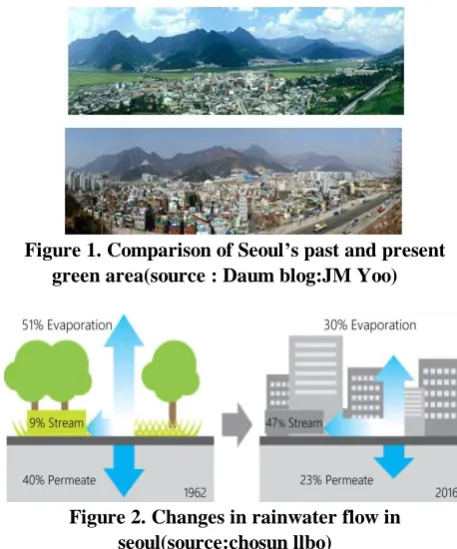
[image:1.595.314.543.343.618.2][Figure 1] shows the past and present of the Republic of Korea. In the past, there were a lot of green areas, but now the green areas have decreased a lot due to urban development. This changed the flow of rainwater in Seoul, Korea. In 1962, 40% of rainwater was introduced into the ground, but in 2016 23% of the rainwater flowed into the ground [4]. [Figure 2] is a schematic diagram of rainwater flow change. Water on the road surface causes traffic accidents and urban floods. In addition, rainwater is temporarily flowing into the river or sea through the sewer system. As a result, the amount of rainwater that has flowed into the groundwater in urban areas is reduced, leading to desertification in urban areas[5,6].
Figure 1. Comparison of Seoul’s past and present green area(source : Daum blog:JM Yoo)
Figure 2. Changes in rainwater flow in seoul(source:chosun llbo)
In order to solve these problems, the ROK proposed a plan to create a 'water cycle city'. Water permeable blocks are installed to improve water circulation. However, existing permeable blocks lose their permeability due to pore clogging due to foreign matter. Also, there is a phenomenon of destruction or dropout due to differential settlement, resulting in inconvenience and accidents[7].
Properties of Permeable Block using Aggregate
Grading and Artificial Permeable Tube
The permeable block is different from the past pavement method, which uses impermeable pavemen as the basic design concept. Permeable block is installed to induce water infiltration through the pores of the block and to introduce the rainwater into the groundwater[8]. However, pitcher blocks are mostly packaged in places such as sidewalks, bicycle lanes, parks, and plazas. After a certain period of time, the pitcher's block will lose its function due to pollution and various foreign substances in the air[2,9].
Some foreign matter on the surface can be regenerated through cleaning and cleaning. However, there is a disadvantage of replacing the Permeable block because there is no way to remove foreign matter if foreign matter accumulates inside the Permeable block product. As the replacement period of the Permeable block is shortened, it is pointed out that traffic interference and economical efficiency are problems. Korea has been developing and researching many products in order to solve these problems, but it is not enough to overcome the shortcomings[10]. In this study, an artificial permeable tube(APT) was used as artificial light-weight aggregate(ALA) concept to improve permeability of permeable block. The permeable block is divided into an upper layer and a lower layer. In the lower layer, aggregate having a large particle size is used to obtain a large permeability. The aggregate of the upper layer is to make a pitcher block according to the grain size to control the permeability and strength. Experiments were carried out for the properties according to the APT and upper aggregate grading by fabricating a permeable block according to the upper aggregate grading.
II. EXPERIMENTAL PLAN
The upper layer of aggregate penetration was compared with A_aggregate(2 mm or less)and B_aggregate(3-5mm or less). Experiments were conducted according to the addition rate. The permeability block was fabricated and the physical properties were analyzed.
In this study, it is experiment to compare the properties according to the aggregate grading of the permeable block and analyze the properties according to the addition rate of APT. The bottom layer of the permeable block was made of 5 ~ 8 mm of aggregate. To improve the permeability, artificial permeable tube made of plastic with spiral groove was prepared and mixed like artificial aggregate to form a lower layer. The addition ratio of APT is 0, 1, 2, 3, 4, 5 (%).
[image:2.595.305.555.49.197.2]In order to analyze the strength according to the upper layer aggregate grading, the experiment was conducted using A_aggregate and B_aggregate. The specimens were manufactured to meet the criteria of KS F 4419, and the flexural strength, density, water absorption, porosity and permeability coefficient were measured at 28 days. The experimental plan is shown in [Table 1].
Table 1: Experimental plan
Experimental factor Experimental level
Binder Cement 1
W/B 35 (wt.%) 1
Artificial permeable
tube addition ratio 0, 1, 2, 3, 4, 5 (wt.%) 6 Upper later
aggregate grading A(1~2㎜), B(3~5㎜) 2
Curing conditions Relative humidity 80±5%,
Temperature 20±2℃ 2
Test items
Density, Water absorption, Porosity, Coefficient of
permeability, Flexural strength
5
III. MATH
If you are using Word, use either the Microsoft Equation Editor or the MathType add-on (http://www.mathtype.com) for equations in your paper (Insert | Object | Create New | Microsoft Equation or MathType Equation). “Float over text” should not be selected.
IV. MATERIALS USED
A. Cement
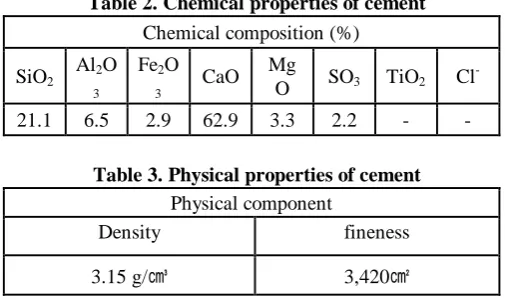
The cement used was one kind of ordinary portland cement of Korean products according to KS L 5201 standard.
[image:2.595.303.556.455.605.2]The density of cement is 3.15g/㎤ and the fineness is 3,420㎠ [1,11]. CaO accounts for 62.9% of the chemical composition of cement followed by SiO2 by 21.1%. In addition, there are chemical components such as Al2O3, Fe2O3, MgO, and SO3. [Table 2] shows the chemical composition of cement and [Table 3] shows the physical properties of cement.
Table 2. Chemical properties of cement
Chemical composition (%)
SiO2 Al2O
3
Fe2O
3 CaO
Mg
O SO3 TiO2 Cl
-21.1 6.5 2.9 62.9 3.3 2.2 - -
Table 3. Physical properties of cement
Physical component
Density fineness
3.15 g/㎤ 3,420㎠
B. Arificial permeable tube(APT)
[Table 4] show the properties of APT. APT has a low
International Journal of Innovative Technology and Exploring Engineering (IJITEE) ISSN: 2278-3075, Volume-8 Issue-8S2, June 2019
Table 4. Properties of Artificial permeable tube(APT)
Artificial permeable tube(APT )
Density Water
absorption Size Texture Shape
1.5 g/ ㎤ 0 % 20 mm Plastic Spiral
cylinder
C. Aggregate
[image:3.595.57.299.245.421.2][Figure 4] is a photograph of permeable block according to the aggregate particle size. The upper layer was composed of A aggregate and B aggregate and the lower layer was composed of 8 ~ 10 mm aggregate. The aggregate used was crushed stone.
Figure 3. Arificial permeable tube
A_aggregate(1~2㎜) B_aggregate(1~2㎜) C_aggregate(1~2
㎜)
Figure 4. Photo of each aggregate
[image:3.595.318.544.278.543.2]V. CROSS SECTION OF SPECIMEN
[image:3.595.56.276.614.664.2][Figure 5] is a cross-section photograph of the specimen. The permeable block is divided into an upper layer and a lower layer. The upper layers were compared using an aggregate grading 1 ~ 2 and 3 ~ 5 mm. The lower layer used 8 ~ 10mm aggregate of crushed stone. Also, it is expected that the porosity is increased and the coefficient of permeability is increased due to the permeable tube penetrating through using APT as artificial aggregate.
Figure 5. Cross section of specimen
VI. RESULTS AND ANALYSIS
A. Density
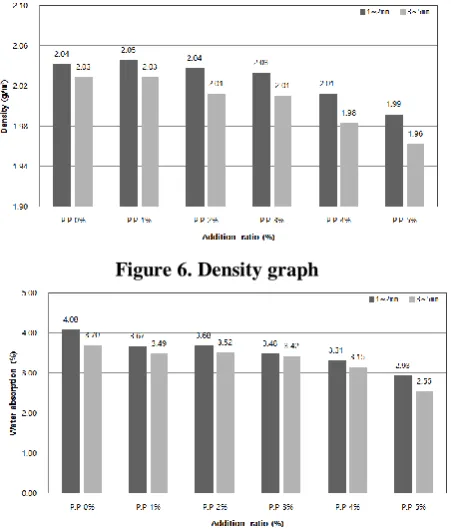
[Figure 6] is a graph of the density of the upper aggregate grading and the APT addition rate. As the size of the upper layer aggregate increases, the density tends to decrease. The larger the aggregate size, the more pores are formed and the
density decreases. As the addition rate of APT increases, the density tends to decrease. It is considered that the density of the matrix decreases as the addition rate of the APT increases because the APT is less dense than the aggregate.
B. Water absorption
[Figure 7] is a graph showing water absorption. The larger the aggregate particle size, the smaller the absorption rate tends to decrease. As the size of the aggregate increases, the amount of aggregate used decreases, and the water absorption is also reduced[11]. Also, as the addition rate of the permeable tube increases, the absorption rate tends to decrease. It is considered that the APT is made of plastic material which does not absorb water, and the water absorption is decreased because APT with a lot of pores replaces aggregate.
Figure 6. Density graph
Figure 7. Water absorption graph C. Porosity
[Figure 8] is a graph showing porosity. The larger the grading of the aggregate, the greater the porosity tends to increase. As the grading of the aggregate increases, pores are formed between the aggregates of the matrix.
Figure 8. Porosity graph D. Coefficient of permeability
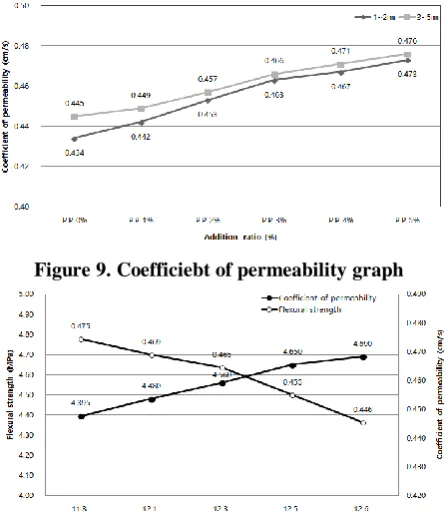
[Figure 9] is a graph showing coefficient of permeability. The larger the aggregation grading, the higher the coefficient of permeability. The coefficient of permeability tends to increase as the addition rate of the permeable tube increases. The porosity and the coefficient of permeability are analyzed to have a proportional relationship[11]. [Figure 10] shows the relationship between porosity, coefficient of permeability and flexural strength. The strength tends to decrease as the porosity increases, and the coefficient of permeability tends to increase with increasing porosity [12]. According to Korea KS F 4419, the permeability coefficient of the permeable
[image:4.595.315.540.116.237.2]block is 0.1㎝/s. The values derived from this experiment were analyzed to satisfy this criterion.
Figure 9. Coefficiebt of permeability graph
Figure 10. Proporional relationship of properties
[image:4.595.59.283.390.650.2]E. Flexural strength
[Figure 11] is a graph showing flexural strength. Flexural strength was measured after 28 days aging. The larger the aggregate, the higher the strength. It is considered that the strength of the matrix increases as the bonding surface of the binder and aggregate increases. As the addition rate of APT increases, the intensity decreases. This is because the surface
of the APT is smooth and the strength is decreased due to lack of binder and cementing power[13]. APT is replaced with aggregate and the strength is decreased and further study is needed to increase the cementing power of APT and binder.
Figure 11. Flexural strength graph
VII. CONCLUSION
The larger the grading of the upper layer aggregate, the smaller the amount of aggregate used in the permeable block. As the weight of the permeable block decreases, the density decreases and the absorption rate decreases. The larger the aggregation grade, the more pore will be created inside the permeability block, resulting in higher porosity and a higher permeability coefficient. Also, the bending strength increases as the amount of joint between aggregate and binder increases. As the addition ratio of artificial permeable tube increases, the amount of artificial permeable tube increases in the permeable block. Because the density of the artificial permeable tube is lower than that of the aggregate, the density and water absorption of the permeable block are reduced. Due to the spiral groove of the permeate tube, the porosity is increased and the porosity is increased and the coefficient of permeability is increased. However, due to the smooth surface of the permeable tube, the cementing power decreases and the flexural strength tends to decrease.
Utilizing the artificial permeable tube, you can control the performance of the Permeability to the field. If you use waste plastics as a artificial permeable tube material, it will be improved in terms of environment.
REFERENCES
1. Lee SS, Yoo BY, Lee WG, ” Properties of Polymer Addition Ratio for Efflorescence Reduction in Permeable Blocks,” International Journal of Engineering&Technology, 2018 Oct;7(3.24). pp.623-626.
2. Jun SM, Park JH, and Kim YD, “Quantitative Analysis of the Permeability of Water Permeable block,” The Korean Society of Civil Engineers, 2012 Oct; 38(1). pp.224-227. Available: http://www.dbpia.co.kr/Article/NODE02300291
3. Lee YS, Joo MK, and Yeon KS, “Development of Water-Permeable Polymer Concrete for Pavement,” Korea Concrete Institute. 2001 Nov. pp. 147-152. Available: http://www.dbpia.co.kr/Article/NODE02305104. 4. Lee WC, Kim SB, “Seoul Metropolitan City Rainwater Management Basic
Plan: Guideline,” 2013. p.10.
International Journal of Innovative Technology and Exploring Engineering (IJITEE) ISSN: 2278-3075, Volume-8 Issue-8S2, June 2019 6. Ban SS, “Anexperiment al study on the perme ability and eng ineering
propertie sofporou sconcrete” [master’s thesis], Korea: Chungnam National University; 2000. p.72.
7. Yoo BY, “Performance Evaluation of Polymer Block using Artificial Permeable Pipe,” [master’s thesis]. Korea: Hanbat National University; 2018. p.69.
8. Park DG, Jung WK, Jeong DW, and Lee JW, “Evaluation of Field Permeability and Material Characteristics of Permeable Block for Roadway Pavement,” Ecology and Resilient Infrastructure, 2016; 3(2):, pp.110-116. Available: http://dx.doi.org/10.17820/eri.2016.3.2.110. 9. Yoo SA. “A study on the development of the environment-friendly paving
block; Focused on low-toxicity paving materials development “ [master’s thesis], Korea: Hanyang University; 2009. p.79.
10.Park DG, Jung WK, Jeong DW, Baek JE, and Lee JW, “Evaluation of Field Permeability and Material Characteristics of Permeable Block for Roadway Pavement,” Ecology and Resilient Infrastructure, 2016 Jun, 3(2): pp.110-116. Available:
http://www.dbpia.co.kr/Article/NODE07223333
11.Choi JJ, Choi DS. “Influence of the Types and Grading of Aggregate on the Properties of Porous,” Concrete. Journal of the Korean society of civil engineers, 2007 May; 27(3A). pp.393-400. Abailable: http://www.dbpia.co.kr/Article/NODE01225550
12.Park DG, “Development of a Test Method to Evaluate the Permeability on Permeable Block Pavement” [Doctoral’s thesis], Korea: Chung-ang University; 2014. p.171.
13.Lee SS, Lee WG, and Jo ES. “Properties of Permeable Block According to Replacement ratio of Fly ash,” International Journal of Engineering&Technology, 2018 Oct, 7(3.24). pp.375-378.
AUTHORS PROFILE
First Author Eun-Seok, Cho, The Doctor’s course, Department of Architectural Engineering, Hanbat National University, Daejeon, Korea
Second Author Won-Gyu, Lee The master’s course, . Department of Architectural Engineering, Hanbat National University, Daejeon, Korea
Third Author Byeong-Yong, Yoo Master,
Department of Architectural Engineering, Hanbat National University, Daejeon, Chief Executive Officer, SAMI C&G Corporation, Gongju, Korea
Fourth Author Sang-Soo, Lee, Professor,