International Journal of Innovative Technology and Exploring Engineering (IJITEE) ISSN: 2278-3075, Volume-8 Issue-8S3, June 2019
Abstract: A discrete time sliding mode controller (DSMC) is proposed for higher solicitation not withstanding defer time (HOPDT) frames. As portion of structure states and botch, a sliding mode surface is selected and the tuning parameters of the sliding mode controller are resolved using overpowering post circumstance scheme. The control object for "ball in a barrel" is to handle the velocity of a fan blowing air into a chamber to keep a ball suspended in the barrel at a certain predestined position. The DSMC isT attemptedT toT coordinateT theT ball'sT positionT
subsequently.T ButT skillfullyT clear,T thisT isT aT troublesomeT
controlT issueT dueT toT theT non-directT ramificationsT forT theT
ballT andT theT confoundingT materialT scienceT regulatingT itsT
lead.T TheT DSMCT isT attemptedT toT coordinateT theT ball'sT
positionT subsequently.T ButT skillfullyT clear,T thisT isT aT
troublesomeT controlT issueT dueT toT theT non-directT
ramificationsT forT theT ballT andT theT confoundingT materialT
scienceT regulatingT itsT lead.T TheT generationT andT
experimentationT resultsT exhibitT thatT theT proposedT
methodologyT ensuresT neededT afterT components.T TheT
flawlessnessT ofT currentT proposedT frameworkT isT itT stipendsT
followingT ofT advancementT continuouslyT setT point.T ThisT
deviceT toT likelyT investigateT aT standard PID controller and
DSMC controller. The results indicate notable separations in controllers ' implementation characteristics.
Index Terms: PID controller, SMC, DSMC, HOPDT
I. INTRODUCTION
ForT greaterT requests,T aT discreteT timeT slidingT modeT
controllerT (DSMC)T isT suggestedT forT non-resistantT deferT
timeT framesT (HOPDT).T AsT portionT ofT structureT statesT andT
botch,T aT slidingT modeT surfaceT isT selectedT andT theT tuningT
parametersT ofT theT slidingT modeT controllerT areT resolvedT
usingT overpoweringT postT circumstanceT scheme.T TheT
controlT objectT forT "ballT inT aT barrel"T isT toT handleT theT
velocityT ofT aT fanT blowingT airT intoT aT chamberT toT keepT aT
ballT suspendedT inT theT barrelT atT aT certainT predestinedT
position.T TheT DSMCT isT attemptedT toT coordinateT theT ball'sT
positionT subsequently.T ButT skillfullyT clear,T becauseT ofT theT
non-directT ramificationsT forT theT ballT andT theT confusingT
materialT scienceT thatT regulatesT itsT lead,T thisT isT aT
troublesomeT controlT issue.T Additionally,T theT ballT isT
Revised Manuscript Received on May 23 , 2019.
Bharatkumar Shamrao Patil Department of instrumentation, AISSMS Polytechnic, Maharashtra, INDIA
Dr. Laxman M. Waghmare Department of instrumentation SGGS, IOT, Nanded, INDIA
Dr. M. D. Uplane Prof. Instrumentation Science Department, SP Pune, University Pune, INDIA
incrediblyT sensitiveT toT anyT externalT aggravationsT fromT
theT fan.T TakenT together,T itT isT difficultT toT beT compelledT byT
theT standardT science,T andT notT reallyT gotT inT duplicatedT orT
numericalT connectionsT ofT controlT counts.T TheT resultsT ofT
theT generationT andT experimentationT showT thatT theT
methodologyT proposedT ensuresT thatT componentsT areT
needed.T TheT flawlessnessT ofT theT presentT proposedT
structureT isT thatT itT stipendsT onT theT continuousT setT pointT
ofT progress.T ThisT unitT isT likelyT toT exploreT aT conventionalT
controllerT forT PIDT andT DSMC.T TheT resultsT indicateT
notableT separationsT inT controllersT 'T implementationT
characteristics.T
II. METHODOLOGY
Control action depends on the second legislation of movement of Newton. Newton's second movement law is more quantitative and is widely used to calculate what occurs in circumstances involving a force.
Figure1. Block diagram of proposed system
Law of Force and Acceleration states that, according to the formula net force = mass x acceleration, a force on an object
causes it to accelerate. Thus the object's acceleration is directly proportional to the force and inverse to the mass.
a= acceleration of the object, which is velocity change per
time i.e.
= net force on the object, SI unit is mass times
acceleration, = Newton, NT
m = mass of the object
It has what we call acceleration when an object changes its velocity. Newton's second movement law offers an explanation for object conduct when applying forces. The legislation says that internal
forces cause objects to
accelerate, and the quantity
of speed is directly
Bharat Kumar Shamrao Patil, Laxman M. Waghmare, M. D. Uplane
Implementation of SMC Control Action with Pi
Sliding Surface for Non Linear Plant Along with
proportional to the objects ' net power and inversely proportional to the objects ' mass. Notice that Newton's second law states that the amount of acceleration is directly proportional to the net force acting on the object. What is the net force and how do we calculate it? Net force is the sum of all forces acting on an object in a particular direction. Because forces have direction, they are quantities of vectors. With both magnitude and direction, the vector quantities are fully defined and represented with arrows. Consider an object being pushed to the left with 10 Newtons of force and to the right with 5 Newtons of force. The net force = 5 N to the left as 10 N - 5 N = 5 N. The forces are subtracted from each other since they are pointing in opposite directions. If they pointed in the same direction, the forces would be added to each other. Once the net force is determined, it is possible to determine the object acceleration.
Acceleration: When the velocity of an object changes it is
said to be accelerating. Acceleration is the rate of change of
velocity with time. Any change in the velocity of an object results in an acceleration: increasing speed (what people usually mean when they say acceleration), decreasing speed (also called deceleration or retardation), or changing direction (called centripetal acceleration).
AverageT accelerationT isT determinedT overT aT "long"T timeT
interval.T TheT wordT longT inT thisT contextT meansT finiteT —T
somethingT withT aT beginningT andT anT end.T TheT velocityT atT
theT beginningT ofT thisT intervalT isT calledT theT initialT
velocity,T representedT byT theT symbolT v0T (veeT nought),T andT
theT velocityT atT theT endT isT calledT theT finalT velocity,T
representedT byT theT symbolT vT (vee).T AverageT accelerationT
isT aT quantityT calculatedT fromT twoT velocityT measurements.
InT contrast,T instantaneousT accelerationT isT measuredT overT
aT "short"T timeT interval.T TheT wordT shortT inT thisT contextT
meansT infinitelyT smallT orT infinitesimalT —T havingT noT
durationT orT extentT whatsoever.T ItT isT anT idealT ofT
mathematicsT thatT canT beT realizedT onlyT asT aT limit.T TheT
limitT ofT aT rateT isT calledT aT derivativeT asT theT denominatorT
approachesT zero.T InstantaneousT accelerationT isT thenT theT
limitT ofT averageT accelerationT asT theT timeT intervalT
approachesT zeroT —T orT alternatively,T accelerationT isT theT
derivativeT ofT velocity.
Acceleration is the derivative of time-speed, but velocity itself is the derivative of time-speed displacement. The derivative is a mathematical operation that can be applied to a pair of different quantities multiple times. Once you do it, you get a first derivative. Doing it twice (a derivative) provides you a second derivative. This makes speed the first
speed derivative with moment and the second displacement
derivative with time.
Vectors are written in boldface in formal mathematical writing. In italics, scalars and vector magnitudes are written. Numbers, measurements, and units are written in roman (not italic, not bold, not oblique — ordinary text). For example
Another frequently used unit is the acceleration due to gravity — g. Since we are all familiar with the effects of gravity on ourselves and the objects around us it makes for a convenient standard for comparing accelerations. Everything feels normal at 1 g, twice as heavy at 2 g, and weightless at 0 g. This unit has a precisely defined value of 9.80665 m/s2, but for everyday use 9.8 m/s2 is sufficient, and 10 m/s2 is convenient for quick estimates.
The unit called acceleration due to gravity (represented by a roman g) is not the same as the natural phenomena called acceleration due to gravity (represented by an italic g). The former has a defined value whereas the latter has to be measured.
Force:T AT ‗Force‘T isT aT vectorT quantityT thatT canT beT
describedT asT aT pushT orT pullT onT anT objectT resultingT fromT
theT object‘sT interactionT withT anotherT object.T WheneverT
thereT isT anT interactionT betweenT twoT objects,T theT objectsT
experienceT anT equalT andT opposingT forceT onT eachT other.T
InT otherT words,T bothT theT objectsT ‗exertT force‘T onT eachT
other.T ForceT onlyT existsT asT aT resultT ofT anT interaction.T IfT
thereT isT noT interaction,T theT objectsT noT longerT experienceT
theT force.T ForceT isT measuredT inT unitsT calledT NewtonsT (N).
Block diagram of proposed system is shown in fig 1 and described as follows:
Control action
ControlT actionT isT dependingT onT Newton‘sT 2ndT lawT ofT
motion.T ForceT actingT onT anT objectT causesT theT objectT toT
changeT itsT shapeT orT size,T toT startT moving,T toT stopT
moving,T toT accelerateT orT decelerate.T WhenT there‘sT theT
interactionT betweenT twoT objectsT theyT exertT aT forceT onT
eachT other,T theseT exertedT forcesT areT equalT inT sizeT butT
oppositeT inT direction.T WhenT anT objectT hasT severalT forcesT
actingT onT it,T theT effectsT ofT forceT isT sameT asT oneT forceT
actingT onT theT objectT inT aT certainT directionT andT thisT
overallT forceT isT calledT theT ‗resultantT force‘.T TheT resultantT
forceT isT essentialT toT changeT theT velocityT ofT anT object.T
International Journal of Innovative Technology and Exploring Engineering (IJITEE) ISSN: 2278-3075, Volume-8 Issue-8S3, June 2019
So to keep the height of ball constant, we need to change ‗N‘ such that force exerted on ball will keep the height same. To keep the ball at particular height we have to keep monitoring it and accordingly we have to adjust the volumetric flow of air.
III. SIMULATION RESULTS
Using PID and SMC control activity, reenactment results are tested. Similar computations are tried on the trial setup after reproduction with some handy preliminaries. The findings of recreation are as follows.
Figure2. Simulation Results using PID control action
[image:3.595.64.271.645.751.2]Figure3. Simulation Results using SMC control action
Figure 1 shows the simulation result of PID control action. While figure 2 reflects that of SMC control action. It gives the full idea of how SMC control action with PI sliding mode results better with suppressed damping and oscillations. Moreover, figure 3 gives idea about how tuning of SMC results in better accuracy.
Figure4. Control signal of sliding mode control for different tuning parameter strategies
IV. EXPERIMENTAL IMPLEMENTATION
TheT exploratoryT systemT includesT aT 1T mT longT straightT
acrylicT tubeT withT aT 45T mmT longT distance.T AsT shownT inT
FigureT 3,T theT breezeT currentT inT theT barrelT isT forcedT byT aT
DCT fanT attachedT toT theT baseT endT ofT theT weightT bind.T
UltrasonicT sensorT isT mountedT onT theT mostT elevatedT
purposeT ofT theT chamberT soT itT canT checkT theT ball'sT
position.T
UltrasonicT sensorsT emanateT aT 8T cycleT burstT ofT ultrasonicT
soundT atT 40T kHz.T TheseT spreadT noticeableT allT aroundT atT
theT speedT ofT sound.T OnT theT offT chanceT thatT theyT strikeT aT
ball-in-tube,T atT thatT pointT theyT areT reflectedT backT asT
reverberationT signsT toT theT sensor,T whichT itselfT registersT
theT separationT toT theT objectiveT dependentT onT theT
time-lengthT betweenT producingT theT flagT andT acceptingT
theT reverberation
Figure5. actual hardware
Distance = {time-span between emitting the signal and receiving the echo} x velocity of sound / 2.
TheT DCT blowerT isT usedT toT supplyT theT airT inT theT
cylinderT thatT isT supposedT toT liftT theT ball.T TheT windT
currentT suppliedT toT liftT aT ballT isT relativeT toT theT
fan-connectedT voltage,T whichT correspondsT toT theT
PWMT signal'sT dutyT cycle.T ForcesT appliedT onT theT ballT
areT illustratedT inT figureT 6.T TheT upwardT appliedT forceT
fromT theT blowerT actingT onT ball-in-tube,T F=T -T mgT andT
downwardT forceT exertedT onT ball,T FT =T mg,T whereT 'm'T
isT massT (hereT 2.7T gramT isT theT massT ofT ball)T andT 'g'T
Figure6. Forces acting on ball in cylinder
For tracking of set point on experimental setup PID and SMC control action is used. It gives good tracking results. For both control actions set point is set as 60cm. Results are as shown in figure below.
Figure7. PID control action results on experimental setup
Figure8. SMC control action results on experimental
setup
ExperimentalT configurationT resultsT showT thatT SMCT
controlT actionT providesT outstandingT precisionT andT
stability.T ForT nonlinearT andT robustT plant,T itT isT theT bestT
choice.T itT isT clearT thatT theT controllerT actionsT givenT byT
proposedT SMCT withT PIT slidingT surfaceT isT smoothT butT PIDT
hasT moreT chattering.T OnT theT sameT setup,T whenT PIDT
fuzzyT actionT isT testedT asT proposedT byT OuyangT ZiweiT etT
al.T theT resultantT responseT isT illustratedT inT figureT 9.
Figure9. Comparison on setup between proposed algorithm and Ouyang Ziwei
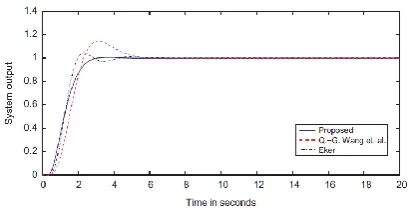
It clearly indicates that the results tested by using the Ouyang Ziwei et al. give more oscillations along with peak overshoot.
Table1. Comparison of controllers' performance
Fuzzy PID (Ouyang Ziwei et. al.)
Proposed SMC
with PI sliding surface
Rise time (sec)
1.06 0.9698
Settling time (sec)
5.496 3.15
Overshoot (%) 46.667 22.0339
The beauty of the proposed system is it gives the best results even for the changing set point system. It also with quick response than PID control action. The set point is set as 60 and then after some time the set point is changes to 70. Result of the same is shown in following figure.
International Journal of Innovative Technology and Exploring Engineering (IJITEE) ISSN: 2278-3075, Volume-8 Issue-8S3, June 2019
Figure11. Comparison between Simulation Results and Experimental Results
In most of the cases open loop response of the system comes out to be oscillatory. The reduced order model gains;
Figure12.Nyquist plot
TheT responseT ofT continuousT timeT transferT functionT whichT
isT plottedT inT figureT 12.T TheT plotT drawnT inT blueT colourT
representsT NyquistT plotT ofT originalT systemT whereasT plotT
drawnT inT redT colourT representsT NyquistT plotT ofT proposedT
system.
Figure13. Simulation result
FigT 12T showsT stepT responseT ofT originalT andT reduceT orderT
system.T SimulationT resultsT showsT thatT setT pointT isT
responsibleT forT changingT characteristicsT ofT outputT asT oneT
canT seeT asT setT pointT changesT outputT waveformT
simultaneouslyT changes.T ItT resultsT inT smoothT andT quickT
results.
V. CONCLUSION
InT relationT toT momentT defermentT formsT byT predominantT
post-arrangementT strategy,T SMCT controlT activityT withT PIT
slidingT surfaceT isT suggestedT forT set-pointT followingT
greaterT demand.T OverpoweringT postsT areT acquiredT by,T forT
example,T settlingT timeT andT apexT overshootingT fromT theT
idealT closedT hoverT decisions.T TheT arrangementT methodT isT
obviouslyT essentialT becauseT itT includesT aT singleT tuningT
parameter.T TheT proposedT methodologyT hasT noT restrictionsT
inT regardsT toT changingT setT point,T frameworkT request,T
timeT deferral,T coordinatingT andT oscillatoryT conduct,T openT
circleT vibrationT orT non-leastT stageT framework.T TheT
findingsT ofT theT testingT demonstrateT theT materialityT ofT theT
ongoingT applicationT method.T TheT movementT ofT theT
controllerT byT theT proposedT procedureT thumpsT lessT andT theT
expulsionT ofT theT disruptiveT effectsT isT betterT whenT itT
standsT outT fromT theT controllerT ofT theT PID.T TheT tradingT
controlT lawT isT keptT inT theT proposedT techniqueT littleT toT
diminishT motionsT thatT haveT anT offT exchangeT withT theT
strength.
REFERENCES
1. Levant,T Higher-orderT slidingT modes,T differentiationT andT
output-feedbackT control,T InternationalT JournalT ofT ControlT 76T (9/10)T
(2003)T 924–941.
2. Levant,T SlidingT orderT andT slidingT accuracyT inT slidingT modeT
control,T InternationalT JournalT ofT ControlT 58T (6)T (1993)T 1247–1263.
3. Edwards,T S.T Spurgeon,T SlidingT ModeT Control:T TheoryT andT
Applications,T CRCT Press,T BocaT Raton,T FL,T 1998.
4. Levant,T UniversalT single-input-single-outputT sliding-modeT controllersT
withT finite-timeT convergence,T IEEET TransactionsT onT AutomaticT
ControlT 46T (9)T (2001).J.S.T Orr,T Y.B.T ShtesselT /T JournalT ofT theT
FranklinT InstituteT 349T (2012)T 476–492.
5. Klumpp,T ApolloT LunarT DescentT Guidance,T NASAT R-695,T 1971.
6. F.T Bennett,T ApolloT ExperienceT Report—MissionT PlanningT ForT
LunarT ModuleT DescentT andT Ascent,T NASAT TNT D-6846,T 1972.
7. F.T Dodge,T H.T AbramsonT (Eds.),T AnalyticalT RepresentationT ofT
LateralT SloshingT byT EquivalentT MechanicalT Models,T TheT DynamicT
BehaviorT ofT LiquidsT inT MovingT Containers,T NASAT SP-106,T 1966,T
pp.T 199–223.
8. W.T Widnall,T LunarT ModuleT DigitalT Autopilot,T JournalT ofT
SpacecraftT 8T (1)T (1971)T 56–62.
9. E.T Kubiak,T PhaseT PlaneT LogicT DesignT Principles,T NASAT
MemorandumT EH2-86M-149,T MayT 1986.
10. Hall,T Y.T Shtessel,T SlidingT modeT observer-basedT controlT forT aT
reusableT launchT vehicle,T JournalT ofT Guidance,T Control,T andT
DynamicsT 29T (6)T (2006)T 1315–1328.
11. J.T Orr,T Y.T Shtessel,T RobustT controlT ofT lunarT spacecraftT poweredT
descentT usingT aT second-orderT slidingT modeT technique,T in:T
ProceedingsT ofT theT 2008T AIAAT Guidance,T Navigation,T andT
ControlT Conference,T Honolulu,T HI.
12. H.T Khalil,T in:T NonlinearT Systems,T thirdT ed,T Prentice-Hall,T UpperT
SaddleT River,T NJ,T 2002.
13. Y.T Shtessel,T J.T Moreno,T F.T Plestan,T L.T Fridman,T A.T Poznyak,T
Super-twistingT adaptiveT slidingT modeT control:T aT LyapunovT design,T
in:T ProceedingsT ofT theT ConferenceT onT DecisionT andT Control,T
Atlanta,T GA,T December,T 2010.
14. F.T Plestan,T Y.T Shtessel,T V.T Bregeault,T A.T Poznyak,T NewT
methodologiesT forT adaptiveT slidingT modeT control,T InternationalT
JournalT ofT ControlT 83T (9)T (2010)T 1907–1919.
15. J.T Orr,T Y.T Shtessel,T RobustT lunarT spacecraftT autopilotT designT usingT
high-orderT slidingT modeT control,T in:T ProceedingsT ofT theT 2009T
AIAAT Guidance,T Navigation,T andT ControlT Conference,T Chicago,T IL.
16. OuyangZiweiT ,Schnell.MichaelT andT WeiT KexinT ―TheT ExperimentT
"Ball-in-tube"T withT Fuzzy-PIDT ControllerT BasedT onT Dspace‖T 2007T