Ames Laboratory Publications
Ames Laboratory
4-2002
Quantitative Depth Profiling Using
Saturation-Equalized Photoacoustic Spectra
Roger W. Jones
Iowa State University, [email protected]
John F. McClelland
Iowa State University, [email protected]
Follow this and additional works at:
http://lib.dr.iastate.edu/ameslab_pubs
Part of the
Acoustics, Dynamics, and Controls Commons
, and the
Biochemistry, Biophysics, and
Structural Biology Commons
The complete bibliographic information for this item can be found at
http://lib.dr.iastate.edu/
ameslab_pubs/227
. For information on how to cite this item, please visit
http://lib.dr.iastate.edu/
howtocite.html
.
Quantitative Depth Profiling Using Saturation-Equalized Photoacoustic
Spectra
Abstract
Depth profiling using photoacoustic spectra taken at multiple scanning speeds or modulation frequencies is
normally impaired by the increase in spectral saturation that occurs with decreasing speed or frequency.
Photothermal depth profiling in general is also impeded by the ill conditioned nature of the mathematical
problem of determining a depth profile from photothermal data. This paper describes a method for reducing
the saturation level in low-speed or low-frequency spectra to the level at high speed or frequency so that all
spectra have the same saturation. The conversion method requires only magnitude spectra, so it is applicable
to both conventional and phase-modulation photoacoustic spectra. This paper also demonstrates a method
for quantitative depth profiling with these converted spectra that makes use of prior knowledge about the type
of profile existing in a sample to reduce the instabilities associated with the mathematically ill conditioned
task.
Keywords
Biochemistry Biophysics and Molecular Biology, Mechanical Engineering, depth profiling, PAS,
photoacoustic spectroscopy, spectrum saturation
Disciplines
Acoustics, Dynamics, and Controls | Biochemistry, Biophysics, and Structural Biology | Mechanical
Engineering
Comments
This paper was published in
Applied Spectroscopy
56 (2002): 409 and is made available as an electronic reprint
with the permission of OSA. The paper can be found at the following URL on the OSA website: doi:
10.1366/
0003702021954926
.
Rights
Systematic or multiple reproduction or distribution to multiple locations via electronic or other means is
prohibited and is subject to penalties under law.
Volume 56, Number 4, 2002 0003-7028 / 02 / 5604-0409$2.00 / 0 APPLIED SPECTROSCOPY 409
q2002 Society for Applied Spectroscop y
accelerated paper
Quantitative Depth Pro ling Using Saturation-Equalized
Photoacoustic Spectra
ROGER W. JONES
*
and JOHN F. M
CCLELLAND
Ames Laboratory, U.S. Department of Energy, Iowa State University, Ames, Iowa 50011 (R.W.J., J.F.M.); and MTEC Photoacoustics, Inc., Ames, Iowa 50014 (J.F.M.)
Depth pro ling using photoacoustic spectra taken at multiple scan-ning speeds or modulation frequencies is normally impaired by the increase in spectral saturation that occurs with decreasing speed or frequency. Photothermal depth pro ling in general is also impeded by the ill conditioned nature of the mathematical problem of deter-mining a depth pro le from photothermal data. This paper de-scribes a method for reducing the saturation level in low-speed or low-frequency spectra to the level at high speed or frequency so that all spectra have the same saturation. The conversion method requires only magnitude spectra, so it is applicable to both conven-tional and phase-modulation photoacoustic spectra. This paper also demonstrates a method for quantitative depth pro ling with these converted spectra that makes use of prior knowledge about the type of pro le existing in a sample to reduce the instabilities associated with the mathematically ill conditioned task.
Index Headings:Depth pro ling; Photoacoustic spectroscopy; PAS; Spectrum saturation.
NOTICE
This work was funded in part by the Iowa State Uni-versity of Science and Technology under Contract No. W-7405-ENG-82 with the U.S. Department of Energy. The United States Government retains and the publisher, by accepting the article for publication, acknowledges that the U.S. Government retains a non-exclusive, paid-up, irrevocable, world-wide license to publish or repro-duce the published form of this manuscript, or allow oth-ers to do so, for U.S. Government purposes.
INTRODUCTION
A nondestructive depth-pro ling probe for determining molecular composition is a highly desirable analysis tool, but there are few methods that provide one. Confocal spectroscopic microscopy can depth pro le visible struc-tures, but its depth resolution is approximately equal to its depth of eld.1 The resolution of Raman microscopy is also limited to its depth of eld.2 Variable-angle atten-uated total re ectance gives very good resolution, but its probe depth is limited to a few micrometers at most.3,4 Photothermal techniques have the virtue of a frequency
Received 19 October 2001; accepted 19 December 2001. * Author to whom correspondence should be sent.
dependent, and therefore adjustable, probe depth. Various photothermal techniques have been used for depth pro- ling, including the mirage effect,5–7 the photopyroelec-tric effect,8,9 and detecting the acoustic wave produced with a pulsed laser via the photoacoustic effect.10 –12 By far the most popular photothermal technique for depth pro ling, however, is Fourier transform infrared (FT-IR ) photoacoustic spectroscopy (PAS), in which the thermal wave is (indirectly) detected.
In PAS, intensity-modulated radiation is incident on a sample in a sealed chamber.13,14Heat deposited by sample absorption travels to the sample surface as a damped ther-mal wave. At the sample surface, the therther-mal wave heats the surrounding gas, modulating its pressure at the same frequency as the incident radiation. The pressure modu-lation is detected as sound by a microphone. Even before the widespread use of FT-IR spectrometers, PAS was used for depth pro ling by chopping the incident radia-tion and using phase-sensitive detecradia-tion. The phase of the signal depends on the average sample depth at which the incident radiation is absorbed, so for two-layer samples it is possible to select a phase roughly orthogonal to the signal from one layer, effectively isolating the spectrum of the other layer.15,16With the advent of the FT-IR spec-trometer, PAS depth pro ling became more common. The FT-IR spectrometer allows easy adjustment of the mod-ulation frequency over a wide range, giving the user con-trol over the PAS probe depth. Conventionally, the PAS probe depth is taken to be the thermal diffusion length, L, which is given by13,14
1/2 D
L 5
1 2
(1)pf
at the surface of a sample, so this has been used to gain depth information.22–24Unfortunately, conventional FT-IR PAS does not provide ready access to the phase of the photoacoustic signal. The introduction of the phase-mod-ulation FT-IR spectrometer,25 commonly called step-scan FT-IR, provided an easier method for determining phase. In addition, the same modulation frequency applies to the full spectrum in phase modulation, so the wavenumber dependence of the thermal diffusion length is removed.25 The capabilities of phase modulation led to several meth-ods of visualizing signal phase and using it to interpret the depth structure of samples.24,26Phase modulation has resulted in increased research on using PAS for depth pro ling.23,24,26–33Nevertheless, conventional depth pro l-ing by frequency variation remains the more popular ap-proach, both because of the higher cost of phase-modu-lation spectrometers and because of the more complicated data processing and interpretation of phase data.
For samples composed of discrete layers, layer thick-nesses can be quantitatively determined from phase dif-ferences if there is no overlap27,28 or very modest over-lap23,29 between peaks from different layers, and the the-ory for discretely layered samples is well understood.34 Except for this one use, almost all FT-IR PAS depth-pro ling results have been only qualitative in nature, identifying and ordering layers or detecting the presence of compositional gradients. Two impediments to FT-IR PAS depth pro ling account for this limitation—optical saturation and ill conditioning.
As in other forms of spectroscopy, the PAS signal is said to be saturated when it loses its dependence on the sample absorption coef cient, a, but saturation in PAS takes a somewhat different form from that in transmission spectroscopy. For homogeneous, thermally thick (L , sample thickness) samples, the photoacoustic signal is proportional to aL2, as long as L , 1/a, even if the sam-ple is opaque.13 Only when L . 1/a does the signal sat-urate; it becomes proportional to L but independent ofa. In depth pro ling, this means that when the modulation frequency is lowered to increase the thermal diffusion length, the amount of saturation in a spectrum increases as L approaches 1/a. Because a varies from one peak to the next, different peaks saturate at different points as the modulation frequency drops, which complicates even the qualitative interpretation of a set of spectra with differing modulation frequencies.14,18,19,30
The general problem of determining the depth pro le that gives rise to an observed set of photoacoustic mag-nitudes or phases (or both) based on those observations is, in mathematical terms, ill conditioned.35,36That means the solution (the depth pro le) is extremely sensitive to small errors in the initial data. Researchers have therefore
approached this problem either by using regularization techniques to stabilize the solution recovery,35,36 or by using intrinsically more stable approximate solutions.37
In this paper, we propose a solution to the saturation impediment that equalizes the degree of saturation in spectra with different thermal diffusion lengths, and we demonstrate a method that can circumvent the impedi-ment of ill conditioning in favorable cases by making use ofa prioriknowledge about the sample structure to limit the possible depth-pro le solutions. This paper describes a method for reducing the level of saturation in a low-scanning-speed or low-modulation-frequency spectrum to that in a high-speed or high-frequency spectrum. This makes the intuitive approach of comparing spectra with different probe depths to qualitatively determine depth pro les much easier. The method makes use solely of magnitude spectra, so it is applicable to both phase-mod-ulation and conventional FT-IR PAS spectra. It relies on having one peak in a spectrum whose scanning-speed (or frequency) dependence is like that of a peak arising from a homogeneous component. The change in magnitude of this peak between the low-speed spectrum and the high-speed spectrum is used as a guide for determining how much correction for saturation is needed in the low-speed spectrum to make it the saturation-level equivalent of the high-speed spectrum. Freed of saturation distortion, these high-speed-equivalent spectra are more readily useable in determining depth pro les. They still suffer from being formally ill conditioned for quantitative depth pro ling, as all photothermal data are, but we demonstrate in this paper an approach that uses them to produce good depth pro les under favorable conditions from both discretely layered samples and samples with components having continuously var ying concentrations. The approach makes use of a priori knowledge of what type of depth pro le a sample should have. With the type of pro le de ned, the photoacoustic data are then used to determine only the values of the parameters in the predetermined pro le function. This approach constrains the possible depth-pro le solutions and reduces the likelihood of er-roneous results.
THEORY
The goal is to reduce the photoacoustic saturation ob-served in a low scanning-speed (i.e., low modulation fre-quency) spectrum to the same level as a high scanning-speed spectrum so that the two spectra can be compared free of saturation differences. Equation 21 of Rosencwaig and Gersho13 is the formula forQ, the complex envelope of the sinusoidal pressure variation that constitutes the photoacoustic signal:
ssl 2 ssl 2 al
aI0gP0 (r 21)(b 11)e 2 (r 11)(b 21)e 1 2(b 2r)e
Q 5 3 /2 2 2
1
sl 2sl2
(2)s s
2 k l a Ts g g 0(a 2 ss) (g 1 1)(b 1 1)e 2 (g 21)(b 21)e
where a is the optical absorption coef cient, I0 is the incident light ux,g is the heat capacity ratio of the gas, P0 and T0 are the ambient pressure and temperature in
the photoacoustic cell,l is the sample thickness, lg is the
conduc-APPLIED SPECTROSCOPY 411
tivity,Ci is the heat capacity,ri is the density,Di 5 ki/riCi
is the thermal diffusivity, ai 5 1/Li 5 (pf/Di)1/2 is the
thermal diffusion coef cient, Li is the thermal diffusion
length, f is the modulation frequency, andsi5(11j)ai.
In addition,b 5kbab/(ksas),g 5kgag/(ksas), andr 5½(1
2 j)a/as.
For thermally and optically thick samples,ssl¾1 and
al¾1, so thee2 ssl and e2 al terms can be dropped, which
simpli es Eq. 2 to the following:
aI0gP0 r 2 1
Q 5 3 /2 2 2
1 2
(3)2 k l a Ts g g 0(a 2 ss) g 1 1
From the de nitions given above, it can be shown that ss 5 a/r. Substituting this for ss gives the following:
2 I0gP0r
Q 5 3 /2 (4)
2 k l a Ts g g 0a(r 11)(g 1 1)
Let the ratio of the high-speed spectrum to the low-speed spectrum at any given wavenumber be R. This equals the ratio of Q at the high-speed frequency andQ
at the low-speed frequency. The only quantities on the right side of Eq. 4 that depend on frequency are r and ag, so all of the other variables cancel out when
calcu-lating R:
2
r a (r 1 1)
Qh h gl l
R 5 5 2 (5)
Ql rlagh(rh 11)
where the land h subscripts refer to the two frequencies. If the frequencies of the data point at the low and high speeds are f and Nf, respectively, then rh 5 rl/N1/2 and
agh 5 aglN1/2. Equation 5 therefore simpli es to
rl 1 1
R5 1/2 (6)
N(rl 1N )
Unfortunately, r depends on both the absorption co-ef cient at each wavenumber and the thermal properties of the sample, so Eq. 6 by itself cannot be used to de-termine R from just the observed spectra. A substitute forr must be derived from the spectra. This can be done by scaling a spectrum according to how saturated it is; that is, by putting it on a scale of 0 to 1 where 1 is the completely saturated, maximum possible photoacoustic signal, which is the signal for an in nite absorption co-ef cient. The maximum possible signal,Qmax, can be de-rived from Eq. 4:
I0gP0r
Qmax5 lim Q 5 23 /2k l a T (7) a(g 1 1)
a®` s g g 0
The data points of the spectrum scaled from 0 to 1, Qsc, can then be calculated by ratioing Q and Qmax:
Q r
Qsc5 Q 5r (8)
1 1
max
Combining Eqs. 6 and 8 allows rl to be eliminated,
andRcan be written in terms ofQsc, orQsccan be written in terms of R:
1
R 5 3 /2 3 /2 (9)
N 1 Qsc(N2 N )
3 /2
N R 2 1
Qsc5 NR(N1/2 (10)
2 1)
where Qsc is the scaled version of the low-speed spec-trum. Equations 9 and 10 are valid for unnormalized pho-toacoustic spectra without any instrumental effects (e.g., the frequency-dependent throughput of a spectrometer). In practical terms, normalized spectra must be used so as to eliminate instrumental effects. Using normalized spec-tra changes R because of the frequency dependence of the photoacoustic signal from the normalization refer-ence. Assuming the reference-material signal has a mag-nitude with f21 dependence and a frequency-independent phase, as is expected for a good reference,13,38then R
n5
NR, where Rn is R for use with normalized spectra.
Equations 9 and 10 can then be rewritten for normalized spectra:
1
Rn 5 N1/2 1 Q (1 2 N1/2) (11) sc
1/2 N Rn 21
Qsc5 R (N1/2 (12)
21)
n
In the above equations,Rn andQscare vectors, having both magnitude and phase. Only the magnitudes of these vectors, Rn and Qsc, can be derived from ordinary mag-nitude spectra, so Eqs. 11 and 12 must be recast for the magnitudes:
1
Rn 5 [N 1/2 1/2 1/2 2 2 1/2 (13) 12N (12N )qr1(12N ) Qsc]
2 1/2 1/2
[NRn 2 2N r 1r 1]
Qsc5 R (N1/2 (14)
21)
n
where qr and rr are the real components of the vectors
Qsc and Rn, respectively. The real components can be
related to the magnitudes:
aL 1 1 2
qr 5 Qsc (15)
aL
1/2
(N 21)(aL 12) 2
r 5r
1
1 1 2 22
Rn (16)a L 1 2aL 1 2
The aL product can be written in terms of either Qsc or Rn,as needed:
2 2 1/2
Qsc 1Qsc(22 Qsc)
aL 5 2 (17)
1 2 Qsc
1/2 2 4 2 1/2 2 2 1/2
12N Rn2[2NRn12NRn22N Rn12Rn21]
aL 5 2
Rn 2 1
(18) Substituting Eqs. 15 and 17 into Eq. 13 allows Rn to be
determined from Qsc, while substituting Eqs. 16 and 18 into Eq. 14 gives Qsc from Rn. Figure 1 shows how Rn
FIG. 1. Relation between the ratio,Rn,of photoacoustic magnitudes at
two different scanning speeds and the magnitude of the photoacoustic signal at the lower speed,Qsc, on a scale where a completely saturated
signal equals one. The ratio of the scanning speeds is marked for each curve.
developing the speed-conversion equations if the physical oscillation from thermal expansion by the sample is ne-glected. Equations 13 through 18 can be derived from Eq. 41 of McDonald and Wetsel if the thermal expansion coef cient (theirbT) is set to zero.
EXPERIMENTAL
Two Bio-Rad FTS 60A FT-IR spectrometers tted with MTEC Model 200 photoacoustic detectors were used for all spectrum acquisition. One spectrometer was controlled by a Bio-Rad SPC 3200 Workstation running Unix-based DDS. It acquired the data in Figs. 2 through 5. The other used a Digital Celebris 90 MHz Pentium PC running Windows NT 4 based Win-IR Pro. It acquired the data in Figs. 6 through 8. All data were taken using normal (non-phase modulation) scanning at 8 cm21 resolution. The number of scans coadded depended on scanning speed. The Bio-Rad spectrometers denote scanning speed in terms of HeNe laser-fringe modulation frequency. There were 10 scans at 50 Hz (0.00316 cm/s OPD ve-locity), 20 at 100 Hz (0.00633 cm/s), 41 at 200 Hz (0.0127 cm/s), 82 at 400 Hz (0.0253 cm/s), 164 at 800 Hz (0.0506 cm/s), 512 at 2.5 kHz (0.158 cm/s), 1024 at 5 kHz (0.316 cm/s), 2048 at 10 kHz (0.633 cm/s), 4096 at 20 kHz (1.27 cm/s), and at 40 kHz (2.53 cm/s) either 8192 scans for the data in Figs. 2 through 5 or 32 768 scans for the data in Figs. 6 through 8. Glassy carbon (MTEC Photoacoustics) was used as the normalization reference. T he photoacoustic detectors were helium purged and desiccant (m agnesium perchlorate) was placed in the detectors beneath the samples. The spectra were translated using GRAMS/386 into spreadsheet- le format, then the speed conversion and most other data processing were performed using Lotus 1-2-3. The non-linear least-squares curve tting was done using
SigmaPlot. A thermal diffusivity of 0.0010 cm2/s for polyethylene terephthalate (PET) was used for all calcu-lations, based on data from Anderson and Acton.39
Three sample types were used in the experiments. A 1.3-mm-thick poly(methyl methacrylate) disk was used for the homogeneous-sample work. A layered sample was constructed using a previously described method29 from a 6-mm sheet of PET (Chemplex) and 1.6-mm-thick poly-carbonate (GE Lexant). A brass ring (6-mm i.d.) was placed on top of the layered sample during data collection so that any delaminations at the edge of the sample were hidden. A set of arti cially weathered PET samples were used for depth pro ling a sample gradient. These were 0.3-mm-thick extruded sheets containing varying amounts of Tinuvin 360t. The weathering was 1088 hours exposure according to Method A of ASTM G26,40 which consists of xenon arc light ltered by borosilicate (daylight) lters. The conditions were continuous illumination at 0.35 W/ m2 (at 340 nm) and 63 8C black-panel temperature with an 18 min water spray repeated every 2 h. The brass ring was also placed on top of these samples during spectrum collection.
APPLIED SPECTROSCOPY 413
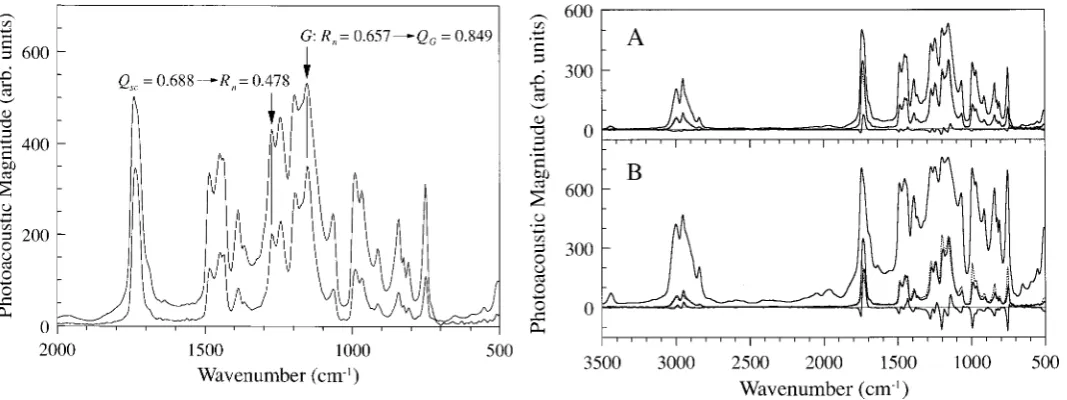
FIG. 2. Spectra of a thick sam ple of PMMA taken at scanning speeds of 2.5 and 40 kHz, and the conversion-parameter values for the guide peak,G,and an example peak.
FIG. 3. Conversion of two low-speed spectra of PMMA to high-speed equivalents. (A) The 2.5 and 40 kHz spectra from Fig. 2, the 2.5 kHz spectrum after conversion to 40 kHz equivalence (dotted line), and the difference spectrum between the true 40 kHz spectrum and the 40 kHz-equivalent spectrum. (B) As inA, except using starting spectra at 200 Hz and 40 kHz.
thickness by an unusually large amount (15mm) but had little effect on spectrum-peak height. The next three lap-pings after that each removed a decreasing thickness and had an increasing effect on peak height. Apparently, this sample had a few high points on its surface, which were all that was being taken off at rst. The ‘‘depth’’ of the sample surface, therefore, had to be assigned for this one sample. Given the decaying-exponential gradient expect-ed for this sample (see Results and Discussion), the great-est change in peak height with depth should occur at the sample surface measurement (i.e., at a probe depth of 3 mm). Accordingly, we have assigned the measurement after the second lapping (when the total measured reduc-tion in thickness was 19 mm) a depth of 1 mm, which places the greatest peak-height change with depth be-tween 2 and 3 mm.
RESULTS AND DISCUSSION
Performing a speed conversion can best be illustrated using spectra of a homogeneous sample. Figure 2 shows two spectra of a thermally thick disk of poly(methyl methacrylate) (PM MA). The taller of the two spectra was taken at a scanning speed of 2.5 kHz and the smaller at 40 kHz, so the frequency ratio, N, is 16. The process begins by scaling the low-speed spectrum. The behavior of a peak,G,in the two spectra will be used to guide the scaling. The peak must arise from a homogeneous com-ponent of the sample so that the height of the peak varies with scanning speed according to the Rosencwaig and Gersho theory.13 In Fig. 2, the peak at 1153 cm21 has been selected to be G. If the heights of peak G are hh
and hl in the high- and low-speed spectra, respectively, thenRn 5 hh/hl,and Qscfor the peak, which we will call QG,can be calculated from Eq. 14. The peak-height ratio
of G in Fig. 2 is 0.657, so from Eq. 14 (or reading from Fig. 1), QG is 0.849. Now that QG is known, the scaling
for the rest of the spectrum is straightforward because the scaling is linear with a scaling factor of QG/hl.If a data point in the low-speed spectrum has a value Y, so that it isy times the value of peak G,then it will have a value
of yQG in the scaled spectrum; Qsc 5 yQG 5 YQG/hl for
that point. For example, the second peak marked in Fig. 2 is at 1273 cm21. In the low-speed spectrum, the mag-nitude of this peak is 81% the magmag-nitude ofG, so Qscat 1273 cm21is 81% ofQ
G,or 0.688. Once the whole
spec-trum has been scaled and all of theQscvalues are known, Eq. 13 is used to determine Rn for each data point. For
the 1273 cm21 peak of the example, R
n calculated from
Eq. 13 (or read from Fig. 1) is 0.478. Each data point in the starting, low-speed spectrum (not the scaled spec-trum) is multiplied by the Rn calculated for it to produce
the high-speed-spectrum equivalent.
[image:7.578.27.561.30.230.2]Figure 3B shows a second example using the same PM MA sample, but with a much larger frequency ratio between the starting spectra. The tall spectrum was ac-quired at 200 Hz, and the smaller, solid-line spectrum is the 40 kHz spectrum used before, so N is now 200. The dotted spectrum is the high-speed equivalent calculated from the 200 Hz spectrum, again using 1153 cm21 as the guide peak. An error spectrum is also plotted as before. Overall, the speed-converted spectrum is qualitatively similar to the true high-speed spectrum, but the closeness of the match varies substantially from peak to peak. Be-tween 1000 and 2000 cm21, the error spectrum in Fig. 3B looks largely like an ampli ed version of the Fig. 3A error spectrum. This comes from the saturation-related peak shift being larger here than in the previous example, so the derivative-like errors are greater. Outside the 1000 to 2000 cm21 range, the error spectrum shows another trend. The error-spectrum features are negative-going at low wavenumbers and positive-going at high wavenum-bers. This is a general pattern we have observed for a variety of samples once N becomes large enough; partly saturated peaks in the low-speed spectrum tend to be too large after speed conversion at wavenumbers below the guide-peak location and too small above the guide peak, with the error generally increasing with distance from the guide peak. We have observed this trend with phase-mod-ulation spectra as well, so it is not related to the variation in modulation frequency with wavenumber across rapid-scan spectra. Using a different material as the background reference may help in individual cases by providing dif-ferent normalization scaling. Here, however, we have used glassy carbon throughout because we found it to be the best general background reference.
The thermal diffusion length, which is proportional to f21/2, is conventionally taken as the approximate probe depth of a photoacoustic measurement. A set of speed-converted spectra at various scanning speeds (and so var-ious frequencies) therefore provides a qualitative view of the depth dependence in a sample. This view is much clearer than that from unconverted spectra because the obscuring effects of unequal saturation levels have been removed. The utility of speed-converted spectra can be extended even further. With some foreknowledge of what kind of depth pro le should be present in a sample, quan-titative depth pro les can be derived from the speed-con-verted data.
Two decay effects control the depth sensitivity of speed-converted spectra; the attenuation of illuminating radiation as it is absorbed in the sample, and the decay of the thermal wave as it travels from the point of radi-ation absorption to the sample surface. Formally, speed conversion removes the effects of illumination attenua-tion, but if the average value of the depth-varying ab-sorption coef cient is suf ciently large, virtually all of the illuminating radiation will be absorbed within one thermal diffusion length of the sample surface. No infor-mation can be gathered from depths where the illumi-nation does not reach. Accordingly, the rest of this paper will be limited to the case where speed conversion re-duces the effects of radiation attenuation to the point that attenuation may be ignored over the range of depths be-ing probed. Within this limitation, the depth sensitivity of speed-converted spectra is controlled solely by the
ex-ponentially decaying thermal wave. The thermal diffu-sion coef cient,a, which equals 1/L, is the rate constant for this decay. The photoacoustic signal is therefore pro-portional to the product of the absorption coef cient and the fraction of the decayed thermal wave that reaches the sample surface, integrated over the full thickness of the sample:
`
21 2x/L
S }L
E
a(x)e dx (19)0
whereSis the normalized, speed-converted photoacoustic signal; theL21 outside the integral is a normalization fac-tor; and it is assumed the sample is thermally thick (i.e., the sample thickness is much greater than L), so that the integration can extend to in nity. Also implicit in Eq. 19 is the assumption that the speed conversion does not im-properly correct a peak height. The equations for speed conversion are based on a homogeneous-sample model. If depth-related composition changes cause a peak to grow so much over the range of scanning speeds used that the peak appears to be entering saturation, then the speed conversion will inappropriately ‘‘correct’’ it, and it will appear too large in the speed-converted spectrum. The 560 cm21 peak in Fig. 4 is an example of this and is discussed below.
As previously discussed, determining a(x) from a set ofS values measured at various thermal diffusion lengths, is an ‘‘ill conditioned’’ problem.35,36 Although the general solution for determining depth pro les from spectra may be ill conditioned, if there is a prioriknowledge of what kind of depth pro le a sample should have, so that only a few parameters need to be determined, then the speed-converted spectra can often be used with Eq. 19 to de-termine the speci c pro le. The simplest non-trivial case is a sample composed of a discrete layer of thickness l on top of a thermally thick substrate. At a given wave-number, the absorption coef cient has a constant value, a1, for 0 , x , l, and a second constant value, a2, for x
. l.For such an a(x), Eq. 19 becomes the following: S 5 C(a1 1 (a2 2 a1)e2l/L) (20) whereC is a proportionality constant. This assumes there is negligible difference between the thermal properties of the substrate and overlayer. The normalized, speed-con-verted photoacoustic signal can be considered an expo-nential function of 1/L, with a rate constant of l. The thickness of the discrete layer can be determined by t-ting Eq. 20 to a set of measured S values.
possi-APPLIED SPECTROSCOPY 415
FIG. 4. Spectra of a sample consisting of a 6-mm layer of PET on a thick polycarbonate substrate taken at 40 kHz (thick solid line), 10 kHz (dot-dash line), 2.5 kHz (thin solid line), and 400 Hz (dotted line) scan-ning speeds. Lower panel; spectra as acquired. Upper panel; the same spectra as in the lower panel after conversion to 40 kHz equivalence.
FIG. 5. Peak heights as a function of thermal diffusion length for ve peaks taken from seven speed-converted spectra (including those in the upper panel of Fig. 4) of a sample consisting of a 6-mm layer of PET on a polycarbonate substrate.
bility of the previously described peak-shifting affecting the accuracy of the guide-point values. Prior to speed conversion, the 40 kHz spectrum is the smallest through-out, indicating that, as usual, the signal magnitude in-creases with decreasing scanning speed everywhere ex-cept the most saturated features. After speed conversion, this behavior is gone, and each peak has its own trend, qualitatively indicating the depth-related sample struc-ture. Those peaks that grow with decreasing scanning speed grow with increasing thermal diffusion length, so they must arise from the polycarbonate substrate. Those peaks that shrink with decreasing scanning speed and in-creasing thermal diffusion length must come from the PET layer. The strongest bands in the 40 kHz spectrum (730, 1020, and 1130 cm21) change little with scanning speed after conversion, indicating that they are strong PET bands in which almost all of the incident beam in-tensity is absorbed within the PET. The polycarbonate band at 560 cm21 is an example of a peak that is im-properly corrected by the speed conversion because the peak grows so large at low scanning speeds. In the speed-converted spectra, the 560 cm21peak height grows steadi-ly between the 40 and 2.5 kHz spectra but then leaps to a much higher value at 400 Hz. In the spectra prior to conversion, the 560 cm21 peak is smaller than the strong, highly saturated PET bands, except in the 400 Hz spec-trum. At 400 Hz, the 560 cm21 peak is as tall as these bands, so the conversion treats it as a highly saturated band; itsQscandRnvalues are near 1, and the peak height
remains near its original value of 600 after conversion. The speed-conversion equations properly correct the growth of large peaks arising from homogenous
com-ponents, but it can distort large peaks whose growth is principally caused by sample structure.
FIG. 6. Heights of the 3271 cm21 hydroxyl peak in speed-converted
spectra of one unweathered and three weathered PET sam ples. Data for the three weathered samples are identi ed by their concentration of ultraviolet stabilizer. The discrete markers are the observed peak heights, and the curves are least-squares ts of Eq. 22 (withn52) to the observed points.
TABLE I. Hydroxyl gradient parameters from least-squares ts of speed-converted peak heights.
Equation 22 parameters
Double-exponential ts
Unweathered 2% additive 1% additive No additive
Single-expo-nential t No additive
Cc0
Cc1
d1
Cc2
d2
12.9 42.3
22.95
210.5
21.0310212
2.51 18.1
20.395 89.1
21.67
1.69 28.1
20.203 266.
210.2
3.09 22.0
20.117 1300.
234.6
4.73 67.0
20.468 Figure 5 shows the peak-height behavior of four peaks
from the PET-on-polycarbonate sample spectra. The data points shown are those for the spectra in Fig. 4, along with points from spectra taken at scanning speeds of 20 kHz, 5 kHz, and 800 Hz. The smooth curves are least-squares ts of the Eq. 20 function to the observed data points. These four peaks give the best ts among a dozen different wavenumber positions tested. The l values de-termined from these ts are 6.5mm at 772 cm21, 4.7mm at 795 cm21, 10.5 mm at 972 cm21, and 5.8 mm at 2974 cm21. Although the 10.5 mm value from 972 cm21 is ob-viously high in comparison to the known thickness of 6 mm, there would be no objective reason to exclude this result if the true thickness were not known; the root-mean-square error of the 972 cm21 t is smaller than that for 772 cm21. Combining these four measurements gives a layer thickness of 6.96 2.5mm, in agreement with the known value. The rms error of this is large because of the ill-conditioned nature of the problem. Layer thick-nesses in discretely layered samples can be determined more straightforwardly and often more accurately using phase measurements on peaks having little overlap with bands from another sample layer.23,27–29 When there is moderate overlap between peaks from different layers, however, phase measurements cannot be used to deter-mine layer thicknesses, but the present method can be used.
Determining depth pro les rather than just layer thick-nesses is where using Eq. 19 and speed-converted spectra can be superior to phase measurements. One common pro le type is an exponential gradient consisting of one or a sum of exponentials:
n d xi
a(x)5 c0 1
O
cie (21)i51
where x is sample depth, and c0, ci, and di are all
con-stants. From Eq. 19, the photoacoustic signal from a sam-ple with such a gradient is
n c
i
S 5 C c
1
0 1O
12
(22)2d L
i51 i
where C is a proportionality constant. We examined ar-ti cially weathered PET sheets as examples of materials with two-exponential (n52) gradients. The set consisted of three samples weathered for 1088 hours and an un-weathered control. The un-weathered samples contained 0, 1, and 2 wt % of the ultraviolet stabilizer Tinuvint360. We recorded spectra at nine scanning speeds from 40 kHz to 50 Hz and speed converted them, again using 1111 cm21 as the guide peak. The hydroxyl peak at 3271 cm21 in the resulting spectra showed the gradient most clearly. The discrete data points in Fig. 6 are the speed-converted hydroxyl peak heights for all four samples. Least-squares ts to these peak heights using Eq. 22 with two expo-nentials produce the parameter values in Table I and the smooth curves in Fig. 6. The results are qualitatively rea-sonable; the hydroxyl peak increases in size and the gra-dient extends to greater thermal diffusion lengths for de-creasing amounts of the stabilizer. The unweathered sam-ple has a small, nearly constant hydroxyl peak at most thermal diffusion lengths, but shows an increase at small thermal diffusion lengths, which may indicate some hy-droxyl species on the sample surface. The smooth curves in Fig. 7 are the double-exponential depth pro les cal-culated from the parameters in Table I. Again, the results are reasonable. In terms of the Table I parameters, all three weathered samples have small d1 values and sub-stantially larger d2 values. This means that the rst ex-ponentials taper off slowly with depth and account for most of the shape of the curves in Fig. 7. The second exponentials drop to negligible values at shallow depths, so they affect only the near-surface results. Thed1values decrease with decreasing additive concentration, indicat-ing that the hydroxyl gradient extends to a greater depth with decreasing additive. The large d1 and extremely small d2 for the unweathered sample mean its gradient is essentially a very shallow single exponential.
[image:10.578.26.282.29.225.2] [image:10.578.27.550.636.723.2]APPLIED SPECTROSCOPY 417
FIG. 7. Quantitative depth pro les of the 3271 cm21peak in the same
weathered and unweathered PET samples as in Fig. 6. The smooth curves are the calculated depth pro les based on the parameters in Table I and Eqs. 21 and 22. The discrete data points are observed peak heights from spectra taken as material was lapped off the surface of each sam-ple.
FIG. 8. (A) The speed-converted peak heights of the 3271 cm21peak
in weathered PET containing no additive (discrete points) and the least squares ts to these points assuming a double-exponential gradient (sol-id line) or a single-exponential gradient (dashed line). The peak heights and double-exponential t are the same as in Fig. 6. (B) The depth pro les derived from the double-exponential (solid line) and single-exponential (dashed line) ts inAcompared to the observed peak height during the microlapping of the sample. The lapping points are the same ones as in Fig. 7.
destructively analyzed the samples using the successive lapping technique described in the Experimental sec-tion.41 The successive lapping produced the discrete data points in Fig. 7. The arbitrary vertical units are not the same for the successive-lapping and speed-conversion methods, so the speed-conversion curves have been scaled and offset vertically as a group in Fig. 7 to give the best match with the successive-lapping data. That is, the same factor (2.14) was used to scale all four curves, and the same factor (4.65) was used to offset all four. Somewhat better ts could have been achieved if each curve were scaled and offset individually, but universal factors were used because the only purpose was to bring the two arbitrary scales into agreement.
The match between the two data sets is very good, demonstrating that non-trivial depth pro les can be ob-tained nondestructively by photoacoustic analysis. The limitation stated earlier must be emphasized, however; the type of gradient curve to be tted must be known in advance in order to achieve a reliable depth pro le. If a plausible but incorrect type of curve is chosen, it is pos-sible to get a precise t to the peak-height data that pro-duces an inaccurate depth pro le. The weathered PET data provide a case in point. Figure 8A shows the same speed-converted peak-height data for the no-additive sample, as in Fig. 6, and the same two-exponential-based t of the data as before (solid line). Figure 8A also shows a least-squares t based on a single exponential (dashed line), the parameters for which are given in Table I. Both are good ts; the rms error of the one-exponential t is only 1.11 times that of the two-exponential t, so the two-exponential t is only slightly better. Figure 8B, however, shows that the resulting depth pro les differ substantially in how well they match the successive-lap-ping data. Each pro le has been scaled and offset verti-cally to give the best least-squares t to the lapping data, but the one-exponential pro le (dashed line) is obviously inferior. (Because the two-exponential curve has been scaled and offset individually in Fig. 8B, it ts the
lap-ping data better than in Fig. 7, where universal scaling and offsetting were used.) Among the weathered PET samples, the differences between the two- and one-ex-ponential pro les decrease as the weathering effects de-crease, as signi ed by the decreasing values of both Cc2 and d2 with increasing additive concentration. Neverthe-less, the two-exponential pro le is always clearly better.
CONCLUSION
A method for making the level of saturation the same in photoacoustic spectra taken at different scanning speeds or modulation frequencies has been developed. These saturation-equalized spectra make the depth-related structure in samples much clearer. In addition, an ap-proach for quantitatively depth pro ling samples with these spectra has been demonstrated. The approach makes use ofa prioriknowledge about the sample struc-ture to restrict the possible depth-pro le outcomes and reduce or avoid the ill-conditioned nature of the mathe-matical problem.
ACKNOWLEDGMENTS
and for loan of a Bio-Rad spectrometer used for some of the work reported here. A portion of the work reported here was performed under CRADA No. AL-C-2000-01, jointly funded by the Of ce of Science of the U.S. Department of Energy, Ford Motor Company, Minnesota Min-ing and ManufacturMin-ing Company, Sherwin-Williams Company, and MTEC Photoacoustics, Inc. This work was funded in part by the Iowa State University of Science and Technology under Contract No. W-7405-ENG-82 with the U.S. Department of Energy.
1. T. Wilson and C. Sheppard,Theory and Practice of Scanning Op-tical Microscopy(Academic Press, London, 1984).
2. G. Turrell and J. Corset, Raman Microscopy: Developments and Applications(Academic Press, London, 1996).
3. R. A. Shick, J. L. Koenig, and H. Ishida,Appl. Spectrosc.50,1082 (1996).
4. F. M. Mirabella, ‘‘Attenuated Total Re ection Spectroscopy,’’ in
Modern Techniques in Applied Molecular Spectroscopy,F. M. Mir-abella, Ed. (Wiley Scienti c, New York, 1998), Chap. 4, pp. 127– 184.
5. B. Mongeau, G. Rousset, and L. Bertrand,Can. J. Phys.64,1056 (1986).
6. W. Faubel, G. R. Hofmann, S. Janssen, and B. S. Seidel, ‘‘Quan-titative Analysis of Atmospheric Copper Corrosion Productions by Photoacoustic FTIR Spectrometry and Photothermal De ection Method,’’ inPhotoacoustic and Photothermal Phenomena: Tenth International Conference, F. Scudieri and M. Bertolotti, Eds. (American Institute of Physics, Woodbury, NY, 1999), CP 463, pp. 661–663.
7. S. W. Fu and J. F. Power,Appl. Spectrosc.54,127 (2000).
8. J. F. Power and M. C. Prystay,Appl. Spectrosc.49,725 (1995).
9. M. Chirtoc, I. Chirtoc, D. Paris, J.-S. Antoniow, and M. Ege´e, ‘‘Photopyroelectric (PPE) Study of Water Migration in Humidi ed Laminated Starch Sheets,’’ in Photoacoustic and Photothermal Phenomena: Tenth International Conference, F. Scudieri and M. Bertolotti, Eds. (American Institute of Physics, Woodbury, NY, 1999), CP 463, pp. 646–648.
10. A. Beenen, G. Spanner, and R. Niessner,Appl. Spectrosc. 51,51 (1997).
11. C. Kopp and R. Niessner,Anal. Chem.71,4663 (1999).
12. C. Kopp and R. Niessner, ‘‘Depth Resolved Photoacoustic Mea-surements with Pulsed Excitation,’’ in Photoacoustic and Photo-thermal Phenomena: Tenth International Conference,F. Scudieri and M. Bertolotti, Eds. (American Institute of Physics, Woodbury, NY, 1999), CP 463, pp. 27–30.
13. A. Rosencwaig and A. Gersho,J. Appl. Phys.47,64 (1976).
14. J. F. McClelland, R. W. Jones, S. Luo, and L. M. Seaverson, ‘‘A Practical Guide to FT-IR Photoacoustic Spectroscopy,’’ inPractical Sampling Techniques for Infrared Analysis, P. B. Coleman, Ed. (CRC Press, Boca Raton, Florida, 1993), Chap. 5, pp. 107–144.
15. D. M. Anjo and T. A. Moore, Photochem. Photobiol. 39, 635 (1984).
16. J. W. Nery, O. Pessoa, Jr., H. Vargas, F. de A. M. Reis, A. C. Gabrielli, L. C. M. Miranda, and C. A. Vinha,Analyst (Cambridge, U.K.)112,1487 (1987).
17. C. Q. Yang, R. R. Bresee, and W. G. Fateley,Appl. Spectrosc.41,
889 (1987).
18. P. A. Dolby and R. McIntyre,Polymer32,586 (1991).
19. L. E. Jurdana, K. P. Ghiggino, I. H. Leaver, C. G. Barraclough, and P. Cole-Clarke,Appl. Spectrosc.48,44 (1994).
20. L. Gonon, O. J. Vasseur, and J.-L. Gardette,Appl. Spectrosc.53,
157 (1999).
21. B. D. Pennington, R. A. Ryntz, and M. W. Urban, Polymer 40,
4795 (1999).
22. R. O. Carter III,Appl. Spectrosc.46,219 (1992).
23. J. F. McClelland, S. J. Bajic, R. W. Jones, and L. M. Seaverson, ‘‘Photoacoustic Spectroscopy,’’ in Modern Techniques in Applied Molecular Spectroscopy, F. M. Mirabella, Ed. (Wiley Scienti c, New York, 1998), Chap. 6, pp. 221–265.
24. E. Y. Jiang, W. J. McCarthy, and D. L. Drapcho, Spectroscopy
13(2), 21 (1998).
25. M. J. Smith, C. J. Manning, R. A. Palmer, and J. L.Chao, Appl. Spectrosc.42,546 (1988).
26. E. Y. Jiang and R. A. Palmer,Anal. Chem.69,1931 (1997).
27. E. Y. Jiang, R. A. Palmer, N. E. Barr, and N. Morosoff, Appl. Spectrosc.51,1238 (1997).
28. D. L. Drapcho, R. Curbelo, E. Y. Jiang, R. A. Crocombe, and W. J. McCarthy,Appl. Spectrosc.51,453 (1997).
29. R. W. Jones and J. F. McClelland,Appl. Spectrosc.50,1258 (1996).
30. M. G. Sowa and H. H. Mantsch,Appl. Spectrosc.48,316 (1994).
31. Y. Kano, S. Akiyama, T. Kasem ura, and S. Kobayashi,Polym. J.
27,339 (1995).
32. M. W. C. Wahls and J. C. Leyte,J. Appl. Phys.83,504 (1998).
33. M. W. Urban, C. L. Allison, G. L. Johnson, and F. Di Stefano,Appl. Spectrosc.53,1520 (1999).
34. E. Y. Jiang, R. A. Palmer, and J. L. Chao,J. Appl. Phys.73,460 (1995).
35. R. J. W. Hodgson,J. Appl. Phys.76,7524 (1994).
36. J. F. Power,Analyst (Cambridge, U.K.)121,451 (1996).
37. A. Harata and T. Sawada,J. Appl. Phys.65,959 (1989).
38. F. A. McDonald and G. C. Wetsel, Jr., J. Appl. Phys. 49, 2313 (1978).
39. D. R. Anderson and R. U. Acton, ‘‘Thermal Properties’’, in Ency-clopedia of Polymer Science and Technology,H. F. Mark, N. G. Gaylord, and N. M. Bikales, Eds. (Wiley-Interscience, New York, 1970), vol. 13, pp. 780–1, Table 4.
40. Annual Book of ASTM Standards,Vol. 14.04 (American Society for Testing and Materials, West Conshohocken, Pennsylvania, 2000), Standard Practice G26-96, pp. 455–464.