Abstract: Resource allocation policies play a key role in determining the performance of cloud. Service providers in cloud computing have to provide services to many users simultaneously. So the job of allocating cloudlets to appropriate virtual machines is becoming one of the challenging issues of cloud computing. Many algorithms have been proposed to allocate cloudlets to the virtual machines. Here in our paper, we have represented cloudlet allocation problem as job assignment problem and we have proposed Hungarian algorithm based solution for allocating cloudlets to virtual machines. The main objective is to minimize total execution time of cloudlets. Proposed algorithm is implemented in Cloudsim-3.03 simulator. We have done comparative analysis of the simulation results of proposed algorithm with the existing First Come First Serve (FCFS) scheduling policy and Min-Min scheduling algorithm. Proposed algorithm performs better than the above mentioned algorithms in terms of total execution time and makespan time (finishing time of last cloudlet).
Index Terms: CloudSim, cloudlets, Hungarian algorithm, resource allocation, virtual machines
I. INTRODUCTION
Cloud Computing is internet based computing in which services are provided on demand as per the requirements of clients. Three main services provided by cloud computing is infrastructure as a service (IAAS), platform as a service (PAAS) and software as a service (SAAS) [1]. Cloud computing is based on pay per usage model. Customers will have to pay only for what they consume. Cloud computing provide mobility, scalability and flexibility in service provisioning. In cloud, users’ requests for resources are termed as cloudlets. These cloudlets need to be handled effectively with available resources. So main concern in cloud computing is to use efficient allocation algorithms in order to allocate virtual machines (VM) to the cloudlets [2].
Cloud computing environments are used for implementing scheduling algorithms. Some basic entities of cloud computing environments are Datacenter, Host, Virtual machines (VM), Tasks/Cloudlets, Datacenter Broker and Cloud Information Service (CIS) [3]. Fig 1 shows the pictorial representation for cloudlet allocation in cloud. Datacenter is group of different host. Each host may consist of different virtual machines of different specifications. CIS stores metadata of different cloud entities. CIS is kind of
Revised Manuscript Received on July 10, 2019.
Sonam Pathak, Computer Science and Engineering, Maulana Azad National Institute of Technology, Bhopal, India.
Manish Pandey, Computer Science and Engineering, Maulana Azad National Institute of Technology, Bhopal, India.
Kanu Geete, Computer Science and Engineering, Maulana Azad National Institute of Technology, Bhopal, India.
repository in cloud computing environment. Datacenter broker works between clients and. cloud service supplier. It gathers all the required information related to availability of resources, usage of resources and cost of communication. Then according to the used scheduling algorithm datacenter broker allocates cloudlets to virtual machines.
Fig.1. Cloudlet Allocation in Cloud Computing
In our paper, we have used one of the solutions of job assignment problem i.e. Hungarian algorithm for allocation of cloudlets. Our proposed algorithm minimizes total execution time of all cloudlets.
II. RELATED WORK
Cloudlet allocation is one of the most trending research topic in cloud computing. Several algorithms for cloudlet allocation have been proposed. The default policy used by Cloudsim toolkit is first come first serve policy (FCFS) [4]. FCFS simply allocates first cloudlet to first virtual machine, second cloudlet to second virtual machine and so on. Disadvantage of FCFS is that it does not consider which virtual machine will take less time for execution of particular cloudlet. Min-Min scheduling algorithm firstly computes minimum time required for execution of each cloudlet. Among all the cloudlets it selects the cloudlet with least execution time. Then it assigns this cloudlet to the virtual machine that computes minimum time for that cloudlet. This process continues for all cloudlet. [5] [6].
In Max-Min scheduling algorithm first step is same as Min-Min i.e. we calculate
Allocation of Cloudlets using Solution of Job
Assignment Problem
minimum execution time of each cloudlet. Then instead of selecting the cloudlet with least execution time we select the cloudlet with maximum execution time and repeat the process until last cloudlet is allocated [7]. A reliability based resource allocation has also been proposed by A B M Bodrul Alam and Mohammad Zulkernine [8]. The main goal of this allocation method is to
increase the reliability of cloud by increasing the reliability of its resources. These days, a lot of other domains including machine learning and big data utilize the capabilities of each other to give large efficient enterprise solutions in cloud. An extension of the shortest job first algorithm has been proposed by Mokhtar A. Alworafi [9]. This modified shortest job first algorithm performs better than the shortest job first algorithm by considering mean of all the cloudlets.
III. PROPOSED METHOD
We have related “Cloudlet Allocation Problem Model” with “Job Assignment Problem Model” [9]. We have proposed a linear programming model for mapping cloudlets to the virtual machines. Let us consider a set of virtual machines with n virtual machines and a set of cloudlets with m cloudlets. Assume that allocation is such that per virtual machine one cloudlet is allocated
.
Let us take n=m .We will calculate the cost matrix C = [ ] by using formula which is mentioned in (1) . Here C is an n×n cost matrix and denotes i, j entry of matrix.
= ∕ (1)
=Execution time of jth cloudlet on ith virtual machine =length of jth cloudlet in million instructions
=capacity of ith virtual machine in million instructions per second
Let Y= [ ] is another n×n matrix where is
=
Our goal is to optimize the cost q(Y). Here cost is the total time required for execution of all cloudlets. Linear model of our cloudlet allocation problem is as follows:
Minimize q(Y) = (2)
Subjects to
for j = 1,2,3….m (3) for i =1,2,3…..n (4) = 0 or 1 (5)
This linear programming model of cloudlet allocation is same as job assignment model. So we can use the solution of assignment problem to solve our cloudlet allocation problem. We have used Hungarian Method based solution for our problem. Hungarian Method is one of the standard solutions of job assignment problem which we are using for solving our cloudlet allocation problem. The objective of proposed method is to lessen the overall execution time of all cloudlets.
In the proposed method, we have considered equal number of cloudlets and equal number of virtual machines. If available virtual machines and cloudlets are not equal in number then we add dummy rows. We assume that each cloudlet needs to be allocated to just single VM and each VM will execute just one cloudlet.
A. Method Description
Let us take an example with 3 virtual machines and 3 cloudlets.
Table1. MIPS Value for Virtual Machines
Parameter VM1 VM2 VM3
Capacity 200 500 100
Table2. Length of Cloudlets Parameter CL1 CL2 CL3
Length 20000 60000 40000
Step1: Compute the initial cost matrix by the mentioned formula.
Table3. Cost Matrix
CL1 CL2 CL3
VM1 100 300 200
VM2 40 120 80
VM3 200 400 600
Step2: Subtracting minimum element of each row from all the values of its row.
Table4. Cost Matrix after performing step2
CL1 CL2 CL3
VM1 0 200 100
VM2 0 80 40
VM3 0 200 400
Step3: Subtracting minimum element of each column from all the elements of its column.
CL1 CL2 CL3
VM1 0 120 60
VM2 0 0 0
VM3 0 120 360
Step4: Now we find out minimum number of lines required to cover all zeroes in Reduced Cost Matrix. As we can see two lines will be needed one at column 1 and one at row 2. If number of lines is same as number of available virtual machines then we do mapping of cloudlet and virtual machine. If number of lines is less then number of virtual machine then we find out minimum value element among all uncovered elements. We subtract this least value element from all the uncovered elements and add this element to the elements where lines intersect with each other.
Table6. Final Cost Matrix
CL1 CL2 CL3
VM1 0 60 0
VM2 60 0 0
VM3 0 60 300
Step5: Now we require three lines to cover all zero, one line at column 1, one line at row 2 and the last one at column 3. We do mapping of cloudlet to virtual machine based on zeros. VM1-> CL3
VM2-> CL2 VM3-> CL1
Now we get total execution time (Cost) by adding the value of corresponding mapping in initial cost matrix.
Cost = 200+120+200= 520 seconds
B. Algorithm Input:
n: available virtual machines m: available cloudlets Output:
Cost: Total execution time of all cloudlets 1:/* Initialize value of cost matrix*/ 2: for i=1 to n
3: for j=1 to m 4: cij = lj / vmi
5: end for 6: end for
7: if n is not equal to m
8: put dummy value in matrix to convert matrix in Square matrix
9: end if
10: minri = smallest element in row i
11: minci = smallest element in column i
12: /* calculate reduced cost matrix */ 13: for i=1 to n
14: for j=1 to m 15: cij = cij - minri 16: end for 17: end for 18: for i=1 to n 19: for j=1 to m 20: cji = cji - minci 21: end for
22: end for
23: /* calculate final cost matrix */ 24: k = min_no_line()
25: if k<n 27: for i=1 to n 28: for j=1 to m
29: if cij is not covered by any of line
30: cij = cij –minimum of all uncovered elements
31: elseif cij is covered by two line
32: cij = cij + minimum of all uncovered elements 33: end if
34: end for 35: end for 36: end if
37: /* Finding mapping of cloudlets to virtual machines */ 38: Find_mapping() for all cloudlets
39: adding their execution time will give total execution time i.e. Cost
40: return Cost
IV. EXPERIMENTAL RESULTS AND COMPARATIVE ANALYSIS
Fig.2. Cloudsim Lifecycle
Cloudsim gives classes for virtual machines, data centers, applications, clients and scheduling methods. Different stages of Cloudsim lifecycle is shown in Fig.2. Cloudsim life cycle starts with initialization of Cloudsim environment and ends with simulation results [13][14][15]. Scheduling algorithm is applied after creation of cloudlets. We have executed our proposed algorithm in Cloudsim and compared its result with conventional FCFS policy and Min-Min scheduling algorithm. Simulation results are given in tables 9, 10 and 11.
Table7. Length of Cloudlets for 3 different jobs
Cloudlet Id
Job1 Job2 Job3
(Length) (Length) (length)
0 20000 200000 40000
1 60000 20000 120000
2 90000 80000 60000
3 40000 90000 20000
4 120000 10000 70000
Table8. MIPS of Virtual Machines
VM ID 0 1 2 3 4
MIPS 1000 500 200 2000 250
Table9. Result of Conventional FCFS Scheduling in Cloudsim
Cloudlet id
Job1 Job2 Job3
VM id
Exec. Time
VM id
Exec. Time
VM ID
Exec. Time
0 0 20 0 200 0 40
1 1 120 1 40 1 240
2 2 450 2 400 2 300
3 3 20 3 45 3 10
4 4 480 4 40 4 280
Total Exec.
Time 1090 sec 725 sec 870 sec
Table10. Result of Min-Min scheduling in Cloudsim
Cloudlet id
Job1 Job2 Job3
VM id
Exec. Time
VM id
Exec. Time
VM id
Exec. Time
0 0 20 1 20 0 20
1 1 120 2 160 2 180
2 4 600 0 1000 1 300
3 3 20 4 5 3 20
4 2 360 3 360 4 480
Total Exec.
Time 1120 sec 1545 sec 1000 sec
Table11. Result of our proposed Hungarian Scheduling in Cloudsim
Cloudlet id
Job1 Job2 Job3
VM id
Exec. Time
VM id
Exec. Time
VM id
Exec. Time
0 2 90 3 90 4 70
1 1 120 2 160 2 120
2 0 100 4 50 3 100
3 4 60 0 100 1 60
4 3 160 1 80 0 160
Total Exec.
[image:5.595.55.549.56.471.2]Time 530 sec 480 sec 510 sec
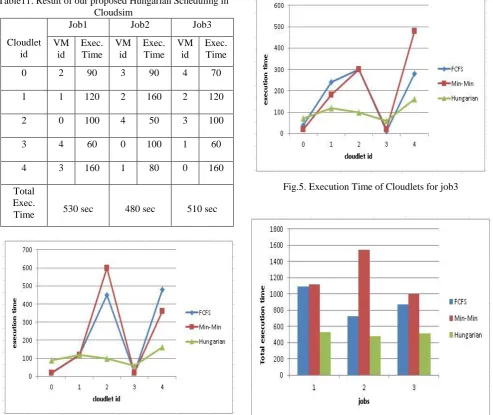
Fig.3. Execution Time of Cloudlets for job1
Fig.4. Execution Time of Cloudlets for job2
Fig.5. Execution Time of Cloudlets for job3
Fig.6. Comparing total execution time of proposed algorithm with FCFS and Min-Min scheduling algorithm for 3 different
[image:5.595.55.302.66.474.2]jobs
Fig. 3, 4 and 5 shows graphs of execution time for job1, job2 and job3 respectively. We have shown comparative analysis of total execution time of each job in Fig.6. Table 12 shows makespan time for 3 jobs using proposed method, conventional policy and min-min scheduling. Fig.7 gives graphical representation for comparing makespan time. We can clearly see from the tables and graphs that total execution time and makespan time is improved using our proposed method. Rate of improvement in makespan time for job1 using our proposed method is 66.67% over FCFS and 73.33% over Min-Min, for job2 improvement is 60% over FCFS and 84% over Min-Min and for job3 improvement is 37.5% over FCFS and 66.67% over Min-Min algorithm.
[image:5.595.51.289.527.719.2]Table12. Comparing Makespan time for job1, job2 and job3 using FCFS, Min-Min and Proposed approach
Job FCFS Min-Min Proposed Method
1 480 600 160
2 400 1000 160
3 300 480 160
Fig.7. Comparing Makespan time of proposed method with existing ones
V. CONCLUSION AND FUTURE WORK
In this paper, we have proposed Hungarian Algorithm
based solution for cloudlet allocation problem by keeping in mind the issues of resource allocation problem. Our proposed algorithm allocates each cloudlet to appropriate virtual machine in such a way that overall execution time is minimized. Consequently makespan time is also minimized. We have implemented our proposed algorithm, first come first serve scheduling (FCFS) and Min-Min scheduling algorithm in Cloudsim tool and we have compared the simulation results of these three algorithms. Our proposed algorithm is more efficient than the existing conventional FCFS binding policy and Min-Min scheduling algorithm in terms of total execution time and makespan time.
In future, our proposed method may be used for allocation of cloudlets in real time. By keeping in mind the efficiency of the proposed approach, same method can be used for fog computing and mobile computing applications. .
REFERENCES
1. Saurabh Kumar Garg, Steeve Versteeg and Rajkumar Buyya, “A
Framework for ranking of cloud computing services”, S.K. Garg et al. / Future Generation Computer Systems 29 (2013) 1012-1023.
2. MR.Manan D. Shah, MR.Amit A. Kariyani and MR.Dipak L. Agrawal,
“Allocation of Virtual Machines In Cloud ComputingUsing Load
Balancing Algorithm” IRACST - International Journal of Computer
Science and Information Technology & Security (IJCSITS), ISSN:
2249-9555 Vol. 3, No.1, February 2013.
3. Tarun Goyal, Ajit Singh and Akansha Goyal, “Cloudsim:Simulator for
cloud computing infrastructure and modeling” International Conference on Modeling, optimization and computing (ICMOC-2012).
4. Dr. Amit Agarwal and Saloni Jain, “Efficient Optimal Algorithm of
Task Scheduling in Cloud Computing Environment” International
Journal of Computer Trends and Technology (IJCTT) – volume 9.
5. Gaurang Patel, Rutvik Mehta and Upendra Bhoi, “Enhanced Load
Balanced Min-Min Algorithm for Static Meta Task Scheduling in Cloud
Computing”, 3rd
International Conference on Recent Trends In Computing 2015 (ICRTC-2015).
6. Neha Sharma and Dr. Sanjay Tyagi , “A Comparative Analysis of Min-
Min and Max-Min Algorithms based on the Makespan Parameter” International Journal of Advanced Research in Computer Science.
7. Upendra Bhoi1 and Purvi N. Ramanuj2, “Enhanced Max-min Task
Scheduling Algorithm in Cloud Computing”, Web Site: www.ijaiem.org Email: [email protected],[email protected] Volume 2, Issue 4, April 2013.
8. A B M Bodrul Alam, Mohammad Zulkernine and Anwar Haque, “A
Reliability-Based Resource Allocation Approach for Cloud
Computing”, 2017 IEEE 7th International Symposium on Cloud
andService Computing
9. Mokhtar A. Alworafi, Atyaf Dhari and Asma A. Al-Hashmi, “An
Improved SJF Scheduling Algorithm in Cloud Computing
Environment”2016 International Conference on Electrical, Electronics,
Communication, Computer and Optimization Techniques
(ICEECCOT).
10. “Linear Programming Applications-nptel”
https://nptel.ac.in/courses/110106059/Module%201/Lecture%202.pdf
11. Gibet Tani Hicham and El Amrani Chaker, “Cloud Computing CPU
Allocation and Scheduling Algorithms Using CloudSim Simulator” International Journal of Electrical and Computer Engineering IJECE)Vol. 6, No. 4, August 2016, pp. 1866~1879 ISSN: 2088.
12. Pradeep Singh Rawat, G. P. Saroha and Varun Barthwal“Quality of
Service Evaluation of SaaS Modeler (Cloudlet) Running on Virtual
Cloud Computing Environment using CloudSim”International Journal
of Computer Applications (0975– 8887) Volume 53– No.13, September 2012”.
13. Suchintan Mishra and Manmath Narayan Sahoo, “On using CloudSim
as a Cloud Simulator: The Un-official Manual”, Research · December 2017 DOI: 10.13140/RG.2.2.30215.91041
14. Arezoo Khatibi and Omid Khatibi, “Criteria for the CloudSim
Environment”, arXiv:1807.03103v1 [cs.DC] 14 Jun 2018
15. Ranjan Kumar and G. Sahoo, “Cloud Computing Simulation Using
CloudSim”, International Journal of Engineering Trends and Technology (IJETT) – Volume8 Number 2-Feb 2014
AUTHORSPROFILE
First Author: Sonam Pathak, Research Scholar in Computer Science and engineering at Maulana Azad National Institute of Technology, Bhopal Email- [email protected]
Second Author : Dr Manish Pandey, Assistant Professor at Maulana Azad National Institute of Technology, Bhopal, India,.
Email- [email protected]
Third Author: Kanu Geete, Phd scholar at Maulana Azad National Institute of Technology, Bhopal, India.