International Journal of Innovative Technology and Exploring Engineering (IJITEE) ISSN: 2278-3075, Volume-8 Issue-7S2, May 2019
Abstract: Routing is one of the most challenging tasks in Mobile Ad hoc Networks (MANETs) as the network is resource constrained and dynamic by nature. Ad hoc infrastructure along with node mobility further makes the network more challenging and unstable. Limited radio range communication, dynamic topology makes the routing technique even more fuzzy to find a desired path from source to destination. Many studies provide many different solutions to route the data from source to the destination. Ad hoc On demand distance vector (AODV) routing protocol is one of the most effectual reactive routing protocols to handle the uncertainty of routing path in MANET. In this paper, a Genetic Algorithm based new protocol is proposed to find the forward path from source to destination. But, the same principle of AODV is applied for back word path. Genetic algorithm has been applied to solve many optimization problems in the literature. The proposed protocol uses the potentiality of genetic algorithms to resume a path that consumes minimum energy as well as preserves a shortest routing path from source to destination. The proposed protocol is experimented and proved through NS-2 Simulator. Simulation results show that proposed protocol over performs existing AODV protocol in terms of end to end delay, throughput and lifetime.
Index Terms: MANET, AODV, Genetic Algorithm (GA)
I. INTRODUCTION
Mobile Ad hoc Networks (MANETs) consist of number of mobiles nodes enable the users to communicate with each other without any central coordinator. There is no permanent infrastructure is required to set up a network. So, other way it is called as an “Infrastructure less” network. These mobile devices are self-organized to communicate with each other for sharing the data without any fixed controller. These networks have been used in diversified applications that ranges from military, defense, health care to small classroom coaching even though these devices are resource constrained. The devices in the network are closely connected and data reaches at the destination in a multi hop fashion. These nodes cooperate with each other to dynamically establish the path and to maintain routing the data packets in the network. Communication between the nodes is carried out by forwarding packets using the wireless range.
The on-demand protocols normally do not consider the existing routing information but try to discover a route to
Revised Manuscript Received on May 28, 2019.
Veena Trivedi, Research Scholar, Mewar University, Rajasthan. India
Padmalaya Nayak, Gokaraju Rangaraju Institute of Engineering and Technology, Hyderabad ,India{ Supervisor, Mewar University,
Rajasthan}.
some destination node only when a sending node has a request data packet addressed to the particular node. MANETs are more vulnerable to attacks when compared to other networks. Some of the features of MANET is discussed below [1].
• Decentralized management: MANETs do not require
any centralized coordinator to manage the network. This decentralized arrangement leads to many challenging issues related to traffic monitoring with dynamic topology.
• Resource availability: The major problem in MANET
is that all the devices are battery powered and deployed mostly in an open environment. Topology changes frequently proportional to the node’s mobility. All these limited parameters within the radio range communication is highly challenging task.
• Network size: Scalability issue must be handled in MANET due to frequent change topology due to the node’s mobility. So, the designer has to take care of these issues while developing the routing protocols.
• Compliance amidst nodes: Routing algorithms in
MANET usually consider that nodes are cooperative and non-malignant. As a result, any attacker takes the opportunity and start behaving as a valid routing agent thus disturbs the network operation by deviating from the protocol specifications
• Dynamic topology: Due to the node’s mobility,
topology changes very frequently in MANET. It has huge impact on MANET that brings a huge impact on routing protocols
• Confined power supply: All the nodes in MANET
consider constrained power supply, that tends to create many problems. A node in a MANET may behave in a selfish manner when it finds that there is power supply restrictions.
Routing in MANETS has been always an open issue [1]. An optimized routing algorithm helps to generate a better routing table.
Hence MANETs have been integrated with machine learning techniques such as fuzzy logic Genetic algorithms, Neural Networks etc. The basic architecture of the MANET is given in Figure 1. Rest of the paper
is framed as follows. Section II outlines the existing work. Section III presents the
Modified AODV Using Genetic Algorithm to
Minimize Energy Consumption in MANET
proposed algorithm. Results and discussions are given in Section IV followed by a conclusion in Section V.
II. RELATED WORKS
This section discusses few existing routing protocols for MANET available in the current literature. MANETs have been always in an interesting topic of research and has opened many challenging issues for research. The nodes in the MANET are neither fixed nor permanent that makes topology change dynamically and frequent link failures [2]. The nodes in MANET are battery operated and have limited lifetime which must be optimized for longer operational characteristics of the nodes. The routes must be optimized, and better routing techniques should be proposed. Therefore, providing an efficient and effective routing in MANETs with limited resources like radio communication, limited bandwidth and limited power is a challenging task. The author in [4] have proposed an energy efficient, cross layer design paradigm making use of nonlinear programming formulation for routing and traffic scheduling. In [5], an adaptive HELLO messaging scheme is proposed which aggregates the local link connectivity information that keeps the track of the link status between nodes making use of AODV protocol to minimize the energy consumption of mobile nodes. In [6], the author has developed dynamic AODV back up routing protocol (DABR) to enhance the routing mechanism in dense MANET. Many researchers have focused on many soft computing techniques like Neural Networks, Fuzzy Logic, Genetic Algorithms for optimization purpose. In this paper, we have focused on some GA based techniques as our work is based on GA based routing. In primary phase, GA is applied to discover the routes and some techniques are used to select back up path. The basic capability of Genetic algorithms and the chromosome generation mechanism using meta heuristic technique and a good designed objective function paves a way for optimization in each network scenario. Related to this, in [3] the author has used Genetic algorithms to optimize both distance and congestion factor. In [7-8] energy drain rate, Interference, congestion status are used to compute the path evaluation function. The authors in [11] discuss a genetic algorithm that generates the k shortest paths using bandwidth constraints for multipath routing.
Many research papers discuss about the optimization of the routing protocol in MANETs. The optimization aspect considered in this paper is related to energy present at the mobile nodes. The authors in [13-14] have also emphasized on link cost management and its optimization and have
incorporated genetic algorithm features to increase the reliability of the network. In another paper [14] an improved Genetic Algorithm has been proposed which aims at optimizing the network link cost, thereby increasing the reliability of the network by reducing link media costs. This paper has implemented the algorithm in a restricted environment of maximum N nodes and to extend it for a wider network domain. The paper considers the congestion condition which occurs in the network due to heavy flow of traffic. This work also shows the impact of congestion control to an extend but proposes an enhancement for integrating the parameters of congestion with optimization. Motivated by this fact, an algorithm is proposed in this paper that considers both the distance and energy to define the objective function. The efficiency of the proposed protocol is shown in Section 4.
III. PROPOSED ALGORITHM
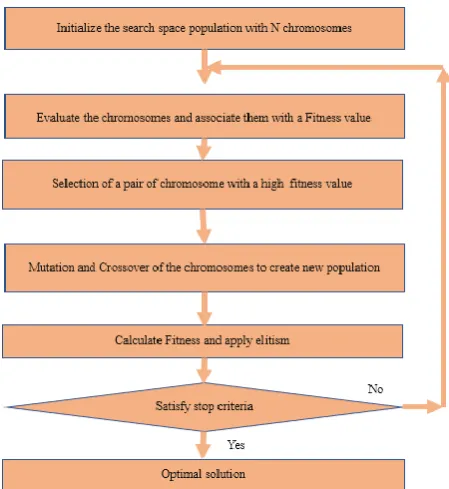
Consider a Network environment with N mobile nodes and these nodes are close to each other within the radio communication range. All these nodes are available in the same transmission range of each other. All mobile nodes are equally capable to receive and transmit the packets from each other. The proposed algorithm uses the Genetic Algorithm approach to route the data packet from to the destination. It calculates a fitness function to find the neighbor node, uses crossover and mutation mechanism for creating the new paths (new chromosomes). The basic model of GA is given in Fig. 2.
[image:2.595.319.544.411.656.2]
International Journal of Innovative Technology and Exploring Engineering (IJITEE) ISSN: 2278-3075, Volume-8 Issue-7S2, May 2019
A. Network Assumption
In the proposed system architecture, the mobile nodes are positioned randomly to form a network for certain applications. The proposed model is shown in Fig 3.
1.The network consists of mobile nodes and each node is characterized by a unique Identification number.
2.The MANET environment is homogeneous type with all mobile nodes having equal initial energy.
3.The number of mobile nodes is application dependent and is assumed as N.
4.The nodes are considered to have mobility characteristics and hence distance between the nodes keeps on varying. 5.The distance and the residual energy is considered for
calculating a new path between the source and destination.
B. Network Architecture
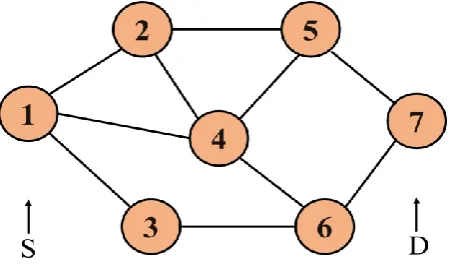
The proposed model of MANET is shown in Fig. 3. Initially we have considered 7 nodes to validate the proposed model. Then, we have experimented with 25 nodes and finally concluded with 50 nodes.
Figure 3: Example of Proposed Topology
Let us consider a MANET of number of nodes N that can be represented as a graph of G (V, E) where the |V| is the set of nodes and |E| is the set of links. For a graph with |V| vertices, the adjacency matrix is a |V| X |V| of 0’s and 1’s where the entry in row i and j column is 1 only if there is an edge between (i, j) otherwise it is 0. The adjacency matrix of the proposed model is given in Fig. 4. Here, 7 vertices in network graph is identified by set of numbers not by names.
[image:3.595.48.276.372.509.2]
Fig. 4: Adjacency Matrix of proposed topology in fig.3
C. Genetic Algorithm Based AODV
GA is considered as a robust technique to search an optimal path from source to destination. In our proposed model, we have used the basic principle of Genetic Algorithm. The main aim of this proposed protocol is to provide a shortest path applying GA principle for a Mobile Ad hoc Network so that it can consume less energy and prolong the network lifetime.
➢ Terminologies Used
• A path from source to destination represents individual population
• An adjacent node corresponding to a node represents as child
• An entire path from source to destination indicates a chromosome
• A string of adjacent nodes identifies a gene
• All the possible paths from source to the destination implies chromosome structure
➢ Procedure for GA based AODV
Step 1: Initial Population: Consider N number of nodes in a
network
Step 2: Initialize all the nodes
Step 3: The neighbor node is selected based on Fitness function. The Fitness function can be calculated as follows (1)
Where,
= Fitness function of each node (depends on residual energy and distance)
= Fitness function based on energy
= Fitness function of a node based on distance
and is calculated using the formula given in equation 2 and equation 3.
(2)
(3)
= Distance between node to node
= Total distance from source to Destination
Step 4: Apply Crossover and Mutation operators are applied in-order to generate the set of paths to the destination
Step 5: GA is applied with fitness function till a complete path is found. Its stops when all the nodes run out of battery.
Example: From Fig. 3 the procedure is as follows: 1st Chromosome: 1st Path: 1-2-4-5-7
2nd Chromosome: 2nd Path: 1-4-6-7 3rd Chromosome: 3rd Path: 1-3-6-7
After Crossover of 1st and 2nd Chromosome 4th Chromosome: 1-4-5-7
After Mutation: 1-2-5-7
The process continues till it satisfies the stopping criteria.
Parameters Values
Area of Simulation 1100X600
Node Number 50
Routing protocol type AODV
IP protocol type UDP(CBR) Traffic
Antenna Model Omnidirectional
Type of MAC 802.11
Transmission Speed 1.2Mbps
Bandwidth 20MHz
Security Algorithm RC5
Data Payload 512 bytes
Wireless Channel Two way ground propagation Simulation Time 50 sec,100 sec, 200 Sec
IV. RESULTS AND DISCUSSION
To verify the efficiency of proposed algorithm, the network is simulated and experimented with NS-2 Simulator. The network is organized with 7 nodes initially in the grid area of 1100m X660m. Slowly, the number of nodes is increased to 25 and 50 nodes to verify the scalability of the network. Data Packet size is considered as 512 bytes. IEEE 802.11 is used in physical and data link layer. The parameters of our interest are summarized in the Table 1. The simulation was carried out on conventional AODV protocol and proposed protocol which is referred as GA-AODV. Few performance parameters like end to end delay, throughput, packet delivery ratio is considered to proof the efficiency of the proposed protocol. The result has been plotted from figure 5 to figure 9.
[image:4.595.307.540.66.218.2]
Figure 5: Fitness Function Vs. No. of Iterations
Figure 6: No. of packets transmitted Vs. No. of Nodes
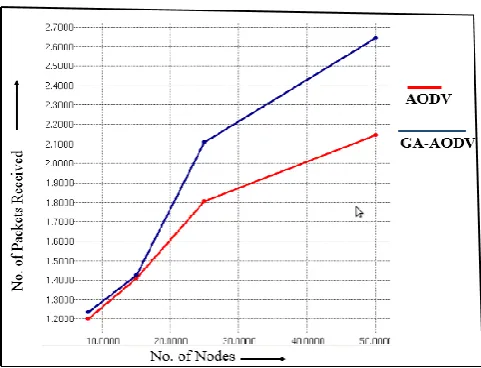
Figure 7: No. of packets received Vs. No. of Nodes
[image:4.595.308.549.439.623.2]International Journal of Innovative Technology and Exploring Engineering (IJITEE) ISSN: 2278-3075, Volume-8 Issue-7S2, May 2019
[image:5.595.50.290.52.221.2][image:5.595.50.285.265.445.2]
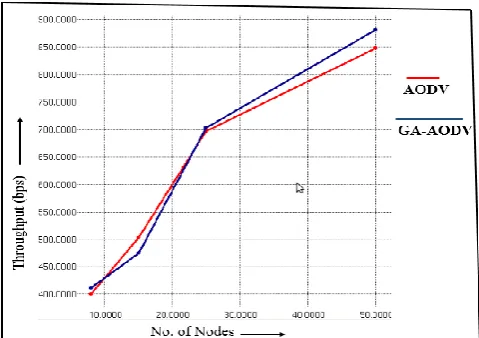
Figure 8: Throughput Vs. No. of Nodes
Figure 9: End to end delay Vs. No. of nodes
Figure 5 shows how the fitness function varies with respect to number of generations. The Number of iterations signifies the number of generations. It is shown from the simulation results that Genetic Algorithm based AODV protocol performs better than the basic AODV protocol. Figure 6 and 7 shows the number of packets transmitted from the source to the destination. It is seen from fig. 6 and 7 that number of packets transmitted and received is better in GA based AODV compared to basic AODV. Throughput for the two protocols is measured and plotted in figure 8. It is observed that throughput is better for proposed GA based AODD over basic AODV protocol. Figure 9 measures the end to end delay which is less in GA based AODV compared to AODV protocol.
V. CONCLUSION
This paper presents a new routing protocol that follows the principle of genetic algorithm to find the forward path in MANET and follows AODV principle for backward path routing. Genetic Algorithm is a bio inspired algorithm and is used to solve many optimization problems. It does not consider any previous routing information to select a neighbor node and finds a path dynamically to the destination using a defined fitness function. It finds an alternative path or backup path in-order to avoid reroute discovery in case of link failure
or node failure. In our proposed algorithm, we make use of genetic algorithm principle that considers crossover and mutation operations. After extensive Simulations, it is concluded that our proposed protocol outperforms AODV in terms of some performance such as number of packet transmitted and delivered, end to end delay and throughput of the network.
REFERENCES
1. Boukerche, B. Turgut, N. Aydin,M. Z. Ahmad, L. Bölöni, and D.Turgut, “Routing protocols in ad hoc networks: A survey,” “Elsevier Computer Networks”, 55 (2011) 3032–3080. 2. Nanhao Zhu, Ian O’Connor; iMASKO: A Genetic Algorithm
Based Optimization Framework for Wireless Sensor Networks, Journal of Sensor and Actuator Networks ISSN 2224-2708, J. Sens. Actuator Networks 2013, 2, 675-699; doi:10.3390/jsan2040675
3. Kamal Kant Sharma, Inderpreet Kaur; Implementation of Genetic Algorithm for Optimization of Network Route, Proceedings of the Second International Conference on Computer and Communication Technologies, Advances in Intelligent Systems and Computing 381, DOI 10.1007/978-81-322-2526-3_2; Springer, India,2016 4. Nilanjan Banerjee, Vaibhav Mehta and Sugam Pandey; A
Genetic Algorithm Approach for Solving the Routing and Wavelength Assignment Problem in WDM Networks; 3rd IEEE/IEE international conference on networking, ICN, 70-78,2004
5. Ahmed Younes Hamed; A genetic algorithm for finding the k shortest paths in a network; Elsevier, Egyptian Informatics Journal (2010) 11, pg 75–7
6. W.T. Chen and W.T. Lee, "Dynamic AODV Backup Routing in Dense Mobile Ad- Hoc Networks", Wireless On-Demand Network Systems, Vol. 2928, pp 158-170, 2004.
7. F.D.Rango and M.Tropea, “Energy saving and Load Balancing in Wireless Ad Hoc Networks through Ant-based Routing”, SPECTS 2009.
8. M.Canales, J.R.Gallego, A. HernandezSolana and A.Valdovinos, “ QoS provision in mobile ad hoc networks with an adaptive crosslayer architecture” , Wireless Networks, Vol. 15, pp. 1165–1187, 2009.
9. W.Ya-li, S.Mei, W.Yi-fei, W.Ying-he and W.Xiao-jun,“ Improved ant colony-based multiconstrained QoS energy-saving routing and throughput optimization in wireless Ad-hoc networks”, The Journal of China Universities of Posts and Telecommunications, Vol. 21, No. 1, pp. 43–53, 2014. 10. L.C. Llewellyn, K.M. Hopkinson and S. R. Graham,
“Distributed Fault-Tolerant Quality of Wireless Networks”, IEEE Transactions on Mobile Computing, Vol. 10, No. 2, 2011 11. Dr. Rakesh Kumar, Mahesh Kumar; Exploring Genetic Algorithm for Shortest Path Optimization in Data Networks; Global Journal of computer science and Technology, Vol. 10 Issue 11 (Ver. 1.0) October 2010 pr 8-12
12. Dr. Garima Krishna, Neeraj Kumar Pandey, Shivank Bajpai; Optimal Path Routing In Variable Data Network Using Genetic algorithm; International Journal Of Engineering Science & Humanities,2010,ISSN 2250-3552
13. Olalekan Ogunbiyi , Wasiu Akande Ahmed; Genetic Algorithm Based Routing Algorithm for Packet Switching Network; (IJEECS) International Journal of Electrical, Electronics and Computer Systems. Vol: 20 Issue: 01, May 2014
14. S.M. Hosseinirad, S.K. Basu; Wireless sensor network design through genetic algorithm;
15. Bilal Gonen, Sushil J. Louis1; Genetic Algorithm Finding the Shortest Path in Networks; The 2011 International Conference on Genetic and Evolutionary Methods
16. Wang LiYan, Zheng XianFeng; The application of improved genetic algorithms in computer network reliability optimization; Proceedings of the 2nd International Conference On Systems Engineering and Modeling (ICSEM-13)
17. L.Hanzo, and R.Tafazolli, “QoS-Aware Routing and Admission Control in Shadow Fading Environments for Multirate MANETs”, IEEE Transactions on Mobile Computing, Vol. 10, No. 5, 2011
AUTHORS PROFILE
Veena Trivedi pursed Bachelor of Technology from NIT Bhopal in the year of 1992 , Master of Technology from RGPV Bhopal in the year of 2005, and pursuing Ph.D. from Mewar University, Rajasthan. Currently she is working as an Associate Professor in the Department of Informational Technology in Gokaraju Rangaraju Institute of Engineering & Technology since 2009. She is a member of IAENG. Her main research work focuses on Wireless Networks, Soft Computing and Data Mining, She has 24 years of teaching experience.