
Rochester Institute of Technology
RIT Scholar Works
Theses
Thesis/Dissertation Collections
5-19-1999
Interactive and zero-knowledge proofs
Molli Noland
Follow this and additional works at:
http://scholarworks.rit.edu/theses
This Thesis is brought to you for free and open access by the Thesis/Dissertation Collections at RIT Scholar Works. It has been accepted for inclusion
in Theses by an authorized administrator of RIT Scholar Works. For more information, please contact
Recommended Citation
Rochester Institute of Technology
~'1athematics
and Statistics Department
Interactive and Zero-Knowledge
Proofs
Molli Noland
A thesis submitted to
The Faculty of the Department of ;vfathematics and Statistics,
in partial fulfillment of the requirements for the degree of
Master of Science in Industrial and Applied Mathematics.
Approved by:
Stanislaw P. Radziszowski
Theodore W. Wilcox
David S. Hart
George E. Christopher
WALLACE
LIBRARY
i f
G··· <"'1 . .
f e w "
I,
u
.;
11
"
,
t
I,'r
I
1\ ;t i l
u
~
L'~I
f l · :
,
h
n
.:>
1 ,-'
f;
\
RIT Thesis Binding Procedure
Examples of Thesis Reproduction Permission Statement
(3 options--please choose one)
Permission granted
Title of thesis
:In+ert\chve..
and
""lero-kJ\O~19e. ~
I,
author's name,
hereby
grant permission
to the Wallace Library of the Rochester Institute of Technology
to reproduce my thesis in whole or in part. Any reproduction will not be for commercial use or profit.
Date:
S
/lj
hf'1
Signature of Author:
_
OR
Permission From Author Required
Title of thesis
_
I,
author's name,
prefer to be contacted each time a request for reproduction is made.
If
pennission is
granted, any reproduction will not be for commercial use or profit. I can be reached at the fol!owing
address:
Phone:
_
Date:
Signature of Author:
_
OR
Abstract
An interactive
proofinvolves
two
parties, the
proverandthe
verifier.The
goal ofthe
proofis for
the
proverto
convincethe
verifierthat
someinstance
of adecision
problemis
true.
A
zero-knowledgeproofis
aninteractive
proof wherethe
only
information
learned
by
the
verifierofthe
proofis
the
outcome ofthe
proof.This
thesis
contains atheoretical
overviewofinteractive
and zero-knowledge proofs anddescribes
experiments withimplementations
of some ofthem.
Two
examplesofinteractive
proofsfrom
numbertheory
aregiven,
a protocolfor
quadratic non-residues and a protocolfor
subgroup
non-membership.The
third
example of aninteractive
proofis
a protocolfor
determining
the truth
value ofa quantified
Boolean formula. This
interactive
proof wasimplemented
and
the
details
ofthat
implementation,
plusatest
ofthe
implementation
derived
from
gametheory,
areincluded.
There is
also adiscussion
of quantuminteractive
proofs.
The
two
examples of perfect zero-knowledge proofsthat
areincluded
are protocolsfor
quadratic residues andfor
subgroup
membership.These
protocols werealsoimplemented,
andthose
details
areincluded.
For
eachprotocol, there
is
adiscussion
ofthe complexity
status ofthe
problems
addressedby
the
protocol.There
is
also abrief discussion
ofthe
history
Contents
1
Complexity
Theory
1
1.1
Definitions
1
1.2
Complexity
Status
ofProblems Addressed
by
Protocols
2
2
Interactive Proofs
4
2.1
Number Theoretical Examples
4
2.1.1
Quadratic Non-Residues
4
2.1.2
Subgroup Non-Membership
6
2.2
Quantified Boolean Formulas
. .8
2.2.1
Preliminary
Information
8
2.2.2
Determining
the
Truth Value
of aQBF
10
2.2.3
Implementation
ofthe
Interactive
Proof
13
2.2.4
QBF
and aPebbling
Problem
14
2.2.5
IP
=PSPACE
16
2.3
Quantum Interactive Proofs
18
2.3.1
Preliminary
Information
18
2.3.2
Second Interactive Proof for QBF
19
2.3.3
Quantum Interactive Proof for QBF
25
3
Perfect Zero-Knowledge
Proofs
27
3.1
Quadratic Residues
27
3.1.1
Perfect Zero-Knowledge Proof for Quadratic Residues
. .28
3.1.2
Implementation
ofProtocol for Quadratic
Residues
...30
3.2
Subgroup Membership
31
3.2.1
Perfect Zero-Knowledge
Proof for
Subgroup Membership
31
3.2.2
Implementation
ofProtocol
for
Subgroup Membership
. .34
4
History
andApplications
35
A
Implementation
37
B
Test Runs
ofPrograms
40
B.l
Quantified
Boolean
Formulas (qbf
)
40
B.2.1
quadres ...44
B.2.2
qrforge ... .50
B.3
Subgroup Membership
50
B.3.1
subgrp
...50
B.3.2
sgforge56
Source Code
57
Cl
Polynomial
andFormula
Header Files
57
C.2
qbf65
C.3
zero-knowledge.h.
70
C.4
quadres73
C.5
qrforge85
C.6
subgrp
88
C.7
sgforge101
List
of
Figures
2.1
Interactive Proof for
Quadratic
Non-Residues
[Stinson, 408]
5
2.2
Interactive Proof for
Subgroup Non-Membership
...7
2.3
Interactive Proof for
Determining
the
Truth
Value
of aClosed,
Simple QBF
[Shamir, 874]
11
2.4
A 5-pyramid
[Gilbert, 515]
15
2.5
Universal
Quantifier Block
[Gilbert, 517]
15
2.6
Existential
Quantifier Block
[Gilbert, 517]
15
2.7
Clause Quantifier Block
[Gilbert, 517]
16
2.8
Graph for
Bxi^/x^xs^XiBx^^x^S/x^
Vi3)A(i2 VSJViJjA^i
V
4 V
5)
A
(13
V xl
WxJ)),
wherethe
maximum number of pebblesallowed
is 18
[Gilbert, 518]
17
2.9
Quantum
circuitfor
a two- round quantuminteractive
proof system
[Watrous, 4]
20
2.10 Simplified Interactive Proof for
Determining
the
Truth Value
ofa
QBF
[Sipser, 365-366]
22
2.11
Quantum Interactive Proof for
Determining
the
Truth Value
ofa
QBF
[Watrous, 7]
25
2.12 Example division
ofR
andF
for
jV =10,
m =6,
and u =(9,3,4,7,2,5) [Watrous, 6]
26
3.1
Perfect
Zero-Knowledge
Proof
for Quadratic Residues
[Stinson,
396]
28
3.2
Forging
Algorithm for Transcripts for Quadratic Residues
....29
3.3
Perfect
Zero-Knowledge
Proof for
Subgroup Membership [Stinson,
398]
32
Chapter
1
Complexity
Theory
Before
the
definitions
ofinteractive
and zero-knowledge proofs areintroduced,
the
reader shouldbe familiar
withthe complexity
status ofthe
problems addressed
by
the
protocols.In
orderto
discuss
the
complexity
status ofthese
problems, it is necessary
for
the
readerto
understand afew
key
concepts of computationalcomplexity
theory.
1.1
Definitions
The
complexity
ofdecidable
problems canbe
thought
ofin
two
ways:in terms
of
the time
the
problem requiresorin
terms
ofthe
space,
ormemory,
that
the
problem requires.
Both
time
and spacecomplexity
are measuredin
terms
ofn,
the
size ofthe
input
to the
problem.First,
we willdiscuss
time
complexity.P
is
the
class of alllanguages
that
aredecidable
in
polynomialtime
on adeterministic
Turing
Machine;
in
otherwords, it is
the
set oflanguages
that
aredecidable
by
0(nk)
time
Turing
Machines,
wherek
is any
non-negativeinteger
[Sipser,
235].
P
representsthe
set of problemsthat
canbe
realistically
solvedusing
a computer.NP
is
the
class of alllanguages
that
aredecidable
in
polynomialtime
on a non-deterministicTuring
Machine
[Sipser,
244]. NP
can alsobe
thought
of asthe
class of
languages
that
canbe
verifiedby
a polynomialtime
deterministic
Turing
Machine;
in
otherwords, the
languages for
whichthe
membership
relation canbe
realistically
verifiedusing
a computer[Sipser,
243].
It is
clearthat
P
C
NP,
sinceany
language
that
canbe decided
by
a polyno mialtime
deterministic
Turing
Machine
canclearly
be
verifiedby
such aTuring
Machine.
It has been
conjecturedthat
P
^
NP,
but
this
has
notbeen
proven.NP
is
thought
to
containlanguages
that
are notin
P because
an enormous amount of efforthas been
spenttrying
to
find
polynomialtime
algorithmsfor
specific problemsin
NP
withoutany
success[Sipser,
247].
A
language
is
NP
completeif
G
NP,
andfor
every
'NP,
there
exists a polynomialtransformation
from
to
'transformation
from
j
C
EJ
to
2
C
Y,*is
afunction
/
:EJ
-E?
suchthat
there
is
apolynomialtime
deterministic
Turing
Machine
whichcomputes/,
andVx
E^
a;1
if
andonly if
f(x)
2
[Garey,34].
The idea
ofNP
completenessis
important because
if
P
^
NP,
then there
can not exist a polynomialtime
algorithmfor
deciding
any NP
completelanguage.
Also,
if
a polynomialtime
algorithmis
found for
any
NP
completelanguage,
then the
hierarchy
collapses,
andP
=NP
[Sipser,
248].
Now,
we will moveto the
idea
of space complexity.PSPACE
is
defined
asthe
set of alllanguages
that
aredecidable
in
polynomial space ondeterministic
Turing
Machines
[Garey,
170].
PSPACE
is the
spacecomplexity analog
ofP.
The analog
ofNP, NPSPACE,
is
defined
in
a similar way.It
turns
outthat
NPSPACE
=PSPACE,
sinceany
non-deterministicTuring
Machine,
which usesf(n)
space,
canbe
convertedto
adeterministic
Turing
Machine,
which usesonly
/2(n)
of space[Sipser,
279].
This
is clearly
still polynomial space.P
C
PSPACE
since an polynomial-time machine can not use morethan
polynomial space
[Sipser,
282].
For
the
same reasonNP
C
NPSPACE.
The
relationships
between
the
classes oflanguages
arethen
asfollows:
PCNPC
PSPACE
=NPSPACE,
and
both
ofthe
inclusions
are conjecturedto
be
strict.PSPACE
completenessis
defined
in the
sameway
asNP
completeness.A
language
is PSPACE
completeif
for
all'PSPACE,
there
exists a polyno mialtransformation
from
to
'[Garey,
171].
1.2
Complexity
Status
of
Problems Addressed
by
Protocols
Now
that the necessary
conceptsofcomplexity
theory
have been
introduced,
we candiscuss
the
status ofthe
problems addressedby
the
protocols usedin
this
thesis.
One
ofthe
fundamental
assumptions madeby
the
protocolsis
that
the
problem of
factoring
large
numbersis
hard. There
is
noknown
polynomialtime
algorithm
for
factoring
large
numbers,
eventhough there
has been
extensive researchin
this
area[Sipser,
339].
The
complexity is
measuredin terms
oflog2
n,
sincethis is
the
number ofdigits
neededto
representthe
integer
n.Many
ofthe
current cryptographicprotocols,
including
RSA,
arebased
onthis
assumption.The
problem of quadratic residuesis
posedasfollows:
given n anda,
does
there
exist an x suchthat
x2 =a mod n?
If
xexists,
then
ais
a quadratic residue modulo n.This
problemis
solvablein
polynomialtime
if
nis prime,
orThe
problem ofsubgroup
membership
is
posed asfollows:
givenn, a,
and6,
does
there
exist ak
suchthat
b
= akmod n?
If fc
exists, then
b
is
an element ofthe
subgroup
of Z* generatedby
a.Finding
k
is
equivalentto
computing
thediscrete logarithm:
loga
b
mod n.There is
noknown
polynomialtime
algorithmfor
computing discrete
logarithms,
and
if there
was such analgorithm,
then
we wouldhave
the
ability
to
factor
numbersin
polynomialtime
[Schneier,
262].
The last
problemthat
the
protocols addressis
determining
the truth
valueof a quantified
Boolean formula (QBF). The
problemis
posed asfollows:
given a set ofBoolean
variables{ij
,2,
. ..,
in}
and a well-formedQBF
B
=Qix1Q2x2...QnXn
E(xi,x2,.-.,xn),
where
Qi
{V,
3}
andE
is
a quantifier-freeBoolean
expression,
is B
true?
This
problemis
PSPACE
complete,
and a proof ofthis
canbe found
in
[Sipser,
284-287].
If
the
QBF
is in
conjunctive normalform
with no morethan two
literals
Chapter
2
Interactive
Proofs
Let P be
adecision
problem, then
aninteractive
prooffor P involves
two parties,
the
prover(Peggy)
andthe
verifier(Vic).
Peggy
is
trying
to
convinceVic
that
she
knows
whether or notthe
given xP.
At
the
end ofthe
proofVic
shouldbe
convincedthat
Peggy
is
eithertelling
the
truth
or sheis
not.This
processis
madeup
of rounds.Each
round consists of a challengeby
Vic
and a responseby
Peggy.
In
eachround,
Peggy
andVic
alternately
do
the
following:
receive amessage,
do
acomputation,
and send a message.At
the
end ofthe
process,
Vic
either accepts or rejectsPeggy's
proof.For
the
proofsthat
we wilconsider,
Peggy
has
unlimitedcomputationalpower,
but Vic
is
limited
to
polynomialtime
algorithms.
An
interactive
proof must meettwo
conditions: completeness and soundness.For
aninteractive
proofto
be
complete,
Vic
willalways acceptPeggy's
proofif
x
is
a yes-instance ofthe
decision
problem.The
proof willbe
soundif there is
only
a smallprobability that
Vic
willacceptPeggy's
proofif
xis
a no-instance ofthe
decision
problem.In
otherwords,
the
interactive
protocolbecomes
aninteractive
proofif the probability
ofType I
error, a, is zero,
andthe
probability
of
Type
II error,
/3,
is
small.0
canbe
reducedarbitrarily
closeto
zeroby
iterating
the
processa certain number oftimes.
2.1
Number Theoretical Examples
2.1.1
Quadratic Non-Residues
A
quadratic non-residueis
a numbera,
suchthat the
equation x2=amod n
has
no solutionsfor
xZ*.
Currently,
there
does
not exist a polynomialtime
algorithm which
decides
if
ais
a quadratic non-residue modulon;
therefore,
Vic
Input:
An integer
n withunknownfactorization
n=pq,
wherep
andq
areprime,
and x
Z*,
where xis
a quadratic non-residue modn.1.
Repeat
the
following
stepslog2
ntimes:
(a)
Vic
chooses a random v Z* and computesy
= v2modn.
Vic
chooses
i
{0, 1}
at random.He
sends z=x'y
mod nto
Peggy.
(b)
If
zis
a quadratic residue modulon, then
Peggy
defines
j
=0;
otherwise,
shedefines
j
=I.
Peggy
sendsj
to
Vic.
(c)
Vic
checksto
make surethat
i
=j
2. Vic
acceptsPeggy's
proof,
that
xis
a quadratic non-residue modn, if step
c
is
verifiedin
each ofthe
log2
n rounds.Figure
2.1:
Interactive Proof for Quadratic
Non-Residues
[Stinson, 408]
To
provethat this
proofis
aninteractive
proof,
it
needsto
be
shownthat
the
proofis
complete and sound.The
proofis
completeif
for
every
xthat
is
aquadratic
non-residue,
Vic
will always acceptPeggy's
proof.Theorem
2.1
The
protocolin
Figure
2.1
providesa completeproof for
quadraticnon-residues.
Proof: Assume
that
xis
a quadratic non-residue andthat
Vic
rejects the
proof.If Vic
rejectsthe proof, then
i
^
j
in
atleast
one ofthe
log2
n rounds.If
i
^
j,
then
either1.
zis
a quadratic residue and z= xv2mod
n,
or2.
zis
quadratic non-residue and z=v2 mod n.The
second caseis
an obvious contradictionby
the
definition
ofquadratic
non-residue,
sothis
leaves
only
the
first
caseto
prove.If
zis
a quadraticresidue, then there
exists a wZ*,
suchthat
w2 =
z mod
n;
therefore,
z=xv2
mod n and w2
= zmod n
w2 =xv2
modn
{wv~1)2 =
x modn.
This
is
acontradiction since xis
a quadratic non-residue modulon.
Note
that
V1exists since v
Z*.
Since
both
cases causedcontradictions,
the
assumption mustbe
false:
If
xis
a quadratic non-residue,then
Vic
will always acceptPeggy's
proof;
therefore,
the
proofis
complete.Soundness
is
provedby
showing
that
if
a;is
a quadratic residue modulon,
[image:12.525.80.445.56.242.2]Theorem 2.2 The
protocolin
Figure
2.1
provides a soundproof
for
quadraticnon-residues.
Proof:
xis
aquadratic residue modulon;
therefore,
there
exists aw
Z*,
suchthat
w2 =x mod n.
Peggy
willalways sendj
=0
in
step
b
sinceif
i
-0,
then
z=v2mod
n,
andif
i
=1,
then
z =
xu2
mod n andw2 =
x mod n
z=
(wv)2 mod
n;
and
therefore,
zis
aquadraticresiduein
both
cases.Since
j
alwaysequals
zero, the
probability
ofi
being
equalto
j
is
the
same asthe
probability
ofi
being
zero.Since
i is
chosen at randomfrom
{0,
1},
the probability
ofi
being
zerois
one-half.This
procedureis
repeatedlog2
ntimes; therefore,
the probability
ofVic
accepting
Peggy's
proofif
xis
a quadratic residueis
This
meansthat
for large
nthe
protocolfor
quadratic non-residuesis
sound.By
Theorem 2.1
andTheorem
2.2,
the
protocolfor
quadraticnon-residues,
as presentedin
Figure
2.1,
is
aninteractive
proof sinceit is
both
complete and sound.2.1.2
Subgroup Non-Membership
The
second example ofinteractive
proofs asksthe
question, is
6
a member ofthe
subset of Z* generated
by
a?In
otherwords,
does
there
exist ak
{0,
1,
. ..,m
1},
suchthat
b
= ak
mod
n, if a,
6
Z*and a
has
order min Z*?
As
withthe
problem of quadraticnon-residues,
there
is
noknown
polynomialtime
algorithmfor
deciding
if there
exists such ak,
soVic
needsto
use an
interactive
proofto
decide
this
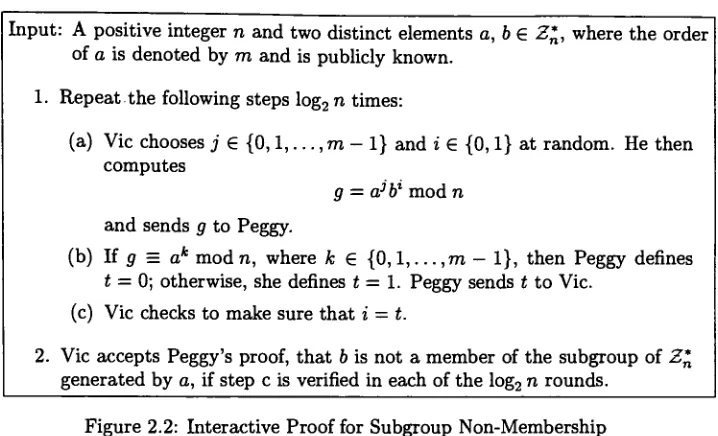
problem.The
proofin
Figure
2.2 is
aninteractive
prooffor
subgroup non-membership,
the
case whenthe
answerto
the
above questionis
no.Note
that
eventhough
nis
large,
akcan
be
computedefficently
by
using
binary
exponentiation.Using
the
square-and-multiply algorithm,
as presentedin
[Stinson,
127],
this
calculationcanbe done in
polynomialtime.
Also
noticethat
m shouldbe
a numberless
than <j)(n),
sinceVa
Z*a^n)=
1
mod n.If
m =<j>(n)
then
the subgroup
generatedby
ais
Z*,
andb
will alwaysbe
asubgroup
member.Theorem 2.3
andTheorem
2.4
statethe
completeness and soundness ofthis
Input: A
positiveinteger
n andtwo
distinct
elementsa,
6
Z*,
wherethe
orderof a
is
denoted
by
mandis publicly known.
1.
Repeat
the
following
stepslog2n
times:
(a)
Vic
choosesj
{0,
1,
. .. ,m
-1}
andi
{0,
1}
at random.He
then
computesg
= a3blmod n
and sends
g to
Peggy.
(b)
If
g
= akmodn,
whereA;
6
{0,1,...,
m-1},
then
Peggy
defines
t
=0;
otherwise,
shedefines
t
=1.
Peggy
sendst
to
Vic.
(c)
Vic
checksto
make surethat
i
=t.
2.
Vic
acceptsPeggy's
proof,
that
b
is
not a member ofthe
subgroup
ofZ*generated
by
a,
if step
cis
verifiedin
each ofthe
log2
n rounds.Figure
2.2:
Interactive Proof for
Subgroup
Non-Membership
Theorem 2.3
The
protocolin
Figure 2.2
provides a completeproof
for
subgroup
non-membership.Proof:
Show
that if
b
is
not a member ofthe
subgroup
ofZ* gen eratedby
a, then
Vic
will always acceptPeggy's
prooffor
subgroup
non-membership.
Assume
that
b
is
not amember,
andthat
Vic
rejects
Peggy's
proof.Vic
willonly
rejectthe
proofif
for
atleast
one ofthe
log2
n roundsi
^
t.
This
meansthat
either1. g
=a) mod n andg
^
akmod
n,
for
allk
0,
1,
.. .,m
1,
or2. g
=a-76
mod nandg
=ak
mod
n,
for
somek
0, 1,
.. .,m
1.
The first
caseis
clearly
a contradiction.This leaves
the
second case:g
=aPb mod n andg
=akmod n
ak
=aPbmod n
6
=ak-jmod mmod n
This is
also acontradiction,
since we assumedthat
b
was not a member ofthe
subgroup
generatedby
a.Since both
caseslead
to
contradictions,the initial
assumptionis
wrong;
therefore,
if
b is
not a member ofthe
subgroup
generatedby
athen
Vic
willalways acceptPeggy's
proof.This
provesthe
completeness ofthe
protocolfor
subgroup
non-membership. [image:14.525.83.442.54.272.2]Proof: Show
that
if
6
is
amember ofthe
subgroup
ofZ*generatedby
a,
then there is only
a smallprobability
that
Vic
will acceptPeggy's
prooffor subgroup
non-membership.Vic
only
acceptsthe
proof
if i
=t
for
alllog2
n rounds.Since 6
is
asubgroup
member,
b
= akmod
n,
for
somefc
{0,
1,
. .. ,m-
1}.
Peggy
will always sendt
=0 in
step
b,
sinceeitherg
= a? mod n org
a?b mod n andb
=akmod n
g
=aj+kmodm modn.
and
therefore,
g is
asubgroup
member.Since
t
always equalszero,
i
will always equalt
wheneveri
equals zero.The
probability
ofi
being
zerois one-half,
sincei is
chosen at randomfrom
{0,1}.
This
procedureis
repeatedlog2
ntimes;
therefore,
as seenbefore,
the probability
ofVic accepting Peggy's
proof, if
6
is
a member ofthe subgroup
generatedby
a, is 1/n.
This
meansthe
protocolfor
subgroup non-membership
is
sound.2.2
Quantified
Boolean Formulas
A
third
example of aninteractive
proofis
a protocolfor
determining
the truth
value ofa quantified
Boolean formula.
Some definitions
andtheorems
are neededbefore
the
proof canbe
presented.The
information in
Section
2.2.1
andSec
tion
2.2.2
canbe found
in
moredetailed form
in
[Shamir].
2.2.1
Preliminary
Information
The
class of quantifiedBoolean
formulas
(QBF)
is
defined
asthe
closure ofthe
set of
Boolean
variables(x;)
andtheir
negations(xi)
underthe
operationsA
(and),
V
(or),
Vxj
(universal
quantification),
and3xj
(existential
quantification).It
is
not requiredthat
all quantifiersappearin
aleftmost
prefix[Shamir,
870].
A QBF is
considered closedif
allits
variables are quantified.The
truth
value of a closed
QBF
canbe
evaluated.A
convenient measure ofthe
size ofa
QBF is
the
number ofdistinct
variablesthat
the
QBF
contains.A
closedQBF is
simpleif every
occurrenceof each variableis
separatedfrom
its
point of quantificationby
at most one universal quantifier[Shamir,
870].
By
this
definition,
Vxi3x2[(xi Vxj) Wx3(xi
AX3)]
is
simple.The first
instance
ofx\
is
separatedfrom
its
point ofquantificationby
nouniversalquantifiers,
andthe
secondinstance is
separatedonly
by
VX3.
The
instances
ofx2
andX3
areseparatedfrom
their
points of quantificationby
nouniversal quantifiers.On
the
otherhand,
is
not simple sincexi
is
separatedfrom its
point of quantificationby
both
Vx2
and
Vx3.
Even
though
this
definition
seemsto
restrictthe
power ofQBF's,
it
canbe
provedthat:
Theorem
2.5
Every
QBF
of
size n canbe
transformed
into
an equivalent simple
QBF
whose sizeis
polynomialin
n[Shamir,
870].
Closed QBF's
canbe
transformed into
arithmetic expressionsby
the
follow
ing
process,
whichShamir
calls arithmetization[Shamir,
871]:
1.
Replace
eachoccurrenceofthe
Boolean
variableXj
by
a variable ZiEZ.
2.
Replace
eachoccurrenceofxl
by
(1
zi).3.
Replace
A
(and)
by
(integer
multiplication),
V
(or) by
+
(integer
addition),
Vxj
(universal quantification)
by
jTIz.eloi}(integer
product),
and3x,
(existential
quantification)
by
S2i6/0
n(integer
sum).According
to
this
process, the
arithmetization ofVxi3x2[(xi
V
X2)
V
Vx3(xi
A
X3)]
would
be
n
[(zi+(i
_*,))+n
(Z1.Z3)].
Z1{0,1}226{0,1} 236{0,1}
From
this
definition
ofthe
process ofarithmetization,
Theorem 2.6
caneasily
be
provedby
induction
onthe
structure ofQBF's:
Theorem 2.6
A
closedQBF B
is true
if
andonly
if
the
valueof its
arithmeticform A
is
non-zero[Shamir,
871].
Theorem 2.6
canbe
provedby
induction
onthe
structure ofB.
One
problem withusing
the
arithmeticform
to
find
the truth
value ofthe
QBF
is
that
if the
QBF
is
true,
the
valueofA
canbe
very
large,
but Theorem
2.7
states
that there
exists an upper-boundto
the
value ofA:
Theorem 2.7 LetB
be
a closedQBF
of
sizen.Then
the
valueof its
arithmeticform
A
can not exceedC(2n"
)
[Shamir,
871].
Using
Theorem
2.6
andTheorem
2.7,
it
canbe
provedthat the
following
equiv alenceis
true,
andtherefore,
the
equivalence canbe
usedto
find
the
truth
value of aQBF:
Theorem 2.8 Let
B
be
a closedQBF
of
size n.Then there
exists a primep of
length
polynomialin
n suchthat
AQ
modp
if
andif
B
is true
[Shamir,
872].
Definitions
ofthe functional
form
and randomizedform
of aQBF
arealsoneeded.
Given
a closedQBF
B,
the
functional form
A'of
its
arithmeticthen
a polynomialfunction
of onefree
variable,
andthis
polynomialfunction
will
be
denoted
gfo)
[Shamir,
872].
By
this
definition,
the
functional form
ofthe
QBF
B
=Vxi3x2[(xi
V
xi)
V
Vx3(xi
A x3)]
is
a'=
e
K*
+
a
-**))
+
n
(*i-*3)i,
226(0,1} 236(0,1}
and
the
polynomialdescription
ofA'is
?(*i)
=((^i
+
(l-0))
+
(z1-0)(Zl-l))
+
((z1
+
(l-l))
+
(z1-0)(Zl
1))
=
((zj
+
1)
+
0)
+
((zx
+
0)
+
0)
=
2zi
+ 1.
The
randomizedform
ofA is
simply
A'(zi
=r),
whereris
a random elementof
Zp
[Shamir,
872].
The
value ofA'fa
=r) is
q{r).During
the
interactive
proof,
Peggy
will needto
splitA
into
Ai
andA2. This
is
done
by letting
A\
be
everything in
A before
the
first
riz;e{o,i}
orX^e^.i}'
except
the
rightmost+
or -, andletting
A2
be
everything after,
andincluding,
the
first
I~Li(o
1}
orSzje(o
1}
[Shamir,
874].
For
example, if
Peggy
is
splitting
a
=i+
C1-^).
226(0,1}
then
A
=Ai+A2,Ai
=l,andA2=^Z
(x
'z2),
226(0,1}
and
if
Peggy
is splitting
A=
J]
E
(*i+*a).
216(0,1} 226(0,1}then
A2
=A
andAi
is
empty.2.2.2
Determining
the Truth
Value
ofa
QBF
The
interactive
proof presentedin Figure
2.3
takes
aclosed,
simpleQBF
asinput
and provesthat the
value ofA,
the
arithmeticform
ofB,
is
a modp,
where a
is
anon-negativeinteger
andp is
a primethat
is polynomially
long
in
the
size ofB. If
Peggy
claimsthat
ais
zero, then
the
proofis
determining
the
truth
value ofthe
QBF
B;
if
the
proofacceptsPeggy's
claimthen
B
is
false,
otherwise
B is
true.
Since Vic
is
restrictedto
polynomialtime algorithms,
he is
not capable ofderiving
the
polynomialsq(zi)
from
A,
andthis
is why
Peggy
is necessary in
the
proof.The QBF B
mustbe
simple sothat
Vic
is
ableto
evaluatethe
Input: A
closed,
simpleQBF B
andthe
arithmeticform A.
1.
Either Vic
orPeggy
choosea primep
that
is polynomially
long
in
the
size ofB
[Shamir,
872].
2.
Peggy
sendsthe
claimedvaluea,
ofA
modp,
to
Vic.
3.
While
the
algorithmis
notdone,
repeatthe
following:
Vic
splitsA into
Ai
A2
orAi
+
A2.
IF
A2
is empty,
the
algorithmis
finished
andVic
acceptsPeggy's
claimif
andonly
if
a=
ai
modp,
where
a
is
the
value ofAi
.ELSE IF
Ai
is non-empty,
Vic
setsA
=A2
modp
and a=a/a\
modp
or a=aai
modp,
depending
onif
A
is
A\
A2
orA\
+
A2. If
A
=Ai
A2
andai
=0
modp,
then the
algorithmis
finished
andVic
acceptsPeggy's
claimif
andonly if
a=
0
mod p.ELSE
Vic
needs moreinformation
from
Peggy.
(a)
Peggy
sendsthe
polynomialdescription,
q(z{)
ofA1to
Vic.
(b)
Vic
checksthat
a=
q(0)
q(l)
modp
or a=g(0) + q(l)
modp,
depending
onthe
first
symbol ofA2. If
this
fails,
the
algorithmis
finished,
andVic
rejectsPeggy's
claim; otherwise,
Vic
sends arandom r
Zp
to
Peggy
and setsA
=A'(zi
=r)
modp
and a=q(r)
mod p. [image:18.525.91.440.88.558.2]would not
necessarily be
ableto
evaluatethe
polynomial q(zt).For
simpleQBF's Vic is
guaranteedto
be
ableto
handle
these
polynomialsbecause
ofthe
following
theorem:
Theorem
2.9
If
B
is simple, then the
degree
of the
polynomialq{zi),
that
describes
the
functional form
of
A,
grows at mostlinearly
withthe
sizeof
B
[Shamir,
873].
Before
the
protocol givenin
Figure 2.3
is
provedto
be
aninteractive
proof,
we will
demonstrate
a small numerical example ofthe
protocol.If
welet
B
=Vxi3x2(xi
Ax^),
then
A,
the
arithmetizedversion ofB,
is
n
e
[*i-u-*2)].
216(0,1}226{0,1}
In
step
1,
setp
to
17,
andin step
2,
Peggy
sendsthe
claimed value ofa,
whichin
this
case willbe
0.
Now,
step 3 is
repeated untilone ofthe
ending
conditionsis
met.In
the
first
iteration
Ai
is empty
andA2
=A,
meaning
that
neitherthe
if
nor
the
elseif
clauseholds,
andVic
must requestmoreinformation
from
Peggy.
Peggy
sendsVic
q(zi)
=Zx.Vic
must checkthat
a =q(0)
q(l)
modp,
since a universal quantifier wasremoved
to
form A':
q(0)
q(l)
=0-l
=0
=a mod17,
so
this
step
checks.Vic
then
chooses a r at random.We
willlet
r =5.
He
then
setsA
=A'(zi
=5)
=Yl
t5
(x
~z2)]
and226(0,1}
a =
o(5)
=5
mod17.
Now,
step
3
mustbe
repeated.Again,
Ai
is empty
andA2
=A,
soVic
asksPeggy
for
additionalinformation.
Peggy
sendsVic
q(z2)
=5
-5z2.
Vic
checksthat
a =q(0) + q(l)
modp,
sincethe
removedquantifier was exis tential:q(0) + q(l)
=(5
-5
0)
+
(5
-5
1)
=5
= a mod17.
Since
this step
checked,
Vic
then
choosesr,
atrandom, to
be
9,
and setsA
=A'(z2
=9)
=[5
(1
-9)]
= -40 =11
mod17
anda =
q(9)
=(5
Repeating
step 3
afinal
time,
Ax
=11
andA2
is
empty.This
meetsthe
if
condition,
soVic
checksthat
a=ax
mod p:a=
11
=m
mod17.
This
checkis
verified;
therefore,
Vic
acceptsPeggy's
proofthat the
QBF B
is
false.
Now
that
wehave
seenhow
the
protocolworks,
it
needsto
be
shownthat
the
protocolis
aninteractive
proof.This
is
done
by
Theorem
2.10,
whichproves completeness andsoundnessofthe
protocol.Theorem
2.10
// Peggy
choosesthe
primep, then the
protocol givenin
Fig
ure2.3
provides a complete and soundproof
for
determining
the truth
valueof
aclosed,
simpleQBF.
Proof:
The
proofis
complete sincePeggy
will alwaysbe
ableto
justify
her
claimed values and polynomialsif
sheis
telling
the
truth,
and
Vic
must acceptthe
proofif
Peggy
justifies
her
claims atevery
step
[Shamir,
875].
Note
that
if
Vic
choosesthe
prime, the
proofdoes
nothave
perfect completeness sinceif p is
adivisor
ofthe
true
value of
A,
then
B
will appearto
be false
whenin reality it is
true
[Shamir,
872].
The
proofis
sound sinceif
Peggy
provides anincorrect
value ofa,
then
sheis
forced
to
provide anincorrect
polynomialq{z{)
to
supporther
claim.An
incorrect
polynomial ofdegree
t
can agree withthe
correct polynomialon at most
t
ofthe p
valuesin
Zp
.Since
the
valueof
p
is
exponentialin
the
size ofB
andthe
valueof ris
chosenby
Vic,
the
probability is
negligiblethat the
incorrect q(zi)
will yield a correct value whenq is
evaluated at r.Peggy
is
therefore
providing
incorrect
valuesfor
smaller and smallersubexpressions,
sothere
is
aexponentially
smallprobability
that
Vic
will notexposePeggy
whenhe
evaluatesthe
final
subexpression.[Shamir, 875]
2.2.3
Implementation
ofthe
Interactive
Proof
qbf
is
a program whichimplements the
algorithmdescribed
in
Figure
2.3.
The
program should
be
thought
of asPeggy,
andthe
user shouldbe
thought
of asVic.
The
only
requiredinput to the
programis
aninput
file
which contains aQBF. The QBF is
assumedto
be
closed andsimple,
andit
assumedto
have
proper syntax.
Vic has
the
option ofproviding
the
value a ofthe
QBF. If Vic
does
not choose a valuefor
a,
Peggy
assumesit to
be
zero, making it
a protocolfor
non-membershipin
QBF. Vic
alsohas
the
optionto
providethe
value of p.If p is
chosenby
Peggy,
p
willhave
onehundred
digits.
The
output of qbfis
atranscript
ofthe
interactions
between
Peggy
andVic.
The
inputs,
the
messagesexchanged,
andthe
outcomeofthe
proof are printedto the
screen.Instances
ofQBF's
whichmay
lead
to
applications shouldhave
in
Appendix
B.l. The
next sectiondiscusses
the
details
of one ofthe
formulas
usedto test
qbf.2.2.4
QBF
and
aPebbling
Problem
Since QBF
is
PSPACE complete,
interesting
(i.e.
difficult)
instances
ofQBF's
can
be found
by
transforming
otherPSPACE
complete problemsinto
QBF's.
Games
areparticularly
suitedfor
this
purpose.One
type
oftest
casefor
the
program qbf was
derived from
the pebbling
game.The
pebbling
gameis
playedon an
acyclic,
directed
graph,
whereevery
nodehas
at mosttwo
predecessors.The
playerhas
a set ofpebbles,
andhe
cando
one ofthe
following
at eachtime
step:
1.
He
can remove a pebblefrom
any
vertex atany
time.
2.
He
can place a pebble onany
unpebbled vertex vif
andonly if
allthe
predecessors of v are
currently
pebbled.3.
He
can move a pebbleto
an unpebbled vertex vfrom
a predecessor of vif
and
only
if
all predecessors of v arecurrently
pebbled.The
object ofthe
gameis
to
pebble a specified goal vertex[Gilbert,
513].
The
pebbling
problemis
defined
asfollows:
"Given
a graphG,
can a vertex vin
G be
pebbledusing
no morethan
spebbles?"
[Gilbert,
514].
This
problemis
PSPACE
complete,
as provenin
[Gilbert];
therefore,
there
is
atransformation
from QBF
to the
pebbling
problem.A
naturaltransformation
canbe devised
if
the
QBF
is in
conjunctive normalform,
withexactly
three
literals
per clause andall ofthe
quantifiersin
the
prefix.This
meansthat
the
QBF
is
ofthe
following
form:
giXi<32x2...Qnxn((Zi,iVZi,2VZi,3)A(/2,iV/2,2Vi2,3)A...A(ZmilVim,2VZm,3)),
where
Qi
{V, 3},
Xj'sareBoolean
variables,
ljtk
{xj,x7},
nis
the
number ofquantifiers/
variables,
and mis
the
number of clauses.From
this
QBF,
a graphG
canbe
constructed,
with goal vertexqi,
suchthat
the
QBF
is
true
if
andonly
if
qi
canbe
pebbled with s =3n
+
3
pebbles[Gilbert,
514].
A
pyramidof verticesis
defined
asin
Figure
2.4,
andit
canbe
abbreviated asshown
in
the
figure. It
takes
atleast k
pebblesto
pebble afc-pyramid
[Gilbert,
515].
G
consistsoin+
mblocks
ofvertices,
onefor
each quantifier and onefor
each clause
in
the
formula. The
universal and existential quantifierblocks,
qi,
are shownin
Figure 2.5
andFigure
2.6,
respectively.The block for
eachclause,
Pj,
is
shownin
Figure
2.7.
p0
is
simply
a singlevertex,
andpTO
=qn+x
[Gilbert,
516].
Using
the
preceeding definitions
the
graphG,
derived from
3xiVx23x3Vx43x5((x7Vx2~Vx3)
A
(x2
VxJVxi")
A
(xi
Vx4
Vx5)
A
(x3
VxIVx?)),
is
shownin Figure
2.8.
The blocks for
eachofthe
five
quantifiers arelocated
onaA
/\A
AAAA
o o o o o
[image:22.525.178.352.68.180.2]o
Figure 2.4: A 5-pyramid
[Gilbert, 515]
Figure
2.5:
Universal
Quantifier Block
[Gilbert, 517]
[image:22.525.161.368.232.367.2] [image:22.525.191.337.432.557.2]JJO
Figure
2.7:
Clause Quantifier Block
[Gilbert, 517]
the
graph.The
edgesfrom
the
quantifierblocks
to the
clauseblocks
representthe
occurrencesofthe
variablesin the
clauses.The
proofthat this
processcorrectly
produces a graphG
suchthat
the
QBF
is
true if
andonly if
gi
canbe
pebbled with s pebbles canbe found
in
[Gilbert].
This
example was onetest
case usedin
testing
qbf, andthe
outputfrom
this
test
canbe found
in
Appendix B.l.
qbf showedthat the
aboveQBF
is
true;
therefore,
qi
canbe
pebbled witheighteen pebbles.Several
othergames,
including
Go
andHex,
have been
shownto
be
PSPACE
complete.
Refer
to
[Garey]
for
adiscussion
of some gamesthat
arePSPACE
andNP
complete.[Sipser]
contains adetailed description
of atransformation
from
the
gameGeography
to
QBF. This
transformation
is very
similarto the
one wehave
just
described.
Other
examples ofQBF's,
createdby
Jussi
Rintanen,
canbe found
at[Rintanen].
2.2.5
IP
=PSPACE
IP is
the
set of alllanguages
that
have
efficientinteractive
proofsofmembership
[Shamir,
869].
Shamir has
provedthat
IP
andPSPACE
are equivalent.Using
the
fact
that
QBF
is PSPACE complete,
wecan provethe
following
theorem:
Theorem 2.11
IP
=PSPACE.
Proof:
First,
it
needsto
be
shownthat
IP
C
PSPACE. This
is easy
since
every
IP language
is
acceptedby
the
PSPACE
machinethat
simply
traverses
the tree
of all possibleinteractions
between
Peggy
andVic
[Shamir,
869].
This
machineis
aPSPACE
machine sincethe
depth
ofthe
tree
is polynomial,
and ateachlevel
only
a polynomialamount of
memory is
needed.Second,
it
needsto
be
shownthat
PSPACE
C
IP. This is done
by
using
the
IP for
deciding
QBF. The interactive
proofpresentedhere
[image:23.525.154.338.61.178.2]q.=
p.
Figure
2.8:
Graph for
3xiVx23x3Vx43xs((xi
V x2 V
x3)
A
(x2
V X3 V
xl)
A
(xi
V
X4
VX5)
A
(X3
VxJVxjJ)),
wherethe
maximum number of pebbles allowedis
18
[image:24.525.99.436.117.458.2]closed,
simpleQBF.
Since
there
is
anIP
for
every instance in
QBF,
and
QBF is PSPACE complete,
then
PSPACE
C
IP.
Since
IP
C
PSPACE
andPSPACE
C
IP,
IP
=PSPACE.
2.3
Quantum Interactive
Proofs
Once
quantum computersarebuilt,
the
entire concept oftractability
willlikely
change.
Because
ofthis
changein
the
definition
of whatis realistically
computable, only
someinteractive
protocolswill remain secure.The idea
ofinter
active proofsystemshas been
generalizedto
the
idea
of quantumcomputing
by
giving
adefinition
of quantuminteractive
proof systems.This
idea is
dis
cussed atlength
in
[Watrous].
Also,
an audio presentation ofthis
paper and otherquantumcomputing information
canbe found
at[AQIP99]. In
this
thesis,
quantuminteractive
proofsystems willbe
defined,
and a quantuminteractive
proof
for
the truth
value of aQBF
willbe
given.First
somedefinitions
areneeded.
2.3.1
Preliminary
Information
A
quantum computerdiffers from
a classical computerbecause
the
quantumcomputer can not
only
read and write zeros andones,
but
it
can read and writesuperpositions of zeros and ones
simultaneously
[Williams,
24].
A
singlebit
ofa quantum
computer,
aqubit, is
thought
of as a vector within a sphere whichsimultaneously
measuresthe
zero-ness and one-ness ofthe
bit,
as well asthe
phase[Williams,
25].
The
values|0)
and|1)
are writtento
correspondto the
bits 0
and1.
A
quantum computeris
built
of quantumgates,
which arethe
same as regular
gates,
exceptthey
input
and output qubits ratherthan
bits.
Quantum
circuits,
which are madeup
of quantumgates,
arereversible,
andthe
transformation
from
the
inputs
to the
outputsis thought
of as aunitary
operator
[Williams,
44].
Quantum
computers,
whenbuilt,
willhave
adramatic impact
on our concept of
tractability.
Peter
Shor has developed
efficent quantum algorithmsfor
factoring
large
integers
andsolving discrete logarithms
on quantumcomputers[Shor]. Since RSA
and other cryptographic systems arebased
onthe
belief
that
there
is
noefficent algorithmfor
these
problems,
newsecure protocols will needto
be developed. This
is
alsotrue
for
severalinteractive
protocols,
including
the
ones
discussed
in
this thesis.
New
methods of quantumcryptography
arebeing
created
to
replacethe
methodsthat
willbecome insecure
once quantum computersare
built.
One
such method wasdeveloped
by
Charles Bennett
andGiles
Brassard
[Bennett].
This
method encodes messagesusing
polarizedphotons,
and
it
obtainsits security
from
the
impossibility
ofcloning
quantuminforma
tion
andfrom
the
consequencesofHeisenberg's
uncertainty
principle[Williams,
164].
Quantum
computers will also extendthe
realmof whatis imaginable.
Since
quantum computers will
be
ableto
generatetrue
randomnumbers;
whereas,
classical computers canonly
pretendto
generate random numbers[Williams,
147-148].
Quantum
computers will also maketeleportation
feasible.
This
is
done
by
exploiting
the
ideas
ofentanglementof statesand non-logicalinfluence
[Williams,
184].
Teleportation
would provide an ultra-secure methodfor sending
data,
sincethe
data
would never needto
cross achannel, it
wouldsimply
be
teleported
from
one secure systemto
another[Williams,
185].
Now
that
wehave
seenthe
consequences of quantumcomputing,
we areready to
define
the
concept of a quantuminteractive
proof.A fc-round
verifierVic is
thought
of as apolynomialtime
computablemapping
V:E*
x
{0,l,...,fc}->E*,
where
V(x, j)
is
anencoding
of a quantum circuit.That
circuitis
madeup
of quantum gates which are chosenfrom
a universal set of gates whichnecessarily
includes
the
Walsh-Hadamard
gate and a gatefor
reversible computation.Each
circuit
V(x,
j)
mustbe
polynomialin
size.The
circuit acts ontwo
setsofqubits,
the
message andthe
ancilla.The
messageis
the
communicationline between
Vic
andPeggy,
andthe
ancillais
Vic's
privateinformation
storage[Watrous,
3].
A fc-round
proverPeggy
is
amapping
P from
E* x{0,
1,
.. .,
k}
to the
set of all quantum circuits.There
are no restrictions onthe
complexity
ofP(x,j),
and
P{x,
j)
also acts ontwo
sets ofqubits, the
common message andher
ancilla[Watrous,
3].
An
example ofthe
pair(P, V)
canbe
seenin
Figure
2.9.
The
probability
that
(P, V)
accepts xis
defined
asthe probability
that the
output qubit yields|1)
whenthe
circuits are appliedin
sequence and all qubits areinitially
in the
|0)
state[Watrous,
3].
A language
has
afc-round
quantuminteractive
proofsystem,
with errorprobability
e,
if there
existsafc-round
verifierVic
suchthat:
1.
There
existsafc-round
proverPeggy
suchthat
for
all xC,
(P, V)
acceptsx with
probability
one.2.
For
all x ",
andfor
allfc-round
proversP',
(P',V)
accepts x withprobability
at moste[Watrous,
3].
Before
the
quantuminteractive
prooffor QBF is
presented,
anotherinteractive
proof
for QBF
needsto
be
discussed because
this
interactive
proofis
usedin
the
quantuminteractive
prooffor QBF.
2.3.2
Second Interactive Proof
for
QBF
The
secondinteractive
prooffor
determining
the truth
value ofaQBF is due
to
Shen,
andthe
proofcanbe found
in
its
originalform
in
[Shen]. This
thesis
willdiscuss
amodificationofShen's
prooffrom
[Sipser,
364-366].
The
proof requiresthat the
QBF
<bbe
ofthe
form
output qubit
Figure 2.9:
Quantum
circuitfor
atwo-round
quantuminteractive
proofsystemwhere
Qi
{V,
3},
Xj's areBoolean
variables,
andB is
aquantifier-freeBoolean
formula,
b is
the
polynomial associated withB found
by
using
the
following
algorithm:
1.
Replace
a with1
-a.
2. Replace
aA
8
with a8.
3. Replace
aV
8
with a*/3=l-(l-a)(l-8).
This
is
similarto
the
process ofarithmetizationin
Section
2.2.1,
but
the
details
of
the
two
processes aredifferent. The
value ofb
will agree withB
whenxt
{0,1}
for
allx^s[Shen,
878].
In
orderto
completethe
arithmetization of<f>,
we writethe
expression4>
=QiXiRxiQ2x2RxiRx2
...QmxmRxi ...Rxm
B(xx,
. . . ,xm),and
then
rewrite<j>'as
</>'
=
SiyiS2y2
.. .Skyk
B(xi,...,xm),
where
Si
{V, 3, R}
andyi
{xi,
. ..,
xm}
[Sipser,
365].
Define
fk
to
be
b,
andthen
for
i
<
k,
define
fi
in
terms
offc+i
by
the
following:
5i=V
Si
=3
Si
=R
/*(
-) =/h-i(- ,0)
-/i+1(--
-,
1)
/*(
) = /*+i(-.
0)
*/i+i(-,
1)
fi(-,a) =
(1
-
a)fi+1(-,0)
+
a/i+1(--,!).
Note
that
the
argumentshave been
arranged sothat the
last
argumentis
j/j+i
and " represents
the
valuesa\
through aj,
for
the
appropriate value ofj
[Sipser,
365].
The
purposeofR
is
to
reducethe
degree
ofthe
variableto
one.The
protocolfor
deciding
the truth
valueof <f>is
described
in
Figure
2.10.
Note
that
all operations aredone
overthe
field
T,
andthe
size ofT
mustbe
atleast
d4,
whered
is the
length
of<f>.Refer
to
[Sipser, 366]
or[Shen, 880]
for
aproof
that
this
protocolis
aninteractive
proof.To
illustrate
the
protocol we will workthrough
a small example.Let
(j)be
defined
asfollows:
(f>=
Vxi
3x2
(xi
V xj
)
;
therefore,
(/>'
=
Vxii?xi3x2ii!xii?x2(xi
Vij).
Since
B{x\,x2)
=xi
Vxb",
b
=xi
*(1
-x2)
=
l-(l-xi)(l-(l-x2))
=
l-(l-xx)x2
Input: A QBF
0
and afield
T.
Phase
0:
Peggy
sends/o().
1.
Peggy
sends/0()
to
Vic.
2.
Vic
checksthat
f0()
=1,
and rejectsif
not.Phase
i:
Peggy
persuadesVic
that
fi-iin
)is correct,
giventhat
/i(rx
)is
correct.1.
Peggy
sendsthe
coefficentsofs(z)
=fi(ri---,z),
where
rx
is
the
setting
ofthe previously
selected random variables.2.
Vic
checksthat
*
(r
^_/*(0)-(i)ifSi_1=V
or
fi-i
(ri
,r)
=(1
-r)s(0) + rs(l) if
S4_i
=R.
If
the
checkfails,
Vic
rejects; otherwise,
Vic
chooses rT
and sendsr
to Peggy.
If
Sj_i
=R,
then
this
r replacesthe
previous r.Phase
fc
+ 1:
Vic
checksthat
fk(ri,
-,rm)is
correct.Vic
checksthat
6(ri,
.. .,rm) =/fc(ri,
. .. ,rm).Vic
acceptsif
andonly if
they
are equal. [image:29.525.87.440.115.509.2]Before
Peggy
can send/o,
she musthave
calculatedfi,f2,--,
andfk,
sinceeach
fi
depends
onfi+\.
This
is the difficult
part ofthe protocol,
andthis
computation
is the
reasonVic
couldnot performthe
protocolonhis
own.Before
weexecutethe
protocol,
we will calculatethe
fi's.
/s(xi,x2)
=6(xi,x2)
=
1
x2
+
X\X2
/4(xi,x2)
=Rx2f5{xi,x2)
=
(l-x2)/5(xi,0)+x2/5(xi,l)
=
(1
-X2)
1
+ X2Xi
=
1
X2
+
XiX2
/3(X1,X2)
=i?Xi/4(xi,X2)
=
(1-X1)/4(0,X2)+Xi/4(1,X2)
=
(1-Xi)(l-X2)+Xi
1
=
1
X2 + XiX2
/2(Xi)
=3X2/3(1!,
x2)
=
/3(Xl,0)*/3(X!,l)
=
l-(l-/3(xi,0))(l-/3(x1,l))
=
l-O-(l-n)
=
1
fl(Xi)
=i?Xl/2(xi)
=
(l-xi)/2(0)+xi/2(l)
=
(l-xi)-H-xi-l
=
1
/o()
=Vn/i(xi)
=
/i(0)-/i(l)
=
1
Now,
we canbegin
the
protocol.Choose T
to
be
Z17.
This
meansthat
all operations are performed mod17,
andthat
every
rj
Zi7.
Phase 0:
1.
Peggy
sends/0()
=1.
2.
Vic
does
notreject.Phase 1:
1.
Peggy
sendss(z)
=/i(z)
=1.
2. Since
Si
=V,
Vic
checksthat
s(0)
s(l)
=/0():
s(0)
s(l)
=1
1
=1
=/o
mod17.
Phase
2:
1.
Peggy
sendss(z)
=f2(z)
=1.
2.
Since
S2
=R,
Vic
checksthat
(1
-n)s(O)+
ris(l)
=A(ri):
(1-6)
-1+
6-1
=-5+ 6=1
=/i(6)
mod17.
Vic
choosesn
=3,
which replacesthe
oldn
.Phase
3:
1.
Peggy
sendss(z)
=h{rx,z)
=1
-z
+
3z
=1 + 2z.
2.
Since
S3
=3 Vic
checksthat
s(0)
*s(l)
=/2(ri):
l-(l-(l + 2-0))(l-(l
+
2-l))
=
1
-0
-2=
1
=/2(3)
mod17.
Vic
choosesr2
=11.
Phase
4:
1.
Peggy
sendss(z)
=fi{rx,z)
=1
-z
+ 3z
=1 + 2z.
2.
Since
54
=R Vic
checksthat
(1
-r2)s(0)
+
r2s(l)
=/3(n,r2):
(1
-11)(1 + 2
0)
+ 11
-(1
+ 2
1)
= -10
+ 11
3
=23
=6
mod17,
and/3(3,
11)
=1 + 2
11
=23
=6
mod17.
Vic
choosesr2
=13.
Phase 5:
1.
Peggy
sendss(z)
=/5(ri
,z)
=1
-z
+
Zz
=1 + 2z.
2.
Since
55
=R
Vic
checksthat
(1
-r2)s(0) +
r2s(l)
=/4(ri,r2):
(1-13)(1
+
2-0)
+
13
-(1+
2-1)
= -12
+
13
3
=27
=10
mod17,
and/4(3,
13)
=1 +
2
13
=27
=10
mod17.
Vic
choosesr2
=7.
Phase 6:
Vic
checksthat
6(3,7)
=/5(3,7)
mod17:
6(3, 7)
=1
-7 +
3
7
= -6+
21
=15
mod17,
and/6(3,7)
=1 +
2-7=15
mod17;
![Figure 2.1: Interactive Proof for Quadratic Non-Residues [Stinson, 408]](https://thumb-us.123doks.com/thumbv2/123dok_us/118369.11463/12.525.80.445.56.242/figure-interactive-proof-quadratic-non-residues-stinson.webp)
![Figure 2.3:Interactive Proof for Determining the Truth Value of a Closed,Simple QBF [Shamir, 874]](https://thumb-us.123doks.com/thumbv2/123dok_us/118369.11463/18.525.91.440.88.558/figure-interactive-proof-determining-truth-closed-simple-shamir.webp)
![Figure 2.4: A 5-pyramid [Gilbert, 515]](https://thumb-us.123doks.com/thumbv2/123dok_us/118369.11463/22.525.191.337.432.557/figure-a-pyramid-gilbert.webp)
![Figure 2.7: Clause Quantifier Block [Gilbert, 517]](https://thumb-us.123doks.com/thumbv2/123dok_us/118369.11463/23.525.154.338.61.178/figure-clause-quantifier-block-gilbert.webp)
![Figure 2.8:X4 Graph for 3xiVx23x3Vx43xs((xi V x2 V x3) A (x2 V X3 V xl) A (xi V VX5) A (X3 VxJVxjJ)), where the maximum number of pebbles allowed is 18[Gilbert, 518].](https://thumb-us.123doks.com/thumbv2/123dok_us/118369.11463/24.525.99.436.117.458/figure-graph-vxjvxjj-maximum-number-pebbles-allowed-gilbert.webp)
![Figure 2.9: Quantum circuit for a two-round quantum interactive proof system[Watrous, 4].](https://thumb-us.123doks.com/thumbv2/123dok_us/118369.11463/27.525.122.408.151.456/figure-quantum-circuit-round-quantum-interactive-proof-watrous.webp)
![Figure 2.10: Simplified Interactive Proof for Determining the Truth Value of aQBF [Sipser, 365-366]](https://thumb-us.123doks.com/thumbv2/123dok_us/118369.11463/29.525.87.440.115.509/figure-simplified-interactive-proof-determining-truth-value-sipser.webp)
![Figure 2.11: Quantum Interactive Proof for Determining the Truth Value of aQBF [Watrous, 7]](https://thumb-us.123doks.com/thumbv2/123dok_us/118369.11463/32.525.87.436.59.320/figure-quantum-interactive-proof-determining-truth-value-watrous.webp)
![Figure 2.12:Example division of R and F for JV= 10, m= 6, and u=(9,3,4,7,2,5) [Watrous, 6].](https://thumb-us.123doks.com/thumbv2/123dok_us/118369.11463/33.525.104.424.57.189/figure-example-division-r-f-jv-m-watrous.webp)