Rochester Institute of Technology
RIT Scholar Works
Theses Thesis/Dissertation Collections
5-1-1993
Morphological filter mean-absolute-error
representation theorems and their application to
optimal morphological filter design
Robert P. Loce
Follow this and additional works at:http://scholarworks.rit.edu/theses
This Thesis is brought to you for free and open access by the Thesis/Dissertation Collections at RIT Scholar Works. It has been accepted for inclusion in Theses by an authorized administrator of RIT Scholar Works. For more information, please [email protected].
Recommended Citation
Morphological Filter Mean-Absolute-Error Representation
Theorems and Their Application to Optimal Morphological
Filter Design
Robert P. Loce
CenterforImagingScience
Rochester InstituteofTechnology
Morphological Filter Mean-Absolute-Error Representation
Theorems and Their Application to Optimal Morphological
Filter Design
Robert P. Loce
Center forImagingScience
Advisor: E.Dougherty
Committee: A.Biles E.Dougherty R. Haralick
Morphological Filter Mean-Absolute-Error Representation Theorems and Their Application to Optimal Morphological Filter Design
by Robert P. Loce
Rochester Institute of Technology Rochester, New York
(1993)
A thesis submitted in partial fulfillment of the requirements for the degree of Ph.D. in the Center for Imaging Science
in the College of Imaging Arts and Sciences of the Rochester Institute of Technology
May 1993
Signature of Author Robert P. Lace
Accepted by JohnR.Shaft
COLLEGE OF IMAGING ARTS AND SCIENCES ROCHESTER INSTITUTE OF TECHNOLOGY
ROCHESTER, NEW YORK
CERTIFICATE OF APPROVAL
Ph.D. DEGREE THESIS
The Ph.D. Degree Thesis of Robert P. Loce has been examined and approved by the the
thesis committee as satisfactory for the thesis requirement for the
Ph.D. degree in Imaging Science
Dr. E.R. Dougherty, Thesis Advisor
ProfessorJ.A. Biles
Dr. R. M. Haralick
THESIS RELEASE PERMISSION
ROCHESTER INSTITUTE OF TECHNOLOGY COLLEGE OF IMAGING ARTS AND SCIENCES
Abstract
The presentthesis deriveserror representations and develops design meth
odologies for optimal mean-absolute-error (MAE) morphological-based filters.
Four related morphological-based filter-types are treated. Three are
translation-invariant, monotonicallyincreasing operators, andour analysis is
basedontheMatheron (1975)representation. Inthisclass we analyzeconven
tional binary, conventional gray-scale, and computational morphological fil
ters. The fourth filter class examined is that ofbinary translation invariant
operators. Ouranalysis isbased onthe Banon andBarrera (1991) representa
tion and hit-or-miss operator ofSerra (1982). A startingpointwill be the op
timalmorphologicalfilterparadigm ofDougherty(1992a,b) whoseanalysisde
scribesthe optimalfilter by a system of nonlinear inequalitieswith no known
method ofsolution,andthusreducesfilter designtominimal searchstrategies.
Althoughthesearch analysisisdefinitive,practicalfilter designremained elu
sive because the search space can be prohibitively large if it not mitigated in
some way.
Thepresentthesisextendsfrom Dougherty'sstartingpointinseveralways.
Centraltothe thesis isthe MAEanalysis forthe variousfilter settings, where
ineach case,atheoremis derivedthatexpresses overallfilter MAEas a sumof
MAE values of individual structuring-element filters and MAE of combina
canbe employed ina computer algorithm to rapidly evaluate combinations of
structuringelements and searchforan optimalfilter basis.
AlthoughtheMAEtheoremsprovide a rapid meansforexamining thefilter
designspace, thecombinatoric natureofthis spaceis, ingeneral, toolarge fora
exhaustive search. Anotherkeycontribution ofthis thesisconcernsmitigation
ofthe computationalburdenviadesignconstraints. Theresultingconstrained
filterwillbe suboptimal,but, ifthe constraints are imposed ina suitable man
ner, there is little loss offilter performance in return for design tractability.
Three constraint approaches developed here are (1) limiting the number of
terms inthefilter expansion, (2) constraining the observationwindow, and(3)
employing structuring element libraries from which to search for an optimal
basis.
Anothercontribution ofthis thesisconcernstheapplicationof optimal mor
phological filters to image restoration. Statistical and deterministic image
and degradation models for binary and low-level gray images were developed
here that relate to actual problems in the optical character recognition and
electronic printing fields. In the filter design process, these models are em
ployed to generate realizations, from which we extract single-erosion and
single-hit-or-miss MAE statistics. These realization-based statistics are uti
TABLE OF CONTENTS
Section Page No.
1: INTRODUCTION 1
1.1: StatementofProblemand Objectives 1
1.2: BackgroundandHistorical Perspective 5
1.3 OverviewofThesis 9
2: OPTIMAL BINARY MORPHOLOGIC AL FILTERS 10 2.1: ReviewofBinaryMorphologicalFiltering 10
2.2: ReviewofOptimal Estimation intheBinarySetting 14
2.3: BinaryMorphologicalFilter MAE Theorem 17
2.4: Constrained Approachto MorphologicalFilter Design 30
2.4.1: Window Constraint 33
2.4.2: LibraryOptimal Filters 35
2.4.2.1: ASpecific ExpertLibrary 37
2.4.2.2: First-OrderLibrary 47
TABLEOF CONTENTS cont.
Section Page No.
3: OPTIMAL GRAY-SCALE MORPHOLOGICAL FILTERS 73
3.1: ReviewofGray-Scale MorphologicalFiltering 74
3.2: Reviewofthe Gray-Scale Optimal MorphologicalEstimation
Paradigm 76
3.3: Gray-Scale MorphologicalFilter MAE Theorem 80
3.4: ExamplesoftheFilter DesignMethod Appliedto Gray-Scale
Signal Restoration 85
3.5: ApplicationoftheGray-ScaleMAE Theoremto Order-Statistic
Filters 91
4: OPTIMAL COMPUTATIONAL MORPHOLOGICAL
FILTERS 96
4.1: ReviewofComputationalMorphologicalFiltering 97
4.2: ReviewofOptimal Estimation Paradigm 100
4.3: ComputationalMorphologicalFilter MAE Theorem 103
4.3.1 Gray-ScaletoBinaryMorphological Filter MAE
Analysis 103
4.3.2 AnalysisofGeneral Gray-Scale Filters 106
4.4: Application oftheMAE TheoremtoDesignofImage
TABLE OF CONTENTS cont.
Section Page No.
5: OPTIMAL HIT-OR-MISS FILTERS 126
5.1 Review ofHit-or-MissFiltering 127
5.2: Optimal Hit-or-Miss Filters- MorphologicalRepresentation
ofthe ConditionalExpectation 129
5.3: Mean-AbsoluteError AnalysisofHit-or-MissFiltering ... 133
5.4: ApplicationofOptimalHit-or-MissFilterstoText
Restoration 137
6: CONCLUSION 140
Appendix1: DerivationofBinaryMAETheorem 143
Appendix 2: Derivation ofGray-ScaleLemmas 148
Appendix3: DerivationofComputationalMorphologyBinary
MAE Theorem 153
LIST OF ILLUSTRATIONS
Figure No. PageNo.
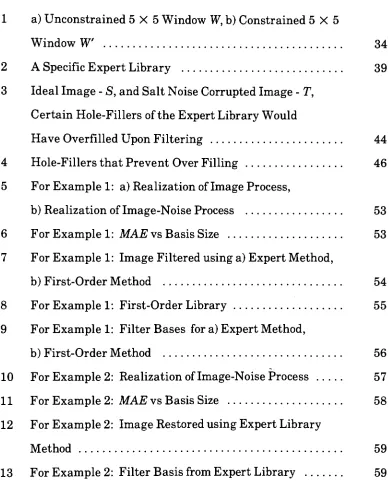
1 a)Unconstrained5X5WindowW,b)Constrained5X5
Window W 34
2 A Specific ExpertLibrary 39
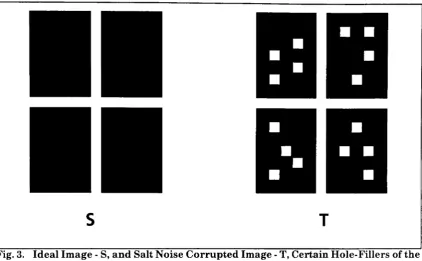
3 IdealImage
-S,andSalt NoiseCorruptedImage
-T,
Certain Hole-Fillersofthe ExpertLibraryWould
Have Overfilled UponFiltering 44
4 Hole-FillersthatPreventOverFilling 46
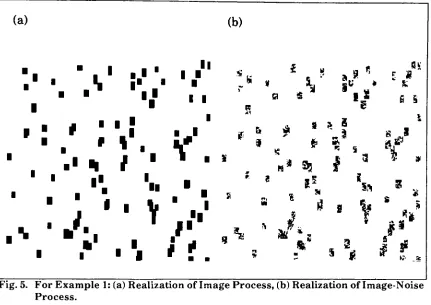
5 ForExample 1: a) RealizationofImageProcess,
b) RealizationofImage-NoiseProcess 53
6 ForExample 1: MAEvsBasis Size 53
7 ForExample 1: ImageFilteredusinga)ExpertMethod,
b)First-OrderMethod 54
8 For Example 1: First-OrderLibrary 55
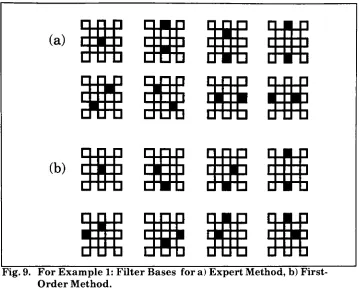
9 ForExample 1: Filter Bases fora)ExpertMethod,
b)First-Order Method 56
10 For Example 2: RealizationofImage-Noise Process 57
11 For Example 2: MAEvsBasisSize 58
12 For Example 2: ImageRestoredusingExpertLibrary
Method 59
LIST OFILLUSTRATIONS (cont.)
Figure No. PageNo.
14 MAEvsBasis Size for Image-NoiseofExample2,with
Noise Area Coverage of5%, 10%and 15% 60 15 Optimal6-ErosionBasesforImage-NoiseofExample2,
withNoise Area Coverageof5%, 10%and 15% 61 16 ForExample3: a) Ideal TextImage, b)Light-Copy
Degraded TextImage, c)MAEvsBasisSize,
d)OptimalBasis,e)Optimal DilationElement,
f) Restored Image 64
17 ForExample 4: a)Min-Noise DegradedImage, b)MAEvsBasisSize,c)OptimalBasis,
d)Restored Image 66
18 ForExample5: a)Ideal CheckImage,b)Threshold
Degraded CheckImage, c)MAEvsBasisSize,
d)OptimalBasis,e)RestoredImage 68
19 ForExample 5: a)StatisticallyRelevantStructuring
Elements, b)GraphicalDepiction ofMAETheorem,
c)GraphicalDepictionofRecursive MAETheorem, 69 20 ForExample6: a)Ideal Address Image, b)Threshold
Degraded AddressImage,c)MAEvsBasisSize,
d)Optimal Basis,e)RestoredImage 72
LIST OFILLUSTRATIONS (cont.)
Figure No. Page No.
22 For Example 11: Strong-NeighborMedianBasis 93
23 For Example 11: 5-PixelWindow 116
24 For Example 11: (a) BinaryImage, DifferenceImages
-(b)A2o ~
A128, (c)Ai28 ~
Auo, (d)Ai28 ~
A250 H8
25 For Example 11: MAEvsBasis Size 119
26 For Example 11:Optimal 4-ErosionBasis 120
27 For Example 11: Character Image(a) BeforeFiltering
-Binary, (b) AfterFiltering
-Quaternary 121
28 ForExample 11: SchematicoftheXerographicLaser
Printer Model 123
29 ForExample11: PrintSimulation for(a)Unfiltered
and(b) Filtered Image 125
30 For Example 12: a)Ideal TextImage,b)Image Degraded
byTextNoise, c)MAEvsNumberofStructuring-Element
LIST OF TABLES
Table No . PageNo.
1 Elementsof aSpecific ExpertLibrary 45
2 MAEandFilterEfficiencyfortheThreeOptimal
1. Introduction
1.1 StatementofProblemand Objective
Whenemployinga statistical estimation rulefor imagerestoration,pattern
recognition, image transformation, etc., it is usually desiredthat the estimate be optimal asjudgedby a chosen criterion. As an example, consider the Wie
nerfilter [Wiener (1942)], wherethe estimation rulecanbewritten as a linear
combination ofobserved data values. In this case the optimality criterion is
minimum mean-square error (MSE) between an idealized image model and a
collection of estimated image values. Mathematical formalisms for practical design ofnonlinear optimal filters are not generally available [See Pitas and
Venetsanopoulos (1989) for a discussion ofvarious types of nonlinear filters.].
Images oftenhavesharpedges,binarystructures and a limitednumber ofbits
per pixel. Therestrictionthat the estimatationrulebe alinearcombination of
observed valuesistypicallyunsuitable. Thepresentthesisderives error repre
sentations and develops design methodologiesfor optimal mean-absolute-error (MAE) morphological-basedfiltersthatare well suitedforoperatingonimages
thatarebinaryorlow-level gray-scale (2 or3bits/pixel)innature.
Four related morphological-based filter types are analyzed in this thesis.
The first three are translation-invariant, monotonically increasing operators,
and our analysisis based onthe Matheron(1975) representationforthatfilter
and computational morphological filters. As will be explained subsequently,
the conventionalbinarytheory is not ipsofacto subsumedbythe conventional
gray-scale theorybecausebinary morphology isembeddedintogray-scalemor
phology in a mannerthat doesnot allow a 0-1 structuring elementto betreat
edthesame inboththeorieswhenconsideringestimationerrorfordiscreteim
ages possessingfinite gray ranges. Computational morphologyis a recent at
tempt [Dougherty and Sinha (1992, 1993a,b)] to unify the binary and gray
scale morphologicalfilteringtheoriesand requiresananalysis distinct from its
conventional counterparts. The fourth filter class examined is that ofbinary
translation invariant operators. Our analysis is based on the Banon and Barrera (1991)representationandthehit-or-missoperator ofSerra(1982).
Aswehave stated, this thesiswillprovide error representation anddevelop
design methodologies for optimal nonlinear estimators. A starting point will
be the optimal p-norm morphological filter paradigm ofDougherty (1990a,b,
1992a,b). Dougherty performed an analysis of discrete morphological filters
based on a finite number ofobservations in the context ofthe
mean-square-error (MSE) criterion. There are two key aspects to the analysis. First, it is
based on the Matheron representation for translation-invariant,
monotonically increasing filters; namely, that a binary (or gray-scale)filter is
represented by aunion (maxima inthe gray-scale case) oferosions over struc
turing elementsin thefilter basis. Second,the analysis describes the optimal filter bya system ofnonlinearinequalities with noknownmethod ofsolution,
strat-egies over subsets of Af-dimensional discrete Cartesian space. Although the search analysisisdefinitive, inthe sensethatitderivesminimal search spaces
for optimalfilter design,the search space canbe prohibitivelylarge ifit is not
mitigatedinsome way.
ThepresentthesisextendsfromDougherty'sstartingpointinseveral ways.
Central to the thesisis the MAE analysisforthevarious filter settings,where
ineach case, atheoremisderivedthatexpresses overallfilter MAEas asum of MAE values of individual structuring-element filters and MAE of combina
tions of unions (maxima) ofthose elements. Recursive forms ofthe theorems
can be employed in a computer algorithm to rapidlyevaluate combinations of
structuring elements and search for an optimal filter basis. In addition, the theorems provide insight into the performance of nonlinear filters. For in
stance, we analyse order-statisticfilters in termsofthe gray-scale morphologi
calfilter MAEtheorem.
AlthoughtheMAEtheoremsprovidearapidmeansforexaminingthefilter design space, the combinatoric nature ofthisspace is, in general, too large for
an exhaustive search. To render the search tractable, we have developed a
constraint methodology that is employed in conjunction with the computer search. The designmethodology involves constraining the class offilters from
whichtheoptimal morphologicalfilter istobechosen;hence,fromtheperspec
tive of the original optimization paradigm of Dougherty (1992a,b), this ap
imposed torenderthefilter designprocesstractable: (1) Limiting
structuring-element size and shape, which we refer to as window constraint; (2) Limiting
the number ofstructuring elements formingthe filter, termed basis size con
straint; (3) Limitingthe search to structuring elements derived from some li
brary that has been chosen in a expert manner or by means of some prelimi
nary statistics, which we call libraryconstraint. Thisconstraintmethodology isanotherkeycontributionofthepresentthesis.
Image restoration is the primary application ofthe morphological estima
tors developedinthis thesis. Imagerestoration involves application ofafilter
to anobserved image, assumedto be degraded,withthe intentbeingto restore
theobservedimageto someidealform. The methodologyisbasedon statistical
analysis ofsignal andnoiseprocesses,and theconsequentdevelopmentof afil
ter (statisticalestimator) to take the observed image as an input and yield an
estimateofthe ideal (uncorrupted)image as anoutput. Interms ofthe model,
the image, noise, andnoisy image arerandomprocesses, so that the estimator
is a function of random inputs, but in actual practice the filter is applied to a
realizationofthe image-noiseprocess.
Anothercontribution ofthis thesis concernsmodelingfortheapplication of
optimal morphological filters to image restoration. Not muchcan be found in
the literature on statistical and deterministic degradation models for binary
andlow-levelgrayimages,so several suchmodelshavebeen developedthatre
printing fields. In the filter design process, these image and image-noise models are employed to generate realizations from which we extract
single-erosion and single-hit-or-miss MAE statistics. These realization-based statis tics are utilized in the search for the optimal combination ofstructuring ele
ments.
1.2 BackgroundandHistoricalPerspective
We begin by referencing several seminal works and general publications
thatprovide abasisofunderstandingofmathematicalmorphology, estimation theory, and image restoration. We then reference general papers on various applications and properties ofmorphologicalfilters. Last,and most relevantto thethesis,wefocus onmorphologicalfiltersappliedto imagerestoration.
Morphological analysis of binary images was originated by Matheron
(1967, 1972, 1975) for the study of porous images. The method is based upon
Minkowskialgebra [Minkowski (1903)] as developedby Hadwiger (1957). For
a general description of mathematical morphology see Serra (1982, 1986,
1988), Haralick, Sternberg and Zhuang (1987), Giardina and Dougherty
(1988), andDougherty (1992c). Anoverview of estimationtheory as employed in linearsystems is givenby Lewis (1986), itsapplicationto digital imageres
nonline-ar filtering methods can be found in the book by Pitas and Venetsanopoulos (1989).
The early applications ofmorphologicalfilteringwere aimed at image seg
mentation and patterndescriptionthroughgranulometricanalysis [Matheron
(1975)] and operationssuchas theHit-or-Misstransform [Serra (1982)]. Prop
ertiesforbothgray-scale andbinarymorphologicalfilters arewelldescribed in
theliterature. Alternatingsequentialfilters aredescribedbyLougheed(1983)
and Sternberg (1986). Serra (1988), and Serra and Vincent (1989) present a lattice theoretic approach to morphological filtering. Maragos (1985), and
Maragos and Schafer (1987a,b) give a set-theoretic analysis of morphological
filters and describe their relationship to linear, median, order-statistic and
stackfilters. Doughertyand Giardina (1986b)alsodescribethe relationship to
linear filters. Dougherty andKraus(1990a,b,c,d,1991) describemorphological filters with convolution like properties. The present study is concerned with
employing the Matheron expansion in filter design. Matheron (1975), Serra
(1982), Dougherty and Giardina (1986a, 1988) and Maragos (1989) describe
thefilter basisofMatheron.
Concerning morphological-based restoration, we take the optimality para
digmofDougherty (1990a,b, 1992a,b)as ourstartingpoint. Dougherty formu
designof actual filters remained elusive dueto the combinatoric nature ofthe
problem. In this thesis we renderthe design process practical through use of
themorphologicalfilter MAEtheorems, designconstraints, andtheutilization
ofimageandimage-noise models. Muchofthisworkhasbeenpublishedinthe
course ofthe thesis research[Dougherty andLoce(1991,1993a,c) and Loceand
Dougherty (1991, 1992a,b,c,d,e,f)] and has beensummarizedinabook chapter [DoughertyandLoce(1993a)]. Inadditiontodevelopingdesignmethodologies, DoughertyandLoce (1992, 1993b) have performedan analysis onthe goodness
of the estimators produced by their morphological filter design methods. In particular, they examined the realization-based nature ofdesign andthe con straintonbasissize.
For binary images, there have been other strategies employed to facilitate
an efficient search within the paradigm of Dougherty (1992a). Dougherty,
Mathew, and Swarnakar (1991) and Mathew, Dougherty and Swarnakar
(1991, 1992), have developedanalgorithmic approachthatderivestheoptimal
morphological filter from the conditional expectation. For certain types of
noise conditions this technique has been demonstrated to be quite
computationallyefficient.
Various other approaches have beentaken tofacilitate filter design in the
binarysetting. One has been to design filtersbased upon conducive imagere
the Wiener approach in the frequency domain. As in the Wiener approach, this requires constraints onthe image-noise model. Progress in this direction
has been promising, but atthe present stage remains quite theoretical. Dou
gherty and Haralick (1991, 1992) have proposed a spectral decomposition based upon a hole spectrum, which in effect models an image by considering
holes in the image. In a closely related filtering paradigm, Haralick, Dou
gherty, and Katz (1991a,b) have taken an approach very similar to Wiener
spectral design by defining an opening spectrum. Also note that Dougherty, Haralick, Chen, Agerskov Jacobi and Sloth (1991, 1992) utilize
pattern-spectrainformation todesignoptimal x-openings.
Other approaches to optimal morphological restoration have been taken thatdonotfollowthe Matheron-representationparadigm,thatis,optimization
is notover all monotonically increasing, translation invariantmappings rela
tive to the MAEor MSEgoodness criterion. Schonfeld andGoutsias (1989a,b,
1990, 1991a,b) describe an alternating sequential morphological filter opti mized for binary image restoration based on a set-difference metric and the
morphologicalpattern spectrum.
Koskinen, Astola, andNeuvo have analyzed the input-output statistics for certain flat morphological filters operating on i.i.d. random variables. They have obtained both exact and asymptotic representations for the output dis
1.3 OverviewofThesis
After this introduction, the thesis describes optimal estimation in four fil
tering settings: conventional binary morphological, conventional gray-scale
morphological, computational morphological, and hit-or-miss. Each settingis analyzed independently in detail in Sections 2
-5, respectively. The sections arewritten in a parallelfashion. Theyeach start with abriefreview offilter
ing in that setting; then, in general terms, discuss the respective approach of
optimal estimation. Followingthatintroductorymaterial,probabilisticanaly sis is performed that leads to an MAE expression or theorem for that filter type. For the monotonically increasing type offilters, recursive forms ofthe MAEtheorems are given. Several ofthe more lengthy proofs are given in ap
pendices. It is this analysis that is central to the thesis and key to our ap proachtofilter designvia efficient search. Atthispointineachsection,wedis
cuss additionaldesign considerations, such asconstraintsthat mustbeusedto renderthedesign spacetractable. Whenthisconstrained approachtodesignis first introduced (binary filtering, Section 3), we discuss the methodology and
2.OptimalBinaryMorphological Filters
This sectionpresents the theoryand design methodology of optimal binary
morphological filters. We first review binary morphology and the optimal estimation paradigm of Dougherty (1990a, 1992a). We then perform a probabilistic analysis thatallows us to derive abinarymorphologicalfiltering MAEtheorem. It isthenshownhowtherecursiveform ofthis theorem maybe
employed in a computer search algorithm that determines the optimal filter
(optimal subject to constraints). The constrained design methodology that
renders the computer search realizable is also described in detail. Lastly, we
apply thedeveloped designmethodtobinaryimagerestoration problems.
2.1 ReviewofBinaryMorphologicalFiltering
A review of binary morphological filtering is presented here. We first
describethe fundamental morphological operations, thenproceed onto general
morphological filters and filter optimization. The definitions of the
morphologicaloperations and ofgeneral morphologicalfilters are independent
ofdimension, applying toboth images (2-D) and signals(1-D). For simplicity,
We employfourelementarymorphological operations in thepresent paper:
erosion, dilation, opening, and closing. In the binary setting, these are
respectivelydefinedby
S9 B = {z:B +z C S}
, (1)
S B = U{B + x: x S}
, (2)
SOB = (S 0B) B
, (3)
SB =
[S(-B)]0(-B), (4)
where B + z = {b + z: b B), B = {b:b B}, andB is called a
structuring element. In designing and analyzing morphological filters, the operation of erosionplays a key role. Akey property of erosion employed throughout this paper is the following: ifA C B, then S A D S B. Both erosion/dilation andopening/closingsatisfydualityrelationsrelativetocomplementation:
SB =
[SC e(-B)]c
,
(5)
SB = (ScOB)c. (6)
More generally, we consider a binary morphological filter to be a set
mapping W that is increasing [S C T implies W(S) C ^(1)] and translation
filter to be called "morphological."] The kernel of an increasing, translation invariant mapping W, KerPFI, is the class of all images S such that W(S)
contains the origin. The dual is defined by W*(S) = W(SC)C, it is also a morphologicalfilter,thedualofthedualistheoriginalfilter(*** =
W),and
KerfY*] ={B: Bc
KerfV]}.
(7)
From Eqs. (5) and (6)we seethatdilation byB is thedualof erosionby Band
closingbyB isthedualofopeningbyB. Forthe designmethodology developed
in the present paper, it is important to recognize that Matheron (1975) gave
expressions forthe kernels ofthe morphological mappings ofEqs. (1) through
(4):
Ker[.0B] = {A:A DB}
, (8)
Kerf. B] ={A:A n(- B) * 0} , (9)
Kerf.OB] = {A:B
-zCA forsomezCB}, (10)
Kerf. B] = {A:An (B
-z) * 0forallziB) , (11)
As noticed by Dougherty and Giardina (1986a) and Maragos and Schafer (1987a,b), excludingcertainpathological cases, a morphological filter Whas a basis, BasTO, ofstructuring elements such that the Matheron expansion can betakenoverBasfY] insteadofKerPF]:
W(S) = U{S0 B:B BasPF]}
. (12)
The basis is a minimal (nonredundant) class of structuring elements within thekernel: foranyB KerFP],there exists
B'
BasPF] such thatB'C B; and
there does not exist a pair ofstructuringelements in Bas[*F] properly related by set inclusion. If B is the basis for a filter, we will sometimes denote the filter by ^b- By duality, there exists a morphologicalfilterrepresentation in terms of dilation [Matheron (1975)]. For lattice extensions of the Matheron
representation, see Serra (1988a,b,c), Matheron (1988), Heijmans and Ronse (1990), and Heijmans (1991). Generalization to nonmonotonic mappings is
given by Banon and Barrera (1991). Finally, the characterization of translation-invariant mappings between arbitrary complete lattices is
2.2 Optimal Estimation intheBinaryMorphologicalSetting
We now turn to the application of morphological filtering to statistical
estimation. Relativeto statistical optimization,erosionplaysthekeyrole. To
adapt its definition to a digital environment and to statistical estimation,
consider N binary observation random variables X\, X2, , Xn. Each
realization oftherandom vectorX = (Xi, X2, . . . ,Xrf)is a 0-1 AT-tuple denoted
byx = (x\,X2,
, xn). Ifwe let 1 and 0denotepoints ofthe domainofXthat lie within or outside the domain {1, 2, . . .
, N}, then each realization x of X
constitutes a subset of{1, 2, ...
, N\, and we can erode x by a deterministic
structuringelementb = (61, 62,
, *w), bjbeing0or 1. Theerosionx b is
abinary functional, itsvaluebeingeither0or 1:
x b = min{xy. bj= 1}.
j
(13)
Using the Matheron representation [Eq. (12)] as a guide, in Dougherty
(1990a, 1992a) an N-observation digital morphologicalfilter is defined to be a
functionaloftheform
W(x) = max{x bj =max{min {xy. bu=
1}}. (14)
i i J
where x and b; are deterministic binary N-vectors, and assuming
Given N observation random variables X\, X2,..., Xn and a random
variable Yto be estimated, theoptimal mean-absolute-error (MAE) estimator
isthefunctiong(X\,X2, . . .
,Xn)thatminimizestheexpected value,
MAE =E I Y-^X1,X2,...,XN)\
(15)
In the binary setting, mean-absolute error equals mean-square error (MSE),
andtherefore the analysis ofDougherty (1990a, 1992a) applies directly to the
presentstudy. Furthermore, it is wellknownthat theoptimal MSEestimator
is given by the conditional expectation; however, rather than find the best
estimator, it iscommonpractice tolook forthe bestestimator amonga classof
estimators, thereby restricting the nature ofthe estimation rule g. Here we
requiregtobemorphological.
For a random vector X and fixed structuringelementb, erosion defines an
estimator that can be used to estimate another random variable Y. The
optimal mean-absolute erosion filter is the one defined by the structuring
elementBminimizing
MAE(b)= E[\ 7-(Xb)| ]=E[\ Y-mm{Xf.bj = l}\ .
(16)
MAE(W) over all possible choices of AT-observation morphological filters W.
Theoptimal mean-absoluteN-observationmorphologicalfilter isgiven
by
MAE{W) = E\\ Y-W(X)\
}
= e\\ Y- max{X bj |(17)
(see Eq. 14). Since W is fully determined by its basis, finding the optimal
N-observation filterreducesto selectingthesubset ofthe2N
structuringelements
thatyields minimumMAE(W).
A strikingfeature ofthe optimal MAEerosion filter isthat, relative to the
entireimage, it isnot a morphologicalfilter. Becausefiltering isconsidered as
point-wise estimation, each pixel possesses its own optimal basis. Thus, it is notspatially invariant, and therefore nottranslationinvariant. Inthecase of
optimizing a linear estimator, wide-sense stationarity yields spatial
invariance; however, morphological estimators require strict-sense
2.3. BinaryMean-Absolute-ErrorTheorem
Thepresent section states a binarymorphologicalfilter MAEtheoremthat
can be employed in a computer algorithm to search for an optimal basis. In
effect, the theorem states that the MAE of a morphological filter can be
expressedas alinearcombination oftheMAEs ofits individualbasiselements
and their unions. Under the assumption of stationarity, a computer search
approach could directly employ Eqs. (16) and (17), which give the numerical
MAE expressions for single-erosion and multiple-erosion filters, respectively,
to estimate MAE from image realizations by comparing filtered
noise-corrupted realizations to corresponding uncorrupted realizations. However,
rather than actually filtering images to determine estimation efficiency and
find theoptimal-filterbasis, it iscomputationally more efficientto employ the
general theorem regarding MAE for morphological filters. Employed over a
range ofbasis sizes (basis size refers to number ofstructuringelements inthe
basis), to an allowed limit, an algorithm employing the theorem can provide
thebasisthatyields minimumMAE. Thetheoremisproven intheappendix.
The theorem depends upon certain structuring-element
"fit,"
or
"subset,"
statistics based upon an image model and image degradation model (or more
generally, image transformation model), orrealizationsofsuchmodels. First,
we will describe the fit statistics, how they pertain to two types of estimation
expression for MAE ofthe single-erosion filter. To provide understanding on
how the general theorem for n erosions will lead to a basis-search algorithm,
we will next derive the 2-erosion MAE formula. A prooffor arbitrary n is in
the appendix. Strict-sense
stationarity ofthe image process and degradation
process isassumedthroughoutthederivation.
Toproceed, let S and S'
respectively denote theuncorrupted and corrupted
image, letBz denote the structuring element B translated bythe vector z, Bz
= B
+ z, and letKz denotethe set of observed pixels aboutthe pixelz, Kz = S'
Pl Wz, where Wz is an observation window W translated by z. Under the
assumption of strict-sense stationarity,we can speakoftheMAE forafilter as
beinganimageerror, sinceit ispixelindependent. Fora singleerosionbyB,
MAE(B) =E[\ S{z) -(S'
B)(z)\
]
= P[S(z) * (S'eB)(z)}
(S(z)=l) n ((S'B)(z) =
0)
]
+ p[(S(z)=0) D ((S'9B)U) =1)
]
(18)As written, MAE(B)is evaluated relative to sets beingtreated as {0, l}-valued
functions. However, each of the events in Eq. (18) possesses a random-set
formulation. For instance, the random-function event [(S'
B)(z) = 0]
Similarconsiderations applyto more general multi-erosionfilters, Eq. (18) holdingfor MAE(W) withW(S*)in place of
S'
B. If W(S0 =
max{S' Bt},
then the following random-function events and random-set events are
equivalent:
[W(S')(z) =0] = V,
(S'
B.)(z) = 0 (random functionformulation) ,
(19)
[z ew)] =n. (B.) (ZK l z z
(randomsetformulation). C2SS\
In Eq. (20), it must be kept in mind that the intersection is an intersection of
events. To avoid needless notational pedantry, in the following analysis we
will frequently mix random-function and random-set formulations, and
certain symbols (e.g., S, B) may be used to represent either functions or sets dependingontheformulation.
When estimating S(z) by (S' B)(z), one oftwo types of estimation error
can occur. We define type-0error asthatwhichoccurswhenS(z) = 1but
(S'
B)(z) = 0;
eroding the observedimage resultsin a zero at alocationwherethe
ideal value is one. Type-1 error occurs when S(z) = 0 but (S'
B)(z) =
1;the
erosion estimate is one where the ideal state of the pixel is zero. The
probabilities of type-0 and type-1 errors occurring can be written as
pQ[5]= p[(S'B)(z) =
0) n(S(z)=l)
= p
BzdKz ] n ( z e s
(21)
Pif5]= p[((S'B)(z) =
l) n(S(z)=0)
= p
p^c
Kz ) n ( z e s
(22)
wherepof-B] andpi[B] arethe probabilities oftype-0 and type-1 estimation er
rors, respectively, when erosion by B is the estimation rule. Note the
equivalent events
[(S'
B)(z) = 0] = [Bz <ZKz] and
[(S'
)(z) = 1] =
[BzC
i<L2], where erosion is treated as set exclusion or inclusion for derivationpur
poses. The mean-absolute error ofestimation atzis thesum ofthese two mu
tuallyexclusive error probabilities:
MAE{B)= pQ[B]+Pi[B]
= P
(*2cztf2)n(zes)
+ p B CKz z
)
ri(zes)
(23)ItisadvantageoustoviewEq. (23)fromaslightlydifferentperspective:
MAE(B)= P
H
B CK 1 A ( zSA A B = (AcnB) U (A nBc) = (AUB)
-(An5) . (25)
The assumption ofstrict-sense stationarity results in the MAE relative to
the entire image beingequaltothe point-wiseMAEofEq. (24). Providedwith
a suitable image model and image transformation model we may extract the
probabilities oftype-0 and type-1 errors, and thus calculate MAE for a given
single-erosion filter. Depending on the nature ofthe models, it may be more
convenientto statepoandpi ina particularform,suchas conditional probabil
ities, setinclusions, orerosions. Also, forcomputational efficiencypurposes, it
maybemoredirectto employan"exclusive
or"
(XOR),whichisthelogicequiv
alent ofA.
Toward our goal ofderivingand understanding a theorem relating
single-erosion MAE and n-erosion MAE, we next examine the two-erosion case. The
probability oftype-0 error can be written in terms ofthe max (\y) oftwo ero
sions:
P [B ,B ]= P
yQ 1'
2
((S'eB^iz)
v(S'b2)(z) = o
) n { S(z) = i
(-.
) <LK n (SJ ZKz z I V 2 z z
n [zts
Equation (26) can be simplified to a sum of single-erosion type-0 probabilities
byusingP[C D D] = F[C\ + P[D]
-P[C U D], with C= [(Bi)z <Z Kz] n [z S]
8LndD=[(B2)z(lKz]n[zS]:
p [B ,B ] = P
*o r 2
(^V.**
)
nzes + p (B2)z <zx ) n ( z s
- p (BJ <Ztf u (BJ <ZK
1 2 2/ \ 2z 2 n
zcs
(27)
The eventthat atleast one structuring elementis not a subset ofthe observa
tionsetisequivalentto theunionofstructuringelements notfittinginKz:
((iVzC*
)
U{{B2\(LKz)
=((B1US2}2C*2
)
(28)
SubstitutingintoEq.(27), weobtain
P0IB1,B2)=P
(Bi)z(LKz ) n ( zS + P (B) Q.K 2 2 2
)
n(zts)
-P (B1 VB2)2dKz ] n ( ztS
(29)
andfinally,byrecognizing theformofEq. (21),
From Eq. (30) we see that knowing the probability oftype-0 estimationerror,
individually, ofany two structuring elements andtheir union,we may simply
calculate the probability oftype-0 error when the two elements are used as a
morphologicalfilter basis.
Probabilityoftype-1 error canbecalculatedsimilarly:
P1[B1,B2]=P
(S'
BJiz) V (S'QBJiz) = 1
) D ( S(z) = 0
= P (BJ CK
)
u (B) CK1 2 2/ \ 2 2 2 n
zts
(31)
Apply P[C U D] = PVC] + P[D)
-P[C n D],where C= [(Bi)z C X2] n [z S]
andD = [(B2)zCKz] n [z f? S]:
P^^.^l = p
- P
)n(.
(Bi)zCJf ) n ( zS +p
(B ) ck n (BJ cii: 1 2 2 / V 2 Z 2
(Bj ex n [ zS
2 z z
n zts
(32)
The event where both structuringelements are subsets ofthe observation set
isequivalentto the union ofthestructuringelementsbeingasubsetofKz:
{(B1)zcKz)
n((B2KK)
=(UVJ*AC*.
Substituting into Eq. (32), we obtain an expression that can be writtenin the
sameformasEq. (30):
P1[Bi,B2]=pi[Bi] +P1lB2]-pi[BiUB2]. (34)
Mean-absolute error ofthe 2-erosion filter is the sum ofthe two mutually
exclusive errorprobabilities:
MAE{BVB2)= P0fBi;B2] +
p^B^BJ
=
*<W + P0^-VBiUB2l + VBi] +P1[B2]-p1[B1UB2],
(35)
whichitself isasum ofmean-absolute errors,
MAE(BVB2)=
MAEiBJ + MAEiBJ-MAEiB^BJ.
The key result ofthisprobabilistic analysis isthat the MAEofa 2-erosion fil
ter is equal to a linear combination ofthe MAEs oftheindividual structuring
elements andtheir union. We found a similarresult withthe individual error
probabilities [Eqs. (30) and (34)]. Equation (36) leads us to a minimum MAE
filter basis search strategy. Knowingthe MAEvalues for individualstructur
ingelements, whichmay have beenchosenfor, say, theirfilterproperties, and
knowing the MAE for corresponding unions, one may calculate all 2-erosion
It isalso worthinterpretingEq. (36)fromamorphological filteringperspec
tive. Equation (36), inessence, counts estimation errors incurredupon filter
ingwith a 2-erosion filter. ThetermsMAE(B\) andMAE{B}countthe errors
incurred upon eroding individually withB\ andB2, respectively. When over
all estimation error (MAE(B\, B2)) is writtenin terms ofindividual errors, a subtraction of the mean-absolute error of the structuring-element union (MAE{B\ UB2)) mustbeperformed sothaterrors arenot countedtwice.
To provide a key intermediate step to the understandingand derivation of
the general ^-erosion mean-absolute errortheorem, we endthe 2-erosion ana
lysis by stating the MAE in terms of the symmetric difference. We employ
DeMorgan's Law to show that Eqs. (26) and (31) contain the complementary
events
(B) CK n (B) CK
1 z z I \ 2 z z
(B) CK u (B) CK
1 2 Z I \ 2z 2 (37)
Using this relationship and combining Eqs. (24), and (26), we can express
2-erosion mean-absolute error as the probability ofthe symmetric difference of events:
MAE(B ,B >= P
1 2
(B ) CK U (B ) CK
1 2 z I V 2 2
a[z es]
We now turn to the general binary case, stating the morphological filter
MAEtheorem. Thetheorem statesthat the MAEof a morphologicalfilter can
be expressed as a linear combination ofthe MAEs ofits individual basis ele
ments andtheirunions. AproofisgiveninAppendix 1.
Theorem 1
-BinaryMorphologicalFilter MAE Theorem: An n-erosion
binary morphological filter YpossessingbasisBas^] = {B\, B2, . .
,Bn}will provide a point estimatewith mean-absoluteerror givenby
n MAE(W) =
53
(-l)j+1Yl
MAE^\=i Bt >/=1 l<i,<i0<...<i.sn k
J
1 2 j
Besides providing insight into MAE incurred upon morphological filter
ing, the binary morphological filter MAE theorem provides a mechanism for
searchingfor an optimal filter basis. For computer searchefficiency, it is de
sirabletorewrite an expressionfor MAE inrecursiveform. Corollary 1isare
cursive form ofthe rc-erosion MAEtheorem canbestbe understood intermsof
asingle-erosionfilterBnandtwo(71-l)-erosionfilters,Y-iand
On-l-Corollary 1 - Recursive Form ofthe BinaryMorphological Filter MAE
Bas[W]
-{Bi, B2, . . . , Bn} will provide a point estimate
with mean-absolute
error givenby
MAE{W ) = MAE(W
) + MAE(B ) - MAE(<f> )
n n-l n x n-Y
whre
Bas[^_i]={Pi,P2)...>Bn_i}(
Bas[Vn] =Bas[Wn_1]U{Bn}= {By,B2, . . .
,BJ ,
Bas[3> 1={BUB,BUB,...,B UB}.
n1 1
n 2 n n
1 n
Proof: TheMA"
theorem maybewritten
MAE(W ) =MAE(B
,B,...,B > + MA(B )
n 12 711
n
i-l
+ V (-1/ V MAE(U{ , B. U B ) . (39)
^ ' z ' * 1 1 n
7=1 l<i: <i <...<.. Sn-1 *
12 ^
where we seethat thefirsttermistheMAE foran(nl)-erosionfilterwithba
sisBast^H-].],the secondterm corresponds to thesingle erosion filterBn,and
the summation ofthe third term is ofthe same form as the MAEtheorem for
To moreclearly see the formofthebinary morphologicalfilterMAEtheo
rem and its recursive formulation,we write the expressions in expanded form fora specificbasissize. The MAEof a3-erosionfilterisgivenby
MAE(B ,B BJ= MAE(B,> + MAE(B) + MAE (B )
A ^ o 1 2 3
-MAE(B, UB)
-MAE(B UB )- MAE{B U B )
12 1 3 2 3
+MAE(Bx UB UB ) ,
1 2 3' '
or,inrecursiveform,
MAE(W) =MAE(B,,B0) + MAE(B0)
-MAE(B,l)B0, BUB,) .
o 1 Z o 1 o 1 o
(40)
(41)
Single-erosion-filterMAEforstructuringelementsB\, B2, 3 andtheirunions
may be obtained through image models andimage degradationmodels. MAE ofthe corresponding 3-erosionfiltermaybecalculatedthrough thelinearoper ations indicated inthe MAEtheorem. An optimal 3-erosion filter may be de signed by examining libraries (Section 2.4.2) of structuring-element candi
dates, where, knowing single-erosion statistics, all 3-tuples, are evaluated by
thetheorem, andthe combination yieldingminimumMAE is optimal. Ingen
eral, the binary morphological filter MAE theorem may be employed over a range ofbasis size, to an allowed limit n, thereby providing the n-optimal fil
(greaternumberofstructuringelements) to approachafilter
with suitable low MAE,therecursiveformoftheMAEtheoremshouldbeemployed.
To see the manner in which the recursion formula can be employed in filter optimization, suppose we wish to optimize by selectingbases from some
structuring-element collection B = {Bi, B2,..., Bq}. For
p =
1, 2,..., q, let Bp denotetheclosure ofBunder unionsofpelements withinB. ThenBi = B, B2
=
[Bh U Bi2}, B3 =
{Bh U Bi2 U Bi3},..., andBi C B2 C . . . C Bq. Suppose we know the MAE for each structuring element in Bq. We can proceed in the
followingrecursive manner. For any 2-erosion filter ^2 withBasf1!^] =
{Biv
MAE (W> = MAE(B. )+ MAE(B. )-MAE(B. UB. ).
2
li l2 '1 l2 (42)
Now supposeW3 is a 3-erosion filter withBas[TP3] =
{BivBiv B^. MAE(Ws)
canbeobtained viaEq. (41),witharethe terms comingfromtheprevious stage
oftheiteration. Wecan continue recursively.
Note that the generality ofthe MAEtheorem doesallowfor evaluation of
redundant structuring-element combinations, but reduces to nonredundant forms. For example, consider the structuring elements B\, B2, and B3 as a
2.4. Constrained ApproachtoMorphologicalFilterDesign
Rather than select the optimal filter W over an AT-pixel window W, we
may wish to constrain Wbyrequiringthat some extra properties be satisfied.
We might wish to impose some algebraic constraints on W. For instance, we
mightdesire thatWbe antiextensiveoridempotent, orperhapsboth, sothatit
is a x-opening. Each constraint translates into some constraint on the filter
basis, and conversely. In the case of antiextensivity, the requirement is that
each basis element must contain the origin. When applying algebraic
constraints we gain some desirable filter property in exchange for a possible
increase in MAE, because requiring the filter to possess certain properties is
tantamount to restricting the setofpossiblefilter basesto some subcollection
of all potential filterbases. This type of algebraic constraint wasdiscussed at
length in Dougherty (1992a) with respect to binary x-openings and in
Dougherty(1992b)with respecttogray-scalelinearoperators.
Our concern in the present paper is design tractability, and to that end
we are concerned mainly with three constraint paradigms, each of which
involves moreefficientfilter design inreturnfor suboptimality(an increasein
MAE). While we will analyze each ofthe three individually, tractable design
may verywellinvolveusingallthreeconstraintsinconjunction.
First, we might wish to constrain the number ofbasis elements to some
we obtain the optimal single-erosion filter. By fixing a limit m we do not
require that there be exactly merosions in thefilter, only that the number be
bounded by m. This convention is crucial because if B and E are two
structuring-elementclasses suchthatBC E,then^b^^e. Thus,forcingtoo
large a basis can cause overestimation: there will be too many erosions inthe
Matheron expansion. We call this type of constraint size constraint. The
impactofbasis-sizeconstraint onthegoodness of morphological estimatorshas
beenexaminedby DoughertyandLoce(1992, 1993b).
Ratherthanfixthemaximum number ofbasiselements atthe outset,we
often choose to dynamically limit the number by plotting MAE against the
number ofstructuring elements. Whenthis size-MAEcurvebeginsto flatten,
we recognize thatit is highly unlikely thatlargerbaseswill havea significant
effect. We could, of course, wait for a definitive increase in the size-MAE
curve; however, computation time increases combinatorically withincreasing
basis size and therefore it is pragmatic to choose some heuristic decision
mechanism to judge when the basis is sufficiently large to preclude further
significantreductioninMAE.
A second constraint arising from our desire to reduce computation in
filter designinvolvesobservation restriction. Ratherthanconsider allpossible
structuring elements in a window W, we might restrict our attention to
structuring elements in some subwindow W in W. Strictly speaking,
unconstrained optimization over W; however, assuming that we would
actually like to optimize over W, we can view restriction to Was a constraint
that will allow us only to consider a subclass of all W-bases, thereby likely
yielding a filter with increased MAE. In effect, this type of constraint is a
special case of the general constraint problem in which basis restriction is
relativetowindow geometry. Wetermitwindow constraint.
A third type of constraint is library constraint. Here, rather than
optimize over all possible structuring elements, we restrict ourselves to some
predetermined subset, or subsets, of structuring elements in the window.
Specifically,we might postulate mcollections ofstructuringelements,Li, L2, .
. .
, Lm, each of which is suited for accomplishing a certain type offiltering
task. Letting L = U Li, we constrain our basis selection process to
L, or
perhaps to some subfamily L;p L;2, . . . , L;r. The manner in which such a
restriction is developed is key to the goodness of the filter, where (as in
common statistical usage) goodness refers to the accuracy and precision of
estimation.
2.4.1. Window Constraint
Suppose we wish to reduce the computational burden by only employing
structuring elements in a subwindow W ofthe window W. Heuristically, we willdelete pixelsthatwebelievetoform structuringelementsthatdo notplay
a major role in reducing MAE. If our assumptions are reasonable, we will
obtain a suboptimal filter that is only marginally less efficient than the
optimal filter over W. For instance, we might desire a 5 X 5 square window;
however,such awindowpossesses225 = 33,554,432
structuringelements,and
therefore there are 33, 554,432!/m!(33,554,432 m)\ m-element structuring
element combinations. Ofcourse, a multitude ofthese are redundant due to
basisminimality; nevertheless, even ifwelimitourselvesto small m, a search
throughallpossible structuring-element combinationsisstillcomputationally
burdensome. Rather than use the 5X5window, we can greatly decreasethe
search spacebyeliminating8pixelstoformthe subwindow WshowninFig. 1.
Thecostis a constraintthat impinges ultimatelyonfilterproperties,as well as
uponMAE.
Window constraintcan, ingeneral, beformulated intermsofthe Matheron
representation, Eq. (12). Suppose W is a filter with Bas[^] over window W,
which means that all basiselements lie in W. If Wis a subwindow of W, the
window-constrainedfilter isgivenby
(a) (b)
Fig. 1. a)Unconstrained 5x5 WindowW,b)Constrained5x5Window W.
wheretheconventionis adoptedthatBfl Wisdeletedfromtheexpansionifit
isnull. If ithappensthatB n W *0 forallB inBas[W],then, sinceBDW'C
B,eachimage inthe constrained expansionisasuperset oftheoriginalimage,
so that W(S) D ^(S). Here one mustbe prudent: ifthe constraint eliminates
some ofthebasiselementsaltogether,then therearefewer imagesformingthe
union and the constrained filter might not dominate the original filter.
Moreover, note that Bas[*F1 need not equal {B D W: B Z Bas[W]}, since
intersection with W might create redundancy; however, Basf^H can be
derived by simply eliminating redundancy. Note that we have published
additional material on window constraint, in particular, on
2.4.2 Library-Optimal Filters
Akeymethod ofachieving designtractability over a given window Wis to
limit the set of potential basis elements: rather than optimize over all
nonredundant collections of structuring elements within W, we preselect a
library L from which to form bases, and we say that the optimal filter from
among those whose bases are formed from L is ~L-optimal. Library
optimization constraintischaracterizedbythelimitationsofL. InselectingL,
two conditions must be met: (1) bases formed from L must produce a class of
filters that provides good suboptimality over the imagerange ofinterest, and
(2) the size ofL must be sufficiently small to yield design tractability. Aside
fromthese globalconstraints,there areother propertiesthatwillproveuseful,
andthesewillbecomeapparentaswe proceed.
While one might approach the construction of a library in a number of
ways, herewe willdescribetwomethods. Onewillbebaseduponknowledge of
important filter bases. Because knowledgeoffilter behavior willbecontained
inthe final library, we call it an expert library. Wewill also discussa method
oflibrary constructionbased onfirst-order statistical properties ofstructuring
elements. Thiswecallafirst-order library.
Concerning properties of libraries constructed by either method or a
G =
{yltV2,...,WJ, (44)
with bases Bast^;], i = l,2,...,n. If C is a class of
structuring elements
such that C D U Bas[^;], and Wis C-optimal, then MAE(W) < MAE(Wt) for
all i,sothatW isbetterthanWiforall i. Inparticular, ifwe let L = U Bast1?;],
thentheL-optimal filter is betterthanWiforalli.
Taking aslightly more generalapproach, letGi, G2,..., Gmbe collections of
filters, let
Li = U{Bas[Wy]:Wy-6Gi}, (45)
and letL = U L;. If W is L-optimal, we say thatit is generatedbyG = U G;,
andforeach iwe say theLj-optimal filterWiisgeneratedbyG;. Thefilter W is
better than Wi, for each i, and each Wi is better than any of the filters
comprisingG;. Ifwe let
L(k i2...ir) = Lfl UL^U ... uL,v (46)
Milh-Js> =
L/, uL,-2 u ... uLJs, (47)
where {i, i2, . . .
, ir} C {/^j2, . . . J8}. then the LO'i/2 js>-optimal filter is
betterthanthe L(iii2. . . ir>-optimalfilter. Inparticular,the L-optimalfilteris
filter is betterthan any sublibrary-optimal filter.
Generally, if W is anyfilter
whose basis lies in L<y . . . ), then Wis saidto begenerated
by L(y . . . ), orby
G(ij...) = Gt U
G/ U . . . . Notethatinour
notation,L(i) = L;andG(i) = Gt.
Given the preceding methodology, ourtask is to form an appropriate set of
Gi, orequivalently, an appropriate setofsublibrariesL;.
2.4.2.1. A Specific ExpertLibrary
For an expert library, our approach is to select important filter classes G;.
Keep in mind that a particular sublibrary labeling will no longer be general,
butinstead willberelativeto thespecificlibrarythatwedevelop. Throughout
the present study, we will be focusing our attention on a centered 5X5
window, but the actual library will involve the constrained 5X5 window of
Fig. 1. Thus, we will actually be employing two constraint criteria in
conjunction. Henceforth, we will denote the constrained 5X5 windowby
W5andthefullcentered3X3windowby W3.
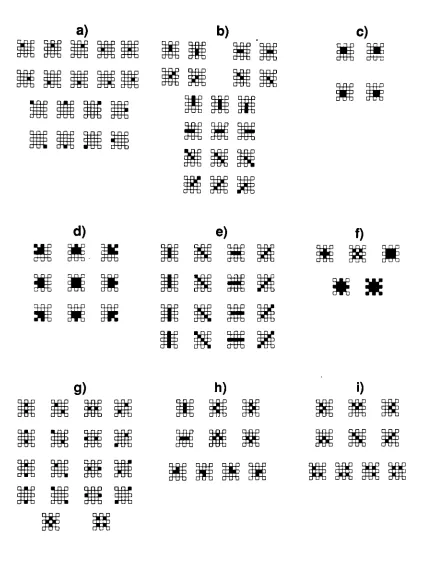
We will now describe the particulars ofa specific expert library. To begin
with, there are9 singleton elements in W3 and 8 in W5
-W3 [Fig. 2(a)]. Each
ofthese representsatranslation:ifB =
{z}isasingleton,then S Q B = S
-z.
Consequently, ifB = {B\, B2, . . .
, Bq} isa collectionofq singletons, Bi
= {zj},
*PB(S) = U{S
Bt} = U{S
-zj= S (- U{Bt})
. (48)
LetLi and L2 denotethesingletons in W3and W5
-W3, respectively. Gi and
G2 denote the collections of translations by pixels in W3 and W5 W3,
respectively. The filtersgeneratedbyGi aredilationsbystructuringelements
in W3, and the filters generated by Gi U G2 are dilations by structuring
elementsin W5.
There are four length-two linear openings: vertical, horizontal, and two
diagonal. These comprise G3. Each possesses a basis consisting of two
elements, the two translates ofthe opening structuring elementthat contain
the origin. These 8 structuring elements comprise L3 and are depicted in the
first two rows of Fig. 2(b). Since any x-opening formed from the length-two
linear-openingstructuringelements isaunionofthe openings,andthereforea
union oferosionsformed from L3,these x-openings aregeneratedbyG3. The4
length-three linear openings comprise G4. Each has a basis with three
elements,andthe 12elements ofL4areshown in thelast fourrows ofFig. 2(b).
Taken together, L3 and L4 generate all x-openings with linear structuring
elements oflengthstwoandthree.
In addition to linear openings, we also desire square openings. Letting
G5 consist of the single 2X2 opening, L5 consists of the 4 structuring
a) c-ft C-3 Cl.-.! c_:"D c::!d it:-3 nr1 P
uLJu CT--3 C..-3 cz-.j czz 3
C--.3
n rn n
c::i:j
lILJu -+P
c:::d cHtd
n I p uLJU
C.Z.t c:::d &-.-3
c np c:::d d-tri
c:::d i":_d
n r1 P J LJu n np :::d nrt-D
m
^'z3 SSS b)M
c.xp cii:d ffff: c) d-U-b d(-n d) e) crai dra ltliuffi
c;i:d i_HJu 11 'i35Hf ci' =* d^ JUL .TJu
f) c:;:d g) c!:jd C.D m---j z:: 3 &T3
H
JULnri p uLJ L
CT1 lib CIIIJ C"."D h) ci! i^ i) c!I!d tl c
is
P c ) cn DP TJip n
r]p n r1 zz, ^i
n
iu J L
in r
J ll J I
]p n r Ju lTL
in nr
] u ib lJLJ b tJL111 dl
nnn
c
tt
uuhu lTHu uDu irlrt
n r1 P i 1
JTJTj
n ri p
[image:54.531.54.477.76.643.2]i i J LTu C .-3
observation window can hold the 9 basis elements for the 3 X 3
opening;
however, here we must contend with the constrained window W5.
Consequently, L6 consists of the 9 elements depicted in Fig. 2(d), these
constituting thebasisofthewindow-constrainedopening.
An erosion structuring element comprises its own single element basis.
Letting G7 consist of the 4 centered length-three linear erosions, L7 is composed ofthe 4 structuring elements shown in the first row ofFig. 2(e). Eachoftheseis a subsetofW3. Lsconsists ofthe 8length-four,noncentered
linear structuring elements shownin the second andthird rows ofFig. 2(e). L9 consists ofthe 4 length-five, centered linear structuring elements in the
lastrow ofFig. 2(e). Gs and G9 are composedofthe erosions corresponding
to L8 and L9,respectively. For both Ls and L9, window constraint plays no
role.
As for nonlinear antiextensive erosions, we consider two classes, the
elements of which are to some extent
"ball-like."
L10 has 3 elements, each
lying in W3, and these are shown in the first row of Fig. 2(f). Ln has 2
elements,eachrequiring W5. Theseareshownin the secondrowofFig. 2(f).
The nextthreesublibraries correspondto hole-fillingerosions,and are of
particular importance for restoring images degraded by salt noise. We call
6_i, 6q, b\, . . . , bq)represents the
structuringelementwith value 6/at(i, 0)
in thegrid,andhavingall otherpixelvalues zero.
Consider closing by B = (1 1). There are two
translates B
-z, z 6 B,
thesebeinggivenbyBand(1 1). Thesingleton set(1)andthe two-pointset
(1 0 1) both lie in KerPF], and it is readily seen that any kernel element
must contain one ofthese. Thus,
Basl^] ={(1),(1 0
1)}, (49)
and,since erosionbythe originistheidentity map,
SB = SU[S(1 0 1)]. (50)
In effect, for a horizontal two-point linear element, the closing maintains S
while filling any inactivated pixel with activated pixels bothto the left and
to theright. In ourterminology,theelement (1 0 1)isahole-filler.
As a second illustration relevant to our study, suppose we consider
closing by a horizontal linear three-point element B. This closing fills
inactivated pixels lying horizontally between two activated pixels and fills
horizontal pixel pairs lying horizontally<